

Submitted:
25 August 2023
Posted:
28 August 2023
You are already at the latest version
Abstract
Abstract: The spectral and dynamic properties of 2,2,6,6-tetramethyl-1-piperidinyloxy (TEMPO)
Keywords:
1-alkanols
; spin probe TEMPO
; ESR
; thermodynamic transitions
; viscosity
; crossover transition
; polarity
; proticity
1. Introduction
In general, the dynamics of glass-forming liquids, i.e., organics and inorganics forming the supercooled liquid by their cooling below the melting temperature, Tm, and finished by a liquid-to-glass transition to a glass below the glass temperature, Tg, is non-monotoneous and exhibits a change at the so-called dynamic crossover temperature, Tcross = TB or TX lying between Tm and Tg [1,2,3,4,5,6,7,8,9,10,11,12]. This dynamic crossover phenomenon between the relatively weakly and strongly changing supercooled liquid dynamics is observed using experimental techniques such as viscosity (VISC) at TB,η or TX [1,2] and dielectric spectroscopy (DS) at TB,DSST [3,4] or TB,DSMG [5] and TB,DSKWW [6] as well as TB,DSSCH [7]. Standardly, the crossover temperatures are determined by fitting the supercooled liquid dynamics using a combination of classic phenomenological expression for viscosity, η, or structural relaxation time, τ, such as the Vogel-Fulcher-Tamman-Hesse (VFTH) equation [1] or using the power law (PL) equation [2]. Lately, a special evaluation method via Stickel‘s temperature-derivative type of analysis or via more general Martinez-Garcia’s apparent enthalpy analysis of the relevant dynamic quantities giving TB,DSST and TB,DSMG, respectively, were proposed [3,4,5]. Another ways of determination of the crossover temperature are based on the onset of increasing broadening of the frequency dispersion of the structural relaxation time distribution and on the change of structural relaxation strenght, Δεα, leading to TB,DSKWW or TB,DSSCH, respectively [6,7]. In the case of the PL eq. with TX [2,9], this expression is rationalized theoretically within the idealized mode coupling theory (I-MCT) of liquid dynamics [11] by derivation of the same form of temperature dependence for viscosity and relaxation time with the so-called critical temperature, Tc ≈ TX.
The crossover transition is very significant feature of the supercoled liquid behavior as it is demonstrated by findings of several empirical correlations of TBorTX with various characteristic temperatures of a variety structural-dynamic phenomena, such as the decoupling or bifurcation of the primary α relaxation and the secondary β process, Tαβ, from DS or dynamic light scattering (DLS) [8]. Moreover, the crossover phenomenon is also reflected by various extrinsic probe techniques, such as FS, ESR and PALS. They revealed the decoupling of translation from rotation of molecular probes and the medium dynamics, at Tdecoup, either for the relatively large fluorescence probes via fluorescence spectroscopy (FS) [13] or decoupling of rotation of the spin probes from the medium dynamics using electron spin resonance (ESR) [14]. Finally, crossover in the supercooled liquid state is also manifested by a bend effect in ortho-positronium lifetime τ3 vs. T dependence as detected by positron annihilation lifetime (PALS). This slope change reflects a change in the free volume expansion at the characteristic PALS temperature Tb1L above Tg in amorphous glass-formers [15]. Evidently, it is increasingly recognised that the dynamic crossover before glass transition temperature plays an essential if not fundamental role in our understanding glass transition phenomenon [9].
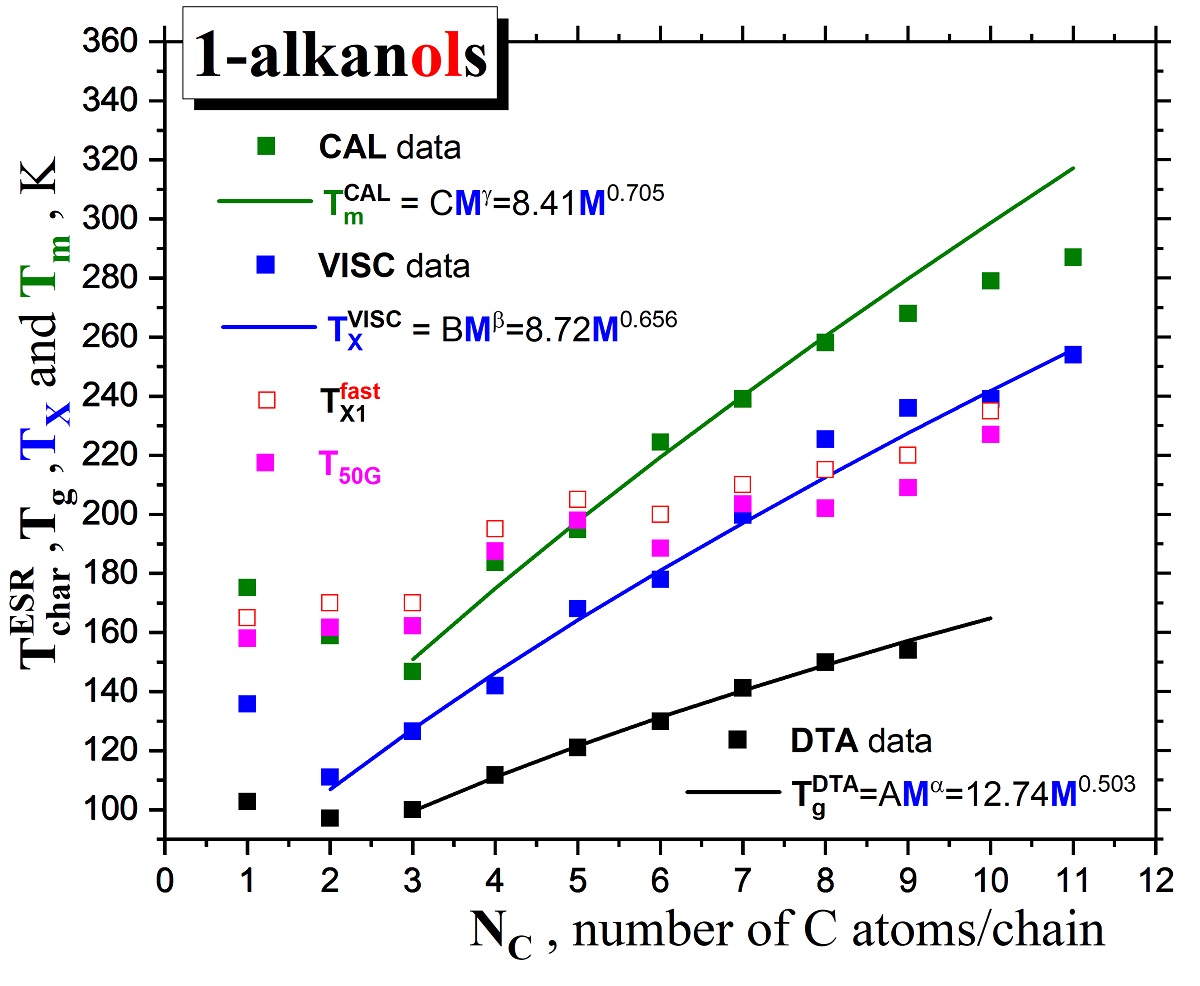
In contrast to the afore-mentioned cases of amorphous glass-formers, observations of the crossover transition in strongly crystallizing, i.e., relatively hardly supercooled apolar and polar organics is substantially more difficult. This is connected with the problem of formation of sufficiently large amorphous domains in the otherwise dominantly ordered material and subsequently, with their characterization by suitable experimental technique. Recently, we have proposed one special method of creation of such amorphous domains in crystalline materials consisting in an introduction of appropriate molecular probe disordering its immediate surroundings of the otherwise ordered medium. This included spin probe (2,2,6,6-tetramethyl piperidin-1-yl)oxyl (TEMPO) with VTEMPOW = 170 Å3 in a series of apolar n-alkanes ranging from n-hexane to n-nonadecane using ESR technique [16]. On the basis of a close correlation between one of the characteristic ESR temperatures, namely, TX1fast, lying a bit above the main slow-to-fast transition at T50G and marking the onset of pure fast motion regime of TEMPO and the crossover temperatures, TXVISC, as obtained from fittings the corresponding viscosity data for a series of n-alkanes using the PL eq., the dynamic crossovers in the local disordered regions around the probe molecules in the otherwise dominantly crystalline organics were detected.
One of the most important aspects of the extrinsic probe techniques, such as ESR is a potential interaction between the used probe and the medium‘s constituents which can in more or less extent influence the corresponding probe response from the investigated organic matrix. In our previous work on a series of apolar crystallizing n-alkanes we used one of the smallest polar spin probe TEMPO where this interaction aspect is supposed to be small [16]. The aim of this work is to test another types of strongly crystallizing organic media consisting of protic polar compounds, such as 1-alkanols with a potential of the intermolecular H-bonding interaction not only between the own polar molecules but also between these polar molecules and polar spin probe TEMPO. The obtained spectral and dynamic data for the TEMPO on the family of aliphatic monohydroxyalcohols or 1-alkanols H(CH2)nOH with NC = 1-10, i.e., ranging from methanol to 1-decanol are interpreted using the newly analyzed viscosity data from the literature in order to reveal roles of the thermodynamic and dynamic transitions as well as of the interaction aspect in the main slow to fast transition behavior of the the used spin probe TEMPO.
2. Results and Discussion
2.1. Thermodynamic and crossover transition behaviors in 1-alkanols
It is well known that 1-alkanols similarly as n-alkanes belong to the class of relatively easily crystalizing organic compounds. For this strong ordering tendency they require special ways of preparation of the totally or partially amorphous samples with one exception of 1-propanol (C3OH) which is a very good glass-former [17].
2.1.1. Thermodynamic transitions in 1-alkanols
Figure 1 and Figure 2 and Table 1 summarize the literary data about three basic thermodynamic transitions of condensed materials, i.e., glass-to-liquid (devitrification) transition of the amorphous phase and solid-to-liquid (melting) transition of the crystalline phase to liquid one as well as liquid-to-gas (evaporation) transition of the liquid phase to gas one. In general, the corresponding transition temperatures, i.e., glass temperature Tg and melting temperature Tm for 1-alkanols exhibit the non-monotoneous character as a function of their molecular size expressed by the number of carbon atoms in the chain, Nc, or molecular weight, M, while the boiling temperature, Tb, shows up the monotoneous type of dependence over the whole molecular size interval. In contrast to the melting with the well-defined Tm values [18], the Tg values measured so far exhibit a scatter up to 10 K which depend on both preparation procedure and measuring technique, such as dynamic-mechanical spectroscopy (DMS), differential thermal analysis (DTA) or differential scanning calorimetry (DSC) and dielectric spectroscopy (DS) [19,20,21,22,23,24,25,26,27,28], apparently diminishing with increasing molecular size. In spite of this fact, the Tg value for the shortest 1-alkanols decreases from methanol (C1OH) to ethanol (C2OH) followed by monotoneous increasing trend starting from C2OH for DMS data [26] or from 1-propanol (C3OH) for CAL ones [17]. As originally proposed by Faucher & Koleske [26], their DMS results could be described by the power law (PL)–type expression as a function of molecular weight M:
where A, α are empirical parameters for a given homologous series of compounds. As seen from Figure 1A, they exhibit similar trend depending relatively strongly on the way of generation of amorphous material and the used set up in DMS or DTA, respectively. The latter values of TgDTA coinciding with TgCAL in cases of lower 1-alkanols, such as ethanol, 1-propanol and 1-butanol studied by special CAL technique, i.e., quasiadiabatic calorimetry (QADC) [17,28] are considered to be more reliable ones mainly because of the experimental complexity of DMS.
Tg = AM α
As for the melting transition of 1-alkanols, the same expression can be approximately used for the melting points:
where C = 8.41 and γ = 0.705 are empirical parameters for the melting of a given homologeous series of compounds as determined mainly from the calorimetric data [18]–Figure 2. Similar approach has been recently applied for n-alkanes and monoalcohols in spite of the very pronounced zig-zag effect for the formers with the similar γ value of 0.7 by Novikov & Rössler [29].
Tm = CM γ
Finally, in Figure 1B the estimated values of glass transition, Tg*, calculated according to the well-known empirical rule for many organic and inorganic glass formers: Tg* = (2/3)Tm [see e.g. Ref. 29–32] are also listed. From their comparison with the measured Tg data from DTA or DMS it follows that this rule is not valid for our series of the first ten 1-alkanols with one exception for C3OH. Alternatively, the measured TmCAL/TgDTA ratios fullfil rather another empirical rule of ~ 1.70 instead of Tm/Tg*= (3/2) = 1.50 valid again for C3OH only–Figure 3.
2.1.2. Dynamic crossovers in 1-alkanols
As mentioned in Introduction, the crossover temperature in the supercooled liquid state of many organic compounds can be obtained using the power law (PL) equation connecting the viscosity of liquids, η, with temperature T in the normal liquid and weakly supercooled liquid states [2,9,16]. Figure 4 and Figure 5 and Table 1 as well as Figure 6 give the results of such a way of determination of the crossover temperature, TX. Thus, Figure 4 presents compilations of the viscosity data for a series of ten 1-alkanols ranging from methanol (C1OH) up to 1-decanol (C10OH) as a function of temperature mostly from the two large summarizing literature sources [33,34]. Most of the viscosity data of 1-alkanols falls into the normal liquid state between the melting temperature, Tm, and the boiling temperature, Tb. For two lower members of this series, namely, ethanol (C2OH) and 1-propanol (C3OH), the viscosities were also measured in the supercooled liquid state below the corresponding Tm’s; sligthly for the former [36] but even almost down to the corresponding Tg for the latter because of its very good glass-forming ability [36,37,38]. All the viscosity data for a serie of the first ten 1-alkanols can be described by the power law (PL) equation:
where, η∞ is the pre-exponential factor, TX is the empirical characteristic dynamic PL temperature or the theoretical critical MCT temperature Tc and μ is a non-universal coefficient. The corresponding fitting curves are plotted in Figure 4 and the obtained crossover temperatures TX are listed in Table 1 and Figure 6. In the afore-mentioned case of 1-alkanols for which the viscosity data also in the supercooled liquid state exist [43], the extracted TX‘s for, e.g., C2OH from fitting over the usual normal liquid state range Tb - Tm = 192 K and over the whole accessible temperature range of 227 K [36] = Tb –Tmin = 227 K, change by 4 K only. Similarly, for very good glass-former C3OH this difference reaches 3 K towards the lower value by including also the strongly supercooled liquid range data from Ref. 36 - see Figure 5A,B. Thus, the PL equation. fit over the normal liquid state only appears to be a very good approximation to obtain the TX‘s lying in the supercooled liquid state below the corresponding Tm’s in strongly crystallizing organics, such as 1-alkanols. These are also listed in Table 1 together with scarce determinations on the first three members, namely, C1OH, C2OH and C3OH by other authors [2,5,9].
It is shown that the PL equation is valid for a large number of organic molecular glass formers over rather higher temperature range [2,5,9] It is also known, the I-MCT works very well also for the relatively lower viscosity regime [11]. In reality, although the viscosity does not diverge at TX ≈ Tc, several analyses of the slightly supercooled and normal liquid dynamics in various organic glass formers in terms of the extended mode coupling theory (E-MCT) which removes this singularity, provide the same crossover temperature in the supercooled liquid phase [11,40]. Thus, the TX parameter marks two distinct regimes of the strongly and weakly supercooled liquid dynamics [11]. In particular, it corresponds to the onset of dynamic heterogeneities, i.e., regions with slower dynamics embedded into regions of higher dynamics, when the decoupling of translation from rotation of the molecular tracers and the decoupling of rotation of the molecular tracer from that of the medium constituents occur and the classic Stokes-Einstein law or Debye-Stokes-Einstein law, respectively, are violated [9,14].
Figure 6 displays the molecular size dependence of the extracted dynamic crossover temperature
TX for 1-alkanols together with its fitting curve of a similar form as
for Tg and Tm. Similarly to the Tg
and Tm quantities, after the initial decrease to the second lowest member the series of nine 1-alkanols
follows the power law formula:
with the β exponent equals 0.656 lying in between those for the glass temperature, Tg(α = 0.503) and melting point, Tm(γ = 0.705).
TX = BM β
Finally, returning to Figure 3, a comparison of TX/Tg vs. Tm/Tg dependencies as a function of molecular mass M starting from C2OH shows diametrally different trend for the former quantity with respect to the latter one, i.e., increasing distance of the particular TX from the respective Tg with the increasing molecular size of 1-alkanol. This finding together with the almost same relative distance of TX from Tm being ca. 0.81xTm indicates that the larger molecule of 1-alkanol the larger temperature range of the existence of the strongly (or deeply) and correspondingly the shorter weakly (slightly) supercooled liquid state. On the other hand, on cooling of the smaller 1-alkanols, the weakly supercooled liquid state persists for longer T range with the correspondingly shorter deeply supercooled liquid range.
2.2. ESR data
2.2.1. General spectral and dynamic features
Figure 7 presents the 2Azz‘ vs. T dependencies for our series of the spin systems: TEMPO/1-alkanols. In all cases, a quasi-sigmoidal courses of these plots are found with the higher 2Azz‘ values in a slow motion regime at relatively lower temperatures and the lower 2Azz‘ ones in a fast motion one in relatively higher temperature region.The main feature of 2Azz‘ vs. T dependencies is a more or less sharp change at the main characteristic ESR temperature T50G , at which the 2Azz‘(T50G) value reaches just 50 Gauss corresponding to the correlation time of the TEMPO in a typical organic medium around a few ns. Note that the detailed spectral simulations of the TEMPO dynamics in several organics, including one of the investigated 1-alkanols, namely, 1-propanol [41], revealed that the spin probe population even at T50G is not completely in the fast motion regime which occurs at a bit higher temperature TX1fast. In addition to these main characteristic ESR temperatures T50G and TX1fast other effects appear at TX1slow,TX2fast a discussion of which goes beyond the scope of this work and therefore it will addressed elsewhere. All the 2Azz’ vs. T plots include also the afore-mentioned thermodynamic and dynamic temperatures: Tg, Tm or TX, respectively. Then the mutual relationships of these three basic characteristic thermodynamic and dynamic temperatures to T50G and TX1fast in a series of 1-alkanols will be discussed below in Section 2.2.2.
In principle, the main slow-to-fast motion transition of the TEMPO in any organics is related not only to these thermodynamic and dynamic transitions but it may also be influenced by further factors, such a potential mutual interaction of a polar spin probe with organic media, especially, polar ones. The values of anisotropic hyperfine constants Azz‘(100 K) at the lowest measured temperature of 100 K and of isotropic ones Aiso(RT) at room temperature are summarized in Table 1. Their dependencies on NC as well as on some relevant bulk property of media such as bulk polarity of media through their dielectric constant, εr, will be discussed in the Sect.2.2.3.
Finally, the mutual connection between temperature parameters of the slow-to-fast transition and the thermodynamic as well as dynamic ones in relation to the polarisation interaction of the polar TEMPO probe with a series of polar 1-alkanols are discussed in Sect.2.2.4.
2.2.2. The mutual relationships of T50G and TX1fast with thermodynamic and dynamic transitions
In Figure 8 global comparisons of the characteristic ESR temperatures T50G and TX1fast with the afore-mentioned thermodynamic and dynamic temperatures Tg, TX and Tm are presented. In all the cases, the slow-to-fast transition in all 1-alkanols occur above the corresponding glass-to-liquid transition Tg’s, i.e., in the amorphous phase liquid sample or in the local amorphous liquid zones of partially crystalline matrices, at least. Figure 9 expresses these comparisons in terms of the corresponding ratios: T50G/Tm, T50G/TX and TX1fast/Tm, TX1fast/TX. We can approximately distinguish two distinct regions of these ratios with a boundary at around C5OH:
low M region: C1OH-C5OH with T50G/Tm ≈1
high M region: C6OH-C10OH with T50G/TX ≈ 1
So, for higher members starting at C6OH to C10OH with a relatively longer aliphatic part we observe a quite plausible closeness between the characteristic ESR temperatures and the TX‘s indicating that the main ESR transition is related to the dynamic crossover between the deeply and slightly supercooled liquid state. This basic finding is similar to the previous one for a series of n-alkanes [16] with the fact that the TX‘s for n-alkanols are higher than the TX‘ ones for the corresponding n-alkanes with the same number of C atoms in the molecule. This difference indicates that the spin probe TEMPO is not fully surrounded by the apolar aliphatic parts of the n-alkanol molecules and that the polar -OH groups influence its dynamics as it will be discussed later in Section 2.2.3. Anyway this indicates that the immediate environment of the molecular-sized spin probe TEMPO is locally disordered and subsequently, sensitive to the crossover transition in this local amorphous phase. On the other hand, for low M members from C1OH to C5OH T50G and TX1fast lie significantly above the corresponding TX values and they are situated rather in the vicinity of the corresponding melting temperatures, Tm. This indicates that the slow- to-fast transition of TEMPO appears to be related to the global disordering process connected with the solid–to-liquid state phase transition in the otherwise partially crystallized samples.
2.2.3. Isotropic and anisotropic hyperfine constants Aiso(RT), Azz‘(100 K) as a function of NC and polarity and proticity of 1-alkanols
Figure 10 displays the anisotropic hyperfine constant, Azz‘(100K) and the isotropic. hyperfine constant, Aiso(RT), of the TEMPO as a function of the chain length in a series of 1-alkanols studied. Our values of Aiso(RT) for TEMPO are quite consistent with the scarce ones obtained for lower members of our series, namely, C1OH-C4OH [42,43,44]. Although both the quantities are decreasing with increasing chain size, a significant difference does exist in the corresponding trends. The former quantity has two clearly regions of distinct behavior: a sharper decreasing trend for low-M members and the weaker one for higher-M ones above NC ~ 4. On the other hand, the Aiso(RT) parameter shows up rather slighter reduction with the number of C atoms in the molecule, NC.
These basic empirical findings can be discussed in relation to polarity of a set of the polar media with the dissolved polar spin probe TEMPO μTEMPO ~ 3D [45] from both the phenomenological and theoretical viewpoints. First, the Aiso(RT) values can be related to various measures of polarity of the medium, e.g., the dipole moment of the medium‘s molecule, μentity,X, as a measure of the polarity of individual entity in a given phase state X = g,l or the static dielectric constant of the medium, εr(RT), as a measure of the polarity of the bulk liquid medium as listed in Table 1. In the first case evidently no any relationship does exist due to the quasi-constant values of the gas-phase μg = 1.66±0.05 D or the liquid-phase μl = 2.84 ± 0.15 D dipole moments [34,35]. On the other hand, Figure 11 displays the mutual relationship between the isotropic hyperfine constant, Aiso(RT), and the dielectric constant, εr(RT), of 1-alkanols [34] together with of the latter quantity at RT as a function of the number of C atoms in chain in insert. Both the quantities decrease with NC resulting into Aiso (RT) vs. εr (RT) relationship with approximately two regions of a distinct behavior: i) for lower polar 1-alkanols (C10OH-C5OH) with εr < ~ 17 with a strong sensitivity of Aiso(RT) to polarity and a weak one to proticity and ii) for higher polar 1-alkanols (C3OH-C1OH) with εr > ~ 17 with weak sensitivity of Aiso(RT) to polarity and stronger to proticity due to the increased population of HO-groups potentially interacting with the spin probe TEMPO molecule. The apparent boundary between both regions occurs at NC = 4-5, i.e., for 1-butanol or 1-pentanol, where the εr(RT) vs. NC(RT) plot changes rather pronouncedly from the sharply decreasing dependence to the slightly decreasing one and where, at the same time, conformational degrees of freedom and related enhanced alignement of the apolar parts of the molecules start to occur. Interestingly, in spite of the absence of εr(100K) data for their direct comparison with Azz‘(100K), the boundary for this quantity seems to be consistent with that for Aiso(RT) suggesting a significant role of polarity and proticity in both the mobility states of the spin probe TEMPO. These findings of a solvent dependence of the different ESR parameters are consistent with the previous ones for Aiso(RT) [46,47] as well as for Azz‘(77 K) [48,49].
This our basic finding is similar to that for another larger nitroxide spin probe 1-oxyl- 2,2,5,5-tetramethyl pyrroline-3-methyl)methanethiosulfonate (MTSSL) in a series of 17 solvents ranging from apolar methylbenzene (toluene) [εr(RT) = 2.4] to highly polar water [εr(RT) = 80.4] and even more polar formamid [εr(RT) = 109] including most of the members of our 1-alkanol series with one expection for 1-pentanol [50]. These authors similarly distinguished the following two regions, i.e., „apolar“ region for εr(RT) < 25, where the sensitivity of Aiso(RT) and Azz‘(77K) to the polarity expressed by εr(RT) is large and „polar“ region for εr(RT) > 25, where the sensitivity of Aiso(RT) and Azz‘(77 K) to the polarity is small and the change is ascribed to the medium proticity.
However, it is evident that this their dividing is rather arbitrary and very rough because the former „apolar“ region include also many of our polar 1-alkanols. In connection with the afore-mention empirical relation between spectral parameters and bulk polarity, more elaborate theoretical approaches based on models of the medium as a dielectric continuum with dielectric constant, εr, and the molecular solute, e.g., polar spin probe as a molecular entity localized in a spherical cavity [47,51] can be discussed. Within the reaction field concept of the polarization of the continuum medium by the polar solute, one obtains for the Onsager‘s reaction field [52] and Böttcher‘s reaction field [53] the following functional relations: Aiso = f[(εr–1)/(εr + 1)] [47] or Aiso = f [(2εr + 1)/(2εr + nD2)], where nD is the refraction index of the pure nitroxide [51], respectively. Figure 12 displays test of the validity of the first functional dependence for two basic groups of organic compounds at RT doped by TEMPO. The first is represented by a series of apolar and aprotic polar solvents which range from apolar benzene (BZ) with εr(RT) = 2.3 to highly polar but aprotic dimethylsulphoxide (DMSO) with εr(RT) = 48.9 as taken from Ref.50. The other group including our series of ten 1-alkanols from methanol with εr(RT) = 33 to 1-decanol with εr(RT) = 7.9 differs significantly from the predicted linear trend due to the specific protic character of the molecules allowing for the H-bond formation between the polar spin probe TEMPO molecule and the alkanol’s one(s). This is quite consistent with the maximal value of Aiso (RT) = 17 Gauss [44] for highly polar and protic water εr(RT) = 80.4 [50]. The relative large difference between water and the first member of alkanol family is on the basis of theoretical calculations using density functional theory (DFT) interpreted in terms of the complexation of nitroxide with two water or one methanol molecules, respectively [45,50]. Moreover, a closer inspection of this group of protic polar compounds confirms a distinguishing a series of 1-alkanols into two subgroups with the distinct slopes of Aiso(RT) as a function of the corresponding dielectric function: i) weaker for the higher members from C10OH to C6OH and ii) stronger for the shorter ones from C5OH to C1OH with the approximate boundary between C5OH and C6OH, i.e., for εr(RT) ~ 16.5. Similar situation can be found for the Böttcher type of reaction field due to a linearity between the respective functional forms. Both these findings appear to be consistent with the purely empirically found boundary at C4OH - C5OH as seen from the Aiso(RT) vs. εr(RT) plot without inclusion of the polarization interaction between the polar solute and the solvent in Figure 11.
2.2.4. Connection of the main slow to fast motion transition of the spin probe TEMPO with the polarity and proticity and the thermodynamic and dynamic transition behavior of 1-alkanols.
In Figure 8 and Figure 9 in Section 2.2.2 we have compared the characteristic ESR temperatures T50G and Tinifast of the slow to fast transition of TEMPO in a series of 1-alkanols with the dynamic crossover TX and thermodynamic transition temperatures Tm, and their mutual ratios as a function of molecular size, NC, of the media. In particular, we revealed rather a step-like change in the main spin probe TEMPO transition from that related by dynamic crossovers at around TX for the longer chains to that related to thermodynamic transitions around Tm for the shorter molecules at NC ~ 5.
Next, in Figure 10, Figure 11 and Figure 12 in Section 2.2.3 we presented the relations of spectral parameters Aiso(RT) and Azz‘(100 K) to NC as well as their phenomenological and theoretical relationships of especially Aiso(RT) to polarity properties for a set of 1-alkanols. Here, we observed a change in the trend of hyperfine interactions with polarity and proticity of 1-alkanol media at NC ~ 4. Now, a combination of these findings indicates that the slow to fast transition in mobility of TEMPO in a series of 1-alkanols is relatively strongly dependent on the strenght of intermolecular interactions between the polar constituents of the polar media as well as between the polar spin probe and the polarity and proticity of the 1-alkanols investigated. In the longer members of the 1-alkanol family with the relatively higher population of the apolar aliphatic methylene groups related to a weakly changing polarity, the slow to fast transition is related mainly to the dynamic crossover process around TX similarly as in the apolar n-alkanes [16]. On the other hand, in the shorter members with the relatively higher dielectric constants and proticity due to the relatively higher population of the polar hydroxyl groups, the larger-scale disorder process connected with the solid-to-liquid phase transition around Tm is needed for destroying not only the dense H-bonding network between the medium’d molecules, but also of clusters of the polar TEMPO molecules with them and subsequently, to the appearance of slow-to-fast transition in mobility of TEMPO. The critical molecular size of 1-alkanol for this step-like change in the slow to fast transition of TEMPO lies at NC ~ 5 below which the polarity and proticity aspects of the media become to be dominanting factors.
3. Experimental
3.1. Materials and Methods
A series of 1-alkanols ranging from methanol to 1-decanol from Sigma-Aldrich, Inc was used as model protic polar media. The reason for our choice of this series stems from the fact that all of the used 1-alkanols are in the liquid state at room temperature because of easy spin probe system preparation. As an extrinsic particle, the spin probe 2,2,6,6-tetramethyl-1-piperidinyloxy (TEMPO) of the quasi-spherical shape and the relative high dipole moment of μTEMPO = 3 D [45] was applied in the deoxygenated 1-alkanols with a very low concentration of ~ 5x10⁻⁴ M.
3.2. ESR
ESR measurements of the very dilute spin systems 1-alkanol/TEMPO were performed on the X-band Bruker–ER 200 SRL spectrometer operating at 9.4 GHz with a Bruker BVT 100 temperature variation controller unit. ESR spectra were recorded after cooling with a rate ~–4 K/min in a heating mode over a wide temperature range from 100 K up to 300 K with steps of 5 - 10 K. To reach the thermal equilibrium, the sample was kept at a given temperature for 10 minutes before starting three spectra accumulations. The temperature stability was ± 0.5 K. The microwave power and the amplitude of the field modulation were optimized to avoid the signal distortion. The ESR spectra were evaluated in terms of the spectral parameter of mobility, 2Azz’(T), i.e.,z-component of the anisotropic tensor of hyperfine interaction A(T), corresponding to the outermost peaks separation of the triplet spectra of the spin probe of nitroxide type in a given medium, as a function of temperature and the subsequent determination of the spectral T50G parameter [50,54]. This is the characteristic ESR temperature at which 2Azz’ reaches the conventional value of 50 Gauss (G). Furthermore, additional characteristic ESR temperatures can be obtained describing in detail the slow to fast regime transition zone over more or less wide temperature interval around T50G as well as in both slow and fast motion regimes: TXislow, TXifast [55,56,57]. In addition to this anisotropic hyperfine splittting parameter, Azz’(100 K), the isotropic hyperfine constants, Aiso(RT) of the spin probe TEMPO as a measure of its interaction with a given medium were determined at room temperature under the fast motion condition in low-viscosity media [50].
4. Conclusions
The spectral and dynamic behaviours of the spin probe TEMPO in a series of 1-alkanols ranging from methanol to 1-decanol over a wide temperature range from 100 K up to 300 K using electron spin resonance (ESR) are reported. For all of alkanols, the main characteristic ESR temperatures connected with the slow to fast motion regime transition, namely, T50′s and TX1fast’s are situated above the corresponding glass temperatures, Tg, and for the first five shorter members T50G‘s lie in the vicinity of melting point, Tm, while for the longer ones the T50G < Tm relationship indicates that the TEMPO molecules are in the local disordered regions of the crystalline media. The TX1fast’s are compared with the dynamic crossover temperatures, parametrized as TXVISC = 8.72M0.66, as obtained by fitting the viscosity data in the liquid n-alkanols with the empirical power law. In particular, for NC = 6-10 TX1fast’s lie rather relatively close to TXVISC as for apolar n-alkanes, while for NC = 1-5 they are situated above the respective TXVISC in the vicinity of Tm. The absence of such a coincidence for lower 1-alkanols indicates that the slow to fast motion transition is significantly influenced by the mutual interaction between the polar TEMPO and the protic polar medium due to the increased polarity and proticity which are destroyed at higher temperatures region connected to the larger-scale solid-to-liquid transition.
Author Contributions
Conceptualization,J.B.; methodology,J.B.; investigation,J.B. and H.Š.; analyses, J.B.and H. Š; data curation, J.B.; writing-original draft preparation, J.B.; writing-review and editing, J.B and H.Š.; visualization, J.B.; project administrationtion, J.B.
Funding
This research was funded by the VEGA, grant number 2/0005/20.
Institutional Review Board Statement
Not applicable.
Informed Consent Statement
Not applicable
Data Availability Statement
Not applicable.
Acknowledgments
The authors thank C. Corsaro for fruitful discussion.
Conflicts of Interest
The authors declare no conflict of interests.
References
- Barlow, A.J.; Lamb, J.; Matheson, A.J. Viscous behavior of supercooled liquids. Proc.Roy.Soc.London,Ser.A 1966, 292, 322–342. [Google Scholar]
- Taborek, P.; Kleinman, R.N.; Bishop, D.J. Power law behavior in the viscosity of supercooled liquids. Phys.Rev.B 1986, 34, 1835–1840. [Google Scholar] [CrossRef]
- Stickel, F.; Fischer, E.W.; Richert, R. Dynamics of glass-forming liquids. I. Temperature-derivative analysis of dielectric relaxation data. J.Chem.Phys. 1995, 102, 6251–6257. [Google Scholar] [CrossRef]
- Stickel, F.; Fischer, E.W.; Richert, R. Dynamics of glass-forming liquids. II. Detailed comparison of dielectric relaxation, dc-conductivity and viscosity data. J.Chem.Phys. 1996, 104, 2043–2055. [Google Scholar] [CrossRef]
- Martinez-Garcia, J.C.; Martinez-Garcia, J.; Rzoska, S.; Huellinger, J. The new insight into dynamic crossover in glass forming liquids from the apparent enthalpy analysis. J.Chem.Phys. 2012, 137, 064501-8. [Google Scholar] [CrossRef]
- a. Leon, L.; Ngai, K.L. Rapidity of the Change of the Kohlrausch Exponent of the α-Relaxation of Glass-Forming Liquids at TB or Tβ and Consequence. J.Phys.Chem. B 1999, 103, 4045–4051; b. Ngai, K.L.; Roland, C.M. Development of cooperativity in the local segmental dynamics of poly(vinylacetate): synergy of thermodynamics and intermolecular coupling. Polymer 2002, 43, 567–573.
- Schönhals, A. Evidence for a universal crossover behavior of the dynamic glass transition. Europhys. Lett. 2001, 56, 815–521. [Google Scholar] [CrossRef]
- a. Johari, G.P.; Goldstein, M. Viscous Liquids and the Glass Transition. II. Secondary Relaxations in Glasses of Rigid Molecules. J. Chem.Phys. 1970, 53, 2372–2388; b. Beiner, M.; Huth, H.; Schröter, K. Crossover region of dynamic glass transition: general trends and individual aspects, J. Non-Cryst.Solids 2001, 279, 126–135; c. Mallamace, F.; Corsaro, C.; Leone,N.; Villari, V.; Micali, N.; Chen, S.H. On the ergodicity of supercooled molecular glass-forming liquids at the dynamic arrest: ortho-terphenyl case. Sci.Rep. 2014, 4, 3747.
- Mallamace, F.; Branca, C.; Corsaro, C.; Leone, N.; Spooren, J.; Chen, S.H.; Stanley, H.E. Transport properties of glass-forming liquids suggest that dynamic crossover temperature is as important as the glass transition temperature. Proc.Natl.Acad.Sci.U.S.A. 2010, 107, 22457–22462. [Google Scholar] [CrossRef]
- a. Roland, C.M. Characteristic relaxation times and their invariance to thermodynamic conditions. Soft Matter 2008,4,2316-2322; b. Roland, C.M. Relaxation Phenomena in Vitrifying Polymers and Molecular Liquids. Macromolecules 2010, 43, 7875–7890.
- Götze, W.; Sjögren, L. Relaxation processes in supercooled liquids, Rep.Progr.Phys., 1992, 55, 241–376; b. Götze, W. Recent tests of the mode-coupling theory for glassy dynamics. J.Phys.-Cond.Matter, 1999, 11, A1–A45; c. Götze, W. Complex Dynamics of Glass-Forming Liquids,:A mode coupling theory, Oxford Univ.Press, Oxford, 2009.
- Novikov, V.N.; Sokolov, A.P. Universality of the dynamic crossover in glass-forming liquids: A ‘‘magic’’ relaxation time. Phys. Rev.E 2003, 67, 031507. [Google Scholar] [CrossRef]
- a. Hyde, P.D.; Evert, T.E.; Cicerone, M.T.; Ediger, M.D. Rotational motion of molecular probes in orto-terphenyl and cis-poly-isoprene, J Non-Cryst.Solids 1991, 131-133, 42-47; b. Ediger, M.D. Spatially Heterogeneous Dynamics in Supercooled liquids. Annu. Rev.Phys.Chem. 2000, 51, 99–128.1, Todd E. 14. a. Andreozzi, L.; Schinoy, A.D.; Giordano, M.; Leporini, D. A study of the Debye–Stokes–Einstein law in supercooled fluids J. Phys.-Cond.Matter 1996, 8, 9605–9608; b. Andreozzi, L.;Faetti, M.; Giordano, M. Fractional Debye-Stokes-Einstein law and scaling of the rotational relaxation in molecular glass formers: linear and non-linear ESR studies. Rec.Res.Devel.Phys.Chem. 2001, 5, 219–254; c. Andreozzi, L.; Faetti, M.; Giordano, M.; Zulli, F. Length Scales and Dynamics in the Reorientational Relaxation of Tracers in molecular and Polymeric Glass Formers via ESR. J.Phys.Chem.B 2010, 114, 12833–12839.
- a. Bartoš, J.; Šauša, O.; Bandžuch, P.; Zrubcová, J.; Krištiak, J. Free volume factor in supercooled liquid dynamics .J. Non-Cryst. Solids 2002, 307–310, 417–425. b. Bartoš, J.; Šauša, O.; Krištiak, J.; Blochowicz, T.; Rössler, E. Free-volume microstructure of glycerol and its supercooled liquid-state dynamics. J.Phys.-Cond.Matter 2001,13, 11473–11484.
- Bartoš, J.; Corsaro, C.; Mallamace, D.; Švajdlenková, H.; Lukešová, M. ESR evidence of the dynamic crossover in the supercooled liquid states of a series of solid n-alkanes. Phys.Chem.Chem.Phys. 2018, 20, 11145–11151. [Google Scholar] [CrossRef]
- Ramos, M.A.; Talon, C.; Jimenez-Riobóo, R.J.; Vieira, S. Low-temperature specific heat of structural and orientational glasses of simple alcohols. J. Phys.-Cond.Matter 2003, 15, S1007. [Google Scholar] [CrossRef]
- Available online: http://webbooknistgov/chemistry/.
- Illers, K.H. Innere Rotationen in Festkörpern aus hoch- und niedrigmolekularen organischen Molekülen. Rheol. Acta 1964, 3, 183–193. [Google Scholar] [CrossRef]
- a. Faucher, J.A.; Koleske, J.V. Glass Transitions of Organic Compounds. 1.Lower Aliphatic Alcohols, Phys. Chem. Glasses 1966, 7, 202–208; b. Koleske, J.V.; Faucher, J.A. Glass Transitions of Organic Compounds. 2.Linear Aliphatic Alcohols, Phys.Chem. Glasses, 1974, 15, 65–67.
- Sugisaki, H.; Suga, H.; Seki, S. Calorimetric Study of the Glassy state.III. Novel Type Calorimeter for Study of Glassy State and heat Capacity of Glassy Methanol. Bull.Chem.Soc.Jpn. 1968, 41, 2586–2591. [Google Scholar] [CrossRef]
- Lesikar, A.V. On the self-association of the normal alcohols and the glass transition in alcohol-alcohol solutions. J.Solut.Chem. 1977, 6, 81–93. [Google Scholar] [CrossRef]
- Carpenter, M.R.; Davis, D.B.; Matheson, A.J. Measurement of the Glass Transition Temperature of Simple Liquids. J.Chem.Phys. 1967, 48, 2451–2454. [Google Scholar] [CrossRef]
- Haida, O.; Suga, H.; Seki, S. Calorimetric study of the glassy state XII. Plural glass transition phenomena of ethanol. J.Chem. Thermodyn. 1977, 9, 1133–1148; b. Brand, R.; Lunkenheimer, P.; Schneider, U.; Loidl,A. Excess wing in the dielectric loss of glass-forming ethanol: A relaxation process Phys.Rev. B 2000, 62, 8878–8883.
- Murthy, S.S.N. Experimental study of dielectric relaxation in supercooled alcohols and polyols. Mol.Phys. 1996, 97, 691–709. [Google Scholar] [CrossRef]
- Koleske, J.V.; Faucher, J.A. Glass Transitions of Organic Compounds. III. Cellulose Substrate Technique and Aliphatic Alcohols. Polym.Engn.Sci. 1979, 19, 716–721. [Google Scholar] [CrossRef]
- a. El Goresy,T.; Böhmer, B. Diluting the hydrogen bonds in viscous solutions of n-butanol with n-bromobutane: A dielectric study. J.Chem. Phys. 2008, 28, 154520 ; b. Bartoš, J.; Šauša, O.; Vyroubalová, M.; Maťko, I. Švajdlenková,H. Confined effects on Structural isomers in the MCM-41-SIL Matrix as Seen by extrinsic probes via PALS and ESR“ n-Butanol vs. tert-Butanol J.Phys. Chem. C 2021, 125, 15796–15811.
- Hassaine, M.; Jimenez-Rioboo, R.J.; Ramos, M.A.; Sharapova, I.V.; Koroyluk, O.A.; Krivchikov, A.I. Thermal properties and Brillouin scattering study of glass, crystal and „glacial“ state in n-butanol. J.Chem.Phys. 2009, 131, 174508. [Google Scholar] [CrossRef]
- Novikov, V.N.; Rössler, E.A. Correlation between glass transition temperature and molecular mass in non-polymeric and polymer glass formers. Polymer 2013, 54, 6987–699113. [Google Scholar] [CrossRef]
- Kauzmann, W. The nature of the glassy state and the behavior of liquids at low temperature. Chem.Rev. 1948, 43, 219–256. [Google Scholar] [CrossRef]
- Boyer, R. The relation of transition temperatures to chemical structure in high polymers. Rubber Chem.Technol. 1963, 36, 1303–1421. [Google Scholar] [CrossRef]
- Sakka, S.; McKenzie, J.D. Relation between apparent glass transition temperature and liquidus temperature for inorganic glasses. J. Non-Cryst. Solids 1971, 6, 145–162. [Google Scholar] [CrossRef]
- Landolt-Börnstein - Group IV Physical Chemistry, Pure Organic Liquids, Subvolume B ‘Pure Organic Liquids’ of Volume 18 Viscosity of Pure Organic Liquids and Binary Liquid Mixtures’ of Landolt-Börnstein - Group IV Physical Chemistry.
- R. Rowley, DIPPR Data Compilation of Pure Chemical Properties, Design Institute for Physical Properties, 2010 (Ref Type: Electronic Citation).
- Barrera, M.C.; Jorge, M. A Polarization-Consistent Model for Alcohols to Predict Solvatation Free Energies. J.Chem.Info & Modelling 2020, 60, 1352–1367. [Google Scholar]
- Tamman, G.; Hesse, W.Z. Die Abhängigkeit der Viskosität von der Temperatur die unterkühlten Flüssigkeiten. Zeitsch.Anorg. Allgem.Chem. 1926, 156, 245–257. [Google Scholar] [CrossRef]
- Denney, D.J. Viscosities of some undercooled liquid alkylhalides. J.Chem.Phys. 1959, 30, 159–162. [Google Scholar] [CrossRef]
- Campbell Ling, A.A.C.; Willard, J.E. Viscosities of some organic glasses used as trapping matrixes. J.Phys.Chem. 1968, 72, 1918–1923. [Google Scholar] [CrossRef]
- Mitsukuri, S.; Tonomura, T. Proc. Imper Academy of Japan 1927, 3, 155 and 1929, 5, 23.
- Krakoviack, V.; Alba-Simionesco, C.; Krauzman, M. Study of the depolarized light scattering spectra of supercooled liquids by a simple mode-coupling model. J.Chem.Phys. 1997, 107, 3417–3427. [Google Scholar] [CrossRef]
- Bartoš, J.; Švajdlenková, H.; Šauša, O.; Lukešová, M.; Ehlers, D.; Michl, M.; Lunkenheimer, P.; Loidl, A. Molecular probe dynamics and free volume in organic glass-formers and their relationships to structural relaxation:1-propanol. J.Phys.-Cond.Matt 2016, 28, 015101. [Google Scholar] [CrossRef]
- Dodd, G.H.; Barratt, M.D.; Rayner, L. Spin probes for binding site polarity. FEBS 1970, 8, 286–288. [Google Scholar] [CrossRef] [PubMed]
- Jolicoeur, C.; Friedman, H.L. Hydrophobic nitroxide radicals as probes to investigate the hydrophobic interaction. J.Sol. Chem. 1974, 3, 15–43. [Google Scholar] [CrossRef]
- Al-Bala, R.D. Bates, Jr. R.D. Medium Effects on ESR Spectra in Studies of Hydrogen-Bonded Transient Solvent-Solute Complexes. J.Magn.Res. 1987, 73, 78–89. [Google Scholar] [CrossRef]
- Laleveé, J.; Allonas, X.; Jacques, P. Electronic distribution and solvatochromism of investigation a model radical 2,2,6,6-tetramethyl piperidine N – oxyl: TEMPO through TD-DFT calculation including PCM solvatation. J.Mol.Struct.Theochem. 2006, 767, 143–147. [Google Scholar] [CrossRef]
- Kawamura, T.; Matsunami, S.; Yonezawa, T. Solvent Effects on the g-value of Di-t-butyl Nitric oxide. Bull.Chem.Soc.Jpn. 1967, 40, 1111–1115. [Google Scholar] [CrossRef]
- Griffith, O.H.; Dehlinger, P.J.; Van, S.P. Shape of the Hydrophobic Barrier of Phospholipid Bilayers (Evidence for Water Penetration in Biological Membranes). J.Membrane Biol. 1974, 15, 159–192. [Google Scholar] [CrossRef]
- Krinichnyi, V.I.; Grinberg, O.Y., Bogatyrenko, V.R.; Likhtenshtein, G.I.; Lebedev, Y.S. Biophysics 1985, 30, 233.
- Ondar, M.A.; Grinberg, O.Y.; Dubinskii, A.A.; Lebedev, Y.S. Sov.J.Chem.Phys. 1985, 3, 781.
- Owenius, R.; Engström, M.R.; Lindgren, M. Influence of Solventr Polarity and Hydrogen Bonding on the EPR parameters of a Nitroxide Spin label Studied by 9-GHZ and 95-GHz EPR Spectroscopy and DFT calculations. J.Phys.Chem. 2001, 105, 10967–10977. [Google Scholar] [CrossRef]
- Seelig, J.; Limacher, H.; Bader, P. Molecular Architecture of Liquid Crystalline Bilayer. J.Amer.Chem Soc. 1972, 94, 6364–6371. [Google Scholar] [CrossRef]
- Onsanger, L. Electric Moments of Molecules in Liquids. J.Amer.Chem.Soc. 1936, 58, 1486–1493. [Google Scholar] [CrossRef]
- Böttcher, C.J.F. Theory of Electric Polarisation; Elsevier: New York, N. Y., Amsterdam, 1952; p. 70.
- Rabold, G.P.; Spin-Probe Studies.II. Applications to Polymer Characterization. J.Polym.Sci. A 1969, 7, 1203–1223. [Google Scholar] [CrossRef]
- Bartoš, J.; Švajdlenková, H.; Zaleski, R.; Edelmann, M.; Lukešová, M. Spin probe dynamics in relation to free volume in crystalline organics by means of ESR and PALS: n-Hexadecane. Physica B Cond.Mat. 2013, 430, 99–105. [Google Scholar] [CrossRef]
- Švajdlenková, H.; Iskrová, M.; Šauša, O.; Dlubek, G.; Krištiak, J.; Bartoš, J. The Spin probe Dynamics and the Free Volume in a series of Amorphous Polymer Glass-Formers. Macromol.Symp. 2011, 305, 108–115. [Google Scholar] [CrossRef]
- Švajdlenková, H.; Arrese-Igor, S.; Nógellová, Z.; Alegría, A.; Bartoš, J. Molecular dynamic heterogeneity in relation to free volume and relaxation dynamics in organic glass-formers: oligomeric cis-1,4-poly(isoprene). Phys.Chem.Chem.Phys. 2017, 19, 15215–15226. [Google Scholar] [CrossRef] [PubMed]
Figure 1.
A.Glass-to-liquid temperature Tg of 1-alkanols as a function of the molecular size expressed by the number of carbon atoms in the chain NC. Two fits of the Tg’s from DMS [20,26] and DTA data sets [22] via the PL equation of form: Tg = AM α are included, B. Comparison of the TgDTA values with the empirical rule: Tg* = (2/3) Tm.
Figure 1.
A.Glass-to-liquid temperature Tg of 1-alkanols as a function of the molecular size expressed by the number of carbon atoms in the chain NC. Two fits of the Tg’s from DMS [20,26] and DTA data sets [22] via the PL equation of form: Tg = AM α are included, B. Comparison of the TgDTA values with the empirical rule: Tg* = (2/3) Tm.
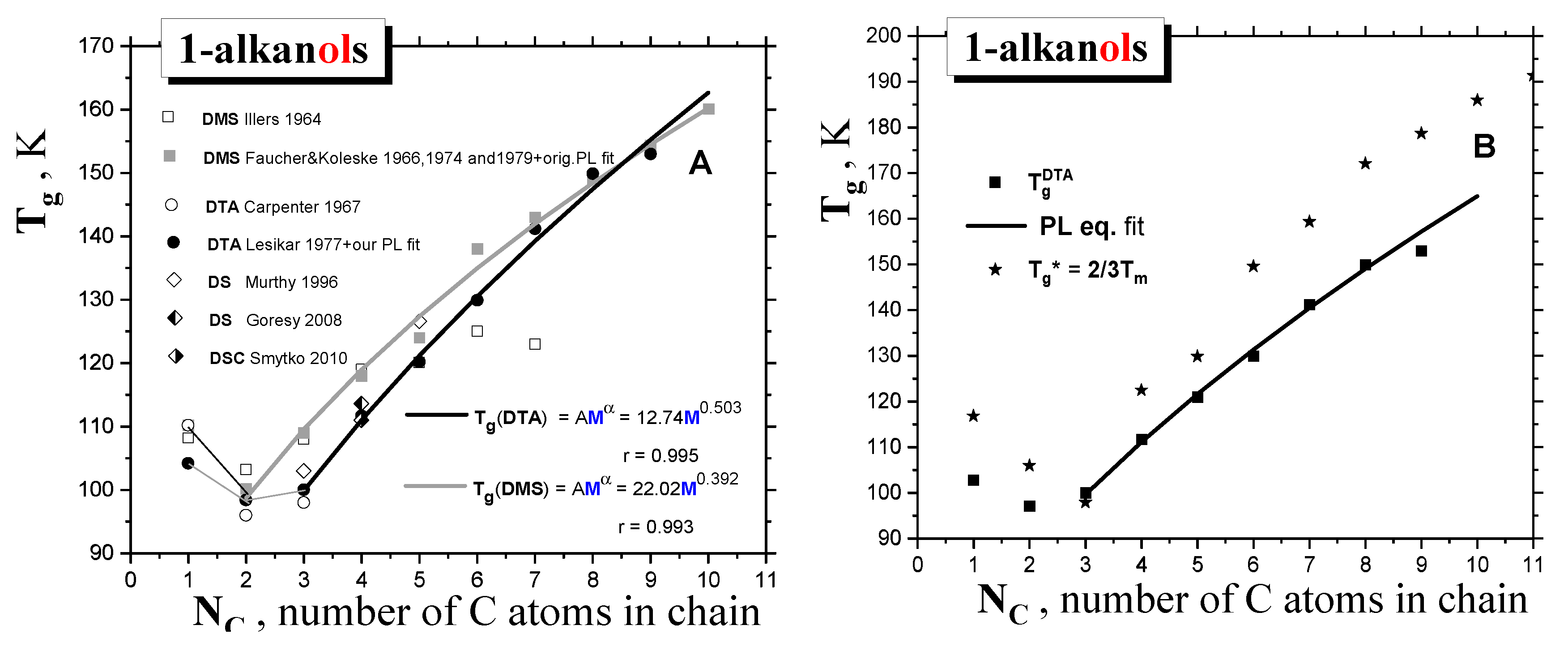
Figure 2.
Melting temperature Tm of 1-alkanols as a function of the molecular size expressed by the number of carbon atoms in the chain NC. Fit of the Tm‘s from CAL data set from Ref.18 via the PL equation: Tm = CM γ is included.
Figure 2.
Melting temperature Tm of 1-alkanols as a function of the molecular size expressed by the number of carbon atoms in the chain NC. Fit of the Tm‘s from CAL data set from Ref.18 via the PL equation: Tm = CM γ is included.
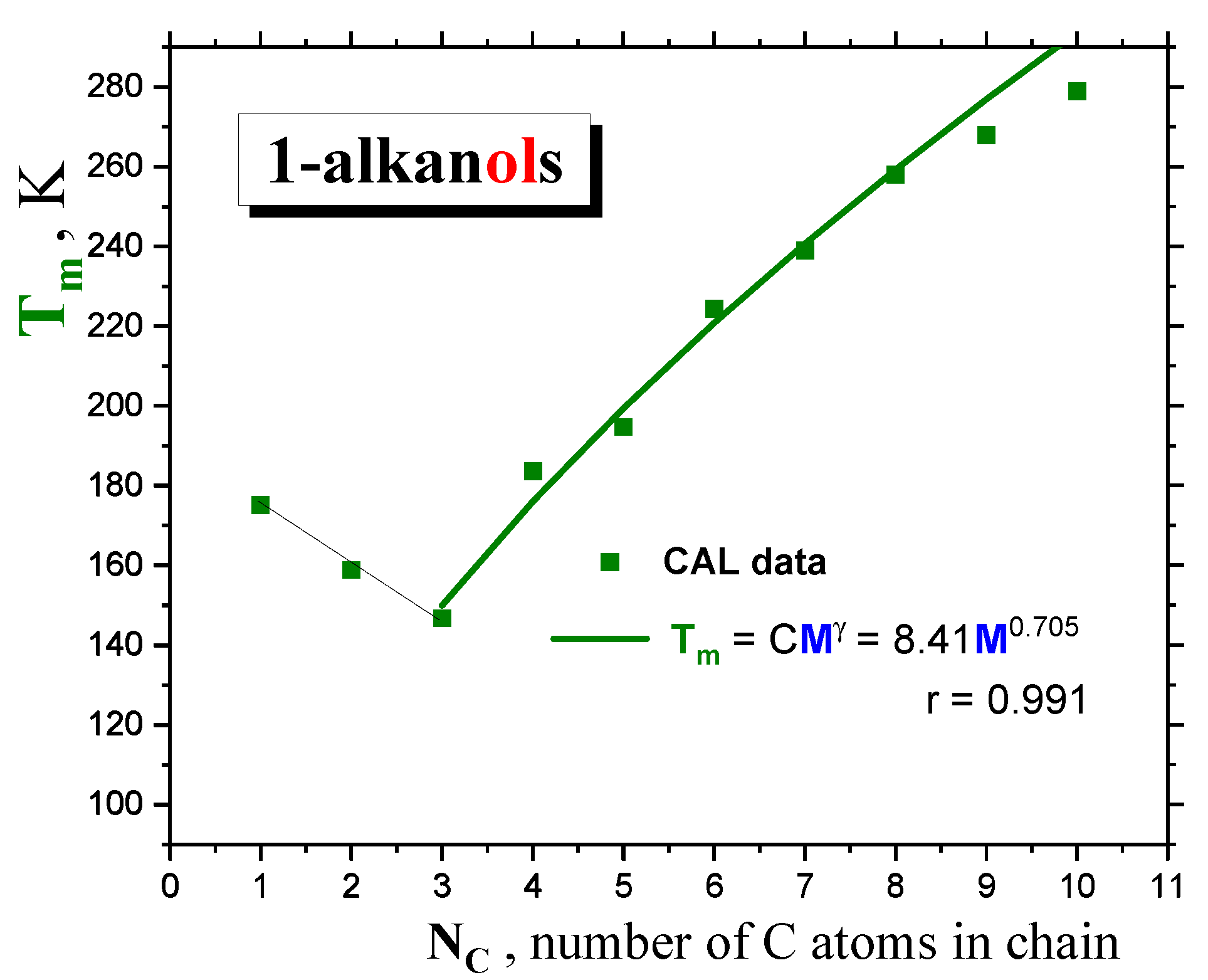
Figure 3.
The Tm/Tg and TX/Tg as well as Tm/ TX ratios of 1-alkanols as a function of the molecular size expressed by the number of carbon atom in the chain NC. In the case of Tm, the full horizontal lines represent the constant value of Tm/Tg = 1.5 from the empirical rule and dotted line with Tm/Tg ~ 1.68 for our series of 1-alkanols, whereas in the case TX with one exception for C1OH increasing linear trend of TX/Tg is found. Finally, TX/Tm ~ 0.81.
Figure 3.
The Tm/Tg and TX/Tg as well as Tm/ TX ratios of 1-alkanols as a function of the molecular size expressed by the number of carbon atom in the chain NC. In the case of Tm, the full horizontal lines represent the constant value of Tm/Tg = 1.5 from the empirical rule and dotted line with Tm/Tg ~ 1.68 for our series of 1-alkanols, whereas in the case TX with one exception for C1OH increasing linear trend of TX/Tg is found. Finally, TX/Tm ~ 0.81.
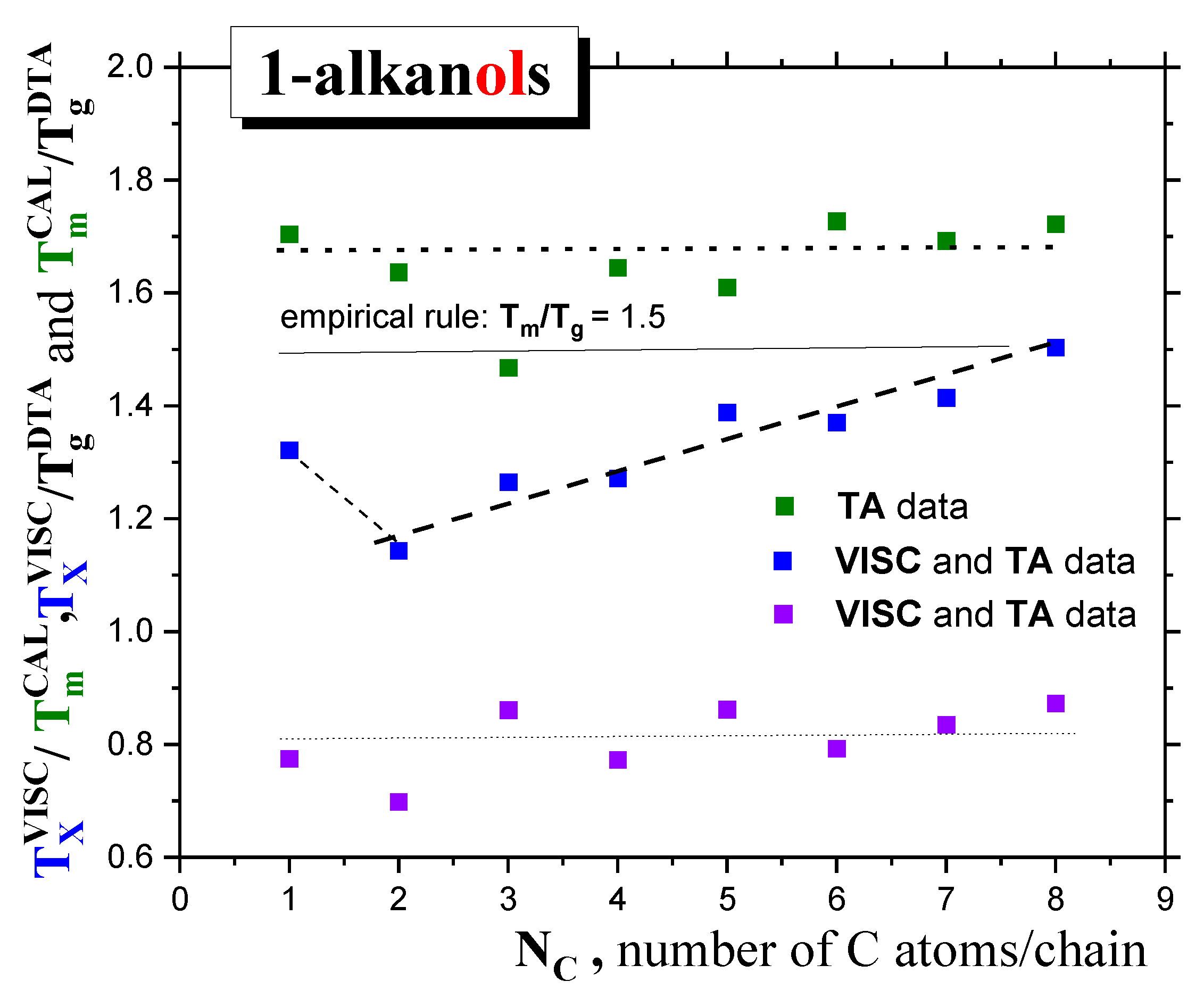
Figure 4.
Viscosities for a series of 1-alkanols as a function of temperature together with the respective power law (PL) equation (3) fits. The vertical lines in the same colors as the corresponding experimental points for each member of a series of 1-alkanols mark the melting temperatures (on left) and the boiling points (on right) with two extrema demonstrations for methanol (black points and lines) and 1-decanol (orange points and lines).Trends in Tm’s and Tb’s show two arrows at bottom of the plot.
Figure 4.
Viscosities for a series of 1-alkanols as a function of temperature together with the respective power law (PL) equation (3) fits. The vertical lines in the same colors as the corresponding experimental points for each member of a series of 1-alkanols mark the melting temperatures (on left) and the boiling points (on right) with two extrema demonstrations for methanol (black points and lines) and 1-decanol (orange points and lines).Trends in Tm’s and Tb’s show two arrows at bottom of the plot.
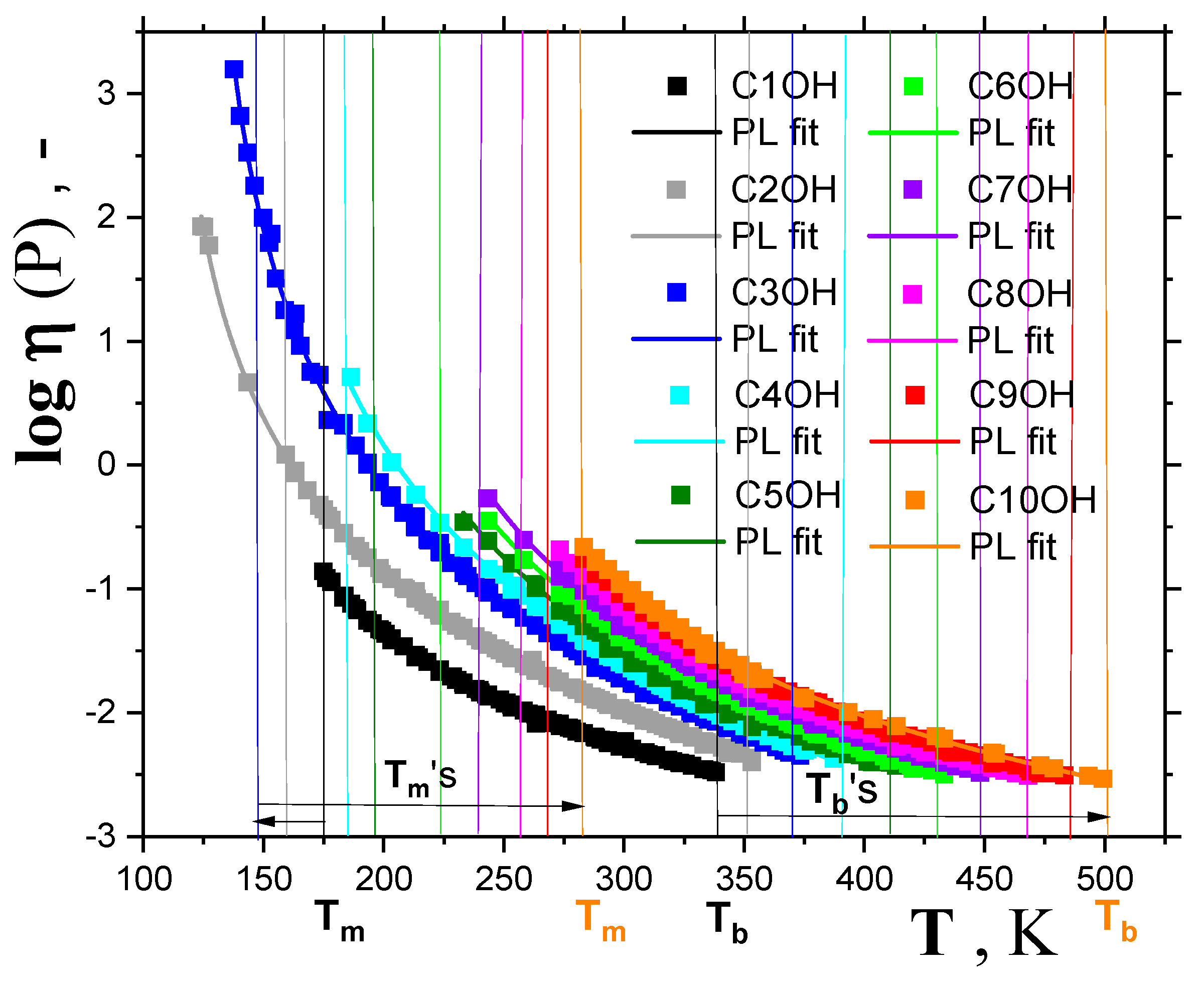
Figure 5.
Viscosity of a good glass-former 1-propanol over (A) restricted temperature range from Tb down to sligtly below Tm using the data sets summared in Refs.33 (Landolt-Börnstein Table data) and Ref. 34 (DIPPR data) and (B) an extraordinary wide temperature range from Tb down almost to Tg with the additionally included data from Refs.36-38 in the strongly supercooled liquid state as well as from Ref.39 in the liquid one together with the best PL equation fit.The original references marked such as 1891T1, 26M2,.can be found in Ref.33.
Figure 5.
Viscosity of a good glass-former 1-propanol over (A) restricted temperature range from Tb down to sligtly below Tm using the data sets summared in Refs.33 (Landolt-Börnstein Table data) and Ref. 34 (DIPPR data) and (B) an extraordinary wide temperature range from Tb down almost to Tg with the additionally included data from Refs.36-38 in the strongly supercooled liquid state as well as from Ref.39 in the liquid one together with the best PL equation fit.The original references marked such as 1891T1, 26M2,.can be found in Ref.33.
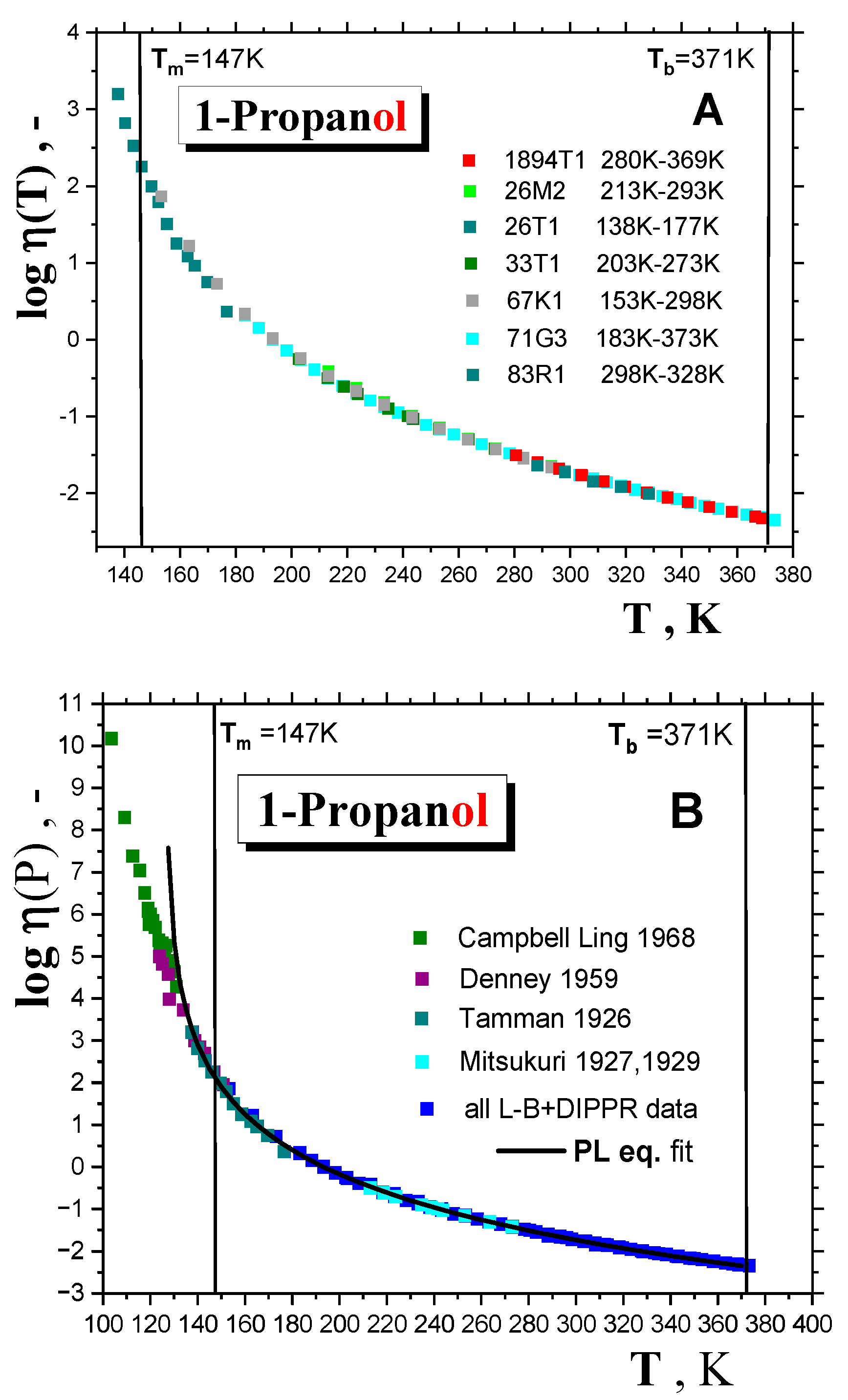
Figure 6.
Dynamic crossover temperature TX of 1-alkanols as a function of the molecular size expressed by the number of carbon atoms in the chain NC. Fit of the TX’s from VISC data via the PL equation of form: TX = BM β is included.
Figure 6.
Dynamic crossover temperature TX of 1-alkanols as a function of the molecular size expressed by the number of carbon atoms in the chain NC. Fit of the TX’s from VISC data via the PL equation of form: TX = BM β is included.
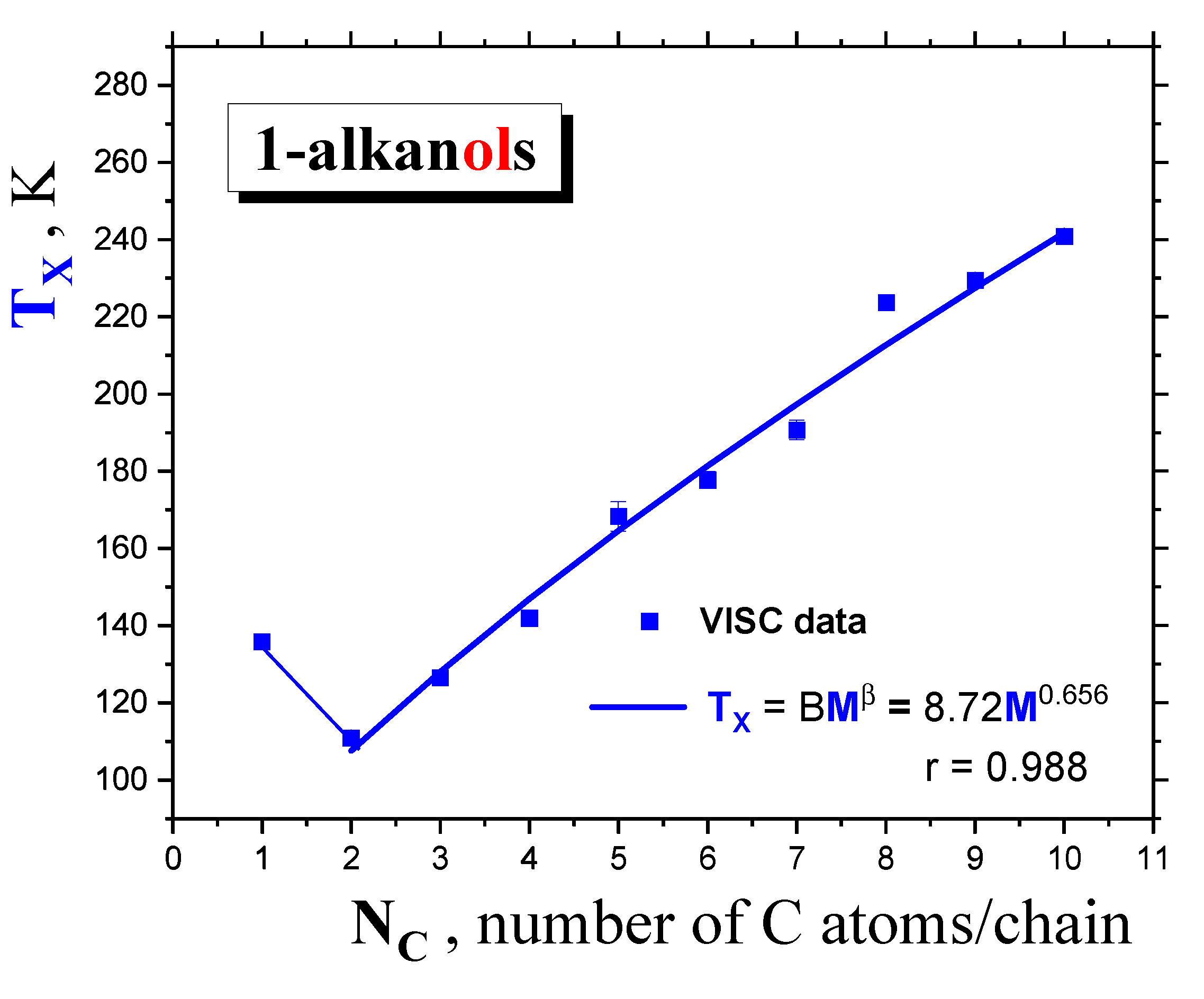
Figure 7.
Spectral parameter 2Azz‘ for a series of 1-alkanols as a function of temperature. The characteristic ESR temperatures TXislow, T50G and TXifast are marked and their mutual relationships with the thermodynamic temperatures TgDTA and Tm and dynamic one TX depicted by black, olive and blue color lines are discussed in the text in detail.
Figure 7.
Spectral parameter 2Azz‘ for a series of 1-alkanols as a function of temperature. The characteristic ESR temperatures TXislow, T50G and TXifast are marked and their mutual relationships with the thermodynamic temperatures TgDTA and Tm and dynamic one TX depicted by black, olive and blue color lines are discussed in the text in detail.
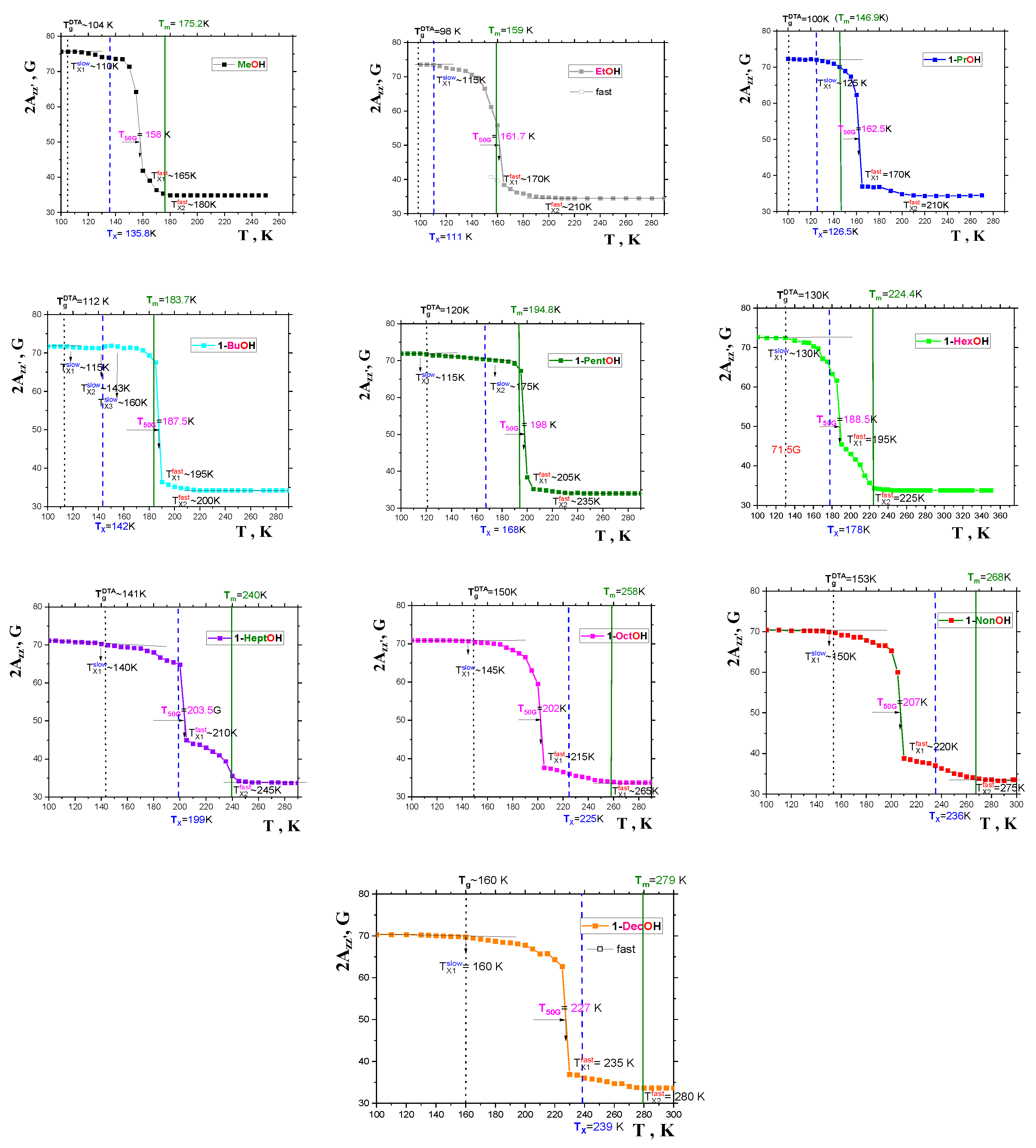
Figure 8.
Comparison of the characteristic ESR temperatures T50G and TX1fast with the thermodynamic and dynamic temperatures TgDTA, TX and Tm together with their corresponding PL fits.
Figure 8.
Comparison of the characteristic ESR temperatures T50G and TX1fast with the thermodynamic and dynamic temperatures TgDTA, TX and Tm together with their corresponding PL fits.

Figure 9.
Comparison of the ratios of the characteristic ESR temperatures T50G and TX1fast with the dynamic and thermodynamic temperatures TX or Tm, respectively.
Figure 9.
Comparison of the ratios of the characteristic ESR temperatures T50G and TX1fast with the dynamic and thermodynamic temperatures TX or Tm, respectively.
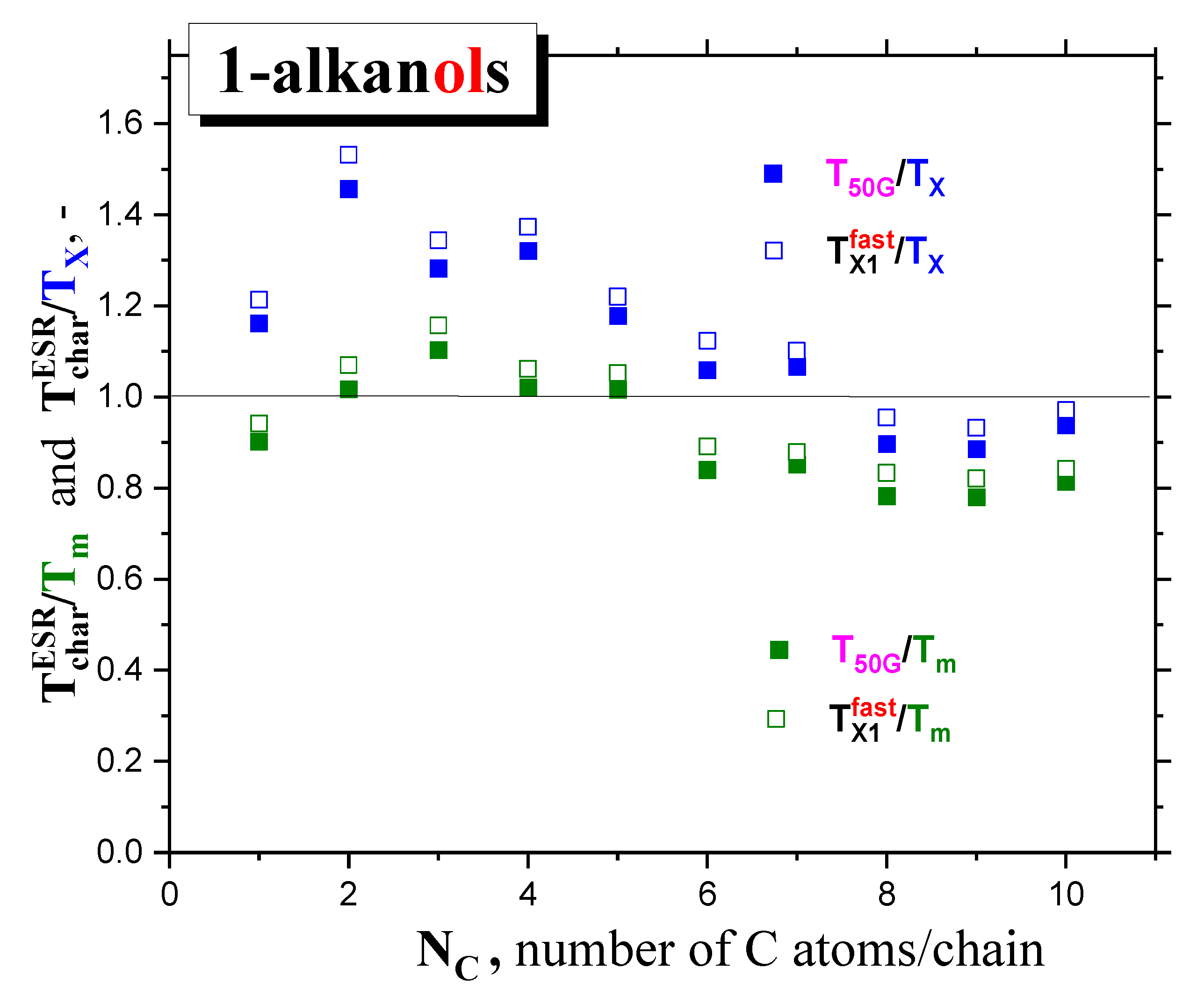
Figure 10.
Hyperfine constants of TEMPO Azz‘(100 K) and Aiso(RT) in a series of ten 1-alkanols as a function of NC.
Figure 10.
Hyperfine constants of TEMPO Azz‘(100 K) and Aiso(RT) in a series of ten 1-alkanols as a function of NC.
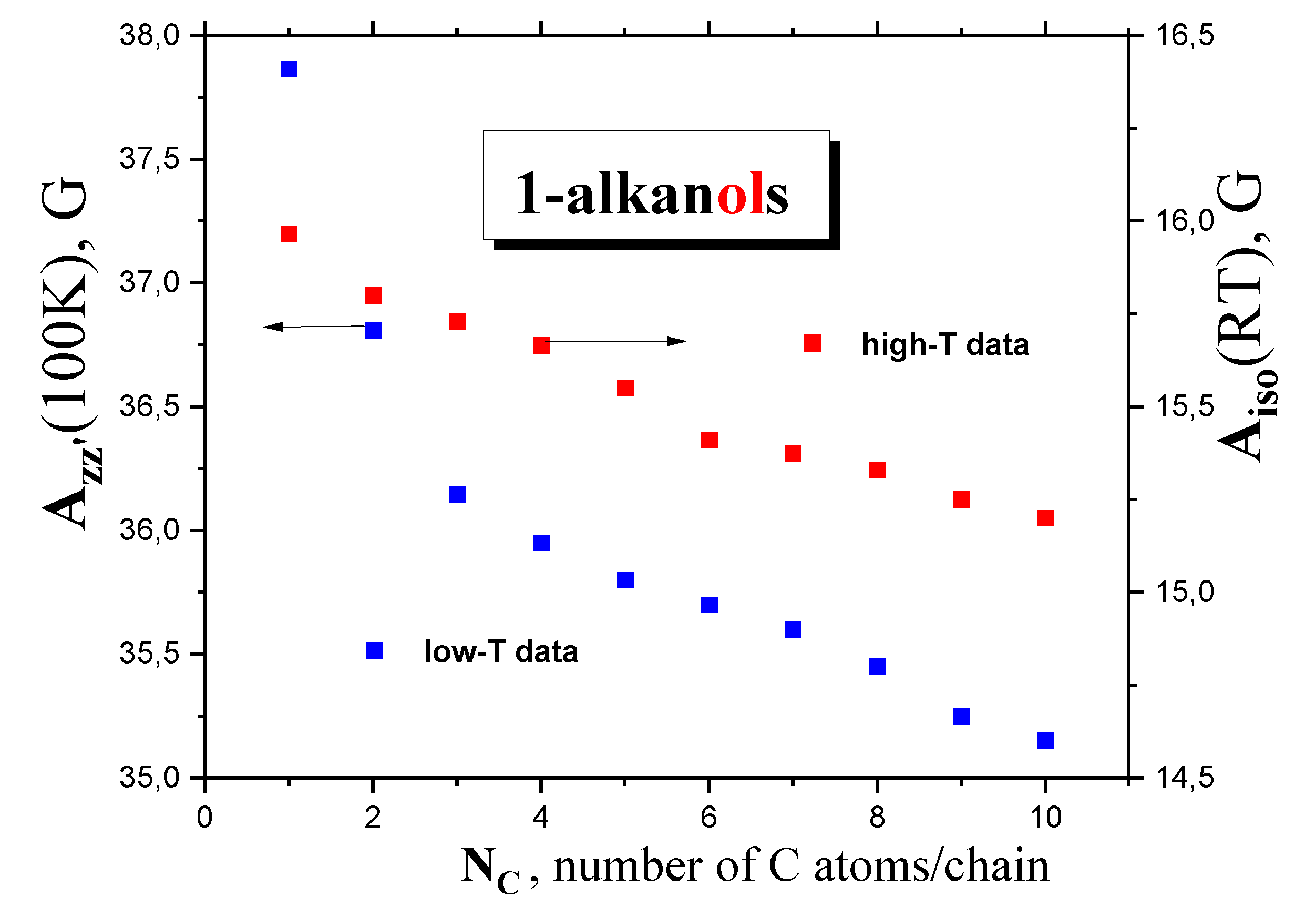
Figure 11.
Empirical relationship between the isotropic hyperfine constant, Aiso(RT), and the relative permitivity, εr(RT), of 1-alkanols. Insert contains the latter quantity at RT from Table 1 as a function of the number of C atoms in chain.
Figure 11.
Empirical relationship between the isotropic hyperfine constant, Aiso(RT), and the relative permitivity, εr(RT), of 1-alkanols. Insert contains the latter quantity at RT from Table 1 as a function of the number of C atoms in chain.
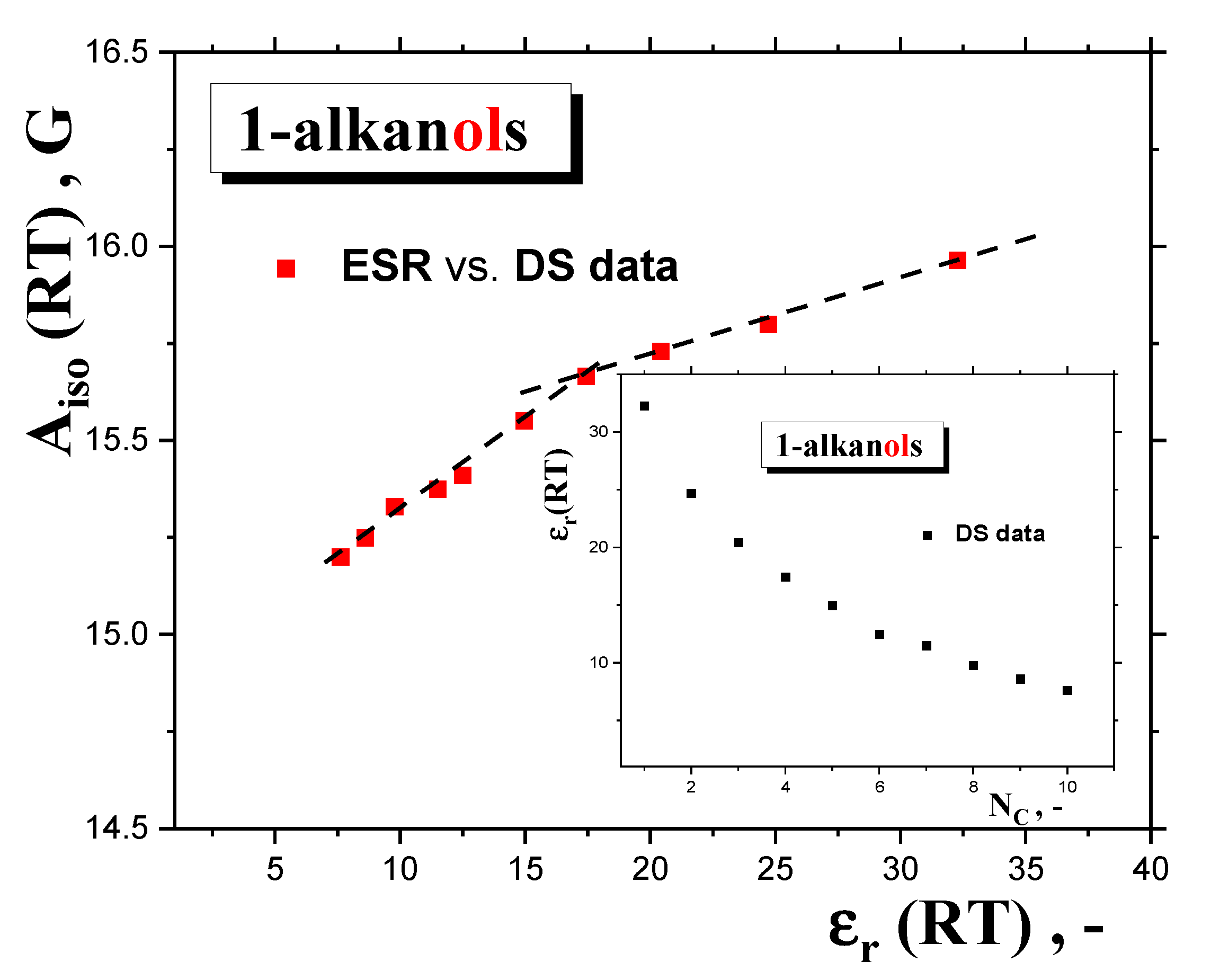
Figure 12.
Test of the Griffith - Onsanger model for isotropic hyperfine constant, Aiso(RT) as a function of polarization expression [εr(RT)-1]/[εr (RT)+1] of the Onsanger reaction field model for three types of media: apolar, such as benzene (BZ) [44] and aprotic polar, such as dimethylsulphoxide (DMSO) [44] and protic polar compounds such as water [44] and our series of ten 1-alkanols.
Figure 12.
Test of the Griffith - Onsanger model for isotropic hyperfine constant, Aiso(RT) as a function of polarization expression [εr(RT)-1]/[εr (RT)+1] of the Onsanger reaction field model for three types of media: apolar, such as benzene (BZ) [44] and aprotic polar, such as dimethylsulphoxide (DMSO) [44] and protic polar compounds such as water [44] and our series of ten 1-alkanols.
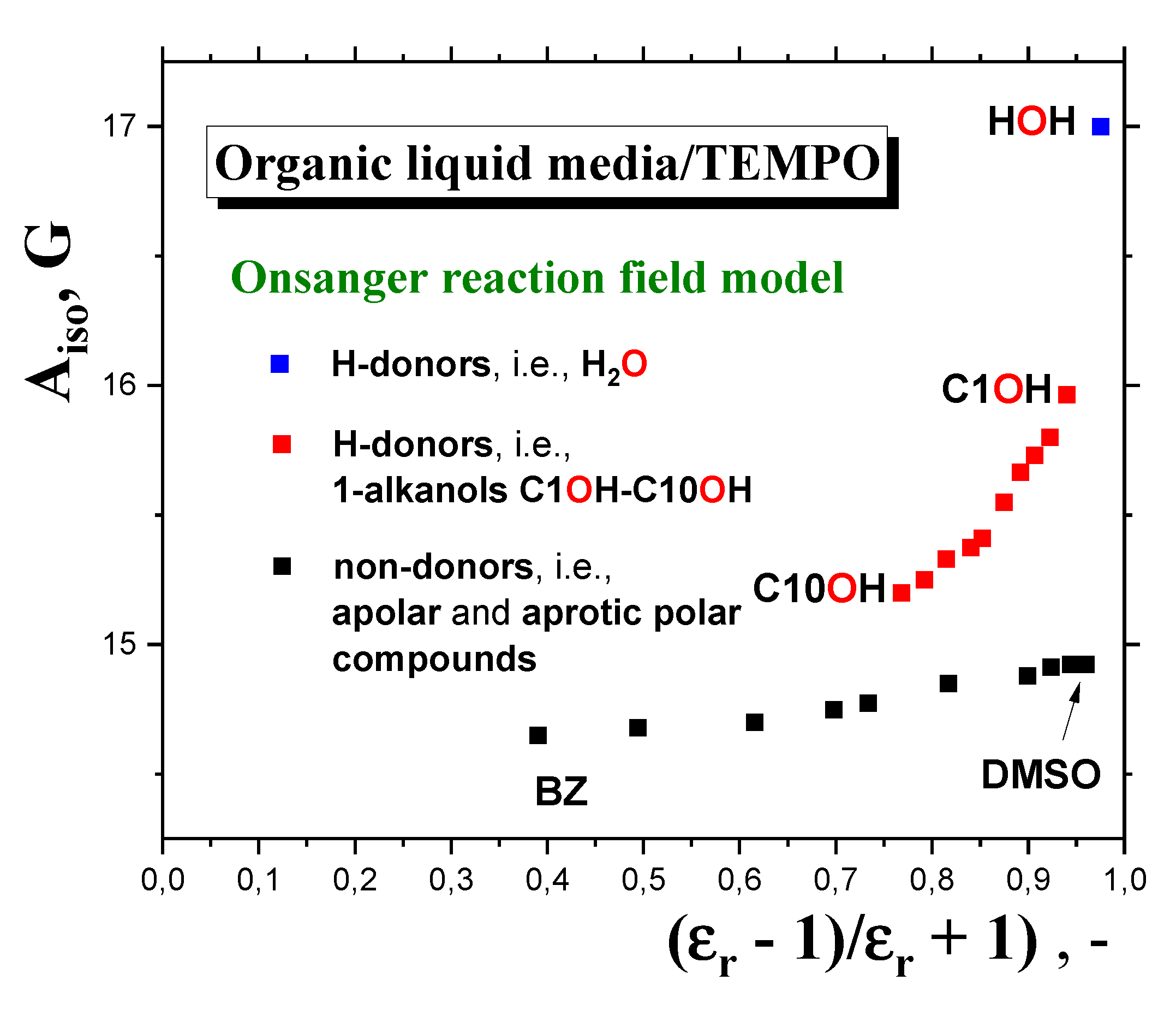

Table 1.
Basic physical properties of investigated 1-alkanols.
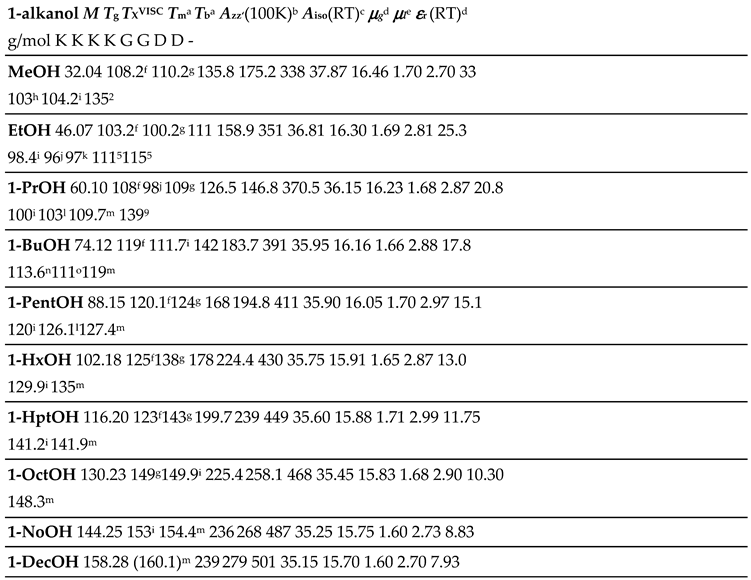
a.Ref.18; b.uncertainty = 0.05 G; c.uncertainty = 0.03 G; d.Ref.33; e.Ref.35; f.Ref.19; g.Ref.20; h.Ref.21; i.Ref.22; j.Ref.23; k.Ref.24; l.Ref.25; m.Ref.26; n.Ref.27; o.Ref.28.
Disclaimer/Publisher’s Note: The statements, opinions and data contained in all publications are solely those of the individual author(s) and contributor(s) and not of MDPI and/or the editor(s). MDPI and/or the editor(s) disclaim responsibility for any injury to people or property resulting from any ideas, methods, instructions or products referred to in the content. |
© 2023 by the authors. Licensee MDPI, Basel, Switzerland. This article is an open access article distributed under the terms and conditions of the Creative Commons Attribution (CC BY) license (http://creativecommons.org/licenses/by/4.0/).
Copyright: This open access article is published under a Creative Commons CC BY 4.0 license, which permit the free download, distribution, and reuse, provided that the author and preprint are cited in any reuse.


