

Submitted:
22 August 2023
Posted:
24 August 2023
You are already at the latest version
Abstract
Agriculture uses a lot of fuel, fertilizers, pesticides and other substances, while emitting large amounts of GHGs. It is important to optimize these inputs and outputs. One such way is increas-ing crop biodiversity. For this reason, single crops and mixtures of maize, hemp and faba bean as binary and ternary crops were investigated at the Experimental Station of Vytautas Magnus Uni-versity, Lithuania.
Results showed that consumption of diesel fuel was by the 31-46% higher than in single and 22-35% higher than in binary cultivations was found in a ternary crop. This influenced on the highest energy input or near twice higher than in maize and hemp single crops and maize+hemp binary crop, but similar with binary crops with faba bean. Despite this, the productivity of the trinary crop and, at the same time, the energy output were 2-5 times higher than in other treat-ments. This compensated for higher energy inputs and the energy efficiency ratio. In ternary crop, energy productivity was from 1.1 to 2.8 times higher and net energy was by 1.9-5.3 times higher than in other tested cultivations. The highest total GHG emissions were obtained in binary maize+hemp and maize+faba bean cultivations (1729.84 and 2067.33 CO2eq ha-1). Ternary cultiva-tion with the highest energy inputs initiated average GHG emission - 1541.90 kg ha-1 CO2eq.
For higher efficiency, ternary crop could be sown and harvested in one machine pass. Faba beans should be included in the ter-nary crops, as their biomass takes a significant part of the total biomass produced. We recommend to review the inter-cropped faba bean seeding rates as faba bean seeds have a high energy input equivalent.
Keywords:
Zea mays L.
; Cannabis sativa L.
; Vicia faba L.
; multi-cultivations
; energy indices
; CO2 eq
1. Introduction
Currently, high population growth and high demand for food and energy, especially produced from renewable resources (for example, biomass) [1].
Maize is a crop with a high potential for biomass production. Today, maize is one of the most important and productive crops in the world, with more than 206 million hectares being cultivated in 2021. In the USA, ethanol extracted from maize is mixed with standard fuel and the final product contains 10% of ethanol. They can be used for the production of feed, biofuels, synthetic plastics, chemical compounds, etc. [2,3]. The aim is to reduce the use of fossil fuels and regulate greenhouse gas emissions [4]. However, this fuel does not provide a significant amount of energy compared to the energy produced from sugar cane [5].
Faba beans are widely grown around the World. According to FAO data, faba beans were grown over 2.7 million hectares worldwide in 2021, and over 473 thousand hectares in Europe. The faba beans are mainly used for food, animal feed and soil improvement, but they can be used for energy purposes by converting biomass into pellets and using them as medium to low-power boilers [6].
Industrial hemp—it is great technical crop. Their ability to produce high biomass yields with relatively low water content is one of the main advantages. Industrial hemp is valuable for its high energy and biomass yield per hectare [7]. It is claimed that hemp can be used for energy production as a fuel source that does not emit sulphur either by direct combustion or by liquefying fuels such as bioethanol. Hemp oil is produced as a renewable biofuel because it emits less carbon monoxide when burned, thus helping to reduce global warming. It is important to emphasize that biomass by-products (straw and shivers) are a good raw material for energy production [8].
Multi-crops are a type of crop cultivations, where several species of plants are grown at the same place and time. Multi-crops ensure sustainable farming and increase crop productivity per unit area [9]. Multi-crops can increase biodiversity, reduce the damage caused by diseases, pests and weeds, reduce the need for mineral fertilizers and maintain soil fertility and quality, easier for plants to grow under adverse conditions [10]. Biomass plants are classified as renewable sources and their cultivation is very courageous, as the European Union wants to increase the energy supply from alternative sources by 2030 (up to 45%). However, despite the enormous hidden potential in this area, the cultivation of inter-crops has still not been sufficiently studied [11]. It is important to understand that the number of plants that can be cultivated as multi-crops is quite large and all crops have a different function and their benefits are not the same. In order to achieve the maximum harvest result, the advantages of each multilayer plant must be exploited [12].
Agro-technological operations have a significant impact on energy consumption and environmental pollution. Tillage technologies are one of the most important, but at the same time the most energy-intensive and expensive technological operations [13]. Reversible tillage technologies consume between 29 and 59% of total diesel fuel in technological process [14,15].
Fertilizers production and use account for the majority of energy expenditure (about 50%) in field crop production in Europe [16]. The production of nitrogen fertilizers is a particularly energy-intensive process, compared to the production of phosphorus and potassium fertilizers, about 10 times more energy is consumed [17]. Ghazvineh at al. [18] found that in maize cultivation, the total energy consumption and output were 50.485 and 134.946 MJ ha−1, respectively. Nitrogen fertilizers, electricity and diesel fuel consume the largest part of energy with 35.25 and 20 percent, respectively. In barley production systems, the total energy input and output was 12416.62 and 43656.25 MJha−1. The most energy consumed was diesel fuel energy (52.4%), nitrogen fertilizers (16.2%) and seed (23%). 3.51 and 0.11 KgMJ−1 in energy efficiency and energy productivity of this agroecosystem. In wheat systems, total energy input was 14255.05 MJha−1, total energy output—56161.7 MJha−1. The biggest part of wheat made up the total energy input nitrogen fertilizers (31.8%), seed (27.2%) and diesel fuel energy (31.6%). In hemp systems, it was 17,945 MJha−1 for the total energy input.
There is still no formal agreement on a methodology for calculating greenhouse gas (GHG) emissions from crop production systems. The authors conclude that further research and development is still needed to improve crop production sustainability [19]. It is argued that the large number of units used to measure agricultural inputs makes it very difficult to compare carbon inputs. Points out that it is useful to convert different units of measurement into carbon dioxide emissions for agricultural activities [20].
Agriculture’s direct contribution to GHG are estimated to be 10−15% of total anthropogenic GHG emissions which non-CO2 anthropogenic GHG emissions consist of 48%. Sustainable agriculture, which reduces greenhouse gas (GHG) emissions, can contribute to climate change mitigation [21]. Also in organic agriculture, in contrast to traditional farming, is associated with a lower average of GHG emissions per hectare [22]. Bručienė et al. [23] pointed that in organic agriculture the most important factor in controlling GHG emissions is reducing the use of organic fertilizers and diesel fuel.
The aim of our study was to evaluate the biomass production capacities of differently biodiversed multi-crops, to analyse the possible for these technologies machinery, to evaluate the inputs of energy for main materials, fuels, working time and biomass energy outputs, to ascertain the impact of technologies on the GHG emissions according CO2 equivalent. We hypothesize that cultivation of a ternary crop will not only produce more plant biomass, but will also use energy more efficiently, and GHG emissions will not be the highest.
2. Materials and Methods
2.1. Experimental Site
A short-term stationary field experiment was performed in 2020–2022 at the Vytautas Magnus University, Agriculture Academy, Experimental station (54°52′ N, 23°49′ E). In this study, data of crops biomass from 2020 is presented because the yield was the highest and the most suitable for fuel production in comparison with continue cropping in 2021 and 2022.
The soil of the experimental field is a deeper gleyic saturated loam (45.6% sand, 41.7% silt, 12.7% clay) Planosol (Endohypogleyic-Eutric, Ple-gln-w [24]. Soil pHHCl varies from 7.3 to 7.8; total nitrogen content, 0.08 to 0.13%; humus, 1.5 to 1.7%; available phosphorus, 189 to 280 mg·kg−1; available potassium, 97 to 118 mg·kg−1; available sulphur, 1.2 to 2.6 mg·kg−1; and exchangeable magnesium, 436 to 790 mg kg−1.
Lithuania is in a zone of surplus moisture. In the experimental site, the annual average precipitation rate varies from 600 to 650 mm or approx. 300–400 mm of precipitation per vegetative season. According to the climatic norm, the coldest month is January, and the warmest and the most humid is July. In nova days, January became much soft, negatives temperatures are recorded less often. In July, droughts occur more and more often, and the peak of precipitation moves to the beginning of August. In 2020 vegetative season, average air temperatures were the same as long-term average, but rainfall was 10 times less. May was colder, but with surplus humidity (Table 1). June was warmer than usually, but precipitation rate was approximately 30% higher than long-term climatic rate.
July was colder than average and slightly arid, but August was warmer and little more humid. In summary, it can be said that the vegetation conditions of the year were favourable for crop development, as moisture was usually sufficient.
2.2. Treatments and Agronomic Practice
Maize (Zea mays L., Pioneer hybrid P8105), hemp (Cannabis sativa L., cultivar Austa SK) and faba bean (Vicia faba L., cultivar Vertigo) were grown in the experiment as three types of cultivations: single, binary and ternary (Table 2).
An experiment was performed with three replications. 21 experimental plots (the size was 8 m2). In 2019, the pre-crop of multi-cultivations was oat. In 2021–2022, cultivations were grown continuously.
In 2019 autumn, disc-cultivated and ploughed (Table 3). In spring 2020, and cultivated in spring before sowing. In April, before seeding, the soil of experiment was shallowly tilled. Before the sprouting of crop, plots were fertilized with NPK 15:15:15 (300 kg·ha−1). There were used no more fertilizers.
The experiment more closely followed the model conditions, so the crops were sown manually according to predetermined schemes. Sowing schemes are shown in Figure 1.
According to the schemes of seeding, the seed rates are presented in Table 4. The idea of experiment was to increase usual seeding rates for more rapid weed control and higher potential of biomass production. For better balance of energy inputs, seeding rates could be decreased, especially faba bean.
For the energy and environmental evaluation, we selected machinery that are mostly used in agriculture in Lithuania. The inter-rows of crops were loosened 1–2 times. No pesticides were used. In experiment, crops biomass production was harvested by hands after a short 103-days vegetative season. At that time, faba bean have been reached full maturity. The biomass of maize and hemp had not yet reached its maximum, but there is a lack of plant biomass for fuel production in Lithuania in August.
In our calculations of energy and environmental evaluation of multi-cropping agrotechnologies, we used the data normative of agricultural machinery from Lithuanian Institute of Economics and Rural Development [25,26]. For calculations we used field size as 2–10 ha. Tractors power varied from 45–102 kW, power of biomass harvester was 250 kW (Table 5). The data of mechanical seeders are given in the calculations, when about 200 kg ha−1 of seeds are sown. Double sowing is carried out with a combined sowing machine, in which separate seed boxes or the sowing unit of the one next to it could be installed. For sowing in two passes, we have provided both of the previously mentioned seeders. Of course, a ternary crop seeder can be made to seed such a crop in one pass. Then the energy and environmental calculations would change.
We chose 6-furrow biomass harvesters. Single and binary crops without hemp are classified as low harvester load. For difficult conditions, we classified single and binary crops with hemp. Biomass harvesting in two passes is provided in ternary crops, in which the upper juicier part of the biomass is cut first, and the more woody lower part is cut in the second pass.
2.3. Methodology
For crop biomass productivity assessment, plants were cut in a row of 1 m length with at least in 5 spots per plot. Samples for each species of plant were taken separately, so a total of 36 samples were formed. Biomass was dried at a temperature of 105 °C to absolutely dry humidity. The results of dried biomass are presented in this study.
A biomass chemical composition was tested in the laboratories of Lithuanian Research Centre for Agriculture and Forestry in Kaunas, Lithuania (Table 6). We would like to show that biomass of crops is rich in elements important for biofuel production and plant nutrition (as pellets or ash). We took advantage of these features by registering patents for the production of solid biofuel from faba bean residues and ternary crop biomass at the Lithuanian National Patent Office [27,28].
Equivalents of energy inputs and outputs in single and multi-crops biomass production are presented in Table 7.
The energy ratio (energy use efficiency), energy productivity, net energy were calculated based on the energy equivalents of technological inputs and outputs [30,36]:
Energy output (MJ ha−1) = Dried biomass yield (kg ha−1) · Energy equivalent (MJ kg−1)
Energy efficiency ratio = Energy output (MJ ha−1)/Energy input (MJ ha−1)
Energy productivity (kg MJ−1) = Biomass yield (kg ha−1)/Energy input (MJ ha−1)
Net energy = Energy output (MJ ha−1) − Energy input (MJ ha−1)
All agricultural technological operations, machinery and materials can be evaluated as environmental impact by CO2 equivalent (Table 8).
In our study, we calculated the conditional GHG emission of fuel, machinery, sowing material and mineral fertilizers according to equation 5 [23]:
GHG emission (kg CO2eq ha−1) = Agro-technological inputs · CO2 equivalents (kg CO2eq unit−1)
An experimental data were analysed using one-factor analysis of variance (ANOVA) from the statistical software SELEKCIJA (vers. 5.00, author dr. Pavelas Tarakanovas, Lithuanian Institute of Agriculture, Akademija, Kedainiu distr., Lithuania). The significance of differences between treatments was estimated by the least significant difference (LSD) test. Lower-case letters mean significant differences between treatments at p ≤ 0.05.
3. Results and Discussion
3.1. Energy Inputs
Energy is an important driver of development, but it is particularly influential in the agricultural sector, as agriculture is both a consumer and a producer of energy [42]. Complex mechanized technological processes such as tillage, sowing or harvesting are widely used in agriculture and have a significant impact on energy consumption [30].
An energy input-output analysis was performed to compare the efficiency of maize, hemp, faba bean production under different multi-cropping systems. The energy inputs for maize, hemp, faba bean multi-crops were calculated based on the mechanized operations and agricultural machinery used, working time, fuel consumption, the sowing of seeds and the application of fertilization. After the maize, hemp, faba bean crop biomass production, energy outputs were determined and recalculated per hectare. Energy inputs and outputs were assessed separately for each maize, hemp and faba bean production treatment (Table 9).
Analysing the indicators of multi-cropping and other technological operations presented in Table 9, it was found that the lowest labour capacity was for the maize single crop (8.8 MJ ha−1) and faba bean (8.8 MJ ha−1). The highest capacity was for the ternary crop (11.0 MJ ha−1) because of wider agro-technological operations.
Biodiesel has been gaining growing importance in terms of environment and energy. Other researchers have obtained opposite trends in the high labour and fuel costs of growing bean crops [30]. Biodiesel can be produced of processed vegetable oils from different feedstock like sunflower oil [43], rapeseed oil [44,45], soybean oil [46,47], palm oil [48] and hemps (Table 9).
In our experiment, the highest fuel consumption is obtained when growing ternary crop (5815.8 MJ ha−1), and the lowest—in single maize (3980.4 MJ ha−1) and faba bean (3980.4 MJ ha−1). Ali et al. [49] stated that the most energy consumption of diesel fuel accounted for about 54% of the total energy used for single faba bean cultivation.
Similar trends have been identified in agricultural machinery as well as in diesel fuel. The most intensive use of agricultural technique was found in the ternary (M+H+FB) crop (2000.3 MJ ha−1). Compared to other crops, it was by 14.3 to 19.6% higher (Table 9).
Maize (600.9 MJ ha−1) and hemp (315.1 MJ ha−1) seeds were the lowest in the ternary crop (M+H+FB) compared to other crops. The highest amount of energy from seed of maize (1505.6 MJ ha−1) was determined in the binary (M+FP) crop, and seed of hemp (512.9 MJ ha−1), in the single (H) crop. Seed of faba bean (8355.9 MJ ha−1) had the highest amount of energy input in the binary (M+FB) crop, and the lowest (7620.9 MJ ha−1)—in the single (FB) crop compared to other crops.
Fertilizer use has increased exponentially worldwide over the past few decades. The intensive use of mineral fertilizers and the use of conventional methods of fertilization have a negative impact on the soil, the environment and human health [50]. In our experiment, the highest amount of energy input (2727.0 MJ ha−1) was determined for N fertilizer, while the lowest (301.5 MJ ha−1) was calculated for K2O fertilizer (Table 9).
The total energy consumption is the highest (20162.9 MJ ha−1) in the ternary crop (M+H+FB), and the lowest (10176.6 MJ ha−1) in the single crop (H) (Table 9). In ternary crop (M+H+FB) the most energy was used, because more human labour is added, more diesel fuel is consumed and agricultural machinery is used several times. This is because single crop require much less energy than other multi-cultivations [51].
3.2. Biomass Yields
Maize and hemp biomass is the main resources for biofuel production [52,53,54]. The highest biomass of maize was grown in single cultivation—4461 kg ha−1 and the lowest one—in ternary crop (1358 kg ha−1) (Table 10) because maize crop density in ternary crop was more than twice less (about 134 thousand plants per ha) according to the seeding scheme. Maize with faba bean inter-crop produced second higher yield of biomass—3519 kg ha−1. According findings of other scientists, maize mix with Fabaceae crops warranted higher maize yields [55], but we found the converse conclusions [56].
The highest dried hemp biomass was in the binary hemp and maize crop (9824 kg ha−1) and the lowest one was in the ternary crop (7239 kg ha−1).
Faba bean as companion of maize and hemp in ternary crop showed the best results (14331 kg ha−1 of dried biomass) although the density of the faba bean crop in the crops of different diversification varied little—from 560 to 614 thousand plants per hectare. In addition, the hemp and maize crops densities were the lowest one in ternary cultivation. Faba bean less interact with rarer crops. Similarly, Ewansiha et al. [57] concluded that reducing the maize shade increases the productivity of inter-crops.
The significantly highest total dried biomass of crops was found of ternary crop—22,928 kg ha−1 or 2–5 times higher than it other tested single and binary cultivations (Table 10)
3.3. Fuel Consumption and Energy Indices
Diesel fuel consumption, energy input, energy output, energy efficiency, energy productivity, net energy of the various mechanised technological operations for tillage, sowing, fertilising and harvesting are presented in Table 11.
The highest consumption of diesel fuel was found in a ternary crop (M+H+FB) (103.3 L ha−1), due to more technological operations. When growing maize and faba bean single crops, diesel fuel consumption was the lowest at 70.7 L ha−1, which is less than 1.5 times that of ternary crop (M+H+FB). Šarauskis et al. [30] obtained the same trends with monocropped faba beans.
In our experiment, the highest energy output (387831.0 MJ ha−1) was obtained from the ternary (M+H+FB) crop, the lowest one—from the single maize crop (M) (7859.7 MJ ha−1). The energy efficiency ratio and the energy productivity was less from by 2.8 to 2.9 times compared to the ternary crop. In terms of energy productivity, the best result (1.14 MJ ha−1) was shown by the ternary crop. The highest net energy (367668.1 MJ ha−1) was also obtained in the ternary crop. Other researchers claim that growing more plants in cultivation results in higher energy productivity and net energy [14].
3.4. Environmental Impact
Agriculture makes a significant contribution to GHG emissions, with as much as 24% of total net GHG emissions coming from Forestry, Agriculture, and Other Land Use (AFOLU) [58]. Agriculture is itself a consumer of energy and a supplier of energy in the form of bioenergy [59]. Efficient use of energy is one of the main requirements of sustainable agriculture [60]. All production processes need to manage energy use and greenhouse gas (GHG) emissions for sustainable development [61]. Mitigation is an intervention aimed at reducing anthropogenic net greenhouse gas emissions [62]. Although the majority of anthropogenic emissions originate from industrial processes, agriculture is one of the most polluting sectors in the world [63,64]. The constant need for increased food production has led to the intensive use of chemical fertilizers, pesticides, agricultural machinery, electricity and other natural resources; however, the intensive use of energy causes problems that threaten public health and the environment [60]. Environmental mitigation in agriculture requires technological changes to reduce the consumption of energy resources and emissions per unit of agricultural production [62]. Efficient use of energy in agriculture will reduce environmental problems, prevent the destruction of natural resources and develop sustainable agriculture as an economical production system [65]. In the period from 2000 to 2017 global GHG emissions from the agricultural sector ranged from 5.0 to 5.8 Gt CO2eq per year [66]. Scientists have found that the largest share of pollution in crop production is related to the use of machinery, diesel, electricity, fertilizers, seeds and pesticides [67,68,69]. Lu et al. [67] showed that nitrogen fertilizers emit the most greenhouse gases (40.9–65.7%), followed by diesel. According to the authors, in order to mitigate the impact of agriculture on the environment, it is necessary to increase nitrogen efficiency and reduce diesel consumption [14]. Reducing fuel consumption by 1 L reduces GHG emissions by 2.76 kg CO2eq [37].
Taking into account the different units of measurement, the GHG emissions for the total agricultural inputs were recalculated into a unified CO2eq system using the conversion equivalents (Table 12).
The highest amount of CO2eq ha−1 from diesel fuel was obtained in the cultivation of ternary M+H+FB crop (285.1 kg CO2eq ha−1), and the lowest in single maize (M) and faba bean FB—195.1 kg CO2eq ha−1 because diesel consumption was 1.2 to 1.5 times higher. Pishgar-Komleh et al. [61] estimated that the total GHG emissions from cucumber production were 82,724 kg CO2eq ha−1, with the highest emissions from diesel (61%), electricity (19%), and manure (14%).
The same trends remained in agricultural machinery. In the ternary crop, CO2eq of agricultural machinery was to be 1.3 times higher compared to other cultivations. Seeds of maize (553.9 kg CO2eq ha−1) and hemp (256.2 CO2eq ha−1) had the lowest emissions in the ternary M+H+FB crop compared to other crops. Maize seeds (1387.7 CO2eq kg−1) had the highest amount of CO2eq in the binary M+FP crop, and hemp seeds (417.0 kg CO2eq ha−1)—in the single hemp crop. Seeds of faba bean (393.9 kg CO2eq kg−1) had the highest amount of CO2eq in the binary (M+FB) crop, and the lowest (359.3 kg CO2eq ha−1)—in the faba bean single crop compared to other crops.
The same amount of fertilizers was used. So the CO2eq was the same in all tested cultivations. Higher fertilizer rates are associated with higher greenhouse gas emissions [70]. In our study, we found that N fertilizer released the highest amount of 58.5 kg CO2eq ha−1, and K2O fertilizer released the lowest amount of 6.85 kg CO2eq kg−1. In terms of GHG emission CO2eq ha−1, the best indicators were shown by the single faba bean crop. Faba beans also play an important role in crop rotation due to the ability to biologically capture nitrogen (N). Therefore, beans are classified as efficient nitrogen sources [71].
The lowest total GHG emissions were calculated in single faba bean and single hemp crops (629.02 and 709.63 CO2eq ha−1) (Table 12). The highest ones were obtained in binary M+H and M+FB cultivations (1729.84 and 2067.33 CO2eq ha−1). Carraretto et al. [40] having assessed the technological operations of mechanized maize cultivation technologies on the basis we would come to the conclusion that the emissions of CO2 into the environment related with all technologies would be reduced about five times. Alimagham et al. [68] investigated the GHG emissions of faba bean. Cultivation and found that the total GHG emissions ranged from 1265.1 kg CO2eq ha−1 to 2969.2 kg CO2eq ha−1) ha−1. In our experiment, ternary cultivation with the highest energy inputs conducted average CO2eq—1541.90 kg ha−1.
4. Conclusions
The highest consumption of diesel fuel was found in a ternary crop (103.3 L ha−1) or 31–46% higher than in single cultivations and 22–35% higher than in binary cultivations because of double crop sowing and harvesting operations. For this reason, the energy input was the highest in the ternary crop or near twice higher than in M, H, M+H crops, but similar with M+FB and H+FB. Despite this, the productivity of the ternary crop and, at the same time, the energy output were 2–5 times higher than in other treatments. This compensated for higher energy inputs and the energy efficiency ratio of ternary crop reached 19.23. In ternary crop, energy productivity was from 1.1 to 2.8 times higher and net energy was by 1.9–5.3 times higher than in other tested cultivations.
The highest total GHG emissions were obtained in binary M+H and M+FB cultivations (1729.84 and 2067.33 CO2eq ha−1). As we expected, ternary cultivation with the highest energy inputs initiated average GHG emission—1541.90 kg ha−1 CO2eq.
In general, this study showed that the multi-cropping in agriculture can be an effective method to warrant high biomass production level, to optimize efficiency of energy consumption, while GHG emissions remains average. In order to make the cultivations of multi-crops even more efficient, it is necessary to improve the sowing and harvesting systems so that the ternary crop can be sown and harvested in one machine pass. In addition, faba beans should be included in the ternary crops, as their biomass takes a significant part of the total biomass produced. Also to review the intercropped faba bean seeding rates as faba bean seeds have a high energy equivalent.
Author Contributions
Conceptualization, K.R.; methodology, K.R. and J.B.; software, A.Š., J.B. and K.R.; validation, J.B., K.R.; formal analysis, J.B., A.Š., R.K., A.S. and K.R.; investigation, J.B., A.Š., K.R., A.S. and R.K.; resources, J.B., K.R., A.R., A.S. and A.Š.; data curation, J.B., K.R. and A.Š.; writing—original draft preparation, K.R., R.K.; A.S. and; writing—review and editing, K.R., R.K., and A.S.; visualization, K.R., A.Š and J.B.; supervision, K.R. All authors have read and agreed to the published version of the manuscript.
Funding
This research received no external funding.
Institutional Review Board Statement
Not applicable.
Informed Consent Statement
Not applicable.
Data Availability Statement
Most of the data generated or analysed during this study are included in the present article. In Balandaitė, J.; Romaneckas, K.; Švereikaitė, A.; Kimbirauskienė, R.; Sinkevičienė, A.; Romaneckas, A. The Biomass Productivity of Maize, Hemp and Faba Bean Multi-Crops. Agronomy 2022, 12, 3193. https://doi.org/10.3390/agronomy12123193, some productivity indices of the experiment are demonstrated.
Conflicts of Interest
The authors declare no conflict of interest.
References
- Ioelovich, M. Energetic Potential of Plant Biomass and Its Use. Int. J. Renew. Sustain. Energy 2013, 2, 26. [Google Scholar] [CrossRef]
- García-Lara, S.; Serna-Saldivar, S.O. Chemistry and Technology. Corn. 2019, 1–18. [Google Scholar]
- Abukhadra, M.R.; Adlii, A.; Jumah, M.N.B.; Othman, S.; Alruhaimi, R.S.; Salama, Y.F.; Allam, A.A. Sustainable conversion of waste corn oil into biofuel over different forms of synthetic muscovite based K+/Na+ sodalite as basic catalysts; characterization and mechanism. Materials Research Express 2021, 6, 1–13. [Google Scholar] [CrossRef]
- Yang, K.; Ryu, Y.; Dechant, B.; Berry, J.A.; Hwang, Y.; Jiang, C.; Kang, M.; Kim, J.; Kimm, H.; Kornfeld, A.; et al. Sun-induced chlorophyll fluorescence is more strongly related to absorbed light than to photosynthesis at half-hourly resolution in a rice paddy. Remote. Sens. Environ. 2018, 216, 658–673. [Google Scholar] [CrossRef]
- Saghaian, S.; Nemati, M.; Walters, C.; Chen, B. Asymmetric Price Volatility Transmission between U. S. Biofuel, Corn, and Oil Markets. Journal of Agricultural and Resource Economics 2018, 43, 46–60. [Google Scholar]
- Romaneckas, K.; Balandaitė, J.; Sinkevičienė, A.; Kimbirauskienė, R.; Jasinskas, A.; Ginelevičius, U.; Romaneckas, A.; Petlickaitė, R. Short-Term Impact of Multi-Cropping on Some Soil Physical Properties and Respiration. Agronomy 2022, 12, 2–17. [Google Scholar] [CrossRef]
- Frankowski, J.; Sieracka, D. Possibilities for Using Waste Hemp Straw for Solid Biofuel Production. EWaS5 2021, 9, 18. [Google Scholar] [CrossRef]
- Crini, G.; Lichtfouse, E.; Chanet, G.; Morin-Crini, N. Applications of hemp in textiles, paper industry, insulation and building materials, horticulture, animal nutrition, food and beverages, nutraceuticals, cosmetics and hygiene, medicine, agrochemistry, energy production and environment: a review. Environ. Chem. Lett. 2020, 18, 1451–1476. [Google Scholar] [CrossRef]
- Haberl, H.; Erb, K.-H.; Krausmann, F.; Bondeau, A.; Lauk, C.; Müller, C.; Plutzar, C.; Steinberger, J.K. Global bioenergy potentials from agricultural land in 2050: Sensitivity to climate change, diets and yields. Biomass- Bioenergy 2011, 35, 4753–4769. [Google Scholar] [CrossRef]
- Blanco-Canqui, H.; Ruis, S.J. Cover crop impacts on soil physical properties: A review. Soil Sci. Soc. Am. J. 2020, 84, 1527–1576. [Google Scholar] [CrossRef]
- Francis, C.A.; Porter, P. Multicropping. Crop Systems 2016, 3, 29–33. [Google Scholar]
- Beaumelle, L.; Auriol, A.; Grasset, M.; Pavy, A.; Thiéry, D.; Rusch, A. Author response for "Benefits of increased cover crop diversity for predators and biological pest control depend on the landscape context". 2021. [Google Scholar] [CrossRef]
- Failla, S.; Ingrao, C.; Arcidiacono, C. Energy consumption of rainfed durum wheat cultivation in a Mediterranean area using three different soil management systems. Energy 2020, 195, 116960. [Google Scholar] [CrossRef]
- Šarauskis, E.; Buragienė, S.; Masilionytė, L.; Romaneckas, K.; Avižienytė, D.; Sakalauskas, A. Energy balance, costs and CO2 analysis of tillage technologies in maize cultivation. Energy 2014, 69, 227–235. [Google Scholar] [CrossRef]
- Akbarnia, A.; Farhani, F. Study of fuel consumption in three tillage methods. Res. Agric. Eng. 2014, 60, 142–147. [Google Scholar] [CrossRef]
- Paris, B.; Vandorou, F.; Balafoutis, A.T.; Vaiopoulos, K.; Kyriakarakos, G.; Manolakos, D.; Papadakis, G. Energy use in open-field agriculture in the EU: A critical review recommending energy efficiency measures and renewable energy sources adoption. Renew. Sustain. Energy Rev. 2022, 158, 112098. [Google Scholar] [CrossRef]
- Pelletier, N.; Audsley, E.; Brodt, S.; Garnett, T.; Henriksson, P.; Kendall, A.; Kramer, K.J.; Murphy, D.; Nemecek, T.; Troell, M. Energy Intensity of Agriculture and Food Systems. Annu. Rev. Environ. Resour. 2011, 36, 223–246. [Google Scholar] [CrossRef]
- Ghazvineh, S.; Yousefi, M. Evaluation of consumed energy and greenhouse gas emission from agroecosystems in Kermanshah province. Technical Journal of Engineering and Applied Sciences 2013, 3, 349–354. [Google Scholar]
- Trimpler, K.; Stockfisch, N.; Märländer, B. The relevance of N fertilization for the amount of total greenhouse gas emissions in sugar beet cultivation. Eur. J. Agron. 2016, 81, 64–71. [Google Scholar] [CrossRef]
- Lal, R. Carbon emission from farm operations. Environ. Int. 2004, 30, 981–990. [Google Scholar] [CrossRef]
- Mangalassery, S.; Sjögersten, S.; Sparkes, D.L.; Mooney, S.J. Examining the potential for climate change mitigation from zero tillage. J. Agric. Sci. 2015, 153, 1151–1173. [Google Scholar] [CrossRef]
- Adewale, C.; Reganold, J.P.; Higgins, S.; Evans, R.; Carpenter-Boggs, L. Improving carbon footprinting of agricultural systems: Boundaries, tiers, and organic farming. Environ. Impact Assess. Rev. 2018, 71, 41–48. [Google Scholar] [CrossRef]
- Bručienė, I.; Aleliūnas, D.; Šarauskis, E.; Romaneckas, K. Influence of Mechanical and Intelligent Robotic Weed Control Methods on Energy Efficiency and Environment in Organic Sugar Beet Production. Agriculture 2021, 11, 449. [Google Scholar] [CrossRef]
- FAO. World Reference Base for Soil Resources 2014, International Soil Classification System for Naming Soils and Creating Legends for Soil Maps. 2015. Available online: http://www.fao.org/3/i3794en/I3794en.pdf (accessed on 15 May 2020).
- Pagrindinio žemės dirbimo darbai/Primary tillage works. Mechanizuotų žemės ūkio paslaugų įkainiai. Rates for mechanized agricultural services; Srebutėnienė, I., Ed.; Lietuvos agrarinės ekonomikos institutas: Vilnius, Lithuania, 2017; Available online: https://zum.lrv.lt/uploads/zum/documents/files/IKAINIAI_2017_I_dalis.pdf(in Lithuanian). (accessed on 2023 August 2023). (in Lithuanian)
- Pasėlių priežiūra ir šienapjūtės darbai/Crop care and mowing work. In Mechanizuotų žemės ūkio paslaugų įkainiai. Rates for mechanized agricultural, services; Srebutėnienė, I.; Stalgienė, A. (Eds.) Pasėlių priežiūra ir šienapjūtės darbai/Crop care and mowing work. In Mechanizuotų žemės ūkio paslaugų įkainiai. Rates for mechanized agricultural services; Srebutėnienė, I.; Stalgienė, A., Eds.; Lietuvos agrarinės ekonomikos institutas: Vilnius, Lithuania, 2017 (in Lithuanian).
- Patent LT6701B. Faba Bean Waste Biofuel Pellets And/Or Sorbent, Fertilizer. Available online: https://search.vpb.lt/pdb/patent/dossier/5140/text (accessed on 21 August 2023).
- Patent LT6998B. Corn, Hemp And Bean Multi-Crop Biomass Pellets And/Or Fertilizer. Available online: https://search.vpb.lt/pdb/patent/dossier/48325/text (accessed on 21 August 2023).
- Lal, B.; Gautam, P.; Nayak, A.; Panda, B.; Bihari, P.; Tripathi, R.; Shahid, M.; Guru, P.; Chatterjee, D.; Kumar, U.; et al. Energy and carbon budgeting of tillage for environmentally clean and resilient soil health of rice-maize cropping system. J. Clean. Prod. 2019, 226, 815–830. [Google Scholar] [CrossRef]
- Šarauskis, E.; Romaneckas, K.; Jasinskas, A.; Kimbirauskienė, R.; Naujokienė, V. Improving energy efficiency and environmental mitigation through tillage management in faba bean production. Energy 2020, 209, 118453. [Google Scholar] [CrossRef]
- Todde, G.; Carboni, G.; Marras, S.; Caria, M.; Sirca, C. Industrial hemp (Cannabis sativa L.) for phytoremediation: Energy and environmental life cycle assessment of using contaminated biomass as an energy resource. Sustain. Energy Technol. Assessments 2022, 52. [Google Scholar] [CrossRef]
- Kazemi, H.; Shahbyki, M.; Baghbani, S. Energy analysis for faba bean production: A case study in Golestan province, Iran. Sustain. Prod. Consum. 2015, 3, 15–20. [Google Scholar] [CrossRef]
- Amir, S.; Hemp as a biomass crop. Technical Article, April 2023. Available online: https://www.biomassconnect.org/wp-content/uploads/2023/04/Hemp-as-Biomass-Crop.pdf (accessed on 21 August 2023).
- Kraszkiewicz, A.; Kachel, M.; Parafiniuk, S.; Zając, G.; Niedziółka, I.; Sprawka, M. Assessment of the Possibility of Using Hemp Biomass (Cannabis Sativa L.) for Energy Purposes: A Case Study. Appl. Sci. 2019, 9, 4437. [Google Scholar] [CrossRef]
- Jasinskas, A.; Minajeva, A.; Šarauskis, E.; Romaneckas, K.; Kimbirauskienė, R.; Pedišius, N. Recycling and utilisation of faba bean harvesting and threshing waste for bioenergy. Renew. Energy 2020, 162, 257–266. [Google Scholar] [CrossRef]
- Tabar, I. B; Keyhani, A; Rafiee, S. Energy balance in Iran’s agronomy (1990-2006). Renew. Sustain. Energy. Rev. 2010, 14, 849–55. [Google Scholar]
- Moghimi, M.R.; Pooya, M.; Mohammadi, A. Study on energy balance, energy forms and greenhouse gas emission for wheat production in Gorve city, Kordestan province of Iran Eur. J. Exp. Biol. 2014. 4, 234–239.
- Pishgar-Komleh, S.; Ghahderijani, M.; Sefeedpari, P. Energy consumption and CO2 emissions analysis of potato production based on different farm size levels in Iran. J. Clean. Prod. 2012, 33, 183–191. [Google Scholar] [CrossRef]
- Singh, S.; Mittal, J.P.; Verma, S.R. Energy requirements for production of major crops in India. Agric. Mech. Asia Africa Latin. Am. 1997, 28, 13–17. [Google Scholar]
- Campiglia, E.; Gobbi, L.; Marucci, A.; Rapa, M.; Ruggieri, R.; Vinci, G. Hemp Seed Production: Environmental Impacts of Cannabis Sativa L. Agronomic Practices by Life Cycle Assessment (LCA) and Carbon Footprint Methodologies. Sustainability 2020, 12, 6570. [Google Scholar] [CrossRef]
- Reckmann, K.; Blank, R.; Traulsen, I.; Krieter, J. Comparative life cycle assessment (LCA) of pork using different protein sources in pig feed. Arch. Anim. Breed. 2016, 59, 27–36. [Google Scholar] [CrossRef]
- Imran, M.; Özçatalbaş, O.; Bashir, M.K. Estimation of energy efficiency and greenhouse gas emission of cotton crop in South Punjab, Pakistan. J. Saudi Soc. Agric. Sci. 2018, 19, 216–224. [Google Scholar] [CrossRef]
- Tomic, M.; Savin, L.; Micic, R.; Simikic, M.; Furman, T. Possibility of using biodiesel from sunflower oil as an additive for the improvement of lubrication properties of low-sulfur diesel fuel. Energy 2014, 65, 101–108. [Google Scholar] [CrossRef]
- Labeckas, G.; Slavinskas, S. Comparative performance of direct injection diesel engine operating on ethanol, petrol and rapeseed oil blends. Energy Convers. Manag. 2009, 50, 792–801. [Google Scholar] [CrossRef]
- Labeckas, G.; Slavinskas, S. Performance of direct-injection off-road diesel engine on rapeseed oil. Renew. Energy 2006, 31, 849–863. [Google Scholar] [CrossRef]
- Bueno, A.V.; Velásquez, J.A.; Milanez, L.F. Heat release and engine performance effects of soybean oil ethyl ester blending into diesel fuel. Energy 2010, 36, 3907–3916. [Google Scholar] [CrossRef]
- Carraretto, C.; Macor, A.; Mirandola, A.; Stoppato, A.; Tonon, S. Biodiesel as alternative fuel: Experimental analysis and energetic evaluations. Energy 2004, 29, 2195–2211. [Google Scholar] [CrossRef]
- Silalertruksa, T.; Gheewala, S.H. Environmental sustainability assessment of palm biodiesel production in Thailand. Energy 2012, 43, 306–314. [Google Scholar] [CrossRef]
- Ali, A.S.; Tedone, L.; Verdini, L.; Mastro, G. Implications of No-tillage system in faba bean production: energy analysis and potential agronomic benefits Open. Agric. Journal. 2018, 12, 270–285. [Google Scholar]
- Kazlauskas, M.; Bručienė, I.; Jasinskas, A.; Šarauskis, E. Comparative Analysis of Energy and GHG Emissions Using Fixed and Variable Fertilization Rates. Agronomy 2021, 11, 138. [Google Scholar] [CrossRef]
- Mandal, K.; Saha, K.; Ghosh, P.; Hati, K.; Bandyopadhyay, K. Bioenergy and economic analysis of soybean-based crop production systems in central India. Biomass- Bioenergy 2002, 23, 337–345. [Google Scholar] [CrossRef]
- Torney, F.; Moeller, L.; Scarpa, A.; Wang, K. Genetic engineering approaches to improve bioethanol production from maize. Curr. Opin. Biotechnol. 2007, 18, 193–199. [Google Scholar] [CrossRef] [PubMed]
- Prade, T.; Svensson, S.-E.; Andersson, A.; Mattsson, J.E. Biomass and energy yield of industrial hemp grown for biogas and solid fuel. Biomass- Bioenergy 2011, 35, 3040–3049. [Google Scholar] [CrossRef]
- Prade, T.; Svensson, S.-E.; Mattsson, J.E. Energy balances for biogas and solid biofuel production from industrial hemp. Biomass- Bioenergy 2012, 40, 36–52. [Google Scholar] [CrossRef]
- Akinnifesi, F.K.; Makumba, W.; Kwesiga, F.R. Sustainable maize production using gliricidia/maize intercropping in Southern Malawi. Exp. Agric. 2006, 42, 441–457. [Google Scholar] [CrossRef]
- Tsubo, M.; Walker, S.; Ogindo, H.O. A simulation model of cereal-legume intercropping system of semi-arid regions. Field Crops Res. 2005, 93, 23–33. [Google Scholar] [CrossRef]
- Ewansiha, S.U; Kamara, A.Y.; Chiezey, U.F.; Onyibe, J.E. Performance of cowpea grown as an intercrop with maize of different populations. Afr. Crop Sci. J. 2015, 23, 113–22. [Google Scholar]
- IPCC. Climate Change 2014: Mitigation of Climate Change. Working Group III Contribution to the Fifth Assessment Report of the Intergovernmental Panel on Climate Change. 2014. Available online: https://www.ipcc.ch/report/ar5/wg3/ (accessed on 2 October 2020).
- Kizilaslan, H. Input–output energy analysis of cherries production in Tokat Province of Turkey. Appl. Energy 2009, 86, 1354–1358. [Google Scholar] [CrossRef]
- Rafiee, S.; Hashem, S.; Avval, M.; Mohammadi, A. Modeling and sensitivity analysis of energy inputs for apple production in Iran. Energy 2010, 35, 3301–3306. [Google Scholar] [CrossRef]
- Pishgar-Komleh, S.H.; Omid, M.; Heidari, M.D. On the study of energy use and GHG (greenhouse gas) emissions in greenhouse cucumber production in Yazd province. Energy 2013, 59, 63–71. [Google Scholar] [CrossRef]
- Glantz, M.H.; Gommes, R.; Ramasamy, S. Coping with a changing climate: considerations for adaptation and mitigation in agriculture. Environment and Natural Resources Management Series, Monitoring and Assessment-Food and Agriculture Organization of the United Nations 2009, 15, 33–57. [Google Scholar]
- arauskis, E.; Masilionytė, L.; Juknevičius, D.; Buragienė, S.; Kriaučiūnienė, Z. Energy use efficiency, GHG emissions, and cost-effectiveness of organic and sustainable fertilisation. Energy 2019, 172, 1151–1160. [Google Scholar] [CrossRef]
- Hoffman, E.; Cavigelli, M.A.; Camargo, G.; Ryan, M.; Ackroyd, V.J.; Richard, T.L.; Mirsky, S. Energy use and greenhouse gas emissions in organic and conventional grain crop production: Accounting for nutrient inflows. Agric. Syst. 2018, 162, 89–96. [Google Scholar] [CrossRef]
- Streimikiene, D.; Klevas, V.; Bubeliene, J. Use of EU structural funds for sustainable energy development in new EU member states. Renew. Sustain. Energy Rev. 2007, 11, 1167–1187. [Google Scholar] [CrossRef]
- FAO. Agriculture, Forestry and Other Land Use Emissions by Sources and Removals by Sinks. Available online: https://www.fao.org/3/i3671e/i3671e.pdf (accessed on 21 August 2023).
- Lu, X.; Lu, X.; Cui, Y.; Liao, Y. Tillage and crop straw methods affect energy use efficiency, economics and greenhouse gas emissions in rainfed winter wheat field of Loess Plateau in China Acta Agric Scand Sect B Soil. Plant Sci. 2018, 68, 562–574. [Google Scholar]
- Alimagham, S.M.; Soltani, A.; Zeinali, E.; Kazemi, H. Energy flow analysis and estimation of greenhouse gases (GHG) emissions in different scenarios of soybean production (Case study: Gorgan region, Iran). J. Clean. Prod. 2017, 149, 621–628. [Google Scholar] [CrossRef]
- Šarauskis, E.; Romaneckas, K.; Kumhála, F.; Kriaučiūnienė, Z. Energy use and carbon emission of conventional and organic sugar beet farming. J. Clean. Prod. 2018, 201, 428–438. [Google Scholar] [CrossRef]
- Diacono, M.; Rubino, P.; Montemurro, F. Precision nitrogen management of wheat. A review. Agron. Sustain. Dev. 2012, 33, 219–241. [Google Scholar] [CrossRef]
- Etemadi, F.; Hashemi, M.; Barker, A.V.; Zandvakili, O.R.; Liu, X. Agronomy, Nutritional Value, and Medicinal Application of Faba Bean (Vicia faba L.). Hortic. Plant J. 2019, 5, 170–182. [Google Scholar] [CrossRef]
Figure 1.
The seeding schemes of single (a), binary (b) and ternary (c) cultivations [6].
Figure 1.
The seeding schemes of single (a), binary (b) and ternary (c) cultivations [6].
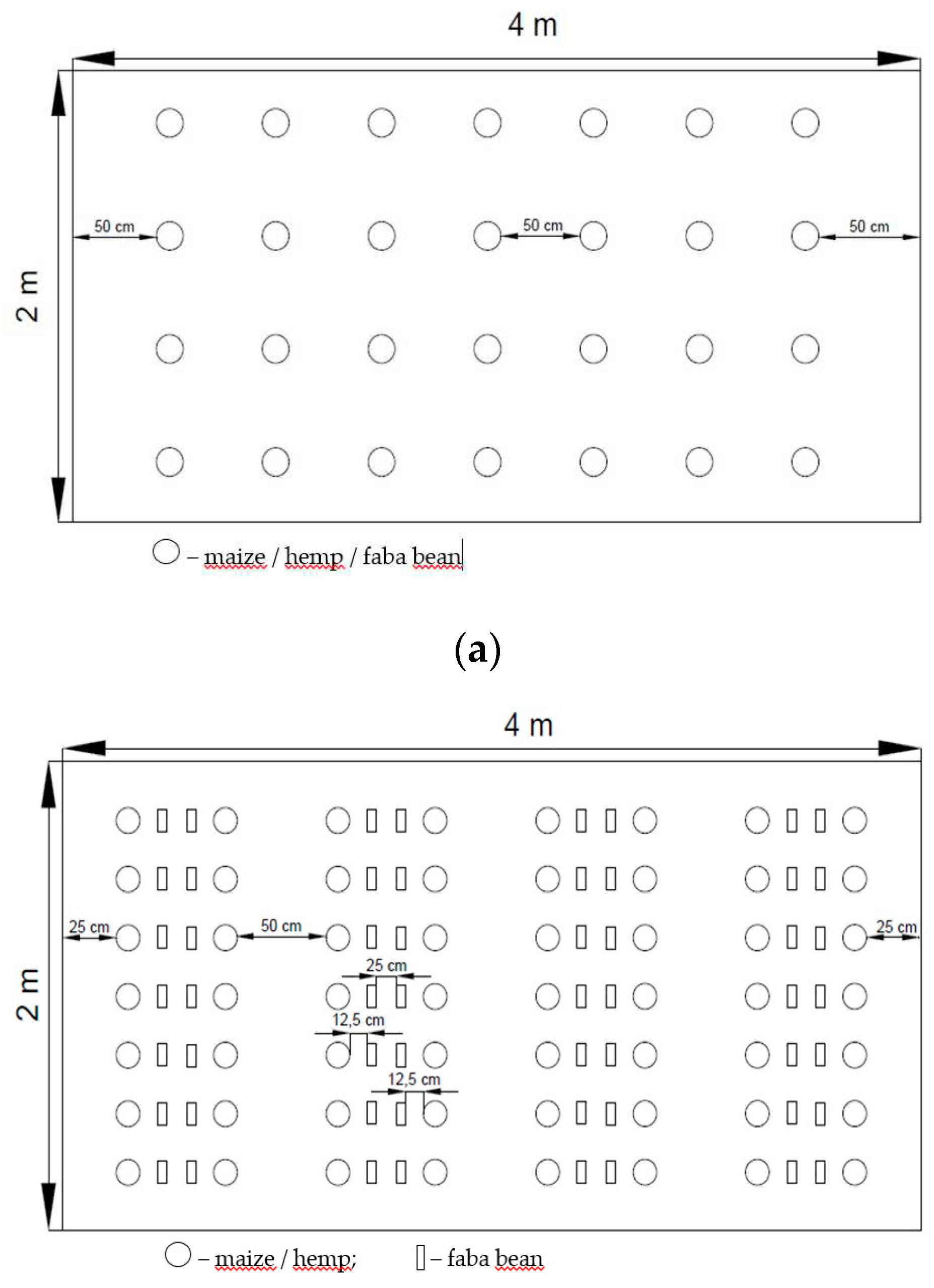
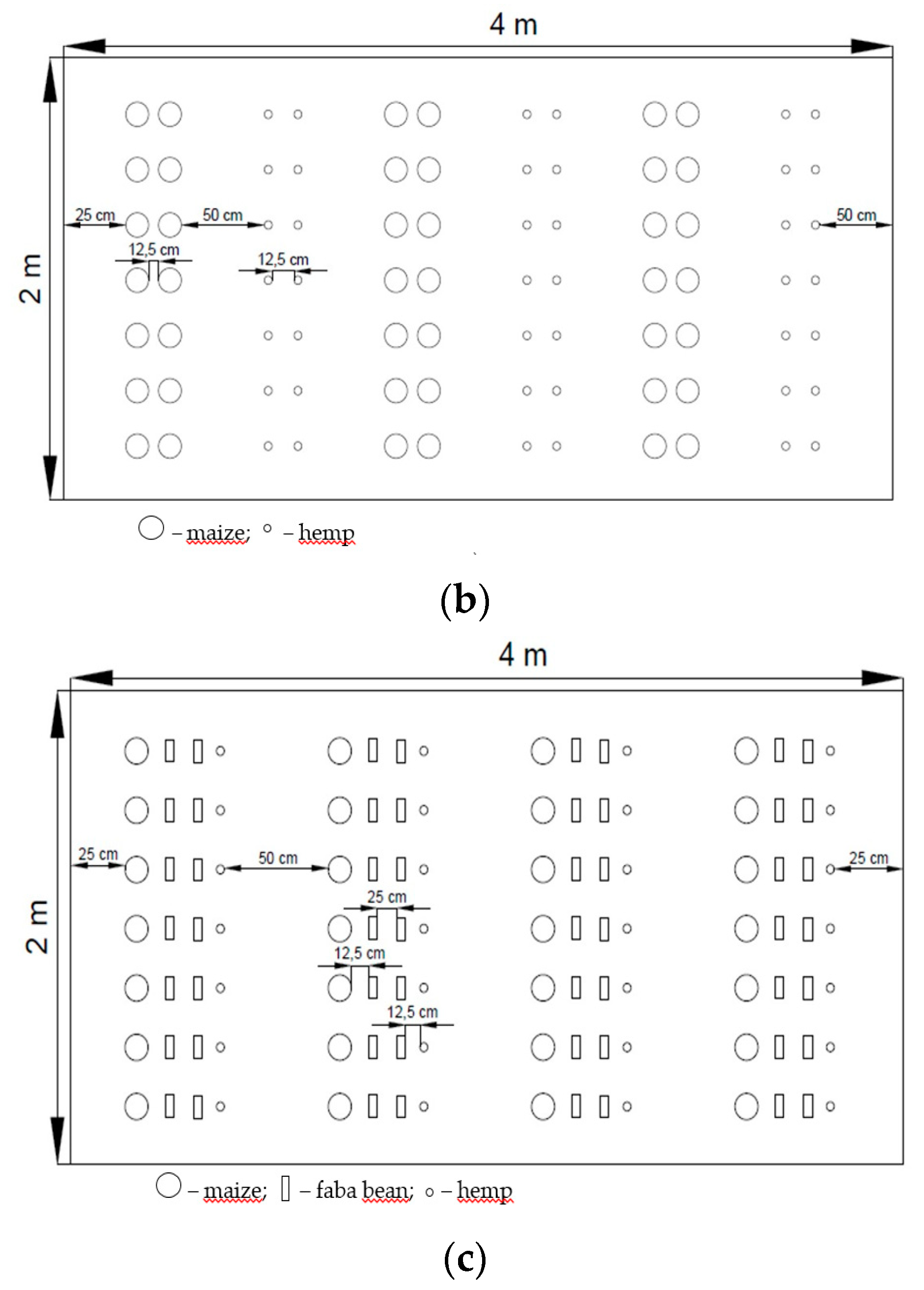

Table 1.
Average air temperatures and precipitation rates. Kaunas Meteorological Station, 2020.
| Months | Average Air Temperatures °C | Precipitation Rates mm | ||
|---|---|---|---|---|
| Monthly | Long-Term | Monthly | Long-Term | |
| April | 6.9 | 6.9 | 4.0 | 41.3 |
| May | 10.5 | 13.2 | 94.4 | 61.7 |
| June | 19.0 | 16.1 | 99.3 | 76.9 |
| July | 17.4 | 18.7 | 60.4 | 96.6 |
| August | 18.7 | 17.3 | 92.8 | 88.9 |
Table 2.
Crop bio-diversity [6].
Table 2.
Crop bio-diversity [6].
| Treatments | Cultivation | Abbreviation |
|---|---|---|
| single crop | maize hemp faba bean |
MA HE FB |
| binary crop | maize + hemp maize + faba bean hemp + faba bean |
MA+HE MA+FB HE+FB |
| ternary crop | maize + hemp + faba bean | MA+HE+FB |
Table 3.
Single and multi-cropping technological operations.
| Technological operation (machinery/depth/material rate)/Treatments | M | H | FB | M+H | M+FB | H+FB | M+H+FB |
|---|---|---|---|---|---|---|---|
| Stubble cultivation (depth 12–15 cm) | o | o | o | o | o | o | o |
| Deep ploughing | o | o | o | o | o | o | o |
| Pre-seeding cultivation | o | o | o | o | o | o | o |
| Fertilization (N45 P45 K45 kg ha−1) | o | o | o | o | o | o | o |
| One-pass conventional seeding of single crops | o | o | o | - | - | - | - |
| One-pass double seeding for binary crops | - | - | - | o | o | o | - |
| Two-passes ternary seeding | - | - | - | - | - | - | o |
| Inter-row loosening (2–3 cm depth) | oo | oo | oo | oo | oo | oo | o |
| One-pass biomass harvesting (low harvester load) | o | - | o | - | o | - | - |
| One-pass biomass harvesting (high harvester load) | - | o | - | o | - | o | - |
| Two-passes biomass harvesting (high harvester load) | - | - | - | - | - | - | o |
Notes: M—maize, H—hemp, FB—faba bean, M+H—maize + hemp, M+FB—maize + faba bean, H + FB—hemp + faba bean, M + H + FB—maize + hemp + faba bean. o—operation performed once, oo—the operation was performed twice.
Table 4.
Seeding rates (kg ha−1) of differently biodiversed cultivations.
| Crop/Treatments | M | H | FB | M+H | M+FB | H+FB | M+H+FB |
|---|---|---|---|---|---|---|---|
| Maize yield | 63.5 | - | - | 68.8 | 90.7 | - | 36.2 |
| Hemp yield | - | 22.3 | - | 14.9 | - | 21.0 | 13.7 |
| Faba bean yield | - | - | 362.9 | - | 397.9 | 369.4 | 375.8 |
Table 5.
Technical indicators of single and multi-cropping operations.
| Technological operation | Machinery power (kW) | Working width (m) | Field capacity (ha h−1) |
Working time (h ha−1) | Fuel consump-tion (L ha−1) |
|---|---|---|---|---|---|
| Stubble cultivation-discing | 102 | 4.00 | 2.21 | 0.45 | 8.2 |
| Deep ploughing | 102 | 1.75 | 0.80 | 1.25 | 24.1 |
| Pre-sowing cultivation | 102 | 7.00 | 4.56 | 0.22 | 6.4 |
| One-pass conventional seeding (single crop) | 45 | 3.00 | 1.41 | 0.71 | 4.0 |
| One-pass double seeding (binary crop) | 67 | 3.00 | 1.31 | 0.76 | 9.8 |
| Two-passes seeding (ternary crop) | 45 and 67 | 3.00 | 0.68 | 1.47 | 13.8 |
| Fertilization | 67 | 14.00 | 16.55 | 0.06 | 0.6 |
| Inter-row loosening | 54 | 3.00 | 1.56 | 0.64 | 4.10 |
| One-pass biomass harvesting (low harvester load) | 250 | 3.00 | 1.82 | 0.55 | 19.19 |
| One-pass biomass harvesting (high harvester load) | 250 | 3.00 | 1.37 | 0.73 | 27.55 |
| Two-passes biomass harvesting | 250 | 3.00 | 0.68 | 1.47 | 46.74 |
Table 6.
Biomass chemical composition.
| Biomass chemical composition | M | H | FB | M+H | M+FB | H+FB | M+H+FB |
| pH | 6.51 | 7.07 | 6.63 | 6.66 | 6.43 | 7.09 | 6.87 |
| Total nitrogen % | 0.92 | 0.64 | 2.12 | 0.84 | 1.48 | 1.22 | 0.98 |
| Available phosphorus % | 0.20 | 0.16 | 0.38 | 0.20 | 0.32 | 0.28 | 0.22 |
| Available potassium % | 1.20 | 0.76 | 0.78 | 0.98 | 1.04 | 0.98 | 0.87 |
Note: M—maize, H—hemp, FB—faba bean, M+H—maize + hemp, M+FB—maize + faba bean, H + FB—hemp + faba bean, M + H + FB—maize + hemp + faba bean.
Table 7.
Energy equivalents in crops biomass production systems.
| Indices | Energy equivalent | Reference |
|---|---|---|
| Inputs: | ||
| Human labour (MJ h−1) | 1.96 | [29] |
| Diesel fuel (MJ L−1) | 56.3 | [29] |
| Agricultural machinery (MJ h−1) | 357.2 | [30] |
| Seed of maize (MJ kg−1) | 16.6 | [29] |
| Seed of hemp (MJ kg−1) | 25.0 | Todde et al., 2022 [31] |
| Seed of faba bean (MJ kg−1) | 21.0 | Kazemi et al., 2015 [32] |
| N (MJ kg−1) | 60.6 | [29] |
| P2O5 (MJ kg−1) | 11.1 | [29] |
| K2O (MJ kg−1) | 6.7 | [29] |
| Outputs: | ||
| Maize biomass (MJ kg−1 dry matter) | 17.7 | [33] |
| Hemp biomass (MJ kg−1 dry matter) | 16.6 | [34] |
| Faba bean biomass (MJ kg−1 dry matter) | 17.0 | [35] |
Table 8.
CO2 equivalents in crops biomass production systems (according Šarauskis et al. [30]).
Table 8.
CO2 equivalents in crops biomass production systems (according Šarauskis et al. [30]).
| Inputs | CO2 equivalent | Reference |
|---|---|---|
| Diesel fuel (kg CO2eq l−1) | 2.76 | [37] |
| Agricultural machinery (kg CO2eq MJ−1) | 0.071 | [38] |
| Seed of maize (kg CO2eq kg−1) | 15.3 | [39] |
| Seed of hemp (kg CO2eq kg−1) | 18.7 | [40] |
| Seed of faba bean (kg CO2eq kg−1) | 0.99 | [41] |
| N (kg CO2eq kg−1) | 1.30 | [20] |
| P2O5 (kg CO2eq kg−1) | 0.20 | [20] |
| K2O (kg CO2eq kg−1) | 0.15 | [20] |
Table 9.
Energy inputs of technological operations and materials in crop biomass production systems, MJ ha−1.
Table 9.
Energy inputs of technological operations and materials in crop biomass production systems, MJ ha−1.
| Inputs | M | H | FB | M+H | M+FB | H+FB | M+H+FB |
|---|---|---|---|---|---|---|---|
| Human labour | 8.8 | 9.2 | 8.8 | 9.4 | 9.0 | 9.4 | 11.0 |
| Diesel fuel | 3980.4 | 4447.7 | 3980.4 | 4774.2 | 4307.0 | 4774.2 | 5815.8 |
| Agricultural machinery | 1607.4 | 1678.8 | 1607.4 | 1714.6 | 1643.1 | 1714.6 | 2000.3 |
| Seed of maize | 1054.1 | - | - | 1142.1 | 1505.6 | - | 600.9 |
| Seed of hemp | - | 512.9 | - | 342.7 | - | 483.0 | 315.1 |
| Seed of faba bean | - | - | 7620.9 | - | 8355.9 | 7757.4 | 7891.8 |
| N | 2727.0 | 2727.0 | 2727.0 | 2727.0 | 2727.0 | 2727.0 | 2727.0 |
| P2O5 | 499.5 | 499.5 | 499.5 | 499.5 | 499.5 | 499.5 | 499.5 |
| K2O | 301.5 | 301.5 | 301.5 | 301.5 | 301.5 | 301.5 | 301.5 |
| Total energy input | 10178.7 | 10176.6 | 16745.5 | 11511.0 | 19348.6 | 18266.6 | 20162.9 |
Note: M—maize, H—hemp, FB—faba bean, M+H—maize + hemp, M+FB—maize + faba bean, H + FB—hemp + faba bean, M + H + FB—maize + hemp + faba bean.
Table 10.
Single and multi-crops dried biomass yields.
| Biomass yields and composition | M | H | FB | M+H | M+FB | H+FB | M+H+FB |
|---|---|---|---|---|---|---|---|
| Total yield kg ha−1 | 4461c | 9038bc | 9811bc | 12197b | 7787bc | 10974b | 22928a |
| Proportion of biomass components | - | - | - | 1:4.1 | 1:1.2 | 1:0.2 | 1:5.3:10.6 |
| Yields of separate components kg ha−1: | |||||||
| Maize yield | - | - | - | 2373 | 3519 | - | 1358 |
| Hemp yield | - | - | - | 9824 | - | 8710 | 7239 |
| Faba bean yield | - | - | - | - | 4268 | 2264 | 14331 |
Notes: M—maize, H—hemp, FB—faba bean, M+H—maize + hemp, M+FB—maize + faba bean, H + FB—hemp + faba bean, M + H + FB—maize + hemp + faba bean. Different letters (a, b, c) mean significant difference between treatments at p ≤ 0.05.
Table 11.
Fuel consumption and energy indices of single and multi-crops biomass production systems.
| Treatments | Diesel fuel consumption L ha−1 |
Energy input MJ ha−1 |
Energy output MJ ha−1 |
Energy efficiency ratio | Energy productivity MJ ha−1 | Net energy MJ ha−1 |
|---|---|---|---|---|---|---|
| M | 70.7 | 10178.7 | 78959.7 | 7.76 | 0.44 | 68781.0 |
| H | 79.0 | 10176.6 | 150030.8 | 14.74 | 0.89 | 139854.2 |
| FB | 70.7 | 16745.5 | 166787.0 | 9.96 | 0.59 | 150041.5 |
| M+H | 84.8 | 11511.0 | 205080.5 | 17.82 | 1.06 | 193569.5 |
| M+FB | 76.5 | 19348.6 | 134842.3 | 6.97 | 0.40 | 115493.7 |
| H+FB | 84.8 | 18266.6 | 183074.0 | 10.02 | 0.60 | 164807.4 |
| M+H+FB | 103.3 | 20162.9 | 387831.0 | 19.23 | 1.14 | 367668.1 |
Note: M—maize, H—hemp, FB—faba bean, M+H—maize + hemp, M+FB—maize + faba bean, H + FB—hemp + faba bean, M + H + FB—maize + hemp + faba bean.
Table 12.
Fuel consumption and energy indices of single and multi-crops biomass production systems.
| Indices/Treatments | M | H | FB | M+H | M+FB | H+FB | M+H+FB |
|---|---|---|---|---|---|---|---|
| Diesel fuel (kg CO2eq ha−1) | 195.1 | 218.0 | 195.1 | 234.0 | 211.1 | 234.0 | 285.1 |
| Agricultural machinery (kg CO2eq ha−1) | 0.32 | 0.33 | 0.32 | 0.34 | 0.33 | 0.34 | 0.40 |
| Seed of maize (kg CO2eq ha−1) | 971.6 | - | - | 1052.6 | 1387.7 | - | 553.9 |
| Seed of hemp (kg CO2eq ha−1) | - | 417.0 | - | 278.6 | - | 392.7 | 256.2 |
| Seed of faba bean (kg CO2eq ha−1) | - | - | 359.3 | - | 393.9 | 365.7 | 372.0 |
| N (kg CO2eq ha−1) | 58.5 | 58.5 | 58.5 | 58.5 | 58.5 | 58.5 | 58.5 |
| P2O5 (kg CO2eq ha−1) | 9.0 | 9.0 | 9.0 | 9.0 | 9.0 | 9.0 | 9.0 |
| K2O (kg CO2eq ha−1) | 6.8 | 6.8 | 6.8 | 6.8 | 6.8 | 6.8 | 6.8 |
| Total GHG emission (kg CO2eq ha−1) | 1241.32 | 709.63 | 629.02 | 1729.84 | 2067.33 | 1067.04 | 1541.90 |
Note: M—maize, H—hemp, FB—faba bean, M+H—maize + hemp, M+FB—maize + faba bean, H + FB—hemp + faba bean, M + H + FB—maize + hemp + faba bean.
Disclaimer/Publisher’s Note: The statements, opinions and data contained in all publications are solely those of the individual author(s) and contributor(s) and not of MDPI and/or the editor(s). MDPI and/or the editor(s) disclaim responsibility for any injury to people or property resulting from any ideas, methods, instructions or products referred to in the content. |
© 2023 by the authors. Licensee MDPI, Basel, Switzerland. This article is an open access article distributed under the terms and conditions of the Creative Commons Attribution (CC BY) license (https://creativecommons.org/licenses/by/4.0/).
Copyright: This open access article is published under a Creative Commons CC BY 4.0 license, which permit the free download, distribution, and reuse, provided that the author and preprint are cited in any reuse.


