
Submitted:
16 August 2023
Posted:
21 August 2023
You are already at the latest version
Abstract
With the development of information technology and the wide application of building information modelling technology, the construction industry continues to make digital changes. Managers are trying to apply smart construction site management to promote the upgrading of production modes. We used CiteSpace software to analyze 1707 articles from China National Knowledge Infrastructure, Web of Science and Scopus to understand the current research hotspots of global scholars in this field. Results show that: (1) The number of studies on smart construction sites increases rapidly by year. Researchers from China, America and the UK have the most influential studies. (2) The cooperation between researchers and institutions is not close enough. In addition, the directions of research in the field are still scattered; (3) Chinese scholars are good at building intelligent platforms and evaluating intelligent systems from multiple perspectives. International scholars are willing to pursue technological innovation, allowing the continuous development of intelligent construction technology. (4) The applications in this field have not been popularized despite relatively perfect technology and typical cases. Future scholars should gradually improve the theoretical basis and industry standards of smart construction sites, promote the development of intelligent construction technology and establish the evaluation standards of qualified smart sites. This study will provide scholars in this field with the theoretical basis and research directions for further in-depth research, help construction companies to understand the development status and trend of smart construction sites and accelerate the intelligent transformation of construction companies.
Keywords:
smart site
; research hotspots
; research trend
1. Introduction
Since 2013, all walks of life have vigorously promoted the development of the Internet. Then, with the development of intelligent technology and the continuous follow-up technology of the construction industry, the concept of ‘intelligent construction’ has gradually gained popular support. In addition, the concept of an ‘intelligent construction site’ has come into being. Dongjian Guo interpreted ‘Smart construction site’ in the ‘2015 China Construction Industry Annual Summit’. ‘Smart construction site’ is the realization of ‘Smart Earth’ and ‘Smart City’ in the engineering industry and is a brand-new concept of the whole-life cycle management of engineering. A smart construction site system is a seamless networking system of sensors, displays and computing components, with embedded intelligence and advanced digital applications [1].
With the continuous reformation of construction technology, the development processes of intelligent construction and smart site technology are disparate in different countries. For example, in 2007, the USA stipulated that all important engineering projects should use building information modelling (BIM) technology to achieve low-carbon and green development. In 2017, the government released the Strategic Plan of the United States Infrastructure Reconstruction, which focused on the construction process. Japan formulated the ‘i-Construction’ strategy and set development goals for the construction industry, which aimed to improve the quality, safety and efficiency of construction products. The specific goals were ‘By 2025, the productivity of construction sites will be increased by 20%’, ‘By 2023, the number of accidents caused by internal causes will be reduced to zero’ and ‘The process of construction and production will be fully integrated with three-dimensional data’. In 2015, Germany released the ‘Digital Design and Construction Development Roadmap’ and proposed the path for the transformation of construction, operation and digital design in the field of engineering construction. Under the background of Industry 4.0, the industry pioneers should vigorously promote the digital upgrading of the construction industry and the deep integration of industrialization and information in the field of construction. In 2021, China issued the notice ‘List of Replicable Experiences and Practices for the Collaborative Development of Intelligent Construction and New Building Industrialization (the first batch)’ [2], which included smart construction sites. According to the intelligent development strategy of the construction industry released by various countries, the ‘intelligent construction site’ is the hotspot of the construction industry at present. When scholars discussed the research status of smart construction sites, they also seek deeper solutions for related policy issues, promote high-quality development of the construction industry and solve problems faced by the traditional construction industry.
From the angle of the technology, equipment and system of intelligent construction, scholars combined the development of smart construction sites with the most advanced and suitable theory. China National Knowledge Infrastructure (CNKI) is the largest database in China at present. Web of Science and Scopus cover almost all the most comprehensive and authoritative scientific literature in the world. We find that the research in the field of ‘intelligent construction sites’ still needs to be further explored by collecting and collating the literature on smart construction sites in these three databases. Thus, clarifying the current research hotspots and future development trends is necessary. Therefore, this study uses CiteSpace software to carry out a visual analysis on the theme of ‘smart construction site’ from 2000 to 2022 to provide a relevant reference for further research in this field.
2. Literature Review
In the last decade, scholars have introduced further emerging technologies in the construction industry, such as cyber-physical systems [28], robot technology [31], and BIM+GIS [33] and et al. Although intelligent construction technology has been deeply rooted amongst scholars in this field, the concept of a ‘smart construction site’ has not yet formed a system. Scholars discussed digitalisation in the Architecture, Engineering, and Construction (AEC) industry in terms of Industry 4.0 and/or Construction 4.0. For example, Alaoul [30] indicated that Industry 4.0 can be described as the trend towards digitalisation, automation, and widespread use of information and communication technologies in the AEC industry. Hallward and Nayyar [67] believed that Industry 4.0 is to digitise industrial processes to accomplish an adaptive yet extensive production and services network. As for the research on a ‘smart construction site’, many outstanding studies already exist. Scholars mainly focused on the innovation of intelligent site technology, the establishment of smart site platforms, and the invention of intelligent construction equipment and system.
In terms of technology innovation and platform construction, Haitao Wang [3] applied green exploration technology to the Xiongan geothermal well smart site. Danyang Wang [4] took 5G + NarrowBand-Internet of Things (IoT), low-speed and narrow-broadband technology as the research focal point to analyse its innovation application in the intelligent construction site. Edirisinghe [5] believed that construction sites would achieve behavioral awareness and intelligent embedding by integrating hardware components, communications technology and software in the future, including the question of the platform benefit. For example: Hong Xu [6] constructed the benefits model of the urban construction smart site supervision system. Dingfei Du built the evaluation model of construction sites benefiting from elaborating the application cost of smart sites.
The research of intelligent construction equipment and system mainly included data collection, on-site monitoring and risk early warning. For example, Natalya Pugacheva [8] simulated a virtual construction site that can maintain residential buildings. Kanan [9] built an autonomous safety system for construction workers with the functions of collecting data, real-time alarm and monitoring. Lee and Park [10] used a stereo camera system to track people within visual range.
CiteSpace software is used to carry out a visual analysis of this field, including the number of papers published, journal sources, authors, keywords and development trends, to obtain comprehensive scientific conclusions.
3. Research Method and Data Source
3.1. Research Method
CiteSpace software is a kind of software for graph analysis, developed by Chaomei Chen. This software mainly uses the visualisation method of spatial morphology to carry out visual analysis on the research hotspot, knowledge structure, development process and distribution, development trend and others in the subject field [11]. Now, although this software is rarely used in the construction industry, this study uses CiteSpace software to measure and visually analyse the related research results of smart construction sites to analyse the research hotspot and future trends of smart construction sites.
In this study, ‘smart construction site’ and ‘digital construction site ‘are mainly based on CNKI, Web of Science and Scopus. The timespan is from January 1, 2000, to November 5, 2022. Finally, a total of 1707 bibliographic data are collected.
3.2. Data Source
The key word ‘smart construction site’ was searched on CNKI, Web of Science and Scopus. The number of publications in the recent 10 years was analysed, as shown in Figure 1.
Figure 1 shows that the number of related articles has been increasing in the past decade. In 2017, 75 articles were published by CNKI, 71 by Web of Science and 38 by Scopus. In addition, the number of articles published by CNKI and Web of Science has doubled compared with 2016. After 2017, the number increased rapidly. Through analysis, with the extensive development and application of information technology in construction engineering and management, construction sites are undergoing a rapid digital revolution and change [1]. In the future, ‘smart site’ will become a hot topic in the field of construction. Therefore, the research hotspots and development trends in this field should be clarified.
We comprehensively analysed 610 articles in CNKI and 482 articles in Web of Science to obtain Figure 2.
Figure 2 shows that, in China, Informatisation of China Construction has published 115 relevant papers, which is the periodical with the largest number of articles in the field of smart construction sites. Second, Construction Enterprise Management has published 64 papers, Intelligent Building & Smart City has published 57 and Building has published 46. The publication volume of these four journals accounted for 46%; Amongst English journals, Automation in Construction published 30 articles with the highest number of publications, Sustainability published 24 articles, Applied Sciences-Basel published 20 articles and Sensors published 19 articles. Most of these journals belong to Q1, which shows the importance of ‘smart construction site’ in the construction field.
4. Basic Analysis of ‘Smart Construction Site’ Research
Keywords are the condensed concepts of themes. Scholars can determine the research hotspots in a certain field based on the keywords [12]. In this study, core papers are selected from CNKI, Web of Science and Scopus databases for analysis. Based on the keyword analysis of a smart site, this study obtains the research hotspots each year and carries out the clustering analysis to obtain the keyword clustering table in Chinese and English.
Table 1 presents the current keywords for smart site research, which can be divided into three categories: smart technology research, smart platform construction and smart system evaluation. The research of intelligent technology includes #1 Internet +, #2 IoT, #6 intelligent equipment, #2 smart technology, #5 real-time interoperation, #6 IoT and #8 smart helmet. The construction of smart platforms includes #3 supervision platform, #4 construction site, #5 joint modelling, #1 smart contract and #3 on-site construction quality inspection. The evaluation of an intelligent system includes #8 factors and #4 text analysis.
4.1. Author and Kkeyword Centrality Analysis of CNKI
4.1.1. Author Analysis
A total of 610 papers about smart construction site research results from CNKI were analysed by author cluster analysis to obtain the literature author cluster analysis diagram, as shown in Figure 3. The number of nodes is 168, the number of lines between keywords is 154 and the density of the network is 0.011.
Figure 3 shows that Chunyuan Liu, Donghai Liu, Jiankui Li and Hui Li have published considerable research with great influence. Amongst them, Chunyuan Liu, Jiankui Li and Hui Li have a high degree of cooperation. Those scholars’ research direction is the application of smart site technology based on BIM, including construction technology, management and system design. They combined the IoT, cloud computing, big data and other new generation of information technology, trying to change the traditional construction site management of interaction, working mode and management mode. [13].
4.1.2. Keyword Centrality Analysis
A total of 610 Chinese articles were retrieved with the keyword ‘smart construction site’, and CiteSpace software was used for the analysis of keyword centrality in Chinese literature.
Table 2 shows that ‘safety management’, ‘construction site’, ‘Internet of Things’, ‘intelligent construction’ and ‘constraints’ are the top 5 high-frequency keywords. Then, ‘safety management’, ‘Internet of Things’, ‘informatization’ and ‘construction management’ are the top 4 high-centrality keywords. On this basis, Chinese scholars are inclined to theoretical research. Based on the theory of smart sites, combined with IoT, information technology and BIM, scholars explored intelligent technology, the construction of intelligent platforms and the evaluation of smart site management systems, which greatly promotes the development of a smart site system.
In terms of the intelligent technology research, Yaowu Wang [14] introduced the basic knowledge of smart sites for the first time, summarised the latest related technologies and summarised the latest content of applications and methods. Yin Wang [15] integrated BIM and information technology to construct the L3 level data base plate, and realized fine management of the construction schedule based on components. Qingping Luo [16] supervised the elements of ‘human, machine, material, law and environment’ in the construction process in real time through the front-end perception technology of the IoT and the digital twin technology of ‘BIM+GIS’. Despite existing research on intelligent technology in the Chinese literature, the research content is relatively simple and common, lacking innovation.
In terms of the construction of an intelligent platform, Wei Du [17] integrates the IoT, cloud computing, big data and BIM to build a ‘smart site platform based on BIM’, which is suitable for the whole life cycle of buildings. Baolong Zhang [18] explored the application of an intelligent construction visualisation platform based on BIM+IoT technology. Xia Li [19] introduced geographic information technology and IoT, cooperating with video surveillance and GPS vehicle positioning, to establish a comprehensive supervision platform for intelligent construction sites. Now, the scale of smart sites is increasing in China. The smooth application of smart construction platforms shows that the research on smart site platforms in China is gradually maturing. However, some problems still exist, such as high construction costs, few technical personnel and a lack of industry standards [20].
In terms of the evaluation of the smart site system, Qiangnian Li [21] built a model through DEMATEL and ISM methods to clarify the hierarchical relationship amongst various constraints on the construction of smart sites, and to determine the key factors that restrict the development of smart sites. Meishan Jia [22] applied the ISM+AHP method to identify the hierarchical relationship and influence amongst the factors and proposed suggestions for the factors with high influence. Jiaxin Liu [23] explored the evaluation of smart construction sites. Although Chinese literature has made some achievements in the systematic evaluation of smart sites, an authoritative, scientific and reasonable smart site evaluation system is not yet formed.
4.2. Author and Keyword Centrality Analysis of Web of Science
4.2.1. Author and Country Analysis
In this study, a total of 482 international core journals on the Web of Science are analysed by author cluster, and Figure 4 is obtained. In this figure, the number of nodes is 587, the number of connections between keywords is 1193 and the network density is 0.0069. This result indicates that under the condition of several network nodes and node connections, the cooperation density of authors is not high.
Figure 4 shows that Heng Li, Jochen Teizer, Geoffrey Shen and six other scholars published further core journals and had greater influence but with few node connections. This case indicates that the six scholars completed fewer studies together. In addition, a high centrality node, namely Xiao Li and Geoffrey Shen, is also found in the network. This node occupies high centrality and high frequency, indicating that the two scholars have cooperated and achieved remarkable research results, which have exerted a certain influence on the development and evolution of smart construction sites.
Table 3 shows the analysis of countries and regions.
As shown in Table 3, Chinese scholars have published 131 papers, far more than other countries. China is currently the global leader in this field of research, followed by South Korea, the United States, the United Kingdom, Australia, Italy and other developed countries that have done research on smart sites.
4.2.2. Centrality Analysis of Keywords
The 482 core papers with the keywords ‘smart construction site’ and ‘intelligent construction site’ are analysed using CiteSpace software.
In Table 4, the system, model, design and management are the top 4 high-frequency keywords, indicating that scholars have made relatively mature research. In addition, the centrality of constructions, models and design is relatively high. These keywords have built a bridge between the implementation of intelligent building technology and management research in the field of construction management.
From the centrality distribution of keywords, it can be seen that the construction industry scholars all over the world are making efforts to introduce additional emerging technologies. In terms of the research on intelligent technologies, Jayasree, V. [24] constructed an intelligent helmet that can monitor the behavior of construction workers. Song Wang [25] built a real-time construction simulation model to predict the factors of temperature in flood dam engineering. Lee Jongse [26] constructed an efficient digital twin space through 3D modelling to reduce the accident rate of the construction site and to shorten the construction period. El Sayegh [27] explored the application of 3D printing technology in the construction industry and analysed the benefits, challenges and risks of the technology. Compared with the Chinese, the international literature covered a wider and more comprehensive aspect of intelligent technology research, including not only the new technology of intelligent construction but also the research of intelligent helmets, forecast temperature simulation models, and other intelligent equipment. The entry point of the international literature research is more challenging and innovative, providing a strong technical support for the progress of the intelligent site system.
In terms of intelligent platform construction, Jiang [28] put forward a site safety management system based on a network physics system. Štefaniˇ c and Mtankovski, V [29] identified and summarised emerging intelligent applications, including construction site management, construction monitoring, early warning and resource and asset management. With the continuous development of intelligent construction technology, the global smart site platform has been used. Compared with the Chinese, it can be seen that the international literature lacks the evaluation of the operation and management, the feasibility evaluation of the smart construction technology and the smart site platform. Furthermore, the research results on the factors hindering the development of smart sites are also few.
4.3. Author and Keyword Centrality Analysis of Scopus
4.3.1. Author and Country Analysis
Scopus is the largest abstract and citation database in the world, covering 15,000 scientific, technical and medical journals. Therefore, the articles retrieved by Scopus can provide a broad understanding of the basic knowledge in the field of smart construction sites and intelligent construction. Figure 5 depicts the visualisation analysis of Scopus.
As shown in Figure 5, the authors with many publications are Li H., Edward D. J. and Zavadskas E. K., with a total of more than 60 publications. Amongst the top 10 authors, five are from China.
The study obtained Figure 6 by analysing the number of publications in various countries and regions.
In Figure 6, China ranks first in the research of this field, with more than 14,000 papers published. The United States follows, with nearly 13,000 papers published. In addition, the United Kingdom, Australia, India, Germany, Italy, Canada, Spain and South Korea, the major construction countries, also publish a relatively high number of papers.
4.3.2. Keyword Centrality Analysis
The paper analyzed 615 core papers in Scopus to obtain Table 5:
As shown in Table 5, project management, smart city, architectural design, IoT and sustainable development are the top high-frequency keywords. The centrality scores of the construction industry, project management, survey and automation are relatively high. Therefore, the papers from Scopus are mainly about intelligent technology. Based on the relatively mature theories of information technology, IoT and BIM, intelligent construction technology is constructed and applied to the construction site.
In terms of intelligent technology, Alaoul [30] believed that intelligent construction technology in Germany can make use of information and communication technology to digitise and automate the construction industry under the trend of ‘Industry 4.0’. Edirisinghe [5] studied the technology of smart construction sites by integrating hardware components, communication technology and applications. Stumm S. [31] used haptic programming to assist in building assembly on site with robots. Chen [32] has built a model of the construction site and a technical framework based on mobile computing technology for site information management. Irizarry [33] integrated BIM and GIS, which are used to track the status of the field material supply procurement. The entry point of intelligent technology research is highly novel and challenging. International scholars keep up with the development of intelligent technology, timely explore further advanced technology and apply it to the construction industry.
In terms of intelligent platform construction, Han [34] created a BIM model and point cloud model of material classification, generated a construction material library and finally performed the efficient classification and sorting of on-site materials; Pradhananga [35] used GPS to collect and record the operation data of the equipment at the site and analysed it on the software platform to realise the automatic evaluation of equipment operation. The Sheffield team [36] developed a platform for intelligent design, monitoring and operation. The research on the construction of intelligent platforms is detailed. Different from the overall control of the intelligent platform by Chinese scholars, international scholars start from construction equipment, construction materials and construction site and explore management technology point-to-point but lack a scientific and unified system to integrate various platforms.
In addition, international scholars have studied the economic benefits of smart site systems. For example, De Soto [37] compared the time and cost of traditional construction and automatic construction of complex concrete walls on site. He concluded that the digital construction method has great economic benefits for complex structures. Barlish [38] constructed an input-output model to measure the benefits of the projects when using or not using BIM. The international literature paid attention to the economic benefits of intelligent systems, and made qualitative and quantitative analyses on the effect of technology application.
5. Development Trend of Smart Construction Site
5.1. Evolution Analysis of Chinese Literature Keywords
The study used CiteSpace software to analyse the articles from CNKI. Figure 7 and Figure 8 were obtained.
Figure 7 and Figure 8 show that since 2015, informatisation and project management have been the main research terms. Since 2017, the supervision platform, construction industry, artificial intelligence (AI) and IoT have been the main research keywords. In 2019, application research and construction site are the key words. In 2020, wisdom is the key words. From 2015 to 2022, the research hotspot of smart sites is constantly updated, and several articles have been produced to promote the development of this research field. From these keywords, the relevant technologies of the smart site system are gradually mature. However, with the rapid development of smart sites, few scholars have discussed the influencing factors for smart site development. According to the ‘China construction industry information development report (2017)’, the application of smart sites is concentrated on key projects and complex projects with high difficulty. General construction projects rarely apply smart sites [39]. Many sites are only equipped with face recognition, vehicle registration system or the visualisation of employee information, which they claim to be a ‘smart site’. Its degree of wisdom and other sites have not yet a substantial distinction.
According to graph analysis, the overall research trend of smart site can be divid-ed into two stages: the early stage (from 2015 to 2017) and the rapid development stage (from 2017 to now).
- The early stage (2015 to 2017) -- the exploration stage
In 2015, with the deep exploration of informatisation in the construction industry and the explosive development of IoT, project managers continue to explore the use of new technologies to transform the traditional construction management mode and put information construction into practical application. Therefore, the construction of a smart site management platform has become a breakthrough to accelerate the digital transformation of engineering projects [40]. In the ‘13th Five-Year Plan’ period, China focuses on improving the level of information technology and strengthening cloud computing, IoT, intelligence, mobile communication, BIM, big data and other integration application capabilities [41]. At this stage, scholars have proposed the concept of informatisation project management. For example, in 2013, the concept of smart construction was first proposed by Baoming Yang, the chairman of Luban Software Company. He believes that smart construction has two meanings, one is the harmonious development of industry, and the second one is to equip the industry with an advanced digital nervous system. Gang Liu [42] summed up the smart site as the product of perception, interconnection, IoT and intelligence. Ziyu Ying [43] conceived to build a platform of smart site through the most cutting-edge technology, to achieve automatic license plate recognition at the site entrance and exit, high-definition capture, tower crane bird’s eye view of the site and other functions.
- 2.
- Rapid development stage (from 2017 to now) -- the development of technologies
Since the 18th National Congress of the Communist Party in China, the transformation of the construction industry has been further accelerated. The government has emphasised the need to shift from the traditional development mode to the scientific development road of green construction, intelligent management and information management [44]. The national policy requires continuous improvement of the information and intelligence level to improve the ability to manage and control the construction project. Therefore, the combination of the construction site and the Internet has achieved unprecedented development at this stage. ‘Artificial intelligence’, ‘robots’ and ‘cloud platforms’ are constantly applied in the construction site. Informationisation, intelligentisation, visualisation and digitalisation have gradually become synonymous with innovation in the construction industry. For example, Yuguang Zhou [45] discussed the problems and practical needs of project management informatisation and discussed the project management informatisation construction scheme model and its positive significance. Most scholars in China are committed to studying the construction of intelligent site platforms based on IoT and BIM and pay attention to the application of construction sites, such as highway projects, sub-way projects and sponge city construction. Hongling Sun and Jie Pi [46] made use of ‘Internet +’ to promote the transformation and upgrading of the construction industry. Zhiwei Zhang [47] took the construction of the Beijing Metro Line 19 as an example to introduce the pile foundation construction schedule management method based on the BIM+ smart site platform, which replaced the traditional management method with modern management means. Ningshuang Zeng [48] proposed the smart site management system framework based on BIM and built the operating mechanism of the intelligent constructed site with multidimensional information and dynamic decision-making.
In addition, at this stage, scholars began to pay additional attention to the quality of the project through the establishment of an intelligent database, the construction of a monitoring system and setting up risk identification. For example, Na Chen [49] analysed the problems of smart city transportation, such as unreasonable road planning and imperfect bus system. Then, she combined with AI to propose solutions. Yu Han [50] introduced the concept of smart earth and smart city into construction management to further clarify the characteristics of the smart site. Jianchen Huang [51] designed the system architecture of the smart site management platform around the supervision requirements of the project construction site.
From the above analysis, despite many typical cases of smart construction sites in China [52], the smart construction technology lacks innovation, and the scope of the application has not been popularised [53]. Many cities have just started to set up pilot units of a ‘smart site’. The popularity of a ‘smart site’ amongst construction workers is not high. The degree of wisdom in the construction site is not deep [54]. Therefore, scholars should pay attention to the popularisation of smart construction sites and the research on the constraints of development in this field when studying new technology and new platform.
5.2. Evolution Analysis of Keywords in the English Literature
The study obtained Figure 9 and Figure 10 through the analysis of articles from Web of Science and Scopus.
As shown in Figure 9 and Figure 10, the research development trend of the international literature is generally from the early exploration of concept to the continuous combination with intelligent technology, which included design, construction, application and technical improvement of the intelligent construction system. According to the graph analysis, the overall research trend of the international literature can be divided into two stages: the early stage (from 2000 to 2015) and the rapid development stage (from 2015 to now).
- The early stage (2000-2015)
International researchers did not directly propose the concept of a ‘smart site’ through the analysis. They mainly discussed ‘digital design’ [55], ‘digital fabrication’ [56,57] and ‘digital construction’ [58]. Developed countries started the informatisation and intelligentisation of construction sites earlier. As early as the 1980s, CIM, a new management model in the manufacturing industry, was introduced into the construction industry, resulting in the idea of Computer Integrated Construction. In 2001, the Stanford University Facility Integration Engineering Center CIFE proposed the Virtual Design and Construction theory for the first time, which is believed to be the direction of future construction informatisation research and development [23]. Tetik [59] proposed direct digital construction according to the DDM mode in the manufacturing industry. He believed that under the concept of DDC, process efficiency and automation can be realised by updating the design model information in each stage of the entire building life cycle.
The first literature on a ‘smart construction site’ was collected by Web of Science in 2009. At that time, scholars studied the contents of ‘information management’, ‘construction activity’ and ‘computer vision’. With the development of the information age, the construction industry is also changing with the changes. Construction is also developing in the direction of intelligence and refinement. Scopus first included relevant literature in 2005. Early scholars tried to integrate ‘wireless communication’ and ‘artificial intelligence’ into the ‘construction industry’. For example, Youngsoo J. [60], a South Korean scholar, evaluated and analysed the level of building informatisation in South Korea from three aspects: infrastructure, technical support and software application as early as 2004. Around 2010, ‘computer vision’ was gradually included in the research by scholars. In 2013, Porwal [61], a Canadian scholar, conducted a survey on the use of information technology amongst construction workers, project managers and suppliers. Then, he concluded the main obstacles facing the informatisation of the construction industry in Alberta at that time, including managers’ reluctance to consider innovative technologies for building, users’ lack of professional technical training, low market demand and low company budget.
- 2.
- Rapid development stage (2015 to date)
Around 2015, the application of BIM has been developed. Project managers implant network applications, visual management, virtual reality and other high-tech technologies in the management of the construction process. This process saved various cost resources and made the management more economical, efficient and convenient. Managers finished a visualisation, data-oriented and humanised process control network, which realised the seamless integration of the process management and the construction site [21]. In 2015, the demand for ‘safety’, ‘tracking’ and ‘recognition equipment’ increased, and the concept of ‘smart construction’ gradually became popular. Currently, the construction industry is experiencing explosive contact with new concepts, new technologies and new methods. Smart construction has become a hot research direction [15].
After 2015, scholars paid additional attention to the problems generated in the process of technology application. Matarneh [62] and other scholars believed that solving the problems of building information parameterisation, information sharing and workflow lies in reducing energy consumption and improving industry efficiency. Khodeir [63], an Egyptian scholar, believed that the key factors limiting the use of BIM in building informatisation in Egypt are: few competent companies to cooperate with, lack of technical talents, lack of education and training, lack of willingness to use and high cost. Tao Cheng [64] proposed a framework to achieve the goal of providing enhanced situational awareness to workers, equipment operators and decision-makers by learning from the most advanced technologies in the field of real-time data collection and visualisation. Maozeng Xu [65] proposed a comprehensive framework for intelligent technologies and a blueprint for intelligent construction sites in HSE management. Petar Kochovski [66] used a fog reduction computing and brokerage platform to address the need for flexible use of AI in construction projects.
To sum up, international research in the field started earlier, but no clear concept of a ‘smart site’ has been put forward. In terms of research content, scholars are inclined to adopt technological methods and theories to study intelligent construction and constantly improve the platform. Similar to Chinese research, research on the popularisation of smart sites and the influencing factors of development is still lacking.
5.3. Analysis of Future Rresearch Trends
Scholars should conduct future research in the field of smart sites from the following aspects based on the above analysis of the research hotspots and trends:
- (1)
- Gradually improve the theoretical basis and industry standards of smart site
The concept of a ‘smart site’ is mostly put forward by industry pioneers according to their own research directions, but the existing concept is too scattered. Therefore, a unified, authoritative and scientific definition of ‘smart site’ is urgently needed. With the continuous development of the construction industry, the scale of intelligent construction continues to expand, the number of smart sites continues to rise and the project manager’s demand for smart sites is growing. The construction industry needs a unified standard for smart sites, such as the functions of qualified smart site systems and the requirements of hardware and software configuration.
- (2)
- Promote research and development of intelligent construction technology and improve the construction of smart site platform
In the research and development of intelligent construction technology, most of the current research results are combined with BIM. The content of the research is relatively simple and common and lacks innovation. In the construction of intelligent platforms, professional technical personnel and scientific system to integrate various platforms are lacking. Therefore, scholars need to strengthen the innovation of intelligent construction technology. CPS technology integrated into construction information, automation engineering machinery technology, construction robot technology, computer vision technology and mobile computing technology can be introduced. Multiple technology integrations, such as designing an intelligent technology integration system to achieve multi-technology, multi-function comprehensive application and unified management, may also be used.
- (3)
- The establishment and improvement of intelligent site evaluation standards
Enterprises urgently need the government to put forward the standard for smart sites to realise the standardisation and process-based construction of the smart site system. The standard is used to evaluate the eligibility or level of smart site construction and ensure the effectiveness of the smart site investment. At present, despite existing studies on the evaluation system of smart site construction, no authoritative, scientific and reasonable evaluation system exists yet. Therefore, the relevant departments should start from the construction objectives of the smart site, combine the economic and social benefits and establish a complete, scientific and practical smart site evaluation standard.
6. Conclusions
The study makes a visual analysis of the smart site literature from CNKI, Web of Science and Scopus based on CiteSpace software analysis. This study will provide references in future research directions through the study of authors, publication sources, keywords and development trends. The following conclusions are drawn from the aspects of research literature statistics, research hotspot distribution and research trend analysis:
- (1)
- The number of published articles in the field continues to increase. Based on the number analysis of articles published by CNKI, Web of Science and Scopus, the year 2017 is the turning point year in the field of ‘smart site’. After 2017, the number of articles continues to rise, and ‘smart site’ will become a hot research field in the future.
- (2)
- The cooperation between different researchers and institutions is not close enough. According to the results of the collaborative network analysis, although some authors have published many relevant papers, the infrequent cooperation amongst these authors indicates that the current global research on smart sites is still scattered and in the early stage.
- (3)
- The research points of ‘smart site’ are innovative, challenging and of high research value. By analysing the centrality of key words, the key words with high centrality in Chinese literature are ‘safety management’, ‘Internet of Things’, ‘informatisation’ and ‘construction management’. Chinese scholars are good at exploring intelligent technology, building intelligent platforms and evaluating intelligent systems from multiple angles with the support of theories. The high centrality key words in Web of Science are ‘construction’, ‘model’, ‘design’ and ‘site’, and those in Scopus are ‘construction industry’, ‘project management’, ‘survey’ and ‘automation’. In addition, the research time of the English literature is published earlier, and international scholars are willing to pursue technological innovation.
- (4)
- In China, relatively complete smart construction technology and typical smart construction site cases have appeared. However, the studies of smart construction technology still lack innovation, and the scope of the application of smart construction sites have not been popularised. Foreign scholars are good at using advanced methods and theories to study intelligent construction and constantly improve the intelligent construction platform. However, no unified and mature concepts to explain a ‘smart construction site’ and no scientific evaluation system to evaluate the construction qualification or the satisfaction of use exist. In the future, research trends are suggested from the following aspects: gradually improve the theoretical basis and industry standards of smart construction sites, promote the research and development of smart construction technology and improve the construction of smart construction platforms, the establishment and the perfection of smart construction site evaluation standards.
With the extensive application of the IoT, AI, BIM and computers in the construction field, the construction industry is about to enter the next generation—the era of digital construction sites and intelligent construction. New problems will constantly arise in the smart site system. The construction industry needs to create constantly new technologies and methods to improve the quality and efficiency of project management. This study analyses the research hotspots and future research trends of smart sites, which will provide some theoretical basis and research ideas for subsequent researchers and certain theoretical supports for the further development of smart sites.
Author Contributions
Conceptualization, T.W.; methodology, T.W.; software, T.W.; formal analysis, Y.Z. and T.W.; investigation, T.W.; resources, Y.Z. and T.W.; data curation, T.W.; writing—original draft preparation, T.W.; writing—review and editing, T.W.; visualization, Y.Z.; supervision, L.L.; project administration, Y.Z.; funding acquisition, L.L. All authors have read and agreed to the published version of the manuscript.
Funding
The work was funded by the National Natura Science Foundation of China (Grant NO. 72201188) and the Project of Housing Construction Department of Jiangsu Province (Grant NO. 2018ZD165).
Data Availability Statement
The data presented in this study are available on reasonable request from the corresponding author.
Conflicts of Interest
The authors declare no conflict of interest.
References
- Liu, H.; Song, J.; Wang, G. A Scientometric Review of Smart Construction Site in Construction Engineering and Management: Analysis and Visualization. Sustainability 2021, 13, 8860. [Google Scholar] [CrossRef]
- List of replicable empirical practices for Synergistic development of intelligent construction and new building industrialization (first batch). Architecture 2021, 18–19. (In Chinese).
- Wang H., T. Application of green exploration technology in smart construction site of geothermal well in Xiongan. Energy and Energy Conservation 2022, 175–178. (In Chinese).
- Wang D., Y.; Li X., W. Innovative application of 5G+NB-IoT technology in smart construction sites. Proceedings of the 8th National BIM Academic Conference. 2022, 96-100. (In Chinese).
- Edirisinghe, R. Digital skin of the construction site Smart sensor technologies towards the future smart construction site. Engineering Construction and Architectural Management. 2019, 26, 184–223. [Google Scholar] [CrossRef]
- Xu, H. Benefit Evaluation of Urban Construction site Intelligent supervision System. Beijing University of Posts and Telecommunications, 2020. (In Chinese).
- Du D., F. Cost and Benefit Analysis of Smart Construction Site. Southeast University,2021. (In Chinese).
- Natalya Pugacheva, Marat Badrutdinov, Svetlana Kashina, Lyaylya Yarullina, Reda Farah, Tatyana Kirillova and Aleksandr Lunev. Organization of Training in Construction Technological Processes Based on Digital Resources. IOP Publishing Ltd.960 022042.
- Kanan, R. , Elhassan, O. and Bensalem, R. (2018), “An IoT-based autonomous system for workers’ safety in construction sites with real-time alarming, monitoring, and positioning strategies”, Automation in Construction, Vol. 88, pp. 73–86. [CrossRef]
- Lee, Y.J. and Park, M.W. (2019), “3D tracking of multiple onsite workers based on stereo vision”, Automation in Construction, Vol. 98, pp. 146–159. [CrossRef]
- Chen, M.; Zhu J., W. Research Hotspot and evolution trend of Chinese Project management Based on Knowledge Graph. Journal of Engineering Management 2016, 30, 105–109. (In Chinese) [Google Scholar]
- Motohashi, K. Assessment of technological capability in science industry linkage in China by patent database. World Patent Information 2008, 30, 225–232. [Google Scholar] [CrossRef]
- Chen, Y.; Wang, P.; Li, H.; Li J., K.; Liu C., Y. Application technology of Intelligent Construction site Integration based on BIM+5G environment. Information Technology of Civil and Architectural Engineering :1-7, 2022-11-28. (In Chinese).
- Wang Y., W.; Wu Y., D. Research on the theory and key technology of Intelligence Building. Advances and countermeasures in science and technology 2012, 29, 13–16. (In Chinese) [Google Scholar]
- Wang, Y.; Deng X., W. ; Research and Application of Smart Site Management Platform: A Case study of Yellow River Sluice Project in Bailongwan. Construction Economics 202, 43, 48-55. (In Chinese).
- Luo Q., Q.; Ren, L.; Wang Y., H. Research and application of intelligent site information integrated management System for urban rail Transit. Urban Rapid Rail Transit 2022, 35, 45–50. (In Chinese) [Google Scholar]
- Du, W.; Fang M., J.; Zhou, H.; Wei, H.; Xia, Z. Digital management and application based on BIM+ Smart Construction site platform. Smart City 2022, 8, 67–70. (In Chinese) [Google Scholar]
- Zhang B., L. Application of Intelligent construction visualization platform based on BIM+IOT technology. Building Safety, 202, 37, 25-30. (In Chinese).
- Li, X.; Li, N.; Zhang Y., N.; Li S., Q. Application of GIS and Internet of Things technology in smart site construction. Surveying, Mapping and Spatial Geographic Information, 2021, 44, 159–161. (In Chinese) [Google Scholar]
- Qin C., L. Discussion on the construction of smart construction site in construction engineering. Intelligent Building and Smart City, 2020, 59-61. (In Chinese).
- Li Q., N.; Fan J., Y. ; Research on constraints and development path of smart site construction in Gansu Province based on DEMATEL-ISM. Engineering Management Journal 2022, 36, 43–48. (In Chinese) [Google Scholar]
- Jia M., S.; Xu Y., Q.; Zhao L., M.; Huang, G. Analysis on Influencing factors of intelligent site construction based on ISM+AHP. Construction Economics, 20, 41, 42-48. (In Chinese).
- Liu, J.X. Research on Construction and Evaluation of Smart Construction Site System. Southeast University,2020. (In Chinese).
- Jayasree, V. , Kumari, M.N. IOT based smart helmet for construction workers.2020 7th International Conference on Smart Structures and Systems, ICSSS 2020.9202138.
- Song, W.; Guan, T.; Ren, B.; Yu, J.; Wang, J.; Wu, B. Real-Time Construction Simulation Coupling a Concrete Temperature Field Interval Prediction Model with Optimized Hybrid-Kernel RVM for Arch Dams. Energies 2020, 13, 4487. [Google Scholar] [CrossRef]
- Lee, Jongseo. Efficient 3D Modeling Automation Technique for Underground Facilities Using 3D Spatial Data. Journal of the Korea Institute of Information and Communication Engineering :25, 1670-1675.
- El-Sayegh, S.; Romdhane, L.; Manjikian, S. A critical review of 3D printing in construction: Benefits, challenges, and risks. Arch. Civ. Mech. Eng. 2020, 20, 1–25. [Google Scholar] [CrossRef]
- Jiang, W.; Ding, L.; Zhou, C. Cyber physical system for safety management in smart construction site. Eng. Constr. Archit. Manag. 2020, 28, 788–808. [Google Scholar] [CrossRef]
- Stankovski, V. A review of technologies and applications for smart construction. Civil Eng. 2019, 172, 83–87. [Google Scholar] [CrossRef]
- Alaloul, W. S.; Liew, M.S.; Zawawi, N.A.W.A.; Kennedy, I.B. Industrial Revolution 4. 0 in the construction industry: Challenges and opportunities for stakeholders. Ain Shams Eng. J. 2020, 11, 225–230. [Google Scholar] [CrossRef]
- Stumm, S. , Braumann J., von Hilchen M, et al. On-Site Robotic Construction Assistance for Assembly Using A-Priori Knowledge and Human-Robot Collaboration. Advances in Intelligent Systems and Computing. 2017, 583-592. [CrossRef]
- Chen Y, Kamara J M. A framework for using mobile computing for information management on construction sites. Automation in construction 2011, 20, 776–788. [CrossRef]
- Irizarry J, Karan E P, Jalaei F. Integrating BIM and GIS to improve the visual monitoring of construction supply chain management. Automation in construction, 2013, 31, 241–254. [CrossRef]
- Han K, Golparvar-Fard M. Appearance-based material classification for monitoring of operation-level construction progress using 4D BIM and site photologs. Automation in construction, 2015, 53, 44–57. [CrossRef]
- Pradhananga N, Teizer J. Automatic spatio-temporal analysis of construction site equipment operations using GPS data. Automation in construction, 2013, 29, 107–122. [CrossRef]
- Griffin A, Hughes R, Freeman C, et al. Using advanced manufacturing technology for smarter construction. Proceedings of the Institution of Civil Engineers-Civil Engineering, 2019, 172, 15–21. [CrossRef]
- De Soto B G, Agusti-Juan I, Hunhevicz J, et al. Productivity of digital fabrication in construction: Cost and time analysis of a robotically built wall. Automation in Construction, 2018, 92, 297–311. [CrossRef]
- Barlish K, Sullivan K. How to measure the benefits of BIM —A case study approach. Automation in Construction, 2012, 149-159. [CrossRef]
- Investigation and analysis on the Application Status of Smart Site in Construction Industry -- Excerpt from “China Construction Industry Credit Development Report (2017) -- Smart Site Application and Development”. Architecture, 2017, 31-34. (In Chinese).
- Huang J., C.; Xu, K.; Dong Z., B. Research and implementation of intelligent construction site management platform system architecture. Construction Economics 2021, 42, 25–30. (In Chinese) [Google Scholar]
- Ministry of Housing and Urban-Rural Development: Comprehensively Improve the informatization level of construction industry and enhance five technologies such as Big Data. Installation 2016, 1. (In Chinese).
- Liu, G. What will Smart site look like. Construction EnterpriseManagement 2014, 84. (In Chinese).
- Ying Z., Y.; Yue, L.; Liu M., L. Building smart construction site, Helping smart City. China Construction Information 2014, 49-51. (In Chinese).
- Zheng X., Y. Application Research of BIM technology in design optimization and Smart Site construction. Zhejiang University 2018. (In Chinese).
- Zhou Y., G. Research on the Framework and Model of Project Management Informatization. Construction Technology 2012, 41, 87–91. (In Chinese) [Google Scholar]
- Sun H., L.; PI, J. “Internet Plus” -- the core engine of construction industry transformation and upgrading. Science and Technology for Development 2018, 14, 599–606. (In Chinese) [Google Scholar]
- Zhang Z., W.; Cao W., F.; Yuan L., S.; Liu Y., S.; Zhang, L.; Zhou, Y. Construction schedule management method of pile foundation based on BIM+ Smart Site Platform. Urban Rail Transit Research 2022, 25, 180–185. (In Chinese) [Google Scholar]
- Zeng N., S.; Liu, Y.; Xu, B. Research on BIM based Intelligent Site Management System Framework. Construction Technology 2015, 44, 96–100. (In Chinese) [Google Scholar]
- Chen, N.; Wang J., Y. Discussion on the application of artificial Intelligence technology in the field of urban Intelligent Transportation. Industry and Technology Forum 2019, 18, 44–45. (In Chinese) [Google Scholar]
- Han, Y.; Sun, H.; Li Y., H.; You S., D. Architecture and Implementation of Intelligent Construction Site System. Science and Technology Progress and Countermeasures 2018, 35, 107–111. (In Chinese) [Google Scholar]
- Huang J., C.; Xu, K.; Dong Z., B. Research and implementation of intelligent construction site management platform system architecture. Building Economics 2021, 42, 25–30. (In Chinese) [Google Scholar]
- You, Z.; Feng, L. Integration of industry 4. 0 related technologies in construction industry: A framework of cyber-physical system. IEEE Access 2020, 8, 122908–122922. [Google Scholar] [CrossRef]
- Oesterreich, T.D.; Teuteberg, F. Understanding the implications of digitization and automation in the context of Industry 4.0: A triangulation approach and elements of a research agenda for the construction industry. Compute. Ind. 2016, 83, 121–139. [Google Scholar] [CrossRef]
- Guo H., R. Research on Influencing Factors and Strategies of Smart Site Development. China University of Mining and Technology, 2022.2022.001956. (In Chinese).
- Zhou, W.; Whyte, J.; Sacks, R. Construction safety and digital design: A review. Automation in construction, 2012, 22, 102–111. [Google Scholar] [CrossRef]
- Lloret E, Shahab A R, Linus M, et al. Complex concrete structures Merging existing casting techniques with digital fabrication. Computer-aided design, 2015, 60, 40–49. [CrossRef]
- Agusti-Juan, I.; Muller, F.; Hack, N.; et al. Potential benefits of digital fabrication for complex structures: Environmental assessment of a robotically fabricated concretion-wall. Journal of cleaner production, 2017, 154, 330–340. [Google Scholar] [CrossRef]
- Glema, A. Building information modeling BIM-level of digital construction. Archives of civil engineering, 39- 2017 tobacco (3): 51.
- Tetik, M.; Peltokorpi, A.; Seppanen, O.; et al. Direct digital construction: Technology-based operations management practice for continuous improvement of construction industry performance. Automation in construction, 2019, 107(UNSP 102910).
- Youngsoo, J.; Sangyoon, C. Informatization index for the construction industry. Journal of Computing in Civil Engineering, 2004, 267-276. [CrossRef]
- Porwal, A.; Hewage K., N. Building Information Modeling (BIM) partnering framework for public construction projects. Automation in Construction, 2013, 31, 204–214. [Google Scholar] [CrossRef]
- Matarneh, R.; Hamed, S. Barriers to the Adoption of Building Information Modeling in the Jordanian Building Industry. Open Journal of Civil Engineering, 2017, 07, 325–335. [Google Scholar] [CrossRef]
- Laila Mohamed Khodeir, Ashraf Ali Nessim. BEM integrated approach: Examining status of the adoption of building information modelling and building energy models in Egyptian architectural firms. Ain Shams Engineering Journal, 2018, 9. [CrossRef]
- Tao Cheng, Jochen Teizer. Real-time resource location data collection and visualization technology for construction safety and activity monitoring applications, Automation in Construction. 2013, 34, 3–15. [CrossRef]
- Maozeng, Xu. Smart construction sites: A promising approach to improving on site HSE management performance. Journal of Building Engineering 2022, 49, 104007. [Google Scholar] [CrossRef]
- Petar Kochovskia, Vlado Stankovski. Building applications for smart and safe construction with the DECENTER Fog Computing and Brokerage Platform. Automation in Construction 2021, 124, 103562. [CrossRef]
- Mehta, B.S. Trouble in the Making? The Future of Manufacturing-Led Development; World Bank Publications: Washington, DC, USA, 2017. [Google Scholar]
Figure 1.
Statistical chart of the number of publications.
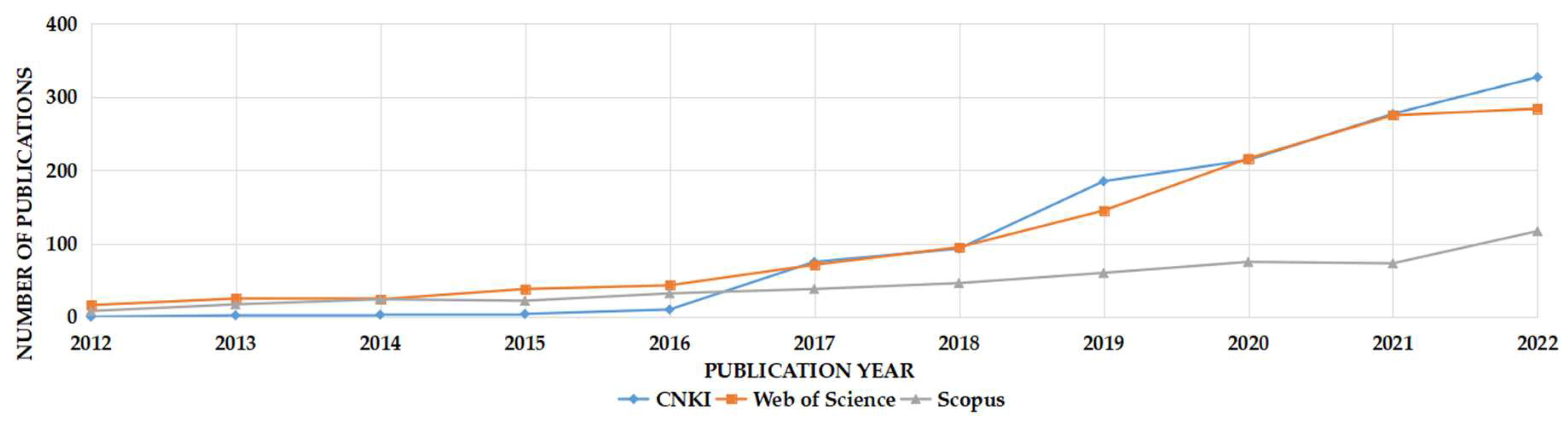
Figure 2.
Statistics of publication sources.
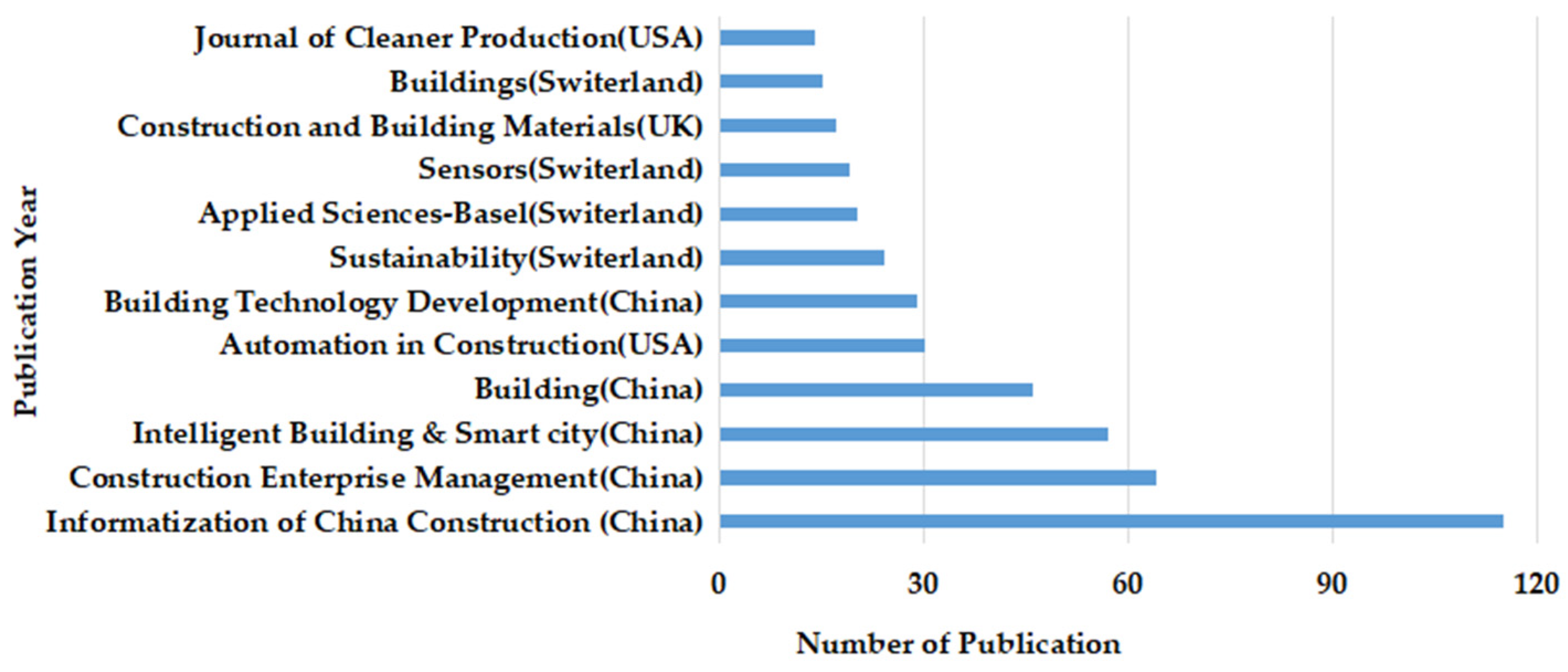
Figure 3.
The author cluster analysis diagram of CNKI.
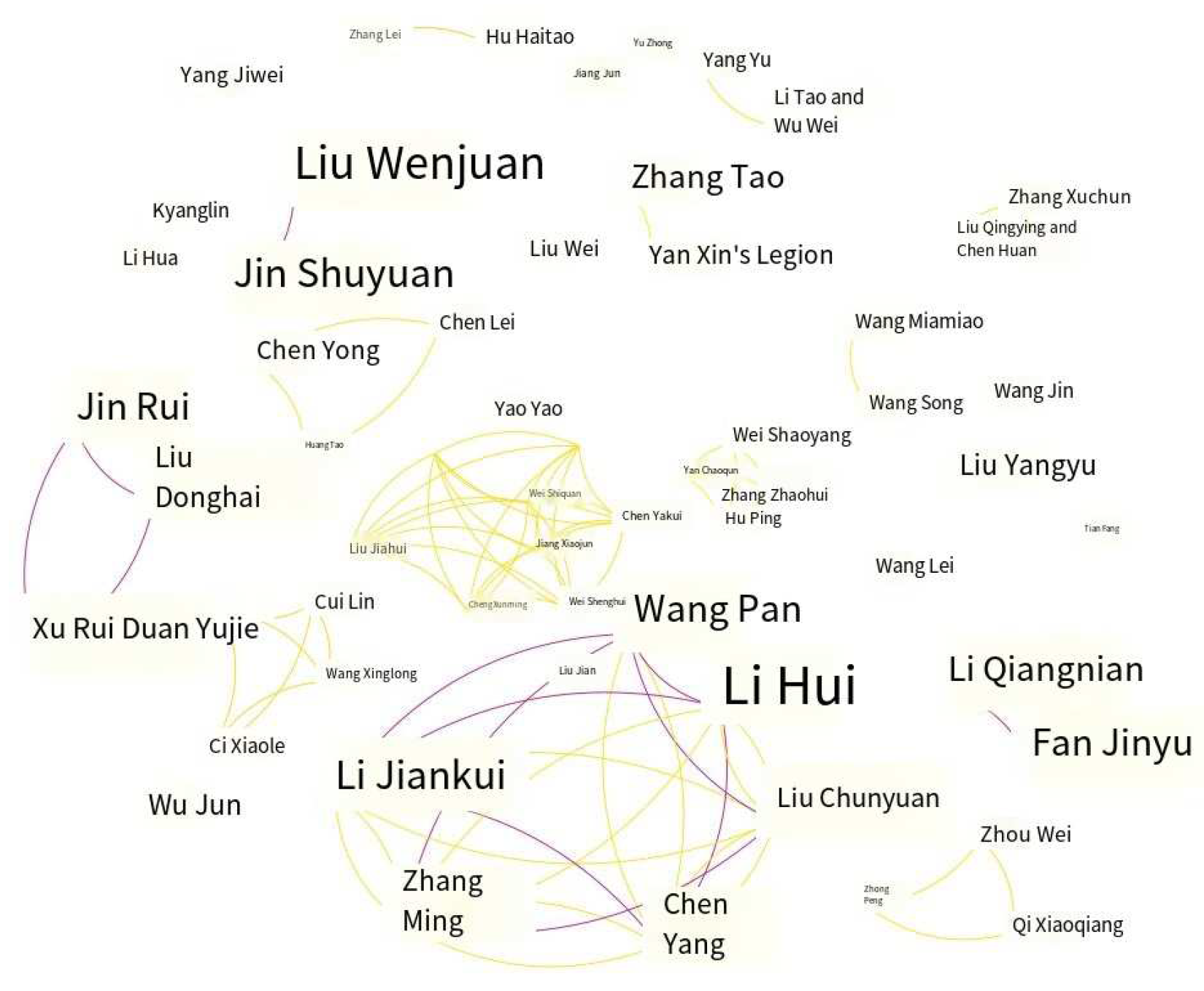
Figure 4.
The author cluster analysis diagram of Web of Science.
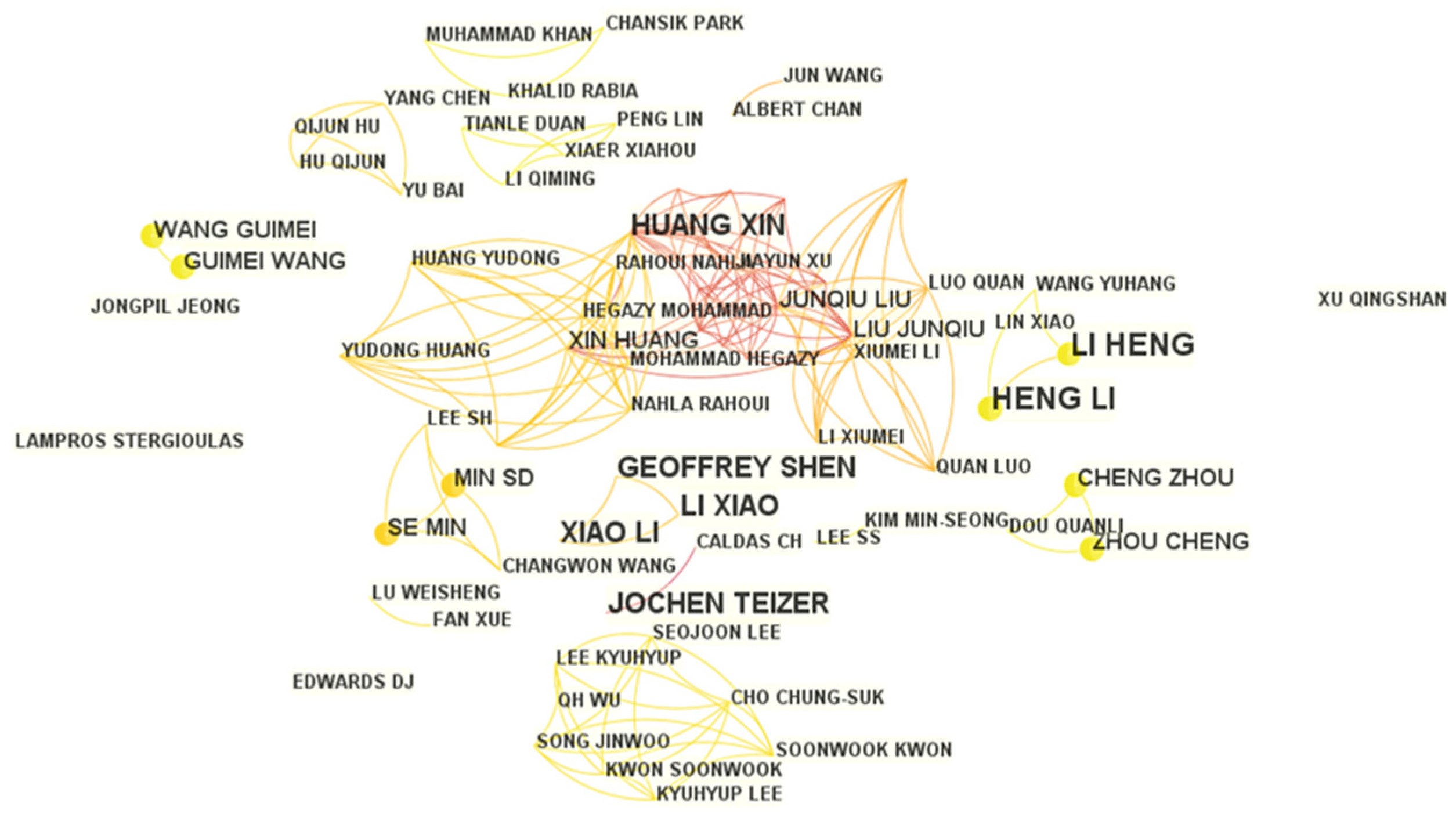
Figure 5.
Statistical chart of authors in relevant fields.
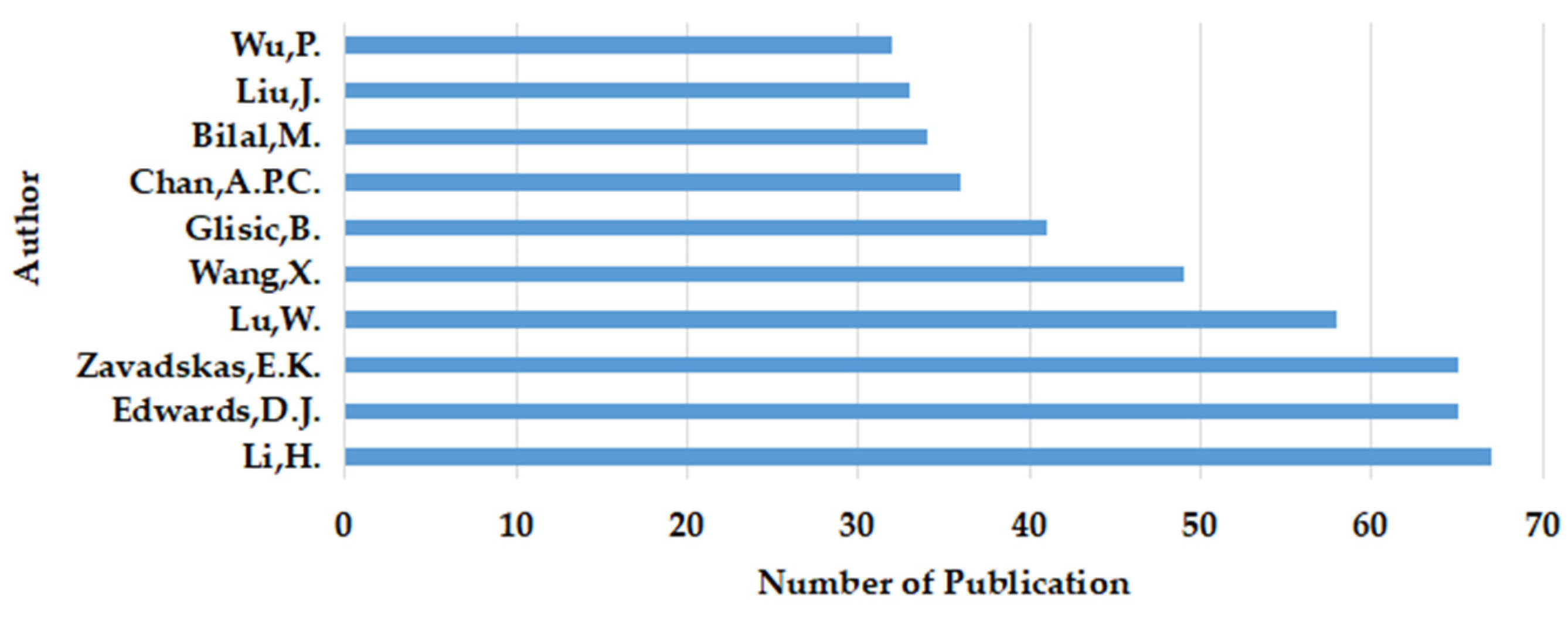
Figure 6.
Accumulations of countries and regions in related fields.
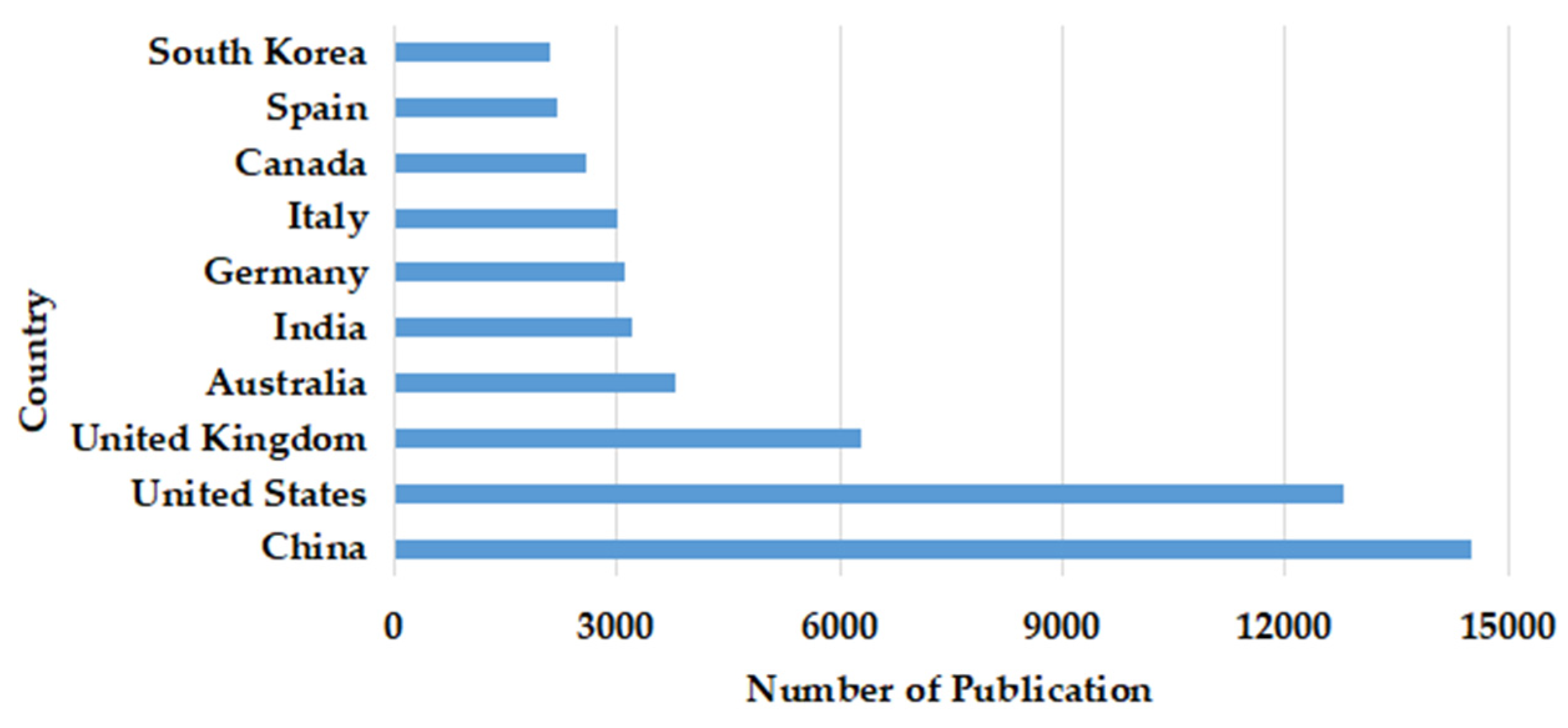
Figure 7.
Timeline diagram of key words from CNKI.
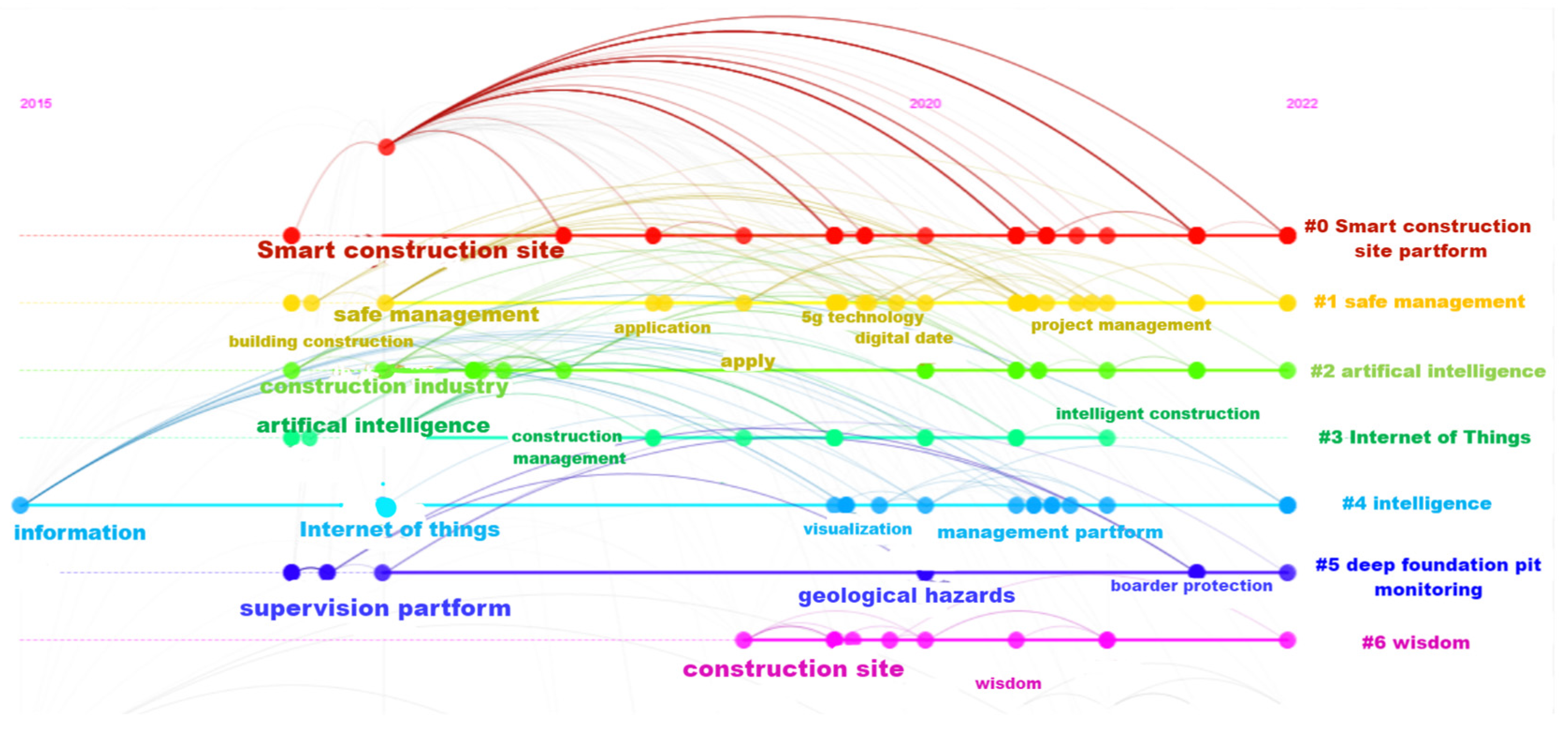
Figure 8.
Sudden emergence chart of keywords from CNKI.
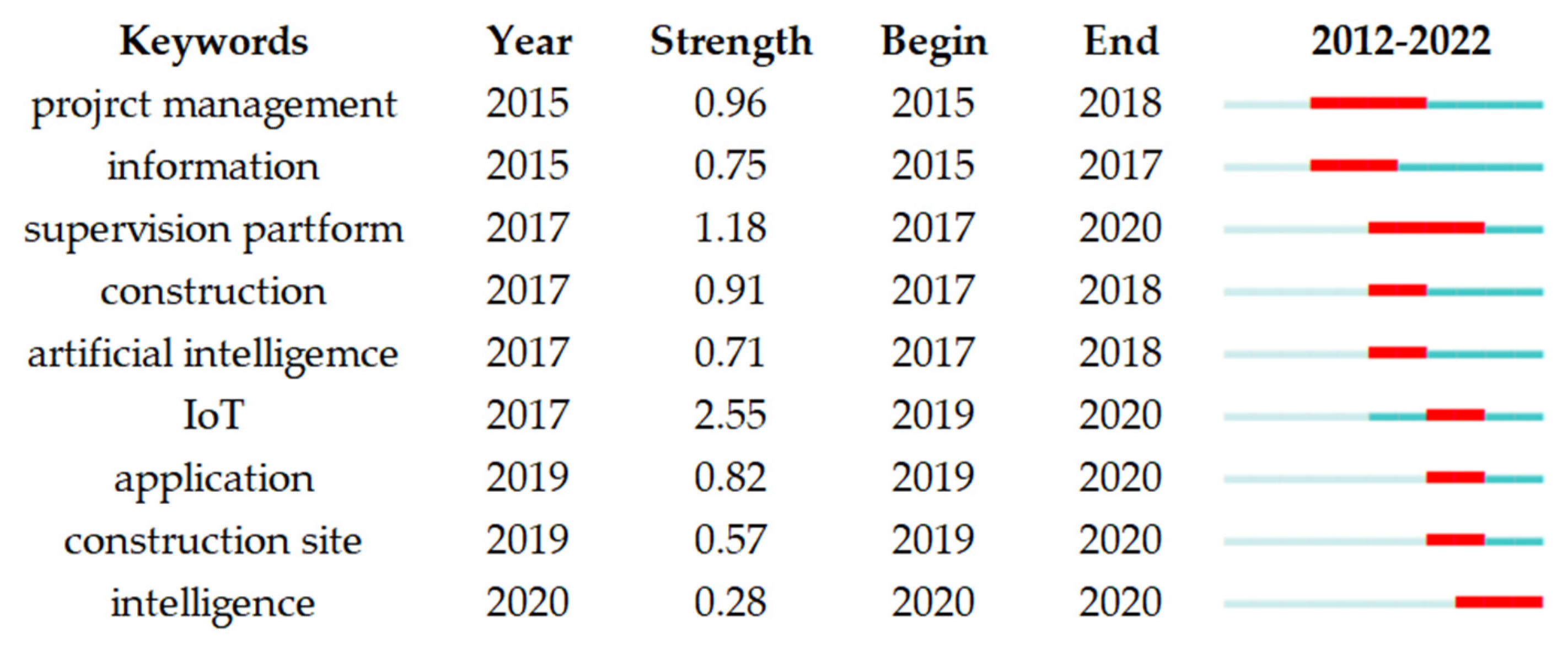
Figure 9.
Timeline of keywords from Web of Science.
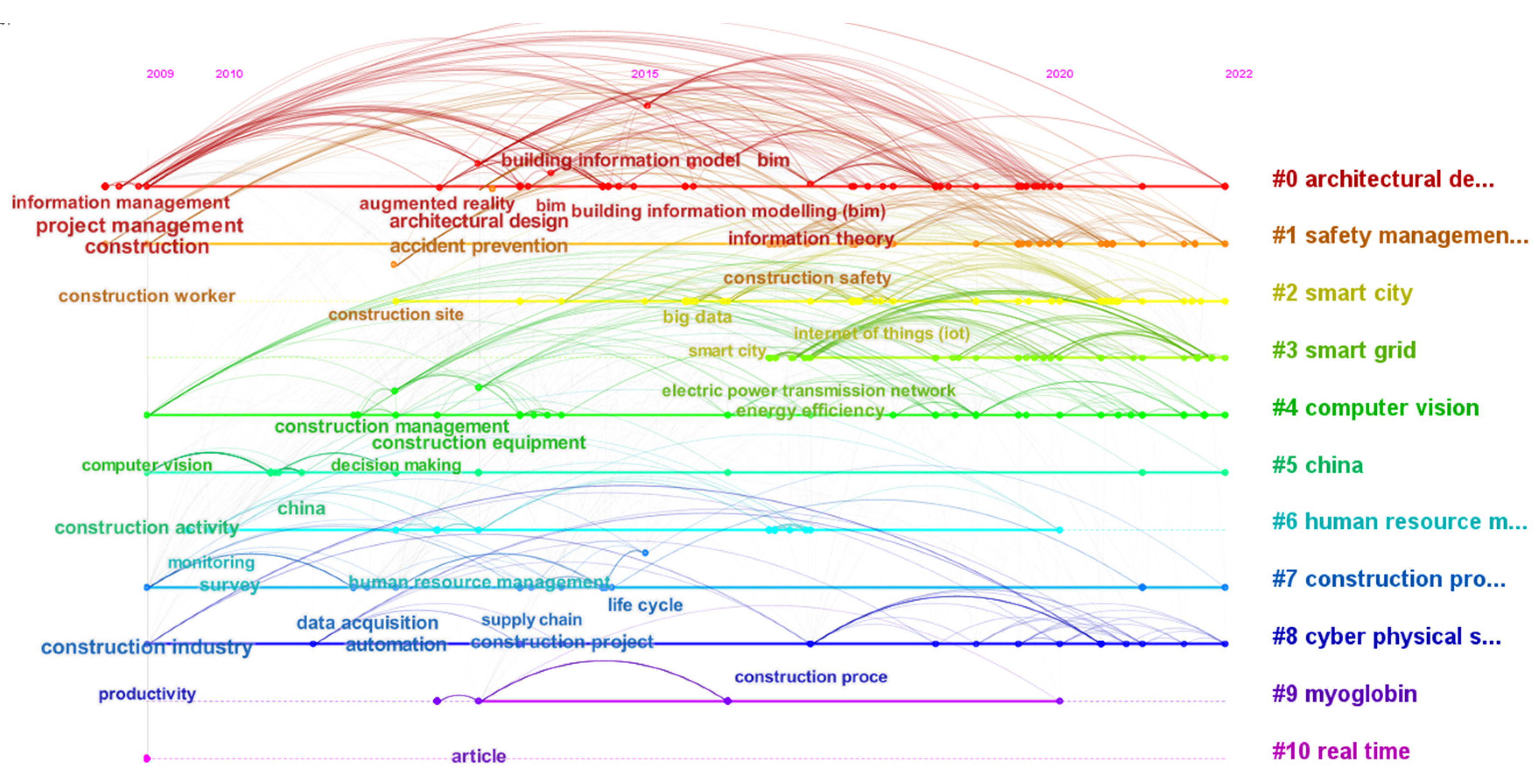
Figure 10.
Timeline of keywords from Scopus.
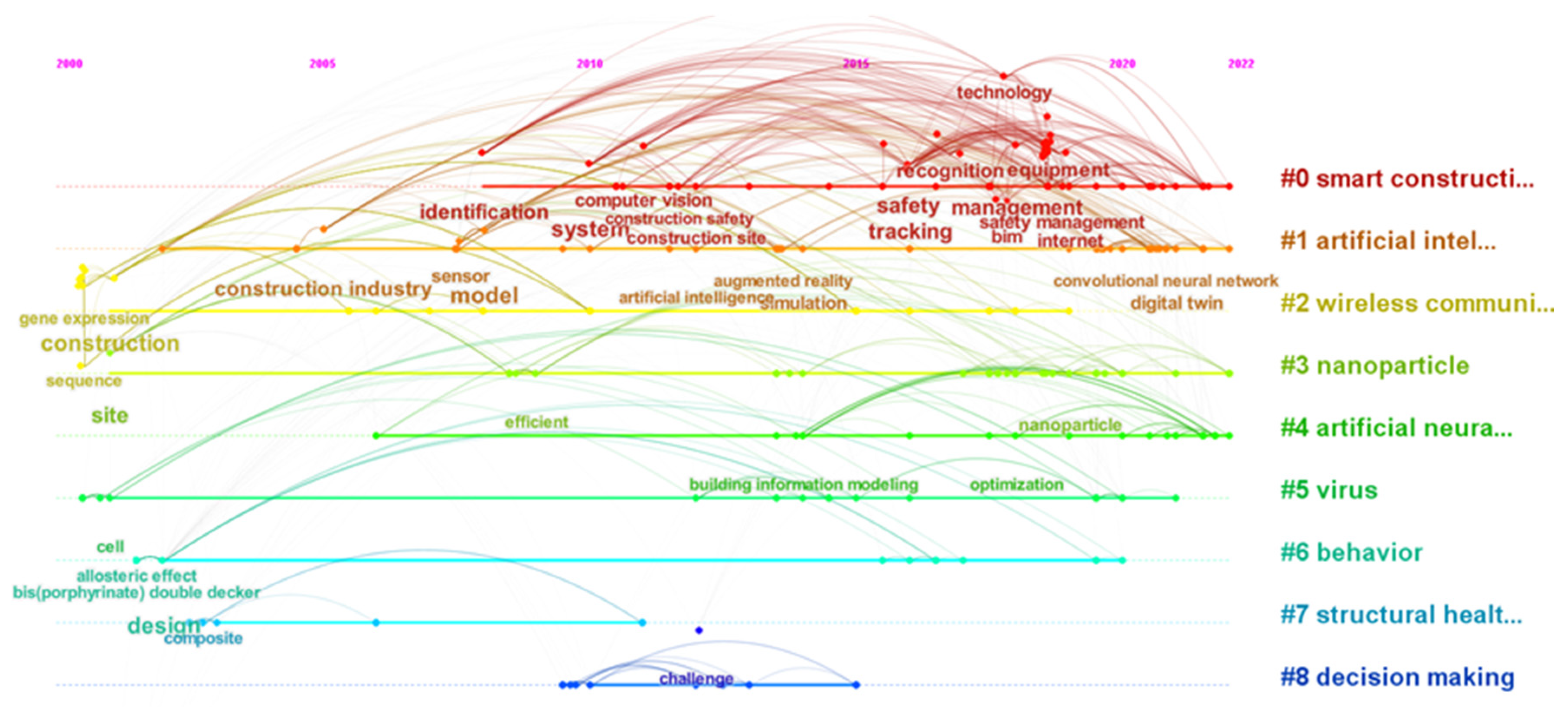

Table 1.
Cluster analysis table of keywords.
| Clustering | Chinese literature | English literature |
|---|---|---|
| #1 | Internet + | Smart contract |
| #2 | IoT | Smart technology |
| #3 | Supervision platform | On-site construction quality inspection |
| #4 | Construction site | Text analysis |
| #5 | Joint modeling | Real-time interoperation |
| #6 | Intelligent equipment | Internet of Thing |
| #7 | Application system | Construction project management |
| #8 | Factors | Smart helmet |
Table 2.
Distribution table of keywords centrality.
| Count | Centrality | Keywords |
|---|---|---|
| 46 | 0.16 | Safe management |
| 40 | 0.09 | Construction site |
| 37 | 0.21 | IoT |
| 27 | 0.04 | Smrt construction |
| 25 | 0 | Constraints |
| 24 | 0 | Intelligent equipment |
| 24 | 0 | Interconnection collaborative |
| 22 | 0.2 | Information |
| 22 | 0.19 | Construction management |
Table 3.
Statistical table of the countries publishing relevant literatures on smart site.
| Number | Country | Earliest age of publication | Quantity |
|---|---|---|---|
| 1 | China | 2002 | 131 |
| 2 | South Korea | 2013 | 41 |
| 3 | USA | 2000 | 38 |
| 4 | England | 2006 | 13 |
| 5 | Austalia | 2006 | 13 |
| 6 | Italy | 2015 | 13 |
| 7 | India | 2007 | 11 |
| 8 | Germany | 2002 | 9 |
Table 4.
Distribution table of foreign literature keywords centrality.
| Count | Centrality | Keywords | Year |
|---|---|---|---|
| 56 | 0.06 | system | 2010 |
| 44 | 0.25 | construction | 2001 |
| 38 | 0.13 | model | 2008 |
| 34 | 0.19 | design | 2002 |
| 32 | 0.01 | management | 2018 |
| 22 | 0.01 | framework | 2017 |
| 20 | 0.02 | bim | 2018 |
Table 5.
Centrality distribution of keywords from Scopus.
| Count | Centrality | Keywords | Year |
|---|---|---|---|
| 152 | 0.19 | construction industry | 2009 |
| 72 | 0.11 | project management | 2009 |
| 68 | 0.04 | smart city | 2016 |
| 66 | 0.04 | construction site | 2012 |
| 64 | 0.06 | architectural design | 2013 |
| 61 | 0.03 | IoT | 2016 |
Disclaimer/Publisher’s Note: The statements, opinions and data contained in all publications are solely those of the individual author(s) and contributor(s) and not of MDPI and/or the editor(s). MDPI and/or the editor(s) disclaim responsibility for any injury to people or property resulting from any ideas, methods, instructions or products referred to in the content. |
© 2023 by the authors. Licensee MDPI, Basel, Switzerland. This article is an open access article distributed under the terms and conditions of the Creative Commons Attribution (CC BY) license (http://creativecommons.org/licenses/by/4.0/).
Copyright: This open access article is published under a Creative Commons CC BY 4.0 license, which permit the free download, distribution, and reuse, provided that the author and preprint are cited in any reuse.