

Submitted:
04 August 2023
Posted:
08 August 2023
You are already at the latest version
Abstract
Taxes on the consumption of certain products have played a key role in public revenue analysis in European countries. This work aims to assess the differences in tax planning on new non-combustion products across some European territories. Through theoretical analysis, the paper has three distinct aspects. Firstly, we show the taxpayer profile in different countries. Secondly, the study analyzes the risks for the health system and the individual. Thirdly, the design of the land tax is based on previous experience and planning in Europe. This paper concludes with a case study for different countries: 1) Spain “vapers” and “smokers”, where the analysis is based on micro-data from the European Health Interview Survey 2020. 2) Sweden with the analysis of snus, shows it as a practice to reach economic savings while decreasing economic costs thanks to the nudging of consumers towards better products. The results show taxation and, specially, land taxation, should consider differences in planning in the case of new products, such as the non-combustion products, given the user per capita income and the potential lower health risks involved.
Keywords:
Taxes
; EU
; Risk Reduced Products
; Land distribution
1. Introduction
Consumption taxes have taken
on a major role in terms of their contribution to public sector revenue. In the
case of territories in Europe, this phenomenon has been accompanied by the
emergence of new products that are supposed to replace those whose tax design
is already developed. This is why policymakers are faced with the dilemma of
whether to tax these new alternatives and, if so, how to proceed. This also
affects land taxation in European tobacco crops. The consumption of certain
products has been a crucial source of public revenue in recent years, with
taxes on these products playing a significant role. However, the existence of
new non-combustion alternatives (RRPs—Risk Reduced Products such as
e-cigarettes, heated tobacco products, snus, and nicotine pouches) has prompted
the need for an optimal land tax design protocol. This paper aims to establish
such a protocol by conducting a theoretical analysis that considers three
distinct aspects: the taxpayer profile, health risks, and previous experiences
in other countries.
The main objective of this article is to establish
a land tax protocol for the optimal design of taxation on products that
generate negative externalities. It goes without saying that the relative
amount of harm produced by the consumption of each product is a fundamental
variable to take into consideration. The negative impacts of these products on
society, such as health risks or environmental harm, create a need for policy
interventions, such as taxation (including land taxation), to nudge consumers
toward better consumption patterns. In this context, the article aims to
provide a framework for designing taxes that will be able to accomplish this
objective while minimizing unintended consequences. Through this protocol,
policymakers and researchers can create evidence-based tax policies that
balance economic, social, and environmental considerations.
The global market for alternative risk reduced
tobacco products, such as e-cigarettes, heated tobacco products (HTPs),
nicotine pouches, and snus, has been rapidly growing [1,2].
As these products are relatively new, there is a lack of consensus among
policymakers on how to regulate them, particularly in terms of taxation. In
some countries, e-cigarettes and HTPs are taxed at the same rate as traditional
cigarettes, despite evidence suggesting that they are less harmful to health [3,4]. This lack of differentiation in taxation
could discourage smokers from switching to these less harmful alternatives,
ultimately hindering public health efforts to reduce the prevalence of smoking.
The main motivation for this article is to explore
the benefits of differentiating taxation rates between traditional tobacco
products and alternative products. By reviewing existing literature on the
health effects of different tobacco products and their associated
externalities, we aim to provide evidence-based recommendations for
policymakers on how to design optimal taxation policies that promote the use of
less harmful alternatives. Additionally, we will examine case studies from
countries that have successfully implemented differentiated taxation policies
to understand their impact on public health outcomes and revenue generation.
Through this article, we hope to contribute to the ongoing policy debate on the
regulation of alternative tobacco products and promote evidence-based
policymaking in the public health domain.
With this work, we aim to suggest that before
implementing price regulations or interventions to reduce traditional tobacco
prevalence, policymakers should consider the taxpayer’s
socio-economic profile and the risks produced by the specific products
to their health. Additionally, the article highlights the potential
benefits of harm reduction strategies that prioritize less harmful alternatives
to smoking, such as vaping, HTPs, nicotine pouches, and so on. The authors
suggest that taxation policies able to recognize the reduced harm of these
alternatives can encourage smokers to switch to them,
reducing the burden of smoking-related health problems. This is a challenge
in Europe for fiscal policies.
This article will be structured in three distinct
parts. The first focuses on a brief review of the literature and proposes an
approach to the problem posed above. The second focuses on an overview of the
negative externalities of consumption theory. Thirdly, an empirical approach to
the optimal design of taxes is proposed. Finally, conclusions and suggestions
for the future development of public policies are presented.
2. Brief Literature Review and General Background
Electronic cigarettes and other risk reduced
alternatives to tobacco have been on the rise in recent years. These products
are often marketed as a safer alternative to traditional tobacco products, and
as a result, have become popular among both current tobacco users and some
non-users. The latest Eurobarometer Report [5]
however shows that e-cigarette initiation rates hover around 2.5%; while HTPs’
initiation is virtually non-existent. There is still much debate regarding the
safety and efficacy of these products, and as such, it is important to consider
the potential impact of taxes on their use.
As analyzed by the German Federal Institute for
Risk Assessment (BfR), non-combustible products have been found to
substantially reduce levels of major carcinogens in the emissions of analyzed
heat-not-burn products in relation to the conventional tobacco cigarettes,
thereby reducing the harmfulness of non-combustible products as compared to
combustible products [6]. Furthermore, the UK
House of Commons Science and Technology Committee [7]
estimated e-cigarettes being approx. 95% less harmful than conventional
cigarettes, suggesting that both e-cigarettes and additional heat-not-burn
products should be used as alternatives to conventional tobacco products.
As the consumption of tobacco has been linked to
various health issues, many countries have implemented taxes as a tool for
curbing its use. However, the use of alternatives to tobacco—such as electronic
cigarettes or heated tobacco products—has become increasingly popular. This is
an important (and factual) development to consider when creating the optimal
tax design for these products. A tax design that must, certainly, focus on
delivering positive health outcomes. This literature review aims to provide an
overview of the research conducted on the optimal design of taxes for
alternatives to tobacco.
Several studies have examined the optimal design of
taxes for alternatives to combusted tobacco. One such study by [8] found that taxing RRPs at a lower rate than
traditional tobacco products could be an effective way to reduce the use of the
latter. This approach is based on the premise that RRPs are a safer alternative
to traditional tobacco products, and as such, should be taxed at a lower rate
to encourage their use. This idea is also stated by [9],
promoting differential taxation between products, based on product harmfulness.
Thereby, the use of harm reduced products in exchange of harmful combustible
products is encouraged.
The optimal design of taxes for alternatives to
tobacco is a challenge for fiscal policies across countries and it requires the
consideration of a variety of factors in the territory, including the potential
harm of the product, the potential impact on public health, and the impact on
consumers’ behaviour. Research has shown that taxing e-cigarettes and other
alternatives to combusted tobacco at a rate that is proportional to their harm
could be an effective tool to reduce the use of more toxic products,
incentivizing the substitution of harmful products with less damaging
alternatives. Ultimately, the optimal design of taxes for alternatives to
tobacco will depend on a variety of factors depending on the territory, among
others, and further research is needed to fully understand the potential impact
of different tax structures.
2. Tobacco Economy and Methodology
This section is divided in the following part:
Tobacco Cultivation and Land Taxes, Tobacco Competitive Markets and Negative
Externalities and Tax Policies’ Measures.
2.1. Tobacco Cultivation and Land Taxes
The cultivation and consumption of tobacco have
long been intertwined with European societies, economies, and health systems.
As European countries have sought to address tobacco’s economic and
health-related challenges, taxation has emerged as a crucial policy instrument.
This section aims to explore the relationship between tobacco cultivation
taxation and the distribution of consumers in Europe, focusing on how
variations in taxation policies influence consumer behaviours, market dynamics,
and public health outcomes.
Tobacco cultivation taxation serves as a vital
revenue source for many European countries while also acting to regulate
tobacco consumption. By levying taxes on the cultivation of tobacco,
governments can control the supply chain, influence the pricing of tobacco
products, and potentially discourage consumption. However, the effectiveness of
taxation policies depends on various factors, including the level of taxation,
the presence of alternative tobacco products, and the prevalence of illicit
trade.
Consumer behavior plays a pivotal role in shaping
the demand for tobacco products. High tobacco cultivation taxes often lead to
increased retail prices, which may deter some consumers from purchasing tobacco
products. Consequently, this section examines how varying levels of taxation
can influence smoking prevalence rates and patterns of tobacco use across
different demographic groups. Analyzing consumer behavior in response to
taxation is essential for understanding the potential impact of taxation
policies on public health outcomes.
The distribution of tobacco consumers across Europe
is not uniform, and taxation policies can contribute to regional disparities in
tobacco consumption. Some countries may adopt more aggressive tobacco taxation
strategies, resulting in reduced consumption rates, while neighboring countries
with lower taxation levels might experience higher tobacco use. Taxation
policies can inadvertently create opportunities for the illicit trade of
tobacco products. When taxes lead to substantial price differences between
neighboring countries, consumers may turn to illegal channels to acquire
cheaper tobacco products.
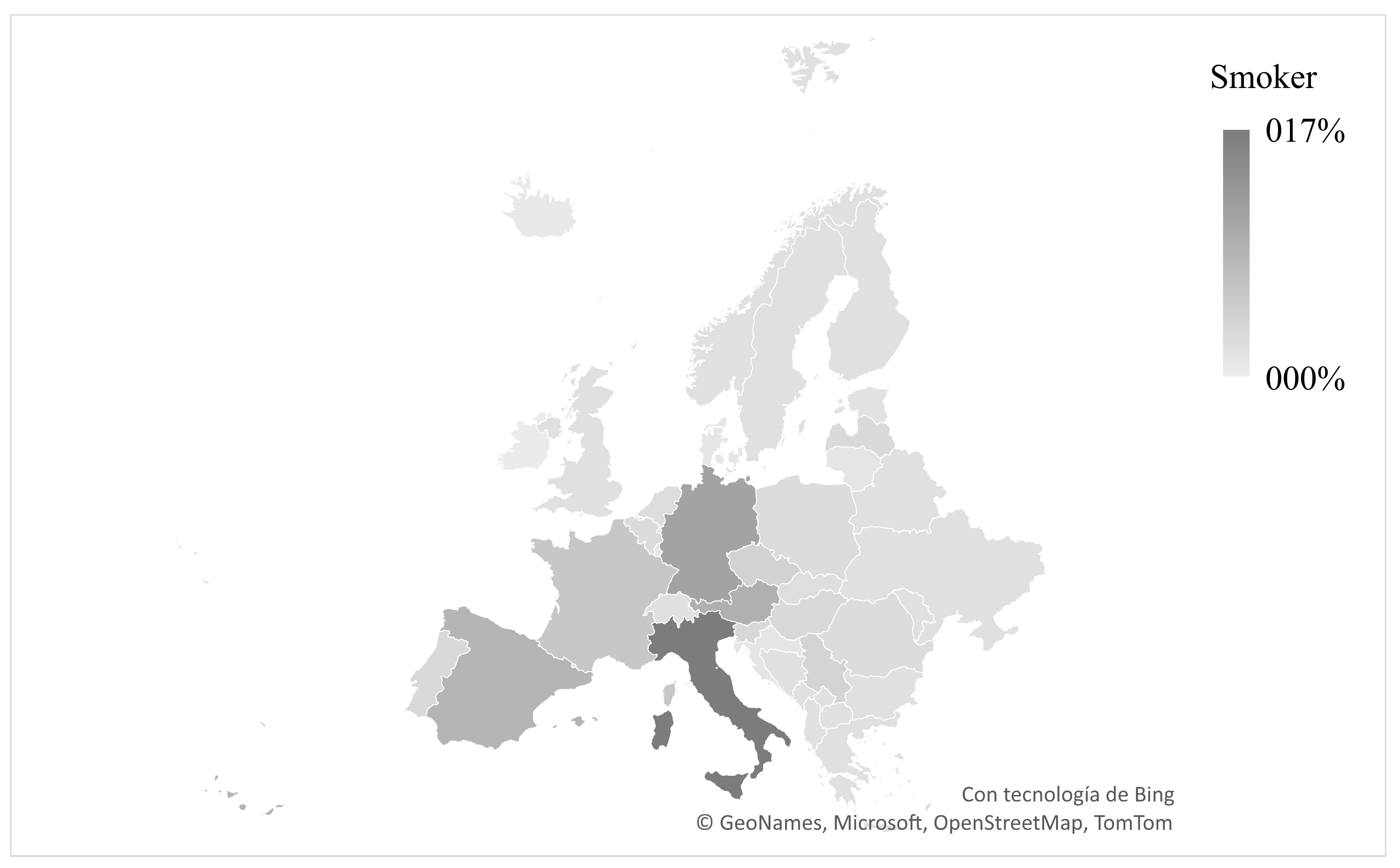
Figure 1.
Distribution of traditional combustion tobacco consumers in Europe. Source: Authors’ analysis from [12] (Wave 3-2020).
Figure 1.
Distribution of traditional combustion tobacco consumers in Europe. Source: Authors’ analysis from [12] (Wave 3-2020).
2.2. Tobacco Competitive Markets and Their Failures
According to classical economic theory, the
conditions for considering a market to be competitive are mainly four. First,
the existence of many suppliers and demanders must be considered. Second, there
must be perfect information, i.e., all market participants must have
information about the risks and opportunities that arise. Thirdly, the product
must be homogeneous, and practically non-differentiable. Finally, there should
be no barriers to market entry and exit.
However, despite such guidelines provided by
theory, experts know that in practice markets function in a much more complex
way. This is what, in the end, has come to be classified as a market failure.
These failures are classified into three types: Externalities, imperfect or
asymmetric information, public goods, and market power.
In this paper, we will focus on the study of
externalities. Externalities are consumption, production, or investment
decisions made by individuals, households, or firms that affect third parties
that do not necessarily participate in the market. This market failure has
indirect effects on the consumption and production opportunities of third
parties who do not directly participate in these transactions. However, the
price of the product taken into consideration does not reflect this impact. As
will be discussed below, such effects may be positive (as in the case of
education) or negative (as in the case of sugar, alcohol, and tobacco
consumption).
2.3. Negative Externalities Tax Policies’ Measures
The specific case studied here, that of RRPs as a
new alternative to traditional combusted tobacco consumption, can be understood
as a negative externality of consumption. In fact, the direct health effects
will not only affect those who use it but will also have a significant impact
on third parties. The question, therefore, arises here: how to optimally
correct the costs caused by a negative consumption externality?
The State generally deals with the reduction of the
social cost associated with a negative externality of consumption through
regulation, taxation, and the education of society. The first two measures are
generally the most effective in the short term. However, the design of
regulation and taxation is not a simple task. This is why policymakers make use
of expert opinions and expertise in carrying out such a task.
Combusted tobacco consumption is widely regarded as
a negative externality due to its harmful effects on both smokers and
non-smokers. According to [10], the negative
health consequences associated with combusted tobacco use extend far beyond the
individual smoker and can have significant impacts on the broader society. This
is because the smoke produced by the combustion of tobacco contains numerous
harmful substances that can cause a wide range of health problems, including
cancer, heart disease, and respiratory illnesses. Non-smokers who are exposed
to secondhand smoke are also at risk of developing these health problems, creating
a negative externality for individuals who have not chosen to smoke.
Furthermore, combusted tobacco consumption has a
significant economic impact on society. According to a report by the World
Health Organization [11], the costs associated
with combusted tobacco use are substantial and include both direct healthcare
costs as well as indirect costs related to decreased productivity and increased
absenteeism. These costs are borne by society, rather than just by individual
smokers, making combusted tobacco consumption a negative externality. The World
Health Organization (WHO) report notes that the economic burden of combusted
tobacco use is particularly high in low- and middle-income countries, where
healthcare systems may be less equipped to handle the health consequences of
smoking.
Among some of the main steps identified to achieve
a good design of the taxes associated with the correction of an externality, we
must highlight three: The determination of the risk in comparison with other
consumption alternatives already subject to taxation; the knowledge of the
taxpayer’s profile and finally, the tax design.
3. The Empirical Approach
This part of the paper is divided into two
sections. The first section presents the basic protocol for establishing and designing
optimal consumption taxes for alternatives to traditional combustion tobacco in
Spain. Secondly, we present a case where the introduction of new alternatives
to traditional cigarettes—such as snus in Sweden—results in a decrease in the
prevalence of traditional tobacco products and allows for savings in both
health and costs terms. This best practice will therefore allow obtaining the
main guidelines for the design of public policies, both from the point of view
of tax design and the needed deregulation of the less-damaging consumption
alternatives.
3.1. The Design of Taxes in Spain. The Case of Vapers
As we have observed in the previous section, in the
European Union, the tax criteria for regulating new alternatives to traditional
tobacco do not always follow a common pattern. However, a vast majority of
countries in the EU regulate new products in a similar way, showing signals of
pre-harmonization. Seventeen countries in the EU have opted for tax
differentials of various magnitude in favor of new alternatives. Some
countries, such as Spain, have opted for non-regulation. In this section of the
work, we will try to carry out a brief simulation of two of the steps that
decision-makers ought to take in terms of taxation. To do this, we will take the
case of Spain as an example.
If we had to follow the experience of other
European countries in terms of regulation, now Spain should be able to decide
whether to regulate the market for alternative tobacco devices in the same way
of the traditional ones, or not. To do this, we must consider two fundamental
steps. First, the characterization and differentiation of the taxpayer. We can
do so observing their differences in personal and socioeconomic
characteristics. Secondly, once the profile of the consumption-related taxpayer
is known, we must analyze the risks for the health system. We do so both in
terms of health-related spending and in terms of the health of individuals.
In this microsimulation, we will use a simple
econometric methodology rather than offering a solid empirical strategy. This
seems to the authors the best method to face the research question of this
study. Furthermore, we will present a study protocol before moving forward with
the material design of the tax.
3.1.1. Brief Methodological Note
As a starting point, it should be considered that
the database used in this study is the European Health Interview Survey [12]. Thanks to its 22,000 observations, it allows
us to identify which Spanish citizens among these are traditional (combusted)
tobacco consumers and which, instead, have opted for new non-combustion
alternatives. In other words, specifically, RRPs consumers.
To approach the design of a possible tax, we must
first understand the taxpayer’s profile and then consider the risks related to
the consumption of the good taken into consideration. To know the taxpayer’s
profile, we will carry out the elaboration of two probit models, which will
indicate the probability of a. being in the group of consumers of RRPs or b.
being in the group of traditional (combusted) tobacco products. This
elaboration is based on a set of control variables (personal and
socioeconomic). The mathematical form applied in the model is the following:
Here the variable takes the value 1 if
the individual is consuming RRPs and takes the value 0 if not. represents the probability in marginal terms that,
given a defined explanatory variable , the individual does or does not belong to the
group of RRPs users. Firstly, as we have pointed out, represents the set of variables of which we want
to discover the incidence in terms of the probability that the individual is
part of one or the other group. Secondly, is the error term of the estimated model. In the
case of , the only difference is that this variable takes
the value of 1 if the individual claims to be a smoker of traditional combusted
tobacco or not.
On the other hand, to know the risks, we use two
different types of econometric approximations. First, to estimate the effect on
the use of health services by vapers or traditional tobacco smokers, we carry
out a negative binomial regression model (recommended in health economics for
these cases).
This model is used because on many occasions—as is
the case of our data, too—, there is a problem of over-dispersion, determined
by the possible existence of negative values in the prediction of the dependent
variable, in which case the use of the OLS model is not recommended. This
negative binomial regression model or Poisson model is frequently used in cases
such as the one of this paper [13].
Finally, beyond the social cost, and in order to
define the risks to the individual’s health, we elaborate a second round of
probit probabilistic regression models that allow us to discover through their
marginal effects the probability of suffering from some of the diseases
commonly associated with the consumption of this type of substance. These will
use the mathematical expression:
where represents the variable that dichotomously
indicates (taking values 1 or 0) whether or not you suffer from the condition;
and represents the type of product you use, i.e.,
vapers (which is our proxy for all non-combustion alternatives) or smokers of
traditional combusted tobacco (also using values 0 or 1 depending on whether or
not you use the product).
The objective is to find out , i.e., the effect of the type of consumption on
the probability of suffering from the disease.
3.2. Empirical Approach. The Case of Spain
Once the data and the methodology to be applied are
known, first, we are going to know the differences, if they exist between the
group of “vapers” and “smokers” through the analysis of the results of the
probits. As we can see in Table 1, in the
case of vaper consumers, it is observed that their consumption significantly
decreases with age. Most of the “vapers” will be comparatively (relatively)
younger. Once again, it is important to underline that we use “vapers” as a
proxy for all new alternative products. Observing the market penetration of the
different products in Spain, this result seems consistent with reality.
Empirically, according to [14], Spanish combustible smoking prevalence was
reported highest in the age group 25–34 years, amounting to 30.9%. In general,
combustible smoking prevalence rates were reported highest among younger consumer
groups and higher among men as opposed to women [15].
Furthermore, combustible smoking prevalence was reported highest among less
educated consumer groups and among lower income consumer groups. These reported
figures are consistent with figures in Table 1,
showing that the likeliness to consume combustible tobacco increases for
younger consumer groups while decreasing for older consumer groups.
Furthermore, the Spanish government reports
switching from combustible products towards e-cigarettes being observable among
older consumer groups, not younger consumer groups. The share of older
consumers having switched from combustible products towards e-cigarettes was
reported at 62.4% whereas the share for younger consumer groups was reported at
only 33.8% [16]. These
findings match the results in Table 1, as
e-cigarette consumption seems mainly appealing to older consumer groups.
On the one hand, it is easy to notice a higher
penetration of e-cigarettes in the Spanish market, which seem to have a larger
appeal on the younger cohorts. On the other hand, anecdotal data seems to
suggest that HTPs are usually consumed by older groups—and have a very small market
share in the country. Finally, nicotine pouches are virtually non-existent, and
snus is banned.
Given this market reality, we can draw a natural
relationship with income. As this is higher, the probability of being part of
the group “vaping” decreases significantly. Conversely, you are more likely to
be part of the group “vaper” as your educational level increases.

Table 1.
Probit models to determine belonging to the group of vapers or traditional tobacco smokers.
Table 1.
Probit models to determine belonging to the group of vapers or traditional tobacco smokers.
| Vapers | Combustion Tobacco | |||
|---|---|---|---|---|
| dy/dx | Sign. | dy/dx | Sign. | |
| Sex | -0,001 | -0,042 | *** | |
| Age group (<25) | ||||
| 25-34 | -0,001 | 0,050 | *** | |
| 35-44 | -0,002 | 0,023 | ||
| 45-54 | -0,001 | 0,055 | *** | |
| 55-64 | -0,006 | -0,056 | *** | |
| 65-74 | -0,010 | *** | -0,158 | *** |
| 75-More | . | -0,201 | *** | |
| Migrant | -0,006 | -0,096 | *** | |
| Education (elementary) | ||||
| Basic | 0,004 | *** | 0,041 | *** |
| Medium | 0,009 | *** | 0,037 | *** |
| High | 0,006 | *** | -0,033 | *** |
| Quintile (Q1) | ||||
| Q2 | -0,006 | -0,039 | *** | |
| Q3 | -0,004 | -0,054 | *** | |
| Q4 | -0,009 | *** | -0,067 | *** |
| Q5 | -0,009 | *** | -0,068 | *** |
| Working | 0,001 | -0,001 | ||
| Sport | 0,000 | -0,010 | *** | |
| Social support | 0,000 | -0,053 | * | |
| Observations | 9.093 | 10.357 |
Source: Authors’ analysis from [12] (Wave 3-2020).
If we compare it with smokers of traditional combusted tobacco, we also observe a decrease with age. Likewise, it seems that the fact of being an immigrant decreases the probability of being part of the group “vaper”. An increase in income has the same effect. However, a significant difference to “vapers” is related to the educational level. In the case of traditional tobacco smokers, as the educational level increases, the probability of belonging to this group decreases. The opposite is true in the case of “vapers”. In other words, the higher the education level, the higher the probability of being in the group of “vapers”.
Therefore, given the market reality of Spain, we can conclude that the profile of the taxpayer is that of a relatively younger consumer, with low income and a relatively higher education level (above the elementary level). This data is meaningful enough so that, when combined with the risk analysis that we will carry out below, clearly indicates the direction that tax regulation should take.
Once the approximation of the profile of the vaper has been carried out—and considering the taxpayer characteristics—we must now focus on the differences between the traditional smoker of combusted tobacco and the consumer of new alternatives. For this we have estimated the results obtained in Table 2. It shows the effects of being part of the group “vaper” on the use of health services. Thus, we can estimate the risk in terms of health spending. As a result, those who decide to consume RRPs do not have significant results in terms of increased use of General Practitioner or specialist health services. However, they do seem to visit the hospital less frequently than the consumers of combusted tobacco products (this variable is measured as the number of nights that the subject remains hospitalized).
Regarding patterns of consumption of health services, we are unable to obtain significant conclusions. The same issue occurs in the case of consumers of traditional combustion tobacco.
Let us now look at the individual health risks, which, indirectly, also plays an important role in increasing health spending. Table 2 shows clear and significant differences between those who consume vapers and those who consume traditional combustion tobacco.
For this part of the work, we are going to use three of the most important diseases related to tobacco consumption as dependent variables. In the first place, bronchitis. Evidence shows that the consumption of traditional combusted tobacco increases the marginal probability of suffering from it. However, this is not the case for the group “vapers”, where the effect is not significant. In the case of suffering from coronary and oral diseases, the same pattern seen for bronchitis is repeated.
That is why these latest models yield a much more significant result on the risks and, therefore, will be more useful to obtain our conclusions (Table 3).
3.3. Health Risk and Costs in Sweden. The Case of Snus
Snus, a form of smokeless tobacco, has been widely used in Sweden for several decades. Despite being a form of tobacco, snus has been associated with lower health risks compared to smoking, leading to it being perceived as a safer alternative to smoking. The use of snus has been credited with the declining tobacco prevalence rates in Sweden.
3.3.1. A Brief Review of Previous Literature about Snus
The use of snus as a harm reduction alternative to smoking has been a topic of interest in the scientific literature for several decades. [16] conducted a study to assess the impact of snus use on smoking prevalence in Sweden, where snus has been widely used as an alternative to smoking since the 1970s. The study found that the use of snus was associated with a significant reduction in smoking prevalence, particularly among men. The authors suggested that the availability of a less harmful alternative to smoking, like snus, may have contributed to the decline in smoking prevalence in Sweden.
In 2016, [17] conducted a similar study in Sweden to assess the impact of snus use on smoking prevalence over time. The study found that snus use had contributed significantly to the decline in smoking prevalence in Sweden since the 1970s. The authors suggested that the widespread availability and acceptance of snus as a less harmful alternative to smoking had played a crucial role in reducing the prevalence of smoking in Sweden.
The findings of these studies suggest that the availability of harm reduction alternatives like snus can contribute to a reduction in smoking prevalence. Careful regulation and education are necessary to ensure that the benefits of snus as a harm reduction tool are maximized while its potential risks are minimized.
Overall, these studies highlight the potential benefits of harm reduction strategies that prioritize less harmful alternatives to smoking like snus. Further research is needed to better understand the long-term health effects of snus use and its potential role in reducing smoking prevalence in other countries.
3.3.2. The Impact of Snus on Smoking Prevalence in Sweden
As discussed above, tobacco prevalence drops substantially when legislation is introduced in favor of alternatives, in this case, snus. For the analysis of the impact of snus use, we will follow two steps.
First, we will take into consideration the calculation of actual and hypothetical cases of disease and death. For this, we will consider data provided by [18,19,20,21]. This data provides us information on smoking and snus in terms of prevalence and its relation to some reference diseases such as: lung cancer, ischemic heart disease (IHD), chronic obstructive pulmonary disease (COPD) and stroke. Secondly, for this analysis, we will consider the impact in terms of health costs, differentiating between the following both direct costs, those related to all services associated with illnesses, treatment costs, hospitalization and medicalization costs and indirect costs, related to productivity losses: costs for morbidity, early retirement, and premature mortality.
3.3.4. Actual and Hypothetical Health Risks
For the calculation, we will essentially start from two, different, assumptions. The first assumption will answer the following question: How many people would be smoking in Sweden in 2019 if they had not switched to snus and remained cigarette smokers—assuming an EU average prevalence in Sweden? The second assumption will try to explain the differences between snus users and smokers in terms of the risk of suffering from any of the four smoking-related diseases.
To answer the first question, we must assume two scenarios, scenario A and scenario B. To graphically observe the results, let us look at the following Table 4.
Regarding the second assumption, the one related to the probability of suffering from the four reference diseases, we can say that, according to [22], the risk for snus is lower for lung cancer and IHD. In the case of COPD and stroke, the risk of snus is also lower than that of traditional combusted tobacco (cigarettes, roll of your own) as indicated by [23]. Once the above two premises have been established, the scheme for the analysis of the risk calculation of suffering from a disease (or dying from it) follows the Table 5:
Therefore, we can conclude that if snus had not been introduced and snus users were cigarette smokers, the risk of having one of the four diseases would have been much higher for them, increasing the number of disease cases.
3.3.5. Actual and Hypothetical Health Costs
The second step, as described at the beginning of this section, concerns a rough calculation of the associated costs. Thus, according to the methodology used by [21] we will estimate the direct and indirect costs following the same scenario scheme as in the previous section (Table 6).
For the analysis of the indirect costs associated with lost productivity, three different variables will be used:
- − The number of years a patient suffers from a disease, referred to in health economics as years-lived-with-disability (YLDs).
- − The number of individuals inactive at work because of suffering from a disease multiplied by the smoking-related shares of YLDs from COPD, IHD, lung cancer, and stroke.
- − Labour costs measured by the average labour cost per year combined with smoking-related incapacity to measure productivity loss due to retirement and permanent incapacity.
Although there are several approaches to the calculation, such as the willingness-to-pay-approach introduced by [21], for our study, we will use the Human-Capital-approach, considered by [28], which considers the number of smoking-related deaths per age group multiplied by the present value of lifetime earnings and yields the following results (Table 7):
As we can see, the differences in the first case, i.e., among cigarette smokers, are about 2.51 bn Euro while, on the other hand, among the total population the costs would increase by 1.70 bn Euro. Based on this approximation of the calculation, if snus had not been introduced, the costs for the total population would have increased by 28.76%. The same would occur if we were to analyze the indirect costs with this same approximation. The results show that the loss of productivity associated with morbidity would be 48% higher if snus had not been introduced. The loss associated with premature mortality would be around 45% higher.
These calculations seem to suggest that the introduction of snus has been crucial for the reduction of tobacco consumption in Sweden, generating significant savings in terms of direct and indirect costs and, most importantly, a reduction in the risk of contracting diseases such as lung cancer, COPD, IHD and stroke.
The case of Sweden should also have a relevant impact when analyzing the prevalence (and the trends) of traditional tobacco consumption. The learnings from the north give some important signals to policymakers when redesigning fiscal policies related to the taxation of these types of products.
In conclusion, the use of snus has contributed significantly to the declining combusted tobacco prevalence rates in Sweden. The perception of snus as a safer alternative to smoking, its social acceptability, availability, affordability, and the reduction in smoking initiation rates among young people are factors that have contributed to this trend. Further research is needed to better the potential impact on tobacco prevalence rates in other countries, but the Swedish case seems too strong of an example to overlook.
4. Conclusions
The aim of this paper is to establish a basic protocol for the optimal design of taxes in the European territories on products whose consumption represents a negative externality. However, to do so, we believe it is appropriate to highlight three elementary design stages. The first of these is related to the knowledge of the taxpayer’s socio-economic profile. The second is the knowledge of the risk involved in terms of expenditure for the system and, finally, the determination of the health risk of the individual who consumes it.
From the case study presented for Spain, we can derive some of the necessary signals for the design of this kind of taxation. This should be extrapolated to many other countries. On the one hand, it can be observed that the profile of consumers of non-combustion alternatives to traditional tobacco, such as the ones being part of the over-comprehensive group of “vapers” in our case, are young individuals with medium and low-income levels. Observing the market penetration of the different products in Spain, this result seems consistent with reality. On the one hand, it is easy to notice a higher penetration of e-cigarettes in the Spanish market, which seem to have a larger appeal on the younger cohorts. On the other hand, anecdotal data seems to suggest that HTPs are usually consumed by older groups—and have a very small market share in the country. Finally, nicotine pouches are virtually non-existent, and snus is banned. We can also conclude that “vapers” have lower individual health risks than those who opt for combusted tobacco, although no significant differences are found in terms of contribution to overall public expenditure.
Based on previous literature, RRPs are a less harmful alternative to traditional tobacco smoking. Noncombustible products do not contain tar, which is a major contributor to the health risks associated with smoking. They produce significantly fewer harmful chemicals than traditional cigarettes. Additionally, research suggests that non-combustible products are an effective tool for smokers who wish to quit tobacco smoking.
Given these facts, governments must implement taxation policies that reflect the reduced harm of RRPs compared to combusted tobacco. Imposing lower taxes on RRPs than on combusted tobacco will incentivize smokers to switch to less-damaging products, which would ultimately lead to a positive health outcome for both individuals and society. In countries such as the UK, the House of Commons, or in Germany, the government institution (BfR), have acknowledged the potentials entailed in harm reduced products to reduce health care costs.
Moving in the opposite direction could also lead to an increase in the black market for RRPs, creating additional health and safety risks for consumers.
Additionally, analyzing the experiences of Sweden, we discover that the use of snus has significantly contributed to the reduction in the prevalence of traditional tobacco smoking in the country. Snus is a smokeless tobacco product that is less harmful than traditional cigarettes, and its use has been widely accepted in Swedish society for decades. By promoting snus as a less harmful alternative to smoking, the Swedish government has been able to nudge consumers away from combusted tobacco products, reducing the prevalence of smoking and the associated health risks. The success of snus in Sweden highlights the potential benefits of harm reduction strategies that prioritize less harmful alternatives to smoking. However, it is important to note that the use of snus is not risk-free and can lead to various health issues. Therefore, careful regulation and education are necessary to ensure that the benefits of snus as a harm reduction tool are maximized while its potential risks are minimized. The production of Snus, requiring less tobacco than traditional tobacco products, can have a positive impact on reducing the demand for tobacco cultivation and, consequently, freeing up land for other purposes. This could lead to greater crop diversification, which in turn would help alleviate pressure on water resources since other crops may require less water compared to vast tobacco fields. Furthermore, by encouraging the adoption of other flavouring substances that require fewer water and resources for production, we can strengthen the agricultural economy by diversifying options for farmers and promoting more sustainable practices in agriculture. It is essential to highlight that the focus on the development and promotion of Snus and other flavouring substances should go hand in hand with education and awareness campaigns, informing the public about their benefits and risks while ensuring strict compliance with regulations to safeguard consumers’ health and well-being. Promoting responsible production of Snus and other flavouring alternatives is a valuable and promising proposal to reduce tobacco cultivation, preserve natural resources, and enhance agricultural sustainability. Together, we can progress towards a more balanced and healthier future for our planet and future generations.
As main suggestions for policymakers, this article suggests that, before taking hasty decisions to reduce the prevalence of traditional combusted tobacco through price regulation or intervention, other academic criteria related to the optimal design of taxation of tobacco and its alternatives should be considered. To this end, the profile of the taxpayer and the risks to his or her health should be considered, avoiding a shift of consumption towards illicit or low-quality products that may be purchased in unregulated secondary markets.
Then, the available evidence supports the implementation of taxation policies that favour harm reduction alternatives like RRPs and snus, while discouraging the use of traditional (combusted) tobacco products. RRPs are less harmful alternatives to smoking, and taxation policies that recognize their reduced harm can encourage smokers to switch to these products and reduce the burden of smoking-related health problems.
Higher taxes on traditional tobacco products can discourage their use and reduce the prevalence of smoking, which is the leading cause of preventable death and disease worldwide. Moreover, high taxes on traditional, combusted, tobacco products can generate substantial revenue for governments that can be used to fund healthcare programs and tobacco control initiatives. All kinds of combusted tobacco products (cigarettes, roll your own, cigars) should be subjected to a relevant increase in their taxation levels, as to improve both public health and public accounts.
Spain should follow the example of the majority of European countries, which have moved toward a fully specific tax, offering a relevant differential in favor of less-damaging products. Doing so, policymakers will be implementing tax policies that prioritize harm reduction alternatives like RRPs, while strongly discouraging the use of traditional tobacco products. Such policies can help reduce the prevalence of smoking and improve public health outcomes while generating an increased revenue for public health programs.
Author Contributions
FPH conceptualized the study, led data collection efforts, and led the writing of the manuscript draft. MJDR helped conceptualize the study and helped to draft and revise the manuscript.
References
- Nutt, D.J.; Phillips, L.D.; Balfour, D.; et al. (Estimating the harms of nicotine-containing products using the MCDA approach. Eur. Addict. Res. 2014, 20, 218–225. [Google Scholar] [CrossRef] [PubMed]
- Clarke, E.; McNeill, A.; Li, J. Snus: A compelling harm reduction alternative to cigarettes. Harm Reduct. J. 2019, 16, 62. [Google Scholar] [CrossRef] [PubMed]
- Meier, E.; Hatsukami, D.K.; Weaver, M.F.; et al. A randomized clinical trial of snus examining the effect of complete versus partial cigarette substitution on smoking-related behaviors, and biomarkers of exposure. Nicotine Tob. Res. 2020, 22, 473. [Google Scholar] [CrossRef] [PubMed]
- Ramström, L.; Wikmans, T. Mortality attributable to tobacco among men in Sweden and other European countries: An analysis of data in a WHO report. Tob. Induc. Dis. 2014, 12, 14. [Google Scholar] [CrossRef] [PubMed]
- Eurobarometer. Attitudes of Europeans towards tobacco and electronic cigarettes. 2021. Available online: https://health.ec.europa.eu/publications/attitudes-europeans-towards-tobacco-and-electronic-cigarettes-1_en.
- Mallock, N.; Böss, L.; Burk, R.; et al. Levels of selected analytes in the emissions of “heat-not-burn” tobacco products that are relevant to assess human health risks. Arch. Toxicol. 2018, 92, 2145–2149. [Google Scholar] [CrossRef] [PubMed]
- House of Commons. Science and Technology Committee. E-cigarettes (Seventh Report of Session 2017-19). 2018. https://content.tobaccotactics.org/uploads/2019/09/Science-Tech-Committee_E-cigarettes_report-2017-19.pdf.
- Levy, D.T.; Cummings, K.M.; Villanti, A.C.; et al. A framework for evaluating the public health impact of e-cigarettes and other vaporized nicotine products. Addiction 2017, 112, 8–17. [Google Scholar] [CrossRef] [PubMed]
- Chaloupka, F.J.; Sweanor, D.; Warner, K.E. Differential taxes for differential risks: Toward reduced harm from nicotine-yielding products. Am. J. Public Health 2015, 105, 9–11. [Google Scholar] [CrossRef] [PubMed]
- Kao, H.; Huang, C.; Hsieh, M. The health and economic externalities of cigarette smoking in Taiwan. Health Econ. Rev. 2019, 9, 5. [Google Scholar]
- World Health Organization. Tobacco. 2019. Available online: https://www.who.int/news-room/fact-sheets/detail/tobacco.
- Eurostat. European Health Interview Survey (EHIS). 2020. Available online: https://ec.europa.eu/eurostat/web/microdata/european-health-interview-survey.
- Antón, J.I.; Muñoz de Bustillo, R. Health care usage among immigrants and natives in Spain: A count data analysis. Eur. J. Health Econ. 2009, 10, 361–374. [Google Scholar]
- Instituto Nacional de Estadística INE. 2020.
- Ministerio de Sanidad (2022). https://www.sanidad.gob.es/.
- Foulds, J.; Ramström, L.; Burke, M.; et al. Effect of smokeless tobacco (snus) on smoking and public health in Sweden. Tob. Control 2003, 12, 349–359. [Google Scholar] [CrossRef] [PubMed]
- Ramström, L.; Borland, R.; Wikmans, T. Patterns of smoking and snus use in Sweden: Implications for public health. Int. J. Environ. Res. Public Health 2016, 13, 1110. [Google Scholar] [CrossRef] [PubMed]
- Statistiska centralbyrån. Smoking and snuffing: The daily habits of the Swedish people. Stockholm, Sweden: Statistiska centralbyrån. 2002.
- Socialstyrelsen. Socialstyrelsen’s regulations on tobacco products and similar products (SOSFS 2022:4). Stockholm, Sweden: Socialstyrelsen. 2022.
- Vos, K.C.; Faber, T.; Rasmussen, M.; et al. Snus use and risk of alcohol-related harm and mortality: A prospective cohort study. Addiction, 2022, 117, 545–553. [Google Scholar]
- European Commission. Directorate-General for Health and Food Safety. A study on liability and the health costs of smoking. GHK, Reino Unido, tobacco_liability_final_en_0.pdf (europa.eu) 2012.
- Levy, D.T.; Mumford, E.A.; Cummings, K.M.; et al. The relative risks of a low-nitrosamine smokeless tobacco product compared with smoking cigarettes: Estimates of a panel of experts. Cancer Epidemiol. Biomark. Prev. 2004, 13, 2035–2042. [Google Scholar] [CrossRef]
- Hallberg, I.; Schelin, M.E.; Lundell, B. Swedish snus and its possible health effects. Scandinavian Journal of Public Health, 2016, 44, 269–276. [Google Scholar]
- Rehman, A.; Riaz, F.; Waheed, M. Effect of snus (smokeless tobacco) on human health: A systematic review. Cureus, 2020, 12, e9353. [Google Scholar]
- Gouliaev, A.; Forsberg, E.M.; Andersson, G.; et al. The association between Swedish snus and prostate cancer: A nationwide, register-based case-control study. Int. J. Cancer 2021, 149, 355–364. [Google Scholar]
- Persson, E.C.; Schwartz, G.G.; Park, Y.; et al. A prospective study of Swedish snus and risk of intraoral cancers. International Journal of Cancer, 2012, 130, 2412–2417. [Google Scholar]
- Haglund, B.; Eliasson, M.; Stenbeck, M. The epidemiology of snus use in Sweden. Nicotine Tob. Res. 2007, 9, 707–712. [Google Scholar]
- World Health Organization. WHO Report on the Global Tobacco Epidemic; WHO Library: Italy, 2011. [Google Scholar]
Table 2.
Negative binomial regression on the probability of being a tobacco user and vaper making use of health services.
Table 2.
Negative binomial regression on the probability of being a tobacco user and vaper making use of health services.
| General Practitioner | Hospital | Specialist | ||||
|---|---|---|---|---|---|---|
| Coef. | Sign. | Coef. | Sign. | Coef. | Sign. | |
| Traditional Tobacco | -0,020 | -0,124 | -0,029 | |||
| Vapers | -0,038 | -0,417 | *** | -0,012 | ||
| Sex | 0,053 | *** | -0,596 | *** | 0,015 | |
| Age | 0,024 | *** | 0,062 | 0,005 | ||
| Age^2 | -0,002 | 0,010 | -0,002 | |||
| Migrant | 0,028 | 0,323 | 0,010 | |||
| Sport | -0,016 | *** | -0,116 | *** | -0,006 | *** |
| Marital | 0,016 | -0,149 | * | 0,014 | ||
| Working | -0,066 | *** | -0,332 | *** | -0,020 | |
| Constant | 0,231 | 1,200 | *** | 0,230 | *** |
Source: Authors’ analysis from [12] (Wave 3-2020).
Table 3.
Probit models to estimate the probability of suffering from a disease based on whether you vape or smoke traditional tobacco.
Table 3.
Probit models to estimate the probability of suffering from a disease based on whether you vape or smoke traditional tobacco.
| Bronchitis | Coronary | Oral | |||||||
|---|---|---|---|---|---|---|---|---|---|
| dy/dx | Std. Err. | Sign | dy/dx | Std. Err. | Sign | dy/dx | Std. Err. | Sign | |
| Sex | -0,003 | 0,004 | - | -0,005 | 0,002 | *** | -0,005 | 0,007 | - |
| Age | 0,005 | 0,003 | - | 0,005 | 0,002 | *** | 0,019 | 0,003 | *** |
| Age^2 | 0,000 | 0,001 | - | -0,001 | 0,000 | *** | -0,001 | 0,001 | ** |
| Traditional Tobacco | 0,023 | 0,006 | *** | 0,002 | 0,004 | ** | 0,058 | 0,008 | *** |
| Vapers | 0,005 | 0,029 | - | 0,012 | 0,011 | - | 0,018 | 0,037 | - |
| Migrant | -0,009 | 0,011 | - | 0,001 | 0,004 | - | 0,023 | 0,012 | ** |
| Sport | -0,003 | 0,001 | *** | 0,000 | 0,000 | - | -0,010 | 0,002 | *** |
| Marital | 0,001 | 0,004 | - | 0,002 | 0,001 | - | 0,001 | 0,004 | - |
| Working | -0,020 | 0,006 | *** | -0,011 | 0,004 | *** | -0,039 | 0,008 | *** |
Source: Authors’ analysis from [12] (Wave 3-2020).
Table 4.
Calculation of actual and hypothetical disease and death cases.
| Scenario A 1 | Scenario B 2 |
|---|---|
| Smoking prevalence: 10%Snus prevalence: 14% | Smoking prevalence: 23%Snus prevalence: 0% |
| 850.000 people could be smoking in Sweden in 2019 | 1.850.000 people could be smoking in Sweden in 2019 |
Table 5.
Several disease cases regarding the health risk levels.
| Scenario A | Scenario B | |||
|---|---|---|---|---|
| Non-smokers and non-snus users | Snus users | Smokers | Non-smokers and non-snus users | Smokers (Smokers and snus users from scenario A) |
| No additional risk | Higher health risk compared to non-smokers and non-snus users; lower health risk compared to smokers. | Higher health risk compared to snus users | No additional risk | Higher health risk compared to snus users |
| 140.000 disease cases from COPD, IHD, lung cancer, and stroke in the total population in 2019. | 186.000 disease cases from COPD, IHD, lung cancer, and stroke in the total population in 2019. | |||
Table 6.
Direct health costs calculations.
| Scenario A | Scenario B |
|---|---|
| Annual treatment costs per case per disease (€) XNumber of disease cases (result from step 1) |
Annual treatment costs per case per disease (€) XNumber of disease cases (result from step 1) |
| Direct costs = 1.5 bn Euro | Direct costs if snus had not been introduced = 1.9 bn Euro |
Table 7.
Total health costs for smokers and total population following the human capital approach.
| Total costs among smokers | Total cost among the total population | ||
|---|---|---|---|
| Cost due to smoking in the scenario A | Increased costs due to smoking in scenario B | Cost due to smoking in the scenario A | Increased costs due to smoking in scenario B |
| 2.10 bn Euro | 4.61 bn Euro | 5.91 bn Euro | 7.61 bn Euro |
Disclaimer/Publisher’s Note: The statements, opinions and data contained in all publications are solely those of the individual author(s) and contributor(s) and not of MDPI and/or the editor(s). MDPI and/or the editor(s) disclaim responsibility for any injury to people or property resulting from any ideas, methods, instructions or products referred to in the content. |
© 2023 by the authors. Licensee MDPI, Basel, Switzerland. This article is an open access article distributed under the terms and conditions of the Creative Commons Attribution (CC BY) license (http://creativecommons.org/licenses/by/4.0/).
Copyright: This open access article is published under a Creative Commons CC BY 4.0 license, which permit the free download, distribution, and reuse, provided that the author and preprint are cited in any reuse.


