

Submitted:
02 August 2023
Posted:
03 August 2023
You are already at the latest version
Abstract
The abandonment of inland areas has become a major demographical challenge, establishing a condition of local fragility in terms of spatial marginalization. To deal with this issue, a number of policy actions have been released over the time, namely the National Strategy for Inland Areas, established in Italy a decade ago, and more recently the Next Generation EU (NGEU) to foster local economic recovery and employment. In this context, RI.P.R.O.VA.RE., a project funded by the former Italian Ministry of the Environment and Protection of Land and Sea (MATTM), aimed at strengthening the resilience characteristics of communities and territories, focusing on areas falling in the Matese and Ufita in Campania Region and the Medio Agri in Basilicata Region (Southern Italy). Besides the ability to respond to different pressure factors (demographics, economic, geophysical, etc.), the project dealt with seismic, hydraulic and landslide risk conditions in the Matese area, proposing mitigation measures. After presenting the developed methodology, the results obtained for the study area are presented and discussed. The procedure can be applied as supporting tool to enhance the regeneration of inland areas.
Keywords:
depopulation
; inland areas
; rural areas
; seismic risk
; hydraulic risk
; hydrogeological risk
; risk mitigation
; risk measures
; RI.P.R.O.VA.RE. project
1. Introduction
In recent years, the fragility and depopulation of inland areas has become an international issue. Underlying these phenomena, which are becoming more and more consistent, is the combination of socio-economic and environmental factors: few or no job opportunities, the frequent occurrence of natural and man-made disasters, the lack and inefficiency of services and infrastructures have triggered continuous migratory dynamics, leading residents to move towards large and medium-sized cities, looking for better living conditions.
Originally central hubs for the territories’ development, the small towns of the inland areas, even before being key nodes for trade, were defence sites during the medieval period. It was from the Industrial Revolution onwards that a change took place: the advent of new machinery and the systematic reclamation of swamps and peat bogs, intensified during the Two World Wars, favoured the migration of most of the population, who chose to move to the new lowland settlements, which were easier to reach and better connected to the main cities.
To date, the state of affairs has remained largely unchanged. According to the latest 2021 Eurostat data, «over the period 2015-2020, the population of predominantly rural regions fell, on average, 0.1% each year, while almost no change was recorded in the population of intermediate regions. On the other hand, the population of predominantly urban regions rose, on average, 0.4% each year» [1]. These percentages become even more significant when compared to the considerable extension of inland areas, which occupy about 80% of the European territory, with 45% of the regions being predominantly rural. The 60% of the population lives in these areas, divided between those inhabiting rural territories (21%) and those living in “intermediate” territories (39%) [2]. A common feature of all these territories, besides the significant demographic contraction, is the tendency to «underutilise or partially utilise their [natural and cultural] territorial capital and, at the same time, [to] economic marginalisation» [3] (p. 6). Precisely because of this vast heritage, natural and cultural, tangible and intangible, which risks of being lost, the European Commission is promoting actions and programmes aimed at valorising inland areas. This is especially significant as the current environmental crisis deepens, with the increasing impoverishment of natural resources, progressive desertification, climate change induced extreme events, the loss of biodiversity, and the consequent alteration of natural ecosystems. In response to this condition, it appears necessary to implement local policies that look at the protection and development of the residual natural capital, mainly concentrated in inland areas. Therefore, these areas could represent potential elements of “re-sewing” between natural and anthropic systems, generating new and effective territorial development settings. Along these lines, the European Commission’s recent Long-term Vision for the EU’s rural areas (2021) insists, aiming to make inland rural areas stronger, more prosperous, connected and resilient [4]. In particular, in order to make inland areas stronger and more resilient, the Vision suggests acting on the awareness of local communities, strengthening services and fostering social innovation; with regard to increasing prosperity, the aim is to stimulate the diversification of economic activities and sustainable production; connection refers to the desire to strengthen digital networks and new forms of mobility; resilience includes the need to face and deal with climate, social and environmental changes. For this reason, the Vision proposes the establishment of a Rural Pact between several EU actors and a Rural Action Plan with pilot initiatives. An important role is also played by the European Network for Rural Development (ENRD), which not only provides continuously updated data on the state of the art of inland areas, but also supports the implementation of Rural Development Programmes by promoting the exchange of information and cooperation between several EU countries, as well as projects and best practices. Among the valorisation models proposed by ENRD, of particular interest is that of Smart Villages, in which new digital technologies and residents’ active and conscious participation are the basis of development guidelines [5]. Further strategies adopted in many European nations involve the use of renewable energy for self-production and energy self-sufficiency [6], as well as the adoption of principles related to bio-architecture and ecology. In the first group are the Renewable Energy Communities (RECs) that find their greatest exemplification in the German Bioenergy Villages; in the second group are the Ecovillages, based on criteria of ecological, spiritual, socio-cultural and economic sustainability. Added to these is the Italian model of the Albergo Diffuso, a scattered model designed to outline a new form of hospitality, recovering and reusing existing buildings in small towns with the intention of relating guests to «the local people, their stories, their cuisine, their handicrafts» [7] (p. 30).
Finally, there are also strategies and programmes carried out by individual EU countries. Among these, an interesting example for its innovative approach is the Strategia Nazionale Aree Interne – SNAI (National Strategy for Inland Areas), which, starting from the formulation of a univocal definition of an ‘inland area’, maps priority areas for intervention according to a special dataset of indicators. In the first 72 priority areas, projects are currently underway aimed at «territorial protection, enhancement of natural and cultural resources and sustainable tourism, [the promotion of] agri-food systems and local development, energy saving and local renewable energy chains, and know-how and crafts» [8] (pp. 6, 7). These have been recently joined by 43 new areas.
Following the results achieved so far by SNAI, comes the work of the Italian Project RI.P.R.O.VA.RE. – Riabitare I Paesi. stRategie Operative per la VAlorizzazione e la REsilienza delle aree interne. This Project, in line with and in addition to the territories mapped by SNAI, proposes a new and further delimitation, focusing on two sample regions of Southern Italy: the Campania Region and the Basilicata Region. Starting from the principles of the 2030 Agenda and the five areas (Planet, People, Prosperity, Peace, Partnership) of the National Strategy for Sustainable Development (SNSVs), the work of RI.P.R.O.VA.RE. outlines an innovative methodology for the inland areas mapping useful to outline development strategies focused on sustainability and resilience criteria. The adopted methodology considers not only social aspects, mainly related to job opportunities, the presence of services and infrastructures, but also includes issues related to risk assessment and mitigation, with particular reference to seismic, hydraulic and hydrogeological risks that pose a significant threat to the population living in Italian inland areas. This condition is worsened by the increasing abandonment of these places, which is rapidly leading to the loss of maintenance actions not only on the territory, but also, and above all, on the built environment.
Therefore, starting with a brief description of the RI.P.R.O.VA.RE. Project, this article presents the results achieved in the assessment and mitigation of existing risks, describing the methodological approaches and their test on sample areas.
The article is structured in 4 main sections, subdivided as follows:
- Brief description of the goals, methodology and outcomes of the Project;
- Description of materials and methods used to define mitigation strategies according to seismic, hydraulic and hydrogeological risk assessment;
- Application to the case study (the Matese focus area in the Campania region, Italy) and presentation of results;
- Discussion of the results, emphasising the novelty of the work and the exportability of the method.
2. The RI.P.R.O.VA.RE. Project: Goals, Methodology, Results
The RI.P.R.O.VA.RE. project, lasting three years, started in 2019 as a response to a Call for Proposals made by the former Ministry of the Environment and Protection of Land and Sea. Ended in 2022, the work involved three departments belonging to as many Italian universities:
- The University of Campania “Luigi Vanvitelli”, Department of Architecture and Industrial Design (DADI);
- The University of Salerno, Department of Civil Engineering (DICIV);
- The University of Basilicata, Department of European and Mediterranean Cultures (DICEM).
Thanks to this collaboration, it was possible to ensure the multidisciplinary nature of the Project, with the participation of numerous experts from different disciplinary fields (architecture, city planning, engineering, anthropology, etc.).
The Project addressed one of the key issues of the National Strategy for Sustainable Development: to create resilient communities and territories and preserving landscapes and cultural heritage. This issue has been addressed with reference to inland areas: this choice stems both from their heterogeneous fragilities, due to the risk features as well as to social and economic dynamics, and by the presence of a significant, although often neglected, potential in terms of natural and cultural heritage, traceable in the numerous tangible and intangible assets still present.
From this consideration, the goal of the RI.P.R.O.VA.RE. Project is outlined: to provide integrated strategies for the sustainable and resilient development of inland areas through a multi-scalar, multi-disciplinary and replicable approach. To this end, taking the work of the SNAI as a reference, it was deemed necessary to supplement the delimitation criteria with additional factors relating to demo-ethno-anthropological, historical-cultural and environmental issues. These elements are essential in prefiguring effective growth scenarios, inevitably impacting the resilience of territories [9,10]. In order to reach the above-mentioned goal, it was decided to structure it into several sub-goals, to which the three methodological steps were associated. More specifically, the methodological steps and sub-goals are:
- Step 1: Redesign the geographies of inland areas;
- Step 2: Understand the resilience of inland areas;
- Step 3: Define strategies for sustainable and resilient development.
The first sub-goal required the study of the sector's literature for the collection of new criteria useful for the redefinition of inland areas. This was conducted by considering the "negative" and "positive" factors describing these realities, that are their criticalities and potential, with the aim of grasping their different peculiarities. These factors were subsequently divided into "geographies”. While the first group factors have been clustered into 'Geography of Contraction', 'Geography of Marginality' and 'Geography of Fragility', the second one has been described through the 'Geography of Quality', 'Geography of Innovation', 'Geography of Migration' and 'Geography of Relationships' [11,12]. Each of these 'geographies' was then described by one or more criteria:
- The ‘Geography of Contraction’ includes the components relating to demographic dynamics and the economic-productive fabric, which are closely linked to each other. In fact, the demographic shrinkage trend inevitably influences the productive and economic activities located in the 'most marginal places';
- The ‘Geography of Marginality’, like the previous one, considers criticalities concerning accessibility (physical and digital), morphological characteristics and the supply of infrastructures and services that, in turn, affect both the economic activities and the quality of life in inner areas;
- The ‘Geography of Fragility’ investigates the social fabric, focusing in particular on the population ageing, NEET people, employment and risk dynamics. The last ones – in particular – are decisive in imagining a possible return to inland areas;
- The “Geography of Quality” investigates the qualities of both natural environments, according to the ecological value of the territory, and built heritage, the presence of certified food products (e.g., D.O.P., D.O.C.G.), the efficiency in the use of resources, assessed with reference to the use of water, separate waste collection and the number of plants for energy production from renewable source, seen as key elements for developing sustainable area strategies;
- The “Geography of Innovation” refers to the virtuous examples in the economic-productive fabric, based on the use of new technologies and the application of advanced production methods;
- The “Geography of migrations” includes demographic dynamics and the social fabric with reference to new families, including foreign ones, who choose to settle in inland areas;
- The “Geography of relations” considers the institutional and relational context of a given inland area, the development of which is also possible thanks to the networking capacity of both institutions and citizens.
The next step involved the definition of evaluation indicators to quantitatively describe each of the mentioned issues. This required the analysis of existing data bases and the building up of new dataset of indices.
Then, summary indicators that could describe each “geography” in a unified manner have been outlined. With the attribution of a score to each index and the restitution in a GIS environment of the sum of each value, synthesis maps were generated for each “geography”, in which a percentage range is shown for all the municipalities of Campania and Basilicata. Thanks to this analysis, the areas characterized by both a high degree of criticalities and a high level of potential emerged.
For the Campania Region, the Fortore, Ufita, Matese, Tanagro/Alto and Medio Sele areas were distinguished; for the Basilicata Region, the Alto Agro, Camastra/Alto Sauro, Medio Agri and Basso Sinni areas were differentiated. Figure 1 illustrates the above-mentioned focus areas.
Among the identified territories, Matese, Ufita, Alto and Medio Agri were chosen as focus areas for the Project.
With regard to the other two methodological steps ("Understand the resilience of inland areas"; "Define strategies for sustainable and resilient development"), these were applied to each focus area, producing different outcomes in terms of resilience features and different “place-based” strategies. In order to better analyse and organise the work, the DADI research group dealt with the Matese area, the DICIV research group with the Ufita area and the DICEM research group with the Medio Agri area, with a transversal contribution of the DICIV team on the topics of risk analysis and mitigation.
In the light of the above, the following paragraphs concern the in-depth studies conducted in the Matese area (Campania Region), presenting, specifically, the outlined methodologies, the test case and the obtained results for the hydraulic, hydrogeological and seismic risk. This research was developed by the working group of the Department of Civil Engineering of the University of Salerno and allowed the definition of a joint methodological procedure for risk mitigation, with effective and organic measures to be implemented.
3. The Proposed Procedure
As mentioned in the previous paragraph, one of the goals of the RI.P.R.O.VA.RE. Project is to provide methodologies for the assessment and mitigation of the different risks mostly affecting inland areas. In particular, the aim is to provide an expeditious method that can be replicated in any reference area, through the application of the criteria outlined in this paper.
The need for specific, yet expeditious procedures for risk assessment arises from the fact that either the available hazard maps are lacking for some inland areas, or the scale of investigation is too large (scale ratio smaller than 1:10000), e.g., for secondary basins of high order tributaries (following the Hack's stream order [13]) flooding maps are sometimes not available from the regulating Authorities.
3.1. Seismic Risk Assessment and Mitigation
The designed procedure here reported aims to supply a set of practical solutions and a simplified approach to make “inland areas” less prone to seismic events, by increasing their resilience. The developed method can be summarized in four distinct phases: 1) Assessment of the seismic hazard [14,15] of the considered areas; 2) Evaluation of the seismic exposure [14,15] of the zone of interest; 3) Estimation of the seismic vulnerability [14,15] of each part of the focus area; 4) Intervention planning by considering the guidelines annexed to Italian Ministry of the Environment and Protection of Land and Sea Decree n. 65 07/03/2017 [20] to reduce the overall seismic risk.
A seismic risk mitigation policy requires the identification and knowledge of the main factors that can describe the hazard, vulnerabilities and exposure affecting the areas;. however, the identification and knowledge may have different meanings as the scale of the survey changes, since the need to arrive at risk scenarios in an acceptable time in a context of often limited resources and knowledge, focuses on the need for flexible, modular, and scalable analytical methodologies and procedures.
In this context, so-called expeditive methodologies for analysis at different scales have been developed, starting from the seismic event of Irpinia (Italy). In the national context, as regards the assessment of the seismic risk to the ordinary building, it is possible to refer to the guidelines adopted by the Tuscany Region (L.R. 65/2014) [14,15] which are based on a multi-scale (multi-level) methodology, that can be considered very useful for quickly classifying risks in large areas. The Tuscan approach [14,15] considers 3 levels of analysis (Regional, Municipal, Urban), each of which uses data generally already available; the methodology returns to each scale comparable risk indices.
The Regional scale analysis (Level 0 - L0) assumes the municipalities as a reference field and considers the following factors:
- Seismic hazard: basic hazard of each town [16];
- Exposure: weighted averages of population and building factors obtained from ISTAT data [17];
- Vulnerability: evolution of the building development in relation to the history of the seismic classification of the considered Municipality and the data available from the Civil Protection Department updated to 31st January 2020 [18].
At Municipal scale (Level 1 - L1), the analysis is conducted with reference to the scope of the census area, using the same methodology as Level 0. Finally, the analysis of risk scenarios at the Urban scale (Level 2 - L2) focuses on the study of detailed aspects in consideration of the built-up fabric intrinsic characteristics.
3.1.1. Seismic Hazard
Seismic hazard is defined as the probability that an earthquake equal or greater than a certain threshold of intensity, magnitude, or peak ground acceleration (PGA) will occur in a certain area and time interval.
At Level 0 (L0), the Hazard Class is described by the basic hazard of each Municipality in terms of peak ground horizontal acceleration (Ag), with return period of 475 years (part 3.2 of the NTC 2018 [19]). The aforementioned accelerations (Hazard Values - VP), evaluated in the centroid of each Town, allow to define the Hazard Index (IP) [14].
At Level 1 (L1), the Hazard Class is evaluated in each census section considering the peak ground acceleration (PGA) in the centroid of the considered section (Table 1 of [15]).
At Level 2 (L2), the Hazard Class is rather evaluated considering also the effects induced by local site conditions through a Local Hazard Index (Iploc) (Table 2 of [15]).
This index can be evaluated based on the information reported in the Seismic Microzonation Maps elaborated by the Municipalities. In summary, the Local Hazard Index refers to the following effects:
- Very high local seismic hazard (S.4)
- High local seismic hazard (S.3)
- Medium local seismic hazard (S.2)
- Low local seismic hazard (S.1).
The Seismic Hazard Class (P2) is thus obtained, for Level L2, from the combination of the Base Hazard Class (P) and the Local Hazard Index [15]:
IP = P + Iploc

3.1.2. Seismic Vulnerability
The vulnerability describes the propensity of the building to damage for seismic events defined by predetermined intensity thresholds.
At regional scale (L0) buildings are divided into 3 classes:
- Historic buildings
- Contemporary buildings
- Modern buildings
Basing on this classification, the Vulnerability Values index (VV) is then computed as the ratio between the number of the most vulnerable buildings (MV) and the total of those built between 1946 and 2005.
The most vulnerable buildings (MV) are those that have potential deficiencies because they were built before the seismic classification of the territory, or in the absence of seismic technical standards. In any case, the highest class is assigned to the buildings built before 1962.
Based on the Vulnerability Values, a Vulnerability Class and Vulnerability Index (IV) are assigned as follows:
| Vulnerability Class | Vulnerability Value (VP) | IV | |
|---|---|---|---|
| 4 | High | 0.65 ≤ VV ≤ 1 in seismic area 2 | 5 |
| 3 | Medium - High | VV < 0.65 in seismic area 2 | 4 |
| 2 | Medium - Low | VV = 1 in seismic area 3 | 3 |
| 1 | Low | VV < 1 in seismic area 3VV ≤ 1 in seismic area 4 | 3 |
At Municipal Scale (L1), the Vulnerability Index is evaluated by explicitly considering the construction period, the structural typology, and the height of the building:
- Period of construction: for each census section an average period value is calculated [15]:
Vperiod = (∑Nbuiding × Ke)/Nbuiding,tot)
- Height of buildings:
Vheight = (∑Nbuiding × Kp)/Nbuiding,tot
where this time Nbuiding is the number of buildings with the same number of floors, Kp the floor coefficient taken from Table 8 of [15] and Nbuiding,tot the total number of buildings of the census section [15]. The Height index will be 1 for Vheight > 0.500 or 0 for Vheight ≤ 0.500 (Table 9 in [15]).
Table 7.
Exposure classes, values, and indices at Level 1 (Table 16 of [15]).
Table 7.
Exposure classes, values, and indices at Level 1 (Table 16 of [15]).
| Seismic Exposure | IEs | E |
|---|---|---|
| High | IEs ≥ 4 | 4 |
| Medium - High | IEs = 3 | 3 |
| Medium - Low | IEs = 2 | 2 |
| Low | IEs = 1 | 1 |
The Vulnerability Class (V) for each census section is therefore defined with the determination of the Vulnerability Index (Iv), given by the sum of the computed indices [15]:
Iv = Ie + (It + Ia + Iu + Id + Ic)
Thus, the seismic vulnerability class (V) is defined as follows:
Regarding the seismic vulnerability of urban centres (Level 2), aimed at the implementation or updating of urban planning tools, in addition to the assessments of Level 1, it is possible to refer also to the results of any analysis and detailed studies on homogeneous areas, identified as municipal or sub-municipal areas (compartments). These evaluations are aimed at both the validation of the statistical and synthetic results of Level 1, as well as at the description with greater accuracy and detail of the building or urban vulnerability.
3.1.3. Seismic Exposure
The seismic exposure describes the quality and quantity of the goods exposed that could suffer damage during an earthquake and may involve in economic losses and/or victims.
On a Regional Scale (L0), seismic exposure is assessed based on the Exposure Value (VE) obtained from the combination of the population (Npop) and the number of buildings (Nbuilding) present in each Municipality [15]:
VE = 2/3 Npop + 1/3 Nbuilding
Based on the calculated values, the Exposure Index (IE) is defined [15]:
At Municipal level (L1), exposure is assessed on the basis of population, buildings and intended use, as follows:
- Exposed population: it is assessed by the density index (Idensity), considering the average of the resident population and the number of total buildings in relation to the area expressed in weighted hectares:
Idensity = (2/3 Npop + 1/3 Nbuilding)/Area
- Intended use: it is evaluated considering the location of the construction and assigning a relative coefficient (Idestination) (Table 15 of [15]).
The Exposure Class (E) is then defined using an Exposure Indicator (IEs), computed as follow [15]:
IEs = Idensity + Idestination
At Urban level (L2) seismic exposure is assessed for each census area using the same approach as for the municipal level (L1) unless detailed studies are available.
3.1.4. Seismic Risk Assessment
The seismic risk represents an estimate of the expected losses in a certain period of time and is a function of the hazard, vulnerability, and exposure.
At the Regional level (L0) the Risk Class is defined considering the Risk Index (IR), evaluated as the contribution of the Hazard, Vulnerability and Exposure Indices:
where IP, IE and IV are danger, exposure, and vulnerability index respectively [14,15].
IR = IP + IE + IV
At the Municipal level (L1) the seismic risk class is assessed considering a Risk Index (IR), computed as a function of Hazard (P), Vulnerability (V) and Exposure (E) [15]:
IR = P + V + E
Finally, the assessment of the seismic risk at the Urban scale (L2) is conducted, considering the same factors evaluated with a Level 2 deepening.
3.1.5. Strategies to Support Seismic Risk Reduction Policies
The guidelines annexed to Ministerial Decree n.65 07/03/2017 [20] introduce a new method of classification that is based on 8 classes of Risk, with increasing risk from letter A+ to letter G. The determination of this class can be carried out according to two alternative methods: the conventional method and the simplified method.
In the case of the assessment of the risk class for masonry constructions with the simplified method, the above guidelines refer substantially to the vulnerability class defined by the European Macroseismic Scale (EMS).
This approach can be complemented by the Level L1 analyses described above; in this regard, it is necessary to normalize the description of the Risk Classes and Vulnerabilities respectively as follows:
The simplified procedure described in the guidelines attached to DM 65/2017 [20] identifies 7 types of masonry, assigning for each of them the corresponding class of vulnerability (Figure 2 of [20]).
The assessment of the vulnerability class, which is fundamental for the identification of the risk class, is therefore based on the following factors (Table 4 of [20]):
- the structural typology of the buildings under consideration;
- negative characteristics which may cause deviation from the typical average class of the structural typology [20].
For the assignment of the risk class, the guidelines consider the seismic classification of the territory, in accordance with the provisions of the O.P.C.M. 3274 of 20/03/2003 and subsequent amendments and additions [21].
Table 12.
PAM class assigned according to the vulnerability class assigned to the building and the seismic zone in which it is located (Table 5 of [20]).
| Risk Class | PAM | Zone 1 | Zone 2 | Zone 3 | Zone 4 |
|---|---|---|---|---|---|
| A+* | PAM ≤ 0.5% | V1 – V2 | |||
| A* | 0.5 < PAM ≤ 1.0% | V1 – V2 | V3 – V4 | ||
| B* | 1.0 < PAM ≤ 1.5% | V1 | V1 – V2 | V3 | V5 |
| C* | 1.5 < PAM ≤ 2.5% | V2 | V3 | V4 | V6 |
| D* | 2.5 < PAM ≤ 3.5% | V3 | V4 | V5 – V6 | |
| E* | 3.5 < PAM ≤ 4.5% | V4 | V5 | ||
| F* | 4.5 < PAM ≤ 7.5% | V5 | V6 | ||
| G* | PAM ≥ 7.5% | V6 |
In order to implement a seismic risk mitigation strategy in a large area, it is possible to refer to widespread local strengthening interventions, such as those described in [20].
For what regards masonry structures, a list of possible interventions is reported in Table 6 of [20], thanks to which the assessment of the transition of the vulnerability class following the local strengthening interventions, the obtainable improvements on the risk and, therefore, to evaluate the positive effects of individual intervention strategies.
For productive activities buildings, in agreement with [20], there is the chance to consider valid the transition to the immediately higher Risk Class by performing only local strengthening interventions, even in the absence of a prior assignment of the Risk Class, if the requirements listed in it for the elimination of their deficiencies are met.
Finally, in the case of reinforced concrete buildings, as in the case of structures similar to industrial buildings (productive activities buildings), it is possible to consider the transition to the next higher Risk Class as valid, performing only local strengthening interventions and even in the absence of a prior assignment of the Risk Class. This is possible if the structure was originally designed with frames in both directions and if all of operations listed in [20] are performed.
Assuming a large-scale risk mitigation policy, it is therefore possible to identify the improvement that can be achieved in the areas under investigation with targeted interventions based on the types of construction present according to [20].
3.2. Hydraulic and Hydrogeological Risk Mitigation
The procedure here presented consists of a set of practical tools/approaches to strengthen the resilience of the “inland areas” under hydraulic and hydrogeological risk. The proposed method is divided into three distinct phases: 1) Evaluation of the state of knowledge concerning hydraulic and hydrogeological critical issues in the inland areas (generally poor data environments) by means systematization and analysis of hazard/risk maps available from official sources; 2) Hydraulic hazard mapping in inland areas hazard mapping through a validate GIS-based methodology based on easily available information; 3) Optimizing the choice of the most appropriate structural-mitigation measures by means a multi-criterial matrices.
Flood inundation maps are at the base of flood risk management (Flood Directive 2007/60/CE, Italian Legislative Decree n. 49/2010), but nevertheless flood hazard maps are still lacking in some inland areas. In these contexts (data-scarce environments), recent several studies have demonstrated the validity/effectiveness of simplified tools to delineate flood-prone areas basing on easily available information [22,23,24,25]. Among these, procedures based on the Geomorphic Flood Index (GFI) have turned out to have an extraordinary potential [26,27,28,29].
In data-scarce environments, the decision-making appears to be very difficult, and the choice of the most appropriate mitigation measures is challenging. Clearly, this has a negative impact in the framework of submission of plan/projects of contrast measures for financing purposes. In order to ease the decision process, some recent projects/studies – in the field of landslides - have proposed rational and flexible approaches to assist decision-making in the choice of the measures [30,31]. These innovative methods showed to be particularly useful especially in poor data contexts.
3.2.1. Input Data
A GIS-based analysis has been developed to evaluate the state of knowledge concerning hydraulic and hydrogeological critical issues in the inland areas (Phase n.1). The analysis requires the following georeferenced layers/shapefile data: 1) administrative limits (municipality, province/sub-prefecture, region) 2) official flood hazard and 3) risk maps (River Basin District Authorities “Appennino Meridionale”); 4) regional topographic map (Campania).
The Geomorphic Flood Area (GFA) tool used to map inland flooding unknown areas (Phase n.2) requires two main sets of input data: 1) a digital terrain model (DTM); 2) official flood hazard maps. A high-quality DTM (~1x1 m) is preferred to have a good reliability of the results; for the same reasons, it is advisable to use (official) hazard maps derived from 2D hydraulic modelling analysis.
3.2.2. Data Processing
The data can be processed in a GIS environment to obtain a single ESRI format Shapefile containing flood hazard and risk information at the scale of the municipalities in the study macro-areas. The database (.dbf) can be rearranged (e.g., in Excel) in order to get initial – possible – spatial “pressure/criticalities” assessments, improving it with also topographic, geological end land cover data.
To identify possible “not mapped” flood-prone areas an open-source QGIS plugin named Geomorphic Flood Area tool (GFA tool) has been applied. GFA tool combines geomorphological information extracted by DTM along with flood hazard information from official inundation maps (usually available only for principal rivers). The GFA tool is basically based on the calculation of the geomorphological descriptor named Geomorphic Flood Index (GFI). The index has been defined as:
It compares in each point of the basin the water level hr in the nearest element of the river network identified following the hydrological paths (‘r’ stands for ‘river’), with the elevation difference (H) between these two points. hr is estimated as a function of the contributing area using [25,32]:
where hr is the water depth [m], Ar [km2] is the contributing area and n is the exponent (dimensionless). The GFI is iteratively calculated to perform an optimal fitting to the official inundation maps (at different return times) [28].
The first two phases of the proposed methodology (1 Evaluation in GIS environment of the state of knowledge by means of systematization and analysis available data; 2 Hydraulic hazard mapping through a GIS-tool based on easily available information) allowed us to characterize the flood hazard of inland “data-scarce” areas not previously and extensively studied. The outcome of these preliminary applications facilitates the identification of critical local issues and consequently to define the most appropriate measure to resolve it.
To identify the most suitable measures for the hazard/risk mitigation, a multi-criteria approach/method has been defined to optimize the process of choosing the alternatives. The method also intends to ease the choosing process within the broader framework of the criteria with which usually public financing resources are assigned (D.P.C.M. 27-09-2021).
This method is based on the application of the following three "tools" specifically produced: 1) database of structural risk countermeasures; 2) general measures sheet; 3) site-specified measures sheet.
- The database is inspired by the recent innovative methodologies developed within the framework of LaRiMiT project [30] and by the "classification tables" represented in the Appendix 2 of the ReNDiS 2020 Report (ISPRA, 2020). Active and passive structural measures are listed without distinction in relation to context, possible use and hydraulic or hydrogeological phenomena.
- For each measure of the database, a “general measure sheet” is produced. The aim is to provide a synthetic/aspecific indication of the degree of adequacy, applicability and sustainability of the measure. A predefined and unchangeable weight assignment system (from 1 to 10) defines the adequacy, applicability and sustainability of the measure with respect to general aspects. A weight from 1 to 10 is assigned to each measure to represent its degree of “applicability” in relation to the type of hydraulic phenomenon expected, type of stream, magnitude of sediment transport, flow velocity. Similarly, weights are given to the degree of “reliability”, defined basing on the good/poor past outcome of its application and its ability to maintain unchanged performance over time. “Low maintainability” is to be evaluated as a function of the frequency of maintenance activity generally required by the measure to ensure performance and effectiveness over time (more frequent intervention is required, the lower is the score). Landscape and environmental insertion is assessed on the basis of the ease of the measure to be easily masked/inserted, and on its potential impacts on the different environmental compartments (e.g., atmosphere, water, soil and sediment, etc.), during both construction and operation. Instead, the cost-effectiveness of the measure is evaluated according to parametric values of realization cost and time.
- The “site-specified measure sheet” guides the user to evaluate the most suitable solution in terms of performance and sustainability for the specific site. The sheet guides the identification process by means a weight assignment system (which can also assist users in the planning/acquisition of useful data for design). The sheet is compiled after inspection and acquisition of all available useful data. It is possible to indicate one or more measures in relation to the number and type of hydraulic phenomena found and/or expected. With the help of the general measure-sheet, it is possible to assign - on the basis of the site-specific conditions found during the inspection and the available data preliminarily acquired - a weight/grade of applicability of the measure for the specific case. The level of site-specific reliability of the measure is given by the product between the weight given to intrinsic/decontextualized reliability (indicated in the general measure-sheet) and the weight given to the degree of knowledge of the areas and issues. Caution: by an improved knowledge of the areas and issues the selected measure may result no more suitable regardless of the level of reliability obtained. The level of maintainability is amplified in proportion to the ease/convenience of access to the intervention areas. On the other hand, the score for environmental and landscape insertion is given by the product of the respective aspecific scores and the weight given to the degree of landscape/environmental official constraints/imperative of the area. Finally, the cost-effectiveness of the measure is evaluated in relation to the time and cost of implementation, not only those of construction but also of design and therefore of initiation and completion of the necessary procedures for overcoming interferences and obtaining all opinions/clearances/authorizations for the project approval; the "cost-effectiveness" score is given by the product between the weight attributed to the measure in the general measure-sheet and the weight attributed in the site-specific measure-sheet to represent number and degree of complexity of the authorization procedures to which the project will have to undergo. The site-Specific measure-sheet provides the tool with which, based on the characteristics of the expected specific phenomena and contextual information, it is possible to contextualize the "first attempt" measures and weigh their effectiveness.
4. Demonstrative Application and Results
4.1. Matese Focus Area
The Matese focus area entirely falls within the province of Caserta in the Campania region. The selected area includes 17 municipalities and hosts a population of about 38,500 inhabitants. Most of the municipalities count a population of less than 2,000 inhabitants apart from Piedimonte Matese that represents the main pole of the area. The Matese area, which is part of the Matese Regional Park, hosts numerous protected areas, that are part of the Natura 2000 network, and an extensive network of natural, historical, and religious paths, such as a section of the Via Francigena. The area is also characterized by numerous historic villages, cultural assets, archaeological sites, and hosts numerous events connected to local history. Nevertheless, this area also has several significant weaknesses, such as the reduced accessibility, the scarcity of local public transport, the increasing contraction of production activities and a widespread abandonment of the building stock. Furthermore, the resilience assessment outlined for the Matese focus area, based on existing data sources, highlighted that most of the Municipalities are characterized by high levels of seismic hazard, as well as by the presence of numerous areas exposed to landslides, while some Municipalities crossed by the Volturno river or by its tributaries are potentially affected also by floods.
4.2. Seismic Risk
The developed approach to characterize an interested area and to choose the appropriate interventions to be carried out was implemented in QGIS® software to be able to graphically observe the possible enhancements that would be obtained using the proposed risk mitigation strategy. A comparison between the under actual conditions and post-intervention improvements at Level 1 is reported in Figure 2, Figure 3, Figure 4 and Figure 5 and an example of seismic risk mitigation at Level 2, made on the Municipality of Valle Agricola, is shown in Figure 6:
4.3. Hydraulic and Hydrogeological Risk Definition
A demonstrative application of the methodology has been carried out in the Matese focus area.
Basing on the available official data, the first phase of the methodology (GIS-based analysis to evaluate the state of knowledge concerning hydraulic and hydrogeological critical issues in the inland areas) allowed to identify the municipalities with higher rate of hydraulic hazard (% hazardous area on administrative area, Figure 7). Through this phase, a priority scale of attention can be defined to optimize the next steps of the application.
So, the next phase of the methodology has been applied, which is the mapping of hazardous areas using the Geomorphic Flood Area tool. The results of the applications conducted on the Matese area showed no appreciable deviations from what is already officially represented by the cartographies of the official risk maps; the limits of the flood-prone areas obtained by the model faithfully retrace those already existing in the official maps. The results can be interpreted as proving the good exhaustiveness of the official cartographies and the high-likely absence of risks outside the areas already classified.
Therefore, similarly with what would have been done for the new no-official hazardous areas, critical points within the areas officially classified as “hazardous” have been identified in order to apply the last step of the methodology and thus to define the most appropriate structural measures to resolve it.
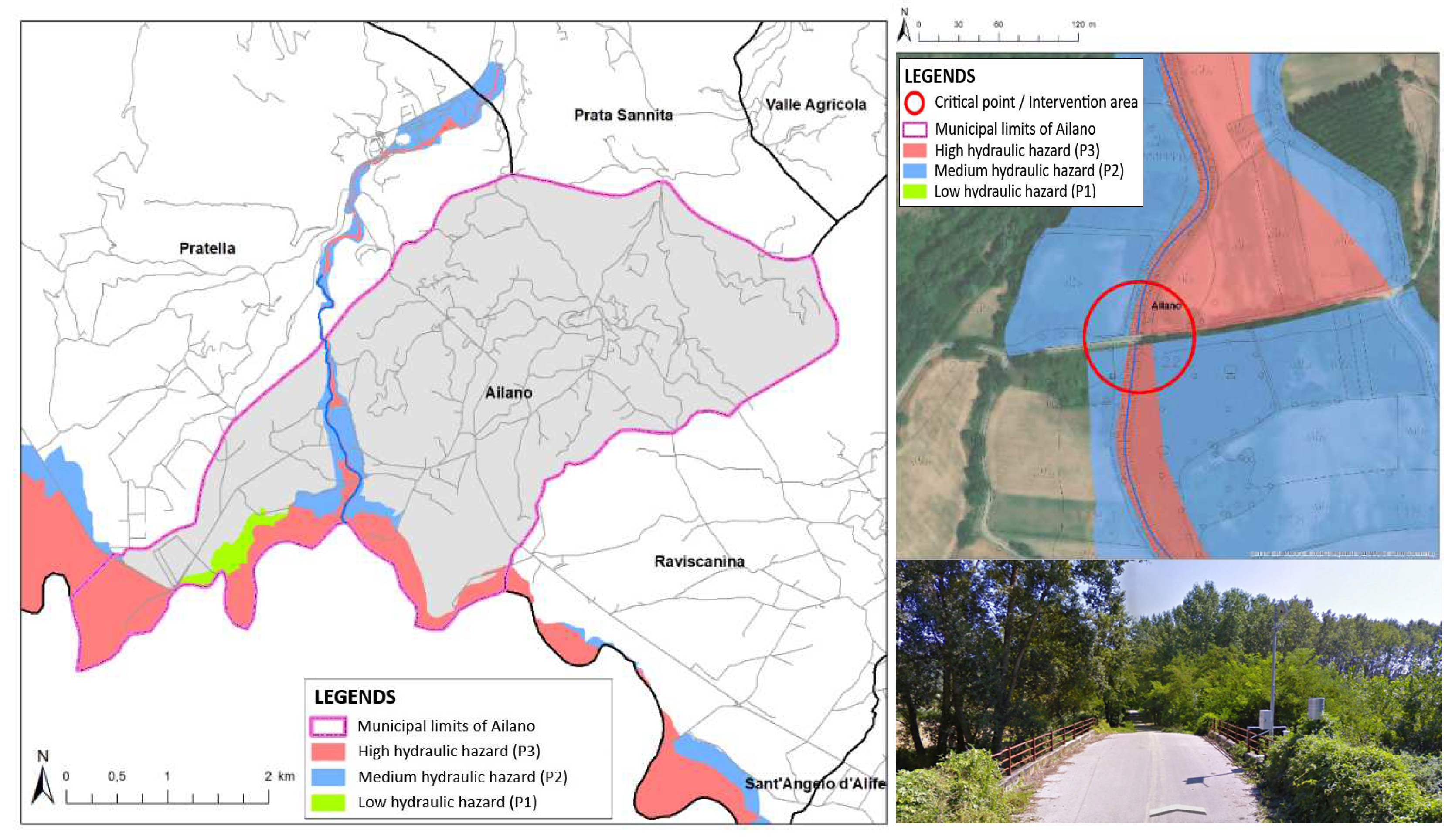
Among the most critical municipalities of the Matese area, Ailano is chosen to apply the last phase of the methodology (Figure 8). A bridge on the Lete River, a tributary of the Volturno River, is one of the possible points of hydraulic crisis in the area. After inspection and consultation of the available data for the area, the “site-specified measure sheet” is compiled providing information in order to 1) typological characteristics of the phenomena/ hydrogeological instabilities encountered or expected and 2) general data context in order to the “level of knowledge of the issue” (availability of previous studies and/or projects, reports, topographical/geometrical and geognostics surveys, etc.), level of accessibility of the areas, interferences with other infrastructures (electricity, sewer and gas pipelines, etc.), landscape/environmental official constraints and number and type of authorities involved in the approval process of the measure.
-
The criticality of the bridge is mainly related to a hydraulic ineffectiveness of the section of the bridge against flood with higher probability of occurrence (Tr 20 and 50 years). The river is characterized by low/medium slope values. Not high sediment transport has been observed and the flow velocities are basically not high. During the flood, the narrowing of river section at bridge location causes the water level rise; thus, the flood affects nearby areas and road, making it not-drivable. Possible deep bank erosion near the bridge abutments may occur due to the increase in current velocity and the consequent turbulence phenomena at the bridge section. The removal of material from the base of the abutments can create stability problems for the foundation/structure.A very poor level of knowledge about the critical point is found (weight 1). The level of accessibility of the areas for means and equipment is very high (weight 10), highlighting no particular difficulties/presence of obstacles for the implementation of any kind of measure. The same exact weight (10) is possible to assign to the field-sheet “operational interference”: no power lines, aqueducts, pipelines in general that could complicate/slow the process/work are found. Regarding the environmental, landscape and archaeological aspects, the area appears to be moderately constrained (weight 4) whereas the number of authorities involved in the approval process is quite high (weight 6).
Therefore, the measures – at first - deemed most suitable for the case were chosen selecting them from the database list. The measures chosen are: 1) enhancement of the channel section at the bridge location); 2) vegetated riprap.
The first solution consists of an adjustment of the height section to make it sufficient for the transit of more severe floods, to reduce the frequency with which the bridge deck interferes with the flows, to improve the safety of the road infrastructure. Riprap consists of blocky, angular rocks of different sizes and shapes. In a streambank stabilization job, the riprap is placed on the bank in such a way that the rocks are not segregated by size. Smaller rocks should chink in the void spaces between the larger rocks. When properly placed, each rock will be locked in to place by the surrounding rocks, creating a virtually solid, immovable object. To add further stability, the riprap should be keyed in both the bank and bed. Vegetated riprap incorporates a combination of rock and native vegetation in the form of live cuttings. The establishment of native vegetation will improve fish habitat by creating shade, cover and input of small organic debris to the stream. It will also provide added bank protection through the development of root mass.
Finally, weights are applied according to the description in paragraph 3.2.2, point 3. By comparing the scores obtained with different solutions it is possible to define a suitability scale that helps the user in choosing the measure/measures.
The proposed methodology has been developed with the aim of ensuring its replicability in contexts different from those on which it has been tested. Indeed, the methodology – the first two steps - is based on few and widely available and easily accessible data (ESRI format shapefile containing flood hazard and risk official maps and digital elevation model) and on the use of open-source GIS tools. The last step of the methodology, aimed at identifying the most appropriate structural measures for risk mitigation, is based on the use of an extensive database of different structural measures applicable to a wide range of contexts. The proposed database of measures provides a broad spectrum of possible alternatives; thus, it is possible to identify useful measures for the mitigation of hazard/risk associated with the main and most frequent hydraulic and hydrogeological phenomena affecting the national territory and, above all, inland areas.
5. Conclusion
Acting on inland areas is a complex issue that requires special studies and careful knowledge of places, including their potential and weaknesses. In the light of their great historical, cultural and social value, as well as of the possibilities offered by coherent and respectful enhancement actions, inland areas represent an effective opportunity for territorial development, since their revitalisation would promote the sustainable restoration and/or reorganisation of settlement patterns. With this aim, it seems necessary to consider not only the role that the great unexpressed potential of these places can play, but also what are the real critical points on which to intervene. Among these, there is very often a fragility caused by the high exposure to hazardous events that inevitably lead to depopulation and abandonment of places. In fact, one of the main reasons behind the substantial migration phenomena is the high seismic and/or hydrogeological risk to which inland areas are subject. In order to outline effective enhancement strategies, there is a need to include risk assessment studies that can provide a starting point for mitigation actions.
With this premise, the paper provided a risk assessment procedure to support the regeneration on inland areas and enhance their resilience to adverse events. The methodology has been developed within the general framework of RI.P.R.O.VA.RE., a project funded by the former Italian Ministry of the Environment and Protection of Land and Sea (MATTM). The hydraulic, hydrogeological and seismic risk analysis has been performed with reference to a case study area falling in the Matese area, Campania Region, Southern Italy. Seismic hazard, exposure and vulnerability allowed the assessment of the seismic risk at the local scale. Strategies to support seismic risk reduction policies were proposed depending on the structural typology of the buildings and on the hazard features. The hydraulic and hydrogeological risk mitigation relied upon the definition of the Geomorphic Flood Area (GFA) to map inland flooding local areas. The definition of weights allows the definition of the mitigation measures. The procedure is proven to be particularly useful with reference to poor data contexts, as the inland areas.
Author Contributions
Conceptualization, A.G., P.F., S.F., L.P., and G.V.; methodology, A.G., P.F., S.F., L.P., and G.V.; software, E.D.A., F.P. and F.C.; validation, E.D.A., F.P. and F.C.; formal analysis, A.G., P.F., S.F., L.P., and G.V.; investigation, A.G., P.F., S.F., L.P., and G.V.; resources, A.G., P.F., S.F., L.P., and G.V.; data curation, A.G., P.F., S.F., L.P., E.D.A., F.P. F.C. and G.V.; writing—original draft preparation, E.D.A., F.P. and F.C.; writing—review and editing, A.G., P.F., S.F., L.P., E.D.A., F.P. F.C. and G.V.; visualization, E.D.A., F.P. and F.C.; supervision, A.G., P.F., S.F., L.P., and G.V.; project administration, A.G., P.F.; funding acquisition, A.G., P.F. All authors have read and agreed to the published version of the manuscript.
Funding
This research was funded by the Italian Ministry of the Environment and Protection of Land and Sea, “Call Snsvs 2”, by Executive Decree no. 138/2020, for EUR 150,000.00 on the basis of the competitive call for “The promotion of research projects to support the implementation of the National Sustainable Development Strategy”.
Conflicts of Interest
The authors declare no conflict of interest.
References
- Eurostat. Available online: https://ec.europa.eu/eurostat/ (accessed on 3 July 2023).
- European Commission. Report from the Commission to the European Parliament, the Council, the European Economic and Social Committee and The Committee of the Regions on the impact of demographic change, 1st ed.; European Commission: Brussels, Belgium, 2020. [Google Scholar]
- Calafati, A. Aree interne: lo sviluppo necessario. In Proceedings of the Forum Aree interne: nuove strategie per la programmazione 2014-2020 della politica di coesione territoriale, Rieti, Italy, 11–12 marzo 2013. [Google Scholar]
- ENRD. Long Term Vision for Rural Areas, 1st ed.; Publications Office of the European Union: Luxembourg, Luxembourg, 2021. [Google Scholar]
- Martinez Juan, A.; McEldowney, J. Smart Villages. Concept, Issues and Prospects for EU Rural Areas. EPRS-European Parliamentary Research Service, 1st ed.2021. [Google Scholar]
- Viccione, G.; Nesticò, A.; Vernieri, F.; Cimmino, M. A Pilot Plant for Energy Harvesting from Falling Water in Drainpipes. Technical and Economic Analysis. Lect. Notes Comput. Sci. 2019, 11624, 233–242. [Google Scholar] [CrossRef]
- Berizzi, C.; Rocchelli, L. Borghi rinati. In Paesaggi Abbandonati e Interventi di Rigenerazione, 1st ed.; Il Poligrafo: Padova, Italy, 2019. [Google Scholar]
- 8. MIUR. Accordo di Partenariato 2014-2020. Strategia nazionale per le Aree interne: definizione, obiettivi, strumenti e governance, 2013.
- Galdersi, A.; Fiore, P.; Pontrandolfi, P. Strategie operative per la valorizzazione e la resilienza delle aree interne: il progetto RI.P.R.O.VA.RE. BDC 2020, 20, 297–316. [Google Scholar] [CrossRef]
- Amodio, T. Territories at risk of abandonment in Italy and hypothesis of repopulation. BELGEO 2022, 4, 1–22. [Google Scholar] [CrossRef]
- Galderisi, A.; Gaudio, S.; Bello, G. Le aree interne tra dinamiche di declino e potenzialità emergenti: Criteri e metodi per future politiche di sviluppo. Arch. Di Studi Urbani E Reg 2022, 133, 5–28. [Google Scholar] [CrossRef]
- Galderisi, A.; Bello, G.; Limongi, G. Per uno sviluppo resiliente dei territori interni: Uno strumento operativo. BDC 2021, 21, 231–251. [Google Scholar]
- Hack, J. Studies of longitudinal stream profiles in Virginia and Maryland. U.S. Geological Survey Professional Paper.
- Bacci, M.; Di Marco, M. Il rischio sismico in Toscana: Valutazione del rischio sismico in Toscana. Modello speditivo a scala regionale Livello 0, SETTORE SISMICA – Prevenzione sismica Regione Toscana, Italy, 2018.
- Bacci, M.; Di Marco, M. Il rischio sismico in Toscana: Valutazione del rischio sismico in Toscana. Modello sintetico a scala comunale e urbana Livello 1 – 2, SETTORE SISMICA – Prevenzione sismica Regione Toscana, Italy, 2019.
- Istituto Nazionale di Geofisica e Vulcanologia. Available online: www.ingv.it (accessed on 3 July 2023).
- Istituto Nazionale di Statistica. Available online: www.istat.it (accessed on 3 July 2023).
- Dipartimento della Protezione Civile. Available online: https://rischi.protezionecivile.gov.it/it/sismico/attivita/classificazione-sismica (accessed on 3 July 2023).
- D.M. 17/01/2018. Nuove Norme Tecniche per le Costruzioni, Italy, 2018.
- D.M. 65 07/03/2017. Allegato A – Linee guida per la classificazione del rischio sismico delle costruzioni, Italy, 2017.
- 3274 20/03/2003. Primi elementi in materia di criteri generali per la classificazione sismica del territorio nazionale e di normative tecniche per le costruzioni in zona sismica, Italy, 2003.
- Clubb, F. J.; Mudd, S. M.; Milodowski, D. T.; Valters, D. A.; Slater, L. J.; Hurst, M. D.; Limaye, A. B. Geomorphometric delineation of floodplains and terraces from objectively defined topographic thresholds. Earth Surface Dynamics 2017, 5, 369–385. [Google Scholar] [CrossRef]
- De Risi, R.; Jalayer, F.; De Paola, F. Meso-scale hazard zoning of potentially flood prone areas. Journal of Hydrology 2015, 527, 316–325. [Google Scholar] [CrossRef]
- Jafarzadegan, K.; Merwade, V. A DEM-based approach for large-scale floodplain mapping in ungauged watersheds. Journal of Hydrology 2017, 550, 650–662. [Google Scholar] [CrossRef]
- Nardi, F.; Vivoni, E. R.; Grimaldi, S. Investigating a floodplain scaling relation using a hydrogeomorphic delineation method. Water Resources Research 2006, 42. [Google Scholar] [CrossRef]
- Albertini, C.; Miglino, D.; Iacobellis, V.; De Paola, F.; Manfreda, S. Flood-prone areas delineation in coastal regions using the Geomorphic Flood Index. J. Flood Risk Manag. 2021, e12766. [Google Scholar] [CrossRef]
- Manfreda, S.; Samela, C. A DEM-based method for a rapid estimation of flood inundation depth. Journal of Flood Risk Management 2019, 12 (Suppl. 1). [Google Scholar] [CrossRef]
- Samela, C.; Albano, R.; Sole, A.; Manfreda, S. A GIS tool for cost-effective delineation of flood-prone areas. Comput. Environ. Urban Syst. 2018, 70, 43–52. [Google Scholar] [CrossRef]
- Samela, C.; Troy, T.J.; Manfreda, S. Geomorphic classifiers for flood-prone areas delineation for data-scarce environments. Adv. Water Resour. 2017, 102, 13–28. [Google Scholar] [CrossRef]
- Capobianco, V.; Uzielli, M.; Kalsnes, B.; Choi, J.C.; Strout, J.M.; von der Tann, L.; Steinholt, I.H.; Solheim, A.; Nadim, F.; Lacasse, S. Recent innovations in the LaRiMiT risk mitigation tool: implementing a novel methodology for expert scoring and extending the database to include nature-based solutions. Landslides 2022, 19, 1563–1583. [Google Scholar] [CrossRef]
- Vaciago, G. The SafeLand compendium of landslide risk mitigation measures. In Landslide Science and Practice: Risk Assessment, Management and Mitigation, 1st ed.; Margottini, C., Canuti, P., Sassa, K, Eds.; Springer: Berlin/Heidelberg, Germany, 2013; Volume 6, pp. 683–689. [Google Scholar]
- Leopold, L. B.; Maddock, T. J. The hydraulic geometry of stream channels and some physiographic implications. Geological survey professional paper.
Figure 1.
The delimitation of Campania and Basilicata inland areas.
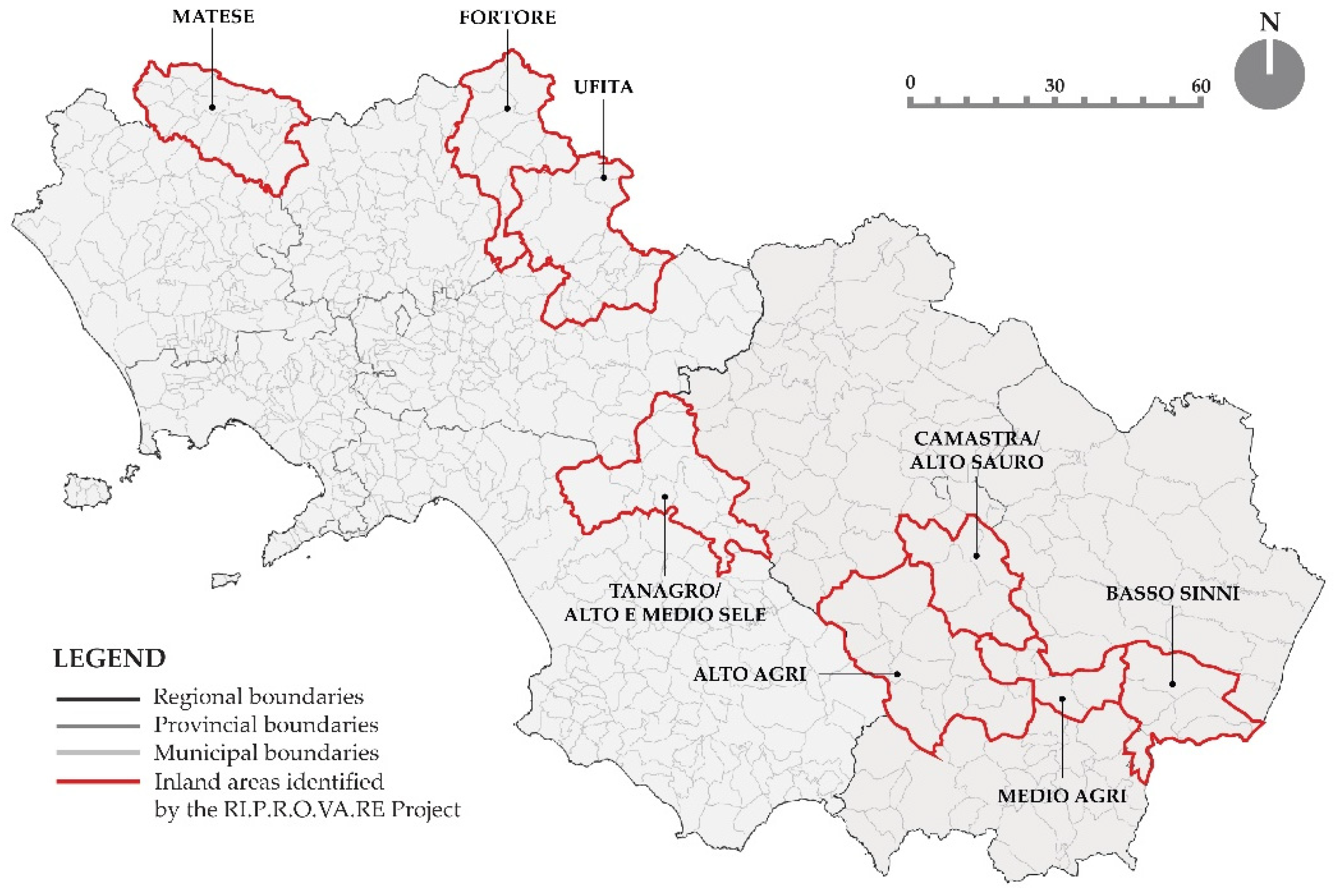
Figure 2.
L1 Hazard Map of Matese inland area.
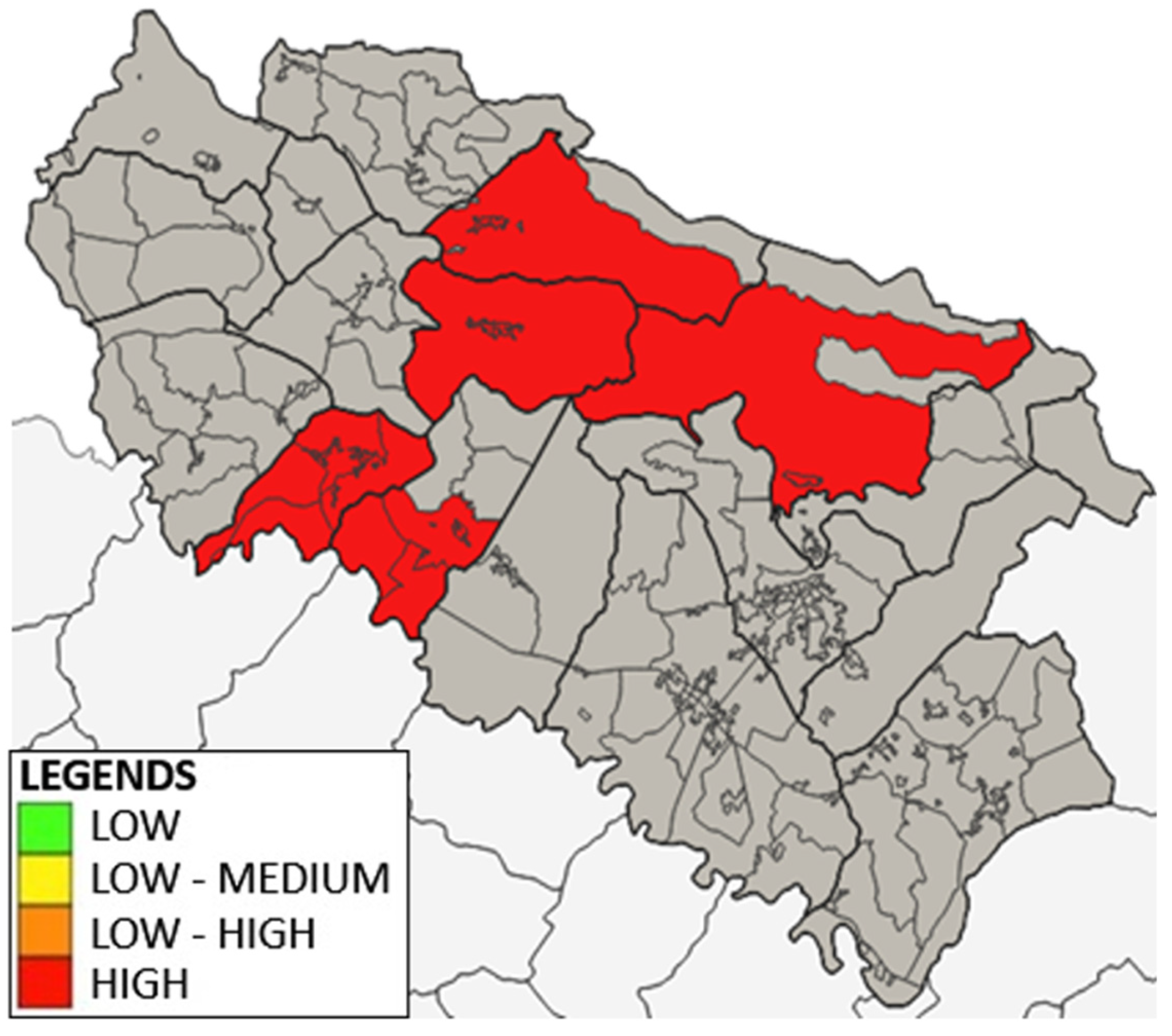
Figure 3.
L1 Vulnerability Map of Matese inland area.
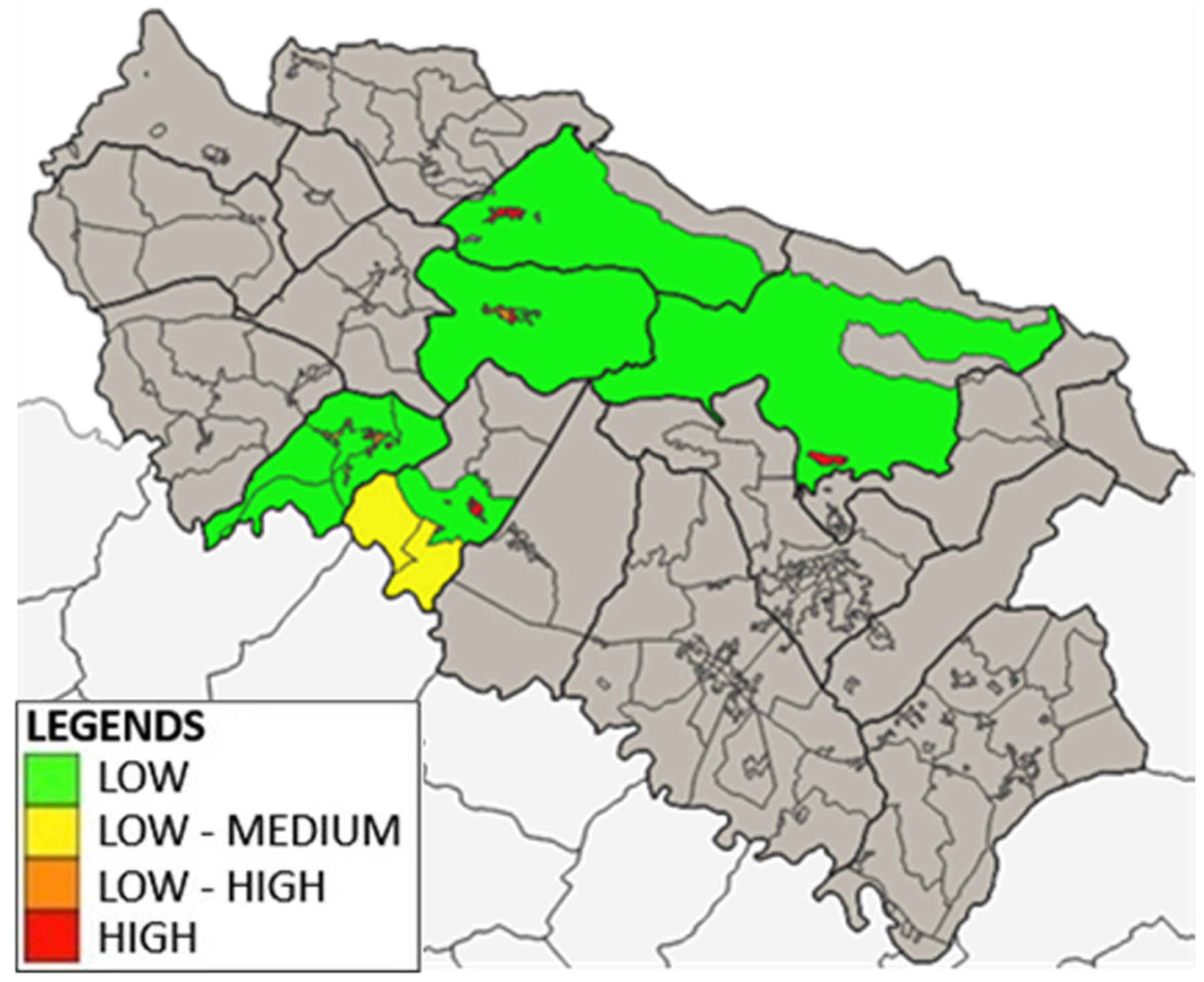
Figure 4.
L1 Exposure Map of Matese inland area.
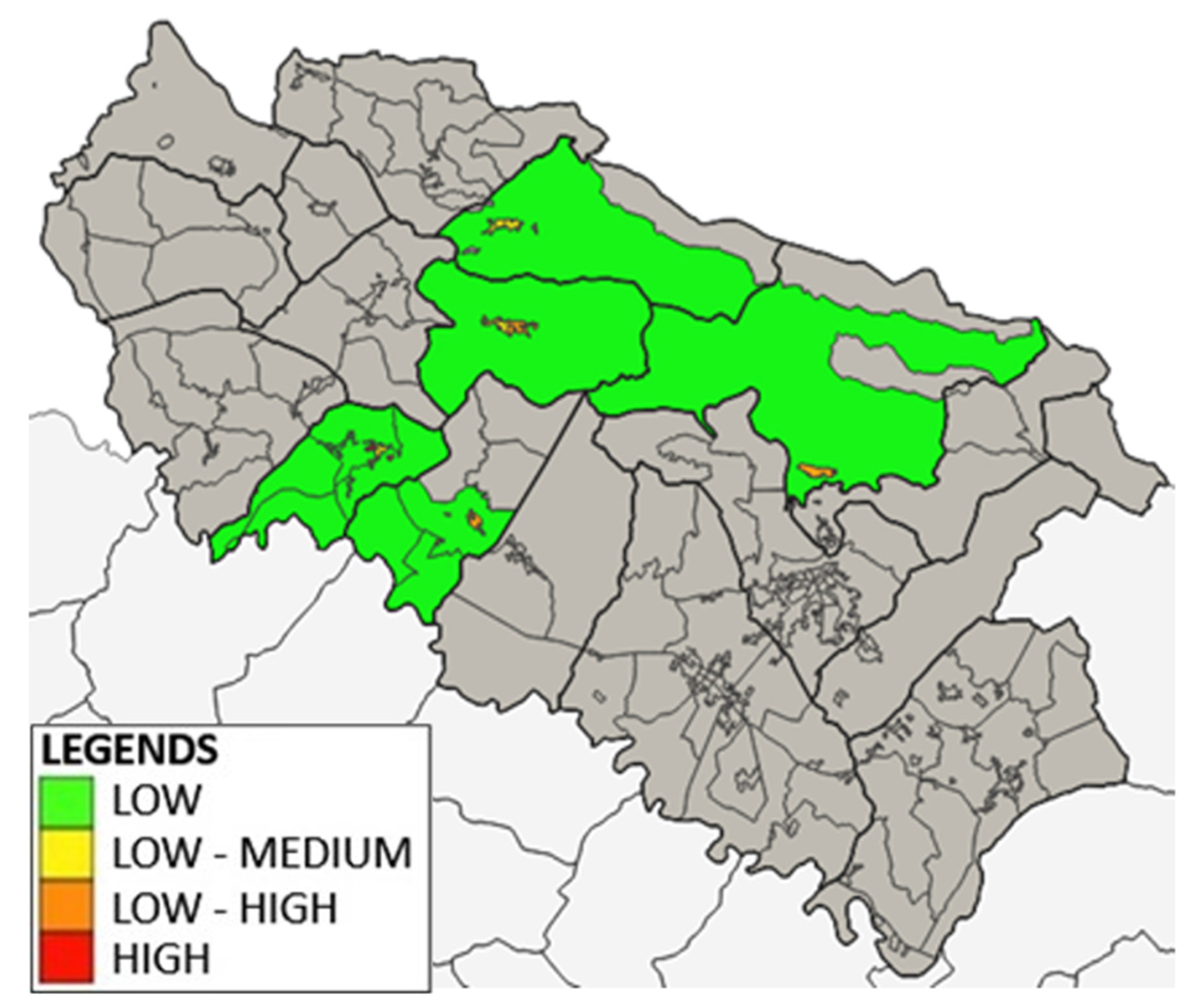
Figure 5.
(a) L1 Risk Map of Matese inland area under actual conditions; (b) L1 Risk Map of Matese inland area after the application of the proposed risk mitigation strategy.
Figure 5.
(a) L1 Risk Map of Matese inland area under actual conditions; (b) L1 Risk Map of Matese inland area after the application of the proposed risk mitigation strategy.
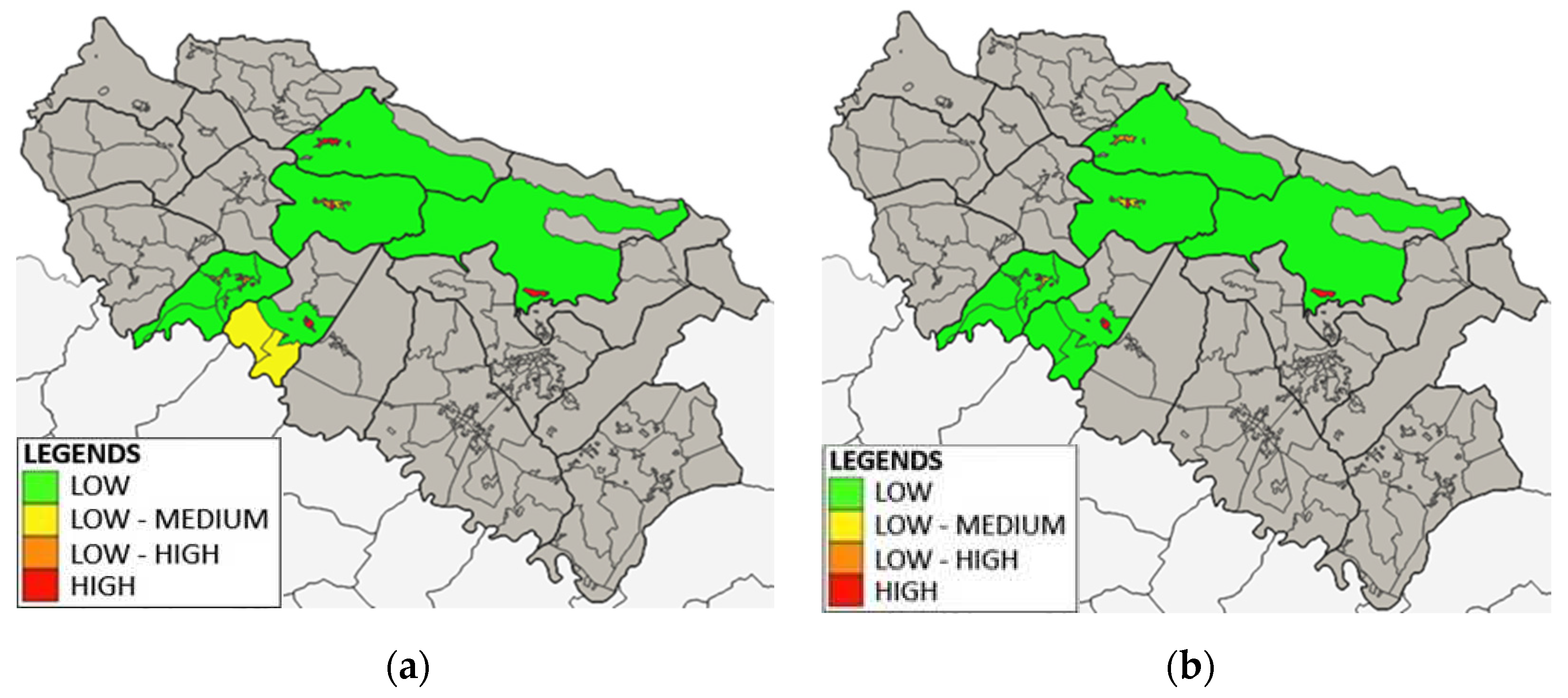
Figure 6.
(a) Municipality of Valle Agricola L2 Risk Map under actual conditions; (b) Municipality of Valle Agricola L2 Risk Map after the application of the proposed risk mitigation strategy.
Figure 6.
(a) Municipality of Valle Agricola L2 Risk Map under actual conditions; (b) Municipality of Valle Agricola L2 Risk Map after the application of the proposed risk mitigation strategy.
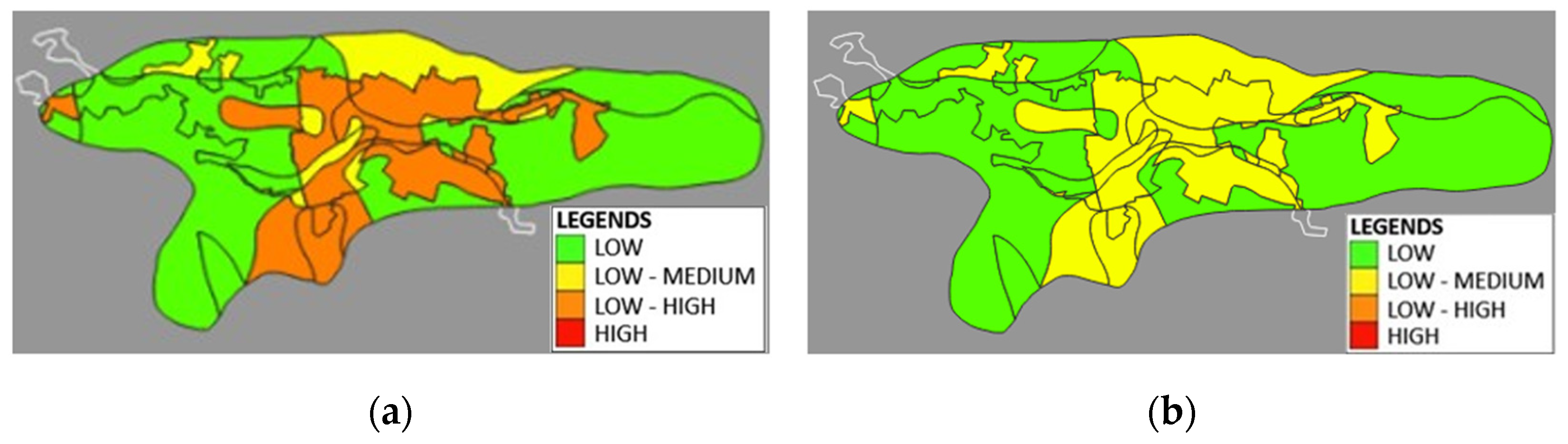
Figure 7.
Percentage of areas prone to high hydraulic hazard levels in each municipality of the Matese area.
Figure 7.
Percentage of areas prone to high hydraulic hazard levels in each municipality of the Matese area.
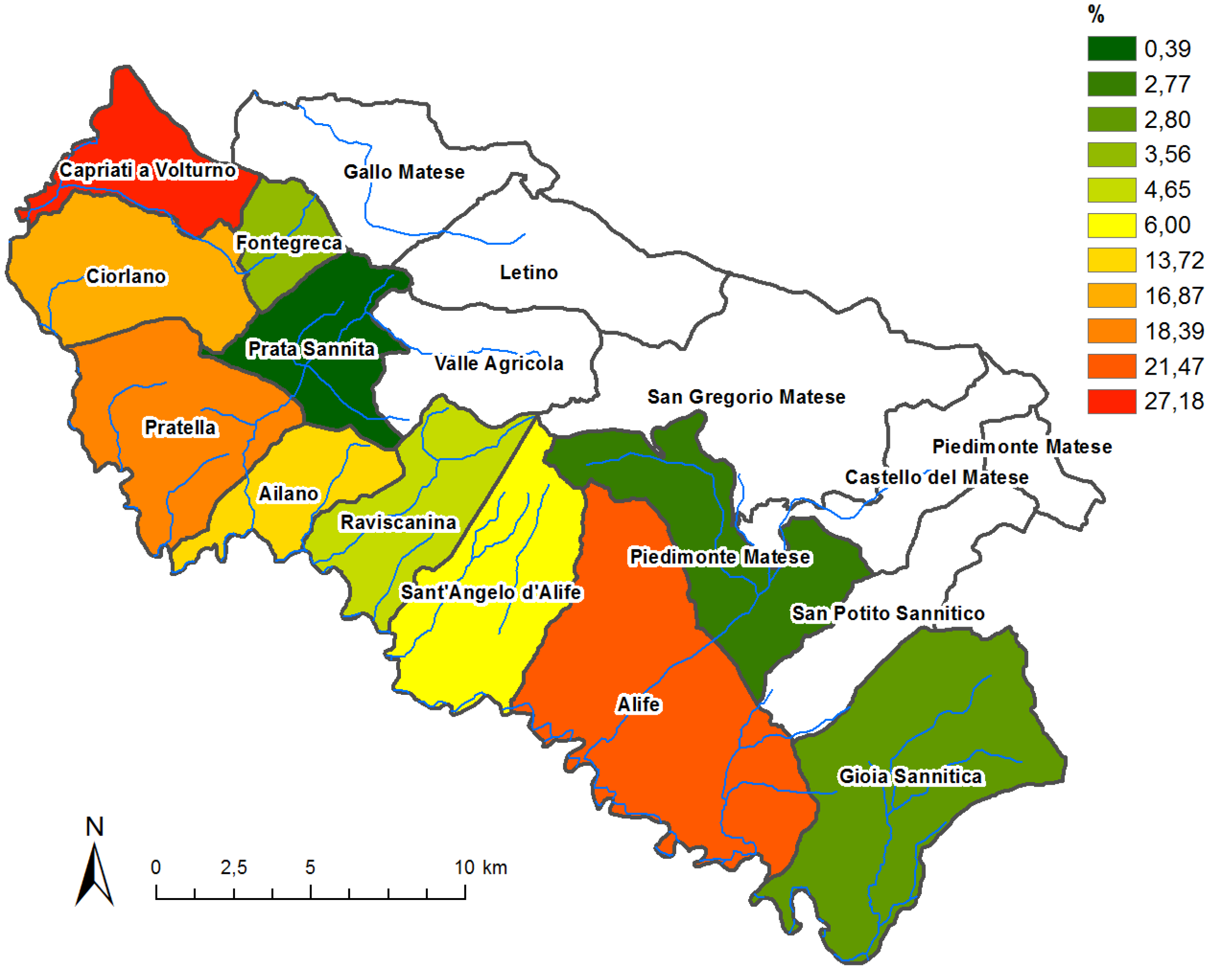
Figure 8.
Excerpt from the hydraulic hazard map (PSAI) with the indication (red circle) of the critical point/intervention area (over the bridge indicated in the lower right photo).
Figure 8.
Excerpt from the hydraulic hazard map (PSAI) with the indication (red circle) of the critical point/intervention area (over the bridge indicated in the lower right photo).
| Hazard Class | Hazard Value (VP) | IP | |
|---|---|---|---|
| 4 | High | Ag > 0.200 g | 5 |
| 3 | Medium - High | 0.150 g < Ag ≤ 0.200 g | 4 |
| 2 | Medium - Low | 0.125 g < Ag ≤ 0.150 g | 3 |
| 1 | Low | Ag ≤ 0.125 g | 1 |
| Basic Seismic Hazard | AG VALUE | P |
|---|---|---|
| High | Ag > 0.200 g | 4 |
| Medium - High | 0.150 g < Ag ≤ 0.200 g | 3 |
| Medium - Low | 0.125 g < Ag ≤ 0.150 g | 2 |
| Low | Ag ≤ 0.125 g | 1 |
Table 5.
Vulnerability classes, values, and indices at Level 1 (Table 13 of [15]).
Table 5.
Vulnerability classes, values, and indices at Level 1 (Table 13 of [15]).
| Seismic Vulnerability | Iv | V |
|---|---|---|
| High | Iv ≥ 4 | 4 |
| Medium - High | Iv = 3 | 3 |
| Medium - Low | Iv = 2 | 2 |
| Low | Iv ≤ 1 | 1 |
| Exposure Class | Exposure Value (VE) | IE | |
|---|---|---|---|
| 4 | High | VE ≥ 37500 | 5 |
| 3 | Medium - High | 10000 ≤ VE < 37500 | 4 |
| 2 | Medium - Low | 2250 ≤ VE < 10000 | 3 |
| 1 | Low | VE < 2250 | 1 |
| Seismic Risk Class | IR |
|---|---|
| High | IEs ≥ 4 |
| Medium - High | IEs = 3 |
| Medium - Low | IEs = 2 |
| Low | IEs = 1 |
Table 9.
Seismic Risk, Risk indices and Seismic Risk classes at Level 1 (Table 17 of [15]).
Table 9.
Seismic Risk, Risk indices and Seismic Risk classes at Level 1 (Table 17 of [15]).
| Seismic Risk | IR | Seismic Risk Class |
|---|---|---|
| High | IEs ≥ 4 | 4 |
| Medium - High | IEs = 3 | 3 |
| Medium - Low | IEs = 2 | 2 |
| Low | IEs = 1 | 1 |
Table 10.
Seismic risk classes conversion.
| Seismic Risk Class before DM 65/2017 | Seismic Risk Class after DM 65/2017 |
|---|---|
| 1 | B – C |
| 2 | D |
| 3 | E |
| 4 | F - G |
Table 11.
Vulnerability risk classes conversion.
| Seismic Vulnerability Class before DM 65/2017 | Seismic Vulnerability Class after DM 65/2017 |
|---|---|
| 1 | V1 – V2 |
| 2 | V3 |
| 3 | V4 |
| 4 | V5 – V6 |
Disclaimer/Publisher’s Note: The statements, opinions and data contained in all publications are solely those of the individual author(s) and contributor(s) and not of MDPI and/or the editor(s). MDPI and/or the editor(s) disclaim responsibility for any injury to people or property resulting from any ideas, methods, instructions or products referred to in the content. |
© 2023 by the authors. Licensee MDPI, Basel, Switzerland. This article is an open access article distributed under the terms and conditions of the Creative Commons Attribution (CC BY) license (http://creativecommons.org/licenses/by/4.0/).
Copyright: This open access article is published under a Creative Commons CC BY 4.0 license, which permit the free download, distribution, and reuse, provided that the author and preprint are cited in any reuse.


