

Submitted:
01 August 2023
Posted:
02 August 2023
You are already at the latest version
Abstract
A novel approach based on response surface methodology (RSM) was developed to predict and apply the best extraction conditions for the isolation of various-type polyphenolic antioxidants from the dried flower buds of Magnolia x soulangeana Soul.-Bod. var. ‘Lennei’ (Magnoliaceae). As a method of choice, ultrasound-assisted extraction was used and the optimized extraction parameters (temperature, time of extraction, the composition of aqueous-ethanolic extractants and solvent to solid ratio) have been determined using a central composite design factorial analysis, followed by appropriate spectrophotometric methods (with Folin–Ciocalteu and 2,2-diphenyl-1-picrylhydrazyl reagents) to determine the antioxidant and antiradical potential of extracts, respectively. The use of 66.8% (V/V) ethanol, as the extraction solvent during the 55.2 min extraction protocol, and the ratio of extractant volume to herbal substance of 46.8 mL/g gave the highest total yield of bioactive antioxidant phenolics in the extract obtained. For this herbal preparation, qualitative and quantitative analysis was performed using combined chromatographic (LC), spectroscopic (PDA) and tandem mass spectrometric (ESI-QTOF–MS/MS) techniques. A detailed phytochemical profiling, conducted for the first time, documented substantial amounts of polyphenolic antioxidants, especially phenylethanoids and flavonoids in the flower buds of M. soulangeana ‘Lennei’. Their average total content exceeded 30.3 and 36.5 mg/g dry weight, respectively.
Keywords:
Magnolia x soulangeana var. ‘Lennei’
; response surface methodology
; ultrasound-assisted extraction
; phytochemical profiling
; phenolic antioxidants
1. Introduction
Magnolia x soulangeana is a plant hybrid of M. denudata Desr. and M. liliiflora Desr., which derives its name from French botanist Étienne Soulange-Bodin who successfully crossed the two aforementioned species in the early 19th century. A large number of hybrid cultivars were later obtained from M. soulangeana, among them a variety called ‘Lennei’ with beautiful pear-shaped white and pink flowers (Figure 1). According to The World Flora Online [1], the genus Magnolia L. (Magnoliaceae) includes 338 subordinate taxa that are trees or shrubs particularly widely distributed in Southeast Asia (China) and the tropical regions of southwestern North America and Central America. Unlike most wild magnolias, M. soulangeana var. 'Lennei, being a hybrid species developed in Europe, is particularly common on this continent (except in Scandinavia) as an ornamental tree in parks and gardens that tolerates low winter temperatures relatively well, so it is popular in cultivation.
Currently, considering biological activity and approved medical uses, M. officinalis Rehder et E.H. Wilson and M. biondii Pamp. are the best-known magnolia taxa in Europe. The dried bark and/or flowers of these two species are described in separate monographs of the European Pharmacopoeia as herbal substances standardized for the content of characteristic polyphenolic components, classified as neolignans (magnolol and honokiol) [2] or lignans (magnolin and fargesin derivatives) [3]. In the past two decades, the presence of other compounds belonging to the general group of plant phenolics, especially phenylethanoids [4,5], flavonoids [6] or phenolic acids [7], has also been confirmed in various herbal substances (organs) obtained from magnolia species. All of the aforementioned compounds are characterized by multidirectional biological potential, based mainly on antiradical and antioxidant properties [8]. They determine anti-biodegenerative properties, confirmed by numerous scientific reports, which indicate the protective effect of magnolia extracts or polyphenolic isolates on the function of the nervous [9,10] and cardiovascular [11,12] systems, as well as their broad anti-inflammatory [13] and even anticancer [14,15,16] activities.
In order to conduct reliable studies of the biological activity of extracts and isolates from various plant species, it is necessary to use efficient methods for isolating complexes and/or individual bioactive components from plant material. A popular preparative procedure for obtaining herbal metabolites, used by phytochemists, is liquid-solid extraction. In this case, the choice of extraction method and optimization of extraction conditions are critical parameters affecting the quality of the resulting product. For the isolation of polyphenolic compounds, ultrasound-assisted extraction (UAE) is often used [17,18,19,20]. When planning UAE, it is important to consider the influence of such parameters as solvent polarity, process time and temperature, ultrasound frequency as well as the solvent to raw herbal material ratio [21]. One of new approach to strengthen the efficiency of various extraction processes is to use a computer-aided tool known as response surface methodology (RSM). This technique is based on optimizing the responses (dependent variables) when two or more quantitative factors (independent variables) are involved. As a result, RSM minimizes the number of runs needed and provides prediction of optimal extraction conditions and evaluation of other parameters (e.g. antioxidant properties) related to the optimized isolation of bioactive plant components [22]. To date, only one article has been published on the isolation of flavonoids from M. offcinalis leaves using infrared assisted extraction optimized with RSM [23]. Therefore, we decided to use a central composite design (CCD), which involved conducting several UAE experiments followed by RSM to determine the optimal settings for each factor used in the extraction. This research was also prompted by the fact that no phytochemical investigation of the polyphenolic content in flower extracts of M. soulangeana var. 'Lennei' has been carried out so far, nor has their antioxidant activity been evaluated.
2. Results
2.1. Multivariate response surface modelling of plant material extraction in relation to total phenolic content and antioxidant activity of magnolia extracts
Multivariate optimization methods used in RSM have currently been used extensively in both plant and food analysis. Recently, the most popular are central composite, Box-Behnken and three-level factorial designs [24]. Table 1 shows the results of our experiments based on the CCD. Within the range of established UAE parameters, extraction time (4.77-55.23 min), ethanol concentration (16.36-83.64%), and solvent to raw material ratio (13.18-46.82 mL/g) were analysed. In relation to the aforementioned conditions, different total phenolic content (TPC) and DPPH• scavenging activity were observed for the individual MSL extracts obtained.
Using optimized UAE parameters, TPC content ranged from 35.42 to 65.73 mg GAE/g of the dried herbal substance, and percent DPPH∙ inhibition ranged from 86.76 to 94.29% under experimental conditions (Table 1). Overall, the highest TPC content was obtained for the following extraction parameters: time of 45 min, ethanol concentration of 70% (V/V), and solvent/raw plant material ratio of 40 mL/g. On the other hand, the highest scavenging activity (%I) was documented for the extract obtained during a 30-minute extraction with 50% (V/V) ethanol, using a solvent to raw material ratio of 30 mL/g. For both dependent parameters, the lowest TPC and %I were determined for extracts obtained during a 30-min extraction using a low (16.36%, V/V) ethanol concentration and 30 mL/g as the solvent/dried herbal material ratio. Therefore, the above results, obtained in the CCD multivariate modelling, suggested the existence of a potential correlation between ethanol concentration and the measured dependent parameters.
Regression coefficients for TPC and %I models are presented in Table 2. For TPC, the ethanol concentration (linear effect β2 and quadratic effect β22), and the interaction between the solvent concentration and solvent/raw material ratio (coefficient β23) was statistically significant (p < 0.05). For the antioxidant activity (%I model), the parameter intercept (coefficient β0) was statistically significant, although independent parameters had no significant effect on the percentage of DPPH• inhibition.
The response surface model used for statistical evaluation showed a good fit of independent variables as evidenced by the high coefficient of determination and non-significance (p > 0.05) of the lack to fit parameter. The results of the ANOVA (shown in Table 3) revealed high coefficients of determination, namely R2 = 0.9685 and R2 = 0.9585, for TPC and %I, respectively, that confirmed a good correlation between responses and independent variables.
Analysis of TPC variance documented that all optimized parameters show statistical significance for the linear effect, however, for the quadratic effects, only the ethanol concentration was statistically significant (p < 0.05). When analysing interactions between individual parameters, the relationship between ethanol concentration and solvent/raw material ratio was seen to be statistically significant (p < 0.05).
In the case of antiradical activity (% I), the results were negligible at p < 0.05. However, due to the high value of the R2 coefficient and the statistically insignificant match, we decided to continue the study in the direction of optimizing the extraction for this parameter.
Based on the estimated parameters of the correlation coefficients, it is possible to establish an empirical relationship between the determined parameters, that is, the dependent (Y) and independent (X) variables [25]. Using the data shown in Table2, these relationships are described by the following second-order polynomial equations (1) and (2):
where YTPC represents total phenolic content and Y%I – shows antioxidant activity of MSL flower bud extracts, and X1, X2 and X3 are time (min), ethanol concentration (%), and solvent/dried herbal material ratio (mL/g), respectively.
In addition, model fit for TPC was also demonstrated by correlating measured experimental versus predicted values and evaluating the random distribution of residuals (Figure 2, a-b).
Finally, the overall RSM model, showing the interactions between the independent factors used and the TPC/%I values, has been presented as three-dimensional response surface plots in Figure 3a–c and Figure 4a–c, respectively.
As can be seen in Figure 3a, as the concentration of ethanol in the extraction solvent increased, the TPC of the MSL extracts also rose. In this case, extraction time had less effect on TPC, although the highest phenolic yield was observed for t > 50 min (optimum 55.2 min). Referring to Figure 2b, at a low solvent-to-raw material ratio (< 35 mL/g), TPC decreased with increasing time, but once this value was exceeded, the total amount of polyphenolic compounds in MSL extracts increased. Hence, we ultimately concluded that as the ratio and ethanol concentration increase, the TPC content of the extract tends to increase. The highest concentrations of phenolics in MSL preparations were obtained for a solvent/raw material ratio > 45 mL/g (optimum 46.8 mL/g) together with ethanol concentration in the range of 63-82% (optimum 66.8%). As shown in Figure 3c, experimental UAE under optimal extraction parameters showed a higher mean content than the predicted value of TPC, namely 76.73 vs. 66.55 mg GAE/g of dry wt, respectively. The literature data indicate that the extraction parameter that mainly affects TPC content is ethanol concentration. Tabaraki and Nateghi [26] obtained the highest TPC content by extracting rice bran with 67% ethanol at 54°C for 40 min. The optimal high ethanol concentration (59%, V/V), in the RSM-monitored experiment, was also estimated for the maximum phenolic yield during a 25-minute UAE of pomegranate peel at 80°C, using a herbal material to solvent ratio of 1:44 [27].
As shown in Figure 4(a-c), optimal extraction parameters for the highest antioxidant/antiradical activity (% I) activity of MSL flower bud extracts were: extraction time of 28.1 min, 59.6% ethanol as extraction solvent and concentration and solvent to/raw plant material ratio of 29.6 mL/g. The antioxidant activity of extract obtained under optimal conditions was 87.10% and was lower than the predicted value (94.04%). The obtained results correspond with other experiments regarding the optimization of extraction parameters to obtain the highest antioxidant activity of plant extracts. For example, Wijngaard and Brunton [28] documented the highest antioxidant effects of the apple pomace extract using 31-min UAE, at 80°C and 56% (V/V) ethanol as the extraction solvent.
2.2. Phytochemical qualitative profiling of MSL flower bud components using coupled chromatographic, spectroscopic and tandem mass spectrometric techniques
A total of 22 polyphenolic antioxidants (Figure 5 and Table 4) were identified in MSL flower bud extracts, prepared in triplicate under RSM-optimized UAE conditions, namely using 66.8% (V/V) ethanol, as the extraction solvent, an extraction time of 55.2 min and the ratio of extractant volume to dried herbal substance of 46.8 mL/g.
For a qualitative profiling, RP-LC/PDA and LC/PDA/ESI-QToF/MS-MS methods were employed simultaneously. The former method was very important for obtaining characteristic UV spectra (of high quality) for the examined compounds and an additional set of retention time parameters, collected under conditions of better peak resolution during optimized classical RP-LC/PDA chromatographic analysis, which could be further compared with data obtained for reference polyphenolic components (Table 4). In the next step, compounds identification was performed based on a data set related to specific precursor ions and fragmentation patterns that were acquired by Agilent MassHunter software. It was found that the negative ionization mode (NEG) was more suitable, especially for obtaining deprotonated polyphenolic molecules and efficient cleavage of precursor ions that facilitated their proper identification. A high-resolution tandem mass spectrometer (Q-ToF) effectively delivered precursor (molecular) ions by operating in scan mode (MS1), while MS2 mode allowed the selection of product (fragment) ions with a specific m/z value, formed by ion dissociation in the collision chamber. Deprotonated ions [M−H]− and main product ions reported in the MS spectra of all phenolics were shown in Table 4. MS data acquired for MSL components were also compared with the spectral data obtained for reference polyphenolic substances.
Detailed results of qualitative profiling of MSL flower bud components using coupled chromatographic, spectroscopic and tandem mass spectrometric techniques are discussed below.
2.1.1. Phenolic acids
Hydrophilic constituents, recorded at low retention times (from ~3.00 to 13 min), were analysed first. Compound 1, (Rt ~3.67 min) fragmented to a precursor ion [M-H]- with m/z 153.0193, and to a product ion [M-H-CO2]- with m/z 109.0297, which was formed from the loss of CO2 from the carboxylic acid. MS data published by other researchers [29,30] have unequivocally confirmed that the molecule sought is one of the hydroxybenzoic acids (protocatechuic acid). Compound 2, with an average Rt of 4.58 min, was identified by analysis of the precursor ion [M-H]-, with m/z 353.0855, that released a fragment ion of m/z 191.0543 (quinic acid). The chromatographic and spectrometric data also corresponded with those previously reported by Saravanakumar et al. [30] and Park et al. [31], matching the fragmentation pattern of chlorogenic acid (C16H18O9), that belongs to the group of hydroxycinnamic acids. The identity of compound 5 (with Rt ~12.41 min), giving precursor ion [M-H]- with m/z 167.0351 and characteristic cleavage to product ions (with m/z 135.0116 and m/z 108.0210), was confirmed with a certified reference substance and published data [31,32] as vanillic acid (C8H8O4).
2.1.2. Phenylethanoids
The second group of polyphenolic antioxidants identified in MSL flower bud extracts were phenylethanoids, for which specific molecular structure elements were confirmed, namely caffeoyl and phenylethanol moieties along with the presence of rhamnose and glucose.
Compound 3, with Rt ~5.08 min and a characteristic UV spectrum showing two maxima (198 and 330 nm) provided a [M-H]- precursor ion of m/z 785.2466, further yielding a fragment ion (m/z 623.2127), corresponding to the loss of hexose. Other characteristic products were also obtained, including an ion with m/z 477.1619 and 315.0898 (formed from the previous one by the cleavage of glucose = 162 Da), as well as a product ion of m/z 179.0338 (C9H7O4), corresponding to a caffeoyl moiety. All these product ions were further confirmed by a fragmentation pattern of the reference substance and literature data [33,34]. The compound was identified as echinacoside (C35H46O20). Compound 4 yielded a characteristic precursor ion with m/z 931.3058 and fragment ions with m/z 769.2726, 751.2572, 179.0499 and 161.0238 corresponding to the loss of rhamnose, glucose and caffeoyl moiety (similarly to compound 3), and in the next step the loss of rhamnose. The fragmentation pattern was also similar to described in literature [33,34], therefore the compound was tentatively identified as 2’-rhamnoechinacoside (C16H16O8). As for compound 9 (Rt~26.48 min), a [M–H]- precursor ion with m/z 623.1985 was formed and characteristic product ions with m/z 461.1665 (resulting from the loss of the caffeoyl moiety) and 179.0342 were also found. When the H2O molecule was detached, a fragment ion with m/z 161.0246 was formed. Based on LC/MS analysis of product ions obtained for the reference substance and information published by Joo et al. [35] for M. denudata flower extracts, compound 9 was identified as acteoside (verbascoside).
2.1.3. Flavonoids
As a medium-polar group of polyphenolic antioxidants, various types of flavonoid compounds were found in MSL flower bud extracts. Compound 7 was identified on the basis of a precursor ion [M–H]- with m/z 609.1433 and a predominant aglycone ion with m/z 301.032, which indicated the loss of rhamnose and glucose moiety from the molecular structure of flavonoid glycoside. Additionally, [M–H–CO–H]- and [M-H-CO2-H]- ions were formed, with m/z of 271.0253 (C14H9O6) and 257.0411 (C14H9O5), as a result of the loss of CO and CO2, respectively. They were characteristic for retro-Diels-Alder (rDA) fragmentation pattern of flavonol aglycone, quercetin. The literature data [36,37] referring to studies of other magnolia species further helped to identify compound 7 as quercetin 3-O-rutinoside (rutoside). Compound 6 preceding compound 7 on the base peak chromatogram (Rt ~19.24 min) formed a precursor ion of m/z 609.1303, similar to the molecular ion of compound 7. According to a study published by Abad-Garcia et al. [38], distinguishing between these compounds is possible based on the analysis of fragment ions formed by the loss of rhamnose and rhamnoglucose and the intensity of these ions. This made it possible to differentiate the two flavonol components and identify compound 6 as quercetin 3-O-neohesperidoside (C27H30O16). A molecular ion of m/z 463.0889 was formed for compound 8 (R t~ 24.37), and further MS/MS fragmentation, after a detaching the glucose molecule, yielded a fragment ion with m/z 301.0347, analogous to the one previously identified in the rutoside fragmentation pattern. UV and retention data (Table 4) compared with the reference substance as well as information provided by other reserachers [36], who analyzed magnolia extracts, allowed us to identify compound 8 as quercetin 3-O-glucopyranoside (C21H20O12), known by its usual name as isoquercitrin.
In the case of compound 10 (with Rt ~28.89 min) a precursor [M-H]- ion of m/z 593.1571 was obtained, which upon cleavage released the [MH-146-162]- ion with m/z 285.0444, characteristic of the kaempferol aglycone, with the observed loss of the rhamnosyl moiety. Taking into account UV, retention and other published MS data [36,39], compound 10 was identified as kaempferol 3-O-rutinoside (nicotiflorin).
Spectrometric analysis of compound 12 (Rt ~30.80 min) confirmed the presence of a third group (in addition to the quercetin and kaempferol derivatives described above) of flavonoid glycosides in MSL flower buds. This phenolic constituent released a molecular ion with m/z 477.1042. In the course of MS/MS analysis, the loss of glucose (162 Da) was documented and characteristic ions, with m/z 315.0486 (corresponding to isorhamnetin moiety) and m/z 271.0256, were formed. Similar results were published by Sokkar et al. [36] and confirmed with the MS fragmentation pattern obtained for the reference substance. Thus, compound 12 was identified as isorhamnetin 3-O-glucoside (C22H22O12). Compound 11 yielded a precursor [M-H]- ion with m/z 623.1622 and fragment ions with m/z 315.0516 and m/z 271.0252, corresponding to isorhamnetin aglycone molecule), and a loss of 308 Da indicating the presence of rhamnosyl-glucose (rutinose) attached to the aglycone, respectively. Therefore, compound 11 was identified as isorhamnetin 3-O-rutinoside (narcissin, C28H32O16). Compound 13 (Rt ~ 35.50 min) had a similar UV spectrum to compound 11, and the same molecular mass, hence was suspected to be an isorhamnetin derivative. It released a precursor ion with m/z 623.1611 and a fragment ion with m/z 315.0509, which was very similar to compound 13, so this component was described as the 3-O-rutinoside isomer of isorhamnetin.
Compound 14 released a molecular [M-H]– ion at m/z 637.1728 and a product ion at m/z 330.0684, that further yielded a methyl unit giving another product ion at m/z 315.0509 corresponding to the isorhamnetin aglycone. Fragmentation results were compared with the literature [40] and compound 14 was finally identified as rhamnazin 3-O-rutinoside (ombuoside, C29H34O16).
2.1.4. Lignans
The group of hydrophobic phenolic constituents of MSL, identified in MSL extracts, were lignans. These compounds recorded were recorded at retention times above 56 min (Figure 5).The taxonomic origin of M. soulangeana (as a hybrid of M. liliiflora and M. denudate) prompted us to look for a group of phenolic compounds previously described for these two taxa [7,31,35]. However, due to the rapid breakdown of lignans, even with low collision energy used, it was difficult to determine accurately the chemical structure of these compounds. Therefore, in the qualitative profiling of MSL extracts, we relied mainly on the characteristic UV and MS spectra of reference substances and the identification of unique product ions derived from lignan structures. Compound 15 (Rt ~56.22 min) released a precursor ion with m/z 415.4612 and main product ions with m/z: 221.1545 and 236.1059 . In addition, we documented three maxima (204, 230 and 278 nm) in its UV spectrum. Retention, spectroscopic and MS/MS data were compared with the reference substances and confirmed with results of other researchers [41,42,43]. Finally, compound 15 was tentatively identified as magnolin (C23H28O7). Compound 18 (Rt ~62.25 min) yielded ions with m/z 357.1360 and 242.9433 as well as characteristic product ions with m/z 174.9563 and 112.9856, also reported for other suspected lignan compounds. UV maxima (202, 234 and 284 nm) and MS spectra of this component corresponded to the spectra of the reference substance and MS data published [42,43,44]. Therefore, compound 18 was described in Table 4 as fargesin (C21H22O6).
As regards to compounds 16-17 and 19-22 their UV spectra indicated the lignan structure resembling fargesin and they yield the same characteristic product ions with m/z 174.956 and 112.9856. Comparing the results of our MS/MS analysis with published data on Magnolia species [43,44], we decided to include all of these compounds in the group of furofuran lignans, with the molecular structure type of fargesin.
An interesting result of our qualitative study was the absence of neolignans (including honokiol and magnolol and their derivatives) in MSL extracts examined. This confirmed the similarity of the lignan profile to M. liliiflora and M. denudata as well as to an important medicinal taxon, M. biondii, whose monograph (Magnoliae biondii flos) is listed in the Europoean Pharmacopoeia [42,43,44,45].
2.3. Phytochemical quantitative profiling of polyphenolic antioxidants in MSL extracts using RP-LC with a photo-diode array (PDA) detection
In terms of the detailed quantitative analysis of polyphenolic antioxidants, MSL flower bud extracts were prepared under RSM-optimized UAE conditions, similarly to the qualitative profiling procedure. On the basis of the studies described in section 2.2, we selected four major groups of compounds (including flavonoids, phenylethanoids, phenolic acids and lignans), whose contents were calculated for the leading components using the corresponding reference substances. The main results of the research done is shown in Figure 6.
As it can be seen, phenylethanoids and flavonoids (quercetin derivatives) were the most abundant group of polyphenolic antioxidants in MSL flower buds. Their average content was established at ~ 30.3 and ~ 30.5 mg/g of the dried herbal substance, respectively (Figure 6a), which corresponded to more than 40% of the total phenolic antioxidant content determined in the plant material examined (Figure 6b). In the group of quercetin derivatives (Q-der), rutoside accounted for about 95% of the labeled components, demonstrating the very high content of this flavonol in MS flower buds. The presence of rutoside, as the dominant component in flowers of other magnolia taxa, and its antioxidant and anti-inflammatory potential was also confirmed by other researchers [13,31,36]. Other quantified flavonoid compounds (kaempferol and isorhamnetin derivatives) may have a much weaker effect on the antioxidant/antiradical potential of MSL flower bud extracts as their percentages of total phenolic content were about 4.7 and 3.6%, respectively. (Figure 6b). The second important group of polyphenols in MSL flowers, which can significantly affect the antioxidant and antiradical capacity of the aqueous-ethanolic extracts obtained thereof, are phenylethanoid compounds (Figure 6a). In this group, the dominant polyphenolic components in the herbal substance examined were 2’-rhamnoechinacoside and acteoside (verbascoside), whose average content reached 19.2 and 8.6 mg/g dry wt, respectively. The results of phytochemical and biological studies, conducted for other magnolia species [4,5,33] highlight the significant protective effects of phenylethanoids against free radical-induced oxidative damage. When considering antioxidant/antiradical activity of MSL lignan compounds, mainly fargesin derivatives, it is important to emphasize the increasing number of phytochemical and biological studies of these constituents in the genus Magnolia L. showing their anti-biodegenerative (anti-inflammatory, antimicrobial, antineoplastic) potential [3,41,42,43,44]. In view of these studies, it is hopeful that a relatively high content of these compounds, accounting for more than 5% of the total polyphenolic compounds, was determined in MSL flowers.
3. Materials and Methods
3.1. Plant material and its pre-treatment
Unopened flower buds of M. soulangeana var. ‘Lennei’ (MSL) were collected in early spring from the specimens growing in the arboretum of Maria Curie-Sklodowska University (UMCS) Botanical Garden (geographical cooridinates: 51°16 'N; 22°30'E; Lublin, Poland) in the presence of a botanical taxonomy specialist employed by the garden. The fresh plant material was dried immediately after collection in a laminar ventilated dryer at a temperature not exceeding 35oC, and a small portion of MSL buds was then deposited in the Department of Pharmacognosy at the Medical University of Lublin. The remaining plant material was then ground into a fine powder using a laboratory mill, sieved to obtain particles of 0.75 mm and placed in a hermetically sealed vessel. Before starting extraction procedures, the average moisture content was determined for 1.000 g samples of powdered MSL buds by drying them in an oven at 105oC to a constant weight.
3.2. Solvents, reagents and certified reference substances
Ethanol 99,8% (EtOH) and methanol (MeOH) provided by Avantor Performance Materials (Gliwice, Poland) were of analytical grade. Other solvents (acetonitrile, formic acid) used in the qualitative and quantitative analysis of MSL phenolics were of chromatographic or LC/MS grade and were purchased from J.T.Baker (Gross-Gerau, Germany). Ultrapure water was obtained from a Direct-Q system (Millipore, Molsheim, France). The reagents used for the antioxidant spectrophotometric assays, namely FCR (Folin–Ciocalteu reagent), calcium carbonate, gallic acid, and DPPH• (2,2-diphenyl-1-picrylhydrazyl radical) were supplied by Sigma-Aldrich Chemie GmbH (Steinheim, Germany). Certified reference substances of plant phenolics, listed below, had a purity higher than 95%. Acteoside (verbascoside), rutoside, fargesin and magnolin were purchased from PhytoLab GmbH (Vestenbergsgreuth, Germany). Honokiol and magnolol were obtained from ChromaDex Inc. (Santa Ana, CA, USA). Phenolic acids (protocatechuic, vanillic and chlorogenic), flavonoids (quercitrin, isoquercitrin, nicotiflorin, isorhamnetin 3-O-glucoside) and echinacoside were supplied by Sigma-Aldrich Chemie GmbH (Steinheim, Germany). Stock solutions of each reference substance were prepared in methanol (LC-grade), in the concentration range of 0.1-0.2 mg/mL, and stored at 4-8oC.
3.3. Central composite design and response surface methodology
To optimize the process of ultrasound assisted extraction (UAE), central composite design (CCD) modelling was used as an efficient variant used in response surface methodology [Boateng., 2021]. The optimization procedure consisted of 15 different experimental sets containing 8 factorial points, 6 axial points and two replicates of central points. Time of extraction X1 (min), solvent concentration X2 (%) and solvent/plant material ratio X3 (mL/g) were chosen as independent variables (Table 4). Total phenolic content (TPC) and antioxidant activity (% I) were dependent variables. Multivariate data obtained in CCD were further fitted to second-order (quadratic) polynomial model of RSM [25] using the equation shown below:
where: Yi is the predicted response; β0 is the intercept; β1-β3; β22 and β33; β13 and β23 stand for linear, quadratic and cross product regression coefficients, respectively; X1, X2 and X3 are independent variables.
Yi = β0 + β1X1 + β2X2 + β3X3 + β11X12 + β22X22 + β33X32 + β12X1X2 + β13X1X3 + β23X2X3
Table 4. Experimental parameters and codes variables of central composite design (CCD)

Table 4.
Experimental parameters and codes variables of central composite design (CCD)
| Coded variables | ||||||
|---|---|---|---|---|---|---|
| Independent variables | Unit | -α | -1 | 0 | 1 | α |
| Time of extraction (X1) | min | 4.77 | 15 | 30 | 45 | 55.23 |
| Ethanol concentration (X2) | % | 16.36 | 30 | 50 | 70 | 83.64 |
| Solvent to plant material ratio (X3) | mL/g | 13.18 | 20 | 30 | 40 | 46.82 |
α = 1.68 – axial point for orthogonal CCD.
3.4. Ultrasound-assisted extraction (UAE) and the preparation of extracts for antioxidant and phytochemical studies
The process of obtaining extracts from dried, powdered MFL buds (1.000 g), placed in round-bottom glass flasks under a reflux condenser, was performed in a Sonorex RK 255H ultrasonic bath (Bandelin, Berlin, Germany) according to the detailed extraction conditions established in the central composite modelling described in Section 2.1. For this purpose, different concentrations of EtOH (16.36-83.64 %) were prepared and various volume ratios of solvent to herbal substance (13.18-46.82 mL/g) and extraction time (4.77-55.23 min) were used. The physical parameter held constant throughout the UAE procedure was the ultrasound frequency (35 kHz). All experiments started when the water bath temperature in the UAE apparatus reached the set value of 75 ˚C. After the extraction was completed and the herbal preparations cooled, each extract was filtered through Filtrak paper (No. 388) into a receiver. The remaining plant material was washed twice with 20 mL of the solvent used for the main UAE process and filtered. The combined ethanol-water extracts were then evaporated to dryness under vacuum and each dry residue was taken up in 75%(V/V) MeOH in a calibrated vial (25 mL). In this way, crude primary extracts from MFL flower buds were obtained for antioxidant activity studies. To remove co-extractable ballast substances (chlorophyll) from the MSL extract obtained under optimized (by RSM) extraction conditions and to obtain a pure phenolic fraction for qualitative and quantitative analysis, a validated solid-phase extraction (SPE) procedure on BakerBond octadecyl columns (500 mg sorbent weight, 3 mL), developed by Zgórka [46] was used. The SPE eluates, obtained in triplicate, were then subjected to phytochemical profiling as described in Sections 4.7 and 4.8.
3.5. Total phenolic content assay
The total phenolic content (TPC) was determined in MSL flower extracts according to the spectrophotometric method developed by Zgórka et al. [47] (with slight modifications) using a Folin–Ciocalteu reagent (FCR). Briefly, 1 ml of each primary MSL extract was pipetted into a 25 ml calibrated flask and diluted with distilled water. Then, 1 mL of the diluted extract, 5 mL of distilled water and 0.5 mL of FCR were added to a volumetric flask (10 mL) and vortexed for 2 min. Afterwards, 1.5 mL of 20% aqueous sodium was added and the calibrated vessel was made up to the nominal volume with distilled water, followed by vortexing by another 2 min. The prepared sample was allowed to stand in darkness for 1 h and, after this time, the absorbance was measured using a 10S Series UV-Vis Spectrophotometer (Thermo Electron Scientific Instruments, Madison, WI, USA) at 765 nm against a reference solution (1 mL of the diluted primary MSL extract and 9 mL of distilled water). Since TPC was determined as gallic acid equivalent (GAE), methanolic solutions of this reference substance (C = 0.05-0.25 mg/mL) were prepared and the six-point calibration curve was constructed following the same aforementioned procedure. The spectrophotometric protocol was performed in triplicate, for both the sample examined and the standard substance. Finally, TPC was calculated as mg GAE per 1 g MSL flower buds (dry weight).
3.6. Antioxidant (antiradical) activity assay
The radical scavenging capacity of different samples was measured using 2,2-diphenyl-1-picrylhydrazyl (DPPH•) radical. Antioxidant activity testing was performed by applying the method described by Benabdallah et al. [48], with slight modifications. Briefly, each sample was prepared at a concentration of 1 mg/mL with 50% methanol. To 20 μL of samples, 180 μL of methanolic solution of DPPH• (0.2 mM) was then added. The 96-well plates with mixtures were incubated in the dark for 30 min at room temperature, and the absorbance was measured at a wavelength of 515 nm against the blank (methanol), using an ELx808 Absorbance Microplate Reader (BioTek, Winooski, VT, USA). The radical scavenging activity expressed as percentage of inhibition (%I) was calculated using the following formula (4):
where Acontrol is the absorbance of DPPH• solution without extracts and Asample is the absorbance of the samples at 515 nm.
%I = (Acontrol – Asample/Acontrol) x 100
3.7. RP-LC/PDA qualitative and quantitative analysis
The qualitative and quantitative analysis of MSL extracts was carried out using an Agilent Technologies Model 1100 liquid chromatograph (Waldbronn, Germany) equipped with a Rheodyne manual injector and photodiode array detector (PDA) set at 215 nm (lignans), 254 nm (flavonoids and hydroxybenzoic acids) and 325 nm (hydroxycinnamic acids and phenylethanoids). The chromatographic separation of polyphenolic compounds was performed on an Aquasil C18 stainless steel column (250 × 4.6 mm I.D., dp = 5 μm). To obtain sufficient separation of all components, the gradient elution program for was developed. Binary solvent system was used, that consisted of 1 mM H3PO4 (A) and acetonitrile (B), at a flow rate of 1 mL/min, as follows: 0 min/15; 15 min/15; 25 min/20; 35 min/20; 55 min/45; 60 min/95% B, continued isocratically to 65 min. The post time was set at 10 min. The injection volume was 10 μL. UV spectra of all phenolics were recorded within the range of 190-400 nm. The identification of individual compounds was performed by comparing retention times of the peaks obtained and their UV spectra with those of the reference substances. Spectral data acquisition, was conducted using Agilent ChemStation Rev. A.10.02 software. In terms of quantitative analysis of all MSL phenolics, an external standard method was used. For this purpose, five-point calibration curves were constructed using methanolic solutions (C = 0.01 to 0.10 mg/mL) of certified phenolic reference substances. The linearity of calibration curves referring to individual compounds was assessed using regression coefficients (R2). Samples were analysed in triplicate.
3.8. Qualitative profiling of MSL phenolics using RP-LC/PDA/ESI-QTOF/MS-MS method
The qualitative analysis was performed using an Agilent Technologies system (Santa Clara, CA, USA) consisting of an LC 1290 Infinity chromatograph coupled to a PDA detector and a 6530B QTOF-MS/MS mass spectrometer and equipped with an electrospray ionization (ESI) source. Chromatographic separation of polyphenolic compounds was performed on a Zorbax Stable Bond-C18 narrow-bore column (2.1 x 150 mm, dp = 3.5μm). Volumes of the injected sample aliquots were 10 μL. A mobile phase gradient (at a flow rate of 0.2 mL/min) composed of acetonitrile (B) and water (A) with 0.1% (V/V) formic acid was employed as follows: 0 min/15; 15 min/15; 55 min/55; 65 min/95 and 72 min/95 % B in A. The column re-conditioning time was 12 min. The mass spectra of compounds examined were recorded in negative ionization mode in the range of 100-1000 m/z, using Agilent Mass Hunter Workstation Software. The collision-induced dissociation (CID) energies were set to -20 and -40 eV to obtain MS/MS spectra with the highest intensity of product ions. The confirmation of the molecular structure for compounds examined was conducted on the basis of their fragmentation patterns compared with data recorded for certified reference substances and published in freely available MS databases.
3.9. Statistical modeling
All statistical analyses used in RSM modelling (experimental design and regression analysis of the experimental data) were performed using Statistica 12 (StatSoft, USA). Linear and quadratic effects and two-way interaction models were also selected for the statistical evaluation. Model adequacy was evaluated using the lack of fit, as well as the coefficient of determination (R2) as obtained from the analysis of variance (ANOVA). In addition, the correlation between the values observed vs. predicted values and graphically evaluated residuals vs. predicted values were assessed.
Statistical evaluation in the quantitative RP-LC/PDA profiling of individual polyphenolic compounds and antioxidant/antiradical assays was performed using the GraphPad Prism 5 programme (GraphPad Software, San Diego, CA, USA) with the F-Snedecor test in the one-way analysis of variance. Statistical significance was set at p < 0.05.
4. Conclusions
Optimized UAE parameters (temperature, extraction time, composition of aqueous-ethanol extractant and solvent-to-solid ratio), controlled by a response surface methodology, allowed us to obtain very high yields of phenolic components from MSL flower buds. For the first time, polyphenolic content and composition of extracts were analysed, providing new data on the chemical composition of this ornamental magnolia taxon. Simultaneous phytochemical and biological profiling confirmed that MSL flower buds could serve as a potential future source of bioactive polyphenolic antioxidants with promising therapeutic (anti-inflammatory) effects, and, like some other magnolias, even for dietary applications.
Author Contributions
Conceptualization, G.Z. and A.A-S.; methodology, G.Z. and T.B.; software, G.Z. and T.B.; validation, G.Z. and T.B.; formal analysis, G.Z.; investigation, A.A-S., G.Z. and T.B.; data curation, G.Z.; writing— A.A-S., G.Z. and T.B, X.X.; writing—review and editing, G.Z.; visualization, G.Z. and T.B.; supervision, G.Z.; All authors have read and agreed to the published version of the manuscript.
Funding
Not applicable.
Institutional Review Board Statement
Not applicable.
Informed Consent Statement
Not applicable.
Data Availability Statement
Not applicable.
Acknowledgments
The authors would like to express their gratitude to Dr. Grażyna Szymczak (Director of the Botanical Garden of the Maria Curie-Skłodowska University in Lublin) for allowing the collection of the flower buds of M. soulangeana ‘Lennei’ along with the taxonomic identification of the species.
Conflicts of Interest
The authors declare no conflict of interest.
Sample Availability
Not applicable.
References
- WFO (2023): Magnolia L. Available online: http://www.worldfloraonline.org/taxon/wfo-4000022860 (accessed on 24 July 2023).
- Zhang, B.; Yu, H.; Lu, W.; Yu, B.; Liu, L.; Jia, W.; Lin, Z.; Wang H.; Chen, S. Four new honokiol derivatives from the stem bark of Magnolia officinalis and their anticholinesterase activities. Phytochem. Lett. 2019, 29, 195–198. [CrossRef]
- Ma, Y.L.; Huang, Q.; Han, G.Q. A neolignan and lignans from Magnolia biondii. Phytochemistry 1996, 41, 287-288. [CrossRef]
- Wang, Y.; Haoa, H.; Wanga, G.; Tub, P.; Jiangb, Y.; Lianga, Y.; Daia, L.; Yanga, H.; Laia, L.; Zhenga, C.; Wanga, Q.; Cuia, N.; Liu Y. An approach to identifying sequential metabolites of a typical phenylethanoid glycoside, echinacoside, based on liquid chromatography–ion trap-time of flightmass spectrometry analysis. Talanta 2009, 80, 572–580. [CrossRef]
- Ge, L.; Zhang, W.; Zhou, G.; Ma, B.; Mo, Q.; Chen, Y.; Wang, Y. Nine phenylethanoid glycosides from Magnolia officinalis var. biloba fruits and their protective effects against free radical-induced oxidative damage. Sci. Rep. 2017, 7, 45342. [CrossRef]
- Soccar, N.M.; Rabeh, M.A.; Ghazal, G.; Slem, A.M. Determination of flavonoids in stamen, gynoecium, and petals of Magnolia grandiflora L. and their associated antioxidant and hepatoprotection activities. Quím. Nova 2014, 37, 667-671. [CrossRef]
- Hyeon, H; Hyun, H.B.; Go, B; Kim, S.C.; Jung Y.H.; Ham, Y.M. Profiles of Essential Oils and Correlations with Phenolic Acids and Primary Metabolites in Flower Buds of Magnolia heptapeta and Magnolia denudata var. purpurascens. Molecules 2021, 27, 221. [CrossRef]
- Dikalov, S.; Losik, T.; Arbiser, J. L. Honokiol is a potent scavenger of superoxide and peroxyl radicals. Biochem. Pharmacol. 2008, 76, 589–596. [CrossRef]
- Fukuyama, Y.; Nakade, K.; Minoshima, Y.; Yokoyama, R.; Zhai, H.; Mitsumoto, Y. Neurotrophic activity of honokiol on the cultures of fetal rat cortical neurons. Bioorg. Med. Chem. Lett. 2002, 12, 1163-1166. [CrossRef]
- Hoi, C.P.; Ho, Y.P.; Baum, L.; Chow, A. H. Neuroprotective effect of honokiol and magnolol, compounds from Magnolia officinalis, on beta-amyloid-induced toxicity in PC12 cells. Phytother. Res. 2010, 24, 1538–1542. [CrossRef]
- Wang, X.; Cheng, Y; Xue, H.; Yue, Y.; Zhang, W.; Li, X. Fargesin as a potential β₁ adrenergic receptor antagonist protects the hearts against ischemia/reperfusion injury in rats via attenuating oxidative stress and apoptosis. Fitoterapia 2015, 105,16-25. [CrossRef]
- Sheu, M. L.; Chiang, C. K.; Tsai, K. S.; Ho, F. M.; Weng, T. I.; Wu, H. Y.; Liu, S. H. Inhibition of NADPH oxidase-related oxidative stress-triggered signaling by honokiol suppresses high glucose-induced human endothelial cell apoptosis. Free Radic. Biol. Med. 2008, 44, 2043–2050. [CrossRef]
- Ham, J.R.; Yun, K.W.; Lee, M.K. Anti-Inflammatory and Antioxidant in Vitro Activities of Magnoliae Flos Ethanol Extract. Prev. Nutr. Food. Sci. 2021, 31, 485-491. [CrossRef]
- Rasul, A; Yu, B; Khan, M; Zhang, K.; Iqbal, F; Ma, T.; Yang, H. Magnolol, a natural compound, induces apoptosis of SGC-7901 human gastric adenocarcinoma cells via the mitochondrial and PI3K/Akt signaling pathways. Int. J. Oncol. 2012, 40, 1153-1161. [CrossRef]
- Hahm, E.R.; Arlotti, J.A.; Marynowski, S.W.; Singh, S.V. Honokiol, a constituent of oriental medicinal herb Magnolia officinalis, inhibits growth of PC-3 xenografts in vivo in association with apoptosis induction. Clin. Cancer Res. 2008, 14, 1248−1257. [CrossRef]
- Wang, J.; Zhang, S.; Huang, K.; Shi, L.; Zhang, Q. Magnolin Inhibits Proliferation and Invasion of Breast Cancer MDA-MB-231 Cells by Targeting the ERK1/2 Signaling Pathway. Chem. Pharm. Bull. 2020, 68, 421-427. [CrossRef]
- Wang, J.; Sun, B.; Cao, Y.; Tian, Y.; Li, X. Optimisation of ultrasound-assisted extraction of phenolic compounds from wheat bran. Food Chem. 2008, 106, 804-810. [CrossRef]
- Liu, Y.; Wei, S.; Liao, M. Optimization of ultrasonic extraction of phenolic compounds from Euryale ferox seed shells using response surface methodology. Ind. Crops Prod. 2013, 49, 837–843. [CrossRef]
- Khan, M. K.; Abert-Vian, M.; Fabiano-Tixier; A.S.; Dangles, O.; Chemat, F. Ultrasound-assisted extraction of polyphenols (flavanone glycosides) from orange (Citrus sinensis L.) peel. Food Chem. 2010, 119, 851–858. [CrossRef]
- Pingret, D.; Fabiano-Tixier, A.S.; Le Bourvellec, C.; Renard, C.M.; Chemat, F. Lab and pilot-scale ultrasound-assisted water extraction of polyphenols from apple pomace. J. Food Eng. 2012, 111, 73-81. [CrossRef]
- Wang, X.; Wu, Y.; Chen, G.; Yue, W.; Liang, Q.; Wu, Q. Optimisation of ultrasound assisted extraction of phenolic compounds from Sparganii rhizoma with response surface methodology. Ultrason. Sonochem. 2013, 20, 846–854. [CrossRef]
- Ferreira, S.C.; Bruns, R.E.; Ferreira, H.S.; Matos, G.D.; David, J.M.; Brandão, G.C.; da Silva, E.G.P.; Portugal, L.A.; dos Reis P. S.; Souza, A.S.; dos Santos, W.N.L. Box-Behnken design: an alternative for the optimization of analytical methods. Anal. Chim. Acta 2007, 597, 179–186. [CrossRef]
- Huang, G; Zhang, M.; Sun, J.; Bai, Y.; Li, L.; Xue, Z.; He, Y.; Li, H.; Yang, B. Determination of Flavonoids in Magnolia officinalis Leaves Based on Response Surface Optimization of Infrared Assisted Extraction Followed by High-Performance Liquid Chromatography (HPLC). Anal. Lett. 2020, 53, 2145-2159. [CrossRef]
- Boateng, I.D.; Yang X.-M. Process optimization of intermediate-wave infrared drying: Screening by Plackett–Burman; comparison of Box-Behnken and central composite design and evaluation: A case study. Ind. Crops Prod. 2021, 162, 113287. [CrossRef]
- Aleboyeh, A.; Daneshvar, N.; Kasiri, M.B. Optimization of CI Acid Red 14 azo dye removal by electrocoagulation batch process with response surface methodology. Chem. Eng. Process. Process Intensif. 2008, 47, 827–832. [CrossRef]
- Tabaraki, R.; Nateghi, A. Optimization of ultrasonic-assisted extraction of natural antioxidants from rice bran using response surface methodology. Ultrason. Sonochem. 2011, 18, 1279–1286. [CrossRef]
- Živković, J.; Šavikin, K.; Janković, T.; Ćujić, N.; Menković, N. Optimization of ultrasound-assisted extraction of polyphenolic compounds from pomegranate peel using response surface methodology. Sep. Purif. Technol. 2018, 194, 40–47. [CrossRef]
- Wijngaard, H.H.; Brunton, N. The optimisation of solid–liquid extraction of antioxidants from apple pomace by response surface methodology. J. Food Eng. 2010, 96, 134–140. [CrossRef]
- Elansary, H.O.; Szopa, A.; Kubica, P.; Al-Mana, F.A.; Mahmoud, M.A.; Ali Zin El-Abedin, T.K.; Mattar, M.A.; Ekiert, H. Phenolic Compounds of Catalpa speciosa, Taxus cuspidata and Magnolia acuminata have Antioxidant and Anticancer Activity. Molecules 2019, 24, 412. [CrossRef]
- Saravanakumar, K.; Park, S.; Sathiyaseelan, A.; Kim, K-N.; Cho, S-H.; Mariadoss, A.V.A., Wang M.-H. Metabolite Profiling of Methanolic Extract of Gardenia jaminoides by LC-MS/MS and GC-MS and Its Anti-Diabetic, and Anti-Oxidant Activities. Pharmaceuticals 2021, 14, 102. [CrossRef]
- Park, C.H.; Park, S.Y.; Lee, S.Y.; Kim, J.K.; Park, S.U. Analysis of Metabolites in White Flowers of Magnolia denudata Desr. and Violet Flowers of Magnolia liliflora Desr. Molecules 2018, 23, 1558. [CrossRef]
- Carvalho, D.O.; Curto, A.F.; Guido, L.F. Determination of Phenolic Content in Different Barley Varieties and Corresponding Malts by Liquid Chromatography-diode Array Detection-Electrospray Ionization Tandem Mass Spectrometry. Antioxidants 2015, 4, 563-576. [CrossRef]
- Porter, E.A.; Kite, G.C.; Veitch, N.C.; Geoghegan, I.A.; Larsson, S.; Simmonds, M.S. Phenylethanoid glycosides in tepals of Magnolia salicifolia and their occurrence in flowers of Magnoliaceae. Phytochemistry 2015, 117, 185-193. [CrossRef]
- Kite, G.C. Characterization of phenylethanoid glycosides by multiple-stage mass spectrometry. Rapid Commun Mass Spectrom. 2020, 34, Suppl 4:e8563. [CrossRef]
- Joo, Y.H.; Nam, M.H.; Chung, N.; Lee, Y.K. UPLC-QTOF-MS/MS screening and identification of bioactive compounds in fresh; aged; and browned Magnolia denudata flower extracts. Food Research International 2022, 133, 109192. [CrossRef]
- Sokkar, N.M.; Rabeh, M.A.; Ghazal, G.; Slem, A.M. Determination of flavonoids in stamen; gynoecium and petals of Magnolia grandiflora L. and their associated antioxidant and hepatoprotection activities. Quim. Nova 2014, 37, 667-671. [CrossRef]
- Srinroch, C.; Sahakitpichan, P.; Chimnoi, N.; Ruchirawat, S.; Kanchanapoom, T. Neolignan and monoterpene glycosides from Magnolia henryi. Phytocem. Lett. 2019, 29, 94-97. [CrossRef]
- Abad-García, B.; Berruetay, L.A.; Garmón-Lobato, S.; Gallo, B.; Vicente, F. A general analytical strategy for the characterization of phenolic compounds in fruit juices by high-performance liquid chromatography with diode array detection coupled to electrospray ionization and triple quadrupole mass spectrometry. J Chromatogr A. 2009, 1216, 5398-415. [CrossRef]
- Guo, X.; Fu, X.; Li, X.; Tang, D. Effect of Flavonoid Dynamic Changes on Flower Coloration of Tulipa gesneiana 'Queen of Night' during Flower Development. Horticulturae 2022, 8, 510. [CrossRef]
- Hawas, U.W.; Abou El-Kassem, L.T.; Shaher, F.; Al-Farawati, R. In vitro inhibition of Hepatitis C virus protease and anti-oxidant by flavonoid glycosides from the Saudi costal plant Sarcocornia fruticosa. Nat. Prod. Res. 2019, 33, 3364-3371. [CrossRef]
- Sun, Y.; Yu, Z.; Duan, W.; Fang, L.; Xu, S.; Wang, X. Isolation and purification of seven lignans from Magnolia sprengeri by high-speed counter-current chromatography. J. Chromatogr. B. Anal. Technol. Biomed. Life Sci. 2011, 879, 3775-3779. [CrossRef]
- Kong, C.S., Lee, J.I., Kim J.A., Seo Y. In vitro evaluation on the antiobesity effect of lignans from the flower buds of Magnolia denudata. J Agric Food Chem. 2011, 59, 5665-5670. [CrossRef]
- Ma, Y.L.; Huang, Q.; Han, G.Q. A neolignan and lignans from Magnolia biondii. Phytochemistry 1996, 41, 287-288. [CrossRef]
- Wu, H.B.; Liu, T.T.; Zhang, Z.X.; Wang, W.S.; Zhu, W.W.; Li, L.F.; Li, Y.R.; Chen, X. Leaves of Magnolia liliflora Desr. as a high-potential by-product: Lignans composition, antioxidant, anti-inflammatory, anti-phytopathogenic fungal and phytotoxic activities, Industr. Crops Prod. 2018, 125, 416-424. [CrossRef]
- Song, Q.; A Phytochemical Study of Members of the Genus Magnolia (Magnoliaceae) and Biosynthetic Studies of Secondary Metabolites in Asteraceae Hairy Root Cultures, LSU Historical Dissertations and Theses 1995, 5930, 5-10. https://digitalcommons.lsu.edu/gradschool_disstheses/5930.
- Zgórka, G. Ultrasound-assisted solid-phase extraction coupled with photodiode-array and fluorescence detection for chemotaxonomy of isoflavone phytoestrogens in Trifolium L. (Clover) species. J. Sep. Sci. 2009, 32, 965-972. [CrossRef]
- Zgórka, G.; Maciejewska-Turska, M.; Makuch-Kocka, A.; Plech, T. In Vitro Evaluation of the Antioxidant Activity and Chemopreventive Potential in Human Breast Cancer Cell Lines of the Standardized Extract Obtained from the Aerial Parts of Zigzag Clover (Trifolium medium L.). Pharmaceuticals 2022, 15, 699. [CrossRef]
- Benabdallah, A.; Rahmoune, C.; Boumendjel, M.; Aissi, O.; Messaoud, C. Total phenolic content and antioxidant activity of six wild Mentha species (Lamiaceae) from northeast of Algeria. Asian Pac. J. Trop. Biomed. 2016, 6, 760–766. [CrossRef]
Figure 1.
M. soulangeana Soul.-Bod. var. 'Lennei' during flowering (photo: A. Adamska-Szewczyk).
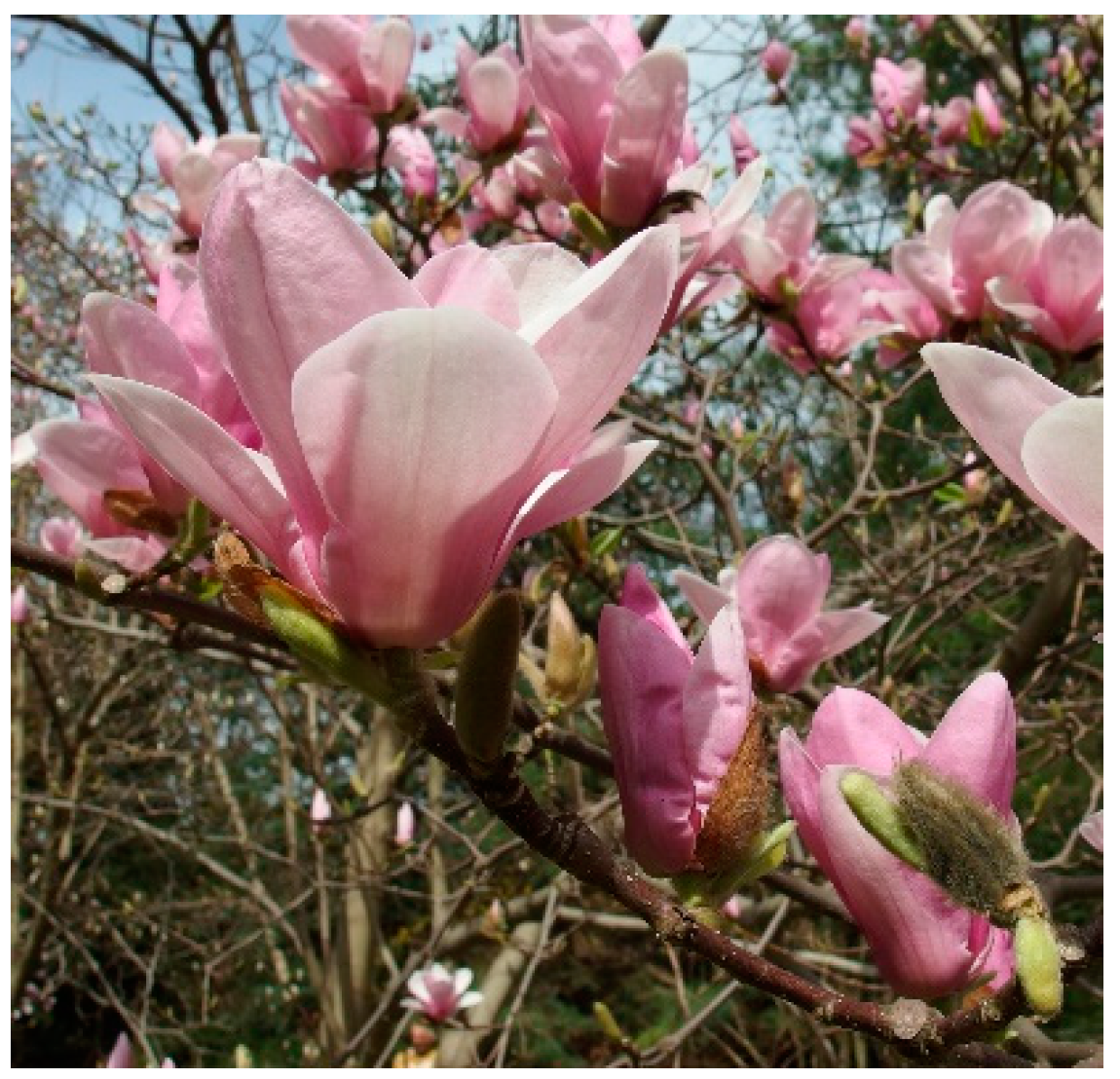
Figure 2.
Correlation between the predicted and experimental values (a) and distribution of residuals vs. predicted values obtained (b) while determining TPC
Figure 2.
Correlation between the predicted and experimental values (a) and distribution of residuals vs. predicted values obtained (b) while determining TPC
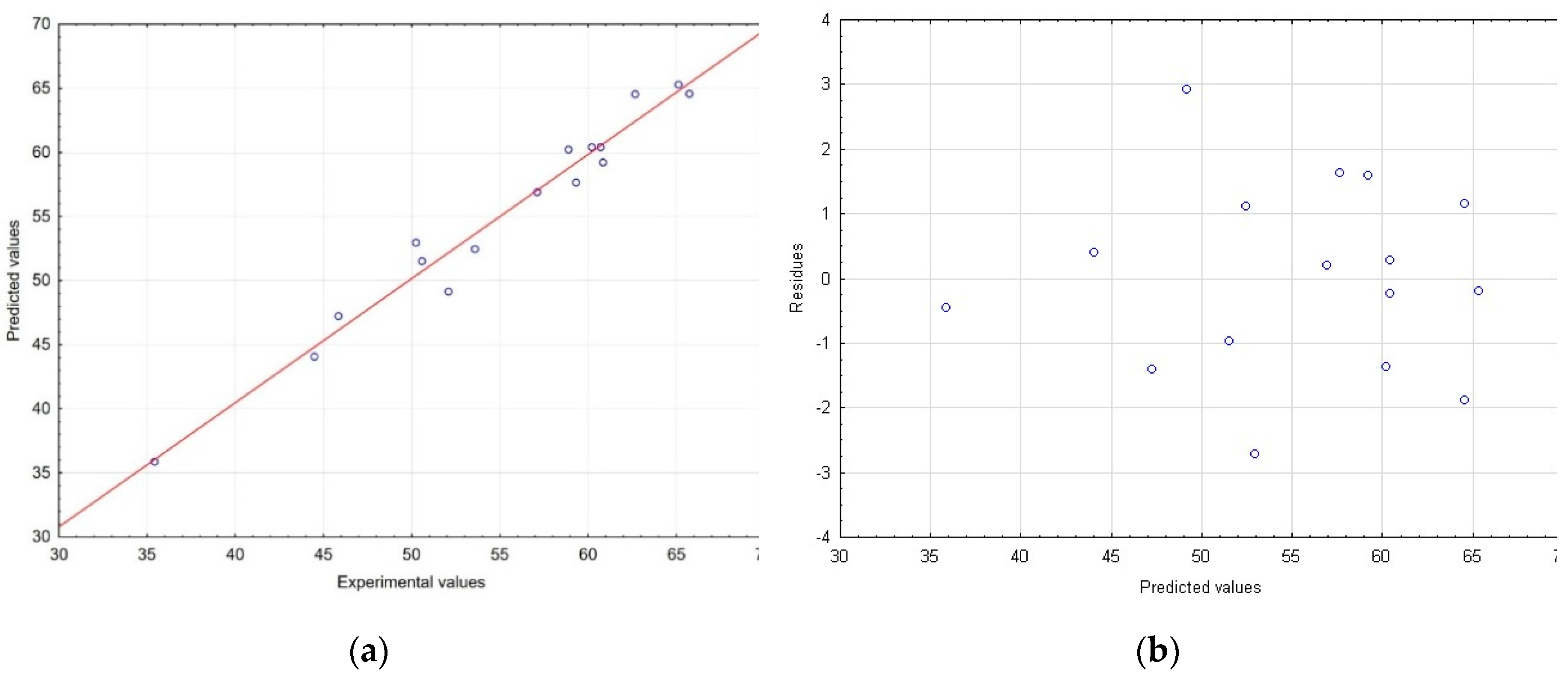
Figure 3.
Surface plot showing the effect of ethanol concentration vs. extraction time (a); extractant volume to plant material ratio vs. extraction time (b), and extractant volume to plant material ratio vs. ethanol concentration (c), respectively, on TPC in the MSL extracts.
Figure 3.
Surface plot showing the effect of ethanol concentration vs. extraction time (a); extractant volume to plant material ratio vs. extraction time (b), and extractant volume to plant material ratio vs. ethanol concentration (c), respectively, on TPC in the MSL extracts.
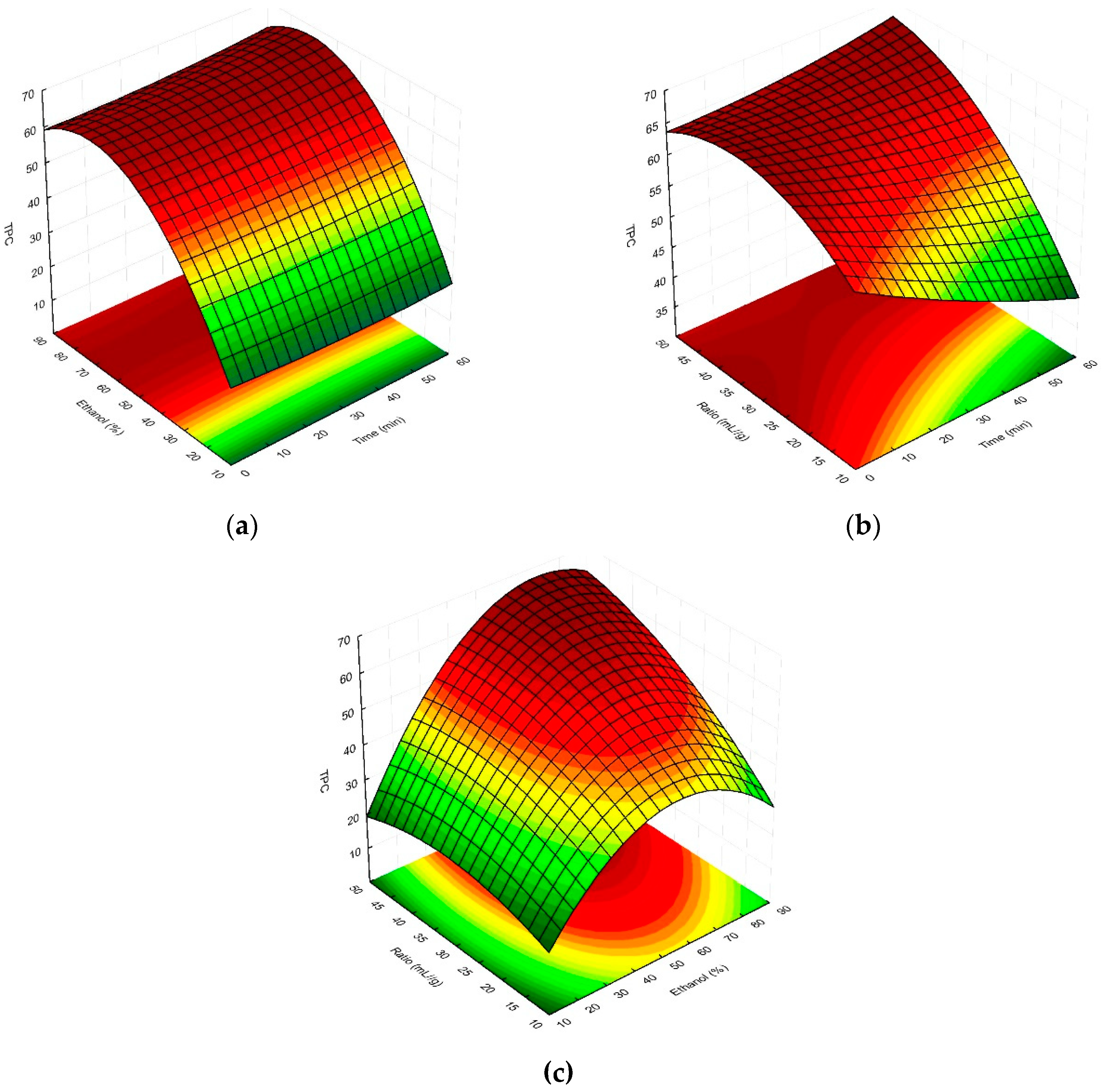
Figure 4.
Surface plot showing the effect of ethanol concentration vs. extraction time (a); extractant volume to plant material ratio vs. extraction time (b), and extractant volume to plant material ratio vs. ethanol concentration (c), respectively, on %I determined for MSL extracts.
Figure 4.
Surface plot showing the effect of ethanol concentration vs. extraction time (a); extractant volume to plant material ratio vs. extraction time (b), and extractant volume to plant material ratio vs. ethanol concentration (c), respectively, on %I determined for MSL extracts.
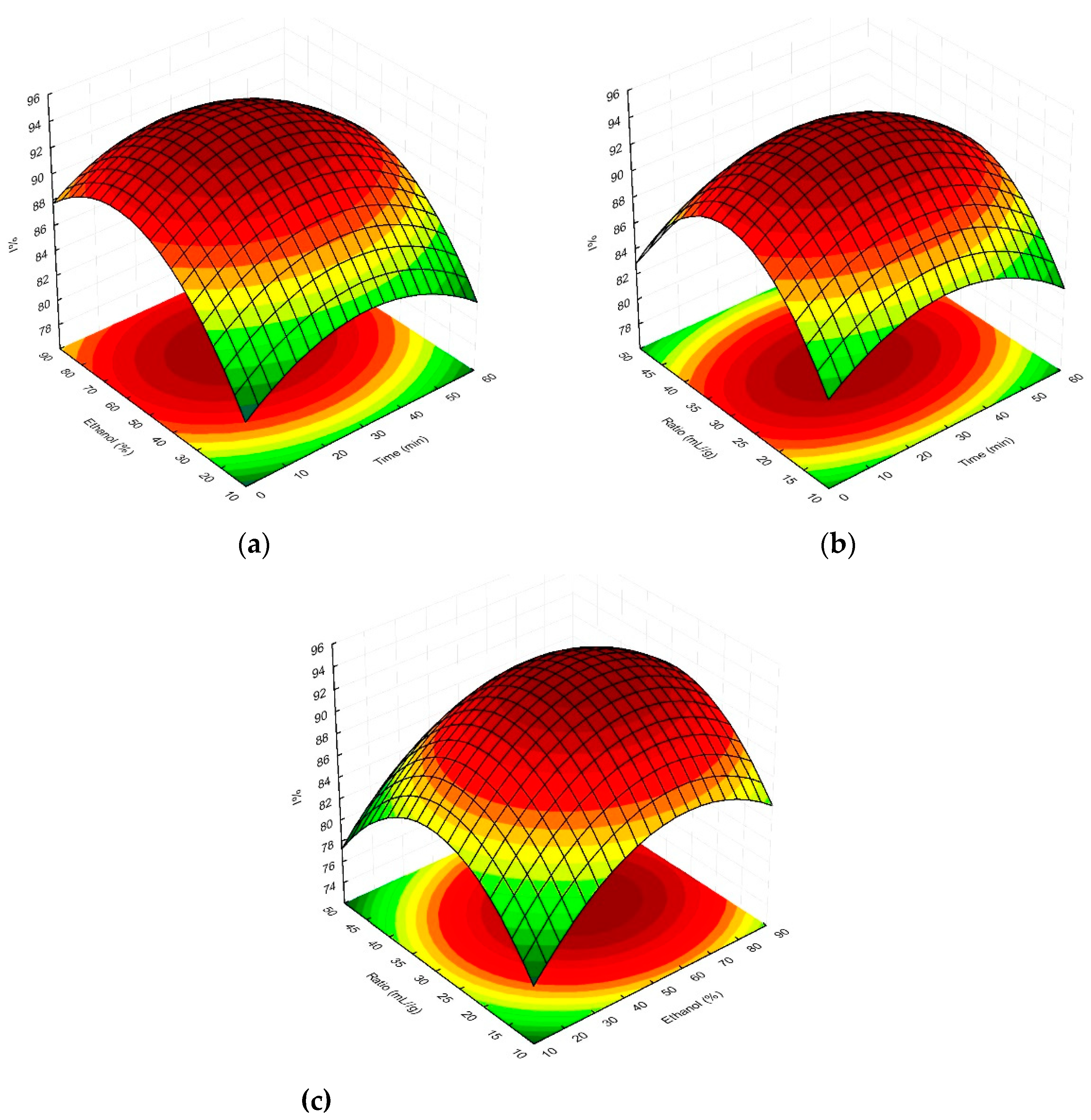
Figure 5.
Base peak chromatogram (BPC) showing polyphenolic compounds identified in MSL flower buds using LC/ESI-QToF/ MS-MS method in negative ionisation mode; numbering of individual components according to Table 4.
Figure 5.
Base peak chromatogram (BPC) showing polyphenolic compounds identified in MSL flower buds using LC/ESI-QToF/ MS-MS method in negative ionisation mode; numbering of individual components according to Table 4.
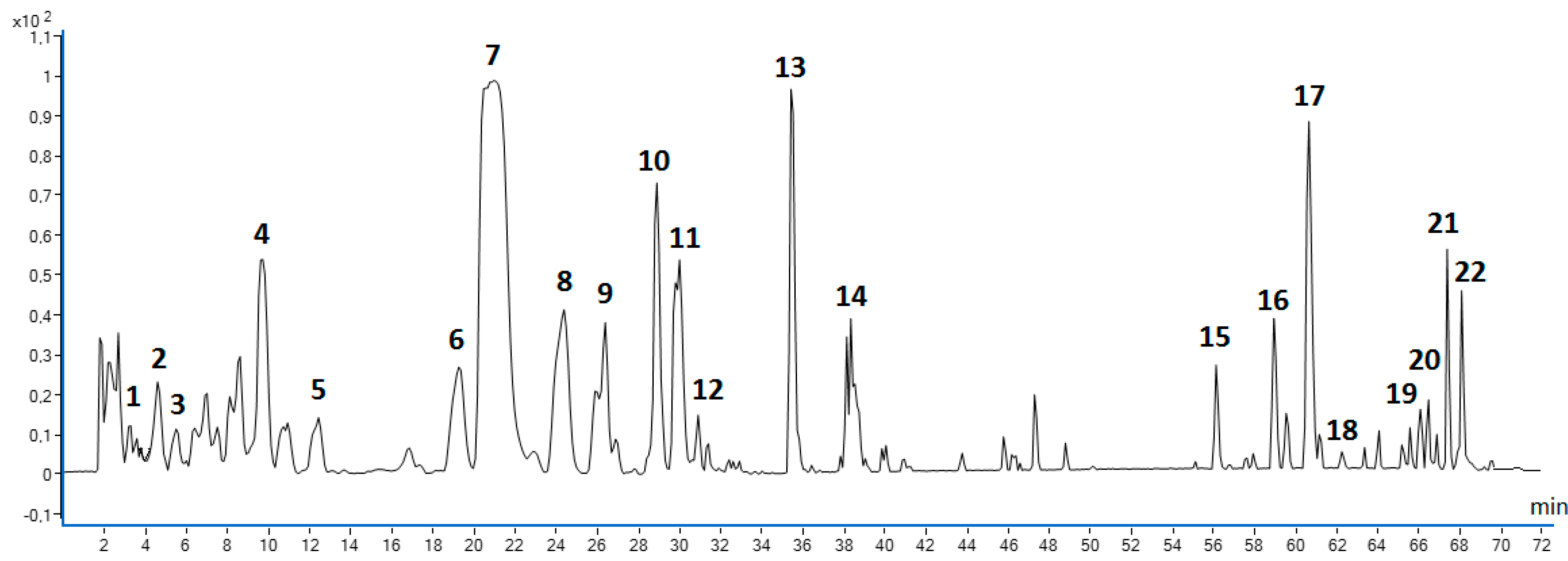
Figure 6.
The mean content (mg/g dry wt) of polyphenolic antioxidants in MSL flower buds (a) and the percentage ratio of individual components in total polyphenolic content quantified in this herbal substance (b). Explanations: PhA – phenolic acids; PhEt – phenylethanoids; Q-der – quercetin derivatives; K-der – kaempferol derivatives; Ir-der – isorhamnetin derivatives; Lig-der – lignin derivatives.
Figure 6.
The mean content (mg/g dry wt) of polyphenolic antioxidants in MSL flower buds (a) and the percentage ratio of individual components in total polyphenolic content quantified in this herbal substance (b). Explanations: PhA – phenolic acids; PhEt – phenylethanoids; Q-der – quercetin derivatives; K-der – kaempferol derivatives; Ir-der – isorhamnetin derivatives; Lig-der – lignin derivatives.
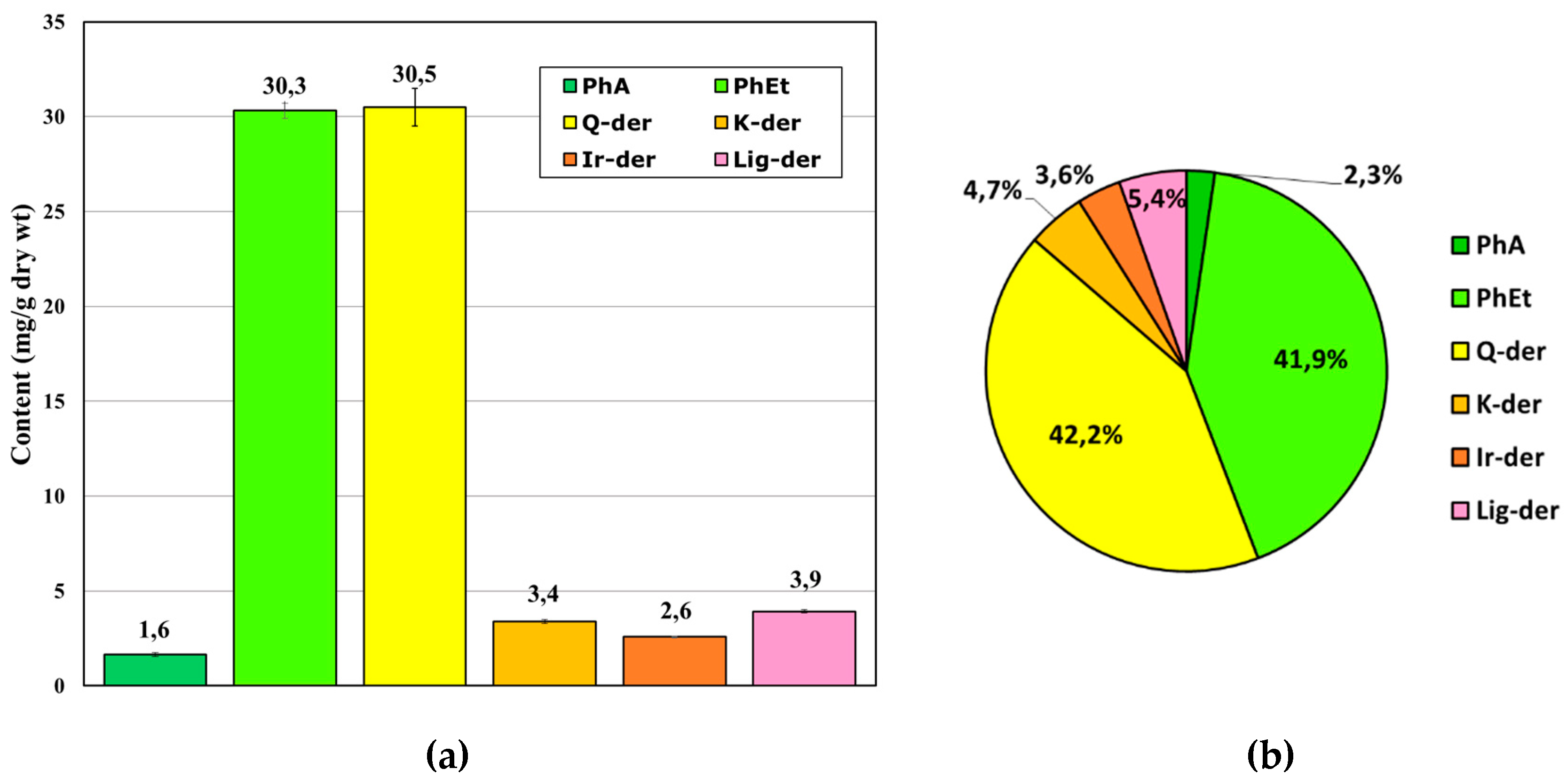
Table 1.
Run coded levels, total phenolic content (TPC) and DPPH∙ scavenging activity (%I) as obtained under the experimental (Exp.) and predicted (Predict.) CCD conditions.
Table 1.
Run coded levels, total phenolic content (TPC) and DPPH∙ scavenging activity (%I) as obtained under the experimental (Exp.) and predicted (Predict.) CCD conditions.
| Run | Coded levels | TPC (mg GAE/g dry wt) |
%I |
||||
|---|---|---|---|---|---|---|---|
| X1 | X2 | X3 | Exp.* | Predict. | Exp.* | Predict. | |
| Factorial points | |||||||
| 1 | -1(15) | -1(30) | -1(20) | 50.58 | 51.55 | 88.25 | 88.01 |
| 2 | -1(15) | -1(30) | 1(40) | 52.08 | 49.17 | 88.63 | 87.99 |
| 3 | -1(15) | 1(70) | -1(20) | 60.84 | 59.24 | 91.47 | 91.15 |
| 4 | -1(15) | 1(70) | 1(40) | 65.10 | 65.31 | 91.25 | 90.90 |
| 5 | 1(45) | -1(30) | -1(20) | 44.48 | 44.09 | 88.38 | 88.12 |
| 6 | 1(45) | -1(30) | 1(40) | 45.84 | 47.25 | 88.06 | 87.77 |
| 7 | 1(45) | 1(70) | -1(20) | 50.24 | 52.97 | 90.64 | 90.67 |
| 8 | 1(45) | 1(70) | 1(40) | 65.73 | 64.58 | 90.47 | 90.10 |
| Axial points | |||||||
| 9 | - α (4.77) | 0(50) | 0(30) | 62.66 | 64.55 | 90.64 | 91.27 |
| 10 | α (55.23) | 0(50) | 0(30) | 59.30 | 57.67 | 90.46 | 90.69 |
| 11 | 0(30) | - α (16.36) | 0(30) | 35.42 | 35.88 | 86.76 | 87.31 |
| 12 | 0(30) | α (83.64) | 0(30) | 57.11 | 56.91 | 91.59 | 91.90 |
| 13 | 0(30) | 0(50) | - α (13.18) | 53.58 | 52.48 | 88.26 | 88.43 |
| 14 | 0(30) | 0(50) | α (46.82) | 58.87 | 60.24 | 87.24 | 87.93 |
| Central points | |||||||
| 15 (C) | 0(30) | 0(50) | 0(30) | 60.70 | 60.43 | 93.27 | 93.71 |
| 16 (C) | 0(30) | 0(50) | 0(30) | 60.20 | 60.43 | 94.29 | 93.71 |
Explanations: X1,X2,X3 – independent variables including time of extraction (min), ethanol concentration (%) and solvent to raw material ratio (mL/g dry wt), respectively; TPC (total phenolic content) and %I (antioxidant activity) - dependent CCD parameters; GAE – gallic acid equivalent; * - average of the triple determinations.
Table 2.
Regression coefficients (R2) of the predicted second-order polynomial models for the total phenolic content (TPC) and antioxidant activity (%I) of MSL extracts
Table 2.
Regression coefficients (R2) of the predicted second-order polynomial models for the total phenolic content (TPC) and antioxidant activity (%I) of MSL extracts
| Coefficient | TPC model | %I model | ||
|---|---|---|---|---|
| R2 | S.E. | R2 | S.E. | |
|
Intercept β0 |
24.60 | 2.10 | 58.95a | 4.29 |
|
Linear β1 |
-0.53 |
0.05 |
0.29 |
0.09 |
| β2 | 1.21 a | 0.04 | 0.45 | 0.08 |
| β3 | 0.29 | 0.08 | 1.19 | 0.17 |
|
Quadratic β11 |
0.00 |
0.00 |
-0.00 |
0.00 |
| β22 | -0.01 a | 0.00 | -0.00 | 0.00 |
| β33 | -0.01 | 0.00 | -0.02 | 0.00 |
|
Interaction β12 |
0.00 |
0.00 |
-0.00 |
0.00 |
| β13 | 0.01 | 0.00 | -0.00 | 0.00 |
| β23 | 0.01 a | 0.00 | -0.00 | 0.00 |
Explanations: S.E. – standard error. a - statistically significant (p < 0.05).
Table 3.
Analysis of variance (ANOVA) including regression coefficients (R2) of the second-order polynomial models related to total phenolic content (TPC) and antioxidant activity (%I) of MSL extracts.
Table 3.
Analysis of variance (ANOVA) including regression coefficients (R2) of the second-order polynomial models related to total phenolic content (TPC) and antioxidant activity (%I) of MSL extracts.
| Independent variables | SS | df | F-value | p-value |
|---|---|---|---|---|
| TPC | ||||
| Linear | ||||
| X1 | 57.25 | 1 | 457.97 | 0.0297a |
| X2 | 534.13 | 1 | 4273.04 | 0.0097b |
| X3 | 72.69 | 1 | 581.49 | 0.0264a |
| Quadratic | ||||
| X12 | 0.54 | 1 | 4.33 | 0.2853 |
| X22 | 228.00 | 1 | 1823.98 | 0.0149a |
| X32 | 19.20 | 1 | 153.58 | 0.0513 |
| Interaction | ||||
| X1X2 | 0.70 | 1 | 5.62 | 0.2542 |
| X1X3 | 15.37 | 1 | 122.99 | 0.0573 |
| X2X3 | 35.66 | 1 | 285.27 | 0.0376a |
| Lack of fit | 32.52 | 5 | 52.03 | 0.1048 |
| Pure error | 0.13 | 1 | ||
| Total SS | 1037.60 | 15 | ||
| R2 | 0.9685 | |||
| R2adj. | 0.9213 | |||
| %I | ||||
| X1 | 0.41 | 1 | 0.78 | 0.5396 |
| X2 | 25.42 | 1 | 48.87 | 0.0905 |
| X3 | 0.31 | 1 | 0.59 | 0.5833 |
| X12 | 8.60 | 1 | 16.54 | 0.1535 |
| X22 | 19.47 | 1 | 37.43 | 0.1031 |
| X32 | 35.36 | 1 | 67.96 | 0.0768 |
| X1X2 | 0.17 | 1 | 0.33 | 0.6685 |
| X1X3 | 0.05 | 1 | 0.10 | 0.8036 |
| X2X3 | 0.03 | 1 | 0.05 | 0.8618 |
| Lack of fit | 2.35 | 5 | 0.90 | 0.6592 |
| Pure error | 0.52 | 1 | ||
| Total SS | 69.06 | 15 | ||
| R2 | 0.9585 | |||
| R2adj. | 0.8961 | |||
Explanations: a and b - statistically significant at p < 0.05 and p < 0.01, respectively; SS – sum of squares; df – degrees of freedom; adj – adjusted value.
Table 4.
Phenolics identified in MSL flower bud extracts using simultaneous LC/ESI-QToF/MS-MS method (in negative ion mode) and RP-LC/PDA methods.
Table 4.
Phenolics identified in MSL flower bud extracts using simultaneous LC/ESI-QToF/MS-MS method (in negative ion mode) and RP-LC/PDA methods.
| No. | Compound |
Rt (min) |
λmax (nm) |
Formula | Precursor ion (m/z) |
Product ions (m/z) |
|---|---|---|---|---|---|---|
| 1 | Protocatechuic acid R | 3.67 | 206, 260, 294 | C₇H₆O₄ | 153.0193 | 110.0331, 109.0297, 108.0219 |
| 2 | Chlorogenic acid | 4.58 | 218, 326 | C16H18O9 | 353.0855 R | 191.0543, 173.0437 |
| 3 | Echinacoside R | 5.08 | 198, 330 | C35H46O20 | 785.2466 | 623,2127, 477.1619, 315,0898, 179,0338, 161.0233 |
| 4 | 2’- Rhamno- echinacoside |
9.91 | 198, 330 | C16H16O8 | 931.3058 | 769.2726, 751.2572, 179.0499, 161.0238 |
| 5 | Vanillic acid R | 12.41 | 218, 260, 292 | C8H8O4 | 167.0351 | 135.0116, 109.0250, 108.0210 |
| 6 | Quercetin 3-O-neohesperidoside | 19.34 | 204, 266, 350 | C27H30O16 | 609,1303 | 300.0277, 271.0268, 151.0039 |
| 7 | Quercetin 3-O-rutinoside (Rutoside) R | 20.95 | 204, 256, 355 | C27H30O16 | 609.1443 | 301.0405, 300.0334, 271.0253, 257.0411, 229.0108 |
| 8 | Quercetin 3-O-glucoside (Isoquercitrin) R |
24.37 | 204, 256, 355 | C21H20O12 | 463.0889 | 301.0347, 271.0229, 178.9999 |
| 9 | Acteoside (Verbascoside)R |
26.48 | 198, 330 | C29H36O15 | 623.1985 | 461.1665, 179.0342, 161.0246 |
| 10 | Kaempferol 3-O-rutinoside (Nicotiflorin)R | 28.89 | 196, 266, 346 | C27H30O15 | 593.1571 | 345.0664, 285.0444 |
| 11 | Isorhamnetin-3-O-rutinoside (Narcissin) | 29.69 | 204, 254, 354 | C28H32O16 | 623.1584 | 315.0516, 314.0441, 300.0296, 271.0252, 255.0216, 161.0243 |
| 12 | Isorhamnetin 3-O-glucoside R | 30.80 | 204, 254, 354 | C22H22O12 | 477.1042 | 315.0486, 314.0429, 271.0256 |
| 13 | Isorhamnetin 3-O-rutinoside isomer |
35.52 | 205, 255, 354 | C28H32O16 | 623.1611 | 315.0505, 314.0437 |
| 14 | Rhamnazin 3-O-rutinoside (Ombuoside) |
38.44 | 206, 256, 356 | C29H34O16 | 637.1728 | 330.0684, 329.0653, 315.0509, 288.0168, 161.0239 |
| 15 | Magnolin R | 56.22 | 204, 230, 278 | C23H28O7 | 415.4612 | 236.1059, 222.1580, 221.1545, 220.1469 |
| 16 | Lignan (fargesin type) | 58.93 | 202, 236, 260 | n.d. | 595.2865 | 279.2333, 174.9563, 112.9860 |
| 17 | Lignan (fargesin type) | 60.54 | 202, 234, 286 | n.d. | 571.2938 | 309.2091, 174.9570, 112.9856 |
| 18 | Fargesin R | 62.25 | 202, 234, 284 | C21H22O6 | 369.1328 | 357.1360, 242.9433, 174.9563, 112.9856 |
| 19 | Lignan (fargesin type) | 66.47 | 204, 234, 280 | n.d. | 293.2140 | 223.1358,195.1402, 174.9570, 112.9856 |
| 20 | Lignan (fargesin type) | 66.87 | 204, 236, 286 | n.d. | 625.3393 | 341.1096, 255.2333, 174.9561, 112.9856 |
| 21 | Lignan (fargesin type) | 67.37 | 202, 234, 286 | n.d. | 317.1745 | 274.1890, 174.9560, 112.9856 |
| 22 | Lignan (fargesin type) | 68.08 | 202, 234, 284 | n.d. | 295.2280 | 277.2182, 174.9564, 112.9856 |
Explanations: R- identity of the compound additionally confirmed using a reference substance; n.d. – not determined.
Disclaimer/Publisher’s Note: The statements, opinions and data contained in all publications are solely those of the individual author(s) and contributor(s) and not of MDPI and/or the editor(s). MDPI and/or the editor(s) disclaim responsibility for any injury to people or property resulting from any ideas, methods, instructions or products referred to in the content. |
© 2023 by the authors. Licensee MDPI, Basel, Switzerland. This article is an open access article distributed under the terms and conditions of the Creative Commons Attribution (CC BY) license (http://creativecommons.org/licenses/by/4.0/).
Copyright: This open access article is published under a Creative Commons CC BY 4.0 license, which permit the free download, distribution, and reuse, provided that the author and preprint are cited in any reuse.


