

Submitted:
24 July 2023
Posted:
26 July 2023
Read the latest preprint version here
Abstract
Type I contextuality or inconsistent connectedness is a fundamental feature of both the classical as well as the quantum realms. Type II contextuality (true contextuality or CHSH type contextuality) is frequently asserted to be specific to the quantum realm. Nevertheless, evidence for Type II contextuality in classical settings is slowly emerging (at least in the psychological realm). An example is given here of Type II contextuality involving a simple cooperative game. This arises due to the cooperative nature of the game which results in sign intransitivity for expectation values while individual random variables remain consistently connected. This shows that the conditions attributed uniquely to quantum systems may occur in classical settings as well. Sign intransitivity can be observed in preference relations in the setting of decision making and so intransitivity in decision making may also yield examples of Type II contextuality. Previously it was suggested that a fruitful setting in which to search for such contextuality is that of decision making by collective intelligence systems. An experiment was conducted using a detailed simulation of nest emigration by workers of the ant Temnothorax albipennis. In spite of intransitivity, these simulated colonies came close to but failed to violate Dzhafarov’s inequality for a 4-cyclic system. Further research using more sophisticated simulations and experimental paradigms is required
Keywords:
Contextuality
; Collective Intelligence
; Intransitive Decision Making
; Social Insects
1. Introduction
In spite of a century of computational success, quantum mechanics still lacks a consistent interpretation although there have been many proposals over the years. This has lent quantum mechanics an air of inscrutability, and the pervasive notion that the quantum and classical realms constitute two solitudes. Nevertheless, there are aspects of quantum mechanics, particularly that of contextuality, which have attracted the interest of serious researchers, particularly within the life and social sciences, and which may in fact cross over into the classical realm. In [1], I suggested that part of the reason why it has been so difficult to find a consensual interpretation is a bias, implicit or explicit, towards what I have termed the Objectivist Worldview. The central entity within the Objectivist Worldview is the object. The prime examples of objects are found in mathematics. The central entities of study within quantum mechanics (and physics generally) are formed of inanimate matter, which come closest to embodying the characteristics of an ideal object. The principal characteristics of an (ideal) object include:
- It exists independent from any other entity -it can be isolated and treated as a whole unto itself
- Entanglement does not occur
- It is eternal - it does not become, it merely is
- It is passive - it reacts, it does not act
- Its properties are intrinsic and non-contextual - they are fixed, complete and independent of the actions of any other entity
- Its motion is determined by fixed laws - which may be deterministic or stochastic (usually explained away as due to ignorance on the part of the observer)
- Its motion is often attributed to variational principles - optimality, minimal, maximal - always extremized in some direction
- Its interactions with other objects are always local
- History is irrelevant - the future motion of an object depends only on its present state (and sometimes not even that in the case of stochastic objects)
Unlike classical systems, quantum mechanical systems frequently fail to exhibit one or more of these characteristics. I believe that the mismatch between an implicit Objectivist Worldview and the characteristics of quantum mechanical systems contributes to the inability to find a consistent interpretation of quantum mechanics.
Living and social systems, on the other hand, possess a very different set of characteristics which render them nearly in opposition to the ideal of an object. Some of these characteristics are:
- They are embedded in an environment, physical or social - they cannot be isolated and treated as a whole unto themself
- Entanglement is commonplace
- They are transient - they come into existence, persist for some duration, then fade away
- They are active - they act upon their environment, and do not merely react to it
- Their properties are contextual - their determination requires interaction with other entities, and such interactions exhibit exclusions and order effects
- Their motions are determined more by rules and influences rather than by fixed laws - information plays a central role
- Variational principles may play a role in some circumstances
- Interactions with other objects are always causal, but may be non-local through the intermediary of information laden signs
- History is fundamental - the future motion of an object depends on its history, not merely its present state
These characteristics are more typical of the concept of process, which forms the basis for the Processist Worldview.
I have suggested [1,2] that quantum systems have much more in common with biological and social systems than with inanimate objects, and that a shift to a Processist Worldview [1] might lead to more effective interpretations, restoring a sense of reality to physics (though not an Objectivist reality), and resolving the quantum-classical dichotomy. The Processist Worldview posits that entities are generated by processes (exemplified by biological organisms) and that processes are generative, contextual, transient (becoming and fading away are fundamental), non-Kolmogorov, active, interactive, and driven by information and functionality. Inspired by the writings of Robert Rosen [3], I have approached quantum mechanics from the perspective of complex systems theory, asking what concepts and methods from the study of complex systems citeLaughlin might be fruitfully applied to shed light into the fundamental problems of quantum mechanics. Further inspired by Whitehead [5] and Trofimova [6,7,8], I was led to the idea of the Process Algebra which provides a formal framework for describing and modeling these features of process and which has been applied with some success to the development of realist models of non-relativistic quantum mechanics [9,10,11,12].
If, as I have suggested, quantum systems and biological and social systems share many characteristics, then it is reasonable to ask which features of quantum theory might be fruitfully applied to the study of biological and social systems. Many authors have explored possible connections between these disciplines [13,14,15,16]. One subject which shows considerable promise is contextuality. It has long been known in the life and social sciences that there is no such thing as a disturbance-free measurement. Every measurement introduces a context within which an observed entity must act, and each such context may elicit its own specific actions and probabilities of appearance. Moreover, the order of measurements can affect the results that are obtained. Indeed, some measurements cannot be carried out simultaneously or can only be carried out in certain orders and not in others (try dissecting a cat first and exercising it later!). Contextual effects have been observed in the life sciences [17], decision theory [18], and in the construction of science [19].
This form of contextuality has been termed inconsistent connectedness in the Contextuality by Default approach of Dzhafarov [20,21] and I have called it Type I Contextuality [10], and it lies at the heart of Bohr’s Copenhagen Interpretation of Quantum Mechanics. This form of contextuality appears to be ubiquitous among complex systems, though its implications for a description in terms of probability and statistics remains largely unrecognized outside of quantum mechanics. The need to take the context of measurement into account requires a modification of the usual Kolmogorov probability structure, whether invoking Khrennikov’s Contextual Probability theory [22] or Dzhafarov’s Contextuality by Default model [20]. Contextuality Probability Theory does for Probability Theory what the discovery of non-Euclidean Geometry did for Geometry in the 19th century. Contextuality by Default takes a different approach, keeping the usual Kolmogorov structure but expanding it by requiring that each random variable be associated with a particular context within which it is defined. The same measurement procedure applied in different contexts may given rise to different random variables for the supposedly same construct. For example, a psychological test applied in different contexts could yield different probability distributions for its test items (i.e., different random variables). Failing to take this into account and simply assuming that they are all the same and combining them into a single joint distribution could result in erroneous results.
A second form of contextuality has received much attention in the quantum mechanical literature. This has been termed True Contextuality by Dzhafarov [20] and Type II Contextuality by me [10]. This form of contextuality concerns the occurrence of correlations among a set of random variables (measurements) which are not possible within the usual framework of Kolmogorov Probability Theory. These correlations are gathered together in a formula whose value is bounded whenever standard Kolmogorov probabilities are involved and which can violate this bound when quantum mechanical type probabilities (Born rule) are involved. These probabilities are, by definition, non-Kolmogorov. The values for quantum mechanical systems are themselves bounded by the so-called Tsirel’son bound. There are many such formulae and corresponding bounds (expressed in the form of inequalities): Bohm [23], Bell [24], Leggatt-Garg [25], CHSH [26], Gisin [27], Mann [28], but the most widely studied is the CHSH inequality. Dzhafarov has developed an analogue of the CHSH inequality which finds application in the study of psychological experiments [20].
In Quantum Mechanics, the explanation for the appearance of these inequality violations is usually attributed to the presence of non-local influences, what Shimony termed "Passion at a Distance" [29]. These influences are not only non-local, but must be superluminal, as a simple argument shows [9]. Gisin has argued that they must in fact be instantaneous no matter what the distance [27]. Much effort has been expended to explain the nature of these influences in the face of the absence of super-luminal signalling as required by Special Relativity due to the constancy of the speed of light in inertial reference frames. I particularly like Griffiths’ comment [30]: "To be sure, those who claim that instantaneous nonlocal influences are present in the quantum world will generally admit that they cannot be used to transmit information; this is known as the ‘no-signaling’ principle, widely assumed in quantum information theory. This means that such influences (including wavefunction collapse) cannot be directly detected in any experiment. The simplest explanation for their lack of influence is that such influences do not exist." There are indeed non-local influences in the biological and psychological realms. In neurobiology and collective intelligence systems for example, nonlocal influences are mediated through the volume transmission of neurotransmitters and hormones and by the diffusion of pheromones [2]. These influences are neither superluminal nor instantaneous. Dzhafarov and colleagues have demonstrated the existence of True Contextuality in two experiments [31,32] as have other authors [33]. A simple thought experiment involving ice cream preferences shows violation of even the Tsirel’son bound under ideal conditions [34] (I will describe this in more detail later). In none of these cases are superluminal influences involved.
As several authors have argued, the appearance of these exceptional correlations is not due to non-locality but rather to the presence of contextuality [30,35,36,37]. The experiments mentioned above are all examples of contextuality, not non-locality. The attachment to a notion of non-locality as a cause of these correlations is again a throwback to an implicit Objectivist Worldview. In such a worldview, spatially separated entities must also be statistically independent entities. From a Processist perspective, in which entities are generated by processes, there is no reason a prior why spatially separated entities cannot be statistically dependent since they may be the outcome of the action of a single process. There is nothing a priori to suggest that a single process must only generate single entities. It is perfectly plausible that they could generate multiple entities, and as has been argued elsewhere [1], these processes are generators of space and time, and therefore they themselves exists outside of space and time, an idea suggested by Gisin [27]. They could conceivably generate entities wherever and whenever, so long as relativistic considerations are respected, including the absence of superluminal information propagation.
Mathematics, the epitome of the Objectivist Worldview, has been profoundly influential in shaping our collective view of the world. Mathematics is held out as the embodiment of all that is ideal. For example, Wigner [38] prefaces his famous paper on the unreasonable effectiveness of mathematics in physics with a quote from Bertrand Russell: "Mathematics, rightly viewed, possesses not only truth, but supreme beauty cold and austere, like that of sculpture, without appeal to any part of our weaker nature, without the gorgeous trappings of painting or music, yet sublimely pure, and capable of a stern perfection such as only the greatest art can show. The true spirit of delight, the exaltation, the sense of being more than Man, which is the touchstone of the highest excellence, is to be found in mathematics as surely as in poetry."
Attributes which are held to be of value in the development of mathematics are thought to be of equal value in the natural world - that the natural world aspires to the mathematical world, and when it deviates from it that represents not novelty or creativity but rather failure. A failure to be rational, extremal, or symmetrical is to be irrational, suboptimal, or distorted. Since the time of Plato, Nature has been viewed as a poor simulacrum of the true reality. For all of its beauty, I believe that mathematics, at least in its current form, is unduly restricted, and that Nature excels in its ability to cobble together effective solutions in the face of imperfect knowledge, transient, ever-changing conditions/contexts, limitations on resources and never ending perturbations. These departures from the so-called ideal may be responsible for the contextuality, both Type I and II, that has been observed. It may be precisely these "non-ideal" features which allow classical systems to surpass these bounds and generate stronger correlations than would be obtainable by those "ideal" entities and interactions.
A hint of this may be found in the form of the CHSH inequality. The CHSH inequality is a special case of the following inequality:
where are some kind of value, function or even index, and f is a real valued function which takes its values in the range . In the case of CHSH, the domain variables represent choices of measurements while f is a correlation function. The CHSH scenario is an example of what Dzhafarov terms a cyclic 4 system. We may represent this in the form of a graph:
Suppose that we assign real values to each vertex and to each edge we assign the product of the values at the vertices. This gives us
Notice that if are all positive in sign, then so must be , and likewise in the negative case. There is thus a kind of transitivity for signs in the 4-cyclic case. In the more general case, we say that the 4-cyclic system possesses f-sign transitivity if whenever sign signsign, then sign. The case of sign transitivity can be depicted as
which represents a linear, or transitive ordering.
Now note that the maximum value of
is 4 and this value can only be obtained in one of two ways
or
This corresponds to the diagram
which represents a cyclic or intransitive ordering. The notion of sign transitivity can be extended to n-cyclic systems for arbitrary n.
Although not proven, it may be the case that sign intransitivity cannot hold for cyclic 4 systems and indeed for any even order cyclic system, so that such inequalities cannot be maximally violated except perhaps in the presence of inconsistent connectedness. This requires further study. Nevertheless, in the case of odd order cyclic systems it may be useful to look for violations of the inequality under conditions in which sign transitivity is broken. Of course, there is no guarantee that merely breaking sign transitivity will result in violation of the inequality, but the presence of sign transitivity will definitely ensure that the inequality is not maximally violated. One setting in which violations of transitivity occur is in decision making.
1.1. Intransitivity in Human Decision Making
Rationality, as a mode of decision making, combines two characteristics of the Objectivist Worldview - logic and optimality. Individuals, in making choices, may show preference for one choice over the others, or indifference, when alternatives may be chosen with equal probability. Rationality in the context of preference is thought to require the presence of transitivity [39], whereby if an agent prefers choice A over choice B, and choice B over choice C, then they will prefer choice A over choice C, regardless of context, order of presentation or the presence of competing attributes. Preferences that are not transitive are said to be intransitive, and are viewed as examples of irrational decision making, and hence to be avoided or derided. The presumption of transitivity is also necessary in order for an ordinal scale of preferences to exist [40] - this is useful mathematically but there is no reason a priori that Nature should organize itself in such a manner as to guarantee us nice mathematical models. In the decision literature, two types of transitivity are studied: strong transitivity (ST) which is deterministic, and weak transitivity (WT) which is stochastic, requiring that the preferred choice be chosen more than 50% of the time.
Butler and Progrebna [41] argue that “Transitivity must hold either if a value attaches to each option without reference to other alternatives (choice-set independence), or if an equivalent value results after comparing and contrasting the attributes of the available choice options”. Anand [42] argued that intransitivity need not necessarily be irrational. Bar-Hillel and Margalit [43] argued for three contexts in which intransitivity might reasonably occur:
- where intransitivity results from application of an ethical or moral choice rule;
- where intransitivity results from application of an ethical or pragmatic choice rule;
- where the choice is intrinsically comparative, depending upon multiple competing alternatives.
In these contexts, intransitivity presents as a plausible consequence. Tversky [40] demonstrated the occurrence of consistent and predictable intransitivity in certain situations of decision making. Since then, there have been many studies demonstrating the occurrence of intransitivity in decision making [44,45]. Nevertheless, several authors continue to deny the existence of intransitive preferences [46,47,48,49]. Regenwetter, Dana and Davis-Stober claim that transitivity is in fact a universal phenomenon and any appearance of intransitivity is a sign of methodological error [46,47].
Consider the following example based on personal experience. I judge ice cream based on two attributes: taste, and the propensity to cause gastroesophageal reflux. One attribute provides pleasure, the other pain. Let us consider four types of ice cream together with their attribute ratings (taste, reflux potential) based on a sliding scale from 0-100: double fudge chocolate (100,100), double chocolate (75,75), chocolate (50,50) and pistachio (25,25). I will choose pleasure over pain, but only to a certain point. If the difference in reflux potential between two alternatives is 50 or less, I choose by taste. If the difference in reflux potential exceeds 50, then I prefer to minimize pain, choosing whichever has the lower reflux potential. This gives a set of preferences in the form double fudge chocolate > double chocolate; double chocolate > chocolate; chocolate > pistachio; pistachio > double fudge chocolate. This preference relation is clearly intransitive, yet it is principled, and I would argue, rational given my tolerances. If my choices are consistently applied, then it is possible to construct a set of random variables on this set of preferences such that the corresponding CHSH inequality is maximally violated, exceeding both the quantum mechanical and Tsirel’son bounds by taking a value of 4.
Note that a different set of preferences will occur if I am given three choices simultaneously. For example, out of double fudge chocolate, double chocolate, and pistachio, I would choose pistachio since the first two are guaranteed to cause a lot of reflux. Yet, given double fudge chocolate, chocolate, and pistachio, I would choose chocolate since it balances pleasure and pain. Three choice preferences are not determined simply from two choice preferences - context matters.
Intransitivity arises in these cases because my preferences are based on two competing attributes, which form a partial rather than a linear order. A linear order exhibits transitivity, by definition. Several authors have studied various partial orders in order to study the concept of intransitivity. Some authors consider weak orders [50] which include an equivalence relation known as incomparability or indifference. Luce considered semi-orders [50] in which indifference was allowed to be intransitive, and where the ordering is induced by a utility function. Fishburn formally studied intransitivity [51] in a wide variety of settings, and suggested that transitivity is not essential to ensuring the existence of maximally preferred alternatives in a number of situations. Butler and Progrebna [41] studied the Steinhaus and Trybula paradox in which the probabilities of choices all exceed 50% and yet Weak Stochastic Transitivity (WST) is still violated and based on a number of experiments concluded that “Results support our conjectures that the cycles reflect latent intransitive preference rather than noisy implementation of transitive preferences.” These experiments demonstrated that people use different strategies in different contexts; a strategy which appears rational in one context may not be so in a different context, thus making human decision adaptable to different circumstances. Makowski et al [52] presented a simple two player choice game and showed that the optimal strategy of one player can only be intransitive while that of the second player may be transitive or intransitive. In a quantum version of the game, it turns out that that there is a certain course of the game where only intransitive strategies are optimal for both players. Klimenko [53] examined intransitivity across a wide range of settings and concluded that intransitivity should appear under any of the following conditions: relative comparison criteria, multiple incommensurable comparison criteria, multiple comparison criteria that are known approximately, or comparisons of groups of comparable elements.
1.2. Contextuality in Classical Systems: Cyclic Systems
In the Contextuality by Default model [20], each random variable is associated with the quantity, q, being measured and the context, a, within which the measurement is made, and denoted . Now consider two measurements and two contexts . For a fixed context a, the pair is termed a bunch. The random variables of a bunch can reasonably be expected to possess a joint distribution. Other the other hand, for a fixed measurement q the pair is termed a connection for q. The most basic form of contextuality occurs when no joint distribution can be found for a connection, in which case the random variables are said to be inconsistently connected. Relevant for the experiment to be considered here is the notion of a cyclic system. This is a collection of random variables and contexts which are arranged in the following matrix form for an n-cyclic system:
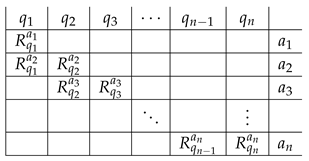
They crafted an inequality which is an analogue of inequalities such as the CHSH inequality, but which takes into account inconsistent connectedness. This inequality is
where means the maximum taken over all combinations of terms such that the number of minus terms is always odd.
The first term corresponds in the case of to the CHSH inequality. The third term was suggested by Dzharfarov and colleagues to compensate for the presence of inconsistent connectedness. In the setting of Bell’s theorem, consistent connectedness arises because it happens that the marginal probabilities for the two observers happen to be the same. Recall that in the usual setup for the Bell inequalities, the wave function for the system takes the general form which yields for each observer a probability distribution of the form . This leads one to erroneously conclude that the joint probability will have the form when in fact it has the form . The consistency shown by the marginals hides the fact that the situation is actually contextual. Consistent connectedness of the marginals reflects a kind of degeneracy, since these marginals are associated with multiple distinct probability distributions. Dzhafarov and Kujala have suggested that contextuality is about the identity of random variables [87]. Here one sees that apparently identical random variables actually derive from completely different joint distributions, a clear example of contextuality.
Although quantum physicists frequently assert that this kind of behaviour is unique to the quantum realm, it can occur classically as well. Consider the following two player cooperative game. Each player is given a collection of structures, colored red for Player I and blue for Player 2. Each structure has an appearance like one half of the Eiffel tower, divided vertically. Thus, each forms one half of an arch (a semi-arch), one component labelled 1, the other -1. Each player has a 50-50 mix of both types of arches. A horizontal plate may be affixed to the top or the bottom, and the plate is asymmetric along one direction - one end being labelled 1, the other -1. The plate must be attached with this long axis aligned across the arch but may be oriented in either direction. Within each structure there is a wheel shaped plate and along one diagonal there is a line, one end labeled 1, the other -1. The diagonal must be vertical and can be oriented in either direction. In each red piece, at the 1 end there is a small hole while in each blue piece, at the -1 end there is a small pin. To form a component structure the two players must choose one partial structure from their collection such that the two structures form an arch, orient their wheels so that the pin on the wheel of player 2 must insert in the hole of player 1, and the two plates must anti-align.
Player 1 goes first, choosing their semi-arch, which may be a 1 or -1, choose their bottom plate, which must be aligned 1 or -1 to match their semi-arch, and set the orientation of their wheel, which must be opposite to their semi-arch choice, thus -1,1 respectively. Player 2 then picks a semi-arch and aligns their wheel so that their component matches pin to hole, semi-arch to semi-arch so as to form an arch, and the top plate is oriented opposite to the bottom plate. For example, if Player 1 picks semi-arch 1, wheel -1, and bottom plate 1, Player 2 must pick semi-arch -1, wheel 1, and bottom plate -1. Once completed, they place their structure vertically on the game board, either directly on its surface or with the bottom plate lying on the top plate of a previously placed structure. The two players play the game, building a structure. Once completed, two observers then examine the completed structure to measure various frequencies and correlations. Note that there is no non-local information, no superluminal influence. The choices are made at the site of construction, at the time of construction, and these are local.
Observer 1 can measure the distribution of red semi-arches , their block orientation B, their wheel orientation , while Observer 2 can measure the distribution of blue semi-arches , their block orientation T or their wheel orientation .
Now notice that Player 1 is free to choose their semi-block at random. Its distribution is uniform, for . Although the orientation of their bottom block and wheel is locked to that of the semi-block, their distributions will appear random to Observer 1 with distribution for each. The same holds true for the distributions observed by Observer 2. Though the choices of Player 2 are locked to choices of Player 1, nevertheless the randomness of choice of Player 1 results in a random occurrence of events as seen by Observer 2. This is true regardless of the choices that Player 1 makes and regardless of the choices of observations that the observers make. Note that observations are made on the entire structure, or at least collected step by step based on the entire structure. Thus the random variables will be consistently connected when measured individually. Non-commutativity is not at issue here although a non-commutative version can be developed as well.
Now consider two collections of observations.
First consider a cyclic 3 system
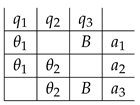
The third term of Dzhafarov’s inequality, will be zero because these random variables are consistently connected. Thus the inequality reduces to
Since and B are always aligned, . Since the pairs and are always anti-aligned, . Hence
hence, and Dzhafarov’s inequality is violated.
Next consider a cyclic 5 system

Again, the distributions for the individual random variables can be seen to be uniform and independent of the observations of Observer 1 and Observer 2, and thus are consistently connected. So again, the third term of the Dzhafarov inequality vanishes. Thus we have
Again and B are aligned, so . The following pairs are all anti-aligned, , , , and thus we must have .
Thus, and thus so again the Dzhafarov inequality is violated.
Thus,nt. I believe that what is key here is the presence of cooperation between the two players and the fact that even though their moves may be coupled, the possible combinations ensure that each component of the system is expressed uniformly over its entire space of possibilities, so that consistent connectedness is present. Note too that sign intransitivity also is present which ensures that the inequality is maximally violated.
Unfortunately, it does not appear possible to produce a cyclic 4 system which possesses sign intransitivity using this scenario.
The point of this discussion is that many features of the quantum situation can be realized within a classical setting, but in this case in the context of a cooperative, rather than a competitive game. Too often, games are structured as competitive rather than as cooperative, and cooperation changes the dynamics and correlative nature of the situation. A collective intelligence provides a clear example of a cooperative system and so it may be possible for Type II contextuality to occur.
Another issue is the probability structure itself. The sum rule for probabilities, where the form a complete set of possible conditions, is a fundamental feature of Kolmogorov probability. In [88], the following example was presented. Consider the following scenario. There is a LEGO mounting block fixed inside a sealed box. Within the box is a bag containing a block and a block. There is dial on the outside of the box which reads . When the dial is set, a reading is taken of the plate and a light turns on corresponding to whether there is no block on the plate (0), a block, whether alone or combined with a block (1) or a block again alone or in combination with a block (2). The examiner cannot look in the box and in fact has no knowledge of the contents of the box. They can only switch the dial and note whether or not a light appears. In another room a researcher can remotely arrange whatever they like on the plate: no block, a , or a block and they change the arrangement immediately following each observation of the examiner. Clearly the probabilities of no block, a block or a block are all . Therefore, for the examiner the probabilities of obtaining a light for are all .
Now let us change the game slightly. The researcher is now permitted to take no action, place a or a block on the plate, or to couple the block to the top of the block and affix this to the plate. Setting the dial to 1 or 2 results in a light so long as the corresponding block is present regardless of whether it is alone or in combination. Note that it is impossible in this arrangement to measure for 1 and 2 simultaneously. Now what is the probability of there being a light on 1? This probability is because there is a probability of there being a single block and a probability of there being a combination. The same holds for the probability of a light on 2, while the probability of a light on 0 remains . Note that now . As far as the examiner is concerned, the outcomes are disjoint, but the sum is not additive to 1. A standard argument to correct this problem is to assert that the space of alternatives has been incorrectly constructed. If the examiner is allowed to look at the blocks, then they might argue that only the global configurations constitute allowable events and these decompose into four equal probabilities, and then the probabilities of occurrence of the individual smaller blocks can be determined using conditional probabilities as per the Kolmogorov scheme. In such a case the probability of a block becomes: , which is the result given above. But this is a mathematical cheat because it assumes knowledge that the examiner does not and cannot possess. From the point of view of the examiner the space of alternatives was correctly constructed, and they are disjoint. However they must also accept the necessity to introduce an interaction term, or to accept a non-standard form for the calculation of the total probability, namely .
Arguing that this scenario is contrived is also a cheat because this is precisely the situation for the experimental physicist. Measurement devices provide only the results of measurements, they do not yield the states of the systems being measured which cannot be directly observed. The idea of a particle being in a superposition comes out of theory, not direct observation. In many cases experiments are contrived to create a collection of particles in a pre-determined state so that the examiner has some knowledge beforehand. If no such knowledge is obtainable, or if simultaneous measurements cannot be made it may not be possible to confirm the existence of such interaction states so as to expand the space of alternatives in such a manner so as to preserve the Kolmogorov property. The preservation of Kolmogorov probability appears to require that one begin with the most basic ‘natural kinds’ from which all other functions are derived, but if we do not know that combinations exist, we can only deal with the event set in hand. Interference creates a failure of the usual additivity rule in the quantum mechanical case and in this classical case as well. Thus, one must accept that the Kolmogorov axioms may work well in many circumstances but there may be other situations in which they fail, and instead of denying the validity of these alternative situations, we should embrace the idea that, just as in the acceptance of non-Euclidean geometry, we should accept the existence of non-Kolmogorov probability theories. There is nothing a priori wrong with the question that the examiner asks, nor the interpretation made of the conditions under which the question is to be answered, unless one requires that the answer follow the conditions of Kolmogorov probability theory. Instead, this very simple example urges us to accept the existence of non-Kolmogorov probability theories, even in the classical setting, and in situations in which the basic elements of observations are derived from prior conditions that are able to interact or superpose in some manner. The problem arises in this example because the Lego pieces are able to interact. Kolmogorov theory presumes that there is no interaction between individual events and that distinct events correspond to distinct natural kinds.
Non-Kolmogorov probabilities occur in the classical realm just as they do in the quantum realm, although the reasons for their occurrence may differ. Quantum mechanics derives its probabilities from the use of the Born rule applied to complex-valued "wave functions". In the classical setting, they appear when changes in context change the value of a random variable but information regarding this new variable is lacking (perhaps as a result of hidden interactions or in situations where information about a system must be inferred rather than being directly observed) and in calculations these "hidden" interaction effects must be corrected for, resulting in non-Kolmogorov probability calculations.
1.3. Intransitivity in Collective Intelligence Systems
Collective intelligence refers to adaptive, intelligent behavior [54] which arises in the absence of any central authority, control, or planning. A collective intelligence system is able to make ecologically salient choices in response to changing environmental conditions or contexts through the collective action of a large numbers of agents, none of which hold any authority or complete knowledge of the situation. In nature, the prototypical example of a collective intelligence is a social insect colony such as that of ants, social bees and wasps [55,56,57].
Individual workers of a colony often exhibit non-rational decision making such as intransitive preferences. For example, workers of the wasp species Vespula germanica were observed individually searching for food [58]. The wasps appeared to utilize two attributes to determine their search preferences: quantity of food and location of food. Prior experience influenced which attribute was dominant with quantity of food dominating initially but location dominating subsequently. Thus in some situations, irrelevant contextual information (location) resulted in intransitive behaviour [58]. Honey bee workers also exhibit intransitivity in preferences [59]. Presented with a set of artificial flowers which varied in height and sucrose concentration, from A (short and weak) to D (long and high), workers exhibited an intransitive preference ordering of the form A > B >C >D <A. In fact, they found workers which violated weak stochastic transitivity and others that violated strong stochastic transitivity. Attempts to teach workers of Apis mellifera a transitive preference hierarchy failed, seemingly due to memory constraints rather than contextual effects [60].
The decoy effect provides another example of non-rational preferences. The decoy effect occurs in a setting in which preferences are based on two attributes. A subject is presented with two alternatives, neither of which is clearly superior, and an asymmetrically dominated decoy option (meaning that it is inferior to (dominated by) one option but not by the other). In the absence of the decoy, neither alternative should be preferred. In the presence of the decoy, the subject will show a preference for the dominating option. This violates the principle of regularity, which asserts that a preference should not change simply due to the presence of additional, non-preferred options. Workers of Apis cerana (Asian hive bees) [61] and Apis mellifera (honeybees) [62] have been observed to exhibit the decoy effect. Latty and Trueblood [63] argue that flower choice is a complex process involving multiple considerations: economics, constancy, choice-set size, innate preferences, and composition, and these in turn are influenced by attributes such as sex, age, nutritional state, satiation, and experience. The belief that preferences should form a linear transitive order seems unduly simplistic in the face of such complexity.
Workers of the ant species Temnothorax albipennis also make preference decisions concerning nest sites based on multiple attributes such as level of lighting, entrance size, height. They too exhibit the decoy effect [64,65].
Workers of the ant species Lasius niger are influenced by additional contextual effects. For example, they may judge food quality relative to some reference point rather than based upon some absolute value [66]. They may be influenced by the presence of labels such as odor [67,68]. Workers of the ant species Atta cephalotes appear to modify their food preferences in response to the variable abundance of potential food, favouring whichever leaf is less abundant [69]. Workers of the ant species Atta insularis, which are indifferent in respect of two different exits, may break this symmetry in the presence of alarm pheromones, and preferentially seek just one exit (though the choice appears random) [70].
More interesting is the behaviour of the social insect colony as a whole; the collective intelligence of the colony as opposed to the intelligence of individual workers. Individual workers are capable of complex decision making, taking account of a potentially large number of factors and integrating those assessments into a single choice, which may not conform to the restrictions of rationality but may, nevertheless, provide the resilience, adaptability, and robustness necessary for survival. The concept of a naturally occurring computational system (NOCS) [71,72] makes explicit the distinction between decision making carried out by a living agent in a complex environment, with imperfect knowledge and on the fly, and the idealized agents presented in theory which exist in simplistic, unchanging environments, having perfect information and infinite time needed to search out optimal choices relative to some arbitrary (often conjectured) criterion. Resilience, robustness and adaptability are often much more important than optimality [71,72]. The dynamics of collective intelligence systems (and NOCS generally) is characterized by generativity, transience, mass action, interaction, emergence, contextuality, openness to the environment, stigmergy, creativity, symmetry breaking and many other properties [2,73,74].
Franks and colleagues have carried out detailed studies of nest emigration by colonies of Temnothorax albipennis [75]. They carried out detailed observations of nest emigration including tracking the movements of each worker individually. When emigration is forced, for example by destroying the nest, workers stream out and explore the surrounding environment. Each worker examines a potential site and if an individual threshold is exceeded, they return to the original nest site to recruit fellow nestmates, eliciting tandem running or carrying. O’Shea-Wheller et al. [76] observed that individual workers appear to manifest a heterogeneous range of decision thresholds which manifest in the duration that they spend in a potential nest site. Using a computer simulation, they showed that the presence of heterogeneous thresholds allowed the colony to effect optimal, self-organized emigration decisions without the need for direct comparisons by individual workers. Franks showed that if a quorum threshold is exceeded by returning workers (a form of plebescite), then the majority of nestmates will begin emigration to the site chosen by the majority [75].
Franks and colleagues [75] found that colonies form preference hierarchies based on multiple attributes and under some circumstances are able to utilize a weighted additive decision strategy, which is difficult even for humans. Decisions at the colony level may sometimes be rational when those of individual workers are non-rational. Edwards and Pratt [64] showed that colonies of Temnothorax avoided falling prey to the decoy effect even though their workers individually did not. Contextual factors play a role here. A study of foraging by Myrmica rubra [77] found that modifying the available choice set by increasing the number of nest entrances from one to two resulted in worse foraging outcomes. In another study [78], prior exposure to an alternative nest can influence the choice of nest site on subsequent emigration. Using formal modeling, the authors showed that workers need not utilize comparative strategies to effect decisions, as is often assumed to be the cause of non-rational decisions. While comparative strategies might manifest at the colony level, individual workers could use absolute strategies combined with threshold-based decision rules, demonstrating how an experience-dependent, flexible strategy can emerge at the global level from a fixed-threshold strategy at the local level. Doran et al.[79] found that the tendency of a colony to move was not based on the value of alternate sites in some abstract sense but instead based on the potential fitness benefit of moving. In an already good nest site, no migration would convey significant fitness benefits, but for a colony recently made homeless, any nest would do. Context dependency suggests that two nest sites assessed under different conditions may be evaluated using different preference hierarchies.
The speed of search may depend upon prior living conditions, being faster if forced from a good nest than from a poor nest, suggesting the presence of an urgency hypothesis [80]. If workers are exposed to an alternative nest site of lower quality than their own, then forced to emigrate facing the familiar alternative nest and a novel alternative of similar quality, they tend to avoid the familiar site and opt for the novel, breaking preference symmetry. However, if presented with familiar and novel high-quality sites, they maintained symmetry.
The study of decision making among social insects has proven to be a fruitful subject matter for the application of sophisticated mathematical and computational models [73,74], particularly in the past 20 years. Houston [81] showed formally that the fitness value of any food item was contextual rather than absolute, dependent on its alternatives and its probability of being foraged. Nicolis et al [82] pointed out that collective intelligence systems often rely upon some form of positive feedback in order to effect their decision making. They showed that, generically, the probability of choosing the best out of a choice of n options depended crucially upon the strength of the feedback. There is an optimal level of feedback which maximizes this probability, and this optimal value of feedback depends upon the number of options. Sasaki et al [83] modeled Temnothorax rugatulus and showed that colonies outperform individuals when the degree of difference between options is small, so that discrimination is difficult. When the degree of difference is large, and discrimination is easy, individuals outperform colonies.
1.4. Obstacles to Forming Cyclic Systems from Available Data
The literature on decision making by social insect colonies was examined to see if there were any results which could be examined for the presence of True, or Type II contextuality. There is certainly abundant evidence in support of Type I contextuality and intransitivity. Some studies [70] demonstrated intransitive preferences but examined only one context, and so are non-contextual. Some studies examined many contexts but only measured one object (for example [66]), so any cyclic system could have many bunches, but each bunch would be composed of one object, and so would not in fact be a cyclic system. Again, this cannot be used to test for contextuality. Many studies with multiple objects and contexts cannot form cyclic systems. For example, Oberhauser [67] studied two objects (probability of motion towards a sucrose solution) and in two contexts, one where the ants had conflicting information about the location of the 1.5M sucrose solution and one where they did not (context 2). However, Oberhauser et al.’s study does not form any cycles.
1.5. Previous Work: A Cyclic System of Rank 3
In a previous study [34], we examined data from a study previously published by Doran et al. [79]. It was not possible to form a cyclic 4 system, but it was possible to form a cyclic 3 system having the three objects
- Marginal probability of emigration from a low-quality nest within 6 hours
- Marginal probability of emigration from a mediocre nest within 6 hours
- Marginal probability of emigration from a good nest within 6 hours
and three contexts
- presence of a mediocre alternative nest
- presence of a good alternative nest
- presence of an excellent alternative nest
.
Unfortunately, in this case , showing no sign of true contextuality or Type II contextuality, although it does exhibit Type I contextuality.
2. Materials and Methods
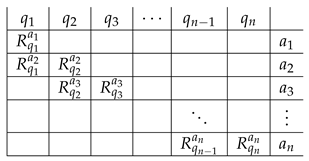
Most of the experiments in the literature were conducted without any concerns about their structure as cyclic systems. Indeed, the issue of True or Type II contextuality does not figure in these experiments. Thus we decided to create a simulation based study using one of the excellent simulations developed by Robinson and reported in the literature [78]. We created a rank-four cyclic system, which consists of four objects and four contexts, giving rise to eight random variables as depicted in the content-context matrix.
Robinson’s model examines the behavior of ants scouting for new nest sites. This model involves Monte-Carlo simulation methods and treats ants as separate realizations of a Markov process. It assumes that ants evaluate sites based on a simple threshold rule, where each ant has a certain minimum quality nest site it will recruit to. Furthermore, the model asserts that these acceptance thresholds are normally distributed across the population of ants. Consequently, the ability of ants to choose the correct nest at the colony level arises not from recruitment latency, but from the fact that the proportion of ants willing to recruit to a good nest will always be higher than the proportion of ants willing to recruit to a poor nest [78].
The Markov process identifies five different states: ’evaluating home site,’ ’evaluating inferior site,’ ’evaluating superior site,’ ’committed to inferior site,’ and ’committed to superior site.’ Ants, once committed to a site, cannot switch to a better alternative. However, ants can switch between evaluation states. All ants start in the ’evaluating home site’ state. However, the home site (with a value of -1000) is uninhabitable. Therefore, ants will never commit to it [78]. After leaving the home nest, the ants will arrive at alternative nest sites whose locations and environmental features are captured in terms of discovery probabilities and required travel time. These attributes allow the simulation to accurately assess the effect of distance from the home nest on the probability of recruiting to a nest. When a site is discovered, the ant evaluates it with some error, intended to replicate the noise present in the decision making of real ants. If the evaluated quality surpasses the ant’s acceptance threshold, it commits to the site. Otherwise, it continues to search for a better site [78]. The model was tailored to replicate a specific experimental setup and showed compatibility with the observed data. The switching behavior demonstrated in the simulations mirrored the empirical data from Robinson et al.’s 2009 experiment [89], with the majority of ants that found the superior site first remaining there, while those discovering the inferior site differed depending on their individual acceptance thresholds [78]. The model also successfully replicated the empirical finding that recruitment latency does not significantly impact the results. Despite quantitative differences (which appeared because simulated ants could not make tandem runs), the general patterns were consistent between simulated and empirical data. Furthermore, the model exhibited predictive validity by accurately forecasting the outcome in a novel scenario involving four potential nest sites [78]. This shows that the model not only fits well with historical data but is also capable of making accurate predictions about novel scenarios, reflecting its robustness and utility in understanding ant behavior.
Considering the capacity of Robinson et a.l’s simulation to mimic real world results, we departed from the parameters of their initial experiment as little as possible. The specific setup in question involved simulating a forced emigration from a destroyed nest, where the ants were forced to choose between two possible nest sites, one that was nearby (but poor quality) and one which was further away (and high quality) [78]. We differentiated our eight experiments from each other by modifying only one model parameter, site quality. In Robinson’s model, site quality is assigned a somewhat arbitrary numerical value. Ants in turn are assigned a threshold value that determines what minimum site quality they will recruit to. Therefore, sites of differing quality can be distinguished in terms of their distance from the mean threshold value for the whole population of ants. When that mean threshold value is set to 5 (as it was in our experiment), a good nest with 1.6 mm walls, a 2mm wide entrance, and a dark interior would be assigned the value 6. A somewhat worse nest, with 0.8 mm walls, 4 mm wide entrances, and a dark interior would be assigned the value 4 [78]. We departed only slightly from these values, with the worst nest in our setup being assigned the value 3.1, and the best nest being assigned the value 6.5. Other nests had values between these lower and upper bounds. As a result, all nests we used had reasonable values and could plausibly describe real nests.
In our setup, the four objects of measurement were the probabilities associated with migrating to each of four nest sites simulated as being far away from the ant colony. These nest sites were assigned the following values within the simulation.

Table 1.
Parametrization used in Robinson et al. [89]
Table 1.
Parametrization used in Robinson et al. [89]
| Parameter | Value | Title 3 |
|---|---|---|
| Number of Nests | 3 | Robinson et al. [89] |
| Position of Nests | Good nest further than poor nest | Robinson et al. [89] |
| Mean travel time between nests | From walking speed of 8.4 mm/secData | |
| Probabilities of finding nests | Robinson et al. [89] | |
| Number of ants | 10,000 | Arbitrary |
| Acceptance Threhsold Distribution | Normal, mean-0,SD=1 | Arbitrary |
| Nest Qualities | See Table 2 | Arbitrary |
| Assessment Error | Normal mean =0, SD=1 | Arbitrary |
Table 2.
Parametrization used in Robinson et al. [89] simulation.
Table 2.
Parametrization used in Robinson et al. [89] simulation.
| Experiment Number | 1 | 2 | 3 | 4 | 5 | 6 | 7 | 8 |
|---|---|---|---|---|---|---|---|---|
| Value Old Nest | -1000 | -1000 | -1000 | -1000 | -1000 | -1000 | -1000 | -1000 |
| Value Poor Nest | 4.6 | 3.1 | 3.1 | 3.6 | 3.6 | 4.1 | 4.1 | 4.6 |
| Value Good Nest | 6.5 | 6.5 | 5 | 5 | 5.5 | 5.5 | 6 | 6 |
Table 3.
Parametrization used in Robinson et al. [89] simulation.
Table 3.
Parametrization used in Robinson et al. [89] simulation.
| Experiment Number | 1 | 2 | 3 | 4 | 5 | 6 | 7 | 8 |
|---|---|---|---|---|---|---|---|---|
| Probability accepting | ||||||||
| good site | ||||||||
| Rate of Switch to | ||||||||
| Good Nest | 0.18 | 0.46 | 0.50 | 0.40 | 0.38 | 0.28 | 0.27 | 0.18 |
| Duration (min.) | 131 | 206 | 497 | 526 | 247 | 231 | 168 | 163 |
| Joint Probability of Accepting | ||||||||
| Good Nest in both Contexts |
Table 4.
Parametrization used in Masuda et al. [90] differential equation simulation.
Table 4.
Parametrization used in Masuda et al. [90] differential equation simulation.
| Parameter | Value | Derivation |
|---|---|---|
| Rate of Switch to good nest | See Table 3 | From Robinson et al. simulation [89] |
| Leak rate | 0.1 | Arbitrary |
| Portion of scouts z | 0.2 | Arbitrary |
| Probability acceptance good nest H | See Table 3 | From Robinson et al. simulation [89] |
Furthermore, the contexts in our setup were merely the alternative, nearby, nest sites presented. These nest sites had the following values.
Before running the simulation using Robinson et al.’s computational model, we tested whether such an experimental set up could conceivably give rise to contextuality using Masuda’s differential equation based model of ant nest site selection |citeMasuda. Masuda’s differential equation model examines nest selection at the colony level where ants choose between two potential sites, one good, the other mediocre. The simulation begins with the ants in their current nest. Some fraction of the ant population (determined by the parameter z) will begin scouting for a new site. However, as the model simulates an infinite population, the z parameter affects the duration of but not the ultimate outcome of the simulation. Like Robinson’s model, Masuda’s model assumes that ants have fixed preferences and will recruit only to nests that are above some minimum threshold of acceptability. Consequently, the model bridges the gap between the probability that some individual ant recruits to a nest site (the parameter H) and the probability that an idealized ant colony with an infinite population will select a given nest site [90].
The speed at which a colony selects the superior nest site is affected by two additional parameters (the rate at which an ant moves to the superior nest site) and the leakage rate (the probability of ants returning to the home nest) [90]. Neither of these two parameters affect the choice of nest. As a result, leakage rate was left unchanged so as to avoid producing less realistic values for duration. Regarding the goodness of fit, the model is highly idealized and operates under the assumption of an infinite population of ants. Consequently, it produces binary values as an infinitely large colony will select a site 100% of the time even if only 51% (or 50.00…1%) of ants prefer it to the alternative [90]. This creates a zero-noise condition which provides a good illustration of whether contextuality could be violated in theory but should not be mistaken for a realistic result. Therefore, the model provides insight into what might occur in a theoretical, noise-free scenario.
On account of producing binary outcomes, calculating joint probabilities is trivial as the joint probability of any value and 0 is 0. Similarly, if a simulated set of ants selects a particular nest under one condition with a probability of 1 and selects that same nest under another condition with a probability of 1, the resultant joint probability is also equal to 1. Predictably, it is also not meaningful to do error calculations when dealing with deterministic simulations.
Calculating the joint probability of an ant accepting the better nest site in both contexts where it was presented was slightly more complicated when dealing with Robinson’s model. Thanks to their fixed thresholds, a subset of ants exists that invariably rejects the inferior nest site in every context. These ants, with high thresholds, will leave poorer quality nests irrespective of when they encounter them. Therefore, the minimum value of the joint distribution can be calculated by determining the minimum number of ants who rejected the poor-quality nest in both trials. This figure represents the population of ants with such high-quality thresholds that they have no alternative to choosing the better site. For the remaining ants, the joint distribution can be computed in a straightforward manner, like any independent probability. The ants with lower thresholds will settle in the first nest they come across. Therefore, to calculate the remainder of the joint distribution, we subtract the number of high-threshold ants from the total number of ants that accepted the good site in both experiments and multiply the results of the two experiments: (accept good in experiment 1 - high threshold) * (accept good in experiment 2 - high threshold). Adding these two values together provides a joint distribution. The error for the probability of accepting the good site is simply measured in terms of standard error of a proportion. The joint distribution involved dependent probabilities, consequently the error was calculated using bootstrapping with 100,000 resamples for each of the four joint distributions. The calculations of contextuality introduce no new errors, so all errors presented in those calculations is downstream of the errors in the probabilities and joint distributions of the simulations themselves.
We analysed the data associated resulting from the two simulations using Dzhafarov’s modified version of the CHSH inequality as described above [20].
3. Results
Masuda’s differential equation model revealed that our experimental setup could come close to demonstrating contextuality under conditions with no noise. Our simulation violated the CHSH inequality with , but failed to violate Dzhafarov’s version of the inequality, with . The results from Robinson et al.’s model proved less promising. The ants consistently demonstrated preference reversal. When presented with a choice between a good but distant nest and a nearby one, they consistently choose the better of the two options. However, when presented with the nest in context 4, they departed from their normal behaviour and chose the worse of the two nests. Nonetheless, the results violated neither the CHSH inequality () nor Dzhafarov’s version of the inequality ().
4. Discussion
Our results demonstrate that in an idealised noise free system, the behaviour of ants, in particular their susceptibility to preference reversal, could conceivably violate even the inequality proposed by Dzhafarov. These results did not appear in the more realistic simulation for a number of reasons. To begin, neither the ants’ initial preferences, nor their eventual preference reversal were particularly strong. For example, in all experiments, excepting the one involving preference reversal, the ants only accepted the good nest in between 50% and 80% of trials. The eventual preference reversal was comparably small, with ants still accepting the better of the two available nests in 49% of trials. The consequence of this is that the negative term in the CHSH inequality was not sufficiently negative to generate contextuality. This issue could conceivably be avoided if multiple drivers of intransitive behaviour were combined in a single experiment which could produce a starker preference reversal. However, the weakness of the preference reversal was not the chief obstacle to producing contextuality. More troublingly, the CHSH inequality depends in part on the joint probability of ants accepting the good nest in both contexts where it is present. However, although ants in the simulation have fixed preferences and are thus more likely than chance to choose the same nest in successive contexts, their nest selection behaviour also depends on the probability of discovering the same nest in both experiments. Consequently, joint probabilities ranged from 0.31 to 0.51. Due to these lower than ideal joint probabilities, the positive terms in the CHSH inequality were not sufficiently positive to generate contextuality. This problem of joint probabilities is likely an intrinsic property of ant behaviour. While natural systems may be too noisy to exhibit true contextuality, it is possible that artificial collective intelligence systems might exhibit true contextuality and its study may provide some illumination of the conditions under which true contextuality could occur in neural systems.
5. Conclusions
Type II contextuality has been claimed as an exclusive characteristic of quantum systems. The simple cooperative game example shows that this is not true, at least in the case of odd order cyclic systems. A simple example of intransitive preference can violate the CHSH inequality maximally, but only in the presence of inconsistent connectedness, so there is Type I but not Type II contextuality. Intransitivity appears to be an important condition under which Type II contextuality might occur, as does some form of cooperation. A collective intelligence can exhibit both cooperation and intransitivity. An example of a collective intelligence was presented in which cooperation and intransitivity of preferences was present, and through computer simulations, a search was made for evidence of Type II contextuality. Unfortunately, this was not found but only a limited sample of situations could be explored. Further research is indicated and it would be ideal if such behaviour could be observed in living collective intelligence systems.
Author Contributions
For research articles with several authors, a short paragraph specifying their individual contributions must be provided. The following statements should be used “Conceptualization, W.S. and A.K.; methodology, W.S. and A.K.; softtware, A.K.; formal analysis, A.K.; investigation, A.K.; resources, A.K.; data curation, W.S.; writing—original draft preparation, A.K. and W.S.; writing—review and editing, W.S.; supervision, W.S. All authors have read and agreed to the published version of the manuscript.”
Funding
“This research received no external funding”
Institutional Review Board Statement
“Not applicable”
Informed Consent Statement
“Not applicable”
Data Availability Statement
In this section, please provide details regarding where data supporting reported results can be found, including links to publicly archived datasets analyzed or generated during the study. Please refer to suggested Data Availability Statements in section “MDPI Research Data Policies” at https://www.mdpi.com/ethics. If the study did not report any data, you might add “Not applicable” here.
Acknowledgments
Thanks are due to Professors Dolan, Matsuda and Robinson for permission to use their software for the generation of these simulations
Conflicts of Interest
“The authors declare no conflict of interest.”
References
- Sulis, W. Process and Time. Entropy 2023, 25, 803. [Google Scholar] [CrossRef] [PubMed]
- Sulis, W. Contextuality in Neurobehavioural and Collective Intelligence Systems. Quantum Rep 2021, 3, 592–614. [Google Scholar] [CrossRef]
- Rosen, R. Some epistemological issues in physics and biology. In Quantum Implications: Essays in Honour of David Bohm; Hiley, B.J., Peat, F.D., Eds.; Routledge: London, UK, 1991; pp. 314–327. [Google Scholar]
- Laughlin, R. A Different Universe: Reinventing Physics from the Bottom Down; Perseus Books: New York, NY, USA, 2005. [Google Scholar]
- Whitehead, A.N. Process and reality; The Free Press: New York, USA, 1978. [Google Scholar]
- Trofimova, I. Principles, concepts, and phenomena of ensembles with variable structure. In Nonlinear Dynamics in the Life and Social Sciences; Sulis, W., Trofimova, I., Eds.; IOS Press: Amsterdam, NL, 2001; pp. 217–231. [Google Scholar]
- Trofimova, I. Phenomena of Functional Differentiation (FD) and Fractal Functionality (FF). Internat. J. Design & Nature and Ecodyn. 2016 11(4); pp. 508-521.
- Trofimova, I. Functional constructivism: in search of formal descriptors. Nonlinear Dynamics in Psychology and Life Sciences 2017 21(4); pp. 441-474.
- Sulis, W. Locality is dead! Long live locality! Front. Phys. 2020, 8. [Google Scholar] [CrossRef]
- Sulis, W. The Classical-Quantum Dichotomy from the Perspective of the Process Algebra. Entropy 2022, 24, 184. [Google Scholar] [CrossRef] [PubMed]
- Sulis, W. An Information Ontology for the Process Algebra Model of Non-Relativistic Quantum Mechanics. Entropy 2020, 22, 136. [Google Scholar] [CrossRef]
- Sulis, W. A Process Model of Quantum Mechanics. J. Mod. Phys 2014, 5, 1789–1795. [Google Scholar] [CrossRef]
- Busemeyer, J.; Bruza, P.D. Quantum cognition and decision; Cambridge University Press: Cambridge, UK, 2012. [Google Scholar]
- Haven, E.; Khrennikov, A. Quantum Social Science; Cambridge University Press: Cambridge, UK, 2014. [Google Scholar]
- [46] Asano, M.; Basieva, I.; Khrennikov, A.; Ohya, M.; Yamato, I. Non-Kolmogorovian approach to the context-dependent systems breaking the classical probability law. Found Phys 2013 43, 895–911.
- Aerts, D.; Aerts Arguelles, J.; Beltran, L.; Geriente, S.; Sassoli de Bianchi, M.; Sozzo, S.; Veloz, T. Modeling human decision-making: An overview of the Brussels quantum approach. arXiv 2018, arXiv.1807.11036v1.
- Harris, R. it Rigors Mortis: How Sloppy Science Creates Worthless Cures, Crushes Hope and Wastes Billions; Basic Books: New York, USA, 2017. [Google Scholar]
- Lejarriga, T.; Hertwig, R. How Experimental Methods Shaped Views on Human Competence and Rationality. Psychological Bulletin 2012, 147(6); pp. 535-564.
- Pickering, A. The mangle of practice; University of Chicago Press: Chicago, USA, 1995. [Google Scholar]
- [52] Dzhafarov, E. N.; Zhang, R.; Kujala, J. Is there contextuality in behavioural and social systems? Phil. Trans. Royal Soc. A: Math., Phys. and Eng. Sci. 2016, 374(2058), 20150099. [CrossRef]
- [53] Dzhafarov, E. N.; Kujala, J. V. Probabilistic foundations of contextuality. Fortschritte Der Physik 2017, 65(6–8), 1600040. [CrossRef]
- Khrennikov, A.Y. Ubiquitous Quantum Structure; Springer: New York, NY, USA, 2010. [Google Scholar] [CrossRef]
- Bohm, D.; Aharonov, Y. Discussion of experimental proof for the paradox of Einstein, Rosen, and Podolsky. Phys. Rev. 1957, 108 (4); 1070. [CrossRef]
- Bell, J.S. Speakable and unspeakable in quantum mechanics; Cambridge University Press: Cambridge, UK, 1987. [Google Scholar]
- Leggett, A.J.; Garg, A. Quantum mechanics versus macroscopic realism: Is the flux there when nobody looks? Phys. Rev. Lett. 1985, 54, 857–860. [Google Scholar] [CrossRef]
- Clauser, J.; Horne, M.; Shimony, A; Holt, R. Proposed experiment to test local hidden variable theories. Phys. Rev. Lett. 1969, 23(15); 880-884. [CrossRef]
- Bancal,J.D.; Pironio, S.; Acin, A.; Liang, Y.C.; Scarani, V.; Gisin,N. Quantum nonlocality based on finite-speed causal influences leads to superluminal signalling. Nature Phys. 2012. [CrossRef]
- Ionicioiu, R.; Jennewein, T.; Mann, R.B.; Terno, D. Is wave-particle objectivity compatible with determinism and locality? Nature Comm. 2014, 5, 3997. [Google Scholar] [CrossRef] [PubMed]
- Shimony, A. Search for a naturalistic world view, Volume II, Natural science and metaphysics; Cambridge University Press: Cambrudge, UK, 1993. [Google Scholar]
- Griffiths, R. Nonlocality claims are inconsistent with Hilbert space quantum mechanics. Phys. Rev. A 101, 022117 (2020).
- Cervantes, V.H.; Dzhafarov, E.N. Snow queen is evil and beautiful: Experimental evidence for probabilistic contextuality in human choices. Decision 2018, 5, 193–204. [Google Scholar] [CrossRef]
- Cervantes, V.H.; Dzhafarov, E.N. True contextuality in a psychophysical experiment. J. Math. Psychol. 2019, 91, 119–127. [Google Scholar] [CrossRef]
- Aerts, D.; Aerts Arguelles, J.; Beltran, L.; Geriente, S.; Sozzo, S. Entanglement in cognition violating Bell Inequalities beyond Cirel’son’s bound. ArXiv.2102.0 3847v1.
- Sulis, W.; Khan, A. Intransitivity and Contextuality in the Decision Making of Social Insect Colonies. Natural Systems of Mind 2021, 1(2), 24-39. [CrossRef]
- Khrennikov, A.; Alodjants, A. Classical (local and contextual) probability model for Bohm-Bell type experiments: No signaling as independence of random variables. Entropy 2019, 21, 157. [Google Scholar] [CrossRef]
- Khrennikov, A. Violation of Bell’s inequality and postulate on simultaneous measurements of compatible observables [Internet]. 2011. ArXiv: 1102. 4743. [Google Scholar]
- Dzhafarov, E.; Kujala, J. Contextuality analysis of the double slit experiment (with a glimpse into three slits). Entropy 2018, 20, 278. [Google Scholar] [CrossRef]
- Wigner, E. The Unreasonable Effectiveness of Mathematics in the Natural Sciences. Communications in Pure and Applied Mathematics 1960, 13(1).
- Von Neumann, J.; Morgenstern, O. Theory of Games and Economic Behavior; Princeton University Press: Princeton, NJ, USA. 1953. [Google Scholar]
- Tversky, A. Intransitivity of preferences . Psychol. Rev. 1969, 76(1), 31-48. [CrossRef]
- Butler, D.; Progrebna, G. Predictably intransitive preferences. Judgment and Decision Making 2018 13(3), 217-236. [CrossRef]
- Anand, P. The philosophy of intransitive preference. The Economic Journal 1993, 103(417), 337-346. [CrossRef]
- Bar-Hillel, M.; Margalit, A. How vicious are cycles of intransitive choice? Theory and Decision 1988, 24(2), 119-145. [CrossRef]
- Guadalupe-Lanas, J.; Cruz-Cardenas, J.; Artola-Jarrín, V.; Palacio-Fierro, A. Empirical evidence for intransitivity in consumer preferences. Heliyon 2020, 6(3). [CrossRef] [PubMed]
- Kalenscher, T.; Tobler, P.; Huijbers, W.; Daselaar, S.; Pennartz, C. Neural signatures of intransitive preferences. Front. Human Neurosci. 2010, 4, 49. [Google Scholar] [CrossRef] [PubMed]
- Regenwetter, M.; Dana, J.; Davis-Stober, J. Transitivity of preferences. Psychol. Rev. 2011, 118(1), 42–56. [CrossRef]
- Cribbie, R.; Keselman, H. Pairwise multiple comparisons: A model comparison approach versus stepwise procedures. Brit. J. Math Stat. Psychol. 2003, 56, 167–182. [Google Scholar] [CrossRef]
- Mueller-Trede J.; Sher, S.;, McKenzie, C. Transitivity in context: A rational analysis of intransitive choice and context-sensitive preference. Decision 2015, 2(4), 280–305. [CrossRef]
- Baillon, A.; Bleichrodt, H.; Cillo, A. A tailormade test of intransitive choice. Operations Res. 2015, 63, 198–211. [Google Scholar] [CrossRef]
- Luce, R.D. Semiorders and a theory of utility discrimination. Econometrica 1956, 24(2), 178-191. [CrossRef]
- Fishburn, P. Nontransitive preferences in decision theory. J. Risk and Uncertainty 1991, 4, 113–134. [Google Scholar] [CrossRef]
- Makowski, M.; Piotrowski, E.; Sladkowski, E. Do transitive preferences always result in indifferent divisions? Entropy 2015, 17, 968–983. [Google Scholar] [CrossRef]
- Klimenko, A. Intransitivity in theory and in the real world. Entropy 2015, 17, 4364–4412. [Google Scholar] [CrossRef]
- McFarland, D.; Bosser, T. Intelligent behavior in robots and animals; MIT Press: Cambridge, USA, 1993. [Google Scholar]
- Wilson, E.O. The Insect Societies. Harvard University Press: Cambridge, USA 1971.
- Holldobler, B.; Wilson, E.O. The Ants; Belknap Press: Cambridge, USA, 1991. [Google Scholar]
- Holldobler, B.; Wilson, E.O. The superorganism: The beauty, elegance, and strangeness of insect societies; Norton: New York, USA 2009. [Google Scholar]
- Moreyra, S.; Lozada, M. How single events can influence decision-making in foraging Vespula germanica (Hymenoptera: Vespidae) social wasps. Austral Entomology 2019, 58(2), 443–450. [CrossRef]
- Shafir, S. Intransitivity of preferences in honey bees: Support for “comparative” evaluation of foraging options. Animal Behaviour 1994, 48(1), 55–67. [Google Scholar] [CrossRef]
- Benard, J.; Giurfa, M. A test of transitive inferences in free-flying honeybees: unsuccessful performance due to memory constraints. Learning & Memory 2018, 11(3), 328–336. [Google Scholar] [CrossRef]
- Tan, K.; Latty, T.; Hu, Z.; Wang, Z.; Yang, S.; Chen, W.; Oldroyd, B. P. Preferences and tradeoffs in nectar temperature and nectar concentration in the Asian hive bee Apis cerana. Behav. Ecol. Sociobiol. 2014, 68(1), 13–20. [Google Scholar] [CrossRef]
- Shafir, S.; Waite, T. A.; Smith, B. H. Context-dependent violations of rational choice in honeybees (Apis mellifera) and gray jays (Perisoreus canadensis). Behav. Ecol. Sociobiol. 2002, 51(2), 180–187. [Google Scholar] [CrossRef]
- Latty, T.; Trueblood, J. S. How do insects choose flowers? A review of multi-attribute flower choice and decoy effects in flower-visiting insects. J. Animal Ecol. 2020, 89(12), 2750–2762. [Google Scholar] [CrossRef]
- Edwards, S. C.; Pratt, S. C. Rationality in collective decision-making by ant colonies. Proc. Royal Soc. B: Biol. Sci. 2009, 276(1673), 3655–3661. [Google Scholar] [CrossRef]
- Sasaki, T.; Pratt, S. C. Emergence of group rationality from irrational individuals. Behav. Ecol. 2011, 22(2), 276–281. [Google Scholar] [CrossRef]
- Wendt, S.; Strunk, K. S.; Heinze, J.; Roider, A.; Czaczkes, T. J. Positive and negative incentive contrasts lead to relative value perception in ants. ELife 2019, 8, e45450–2019. [Google Scholar] [CrossRef] [PubMed]
- Oberhauser, F. B.; Schlemm, A.; Wendt, S.; Czaczkes, T. J. Private information conflict: Lasius niger ants prefer olfactory cues to route memory. Animal Cognition 2019, 22(3), 355–364. [Google Scholar] [CrossRef] [PubMed]
- Wendt, S.; Czaczkes, T. J. Labeling effect in insects: Cue associations influence perceived food value in ants (Lasius niger). J. Comp. Psychol. 2020, 134(3), 280–292. [Google Scholar] [CrossRef]
- Varón, E. H.; Eigenbrode, S. D.; Bosque-Pérez, N. A.; Hilje, L. Effect of farm diversity on harvesting of coffee leaves by the leaf-cutting ant Atta cephalotes. Agricultural and Forest Entomology 2007, 9(1), 47–55. [Google Scholar] [CrossRef]
- Altshuler, E.; Ramos, O.; Núñez, Y.; Fernández, J. Batista-Leyva, A. J.; Noda, C. Symmetry breaking in escaping ants. The American Naturalist 2005, 166(6), 643–649. [Google Scholar] [CrossRef]
- Sulis, W. Naturally occurring computational systems. World Futures 1993, 39(4), 225–241. [Google Scholar] [CrossRef]
- Sulis, W. Causality in naturally occurring computational systems. World Futures 1995, 44 (2-3), 129-148. [CrossRef]
- Sulis,W. Collective intelligence: observations and models. In Chaos and complexity in psychology; Guastello, S., Koopmans, M., Pincus, D. (Eds); Cambridge University Press: Cambridge, UK, 2009; pp. 41-72.
- Sulis, W. Lessons from collective intelligence. In Chaos Theory in the Social Sciences. Elliot, E., Kiel, D. (Eds.); Michigan University Press: Ann Arbor, USA, 2021. [Google Scholar]
- Franks, N.R.; Mallon, E.B.; Bray, H.E.; Hamilton, M.J.; Mischler, T.C. Strategies for choosing between alternatives with different attributes: exemplified by house-hunting ants. Animal Behav 2003, 65, 215–223. [Google Scholar] [CrossRef]
- O’Shea-Wheller, T. A.; Masuda, N.; Sendova-Franks, A. B.; Franks, N. R. Variability in individual assessment behaviour and its implications for collective decision-making. Proc. Royal Soc. B: Biol. Sci. 2017, 284(1848), 20162237. [CrossRef]
- Lehue, M.; Detrain, C. Foraging through multiple nest holes: An impediment to collective decision-making in ants.PLOS ONE 2020, 15(7), e0234526. [CrossRef]
- Stroeymeyt, N.; Robinson, E. J. H.; Hogan, P. M.; Marshall, J. A. R.; Giurfa, M.; Franks, N. R. Experience-dependent flexibility in collective decision making by house-hunting ants. Behav Ecol 2011, 22(3), 535–542. [Google Scholar] [CrossRef]
- Doran, C.; Newham, Z. F.; Phillips, B. B.; Franks, N. R. Commitment time depends on both current and target nest value in Temnothorax albipennis ant colonies. Behav Ecol Sociobiol 2015, 69(7), 1183–1190. [Google Scholar] [CrossRef]
- Healey, C. I. M.; Pratt, S. C. The effect of prior experience on nest site evaluation by the ant Temnothorax curvispinosus. Animal Behav. 2008, 76(3), 893–899. [Google Scholar] [CrossRef]
- Houston, A. I. Natural selection and context-dependent values. Proc. Royal Soc. London. Series B: Biol. Sci. 1997, 264(1387), 1539–1541. [Google Scholar] [CrossRef]
- Nicolis, S. C.; Zabzina, N.; Latty, T.; Sumpter, D. J. T. Collective irrationality and positive feedback. PLOS ONE 2011, 6(4), e18901. [CrossRef]
- Sasaki, T.; Granovskiy, B.; Mann, R. P.; Sumpter, D. J. T.; Pratt, S. C. Ant colonies outperform individuals when a sensory discrimination task is difficult but not when it is easy. Proc. Nat. Acad. Sci. 2013, 110(34), 13769–13773. [Google Scholar] [CrossRef]
- Franks, N. R.; Hooper, J. W.; Dornhaus, A.; Aukett, P. J.; Hayward, A. L.; Berghoff, S. M. Reconnaissance and latent learning in ants. Proc Royal Soc.: Biol. Sci. 2007, 274(1617), 1505–1509. [Google Scholar] [CrossRef]
- Stroeymeyt, N.; Jordan, C.; Mayer, G.; Hovsepian, S.; Giurfa, M.; Franks, N. R. Seasonality in communication and collective decision-making in ants. Proc. Royal Soc. B: Biol. Sci. 2014 281(1780), 20133108.
- Kujala, J. V.; Dzhafarov, E. N. Proof of a conjecture on contextuality in cyclic systems with binary variables. Found Phys. 2016, 46(3), 282–299. [Google Scholar] [CrossRef]
- Dzhafarov, E.; Kujala, J. Contextuality is about identity of random variables. Physica Scripta 2014, T163 014009. [CrossRef]
- Sulis, W. Order Automata. Ph.D. Thesis, The University of Waterloo, 2014.
- Robinson, E.; Smith, F.; Sullivan, K.; Franks, N. Do ants make direct comparisons? Proc Royal Soc B 2009, 276, 2635–2641. [Google Scholar] [CrossRef]
- Masuda, N.; O’Shea-Wheller, Doran, C. ; Franks, N. Computational model of collective nest selection by ants with heterogeneous acceptance thresholds. Royal Soc. Open Sci. 2015, 2, 140533. [Google Scholar] [CrossRef] [PubMed]
Disclaimer/Publisher’s Note: The statements, opinions and data contained in all publications are solely those of the individual author(s) and contributor(s) and not of MDPI and/or the editor(s). MDPI and/or the editor(s) disclaim responsibility for any injury to people or property resulting from any ideas, methods, instructions or products referred to in the content. |
© 2023 by the authors. Licensee MDPI, Basel, Switzerland. This article is an open access article distributed under the terms and conditions of the Creative Commons Attribution (CC BY) license (http://creativecommons.org/licenses/by/4.0/).
Copyright: This open access article is published under a Creative Commons CC BY 4.0 license, which permit the free download, distribution, and reuse, provided that the author and preprint are cited in any reuse.


