
Submitted:
24 July 2023
Posted:
25 July 2023
You are already at the latest version
Artificial Intelligence (AI) and Machine Learning
Abstract
A text obtained by a Large Language Model (LLM) such as GPT4 usually has issues in terms of incorrectness and hallucinations. We build a fact-checking system 'Truth-O-Meter' which identifies wrong facts, comparing the generation results with the web and other sources of information, and suggests corrections. Text mining and web mining techniques are leveraged to identify correct corresponding sentences; also, the syntactic and semantic generalization procedure adopted to the content improvement task. To handle inconsistent sources while fact-checking, we rely on an argumentation analysis in the form of defeasible logic programming. We compare our fact checking engine with competitive approach based on reinforcement learning on top of LLM or token-based hallucination detection. It is observed that LLM content can be substantially improved for factual correctness and meaningfulness.
Keywords:
Large Language Model
; hallucination
; fact-checking
; multiple inconsistent sources
1. Introduction
We propose a novel fact checking framework for answering single/multi-hop questions across heterogeneous knowledge sources. The key novelty of our method is the introduction of the intermediary fact-checking modules into the current retriever-reader pipeline. Unlike previous methods that solely rely on the retriever for gathering all evidence in isolation, our intermediary fact-checker performs a chain of reasoning over the retrieved set. Our approach links the retrieved evidence with its related global context into graphs and organizes them into a candidate list of evidence chains.
Large Language Models (LLMs) such as GPT-3 (Brown et al., 2020) and ChatGPT have demonstrated impressive capabilities in generating natural language texts that are fluent, coherent, and informative. This proficiency is believed to stem from the extensive world knowledge encoded in these models and their ability to generalize effectively from it. Moreover, GPT-4, with its impressive scale and reinforcement learning based on human feedback, has garnered considerable attention. Its ability to provide fluent and comprehensive answers across a wide array of topics surpasses previous public chatbots in terms of usefulness and performance.
However, despite its powerful capabilities, several studies have consistently shown significant issues, including errors in terms of factuality, reasoning, math, coding, biases, etc. (Bang et al., 2023; Borji, 2023; Guiven, 2023). the encoding of knowledge in LLMs is not perfect, and the generalization of knowledge could cause “memory distortion.” This can result in these models generating false information or “hallucinating”.
A majority of approaches to verification and correction of an LLM results identify relevant knowledge which is expected to improve the correctness of result and supply it to the LLM. However, it is frequently beneficial to do all fact-checking processes outside of LLM to assure no hallucination occurs again.
In some verification and correction sessions, coming back to LLM with relevant attributes knowledge and re-running the request helps to obtain the content that can be trusted. In other cases, LLM hallucinates again, and the knowledge session does not converge to the truthful and relevant results. We explore how to combine fact-checking outside of LLM with the one re-iteration. We refer to the former as iterative fact checking. Along with the boost of truthfulness, we attempt to minimize the amount of calls to LLM API to limit the costs of content creation.
We tackle the hallucination detection problem from two directions. One is an improvement in selecting phrases which need fact-checking (Galitsky 2022). Too short, opinionated phrases or the ones with certain discourse roles do not need fact-checking. We develop the algorithms for close similarity assessment oriented towards hallucination (Section 5). Coming from the other direction, we handle multiple sources of information on the topic with potential conflict, such as inconsistent web search results. This is unlike the majority of hallucination detection studies we cite in this paper which assume that a single ground truth is available. Our intention is to identify and correct factual errors in the generated text. This work is expected to improve the overall factuality of LLMs.
Our contribution is as follows:
- Fact checking via web mining adjusted to LLM content versus human-made intentional misinformation
- Applicability to texts of various genres and mixture of formats and genres in a document
- Application to the whole document with opinionated data, background, captions, results, design notes etc.
- Finding proper level of granularity for fact-checking: from phrases to sentences, with contextualization
- Verification against various sources of different modalities with mutual inconsistency
- Verification against abstract canons, generalizations, rules, principles
1.1. Why LLMs Hallucinate
It is not always clear in which case LLMs hallucinate. Hallucination concept is only applicable to factual and not opinionated texts. Hence we work with genres where factual correctness in essential. In fiction, poetry, lyrics, and stories LLMs have limited memorization for less frequent entities, and are prone to hallucinate on long-tail knowledge (Kandpal et al., 2022; Mallen et al., 2022). Therefore, we might be able to ask questions involving long-tail knowledge.
Unstructured factual knowledge typically exists at a document level (i.e., a group of factual sentences about an entity). This means that sentences can contain pronouns (e.g., she, he, it), making these sentences factually useless standalone. To illustrate this with an example from Suvorov Wikipedia page, “He secured Russia’s expanded borders and renewed military prestige and left a legacy of theories on warfare.” cannot be a useful standalone fact because it is unclear who “He” is. Due to the GPU memory limit and computation efficiency, it is common to chunk documents in LLM training corpus. This causes the “fragmentation” of information and leads to wrong associations of entities that appear in independent documents with similar contexts.
(Zhow et al. 2023) explores characteristics of LLM-generated misinformation compared with content written by humans and then evaluates the applicability of existing solutions. The authors compiled human-created COVID-19 misinformation and abstracted it into narrative prompts for a language model to output LLM - misinformation. Significant linguistic differences are identified within human-LLM pairs, and patterns of misinformation in enhancing details, communicating uncertainties, drawing conclusions, and simulating personal tones are revealed. While existing models remained capable of classifying LLM-misinformation, a significant performance drop compared to misinformation in human communication was observed. Results suggested that existing information assessment guidelines had questionable applicability, as LLM-misinformation tends to meet criteria in evidence credibility, source transparency, and limitation acknowledgment. The authors draw implications for practitioners in content creating, researchers, and journalists, as LLM can create new challenges to the societal problem of misinformation.
1.2. Introductory Example
We show a query, ChatGPT response and step-by-step hallucination detection and correction procedure.
Figure 1.
An example of hallucination detection.
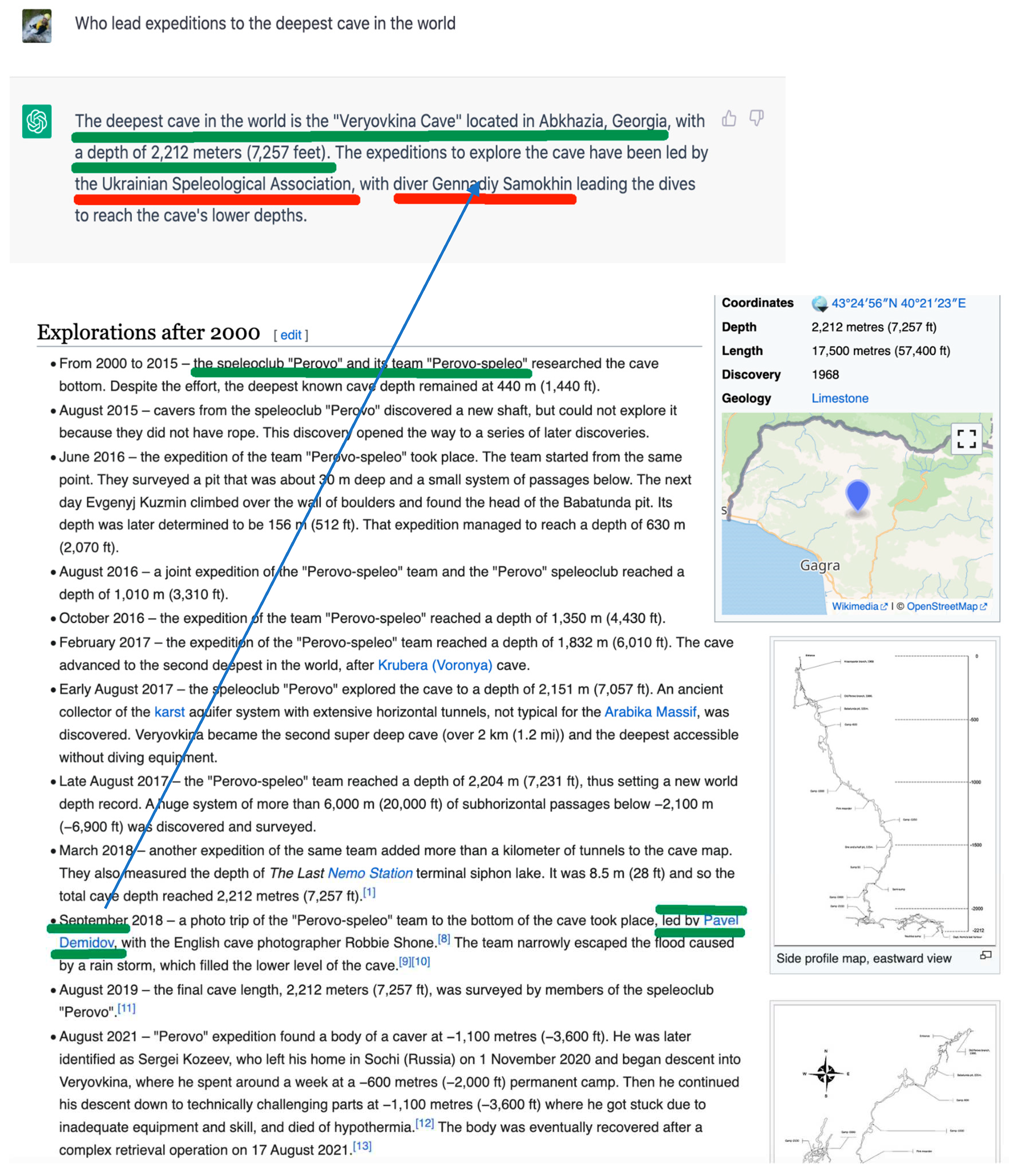
There is a following list of steps which need to be taken to perform fact-checking and correction:
- 1)
- Fact – check LLM sentence by sentence and phrase (with attribute) by phrase
- 2)
- Start with the first sentence. Extract the main entity ‘Veryovkina cave’. Confirm that it is the deepest cave: we search the web for it and find a confirmation on Wikipedia.
- 3)
- Proceed to the second sentence. Extracting ‘led by<entity>’ and ‘ with <entity> leading the dives’ phrases. Both phrases are neither confirmed by the web nor by the Wikipedia page identified by the first sentence.
- 4)
- Coming to conclusion that the second sentence is totally wrong (is a complete hallucination). The hallucinated entities for persons and teams are real but associated with a different geo entity (cave).
- 5)
- It turns out that correct entities needs to be extracted from Wiki page identified by the query derived from the first sentence.
- 6)
- We use a retriever to obtain the value for ‘Expedition leader’ and substitute it into the second LLM sentence to correct it. Both organization name and individual (leader) name needs to be substituted.
Hence we will be identifying and repairing hallucination, moving in two directions:
- 1)
- Consolidating evidence from external knowledge for the LLM to generate responses grounded in evidence. LLM is considered as a black box and is called only once.
- 2)
- Revising LLM’s (candidate) responses using automated feedback (Peng et al. 2023). LLM is called iteratively, each time with additional information (Section 3).
Hence for the LLM’s candidate response:

We obtain the revised response where hallucination is identified and substituted

2. Related Work
Existing work including the current study usually attempts to detect hallucinations based on a corresponding oracle reference at a phrase, sentence or paragraph level. However, ground-truth references may not be readily available for many free-form text generation applications, and sentence- or document- level detection may fail to provide the fine-grained signals that would prevent fallacious content in generation time. (Liu et al. 2022) formulate a novel token-level, reference-free hallucination detection task.
Zhou et al. (2020) emphasize the significance of hallucination detection beyond the content generation domain. Their work formulates a prediction setting, where each token in the output sequence is assessed for hallucination while considering the source input, and introduces new manually annotated evaluation sets for this purpose. Furthermore, the authors present a novel method for learning hallucination detection, utilizing pretrained language models fine-tuned on synthetic data containing automatically inserted hallucinations. Through experiments on machine translation and abstract text summarization, Zhou et al. (2020) demonstrate the effectiveness of their approach, achieving an average F1 score of approximately 0.6 across all benchmark datasets and significant improvements in sentence-level hallucination scoring compared to baseline methods.
Reference-based hallucination detection has been proposed for abstractive summarization (Maynez et al., 2020), machine translation (Wang and Sennrich, 2020), and data- to-text generation (Rebuffel et al., 2021).
In open-ended text generation, widely-used sampling algorithms like top-p can lead to a degradation of factuality due to the inherent “uniform randomness” introduced during each sampling step. To address this issue, Lee et al. (2022) introduce the factual-nucleus sampling algorithm, which dynamically adjusts the randomness to enhance factuality while preserving the overall quality of the generated text. The authors analyze the limitations of the standard training approach in learning accurate associations between entities from factual text corpora like Wikipedia. To overcome these inefficiencies and minimize factual errors, they propose a factuality-enhanced training method that incorporates topic-prefix for improved factual awareness and sentence completion as the training objective. This approach proves effective in significantly reducing factual inaccuracies during text generation.
(Lee at al 2022) explore training methods that can effectively leverage text corpus with rich facts. It turns out that directly continuing the training of LM on factual text data (Gururangan et al. 2020) does not guarantee the improvement of factual accuracy. The authors propose factuality-enhanced training to address the underlying inefficiencies of this baseline. They improve the awareness of facts during training, and also formulate a sentence completion task as the new objective for continued LLM training.
On the contrary, in this work we attempt to distance ourselves from a pure learning-based approach to factuality and combine reinforcement learning iterative approach (Section 3) with a knowledge-based/reference approach (Sections 4 and 5).
Drawing inspiration from human behavior, Gou et al. (2023) have proposed a framework that allows Language Model Models (LLMs) to validate and refine their own outputs using external tools, similar to how humans employ tools for fact-checking or debugging. Traditionally considered as “black boxes,” LLMs can now engage in a process of self-validation and progressive refinement. The framework begins with an initial output generated by the LLM. The system then interacts with appropriate tools to assess specific aspects of the generated text. Based on the evaluation provided by these tools, the output is subsequently revised, leading to an improved version.
Similarly, Peng et al. (2023) have developed a system that incorporates external knowledge into LLM-generated responses. This involves utilizing task-specific databases to ground the responses in relevant information. Furthermore, the system iteratively modifies the prompts given to the LLM, aiming to enhance the quality of the model’s responses. Feedback generated by utility functions, such as the factuality score of a response, plays a crucial role in guiding this iterative refinement process. We refer to these approaches as Iterative and re-implement them to fit the Truth-O-Meter framework.
3. Iterative Mode
Verification and correction can be done outside of an LLM. However, once relevant background knowledge is identified, it can be given to LLM and a request to incorporate it to revise the previous answer issued. This is the promising scenario we will be exploring in this section. Let us continue our example of verification session and now apply iterations to it.
- 1)
- Given a user query, Truth-O-Meter first retrieves evidence from external knowledge (e.g., Web or task-specific datasets) and, if necessary, further fuses evidence by linking obtained raw evidence with related context (e.g., information of the entity “Veryovkina Cave”) and performing reasoning to form evidence chains (e.g., extracting information from list of references on a Wiki page).
- 2)
- Then, Truth-O-Meter queries ChatGPT using a prompt that contains the consolidated evidence for ChatGPT to generate a candidate response grounded in external knowledge (evidence).
- 3)
- Truth-O-Meter verifies the candidate response e.g., by checking whether it is inconsistent with evidence. If so, Truth-O-Meter generates a feedback message (e.g., about the caving team). The message is used to revise the prompt to query ChatGPT again.
- 4)
- The process iterates until a candidate response passes the verification and is sent to the user.
The information flow for iterative Truth-O-Meter is shown in Figure 2. Truth-O-Meter reward R is determined as the inverse frequency of wrong facts returned to the user. The Policy manager selects the next action of Truth-O-Meter that leads to the best expected reward R. These actions include:
- 1)
- acquiring evidence e for q from external knowledge;
- 2)
- calling the LLM to generate a current candidate response, and
- 3)
- sending a response to users if all available knowledge has been applied.
Truth-O-Meter’s policy combines manually crafted rules, and training results on actual or imitated human-system interactions. For example, (Peng et al. 2023) implement a trainable policy π as a neural network model maximize the expected reward as θ:
where: - S is a set of epistemic states, including dialog history, user query, evidence, phrase and attribute/value substitutions, candidate/intermediate response;
- -
- A is a set of actions that Policy manager selects, including Information seeking manager to consult evidence from external knowledge and calling Prompting manager to query the LLM again to proceed with next iteration.
- -
- R(s; a) is the external reward received after taking action a in state s, which is provided by the environment (e.g., users or simulators);
- -
- πq is computed using a logic programming formalism of reasoning about actions, computing possible actions and their resultant states iteratively (Levesque et al. 1997, Galitsky 2006).
To maintain generality, we do not involve task-specific retrievers from Information seeking manager that may lead to an elevated assessment of performance. Instead, we employ the combined Google and Bing Search API to search queries generated by LLMs, scrape the resulting top-five HTML web pages, and extract a candidate answer by fuzzy-matching the snippet from Google and Bing. The maximum number of interactions with search engine is set to 5. Chain-of-thought prompting (Wei et al. 2022) is used to produce an initial answer, and then up to three iterations are being corrected, stopping early if the answer remains the same for two consecutive corrections. We consider the plausibility and truthfulness are assessed with respect to R during our verification.
Iterations in Truth-O-Meter are defined as follows. Given input x and previous output oi, LLMs interact with external tools to generate a possible defeat for oi which we denote di. The task-specific defeat can be used to detail the attributes of the output we expect to evaluate, such as truthfulness, feasibility, appropriateness or safety. For different inputs, task-dependent, heuristically selected, or automatically selected appropriate tools can be chosen for verification.
LLMs can produce an enhanced answer conditioned on input x, previous output oi, and defeat di from verification. Defeat generation plays a pivotal role in this correction process, as it detects errors, provides actionable suggestions, and identifies plausible groundings by interacting with diverse knowledge sources. Through this iterative refinement, the LLM aims to avoid previously made errors in generating new outputs. Inspired by the human process of iteratively refining drafts, we can repeat the verify-then-correct cycle until specific stopping criteria are met, such as addressing critiques from verification, reaching a maximum number of iterations n, or receiving feedback from the environment. This approach facilitates continuous enhancement of output quality, systematically and efficiently verifying and correcting errors that arise from interactions with the world.
Let us look at iterative hallucination detection and verification process:
We start with a question

The last sentence is not really informative, as the vast majority of drugs is eliminated from the body through kidney. Therefore, this raises a question, which leads in hallucination. However, it is caused by a meaningless, uninformative sentence above.
According to ChatGPT, ‘Propranolol is excreted in feces’. However, doing fact-checking on google, we find that it is NOT the case:
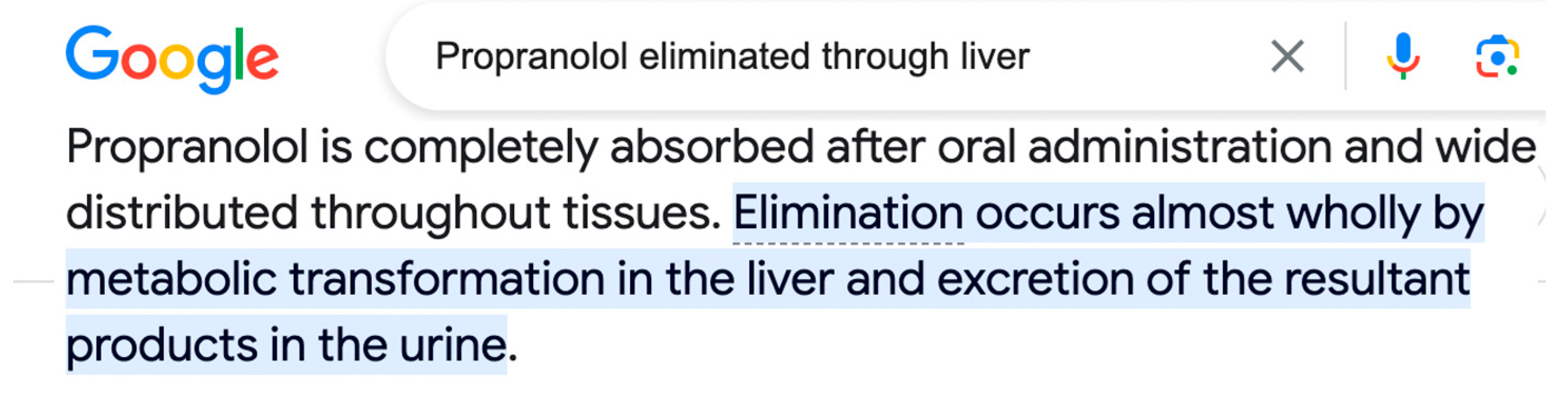
Hence ChatGPT hallucinated: Excretion happens via urine via kidney.
ChatGPT accepts the error but does not state explicitly:
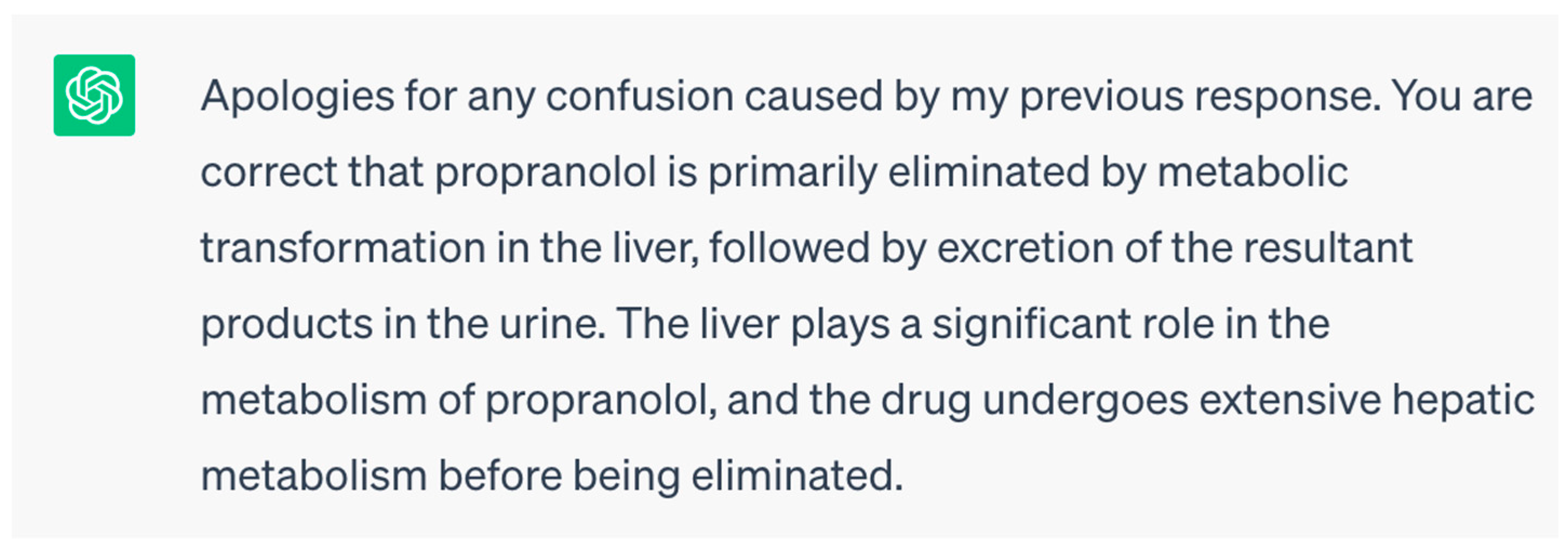
Background info here is as follows:

In summary, the major problem with iterative approach is that it can continue to hallucinate at each step of iterations. Therefore. we need to decide for each correction session, if we use iterative approach or not. When we chose an action a, one option is to exit iterations and proceed with correction outside of LLM. It happens mostly if repetitive hallucination occurred in the previous iteration, or hallucination phrase is short.
4. Handling Multiple Mutually Inconsistent Facts Obtained from Authoritative Sources
Fact verification is a challenging task which requires to retrieve relevant evidence from plain text and use the evidence to verify given claims. Many claims require to simultaneously integrate and reason over several pieces of evidence for verification. However, previous work employs simple models to extract information from evidence without letting evidence communicate with each other, e.g., merely concatenate the evidence for processing. Therefore, these methods are unable to grasp sufficient relational and logical information among the evidence. To alleviate this issue, (Zhou et al. 2019) propose a graph-based evidence aggregating and reasoning framework which enables information to transfer on a fully-connected evidence graph and then utilizes different aggregators to collect multi-evidence information.
(Yin et al. 2020) proposed a method for using pre-trained NLI models as a ready-made zero-shot sequence classifiers. The method works by posing the sequence to be classified as the NLI premise and to construct a hypothesis from each candidate label. For example, if we want to evaluate whether a sequence belongs to the class “politics”, we could construct a hypothesis of “This text is about politics.”. The probabilities for entailment and contradiction are then converted to label probabilities.
A case of the claim that requires integrating multiple evidence to verify is shown in Figure 3. This figure shows an example in the cases which needs multiple pieces of evidence to make the right inference. The ground truth evidence set contains the sentences from the article “Propranolol” with paragraph number 4 and 7. These two pieces of evidence are also ranked at top two in our retrieved evidence set. The representation for evidence, <Document, PositionInDocument> means the evidence is extracted from the document in a certain position.
Let us imagine we got the following search results from the web search:
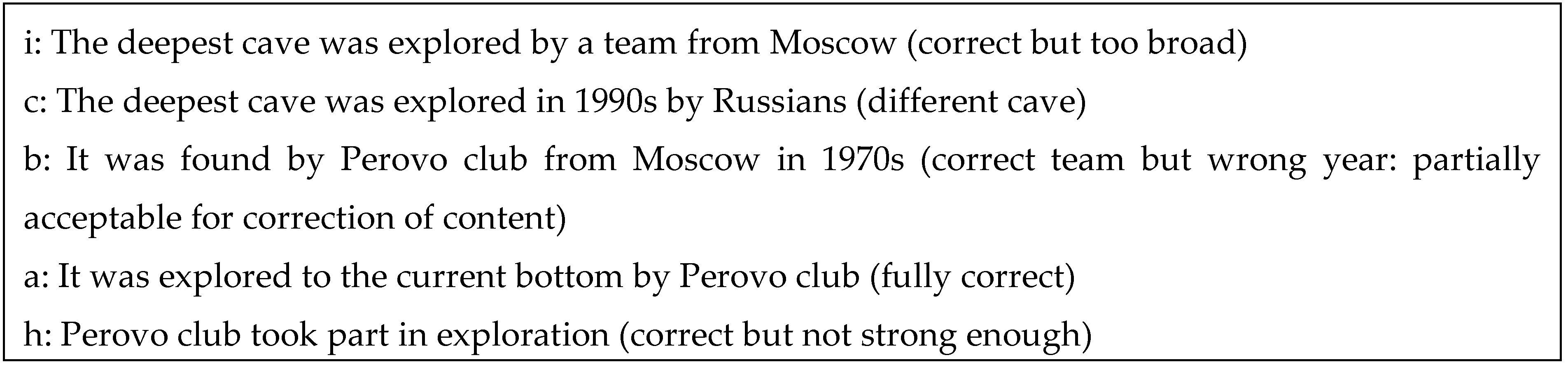
We comment on suitability of each phrase for fact-checking (on the right).
We then apply a Natural Language Inference (NLI) model to determine which of these search results support or defeat which other. We employ Facebook/bart-large-mnli model from HuggingFace and request to assess whether a hypothesis a is true (entailment), false (contradiction), or undetermined (neutral) given a premise b. As a result, we get the following relations:
c ⇒ i (entails)
b ! ⇒ c (contradicts in years)
h ! ⇒b (contradicts in years)
a ⇒b
a ⇒ h
Hence f implies almost everything. How can one derive computationally that f is most trusted and should be used to correct the LLM sentence? We need a machinery to select the best candidate for truth, given all mined facts. A Defeasible Logic Programming (DeLP, García and Simari 2004) approach is selected.
DeLP contains intricate relationships within their knowledge, which can complicate the understanding of why certain information is accepted or rejected. During the reasoning process, dialectical trees are constructed to represent the argumentation. These trees, known as dialectical explanations, serve to justify the status of a literal. In the context of Truth-O-Meter, the primary focus lies in how users form mental images of how arguments are evaluated and compared to reach conclusions, which are essentially dialectical explanations.
The Employed DeLP system, as described by Escarza et al. (2009, Figure 4), consists of two primary components:
- The defeasible reasoner, which is responsible for deriving arguments from the defeasible logic program, constructing dialectical trees, and analyzing defeating relationships to respond to user queries.
- The DeLP Viewer, which serves as the visualization module and the tool presented in the article.
These two modules are interconnected through the dialectical explanation. Using a defeasible logic program based on “true” facts and a query, the DeLP component analyzes the logic program and deduces the most reliable “true” fact. Subsequently, the user can request the system to examine the dialectical explanation by accessing the visualization module. Initially, the DeLP Viewer presents a list of the dialectical trees involved in the reasoning process. The user has the option to choose which dialectical trees they want to visualize. For each selected tree, the system generates an interactive visual representation displayed in a separate window.
To deal with inconsistent rules, the rule engine needs to implement a mechanism of rule justification, rejecting certain rules in the situation when other rules have fired. We now describe Defeasible Logic Programming (DeLP, García and Simari 2004) approach and present an overview of the main concepts associated with it.
A Defeasible logic program is a set of facts, strict rules Π of the form (A:-B), and a set of defeasible rules Δ of the form A- < B, whose intended meaning is “if B is the case, then usually A is also the case”. A DeLP for knowledge sources includes facts which are extracted from search results, and strict and defeasible clauses where the head and bodies form commonsense reasoning rules.
Let P . (Π, Δ) be a DeLP program and L a ground literal. A defeasible derivation of L from P consists of a finite sequence L1, L2, . . ., Ln . L of ground literals, such that each literal Li is in the sequence because:
- 1)
- Li is a fact in Π, or
- 2)
- there exists a rule Ri in P (strict or defeasible) with head Li and body B1,B2, . . .,
Bk and every literal of the body is an element Li of the sequence appearing before Lj (j < i).
Let h be a literal, and P . (Π, Δ) a DeLP program. We say that <A, h > is an argument for h, if A is a set of defeasible rules of Δ, such that:
- 1)
- there exists a defeasible derivation for h from (Π ∪ A);
- 2)
- the set (Π ∪ A) is non-contradictory; and
- 3)
- A is minimal: there is no proper subset A0 of A such that A0 satisfies conditions (1) and (2).
Hence an argument <A, h > is a minimal non-contradictory set of defeasible rules, obtained from a defeasible derivation for a given literal h associated with a program P.
We say that <A1, h1> attacks <A2, h2> iff there exists a sub-argument <A, h> of <A2, h2> (A A1) such that h and h1 are inconsistent (i.e., Π [ {h, h1} derives complementary literals). We will say that <A1, h1> defeats<A2, h2> if <A1,
h1> attacks <A2, h2> at a sub-argument <A, h> and <A1, h1> is strictly preferred (or not comparable to) <A, h>.
In the first case, we will refer to <A1, h1> as a proper defeater, whereas in the second case it will be a blocking defeater. Defeaters are arguments which can be in their turn attacked by other arguments, as is the case in a human dialogue. An argumentation line is a sequence of arguments where each element in a sequence defeats its predecessor. In the case of DeLP, there are a number of acceptability requirements for argumentation lines in order to avoid fallacies (such as circular reasoning by repeating the same argument twice).
Target claims can be considered DeLP queries which are solved in terms of dialectical trees, which subsumes all possible argumentation lines for a given query. The definition of dialectical tree provides us with an algorithmic view for discovering implicit self-attack relations in users’ claims. Let <A0, h0> be an argument (target claim) from a program P.
A dialectical tree for <A0, h0> is defined as follows:
- 1)
- The root of the tree is labeled with <A0, h0>
- 2)
- Let N be a non-root vertex of the tree labeled <An, hn> and Λ . [<A0, h0>, <A1, h1>, . . ., <An, hn>] (the sequence of labels of the path from the root to N).
Let [<B0, q0>, <B1, q1>, . . ., <Bk, qk>] all attack <An, hn>. For each attacker <Bi, qi> with acceptable argumentation line [Λ,<Bi, qi>], we have an arc between N and its child Ni.
A labeling on the dialectical tree can be then performed as follows:
- 1)
- All leaves are to be labeled as U-nodes (undefeated nodes).
- 2)
- Any inner node is to be labeled as a U-node whenever all of its associated children nodes are labeled as D-nodes.
- 3)
- Any inner node is to be labeled as a D-node whenever at least one of its associated children nodes is labeled as U-node.
For example, for the DeLP

we obtain the following dialectical tree Figure 5).
Notice that facts {a, …, i} and relationships between them are obtained from search results and defeasible commonsense reasoning clauses are obtained from LLM (Li et al. 2022). Hence a: ‘It was explored to the current bottom by Perovo club’ is confirmed and can be trusted (Figure 5).
5. Correcting Factual Errors in Syntactic and Semantic Spaces
For fact checking in domains with a focus on entities, such as product recommendation or ecommerce domains, we rely on syntactic structure. The syntactic match components consist of the following:
- 1)
- A set of rules applied to a dependency parse to identify the heads of entity mentions.
- 2)
- Rules based on token tags and text to identify the complete mention.
- 3)
- A system to link the identified entity mentions to corresponding structured evidence, verifying the factual nature of the text and distinguishing it from hallucinations.
In line with the findings of Estes et al. (2022), we employ phrases from the dependency parse tree originating from key verbs (e.g., “has,” “is”) and possessives (poss) to connect to product attributes. For instance, the direct object (dobj) of “has” always represents a product attribute phrase, as illustrated in the example “The table has four legs.”.
The dependency rules assist in determining the head token of a product or attribute. To identify the complete attribute and, if present, its value, we utilize a set of regular expressions based on part-of-speech tags. For instance, the pattern
/(NN|ADV)* ADJ (ADP|PART) (VB|NN) NN? ADP?/.
helps extract the complete attribute “hard to shut down.”
Furthermore, in the domain of product recommendation where the statement structure tends to be relatively simple, we leverage two co-reference rules that establish connections between pronouns and product mentions. These rules have proven to be more accurate and faster than co-reference resolution using general-purpose models.
Identifying entity attributes from the dependency parse tree of an input claim whose factuality is to be assessed is shown in Figure 5. Potential product mentions are shown in blue, attribute names in red, and attribute values in green.
Figure 5.
Syntactic tree representation for a sentence containing products’ attribute values.
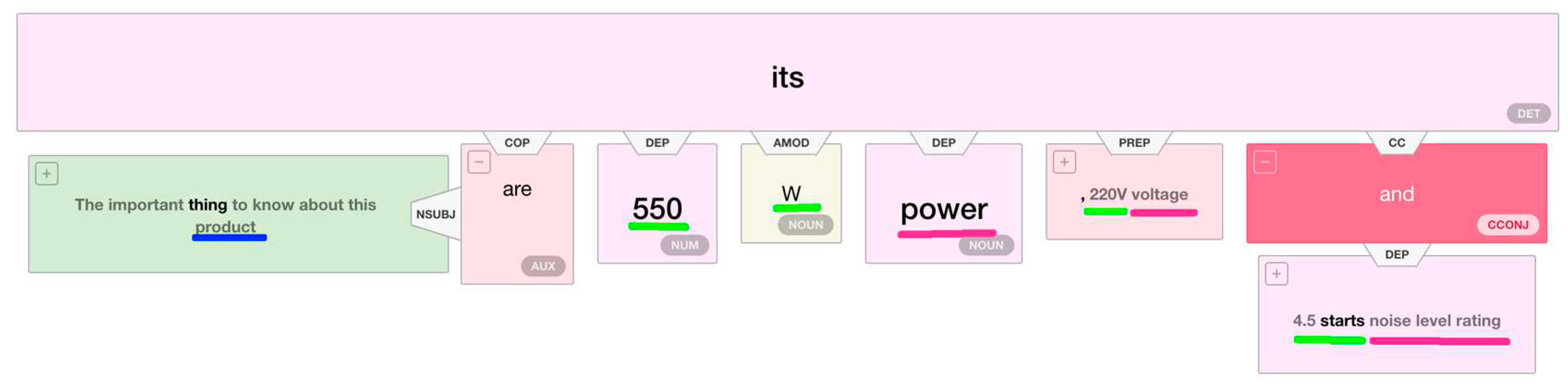
The third component evaluates the extracted hypotheses against the catalog data. Once entities and their attributes are extracted, they can be matched against a product catalogue API such as eBay (https://github.com/timotheus/ebaysdk-python). We focus on the product names, attribute names, and attribute values that are part of our structured product catalog. For each hypothesis extracted from a claim, we iterate through the catalog attributes to find a match. We first check for an exact match. If there is none, we search for catalog and hypothesis attributes whose cosine similarity of their GloVe embeddings (Pennington et al., 2014) is close to 1.0. If any hypothesis fails to match, then the product-attribute claim is defeated. If all hypotheses turn out to be truthful, the claim is labeled as correct.
5.1. Fact-Checking by Question Answering against Sources and Syntax-Semantic Alignment
Once we obtained the most similar text T2 assumed to be truthful for a given text T1, we can decide if T2 supports everything in T1. We use three types of approaches:
- 1)
- Baseline: we consider tokens which occurs in T1 but do not occur in T2 and therefore unconfirmed (should be rejected).
- 2)
- Instead of such tokens we attempt to obtain attribute values which occurs in T1 but do not occur in T2 and therefore unconfirmed (should be rejected). To achieve this, we generate questions and then use a question answering model to obtain answers as entities, attributes and values to find those which occurs in T1 but do not occur in T2 and therefore unconfirmed (should be rejected).
- 3)
- Instead of trusting a question-answering model with extracting entities, attributes and values, we do all the work with explicit syntactic and semantic representation. The advantage of this approach is that we obtain candidate substitutions from T2 as a by-product of fact-checking.
An algorithm of semantic/factual similarity for fact-checking is as follows:
Input: two texts T1 and T2
Output: phrases or attribute values which are from T1 and should be confirmed by T2 but are not.
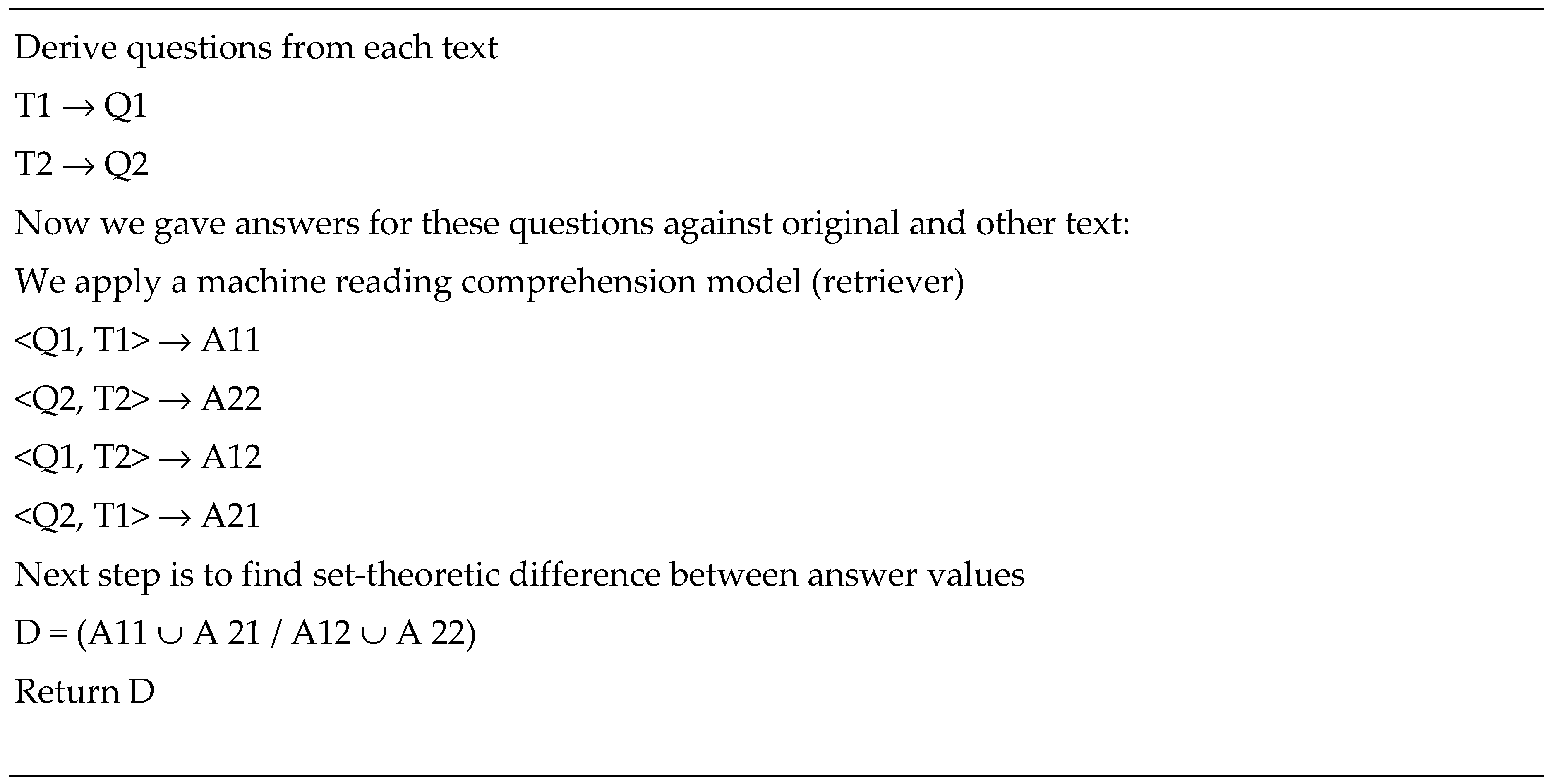
We now proceed to the second approach: Syntax-semantic alignment fact checking
Input: two texts T1 and T2
Output: phrases or attribute values which are from T1 and should be confirmed by T2 but are not.
Also: syntax-semantic alignment of two texts with mapping for confirming/defeating syntax-semantic nodes
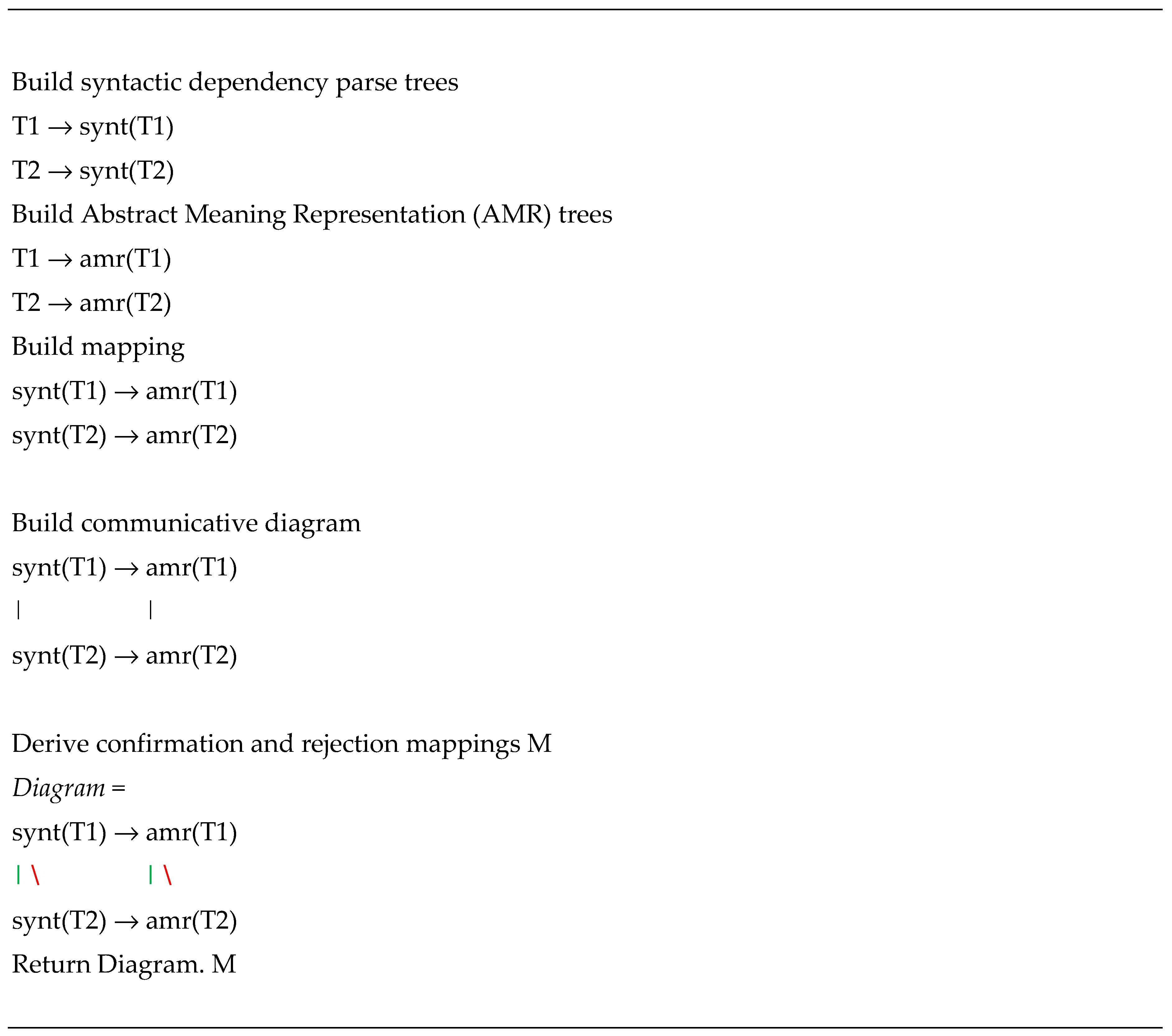
Once we have a candidate true text, we apply both algorithms to confirm / reject it, and whichever gives the lowest number of unconfirmed entities or tokens, is used.
5.2. Example of Alignment
Let us consider an example of a raw and a true decision for a patient with Liddle’s syndrome (Aronson 2009). This genetic disorder is characterized by early, and frequently severe, high blood pressure associated with low plasma renin activity, metabolic alkalosis, low blood potassium, and normal to low levels of aldosterone.
A woman with Liddle’s syndrome presented with severe symptomatic hypokalaemia. Her doctor reasoned as follows [text to be verified]:
- -
- she has potassium depletion;
- -
- spironolactone is a potassium-sparing drug;
- -
- spironolactone will cause her to retain potassium;
- -
- her serum potassium concentration will normalize.
She took a full dose of spironolactone for several days, based on this logical reasoning, but still had severe hypokalaemia.
Her doctor should have reasoned as follows [true text]:
- -
- she has potassium depletion due to Liddle’s syndrome, a channelopathy that affects epithelial sodium channels;
- -
- there is a choice of potassium-sparing drugs;
- -
- spironolactone acts via aldosterone receptors, amiloride and triamterene via sodium channels;
- -
- in Liddle’s syndrome an action via sodium channels is required.
When she was given amiloride instead of spironolactone, her serum potassium concentration rapidly rose to within the reference range. This stresses the importance of understanding the relationship between the pathophysiology of the problem and the mechanism of action of the drug. Channelopathies are diseases caused by a broken function of ion channel subunits or the proteins that regulate them. These diseases may be either congenital (often resulting from a mutation or mutations in the encoding genes) or acquired (often resulting from autoimmune attack on an ion channel).
Now let us try to apply generalization/alignment for raw and true texts. Alignment of a graph against a graph is a mapping retaining the labels on arcs between the source and target nodes of these two graphs. We coordinate an alignment between two semantic graphs and respective syntactic trees accordingly: semantic and syntactic relations between the source and target graphs are honored. Further details on alignment of linguistic structures are available in (Galitsky 2013).
The alignment maps potassium depletion into potassium depletion, potassium-sparing into potassium-sparing, and [true] sodium channel into [raw] retain potassium, and [true] mental action cause into raw mental action chose. Mapping into the same or synonymous entity is shown in green arrows, and the substitution of LLM with true is shown with red arrows (Figure 6).
For each sentence in the raw text, we perform a deterministic fact-checking. We iterate through each sentence in the raw text and try to correct it if necessary, modifying its syntactic structure to an as little degree as possible. Figure 7 shows the correction procedure for a sentence. We first take a sentence and apply syntactic criteria to determine if it is worth retaining in the corrected content. We then proceed to fact-checking, forming a family of queries from this sentence to obtain the candidate true ones.
Candidate true sentences are extracted from search results snippets and identified documents. The true sentences are extracted and matched against the given raw sentence to determine what is the optimal (minimal change) substitution. Syntactic and semantic alignments are built and the entities and phrases to be substituted are determined. The architecture chart shows major decisions on whether this raw sentence can potentially be corrected and if yes, should it be an entity substitution or a phrase substitution. For multiple sentences, substitutions should be propagated according to the structure of coreferences in the raw text.
6. Evaluation
We provide a thorough evaluation of Truth-O-Meter in a broad range of domain, from token-level and Fact Extraction and Verification Annotation Platform to question answering (QA), information seeking dialogues and health recommendations. We compare our performance for a one-shot Thuth-O-Meter, its iterative collaboration mode Thuth-O-Meter-i and a hybrid mode, where the mode is decided individually for each phrase being verified.
6.1. Hallucination Types
We first enumerate the types of hallucinations and show that only the first type is relatively frequent. This assessment is made in all our evaluation domains in this section. Table 1 includes the types of hallucination in LLM’s texts along with its relevant frequency.
In terms of the interaction mode, there are following hallucination scenarios (Williamsn 2023):
- 1)
- Hallucination based in dialogue history. Dialogue history-based hallucinations are produced when an LLM confuses names or relations of entities. For example, if the user mentions that their wife Mary likes shopping, and later informs their niece Lynn is coming to show her recent purchase, the LLM might incorrectly connect Mary and Lynn together as the same person. Furthermore, during a dialogue, the LLM can form incorrect conjectures based on previous mistakes within the dialogue tracking, breaking the context and content of a conversation in a sequence.
- 2)
- Hallucination in abstractive summarization. Although summarization is useful in condensing information, generative summarization systems make errors and deviate between the original and generated data.
- 3)
- Hallucination in generative question answering. It occurs when an LLM makes an erroneous inference from its source information and produces an incorrect answer to a user question. This can happen even when relevant source material is available. For example, if a user asks, “Where a swimmer can be attacked by a sea urchin: Andaman sea or Mediterranean sea?” and context is provided stating that the first choice is true, an LLM may still wrongly respond “Mediterranean sea “ due to its own prior knowledge about Mediterranean sea being a top destination for beach vacations. Rather than accurately recalling the pre-existing source information, LLM can ignore the evidence and perform an unjustified inference based on its existing knowledge.
- 4)
- General data generation hallucination. LLM model generates outputs that may appear plausible or coherent but are not supported by factual or reliable information. It is a type of error where the model fabricates details or makes assumptions that go beyond the input data it has been trained on. This can result in the generation of false or misleading information that may seem convincing to humans but lacks a proper factual basis. Unlike other types of hallucination, the root cause of a general data hallucination is an overextension beyond training data rather than an incorrect inference or lack of grounding. The mode essentially imagines new information that isn’t warranted by its training data.
Our approach can handle all four above cases, but the focus is 4)
6.2. Token-Level Hallucination Correction
We first evaluate our web mining module on the annotated hallucination dataset HADES (Liu et al. 2021) which contains about 9000 texts where about a half of them contains hallucination.
Building the HADES dataset, (Liu et al. 2021) perturb “raw text” web data into “perturbed text” with out-of-box BERT model. Human annotators were asked whether the perturbed text spans are hallucinations given the original text. Verbs and nouns and other parts-of speech occur in approximately 1:1:1 ration, with about a half of verbs and nouns hallucinating. About a one-eighth of NER such as organizations are hallucinating. Liu et al. 2021 split the dataset into train, validation and test sets with sizes of 8754, 1000, 1200 respectively. “hallucination” cases slightly outnumber “not hallucination” cases, with a ratio of 54.5%/45.5%.
Testing HADES dataset showing that web mining can detect most of artificially created hallucinations (Table 2). We only identify wrong facts here and do not correct them. A complete list of resources for matching includes YouTube, eBay, Google knowledge graph, Twitter and Reddit.
One can see that Truth-O-Meter is only 5.4% short of the native HADES performance (done without using external resources, just the training dataset. We conclude that Truth-O-Meter performs comparably in this specific HADES domain; therefore, we can expect satisfactory performance beyond token-based fact-checking.
6.3. Evaluation against Fact Extraction and Verification Annotation Platform
We conduct our experiments on the large-scale dataset FEVER (Thorne et al. 2018, https://github.com/awslabs/fever). The dataset consists of 185k annotated claims with a set of 5+ million Wikipedia documents from a Wikipedia dump. We used the dataset partition from the FEVER Shared Task. We compare Truth-O-Meter and GEAR based on BERT (Zhow et al. 2019). In the BERT-Concat system, the authors concatenate all evidence into a single sentence and utilize BERT to predict the relation between the concatenated evidence and the claim. In the training phase, the ground truth evidence is added into the retrieved evidence set with relevance score of one and select five pieces of evidence.
In the BERT-Pair system, as proposed by Zhow et al. (2019), BERT is utilized to predict labels for each evidence claim pair. Specifically, the authors use each evidence claim pair as input and the claim’s label as the prediction target. During the training phase, supported and defeated claims are paired with their corresponding ground truth evidence, while claims that do not require evidence are paired with retrieved evidence. In the test phase, labels are predicted for all retrieved evidence-claim pairs. However, since different evidence-claim pairs may have inconsistent predicted labels, an aggregator is employed to obtain the final claim label, ensuring a more reliable and cohesive outcome.
To automatically verify the truthfulness of the repaired LLM content, we repeat the repair procedure and measure the frequency of cases when the repaired sentence or repaired phrase is not confirmed by any true sentence or phrase. We evaluate this procedure manually for a representative subset of data and then extrapolate for the whole evaluation dataset.
In Table 3, we show a FEVER score for fact-checking.
We observe a similar performance of Truth-O-Meter and Truth-O-Meter-I on average, but they treat different cases differently, so the idea of using them depending on context and appearance of repetitive hallucinations seems fruitful.
6.4. Automated Evaluation on QA Datasets
We experiment with four datasets: SQuAD2.0, Natural Question (Kwiatkowski et al. 2019) that employs multi-reference annotations to resolve ambiguity, TriviaQA (Joshi et al. 2017) and HotpotQA (Yang 2018). SQuAD is extended via an open-domain question answering benchmark that considers multi-step joint reasoning over both tabular and textual information. It consists of around 40K instances built upon Wikipedia, including 400K tables and 6M passages as the knowledge source. Solving the questions in OTT-QA requires diverse reasoning skills and can be divided into three categories: single-hop questions (1/10), two-hop questions (3/5), and multi-hop questions (1/3).
As a representative case in the customer support scenario, we utilize DSTC11 Track 5 (Kim et al., 2023), which builds upon the DSTC9 Track 1 dataset by integrating subjective knowledge from customer reviews alongside factual knowledge from frequently asked questions (FAQs). This combination provides users with a more comprehensive and informative experience when interacting with the QA system. The dataset assesses the QA system’s capability to comprehend user review posts and FAQs, generating responses based on both sources. To evaluate the system’s performance, we randomly selected 500 examples from each dataset’s validation set and presented the results as F1 scores.
In Table 4 we compare performance of verification and correction answering question on various datasets. We compare approaches with different architectures and distinct roles of LLMs themselves, varying retrieval model and fact-checking sequence. Empty cells denote the lack of results for a particular evaluation setting by a given system.
We observe that Truth-O-Meter is best at DSTC11 followed by Truth-O-Meter-i and then by LLM-Augmenter. Truth-O-Meter-I demonstrates a superior performance at Natural Question followed by CRITIC*. In other QA domains, Truth-O-Meter family show an inferior performance in comparison to competitive systems.
6.5. Information-Seeking Dialogues
We now zoom-in on Truth-O-Meter overall quality of generated answers, correcting ChatGPT in customer support domain. We evaluate its performance on information-seeking dialog tasks using both automatic metrics and human evaluations. Following the literature, we consider commonly used metrics, Knowledge F1 (KF1) and BLEU-4, in grounded conversational response generation and task-oriented dialog. BLEU (Papineni et al., 2002) measures the overlap between the model’s output and the ground-truth human response, while KF1 (Lian et al., 2019) measures the intersection with the knowledge that the human used as a reference during dataset collection. Moreover, ROUGE-1 (Lin, 2004) is used as this assessment have been found to best correlate with human judgment on customer support tasks (Kim et al., 2020) as well as BARTScore as one of the best model-based metrics (Yuan et al., 2021). DSTC11 Track 5 (Kim et al., 2023) with incorporated subjective knowledge from customer reviews in addition to factual knowledge from FAQs is employed.
Evaluation results for Truth-O-Meter in information-seeking dialogues is shown in Table 5. Collaborative mode of Truth-O-Meter is not preferred in all measurement setting of the resultant content, but only for KF1. Interactive Truth-O-Meter-I wins in two measurement settings. Overall, one can observe a 3-10% boost in performance for different measurements moving from LLM-AUGMENTER to Truth-O-Meter.
We now proceed to the performance of Truth-O-meter-collaborative in Table 6 for a general information request prompt. We select four domains where precise answers are needed, and four domain in the humanities(shown in italic). In the second column, we show the number and % of sentences which were properly classified as hallucination (a precision of detection).
The reader can observe that hallucination rate in natural sciences are almost twice as high as in humanities, having the recognition precision comparable. In humanities, 30% more sentences are acceptable as they are, since the notion of falsehood is fuzzy and acceptance rate is significantly higher.
6.6. Personalized Drug Intake Recommendation Domain
We generate personalized drug intake recommendations for patients based on their unique set of medical conditions. In input may include a wide range of patient-specific data, including medical history, genetic information, lifestyle factors, and environmental influences. Ideally, the personalized drug intake recommendations are designed to cater to the specific needs of each patient, taking into account factors such as drug interactions, potential side effects, and the patient’s overall health status.
We obtain the list of drugs from https://www.rxlist.com/. 4k drugs names are selected. The list of medical conditions is available from https://www.medicinenet.com/diseases_and_conditions/article.htm. We select 700 conditions.
Firstly, we form the pairs of drug-condition (disease) where the relationships are drug-treats-disease as well as side-effect-of-drug-under-condition, drug-cause-side-effect-under-condition. We refer to this data as D-C pair set. In most cases, D is not intended to treat C: instead, we are concerned whether D has a side-effect on C, D might-affect C, D might-cause-complication-of C. Our choice of D-C association is connected with a personalized recommendation for a patient with C to take drug D.
These pairs are formed through exhaustive iteration through all drug-condition pairs and retaining these with an explicit relation. These relations were identified in texts about drugs and illnesses at https://www.rxlist.com/ and illnesses at https://www.medicinenet.com. As a result, we compile a list of 6500 pairs where we can experiment with writing a personalized content for drug D and a patient with condition C.
We show the correction characteristics in Table 7. In the leftmost column, the class of symptoms is shown for each assessment group. In columns two to four, we show:
Average # of corrected sentences for a recommendation (10 sentences average);
- – % of properly identified hallucinations sentences;
- – % of properly corrected hallucinations sentences.
We observe that 3/4 of LLM texts can be accepted without repair, according to the automated fact-checking. After correction, more than 94% of texts do not contain wrong facts (Table 8). Not all sentences in texts are potential source of wrong facts: a lot of sentences are neutral with respect to factuality, encouraging to “refer to specialist…” or “check regulations”.
6.7. Error Analysis
In our analysis, the main errors of our framework come from the upstream document retrieval and sentence selection components which can not extract sufficient evidence for inferring. For example, to verify the claim “Dexter is available on Netflix”, we need the evidence “You can watch all eight seasons of Dexter on Showtime, as well as the new series, New Blood. All eight seasons of Dexter are available on Amazon Prime U.S., but New Blood is only available with the Showtime premium add-on.” and “Prime members can subscribe to Showtime with Prime Video Channels. 7-Day Free Trial then only $10.99/month. Prime membership needed.”.
Unfortunately, the entity linking method employed in our text retrieval engine failed to retrieve the “Showtime” document solely from parsing the content of the text for truth-checking. Consequently, the claim verification component was unable to reach a proper conclusion due to insufficient evidence. To understand the claim verification process in this scenario, we conduct fact-checking on an evidence-enhanced development set. In this set, we added the ground truth evidence with the highest relevance score to the evidence set, ensuring that each claim in the evidence-enhanced set was supported by both the ground truth evidence and the retrieved evidence.
6.8. Examples of Repairs for Hallucination
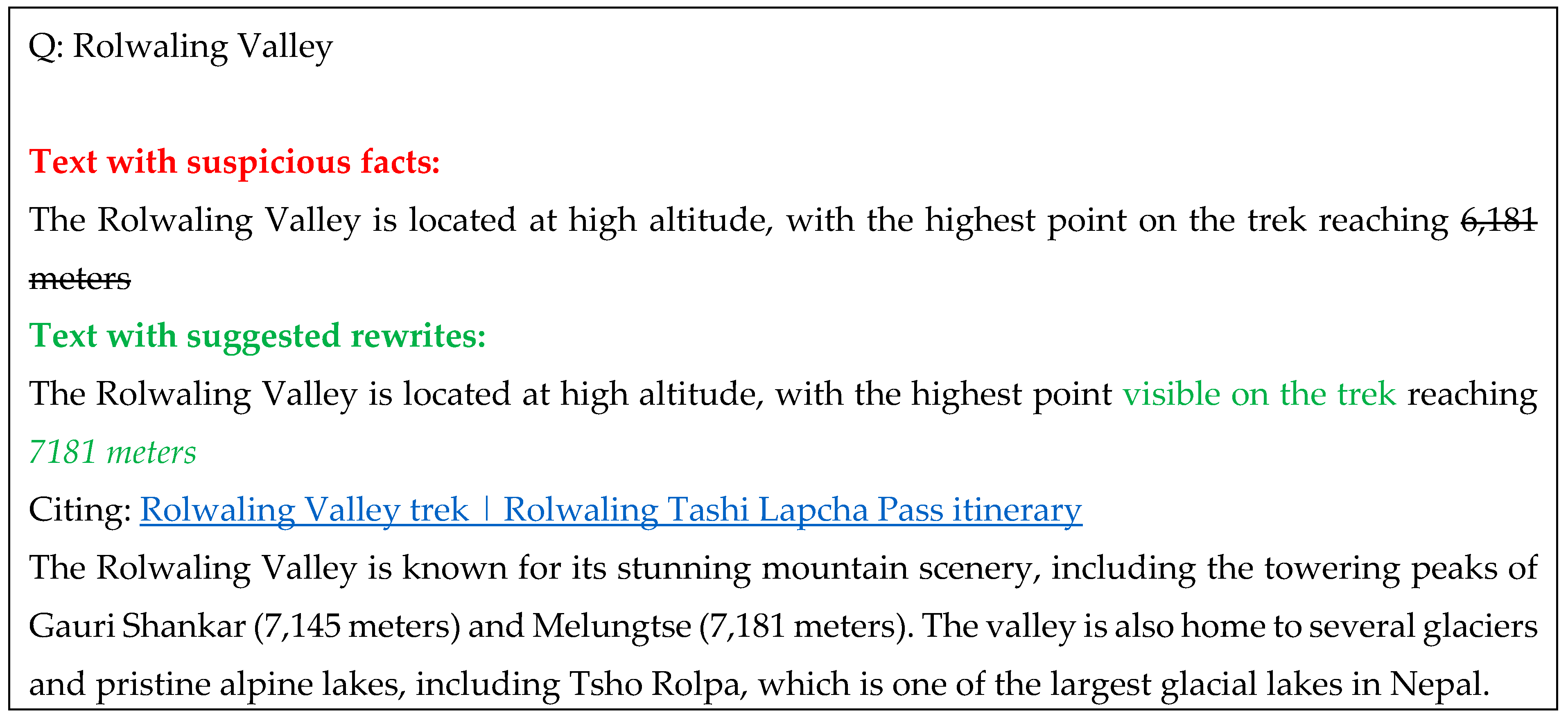
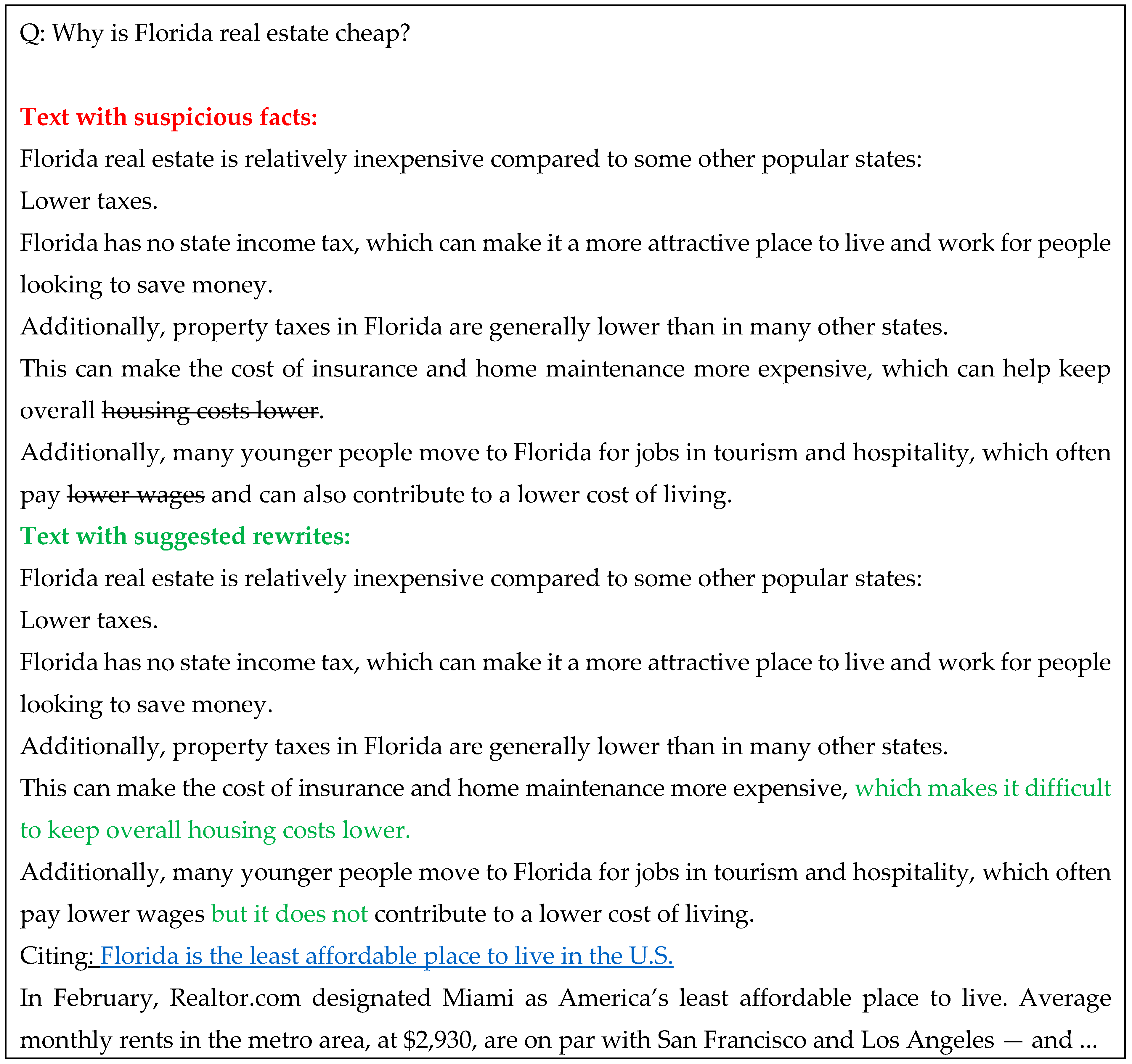
One can observe that a factual and commonsense error is corrected on the top in travel/geographical domain, while a commonsense error is corrected on the bottom in the domain of economics, where the correlations between factors need to be made correct. Instead of updating the factors themselves, we correct the relations, in particular, turning the polarity to negative.
Since LLMs lack true comprehension of the source text, instead relying on pattern recognition and statistics, they may, as a result, distort or even entirely fabricate details, inferring unsupported causal relationships or retrieving unrelated background knowledge. One can observe that without a grounding in common sense or factual knowledge, LLMs can get lost and generate hallucinations.
7. Discussion
Hallucinations in LLMs are not just a problem but also a sought-after feature. Users often desire to witness the models’ creativity and appreciate them generating original content. For instance, when a user asks ChatGPT or other LLMs to create a plot for a fantasy story, they expect unique characters, scenes, and storylines rather than copied content from existing works. To achieve this, models must refrain from relying solely on their training data. Another reason users expect hallucinations is to explore diversity, such as seeking ideas or brainstorming. Users want LLMs to provide derivations from existing concepts found in the training data but with distinct variations, not mere replicas. Hallucinations facilitate users in exploring different possibilities, enhancing the appeal and usability of LLMs.
Many language models have a “temperature” parameter. Users can control the temperature in ChatGPT using the API instead of the web interface. This is a parameter of randomness: the higher temperature can introduce more hallucinations.
In automated fact-checking, Nakov et al. (2021) have recently attempted to connect research to users by examining the concerns of professional fact-checkers. Generally, they find that organizations desire automation beyond veracity prediction models, which cannot function in isolation of media monitoring, claim detection, and evidence retrieval.
In their recent work, Liu et al. (2023) have introduced RETA-LLM, a comprehensive toolkit aimed at supporting research and fostering the advancement of retrieval-augmented Language Model (LLM) systems. This innovative toolkit offers a complete pipeline that empowers researchers and users to effortlessly design personalized LLM-based systems tailored to specific domains. In comparison to earlier retrieval-augmented LLM systems, RETA-LLM stands out for its inclusion of versatile plug-and-play modules, facilitating seamless interaction between Information Retrieval systems and LLMs. These modules encompass request rewriting, document retrieval, passage extraction, answer generation, and fact checking, collectively enhancing the overall performance and effectiveness of LLM-based systems.
Numerous LLMs for text generation (Radford et al., 2018) have been proposed over the years, including GPT-3 (Ouyang et al., 2022) and ChatGPT. However, most of them do not naturally incorporate external knowledge. To address this limitation, various works augment LLMs with knowledge consisting of e.g., personalized recommendations, Wikipedia article and web search (Shuster et al., 2022), structured and unstructured knowledge of task-oriented dialog (Peng et al., 2022).
Other attempts to combine black- box LLMs with external knowledge, such as incorporating external knowledge into prompts (Lazaridou et al., 2022), making GPT-3 more faithful (He et al., 2022), and combining web knowledge with GPT-3 (Nakano et al., 2021) have been made. Also, Shi et al. (2023) tune the ranker of a black-box LLM. Schick et al. (2023) designed a black-box LLMs’ access to different APIs and show improvement on a variety of understanding and reasoning tasks. However, a detailed account of how to combine multiple inconsistent sources of external knowledge, how to adjust LLM results to the identified knowledge, maintaining the resultant discourse has been developed in this paper.
8. Conclusions
Content verification problems are known to be highly challenging, and with the rapid progress of generative AI, the ease of content manipulation and spreading misinformation on a large scale has significantly increased. Whether it is malicious individuals or discrete enthusiasts, the potential for creating deep fakes of political leaders using AI tools has been demonstrated through the manipulation of authentic videos, audios, and images. Media extensively highlights the dangers of deep fakes, as they are utilized to sow discord within society and disrupt public order. Consequently, it becomes crucial to examine the role of generative AI in the face of the growing threat of misinformation, which poses a significant challenge and risk to the functioning of the public sphere and democracy (Kuehn and Salter 2020).
Fact-checking is the prevailing method used to counter misinformation, involving the evaluation of information for its accuracy and truthfulness. Although research has shown its effectiveness in debunking fake news, the labor-intensive nature of fact-checking poses scalability challenges (Micallef et al., 2022). LLM-generated misinformation can blend factual statements with falsehoods, manipulate the context and scope of facts, evoke emotional responses, and draw biased conclusions, presenting additional hurdles for fact-checkers and content moderators in assessing the potential for misleading readers.
Our project on correcting generative content (Galitsky 2022) began well before ChatGPT and we have observed substantial advancements in content correction algorithms, leading to the development of Truth-O-Meter. As LLMs improved, so did these algorithms, enabling higher performance when applied to newer models like GPT-4, especially after fine-tuning them with earlier, less accurate LLMs. Additionally, Truth-O-Meter’s efficacy is enhanced by incorporating additional fact-checking plug-and-play components over time. As both LLMs and their correction algorithms progress in tandem, the wider acceptance of LLMs by the general public at the end of 2022 necessitates reliable verification and correction systems like Truth-O-Meter for their trustworthy use.
In this study, fact-checking is implemented as a collaboration of human and LLM in creating a trusted content. A general case of such collaboration is described in (Goldberg et al. 2022) as approach to a Bi-directional Decision Support System (DSS) as an intermediary between an expert and a ML system for choosing an optimal solution. As a first step, such DSS analyzes the stability of expert decision and looks for critical values in data that support such a decision. If the expert’s decision and that of an ML system continue to be different, the DSS makes an attempt to explain such a discrepancy.
It is well known that deep learning in general and LLMs in particular have strong limitations due to a lack of explainability and weak defense against possible adversarial attacks. In (Galitsky et al. 2023) we proposed a Meta-learning/Deep networks → kNN architecture, called Shaped-Charge, that overcomes these limitations by integrating deep learning with explainable nearest neighbor learning. We evaluated the proposed architecture for pre-ChatGPT content creation tasks and observed a significant improvement in performance along with enhanced usability by users. We also saw a substantial improvement in question answering accuracy and also the truthfulness of generated content due to the application of the Shaped-Charge learning approach. Hence Truth-O-Meter architecture is a successful example of a this learning framework; in our future studies we plan to present a complete such framework including meta-level.
In conclusion, we summarize the following advantages of our approach to tackling hallucination:
- Fact checking via web mining adjusted to LLM by means of collaborating with LLM and applying a spectrum of text matching approaches;
- Applicability to texts of various genres and mixture of formats and genres in a document. By relying on a diversity of text matching algorithms acting on phrase and sentence level, we identify hallucination in various parts of documents.
- Application to the whole document with opinionated data, background, captions, results, design notes etc. Truth-O-Meters only applies fact-checking to the phrases and sentences where hallucination can potentially occur.
- Performing proper contextualization to identify and fully substitute facts from what is expressed in text.
- Handling sources with inconsistency by finding least defeated authoritative source and avoiding most defeated.
We conclude that Truth-O-Meter significantly reduces LLM’s hallucinations while retaining the fluency and informativeness of its generated responses.
Acknowledgments
The author is grateful to Daniel Usikov, Greg Makowski and Dmitri Ilvovsky for fruitful discussions.
References
- Aronson, J (2009). Medication errors: What they are, how they happen, and how to avoid them. QJM: Monthly Journal of the Association of Physicians. 102. 513-21. [CrossRef]
- Epstein D, Illia Polosukhin, Jacob Devlin, Kenton Lee (2019) Natural questions: a benchmark for question answering research. Transactions of the Association for Computational Linguistics, 7:453–466. [CrossRef]
- Escarza, S. Escarza, S., Larrea, M.L., Castro, S.M., & Martig, S. (2009). DeLP viewer: a defeasible logic programming visualization tool.
- Estes A, Nikhita Vedula, Marcus Collins, Matt Cecil, and Oleg Rokhlenko. 2022. Fact Checking Machine Generated Text with Dependency Trees. In Proceedings of the 2022 Conference on Empirical Methods in Natural Language Processing: Industry Track, pages 458–466, Abu Dhabi, UAE. Association for Computational Linguistics.
- Galitsky B (2013) Transfer learning of syntactic structures for building taxonomies for search engines. Eng Appl Artif Intell 26(10):2504–2515. [CrossRef]
- Galitsky B (2022) Improving open domain content generation by text mining and alignment. In Artificial Intelligence for Healthcare Applications and Management. Elsevier.
- Galitsky B, Ilvovsky D, Goldberg S. Shaped-Charge Learning Architecture for the Human–Machine Teams. Entropy. 2023; 25(6):924. [CrossRef]
- Employing abstract meaning representation to lay the last-mile toward reading comprehension. In Artificial Intelligence for Customer Relationship Management; Springer: Berlin/Heidelberg, Germany, 2020; pp. 57–86.
- Galitsky, B. Merging deductive and inductive reasoning for processing textual descriptions of inter-human conflicts. J Intell Inf Syst 27, 21–48 (2006). [CrossRef]
- Gao L, Zhuyun Dai, Panupong Pasupat, Anthony Chen, Arun Tejasvi Chaganty, Yicheng Fan, Vincent Y Zhao, Ni Lao, Hongrae Lee, Da-Cheng Juan (2023). Attributed text generation via post-hoc research and revision. arXiv preprint arXiv:2210.08726. [CrossRef]
- Garcia A, Simari G (2004) Defeasible logic programming: an argumentative approach. Theory Pract Logic Program 4:95–138.
- Goldberg, S.; Pinsky, E.; Galitsky, B. A bi-directional adversarial explainability for decision support. Hum. Intell. Syst. Integr. 2021, 3, 1–14. [CrossRef]
- Gururangan S, Ana Marasovic, Swabha Swayamdipta, Kyle Lo, Iz Beltagy, Doug Downey, and Noah A Smith. Don’t stop pretraining: adapt language models to domains and tasks. In ACL, 2020. [CrossRef]
- He H, Hongming Zhang, and Dan Roth. 2022. Rethinking with retrieval: Faithful large language model inference. arXiv preprint arXiv:2301.00303. [CrossRef]
- Hecham A (2016) DEFT, an open source Java tool for Defeasible Datalog. https://github.com/raoufhec/DEFT/.
- Thorne J, Andreas Vlachos, Christos Christodoulopoulos, and Arpit Mittal. (2018) Fever: a large-scale dataset for fact extraction and verification. In Proceedings of NAACL-HLT, pages 809–819. [CrossRef]
- Zhou Jie, Xu Han, Cheng Yang, Zhiyuan Liu, Lifeng Wang, Changcheng Li, Maosong Sun (2019) GEAR: Graph-based Evidence Aggregating and Reasoning for Fact Verification.
- Joshi M, Eunsol Choi, Daniel S Weld, and Luke Zettlemoyer. (2017) TriviaQA: A large scale distantly supervised challenge dataset for reading comprehension. ACL, 1601–1611. [CrossRef]
- Kim S, Spandana Gella, Di Jin, Alexandros Papangelis, Behnam Hedayatnia, Yang Liu, and Dilek Hakkani-Tur. (2023) DSTC11 track proposal: Task-oriented conversational modeling with subjective knowledge. https://github.com/alexa/dstc11-track5.
- Kuehn KM and Leon A Salter. 2020. Assessing digital threats to democracy, and workable solutions: a review of the recent literature. International Journal of Communication 14 (2020), 22.
- Kwiatkowski T, Jennimaria Palomaki, Olivia Redfield, Michael Collins, Ankur Parikh, Chris Alberti,.
- Lazaridou A, Elena Gribovskaya, Wojciech Stokowiec, and Nikolai Grigorev. 2022. Internet-augmented language models through few-shot prompting for open-domain question answering. arXiv preprint arXiv:2203.05115. [CrossRef]
- Le, and Denny Zhou. (2022) Chain of thought prompting elicits reasoning in large language models. Advances in Neural Information Processing Systems.
- Lee, Nayeon, Wei Ping, Peng Xu, Mostofa Patwary, Mohammad Shoeybi and Bryan Catanzaro. “Factuality Enhanced Language Models for Open-Ended Text Generation.” ArXiv abs/2206.04624 (2022).
- Levesque H.J., Lin F., Reiter R. (1997) Defining Complex Actions in the Situation Calculus. Technical Report, Department of Computer Science, University of Toronto.
- Li XL, Adhiguna Kuncoro, Jordan Hoffmann, Cyprien de Masson d’Autume, Phil Blunsom, and Aida Nematzadeh. 2022. A Systematic Investigation of Commonsense Knowledge in Large Language Models. In Proceedings of the 2022 Conference on Empirical Methods in Natural Language Processing, 11838–11855.
- Lian R, Min Xie, Fan Wang, Jinhua Peng and Hua Wu. 2019. Learning to select knowledge for response generation in dialog systems. In International Joint Conference on Artificial Intelligence. [CrossRef]
- Lin C-Y. 2004. ROUGE: A package for automatic evaluation of summaries. In ACL workshop, pages 74–81.
- Liu T, Yizhe Zhang, Chris Brockett, Yi Mao, Zhifang Sui, Weizhu Chen, and Bill Dolan. (2022) A Token-level Reference-free Hallucination Detection Benchmark for Free-form Text Generation. In Proceedings of the 60th Annual Meeting of the Association for Computational Linguistics (Volume 1: Long Papers), pages 6723–6737, Dublin, Ireland. Association for Computational Linguistics.
- Maynez J, Shashi Narayan, Bernd Bohnet, and Ryan McDonald. 2020. On faithfulness and factu- ality in abstractive summarization. In Proceedings of the 58th Annual Meeting of the Association for Computational Linguistics, pages 1906–1919, On- line. Association for Computational Linguistics.
- Micallef N, Vivienne Armacost, Nasir Memon, and Sameer Patil. 2022. True or False: Studying the Work Practices of Professional Fact-Checkers. Proceedings of the ACM on Human-Computer Interaction 6, CSCW1 (2022), 1–44. [CrossRef]
- Nakano R, Jacob Hilton, Suchir Balaji, Jeff Wu, Long Ouyang, Christina Kim, Christopher Hesse, Shantanu Jain, Vineet Kosaraju, William Saunders 2021. WebGPT: Browser-assisted question answering with human feedback. arXiv preprint arXiv:2112.09332. [CrossRef]
- Nakov P, David Corney, Maram Hasanain, Firoj Alam, Tamer Elsayed, Alberto Barron- ’ Cedeno, Paolo Papotti, Shaden Shaar, and Giovanni ˜ Da San Martino. 2021. Automated fact-checking for assisting human fact-checkers. In Proceedings of the Thirtieth International Joint Conference on Artificial Intelligence, IJCAI-21, pages 4551–4558. International Joint Conferences on Artificial Intelligence Organization. Survey Track.
- Ouyang L, Jeff Wu, Xu Jiang, Diogo Almeida, Carroll L. Wainwright, Pamela Mishkin, Chong Zhang, Sandhini Agarwal, Katarina Slama, Alex Ray, John Schulman, Jacob Hilton, Fraser Kelton, Luke E. Miller, Maddie Simens, Amanda Askell, Peter Welinder, Paul Francis Christiano, Jan Leike, and Ryan J. Lowe. 2022. Training language models to follow instructions with human feedback. ArXiv, abs/2203.02155.
- Papineni K, Salim Roukos, ToddWard, and Wei- Jing Zhu. 2002. BLEU: a method for automatic evaluation of machine translation. In ACL, pages 311–318.
- Peng, Baolin & Galley, Michel & He, Pengcheng & Cheng, Hao & Xie, Yujia & Hu, Yu & Huang, Qiuyuan & Liden, Lars & Yu, Zhou & Chen, Weizhu & Gao, Jianfeng. (2023). Check Your Facts and Try Again: Improving Large Language Models with External Knowledge and Automated Feedback. 10.48550/arXiv.2302.12813. [CrossRef]
- Pennington J, Richard Socher, and Christopher D Manning. 2014. GLOVE: Global vectors for word representation. In Proceedings of the EMNLP, 1532–1543.
- Radford A, Karthik Narasimhan, Tim Salimans, Ilya Sutskever (2018) Improving Language Understanding by Generative Pre-Training. Preprint 2018.
- Rebuffel C, Marco Roberti, Laure Soulier, Geof- frey Scoutheeten, Rossella Cancelliere, and Patrick Gallinari. 2021. Controlling hallucinations at word level in data-to-text generation. arXiv preprint arXiv:2102.02810. [CrossRef]
- Schick, T., Dwivedi-Yu, J., Dessì, R., Raileanu, R., Lomeli, M., Zettlemoyer, L., Cancedda, N., & Scialom, T. (2023). Toolformer: Language Models Can Teach Themselves to Use Tools. ArXiv, abs/2302.04761. [CrossRef]
- Shuster K, Spencer Poff, Moya Chen, Douwe Kiela and Jason Weston. 2021. Retrieval augmentation reduces hallucination in conversation. arXiv preprint arXiv:2104.07567. [CrossRef]
- Wang C and Rico Sennrich. 2020. On exposure bias, hallucination and domain shift in neural ma- chine translation. In Proceedings of the 58th Annual Meeting of the Association for Computational Lin- guistics, pages 3544–3552, Online. Association for Computational Linguistics.
- Wei J, Xuezhi Wang, Dale Schuurmans, Maarten Bosma, Brian Ichter, Fei Xia, Ed H. Chi, Quoc V.
- Williams A, Nikita Nangia, and Samuel R. Bowman. 2018. A broad-coverage challenge corpus for sentence understanding through inference. In NAACL-HLT, pages 1112–1122. [CrossRef]
- Williams, A. (2023) Fact or Fiction: What Are the Different LLM Hallucination Types? https://www.holisticai.com/blog/types-of-llm-hallucinations.
- Yin, W., Jamaal Hay, Dan Roth (2020) Benchmarking Zero-shot Text Classification: Datasets, Evaluation and Entailment Approach. arXiv:1909.00161. [CrossRef]
- Yuan W, Graham Neubig, and Pengfei Liu. 2021. BARTScore: Evaluating generated text as text generation.
- Zhou J, Xu Han, Cheng Yang, Zhiyuan Liu, Lifeng Wang, Changcheng Li, and Maosong Sun. (2019). GEAR: Graph-based Evidence Aggregating and Reasoning for Fact Verification. In Proceedings of the 57th Annual Meeting of the Association for Computational Linguistics, pages 892–901, Florence, Italy. Association for Computational Linguistics.
- Zhou J, Yixuan Zhang, Qianni Luo, Andrea G Parker, and Munmun De Choudhury. 2023. Synthetic Lies: Understanding AI-Generated Misinformation and Evaluating Algorithmic and Human Solutions. In Proceedings of the 2023 CHI Conference on Human Factors in Computing Systems (CHI ‘23). Association for Computing Machinery, New York, NY, USA, Article 436, 1–20. [CrossRef]
- Zhou, Chunting & Gu, Jiatao & Diab, Mona & Guzman, Paco & Zettlemoyer, Luke & Ghazvininejad, Marjan. (2020). Detecting Hallucinated Content in Conditional Neural Sequence Generation. [CrossRef]
Figure 2.
Information flow for iterative Truth-O-Meter. Blue arrows denote data flow, and red arrows – content update.
Figure 2.
Information flow for iterative Truth-O-Meter. Blue arrows denote data flow, and red arrows – content update.
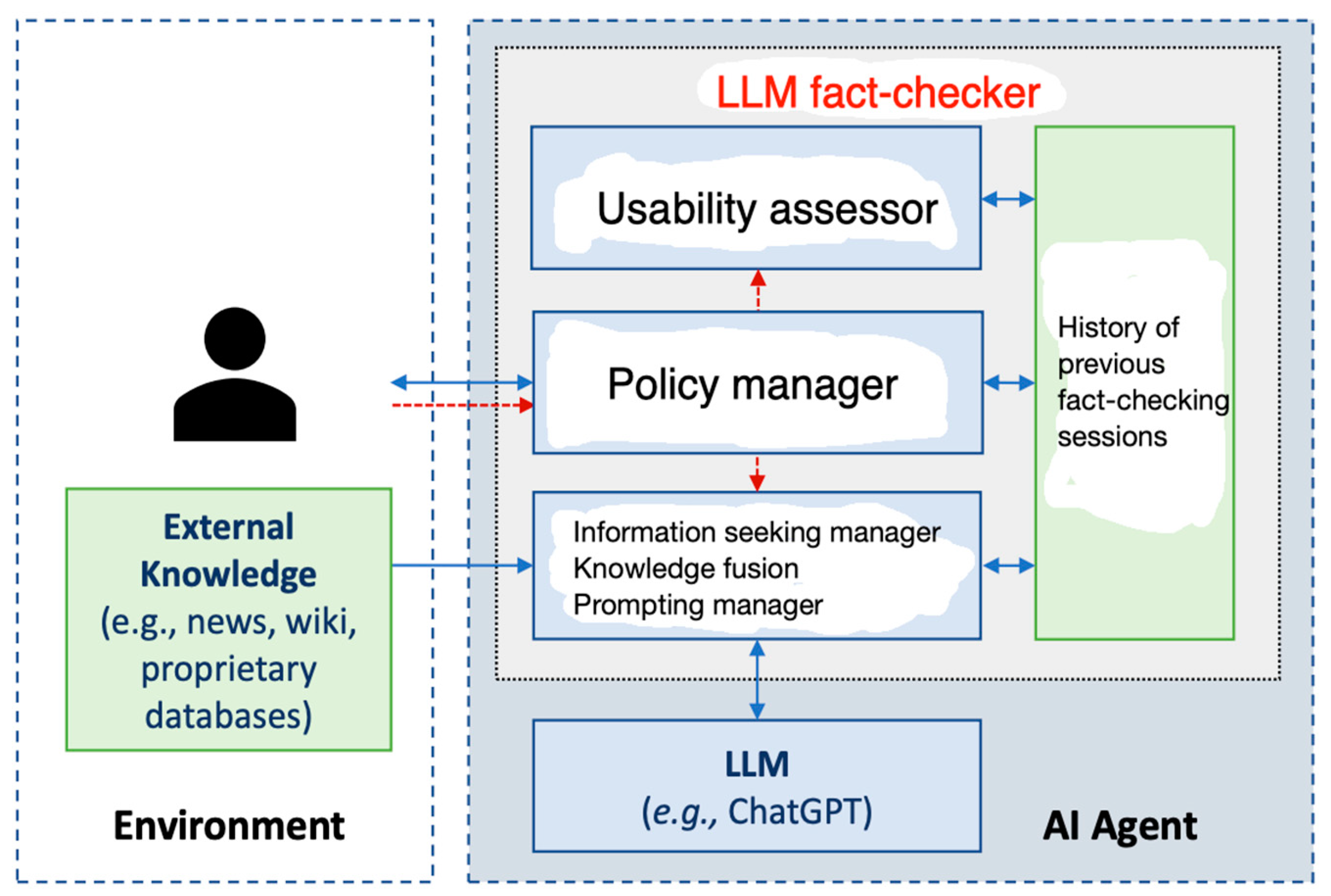
Figure 3.
Combining multiple evidence for verification.
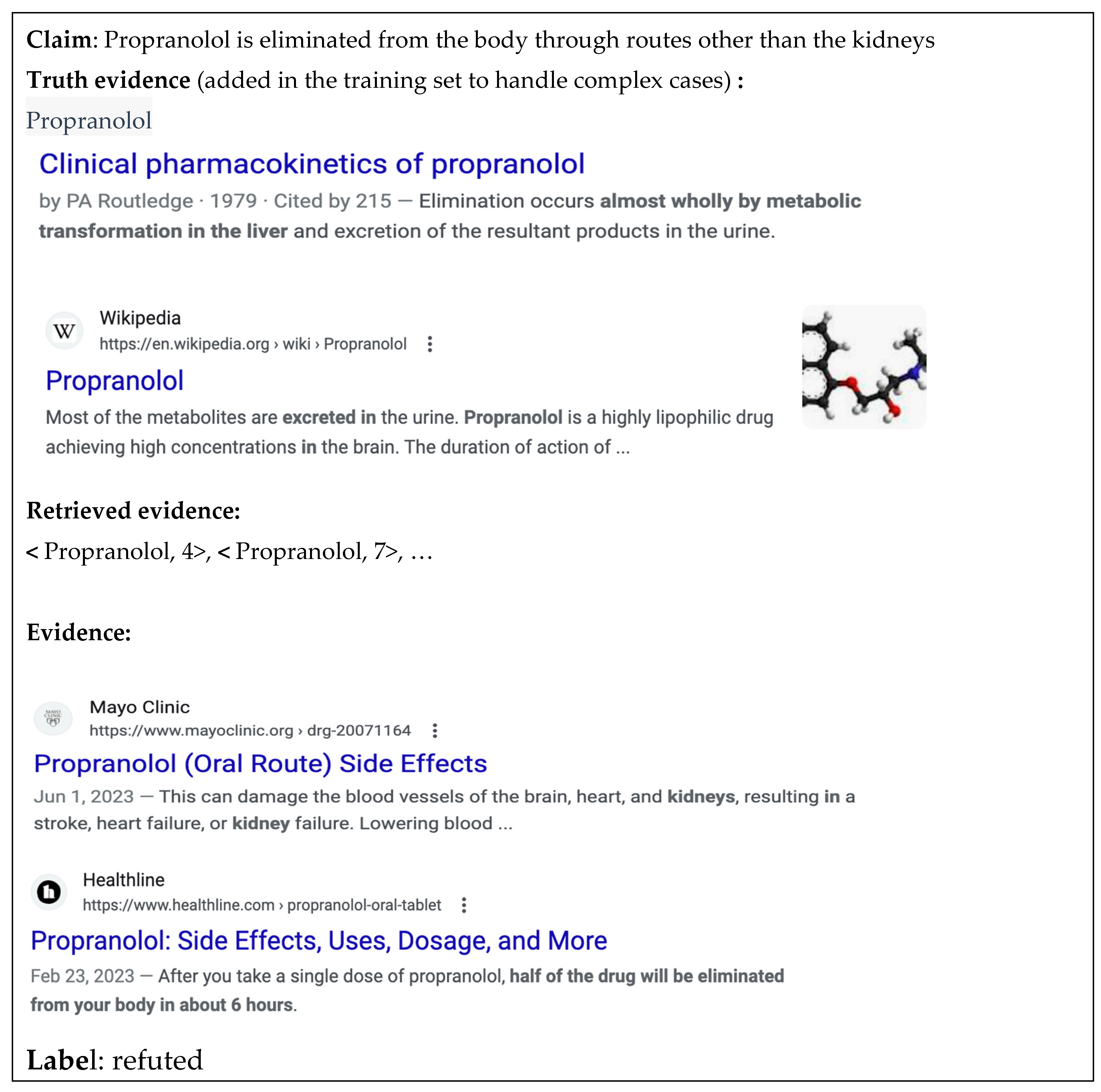
Figure 4.
DeLP processing.
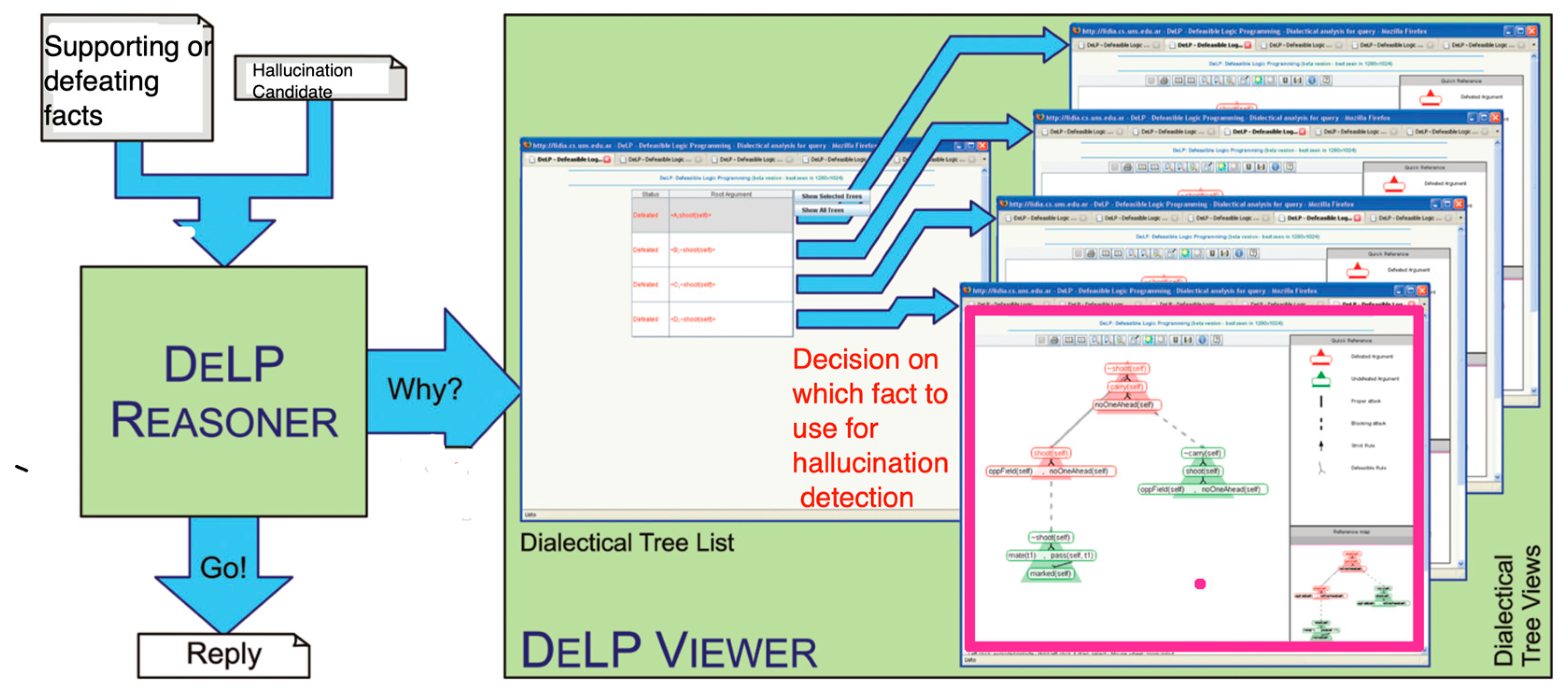
Figure 5.
Dialectical tree for a web mining results for our running example.
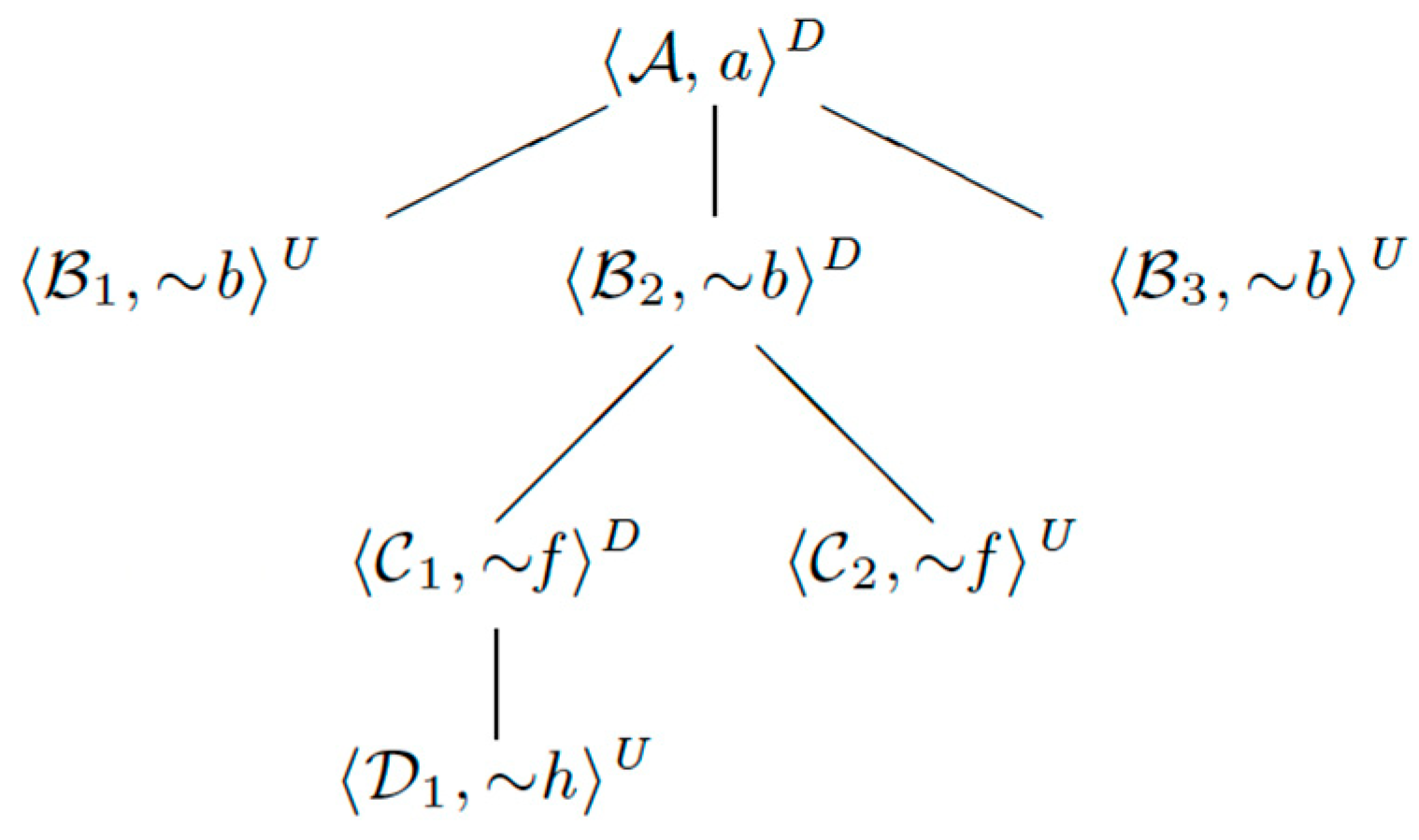
Figure 6.
A map between semantic and syntactic representations for raw (incorrect, on the top) and true (correct, on the bottom) treatment of a disease.
Figure 6.
A map between semantic and syntactic representations for raw (incorrect, on the top) and true (correct, on the bottom) treatment of a disease.
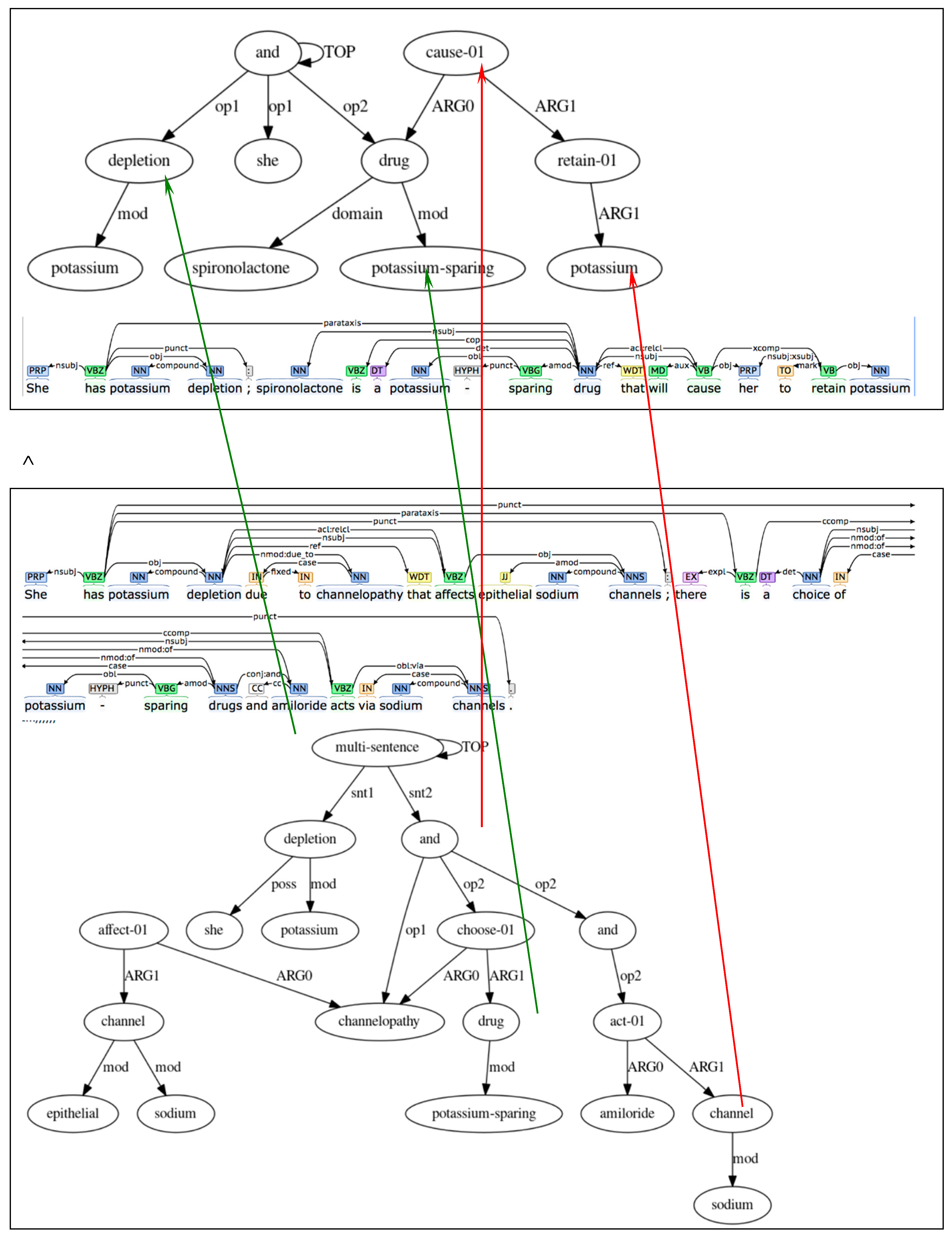
Figure 7.
Hallucination identification and correction architecture.
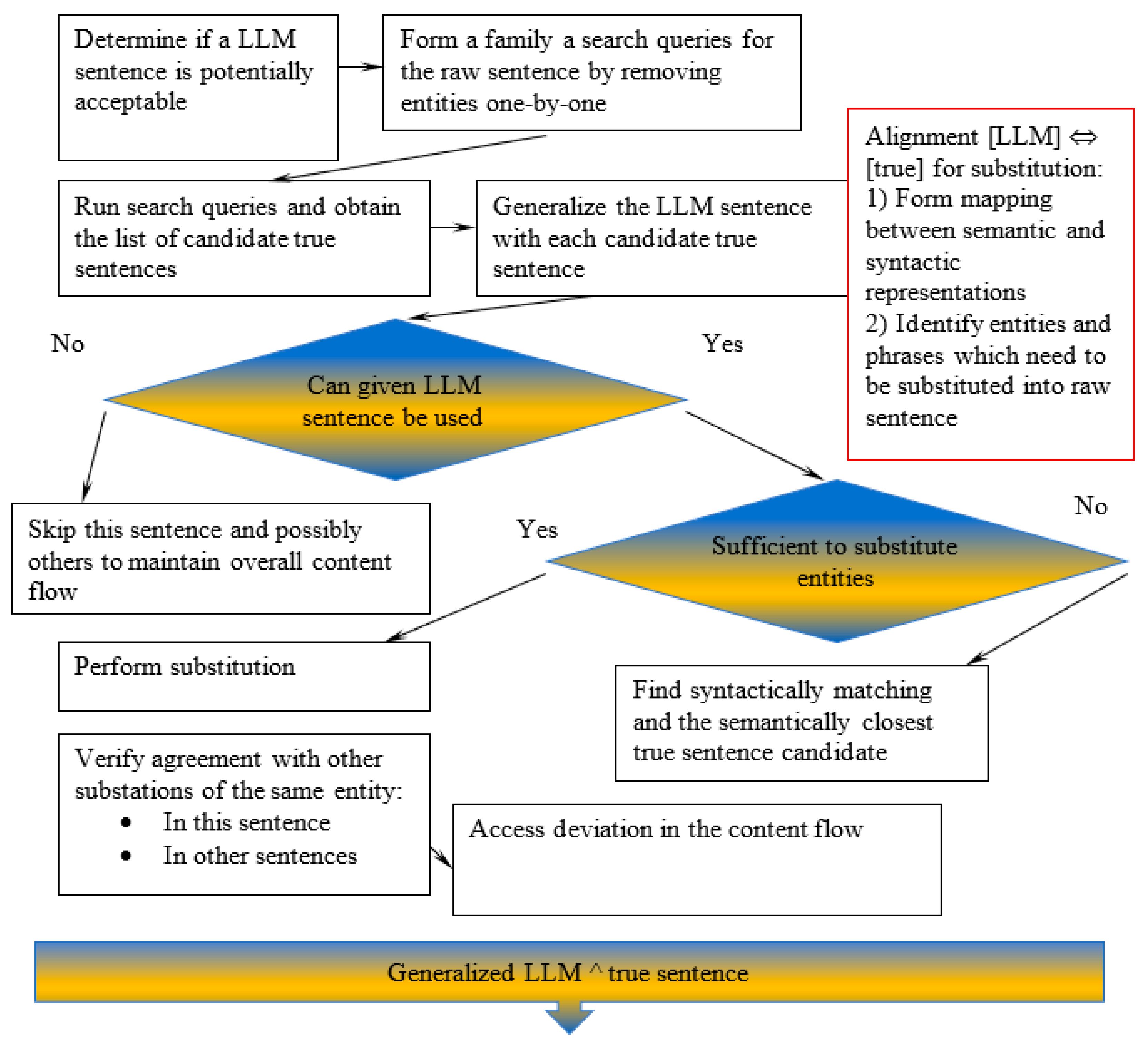

Table 1.
Hallucination types.
| Hallucination Type | Example | % of Identified Cases |
|---|---|---|
| Domain-specific Knowledge | Born in Saints Peterburg (Moscow), Suvorov studied military history as a young boy and joined the Imperial Russian Army. | 89 |
| Commonsense knowledge | The sports award is received at the start (end) of the competition | 4 |
| Incoherence or improper collocation | They describe the civil disobedience by many (people) in their town | 4 |
| Unrelated to the central topic | Composer Tchaikovsky’s work was first publicly performed in 1865. In 1868, his First Symphony was well-received as he established himself as an artist (Piano Concerto No.1) | 2 |
| Conflict with preceding context | Tchaikovsky was born on May 7, 1840, in Kamsko-Votkinsk, Vyatka, Russia. He was the second eldest of his parents’ six surviving offspring. As a youngest () member of the family… | 1 |
Table 2.
Token-level hallucination detection.
| P | R | F1 | |
|---|---|---|---|
| As detected by the authors (Liu et al. 2021) | 0.68 | 0.81 | 0.74 |
| Whole web matching | 0.60 | 0.74 | 0.66 |
| Wikipadia matching | 0.65 | 0.72 | 0.68 |
| Matching with the totality of resources | 0.66 | 0.74 | 0.70 |
Table 3.
Evaluation in Fact Extraction platform.
| FEVER Score | P | R | F1 | |
|---|---|---|---|---|
| GEAR (Zhou et al. 2019) | 67.1 | 70.6 | 81.6 | 75.7 |
| Truth-O-Meter | 69.1 | 75.1 | 78.8 | 76.9 |
| Truth-O-Meter-i | 66.8 | 76.0 | 80.6 | 78.2 |
Table 4.
Identification of hallucination and correction in answering questions.
| Method | SQuAD Extension | Natural Question | TriviaQA | HotpotQA | DSTC11 Track 5 |
|---|---|---|---|---|---|
| ChatGPT | 79.3 | 36.6 | |||
| Chain of thoughts (Wei et al. 2022) | 64.3 | 79.2 | 42.8 | ||
| CRITIC* (Gou et al. 2023) | 79.9 | 86.6 | 56.9 | ||
| LLM-Augmenter CORE (Peng et al. 2022) | 50.83 | ||||
| RARR (Gao et al. 2023) | 41.5 | ||||
| Truth-O-Meter | 81.0 | 78.2 | 84.9 | 51.3 | 55.3 |
| Truth-O-Meter-i | 79.3 | 80.3 | 86.1 | 50.1 | 53.0 |
Table 5.
Evaluation scores in information-seeking dialogues (in %).
| Method | KF1 | BLEU | ROUGE | BARTScore |
|---|---|---|---|---|
| ChatGPT | 26.7 | 1.0 | 16.8 | 0.25 |
| LLM-AUGMENTER (Peng et al. 2023) | 36.41 | 7.6 | 22.8 | 0.35 |
| chatGPT + Truth-O-Meter | 33.5 | 8.0 | 21.8 | 0.30 |
| chatGPT + Truth-O-Meter-i | 32.1 | 8.5 | 23.3 | 0.36 |
| chatGPT + Truth-O-Meter + Truth-O-Meter-i online selector | 33.9 | 7.5 | 23.6 | 0.32 |
Table 6.
Hallucination detection in various content domains.
| The Class of Common Symptoms | #/% of Properly Identified Hallucinations Sentences | #/% Of Sentences Accepted As They Are | Total # of True Sentences Used | ||
|---|---|---|---|---|---|
| Health | 54 | 88.4 | 1026 | 94.1 | 17.1 |
| Geography | 48 | 86.2 | 1251 | 96.3 | 16.3 |
| Legal | 74 | 83.4 | 980 | 92.8 | 19.0 |
| Engineering | 57 | 88.1 | 1340 | 94.7 | 18.7 |
| Average | 58.2 | 86.52 | 1149 | 94.47 | 17.77 |
| History | 28 | 88.6 | 1420 | 97.9 | 20.4 |
| Marketing | 45 | 85.2 | 1237 | 98.6 | 19.3 |
| Art | 17 | 89.6 | 1478 | 96.3 | 17.5 |
| Politics | 52 | 86.5 | 1513 | 98.1 | 19.0 |
| Average | 35.5 | 87.47 | 1412 | 97.72 | 19.05 |
Table 7.
Correction characteristics.
| The Class of Common Symptoms | Average # of Corrected Sentences for a Recommendation | % of Properly Identified Hallucinations Sentences | % of Properly Corrected Hallucinations Sentences |
|---|---|---|---|
| Bloating | 0.8 | 86.3 | 77.1 |
| Cough | 0.7 | 82.6 | 79.3 |
| Diarrhea | 1.0 | 85.8 | 76.3 |
| Dizziness | 0.7 | 88.4 | 80.1 |
| Fatigue | 0.9 | 84.6 | 79.2 |
| Fever | 0.7 | 85.0 | 78.8 |
| Headache | 0.8 | 85.6 | 76.5 |
| Muscle Cramp | 0.8 | 83.5 | 77.0 |
| Nausea | 0.7 | 86.4 | 75.9 |
| Throat irritation | 0.6 | 83.4 | 79.3 |
| Average | 0.77 | 85.16 | 77.95 |
Table 8.
The error rate of repaired generated content, %.
| The Class of Common Symptoms | Rate of Wrong Facts per Text for LLM Content | Rate Of Wrong Facts Per Text For Corrected Content | Rate of Wrong Facts per Sentence for LLM Content | Rate of Wrong Facts per Sentence for Corrected Content |
|---|---|---|---|---|
| Bloating | 29.6 | 5.0 | 3.5 | 0.31 |
| Cough | 23.0 | 6.4 | 3.1 | 0.34 |
| Diarrhea | 26.1 | 6.7 | 2.9 | 0.28 |
| Dizziness | 24.5 | 6.6 | 3.0 | 0.29 |
| Fatigue | 24.0 | 5.1 | 3.4 | 0.27 |
| Fever | 25.7 | 4.8 | 2.7 | 0.29 |
| Headache | 26.6 | 5.1 | 3.2 | 0.30 |
| Muscle Cramp | 24.1 | 5.6 | 3.5 | 0.26 |
| Nausea | 27.0 | 6.1 | 3.3 | 0.27 |
| Throat irritation | 25.9 | 5.9 | 3.0 | 0.31 |
| Average | 25.65 | 5.73 | 3.16 | 0.292 |
Disclaimer/Publisher’s Note: The statements, opinions and data contained in all publications are solely those of the individual author(s) and contributor(s) and not of MDPI and/or the editor(s). MDPI and/or the editor(s) disclaim responsibility for any injury to people or property resulting from any ideas, methods, instructions or products referred to in the content. |
© 2023 by the authors. Licensee MDPI, Basel, Switzerland. This article is an open access article distributed under the terms and conditions of the Creative Commons Attribution (CC BY) license (http://creativecommons.org/licenses/by/4.0/).
Copyright: This open access article is published under a Creative Commons CC BY 4.0 license, which permit the free download, distribution, and reuse, provided that the author and preprint are cited in any reuse.


