
Submitted:
24 July 2023
Posted:
26 July 2023
Read the latest preprint version here
Abstract
The research fills the policy research gap for the women entrepreneurship and sustainability performance for examining key successful factors. Previous women entrepreneurship research fails to offer policy recommendations. The research purpose is to investigate these factors affect women entrepreneurship capabilities and sustainability performance by using SEM analysis and making policy recommendation. This research employs online and mail survey and obtains 175 women entrepreneur sample. The study finds that family support and motivation have positive effect on women entrepreneurship capabilities and sustainability performance. Barriers have no effect on performance. Hopefully, the research can provide the guidance to contribute to women’s entrepreneurship opportunities for achieving SDGs. Policy recommendation and managerial implication are discussed in the article.
Keywords:
women entrepreneurship capability
; sustainability performance
; family support
; motivation
; barriers
1. Introduction
The society shows a rapid growth in the proportion of women in the top management and entrepreneurship of companies and non-profit organizations. This growth in the number of female CEO and managers attracts the research attention about its outcome and performance in the workplace. Carter, Shaw, Wilson & Lam (2007) and Welsh, Memili, & Sadoon (2014) addresses the extent to which gender difference in their entrepreneurship ability and women workers continue to face barriers when seeking positions in executive levels of leadership. Many women continue to be under-represented as leaders and senior managers worldwide. However, the role of women entrepreneurship draws the attention of UN, the World Bank and OECD national governments (UN Women, 2020; OECD, 2021). Investment in female entrepreneurial capacities increase women’s empowerment and reduce gender inequality for any entrepreneurship policy (Sachs, 2020). Female entrepreneurship is regarded as the country’s sustainable economic development to achieve UN sustainable development goals(SDGs) and gender equality for empowering all women involved.
Female entrepreneurship for the food sector can achieve of goals 8 “decent work and economic growth”, 9 “industry, innovation and infrastructure” and 12 “responsible consumption and production”. The food sector includes food sales, fast food, coffee shops, beverages, and restaurants. Food systems and sectors possess multi-faceted and complex set of challenges from farm to fork (Chen & Antonelli, 2020; Pounds et al., 2022; Richter & Klöckner, 2017), but women entrepreneurship for the food sector focuses on service-oriented industry. Akehurst, Simarro, & Mas-Tur (2012), Huarng, Mas-Tur, & Yu (2012) and Mas-Tur & Ribeiro-Soriano (2014) indicates that women's businesses are usually concentrated in the services sector, especially in those activities in which they have traditionally had a greater presence such as retail, education, hospitality and personal assistance. United Nation emphasizes great importance to food sector in the UN sustainable development goals (SDGs). Female entrepreneurship for the food sector achieves SDGs to promote sustainability by contributing decent work and economic growth, creating industry, innovation and infrastructure and guaranteeing responsible consumption and adequate production. Previous studies focus on examining the determinants of food purchasing behavior and intention (Alhammadi, Santos-Roldán, Cabeza-Ramírez, 2021; Sayee et al., 2011) However, there are many unanswered questions about women entrepreneurship policy instruments and empirical evidence regarding the potential for women entrepreneurship to contribute to food sector in affecting sustainability performance.
The study fills this gap by examining what degree in a workplace affect women entrepreneurship performance and investigating the characteristics of successful policy support. Andersén (2011) and Boden & Nucci (2000) compares the performance difference of businesswomen and businessmen to justify gender effect of female entrepreneurship study from the management theory. There are some economic sectors where women in management positions are usually better supported (Ahl, 2006; Zgheib, 2018). This study answers some research questions by investigating women entrepreneurs for the women’s entrepreneurship policy recommendations. Some studies can make women assistance policy recommendation such as the financial support, and marketing skills and business knowledge training (Orser, Riding & Manley, 2006; Schroder, Bobek & Horvat, 2021). Some studies also examine the challenges that the women workers face (Lim et al., 2015; Nair, 2019). Although the issues of female entrepreneurs gain attention from the press and social media, previous studies focusing on women entrepreneurs for achieving policy recommendation are scare. The managerial implications and policy recommendation are provided for the women entrepreneurship research for achieving policy recommendation.
2. Literature Review
Entrepreneurship can help alleviate poverty, enhance health care and education, and reduce environmental destruction (Raman, Vinuesa & Nedungadi, 2021; Terjesen, Bosma & Stam, 2016). Women in the organization suffer from the glass ceiling level and major barriers to advance to the entrepreneurship management (Baxixauli-Soler, Belda-Ruiz & Sanchez-Marin,2015). Akehurst, Simarro, & Mas-Tur (2012) examine the gender effect of key factors that drive women to create business competitive advantage. The study observes which factors for women entrepreneurs with business success for achieving policy support development. The factors of affecting the performance of women entrepreneurship are examined. The research aims to contribute to analyze women entrepreneurship from a gender perspective for making policy recommendation for women entrepreneurship assistance program. In the sustainable development the policy tool can promote and support women’s entrepreneurship as a means for by contributing decent work and economic growth, creating industry, innovation and infrastructure and guaranteeing responsible consumption and adequate production.
Examining the role of women entrepreneurship is increasing, but research on women entrepreneurs assistance program and policy is scarce(Melero, 2011; Ramaswami, Huang & Dreher, 2014). Performance difference in companies exists between women and men (Fairlie & Robb, 2009; Rosa, Carter, & Hamilton, 1996). Carter & Rosa (1998) and Watson(2002) find that women’s job performance tends to underperform from revenues, profitableness and sales in comparison to men’s job performance. De Clercq et al.(2011), Hechavarria & Reynolds(2009)and Langowitz & Minniti (2007) examine the performance differences in women entrepreneurship and finds mixed results on performance difference with gender in entrepreneurship. However, previous studies concern with the role of women entrepreneurship for sustainability development (Bastian, Metcalfe & Zali, 2019; Bastida, Pinto, Olveira Blanco & Vancelo, 2020; Contreras-Barraza et al., 2021), but few studies examine policy recommendation for women entrepreneurship issues.
Brush & Cooper (2012) recognize the need for a theoretical framework to examine women entrepreneurship and leadership. Some business model encompasses the ability of the women entrepreneurship (Budworth & Mann, 2010; Jennings & McDougal, 2007; Watson, 2003). Research progresses towards equality opportunities between men and women, but women feel that they must take care of family and housework (Akehurst et al., 2012; Kantor, 2002; Scott, 1986; Watson, 2002). Women's entrepreneurship involves a complex process and challenge. In general, women's income is lower than men's, which drives women entrepreneurship (Ferdousi & Mahmud, 2019; Wilson, Kickul & Marlino, 2007). Accordingly, women entrepreneurship growth is especially high in developed countries if a government has adequate entrepreneurship assistance program and policy (Contreras-Barraza et al., 2021; Fernández, García-Centeno, & Patier ;2021).
Feminist theory states that men and women is equal opportunity, but women for difficulty work environment because of lacking access to business networks or financial resources (Calás, Smircich, L., & Bourne, 2009; Melero, 2011; Morris, Miyasaki, Watters, & Coombes, 2006; Orser, Spence, Riding, & Carrington, 2010). Women face some barriers when they implement entrepreneurship plan or run a company. Therefore, gender differences examines economic power, social structure and class structure , but women's performance in business innovation, job creation, and economic growth is significant increase (Ahl,2006 ;De Bruin, Brush, & Welter,2007;Orser et al., 2010; Schein, 2007). However, the gender heterogeneity of top management team for organizational performance findings are not conclusive (Budworth & Mann, 2010; Bantel and Jackson, 1989; Langowitz & Minniti). Therefore, there is no empirical study that examines whether women entrepreneurship has an impact on sustainability performance from the policy perspective.
Women entrepreneurship is important for economic growth and welfare creation (Brush & Cooper, 2012; Mas-Tur & Ribeiro-Soriano, 2014; Mas-Verdú, Ribeiro-Soriano, & Roig-Tierno, 2015; Orser, Riding, & Manley, 2006) and sustainable development (Ferdousi & Mahmud, 2019; Sehroder, Bobek & Horvat, 2021). Women entrepreneurship issues include gender differences, motivation and barriers for business start-up (Fairlie &Robb, 2009, Ferdousi & Mahmud, Laguía, et al., 2022; Ibrahim, Angelidis & Tomic, 2009) and examine success factors for women entrepreneurs (Bird &Brush, 2002; Jennings & McDougal, 2007). Women entrepreneurs are motivated by economic factors, and they often adopt entrepreneurship for opportunities development (Kantor, 2002; Scott & Barnes, 2011; Watson, 2002). To understand the motivation and barriers factors for women entrepreneurship is a research agenda to be explored for implementing policy recommendation.
Gender is an important performance difference variable for the women entrepreneurship research (Autio, Pathak, & Wennberg, 2013; Ibrahim, Angelidis & Tomic, 2009). Although some progress of gender equality in business environment, it is important to examine gender performance differences for women entrepreneurship research (Dagoudo et al., 2023; Forret, Sullivan, & Mainiero, 2010; Vracheva,.& Stoyneva,.2020). Scott & Barnes (2011) and Constantinidis et al. (2019) examines the relationship between gender and career mobility. The theoretical background relates to family researches such as the work–family balance perspective (Jennings & McDougald, 2007; Rey-Marti, Porcar, & Mas-Tur, 2015), the work–family interface perspective (Qu, & Zhao, 2012) and family support (Grant-Vallone & Ensher, 2011; Morrisson & Jutting, 2005). However, despite the interest and excitement of family support and women entrepreneurship, there is a paucity of family support research in this women entrepreneurship area.
Sustainable development is regarded as “meeting the needs of the present without compromising the ability of future generations to meet their own needs” (United Nations, 2019). Sustainable performance is defined as the meeting and balancing of current and future stakeholder needs and expectations by ensuring profitability (Artiach et al., 2010; ; Zgheib, 2018). Sustainable performance consists of environmental and financial performances (Maletic et al., 2014; 2015). Epstein and Roy (2001) and Engert et al. (2016) compose sustainable performance frameworks including environmental and social performance to increase market share, enhance brand image, foster the quality of the product or service and drive financial performance.
Lozano (2008) develops sustainability performance into three dimensions and various set of indicators for organizations’ sustainable policy implementation. However, corporate sustainable performance is hardly assessed in practice and empirically tested linking stakeholder demands and sustainability performance (Asif et al., 2011, 2013; Aslam, Elmagrhi, Rehman & Ntim, 2021; Maletic et al., 2015; Wagner,2015). Sustainability performance is increasingly becoming a hot topic in the field of service industry (Aslam et al., 2021; Chou et al., 2012; Chowdhury & Quaddus, 2016; Manz et al., 2015). Sustainability performance includes national economic growth, global environmental protection and social responsibility (Arnold, 2017; Morioka & de Carvalho, 2016). The research examining whether women entrepreneurship have contributed to achieving sustainability performance. Therefore, this study considers sustainability performance dimensions of women entrepreneurship for the food sector to achieve SDGs including female entrepreneurship can achieve of goals 8 “decent work and economic growth”, 9 “industry, innovation and infrastructure” and 12 “responsible consumption and production”.
Policy recommendation for women entrepreneurs is to help more women engage in entrepreneurial intention and activity for achieving the sustainability performance. However, entrepreneurship policy instruments may be biased and do not take into consideration women face in different entrepreneurial environment contexts (Henry, Coleman, Foss, Orser & Brush, 2021; Laguia et al., 2022). However, many countries fail to implement women entrepreneurship policy and offer few or no programs that operationalize their policy (OECD, 2021). Policy are identified as an important research of the entrepreneurial ecosystem (Brown & Mason, 2017; Vracheva & Stoyneva, 2020). Hopefully, the research purpose of women entrepreneurship policy can offer valuable insights from policy perspectives to offer potential policy solution and link policy recommendation instruments for women entrepreneurial ecosystem.
3. Research Methodology
The research tests an empirical model for the practical situation on the basis of research variables and constructs by employing SEM approach. The research objective is to develop an empirical model to study and measure research constructs in women entrepreneurship and sustainability performance from entrepreneurship policy perspectives. Personal interviews are conducted with a convenient sample of 20 participants of women entrepreneurs in Taiwan. Through this step, participants are ensured of personal anonymity and confidentiality of the information shared during voluntary interviews.
After finishing personal interview, an integrative model draws on these sets of sustainability performance antecedent factors including barriers, family support, motivation and women entrepreneurship capabilities from policy perspective. The research purpose is to examine the characteristics of successful women entrepreneurship policy and to develop an empirical model to measure variables relative to the sustainability performance of women entrepreneurship for implementing policy support and recommendation. Questionnaire is designed after personal interview, literature review and pilot study. The questionnaires are pre-tested composed of women entrepreneurs to clarify or eliminate misleading or ambiguous questions before final distribution, which is modified. This study collects data from women entrepreneurs in Taiwan for engaging in food industry. Women entrepreneurs are surveyed by using online questionnaire containing items dealing with barriers, family support, motivation, entrepreneurship capabilities, and performance. All questionnaire items measure women entrepreneurs’ perceptions on seven-point scale.
The study employs SEM to test hypotheses. After reviewing the management literature and conducting a preliminary pre-test study with 20 participants, this study examines five groups of research constructs: barriers, family support, motivation, entrepreneurship capabilities, and performance. (please see Figure 1). Therefore, the research formulates the following research hypotheses:
H1:
Barrier has a negative effect on women entrepreneurship capabilities.
H2:
Family support has a positive effect on women entrepreneurship capabilities.
H3:
Motivation has a positive effect on women entrepreneurship capabilities.
H4:
Barrier has a positive effect on sustainability performance.
H5:
Family support has a positive effect on sustainability performance.
H6:
Motivation has a positive effect on sustainability performance.
H7:
Women entrepreneurship capabilities have a positive effect on the sustainability performance.
A draft of self-administrated questionnaire which comprises 5 research constructs for the research shows in Table 1. The items of the variables in the survey use a 7-point Likert scale with anchorage from “strongly disagree” to “strongly agree” and from “not at all” to “extensively”. 24 items capture barriers, family support, motivation, entrepreneurship capabilities, and performance, and this study uses Akehurst, Simarro & Mas-Tur’s (2012) and Carter et al’s (2007) 5-item scale to measure barrier. Fairlie & Robb (2009) and Jennings & McDougal(2007) measures a 3-item scale to reflect family support. The study uses a 6-item instrument from Rey-Marti, Porcar & Mas-Tur (2015), and Melero(2011) to measure motivation. Terrell & Troilo(2010) and Watson(2002) uses 6-item instrument to capture entrepreneurship capabilities, and employs Hermundsdottir & Aspelund (2022)’s and Watson(2002) 4-item instrument to measure sustainability performance.
Questionnaire is completed after a comprehensive literature review and pre-test study. The study sends the online questionnaire to women entrepreneurs in the food sector form open data of Ministry of Economic Affairs. Data collects a sample of 175 women-led firms in Taiwan. The questionnaire was distributed in March to June 2022 through online or mail survey of women entrepreneurs for the food sector.
4. Results
4.1. Sample Characteristics
The study obtains 175 usable questionnaires from online survey. Married status (60%) outnumber Single (38%), and 35% are between the ages of 41 to 50. For the education status of respondents, 49% of respondents have undergraduate degrees and 31% of respondents have a master’s degree or higher and 15% of respondents have a senior high school degree. Regarding to respondents’ entrepreneurship experience, 41% of respondents have 5 to 10 years; 37 % of respondents have 6 to 9 under 5 years and 16% of respondents have 11 to 15 years. 46% of women entrepreneurs manage coffee shop followed by managing beverage(26%). Most company size are under 10 employees (58%) and 11-50 employee (20%). Table 1 presents the demographic characteristics of the women entrepreneur sample.
4.2. Measurement Model
Table 2 provides the questionnaire items, mean value, and standard deviations of research constructs in the measurement model outputs. The measurement model shows that 24 standardized loadings are high and have t-values with significant (p < 0.01).
The adequacy of the measurement model tests reliability (Cronbach’s alpha), convergent validity, and discriminant validity. This study examines a confirmatory factor analysis (CFA) and reliability analysis for all the constructs (barriers, family support, motivation, women entrepreneurship capabilities, and sustainability performance). The empirical results indicate that composite construct reliability values and composite reliabilities exceed the threshold of 0.70 with adequate composite reliability. Average variance extracted (AVE) values shows indicators’ degree of shared representation with the constructs. The lowest value for average variance extracted is 0.63 with the convergent validity of the measures. The convergent validity of and discriminant validity for all research constructs are shown in Table 3.
A confirmatory factor analysis (CFA) assesses the good-of-fit of the measurement. As a result, CFA is a good fit for the data collection((χ2 = 459.47, df = 174, p = 0.000, RMSEA = 0.055, CFI = 0.92, NFI = 0.93 , GFI = 0.91). Overall fit indices for the models show in Table 4. The chi-squared test yields values of 459.47 for samples with 74 degrees of freedom, p = .00. Chi-squared values, root mean square error of approximation (RMSEA) (0.055), goodness of fit index(GFI)(0.91), comparative fit index (CFI) (0.92) and normed fit index (NFI) (0.93) is adequate to assess model fit. Fit indices yield values that support a good model fit for the dataset.
4.3. Structural Model
The result of each research hypothesis examines the causal relationship among research constructs is presented in Fig. 1. Table 5 presents results of analyses of the SEM path coefficients in the structural model describing the relationships among constructs. Research results support 5 hypotheses: barrier has a negative effect on entrepreneurship capabilities(H1)( (β = -0.47, t = 5.84, p = 0.000); family support has a positive effect on entrepreneurship capabilities (H2)( β = 0.76, t = 7.47, p = 0.000); family support has a positive effect on performance(H5) (β = 0.37, t = 4.15, p = 0.000); motivation has a positive effect on performance (H6) (β = 0.72, t = 7.34, p = 0.000) and entrepreneurship capabilities have a positive effect on the performance (H7) (β = 0.78, t = 6.72, p = 0.000). Motivation has a positive effect on entrepreneurship capabilities (H3) and barrier has a negative effect on performance (H4) is not supported from the research.
5. Discussion
This study proposes as a foundation for a conceptual model of women entrepreneurship capabilities and sustainability performance in the food sector for achieving achieve policy recommendation. The results of this study show that family support and motivation have a significantly positive effect on female entrepreneurship capabilities while barrier has a significantly negative effect on women entrepreneurship capabilities. The research finds that family support and motivation have positive and significant effects on sustainability performance while barrier has no significant effect on sustainability performance. Thus, women entrepreneurship capabilities have a positive and significant effect on sustainability performance.
The findings of the study have several implications for women entrepreneurs in the food sector for policy support. The research finds that family support and motivation affect women entrepreneurship capabilities and sustainability performance. Family support includes family organizational support, family moral support and family financial support. Motivation reflects to develop my business capabilities, to be professional independence from my boss, to take on the risks and challenges, to be encouragement of government, to contribute something useful to society and to seek greater recognition. Accordingly, women entrepreneurs in the food sector have higher family support and motivation with high possibility of success. Particularly, women with higher entrepreneurship capabilities have better sustainability performance. Women entrepreneurship capabilities, family support and motivation are important determinant of success in the food sector. In terms of managerial practice, the finding suggests that government or firm should overcome the barrier and stimulate the motivation for the women entrepreneurs. Significantly, government should have policy operations in stimulating the women motivation and enhance the women entrepreneurship capabilities for achieving better performance.
Barrier has a negative effect on women entrepreneurship capabilities including ability to detect business opportunities, ability to act in uncertain environments, ability to solve problems, ability to be leadership, ability to communication and ability to manage are valid, which suggests that barriers including lacking of business training, difficulty in obtaining financing, difficulty in obtaining subsidies, gender discrimination and high level of competition affect the women entrepreneurship capabilities in the food sector. The research results confirm and extend Akehurst, Simarro & Mas-Tur’s (2012) and Carter et al’s (2007) results. These studies claim that barrier has a negative effect on women entrepreneurship capabilities. When women will start new business or implement entrepreneurship plan to overcome the barriers under policy support.
Family support has a positive effect on women entrepreneurship capabilities, which poses that family support has a positive effect on women entrepreneurship capabilities in a different way including family organizational support, family moral and financial support because women and men have different roles in the family (Blau, 1977; Constantinidis et al., 2019; Sierra, 2014). Additionally, the results indicate that women tend to start business have barriers including lacking of business training, difficulty in obtaining financing, difficulty in obtaining subsidies, gender discrimination and high level of competition. Women actively seek family support and overcoming barriers for entrepreneurship. The results indicate that gender equality policies can be working but still are not enough for developing women entrepreneurship abilities.
Women entrepreneurship policy is recommended to provide more business training, offer some finance support or subsidies, give incentives for women entrepreneurs. The policy support also can offer some family financial or non-financial support for women entrepreneurs. Government can be recommended to encourage women entrepreneurs’ motivation to develop some entrepreneurship motivation such as offer some women entrepreneurship training courses, financial support, child care program. The research aims to contribute to analyze women entrepreneurship from a gender perspective for making policy recommendation for women entrepreneurship assistance program. In the sustainable development the policy tool can promote and support women’s entrepreneurship as a means for by contributing decent work and economic growth, creating industry, innovation and infrastructure and guaranteeing responsible consumption and adequate production. The research results is consisted with the previous studies that women entrepreneurship growth is especially high if a government has adequate entrepreneurship assistance program and policy (Contreras-Barraza et al., 2021; Fernández, García-Centeno, & Patier ;2021).
6. Conclusions and Research Limitations
The research fills the research gap for the women entrepreneurship and sustainability performance for examining key successful factors for the women entrepreneurship. The research purpose is to investigate these factors affect women entrepreneurship capabilities and sustainability performance by using SEM analysis. This research employs online and mail survey and obtains 175 women entrepreneur sample. The study finds that family support and motivation have positive effect on women entrepreneurship capabilities and sustainability performance. Barriers have no effect on performance. Hopefully, the research can provide the guidance to contribute to women’s entrepreneurship opportunities for policy support.
Although contributing the existing sustainability literature, this study has several research limitations. First, his study surveys only female entrepreneurs in the food sector in Taiwan, and the findings may be not generalizable to other countries and industries. Further research can test other research constructs of female entrepreneurs in other countries and various industries. Second, the size of the women entrepreneurship sample is small. Further women entrepreneurship research for policy development needs more resources to increase the sample size for various firms or industries. Third, women entrepreneurship may be observed on the long-term strategic behavior to sustainability performance changes over a one-year period, so future research should adopt a longitudinal design to test the causal relationship for women entrepreneurship in the policy support issues. Finally, not at all research variables and construct are measured and conceptualized in the research model, further research should explore the effect of other external and internal factors of women entrepreneurs for policy instrument evaluation.
Acknowledge
The author acknowledges and is grateful for the financial support the National Science and Technology Council, Taiwan, under grant 107-2410-H-005-019. *Corresponding author: Chih-Wen Wu, National Chung Hsing University, Department of Marketing, 145 Xingda Road, Taichung 402, Taiwan; Tel.:886-4-22840392; exit:752; Fax:886-4-22860993.
References
- Ahl, H. Why research on women entrepreneurs needs new directions. Entrepreneurship Theory and Practice 2006, 30, 595–621. [Google Scholar] [CrossRef]
- Akehurst, G.; Simarro, E.; Mas-Tur, A. Women entrepreneurship in small service firms: Motivations, barriers and performance. The Service Industries Journal 2012, 32, 2489–2505. [Google Scholar] [CrossRef]
- Alhammadi, K.; Santos-Roldán, L.; Cabeza-Ramírez, L.J. A theoretical framework on the determinants of food purchasing behavior of the elderly: A bibliometric review with scientific mapping in Web of Science. Foods 2021, 10, 688. [Google Scholar] [CrossRef] [PubMed]
- Andersén, J. Strategic resources and firm performance. Management Decision 2011, 49, 87–98. [Google Scholar] [CrossRef]
- Arnott, D.C. Research on trust: A bibliography and brief bibliometric analysis of the special issue submissions. European Journal of Marketing 2007, 41, 1203–1240. [Google Scholar] [CrossRef]
- Artiach, T.; Lee, D.; Nelson, D.; Walker, J. The determinants of corporate sustainability performance. Account. Finance 2010, 50, 31–51. [Google Scholar] [CrossRef]
- Arnold, M. Fostering sustainability by linking co-creation and relationship management concepts. Journal of Cleaner Production 2017, 140, 179–188. [Google Scholar] [CrossRef]
- Asif, M. , Searcy, C., Zutshi, A., Ahmad, N. An integrated management systems approach to corporate sustainability. European Business Review 2011, 23, 353–367. [Google Scholar] [CrossRef]
- Asif, M. , Searcy, C., Zutshi, A., Fisscher, O.A.M. An integrated management systems approach to corporate social responsibility. Journal of Cleaner Production 2013, 56, 7–17. [Google Scholar] [CrossRef]
- Aslam, S.; Elmagrhi, M.H.; Rehman, R.U.; Ntim, C.G. Environmental management practices and financial performance using data envelopment analysis in Japan: The mediating role of environmental performance. Business Strategy and the Environment 2021, 30, 1655–1673. [Google Scholar] [CrossRef]
- Autio, E.; Pathak, S.; Wennberg, K. Consequences of cultural practices for entrepreneurial behaviors. Journal of International Business Studies 2013, 44, 334–362. [Google Scholar] [CrossRef]
- Baixauli-Soler, J.S.; Belda-Ruiz, M.; Sanchez-Marin, G. Executive stock options, gender diversity in the top management team, and firm taking. Journal of Business Research 2015, 68, 451–463. [Google Scholar] [CrossRef]
- Bantel, K.; Jackson, S. Top management and innovations in banking: does the composition of the top team make a difference? Strategic Management Journal 1989, 10, 107–24. [Google Scholar] [CrossRef]
- Bastian, B.L.; Metcalfe, B.D.; Zali, M.R. Gender inequality: Entrepreneurship development in the MENA region. Sustainability 2019, 11, 6472. [Google Scholar] [CrossRef]
- Bastida, M.; Pinto, L.H.; Olveira Blanco, A.; Cancelo, M. Female entrepreneurship: Can cooperatives contribute to overcoming the gender gap? A Spanish First Step to Equality. Sustainability 2020, 12, 2478. [Google Scholar] [CrossRef]
- Bird, B.; Brush, C. A gendered perspective on organizational creation. Entrepreneurship Theory and Practice 2002, 26, 41–65. [Google Scholar] [CrossRef]
- Boden, R.J.; Nucci, A.R. On the survival prospects of man's and women's new business ventures. Journal of Business Venturing 2000, 15, 347–362. [Google Scholar] [CrossRef]
- Brown, R.; Mason, C. Looking inside the spiky bits: a critical review and conceptualisation of entrepreneurial ecosystems. Small Business Economics 2017, 49, 11–30. [Google Scholar] [CrossRef]
- Brush, C.G.; Cooper, S.Y. Female entrepreneurship and economic development: An international perspective. Entrepreneurship & Regional Development 2012, 24, 1–6. [Google Scholar]
- Budworth, M.; Mann, S.L. Becoming a leader: The challenge of modesty for women. The Journal of Management Development 2010, 29, 177–186. [Google Scholar] [CrossRef]
- Calás, M.B.; Smircich, L.; Bourne, K.A. Extending the boundaries: Reframing “entrepreneurship as social change” through feminist perspectives. Academy of Management Review 2009, 34, 552–569. [Google Scholar] [CrossRef]
- Carter, S.; Rosa, P. The financing of male—and female—owned businesses. Entrepreneurship and Regional Development 1998, 10, 225–241. [Google Scholar]
- Carter, S.; Shaw, E.; Wilson, F.; Lam, W. Gender, entrepreneurship, and bank lending: The criteria and processes used by bank loan officers in assessing applications. Entrepreneurship Theory & Practice 2007, 31, 427–444. [Google Scholar]
- Chen, P.J.; Antonelli, M. Conceptual models of food choice: Influential factors related to foods, individual differences, and society. Foods 2020, 9, 1898. [Google Scholar] [CrossRef]
- Chou, C.J.; Chen, C.W.; Conley, C. A systematic approach to generate service model for sustainability. Journal of Cleaner Production 2012, 29–30, 173–187. [Google Scholar] [CrossRef]
- Chowdhury, M.M.H.; Quaddus, M.A. A multi-phased QFD based optimization approach to sustainable service design. International Journal of Production Economics 2016, 171, 165–178. [Google Scholar] [CrossRef]
- Contreras-Barraza, N.; Espinosa-Cristia, J.F.; Salazar-Sepulveda, G.; Vega-Muñoz, A. Entrepreneurial intention: A gender study in business and economics students from Chile. Sustainability 2021, 13, 4693. [Google Scholar] [CrossRef]
- Costache, C.; Dumitrascu, D.D.; Maniu, I. Facilitators of and barriers to sustainable development in small and medium-sized enterprises: A descriptive exploratory study in Romania. Sustainability 2021, 13, 3213. [Google Scholar] [CrossRef]
- Constantinidis, C.; Lebègue, T.; El Abboubi, M.; Salman, N. How families shape women’s entrepreneurial success in Morocco: an intersectional study. International Journal of Entrepreneurial Behavior & Research 2019, 25, 1786–1808. [Google Scholar]
- Dagoudo, B.A.; Vershinina, N.; Murithi, W.K. Women, polygamy and family entrepreneuring in southwest Benin: the role of endogenous knowledge. International Journal of Entrepreneurial Behavior & Research ahead-of-print. 2023. [Google Scholar]
- Datta, P.B.; Gailey, R. Empowering women through social entrepreneurship: Case study of a women's cooperative in India. Entrepreneurship theory and Practice 2012, 36, 569–587. [Google Scholar] [CrossRef]
- De Bruin, A.; Brush, C.G.; Welter, F. Introduction to the special issue: Towards building cumulative knowledge on women's entrepreneurship. Entrepreneurship: Theory and Practice 2006, 30, 585–593. [Google Scholar] [CrossRef]
- De Bruin, A.; Brush, C.G.; Welter, F. Advancing a framework for coherent research on women's entrepreneurship. Entrepreneurship: Theory and Practice 2007, 31, 323–339. [Google Scholar] [CrossRef]
- De Clercq, D.; Lim, D.; Oh, C. Individual-level resources and new business activity: The contingent role of institutional context. Entrepreneurship Theory and Practice 2011, 37, 303–330. [Google Scholar] [CrossRef]
- Du Rietz, A.; Henrekson, M. Testing the female underperformance hypothesis. Small Business Economics 2000, 14, 1–10. [Google Scholar] [CrossRef]
- Eagly, A.H.; Karau, S.J. Gender and the emergence of leaders: A meta-analysis. Journal of Personality and Social Psychology 1991, 60, 685–710. [Google Scholar] [CrossRef]
- Engert, S.; Rauter, R.; Baumgartner, R.J. Exploring the integration of corporate sustainability into strategic management: a literature review. Journal of Cleaner Production 2016, 112, 2833–2850. [Google Scholar] [CrossRef]
- Epstein, M.J.; Roy, M.J. Sustainability in action: identifying and measuring the key performance drivers. Long-range planning 2001, 34, 585–604. [Google Scholar] [CrossRef]
- Fairlie, R.W.; Robb, A.M. Gender differences in business performance: Evidence from the characteristics of business owners survey. Small Business Economics 2009, 8, 463–478. [Google Scholar] [CrossRef]
- Ferdousi, F.; Mahmud, P. Role of social business in women entrepreneurship development in Bangladesh: perspectives from Nobin Udyokta projects of Grameen Telecom Trust. Journal of Global Entrepreneurship Research 2019, 9, 58. [Google Scholar] [CrossRef]
- Fernández, M.B.; García-Centeno, M.D.C.; Patier, C.C. Women Sustainable Entrepreneurship: Review and Research Agenda. Sustainability 2021, 13, 12047. [Google Scholar] [CrossRef]
- Forret, M.L.; Sullivan, S.E.; Mainiero, L.A. An empirical investigation of traditional gender role differences in reactions to unemployment: Exploring psychological mobility and boundary less careers. Journal of Organizational Behavior 2010, 31, 647–666. [Google Scholar] [CrossRef]
- Grant-Vallone, E.J.; Ensher, E.A. Opting in between: Strategies used by professional women with children to balance work and family. Journal of Career Development 2011, 38, 331–349. [Google Scholar] [CrossRef]
- Hechavarria, D.; Reynolds, P. Cultural norms & business start-ups: the impact of national values on opportunity and necessity entrepreneurs. International Entrepreneurship and Management Journal 2009, 5, 417–437. [Google Scholar]
- Hermundsdottir, F.; Aspelund, A. Competitive sustainable manufacturing- Sustainability strtaegies, environmental and social innovations, and their effects on firm performance. Journal of Cleaner Production 2022, 370, 133474. [Google Scholar] [CrossRef]
- Henry, C.; Coleman, S.; Foss, L.; Orser, B.J.; Brush, C.G. Richness in diversity: Towards more contemporary research conceptualisations of women’s entrepreneurship nternational. Small Business Journal 2021, 39, 609–618. [Google Scholar] [CrossRef]
- Huarng, K.H.; Mas-Tur, A.; Yu, T.H.K. Factors affecting the success of women entrepreneurs. International Entrepreneurship and Management Journal 2012, 8, 487–497. [Google Scholar] [CrossRef]
- Ibrahim, N.; Angelidis, J.; Tomic, I. Managers’ attitudes toward codes of ethics: Are there gender differences? Journal of Business Ethics 2009, 90, 343–353. [Google Scholar] [CrossRef]
- Jennings, J.E.; McDougal, M.S. Work–family interface experiences and coping strategies: Implications for entrepreneurship research and practice. Academy of Management Review 2007, 32, 747–760. [Google Scholar] [CrossRef]
- Kantor, P. Gender, microenterprise success and cultural context: The case of South Asia. Entrepreneurship: Theory and Practice 2002, 26, 131–144. [Google Scholar] [CrossRef]
- Kanter, R.M. Effects of proportions on group life: skewed sex ratios and responses to token women. American Journal of Sociology 1997, 82, 965–90. [Google Scholar] [CrossRef]
- Karatepe, O.M.; Yavas, U.; Babakus, E.; Avci, T. Does gender moderate the effects of role stress in frontline service jobs? Journal of Business Research 2006, 59, 1087–1093. [Google Scholar] [CrossRef]
- Krishnan, H.G.; Park, D. A few good women—on top management teams. Journal of Business Research 2005, 58, 1712–1720. [Google Scholar] [CrossRef]
- Laguía, A.; Wach, D.; Garcia-Ael, C.; Moriano, J.A. Think entrepreneur – think male”: the effect of reduced gender stereotype threat on women's entrepreneurial intention and opportunity motivation. International Journal of Entrepreneurial Behavior & Research 2022, 28, 1001–1025. [Google Scholar]
- Langowitz, N.; Minniti, M. The entrepreneurial propensity of women. Entrepreneurship Theory and Practice 2007, 31, 341–364. [Google Scholar] [CrossRef]
- Lee, S.M.; Ribeiro, D.; Olson, D.L.; Roig, S. The importance of the activities of service business in the economy: welcome to the Service Business. An international journal. Service Business 2007, 1, 1–5. [Google Scholar] [CrossRef]
- Maletic, M.; Maletic, D.; Dahlgaard, J.J.; Dahlgaard-Park, S.M.; Gomiscek, B. Sustainability exploration and sustainability exploitation: from a literature review towards a conceptual framework. Journal of Cleaner Production 2014, 79, 182–194. [Google Scholar] [CrossRef]
- Maletic, M.; Maletic, D.; Dahlgaard, J.; Dahlgaard-Park, S.M.; Gomiscek, B. Do corporate sustainability practices enhance organizational economic performance? International Journal of Quality and Service Sciences 2015, 7, 184–200. [Google Scholar] [CrossRef]
- Manz, C.C.; Skaggs, B.C.; Pearce, C.L.; Wassenaar, C.L. Serving one another: Are shared and self-leadership the keys to service sustainability? Journal of Organizational Behavior 2015, 36, 607–612. [Google Scholar] [CrossRef]
- Mas-Tur, A.; Soriano, D.R. The level of innovation among young innovative companies: the impacts of knowledge-intensive services use, firm characteristics and the entrepreneur attributes. Service Business 2014, 8, 51–63. [Google Scholar] [CrossRef]
- Mas-Verdú, F.; Ribeiro-Soriano, D.; Roig-Tierno, N. Firm survival: The role of incubators and business characteristics. Journal of Business Research 2015, 68, 793–796. [Google Scholar] [CrossRef]
- McMullen, J.B. Economic freedom and the motivation to engage in entrepreneurial action. Entrepreneurship Theory and Practice 2008, 32, 875–894. [Google Scholar] [CrossRef]
- Melero, E. Are workplaces with many women in management run differently? Journal of Business Research 2011, 64, 385–393. [Google Scholar] [CrossRef]
- Mitchell, R.K.; Busenitz, L.W.; Bird, B.; Gaglio, C.M.; McMullen, J.S.; Morse, E.A.; Smith, J.B. The central question in entrepreneurial cognition research 2007. Entrepreneurship Theory and Practice 2007, 31, 1–27. [Google Scholar] [CrossRef]
- Moncrief, W.C.; Babakus, E.; Cravens, D.W. Examining gender differences in field sales organizations. Journal of Business Research 2000, 49, 245–257. [Google Scholar] [CrossRef]
- Morris, M.H.; Miyasaki, N.N.; Watters, C.E.; Coombes, S.M. The dilemma of growth: Understanding venture size choices of women entrepreneur. Journal of Small Business Management 2006, 44, 221–244. [Google Scholar] [CrossRef]
- Morrisson, C.; Jutting, J. Women’s discrimination in developing countries: a new data set for better policies. World Development 2005, 33, 1065–1081. [Google Scholar] [CrossRef]
- Moneva, J.M.; Archel, P.; Correa, C. GRI and the camouflaging of corporate unsustainability. Account. Forum 2006, 30, 121–137. [Google Scholar] [CrossRef]
- Morioka, S.N.; de Carvalho, M.M. A systematic literature review towards a conceptual framework for integrating sustainability performance into business. Journal of Cleaner Production 2016, 136, 134–146. [Google Scholar] [CrossRef]
- Nair, S.R. The link between women entrepreneurship, innovation and stakeholder engagement: A review. Journal of Business Research 2019, 63, 1065–1081. [Google Scholar] [CrossRef]
- OECD. Gender Equality and Women’s empowerment in fragile and conflict affected situations: a review if donor support; OECD Development Policy Papers; 2017. [Google Scholar]
- Olson Patricia, D.; Zuiker Virginia, S.; Danes Sharon, M.; Stafford Kathryn Heck Ramona, K.Z.; Duncan Karen, A. The impact of family and business on family business sustainability. Journal of Business Venturing 2003, 18, 639–66. [Google Scholar] [CrossRef]
- Orser, B.J.; Riding, A.L.; Manley, K. Women entrepreneurs and financial capital. Entrepreneurship Theory and Practice 2006, 30, 643–645. [Google Scholar] [CrossRef]
- Orser, B.J.; Spence, M.; Riding, A.L.; Carrington, C.A. Gender and export propensity. Entrepreneurship Theory and Practice 2010, 34, 933–957. [Google Scholar] [CrossRef]
- Pounds, A.; Kaminski, A.M.; Budhathoki, M.; Gudbrandsen, O.; Kok, B.; Horn, S.; Malcorps, W.; Mamun, A.-A.; McGoohan, A. Newton, R.; et al. More Than Fish—Framing Aquatic Animals within Sustainable Food Systems. Foods 2022, 11, 1413. [Google Scholar] [CrossRef]
- Qu, H.; Zhao, X. Employees' work–family conflict moderating life and job satisfaction. Journal of Business Research 2012, 65, 22–28. [Google Scholar] [CrossRef]
- Raman, R.; Vinuesa, R.; Nedungadi, P. Bibliometric analysis of SARS, MERS, and COVID-19 studies from India and connection to sustainable development goals. Sustainability 2021, 13, 7555. [Google Scholar] [CrossRef]
- Ramaswami, A.; Huang, J.; Dreher, G.F. Mentoring across culture: the role of gender and martial status in Taiwan and the US. Journal of Business Research 2014, 67, 2542–2549. [Google Scholar] [CrossRef]
- Richter, I.; Klöckner, C. The Psychology of sustainable seafood consumption: A comprehensive approach. Foods 2017, 6, 86. [Google Scholar] [CrossRef]
- Rey-Marti, A.; Porcar, A.T.; Mas-Tur, A. Linking female entrepreneurs’ motivation to business survival. Journal of Business Research 2015, 68, 810–814. [Google Scholar] [CrossRef]
- Rosa, P.; Carter, S.; Hamilton, D. Gender as a antecedent of small business performance: Insights from a British study. Small Business Economics 1996, 8, 463–478. [Google Scholar] [CrossRef]
- Sachs, J.D. From millennium development goals to sustainable development goals. The Lancet 2012, 379, 2206–2211. [Google Scholar] [CrossRef]
- Sayeed, Z.; Sugino, H.; Sakai, Y.; Yagi, N. Consumer Preferences and Willingness to Pay for Mud Crabs in Southeast Asian Countries: A Discrete Choice Experiment. Foods 2021, 10, 2873. [Google Scholar] [CrossRef]
- Schein, V.E. Women in management: Reflections and projections. Women in Management Review 2007, 22, 6–18. [Google Scholar] [CrossRef]
- Schröder, L.M.; Bobek, V.; Horvat, T. Determinants of success of businesses of female entrepreneurs in Taiwan. Sustainability 2021, 13, 4842. [Google Scholar] [CrossRef]
- Scott, B.A.; Barnes, C.M. A multilevel field investigation of emotional labor, affect, work withdrawal, and gender. Academy of Management Journal 2011, 54, 116–136. [Google Scholar] [CrossRef]
- Scott, C.E. Why more women are becoming entrepreneurs? Journal of Small Business Management 1986, 24, 36–44. [Google Scholar]
- Shane, S.; Venkataraman, S. The promise of entrepreneurship as a field of research. Academy of management review 2000, 25, 217–226. [Google Scholar] [CrossRef]
- Terjesen, S.; Bosma, N.; Stam, E. Advancing public policy for high-growth, female, and social entrepreneurs. Public Administration Review 2016, 76, 230–239. [Google Scholar] [CrossRef]
- Terrell, K.; Troilo, M. Values and female entrepreneurship. International Journal of Gender and Entrepreneurship 2010, 2, 260–286. [Google Scholar] [CrossRef]
- UN. UN System Task Team on the post-2015 UN Development Agenda Review of the contributions of the MDG Agenda to foster development: lessons for the post-2015 UN Development Agenda, 16 March.
- United Nations. Attaining Sustainable Development Goals by 2030 Will Be Impossible at Current Investment Rate, Deputy Secretary-General Tells Global Compact CEO Event. 2019.
- 93. UN women. COVID-19 and its economic toll on women: The story behind the numbers.
- 94. United Nations. The 17 goals, /: online: https.
- Vracheva, V.; Stoyneva, I. Does gender equality bridge or buffer the entrepreneurship gender gap? A cross-country investigation. International Journal of Entrepreneurial Behavior & Research 2020, 26, 1827–1844. [Google Scholar]
- Wagner, M. The link of environmental and economic performance: drivers and limitations of sustainability integration. Journal of Business Research 2015, 68, 1306–1317. [Google Scholar] [CrossRef]
- Watson, J. Comparing the performance of male and female controlled businesses: Relating outputs to inputs. Entrepreneurship Theory and Practice 2002, 26, 91–100. [Google Scholar] [CrossRef]
- Watson, J.; Robinson, S. Adjusting for risk in comparing the performances of male- and female-controlled SMEs. Journal of Business Venturing 2003, 18, 773–788. [Google Scholar] [CrossRef]
- Welsh, H.B.; Memili, E.; Al Sadoon, A.D. Saudi women entrepreneurs: a growing economic segment. Journal of Business Research 2005, 67, 758–762. [Google Scholar] [CrossRef]
- Wilson, F.; Kickul, J.; Marlino, D. Gender, entrepreneurial self-efficacy, and entrepreneurial career intentions: Implications for entrepreneurship education. Entrepreneurship Theory & Practice 2007, 31, 387–406. [Google Scholar]
- Wood, B.P.; Ng, P.Y.; Bastian, B.L. Hegemonic conceptualizations of empowerment in entrepreneurship and their suitability for collective contexts. Administrative Sciences 2021, 11, 28. [Google Scholar] [CrossRef]
- Zgheib, P. Multi-level framework of push-pull entrepreneurship: comparing American and Lebanese women. International Journal of Entrepreneurial Behavior & Research 2018, 24, 768–786. [Google Scholar]
Figure 1.
Research framework.
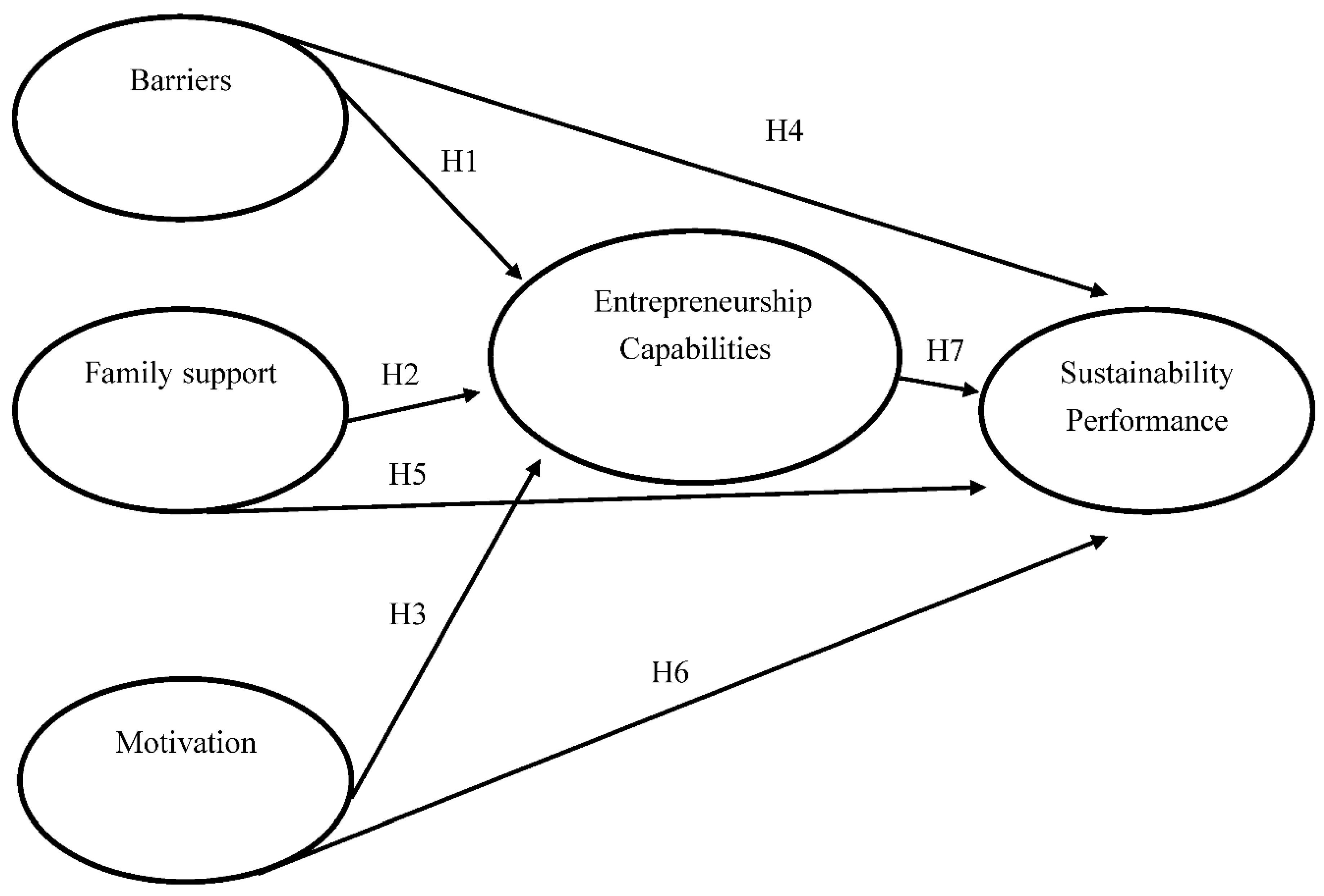

Table 1.
Demographic characteristics of the sample (n=175).
| Married status | Responses | Percentage |
|---|---|---|
| Married | 105 | 60% |
| Single | 66 | 38% |
| Other | 4 | 2% |
| Total | 175 | 100% |
| Age | Responses | Percentage |
| 21-30 | 25 | 14% |
| 31-40 | 57 | 33% |
| 41-50 | 62 | 35% |
| 51-60 | 27 | 15% |
| 61+ | 4 | 2% |
| Total | 175 | 100% |
| Education | Responses | Percentage |
| Below high school | 6 | 3% |
| High School | 27 | 15% |
| Bachelor’s degree | 85 | 49% |
| Master’s degree | 54 | 31% |
| PhD. degree | 3 | 2% |
| Total | 175 | 100% |
| Entrepreneurship experience | Responses | Percentage |
| Under five years | 64 | 37% |
| 5-10 years | 72 | 41% |
| 11-15 years | 28 | 16% |
| 16-20 years | 8 | 5% |
| 21+ years | 3 | 2% |
| Total | 175 | 100% |
| Company Type | Responses | Percentage |
| Fast food | 22 | 13% |
| Coffee shop | 81 | 46% |
| Restaurant | 19 | 11% |
| Beverage | 46 | 26% |
| Food sales | 7 | 4% |
| Total | 175 | 100% |
| Company Size | Responses | Percentage |
| Under 10 employee | 102 | 58% |
| 11-50 employee | 35 | 20% |
| 51-100 employee | 18 | 10% |
| 101-150 employee | 11 | 6% |
| 151-200 employee | 7 | 4% |
| Above 201 employee | 2 | 1% |
| Total | 175 | 100% |
Table 2.
Measures used with mean and standard deviation, and measurement model.
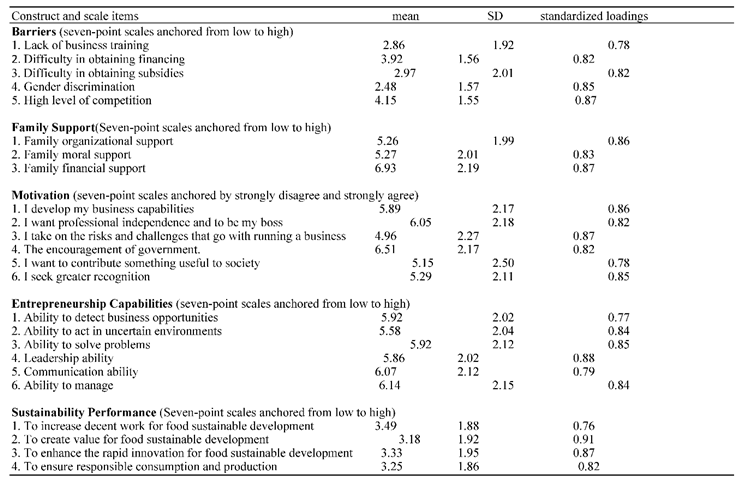 |
Table 3.
Construct measures in the study.
| Measures construct | Cronbach’s α | AVE |
|---|---|---|
| Barriers | 0.78 | 0.64 |
| Family Support | 0.88 | 0.68 |
| Motivation | 0.77 | 0.63 |
| Marketing and entrepreneurship capabilities | 0.97 | 0.74 |
| Sustainability performance | 0.91 | 0.64 |
Abbreviation: AVE, average variance extracted.
Table 4.
Overall model fit.
| Chi-square | 759.47 |
|---|---|
| d.f. | 232 |
| p-value | 0.000 |
| RMSEA | 0.055 |
| CFI | 0.92 |
| NFI | 0.93 |
| GFI | 0.91 |
Abbreviations: CFI, comparative fit index; GFI, goodness of fit index; NFI, normed fit index; RMSEA, root mean square error of approxi-mation.
Table 5.
Path analysis results.
 |
Disclaimer/Publisher’s Note: The statements, opinions and data contained in all publications are solely those of the individual author(s) and contributor(s) and not of MDPI and/or the editor(s). MDPI and/or the editor(s) disclaim responsibility for any injury to people or property resulting from any ideas, methods, instructions or products referred to in the content. |
© 2023 by the authors. Licensee MDPI, Basel, Switzerland. This article is an open access article distributed under the terms and conditions of the Creative Commons Attribution (CC BY) license (http://creativecommons.org/licenses/by/4.0/).
Copyright: This open access article is published under a Creative Commons CC BY 4.0 license, which permit the free download, distribution, and reuse, provided that the author and preprint are cited in any reuse.