

Submitted:
10 July 2023
Posted:
12 July 2023
You are already at the latest version
Abstract
In order to reduce the environmental damage caused by coal waste landfills, it is necessary to look for rational ways of their management. One of the methods of their development may be the creation of soil-like substrates. The aim of the study was to assess the properties of soil-like substrates from coal mining waste with a varied share of sewage sludge and waste mineral wool. The evaluation of the properties of the substrates was carried out in a pot experiment. The properties of the substrates and their yield potential were determined. Coal mining waste as a substrate, compared to anthropogenic soil, was characterized by: significantly higher sorption capacity, content of alkaline cations and pH, significantly higher content of organic carbon, nitrogen and assimilable forms of K and Mg, and lower content of assimilable P. The substrates enriched with sewage sludge showed: significant increase in the content of organic carbon, nitrogen and assimilable forms of P and Mg, optimization of sorption properties. Extending the composition of substrates with mineral wool resulted in further improvement of their properties. Yields of plants grown on coal mining waste were significantly lower than on anthropogenic soil. Substrates with sewage sludge and mineral wool had a significantly higher yield potential.
Keywords:
soil-like substrates
; coal waste
; sewage sludge
; mineral wool
; yielding plants
1. Introduction
The industrialization of developing countries and emerging economies and the continuing high level of demand for materials in developed countries have influenced the unprecedented increase in demand for raw materials observed in recent decades [1]. Population growth and economic development are placing a heavy strain on the earth's natural resources and the environment [2]. This has drawn attention to the need to implement an economic model that reduces the consumption of natural resources through the development of technologies that integrate waste, in its broadest sense, back into the production cycle [3,4]. The significant role of the circular economy in reducing natural resource consumption is highlighted by the European Community's "Circular Economy" action plan [5], which places particular emphasis on actions to reduce waste generation, reuse in production processes, and recover energy and materials from waste. This plan has links with other European programmes that aim to achieve climate neutrality for the European Union by 2050 [6]. A condition for achieving climate neutrality is to protect soils and achieve land degradation neutrality by 2030 [6]. The main actions for soil conservation are to reduce the use of soils for non-agricultural and non-forest purposes, to increase the production potential of poor-quality soils and to reclamation degraded and devastated soils [7]. These actions, for poor-quality soils, may include enriching them with organic matter and plant nutrients. On degraded, and especially devastated, soils, it is often necessary to restore the soil or cover significant areas with material that meets the requirements of the soil substrate [7], and research indicates that waste can be used for these activities [8,9,10].
Implementing sustainability and the circular economy is particularly challenging in economic sectors with high environmental pressures [11], of which the mining industry is a good example. The negative impacts of the extractive industries include occupation and degradation of large areas of soils [12], destruction of vegetation cover and subsequent loss of biodiversity [13], degradation of water relations [14], soil, water, and air pollution, generation of large amounts of waste, and greenhouse gas emissions [15] and the resulting socio-environmental problems [16]. Among all the above, soil devastation deserves particular attention.
Soils play a key role in all terrestrial ecosystems, being responsible for supporting crop and livestock production, maintaining biodiversity, providing clean water, and regulating climate [17]. In addition, soils are a fragile and finite resource, as the soil-forming processes leading to soil formation take thousands of years, degradation can occur in a short time, while regeneration processes take a very long time [18].
Waste is an equally important issue in mining, as mining activities generate more than 100 billion tonnes of waste each year, and the generation of this waste is projected to increase significantly (around 70%) over the next 40 years [19]. Both mining waste management strategies and the management of devastated soils in the mining sector require the implementation of innovative solutions.
Taking into account previous research results on the assessment of the properties of mining waste, it is economically, ecologically, and socially justifiable to look for rational ways to manage it, which can also be an alternative for reducing the environmental damage caused by coal waste dumps [20,21]. Coal waste can be used as an input for concrete paving (Santos et al., 2013), bricks and fuel for their firing [23], and for paving [24].
One option for the recovery of mining waste is its use to produce soil substrates, referred to in the literature as soil-like mixtures, engineered substrates, artificial soil, engineered technosol, and technosol [10,25,26].
Carbon wastes typically contain significant (high) amounts of carbon, macronutrients, and micronutrients [27]. The total carbon content of carbon wastes ranges from 20 to 50% and so, they are used as soil conditioning materials that can increase organic carbon content, which is directly correlated with soil organic matter [28,29]. Soil organic matter has a significant impact on soil physical structure, microbial activity, and nutrient retention capacity for crop production. The beneficial effects of soil organic matter are indirect and are reflected in the long term by improving overall soil properties [30].
Soil substrates constructed from mine waste should provide and process plant and soil biota nutrients and have the capacity to buffer or filter possible contaminants. The functioning and quality of soil-like substrates depend on interrelated and optimally shaped physical, chemical, and biological properties, which not only allow for plant growth but also enable other ecosystem functions and services [8].
In order to use carbonaceous waste as the main raw material of a substrate capable of sustaining high-quality plant growth, it should be combined with organic additives to facilitate the initiation of the plant growth process [10,31].
Municipal sewage sludge, among others, can be used for this purpose. The application of sewage sludge is one strategy for rapidly enriching soils with organic matter, nitrogen, and phosphorus [32,33,34,35]. Structural materials can additionally be used to optimise the properties of tailings-based substrates [25]. An example of such material can be waste rockwool from cover crops. Passive, inactive, and chemically inert, mineral wool has a high water-holding capacity and very good capillary properties. As studies show, when used together with sewage sludge in the reclamation of degraded soils, it optimises physical and water properties and organic matter transformation processes that create conditions for the initiation of the soil-forming process and proper mineral nutrient management, which is reflected in plant yields [36,37,38].
Considering the environmental considerations related to the disposal of coal waste as well as the need for its recovery and further improvement of waste management in the mining industry, a study was conducted, the aim of which was to assess selected extractive properties of coal waste and its mixtures with municipal sewage sludge and waste rockwool from cover crops in terms of their suitability for the production of soil-like substrates for the reclamation of degraded soils, the formation of biological cover on landfills, and the reconstruction of soils on soilless formations. The implementation of the research was aimed at verifying the research hypotheses, which assumed that: mined coal waste has properties that provide minimum conditions for plant growth, and soil substrates obtained by combining mined coal waste with sewage sludge and waste rock wool will provide optimal conditions for plant growth.
2. Materials and Methods
2.1. Substrate composition
Mined coal waste from the enrichment of hard coal as well as municipal sewage sludge and waste rockwool from cover crops were used to create mixtures that met the criteria for a soil-like substrate.
The main material for the production of a soil-like substrate, acting as a mineral material (component), was mining coal waste - fine-grained and silty-clay fraction from the "Bogdanka" coal mine (Lubelskie Voivodeship, Poland). The properties of the substrates were optimised by enriching the mined coal waste (CW) with organic matter and nutrients, the source of which was sewage sludge (SS) from a municipal sewage treatment plant (Lublin, Poland). Waste rockwool from cover crops (MW) (from the Horticultural Enterprise in Niemce near Lublin, Poland) was introduced into the substrates to optimise water and air properties. Before determining the final composition of the substrates, the basic properties of the waste were determined (Table 1).
2.2. Vase vegetation experiment
The properties of prepared soil-like substrates were evaluated in a rigorous two-year pot experiment, in which the effect of varying proportions of sewage sludge and rockwool on the properties of substrates made from mined coal waste was assessed.
12 dm3 vases were filled with the test substrates - 10 kg each (air-dry weight) according to the schemes shown in Table 2. The results obtained for the test substrates were compared with a control soil (CS), consisting of degraded anthropogenic soil. Soil was taken from an overburden heap located at the foreland of a sand mine in Niemce near Lublin (Lubelskie Voivodeship, Poland).
The experiment was carried out in 3 replications. The vases were filled with the evaluated mixtures, which constituted the growing medium. After preparation of the vases, samples were taken from the entire depth of the vases for laboratory tests - the beginning of the experiment or the 1st test date of the study. In the first growing season, white mustard (Sinapis alba), cultivar Borowska C/1, was sewn onto the growing media at a rate of 0.2 g/vase. The mustard was harvested at the flowering stage, the biomass yield was determined, and substrate and soil samples were taken for laboratory tests – the 2nd test date.
In the following year, the contents of the vases were mixed and 20 seeds/vase of maize (Zea mays) variety KB 1903 C/1 were sown. Then, when the maize was at the 5th leaf stage, a break was made, leaving 5 plants in each vase. Harvesting was carried out at the -setting stage. At the same time, the biomass yield was determined and substrate samples were taken for laboratory tests - the 3rd test date
2.3. Laboratory analysis
The pHKCl was determined by the potentiometric method in a 1 mol·dm−3 KCl (1:2.5) solution [39]. Electrical conductivity (EC) was analyzed in a 1:5 substrate-water suspension with a HI 2316 EC-meter from Hanna Instruments (Nusfalau, Romania). The hydrolytic acidity (HA) and exchangeable base cations (BC) were determined with Kappen’s method [40]. The cation exchange capacity of the soil (CEC) was calculated according to the following formula:
CEC = HA + BC,
The degree of saturation of the sorption complex with basic cations (V) was calculated according to the formula:
V= (BC*100): CEC
Total organic carbon (TOC) was determined in dry soil samples by combustion using a TOC-VCSH apparatus [41] with an SSM-5000A module (Shimadzu Corp.; Kyoto, Japan). The total nitrogen (TN) content was determined by the modified Kjeldahl method [42] using a Kjeltech TM 8100 distillation unit (Foss; Hillerød, Denmark). The C/N ratio was calculated from the ratio of total organic carbon (TOC) and total nitrogen (TN). The content of available phosphorus (P), available potassium (K) and available magnet (Mg) was determined by the Egner–Riehm method [43]. All determinations were performed in three parallel replications.
Total heavy metals (Pb, Zn, Cu, Cd, Cr, Ni, Hg) and barium (Ba) content in waste was determined by extraction using a mixture of concentrated acids (nitric and perchloric acid 1:1). The weight of 0.5 g of waste and 20 mL of mixture was used. It was diluted to 25 mL after mineralization. The content of individual elements in the waste was determined using inductively-coupled plasma atomic emission spectroscopy (ICP-AES) on a PS 950 ICP-OES (optical emission spectrometer) (Teledyne Leeman Labs,Mason, OH, USA) [44].
2.4. Statistical analysis
All analyzes were performed in three parallel replicates and are presented as the average of these replicates. The results were statistically analyzed using STATISTICA 13.1 with ANOVA models and Tukey's multiple post-hoc tests (HSD) at a significance level of α = 0.05.
The impact of two factors (reclamation variant and date) on the measurable feature and the interaction effect, i.e. the mutual interaction of the analyzed factors, were assessed. For each factor, the degrees of freedom, the sum of squares of variance (SS), the mean square of variance (MS) and the value of the test statistic (F) were determined. Assuming that the null hypothesis is true, the F Snedecor distribution follows with the number of degrees of freedom (Df) corresponding to the number of degrees of freedom of the analyzed factor and the error (random factor).
Two methods of numerical taxonomy (cluster analysis) were used to identify groups of reclamation variants characterized by similarity [45]:
Ward's method - determination of the number of clusters (distance measure - Euclidean) based on a visual analysis of the graph of distance changes in subsequent phases of the agglomeration (significant increase in the distance of the agglomeration on the graph) and the tree of connections (Ward's dendro-gram);
K-means method - to determine cluster composition. An analysis of variance was also performed to determine the significance of cluster variability.
Principal component analysis (PCA) was used to interpret the relationships between the variables studied and to search for relationships between the methods of reclamation and the studied soil properties.
3. Results
3.1. pH i EC
The pHKCl value of the control soil (CS) at the beginning of the experiment (test date I) was 3.9, indicating strong acidity; on the subsequent test dates, the pHKCl value indicated an acidic and slightly acidic reaction (Table 3). The substrate CW_1 (100% mined coal waste), on the first test date, was characterised by a neutral reaction (pHKCl 7.2). Under the influence of the addition of sewage sludge to the substrate at doses of 2.5 and 5.0% (CW_2 and CW_3), a reduction in the pHKCl of the substrates was observed, down to 7.0 and 6.8, i.e., to a neutral and slightly acid reaction, respectively (Table 3). On subsequent test dates, a reduction in pHKCl in the mining waste substrate (CW_1) to 6.8, while in the sewage sludge mining waste substrate to 6.6 - 6.5, was observed. In the mineral wool substrate (CW_4 and CW_5), the pHKCl was 0.2 - 0.1 pH higher than in the sewage sludge substrate (Table 3).
The EC of the CW_1 substrate was 0.60 mS·cm-1 and, compared to CS, was significantly - about 6 times, higher (Table 3). The substrates of mining waste with sewage sludge (CW_2 and CW_3) showed a salinity increase of 25% (CW_1) and 57% (CW_2) proportional to the amount of sludge, and the substrates with sewage sludge and rockwool showed a salinity increase of 30% (CW_4) and 62% (CW_5) compared to the CW_1 substrate.
3.2. Sorption properties
Substrate composition (variant) had a significant effect on hydrolytic acidity (HA) (Table 4) (Supplementary Materials). The HA of the substrate from mining waste 100% (CW_1) was 4.5 times lower than that of CS. Increasing the proportion of sludge (2.5 and 5.0%) significantly increased, compared to substrate CW_1, the HA of substrates CW_2 and CW_3, by 31 and 27%, respectively, and in the interaction of sludge with mineral wool (substrates CW_4 and CW_5), the increase in HA was 8.6 and 10%. The HA decreased in the subsequent test periods, with the differences not statistically significant between periods I and II. At test date III, HA was statistically significantly lower compared to test dates I and II (Supplementary Materials). The interaction between the factors tested had no significant effect on HA.
Tukey's HSD test indicates that total base cations (BC) were significantly affected by the composition of the substrate (Supplementary Materials). On the first test date, CS was low at 3.37 cmol(+)·kg-1 (Table 4) and then increased on subsequent test dates. In the CW_1 substrate, the average in the BC period assessed, compared to the CS, assumed a significantly higher (by 206%) value (Supplementary Materials). Compared to the CW_1 substrate, BC in the substrates with increasing sludge (CW_2 and CW_3) was higher by 8.7% and 22.4%, respectively, and in the CW_4 and CW_5 substrates, by 15.4% and 24.2%, respectively. The test period had a significant effect on BC content; BC was lowest during the first test period and higher and similar in subsequent test periods (Supplementary Materials).
The sorptive capacity (CEC) in CS, on the first test date, was low at 6.06 cmol(+)·kg-1 (Table 4). The variants had a significant effect on CEC (Supplementary Materials). The lowest CEC was in the CS variant and was more than twice as high in the others. While the CEC of the CW_3 and CW_4 variants was not statistically significantly different, the other variants were statistically significantly different. The variant and the interaction between the factors tested had a significant effect on the CEC content. The test period had no significant effect on CEC. The interaction between the study factors had a significant effect on CEC content. The lowest CEC values were found in all CS variant test periods, while the highest values were found in CW_3 and CW_5 variants, also in all test periods.
The variability factors assessed, i.e., variant and term, and the interactions between these factors, had a significant effect on the degree of saturation of the sorption complex with base cations (Table 4) (Supplementary Materials). The lowest values of V were found on all CS variant test dates, while the highest values were found in variants CW_3 and CW_5 also on all test dates. In the CW_2 and CW_4 variants, the amounts of V were not statistically significantly different between the test periods.
Ward's cluster analysis based on sorption properties confirmed that the sorption properties were significantly dependent on substrate composition (Figure 1). The diagram shows three clusters, the first cluster included one case (CS), the second two (CW_1 and CW_2), and the third three (CW_3, CW_4, and CW_5).
Based on the cluster profiles, it can be observed that cluster 3 (CW_3, CW_4, CW_5) was characterised by high mean values of the analysed indicators - BC, CEC, V, and a low mean value of the HA indicator. Cluster 2 was characterised by the lowest mean value of the HA indicator and high values of the other indicators. Cluster 1 was characterised by the lowest values of the three analysed indicators - BC, CEC, and V and the highest value of HA (Table 5).
3.3. TOC, TN, C/N
Significantly, the control soil (CS) was characterised by the lowest TOC content (Table 6) (Supplementary Materials). At the first test date in CS, the TOC content was 7.50 g·kg-1. The composition of the substrate had a statistically significant effect on the TOC content (Table 6) (Supplementary Materials). In the substrate CW_1 (mining waste 100%), the average organic carbon content was significantly, about 8 times, higher than in the CS during the assessed period. Supplementing the composition of the mining waste substrate with sewage sludge increased the TOC content by 14% (CW_2) and 32% (CW_3), respectively, and in the interaction of sewage sludge with rockwool, by 10% (CW_4) and 18% (CW_5), respectively. The test period had a significant effect on TOC content, which was statistically significantly different between test periods. In the evaluated substrates, TOC content decreased significantly with time. The interaction between the factors studied had a significant effect on TOC content. The lowest TOC values occurred in all CS test periods and were not statistically significantly different from each other. In contrast, they were highest in variants CW_3 and CW_5 in the first test period (Table 6) (Supplementary Materials).
Variant, date, and interaction between the factors studied had a significant effect on total nitrogen content (Table 6) (Supplementary Materials). The mean TN content over the evaluated period in the CW_1 substrate was 2.26 g·kg-1 and was statistically significantly higher than in the CS. Supplementation of the excavation waste substrate with sewage sludge significantly increased the TN content by 32% (CW_2) and 48% (CW_3), respectively, and in substrates with a composition additionally supplemented with mineral wool, by 24% (CW_4) and 34% (CW_5) (Table 6) (Supplementary Materials). TN content decreased significantly with time. The interaction between the factors studied had a significant effect on TN content. The lowest TN values were found in all CS test periods and were not statistically significantly different from each other.
The C/N ratio in CS was 8.63 on average over the period assessed (Table 6). In the CW_1 substrate (mining waste 100%), the C/N ratio was wide at 27.75 on average over the study period. The addition of sewage sludge had the effect of narrowing this ratio in the mixtures by about 4.5 (CW_2) and 3.5 (CW_3), and in the interaction with mineral wool, by 3.7 (CW_4) and 4 (CW_5).
The significant effect of substrate composition on TOC and NT content was confirmed by Ward's cluster analysis (Figure 2). The diagram shows 3 clusters: the first cluster included the CS variant, the second CW_1, and the third CW_2, CW_3, CW_4, and CW_5.
Based on the cluster profiles, it can be seen that cluster 3 (CW_2, CW_3, CW_4, CW_5) was characterised by high average values of the two analysed indicators - TOC and Nt. Cluster 2 was characterised by the highest value of the C/N indicator. In contrast, cluster 1 was characterised by the lowest values of all analysed indices (Table 7).
3.4. Contents of available forms of P, K, and Mg
The average content of available P in CS was 16.02 mg∙kg-1, and was trace in the CW_1 substrate, 10.7 times lower than in CS (Table 8) (Supplementary Materials).
Compared to the content in the CW_1 substrate, in the substrates with sewage sludge, the P-available content increased significantly, by 8 (CW_2) and 19-fold (CW_3), and in the substrates additionally supplemented with mineral wool, by 10.1 (CW_4) and 16.6-fold (CW_5). Only the substrates with a 5% share of sewage sludge were characterised by a higher available phosphorus content compared to the soil of the control object.
At successive test dates, the available P content decreased significantly (Table 8) (Supplementary Materials). The interaction between the factors studied had a significant effect on the available P content, with its lowest values occurring in all test periods of the CW_1 Variant, while it was highest in the CW_3 and CW_5 Variants in the first test period.
The composition of the substrate (Variant) had a significant effect on the content of available potassium (Table 8) (Supplementary Materials). CS had the lowest content of available K, while CW_1 substrate had the highest. The average content of available potassium in the 100% mining waste substrate (CW_1) was 180.7 mg∙kg-1and was more than 5 times higher compared to the content in CS. Supplementation of the mining waste substrate with sludge (at 2.5 and 5.0%) reduced, but not significantly, the available potassium content by 24% (CW_2) and 13% (CW_3), and by 10% (CW_4) and 5% (CW_5) in the sludge substrate with mineral wool added. During the period evaluated (2 growing seasons), there was a significant reduction in the K-available content of the tested substrates (Supplementary Materials).
In the CW_1 substrate, the Mg-available content of 194.9 mg∙kg-1was more than 10 times higher on average during the assessed period and compared to CS. Increasing the proportion of sewage sludge (2.5 and 5.0%) increased the Mg-available content in the evaluated substrates by 5.2 (CW_2) and 5.9% (CW_3), and in the interaction of sludge with mineral wool, by 2.6 (CW_4) and 2.5% (CW_5). The test period had a significant effect on the available Mg content. The highest available Mg content was recorded in the 2nd test period and the lowest in the 3rd (Table 8) (Supplementary Materials).
As a result of Ward's analysis, 3 clusters are visible in the diagram (Figure 3). Based on the cluster profiles, it can be seen that cluster 2 (CW_3, CW_5) was characterised by the highest mean values of the analysed indices - K, Mg.
Cluster 3 (CW_1, CW_2, CW_4) was characterised by slightly lower average values of the analysed indicators, and cluster one (CS) by the lowest values, very different from the other two clusters (Table 9).
Principal component analysis (PCA) has been widely used to identify the most sensitive factor explaining significant differences between different types of use [46].
Figure 4 shows the results of the principal component analysis (PCA). Factors 1 and 2, extracted during the analysis, explain a total of 98.81% of the variance in the analysed properties of the studied soils. Factor 1 explains 86.10% of the variation in the studied properties (total variance) and is strongly correlated with all indicators except P. Factor 2 explains 12.71% of the variation in the studied properties and is most strongly correlated with P.
CEC and BC content were strongly positively correlated with each other, such that if BC content increased, CEC also increased. The content of P was not correlated with the content of any other indicator.
Considering the first dimension (factor), it can be seen that the CS variant had the highest HA content and the lowest content of the other indicators compared to the other variants (except for P content, which was correlated with the second factor). Considering the second dimension, it can be seen that the variant had the lowest P content compared to the other variants.
3.5. Yield of plants grown on the evaluated substrates
The average fresh weight yield of white mustard grown on CS was 76.17 g/vase (Table 10). The yield potential of the CW_1 substrate (100% extraction waste), expressed in terms of mustard fresh weight yield per vase (26.47 g/vase), was 189% lower compared to the mustard yield with CS (Table 10).
The fresh weight yield of white mustard grown on mining waste substrates with 2.5 and 5% sewage sludge (substrates CW_2 and CW_3, respectively) was significantly higher than that obtained on CS, by 179% and 230%, respectively. Supplementing the composition of the mining waste + sludge substrates with rockwool increased the yield of white mustard. Compared to the yield of white mustard grown on the CW_1 substrate, the substrates with the addition of sludge showed an increase in white mustard fresh matter yield, by 709% on the CW_2 substrate and by 855% on the CW_3 substrate, and in the interaction of sludge with mineral wool by 769% (CW_4) and 1233% (CW_5) (Table 10).
The fresh matter yield of maize grown in the second year of the experiment on CS was 112.17 g/vase (Table 10) and on CW_1 substrate, 52.23 g/vase. On substrates with 2.5 and 5%, maize yields were higher by 214 % (CW_2) and 259 % (CW_3) compared to the yield obtained on CS. On the substrates supplemented with rockwool, compared to the yield from the CS site, the maize yield was significantly higher; by 194% (CW_4) and 148% (CW_5). Compared to the yield of maize grown on CW_1 substrate, maize fresh matter yield was higher on substrates supplemented with sewage sludge, by 574% (CW_2) and 670% (CW_3), and substrates with sludge and rockwool, by 530% (CW_4) and 757% (CW_5).
4. Discussion
This paper presents the results of a study on the evaluation of the suitability of coal mining waste as a mineral component of soil-like substrates that could be used in soil remediation as a soil substrate.
The coal mining wastes used in the present study, produced at the Lubelskie Zagłębie Węglowe mine (Poland), were characterised by a neutral reaction, very favourable sorption properties, very low abundance of assimilable forms of phosphorus, and very high abundance of magnesium and potassium. The total heavy metal contents were within the range of those typical of unpolluted soils. The properties of the waste were within the ranges typical of post-coal waste [47,48,49,50].
Literature data indicate that the substrate of coal mining waste meets the minimum requirements for the development of vegetation cover. Both self-increasing vegetation and vegetation introduced as part of biological reclamation develop on coal waste heaps. The initiation of soil-forming processes is recorded in these areas but the resulting habitats are poor and do not sufficiently satisfy the nutritional requirements of plants [49,51].
The properties of the coal waste used in mining studies and scientific reports [49] indicate the need to enrich mineral materials for soil substrates with organic compounds. In our study, municipal sewage sludge was used for the composed substrates. The composition of the substrates was extended to include waste rockwool from cover crops, guided by research results that indicated its suitability for shaping soil properties, including increasing the fertilising effects of municipal sewage sludge in the reclamation of degraded soils [52,53,54,55,56,57].
The properties of the evaluated soil-like substrates indicate that the quality of the substrate was closely related to the proportion of sewage sludge and was modified by the addition of rockwool.
Compared to the soil of the control soil (CS), which was degraded anthropogenic soil, the evaluated substrates were characterised by a very favourable reaction. The substrate CW_1, before the introduction of plants, was characterised by an alkaline reaction. The addition of sewage sludge and rockwool to the substrate composition slightly lowered the pHKCl. The pHKCl changes noted are due to a 'dilution' effect, as the sewage sludge had a lower pH than the mining waste. A similar range of pHKCl reduction was recorded for composites of mining waste from shale gas exploration enriched with sewage sludge [37,58]. A slight decrease in the pHKCl of the assessed substrates was observed during the assessed period. This may be related to the start of the weathering process of the mining waste. Patrzałek and Nowińska [59] indicate that, with the passage of time, the mined coal waste becomes acidified as a result of the pyrite weathering process, while the resulting weathering products are poorly buffered.
In the CW_1 substrate, the values of specific electrical conductivity, which is a measure of salinity, ranged from 0.65 mS·cm-1 to 0.55 mS·cm-1and were more than six times higher than in CS. According to Jackson's classification [60], these values were within the range for non-saline soils. The substrates into which sewage sludge and sewage sludge together with rockwool were introduced were characterised by higher salinity compared to the CW_1 substrate, but the recorded values also qualified these substrates in the non-saline category. This indicates that the salinity of substrates of the tested composition will not cause disturbances in plant growth and development. The observed reduction in salinity at successive test dates is consistent with observed changes in this property in reclaimed waste rock dumps and technosols constructed from coal waste and bio-waste [7,47].
Significantly more favourable, compared to CS, were the sorption properties of the evaluated substrates, as manifested by lower hydrolytic acidity (HA), higher base cation content (BC), and increased sorption capacity (CEC). The significantly higher CEC of the substrate from CW_1 compared to CS was due to the very high BC content. The observed increase in BC content in the evaluated substrates can be explained by the introduction of alkali cations together with the sewage sludge and the influence of rockwool on the rate and direction of transformation in the substrate. The results of studies on the properties of constructed technosols from mining waste indicate that the addition of materials rich in organic matter increases BC content [16,58,61].
Organic matter is an important component of soil substrates due to its numerous important functions. The TOC content of the CW_1 substrate was significantly (about 8 times) higher than that of the CS. The evaluation of the TOC content of the substrates, which were waste mixtures, showed that sewage sludge and rockwool could be used to increase the organic matter content of mining waste-based substrates. The introduction of sewage sludge into the substrates increased the TOC content by 14% and 32%, respectively, at 2.5% (CW_2) and 5% (CW_3) sludge contribution. Weiler et al. [50], when evaluating a soil-like substrate obtained from coal waste with the addition of sewage sludge, showed that a significant increase in TOC content is obtained with a 5% addition of sewage sludge. These results are confirmed by the studies of other authors, who indicate that the addition of biowaste to mineral waste substrates has a beneficial effect on TOC content, with an indirect effect of improving physicochemical properties [3,8,35]. Gigliotti et al. [62], in their study of technosol development in a post-mining waste landfill, indicate that the addition of bio-waste to the subsoil is necessary because the organic matter of bio-waste contains a significant proportion of active carbon fractions, which has the effect of accelerating the incorporation of C from the post-coal waste, that is inactive, into the cycle of transformations characteristic of soil-forming processes and the formation of the humus horizon.
In the coal tailings substrates with 2.5 and 5% sewage sludge, and with a 1% addition of waste rock wool, the TOC content was higher than in the CW_1 substrate, by 11% (CW_4) and 19% (CW_5), but this was lower than the tailings mixtures with sewage sludge only. Mineral wool was introduced to loosen the substrate and optimise water and air properties and, as a result of the greater access to oxygen, the mineralisation processes of the organic matter introduced with the sewage sludge were intensified. A similar relationship was obtained by Firpo et al. [49], who used rice husks as a structural material in the substrates of coal waste and sewage sludge, and the authors of a study on shaping the properties of 'artificial soil' from drilling waste, sewage sludge, and waste rock wool [37,58].
Nitrogen is an essential component for plant growth, especially when introduced onto reclaimed land [49]. The TN content in the CW_1 substrate was significantly higher compared to its content in CS. However, the nitrogen present in the tailings is in forms that are not available to plants [50]. Sewage sludge introduced into the post-coal waste significantly increased the TN content of the evaluated substrates. The observed increase in TN content was proportional to the proportion of sludge in the substrate. The extent of the increase in TN content in the assessed substrates based on coal mining waste under the influence of sewage sludge, obtained in our study, was similar to that observed when sewage sludge was introduced into devegetated soils [36,63]. Supplementing the composition of the substrates with waste rockwool did not significantly reduce the TN content compared to its content in the substrates with sludge addition only, but the content was still significantly higher than in CS and CW_1. Similar TN contents were obtained in the study by Firpo et al. [49] and Filho [64], and showed that in the soil-like substrate from coal waste with the addition of bio-waste, the TN content was at levels sufficient for plant growth and development. Furthermore, Firpo et al. [49] also observed a reduction in TN content in these substrates after the addition of rice husks as a structuring material.
The available phosphorus content of the CW_1 substrate was, on average during the period evaluated, 1.50 mg·kg-1. Although coal waste is abundant in phosphorus, it occurs in combinations that are not available to the plants and, as shown by Chen et al. [65], the lack of plant-available phosphorus is a serious limiting factor in the fertility of reclaimed coal waste storage areas. They also report that an effective way to reclamation these sites is to supplement the deficiency of plant-available phosphorus by phosphorus mineral fertilisation or the introduction of phosphorus-rich organic materials. The results of our own study showed that the addition of sewage sludge to mining waste effectively increased the available phosphorus content of the evaluated substrates. This is corroborated by the studies of other authors, who indicate that in substrates and technosols constructed from extractive waste, the content of assimilable phosphorus can be effectively increased by the addition of organic materials rich in this component such as sewage sludge [49], municipal waste compost [64], and biocarbon or poferment [7]. The CW_1 substrate was characterised by a very high abundance of available potassium. Its average content in this substrate was 5.6 times higher compared to that in CS. The increasing proportion of sewage sludge in the substrates (2.5 and 5.0%) reduced, but not significantly, the content of available K. Similar trends of reduced contents of the available form of potassium were observed in composites of drilling waste enriched with sewage sludge [58]. Compared to CS, the content of Mg available in CW_1 was more than 10 times higher. In the sludge-enriched mining waste substrates (2.5 and 5.0%), an increase in Mg-available content was found compared to the CW_1 substrate.
An important element in the evaluation of waste-formed substrates is the assessment of plant response to substrate quality. Evaluation of plant development on reclaimed land is a widely accepted indicator for monitoring the effectiveness of reclamation [49,66]. In our study, plants were grown on the evaluated substrates for 2 growing seasons; white mustard in the first season and maize in the second season. The results obtained confirmed the hypothesis that mined coal waste provides minimal conditions for plant growth. The fresh weight yield of mustard grown on 100% mining waste substrate (CW_1) was reduced by 189% and that of maize by 115%, compared to the yield of the plants tested on CS. Evaluation of the properties of the CW_1 substrate relevant to their productivity showed that most of them took higher values than CS. Only the content of assimilable phosphorus was extremely low, and this could be the reason for the lower yield of plants grown on mining waste. The results obtained are confirmed by the studies of other authors, who have shown that vegetation does not develop, or develops very poorly, on a substrate consisting only of post-mining mineral waste and indicate that it is necessary to supplement such a substrate with waste rich in organic matter [33,50,67,68]. The fresh weight yield of crops grown on CW_2 and CW_3 substrates increased; mustard by 703% and 848%, and maize by 571% and 648%, respectively. Such beneficial effects of sewage sludge were direct and indirect. Similar results were obtained by Firpo et al. [49], indicating that, in addition to introducing significant amounts of plant nutrients into the substrate with the sludge, the sludge optimised the physico-chemical, chemical, and biological properties of the substrates. Further increases in yield of the tested plants were found in substrates additionally enriched with rockwool.
5. Conclusions
Mine coal waste as a soil-like substrate was evaluated in a closed-pot growing experiment and compared to degraded anthropogenic soil. It was characterised by very good sorption properties, including significantly higher sorption capacity and content of base cations and higher pH, significantly higher content of organic carbon and nitrogen, assimilable forms of potassium and magnesium, and lower assimilable phosphorus.
Substrates in which the mineral matrix of mined coal waste was enriched with sewage sludge at doses of 2.5% and 5.0% w/w d.m. showed a significant increase in the content of organic carbon, nitrogen, and assimilable forms of phosphorus and magnesium as well as optimisation of sorption properties.
Extending the composition of sludge mining waste substrates with rockwool (1% w/w d.m.) further improved the sorption properties, slightly reduced the organic carbon and nitrogen content, narrowed the C/N ratio, and increased the abundance of available forms of phosphorus and potassium.
Mined coal waste and its mixtures with sewage sludge and rockwool had a significant effect on crop yields. Yields of mustard and maize on mine coal waste soil were significantly lower than on anthropogenic soil. Substrates with sewage sludge had a significantly higher yield-forming potential than the anthropogenic soil, and the addition of mineral wool further increased this potential. The highest yields were obtained on a mining waste substrate with 5% sewage sludge and 1% mineral wool addition.
Mine coal waste can be used for soil reclamation with great success. Given their imbalanced properties, they should not be used alone, but in mixtures, especially with a 5% share of sewage sludge.
The management of extractive coal waste and waste optimising its properties for natural purposes can be an effective strategy within a closed-loop economy, which at the same time will increase the efficiency of degraded soil management.
Supplementary Materials
The following supporting information can be downloaded at the website of this paper posted on Preprints.org.
Author Contributions
Conceptualization, G.Ż. and M.M-D.; methodology, G.Ż.; software, Sz.R.; validation, G.Ż., Sz.R. and M.O.; formal analysis, M.M-D.; in-vestigation, Sz.R.; resources, M.O.; writing—original draft preparation, G.Ż.; writing—review and editing, M.M-D.; visualization, M.O.; supervision, M.M-D. All authors have read and agreed to the published version of the manuscript.
Funding
This research received no external funding
Institutional Review Board Statement
Not applicable.
Informed Consent Statement
Not applicable.
Data Availability Statement
Not applicable.
Acknowledgments
Not applicable.
Conflicts of Interest
The authors declare no conflict of interest.
References
- Ahuja, D.; Tatsutani, M.; Schaffer, D. Sustainable energy for developing countries. Surveys and Perspectives Integrating Environment and Society. 2009, 2. [Google Scholar]
- Weber, H.; Sciubba, J.D. The Effect of Population Growth on the Environment: Evidence from European Regions. Eur J Popul. 2018, 35, 379–402. [Google Scholar] [CrossRef] [PubMed]
- Grosbellet, C.; Vidal-Beaudet, L.; Caubel, V.; Charpentier, S. Improvement of soil structure formation by degradation of coarse organic matter. Geoderma. 2011, 162, 27–38. [Google Scholar] [CrossRef]
- OESD, 209. Bisiness Models fos the Circular Economy. Available online: https://www.oecd.org/environment/ business-models -for-the-circular-economy-g2g9dd62-en.htm (accessed on 25 June 2023).
- Bourguignon, D. Circular economy 1.0 and 2.0: a comparison [WWW Document]. Available online: http://www.europarl.europa.eu/EPRS/EPRS-AaG-573937-Circular-economy-1-0-and-2-0-comparison-FINAL.pdf 2016 (accessed on 25 June 2023).
- Montanarella, L.; Panagos, P. The relevance of sustainable soil management within the European Green Deal. Land Use Policy. 2021, 100, 104950. [Google Scholar] [CrossRef]
- Fabbri, D.; Pizzol, R.; Calza, P.; Malandrino, M.; Gaggero, E.; Padoan, E.; Ajmone-Marsan, F. Constructed technosols: A strategy toward a circular economy. Applied Sciences. 2021, 11, 3432. [Google Scholar] [CrossRef]
- Lal, R. Restoring soil quality to mitigate soil degradation. Sustainability. 2015, 7, 5875–5895. [Google Scholar] [CrossRef]
- Łabętowicz, J.; Stępień, W. Fertilizers from waste as a source of nutrients in fertilization of crops. Agricultural use of waste and by-products as a link in the circular economy. Publisher: SSW i Fundacja „Pro Civis”, Country: Warszawa-Kielce. 2020.
- Weiler, J.; Firpo, B.A.; Schneider, I.A.H. Technosol as an integrated management tool for turning urban and coal mining waste into a resource. Minerals Engineering. 2020, 147. [Google Scholar] [CrossRef]
- Purvis, B.; Mao, Y.; Robinson, D. Three pillars of sustainability: in serch of conceptual origins. Sunstain. Sci. 2019, 14, 681–695. [Google Scholar] [CrossRef]
- Bell, F.G.; Bullock, S.E.T.; H€albich, T.F.J.; Lindsay, P. Environmental impacts associated with an abandoned mine in the Witbank Coalfield, South Africa. Int. J. Coal Geol. 2001, 45, 195–216. [Google Scholar] [CrossRef]
- Latifovic, R.; Fatys, K.; Chen, J.M.; Praszczak, J. Assessing land cover change resulting from large Surface mining development. Int. J. of Applied Earth Observation and geoinformation. 2005, 7, 29–48. [Google Scholar] [CrossRef]
- Masood, N.; Hudson-Edwards, K.; Faroogi, A. True cost of coal: coal mining industry and its associated environmental impacts on water resource development. Journal of Sustainable Mining. 2020, 19, 1. [Google Scholar] [CrossRef]
- Bi, G.; Shao, Y.; Song, W.; Yang, F.; Luo, Y. A performance evaluation of China's coal-fired power generation with pollutant mitigation options. J. Clean. Prod. 2018. [Google Scholar] [CrossRef]
- Ruiz, F.; Cherubin, M.R.; Ferreira, T.O. Soil quality assessment of constructed Technosols: Towards the validation of a promising strategy for land reclamation, waste management and the recovery of soil functions. Journal of Environmental Management. 2020, 276, 111344. [Google Scholar] [CrossRef] [PubMed]
- Adhikari, K.; Hartemink, A. Linking soil to ecosystem services – a global review. Geoderma. 2016, 262, 101–111. [Google Scholar] [CrossRef]
- Kaiser, J. Wounding Earth's fragile skin. Science. 2004, 304, 1616–1618. [Google Scholar] [CrossRef]
- Kaza, S.; Yao, L.; Bhada-Tata, P.; Van Woerden, F. What a waste 2.0: a global snapshot of solid waste management to 2050. World Bank Publications. Urban Development;. Washington, DC: World Bank. © World Bank. 2018. Available online: https://openknowledge.worldbank.org/handle/10986/30317 License: CC BY 3.0 IGO (accessed on 25 June 2023).
- Basu, A.J.; Van Zyl, D.J.A. Industrial ecology framework for achieving cleaner production in the mining and minerals industry. J. Clean. Prod. 2006, 14, 299–304. [Google Scholar] [CrossRef]
- Franks, D.M.; Boger, D.V.; Côte, C.M.; Mulligan, D.R. Sustainable development principles for the disposal of mining and mineral processing wastes. Resour. Pol. 2011, 36, 114–122. [Google Scholar] [CrossRef]
- dos Santos, C.R.; do Amaral Filho, J.R.; Tubino, R.M.C.; Schneider, I.A.H. Use of coal waste as fine aggregates in concrete paving blocks. Geomaterials. 2013, 3, 54–59. [Google Scholar] [CrossRef]
- Stolboushkin, A.Y.; Ivanov, A.I.; Fomina, O.A. Use of coal-mining and processing wastes in production of bricks and fuel for their burning. Procedia Eng. 2016, 150, 1496–1502. [Google Scholar] [CrossRef]
- Hesami, S.; Modarres, A.; Soltaninejad, M.; Madani, H. Mechanical properties of roller compacted concrete pavement containing coal waste and limestone powder as parcial replacements cement. Construct. Build. Mater. 2016, 111, 625–636. [Google Scholar] [CrossRef]
- Firpo, B.A.; do Amaral Filho, J.R.; Schneider, I.A.H. A brief procedure to fabricate soils from coal mine wastes based on mineral processing, agricultural, and environmental concepts. Minerals Engineering. 2015, 76, 81–86. [Google Scholar] [CrossRef]
- Amaral, L.F.; Delaqua, G.C.G.; Nicolite, M.; Marvila, M.T.; de Azevedo, A.R.; Alexandre, J.; Monteiro, S.N. Eco-friendly mortars with addition of ornamental stone waste-A mathematical model approach for granulometric optimization. Journal of Cleaner Production. 2020, 248, 119283. [Google Scholar] [CrossRef]
- Haynes, R. Reclamation and revegetation of fly ash disposal sites–challenges and research needs. J Environ Manag. 2009, 90, 43–53. [Google Scholar] [CrossRef]
- Amoah-Antwi, C.; Kwiatkowska-Malina, J.; Thornton, S.F.; Fenton, O.; Malina, G.; Szara, E. Restoration of soil quality using biochar and brown coal waste: a review. Sci Total Environ. 2020, 722, 137852. [Google Scholar] [CrossRef] [PubMed]
- Zhou, H.; Bhattarai, R.; Li, Y.; Si, B.; Dong, X.; Wang, T.; Yao, Z. Towards sustainable coal industry: turning coal bottom ash into wealth. Sci Total Environ. 2021, 804, 149985. [Google Scholar] [CrossRef]
- Azadi, M.; Edraki, M.; Faezeh, F.; Ahn, J. Opportunities for mineral carbonation in Australia’s mining industry. Sustainability. 2019, 11, 1250. [Google Scholar] [CrossRef]
- Bolan, N.S.; Kirkham, M.B.; Ok, Y.S. Spoil to soil: mine site rehabilitation and revegetation. CRC Press, 2017.
- Darmody, R.G.; Daniels, W.L.; Marlin, J.C.; Cremeens, D.L. Topsoil: What is it and who cares. Annual meetings of the american society of mining and reclamation. 2009, 26, 15–22. [Google Scholar]
- Liu, R.; Lal, R. Quality change of mine soils from different sources in response to amendments-A laboratory study. Environment and Natural Resources Research. 2014, 4, 20–39. [Google Scholar] [CrossRef]
- Watkinson, A.D.; Lock, A.S.; Beckett, P.J.; Spiers, G. Developing manufactured soils from industrial by-products for use as growth substrates in mine reclamation. Restor. Ecol. 2017, 25, 587–594. [Google Scholar] [CrossRef]
- Moreno-Barriga, F.; Díaz, V.; Acosta, J.A.; Muñoz, M.A.; Faz, A.R.; Zornoza, R. Organic matter dynamics, soil aggregation and microbial biomass and activity in Technosols created with metalliferous mine residues, biochar and marble waste. Geoderma. 2017, 301, 19–29. [Google Scholar] [CrossRef]
- Baran, S.; Wójcikowska-Kapusta, A.; Żukowska, G.; Bik, M.; Szewczuk, Cz.; Zawadzki, K. The role of mineral wool and sewage sludge in shaping the nitrogen content in the reclaimed soilless formation. Przemysł Chemiczny. 2012, 91, 1259–1262. [Google Scholar]
- Żukowska, G.; Baran, S.; Pawłowski, A.; Myszura, M.; Wójcikowska-Kapusta, A.; Wesołowska, S.; Pawłowska, M. Reclamation of drill cuttings landfill. Rocznik Ochrona Środowiska. 2016, 18, 988–1006. [Google Scholar]
- Kołodziej, B.; Bryk, M.; Otremba, K. Effect of rockwool and lignite dust on physical state of rehabilitated post-mining soil. Soil and Tillage Research. 2020, 199, 104603. [Google Scholar] [CrossRef]
- International Organization for Standardization. Soil Quality. In Determination of pH; ISO, 10390; ISO: Geneva, Switzerland, 2005. [Google Scholar]
- Soil Survey Laboratory Methods Manual. Soil Survey Investigation Report; United States Department of Agriculture, Natural Resources Conservation Service, National Soil Survey Center: Washington, DC, USA, 1996. [Google Scholar]
- PN-EN 15936:2013:02. Available online: https://sklep.pkn.pl/pn-en-15936-2013-02p.html (accessed on 20 June 2023).
- International Organization for Standardization. Soil Quality. In Determination of Total Nitrogen Content by Dry Combustion; International Organization for Standardization: Geneva, Switzerland, 1998. [Google Scholar]
- Soil Survey Laboratory Methods Manual. Soil Survey Investigation Report; United States Department of Agriculture, Natural Resources Conservation Service, National Soil Survey Center: Washington, DC, USA, 1996. [Google Scholar]
- PN-EN 16170:2017-02 - Sewage sludge, treated bio-waste and soil - Determination of elements by inductively coupled plasma optical emission spectrometry (ICP-OES). Available online: https://sklep.pkn.pl/pn-en-16170-2017-02e.html (accessed on 25 June 2023).
- Malina, A. Multidimensional Analysis of the Spatial Differentiation of the Structure of the Polish Economy by Voivodship; Publishing House of the Cracow University of Economics (Wydawnictwo Akademii Ekonomicznej): Kraków, Poland, 2004; p. 162. [Google Scholar]
- Moghimian, N.; Hosseini, S.M.; Kooch, Y.; Darki, B.Z. Impacts of changes in land use/cover on soil microbial and enzyme activity. Catena. 2017, 157, 407–414. [Google Scholar] [CrossRef]
- Klatka, S.; Malec, M.; Kru, E.; Ryczek, M. Evaluation of possibility of natural utilisation of coal mine waste used for surface levelling. Acta Agrophysica. 2017, 24, 253–262. [Google Scholar]
- Czop, M.; Kościelan, A.; Żydek, K. Testing physicochemical properties and fitotoxicity of selected extractive waste in light of a Circular Economy. Scientific Journals of the Institute of Mineral Resources and Energy Management of the Polish Academy of Sciences. 2019, 109, 17–30. [Google Scholar]
- Firpo, B.A.; Weiler, J.; Schneider, I.A. Technosol made from coal waste as a strategy to plant growth and environmental control. Energy Geoscience. 2021, 2, 160–166. [Google Scholar] [CrossRef]
- Weiler, J.; Firpo, B.A.; Schneider, I.A.H. Coal waste derived soil-like substrate: An opportunity for coal waste in a sustainable mineral scenario. Journal of Cleaner Production. 2018, 174, 739–745. [Google Scholar] [CrossRef]
- Kompała-Bąba, A.; Bierza, W.; Błońska, A.; Sierka, E.; Magurno, F.; Chmura, D.; Besenyei, L.; Radosz, Ł.; Woźniak, G. Vegetation diversity on coal mine spoil heaps – how important is the texture of the soil substrate? Biologia. 2019, 74, 419–436. [Google Scholar] [CrossRef]
- Baran, S.; Wójcikowska-Kapusta, A.; Żukowska, G. Assessment of the suitability of sewage sludge and Grodan mineral wool for the reclamation of soilless soil based on the content of assimilable forms of phosphorus, potassium and magnesium. Soil Science Annual. 2006, 57, 21–31. [Google Scholar]
- Baran, S.; Pranagal, J.; Bik, M. Possibilities of using Grodan mineral wool and sewage sludge to shape water properties in soils devastated in the Frash sulfur extraction process. Mineral Resources Management. 2008, 24, 81–96. [Google Scholar]
- Baran, S.; Wójcikowska-Kapusta, A.; Żukowska, G.; Bik, M. Sorption properties of a soilless formation reclaimed with sewage sludge and mineral wool. Problem Books of Progress in Agricultural Sciences. 2008, 533, 39–47. [Google Scholar]
- Baran, S.; Wójcikowska – Kapusta, A.; Żukowska, G.; Bik-Małodzińska, M.; Wesołowska-Dobruk, S. Influence of sludge-ash composts on some properties of reclaimed land. Arch. Environ. Prot. 2015, 41, 82–88. [Google Scholar] [CrossRef]
- Żukowska, G.; Baran, S.; Wójcikowska – Kapusta, A. Organic carbon content and fractional composition of organic matter in soil reclaimed with sewage sludge. Przemysł Chemiczny. 2012, 91, 1267–1269. [Google Scholar]
- Żukowska, G.; Baran, S.; Wójcikowska-Kapusta, A.; Wesołowska-Dobruk, S. Kopiy, L.; Bik-Małodzińska, M. Sewage sludge and mineral wool for reclamation of devastated soils and in forest management. Nauk. Visn. NLTU Ukr. 2014, 24, 71–80. [Google Scholar]
- Kujawska, J.; Pawłowska, M. Effect of drill cuttings addition on physicochemical and chemical properties of soil and red clover (Trifolium pretense L. ) growth. PLOS ONE. 2020, 15, e0242081. [Google Scholar] [CrossRef]
- Patrzałek, A.; Nowińska, K. Development of plant communities on mining waste tips subjected to various methods of reclamation. W: Dzieje Górnictwa – element europejskiego dziedzictwa kultury, Wrocław. 2013, 297-306.
- FAO. World reference base for soil resources. A framework for international classification, correlation and communication. World Soil Resources Reports. 2006, 103.
- Kacprzak, M.; Kupich, I.; Jasinska, A.; Fijałkowski, K. Bio-Based Waste’ Substrates for Degraded Soil Improvement—Advantages and Challenges in European Context. Energies. 2022, 15, 385. [Google Scholar] [CrossRef]
- Gigliotti, G.; Kaiser, K.; Guggenberger, G.; Haumaier, L. Differences in the chemical composition of dissolved organic matter from waste material of different sources. Biology and Fertility of Soils. 2002, 36, 321–329. [Google Scholar] [CrossRef]
- Daniels, W.L.; Stewart, B. Reclamation of Coal Refuse Disposal Areas. VCE publication. 2010.
- Filho, A.J.R.; Firpo, B.A.; Broadhurst, J.L.; Harrison, S.T. On the feasibility of South African coal waste for production of ‘FabSoil’, a Technosol. Minerals Engineering. 2020, 146, 106059. [Google Scholar] [CrossRef]
- Chen, H.; Zheng, C.; Zhu, Y. Phosphorus: a limiting factor for restoration of soil fertility in a newly reclaimed coal mined site in Xuzhou, China. Land Degradation & Development. 1998, 9, 115–121. [Google Scholar]
- Doley, D.; Audet, P. What part of mining are ecosystems? Defining success for the “restoration” of highly disturbed landscapes. In: V.R. Squires (Ed.), Ecological Restoration: Global Challenges, Social Aspects and Environmental Benefits (Chapter 4), 978-1-63484-611-0, Nova Science Publishers, New York. 2016.
- Tian, Y.; Zhang, J.; Zuo, W.; Chen, L.; Cui, Y.; Tan, T. Nitrogen conversion in relation to NH3 and HCN during microwave pyrolysis of sewage sludge. Environmental science & technology. 2013, 47, 3498–3505. [Google Scholar]
- Waterhouse, B.R.; Boyer, S.; Adair, K.L.; Wratten, S.D. Using municipal biosolids in ecological restoration: What is good for plants and soil may not be good for endemic. [CrossRef]
Figure 1.
Ward’s tree dendrogram for HA, BC, CEC and V.
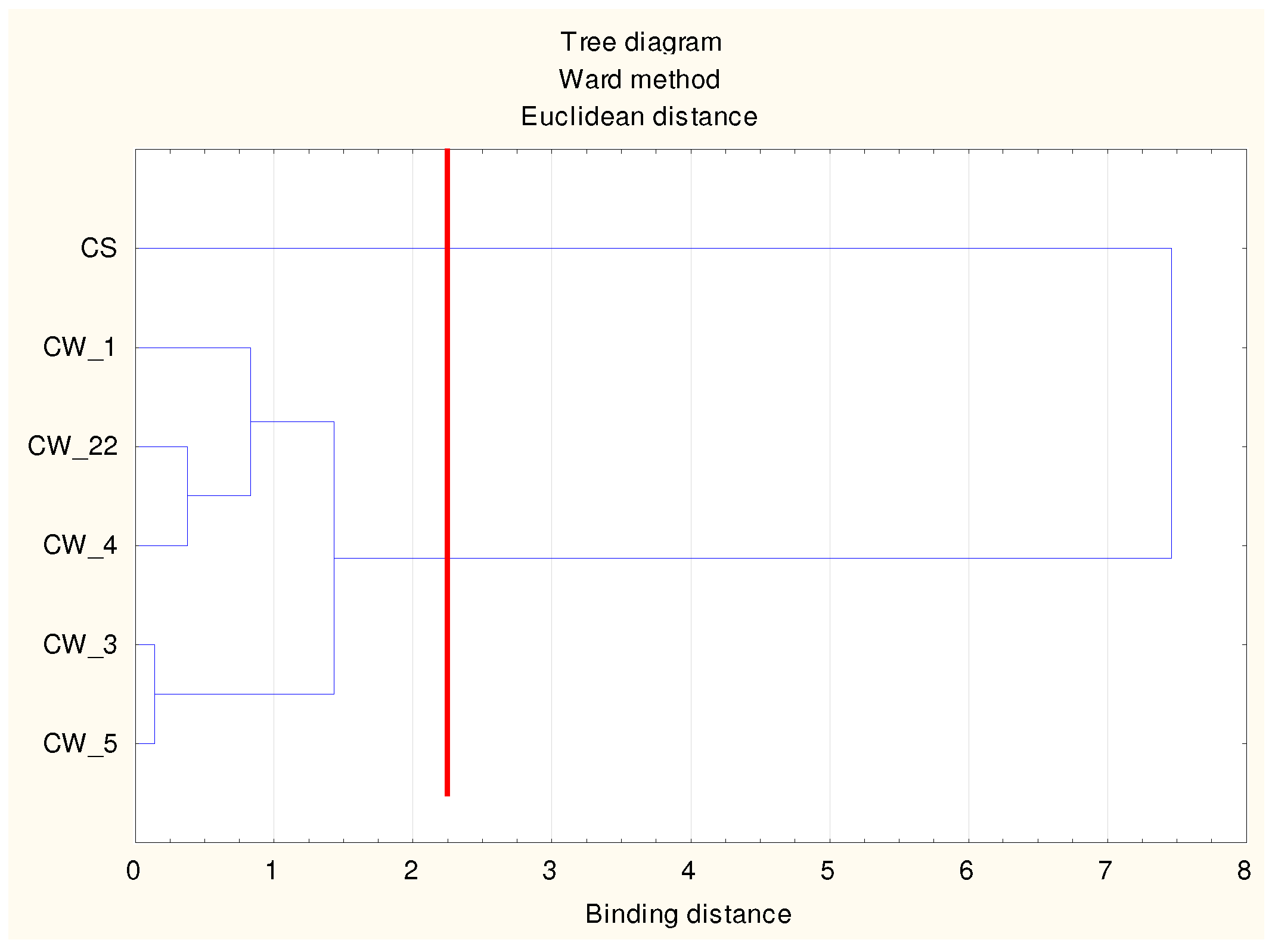
Figure 2.
Ward’s tree dendrogram for TOC, TN, and C/N.
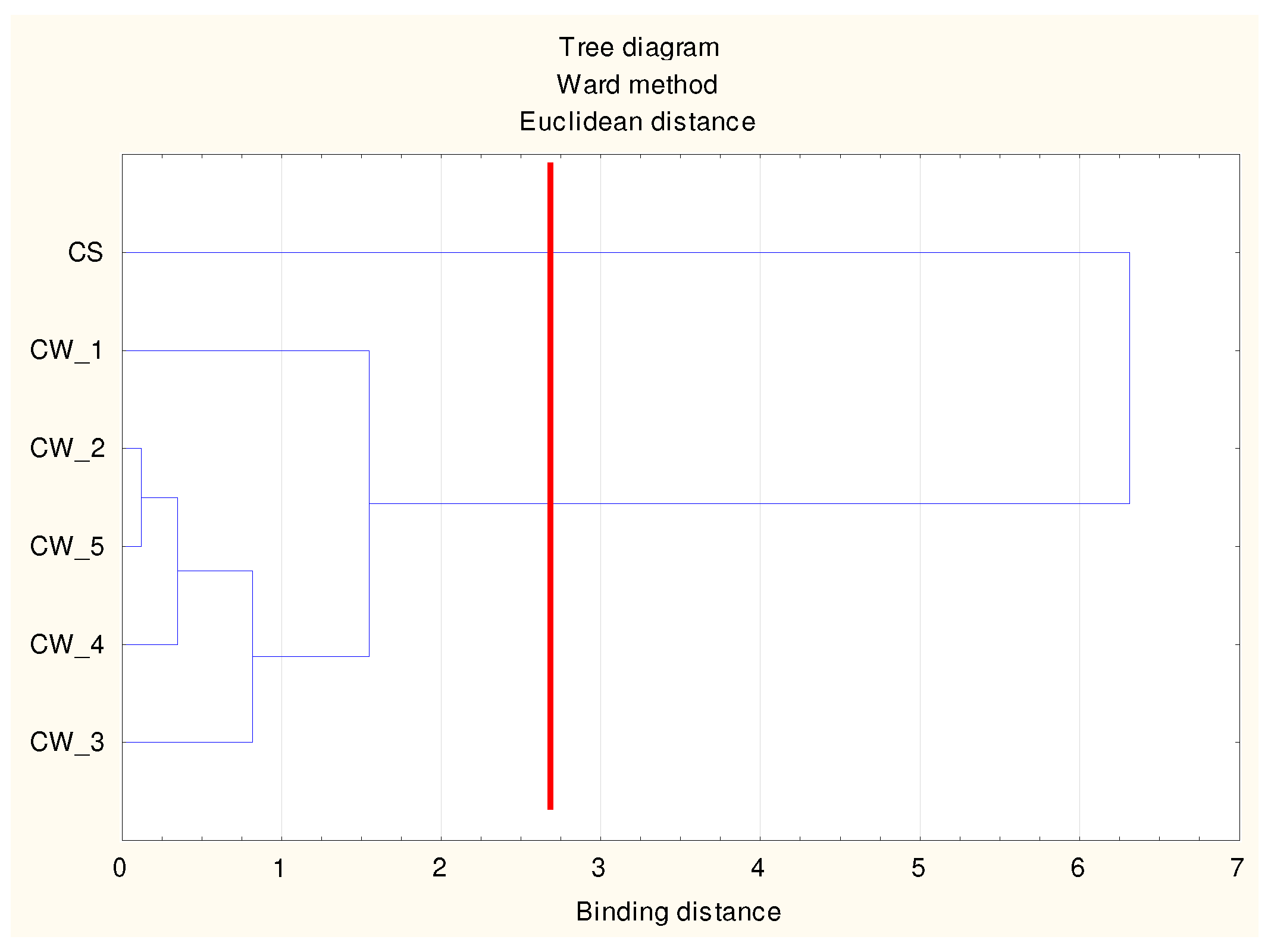
Figure 3.
Ward’s tree dendrogram for P, K and Mg.
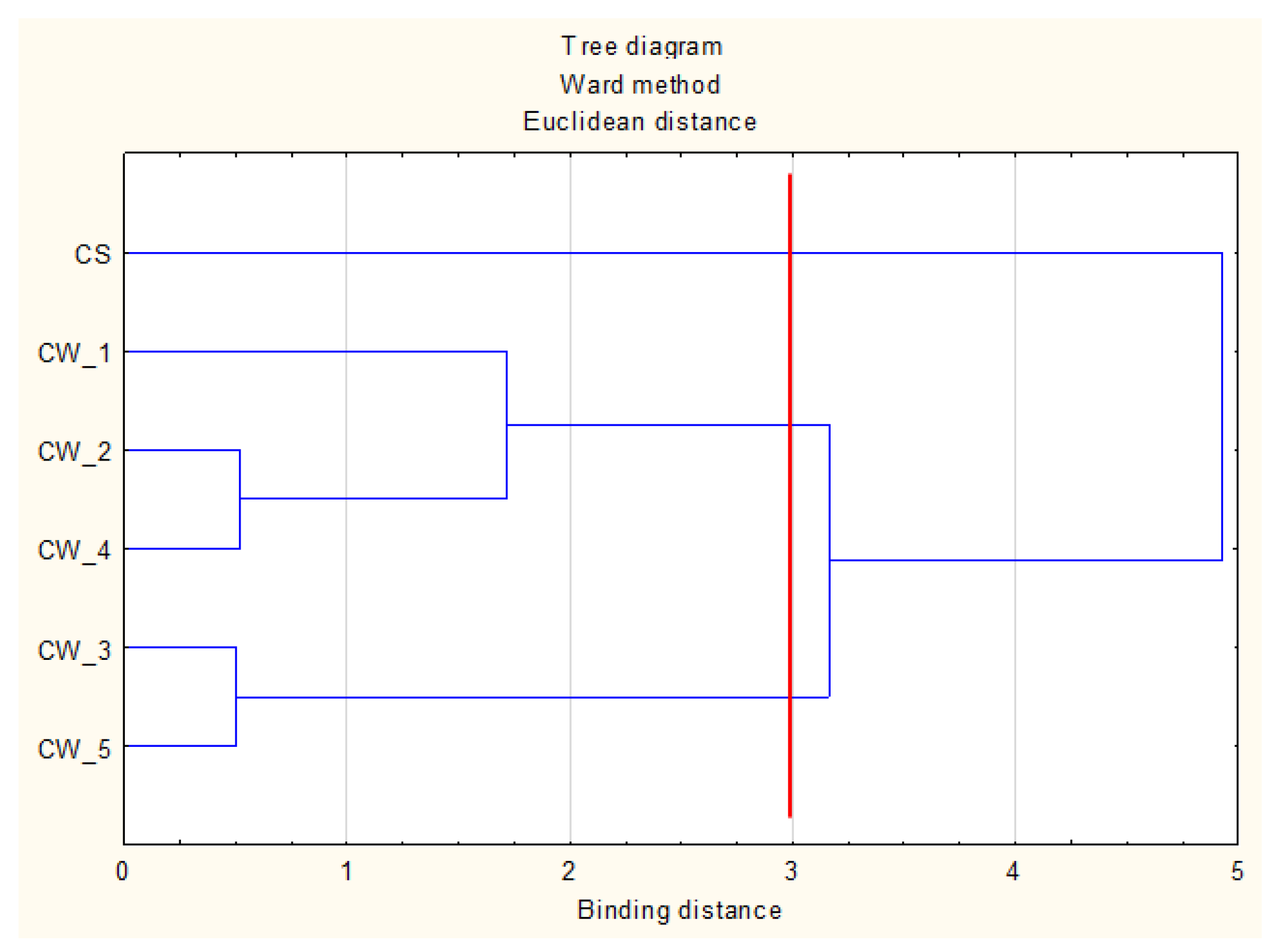
Figure 4.
Biplot (combination of a 2D factorial plot for cases (CS, CW_1, CW_2, CW_3, CW_4, CW_5) with a 2D factorial plot for variables (HA, BC, CEC, V, TOC, TN, C/N, P, K, Mg).
Figure 4.
Biplot (combination of a 2D factorial plot for cases (CS, CW_1, CW_2, CW_3, CW_4, CW_5) with a 2D factorial plot for variables (HA, BC, CEC, V, TOC, TN, C/N, P, K, Mg).
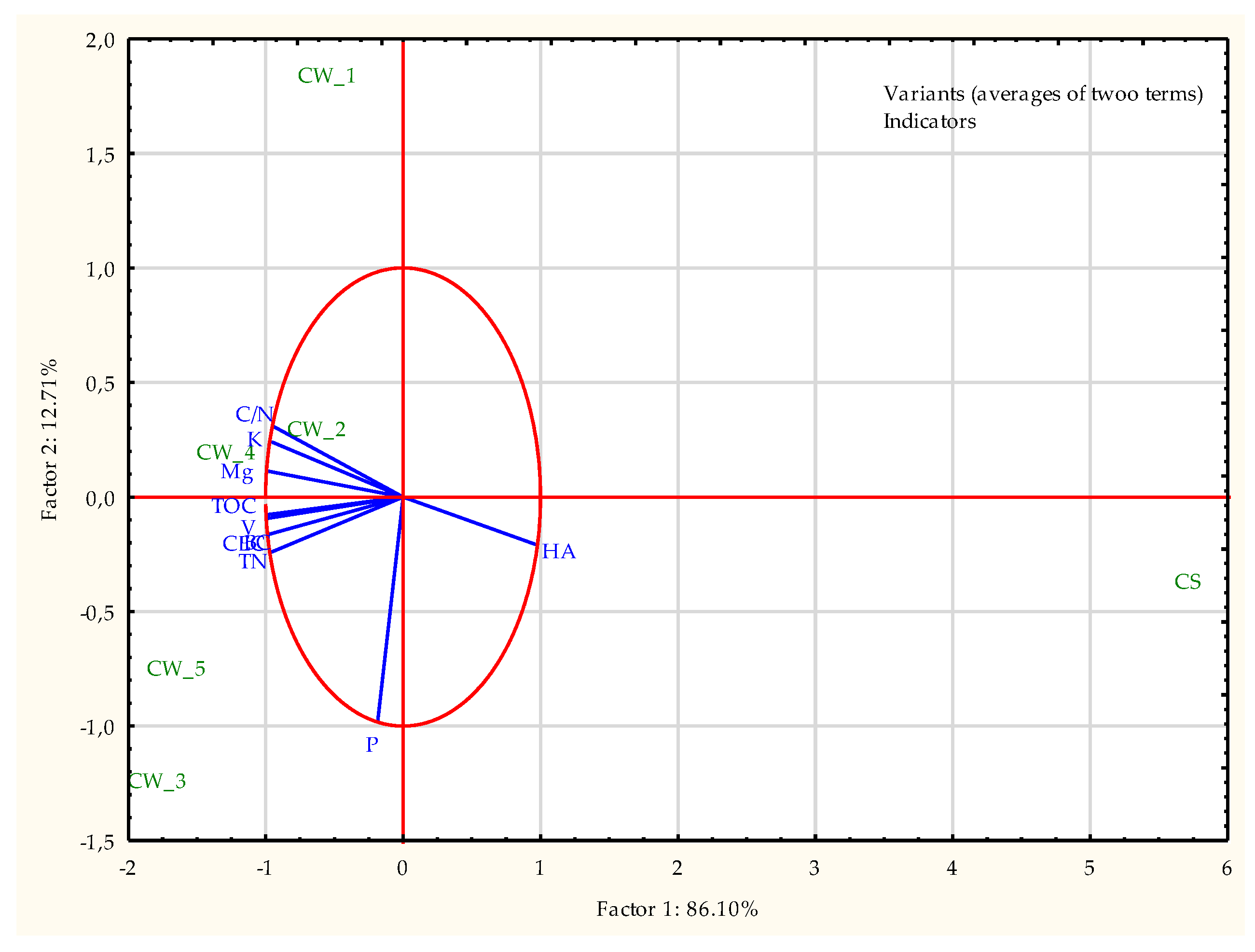

Table 1.
Selected soil properties and materials used. Average values.
| Property | Unit | Coal Waste (CW) | Sewage Sludge (SS) | Mineral Wool (MW) |
Control Soil (CS) |
|---|---|---|---|---|---|
| Reaction | pH w H2O | 7.30 | 6.45 | 6.72 | 4.48 |
| pH 1 mol·dm −3 KCl |
7.10 | 6.15 | 652 | 4.08 | |
| Hydrolytic acidity (HA) | cmol(+)·kg-1 | 0.61 | 4.74 | 0.23 | 2.70 |
| Exchangeable base cations (BC) | 11.47 | 29.15 | 23.22 | 3.38 | |
| Cation exchange capacity of the soil (CEC) | 12.08 | 33.89 | 23.45 | 6.08 | |
| Degree of saturation of the sorption complex with basic cations (V) | % | 94.9 | 86.1 | 99.0 | 55.6 |
| TOC | g·kg-1 | 6850 | 207.50 | n.o. | 7.50 |
| TN | 2.36 | 38.10 | n.o. | 0.88 | |
| C/N | - | 29.0 | 5.6 | n.o. | 8.5 |
| Salinity | gNaCl·kg-1 | 1.80 | 286 | 0.06 | 0.11 |
| P available | mg·kg-1 | 1.6 | 742.5 | 632.2 | 18.2 |
| K available | 208.4 | 13.68 | 1249.2 | 3.,0 | |
| Mg available | 180.0 | 135.0 | 54.,2 | 17.1 | |
| Pb | 47.5 | 39.8 | 38.3 | 27.5 | |
| Zn | 45.8 | 874.5 | 44.9 | 24.8 | |
| Cu | 45.5 | 301.5 | 26.5 | 20.1 | |
| Cd | 1.04 | 3.54 | 1.05 | 0.36 | |
| Cr | 33.9 | 89.3 | 11.4 | 19.6 | |
| Ni | 35.9 | 37.6 | 22.6 | 5.8 | |
| Hg | 0.029 | 0.984 | 0.006 | 0.035 | |
| Ba | 308.0 | 110.5 | 27.5 | 41.5 |
Explanation: TOC—Total Organic Carbon, TN—Total Nitrogen Content, and C/N ratio.
Table 2.
Used variants and to composition of soil-like substrates.
| Variant | Substrate characteristics | Control Soil (CS) |
Coal Waste (CW) |
Sewage Sludge (SS) |
Mineral Wool (MW) |
||||
|---|---|---|---|---|---|---|---|---|---|
| % w/w s.m | kg s.m. | % w/w s.m | kg s.m. | % w/w s.m | kg s.m. | % w/w s.m | kg s.m. | ||
| CS | Control Soil | 100 | 10 | - | - | - | - | - | - |
| CW_1 | Coal Waste – 100% | - | - | 100 | 10 | - | - | - | - |
| CW_2 | Coal Waste 97.5% + Sewage Sludge 2.5% | - | - | 97.5 | 9.75 | 2.5 | 0.25 | - | - |
| CW_3 | Coal Waste 95% + Sewage Sludge 5% | - | - | 95 | 9.50 | 5 | 0.50 | - | - |
| CW_4 | Coal Waste 96.5% + Sewage Sludge 2.5% + Mineral Wool 1% | - | - | 96.5 | 9.65 | 2.5 | 0.25 | 1 | 1 |
| CW_5 | Coal Waste 94% + Sewage Sludge 5% + Mineral Wool 1% | - | - | 94 | 9.4 | 5 | 0.50 | 1 | 1 |
Table 3.
pH and Electrical conductivity (EC).
| Variant | Term | pH | Electrical conductivity (EC) |
|---|---|---|---|
| 1 mol KCl·dm-3 | mS·cm-1 | ||
| CS | I | 3.90 ± 0.01a | 0.11 ± 0.02a |
| II | 4.29 ± 0.01b | 0.10 ± 0.02a | |
| III | 4.90 ± 0.02c | 0.09 ± 0.01a | |
| CW_1 | I | 7.20 ± 0.01k | 0.65 ± 0.02bc |
| II | 7.00 ± 0.01ij | 0.60 ± 0.00b | |
| III | 6.80 ± 0.01g | 0.57 ± 0,01b | |
| CW_2 | I | 6.00 ± 0.02i | 0.79 ± 0.05fg |
| II | 6.82 ± 0.02g | 0.77 ± 0.03def | |
| III | 5.68 ± 0.02e | 0.69 ± 0.07cd | |
| CW_3 | I | 6.80 ± 0.02g | 1.14 ± 0.02i |
| II | 6.50 ± 0.01d | 0.95 ± 0.02h | |
| III | 6.50 ± 0.01d | 0.76 ± 0.01de | |
| CW_4 | I | 7.07 ± 0.07j | 0.84 ± 0.02fg |
| II | 6.90 ± 0.01h | 0.79 ± 0.01fg | |
| III | 6.71 ± 0.01f | 0.70 ± 0.02cd | |
| CW_5 | I | 7.03 ± 0.06ij | 1,12 ± 0.04i |
| II | 6.59 ± 0.01e | 0.95 ± 0.03h | |
| III | 6.60 ± 0.01e | 0.85 ± 0.01g |
Explanation: different lowercase letters in the upper index indicate significant differences. Mean ± standard deviation.
Table 4.
Sorption properties.
| Variant | Term | HA | BC | CEC | V |
|---|---|---|---|---|---|
| cmol(+) kg-1 | % | ||||
| CS | I | 2.69 ± 0.18 cd | 3.37 ± 0.15a | 6.06 ± 0.31a | 3.37 ± 0.15a |
| II | 2 78 ± 0.24 d | 3.80 ± 0 10a | 6 58 ± 0.21a | 3.80 ± 0.10a | |
| III | 2.48 ± 0.10 c | 4.67 ± 0.06b | 7.15 ± 0.14b | 4.67 ± 0.06b | |
| CW_1 | I | 0.62 ± 0.03 ab | 11.48 ± 0.26c | 12.10 ± 0.28c | 11.48 ± 0.26c |
| II | 0.59 ± 0.03 ab | 12.22 ± 0.12d | 12.81 ± 0.15d | 12.22 ± 0.12d | |
| III | 0.57 ± 0.03 a | 12.56 ± 0.28de | 13.13 ± 0.25d | 12.56 ± 0.28de | |
| CW_2 | I | 0.84 ± 0.07 b | 13.20 ± 0.09f | 14.04 ± 0.10ef | 13.20 ± 0.09f |
| II | 0.78 ± 0.01 ab | 13.13 ± 0.16f | 13.91 ± 0.17e | 13.13 ± 0.16f | |
| III | 0.76 ± 0.07 ab | 13.03 ± 0.08ef | 13.79 ± 0.15e | 13.03 ± 0.08ef | |
| CW_3 | I | 0.79 ± 0.05 ab | 15.10 ± 0.10kl | 15.89 ± 0.15l | 15.10 ± 0.10jk |
| II | 0.77 ± 0.04 ab | 14.81 ± 0.10ijk | 15.57 ± 0.08jkl | 14.81 ± 0.10ijk | |
| III | 0.74 ± 0.01 ab | 14.37 ± 0.18hi | 15.11 ± 0.17hij | 14.37 ± 0.18hi | |
| CW_4 | I | 0.74 ± 0.02 ab | 13.91 ± 0.15gh | 14.65 ± 0.13gh | 13.91 ± 0.15gh |
| II | 0.71 ± 0.05 ab | 14.12 ± 0.19gh | 14.83 ± 0.15ghi | 14.12 ± 0.19gh | |
| III | 0.63 ± 0.07 ab | 13.83 ± 0.16g | 14.46 ± 0.11fg | 13.83 ± 0.16g | |
| CW_5 | I | 0.72 ± 0.03 ab | 15.21 ± 0.04l | 15.93 ± 0.02l | 15.21 ± 0.04k |
| II | 0.69 ± 0.04 ab | 15.11 ± 0.16kl | 15.81 ± 0.14kl | 15.11 ± 0.16jk | |
| III | 0.63 ± 0.07 ab | 14.67 ± 0.23ij | 15.29 ± 0.24ijk | 14.67 ± 0.23ij | |
Explanation: HA—hydrolytic acidity, BC—exchangeable base cations; CEC—cation exchange capacity; V – the degree of saturation of the sorption complex with basic cations; different lowercase letters in the upper index indicate significant differences. Mean ± standard deviation.
Table 5.
Mean values of the output variables in the clusters.
| Variable | Mean Values of the Output Variables in the Clusters | ||
|---|---|---|---|
| Clusters 1 (CS) |
Clusters 2 (CW_1, CW_2) |
Clusters 3 (CW_3, CW_4, CW_5) |
|
| BC | 3.94 | 13.60 | 14.57 |
| HA | 2.65 | 0.69 | 0.71 |
| CEC | 6.59 | 13.30 | 15.28 |
| V | 3.94 | 12.60 | 14.57 |
Explanation: HA—hydrolytic acidity, BC—exchangeable base cations; CEC—cation exchange capacity; V – the degree of saturation of the sorption complex with basic cations.
Table 6.
Total Organic Carbon (TOC), Total Nitrogen (TN) Content, and C/N ratio.
| Variant | Term | TOC | TN | C/N |
|---|---|---|---|---|
| g·kg-1 | ||||
| CS | I | 7.51 ± 0.22a | 0.84 ± 0.02a | 8.94 |
| II | 7.61 ± 0.17a | 0.89 ± 0.03a | 8.55 | |
| III | 8.21 ± 0.34a | 0.93 ± 0.03a | 8.23 | |
| CW_1 | I | 68.54 ± 0.79e | 2.36 ± 0.09bcd | 29.04 |
| II | 64.44 ± 0.54d | 2.27 ± 0.13bc | 28.39 | |
| III | 51.77 ± 0.25b | 2.15 ± 0.13b | 24.08 | |
| CW_2 | I | 82.40 ± 1.06g | 3.22 ± 0.03hi | 25.60 |
| II | 75.50 ± 0.45f | 3.14 ± 0.04gh | 78.64 | |
| III | 52.82 ± 0.64b | 2.63 ± 0.04de | 20.08 | |
| CW_3 | I | 95.49 ± 0.59j | 3.37 ± 0.14hi | 28.34 |
| II | 91.52 ± 0.93i | 3.44 ± 0.12i | 26.60 | |
| III | 57.60 ± 0.98c | 3.22 ± 0.02hi | 17.89 | |
| CW_4 | I | 85.30 ± 1.05h | 3.18 ± 0.07ghi | 26.82 |
| II | 62.30 ± 1.15d | 2.77 ± 0.06ef | 22.50 | |
| III | 56.49 ± 0.10c | 2.47 ± 0.07cd | 22.87 | |
| CW_5 | I | 95.21 ± 0.93j | 3.33 ± 0.10hi | 28.59 |
| II | 64.58 ± 0.41d | 2.94 ± 0.16fg | 21.97 | |
| III | 58.10 ± 1.24c | 2.86 ± 0.10ef | 20.31 | |
Explanation: different lowercase letters in the upper index indicate significant differences. Mean ± standard deviation.
Table 7.
Mean values of the output variables in the clusters.
| Variable | Mean Values of the Output Variables in the Clusters | ||
|---|---|---|---|
| Clusters 1 (CS) |
Clusters 2 (CW_1) |
Clusters 3 (CW_2, CW_3, CW_4, CW_5) |
|
| TOC | 7.77 | 61.58 | 73.11 |
| TN | 0.89 | 2.26 | 3.05 |
| C/N | 8.78 | 27.23 | 23.80 |
Explanation: TOC – Total Organic Carbon, TN – Total Nitrogen and C/N ratio.
Table 8.
Contents of available forms of P, K, and Mg.
| Variant | Term | P | K | Mg |
|---|---|---|---|---|
| mg·kg-1 | ||||
| I | 18.23 ± 0.21de | 33.00 ± 2.00b | 17.10 ± 0.30a | |
| CS | II | 17.37 ± 0.21d | 38.80 ± 1.40c | 20.00 ± 1.20a |
| III | 12.47 ± 0.15bc | 25.13 ± 0.50s | 20.20 ± 1.00a | |
| I | 1.77 ± 0.35a | 208.40 ± 2.00k | 180.00 ± 1.32c | |
| CW_1 | II | 1.43 ± 0.15a | 217.20 ± 1.73l | 203.00 ± 1.80g |
| III | 1.23 ± 0.25a | 116.60 ± 1.00f | 201.80 ± 0.53g | |
| I | 14 04 ± 0.44c | 198.50 ± 2.00j | 187.20 ± 1.80d | |
| CW_2 | II | 12.50 ± 0.17bc | 132.20 ± 1.00g | 235.00 ± 2.11j |
| III | 10.90 ± 1.67b | 83.40 ± 1.00d | 190.77 ± 0.32e | |
| I | 33.50 ± 1.00i | 242.27 ± 0.70m | 198.13 ± 0.95f | |
| CW_3 | II | 27.50 ± 1.10 gh | 148.10 ± 2.10h | 241.13 ± 0.68k |
| III | 26.37 ± 1.85g | 81.97 ± 1.15d | 179.97 ± 0.45c | |
| I | 21.00 ± 0.30f | 236.40 ± 0.40ł | 196.80 ± 0.92f | |
| CW_4 | II | 13.80 ± 0.10c | 162.67 ± 0.45i | 219.20 ± 1.20i |
| III | 10.80 ± 0.20b | 85.80 ± 0.40d | 184.47 ± 0.50d | |
| I | 29.40 ± 0.30h | 273.10 ± 2.80n | 218.40 ± 0.60i | |
| CW_5 | II | 25.50 ± 0.70g | 144.20 ± 2.40h | 209.80 ± 0.60h |
| III | 19.87 ± 0.45ef | 95.73 ± 0.50e | 170.87 ± 0.12b | |
Explanation: different lowercase letters in the upper index indicate significant differences. Mean ± standard deviation.
Table 9.
Mean values of the output variables in the clusters.
| Zmienne | Mean Values of the Output Variables in the Clusters | ||
|---|---|---|---|
| Clusters 1 (CS) |
Clusters 2 (CW_3, CW_5) |
Clusters 3 (CW_1, CW_2, CW_4) |
|
| K | 32.31 | 164.23 | 160.13 |
| Mg | 19.10 | 203.05 | 199.80 |
Explanation: K – available potassium, Mg – available magnesium
Table 10.
Yield of plants grown.
| Variants | White mustard | Maize |
|---|---|---|
| CS | 76.17 ± 0.85b | 112.70 ± 1.14b |
| CW_1 | 26.47 ± 0.64a | 52.23 ± 0.35a |
| CW_2 | 212.93 ± 0.91c | 351.53 ± 0.61d |
| CW_3 | 251.43 ± 0.55e | 402.23 ± 0.64e |
| CW_4 | 223.57 ± 0.40d | 328.93 ± 0.38c |
| CW_4 | 350.90 ± 1.15f | 453.60 ± 10.13f |
Explanation: different lowercase letters in the upper index indicate significant differences. Mean ± standard deviation.
Disclaimer/Publisher’s Note: The statements, opinions and data contained in all publications are solely those of the individual author(s) and contributor(s) and not of MDPI and/or the editor(s). MDPI and/or the editor(s) disclaim responsibility for any injury to people or property resulting from any ideas, methods, instructions or products referred to in the content. |
© 2023 by the authors. Licensee MDPI, Basel, Switzerland. This article is an open access article distributed under the terms and conditions of the Creative Commons Attribution (CC BY) license (http://creativecommons.org/licenses/by/4.0/).
Copyright: This open access article is published under a Creative Commons CC BY 4.0 license, which permit the free download, distribution, and reuse, provided that the author and preprint are cited in any reuse.


