

Submitted:
20 July 2023
Posted:
21 July 2023
You are already at the latest version
Abstract
The papaya mealybug Paracoccus marginatus is an invasive, polyphagous pest and poses a quarantine threat to tropical and subtropical countries. Infested commodity internationally should be undergoing phytosanitary treatment, while irradiation is recommended to replace methyl bromide fumigation. Dose-response tests were conducted on the 2-, 4-, and 6-d-old eggs and gravid females of P. marginatus using the X-ray radiation doses of 15–105 Gy with an interval of 15 Gy, respectively. Radiotolerance was compared using fiducial overlapping and lethal dose ratio (LDR) test, resulting in insignificant difference except for LDR test at LD90 (leading 90% mortality at 95% confidence level (CL)); the estimated dose for 99.9968% mortality at 95% CL was 176.5–185.2 Gy, which was validated in the confirmatory tests using gamma irradiation because gammy and X-rays have equal biological effect on pests. Therefore, a total of estimating 60,386 gravid females of papaya mealybug irradiated with 146.8–185.0 Gy resulted in no F1 nymphs developing. Eggs can therefore be used as an alternative to gravid females for dose-response tests; the recommended minimum dose for phytosanitary treatment of P. marginatus on infested commodity is 185 Gy, with treatment efficacy ≥ 99.9950% at 95% CL.
Keywords:
Phytosanitary irradiation
; Paracoccus marginatus
; dose-response test
; large-scale confirmatory test.
1. Introduction
The papaya mealybug, Paracoccus marginatus Williams and Granara de Willink (Hemiptera: Pseudococcidae), is native to Central America and since the 1990s. It has spread rapidly in mainly tropical areas of the Caribbean, islands in the Indian and Pacific Oceans, Africa and southern Asia, and transmitted throughout most provinces of southern China; till now it distributed in a total of 62 countries[1-4]. Ahmed et al. (2015) conducted a genetic analysis on samples of P. marginatus collected across Asian (Cambodia, China, India, Indonesia, Malaysia and Thailand) and African countries; and revealed that there was only one haplotype (a group of alleles in an organism that are inherited together from a single parent) reflecting the very recent invasion of P. marginatus in Asia[5,6]. Papaya mealybug is an economic insect which is estimated causing more than 75% economic damage and income loss of more than USD 3009 per ha at the farm level in Keniya[7]. It has a wide range of hosts and has recorded damage to 189 genera in 58 families. The main economic crops include papaya, mango, custard apple, emblica, acerola, jackfruit, banana, guava, pomegranate, Indian date, sapodilla, and cassava[1,4]. The nymphs and adult females insert its stylet into the epidermis of the leaf or the skin of fruit or stem and feeds on the plant sap. At the same time, it injects a toxic substance into the plant which results in chlorosis, distortion, stunting, early leaf and fruit fall, the production of honeydew, sooty mould and possibly the death of the plant, resulted in huge economic losses[1,6]. In addition, it is one of the vectors of Piper yellow mottle virus[8]. The insect can spread long-distance along with entering and exiting fruits, vegetables, ornamental plants, etc., and has been listed as a quarantine pest by the United States, Canada, Australia, the European Union and other countries. As a result, phytosanitary measures including pest risk analysis, inspection, treatment, and eradication are needed to be carry out to prevent its spread and to reduce the economic losses[1,6,9].
Control measures have been developed for quarantine disinfestation and field controlling, including chemical (fumigation, spraying/dipping pesticide) and physical (irradiation, cold, heat, mechanical clean) treatments on consignments or during processing, cleaning and disinfection of facilities, tools and machinery, and field temperature control[6,10,11]. Currently, cold treatment and methyl bromide fumigation is a common measure to disinfest regulated pests founded in fresh commodities, but the fumigant is restricted in use excepted quarantine and pre-shipment uses because it depletes ozone layers; alternative measure should be developed[12,13]. Irradiation treatment has many advantages such as highly penetration in the commodities, prevention of development and reproduction effectively, no residues, and no negative effects that could endanger consumers[14,15]. It is an optimum alternative to methyl bromide fumigation treatment in disinfesting insect pests of fruits and vegetables to overcome quarantine barriers in trade[16,17]. Phytosanitary irradiation (PI) treatment measure has been developed and used in international trade since the establishment of the International Standard on Phytosanitary Treatment (ISPM) No.18 (Guidelines/Requirements for the use of irradiation as a phytosanitary measure) by the secretariat of the International Plant Protection Convention (IPPC) in 2003 and revised in 2023, and the international shipment trials on irradiated mangoes (at 250 Gy) between Australia and New Zealand in 2004[16-18]. In the meanwhile, the schedule and standards are essential for the application of PI treatment; there are two phytosanitary treatment (PT) standards for mealybugs (PT 19 and 45) have been established by IPPC[19,20]; more PT standards on mealybugs species are urgently needed to push forward the listed topic: 2017-012 (Irradiation treatment for all stages of the family Pseudococcidae (generic)) for drafting, consultation and adoption, since mealybugs are the second most important regulated pests besides fruit flies on fruits and vegetables[1,21,22].
For the PI treatment of papaya mealybug, Seth et al. (2016) found that the radiotolerance grows with increasing stages and times in the dose-response tests; gamma radiation in the LD99.9 (99.9% mortality or prevention at 95% confidence level (CL)) of 165 and 258 Gy, which was estimated by the linear regression on dose-percent mortality data, induced lethality in developing stages, and sterility in adults, respectively[23]. Unfortunately, LD99.9968 prevention of F1 neonates was neither estimated nor validated by the large-scale confirmatory tests, which is essential for the development of ISPMs according to ISPM 28 (Phytosanitary treatments for regulated pests)[19.20,24]. Therefore, normalized dose-response and large-scale confirmatory tests are required to determine the phytosanitary treatment dose for P. marginatus gravid females, and to develop a treatment schedule, national standard, and IPPC PT standard (annex to ISPM 28) based on the outcomes of this study.
2. Materials and Methods
2.1. Insect Rearing
The colony of P. marginatus used in this research was collected from the plant of papaya or cassava (leaves or papaya fruits) at Pingxiang city, Guangxi Autonomous Region, Guangzhou city and Shenzhen city, Guangdong Province, China. The mealybugs were reared in the Laboratory of Phytosanitary Treatment and Equipment, Chinese Academy of Inspection and Quarantine, Beijing, China on insecticide-free sprouting potato tubers, Solanum tuberosum L. (Tubiflorae: Solanaceae). The infested tubers were incubated in the middle-sized plastic boxes (22.5 × 15.5 × 7.5 cm, with a meshed ventilation window on lid) in the laboratory at 27±2℃ and 60–80% RH, under a photoperiod of L:D = 12:12 h, in a constant climate chamber (Binder KBF 720, Germany) or rearing room[25]. The progeny was replaced with field population ever 9 to 12 months, and all the species-identification was conducted by Dr. Yong Zhong (Technical center of Pingxiang Customs).
The lifespan of P. marginatus rearing in the laboratory conditions was investigated, and the duration was 7–9 d for egg; 6–10 d, 5–7 d, and 4–6 d for the 1st, 2nd, and 3rd instar nymphs (to females), respectively. About 7 days were needed for the young female develops to oviposition/gravid female, and the whole lifespan for adult female was 16–25 days[25].
2.2. Dose-Response Test using X-Ray Irradiation
2.2.1. X-Ray Irradiator
Dose-response tests were performed on eggs and gravid females (containing immature eggs) using a RS-2000 Pro X-ray irradiator (Rad Source Technologies, Inc., USA). To provide a uniform dose distribution, a reflector (43 cm wide, 38 cm deep, and 43 cm high) is placed 40 cm far from the X-ray source at the bottom of the exposure chamber. A petri dish containing eggs or adult females is placed in the center of the chamber to be irradiated and a dosimeter (Model 2086, RadCal, CA) with a 10 x 6-6 ion beam chamber is placed next to the dish to monitor the absorbed doses. The procedure and designs were closed to the X-ray irradiation of Dysmicoccus lepelleyi Betrem[26] and the aerial root mealybug Pseudococcus baliteus Lit[15], while the operating parameters were 200 keV and 17.6 mA during the irradiation treatments.
2.2.2. Preparation of Adult Females and Eggs
The adult stage is the most radio-tolerant life stage, and so adults were used as the target stage for PI treatment[14,22,23], whereas egg-hatching or emergence of F1 generation 2nd instar nymphs were used for efficacy evaluation[25-27]. Eggs of P. marginate are present in ovisac and are always attached to the body of an adult female, which needs to be removed before irradiation treatment.
Preparation of adult females. The gravid females (30–35-d-old) were collected from sprouting potato tubers and then transferred to a 5 cm polystyrene Petri dish with a moist filter paper on the bottom after removing away attached ovisacs and eggs; every 10 females were placed in a dish (as a treatment batch) which was then sealed with a plastic film punched with pinholes for ventilation.
Preparation of eggs. About 20 gravid adult females reared on sprouting potato tubers were transferred into a 9 cm Petri dish containing a layer of moist filter paper on the bottom after remove away attached ovisacs and eggs if exist; 24 hours later the adults were transferred back to the tubers for continuous rearing; and the number of eggs in ovisacs were counted under a stereomicroscope (SteREO Discovery V12, ZEISS, Germany) and transferred to a new Petri dish with moist filter paper on the bottom (120 eggs/dish). Petri dishes were then placed back in the rearing room and the eggs were allowed to develop for 2, 4, or 6 days before treatment, since eggs hatched from 7–11 days after laying in the experimental conditions.
2.2.3. X-ray Irradiation Treatment
The Petri dishes containing adults or eggs were subjected to irradiation at the target dose of 0 (as control), 15, 30, 45, 60, 75, 90 and 105 Gy, each dose was replicated three times. The cumulative irradiation dose was recorded from the dosimeter. To get a better dose uniformity, the Petri dishes were rotated 180° horizontally or change position when half of the target dose was reached. The dose rate monitored in this testing was about 6.1–6.2 Gy/min. All the control eggs (120 eggs/dish) and adults (10 gravid adult females as a batch) were also brought into the irradiation room but without treatment.
2.2.4. Bioassays after Irradiation Treatment
After the X-ray irradiation treatment, the 2-, 4-, and 6-d-old eggs were transferred back to the rearing room for hatching (7–11 days after laying); the unhatched eggs were finally checked under a stereomicroscope 20-d after laying. The irradiated adult females were transferred back to new sprouting potato tubers in a new box for continuous development. The newborn eggs and ovisacs were collected and number-counted every two days, then reared in the rearing room and checked unhatched eggs 20-d after their laying.
2.3. Large-Scale Confirmatory Trials using Gamma Radiation
2.3.1. Cobalt-60 Radiation Facility and Treatment
It is required to conduct the large-scale confirmatory tests to validate the phytosanitary treatment dose (estimated through the dose-response test) leading to a specific treatment efficacy (for instance LD99.99 at 95% CL), so as to develop a technical schedule or standard in PI treatment; and then a minimum of 30,000 most tolerant individuals (gravid females) should be treated according to ISPM 18 and 28[16-19,28]. Since lack of large-scale X-ray irradiator, the confirmatory tests were conducted in a Cobalt-60 radiation irradiator provided by the National Institute of Metrology Research in Beijing, China. The Fricke system were used for dose-mapping and monitoring the absorbed dose[29].
The gravid females were prepared by injecting parent oviposition females on the sprouting potato tubers and removed away 4 days later, then remained the infested tubers in the rearing room for about 30 days to allow their development to gravid female. The tubers were placed in the middle-sized plastic boxes, weighing between 35 and 70 g with a diameter of 3 to 4.5 cm and a length of 4.5 to 6 cm.
Before irradiation, a total of 439 and 817 potato tubers were placed tightly (to avoid moving during transportation) in boxes (about 15 tubers for each) for the first and second irradiation treatment, and about 10% of boxes were left untreated for control group. Then, all the boxes were put into carboards and transported to the gamma irradiator. During the irradiation process, the boxes were positioned 100 cm away from the center of radiation source and irradiated at the target dose of 165 Gy; at mid-exposure, the irradiator was stopped and plastic boxes were rotated 180° horizontally to achieve a more uniform dosage distribution, fifteen Fricke dosimeters were employed for each irradiation treatment to measure dose variations.
2.3.2. Post-Treatment Rearing and Bioassays
After irradiation, the papaya mealybugs and potato tubers were transport back to the laboratory and kept separately from the control group to prevent cross-infestation; both the irradiated and controlled mealybugs were maintained under the above rearing conditions. For the continuous rearing of the papaya mealybugs, the gravid females on each tuber were counted firstly, and subsequently transferred the tubers along with mealybugs to the large-sized plastic boxes (34.0 × 23.5 × 14.0 cm, with 3 meshed ventilation windows on lid), adding about 2/5 of new potato tubers to allowed any F1 nymphs for feeding. Eggs laid by irradiated or untreated females were collected in the petri dishes containing moist filter paper at the bottom every 4 days until the female died, hatch rate for eggs in the control was checked by counting all the initial number and unhatched number 2 weeks later; eggs laid by irradiated female were placed in the center of the Petri dish, and a layer of sticky shellac was applied around the eggs to collect the hatched 1st instar nymphs. The number of eggs in the large-scale confirmatory tests was estimated on the number of gravid females multiplied by 255, which was the means counted from a total of 720 females treated in dose-response tests.
2.4. Statistical Analysis
To determine the effects of radiation dose on different ages of eggs, and to compare radiotolerance among 0-, 2-, 4-, and 6-d-old egg, mortality data in the X-ray irradiation dose-response tests were subjected to two-way ANOVAs after correcting with Abbot's formula[30]. Means (±SD, for all mortality) were compared by Tukey’s multiple comparison tests using DPS software[31].
In the probit analysis of the dose-response data, the PoloPlus 2.0 program was used to estimate the minimum absorbed dose leading to 90% (LD90), 99%(LD99) or 99.9968% (LD99.9968, Probit-9) mortality at 95% CL, where the data used in the estimation includes any dose leading <100% mortality and the first dose leading 100% mortality[32,33]. So as to compare the significance of tolerance, the overlapping tests on the 95% confidence intervals (CI) at LD90, LD99 and LD99.9968 were performed and showed no significant difference among females and developing eggs; then, pair-wise comparison tests were performed by calculating the 95% CI of the lethal dose ratios (LDR) at LD90, LD99, and LD99.9968, respectively; and the criterion for significance is that the 95% CI should not include 1[33,34].
For the confirmatory tests, the treatment efficacy (1-Pu) at a specific CL was calculated using the equation (1) when no survivor emergence from the treated gravid female:
where is the acceptable level of survivorship (normally 0.01% or 0.0032%), C is the CL, and n is the number of treated females[28,32]. Normally, the mortality proportion (1-Pu) at 95% CL is used, the value is calculated according to the number of irradiated P. marginatus gravid females (≥30,000 for PI treatment)[12,35].
3. Results
3.1. Dose-Response Testing
3.1.1. Impact on Egg Number Laid by Irradiated Females
The number of eggs laid by irradiated gravid females of P. marginatus is listed in Table 1. Results of irradiation effect derived from two-way ANOVA showed that number of eggs was not affected by the radiation dose (F = 1.33, df = 7,95, p = 0.2490)nor the interaction of dose × duration (F = 0.36, df = 14,72, p = 0.9821); but it was significantly affected by the duration (F = 139.54, df = 2,95, p ˂ 0.0001).There were no significant differences in number for the first 4 days, but it decreased dramatically from 5 to 6 days, indicating that no significant irradiation effect was observed when the papaya mealybugs were irradiated at the radiation dose below 105 Gy. In addition, the number of eggs laid by per female within 6 days was 255.6±61.8 (mean±SE).
3.1.2. Two-Way ANOVA on Dose-Mortality of X-Ray Irradiation
When P. marginatus eggs (including gravid females, containing immature eggs) were exposed to X-ray irradiation, the mortality of eggs generally increased with the increasing dose within an age; and the minimum doses causing 100% mortality for 0-, 2-, 4-, and 6-d-old eggs were >105 Gy, 105 Gy, 105 Gy, and >105 Gy, respectively (Table 2). To investigate the significant difference of egg mortality, the dose-mortality data were subjected to two-way ANOVA, which showed that the effects on mortality of P. marginatus were significant for both age (F = 9.25, df = 3,83, p ≤ 0.0001) and dose (F = 44.29; df = 6,83; p ≤ 0.0001), but not significant for the age × dose interaction effects (F = 0.55; df = 18,56; p = 0.9171).
For the effect of radiation dose, mortality of eggs increased significantly with increasing dose within the same age. For the effect of age, there was no significant differences within the same radiation dose except for 30 Gy and 45 Gy, where the 0-d-old eggs (16.9±5.0, 33.8±9.5%) obtained the lowest mortality, followed by the 2-d-old (43.6±15.3, 57.1±18.2) and 6-d-old eggs (28.1±14.8, 61.5±9.9), while the 4-d-old eggs (48.8±6.5, 70.0±19.0) got the highest mortality (Table 2). For comparison of the mean mortality in ages, the 0-d-old eggs with the minimum value (50.0±32.0%) were the most tolerant life age; while the 2-, 4- and 6-day-old eggs showed no significant difference (Table 2), means no radiation tolerance difference was observed in this testing.
Consequently, there are not significant differences in radiotolerance of P. marginatus among the produced eggs, however, the 0-d-old eggs showed the most resistant age especially at lower dose of 15 to 45 Gy.
3.1.3. Probit Analysis of Dose-Mortality Data
Results derived from the probit analysis using probit model on the dose-mortality data of P. marginatus gravid females and eggs are listed in Table 3, including the estimated minimum absorbed dose that leading to LD90, LD99, and LD99.9968 prevention of egg-hatching at 95% CL, heterogeneity, slope, intercept, and comparison of the lethal dose ratio (LDR); whereas the radiation dose was not log-transformed which is the default setting for probit analysis. The 2-, 4-, and 6-d-old eggs got very closed (and equal) slopes and intercepts mean similar radiotolerance, however, 0-d-old eggs obtained much larger slope value but the least intercept, indicated the probit lines will be intersected somewhere, and, then, other measures such as CI overlap, LDR testing (Table 4) should be used to compare radiotolerance among eggs with different ages.
Among different ages of egg, all the 95% CI for LD90, LD99, and LD998.9968 overlapped each other means no significant radiotolerance differences are existed. When pairwise comparison of LDR (Table 4) was used, 0-d-old eggs got the largest slope and LD90 means the most resistant age in eggs, thus, the results in radiotolerance derived from probit analysis is the same as that from two-way ANOVA (Table 2). For comparing of LD99, 0-d and 6-d-old eggs obtained the similar value which is significantly larger than that for 2- and 4-d-old eggs, resulted in stronger radiotolerance significantly. However, there was no significant difference in LD99.9968 although it is an extrapolated value, illustrating that no radiotolerance difference exists in all the eggs.
To explain the strange/irregular sequence of radiotolerance in P. marginatus eggs, all the raw and expected dose-mortality curves are shown in Figure 1; and the dose-probit lines are shown in Figure 2. The 0-d-old eggs are obviously tolerant than produced eggs (Figure 1). The expected dose-probit lines for 2-, 4- and 6-d-old eggs were roughly parallel, whereas, the expected line for 0-d-old eggs located in the lower position at beginning and even at probit 6.28 (Line A, LD90 at 95% CL) and probit 7.32 (Line B, LD99), but it intersected with the lines for 2- and 4-d-old eggs at about probit 8.20 (Line C, LD99.932), and crossed at until probit 9 (Line D, LD99.9968) with line for 6-d-old eggs (Figure 2). This is why the 0-d-old eggs shows significant radiotolerance at LD90 and LD99, but it presents similar tolerance at LD99.9968 (Table 2 and 3). For phytosanitary treatment, the criteria for efficacy evaluation are normally mortality or prevention of development/reproduction at probit-9 level, and the estimated probit-9 value is ordinarily used as the target dose for the large-scale confirmatory tests, then, we can select eggs at different ages for conducting the confirmatory tests with target dose rage from 161 to 199 Gy (Table 3, Figure 2). Here, we applied 165 Gy as target dose to conduct the gamma radiation confirmatory tests.
3.2. Large-Scale Confirmatory Tests
In the large-scale confirmatory tests, a dose of 165 Gy was used as the target dose; the actual absorbed doses measured by Fricke dosimeters were ranged from 150.5 Gy to 183.6 Gy and 146.8 Gy to 185.0 Gy at the dose rate of 1.26 and 1.23 for the first and second trails, respectively; resulted in the dose uniformity ratio (DUR, the ratio of the maximum dose divided by the minimum dose) of 1.22, and 1.26 respectively for these two tests (Table 5). There was no F1 egg hatched and therefore no F1 generation crawler emerged from an estimated 60,386 irradiated gravid females reared on sprouting potatoes; in addition, no dead females was found in the radiation treatment to the oviposition period, indicating the number of gravid females used for calculation was not adjusted[12,35]; whereas the mortality of eggs in the control was 2.84 % and 3.13% for these two confirmatory tests, indicating that the F1 generation developed normally in the controls (Table 5). Thus, efficacy for gamma irradiation treatment calculated by Equation 1 is 99.9950% at 95% CL. Since the maximum radiation dose in the confirmatory tests should be the minimum dose for PI treatment, the phytosanitary radiation dose (minimum dose) should be not less than 185 Gy.
4. Discussion
During this research, radiotolerance for the 2-, 4-, and 6-d-old eggs and gravid female (containing immature eggs) of P. marginatus were tested by comparing the number of eggs (Table 1), and the ability to develop into 1st instar nymphs after exposure to X-rays irradiation at the dose of 15 to 105 Gy with intervals of 15 Gy; whereas preventing egg-hatching (mortality of egg including eggs laid by irradiated females) was used as the criteria for efficacy evaluation. The dose-mortality data was analyzed by two-way ANOVA (Table 2), probit and LDR test (Table 3, 4), and overlapping test on fiducial intervals of LD90, LD99, and LD99.9968 afterwards. As a result, the 2-, 4-, and 6-d-old eggs present very closed radiotolerance, but they are significantly more sensitive than the immature eggs in the ANOVA and LDR test at LD90 (Table 2, 3 and 4); whereas there is no significant difference in LD99.9968. This result agrees with the relative radiotolerance of D. lepelleyi eggs irradiated by X-ray irradiation, in which the immature eggs seem more tolerant that 1-, 2-, and 3-d-old eggs[26]. This also indicate that the egg developed well in the body of female of papaya mealybug. However, the radiotolerance grows with the developing ages of egg[14] for other mealybugs, for instance, Ps. comstocki Kuwana[36] and Ps. baliteus[15] in which 0-d-old eggs (immature eggs in the body of gravid females) were significantly more sensitive to radiation than 2-, 4-, and 6-day-old eggs.
How to comparing the relative radiotolerance in different insect stages/ages had once been discussed by Zhan et al. (2020)[11], the statistical methods including probit analysis, CI overlapping, relative median potency, and ANOVA; the 95% CI of the LDR at LD99 had been recommended for comparing the significance of tolerance in phytosanitary treatments. In this investigation, no significant radiotolerance difference was found for the 2-, 4-, and 6-d-old eggs by all above measures except for LDR test at LD90 (Table 3, 6-d-old eggs are significantly tolerant than 4-d-old eggs); whereas, 0-d-old eggs showed significantly more resistant than produced eggs when comparing in ANOVA (Table 2) and LDR test at LD90 (Table 3 and 4) may due to the lack of the 100% mortality data for the 0- and 6-d-old eggs. The dose-probit line for 0-d-old egg showed steeper (possess of a larger slope of 0,034 vs. 0.026-0.028) than other lines and they crossed at probit 8.20 and probit 9 (Figure 2), resulted in no significant tolerance difference in LD99 and LD99.9968. However, during the probit analysis, all the 95% CIs overlapped means there is no significant radiotolerance difference among all testing eggs; and this may due to the larger CIs ranges in produced eggs caused by the larger experimental errors. In a word, there is none significant radiotolerance exist among the eggs when the probit-9 mortality was used as the criterion for efficacy evaluation.
Additionally, the estimated LD99.9968 value for produced eggs (Table 3) will be increased by 4.22 to 5.33-fold with a large rang of CI If the dose was logarithmic transformed during the probit analysis; and the calculation for adult female suspended due to heterogeneity factor exceeding 100 [32]. The results are in agreement with that for PI treatment of the cacao mealybug Planococcus lilacinus Cockerell[27]. Therefore, the traditional logarithmic transformation of radiation dose is unsuitable for dose-response data analysis in this investigation.
It is very important and reasonable to conduct the dose-response tests (i.e., predict the treatment intensity of large-scale confirmatory trials) in order to develop a technical schedule or standard for PI treatment of papaya mealybug[15,18,24]. In order to facilitate the application of PI technology, we prefer to choose the effect of radiation on preventing the emergence of 2nd instar nymphs as the end-point of efficacy evaluation, rather than neonate (1st instar nymphs) from the irradiated females, even though the oviparous mealybugs that they lay eggs, because it is difficult to find out all eggs or neonates lurking in the female's abdomen before irradiation treatment[19,20,27,37,38]. Additionally, very high radiation doses are required to prevent hatching of ready-to-hatch eggs; for instance, the minimum dose to prevent egg-hatch of Pl. minor Maskell is different from 7–14-d-old old and un-oviposited eggs (in the abdomen of females); they are > 250 Gy and 150 Gy, respectively[39].
The target dose used in the large-scale testing was always obtained from the probit analysis on the most tolerant stage(s) that may present on commodity, which is the gravid females for mealybugs and scale insects, for instance the PI treatment of Aonidiella aurantia Maskell[40], Aspidiotus destructor Signoret[41,42], Hemiberlesia lataniae Signoret[43], Pl. citri Risso and Pl. ficus Signoret[44], Pl. lilacinus[27], Ps. baliteus[15], and Ps. jackbeardsleyi Gimpel & Miller[37,38]. For P. marginatus, however, probit-9 value was 176.7 Gy (160.7 – 198.9 Gy, 95% CL) for gravid females, and 143.8 – 272.1 Gy for produced eggs (Table 3), then, 165 Gy was used as the target dose for the confirmatory tests. No F1 generation neonate developed from an estimation of 60,386 gravid females and their immature eggs (≥1.5 billion) on sprouting potatoes irradiated at monitored doses of 146.8 to 185.0 Gy (Table 5), indicating the estimated dose for probit-9 efficacy was validated. In the meantime, the largest radiation dose of 185 Gy monitored in the confirmatory tests, which is also larger than or equal to the estimated mean values of probit-9 for the late females (176.7 Gy), 2-d-old eggs (178.5 Gy), 4-d-old eggs (182.9 Gy), and 6-d-old eggs (185.2 Gy) in Table 3, could be recommended as the phytosanitary treatment doses for commodity internationally[14,20,21,45].
For PI studies on oviparous mealybugs, preventing egg-hatching of the F1 genera-tion could be used as the efficacy criterion, thereby using eggs to replace females in the dose-response tests to determine the relative tolerance and estimate the probit-9 mortality value [15,26]. During the life cycle of mealybugs, immature eggs in the body of adult females are the connector between adults and F1 generation eggs (for oviparous reproduction type) or neonates (deuterotokous ovoviviparous reproduction type). Gravid female is the most radiotolerance stage and should be used as the target stage to be tested in the PI researches according to ISPM 18 and 28[4,14,17], then, the produced eggs, same as D. lepelleyi[27] and Ps. baliteus[15], can be used as alternative to gravid females for the dose-response testing.
Author Contributions
Methodology, G.P.Z., Z.H.L., Z.J.S. and C.M.; investigation, Z.J.S., Q.Y.Z. and T.B.M.; data curation, Z.J.S., G.P.Z., Q.Y.Z. and R.R.C.; writing—original draft preparation, Z.J.S., Q.Y.Z. and C.M.; writing—review and editing, G.P.Z., Q.Y.Z. and Z.H.L.; project administration, G.P.Z. All authors have read and agreed to the published version of the manuscript.
Funding
This research was funded by Chinese National Key R&D Program (2021YFF0601901), and the International Atomic Energy Agency CRP Research Contract No. 25002.
Data Availability Statement
All data presented in this study are available in the article.
Acknowledgments
We would like to thank Dr. Yong Zhong (the Technical Centre of Nanning Customs, Nanning Customs District P.R. China) for insect identification, and the anonymous reviewers for their valuable suggestions and modifications to the draft of this manuscript.
Conflicts of Interest
The authors declare no conflict of interest.
References
- CABI. Paracoccus marginatus (papaya mealybug) datasheet (updated on 04 Jan 2023). 2023. Available online: https://www.cabi. org/isc/datasheet/39201 (accessed on 28 May 2023).
- Chuai, H.Y.; Shi, M.Z.; Li, J.Y.; Zheng, L.Z.; Fu, J.W. Fitness of the Papaya Mealybug, Paracoccus marginatus (Hemiptera: Pseudococcidae), after Transferring from Solanum tuberosum to Carica papaya, Ipomoea batatas, and Alternanthera philoxeroides. Insects 2022, 13, 804. [Google Scholar] [CrossRef] [PubMed]
- Finch, E.A.; Beale, T.; Chellappan, M.; Goergen, G.; Gadratagi, B.G.; Khan, M.A.; Rehman, M.A.; Rwomushana, I.; Sarma, A.K.; Wyckhuys, K.A.; et al. The potential global distribution of the papaya mealybug, Paracoccus marginatus, a polyphagous pest. Pest Manag. Sci. 2021, 77, 1361–1370. [Google Scholar] [CrossRef]
- ScaleNet. Paracoccus marginatus. 2023. Available online: http://scalenet.info/catalogue/Paracoccus%20marginatus/ (accessed on 18 April 2023).
- Ahmed, M.Z.; He, R.; Wu, M.T.; Gu, Y.J.; Ren, J.M.; Liang, F.; Li, H.L.; Hu, X.N.; Qiu, Q.; Mannion, C.M.; Ma, J. First report of the papaya mealybug, Paracoccus marginatus (Hemiptera: Pseudococcidae), in China and genetic record for its recent invasion in Asia and Africa. Fla. Entomol. 2015, 98, 1157–1162. [Google Scholar] [CrossRef]
- (EFSA Panel on Plant Health) Bragard, C.; Baptista, P.; Chatzivassiliou, E.; Di Serio, F.; Gonthier, P.; Jaques Miret, J.A.; Justesen, A.F.; Magnusson, C.S.; Milonas, P.; Navas-Cortes, J.A.; et al. Scientific Opinion on the pest categorisation of Paracoccus marginatus. Efsa J. 2023, 21, 7899–41. [Google Scholar] [CrossRef]
- Kansiime, M.K.; Rwomushana, I.; Mugambi, I.; Makale, F.; Lamontagne-Godwin, J.; Chacha, D.; Kibwage, P.; Oluyali, J.; Day, R. Crop losses and economic impact associated with papaya mealybug (Paracoccus marginatus) infestation in Kenya, Int. J. Pest Manag. 2020, 1–14. [Google Scholar] [CrossRef]
- Miftakhurohmah, M.; Hendrastuti, H.S.; Hamzah, M.K.; Poernomo, W.S.B.; Wahyuno, D. Identification of mealybugs on Piper nigrum as vector of Piper yellow mottle virus (Badnavirus: Caulimoviridae). J. Trop. Plant Pests Dis. 2022, 22, 144–153. [Google Scholar] [CrossRef]
- Song, Z.J; Qing, Y. Ma, F.; Li, Y.; Lu, G.; Sun, H.; Li, Z.; Zhan, G. Predicting the potential geographical distribution of Paracoccus marginatus (Hemiptera:Pseudococcidae). Plant Quar. 2019, 33, 73–78. (In Chinese) [Google Scholar]
- Fang, Y.; Kang, F.; Zhan, G.; Ma, C.; Li, Y.; Wang, L.; Wei, Y.; Gao, X.; Li, Z.; Wang, Y. The effects of a cold disinfestation on Bactrocera dorsalis survival and navel orange quality. Insects 2019, 10, 452. [Google Scholar] [CrossRef] [PubMed]
- Zhan, G.; Zhao, J.; Ma, F.; Liu, B.; Zhong, Y.; Song, Z.; Zhao, Q.; Chen, N.; Ma, C. Radioprotective Effects on Late Third-Instar Bactrocera dorsalis (Diptera: Tephritidae) Larvae in Low-Oxygen Atmospheres. Insects. 2020, 11, 526. [Google Scholar] [CrossRef]
- Follett, P.A.; Neven, L.G. Current trends in quarantine entomology. Annu. Rev. Entomol. 2006, 59, 359–385. [Google Scholar] [CrossRef] [PubMed]
- IPPC (International Plant Protection Convention). 2008. Recommendation on: Replacement or reduction of the use of methyl bromide as a phytosanitary measure (adopted 2008, published 2017). Food and Agricultural Organization, Rome, Italy.
- Hallman, G.J.; Levang-Brilz, N.M.; Zettler, J.L.; Windborne, I.C. Factors affecting ionizing radiation phytosanitary treatments, and implications for research and generic treatments. J. Econ. Entomol. 2010, 103, 1950–1963. [Google Scholar] [CrossRef]
- Zhao, Q.Y.; Ma, F.H.; Deng, W.; Li, Z.H.; Song, Z.J.; Ma, C.; Ren, Y.L.; Du, X.; Zhan, G.P. Phytosanitary irradiation treatment of the aerial root mealybug, Pseudococcus baliteus (Hemiptera: Pseudococcidae). J. Econ. Entomol. 2023. [Google Scholar] [CrossRef] [PubMed]
- IPPC (International Plant Protection Convention). 2003. ISPM #18: Guidelines for the use of irradiation as a phytosanitary measure. Food and Agricultural Organization, Rome, Italy.
- IPPC (International Plant Protection Convention). 2023. ISPM #18: Requirements for the use of irradiation as a phytosanitary measure. Food and Agricultural Organization, Rome, Italy.
- Hallman, G.J.; Hénon, Y.M.; Parker, A.G.; Blackburn, C.M. Phytosanitary irradiation: an overview. Fla. Entomol. 2016, 99, 1–13. [Google Scholar]
- IPPC (International Plant Protection Convention). 2015. ISPM #28 PT 19: Irradiation treatment for Dysmicoccus neobrevipes, Planococcus lilacinus and Planococcus minor. Food and Agricultural Organization, Rome, Italy.
- IPPC (International Plant Protection Convention). 2023. ISPM #28 PT 45: Irradiation treatment for Pseudococcus jackbearsleyi. Food and Agricultural Organization, Rome, Italy.
- IPPC (International Plant Protection Convention). 2022. Available online: https://www.ippc.int/en/core-activities/standards-setting/list-topics-ippc-standards/list (accessed on 8 May 2023).
- Dias, V.S.; Hallman, G.J.; Martínez-Barrera, O.Y.; Hurtado, N.V.; Cardoso, A.A.S.; Parker, A.G.; Caravantes, L.A.; Rivera, C.; Araújo, A.S.; Maxwell, F.; et al. Modified atmosphere does not reduce the efficacy of phytosanitary irradiation doses recommended for Tephritid fruit flies. Insects. 2020, 11, 371. [Google Scholar] [CrossRef] [PubMed]
- Seth, R.; Zarin, M.; Khan, Z.; Seth, R.K. Phytosanitary irradiation treatment against Maconellicoccus hirsutus (Hemiptera: Pseudococcidae). Fla. Entomol. 2016, 99, 102–113. [Google Scholar]
- IPPC (International Plant Protection Convention). 2007. ISPM #28: Phytosanitary treatments for regulated pests. Food and Agricultural Organization, Rome, Italy.
- Song, Z.J. 2020. Potential geographical distribution and phytosanitary irradiation treatment of Paracoccus marginatus. Master Degree Thesis, China Agriculture University, Beijing.
- Ma, C.; Zhan, G.; Zhong, Y.; Liu, B.; Gao, X.; Xu, L.; Wang, Y. Effects of X-ray irradiation on the eggs and females of Dysmicoccus lepelleyi (Hemiptera: Pseudococcidae). J. Econ. Entomol. 2019, 112, 134–138. [Google Scholar] [CrossRef] [PubMed]
- Ma, C.; Liu, H.; Liu, B.; Zhao, J.P.; Zhao, Q.Y.; Song, Z.J.; Han, X.; Zhan, G.P. Gamma and X-ray irradiation as a phytosanitary treatment against various stages of Planococcus lilacinus (Hemiptera: Pseudococcidae). J. Asia Pac. Entomol. 2022, 25, 102009. [Google Scholar] [CrossRef]
- Couey, H.M.; Chew, V. Confidence limits and sample size in quarantine research. J. Econ. Entomol. 1986, 79, 887–890. [Google Scholar] [CrossRef]
- ISO/ASTM 51261:2013. Practice for calibration of routine dosimetry systems for radiation processing, 2nd edn. United States of America, International Organization for Standardization and ASTM International.
- Abbott, WS. A method for computing the effectiveness of an insecticide. J. Econ. Entomol. 1925, 18, 265–267. [Google Scholar] [CrossRef]
- DPS. Data Processing System. <b>2010</b>. User’s guide. Version 13.5. Hangzhou RuiFeng Information Technology Co., Lt. DPS. Data Processing System. 2010. User’s guide. Version 13.5. Hangzhou RuiFeng Information Technology Co., Lt., Hangzhou, China.
- LeOra Software. 2002. User’s guide: PoloPlus probit and logit analysis. Version 2.0. LeOra Software, Berkeley, CA.
- Nicholas, A.H.; Follett, P.A. Postharvest irradiation treatment for quarantine control of western flower thrips (Thysanoptera: Thripidae). J. Econ. Entomol. 2018, 111, 1185–1189. [Google Scholar] [CrossRef] [PubMed]
- Wheeler, M.W.; Park, R.M.; Bailer, A.J. Comparing median lethal concentration values using confidence interval overlap or ratio tests. Environ. Toxicol. Chem. 2006, 25, 1441–1444. [Google Scholar] [CrossRef] [PubMed]
- NAPO (North American Plant Protection Organization). 2011. RSPM#34: Development of phytosanitary treatment protocols for regulated arthropod pests of fresh fruits or vegetables. Ottawa, ON, Canada.
- Dohino, T.; Masaki, S. Effects of electron beam irradiation on comstock mealybug, Pseudococcus comstocki (Kuwana) (Homoptera: Pseudococcidae). Res. Bull. Plant Prot. Jpn. 1995, 31, 31–36. [Google Scholar]
- Shao, Y.; Ren, L.; Liu, Y.; Wang, Y. , Jiao, Y.; Wang, Q.; Zhan, G. The preliminary results of the impact on the development and reproduction of Jack Beardsley mealybug irradiated with Cobalt-60 gamma rays. Plant Quar. 2013, 27, 51–55. (In Chinese) [Google Scholar]
- Zhan, G.; Shao, Y.; Yu, Q.; Xu, L.; Liu, B.; Wang, Y.; Wang, Q. Phytosanitary irradiation of Jack Beardsley mealybug (Hemiptera: Pseudococcidae) females on rambutan (Sapindales: Sapindaceae) fruits. Fla. Entomol. 2016, 99, 114–120. [Google Scholar]
- Ravuiwasa, K.T.; Lu, K.H.; Shen, T.C.; Hwang, S.Y. Effects of irradiation on Planococcus minor (Hemiptera: Pseudococcidae). J. Econ. Entomol. 2009, 102, 1774–1780. [Google Scholar] [CrossRef]
- Khan, I.; Zahid, M.; Mahmood, F.; Zeb, A. Mortality and growth inhibition of γ-irradiated red scale Aonidiella aurantii (Hemiptera: Diaspdidae) on ‘Kinnow’ citrus (Sapindales: Rutaceae) fruits. Fla. Entomol. 2016, 99, 121–124. [Google Scholar]
- Follett, A. Irradiation as a Phytosanitary treatment for Aspidiotus destructor (Homoptera: Diaspididae). J. Econ. Entomol. 2006, 99, 1138–1142. [Google Scholar] [CrossRef] [PubMed]
- Khan, I.; Bitani, S.; Habib, U.R. Mortality and growth inhibition of γ-rradiated Aspidiotus destructor (Hemiptera: Diaspididae), on mango (Sapindales: Anacardiaceae) plantlets. Fla. Entomol. 2016, 99, 125–129. [Google Scholar]
- Van Nieuwenhove, G.A.; Oviedo, A.V.; Perez, J.; Ruiz, M.J.; Dalto, Y.M.; Villagran, M.F.; Cazado, L. E.; Horak, C.I.; Gastaminza, G.A.; Willink, E.; Hallman, G.J. Gamma radiation phytosanitary treatment for Hemiberlesia lataniae (Hemiptera: Diaspididae). Fla. Entomol. 2016, 99, 134–137. [Google Scholar]
- Hofmeyr, H.; Hofmeyr, M.; Slabbert, K. Postharvest phytosanitary irradiation disinfestation of Planococcus citri and P. ficus (Hemiptera: Pseudococcidae). Fla. Entomol. 2016, 99, 166–170. [Google Scholar]
- Zhan, G.; Ren, L.; Shao, Y.; Wang, Q.; Yu, D.; Wang, Y.; Li, T. Gamma irradiation as a phytosanitary treatment of Bactrocera tau (Diptera: Tephritidae) in pumpkin fruits. J. Econ. Entomol. 2015, 108, 88–94. [Google Scholar] [CrossRef]
Figure 1.
Probit model expected dose-percent mortality curves for 0-, 2-, 4-, and 6-d-old eggs of Paracoccus marginatus irradiated at radiation dose from 15 Gy to 105 Gy with intervals of 15 Gy.
Figure 1.
Probit model expected dose-percent mortality curves for 0-, 2-, 4-, and 6-d-old eggs of Paracoccus marginatus irradiated at radiation dose from 15 Gy to 105 Gy with intervals of 15 Gy.
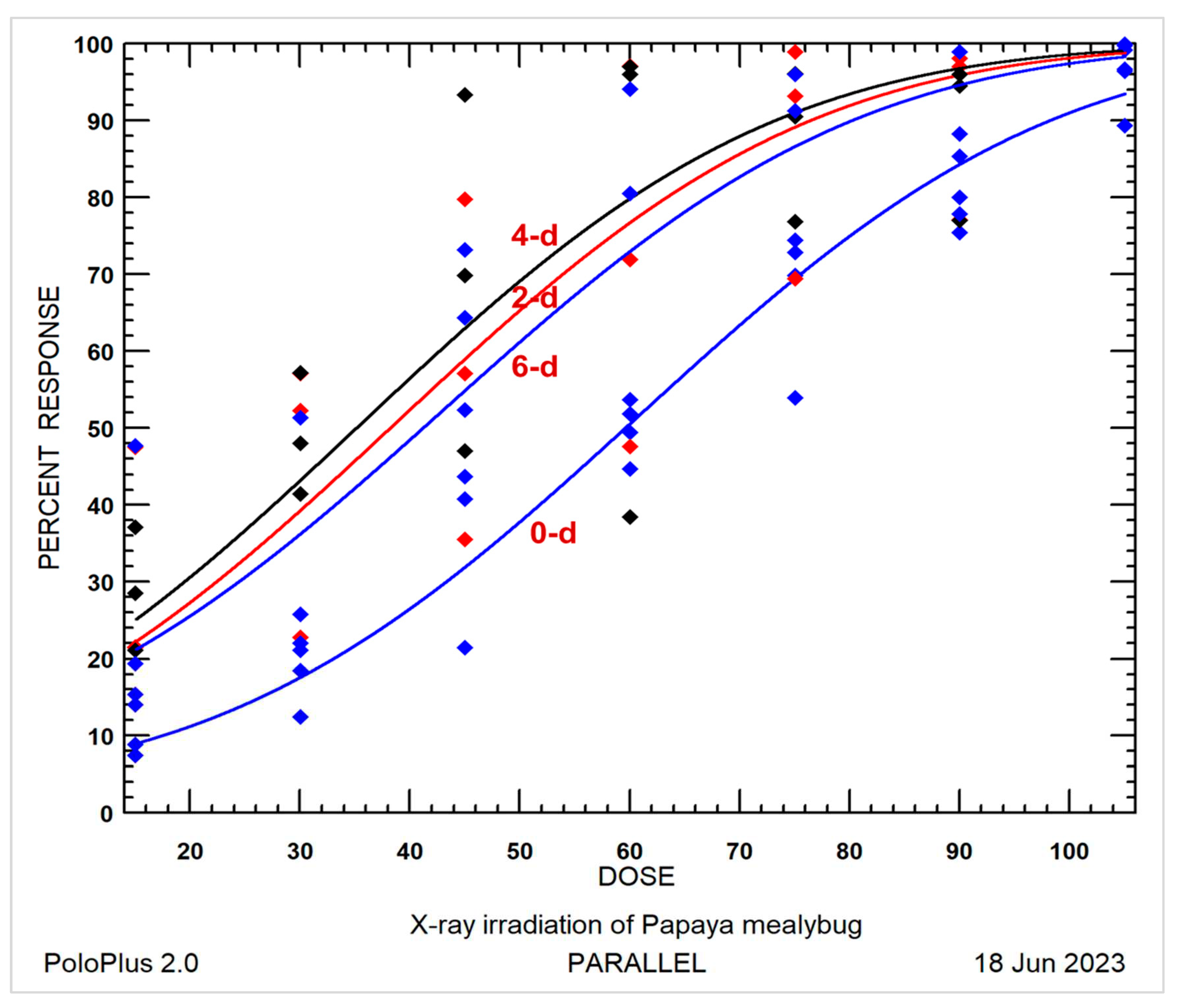
Figure 2.
Probit model expected dose-probit lines for 0-, 2-, 4-, and 6-d-old eggs of Paracoccus marginatus irradiated at the dose from 15 Gy to 105 Gy with intervals of 15 Gy.
Figure 2.
Probit model expected dose-probit lines for 0-, 2-, 4-, and 6-d-old eggs of Paracoccus marginatus irradiated at the dose from 15 Gy to 105 Gy with intervals of 15 Gy.
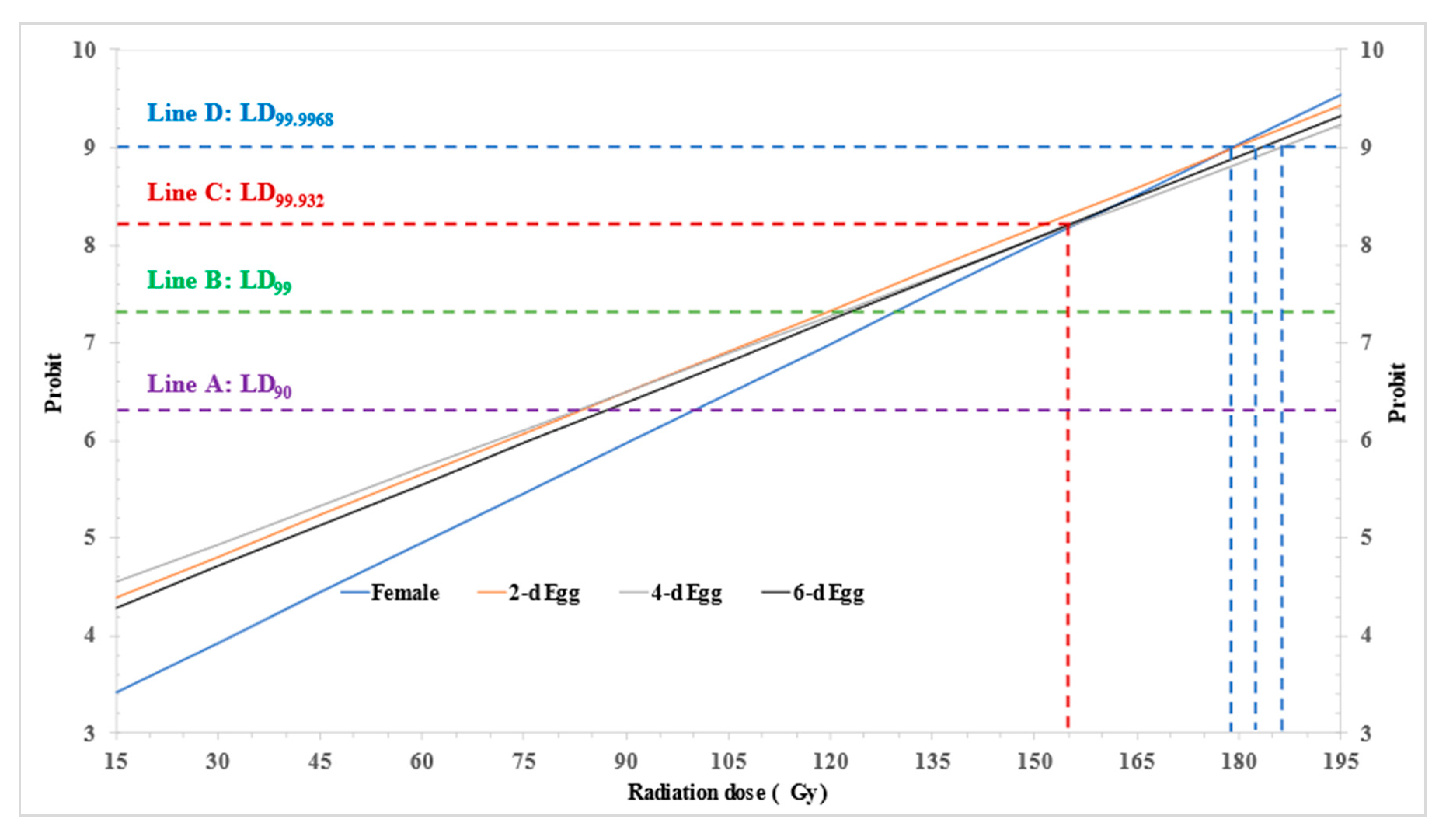

Table 1.
Result of two-way ANOVA on the number (mean ± SE, %) of Paracoccus marginatus eggs laid by females irradiated at different dose.
Table 1.
Result of two-way ANOVA on the number (mean ± SE, %) of Paracoccus marginatus eggs laid by females irradiated at different dose.
| Duration | Mean Number(±SE) of Eggs Laid by Irradiated Females a | |||||||
|---|---|---|---|---|---|---|---|---|
| 0 Gy | 15 Gy | 30 Gy | 45 Gy | 60 Gy | 75 Gy | 90 Gy | 105 Gy | |
| 0-2 d | 1305.0±98.1aA | 1339.3±191.9aA | 1250.5±151.8aA | 1163.8±132.0aA | 1457.0±97.4aA | 998.8±74.0aA | 1255.5±107.2aA | 1281.8±237.5aA |
| 3-4 d | 1139.8±186.0aA | 1311.5±322.9aA | 1215.8±340.9aA | 982.0±86.2aA | 1246.5±108.1aA | 869.8±29.0aA | 1145.5±108.7aA | 1228.8±211.5aA |
| 5-6 d | 189.0±11.0aB | 199.8±10.5aB | 186.5±11.5aB | 208.0±9.1aB | 198.8±13.0aB | 124.0±4.7aB | 95.8±8.9aB | 60.5±7.0aB |
aMeans followed by different upper-case letters (for age within a column) and lower-case letter (for dose within a row) are significantly difference (p < 0.05; Tukey test).
Table 2.
Result of two-way ANOVA on the corrected mortality (mean±SD, %) of Paracoccus marginatus eggs irradiated with X-rays at different dose.
Table 2.
Result of two-way ANOVA on the corrected mortality (mean±SD, %) of Paracoccus marginatus eggs irradiated with X-rays at different dose.
| Age | Mortality of age a | Corrected mortality (%) of eggs irradiated at dose b | ||||||
|---|---|---|---|---|---|---|---|---|
| 15 Gy | 30 Gy | 45 Gy | 60 Gy | 75 Gy | 90 Gy | 105 Gy | ||
| 0-d | 50.0±32.0b | 7.9±2.5eA | 16.9±5.0deB | 33.8±9.5cdeB | 47.5±2.6bcdA | 65.4±8.7abcA | 79.9±4.0abA | 98.6±1.3aA |
| 2-d | 68.6±28.7a | 29.6±12.4dA | 43.6±15.3cdAB | 57.1±18.2bcdAB | 72.0±20.4abcA | 87.2±12.9abA | 90.7±9.7abA | 100.0±0.0aA |
| 4-d | 71.9±27.8a | 28.7±6.5cA | 48.8±6.5bcAB | 70.0±19.0abAB | 77.2±27.5abA | 87.9±8.1aA | 90.7±6.5aA | 100.0±0.0aA |
| 6-d | 65.4±30.2a | 23.9±15.1cA | 28.1±14.8bcA | 61.5±9.9abA | 75.0±17.6aA | 86.1±10.5aA | 87.8±9.1aA | 95.1±4.6aA |
a Means (±SD, %) followed with different upper-case letters (for each age within a column) and lower-case letter (for dose within a row) are significantly difference (p < 0.05; Tukey test). b Mean mortality (±SD, %) of ages followed by different letters in the same row are significantly different (p < 0.05, Tukey test).
Table 3.
Probit analysis on prevention of egg-hatch when the gravid females and 2-,4-,6-d-old eggs of Paracoccus marginatus were irradiated with X-rays.
Table 3.
Probit analysis on prevention of egg-hatch when the gravid females and 2-,4-,6-d-old eggs of Paracoccus marginatus were irradiated with X-rays.
| Age (days) | No. eggs | Slope ± SE | Intercept ± SE | Estimating LDs and 95% CI (Gy) a | Hetero-geneity b | ||
|---|---|---|---|---|---|---|---|
| LD90 | LD99 | LD99.9968 | |||||
| 0-d | 53,249 | 0.034 ± 0.000 | -2.090 ± 0.022 | 97.8 (92.0 – 05.4)a | 128.2 (118.7 – 141.0)a | 176.7 (160.7 – 198.9)a | 79.4 |
| 2-d | 2,247 | 0.028 ± 0.001 | -1.030 ± 0.069 | 82.0 (70.5 – 102.5)bc | 119.1 (99.6 – 157.7)b | 178.5 (144.4 – 248.0)a | 14.4 |
| 4-d | 2,095 | 0.026 ± 0.001 | -0.843 ± 0.070 | 80.2 (67.6 – 104.7)c | 119.7 (97.7 - 168.2)b | 182.9 (143.8 – 272.1)a | 15.5 |
| 6-d | 2,195 | 0.028 ± 0.001 | -.130 ± 0.077 | 87.1 (76.0 – 105.0)b | 124.8 (106.4 – 158.3)ab | 185.2 (153.2 – 245.5)a | 11.1 |
a LD90, LD99 and LD99.9968 are the lethal dose leading to 90, 99, and 99.9968% mortality at 95% CL of P. marginatus egg calculated with probit model (PoloPlus 2.0). Within a column, estimating LD values followed by different letters are significantly different (p < 0.05, LDR test). b Chi-square (χ2) divided by the degree of freedom.
Table 4.
Pairwise comparison of LDR for the different aged eggs of Paracoccus marginatus treated with X-rays irradiations.
Table 4.
Pairwise comparison of LDR for the different aged eggs of Paracoccus marginatus treated with X-rays irradiations.
| Reference Age (Days) | Pairwise Age (Days) | 95% CI of Lethal Dose Ratio | ||
|---|---|---|---|---|
| LD90 | LD99 | LD99.9968 | ||
| 0-d | 2-d | 1.25×10¹² – ∞ | 273.36 – 4.24×10¹⁵ | 0.00 – 7.55×10⁹ |
| 4-d | 4.49×10¹³ – ∞ | 13.80 – 6.31×10¹³ | 0.00 – 1.18×10⁷ | |
| 6-d | 7.89×10⁶ – 4.78×10¹⁴ | 0.00 – 1.73×10¹⁰ | 0.00 – 4.59×10³ | |
| 2-d | 4-d | 0.00 – 1.38×10⁷ | 0.00 – 1.44×10⁹ | 0.00 – 1.17×10¹³ |
| 6-d | 0.00 – 1.86 | 0.00 – 5.28×10³ | 0.00 – 8.80×10⁹ | |
| 4-d | 6-d | 0.00 – 0.04 | 0.00 – 6.54×10⁴ | 0.00 – 2.79×10¹⁵ |
Table 5.
Results of the large-scale confirmatory tests of Paracoccus marginatus adult females reared on sprouting potatoes using gamma irradiation.
Table 5.
Results of the large-scale confirmatory tests of Paracoccus marginatus adult females reared on sprouting potatoes using gamma irradiation.
| Irradiation Date | Absorbed Dose (Gy) | DUR | No. Potatoes | No. Females | F1 Generation Eggs | |
|---|---|---|---|---|---|---|
| No. a | Mortality (%) | |||||
| Feb. 13, 2023 | 150.4 – 183.6 | 1.22 | 439 | 9,992 | 2.5×10⁶ | 100 |
| control | 0 | - | 60 | 2,056 | 5.2×10⁵ | 2.84 |
| Apr. 10, 2023 | 146.8 – 185.0 | 1.26 | 817 | 50,376 | 1.3×10⁷ | 100 |
| control | 0 | - | 75 | 4,749 | 1.2×10⁶ | 3.13 |
a Total number of eggs was estimated using 255 eggs per female as the average value, which was obtained from a total of 720 females in table 1.
Disclaimer/Publisher’s Note: The statements, opinions and data contained in all publications are solely those of the individual author(s) and contributor(s) and not of MDPI and/or the editor(s). MDPI and/or the editor(s) disclaim responsibility for any injury to people or property resulting from any ideas, methods, instructions or products referred to in the content. |
© 2023 by the authors. Licensee MDPI, Basel, Switzerland. This article is an open access article distributed under the terms and conditions of the Creative Commons Attribution (CC BY) license (http://creativecommons.org/licenses/by/4.0/).
Copyright: This open access article is published under a Creative Commons CC BY 4.0 license, which permit the free download, distribution, and reuse, provided that the author and preprint are cited in any reuse.


