

Submitted:
05 July 2023
Posted:
06 July 2023
You are already at the latest version
Abstract
Within this paper, electro-mechanical long-term tests on a thrust bearing are presented. The effects of an additional electrical load on the bearing raceways and the used lubricant are investigated. Chemical and rheological investigations are presented which show the changes in the lubricant. These investigations are compared with the electrical loads and the occurring raceway damage. In addition, a comparison is made with mechanical reference tests. This procedure makes it possible to classify the changes that occur due to the electrical load and to distinguish the effects from each other.
The background to these investigations is the increased occurrence of parasitic currents in electric motors, which can lead to damage to machine elements. The phenomena that occur here are new challenges in the development of drive trains.
Keywords:
Bearing currents
; electrical properties of lubricants
; influence analysis
1. Introduction
Due to the increasing use of AC machines in combination with fast-switching frequency converters, there is an increased electrical load on machine elements (cf. summary according to [1, 2]). In this case, the parasitic current flows mostly via the tribological contacts. As a result of the interaction between this additional electrical and the mechanical load on the contact, the components can be damaged and their service life reduced [3-5]. This affects not only the metallic raceway surfaces of bearings and gears, also the lubricant which separates the contact partners is affected to [6-8]. Therefore the lubricant must also be considered as an electrical component.
The most important electrical parameters of the lubricants are::
- The relative permittivity εr gives the electrical polarisation of a dielectric.
- The breakdown field strength E (also breakdown voltage) indicates the highest field strength that can be applied to a material without it failing as an insulating medium.
- The specific electrical resistance ρ or its reciprocal, the electrical conductivity κ, describe the electrical conductivity of a material.
In addition, a rough distinction is made between high- and low-resistance lubricants [9, 10].
In combination with the rheological lubricant properties (such as viscosity and density), these electrical variables influence the properties and effects of the bearing currents. Another component influencing the properties are possible additives in the lubricant. Even with purely mechanical loads, individual additives or combinations of various additive packages can influence the service life of a lubricant both positively and negatively. In the context of the increasing electrification of powertrains, the demands on lubricants have increased even further [11]. The choice of lubricant can influence both the magnitude of the bearing stress amplitude [5, 6, 9, 12, 14] and the damaging effects on the rolling bearing components [5, 11, 14-16]. Here, for example, investigations on single-contact test rigs show increased wear under combined electro-mechanical load depending on the lubricant [15]. So-called "tribo-electro-chemical" reactions also occur [7]. These describe the interaction between the conditions in the tribological contact, the external electrical load and the resulting changes in the lubricant chemistry. Both the processes of absorption/desorption of the additives in the electric field and an influence of the reactions of the lubricant with the contact surface by the passage of electric current should be mentioned [7]. These are shown, for example, by changes in the lubricant at the molecular level [17] (the changes observed here led to an increased occurrence of white etching cracks). Furthermore, the electrical and dielectric properties can also be influenced by the addition of additives [8].
In the context of investigations with electrically loaded lubricants, infrared spectroscopy (IR-spectroscopy) was successfully used for analysis by [10, 18-20]. Here, however, partly contradictory results are shown depending on the author.
In the context of the investigations presented here, results from long-term tests are presented in which, in addition to the electro-mechanical damage to the rolling surfaces, the lubricant is also investigated.
2. Materials
A thrust bearing test rig is used to investigate the issue specified here. This was developed as part of the research project [5] and allows the targeted investigation of the interaction between mechanical and electrical loads. This test adapter with the designation GESA (ger. Gerät zur erweiterten Schmierstoffanalyse - device for advanced lubricant analysis) can be operated in a four-ball apparatus. The reliability and quality of this test system has been demonstrated in a large number of publications [6, 21-24]. A schematic sketch of the test fixture is shown in Figure 1.
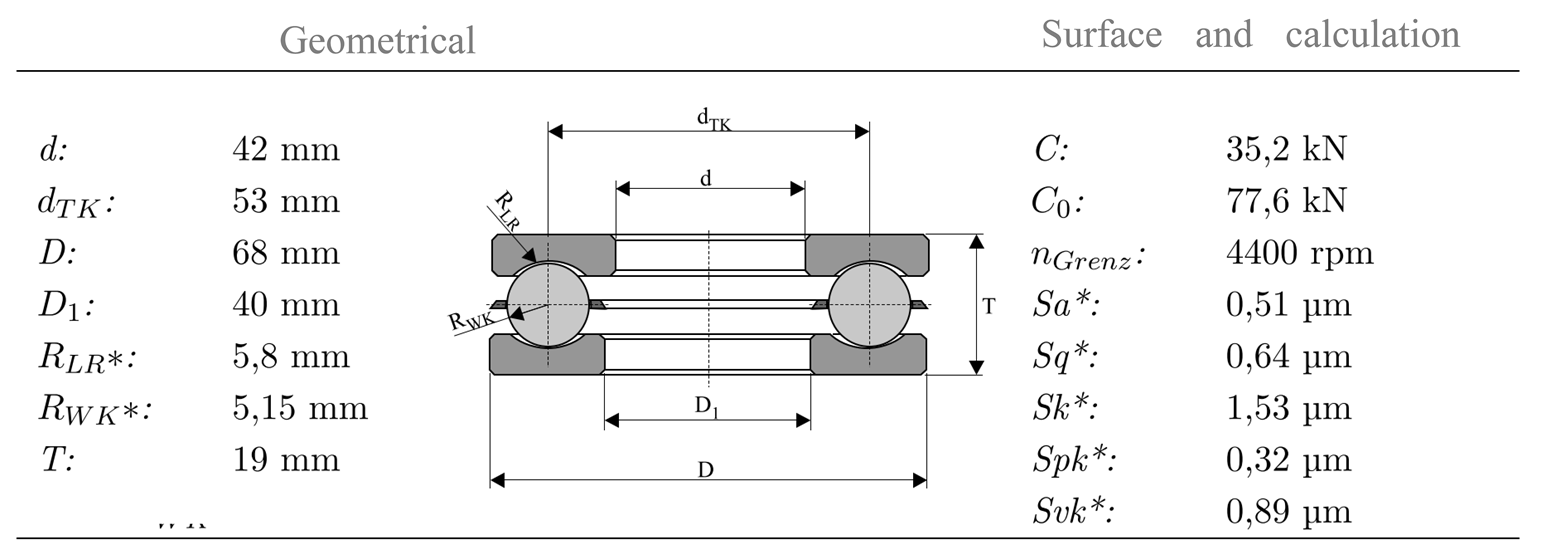
A thrust bearing of type 51208 (cf. Table 1) and a non-additivated mineral oil with the designation OF 1.1 (cf. Table 2) serve as the test objects in this case.
The applied electrical load corresponds to a common-mode voltage whose frequency and voltage amplitude can be adjusted. A specially developed signal generator is used for this purpose. This allows the rolling bearing to be subjected to an electrical load comparable to that in the real electrical machine.
3. Experiment Description and Boundary Conditions
The following tests are carried out on the test set-up described above. A constant load is applied over the duration of the test and the long-term effects of these loads on the test specimen (thrust bearing 51208 and lubricating oil OF 1.1) are investigated. Figure 2 shows an example of the basic test procedure including the measured variables. At the beginning, the surfaces of the raceways of the axial bearings are examined and recorded with a microscope. In order to create comparable conditions for all tests, the actual test is preceded by a mechanical running-in phase that is identical for all test specimens. During this phase, the roughness peaks of the raceway surfaces are smoothed and a constant mechanical-electrical behaviour is established [6, 21, 23]. As operating conditions, an operating time of 16 h, an axial load of 2400 N and a speed of 1000 rpm have proven themselves. The lubricant used is further tempered to 40 °C and corresponds to the same type that is also used in the load phase. There is no electrical load within the run-in.
These preparatory steps are followed by the actual test run, which lasts 168 hours. For this purpose, the test cell is cleaned beforehand and the run-in test specimen is supplied with fresh lubricating oil. Furthermore, the boundary conditions of the individual test runs are applied. These boundary conditions are listed in Table 3 together with the designation of the individual tests. After completion of the loading phase, the test cell is dismantled and the loaded lubricant is filled for further oil analysis. In addition, the bearings are inspected and the surface changes are documented. During the running-in phase and the load phase, various measured variables are recorded. Furthermore, in the case of additional electrical load, the bearing currents and bearing voltages are recorded. By selecting the test parameters according to Table 3, the influence of various variables and their effects on the test specimen are to be determined with as few tests as possible. Furthermore, the results from endurance tests known from the literature should be taken into account when selecting the operating conditions.
So far, tests have mainly been carried out at low load ratios of the rolling bearings (𝐶0/𝑃 ≤ 32). Accordingly, the mechanical load points applied for this series of tests were selected so that higher load conditions occur in the rolling contact. For this purpose, the following three primary test series were defined:
- Test series A – axial load 4000 N (𝐶0/𝑃 19)
- Test series B – axial load 6000 N (𝐶0/𝑃 13)
- Test series C – axial load 8000 N (𝐶0/𝑃 10)
The operating speed for each test was 1000 min-1 at partly different lubricant temperatures (40 °C and 80 °C). As a result of these mechanical operating conditions, the loads and lubricant film heights in the tribological contact listed in Table 4 occur mathematically. In order to be able to distinguish the electrical changes from normal, purely mechanical changes, mechanical reference tests are carried out in each test series. These serve as a basis for assessing and interpreting the combined mechanical and electrical loads. Based on this reference, each test series is loaded with the electrical peak-to-peak voltage of 60 V (corresponding to the DC link voltage reduced by the BVR) at 20 𝑘𝐻𝑧 switching frequency. This basic test should allow conclusions to be drawn about the interaction of mechanical load, lubricant film height and the electrical load parameters in relation to the changes in the rolling bearing components and the lubricant.
Test series A (4000 N / 𝐶0/𝑃 19) is then subjected to a voltage variation of 40 V or 20 V common mode voltage at the bearing. The aim here is to investigate the effects of the voltage amplitude on the surface change. Furthermore, the influence of the lubricant temperature is also investigated in this series of tests. Increasing the temperature leads to a decrease in the breakdown voltage as well as to a strong reduction of the lubricant film. Both effects lead to a current transfer in the contact at a lower voltage amplitude. A mechanical reference test is also carried out at increased temperature as part of this series of tests. To check the reproducibility of the tests, the test configuration A-e3 is repeated under the same conditions (A-e3-a / A-e3-b).
Test series B (6000 N / 𝐶0/𝑃 13) is also carried out with increased lubricant temperature in order to investigate the interaction due to the increase in the Hertzian contact area with the resulting decrease in bearing current density (with identical source voltage applied to the bearing). Furthermore, an additional test with reduced clock frequency of 5 𝑘𝐻𝑧 is carried out and it is determined whether there is a correlation with the degree of the observed changes.
Test series C (8000 N / 𝐶0/𝑃 10) is intended to show the influence of further increased contact pressures. No further variation takes place within this test series. Table 4 summarises the mechanical parameters for interpreting the loads in the rolling contact for the individual test series.
4. Results
4.1. Electrical Load over Time
In order to ensure comparability with endurance tests known from the literature, the known design parameters are listed in Table 5 as an average over the entire test. In addition to the mean apparent bearing current density and the mean bearing apparent power, the electrical bearing stress W defined according to [18] is also given here.
Furthermore, the electrical stresses for the individual tests are visualised in Figure 3 by means of the boxplots known from statistics. Here, the standard deviation is not shown due to the exponential distribution of the data and instead the 25 % and 75 % quantiles are used. The reason for this is that these statistical parameters better indicate a rightward or leftward skew in the data distribution. This representation allows a compromise between the singular characteristic value from Table 5 and a detailed oscillographic representation at several test times.
It is evident from the electrical loads that occur that they are predominantly within the permitted limits for the electrical bearing power and the apparent bearing current density.
4.2. Occuring Surface Changes
The surface changes that occur in the bearing raceways and the rolling elements are a result of the acting mechanical and electrical loads. The interaction between the tribological condition of the contact and the resulting electrical substitute system must be taken into account. Thus, a change in the tribological behaviour of the rolling contact can occur due to the electrically induced surface mutation, which in turn influences the type of bearing current. Furthermore, the degree of damage to the bearing is classified by the type of surface change that occurs. Investigations into how the surface changes that occur during gray frosting affect the further service life of a rolling bearing are the subject of current research, such as [26].
Compared to long-term tests known from the literature, this work focused exclusively on tests with a high mechanical load (𝐶0/𝑃 < 20). Regardless of the high load, every possible surface change that could occur in the context of an electromechanical load was also detected in these tests. Figure 4 shows exemplary macroscopic and microscopic images of the bearing raceways and rolling elements that occurred after the tests. In order to establish a reference to the influence of the electrical load, a picture of a purely mechanically loaded bearing is also shown (cf. Figure 4 a Rolling bearing raceway and rolling elements). In addition to the clear surface conditions such as grey frosting (cf. Figure 4 a EDM or ohmic based) and fluting (cf. Figure 4 c), very fine periodically changing surface changes could also be detected (cf. Figure 4 d). These are strongly reminiscent of the familiar flutings in their type and characteristics, but are much less pronounced and occur in the form of shading of raceways and rolling elements. This surface change will be referred to as fluting shading in the further course of the work. Whether this is a possible preliminary stage of fluting was not the focus of the tests carried out. Furthermore, circular ring-shaped structures appeared on individual rolling elements (cf. Figure 4 e) as well as on the raceways (cf. Figure 4 f). These are characterised by an undamaged surface being surrounded by a circle of densely grouped craters. The shape and structure of these surrounding craters resembled those known from EDM currents. When this phenomenon occurred, only individual sections of the raceways or individual rolling elements were affected, but here there was an increased occurrence of these structures. These circular rings of craters are referred to in the following as bearing current marks. Based on the surface changes that occur, as shown in Figure 4, the different final states of the bearing surfaces are described below. Table 6, for example, shows which surface mutation has occurred on the individual components of the contact partners of the test bearings at the end of the respective tests.
4.3. IR Spectroscopy
The examination of the contaminated oils showed an IR index greater than 99 % for all tests. This means that each individual transmission diagram deviates at most 1 % from the reference sample. For clarification, the individual measured spectra are summarised in Figure 5. In addition to the fresh oil curve, the total minima, maxima and mean values over all tests are shown. This shows that there is no significant influence of the lubricant within the scope of this test series, which could be detected by IR spectroscopy. In [18, 19] contrary results are published. In [18], a degradation of carboxylic acids (COOH group) could be determined in the grease used. This correlated to the level of bearing stress and thus to the electrical load.
In contrast, there are experimental results from [10, 20], which correspond to the results presented here. In the spectroscopies carried out there, no deviation of the spectra between fresh and electrically loaded oil and consequently also no correlation between current passage and lubricant ageing could be determined. Surface changes were also observed in both studies, which are comparable to those presented in Figure 4. Accordingly, the IR in the present case is inconspicuous and inconclusive with regard to an assessment of the electrical ageing of lubricants.
4.4. Chemical Wear Elements (Table 7) and Contaminants (Table 8)
The detailed analysis for contamination identifies the impurities visible to the naked eye in test series C as iron particles from bearing raceways and rolling elements. This is due to the chipping and pitting visible in the macroscopic observation of the bearing rings in this test series. In the other tests, the iron value as a wear indicator is in the low two-digit range. In individual tests (A-m1, A-e3-b and C-e1) an increased silicon concentration can be observed. The most probable cause for this is contamination of the lubricant by abrasion of the slip ring carrier. A connection with the degree of electrical load and the concentration of wear particles cannot be clearly proven within the framework of this series of tests.
5. Viscosity (Table 9)
The measured viscosity of all tests fluctuates slightly (≤ 3 %) around the value of the reference sample of 105 mm2/s. However, there is an exception. However, there is one exception. Test A-e2 shows a significantly lower viscosity (40°C) of 92.2 mm2/s. This deviation of about 13 % is considered an outlier, especially considering the second viscosity measurement at 80°C, which with 10.78 mm2/s is within the scatter of the tests. Based on this, it can be assumed that there was no influence on the viscosity in the present tests.
6. Conclusions
On the basis of the investigations carried out here on the electrical load and the interaction with the changes occurring on the components in the current flow, the following partial statements and assessments of the evaluations made can be made:
Electrical load over the test period - significant
During the evaluation of the tests, different methods of visualising and documenting the electrical load over time were recorded. In terms of their level of detail, these range from a single characteristic value for the entire test to a time-resolved frequency distribution of electrical events per test. Furthermore, the known dimensioning parameters such as bearing current density, bearing apparent power and bearing stress were also determined here. A comparison of these characteristic values with the stress limits known from the literature showed that the loads only exceeded the lower design characteristic values (bearing current density, bearing apparent power, bearing stress) for individual rare events. Despite this low load, critical surface damage, such as corrugations, occurred in the tests. [27] provides a possible explanation for this. It was observed here that when transferring the dimensioning parameters determined for a specific radial deep groove ball bearing to other bearing sizes, there are inconsistencies in the limit loads. Due to the use of the axial bearing, it is therefore unclear whether the limiting loads determined on a radial deep groove ball bearing also apply to this bearing type. The identical problem is also evident when using the bearing apparent power as a design variable.
As a compromise between a one-dimensional characteristic value and a more detailed frequency evaluation, a boxplot representation similar to [28] was established, which allows the evaluation of the test.
Change in the rolling surface - significant
Changes occurred in the surface topographies of both the raceways and the rolling elements as a result of the electrical loads. These differed significantly from the topographies of the purely mechanical reference tests. The subjective evaluation of the surfaces by means of a light microscope (cf. Figure 4) shows that with increasing electrical load, the running track takes on an increasingly silvery sheen in which the machining grooves and running-in marks, as in the surrounding area, are no longer visible. This phenomenon is called grey frosting. In the majority of the present tests, the grey frosting was accompanied by a strong smoothing of the surfaces, the cause of which is assumed to be an ohmic current flow. Furthermore, these tests also showed that the smoothing is more pronounced on the stationary ring than on the rotating ring (cf. Table 6). In a stub test (B-e2 ) with reduced switching frequency, a grey running track was also observed, but this stood out from the rest of the track due to a clustering of individual discharge craters. Likewise, fluting appeared on the raceway in test A-e1. Accordingly, even at low C0/P ratios, all known surface changes associated with parasitic bearing currents could be observed. In addition, so-called bearing current marks occurred in isolated cases (cf. Figure 4 e and f). Furthermore, fluting shading was also observed.
Lubricant analysis - further research necessary
The analytical methods used showed no clear influence of an electrical load on the lubricant used. The IR spectroscopy as well as the rheological properties are approximately at the level of a fresh oil sample and are comparable to the mechanical reference tests. In the tests with chipping on the bearing, increased values of iron abrasion were observed. Furthermore, an increased concentration of silicon was present in selected tests. The reason for this is most likely an increased abrasion of the slip ring. Accordingly, an interaction between the electrical load and damage to the lubricant could not be determined with the analyses carried out, despite clear electrical surface damage. Even though the lubricant analysis was not the focus of the present work, it is evident that IR spectroscopy shows ambiguous results in the context of an electrical load (cf. [10, 18 -20]) and a correlation of different wear particles to the electrical load could not be established in the context of these tests. Whether further analyses (such as Remaining Useful Live Evaluation Routine (RULER) test, Nuclear Magnetic Resonance (NMR) spectroscopy or dielectric spectroscopy) can detect the influence of the electrical load and which interactions occur between individual additives and the electrical fields resulting from the electrical load is not shown by the series of tests presented here.
Acknoladgement: This work was carried out within the framework of the projects "Model for determining the thermal stress of lubricants as a result of mechanical and electrical loads in rolling contact" (Project No.SA898/25-1 / 407468812) and "Determination of ball bearing impedances under steady state operating conditions by means of a further developed rolling contact model at full film lubrication" (Project No.SA898/32-1 / 470273159). Booth financially supported by the Deutsche Forschungsgemeinschaft (DFG) e.V. (German Research Foundation).
References
- Schneider V, Behrendt C, Höltje P, Cornel D, Becker-Dombrowsky FM, Puchtler S, Gutiérrez Guzmán F, Ponick B, Jacobs G, Kirchner E. Electrical Bearing Damage, A Problem in the Nano- and Macro-Range. Lubricants. 2022; 10(8):194. [CrossRef]
- Graf, S.; Capan, R.; Koch, O.;Sauer, B.; Electrically induced damage of rolling bearings due to parasitic converter currents in electrical drive trains. 7. International Commercial Vehicle Symposium. 2022. Kaiserslautern. ISBN 978-3-658-40782-7. [CrossRef]
- Zika, T.: Electric discharge damaging in lubricated rolling contacts, Dissertation, Technische Universität Wien, Wien, 2010.
- M. Kriese, E. Wittek, S. Gattermann, H. Tischmacher, G. Poll and B. Ponick, "Influence of bearing currents on the bearing lifetime for converter driven machines," 2012 XXth International Conference on Electrical Machines, Marseille, France, 2012, pp. 1735-1739. [CrossRef]
- Bechev, D.; Weiker, M.; Sauer, B.; Binder, A.: Abschlussbericht FVA 650 II Schädlicher Stromdurchgang 2, Forschungsvereinigung Antriebstechnik e.V, Heft 1387, Frankfurt, 2020.
- Gonda, A.; Capan, R.; Bechev, D.; Sauer, B.: The Influence of Lubricant Conductivity on Bearing Currents in the Case of Rolling Bearing Greases. Lubricants 2019, 7, 108.
- Spikes, H. A.: Triboelectrochemistry: Influence of Applied Electrical Potentials on Friction and Wear of Lubricated Contacts. Tribology Letters (2020) 68:90.
- García Tuero, A.; Rivera, N.; Rodríguez, E.; Fernández-González, A; et al. Influence of Additives Concentration on the Electrical Properties and the Tribological Behaviour of Three Automatic Transmission Fluids. Lubricants 2022, 10, 276. [CrossRef]
- Weicker, M.: Gleichtakteffekte bei umrichtergespeisten Elektromotoren. Diss., Technische Universität Darmstadt, 2021. [CrossRef]
- Phrashad H.: Tribology in Electrical Environments, Elsevier, Amsterdam, 2006.
- Chen Y, Jha S, Raut A, et al. Performance Characteristics of Lubricants in Electric and Hybrid Vehicles: A Review of Current and Future Needs. (2020) Front. Mech. Eng. 6:571464. [CrossRef]
- Tischmacher, H.; Gattermann, S.: Einflussgrößen auf Lagerströme bei umrichtergespeisten Elektromotoren, VDI-Berichte 2202 (2013), S. 45-59.
- Durkin, W.; Fish, G.; Dura, R.; et al.: Compositional Effects on the electrical properties of Greases. (2022) elgi Eurogrease Q2, Hamburg (Germany).
- Esmaeili, K.; Wang, L.; Harvey, T.J.; et al. Electrical Discharges in Oil-Lubricated Rolling Contacts and Their Detection Using Electrostatic Sensing Technique. Sensors 2022, 22, 392. [CrossRef]
- Erdemir, A.; Farfan-Cabrera, L.; Anderson, W. B.; et al.: Comparative Tri Comparative Tribological Properties of Commercial Drivetrain Lubricants Under Electrified Sliding Contact Conditions. 2nd STLE Tribology & Lubrication for E-Mobility Conference. Online. 2022.
- Radnai, B., Gemeinder, Y., Sauer, B., Binder, A.: Abschlussbericht FVA 650 I Schädlicher Stromdurchgang 1, Forschungsvereinigung Antriebstechnik e.V, Heft 1127, Frankfurt, 2015.
- Holweger, W.; Bobbio, L.; Mo, Z; et al.: A Validated Computational Study of Lubricants under White Etching Crack Conditions Exposed to Electrical Fields. Lubricants 2023, 11, 45. [CrossRef]
- Muetze, A.: Bearing Currents in Inverter-Fed AC Motors, Dissertation, TU Darmstadt D 17, Shaker Verlag, Aachen, 2004.
- Recker, C.; Weicker, M.: Einfluss der elektrischen Schmierfettleitfähigkeit auf die Ausbildung von Lagerströmen bei umrichterbetriebenen 1,5kW-Asynchronmotoren, Aachen, 2022. 5. VDI-Fachkonferenz - Schadensmechanismen an Lagern.
- Jagenbrein, A.: „Investigations of bearing failures due to electric current passage“. Diss., Technische Universität Wien, 2005.
- Bechev, D.: „Prüfmethodik zur Charakterisierung der elektrischen Eigenschaften von Wälzlagerschmierstoffen“. Diss., Technische Universität Kaiserslautern, 2020.
- Bechev, D.; Kiekbusch, T.; Sauer, B.: Characterization of electrical lubricant properties for modelling of electrical drive systems with rolling bearings, In: Bearing World Journal Volume 3, VDMA Verlag GmbH, Frankfurt am Main, 2018.
- Graf, S.; Werner, M.; Koch, O.; Götz, S.; Sauer, B.; Breakdown voltages in thrust bearings: Behavior and Measurement, Tribology Transactions (2023). [CrossRef]
- Graf, S.: Charakterisierung und Auswirkungen von parasitären Lagerströmen in Mischreibung. Dissertation. RPTU Kaiserslautern-Landau (2023).
- Hamrock J, B.; Dowson, D.: „Isothermal elastohydrodynamic lubrication of point contacts III: Fully Flooded Results“. Journal of Lubrication Technology 99 (1) (1977), S. 264–275.
- Schneider, V.; Stockbrügger, J. O.: FVA 863 I - Stromdurchgang am Wälzlager. Frankfurt: FVA-Heft Nr. 1501, 2022.
- Gemeinder, Y.: Lagerimpedanz und Lagerschädigung bei umrichtergespeisten Antrieben. Dissertation, Technische Universität Darmstadt. 2016.
- Joshi, A.: „Electrical Characterisations of Bearings“. Diss., Chalmers University of Technology, 2019.
Figure 1.
Sectional view of GESA (1 distributing ring / 2 driving shaft / 3 centering ball / 4 shaft / 5 housing / 6 tested bearing / 6a rotating ring / 6b rolling element / 6c stationary ring / 7 bearing ring holder).
Figure 1.
Sectional view of GESA (1 distributing ring / 2 driving shaft / 3 centering ball / 4 shaft / 5 housing / 6 tested bearing / 6a rotating ring / 6b rolling element / 6c stationary ring / 7 bearing ring holder).
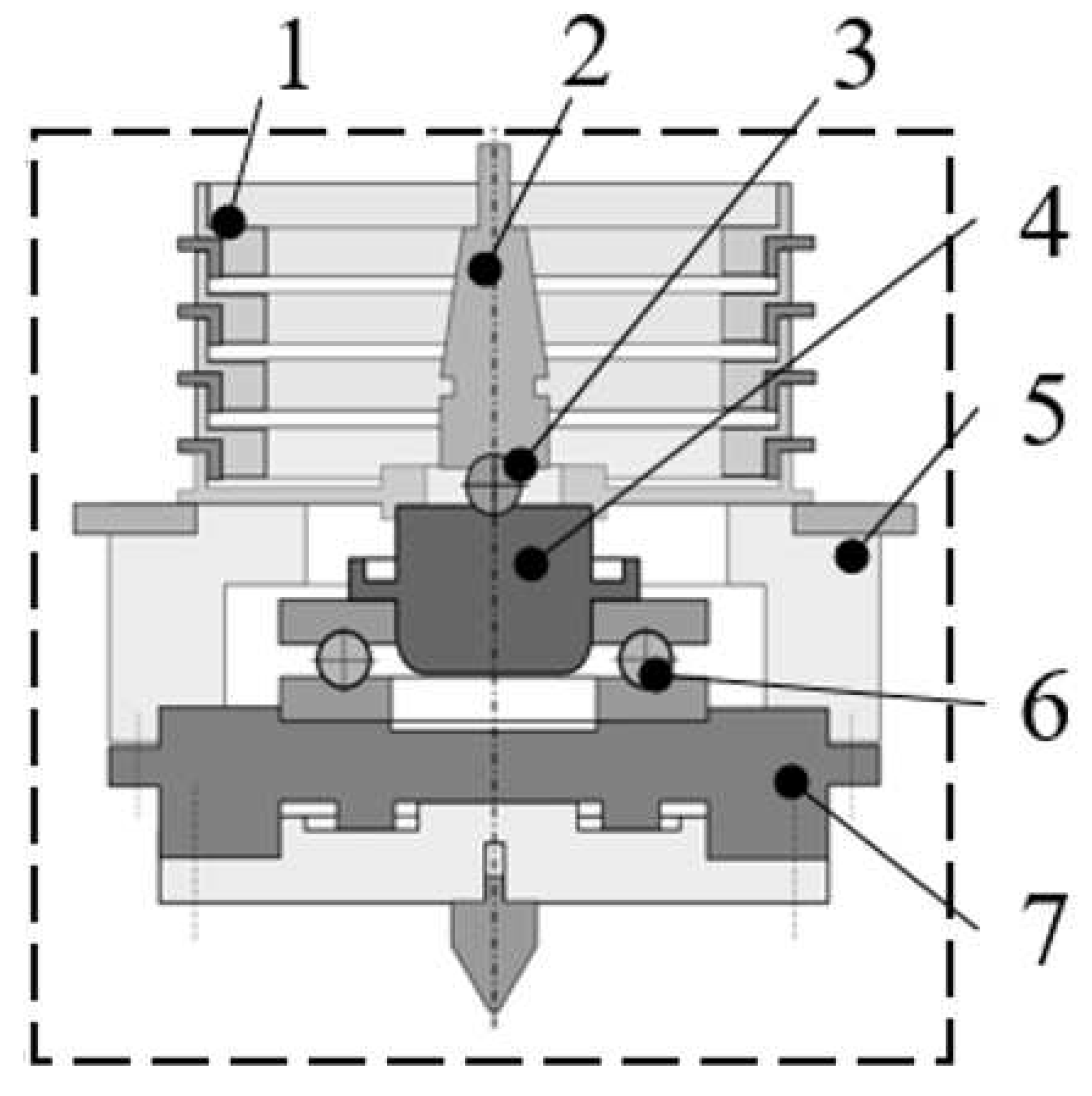
Figure 2.
Schematic representation of the test sequence of the endurance tests with indication of the individual individual measured variables.
Figure 2.
Schematic representation of the test sequence of the endurance tests with indication of the individual individual measured variables.
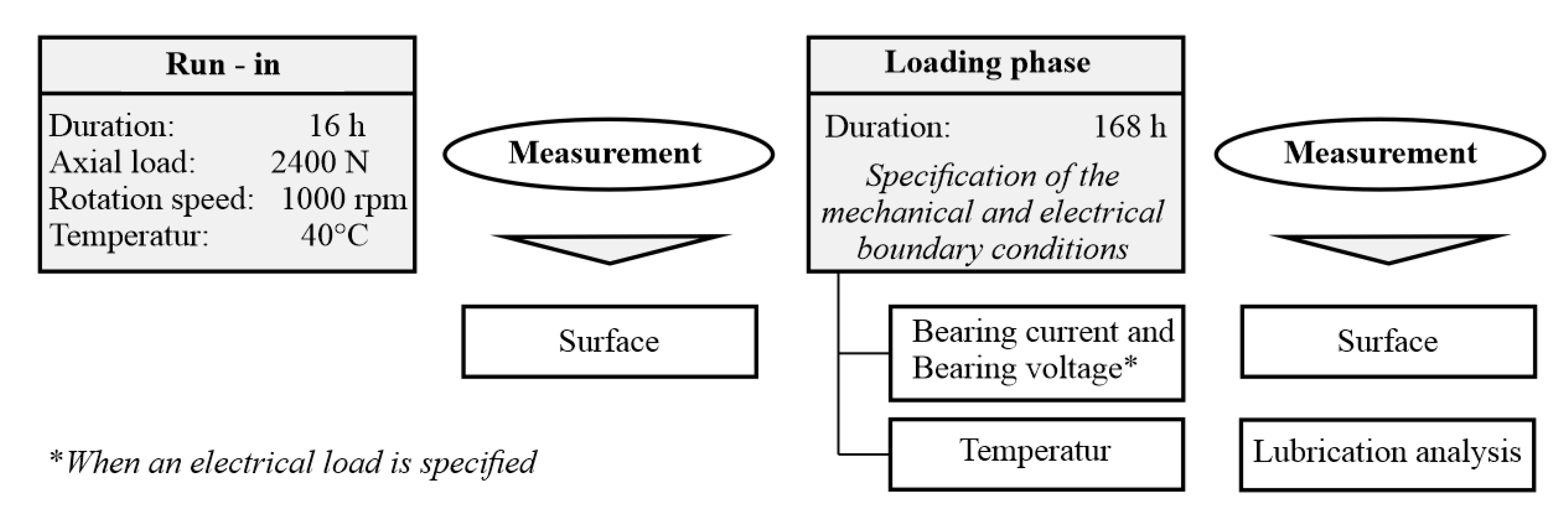
Figure 3.
Representation of the boxplots of the individual tests for bearing apparent power and bearing current density with minimum value, 25 % quantile, mean value, 75 % quantile and maximum value.
Figure 3.
Representation of the boxplots of the individual tests for bearing apparent power and bearing current density with minimum value, 25 % quantile, mean value, 75 % quantile and maximum value.
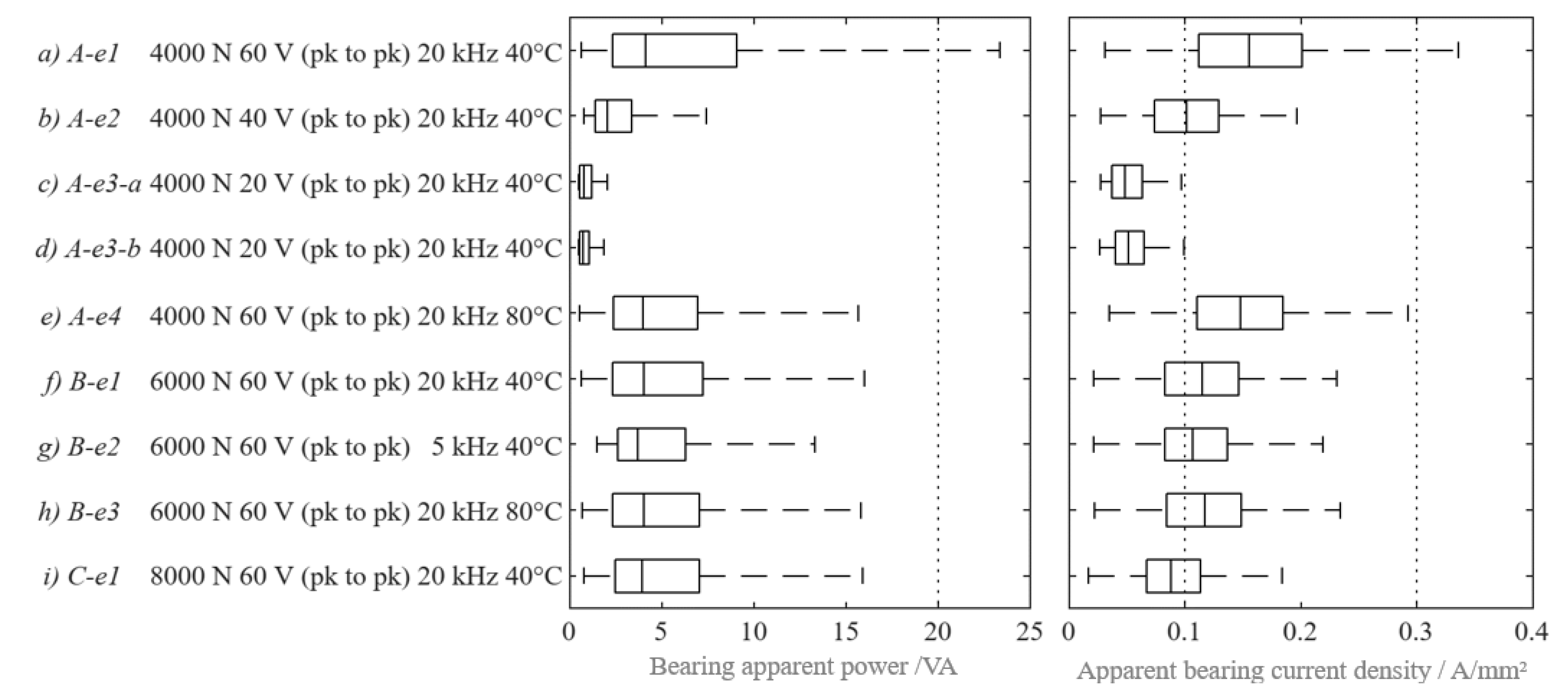
Figure 4.
Surface changes that occurred during the endurance tests.
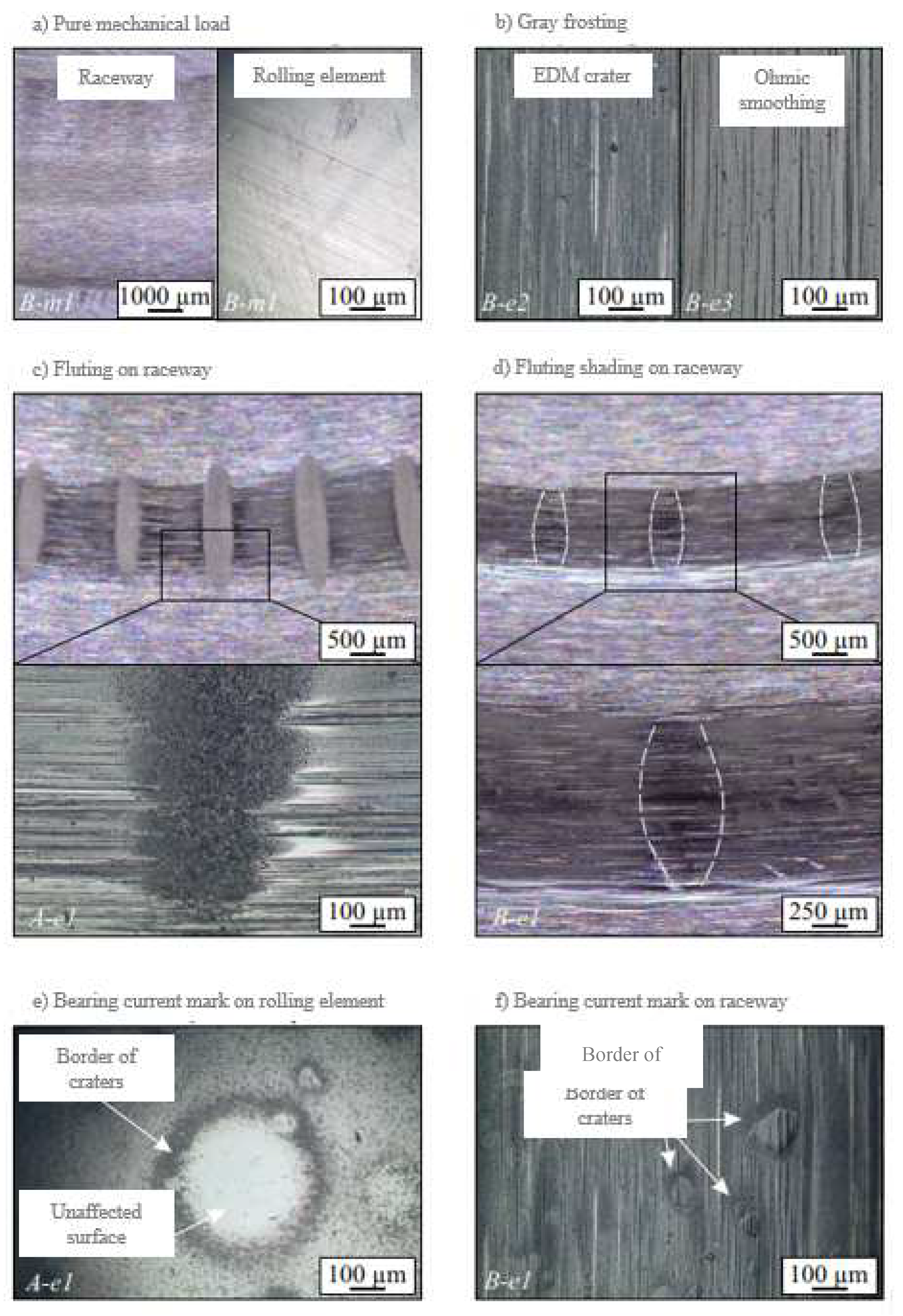
Figure 5.
Comparison of the IR spectroscopies of the unloaded reference sample with the Minimum, maximum and mean values of all loaded oil samples.
Figure 5.
Comparison of the IR spectroscopies of the unloaded reference sample with the Minimum, maximum and mean values of all loaded oil samples.
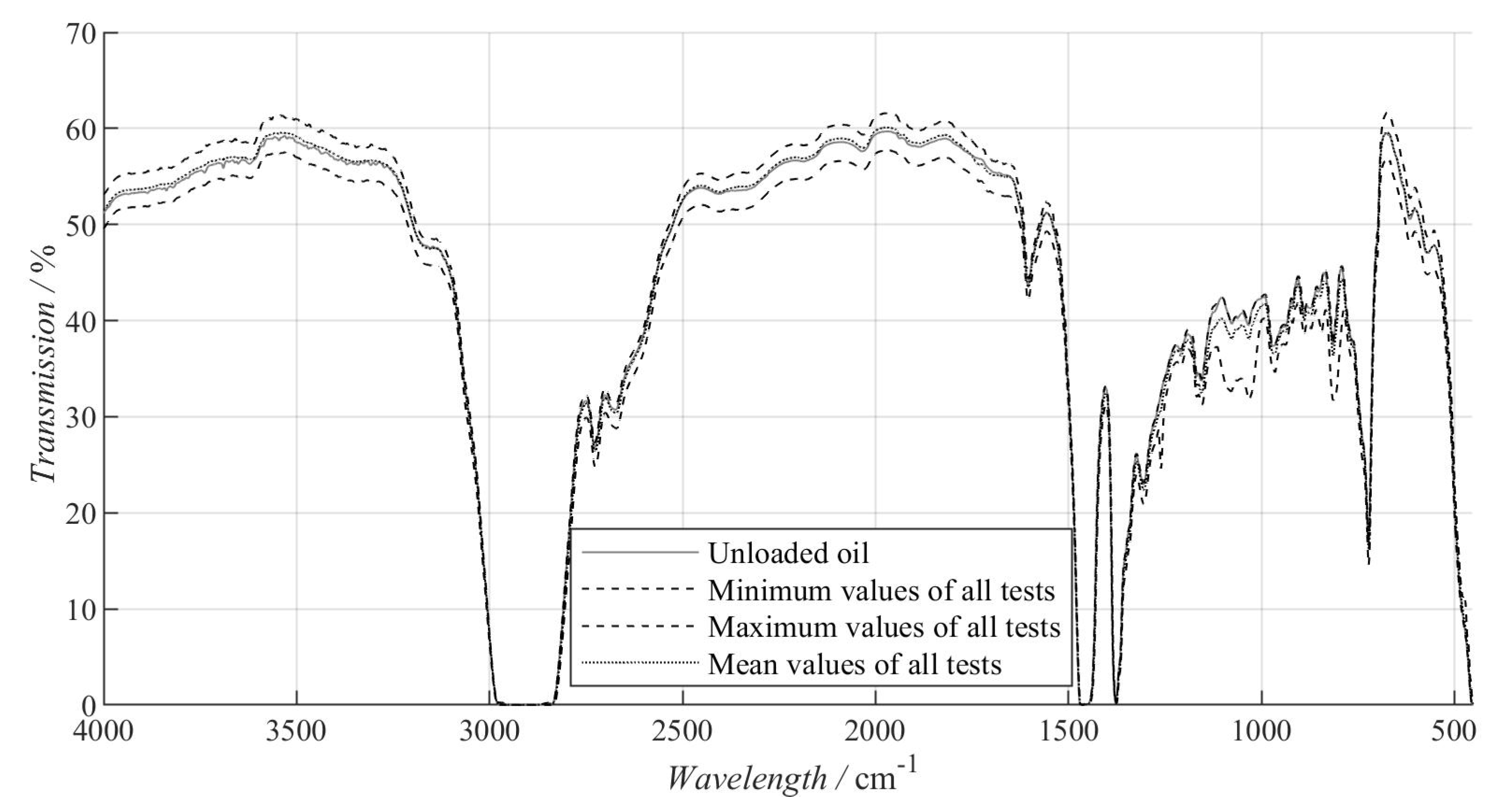

Table 1.
Summary of the geometric dimensions as well as indication of essential calculation data and surface characteristics of the test bearing 51208.
Table 1.
Summary of the geometric dimensions as well as indication of essential calculation data and surface characteristics of the test bearing 51208.
 |
*Median of 26 single measurements by using confocal microscope
Table 2.
Relevant properties of the used lubricant - mineraloil.
| Temperature / °C | 10 | 40 | 80 |
| Kinematic viscosity / mm²/s | 816,8 | 104,8 | 19,2 |
| Density / g/cm³ | 0,89 | 0,87 | 0,85 |
| Conductivity / nS/m | < 0,001 | ||
| Relative permittivity / - | 2,15 | ||
Table 3.
Boundary conditions specified at the test bench.
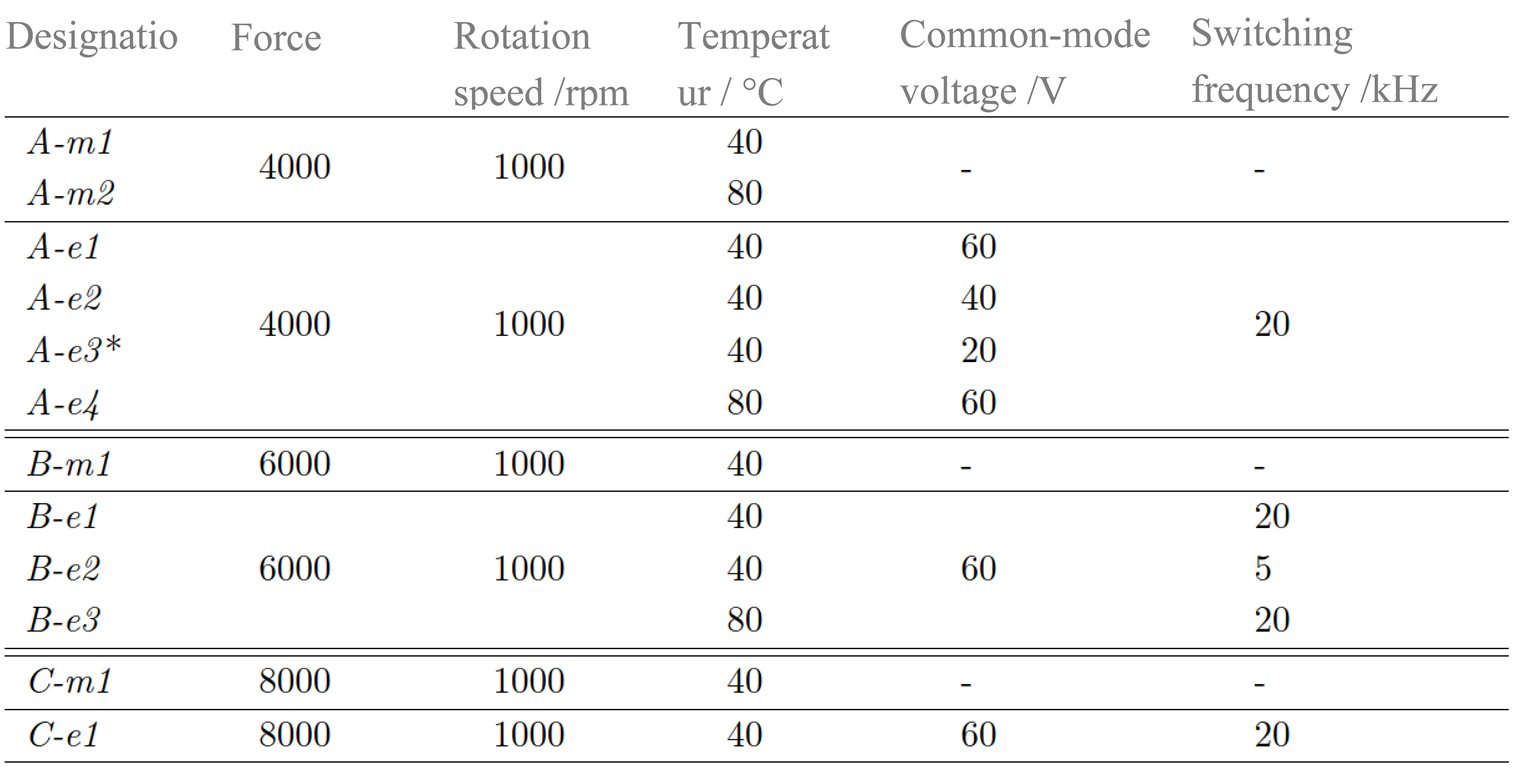 |
*including retry with -a and -b denoted
Table 4.
Boundary conditions specified at the test bench.
| Parameter | Unit | Test series A | Test series B | Test series C |
| Contact force | N | 4000 | 6000 | 8000 |
| C0/P | - | 19 | 13 | 10 |
| Hertzian pressure | MPa | 1494 | 1710 | 1883 |
| Single contact area | mm² | 0,27 | 0,35 | 0,43 |
| Lubrication gap height* | µm | 0,79 @40 °C | 0,76 @40 °C | 0,72 @40 °C |
| 0,22 @80 °C | 0,21 @80 °C | - | ||
| Specific lubrication gap | - | 1,23 @40 °C | 1,19 @40 °C | 1,13 @40 °C |
| 0,34 @80 °C | 0,33 @80 °C | - |
* according to [25]
Table 5.
Electrical loads determined over the test time.
| Designation | Apparent bearing current density / A/mm² | Bearing apparent power / VA | Bearing Stress / 109 A/mm² |
| A-e1 | 0,16 | 4,13 | 19,35 |
| A-e2 | 0,10 | 2,04 | 12,10 |
| A-e3-a | 0,05 | 0,78 | 0,60 |
| A-e3-b | 0,05 | 0,70 | 0,60 |
| A-e4 | 0,15 | 3,97 | 18,14 |
| B-e1 | 0,11 | 4,02 | 13,31 |
| B-e2 | 0,11 | 3,67 | 13,31 |
| B-e3 | 0,12 | 4,01 | 14,52 |
| C-e1 | 0,08 | 3,93 | 0,97 |
Table 6.
Visual assessment of the resulting surfaces after completion of the long-term tests.
| Designation | Rotating ring | Stationary ring | Rolling elements |
| A-m1 | Mechanical run-in | Mechanical run-in | Mechanical run-in |
| A-m2 | Mechanical run-in | Mechanical run-in | Mechanical run-in |
| A-e1 | Fluting | Fluting shading | Bearing current marks |
| A-e2 | Gray frosting | Gray frosting | Gray frosting |
| A-e3-a | Mechanical run-in | Gray frosting | Mechanical run-in |
| A-e3-b | Mechanical run-in | Gray frosting | Gray frosting |
| A-e4 | Gray frosting | Gray frosting | Gray frosting |
| B-m1 | Mechanical run-in | Mechanical run-in | Mechanical run-in |
| B-e1 | Gray frosting / Bearing current marks | Fluting shading | Bearing current marks |
| B-e2 | Gray frosting / Bearing current marks | Gray frosting | Bearing current marks |
| B-e3 | Gray frosting | Gray frosting | Mechanical run-in |
| C-m1 | Pitting | Pitting | Pitting |
| C-e1 | Gray frosting | Pitting / Gray frosting | Pitting / Gray frosting |
Table 7.
Chemical wear elements in the lubricant after a load phase of 168 h.
| Chemical wear elements in mg/kg | |||||||||
| Designation | FE | Cr | Sn | Al | Ni | Cu | Pb | Mo | Mn |
| Reference | - | - | - | - | - | - | - | - | - |
| A-m1 | 10 | ||||||||
| A-m2 | 35 | 1 | 1 | ||||||
| A-e1 | 17 | ||||||||
| A-e2 | 16 | 1 | |||||||
| A-e3-a | 6 | ||||||||
| A-e3-b | 14 | 1 | 1 | ||||||
| A-e4 | 98 | 1 | |||||||
| B-m1 | 10 | ||||||||
| B-e1 | 9 | ||||||||
| B-e2 | 23 | ||||||||
| B-e3 | 14 | ||||||||
| C-m1 | 40 | 1 | 1 | 1 | 1 | ||||
| C-e1 | 44 | 8 | |||||||
Table 8.
Chemical impurities and additives in the lubricant after a loading phase of 168 h.
| Impurities | Additives in mg/kg | |||||||||||
| Designation | Si | K | Na | Li | Ca | Mg | Zn | P | Ba | S | ||
| Reference | - | - | - | - | 2 | - | - | 1 | - | 4036 | ||
| A-m1 | 286 | 2 | 1 | - | - | - | 1 | 3 | - | 4056 | ||
| A-m2 | 11 | - | - | - | 5 | - | 1 | - | - | 3684 | ||
| A-e1 | 39 | - | 1 | 1 | 3 | - | 1 | 2 | - | 3869 | ||
| A-e2 | 11 | - | - | - | 1 | - | 1 | 2 | - | 3933 | ||
| A-e3-a | 12 | - | - | 1 | - | - | - | 2 | - | 3810 | ||
| A-e3-b | 148 | - | - | - | 2 | - | 1 | - | - | 3915 | ||
| A-e4 | 32 | - | - | - | 2 | - | 2 | - | - | 3831 | ||
| B-m1 | 8 | - | - | - | 4 | - | - | - | - | 3640 | ||
| B-e1 | - | - | - | - | - | - | - | - | - | 3721 | ||
| B-e2 | 3 | - | - | - | 2 | 1 | 1 | 5 | - | 3829 | ||
| B-e3 | 59 | - | - | - | 1 | - | 3 | - | - | 3901 | ||
| C-m1 | 56 | 1 | - | - | 4 | 1 | - | 3 | - | 3807 | ||
| C-e1 | 1007 | - | - | - | 2 | - | 1 | 4 | - | 3980 | ||
Table 9.
Overview of the lubricant properties after a loading phase of 168 h with comparison to an unloaded reference sample.
Table 9.
Overview of the lubricant properties after a loading phase of 168 h with comparison to an unloaded reference sample.
| Designation | Viscosity at 40 °C/ mm/s² | Viscosity at 80 °C/ mm/s² | Oxidation index/ - | Colour code/ - |
| Reference | 105 | 10,8 | - | 1 |
| A-m1 | 104,9 | 11,11 | 10 | 2,5 |
| A-m2 | 104,9 | 10,91 | 25 | 5,5 |
| A-e1 | 105,1 | 10,88 | <5 | 2 |
| A-e2 | 92,2 | 10,78 | - | 2 |
| A-e3-a | 104,5 | 10,78 | 7 | 1,5 |
| A-e3-b | 105,6 | 10,89 | 12 | 2 |
| A-e4 | 105,3 | 10,79 | 30 | 6 |
| B-m1 | 105,6 | 10,88 | 14 | 2,5 |
| B-e1 | 105,4 | 10,88 | 10 | 2 |
| B-e2 | 105,3 | 10,85 | 6 | 2 |
| B-e3 | 105,8 | 10,91 | 35 | 4 |
| C-m1 | 103,6 | 10,79 | 12 | 3 |
| C-e1 | 105,4 | 10,74 | 10 | 3 |
Disclaimer/Publisher’s Note: The statements, opinions and data contained in all publications are solely those of the individual author(s) and contributor(s) and not of MDPI and/or the editor(s). MDPI and/or the editor(s) disclaim responsibility for any injury to people or property resulting from any ideas, methods, instructions or products referred to in the content. |
© 2023 by the authors. Licensee MDPI, Basel, Switzerland. This article is an open access article distributed under the terms and conditions of the Creative Commons Attribution (CC BY) license (http://creativecommons.org/licenses/by/4.0/).
Copyright: This open access article is published under a Creative Commons CC BY 4.0 license, which permit the free download, distribution, and reuse, provided that the author and preprint are cited in any reuse.


