

Submitted:
04 July 2023
Posted:
05 July 2023
You are already at the latest version
Preprints on COVID-19 and SARS-CoV-2
Abstract
This paper proposes a concise literature review aimed at identifying the current body of knowledge on the adoption of Social Networks in Crisis Management. The major input is a structured research question based on the initial reading around the topic. Before the recent pan-demic, most literature has focused on local crises, with a relatively low number of exceptions. Additionally, self-organizing system are spontaneous established between people who are af-fected by a crisis. Among the identified challenges, there is the need to integrate official commu-nication by emergency agencies with citizen-generated contents in a contest of credibility and trustworthiness. In certain cases, it has been reported a lack of specific competence, knowledge, and expertise, as well as a lack of sufficient policies and guidelines in the use of Social Networks. Those challenges need to be framed by considering the classic difficulties to provide timely and accurate information, to deal with fake news, unverified or misleading information, and infor-mation overload. Bridging major gaps though advanced analytics and AI-based technology is expected to provide a key contribution to establish and safely enable in practice an effective and efficient communication, to contrast dissonant mental models, which are often fostered by Social Networks, and to enable a shared situational awareness.
Keywords:
Keywords: Social Media
; Social Networks
; Crisis Management
; Mental Model
; Situational Awareness
; Disinformation
; Misinformation and Fake News
; Infodemic
; Covid 19
1. Introduction
Despite several different definitions, currently, there is no unique universally accepted definition for crisis, which may refer, among others, to disaster, emergency, and catastrophe [1]. [2] has defined crisis as an event which is been observed in time and space, where societies/communities face physical losses/damages/disruption of their functioning routine. [3] has classified crisis into natural and human made crises.
Crisis management is commonly understood as the process in which an organization and/or a government deals with an emergency [4,5]. Crisis management is typically approached considering four different phases: mitigation, preparedness (prior to a crisis event), response, and recovery [4,5]. The mitigation phase aims to prevent the occurrence of a crisis event, as well as to mitigate known vulnerabilities inherent within the socio-economic systems. The preparedness phase explicitly targets enabling crisis managers and responders to act effectively [6]. In the response phase, responders act to prevent any further damage for ongoing issues, while during recovery, the focus is on restoring the pre-crisis state [6].
There is a tangible and increasing adoption of Social Media within the specific context of crisis management [7,8]. Indeed, Social Media have become an integral part of communication during crisis events, enabling effective real-time dissemination of relevant information [9,10].
Social Media has become an important communication channel for emergency agencies [11,12] to manage crisis [13]. Social Networks are used during crisis for information gathering [14], situation awareness [15,16], maintaining relationships [17], emotional support [18], volunteer coordination [19,20] and disseminating relevant information and providing advice and guidance [21]. For instance, Social Media were widely beneficial during the flood crisis in Queensland 2011 [22].
In this research Social Media is defined within the specific context of crisis management as a socio-technical system that provides real-time information on the crisis and assists in protecting lives and properties [23]. Situation awareness is defined as being aware of what events unfolding around people and gaining an understanding of potential relevant information means to people in that specific moment and in the future [24]. A significant aspect of situation awareness is the gathering of data from a wide number of sources by crisis managers [25].
A mental model is defined as a cognitive model that people use to understand the world [26]. A mental model is shaped by various factors, including cultural, environmental, and social as well as people’s experiences [27,28]. For instance, people use their personal experiences to develop their own models of understanding of the World and this influences their responses [29]. A shared mental model is useful in a multi-stakeholder context [30]. Shared mental models are about sharing information, knowledge, concepts, and word usage among individuals to achieve sufficient agreement among stakeholders [31].
In a complex environment, mental models are related to a systematic understanding and normally affect decision making as are a determinant on situational awareness [24]. Situation awareness is described as goal-oriented, and a goal-task analysis which was used to decide which data the users need to beware of, how the data needs are understood in relation to the goal, and what projections need to be established to reach these goals [24]. Further, situation awareness contributed to 88% of human error as people misunderstood the situation, and to avoid these errors, there is a need to develop a higher level of situation awareness [24].
The majority of the studies focused on the use of Social Media in crisis management in the United States [32], while there is a relatively limited number of studies in other countries or with a more generic focus.
Many organizations have invested in incorporating social media into their crisis response strategy [33]. It is important to observe how crisis management agencies currently leverage Social Networks to enhance both situational awareness and decision-making. Furthermore, Social Networks are a critical component of any emergency response and preparedness [34]. Government officials have turned to Social Media for various purposes, including information sharing and direct connection with citizens [34].
The Virtual Social Media Working Group (VSMWG) has been established by the US Department of Homeland Security Science and Technology Directorate [34], which focuses on providing guidance to emergency agencies on safe practices in using Social Media technologies [34]. There is a generic interest in understanding the relationship between Social Media and situational awareness in public safety [34]. Many authors emphasize that several organizations have not yet fully understood how to use Social Media to effectively communicate during a crisis [35,36,37,38,39].
Crisis Management is a relevant topic, which is often the object of review as well as of holistic and more specific discussion. This paper aims to provide a concise literature review on the adoption of Social Networks in the specific field of crisis management. In this context Social Networks and Social Media are used indistinctly.
2. Methodology and Approach
This section outlines the methodological approach that has been adopted to provide a concise overview of the impact of Social Media on Crisis Management. This review has been conducted by following the typical methodological guidelines for performing a systematic literature review in Software Engineering [40].
The topic of the review is summarised by the Concept Map [41,42,43] depicted in Figure 1. Such a conceptualization is further developed and discussed in context as an outcome of the study conducted.
That’s a conceptualization of the initial research question: how can a better situational awareness be achieved in a crisis management context?
According to the methodology adopted by [40], there is a need to define formal search criteria. This study is mainly based on peer reviewed papers, as well some relevant reports are referenced. They have been retrieved by performing multiple queries based on the combination of significant keywords in the field in the most popular databases and repositories. Finally, 100+ documents have been selected to be discussed in this concise review as a result of a critical assessment of the relevance in the context for the target research question.
3. Crisis Management & Social Network
By definition, emergency agencies play an influential and central role during emergency events [53]. The study conducted by [21] has explicitly focused on emergency agencies adopting Social Media, which are extensively used to push critical information, normally according to a one-way channel that does not include any feedback loop [54,55]. Moreover, emergency management agencies have to enable effective and timely decisions to minimize damages [11,56,57].
Emergency agencies find out that the re-sharing feature on Twitter is the key mechanism to expanding the agency’s visibility during the crisis [22] within a given community. Therefore, it is necessary for emergency agencies to push re-sharing more during a crisis [21]. Clear sentences with a specific focus have shown to be especially impactful on the public in terms of dissemination and influence [58].
Online Social Networks have become a significant channel in the context of crisis management, as they have played an important role to assist people during crises. For instance, Facebook has provided the “I am safe” functionality that allows individuals to inform their connections that they are safe in a given critical situation [59]. Safety check during crisis resulted to be an effective mechanism to enable Facebook users to notify their contacts list that they are safe [60].
Another clear example in literature is the early detection of bushfires in Australia that provides a holistic understanding of the problems facing emergency agencies during bushfires [61]. The data collected from IoT-based forest monitoring sensors [61] combined with data gathered from social media is able to provide emergency agencies with a complete picture of the crisis and enhance their knowledge-sharing processes [62] and decision-making mechanisms.
Social Networks are recognized to enhance situational awareness [45]. Recent studies [45] have contribute to consolidate a theoretical link between Social Media and situational awareness. The same study identified Twitter as the most popular platform used during the crisis [63].
However, there is a need for further research on the use of Social Media in crisis management to better develop situational awareness [64]. Indeed, in some cases, crisis managers are unable to coordinate crisis management strategies, due to the lack of situational awareness, which leads to poor decision-making [64]. The time and resources constraints push response agencies to make decisions in a continuously changing environment. It requires constant collection, analysis, and sharing of actionable information among the different agencies [65].
3.1. Information, Misinformation/Dis-Information and Fake News
While many studies have focused on the role of Social Media to improve the dissemination of critical information during crises (e.g. [66]), several contributions [66,67,68,69] address the need for further research on di-information and mis-information, pointing out a relatively limited number of studies on the topic. Indeed, exactly like in everyday life scenarios, Social Media has contributed to create and disseminate false or misleading information [83,84]. That is of course reason of increasing concern [74,75,83,84], as such phenomena may become especially critical during a crisis [76]. There are many socio-economic factors that could hinder the communication among social media users or generate unwanted patterns [85]. Among others, language barriers [86], lack of trust [87] and different cultural backgrounds [11,88] normally play a relevant role.
[67] examined the fast diffusion of rumours among the public and its consequent impact on the decision-making. For instance, it is the case of the earthquake in Ecuador in 2016 [74,75].
In [67] and [70], the authors have focused on the need for early detection of rumours spread through Social Network and on the consequent need for a quick response based on verified updated information. However, it is evidently challenging and expensive, as it requires a highly active presence of emergency agencies on Social Media sites [69,71,72,73].
According to [76], information exchanged via Social Media channels during the crisis, and also post-crisis, present a generic challenge in terms of trustworthiness and reliability, noted as the most complex challenge yet to face. Consequently, emergency agencies must disseminate trustworthy and accurate information as early as possible to address the uncertainty [76]. Such an activity needs to involve experts, government officials and emergency agency representatives. Overall, this is perceived as a challenge [14,15,77] and contributes to uncertainty and the enormous pressure the decision-makers in crisis face under time constraints [14]. It contributes to perceive Social Media channels as a treat inhibiting de facto to gain benefit [60].
Among the very many, [79] has suggested AI-based mechanisms to detect, verify and control rumours on online platforms to prevent the spread of fake news and unverified information [80,81], for instance trough prediction and verification [82].
The work in [89] reported a lack of credibility and trustworthiness in citizen-generated contents as the main barrier to use Social Media for emergency organisations. Additional possible barriers are lack of competence, including knowledge and expertise [89], as well as certain internal limitations within organisations, such as appropriate policies and guidelines on the use of Social Media in situations of crisis and a lack of awareness of potential benefits [89]. Emergency agencies normally base their decisions on information that is originated from trusted sources and vetted as credible according to the organisation standards and procedures [23]. That doesn’t normally include ‘The Wisdom of Crowds’ [90].
3.2. Managing Information from Social Media
According to a study conducted by [93], the provision of real-time information via Social Media to emergency agencies provides an invaluable opportunity to enhance their overall performance in managing the crisis. In addition, the analysis of Social Media information is used to improve decision-making outcomes [15].
However, such an adoption implies several challenges. For instance, agencies are called to respond requests by highly heterogeneous communities [94]. Some studies [22,58] have put emphasis on the difficulty to canalize the attention on information from authorities’ sources, given a large volume of data generated by the public. It led to a need for a shift in thinking to develop experts system for crisis, which are expected to enable dialogical interaction to strengthen management capabilities [89].
3.3. Situational Awareness
Various studies emphasise that organisations still do not fully understood how to communicate crisis information using social media [35,36,39]. This lack of understanding can lead to compromising the organisational competitive position and reputation [97]. The research conducted by [97] focuses on the increase in organisations’ situational awareness to enable the organisation to gain better understanding of how organisation communicate crisis information to different stakeholders.
According to [89], Social Media contribute significantly to establish situational awareness, building social capital, and allow direct, rapid and wide communication with citizens and other agencies. [89] suggests that more research is needed to study the practices of dissemination of knowledge that contributes to situational awareness.
Crisis managers have often to deal with a high volume of information from different sources in order to maintain good situational awareness [99]. The study in [98] points out that decision-makers performance declines with the increase of the information load to be processed under time constraint.
Research clearly shows the role of Social Media that enable emergency responders, media outlets, and public health officials to communicate directly with the public [100,101]. In case of acute public health crises, Social Media may play a central role to quickly disseminate information to the public on a large scale. For instance, in 2009 Alexandria Virginia health department effectively used Twitter to direct people to the vaccination sites during H1N1 outbreak [102]. Also, research shows the extensive use of Social Media during Ebola outbreak in West Africa [103].
Twitter is the most used platform [63], often adopted to detect and spread the most critical information in an efficient and accurate way to support situational awareness [63]. The public is often sharing useful real-time information in the affected areas, offering assistance to others, and requesting assistance from others [104]. More in general, Social Media enable 2-way provision of information [21].
In general terms, Social Media provide a solid support to communication [33,101] as shown in several situations. For instance during Hurricane Sandy period in 2012 [106] there were more than 20 million tweets sent[107,108]. During Thailand flood in 2011, information through traditional channels was slow and ambiguous, while Social Media established a more consistent and reliable two-way communication system [109].
[89] focuses on the potential of Social Media to facilitate citizen interactions, “help citizens to help others”, with a potential to establish consistent self-organizing systems.
3.4. Crisis Management, Decision Making and Technology
The main function of emergency agencies during a crisis is to enhance situational awareness and to inform the public to make the right informed decisions to increase the overall safety outcomes [111,112]. Normally, the decision-making processes occur within a multi-agency team in the crisis management context [113].
There is a relatively limited guidance in the literature to enable crisis mangers to select appropriate crisis response strategy [97] and crisis communication theories don’t fully address Social Media [97]. A study reported in [97] adopted a qualitative approach to analyse multiple organisations in their use of Social Media in crisis. Situational crisis communication theory (SCCT) [114] has been used as a lens to analyse Facebook posts and Tweets [97]. Such generic-purpose platforms are also the most popular in situations of crisis in several countries, for instance Australia [114,115]. The study pointed out a potential [65] not fully exploited and a number of risks—i.e. for the reputation of a given organization for not being able to fully address issues on online platforms [97].
Social Networks are expected to play a relevant role in the current and next generation of systems for crisis management. However, at the best of our current knowledge, there is no exhaustive and well-defined analysis of the potential impact of cutting-edge technology, especially AI, to define the next generation of systems, which is expected to be extremely sophisticated. Such a potential is addressed in many different contributions but, overall, the big picture is still somehow missed. For instance, social bots have recently gained some popularity because of their potential to automatise alerts and messages by emergency agencies [77,116,117,118]. Current research shows promising results when social bots are used retrospectively [77].
While it is implicitly assumed that most part of modern communication relies on Social Media, emergency agencies need to take specific steps to address rumours and non-accurate information. Advanced analytics [18] and AI-based technology [119] are expected to provide a key contribution to establish and safely enable in practice an effective and efficient communication.
3.5. Datasets
As part of the analysis conducted, we provide an overview of available resources in terms of datasets. Such an overview is not expected to be exhaustive but it rather aims to explicit ongoing efforts to establish a solid ground in the field.
Among the many available datasets on the occurrence, impact and management of natural disaster or related crises, we mention:
- Global Disaster Alert and Coordination System (GDACS), containing real-time information about natural disasters, including earthquakes, hurricanes, and floods.
- National Oceanic and Atmospheric Administration (NOAA) on severe weather events, such as tornadoes, thunderstorms, and hailstorms.
- Emergency Events Database (EM-DAT) on mass disasters.
- US Federal Emergency Management Agency (FEMA) on federal disaster declarations in the United States.
- Global Historical Climatology Network (GHCN) on historical weather data , which can be used to study trends in temperature, precipitation, and other climate variables.
- Sentinel-1 Radar Imagery, which provides radar imagery of the Earth’s surface.
- Global Forest Watch Fires on wildfires worldwide.
- In addition, the following datasets are tailored for Social Media related to natural disasters:
- CrisisLex (https://crisislex.org/data-collections.html) includes social media data related to natural disasters, such as tweets, images, and videos, as well as annotations related to the type of crisis and the type of information shared.
- CrisisNLP (https://crisisnlp.qcri.org/) includes social media data related to natural disasters, enriched by annotations and metadata.
- Twitter Crisis Response Data (https://crisislex.org/data-collections.html) includes tweets related to natural disasters, enriched by annotations and metadata.
- Social Media and Emergency Management Data Toolkit (https://tools.emergencymanagement.columbia.edu/) includes multiple datasets that contain data from Social Media related to natural disasters, including tweets and Facebook posts, as well as annotations and metadata.
Advanced technological approaches, such as Machine Learning and Social Network Analysis, become vital to enforce a sustainable crisis management [121].
4. Results
The analysis conducted has been elaborate and consolidated to (i) conceptualise the state of the art and outline possible future research, (ii) identify related gaps and major challenges, and (iii) extend the initial research question to establish a more structured approach. Those outcomes are presented separately in the following sib-sections.
4.1. Conceptualisation of the Literature Review
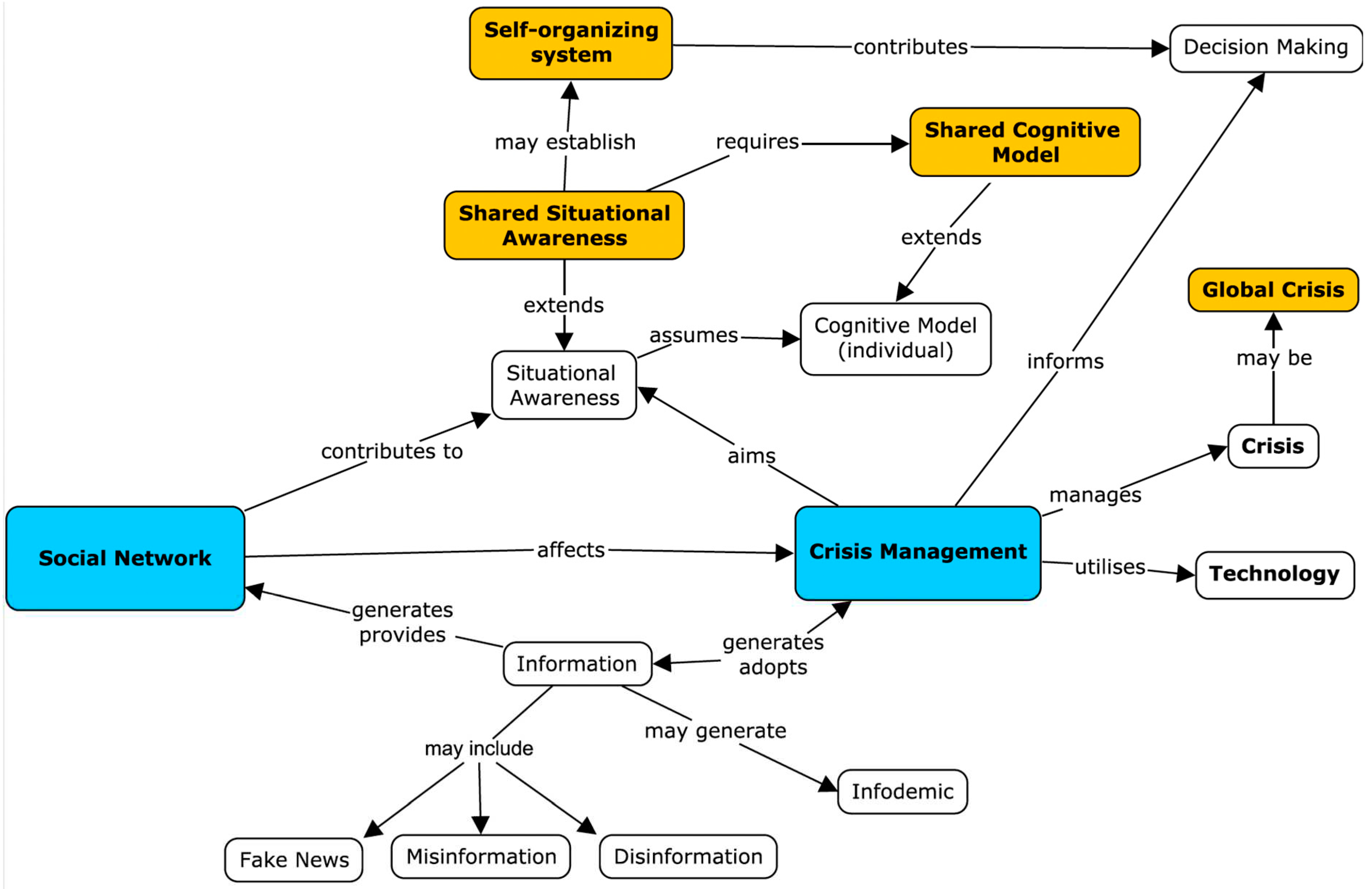
A conceptualization of the analysis conducted is proposed in Figure 2. As extensively discussed, the generic potential role of Social Networks in a context of Crisis Management is well established and largely accepted.
There is an increase in the use of Social Network in such a context, mostly aimed at situational awareness [44]. At the same time, many studies noted that organisations are not always able to exploit the potentiality of Social Media [35,36,39].
While Social Media are recognised to contribute to situational awareness enhancement during crisis [45,63], they may also contribute to generate and propagate fake news, as well as, more in general, misleading information [15]. In this context, the relationship between cognitive load theory and misinformation [51] may play a key role, as people need to understand new information in a very short period of time and eventually take decisions and act accordingly. The key issue is the establishment of shared situational awareness to enable self-organising systems, to further enhance decision making [14,124].
Overall, the evolution of Crisis Management largely depends on the effective adoption of technology [115]. Cutting edge solutions based on IoT [61] and AI [47], both with the capability to manage large amount of heterogeneous data (e.g. from Social Media, geospatial, crowdsourcing, and sensors), are progressively enabling more capable strategies that assume a more and more consistent technological support (e.g. social bots [77,117,118]).
4.3. Gap Identification and Challenges
Many challenges have been identified. They are mostly related to:
- large volume of information exchanged via Social Media [76]
- uncertainty caused by the lack of reliable and trustworthy information [76]
- user-generated contents that don’t meet the trust standards of the emergency agencies [15]
- lack of credibility and trustworthiness in the citizen-generated contents [89]
- lack of competence and knowledge expertise [89]
- lack of sufficient policies and guidelines to use social media [89]
- information overload [92]
- lack of ability to provide timely and accurate information [105]
- lack of expertise to build self-organising systems using social media [89]
These challenges need to be considered in context looking at potential mitigator factors, such as the “crowd wisdom” and self-organized groups [90]. A proper effective use of Social Media is expected to enhance the system in that direction. On the other side, exactly like in common everyday life scenarios, Social Media contribute to create and disseminate false or misleading information [83,84]. That is of course reason of increasing concern [74,75,83,84,125,126], as such phenomena may become especially critical during a crisis [76].
At the best of our current knowledge, there is no exhaustive and well-defined analysis of the potential impact of cutting-edge technology, especially AI, to define the next generation of systems which is expected to be extremely sophisticated. Such a potential is addressed in many different contributions but, overall, the big picture is still somehow missed. For instance, social bots have recently gained some popularity because of their potential to automatise alerts and messages by emergency agencies [77]. Current research shows promising results when social bots are used retrospectively [77].
The Covid 19 pandemic has shown additional concerning patterns as disinformation and misinformation switched from a local to a global context, generating an “infodemic” [128].
Consolidated research gaps and associated concepts are reported in Table 2.

Table 1.
Structured research questions resulting from the conceptual analysis conducted.
| Research Questions | |
|---|---|
| RQ1 | How can a better shared situational awareness be achieved in a crisis management context? |
| RQ1/a | How can the use of social media and AI-based technology change cognitive models to develop a shared situational awareness during crisis? |
| RQ1/b | How can we establish alignment of individual cognitive models and shared situational awareness to support effective crisis management? |
| RQ1/c | What is the expected role of cutting-edge technology in the next generation of systems? |
| RQ2/ | How can effective cognitive models be established during global crisis? |
| RQ2/a | What are the negative aspects of using social networks in a context of infodemic? |
| RQ2/b | How the public interact during the global crisis in term of information seeking and self-organizing? |
| RQ2/c | How can shared mental models be established in a global crisis? |
Table 2.
Research Gaps.
| Research Gap | Concept | |
|---|---|---|
| G1 | The capability to systematically retrieve information real-time as well as to generate effective analytics and predictive models is still a challenge [18]. | Information Retrieval/Analysis, Analytics, Predictive Models |
| G2 | There is no exhaustive and well-defined analysis of potential impact of cutting-edge technology, especially AI to define the next generation of systems [119]. | Cutting-edge technology, AI, next generation systems |
| G3 | Advanced Analytics and AI based technology are expected to provide a key contribution to establish and safely enable in practice an effective and efficient communication [18,119]. | Advanced Analytics, AI |
| G4 | The well-known effect of Social Networks on dis-information, misinformation and fake news has an evident potentially higher impact on mental and cognitive models in exceptional situations such as crisis. Such aspects are currently object of study [84,130]. | Mental model, cognitive model, mis-leading information, fake news |
| G5 | Dissonant mental models are often fostered by social networks at different levels (e.g. algorithms, influencers) which together undermine social cohesion and form barriers to shared situational awareness. To support effective crisis management there is a need to establish alignment of mental models and shared situational awareness, which is evidently a challenge [130,131]. | Dissonant mental model, influencer, shared situational awareness |
| G6 | In general terms, there is an intrinsic need to early detect and properly deal with rumors and fake news. It becomes more and more critical and relevant in crisis management [79,81,82]. | Rumours |
| G7 | There is a general lack of trust and effectiveness across mechanisms that strongly rely on social networks and the recent Covid-19 ‘infodemic’ is a clear example [130]. | Trust, Infodemic, Global Crisis |
| G8 | The COVID 19 pandemic has unfortunately provided a kind of stress-test for our system. Lessons and, more in general, the experience and knowledge we are developing from the global crisis has not yet been fully translated into tangible general frameworks [130]. | Knowledge Management, Global Crisis |
| G9 | Managing a global crisis (e.g. a pandemic) is a complex process that involves many stakeholders to be effective. Shared situation awareness through some mental models alignment may play a critical role [130]. | Global Crisis, Shared Situation Awareness |
| G10 | There is a relatively limited knowledge about the public-to-public interaction during the crisis and on the impact of this self-organizing system [21,76,132]. | Self-organizing system |
4.4. Research Questions
A large number of research questions may be generated looking at the gaps and challenges previously discussed. Based on the conceptual analysis conducted, the initial research question has been elaborated and structured into two main generic research questions and a number of associated sub-questions. Main questions reflect research mainstreams according to a holistic perspective, while sub-questions define more specific research lines.
5. Conclusions
The purpose of this study is to identify the body of knowledge related to the nexus of Crisis Management and Social Networks by adopting a multi-perspective approach involving crisis managers, communication experts, and social network analysts.
The review indicates a potentially critical role of Social Networks in a context of crisis, as demonstrated by a tangible and measurable increase in the adoption in real-world situations, including local and global crisis. Crisis managers tend to incorporate Social Networks into situational awareness strategies, as they have been critical in assisting crisis agencies to formulate preparedness, recovery, and response efforts. However, while the use of Social Media is assumed to be a consolidated practice, an effective and efficient use in the different crisis situations is still considered a challenge.
Situational awareness is a central concept that need to be understood in context, looking at a fluid and continuously changing environment in which information, mis-information and fake news are likely to co-exist. There is currently a relatively limited number of studies to assess the relationship between relevant situational awareness and cognitive models, as well as on the key factors to effectively establish a shared situational awareness.
Last but not least, the strong inequality still existing among the different countries [133] may be a serious discriminant in fact as real capabilities may significantly differ from country to country.
Funding
This research received no external funding.
Conflicts of Interest
The authors declare no conflict of interest.
References
- Hiltz, S.R.; Van de Walle, B.; Turoff, M. The domain of emergency management information. In Information systems for emergency management; Routledge: 2014; pp. 15–32.
- Kreps, G.A. Sociological inquiry and disaster research. Annual review of sociology 1984, 10, 309–330. [Google Scholar] [CrossRef]
- Eshghi, K.; Larson, R.C. Disasters: lessons from the past 105 years. Disaster Prevention and Management: An International Journal 2008, 17, 62–82. [Google Scholar] [CrossRef]
- Petak, W.J. Emergency management: A challenge for public administration. Public Administration Review 1985, 45, 3–7. [Google Scholar] [CrossRef]
- Lettieri, E.; Masella, C.; Radaelli, G. Disaster management: findings from a systematic review. Disaster Prevention and Management: An International Journal 2009. [Google Scholar] [CrossRef]
- McLoughlin, D. A framework for integrated emergency management. Public administration review 1985, 45, 165–172. [Google Scholar] [CrossRef]
- Acar, A.; Muraki, Y. Twitter for crisis communication: lessons learned from Japan’s tsunami disaster. International journal of web based communities 2011, 7, 392–402. [Google Scholar] [CrossRef]
- Laudy, C.; Ruini, F.; Zanasi, A.; Przybyszewski, M.; Stachowicz, A. Using social media in crisis management: SOTERIA fusion center for managing information gaps. In Proceedings of the 2017 20th International Conference on Information Fusion (Fusion); 2017; pp. 1–8. [Google Scholar]
- Raue, S.; Johnson, C.W.; Storer, T. (SMA)2—a Social Media Audience Sharing Model for Authorities to support effective crisis communication. In Proceedings of the 7th IET International Conference on System Safety, incorporating the Cyber Security Conference 2012, 15-18 Oct. 2012; pp. 1–6. [Google Scholar]
- Zhao, D.; Rosson, M.B. How and Why People Twitter: The Role that Micro-blogging Plays in Informal Communication at Work; 2009.
- Fischer, D.; Posegga, O.; Fischbach, K. Communication Barriers in Crisis Management: a literature Review. In Proceedings of the ECIS; 2016; p. 168. [Google Scholar]
- Shahbazi, M.; Ehnis, C.; Shahbazi, M.; Bunker, D. Tweeting from the shadows: Social media convergence behaviour during the 2017 Iran-Iraq earthquake. In Proceedings of the ISCRAM Asia Pacific; 2018. [Google Scholar]
- Ahmed, A. Use of Social Media in Disaster Management; 2011; Volume 5.
- Fraustino, J.D.; Liu, B.; Jin, Y. Social media use during disasters: a review of the knowledge base and gaps. 2012.
- Stieglitz, S.; Mirbabaie, M.; Schwenner, L.; Marx, J.; Lehr, J.; Brünker, F. Sensemaking and communication roles in social media crisis communication. 2017.
- Mirbabaie, M.; Youn, S. Exploring sense-making activities in crisis situations. Proceedings of the 10th Multikonferenz Wirtschaftsinformatik (MKWI) 2018, 1656–1667. [Google Scholar]
- Procopio, C.H.; Procopio, S.T. Do you know what it means to miss New Orleans? Internet communication, geographic community, and social capital in crisis. Journal of applied communication research 2007, 35, 67–87. [Google Scholar] [CrossRef]
- Imran, M.; Castillo, C.; Diaz, F.; Vieweg, S. Processing social media messages in mass emergency: A survey. ACM Computing Surveys (CSUR) 2015, 47, 1–38. [Google Scholar] [CrossRef]
- Bunker, D.; Ehnis, C.; Seltsikas, P.; Levine, L. Crisis management and social media: Assuring effective information governance for long term social sustainability. In Proceedings of the 2013 IEEE International Conference on Technologies for Homeland Security (HST); 2013; pp. 246–251. [Google Scholar]
- Reuter, C.; Heger, O.; Pipek, V. Combining real and virtual volunteers through social media. In Proceedings of the Iscram; 2013. [Google Scholar]
- Mirbabaie, M.; Ehnis, C.; Stieglitz, S.; Bunker, D.; Rose, T. Digital nudging in social media disaster communication. Information Systems Frontiers 2021, 23, 1097–1113. [Google Scholar] [CrossRef]
- Bruns, A.; Burgess, J. # qldfloods and@ QPSMedia: Crisis communication on Twitter in the 2011 south east Queensland floods. 2012.
- Plotnick, L.; Hiltz, S.R. Barriers to use of social media by emergency managers. Journal of Homeland Security and Emergency Management 2016, 13, 247–277. [Google Scholar] [CrossRef]
- Endsley, M.R. Designing for situation awareness: An approach to user-centered design; CRC press: 2016.
- Congress, U.S. “Homeland Security Act 2002” 107th Congress. Section 515 (6 U.S.C321d(b)(1)) 2002.
- Bower, G.H.; Morrow, D.G. Mental models in narrative comprehension. Science 1990, 247, 44–48. [Google Scholar] [CrossRef] [PubMed]
- Norman, D.; Gentner, D.; Stevens, A. Mental models. Human-computer Interaction, chap. Some Observations on Mental Models 1983, 7–14. [Google Scholar]
- Senge, P.M. Mental models. Planning Review 1992, 20, 4–44. [Google Scholar] [CrossRef]
- Kelly, G. The psychology of personal constructs: Volume two: Clinical diagnosis and psychotherapy; Routledge: 2003.
- Biggs, D.; Abel, N.; Knight, A.T.; Leitch, A.; Langston, A.; Ban, N.C. The implementation crisis in conservation planning: could “mental models” help? Conservation Letters 2011, 4, 169–183. [Google Scholar] [CrossRef]
- Alliance, R. A preliminary exploration of two approaches for documenting ‘mental models’ held by stakeholders in the Crocodile Catchment, South Africa. 2008.
- Reuter, C.; Schröter, J. Microblogging during the European floods 2013: What Twitter may contribute in German emergencies. International Journal of Information Systems for Crisis Response and Management (IJISCRAM) 2015, 7, 22–41. [Google Scholar] [CrossRef]
- Graham, M.W.; Avery, E.J.; Park, S. The role of social media in local government crisis communications. Public Relations Review 2015, 41, 386–394. [Google Scholar] [CrossRef]
- Security, H. Using Social Media for Enhanced Situation Awareness and Decision Support 2014.
- Veil, S.R.; Buehner, T.; Palenchar, M.J. A work-in-process literature review: Incorporating social media in risk and crisis communication. Journal of contingencies and crisis management 2011, 19, 110–122. [Google Scholar] [CrossRef]
- Eriksson, M. On-line strategic crisis communication: In search of a descriptive model approach. International Journal of Strategic Communication 2012, 6, 309–327. [Google Scholar] [CrossRef]
- Floreddu, P.B.; Cabiddu, F.; Evaristo, R. Inside your social media ring: How to optimize online corporate reputation. Business Horizons 2014, 57, 737–745. [Google Scholar] [CrossRef]
- Jin, Y.; Liu, B.F.; Austin, L.L. Examining the role of social media in effective crisis management: The effects of crisis origin, information form, and source on publics’ crisis responses. Communication research 2014, 41, 74–94. [Google Scholar] [CrossRef]
- Ki, E.-J.; Nekmat, E. Situational crisis communication and interactivity: Usage and effectiveness of Facebook for crisis management by Fortune 500 companies. Computers in Human Behavior 2014, 35, 140–147. [Google Scholar] [CrossRef]
- Kitchenham, B.; Charters, S. Guidelines for performing Systematic Literature Reviews in Software Engineering. 2007, 2.
- Cañas, A.J.; Hill, G.; Carff, R.; Suri, N.; Lott, J.; Gómez, G.; Eskridge, T.C.; Arroyo, M.; Carvajal, R. CmapTools: A knowledge modeling and sharing environment. 2004.
- Cañas, A.J.; Carff, R.; Hill, G.; Carvalho, M.; Arguedas, M.; Eskridge, T.C.; Lott, J.; Carvajal, R. Concept maps: Integrating knowledge and information visualization. Knowledge and information visualization: Searching for synergies 2005, 205-219.
- Novak, J.D.; Cañas, A.J. The theory underlying concept maps and how to construct them. Florida Institute for Human and Machine Cognition 2006, 1, 1–31. [Google Scholar]
- Son, J.; Aziz, Z.; Peña-Mora, F. Supporting disaster response and recovery through improved situation awareness. Structural survey 2008, 26, 411–425. [Google Scholar] [CrossRef]
- Vieweg, S.; Hughes, A.L.; Starbird, K.; Palen, L. Microblogging during two natural hazards events: what twitter may contribute to situational awareness. In Proceedings of the SIGCHI Conference on Human Factors in Computing Systems, Atlanta, Georgia, USA; 2010; pp. 1079–1088. [Google Scholar]
- Endsley, M.R. Situation Models: An Avenue to the Modeling of Mental Models. In Proceedings of the Human Factors and Ergonomics Society Annual Meeting; 2000; Volume 44, pp. 61–64. [Google Scholar] [CrossRef]
- Fan, C.; Zhang, C.; Yahja, A.; Mostafavi, A. Disaster City Digital Twin: A vision for integrating artificial and human intelligence for disaster management. International Journal of Information Management 2021, 56, 102049. [Google Scholar] [CrossRef]
- Sweller, J. Cognitive Load Theory. Psychology of Learning and Motivation 2011, 55, 37–76. [Google Scholar] [CrossRef]
- Shabani, K.; Mohammad, K.; Ebadi, S. Vygotsky’s Zone of Proximal Development: Instructional Implications and Teachers’ Professional Development. English Language Teaching 2010, 3. [Google Scholar] [CrossRef]
- Bright, L.F.; Kleiser, S.B.; Grau, S.L. Too much Facebook? An exploratory examination of social media fatigue. Computers in Human Behavior 2015, 44, 148–155. [Google Scholar] [CrossRef]
- Laato, S.; Islam, A.N.; Islam, M.N.; Whelan, E. What drives unverified information sharing and cyberchondria during the COVID-19 pandemic? European journal of information systems 2020, 29, 288–305. [Google Scholar] [CrossRef]
- Wendland, J.; Ehnis, C.; Clarke, R.J.; Bunker, D. Sydney siege, December 2014: A visualisation of a semantic social media sentiment analysis. 2018.
- Mirbabaie, M.; Ehnis, C.; Stieglitz, S.; Bunker, D. Communication roles in public events: A case study on Twitter communication. In Proceedings of the Information Systems and Global Assemblages.(Re) Configuring Actors, Artefacts, Organizations: IFIP WG 8.2 Working Conference on Information Systems and Organizations, IS&O 2014, Auckland, New Zealand, December 11-12, 2014; pp. 207–218. [Google Scholar]
- Ehnis, C.; Bunker, D. Social media in disaster response: Queensland police service-public engagement during the 2011 floods. 2012.
- Potter, E. Balancing conflicting operational and communications priorities: Social media use in an emergency management organization. In Proceedings of the ISCRAM 2016 Conference Proceedings-13th International Conference on Information Systems for Crisis Response and Management; 2016; pp. 1–10. [Google Scholar]
- Ben Lazreg, M.; Chakraborty, N.R.; Stieglitz, S.; Potthoff, T.; Ross, B.; Majchrzak, T.A. Social media analysis in crisis situations: can social media be a reliable information source for emergency management services? 2018.
- Reuter, C.; Kaufhold, M.A. Fifteen years of social media in emergencies: a retrospective review and future directions for crisis informatics. Journal of contingencies and crisis management 2018, 26, 41–57. [Google Scholar] [CrossRef]
- Ross, B.; Potthoff, T.; Majchrzak, T.A.; Chakraborty, N.R.; Ben Lazreg, M.; Stieglitz, S. The diffusion of crisis-related communication on social media: an empirical analysis of Facebook reactions. 2018.
- Shemberger, M. Nonprofit organizations’ use of social media in crisis communication. In Social media and crisis communication; Routledge: 2017; pp. 227–237. [CrossRef]
- Redmiles, E.M.; Bodford, J.; Blackwell, L. “I just want to feel safe”: A Diary Study of Safety Perceptions on Social Media. In Proceedings of the Proceedings of the International AAAI Conference on Web and Social Media, 2019; pp. 405–416.
- Nosouhi, M.R.; Sood, K.; Kumar, N.; Wevill, T.; Thapa, C. Bushfire Risk Detection Using Internet of Things: An Application Scenario. IEEE Internet of Things Journal 2022, 9, 5266–5274. [Google Scholar] [CrossRef]
- Toh, K.K.T.; Corbitt, B.; Beekhuyzen, J. A knowledge management model to improve the development of bushfire communication products. Australasian Journal of Information Systems 2014, 18. [Google Scholar] [CrossRef]
- Vongkusolkit, J.; Huang, Q. Situational awareness extraction: a comprehensive review of social media data classification during natural hazards. Annals of GIS 2020, 27, 5—28. [Google Scholar] [CrossRef]
- Pogrebnyakov, N.; Maldonado, E. Didn’t roger that: Social media message complexity and situational awareness of emergency responders. International Journal of Information Management 2018, 40, 166–174. [Google Scholar] [CrossRef]
- Kedia, T.; Ratcliff, J.; O’Connor, M.; Oluic, S.; Rose, M.; Freeman, J.; Rainwater-Lovett, K. Technologies enabling situational awareness during disaster response: a systematic review. Disaster Medicine and Public Health Preparedness 2022, 16, 341–359. [Google Scholar] [CrossRef] [PubMed]
- Muniz-Rodriguez, K.; Ofori, S.K.; Bayliss, L.C.; Schwind, J.S.; Diallo, K.; Liu, M.; Yin, J.; Chowell, G.; Fung, I.C.-H. Social media use in emergency response to natural disasters: a systematic review with a public health perspective. Disaster medicine and public health preparedness 2020, 14, 139–149. [Google Scholar] [CrossRef]
- Tang, Z.; Zhang, L.; Xu, F.; Vo, H. Examining the role of social media in California’s drought risk management in 2014. Natural Hazards 2015, 79, 171–193. [Google Scholar] [CrossRef]
- Brandt, H.M.; Turner-McGrievy, G.; Friedman, D.B.; Gentile, D.; Schrock, C.; Thomas, T.; West, D. Examining the role of Twitter in response and recovery during and after historic flooding in South Carolina. Journal of public health management and practice 2019, 25, E6–E12. [Google Scholar] [CrossRef]
- Scott, K.K.; Errett, N.A. Content, accessibility, and dissemination of disaster information via social media during the 2016 Louisiana floods. Journal of public health management and practice 2018, 24, 370–379. [Google Scholar] [CrossRef]
- Lee, H.; Oh, H.J. Normative mechanism of rumor dissemination on Twitter. Cyberpsychology, Behavior, and Social Networking 2017, 20, 164–171. [Google Scholar] [CrossRef]
- Valente, T.W. Social networks and health: Models, methods, and applications; Oxford University Press: 2010.
- Liu, F.; Burton-Jones, A.; Xu, D. Rumors on social media in disasters: Extending transmission to retransmission. 2014.
- Albris, K. The switchboard mechanism: How social media connected citizens during the 2013 floods in Dresden. Journal of Contingencies and Crisis Management 2018, 26, 350–357. [Google Scholar] [CrossRef]
- Mendoza, M.; Poblete, B.; Castillo, C. Twitter under crisis: Can we trust what we RT? In Proceedings of the Proceedings of the first workshop on social media analytics; 2010; pp. 71–79. [Google Scholar]
- Lozano, E.; Vaca, C. Crisis management on Twitter: Detecting emerging leaders. In Proceedings of the 2017 Fourth International Conference on eDemocracy & eGovernment (ICEDEG); 2017; pp. 140–147. [Google Scholar]
- Mirbabaie, M.; Bunker, D.; Stieglitz, S.; Marx, J.; Ehnis, C. Social media in times of crisis: Learning from Hurricane Harvey for the coronavirus disease 2019 pandemic response. Journal of Information Technology 2020, 35, 195–213. [Google Scholar] [CrossRef]
- Hofeditz, L.; Ehnis, C.; Bunker, D.; Brachten, F.; Stieglitz, S. Meaningful use of social bots? possible applications in crisis communication during Disasters; 2019.
- Stieglitz, S.; Meske, C.; Ross, B.; Mirbabaie, M. Going back in time to predict the future-the complex role of the data collection period in social media analytics. Information Systems Frontiers 2020, 22, 395–409. [Google Scholar] [CrossRef]
- Ahsan, M.; Kumari, M.; Sharma, T. Rumors detection, verification and controlling mechanisms in online social networks: A survey. Online Social Networks and Media 2019, 14, 100050. [Google Scholar] [CrossRef]
- Allcott, H.; Gentzkow, M. Social media and fake news in the 2016 election. Journal of economic perspectives 2017, 31, 211–236. [Google Scholar] [CrossRef]
- Aker, A.; Sliwa, A.; Dalvi, F.; Bontcheva, K. Rumour verification through recurring information and an inner-attention mechanism. Online Social Networks and Media 2019, 13, 100045. [Google Scholar] [CrossRef]
- Gorrell, G.; Kochkina, E.; Liakata, M.; Aker, A.; Zubiaga, A.; Bontcheva, K.; Derczynski, L. SemEval-2019 Task 7: RumourEval 2019: Determining Rumour Veracity and Support for Rumours. In Proceedings of the Proceedings of the 13th International Workshop on Semantic Evaluation: NAACL HLT 2019; 2019; pp. 845–854. [Google Scholar]
- Akhgar, B.; Fortune, D.; Hayes, R.E.; Guerra, B.; Manso, M. Social media in crisis events: Open networks and collaboration supporting disaster response and recovery. In Proceedings of the 2013 IEEE International conference on technologies for Homeland Security (HST); 2013; pp. 760–765. [Google Scholar] [CrossRef]
- Hagen, L.; Keller, T.; Neely, S.; DePaula, N.; Robert-Cooperman, C. Crisis communications in the age of social media: A network analysis of Zika-related tweets. Social science computer review 2018, 36, 523–541. [Google Scholar] [CrossRef]
- Oh, O.; Agrawal, M.; Rao, H.R. Community intelligence and social media services: A rumor theoretic analysis of tweets during social crises. MIS quarterly 2013, 407–426. [Google Scholar] [CrossRef]
- McEntire, D.A. Coordinating multi-organisational responses to disaster: lessons from the March 28, 2000, Fort Worth tornado. Disaster Prevention and Management: An International Journal 2002, 11, 369–379. [Google Scholar] [CrossRef]
- Manoj, B.S.; Baker, A.H. Communication challenges in emergency response. Communications of the ACM 2007, 50, 51–53. [Google Scholar] [CrossRef]
- Bui, T.; Cho, S.; Sankaran, S.; Sovereign, M. A framework for designing a global information network for multinational humanitarian assistance/disaster relief. Information Systems Frontiers 2000, 1, 427–442. [Google Scholar] [CrossRef]
- Haataja, M.; Laajalahti, A.; Hyvärinen, J. Expert views on current and future use of social media among crisis and emergency management organizations: Incentives and barriers. Human Technology 2016, 12, 135. [Google Scholar] [CrossRef]
- Surowiecki, J. The wisdom of crowds: Why the many are smarter than the few and how collective wisdom shapes business, economies, societies, and nations; Doubleday & Co: New York, NY, US, 2004. [Google Scholar]
- Sheridan, T.B.; Ferrell, W.R. Man-machine systems; Information, control, and decision models of human performance; the MIT press: 1974.
- Verma, S.; Vieweg, S.; Corvey, W.; Palen, L.; Martin, J.; Palmer, M.; Schram, A.; Anderson, K. Natural language processing to the rescue? extracting” situational awareness” tweets during mass emergency. In Proceedings of the Proceedings of the International AAAI Conference on Web and Social Media; 2011; pp. 385–392. [Google Scholar] [CrossRef]
- Velev, D.; Zlateva, P. An analysis of the relation between natural disasters and Big Data. International Journal of Data Science 2016, 1, 370–381. [Google Scholar] [CrossRef]
- Hofeditz, L.; Ehnis, C.; Bunker, D.; Brachten, F.; Stieglitz, S. Meaningful Use of Social Bots? Possible Applications in Crisis Communication during Disasters. In Proceedings of the ECIS; 2019. [Google Scholar]
- Chermack, T.J.; Song, J.H.; Nimon, K.; Choi, M.; Korte, R.F. The development and assessment of an instrument for measuring mental model styles in Korea. Learning and Performance Quarterly 2012, 1, 1–20. [Google Scholar]
- Ford, D.N.; Sterman, J.D. Expert knowledge elicitation to improve formal and mental models. System Dynamics Review: The Journal of the System Dynamics Society 1998, 14, 309–340. [Google Scholar] [CrossRef]
- Roshan, M.; Warren, M.; Carr, R. Understanding the use of social media by organisations for crisis communication. Computers in Human Behavior 2016, 63, 350–361. [Google Scholar] [CrossRef]
- Workman, M. Cognitive styles and the effects of stress from cognitive load and time pressures on judgemental decision making with learning simulations: Implications for HRD. International Journal of Human Resources Development and Management 2016, 16, 30–46. [Google Scholar] [CrossRef]
- Seppänen, H.; Mäkelä, J.; Luokkala, P.; Virrantaus, K. Developing shared situational awareness for emergency management. Safety science 2013, 55, 1–9. [Google Scholar] [CrossRef]
- Palen, L.; Liu, S.B. Citizen communications in crisis: anticipating a future of ICT-supported public participation. In Proceedings of the SIGCHI conference on Human factors in computing systems, 2007; pp. 727–736.
- Hughes, A.L.; Palen, L. The evolving role of the public information officer: An examination of social media in emergency management. Journal of homeland security and emergency management 2012, 9. [Google Scholar] [CrossRef]
- Merchant, R.M.; Elmer, S.; Lurie, N. Integrating social media into emergency-preparedness efforts. New England journal of medicine 2011, 365, 289–291. [Google Scholar] [CrossRef]
- Fung, I.C.-H.; Tse, Z.T.H.; Cheung, C.-N.; Miu, A.S.; Fu, K.-W. Ebola and the social media. 2014. [CrossRef]
- Nalluru, G.; Pandey, R.; Purohit, H. Relevancy classification of multimodal social media streams for emergency services. In Proceedings of the 2019 IEEE International Conference on Smart Computing (SMARTCOMP); 2019; pp. 121–125. [Google Scholar]
- Reuter, C.; Spielhofer, T. Towards social resilience: A quantitative and qualitative survey on citizens’ perception of social media in emergencies in Europe. Technological Forecasting and Social Change 2017, 121, 168–180. [Google Scholar] [CrossRef]
- Stewart, M.C.; Wilson, B.G. The dynamic role of social media during Hurricane# Sandy: An introduction of the STREMII model to weather the storm of the crisis lifecycle. Computers in Human Behavior 2016, 54, 639–646. [Google Scholar] [CrossRef]
- Guskin, E.H., P. Hurricane Sandy and Twitter. 2012.
- Chatfield, A.T.; Scholl, H.J.; Brajawidagda, U. # Sandy tweets: citizens’ co-production of time-critical information during an unfolding catastrophe. In Proceedings of the 2014 47th Hawaii International Conference on System Sciences; 2014; pp. 1947–1957. [Google Scholar] [CrossRef]
- Tim, Y.; Yang, L.; Pan, S.L.; Kaewkitipong, L.; Ractham, P. The emergence of social media as boundary objects in crisis response: a collective action perspective. 2013.
- Kaewkitipong, L.; Chen, C.; Ractham, P. Lessons learned from the use of social media in combating a crisis: A case study of 2011 Thailand flooding disaster. 2012.
- Koob, P. Australian emergency management glossary; manual 3. Commonwealth of Australia. First Published 1998.
- Conrado, S.P.; Neville, K.; Woodworth, S.; O’Riordan, S. Managing social media uncertainty to support the decision making process during emergencies. Journal of Decision Systems 2016, 25, 171–181. [Google Scholar] [CrossRef]
- Van Santen, W.; Jonker, C.; Wijngaards, N. Crisis decision making through a shared integrative negotiation mental model. International Journal of Emergency Management 2009, 6, 342–355. [Google Scholar] [CrossRef]
- Coombs, W.T.; Holladay, S.J. Helping crisis managers protect reputational assets: Initial tests of the situational crisis communication theory. Management communication quarterly 2002, 16, 165–186. [Google Scholar] [CrossRef]
- Ott, L.; Theunissen, P. Reputations at risk: Engagement during social media crises. Public Relations Review 2015, 41, 97–102. [Google Scholar] [CrossRef]
- Haustein, S.; Bowman, T.D.; Holmberg, K.; Tsou, A.; Sugimoto, C.R.; Larivière, V. Tweets as impact indicators: Examining the implications of automated “bot” accounts on T witter. Journal of the Association for Information Science and Technology 2016, 67, 232–238. [Google Scholar] [CrossRef]
- Brachten, F.; Stieglitz, S.; Hofeditz, L.; Kloppenborg, K.; Reimann, A.-L.F. Strategies and Influence of Social Bots in a 2017 German state election—A case study on Twitter. In Proceedings of the ACIS; 2017. [Google Scholar]
- Brachten, F.; Mirbabaie, M.; Stieglitz, S.; Berger, O.; Bludau, S.; Schrickel, K. Threat or Opportunity?—Examining Social Bots in Social Media Crisis Communication. In Proceedings of the ACIS; 2018. [Google Scholar] [CrossRef]
- Farrokhi, A.; Shirazi, F.; Hajli, N.; Tajvidi, M. Using artificial intelligence to detect crisis related to events: Decision making in B2B by artificial intelligence. Industrial Marketing Management 2020, 91, 257–273. [Google Scholar] [CrossRef]
- Sacks, J.A.; Zehe, E.; Redick, C.; Bah, A.; Cowger, K.; Camara, M.; Diallo, A.; Gigo, A.N.I.; Dhillon, R.S.; Liu, A. Introduction of mobile health tools to support Ebola surveillance and contact tracing in Guinea. Global Health: Science and Practice 2015, 3, 646–659. [Google Scholar] [CrossRef]
- Bukar, U.A.; Sidi, F.; Jabar, M.A.; Nor, R.N.H.; Abdullah, S.; Ishak, I.; Alabadla, M.; Alkhalifah, A. How Advanced Technological Approaches Are Reshaping Sustainable Social Media Crisis Management and Communication: A Systematic Review. Sustainability 2022, 14, 5854. [Google Scholar] [CrossRef]
- Wright, A.L.; Nichols, E.; McKechnie, M.; McCarthy, S. Combining crisis management and evidence-based management: The Queensland floods as a teachable moment. Journal of Management Education 2013, 37, 135–160. [Google Scholar] [CrossRef]
- Hagar, C. Bulletin of the American Society for Information Science and Technology. asis&t 2010.
- Planella Conrado, S.; Neville, K.; Woodworth, S.; O’Riordan, S. Managing social media uncertainty to support the decision making process during Emergencies. Journal of Decision System 2016, 25, 171–181. [Google Scholar] [CrossRef]
- Dwivedi, Y.K.; Kelly, G.; Janssen, M.; Rana, N.P.; Slade, E.L.; Clement, M. Social media: The good, the bad, and the ugly. Information Systems Frontiers 2018, 20, 419–423. [Google Scholar] [CrossRef]
- Mondal, T.; Pramanik, P.; Bhattacharya, I.; Boral, N.; Ghosh, S. Analysis and early detection of rumors in a post disaster scenario. Information Systems Frontiers 2018, 20, 961–979. [Google Scholar] [CrossRef]
- Imran, M.; Castillo, C.; Lucas, J.; Meier, P.; Vieweg, S. AIDR: Artificial intelligence for disaster response. In Proceedings of the Proceedings of the 23rd international conference on world wide web, 2014; pp. 159–162.
- WHO. Infodemic. Available online: https://www.who.int/health-topics/infodemic#tab=tab_1.
- Chu, S.K. COVID-19 Infodemic: Empowering Australia against infodemic. 2021.
- Bunker, D. Who do you trust? The digital destruction of shared situational awareness and the COVID-19 infodemic. International Journal of Information Management 2020, 55, 102201. [Google Scholar] [CrossRef] [PubMed]
- Lanzing, M. “Strongly recommended” revisiting decisional privacy to judge hypernudging in self-tracking technologies. Philosophy & Technology 2019, 32, 549–568. [Google Scholar] [CrossRef]
- Bunker, D.; Sleigh, T.; Levine, L.; Ehnis, C. Disaster Management: Building Resilient Systems to Aid Recovery. In Proceedings of the Research proceedings from the Bushfire and Natural Hazards CRC & AFAC conference; 2015; pp. 1–6. [Google Scholar]
- Pileggi, S.F. Walking Together Indicator (WTI): Understanding and Measuring World Inequality. Sustainability 2023, 15, 5392. [Google Scholar] [CrossRef]
Figure 1.
Initial Conceptual Map of the review topic.
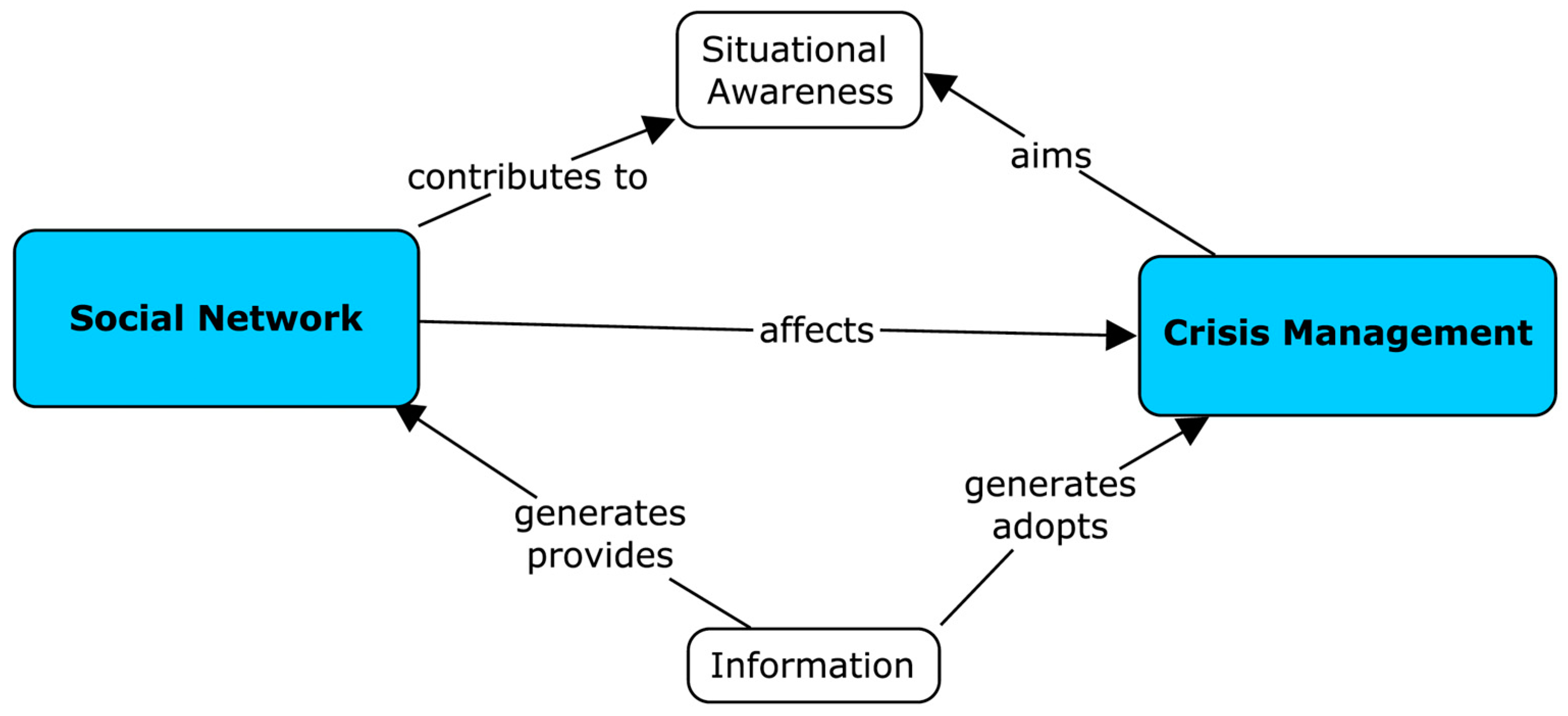
Figure 2.
Conceptualization of the literature review.
Disclaimer/Publisher’s Note: The statements, opinions and data contained in all publications are solely those of the individual author(s) and contributor(s) and not of MDPI and/or the editor(s). MDPI and/or the editor(s) disclaim responsibility for any injury to people or property resulting from any ideas, methods, instructions or products referred to in the content. |
© 2023 by the authors. Licensee MDPI, Basel, Switzerland. This article is an open access article distributed under the terms and conditions of the Creative Commons Attribution (CC BY) license (http://creativecommons.org/licenses/by/4.0/).
Copyright: This open access article is published under a Creative Commons CC BY 4.0 license, which permit the free download, distribution, and reuse, provided that the author and preprint are cited in any reuse.


