

Submitted:
05 July 2023
Posted:
06 July 2023
You are already at the latest version
Abstract
This manuscript explores the significance of continuous improvement in software development and digital product management, highlighting its role in addressing challenges and achieving superior results in today's dynamic business landscape. Drawing on Lean Thinking and Agile principles, the paper emphasizes the importance of customer focus, multidisciplinary collaboration, respect for people, inspection and adaptation, experimentation, incremental delivery, and continuous feedback in driving continuous improvement. It identifies key problems associated with the lack of continuous improvement, including quality issues, stagnation, inefficiency, lack of learning, lack of participation and collaboration, and lack of adaptability. To overcome these challenges, the paper proposes a solution that leverages agile events and interactions, such as sprint retrospectives and daily scrum meetings, and introduces a "kaizen board" as a visual tool to manage and monitor the continuous improvement process. The manuscript highlights the benefits of continuous improvement in terms of quality enhancement, efficiency gains, improved customer satisfaction, and adaptability to change. It stresses the need for fostering a culture of learning and constant adaptation, and provides insights on applying continuous improvement across different dimensions: product, process, team, and culture. The paper concludes by emphasizing the significance of commitment and active participation from all team members for achieving sustainable progress and success in digital transformation efforts.
Keywords:
Agile
; agility
; lean
; software
; culture
; digital
; continuous improvement
1. Introduction
The development of software and the management of digital products play a fundamental role in today’s economy, driving innovation and digital transformation across industries and society[1]. These fields have experienced rapid growth, with companies seeking to leverage the opportunities offered by the digital world to improve their processes, business models, products, and services[2]. However, as the demand for digital products increases, significant challenges arise in terms of quality, efficiency, and the ability to adapt to an ever-evolving business environment[3].
In this context, continuous improvement emerges as an effective approach to address these challenges and achieve superior results in software development and digital product management[4]. Continuous improvement is based on the premise that there is always room for enhancing and optimizing existing processes, practices, and outcomes. It focuses on the constant pursuit of excellence through the identification of areas of opportunity, experimentation, learning, and ongoing adaptation[5,6].
In the realm of digital transformation, continuous improvement and innovation have become essential components for organizations aspiring to lead and stay competitive in an increasingly dynamic and challenging business environment[7]. The ability to quickly adapt to changes, deliver quality products, and meet evolving customer demands are critical elements for success in the digital world[1,8].
2. Development of Continuous Improvement
Continuous improvement in the context of software development and digital products is rooted in the principles of Lean Thinking and Agile[9]. These approaches have proven to be highly effective in driving operational excellence, innovation, and adaptability in organizations[10]. By adopting these principles, work teams and organizations can effectively adapt to changes in customer requirements and the business environment, resulting in higher customer satisfaction and increased efficiency in product delivery[11], creating a virtuous and sustainable cycle of collaboration and growth [12,13,14].
One of the fundamental pillars of Lean Thinking and Agile is the customer focus[15,16]. In software development and digital product management, this entails understanding customer needs and expectations and prioritizing the delivery of value. Adopting a customer-centric approach allows teams to develop solutions that truly solve problems and meet end-users’ demands. This is achieved through close collaboration with stakeholders and continuous feedback gathering, enabling constant adjustment and improvement of the product[3,11].
Multidisciplinary collaboration is another key principle in both Lean Thinking and Agile. By forming cross-functional teams with complementary skills, collaboration, knowledge sharing, and joint decision-making are fostered. This multidisciplinary collaboration facilitates the generation of innovative ideas, identification of more effective solutions, and rapid adaptation to changes[4]. Agile teams, in particular, value face-to-face interaction and promote self-management and shared responsibility, contributing to a collaborative and empowered work environment[16,17].
Respect for people is another fundamental principle of Lean Thinking and Agile. Recognizing and valuing individual contributions, fostering a safe and trusting work environment, and promoting active participation of all team members are essential elements to drive continuous improvement[18,19]. By creating a culture based on respect and trust, the exchange of ideas and experimentation is facilitated, stimulating creativity and innovation in software development and digital product management[8].
Inspection and adaptation are core principles in both Lean and Agile. Constant and detailed evaluation of current processes, practices, and outcomes is essential to identify areas for improvement and growth opportunities. Through regular inspection, teams can detect and correct issues before they become significant obstacles[13,18,20]. Similarly, the ability to adjust methods, processes, and approaches based on learnings and changing product and team needs is essential to maintain agility. Adaptability allows teams to effectively respond to changes and optimize their performance[11,21].
Experimentation is a fundamental pillar in Lean-Agile. Encouraging experimentation and controlled risk-taking is crucial for continuous improvement[22]. By testing new ideas and approaches, teams can learn iteratively and make informed decisions based on evidence[10,23]. Today, in the digital world, companies apply the "A/B Testing" method to run experiments aimed at improving their product outcomes[24].
Incremental delivery and continuous feedback are distinctive features of Lean Thinking and Agile. Instead of developing complete products all at once, the focus is on delivering value increments iteratively[3,8]. This allows for early and continuous feedback from end-users, which in turn informs and guides ongoing improvements. By receiving regular feedback, teams can adjust their approach, address issues promptly, and adapt to changes in customer requirements and the business environment[10,13].
3. Problems Associated with the Lack of Continuous Improvement
The absence of implementing continuous improvement in software development and digital product management can lead to several significant problems:
4. Proposed Solution
To enable organizations and their agile teams to effectively implement continuous improvement, a solution is proposed that leverages key events and interactions within the agile framework. These events and interactions, such as sprint retrospectives, daily scrum meetings, sprint reviews, information radiators, maturity assessments, customer feedback, ideation processes, strategic planning and alignment, business reviews, and agile scaling events, provide valuable inputs for driving continuous improvement[8,13,14].
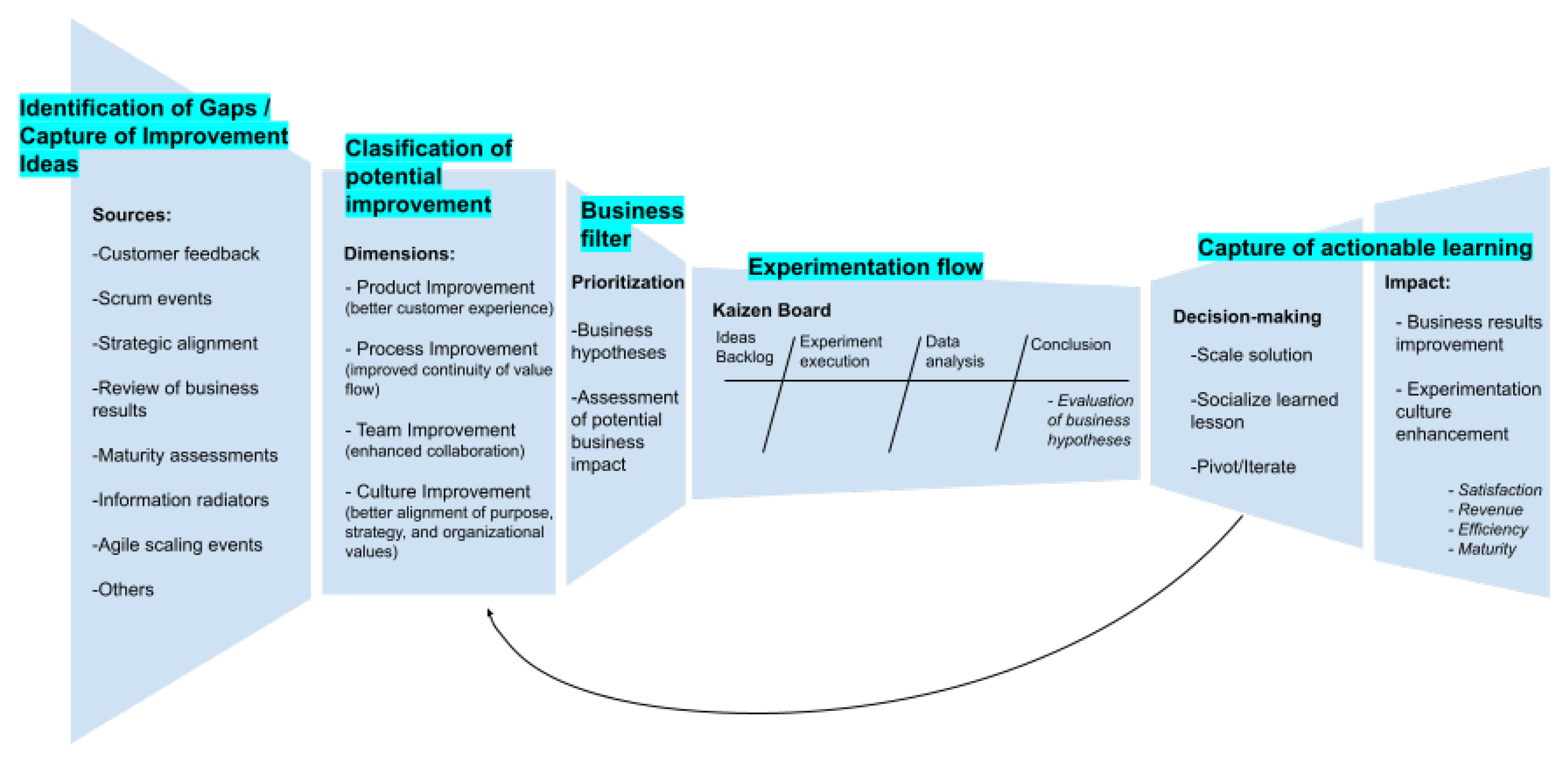
The process begins with the identification of gaps within the organization as shown in Figure 1. These gaps emerge from different sources, such as agile events, team interactions, and visual management tools, to name just a few. During sprint retrospectives, for example, the team reflects on the work done, identifies areas for improvement, and defines concrete actions to address challenges. Similarly, the daily scrum provides an opportunity for synchronization, collaboration, and obstacle detection, while the sprint review allows for valuable feedback from stakeholders and customers[13].
The information collected in these events then enters an ideation process, where hypotheses are defined and actions are prioritized. Those actions identified as having high value and impact on the business will be implemented as continuous improvement experiments[32]. These experiments allow for testing new ideas, approaches, and practices, evaluating their effectiveness objectively through statistical data analysis, to conclusively determine the next steps based on the results obtained[5,31]. If the experiment’s results are positive, the organization can replicate and scale the tested solution; otherwise, the learning is socialized and improvement ideas are adjusted to start a new cycle of prioritization and experimentation[18].
To visualize and manage the proposed improvements, a Kaizen board is used. This board provides a visual and structured way to manage and monitor objectives, actions, and progress in the continuous improvement process. It allows teams to maintain a clear track of improvement activities, assign responsibilities, track progress, and celebrate achievements. This tool promotes transparency, collaboration, and the team’s commitment to continuous improvement[6,22].
Continuous improvement can be applied in different dimensions:
- Product: Focuses on improving the quality, usability, functionality, and customer satisfaction related to the developed product.
- Process: Centers around optimizing development processes, identifying bottlenecks, reducing delivery time, and increasing efficiency in execution.
- Team: Aims to improve collaboration, communication, self-management, and the individual and collective growth of team members.
- Culture: Refers to promoting a culture of learning, experimentation, trust, transparency, and continuous improvement throughout the organization.
Regardless of the dimension(s) to which a potential improvement belongs, it should be prioritized based on the estimated positive impact on business results that the idea can generate. It is important to consider that the improvement idea is a hypothesis, and through an experiment, its ability to create economically positive impacts in the organization will be evaluated[23].
Examples of business result improvement can be achieved through different levers, such as acquiring new customers, customer retention, improving business models to impact monetization and revenue, among others[4].
5. Conclusions
Continuous improvement in the world of software development and digital products is not limited to the implementation of new practices but involves creating a culture rooted in learning and constant adaptation. This approach requires the commitment and active participation of all team members, being a determining factor in achieving sustainable and significant progress in the digital transformation of businesses.
It is important to note that the continuous improvement model is applied throughout all stages of the product life cycle, from identifying opportunities and understanding customer needs to the exploitation phase, operational support, and continuous evolution of the product. In each of these stages, iteration and constant feedback are fundamental elements for driving improvement in different dimensions.
The main objective of continuous improvement is to increase efficiency, quality, customer satisfaction, and overall team and organizational performance. By fostering experimentation, collaboration, and adaptability, the aim is to generate incremental and evolutionary improvements in a flexible and adaptable environment. This enables organizations and their teams to effectively face challenges and changes in the environment, achieving greater competitiveness and success in the market.
To achieve the benefits of continuous improvement, it is essential to establish ideation processes, define hypotheses, and prioritize actions, using events and interactions such as sprint retrospectives, daily scrum, sprint review, information radiators, customer feedback, strategic planning and alignment, business reviews, among others, as inputs. Implementing these high-value actions as continuous improvement experiments allows for evaluating their effectiveness and making adjustments based on the results obtained.
Continuous improvement in software development and digital products is an approach that promotes adaptability, collaboration, and the constant and progressive delivery of value. By addressing the problems associated with the lack of continuous improvement and implementing solutions that leverage key events and interactions, organizations can enhance their ability to adapt, innovate, and grow in the dimensions of product, process, team, and culture. This philosophy becomes a key component in the pursuit of excellence in digital transformation.
Author Contributions
Conceptualization, H.P. and R.M.D.; Formal analysis, H.P. and R.M.D.; Methodology, H.P. and R.M.D.; Project administration, H.P. and R.M.D.; Resources, H.P. and R.M.D.; Software, R.M.D..; Supervision, R.M.D..; Validation, H.P. and R.M.D..; Writing—original draft, H.P. and R.M.D.; Writing—review and editing, H.P. and R.M.D. All authors have read and agreed to the published version of the manuscript.
Acknowledgments
R.M.D.: I would like to acknowledge the Agile TCS community for their valuable insights and contributions that have helped shape the ideas presented in this paper. Their expertise and commitment to agile methodologies have been an inspiration and a driving force in our research. I am grateful for their support and guidance throughout this project. H.P.: Dedicated to all those faithful believers in technological evolution who challenge themselves daily to transform their reality into a higher state.
Conflicts of Interest
No conflicting interests were disclosed.
References
- IMD, A.; Initiative, C. Digital Vortex: How Digital Disruption Is Redefining Industries, 2015.
- Westerman, G.; Bonnet, D.; McAfee, A. Leading Digital Transformation. MIT Sloan Management Review 2014, 55, 1–18. [Google Scholar]
- Silva, D.S.; Ghezzi, A.; Aguiar, R.B.d.; Cortimiglia, M.N.; ten Caten, C.S. Lean Startup, Agile Methodologies and Customer Development for business model innovation: A systematic review and research agenda. International Journal of Entrepreneurial Behavior & Research 2020, 26, 595–628. [Google Scholar]
- Aghina, W.; Handscomb, C.; Ludolph, J.; Rona, D.; West, D. Enterprise agility: Buzz or business impact. McKinsey & Company, 2020; 1–19. [Google Scholar]
- Imai, M. Gemba Kaizen: A Commonsense Approach to a Continuous Improvement Strategy, 2nd ed.; McGraw-Hill: USA, 2012. [Google Scholar]
- Imai, M. Kaizen: The Key to Japan’s Competitive Success, 1st ed.; McGraw-Hill: USA, 1986. [Google Scholar]
- Kotter, J. Accelerate: Building Strategic Agility for a Faster-Moving World, 1st ed.; Harvard Business School Press, 2014. [Google Scholar]
- Denning, S. The age of agile: How smart companies are transforming the way work gets done, 1st ed.; Amacom, 2018. [Google Scholar]
- Blank, S. Why the lean start-up changes everything. Harvard Business Review 2013, 91, 63–72. [Google Scholar] [CrossRef]
- Ries, E. The Lean Startup: How Today’s Entrepreneurs Use Continuous Innovation to Create Radically Successful Businesses, 1st ed.; Currency: USA, 2011. [Google Scholar]
- Takeuchi, H.; Nonaka, I. The new new product development game. Harvard Business Review 1986, 64, 137–146. [Google Scholar]
- Cockburn, A. Agile Software Development: The Cooperative Game, 1st ed.; Addison-Wesley Professional: USA, 2006. [Google Scholar]
- Schwaber, K.; Sutherland, J. The Scrum Guide The Definitive Guide to Scrum: The Rules of the Game, 6th ed.; scrumguides.org, 2020. [Google Scholar]
- Anderson, D. Kanban: Successful Evolutionary Change for Your Technology Business, 1st ed.; Blue Hole Press, 2010. [Google Scholar]
- Womack, J.P.; Jones, D.T.; Roos, D. The Machine That Changed the World: The Story of Lean Production, 1st ed.; Scribner: USA, 1990. [Google Scholar]
- Fowler, M.; Highsmith, J. The agile manifesto. Software development 2001, 9, 28–35. [Google Scholar]
- Womack, J.P.; Jones, D. Lean Thinking: Banish Waste and Create Wealth in Your Corporation, 2nd ed.; Simon and Schuster: USA, 2003. [Google Scholar]
- Ohno, T. Toyota Production System: Beyond Large-Scale Production, 1st ed.; Productivity Press: USA, 1988. [Google Scholar]
- Liker, J. The Toyota Way: 14 Management Principles from the World’s Greatest Manufacturer, 1st ed.; McGraw-Hill: USA, 2004. [Google Scholar]
- Deming, W. Out of the Crisis, 1st ed.; MIT press, 1982. [Google Scholar]
- Schwaber, K.; Beedle, M. Agile software development with scrum. Series in agile software development; Prentice Hall Upper Saddle River, 2002; Vol. 1. [Google Scholar]
- Miller, J.; Wroblewski, M.; Villafuerte, J. Creating a Kaizen Culture: Align the Organization, Achieve Breakthrough Results, and Sustain the Gains, 1st ed.; McGraw-Hill Education: USA, 2013. [Google Scholar]
- Kohavi, R.; Tang, D.; Xu, Y. Trustworthy Online Controlled Experiments: A Practical Guide to A/B Testing, 1st ed.; Cambridge University Press: Cambridge, UK, 2019. [Google Scholar]
- Hamel, G.; Zanini, M. The Power of Experimentation. Innovations: Technology, Governance, Globalization 2023, 13, 52–58. [Google Scholar] [CrossRef]
- Shingo, S. Zero Quality Control: Source Inspection and the Poka-Yoke System, 1st ed.; Routledge: USA, 1986. [Google Scholar]
- McConnell, S. Code Complete: A Practical Handbook of Software Construction, 1st ed.; Microsoft Press: Redmond, WA, 1993. [Google Scholar]
- DeMarco, T.; Lister, T. Peopleware: Productive Projects and Teams, 2nd ed.; Dorset House: Upper Saddle River, NJ, 1999. [Google Scholar]
- Poppendieck, M.; Poppendieck, T. Lean Software Development: An Agile Toolkit, 1st ed.; Addison-Wesley Professional: USA, 2003. [Google Scholar]
- Kotter, J.P. Leading Change: Why Transformation Efforts Fail. Harvard Business Review 1995, 73, 59–67. [Google Scholar]
- Senge, P.M. The Fifth Discipline: The Art & Practice of The Learning Organization, 1st ed.; 1990. [Google Scholar]
- Rother, M. Toyota Kata: Managing People for Improvement, Adaptiveness and Superior Results, 1st ed.; McGraw-Hill: USA, 2009. [Google Scholar]
- Little, J. Lean Change Management, 1st ed.; Packt Publishing, 2014. [Google Scholar]
- Hamel, G. The Future of Management, 1st ed.; Harvard Business Press, 2007. [Google Scholar]
Figure 1.
Key steps for Continuous improvement.
Disclaimer/Publisher’s Note: The statements, opinions and data contained in all publications are solely those of the individual author(s) and contributor(s) and not of MDPI and/or the editor(s). MDPI and/or the editor(s) disclaim responsibility for any injury to people or property resulting from any ideas, methods, instructions or products referred to in the content. |
© 2023 by the authors. Licensee MDPI, Basel, Switzerland. This article is an open access article distributed under the terms and conditions of the Creative Commons Attribution (CC BY) license (http://creativecommons.org/licenses/by/4.0/).
Copyright: This open access article is published under a Creative Commons CC BY 4.0 license, which permit the free download, distribution, and reuse, provided that the author and preprint are cited in any reuse.


