

Submitted:
14 June 2023
Posted:
15 June 2023
You are already at the latest version
Abstract
Smart Cities leverage technology to address various urban challenges and creating disaster resilience is one of them. Technology is a vast and ever-evolving field, and hence the research on technology for improving disaster resilience is scattered. A major drawback of prevailing studies is that they continue to overlook the bottlenecks to effectively harness the benefits of technological innovations and that includes the need for a holistic and multidisciplinary approach. Therefore, this research intends to address that need by methodising the scattered research to provide meaningful insights towards the linkages between society and technological innovations through an urban scholar’s perspective. A comprehensive literature review was conducted to explore emerging and disruptive technologies for improving disaster resilience in Smart Cities. The review findings identified the emerging and disruptive technologies for improving disaster resilience in Smart Cities which were then classified. The findings suggested 4 key criteria to classify technologies including their impact the society, adoption speed, technology maturity and capabilities offered to the community. A Smart City which plans the technologies/ tools for disaster resilience may conduct the assessments under the aforementioned criteria, together with their context-specific feasibility assessments to make informed decisions and ultimately prioritise the most suitable for them.
Keywords:
disruptive technologies
; emerging technologies
; smart city
; urban (city) resilience
1. Introduction
According to the United Nations [1], approximately three in five cities worldwide, with a minimum of 500,000 inhabitants, collectively about one-third of the world’s population, are vulnerable to natural hazards alone. While the main cause of many disasters, the urban population explosion continues, the overwhelmed cities become more and more vulnerable. Therefore, the world was in search of solutions to mitigate the impact of urban population growth while transforming the negativity into opportunities and as a result, several city conceptualisation models were developed. Smart Cities were one of such city conceptualisations that were developed to address a number of unprecedented, interconnected and complex urban challenges provoked as a result of the rapid population growth [2]. Although Smart Cities have shown a promising future offering solutions and opportunities for the urban community, disasters are no exception to Smart Cities, and they can wipe off years of development in no time. Disasters affect Smart Cities differently and sometimes more severely given their unique ecosystem [3], for example, cyber-attacks [4]. Demonstrating a tragic example of how the ripple effect of a catastrophe affects a Smart City, Wuhan, a modern Smart City with more than 11 million populations in China had been closed due to the Covid-19 pandemic [5]. As one of the most severe devastations the world ever combatted, Covid 19 pandemic aftermath highlighted the importance of resilience in response to any kind of disaster [6]. As a result of the growing vulnerability of urban ecosystems including Smart Cities and the rising awareness of disaster risks, making Smart Cities disaster resilient is not only a timely need but should be a natural extension to the accelerated urban development.
According to Samarakkody, et al. [7], disaster resilience in Smart Cities can be understood as restoring or maintaining equilibrium that refers to the state of balance in the Smart City domains including smart environment/ecosystem(natural environment), smart people/people, smart governance/leadership and strategy (knowledge), smart economy/economy, smart living and smart mobility (transportation)/infrastructure, spatiality, society and living (organisation) and ICT infrastructure, in the face of disruptions and stressors. Disaster resilience involves extra work than what is given for disaster risk management and is the guiding principle for urban development, emergency/crisis management and disaster risk management [8]. Smart cities being more advanced have the ability to improve disaster resilience primarily by responding to hazards quicker and faster [9]. Although technologies cannot stop disasters from taking place, they can be very useful for disaster preparedness, especially including prediction, early warning, and rescue operation post disasters [10] which eventually rewards the city to operationalise its resilience mechanism. For instance, having well-defined early warning and post-disaster management systems in a city as part of its disaster risk management strategy/ mechanism enables cities to return to their states of equilibrium, faster, following an extreme event [11]. Hence utilising the potential benefits of technology and innovations is of utmost importance in creating resilience in Smart Cities.
Successful Smart City projects call for two crucial competencies 1) an understanding of the potential of technology solutions in the context of urban systems, and 2) integrating technology solutions rather than applying them in silos [12]. This brings attention to the gap between real city problems and the technological solutions pioneered by Smart Cities proposals [3]. This implies that the tools and technologies that are allegedly designed to address city problems including disaster resilience, either oversee the real problems in the Smart City or do not strategically being applied with the correct understanding of the potential of the technology solution. Therefore, it can be argued that il-chosen technologies applied in silos as a prominent bottleneck to effectively harness the benefits of technological innovations that can be used to make Smart Cities disaster resilient. In fact, according to Bellini and Nesi [13], often the application of Smart City solutions is siloed and needs to be approached in a holistic manner to coherently drive the strategy and resources towards a well-defined goal like city resilience. For example, integrating data from social media, sensors, and other sources to increase situational awareness and response. Therefore, it is important to understand the technologies fit for the purpose of different Smart Cities that intend to be resilient and then determine the right mix of technologies. While there is a range of technologies that are being researched and in use for disaster resilience, it is up to the Smart City to validate and select what suits best for the city. In support of that judgement to be made by individual cities, this study aims to investigate the potential of emerging and disruptive technologies that are in current use (or being researched) for improving disaster resilience in Smart Cities. In order to investigate the potential of technologies, they will be first identified using a systematic literature review and then classified. Classification is important mainly to sort technologies based on their impact made towards creating, enhancing and sustaining disaster resilience in Smart Cities. The impact could be understood by different means, for instance, the impact on society. In fact, as aforementioned, there is a clear research need for interdisciplinary research that helps integrate technology with social sciences. In this context, this study aims to investigate emerging and disruptive technologies for improving disaster resilience in Smart Cities by means of understanding the impact of those technologies on society.
2. Methods
In exploring the potential, initially, a comprehensive literature review was undertaken to identify emerging and disruptive technologies and tools that improve disaster resilience in Smart Cities. It can be argued that a comprehensive literature review is more appropriate than a systematic literature review for this research as the scope of the review is broad and the data set is unmanageable. The said data set in this stage which is the tools and technologies within the fields of disaster resilience or Smart Cities have been researched individually in previous studies, but this study is the first to list out the tools and technologies in the field of disaster resilience in Smart Cities after reviewing scattered studies. Hence, to set a basis for the search of literature about technologies and tools (that improve disaster resilience in Smart Cities), Stratigea, et al. [14]’s study was used. Stratigea, Papadopoulou and Panagiotopoulou [14] identified tools and technologies commonly applied in Smart Cities under 3 categories as follows;
- technologies and tools for citywide geodata collection and management (cloud computing, sensor networks, location-based services, geo-visualization, Geographic Information Systems, mapping, the Internet of Things (IoT), data warehouses, etc.)
- technologies and tools for public participation (crowdsourcing platforms, web-based participatory tools, social media, Living Labs, etc.), and
- sectoral applications (for example, energy, transport, environment, etc.)
Building upon Stratigea, Papadopoulou and Panagiotopoulou [14] findings, this study searched the literature on the sectoral application ‘disaster resilience’ under the first 2 categories. Thereafter, to assess the potential of the identified tools and technologies in transforming Smart Cities’ resilience, the findings were classified under 4 key criteria that determine the impact of the identified tools and technologies towards achieving disaster resilience. Table 1 is a synthesis of key studies that provides an indication of the factors that can be used to assess the potential of tools and technologies applied to Smart Cities.
The above table depicts 4 factors under which emerging and disruptive technologies in Smart Cities can be classified to assess their potential. This mainly represents the essential link between technology and society. Given society’s prominent role in creating resilience it can be argued that these 4 factors are more than justifiable to assess the potential of emerging and disruptive technologies in Smart Cities that helps improve disaster resilience.
3. Results and Discussion
This section is organised under 2 sub sections; 1) Emerging and disruptive technologies for improving disaster resilience in Smart Cities and 2) Classification of technologies under 4 factors identified to assess the potential of emerging and disruptive technologies in Smart Cities that help improve disaster resilience.
3.1. Emerging and disruptive technologies for improving disaster resilience in Smart Cities
All research on Smart Cities is based on the idea that ICTs, the Internet, digital tools and advanced technology discoveries leverage the smartness of a Smart City [23]. Hence, understanding the technology solutions and tools that can make cities disaster resilient is one way to evaluate where a Smart City stands in terms of the technology resources to expedite achieving, enhancing, and sustaining resilience. While the below lists of technologies provide an idea of technologies that are being used in other Smart Cities or researched, an individual Smart City should assess what technologies best solve their current issues related to disaster resilience or what technologies best suit their Smart City (as Smart Cities are context specific).
3.1.1. Technologies and tools for citywide geodata collection and management
Geodata (also known as geospatial data) is the spatially referenced data or data that has a geographic or spatial component [24]. Geo-spatial data encompasses a broad spectrum of data sets and formats, and its versatility makes it applicable to solving a wide range of tasks associated with all phases of disaster resilience management [25]. Citywide geodata collection and management is vital for disaster resilience as it provides cities with valuable insights so that the cities could better prepare for, respond to, and recover from disasters. Below is a list of identified tools and technologies that are important for citywide geodata collection and management.
- Cloud computing
Cloud computing is a computing technique that delivers various IT services with low-cost computing units connected by IP networks so that users from anywhere with an internet connection can access these IT services on-demand without needing to install any hardware or software on their local devices [26,27]. As the cloud offers virtually unlimited resources by means of computing power and storage, geodata -and Web-GIS applications are naturally taking advantage of cloud computing technologies [28]. While cloud computing provides the infrastructure and platform to enable the digital technologies that Smart Cities employ to improve the quality of life of their citizens, increase efficiency and enhance sustainability [29]; its potential to revolutionise the Smart City landscape helps make them disaster resilient.
During disaster situations, cloud computing enables the data and computation (software being used, algorithms, etc.) to be saved (time snapshot) and relocated to another (safer) physical location swiftly, this includes system backup [30]. Large amounts of disaster related data collected from different sources like sensors, satellite imagery, social media, etc. can be stored and analysed and that helps cities to preidentified hazards and disaster risks and prepare [31]. Cloud computing also offers concurrent access to the cloud which may help increase community engagement [32]. Most importantly, cloud computing serves as an underlying infrastructure that provides the on-demand computing resources to meet dynamic computing requirements of real-time disaster/hazard analysis, emergency response and disaster coordination [33]. Cloud Computing also offers a finer solution for disaster modelling and simulation [34] and eventually helps Smart City infrastructure to identify existing vulnerabilities so that resilient infrastructure could be better designed/ improved. However, during the actual disaster scenarios where power, electricity, and communication infrastructure are broken down, the use of cloud services becomes a challenge [31]. To overcome the challenges to use cloud services during disasters, the involvement of evolving disruptive technologies including fog and edge computing, and network work is recommended [10,31]. According to the researchers, Ujjwal, Saurabh, James, Jagannath and Nicholas [31] these technologies act as a transitional data delay for cloud’s further assessment. Further, some studies have also looked at the resiliency techniques in cloud computing infrastructures and applications [35].
- Internet of Things
The Internet of Things (IoT) is a term used to describe the connection of physical objects like mobile devices, sensors, buildings, vehicles, etc. to the Internet, allowing them to collect and exchange data with each other [36]. Some of the IoT implementations feature smart roads, smart grids, smart parking, tank levels, traffic congestion, smartphone detection, radiation levels, smart product management, landslide and avalanche prevention, snow level monitoring, etc. [37]. With the development of Smart City solutions that employ IoT, the world was offered with more factual knowledge about urban systems with high spatial and temporal resolutions [38]. The density and coverage of IoT devices and relatively low energy consumption allow large self-organising networks in emergency communication for longer periods [39]. IoT-enabled disaster management systems that incorporate evolving data analytics and artificial intelligence tool can be used as early warning mechanisms and in finding the victim and possible rescue operations [40].
- Bigdata
Literature refers to Bigdata using 2 different defining characteristics 1) the massiveness of data and 2) complementing techniques and evolving technologies that are vital for the effective processing and conducting insightful analysis of massive volumes of data in a way that their hidden values can be discovered [41,42]. With advanced Big Data Analytics large disaster related datasets from multiple sources can be examined in real time during all the phases of disaster management (including preparedness, mitigation, response, and recovery) to extract valuable information that can help make informed decisions during the resilience journey [41]. Multidimensional big data analytics including descriptive, prescriptive, predictive, and discursive analytics helps create and enhance resilience in the aforementioned phases of disaster management, especially in restoring normal life following a disaster [43]. According to the authors Sarker, Peng, Yiran and Shouse [43], descriptive analytics deals with the description of the status, condition and criticality of disasters while prescriptive analytics focuses on management policy related issues for disaster resilience. Likewise, predictive analytics focus on inferences related to imperceptible issues that could influence future tasks including early warning and forecasting while discursive analytics deals with community resilience related aspects such as raising awareness, timely response and collecting feedback based on big data [43]. Hence, big data technologies improve the effectiveness and speed of linkages between disaster information and appropriate systemic response in Smart Cities [44]. Compared to conventional cities, within Smart City contexts, rapid or real-time big data applications allows better mitigation and capacity enhancement to recover from extreme events relatively faster [45]. One example is the development of ‘geospatial big data’ from location-enabled mobile communication devices and other sensor network-based geospatial data acquisition systems; yet, due to the requirements including high-speed Internet connections, advanced network infrastructure, and knowledge of cloud-based computing, use of cloud-based Big Data processing platforms is questionable in different Smart City contexts like developing countries [46].
- Geo-visualisation and Geographical Information Systems (GIS)
Geo-visualisation includes modern digital ways to represent geospatial data and plays an important role in disaster modelling, scenario development, post disaster analysis and during the execution of search and rescue operations [11]. Geo visualisation is often driven through Geographical Information Systems (GIS). GIS tools are useful for the production and presentation of results obtained from spatial processing and analysis that are ultimately used for better decision-making [31]. GIS has been broadly used widely used to produce hazard, risk and vulnerability maps to effectively understand and manage risks in cities [47]. In addition to risk assessments, GIS plays an important role in emergency response and recovery and reconstruction, especially with its capability to analyse real-time data from cameras and sensors [48]. GIS also assist in deploying location-based emergency services by facilitating the mapping of several contexts within the same area over a period of time so that it helps identify the environmental patterns/ changes in local risk levels [49].
- Sensor networks
Sensor-connected buildings, critical infrastructure systems, vehicles, etc. are critical in capturing real-time information about potential vulnerabilities before catastrophic failure [50]. By using a combination of sensors, for example, seismic sensors, flood sensors, air quality sensors, weather sensors, thermal sensors, motion sensors, and radiation sensors, disaster responders can swiftly assess the scenario, identify potential risks, and take suitable action to mitigate the larger impact [51]. According to Adeel, et al. [52], Wireless Sensor Web (WSW) technology is useful in early warning and situational awareness to prepare communities and assets. Cheikhrouhou, et al. [53] highlighted the synergistic combination of wireless sensor networks and 3D graphics technologies where near-real-time 3D true-to-life scenarios can be generated based on sensor data received from the real environment. Sharma, et al. [54] explained the prominent use of low-power, low data rate wireless sensor networks (WSN) within the intelligent control system of Smart Cities and Khalifeh, et al. [55] highlighted the role of WSN in securing the Smart City from various hazards.
- Grid technologies
Smart Grid incorporates modern advanced technologies, intelligent algorithms, communication networks, and automation systems into the power system to enhance system efficiency, reliability, resiliency, power quality and cost-effectiveness while providing the customer’s tools to manage energy usage [56]. In the case of Smart Cities, innovations in smart energy systems and grids are capable of efficient energy consumption/generation and hence are a popular choice especially when renewable energy such as solar and wind energy are integrated [57]. Smart grid technologies can enhance a city resilience by reducing the length of power outages and consequently reducing the scale and severity of disaster impacts significantly [50]. Similarly, microgrids can improve the post-disaster resilience significantly. With the ability to operate in ‘island mode’, microgrids continue to supply power in the event the large grid is damaged during an extreme event and they can be deployed rapidly [58]. Similar benefits for resilience could be gained with the use of smart water grids use [57].
- Wireless Wide Area Communication and Wireless Local Area Networks
Wireless Wide Area communication (WWAN) for example Long Term Evolution (LTE), Universal mobile telecommunication system (UMTS), Satellite Cellular, High-Speed Downlink Packet Access (HSDPA); or Wireless Local Area Networks (WLAN) for example, Wi-Fi, Bluetooth, etc. facilities interconnect a large number of heterogeneous mobile smart sensing devices which allows providing crisis management services ranging from first responder localisation to all on-site activities within the smart city area [59]. Out of the above WWAN mechanisms, LTE/4G networks have the ability to provide technology agnosticism and provider independence, which is important to mitigate disruptions or outages in any one technology or operator [60]. On the other hand, satellite communication provides reliable communication services in remote or disaster-affected areas where terrestrial communication networks may be unavailable; hence considering the strengths and weaknesses of both, research recommends the integration of satellite and LTE for disaster recovery [61]. Over the recent decade, innovations in communication technology played a crucial role in terms of ensuring error-free connectivity in Smart Cities amidst the major challenge as a result of the coexistence of a high number of intelligent devices [62].
- Location-Based Services (LBS)
The term Location-based services (LBS) is interchangeably used with location services, wireless location services, mobile location-based service, location-enabled services, and location-sensitive services refers to an innovative technology that provides information based on the geographical location (of the user) [63]. The kinds of location-based technologies that offer consumer data services based on the position of the user are mainly used in emergency and rescue services, navigation and tracking and public alerting and warning [64]. Supported by wireless communication technology, LBS technology has two approaches 1) the location data is processed on a server and the result is sent to a mobile device 2) location data can be used through an application on the mobile device [65].
- Geographical positioning techniques
The satellite-based Global Position System (GPS) is the first global location system in use and currently, location-based data can be obtained with one or more of many outdoor and/or indoor positioning determination technologies, classified as terminal/ user-centric, network-centric, and hybrid solutions [49]. Assisted GPS (AGPS) is an improvement to conventional GPS and was developed to compensate for the weakness of GPS. AGPS is a combination of mobile technology and GPS where it makes use of the local wireless networks for faster location acquisition than conventional GPS with enhanced accuracy[66]. Besides, satellite-based technology the other popular technology is network-based which receives a signal from cell sites serving a mobile phone to determine the location some popular methods include, Angle Of Arrival (AOA), Time Of Arrival (TOA), Time Difference Of Arrival (TDOA) and hybrid methods [63]. Positioning as a broad spatial computing area has a large potential in Smart Cities as a means to help re-imagine, review, redesign, and compare alternative infrastructure futures to address risks [67].
- Blockchain
Smart-city-based applications necessitate transparent transactions (verified data/information stored), no single point of failure, data protection and automatic decision-making to ensure the authorization and integrity of transactions and with the immutable decentralized ledger, blockchain technology serves that purpose in securing Smart Cities [68]. Blockchain technology is able to revolutionise disaster resilience, especially in managing the funding/ aid to refugees [69]. The smart contract functionality is highlighted in discussing the use of blockchain technology in disaster management as the city’s disaster management policy can be scripted and damages can be logged with costs being estimated early in the recovery process [70].
- Data Warehouses
A Data Warehouse (DW) is a database that stores an integrated and time-varying data collection derived from operational data and primarily used in strategic decision making [71]. The evolved concept, of big data warehousing is more popular in the Smart City context which supports fact-based decision-making and is with streaming and predictive capabilities [72]. Within the disaster resilience scenario DW can play an important role as it consolidates and (ad hoc) analyses data from different (for example emergency response systems, sensors, social media, etc.) while eliminating data redundancy for improved decision making [73].
- Digital twins
Digital twins facilitate comprehensive data exchange and contain simulations, models, and algorithms describing their counterpart (a physical asset, system, or process) including its characteristics and behaviour in the real world [74]. Urban Digital Twins (UDT) in Smart Cities help them tackle urban complexities by visualizing complex processes in urban systems and their dependencies, simulating possible impacts/outcomes, with particular consideration of the heterogeneous requirements and needs of its citizens to enable collaborative and participatory planning [12]. Smart Cities with digital twins have the capability to synthesise the unique conditions and characteristics of a community during an extreme event and anticipate the evolution of that community following a disaster [75]. UDTs support decision makings when planning activities are synchronised, to improve infrastructure system performance, lower planning conflicts, and for the effective use of environmental and social resources [76]. A digital twin paradigm plays a significant role in a disaster affected city, especially in terms of enhanced situation assessment and decision-making, coordination, and resource allocation [77]. Linking every element in a city to a digital twin in the cloud allows better monitoring of the performance and detection of flaws [78].
- Unmanned Aerial Vehicle(UAV)
UAV path planning is envisioned to find the shortest and optimal path with minimum energy consumption and optimal resource utilisation [79]. Drones have the capacity, responsiveness and portability to increase cellular coverage and bandwidth for disaster relief efforts, criminal surveillance, etc. and they often are considered as a timely solution during disaster rescue missions when regular wireless networks are disrupted [80]. Information about the disaster-affected areas through aerial images from UAVs helps faster evacuations and delivery of supplies helps through a safe route to even inaccessible locations [81].
- Cyber-Physical Systems (CPS)
Cyber-Physical Systems simply integrate the physical element and computational element in engineered systems where the sensors, actuators, and other devices are used to interact with the physical world and computer algorithms analyse and process data in real time [82]. There is only few research that looked at the potential of CPS in disaster resilience which include those that studied about CPS based intelligent structural disaster prevention and reduction system [83], emergency response [84], pre-disaster response planning [85], etc. Smart cities can be viewed as a large-scale implementation of CPS where sensors monitor the physical and cyber components and actuators change the Smart City ecosystem environment [86]. However while improving the cyber infrastructures CPSs can also introduce security vulnerabilities when CPSs are interfaced with Smart Cities [87]. Infrastructure risk is one of the most discussed and critical risks in Smart Cities given the physical world and cyber world are integrated (Baker et al., 2019). Therefore CPSs of smart cities should be designed with balancing the cybersecurity capabilities and proactive intelligence against infrastructure risks and vulnerabilities [88].
- Building Information Modelling (BIM)
BIM is a technology that allows the creation of a digital representation of the functional and physical characteristics of a building. Although the model mainly is used as a shared database to manage a building construction/ facilities throughout its entire project lifecycle it can provide a number of benefits for disaster resilience as well; especially in facilitating post-disaster damage assessment [89]. It also helps in generating and running simulations of the operation of the building facility and the behaviour of occupants of that building, under normal and emergency scenarios [90].
- Smart Disaster Response Systems (Smart DRS)
Compared to traditional disaster response systems, smart DRS deploy real time data to respond in an efficient and timely manner [91]. Local communities as the major component of the smart DRS receive information from sensors and share them in order to obtain assistance [92].
- Early warning systems
Early warning systems are developed for a range of threats including natural geophysical hazards, biological hazards, industrial hazards, complex socio-political events, human health concerns, and other threats within the urban disaster scenario many research have been carried out on early warning systems where real-time data is used to generate warnings for natural hazards [93]. Early warning systems developed for Smart Cities often incorporate different technologies like Artificial Intelligence, IoT, and big data analytics to develop more reliable and resilient systems that are faster to predict and detect [94].
- Virtual Reality (VR), Augmented Reality (AR), And Mixed Reality (MR)
Immersive technology is fundamentally a simulation of reality created by spatial, physical, and visual computers and Virtual Reality (VR), Augmented Reality (AR), And Mixed Reality (MR) have the supremacy to change human-computer relationships with an immersive experience in a digital environment and make digital information meaningful and powerful [95]. With these technologies being able to capture the dynamic interactions in Smart Cities, the city can better prepare for hazards/ disasters [96].
- Artificial Intelligence and machine learning
3.1.2. Artificial intelligence helps to reduce the cascading effects of the destruction of critical infrastructures and allows rapid recovery [97]. Artificial intelligence (AI) applications, including tracking and mapping, remote sensing techniques, geospatial analysis, robotics, machine learning, drone technology, telecom and network services, smart city urban planning, accident and hot spot analysis, environmental impact analysis, and transportation planning, are the technological components of societal change which drives the societal response to hazards and disasters [98]. Accordingly, machine learning and smart city planning are subsets of artificial intelligence. Studies have found prediction and forecasting, early warning systems, resilient infrastructure, financial instruments, and resilience planning as the AI application areas in disaster resilience [99]. With the speed and better ability to analyse large volumes of disaster related data (compared to humans), AI can generate acceptable forecasts to deploy resources and develop disaster plans [100].
The above reviewed are the most cited technologies and tools for citywide geodata collection and management suggest used for DRR and is linked with its potential applications in the Smart Cities. While technologies and tools ranges within a broad spectrum, there could be more which needs to be researched further to justify their potential in creating disaster resilience within Smart Cities. Below section discuss the technologies and tools focused on the public participation in creating disaster resilience within Smart Cities.
3.1.2. Technologies and Tools for public participation
- Crowdsourcing platforms
Crowdsourcing refers to data (by means of ideas, content, services, or even funds) created by a large group of people as a response to an open call or invitation and is based on the underlying argument that a group can provide solutions to a problem more effectively than an expert [101,102]. Crowdsourcing applications can be of large importance in creating disaster resilience as they acknowledge a variety of data collection forms so that it broadens the information availability especially during disasters to impacted communities and at the same time allows the affected populations to communicate with the global community [32]. Data collected through crowdsourcing platforms also help Smart Cities to identify the health conditions of their victimised citizens following a disaster, utilise the resources by better understanding the extent of the disaster, position rescue teams and also help minimise further damage to the environment/ ecosystem[51]. Through active crisis crowdsourcing not only does the community receives a location-based warning and messages like evacuation routes but also offers benefits to all stages of the disaster life cycle as shown in Figure 1 [103].
- Volunteered Geographical Information (VGI)
Volunteered Geographic Information (VGI) is the creation of digital spatial data by groups of people reflecting on their views and geographical knowledge on the web [104]. Some refer to this as a subset of the crowdsourcing mechanism. According to VGI is more detailed, timely, and of a higher quality in many cases compared to what was provided by the official institutions but at the same time the data quality and reliability are highly variable, undocumented and at times incomplete [105,106] and these inconsistencies could lead to errors in disaster related decision making and planning [107].
- Web-based participatory tools
Similar to crowdsourcing, web based participatory tools allow the general community to share their ideas, thoughts, views and collaborate over the internet. For example, the web-based participatory surveillance of infectious diseases collects collect real-time information on the distribution of influenza-like illness cases through web surveys [108]. Other similar examples include a web-based participative decision support platform where the disaster experts, decision makers and the community brainstorm risk mitigation alternatives and select the most appropriate from the proposed [109] and participatory GIS applications that incorporate local knowledge into GIS where public access and collaborative mapping is promoted [110].
- Social media
Social media is a powerful and natural extension of the human sensory system; it includes not only disaster related information shared by the general public but also more trustworthy sources like government authorities, research/ academic institutions and Non-Governmental Organisations (NGOs) [111]. Social media have been primarily used for disaster management to detect extreme events and hazards, and for emergency responders and relief coordinators to obtain situational awareness through social media users’ feedback and monitoring [112]. Researchers also study the social-mediated crisis communication patterns to understand the behaviour of social media users (people and community) during disasters which findings could advise on taking resilient measures [113,114]. Data from social media is vastly important as they overcome the data unavailability due to remote sensing data is lacking during disasters when geo-temporal gaps take place as a result of satellite revisit time limitations, atmospheric opacity, or other obstructions [115].
- Living Labs
Living Labs are a user-centric innovation setting built on everyday research and practice where stakeholders collaborate to design, test, and validate innovative technologies, solutions, and services [116]. Living Labs is a platform to construct Smart City solutions including those aimed at disaster resilience [117]. They help to provide a real-world environment to collaboratively explore, design, test, and implement innovative solutions for disaster resilience [15].
The above review on tools and technologies that facilitate public engagement suggest that there is a potential to build innovative yet inclusive technologies for all. While there are technologies and tools serves the purpose of engaging society by different means, above mentioned are the most common/ mostly cited. The next section classifies the above discussed technologies and tools based on different criteria.
3.2. Classification of technologies
One of the major non-technical challenges in Smart Cities is the financial challenge which can be discussed along the routes of limited funds, large up-front investment, absence of creative business model and monetisation difficulties in SC investments [118]. Therefore, it is vital that Smart Cities utilise their limited resources wisely and this involves choosing the tools and technologies for resilience that are most suitable and feasible for their city. While it is not sensible to draw a generic list of the most suitable tools and technologies for disaster resilient Smart Cities as each Smart City is unique, scientific research can guide Smart Cities to make a judgement in that regard. Therefore, below is a discussion on how the potential of the tools and technologies for improving disaster resilience in Smart Cities, can be assessed. The below discussion links innovation with theory and is structured under 4 sub topics (impact on the society, adoption speed by Smart Cities, maturity of the technology, and capabilities offered to the community) that provides a basis in understanding impact of technology.
3.2.1. Impact on the society
Viewing a Smart City holistically as a system-of-systems is popular when conceptualising the Smart City notion as it is a unit that encompasses a number of interconnected and complex systems including the city’s environmental, economic, and socio-cultural systems [119,120]. Following along the same route, researchers expound people, structure, tasks, and technology as the key four systems of which the Smart City system is comprised and eventually build a relationship between elements of a Smart City and Leavitt’s System Model (also known as Leavitt’s Diamond) looking at Smart City from the perspective of socio-technical system [121]. Out of the four interacting components in Leavitt [122]’s model, technology represents the technical aspect of an organisation while the people, structure, and tasks and the diamond structure showing the relationships imply the importance of treating the social and technical aspects as interdependent parts as changes made to one element can have an impact on the others. Although the model and its extensions initially focused on organisational change management, its use can also be found in Smart City research especially as it overcomes the shortfalls of the standalone humancentric and technocentric modes of thinking which are common to Smart City studies [121,123,124]. According to Mora, et al. [125], with the socio technical approach, the sociotechnical arrangements in a Smart City are envisioned to effectively deploy digital technologies to increase the ability of urban services to sustainably meet societal needs. Use of social technical theory/approach to examine the effect of technologies on social practices, the organization of work and society has been researched considerably [126]. Similarly, with a deeper understanding of interdependencies between a city’s social and technical systems and how they influence one another, Smart City technologies could be classified based on their impact on social systems and even technical systems, or both. For instance, a technology that helps coordinate emergency responders and enhance communication during extreme events could be classified under the technologies having a high impact on social systems. Below Figure 2 depicts a matrix developed based on the impact on social and technical systems.
The tools and technologies identified in the previous section can be placed in the above matrix based on their influence and impact on the Smart City’s social and technical system. Similarly, the tools and technologies can be classified based on their adoption speed and it is discussed in the next section.
3.2.2. Adoption speed by Smart Cities
There is no consensus reached among the practitioners or researchers regarding a standard list of technologies to be employed in Smart Cities. The fast winners or slow losers in technologies are context/user specific. In assessing and predicting the variances in the adoption of technologies, the Technology acceptance model (TAM) is widely used (Pichlak, 2016). TAM postulate that the adoption of a technology is determined by its perceived usefulness to the user and perceived ease of use (Dube et al., 2020). While TAM looks at adoption from the users’ perspective, innovation diffusion theories are usually described from the technology inventor’s perspective (Kopackova et al., 2022). Accordingly, it classifies adopters (users of technology) based on their level of readiness to accept innovations (Bokhari and Myeong, 2022). Together these theories help categorise technologies based on their diffusion in Smart Cities. For instance, if digital twins are widely adopted for DRR in a selected group of cities, compared to Unmanned Aerial Vehicle (UAV)s that technology would be understood as having a high level of diffusion. Similarly, diffusion could be assessed within a city as well. For instance, social media (considering its particular use in DRR activities) is widely adopted and has a large user base; hence, can be classified as having a high level of diffusion. This could also provide an indication of the inclusivity of technology and that its benefits are realised by all segments of society. Below Figure 3 is a framework developed incorporating the above discussed factors.
3.2.3. Maturity of the technology
According to Guseva, et al. [127], the main restriction that hinders the full-scale development of Smart Cities is the expensive Smart City solutions which are still at the introductory and approbation stages yet not ready for scaling. Therefore, the maturity of technology is important when prioritising resources within the Smart City, especially the limited ones which are allocated towards DRR. One of the widely used international assessment tools is the Technology Readiness Level (TRL) scale. It was initiated by the American National Aeronautics and Space Administration (NASA) to measure the maturity of space exploration technology and later became an innovation policy tool of the European Union (EU) [128]. The scale depicts 9 evolutionary stages that abstract how far a technology is from, being ready for use in its anticipated operational environment [129]. The use of the scale is mainly for, but not limited to, making comparisons between diverse technologies based on their respective positioning on the scale, as well as to monitor the progress (usually across time) of an individual technology that involves a linear technology development process [130]. The application of TRL scale within Smart Cities has been researched once by Guseva, Kireev, Bochkarev, Kuznetsov and Filippov [127] and it can be argued that for a niche field like DRR technologies, its use can be highly significant in classifying technologies and understanding the maturity of technology to plan its use in DRR activities. For instance, one may that higher TRL levels as an indication of a higher potential impact on the disaster resilience strategies/plans/activities. Below Figure 4 is an illustration of the TRL scale.
With the use of TRL, Smart Cities can assess the progress of different technologies in the TRL stages, and it provides them with an understanding of the potential risks and sometimes the extent of reliability of the technology. For instance, some technologies may associate less risk when they are in the TRL 9 stage. Similarly, some technologies that need to be developed/validated in controlled laboratory environments or community-based pilot projects require extra facilitation about which the Smart City should be carefully evaluated in terms of resources and practices. In some cases, some technologies could be developed to suit better to a particular Smart City context with citizens’ feedback and in such situations, it is better to select an alternative at a lower TRL stage. Likewise, the maturity of a technology although not directly linked, helps enhance the integration between technology and society.
3.2.4. Capabilities offered to the community.
While much research on Smart Cities is monocentric towards technology, the authors of this study argue that people are as much as important as technology in a Smart City. According to Giffinger, et al. [131], smart people are one of the core six dimensions in a Smart City and it does not only an indication of the level of education/qualification but also is a collection of factors like open mindedness, creativity, flexibility, social interactions, etc. As the key to the creation of Smart Cities, technology should be conceptualised bringing the best out of its transformative’ dimension in a way that enables the capabilities of its citizens [132]. With regards to empowering users a growing scholarly attention has been developed on integrating technology within the Capability Approach (CA) [133]. The notion of capabilities refers to fulfilling expectations and realising achievements and as per the Nobel Laureate Amartya Sen’s CA theory which emphasises individual capabilities suggests that people are given opportunities to make choices on how to live a life they find valuable resources or commodities individuals possess provide means to expand their capabilities. For instance, a study that developed a CA model to look at digital healthcare technology adoption by elderly people conceptualized independent living as a set of capabilities; expounding the freedom to live at home in the way an elderly person wishes, facilitated by digital technologies [134]. Similarly, within the broader perspective of CA, this study argues technology to be conceptualised as a resource while disaster resilience of the Smart City (citizens’ living towards making the city disaster resilient) is a set of capabilities. This entails the enhanced living of individuals in a Smart City that intends to become/sustain disaster resilience with the right utilisation of technologies. Accordingly, there are technologies that become significant in empowering communities and individuals in building resilience within Smart Cities, for instance, the Volunteered Geographical Information (VGI) and social media that involves real time information which is helpful to better respond during extreme events.
The above discussed four factors provide a measure of the potential of a technology/ tool deployed to build/enhance/ sustain disaster resilience in Smart Cities. Potential in the Smart City circumstance is highly context dependent as one technology/tool that works best for one Smart City may not be the best solution for another Smart City with a different character. Evaluating the potential of tools and technologies usually involves prioritising or selecting the most suitable from a few alternatives. Together with feasibility studies, a Smart City that plans the technologies/ tools to build/enhance/ sustain disaster resilience may carry out the assessments under all the above 4 factors, make informed decisions and ultimately prioritise the most suitable for them.
4. Conclusions
Smart Cities provide digitally enabled solutions to various urban problems and hence they are unique to each other. In light of limited resources, Smart Cities should wisely decide on the technologies that they should deploy to address their context specific needs as well as disaster resilience as a mandatory requirement. While there are studies that discuss different emerging and disruptive tools/technologies for disaster resilience and tools/technologies for Smart Cities, there is an absence of the convergence of both aspects. Not only there is a research gap to identify the tools and technologies for improving disaster resilience in Smart Cities, but it is also a clear research need to guide Smart Cities in understanding the potential of tools and technologies for improving disaster resilience in Smart Cities. Therefore, this research addresses the research need and explores the potential of tools and technologies for improving disaster resilience in Smart Cities by identifying the most researched tools and technologies for improving disaster resilience in Smart Cities and providing a guide to evaluate their potential.
Literature findings on tools and technologies for improving disaster resilience in Smart Cities are organised under 2 categories: 1) technologies and tools for citywide geodata collection and management, and 2) technologies and tools for public participation. Citywide geodata collection and management is crucial for disaster resilience as could provide Smart Cities with valuable insights about the city ecosystem enabling them to better prepare for, respond to, and recover from disasters. The tools and technologies that are important for citywide geodata collection and management in transforming Smart Cities to be resilience include cloud computing, the Internet of Things, Bigdata, Geo-visualisation and Geographical Information Systems (GIS), Sensor networks, Grid technologies, Wireless Wide Area communication and Wireless Local Area Networks, Location-Based Services (LBS), Geographical positioning techniques, Blockchain, Data Warehouses, Digital twins, Unmanned Aerial Vehicle (UAV), Cyber-Physical Systems (CPS), Building Information Modelling (BIM), Smart Disaster Response Systems (Smart DRS), Early warning systems, Virtual Reality (VR), Augmented Reality (AR), and Mixed Reality (MR), Artificial Intelligence and machine learning. Technologies and tools for public participation include crowdsourcing platforms, Volunteered Geographical Information (VGI), web-based participatory tools, social media and Living Labs. The above categorisation is based on Stratigea et al.’s (2015) study which was complemented by the findings of similar studies. While the listed are the most researched/ implemented combinations of technologies and developments of these technologies were presented in some product-based publications. Understandably a standard list cannot be generated for a unique setting as a Smart City. Hence the Smart Cities may use this list as a reference to fundamentally understand the tools and technologies for improving disaster resilience and next prioritise their options using a criterion to measure their potential.
The findings propose 4-factor criteria to measure the potential of tools/ technologies available for improving disaster resilience. The 4 factors include Impact on society, adoption speed by Smart Cities, maturity of the technology and capabilities offered to the community. This supports the fundamental argument that well-chosen tools and technologies help Smart Cities to coherently drive their strategy to achieve city goals like disaster resilience. In fact, it is evident that the arbitrarily implemented selection of tools and technologies is a waste of resources and hinders the success of a Smart City project. Alternatively, the above 4 factors help integrate the technology with society and find the right set and the right mix of tools and technologies most suitable to any type of Smart City that intends to be disaster resilient. Although the above 4 factors were found in seeking the tools and technologies for disaster resilience in Smart Cities, the 4 factors are factual in assenting the potential of tools and technologies for any other segment of Smart Cities as well. There have been no previous research findings to develop criteria to assess the potential of tools and technologies in Smart Cities as yet. Therefore, as a way forward, further research needs to be conducted along the 4 factors and be validated in different Smart City contexts to derive further factors for different Smart City categories.
Author Contributions
Conceptualization, A.S. and D.A; methodology, A.S. and D.A.; validation, A.S., D.A. and R.H..; formal analysis, A.S. and D.A.; writing—original draft preparation, A.S. and D.A; writing—review and editing, A.S., D.A., and R.H.; supervision, D.A. and R.H. All authors have read and agreed to the published version of the manuscript.
Funding
The work was conducted as part of Aravindi Samarakkody’s doctoral programme, supervised by Dilanthi Amaratunga and Richard Haigh.
Institutional Review Board Statement
Not applicable.
Informed Consent Statement
Informed consent was obtained from all subjects involved in the study.
Data Availability Statement
Not applicable.
Conflicts of Interest
The authors declare no conflict of interest.
References
- United Nations. The World’s Cities in 2018—Data Booklet; Department of Economic and Social Affairs, Population Division. 2018.
- Chourabi, H.; Nam, T.; Walker, S.; Gil-Garcia, J.R.; Mellouli, S.; Nahon, K.; Pardo, T.A.; Scholl, H.J. Understanding Smart Cities: An Integrative Framework. In Proceedings of the 2012 45th Hawaii International Conference on System Sciences, 4-7 Jan. 2012; pp. 2289–2297. [Google Scholar]
- Marek, L.; Campbell, M.; Bui, L. Shaking for innovation: The (re)building of a (smart) city in a post disaster environment. Cities 2017, 63, 41–50. [Google Scholar] [CrossRef]
- Lee, J.; Kim, J.; Seo, J. Cyber attack scenarios on smart city and their ripple effects. In Proceedings of the 2019 International Conference on Platform Technology and Service (PlatCon), 28-30 Jan. 2019; pp. 1–5. [Google Scholar]
- Cowley, R.; Caprotti, F.; Ferretti, M.; Zhong, C. Ordinary Chinese smart cities: the case of Wuhan. In Inside smart cities; Routledge: 2018; pp. 45-64.
- Hu, X.; Li, L.; Dong, K. What matters for regional economic resilience amid COVID-19? Evidence from cities in Northeast China. Cities 2022, 120, 103440. [Google Scholar] [CrossRef] [PubMed]
- Samarakkody, A.; Amaratunga, D.; Haigh, R. Characterising Smartness to Make Smart Cities Resilient. Sustainability 2022, 14, 12716. [Google Scholar] [CrossRef]
- MacAskill, K.; Guthrie, P. Multiple Interpretations of Resilience in Disaster Risk Management. Procedia Economics and Finance 2014, 18, 667–674. [Google Scholar] [CrossRef]
- Bansal, N.; Mukherjee, M.; Gairola, A. Smart Cities and Disaster Resilience. Singapore, 2017; pp. 109-122.
- Rauniyar, A.; Engelstad, P.; Feng, B.; Thanh, D.V. Crowdsourcing-Based Disaster Management Using Fog Computing in Internet of Things Paradigm. In Proceedings of the 2016 IEEE 2nd International Conference on Collaboration and Internet Computing (CIC), 1-3 Nov. 2016; pp. 490–494. [Google Scholar]
- Kurwakumire, E.; Muchechetere, P.; Kuzhazha, S.; Ikokou, G.B. Geographic Information and Geo-visualisation in support of Disaster Resilience. In Proceedings of the Proc. ICA; 2019; pp. 1–8. [Google Scholar]
- Dembski, F.; Wössner, U.; Letzgus, M.; Ruddat, M.; Yamu, C. Urban Digital Twins for Smart Cities and Citizens: The Case Study of Herrenberg, Germany. Sustainability 2020, 12, 2307. [Google Scholar] [CrossRef]
- Bellini, E.; Nesi, P. Exploiting smart technologies to build smart resilient cities. In Routledge Handbook of Sustainable and Resilient Infrastructure; 2018; pp. 685-705.
- Stratigea, A.; Papadopoulou, C.-A.; Panagiotopoulou, M. Tools and Technologies for Planning the Development of Smart Cities. Journal of Urban Technology 2015, 22. [Google Scholar] [CrossRef]
- Sakurai, M.; Shaw, R. Emerging Technologies for Disaster Resilience: Practical Cases and Theories; Springer. 2021.
- Yeh, H. The effects of successful ICT-based smart city services: From citizens' perspectives. Government Information Quarterly 2017, 34, 556–565. [Google Scholar] [CrossRef]
- Nam, T.; Pardo, T.A. Conceptualizing smart city with dimensions of technology, people, and institutions. In Proceedings of the Proceedings of the 12th Annual International Digital Government Research Conference: Digital Government Innovation in Challenging Times, College Park, Maryland, USA, 2011; pp. 282–291.
- Kogan, N.; Lee, K.J. Exploratory research on the success factors and challenges of smart city projects. Asia Pacific Journal of Information Systems 2014, 24, 141–189. [Google Scholar] [CrossRef]
- Rodríguez-Bolívar, M.P. Transforming city governments for successful smart cities; Springer: 2015.
- Lea, R.J. Smart cities: An overview of the technology trends driving smart cities. IEEE Advancing Technology for Humanity 2017. [Google Scholar]
- Ahad, M.A.; Paiva, S.; Tripathi, G.; Feroz, N. Enabling technologies and sustainable smart cities. Sustainable Cities and Society 2020, 61, 102301. [Google Scholar] [CrossRef]
- Sepasgozar, S.M.E.; Hawken, S.; Sargolzaei, S.; Foroozanfa, M. Implementing citizen centric technology in developing smart cities: A model for predicting the acceptance of urban technologies. Technological Forecasting and Social Change 2019, 142, 105–116. [Google Scholar] [CrossRef]
- Angelidou, M. The Role of Smart City Characteristics in the Plans of Fifteen Cities. Journal of Urban Technology 2017, 24, 3–28. [Google Scholar] [CrossRef]
- Stock, K.; Guesgen, H. Chapter 10 - Geospatial Reasoning With Open Data. In Automating Open Source Intelligence, Layton, R., Watters, P.A., Eds.; Syngress: Boston, 2016; pp. 171–204. [Google Scholar]
- Pashova, E.L.; Bandrova, E.T.; Kouteva-Guentcheva, E.M. Usage of geo-data for educational, purposes to improve disaster preparedness. In Proceedings of the 7th International Conference on Cartography and GIS, Sozopol, Bulgaria; 2018. [Google Scholar]
- Qian, L.; Luo, Z.; Du, Y.; Guo, L. Cloud Computing: An Overview. Berlin, Heidelberg, 2009; pp. 626-631.
- Voorsluys, W.; Broberg, J.; Buyya, R. Introduction to Cloud Computing. In Cloud Computing; 2011; pp. 1-41.
- Riisager, P.; Herzberg, P.; Bødtkjer, M.; Jørgensen, J.; Bergstedt, T.; Helsted, C. Geodata in the Cloud. Geoforum Perspektiv 2015, 14. [Google Scholar]
- Wieclaw, L.; Pasichnyk, V.; Kunanets, N.; Duda, O.; Matsiuk, O.; Falat, P. Cloud computing technologies in “smart city” projects. In Proceedings of the 2017 9th IEEE International Conference on Intelligent Data Acquisition and Advanced Computing Systems: Technology and Applications (IDAACS), 21-23 Sept. 2017; pp. 339–342. [Google Scholar]
- Alazawi, Z.; Alani, O.; Abdljabar, M.B.; Altowaijri, S.; Mehmood, R. Alazawi, Z.; Alani, O.; Abdljabar, M.B.; Altowaijri, S.; Mehmood, R. A smart disaster management system for future cities. In Proceedings of the Proceedings of the 2014 ACM international workshop on Wireless and mobile technologies for smart cities, Philadelphia, Pennsylvania, USA, 2014; pp. 1–10.
- Ujjwal, K.C.; Saurabh, G.; James, H.; Jagannath, A.; Nicholas, F.-S. Cloud Computing in natural hazard modeling systems: Current research trends and future directions. International Journal of Disaster Risk Reduction 2019, 38, 101188. [Google Scholar] [CrossRef]
- Wan, Z.; Hong, Y.; Khan, S.; Gourley, J.; Flamig, Z.; Kirschbaum, D.; Tang, G. A cloud-based global flood disaster community cyber-infrastructure: Development and demonstration. Environmental Modelling & Software 2014, 58, 86–94. [Google Scholar] [CrossRef]
- Huang, Q.; Cervone, G.; Zhang, G. A cloud-enabled automatic disaster analysis system of multi-sourced data streams: An example synthesizing social media, remote sensing and Wikipedia data. Computers, Environment and Urban Systems 2017, 66, 23–37. [Google Scholar] [CrossRef]
- Qiu, M.; Ming, Z.; Wang, J.; Yang, L.T.; Xiang, Y. Enabling cloud computing in emergency management systems. IEEE Cloud Computing 2014, 1, 60–67. [Google Scholar] [CrossRef]
- Colman-Meixner, C.; Develder, C.; Tornatore, M.; Mukherjee, B. A Survey on Resiliency Techniques in Cloud Computing Infrastructures and Applications. IEEE Communications Surveys & Tutorials 2016, 18, 2244–2281. [Google Scholar] [CrossRef]
- Tsai, C.-W.; Lai, C.-F.; Vasilakos, A.V. Future Internet of Things: open issues and challenges. Wireless Networks 2014, 20, 2201–2217. [Google Scholar] [CrossRef]
- Goel, S.S.; Goel, A.; Kumar, M.; Moltó, G. A review of Internet of Things: qualifying technologies and boundless horizon. Journal of Reliable Intelligent Environments 2021, 7, 23–33. [Google Scholar] [CrossRef]
- Harrison, C.G.; Williams, P.R. A systems approach to natural disaster resilience. Simulation Modelling Practice and Theory 2016, 65, 11–31. [Google Scholar] [CrossRef]
- Li, H.; Ota, K.; Dong, M. Always Connected Things: Building Disaster Resilience IoT Communications. In Proceedings of the 2019 IEEE 25th International Conference on Parallel and Distributed Systems (ICPADS), 4-6 Dec. 2019; pp. 570–577. [Google Scholar]
- Ray, P.P.; Mukherjee, M.; Shu, L. Internet of Things for Disaster Management: State-of-the-Art and Prospects. IEEE Access 2017, 5, 18818–18835. [Google Scholar] [CrossRef]
- Shah, S.A.; Seker, D.Z.; Rathore, M.M.; Hameed, S.; Ben Yahia, S.; Draheim, D. Towards Disaster Resilient Smart Cities: Can Internet of Things and Big Data Analytics Be the Game Changers? IEEE Access 2019, 7, 91885–91903. [Google Scholar] [CrossRef]
- Pence, H.E. What is big data and why is it important? Journal of Educational Technology Systems 2014, 43, 159–171. [Google Scholar] [CrossRef]
- Sarker, M.N.I.; Peng, Y.; Yiran, C.; Shouse, R.C. Disaster resilience through big data: Way to environmental sustainability. International Journal of Disaster Risk Reduction 2020, 51, 101769. [Google Scholar] [CrossRef]
- Dattana, V.; Gupta, K.; Kush, A. A probability based model for big data security in Smart city. 2019. [Google Scholar]
- Malik, K.R.; Sam, Y.; Hussain, M.; Abuarqoub, A. A methodology for real-time data sustainability in smart city: Towards inferencing and analytics for big-data. Sustainable Cities and Society 2018, 39, 548–556. [Google Scholar] [CrossRef]
- Lwin, K.K.; Sekimoto, Y.; Takeuchi, W. Development of GIS Integrated Big Data Research Toolbox (BigGIS-RTX) for Mobile CDR Data Processing in Disasters Management. Journal of Disaster Research 2018, 13, 380–386. [Google Scholar] [CrossRef]
- Cariolet, J.-M.; Vuillet, M.; Diab, Y. Mapping urban resilience to disasters – A review. Sustainable Cities and Society 2019, 51, 101746. [Google Scholar] [CrossRef]
- Tomaszewski, B. Geographic Information Systems for Disaster Management. Boca Raton 2015. [Google Scholar]
- Aloudat, A.; Michael, K. The application of location based services in national emergency warning systems: SMS, cell broadcast services and beyond. 2011.
- DesRoches, R.; Taylor, J.J.T.B. The promise of smart and resilient cities. 2018, 48.
- Asimakopoulou, E.; Bessis, N. Buildings and crowds: Forming smart cities for more effective disaster management. 2011; pp. 229-234.
- Adeel, A.; Gogate, M.; Farooq, S.; Ieracitano, C.; Dashtipour, K.; Larijani, H.; Hussain, A. A Survey on the Role of Wireless Sensor Networks and IoT in Disaster Management. In Geological Disaster Monitoring Based on Sensor Networks, Durrani, T.S., Wang, W., Forbes, S.M., Eds.; Springer Singapore: Singapore, 2019; pp. 57–66. [Google Scholar]
- Cheikhrouhou, O.; Koubaa, A.; Zarrad, A. A Cloud Based Disaster Management System. Journal of Sensor and Actuator Networks 2020, 9, 6. [Google Scholar] [CrossRef]
- Sharma, H.; Haque, A.; Blaabjerg, F. Machine Learning in Wireless Sensor Networks for Smart Cities: A Survey. Electronics 2021, 10, 1012. [Google Scholar] [CrossRef]
- Khalifeh, A.; Darabkh, K.A.; Khasawneh, A.M.; Alqaisieh, I.; Salameh, M.; AlAbdala, A.; Alrubaye, S.; Alassaf, A.; Al-HajAli, S.; Al-Wardat, R.; et al. Wireless Sensor Networks for Smart Cities: Network Design, Implementation and Performance Evaluation. Electronics 2021, 10, 218. [Google Scholar] [CrossRef]
- Heirman, D. What makes Smart Grid — Smart — And who is in the “game”? IEEE Electromagnetic Compatibility Magazine 2012, 1, 95–99. [Google Scholar] [CrossRef]
- Farmanbar, M.; Parham, K.; Arild, Ø.; Rong, C. A Widespread Review of Smart Grids Towards Smart Cities. Energies 2019, 12, 4484. [Google Scholar] [CrossRef]
- Nie, H.; Chen, Y.; Xia, Y.; Huang, S.; Liu, B. Optimizing the Post-Disaster Control of Islanded Microgrid: A Multi-Agent Deep Reinforcement Learning Approach. IEEE Access 2020, 8, 153455–153469. [Google Scholar] [CrossRef]
- Palmieri, F.; Ficco, M.; Pardi, S.; Castiglione, A. A cloud-based architecture for emergency management and first responders localization in smart city environments. Computers & Electrical Engineering 2016, 56, 810–830. [Google Scholar] [CrossRef]
- Ring, J.; Foo, E.; Looi, M. On Ensuring Continuity of Mobile Communications in a Disaster Environment. Recent Advances in Security Technology 2007 2007, 268–277. [Google Scholar]
- Casoni, M.; Grazia, C.A.; Klapez, M.; Patriciello, N.; Amditis, A.; Sdongos, E. Integration of satellite and LTE for disaster recovery. IEEE Communications Magazine 2015, 53, 47–53. [Google Scholar] [CrossRef]
- Yaqoob, I.; Hashem, I.A.T.; Mehmood, Y.; Gani, A.; Mokhtar, S.; Guizani, S. Enabling Communication Technologies for Smart Cities. IEEE Communications Magazine 2017, 55, 112–120. [Google Scholar] [CrossRef]
- Chan, N.; Lars, H. Introduction to location-based services. Lund University GIS Centre 2003, 1–12. [Google Scholar]
- Barnes, S.J. Location-Based Services: The State of the Art. e-Service Journal 2003, 2, 59–70. [Google Scholar] [CrossRef]
- Yudha, N.; Nasaruddin, S.; Roslidar, R. The Development of Online Disaster Information System Using Location Based Service (LBS) Technology. International Journal of Informatics and Communication Technology (IJ-ICT) 2014, 47-58.
- Zandbergen, P.A. Accuracy of iPhone Locations: A Comparison of Assisted GPS, WiFi and Cellular Positioning. Transactions in GIS 2009, 13, 5–25. [Google Scholar] [CrossRef]
- Xie, Y.; Gupta, J.; Li, Y.; Shekhar, S. Transforming Smart Cities with Spatial Computing. In Proceedings of the 2018 IEEE International Smart Cities Conference (ISC2), 16-19 Sept. 2018; pp. 1–9. [Google Scholar]
- Hakak, S.; Khan, W.Z.; Gilkar, G.A.; Imran, M.; Guizani, N. Securing Smart Cities through Blockchain Technology: Architecture, Requirements, and Challenges. IEEE Network 2020, 34, 8–14. [Google Scholar] [CrossRef]
- McIsaac, J.; Brulle, J.; Burg, J.; Tarnacki, G.; Sullivan, C.; Wassel, R. Blockchain Technology for Disaster and Refugee Relief Operations. Prehospital and Disaster Medicine 2019, 34, s106–s106. [Google Scholar] [CrossRef]
- Pour, F.S.A. Application of a blockchain enabled model in disaster aids supply network resilience. Old Dominion University, 2021.
- Hüsemann, B.; Lechtenbörger, J.; Vossen, G. Conceptual data warehouse design; Universität Münster. Angewandte Mathematik und Informatik: 2000; Volume 168.
- Costa, C.; Santos, M.Y. The SusCity big data warehousing approach for smart cities. In Proceedings of the Proceedings of the 21st international database engineering & applications symposium, 2017; pp. 264–273.
- H. Krasniqi, Z. THE ROLE OF DATA WAREHOUSE DURING THE NATURAL DISASTER. European Academic Research 2015. [Google Scholar]
- Kuhn, T. Digitaler Zwilling. Informatik-Spektrum 2017, 40, 440–444. [Google Scholar] [CrossRef]
- Ford, D.N.; Wolf, C.M. Smart Cities with Digital Twin Systems for Disaster Management. Journal of Management in Engineering 2020, 36. [Google Scholar] [CrossRef]
- Ye, X.; Du, J.; Han, Y.; Newman, G.; Retchless, D.; Zou, L.; Ham, Y.; Cai, Z. Developing Human-Centered Urban Digital Twins for Community Infrastructure Resilience: A Research Agenda. Journal of Planning Literature 2023, 38, 187–199. [Google Scholar] [CrossRef]
- Fan, C.; Zhang, C.; Yahja, A.; Mostafavi, A. Disaster City Digital Twin: A vision for integrating artificial and human intelligence for disaster management. International Journal of Information Management 2021, 56, 102049. [Google Scholar] [CrossRef]
- Kritzinger, W.; Karner, M.; Traar, G.; Henjes, J.; Sihn, W. Digital Twin in manufacturing: A categorical literature review and classification. IFAC-PapersOnLine 2018, 51, 1016–1022. [Google Scholar] [CrossRef]
- Aggarwal, S.; Kumar, N. Path planning techniques for unmanned aerial vehicles: A review, solutions, and challenges. Computer Communications 2020, 149, 270–299. [Google Scholar] [CrossRef]
- Ali, M.; Naeem, F.; Adam, N.; Kaddoum, G.; Adnan, M.; Tariq, M. Integration of Data Driven Technologies in Smart Grids for Resilient and Sustainable Smart Cities: A Comprehensive Review. arXiv preprint arXiv:2301.08814 2023. arXiv:2301.08814 2023.
- Qadir, Z.; Ullah, F.; Munawar, H.S.; Al-Turjman, F. Addressing disasters in smart cities through UAVs path planning and 5G communications: A systematic review. Computer Communications 2021, 168, 114–135. [Google Scholar] [CrossRef]
- Wolf, W. Cyber-physical systems. Computer 2009, 42, 88–89. [Google Scholar] [CrossRef]
- Lei, Y.; Rao, Y.; Wu, J.; Lin, C.-H. BIM based cyber-physical systems for intelligent disaster prevention. Journal of Industrial Information Integration 2020, 20, 100171. [Google Scholar] [CrossRef]
- Gunes, V.; Peter, S.; Givargis, T.; Vahid, F. A survey on concepts, applications, and challenges in cyber-physical systems. KSII Transactions on Internet and Information Systems (TIIS) 2014, 8, 4242–4268. [Google Scholar]
- Madanian, S.; Johnson, K.; St Martin, M.; Sinha, R.; Cámara, J.; Parry, D. Adaptable socio-cyber physical systems for supporting disaster. Australasian Journal of Disaster and Trauma Studies 2022, 26, 221–234. [Google Scholar]
- Kesswani, N.; Kumar, S. Cyber Physical Systems and Smart Cities. CSI CommuniCationS 2017. [Google Scholar]
- Butun, I.; Österberg, P. Detecting intrusions in cyber-physical systems of smart cities: Challenges and directions. Secure Cyber-Physical Systems for Smart Cities 2019, 74-102.
- Habibzadeh, H.; Nussbaum, B.H.; Anjomshoa, F.; Kantarci, B.; Soyata, T. A survey on cybersecurity, data privacy, and policy issues in cyber-physical system deployments in smart cities. Sustainable Cities and Society 2019, 50, 101660. [Google Scholar] [CrossRef]
- Isikdag, U. BIM: steppingstone in disaster management. GIM mapping the world 2010. [Google Scholar]
- Drogemuller, R. BIM support for disaster response. Risk-Informed Disaster Management: Planning for Response, Recovery and Resilience 2015, 391-405.
- Abdel-Basset, M.; Mohamed, R.; Elhoseny, M.; Chang, V. Evaluation framework for smart disaster response systems in uncertainty environment. Mechanical Systems and Signal Processing 2020, 145, 106941. [Google Scholar] [CrossRef]
- Jung, Y. Smart disaster response through localized short-term cooperation. 2017, 179 LNICST, 12-21. -21. [CrossRef]
- Riaz, K.; McAfee, M.; Gharbia, S.S. Management of Climate Resilience: Exploring the Potential of Digital Twin Technology, 3D City Modelling, and Early Warning Systems. Sensors 2023, 23, 2659. [Google Scholar] [CrossRef] [PubMed]
- Zhang, Y.; Geng, P.; Sivaparthipan, C.; Muthu, B.A. Big data and artificial intelligence based early risk warning system of fire hazard for smart cities. Sustainable Energy Technologies and Assessments 2021, 45, 100986. [Google Scholar] [CrossRef]
- Ullah, F.; Qayyum, S.; Thaheem, M.J.; Al-Turjman, F.; Sepasgozar, S.M.E. Risk management in sustainable smart cities governance: A TOE framework. Technological Forecasting and Social Change 2021, 167, 120743. [Google Scholar] [CrossRef]
- Taylor, J.E.; Bennett, G.; Mohammadi, N. Engineering Smarter Cities with Smart City Digital Twins. Journal of Management in Engineering 2021, 37, 02021001. [Google Scholar] [CrossRef]
- Elvas, L.B.; Mataloto, B.M.; Martins, A.L.; Ferreira, J.C. Disaster Management in Smart Cities. Smart Cities 2021, 4, 819–839. [Google Scholar] [CrossRef]
- Abid, S.K.; Sulaiman, N.; Chan, S.W.; Nazir, U.; Abid, M.; Han, H.; Ariza-Montes, A.; Vega-Muñoz, A. Toward an Integrated Disaster Management Approach: How Artificial Intelligence Can Boost Disaster Management. Sustainability 2021, 13, 12560. [Google Scholar] [CrossRef]
- Yigitcanlar, T.; Butler, L.; Windle, E.; Desouza, K.C.; Mehmood, R.; Corchado, J.M. Can building “artificially intelligent cities” safeguard humanity from natural disasters, pandemics, and other catastrophes? An urban scholar’s perspective. Sensors 2020, 20, 2988. [Google Scholar] [CrossRef]
- Sun, W.; Bocchini, P.; Davison, B.D. Applications of artificial intelligence for disaster management. Natural Hazards 2020, 103, 2631–2689. [Google Scholar] [CrossRef]
- Ghezzi, A.; Gabelloni, D.; Martini, A.; Natalicchio, A. Crowdsourcing: a review and suggestions for future research. International Journal of management reviews 2018, 20, 343–363. [Google Scholar] [CrossRef]
- Hossain, M.; Kauranen, I. Crowdsourcing: a comprehensive literature review. Strategic Outsourcing: An International Journal 2015, 8, 2–22. [Google Scholar] [CrossRef]
- Harrison, S.E.; Johnson, P.A. Crowdsourcing the Disaster Management Cycle. International Journal of Information Systems for Crisis Response and Management (IJISCRAM) 2016, 8, 17–40. [Google Scholar] [CrossRef]
- Haklay, M. Citizen Science and Volunteered Geographic Information: Overview and Typology of Participation. In Crowdsourcing Geographic Knowledge: Volunteered Geographic Information (VGI) in Theory and Practice, Sui, D., Elwood, S., Goodchild, M., Eds.; Springer Netherlands: Dordrecht, 2013; pp. 105–122. [Google Scholar]
- Goodchild, M.F.; Li, L. Assuring the quality of volunteered geographic information. Spatial Statistics 2012, 1, 110–120. [Google Scholar] [CrossRef]
- Flanagin, A.J.; Metzger, M.J. The credibility of volunteered geographic information. GeoJournal 2008, 72, 137–148. [Google Scholar] [CrossRef]
- Horita, F.E.A.; Degrossi, L.C.; de Assis, L.F.G.; Zipf, A.; de Albuquerque, J.P. The use of volunteered geographic information (VGI) and crowdsourcing in disaster management: a systematic literature review. 2013.
- Paolotti, D.; Carnahan, A.; Colizza, V.; Eames, K.; Edmunds, J.; Gomes, G.; Koppeschaar, C.; Rehn, M.; Smallenburg, R.; Turbelin, C.; et al. Web-based participatory surveillance of infectious diseases: the Influenzanet participatory surveillance experience. Clinical Microbiology and Infection 2014, 20, 17–21. [Google Scholar] [CrossRef]
- Aye, Z.C.; Jaboyedoff, M.; Derron, M.-H.; Van Westen, C.J. Prototype of a Web-based Participative Decision Support Platform in Natural Hazards and Risk Management. ISPRS International Journal of Geo-Information 2015, 4, 1201–1224. [Google Scholar] [CrossRef]
- Rouse, L.J.; Bergeron, S.J.; Harris, T.M. Participating in the Geospatial Web: Collaborative Mapping, Social Networks and Participatory GIS. In The Geospatial Web: How Geobrowsers, Social Software and the Web 2.0 are Shaping the Network Society, Scharl, A., Tochtermann, K., Eds.; Springer London: London, 2007; pp. 153–158. [Google Scholar]
- Phengsuwan, J.; Shah, T.; Thekkummal, N.B.; Wen, Z.; Sun, R.; Pullarkatt, D.; Thirugnanam, H.; Ramesh, M.V.; Morgan, G.; James, P.; et al. Use of Social Media Data in Disaster Management: A Survey. Future Internet 2021, 13, 46. [Google Scholar] [CrossRef]
- Sutton, J.N.; Palen, L.; Shklovski, I. Backchannels on the front lines: Emergency uses of social media in the 2007 Southern California Wildfires. 2008. [Google Scholar]
- Liu, B.F.; Fraustino, J.D.; Jin, Y. Social media use during disasters: How information form and source influence intended behavioral responses. Communication Research 2016, 43, 626–646. [Google Scholar] [CrossRef]
- Houston, J.B.; Hawthorne, J.; Perreault, M.F.; Park, E.H.; Goldstein Hode, M.; Halliwell, M.R.; Turner McGowen, S.E.; Davis, R.; Vaid, S.; McElderry, J.A. Social media and disasters: a functional framework for social media use in disaster planning, response, and research. Disasters 2015, 39, 1–22. [Google Scholar] [CrossRef]
- Schnebele, E.; Tanyu, B.F.; Cervone, G.; Waters, N. Review of remote sensing methodologies for pavement management and assessment. European Transport Research Review 2015, 7, 7. [Google Scholar] [CrossRef]
- Ballon, P.; Schuurman, D. Living labs: concepts, tools and cases. info 2015, 17. [Google Scholar] [CrossRef]
- Sharifi, A.; Srivastava, R.; Singh, N.; Tomar, R.; Raji, M.A. Recent Advances in Smart Cities and Urban Resilience and the Need for Resilient Smart Cities. In Resilient Smart Cities: Theoretical and Empirical Insights, Sharifi, A., Salehi, P., Eds.; Springer International Publishing: Cham, 2022; pp. 17–37. [Google Scholar]
- Pierce, P.; Andersson, B. Challenges with smart cities initiatives–A municipal decision makers’ perspective. In Proceedings of the Proceedings of the 50th Hawaii International Conference on System Sciences; 2017. [Google Scholar]
- Cavalcante, E.; Cacho, N.; Lopes, F.; Batista, T. Challenges to the Development of Smart City Systems: A System-of-Systems View. In Proceedings of the Proceedings of the XXXI Brazilian Symposium on Software Engineering, Fortaleza, CE, Brazil, 2017; pp. 244–249.
- Muvuna, J.; Boutaleb, T.; Baker, K.J.; Mickovski, S.B. A Methodology to Model Integrated Smart City System from the Information Perspective. Smart Cities 2019, 2, 496–511. [Google Scholar] [CrossRef]
- Kopackova, H.; Libalova, P. Smart city concept as socio-technical system. In Proceedings of the 2017 International Conference on Information and Digital Technologies (IDT), 5-7 July 2017; pp. 198–205. [Google Scholar]
- Leavitt, H.J. Applied Organizational Change in Industry, I JG March (ed.) Handbook of Organizations. Chicago: Rand McNally 1965, 1144, 1170. [Google Scholar]
- Biloria, N. Smart Cities: A Socio-Technical Perspective. 2021.
- Kopáčková, H.; Libalova, P. THE RISE OF SMART CITIES–RESULT OF GLOBAL PROBLEMS OR TECHNOLOGY CHALLENGE? In Proceedings of the Globalization and its socio-economic consequences: 17th International scientific conference: proceedings, 2017.
- Mora, L.; Deakin, M.; Zhang, X.; Batty, M.; de Jong, M.; Santi, P.; Appio, F.P. Assembling Sustainable Smart City Transitions: An Interdisciplinary Theoretical Perspective. Journal of Urban Technology 2021, 28, 1–27. [Google Scholar] [CrossRef]
- Opazo, M.P. Revitalizing the concept of sociotechnical systems in social studies of technology, 2010. 2010.
- Guseva, A.I.; Kireev, V.S.; Bochkarev, P.V.; Kuznetsov, I.A.; Filippov, S.A. End-to-end digital technologies in “smart cities” of Russia. IOP Conference Series: Earth and Environmental Science 2021, 740, 012022. [Google Scholar] [CrossRef]
- Héder, M. From NASA to EU: the evolution of the TRL scale in Public Sector Innovation. The Innovation Journal 2017, 22, 1–23. [Google Scholar]
- Engel, D.W.; Dalton, A.C.; Anderson, K.K.; Sivaramakrishnan, C.; Lansing, C. Development of Technology Readiness Level (TRL) Metrics and Risk Measures; United States, 2012; p. Medium: ED; Size: PDFN.
- Bruno, I.; Lobo, G.; Covino, B.V.; Donarelli, A.; Marchetti, V.; Panni, A.S.; Molinari, F. Technology readiness revisited: a proposal for extending the scope of impact assessment of European public services. In Proceedings of the ICEGOV; 2020; pp. 369–380. [Google Scholar]
- Giffinger, R.; Fertner, C.; Kramar, H.; Kalasek, R.; Pichler-Milanović, N.; Meijers, E. Smart cities: Ranking of european medium-sized cities. vienna, austria: Centre of regional science (srf), vienna university of technology. www. smart-cities. eu/download/smart cities final report. pdf 2007.
- Roche, S.; Nabian, N.; Kloeckl, K.; Ratti, C. Are ‘smart cities’ smart enough. In Proceedings of the Global geospatial conference; 2012; pp. 215–235. [Google Scholar]
- Haenssgen, M.J.; Ariana, P. The place of technology in the Capability Approach. Oxford Development Studies 2018, 46, 98–112. [Google Scholar] [CrossRef]
- Nikou, S.; Agahari, W.; Keijzer-Broers, W.; de Reuver, M. Digital healthcare technology adoption by elderly people: A capability approach model. Telematics and Informatics 2020, 53, 101315. [Google Scholar] [CrossRef]
Figure 1.
Crowdsourcing for the disaster management cycle. Source: [103].
Figure 1.
Crowdsourcing for the disaster management cycle. Source: [103].
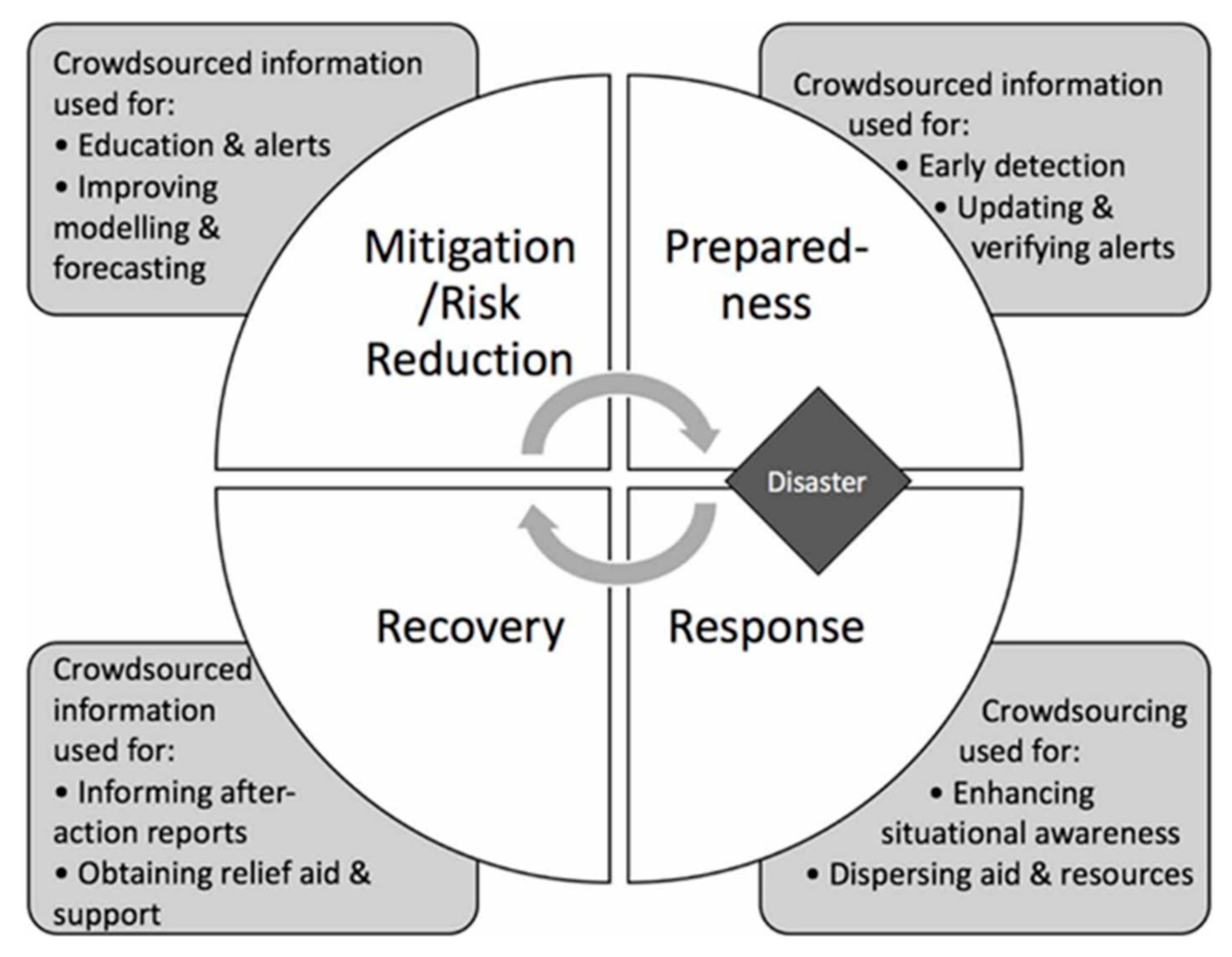
Figure 2.
Impact matrix to assess the technology Impact on the society. Source: Developed by the authors.
Figure 2.
Impact matrix to assess the technology Impact on the society. Source: Developed by the authors.
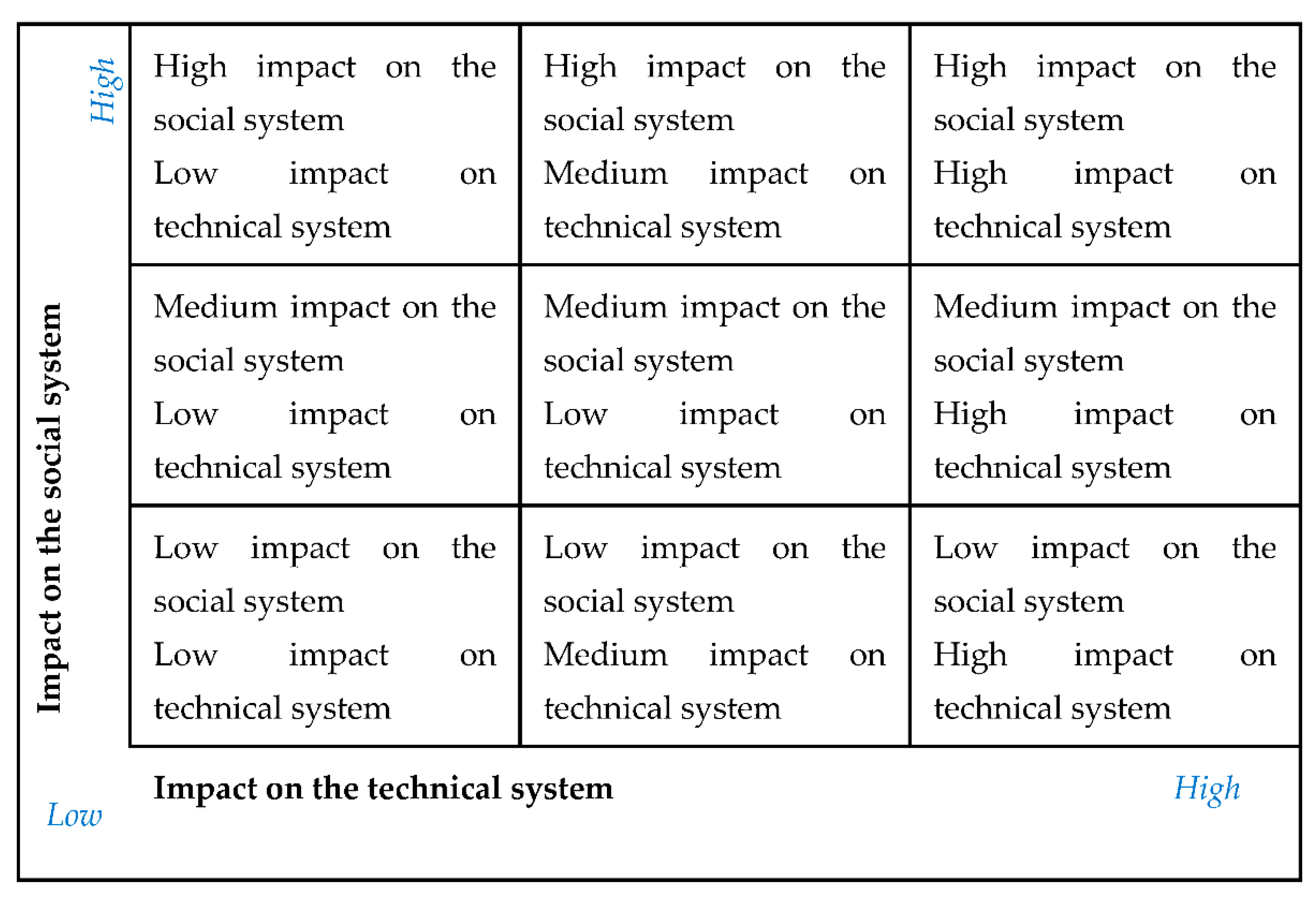
Figure 3.
A framework to assess the adoption speed of technologies/tools. Source: Developed by authors.
Figure 3.
A framework to assess the adoption speed of technologies/tools. Source: Developed by authors.
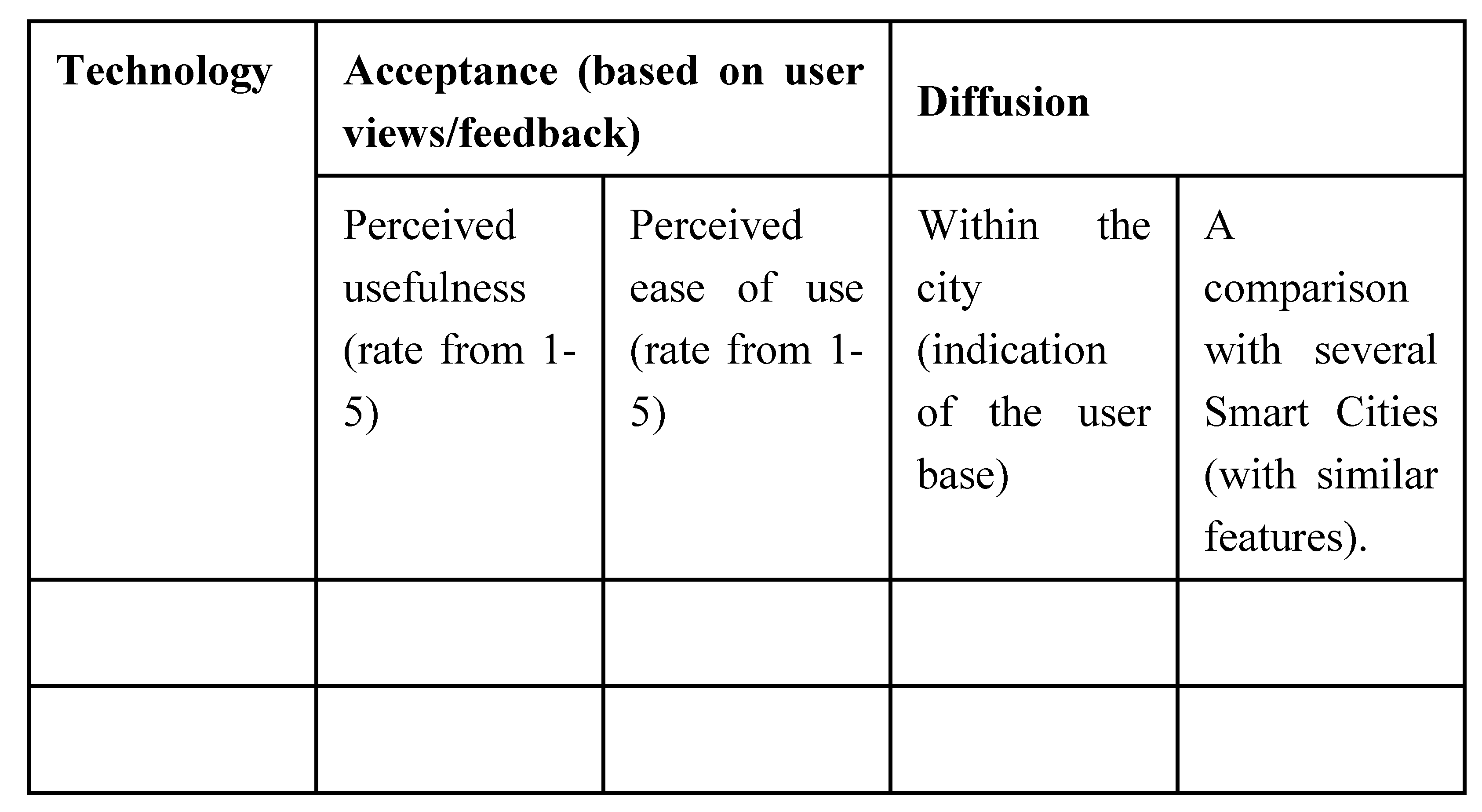
Figure 4.
Technology readiness levels used by EU/ UKRI Science and Technology Facilities Council to determine whether a project/ proposal is eligible for a specific funding opportunity. Source: [128].
Figure 4.
Technology readiness levels used by EU/ UKRI Science and Technology Facilities Council to determine whether a project/ proposal is eligible for a specific funding opportunity. Source: [128].
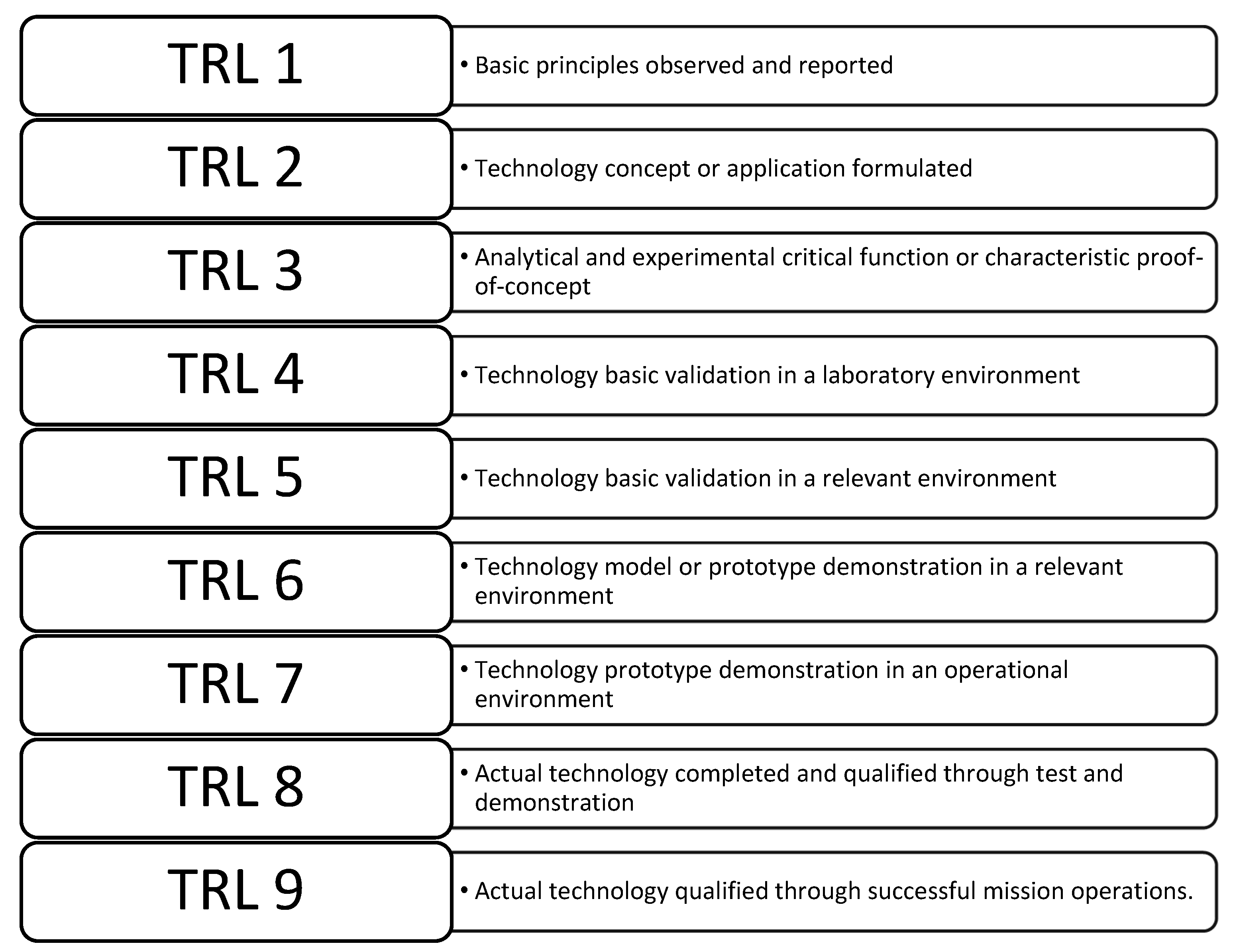

Table 1.
Factors/criteria to assess the potential of emerging and disruptive technologies for improving disaster resilience in Smart Cities.
Table 1.
Factors/criteria to assess the potential of emerging and disruptive technologies for improving disaster resilience in Smart Cities.
| Factor/Criteria | a | b | c | d | e | f | g | h | i |
|---|---|---|---|---|---|---|---|---|---|
| Impact on the society | ✓ | ✓ | ✓ | ✓ | ✓ | ✓ | ✓ | ✓ | ✓ |
| Adoption Speed by Smart Cities | ✓ | ✓ | ✓ | ✓ | ✓ | ✓ | ✓ | ✓ | ✓ |
| Maturity of the technology | ✓ | ✓ | ✓ | ✓ | ✓ | ✓ | ✓ | ||
| Capabilities offered to the community | ✓ | ✓ | ✓ | ✓ | ✓ | ✓ | ✓ | ✓ | ✓ |
| a=[14],b=[15],c=[16],d=[17],e=[18],f=[19],g=[20],h=[21],i=[22] | |||||||||
Disclaimer/Publisher’s Note: The statements, opinions and data contained in all publications are solely those of the individual author(s) and contributor(s) and not of MDPI and/or the editor(s). MDPI and/or the editor(s) disclaim responsibility for any injury to people or property resulting from any ideas, methods, instructions or products referred to in the content. |
© 2023 by the authors. Licensee MDPI, Basel, Switzerland. This article is an open access article distributed under the terms and conditions of the Creative Commons Attribution (CC BY) license (http://creativecommons.org/licenses/by/4.0/).
Copyright: This open access article is published under a Creative Commons CC BY 4.0 license, which permit the free download, distribution, and reuse, provided that the author and preprint are cited in any reuse.