

Submitted:
13 June 2023
Posted:
13 June 2023
You are already at the latest version
Abstract
The Feni Island group is located at the southeastern end of the NW trending Ta-bar-Lihir-Tanga-Feni (TLTF) island chain, northeastern Papua New Guinea. This island chain is renowned for hosting alkaline magmas, geothermal activity, copper-gold mineralization and mining. The purpose of this paper is to present the geological observations of Feni Island within the context of the regional tectonic setting and evolution of the TLTF. The TLTF arc is a younger arc situated within the Greater Melanesian Arc, specifically within the New Ireland Basin bounded by New Ireland to the west and the extinct Kilinailau Trench in the east. The formation of the TLTF is attributed to post-subduction extensional tectonics relating to the opening of the Manus Basin and the magma is sourced from subduction-modified upper mantle. Normal, ex-tensional faulting is observed throughout the TLTF.
Keywords:
Papua New Guinea
; Melanesian Arc
; New Guinea Islands Terrane
; TLTF
; Feni
1. Introduction
Papua New Guinea (PNG) is a geologically and tectonically complex country comprising several unique geotectonic terranes. The Feni Island group is part of the Tabar-Lihir-Tanga-Feni (TLTF) volcanic arc within the New Ireland Basin (NIB), New Ireland Province (NIP), northeast Papua New Guinea (PNG). Feni consists of Babase and Ambitle islands located between geographic coordinates 3° 45’S, 153°30’E and 4° 15’, 154° 00’ E, forming the southern end of the Pliocene to Holocene alkaline TLTF chain (Figure 1). This review article is a prelude to a sister paper also published in this special issue titled “The petrology and geochemistry of the REE- enriched, alkaline volcanic rocks of Feni Island group, Papua New Guinea” by the same authors. The aim of this paper is to (1) summarize the main theories or ideologies on PNG geotectonic evolution particularly focusing on the New Guinea Islands Terrane and the Tabar-Lihir-Tanga-Feni chain and (2) discuss the geology of Feni Island and summarize its geotectonic and petrogenetic history.
2. Geology and Tectonic Setting of Papua New Guinea
The geological history of PNG is relatively young and highly complex with multiple stages of tectonic activity and associated magmatic and deformational events. PNG is located on the eastern side of the island of New Guinea in the SW Pacific (Figure 1). New Guinea is situated at the active boundaries of the north-moving Indo-Australian Plate and the NW-moving Pacific Plate. Island arcs occur above the subducting Australian Plate and include the arcs of the PNG islands, Solomon Islands, Vanuatu, and Tonga [1]. The Australian plate is moving north at 7 cm per year whilst the Pacific Plate is moving west-north west at a rate of 10-11 cm per year [2,3] (Wallace et al., 2004; DeMets et al., 1994). The convergence of these plates within PNG results in a convergence to the east-north east (070 degrees) at a rate of 11 cm per year [4] (Davies, 2012).
Papua New Guinea is made up of several terranes classified into four main geotectonic provinces [5,6,7,8] (Davies, 1991; Davies, 2009; Williamson and Hancock, 2005; Sheppard & Cranfield, 2012):
- (1)
- Stable Fly Platform
- (2)
- New Guinea Orogen
- (3)
- Accreted terranes
- (4)
- Melanesian Arc
Figure 1.
PNG Geotectonic Terrane Map (modified after Williamson & Hancock, 2005) [7].
Figure 1.
PNG Geotectonic Terrane Map (modified after Williamson & Hancock, 2005) [7].
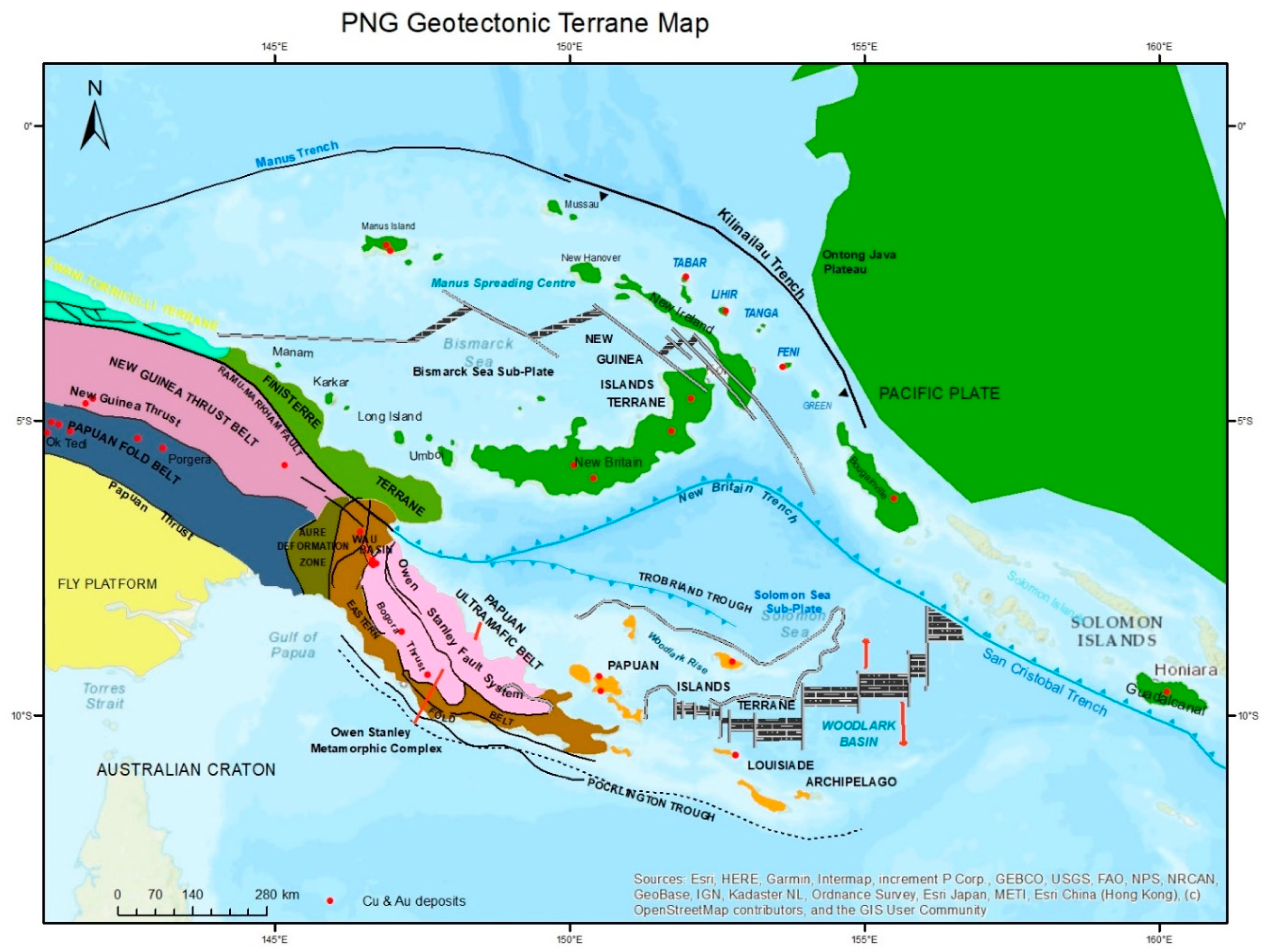
The stable Fly Platform in south PNG is relatively flat and represents the N-NE extension of the underlying Australian Craton. It is north of and adjacent to the Papuan Basin formed by tectonic rifting during the Late Cretaceous. The stable Fly platform-Papuan Basin terrane consists of carbonate and siliclastic sediments sitting on autochthonous Paleozoic granitic basement in the Western and Gulf provinces [9] (Tcherepanov et al., 2008).
The New Guinea Orogen is the 2200 km long collisional zone forming the NW-trending mountainous spine of mainland New Guinea. The stable Fly platform transitions into the magnificent Papuan Fold and New Guinea Thrust belts renowned for hosting economic petroleum and mineral resources that sustain the PNG economy (Figure 1). These belts make up the eastern section of the New Guinea Orogen which was originally described as the New Guinea Mobile Belt [10] (Dow et al, 1972). The New Guinea Thrust Belt is divided into the Western (Highlands and Ramu–Sepik regions) and Eastern (Papuan Peninsula and Islands) Orogens. Pigram and Davies (1987) [11] and Davies (2012) [4] considered the “New Guinea Orogen” as the collision-deformed continental margin of the Australian Craton specifically at Jimi, Bena Bena and Lengguru terranes. Davies (1991) [5] described the New Guinea Orogen as a composite terrane comprised of metamorphosed sediments (that had undergone fold-and-thrust belt deformation), island arc magmatic rocks, and obducted oceanic crust.
The Eastern Orogens or the East Papuan Composite Terrane (EPCT) is an amalgamation of smaller terranes including the Owen Stanley Metamorphics (OSM), Papuan Ultramafic Belt (PUB also referred to as the Bowutu Terrane), Dayman Dome, Port Moresby and the Kutu Volcanics (Pigram & Davies, 1987) [11] forming the Papuan Peninsula and Papuan Islands. The OSM is considered to be sediments scraped off the edge of the Australian Craton and subsequently metamorphosed by the collision of island arc and oceanic crust (ie PUB) onto mainland New Guinea along the Owen Stanley Fault during the Paleocene [12,13] (Lus et al, 2004; Davies et al, 1997). Active sea floor rifting currently occurs at the Woodlark Basin exerting a west-directed collisional force on the east Papuan islands and the mainland.
The third geotectonic province consists of accreted terranes of island arc and obducted ophiolites in the northern and northeastern mainland. It lies north of the New Guinea Thrust Belt and consists of the Bewani-Torriceli and the Finisterre terranes formed by the accretion of allochthonous volcanic island arcs and potentially obducted ophiolites [7] (Williamson & Hancock, 2005). The accretion of the Finisterre Terrane onto the mainland most likely occurred in the early Miocene [13] (Davies et al, 1997) and is said to be the last accretion event in the evolution of eastern New Guinea.
The boundary of the major terranes and geotectonic provinces on mainland New Guinea are demarcated by lithospheric faults and basins [11] (Pigram & Davies, 1987). These include the Ramu-Markham Fault separating the New Guinea Orogen from the Finisterre Terrane and the Owen Stanley fault system marking the boundary of the OSM from the PUB.
The fourth geotectonic province is the Melanesian Arc situated offshore in the north east comprising dismembered island arcs within the segmented Pacific Plate margin and a large igneous province (LIP) termed the Ontong Java Plateau (OJP). It is also referred to as the New Guinea Islands Terrane consisting of arcuate-shaped islands surrounded by the Bismarck and Solomon seas [7,14] (Davies, 1991; Williamson & Hancock, 2005). These island arcs include New Britain, New Ireland, Manus, and Bougainville. Seafloor spreading currently occurs at the Manus Basin whilst active subduction takes place along the New Britain-San Cristobal Trench [15] (Petterson et al, 1999). Another important feature is the OJP situated east of the TLTF representative of a significant tectonic event in the evolution of the Melanesian Arc and the SW Pacific. The TLTF chain is located within the Melanesian Arc although its geological history is far younger than the latter and will be explored in the next section.
2.1. Melanesian Arc and New Guinea Islands Terrane
The present-day key geotectonic elements surrounding the TLTF chain include New Ireland and the New Ireland Basin to the west, the Manus-Kilinailau Trench and the OJP in the east and north east; the New Britain Trench (NBT) in the south-south west and the Manus sea floor spreading centre in the far west.
The Melanesian Arc or Northern Melanesian Arc includes Manus, New Britain, New Hanover, New Ireland, and Bougainville and continues southeastwards to the Solomon Islands (Figure 1), Vanuatu and Fiji along the deep-sea trenches marking the Australia-Pacific Plate boundary. Several workers propose that the formerly linear Melanesian Arc and the New Ireland fore-arc basin formed on the hanging wall of the south or southwest-dipping Manus-Kilinailau Trench (MKT), within an intra-oceanic setting, far north of Australia during the Eocene [7,16,17,18,19] (Johnson, 1979; Audley-Charles, 1991; Yan and Kroenke, 1993; Williamson and Hancock, 2005; Horz et al., 2004). Other models suggest that the Melanesian-Tonga-Kermadec arc rifted away from the Australian continental margin by back-arc spreading due to the southward and westward subduction in the early Cainozoic [20,21,22,23,24] (Crook and Belbin, 1978; Gaina et al., 1999; Hall, 2002; Hall and Spakman, 2002; Mann and Taira, 2004).
Following the former hypothesis, the Manus-Kilinailau Trench is responsible for the formation of the Melanesian Arc during the Eocene and Oligocene. Evidence of the Melanesian arc magmatism is supported by the presence of the Eocene to Oligocene Jaulu Volcanics on New Ireland, Djaul, and New Hanover. The New Ireland Basin (NIB) developed as a forearc basin to the MKT in the Eocene. NIB, today, encompasses eastern New Ireland, the TLTF, and Mussau Island [25] (Exon & Marlow, 1988).
The OJP is a plume-related and voluminous LIP more than 30 km thick (Fitton et al., 2004; Furumoto et al., 1976) [26,27] riding on the Pacific Plate (Figure 1 and Figure 2). The westward motion of the Pacific Plate resulted in the arrival of the OJP (Figure 2) at the MKT (termed soft-docking) in the Upper Oligocene ~26 Ma and finally hard-docking in the eastern Solomon Islands in the Pliocene [15,28] (Holm et al., 2013; Petterson et al., 1999). The OJP subsequently jammed the Melanesian or Kilinailau Trench, bringing collision and magmatism to a complete halt in the Upper Miocene ~20Ma [28] (Holm et al., 2013). Widespread extension in New Ireland, New Ireland, and the Solomon Islands also ensued as a result of the steepening of the Pacific Slab following the OJP collision [28] (Holm et al., 2013).
The OJP collision also resulted in microplate development, arc polarity reversal, and the disconnection and southward migration of New Britain from the previously linear Melanesian arc [15,16,18,29] (Johnson, 1979; Coleman and Kroenke, 1981; Martinez and Taylor, 1996; Tregoning et al., 1998; Petterson et al., 1999). As a result of the pause in magmatism in the Upper Miocene, extensive limestone deposition occurred on the emerging volcanic arcs of New Britain, New Ireland, Manus, and Bougainville. On New Ireland, the Lelet Limestone marks this period of subsidence and hiatus in magmatic activity during the Miocene.
2.2. New Britain Trench & Manus Spreading Centre
The microplates formed following the OJP collision include the Solomon and the Bismarck sea plates. The continued convergence of the major Australian and Pacific plates reactivated the northward subduction of the Solomon microplate beneath the Bismarck microplate along the New Britain Trench around 10-5 Ma [15,16,19,28] (Holm et al., 2013; Johnson, 1979; Petterson et al., 1999; Horz et al., 2004). This, in turn, led to the opening of the back-arc Basin around 3.6 million years as a result of the onset of the NBT and the continued collision of the Finisterre Terrane along the New Guinea mainland (Figure 2).
2.3. Regional Tectonic Evolution of Tabar-Lihir-Tanga-Feni chain
The older island arcs of New Ireland, New Britain, and Bougainville are predominantly calc-alkaline in composition whereas the TLTF volcanic arc is alkaline or shoshonitic ranging from undersaturated alkali basalts to intermediate trachytes. This geochemical difference is the direct result of the different tectonic regimes and ages.
The continued convergence of the westward moving Pacific Plate, initiation of the New Britain Trench, and the opening of the Manus Basin since the Pliocene reconfigured the various island elements [5] (Davies, 1991). Renewed magmatism in the Pliocene to present-day Quaternary period formed two NW-trending volcanic island chains possibly capitalizing on the extension-related faults formed after the OJP collision event (Figure 2):
- 1)
- 1000 km long arc starting from north coast New Britain and continuing on to the Schouten Island Group (Karkar, Manam, Bagabag, Umboi Islands); and
- 2)
- Northwest-trending TLTF chain in the New Ireland Basin renowned for shoshonitic magmatism and gold mineralization.
Woodhead et al (1998) [31] showed that magma chemistry of the New Britain Quaternary volcanics were calc-alkaline to tholeiitic as the distance from the trench increased northwards. Lindley (2006) [32] argued that the NBT is not a subduction zone and displays more extensional tectonics within a left-stepping sinistral strike-slip regional fault system. He noted that most of the faults measured in New Britain are extensional in nature. However, these normal faults may have formed from the steepening of the Pacific Slab following the OJP collision at the Kilinailau Trench.
Relative to the present-day active New Britain Trench, the sedimentary New Ireland Basin is currently located in a back-arc setting [19] (Horz et al., 2004). Some workers propose that the TLTF arc was derived from magmatism associated with the subduction of the Solomon Sea Plate into the New Britain Trench under New Britain and New Ireland [33] (Lindley, 1988). Rogerson et al. (1988) [34] differed by suggesting that the TLTF arc is unrelated to the New Britain Trench but may have been localized by an earlier structural grain resulting from the Kilinailau Trench. Other authors also postulate that volcanism on the TLTF is post-subduction, and was possibly triggered by extension due to the rifting of the back-arc Manus Basin during the Pliocene (Wallace et al., 1983; McInnes and Cameron, 1994) [2,35]. The absence of a Benioff Zone beneath New Ireland and the stalling of subduction at the Manus-Kilinailau Trench since the Miocene coupled with the presence of alkaline magmatism further supports that the TLTF volcanism is extension-related [2,36] (Wallace et al., 1983; O’Kane, 2004). A slab tear or slab window potentially exists under the New Ireland Basin that allows for deep melts or fluids to escape to the surface and form the TLTF [36] (O’Kane, 2004). Slab windows or extensional structures post-dating subduction are common geotectonic conditions in the formation of alkaline or shoshonitic magmas [37]. Further to the argument of slab tears or extensional tectonics, the back-arc spreading and opening of the Manus Basin commenced around 3.5 Ma [38] (Taylor, 1979). Eruptions within the volcanic TLTF chain began in the northwest, near Tabar by 3.6 Ma [39](Rytuba et al., 1993) and the latest eruptions occurred on Ambitle (Feni) in the southeast, about 2300 years ago [2,40](Wallace et al., 1983; Licence et al., 1987).
McInnes and Cameron (1994) [35] suggested that magma genesis beneath Lihir involves decompression melting of subduction-modified mantle relating to the older Melanesian Arc. At present, the Feni Island Group, located furthest south of the TLTF chain, also overlies the deepest part of the subducted Solomon microplate of the New Britain Trench as indicated by the occurrence of deep earthquakes [5] (Davies, 1991). In addition, studies by Mann and Taira (2004) [24] show that the southwestern margins of the Ontong Java Plateau is subducting beneath the North Solomons-Kilinailau Trench. Thus, the Feni Island Group is proximal to an active subduction zone, an older fossil trench or collisional zone, and an active NW-W trending seafloor spreading zone (ie. Manus Spreading Centre) making it a highly complex tectonic region similar to other global settings where alkalic igneous rocks are found. Alkalic igneous rocks mainly form in sites experiencing extensional tectonics after subduction has ended or the slab has fallen off.
2.4. Isotopic studies for source and evolution of TLTF
In this section, we discuss the tectono-magmatic evolution of Feni and the TLTF based on the data presented thus far and isotopic signatures from published literature. The isotopic studies conducted in the TLTF include 3He/4He for geothermal gases and dredged xenoliths by [41] Patterson et al (1997), Pb isotope analysis by Kamenov et al (2008) [42], isotopic composition (Pb, Nd, Sr) of Lihir’s silica undersaturated lavas by [43] Kennedy et al (1990), He isotopes of geothermal gases from Lihir, Ambitle and Rabaul volcano by [44] Farley et al (1995), and 87Sr/86Sr data and 143Nd/144Nd values for the TLTF discussed by Wallace et al (1983) [2]. Most of the isotopic research seem to agree to the mechanism and source for the alkaline magmas in the TLTF. The TLTF magmas are most likely formed by adiabatic decompression melting of the subduction-modified upper mantle producing low volume partial melts that still carried a large proportion of the slab-related volatiles [41] (Patterson et al, 1997). Kamenov et al (2008) [42] proposed another scenario where the stalled slab melts with Pacific MORB affinity were interacting with the overlying peridotite mantle wedge to form the TLTF magmatism (as interpreted from the Pb isotopes for the TLTF coinciding with that of the Pacific MORB). He isotope ratios (compared to atmospheric values) are quite similar to other arcs in PNG and the Pacific with very little variation suggesting some heterogeneity from at least three sources: Pacific Oceanic mantle, Pacific sediments, and the third being either Australian subcontinental lithospheric mantle or Indian Ocean-type mantle (Patterson et al., 1997) [41]. Kennedy et al (1990) [43] also concluded that trace element and isotopic (ie Pb, Nd, Sr) composition for Lihir’s silica-undersaturated lavas (ie samples included both primitive and evolved lavas) were typical of island arcs in the Western Pacific but are the result of extension from a subduction-modified mantle. Farley et al (1995) [44] studied the He isotopes of geothermal gases from Lihir, Ambitle and Rabaul volcano observing that Lihir values were similar to Manus back-arc basalts whilst Ambitle geothermal fluids had He ratios similar to Rabaul Volcano due to its proximity to the New Britain Trench. They concluded that He in the TLTF was derived from the mantle wedge and not from a slab. [2] Wallace et al (1983) also presented 87Sr/86Sr data and discussed 143Nd/144Nd values from another study in comparison to REE data. Sr isotope ratios plotted within the mantle ranges of the west Melanesian island arcs (Perfit et al., 1982 as cited in Wallace et al (1983) [2]. Additionally, a quartz trachyte sample had similar Sr and Nd ratios to undersaturated rocks from Tabar suggesting a close genetic relationship between primitive and evolved magmas.
3. New Ireland Geology & Major Structures
The islands that make up New Ireland Province are geochronologically and geochemically classed into two groups:
- (1)
- older calc-alkaline Melanesian Arc on the western side (ie. New Ireland, New Hanover, Mussau, Djaul) and the
- (2)
- younger, alkaline Tabar-Lihir-Tanga-Feni arc on the eastern side.
The basement of New Ireland consists of the lower to middle Oligocene Jaulu Volcanics intruded by the Oligocene-mid Miocene Lemau Intrusive Complex [45,46] (Stewart & Sandy, year; Hohnen, 1978). These basement rocks are unconformably overlain by the shallow dipping, biogenic Lelet Limestone, and the Lelet’s partial lateral equivalents, the Tamiu siltstone and the Lossuk River beds. In northwestern New Ireland, the lower Lelet Limestone and Lossuk River beds are succeeded conformably by the middle to late Miocene Lumis River volcanics. To the south, where the Lelet Limestone has a longer age range, the formation is overlain by the late Miocene to early Pliocene Punam Limestone, and the Pliocene to earliest Pleistocene Rataman Formation. The youngest rock units on New Ireland are Pleistocene Limestone (Qc) and their lateral equivalents, the Maton Conglomerates. In northwest New Ireland and on Djaul Island, the Jaulu Volcanics are unconformably overlain by early Miocene to late Pliocene marine and non-marine tuffaceous siltstone, sandstone, and mudstone of the Lossuk River Beds.
The earliest and most prominent regional structures are the NW trending arc parallel faults that control the alignment of both New Ireland and TLTF arc. Other important faults that formed later in both arcs are the NE, NS and EW faults. A series of NW-trending normal faults cross-cut New Ireland and the TLTF chain. The intersection of these faults controls lithological boundaries, Au mineralization, emplacement of TLTF magmas on N trending ridges, collapse of volcanoes and alignment of geothermal activity (Lindley, 2016). On South New Ireland, the most prominent fault is the fast-moving left-lateral NW trending Weitin transform. The NE and N faults are associated with small displacements along the limestone-volcanic contact and within the Pliocene to recent sedimentary units on New Ireland [46] (Hohnen, 1978). Lindley (2006, 2016) [32,47] and Brandl et al (2020) [48] discussed the occurrence of major N trending, high-angle faults on New Ireland (i.e. the Andalom Fault, Ramat Fault, and Matakan Fault) that appear to continue into the NIB sea floor and are similar to the N-trending ridges that form the TLTF islands. Lindley (2016) [47] postulated that TLTF arc volcanism originated from extensional cracks that formed on the crest of these N-trending ridges.
3.1. Geology of Feni Island Group by Previous workers
The geology and geothermal activity of the Feni Islands has been documented by Johnson et al (1976), Heming (1979), Wallace et al (1983), Scott (2011, unpublished thesis), Ponyalou (2013, unpublished thesis), Licence et al (1987), Lindley (2015, 2016, 2022), Kumul (2021), Mosusu (2004) [2,40,47,49,50,51,52,53,54,55,56] and numerous Cu-Au exploration companies. This paper gives an overview of both islands in the Feni group with the main focus on the geology and structures of Ambitle Island. Detailed geology of Babase can be gleaned from Wallace et al (1983) [2].
The TLTF volcanics are a mixture of silica-undersaturated, alkaline intermediate to mafic magmas that include basanite, tephrite, phonolite, alkaline basalts, trachybasalt and trachyandesite (McInnes and Cameron, 1994; Heming, 1979) [35,50]. Babase Island consists of two Pliocene-Pleistocene volcanoes connected by coral reef and alluvium. The eastern volcano consists of basaltic and trachyandesitic lava flows and minor interbedded scoriae [2] (Wallace et al., 1983). The western volcano is a quartz-trachyte cumulodome which crops out as the core of a raised limestone block similar to the Oligocene limestone outcrop on Ambitle. Hornblende in Babase volcanic rocks was dated at 1.53 ± 0.15 Ma whilst biotite concentrate from one Ambitle sample gave an age of 0.68 ± 0.1 Ma and 0.49 ± 0.1 Ma using the K-Ar method (Johnson et al., 1976) [49]. We also noted in our study that hornblende mainly occurred in the trachyandesite and evolved phonotephrite whereas biotite is prominent in the late quartz trachyte or trachydacite porphyries.
Wallace et al. (1983) [2] described Ambitle as a truncated Pliocene-Pleistocene stratovolcano built on a tilted mid-upper Oligocene limestone basement (Figure 3). The volcanic stratigraphy on Ambitle Island consists of an older suite of mafic and intermediate lava and pyroclastic flow deposits, mainly basanite and tephrite (Heming, 1979) [50] estimated at 8 to 2 million years in age (Licence et al., 1987) [40] although this has not been substantiated. The oldest rock unit on the island is a small outcrop of oolitic limestone containing Oligocene fossils [2] (Wallace et al., 1983). The main igneous rock types found throughout the island include basaltic lava and trachyandesite.
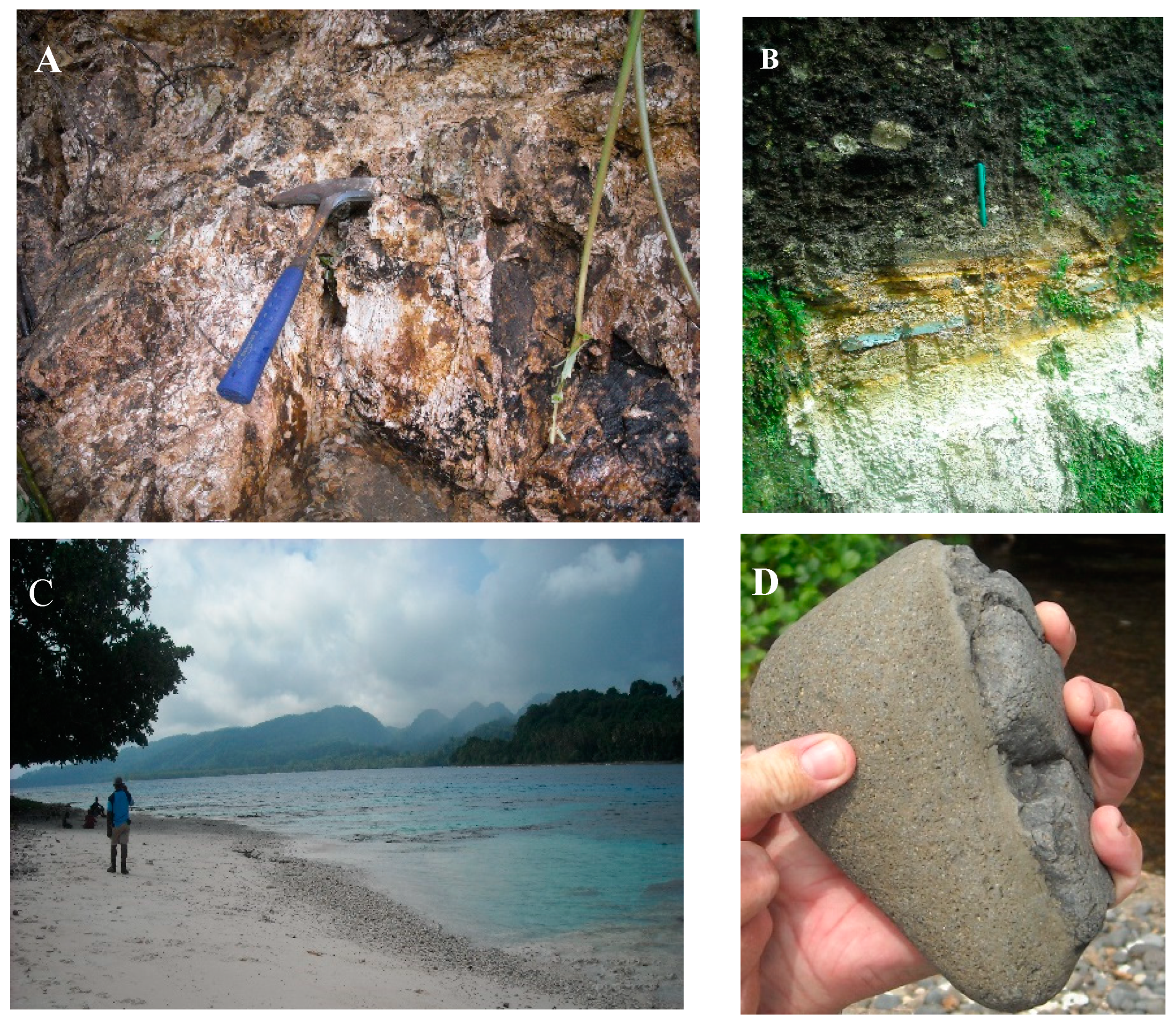
The Niffin Graben is a major structural corridor that transects Ambitle from the southeast to the northwest. In the centre of the island is the Central Caldera at 3 km in diameter that was formed by the collapse of high-level magma chamber [2] (Wallace et al, 1983). The caldera floor is dominated by young, low angle trachyte domes dated at K-Ar ages 0.68 ± 0.1 Ma and 0.49 ± 0.1 Ma. A recent crater interpreted as an 800m wide maar is located on the eastern side of the domes and was possibly formed by a phreatomagmatic explosion which covered much of the Central Caldera with trachyte tuffaceous breccia aged 2300 years by carbon 14 dating [40] (Licence et al., 1987). We also observed a 3m thick unconsolidated, pyroclastic or tuffaceous deposit in the Niffin area which is proximal to and located east of the maar or crater (Figure 6B).
4. Babase and Ambitle Geology & Structure
In this section, we describe the geomorphology, structure, and geology of both Babase and Ambitle islands as observed from the digital elevation model (DEM) and actual field observations to the Feni Island group from 2009 to 2011.
Babase has an elevated central circular volcanic crater surrounded by lower elevations formed predominantly of basalt and coralline reef rocks (Figure 4). During our field trips to the island, it was impossible to visit the caldera on Babase due to cultural taboos. A bedded light-grey siltstone outcrop was mapped on Babase Island at Selselsik Creek. It appeared to be the basement rock upon which the coral reefal limestone was deposited. The siltstone beds were striking 140 degrees and dipping 35 degrees to the south west (230°). It is characterized by a growth fault and alternating layers of orange-brown iron oxidation and greyish-white clay-rich beds. Argillic alteration is present as fine-grained pyrite and clays in parts proximal to the fault. The cobbles and boulders along the creeks and drainages on Babase are basaltic (Figure 6D) and trachybasaltic followed by intermediate trachyandesites and minor felsic trachydacitic porphyries. Both Babase and Ambitle are distinctively girdled by fossiliferous fringing coral reefs which are also an evidence of on-going tectonic uplift.
Ambitle is a composite volcanic island with potentially three main craters forming the central, western, and southern parts of the island. Ambitle is characterized by steep magmatic domes (Figure 6C), an eroded central caldera, and a field of hot springs and mud pools in the southern part of the island (Nanum), central region (Kabang, Caldera) and western side (Waramung & Kapkai). Lower elevation coastlines are a mixture of the terminal zones of lavas and coralline limestone rock.
The main faults mapped on Ambitle Island are predominantly moderate to steeply dipping NW faults inferred as normal faults (Figure 3 and Figure 4). The geothermal activity and Cu-Au mineral prospects are aligned within the major NW structural coridoor (Figure 3 and Figure 4). The center of the island has an eroded caldera, whilst in the east, the island is characterized by the Niffin Graben. This graben is described as a major structural corridor that transects Ambitle from the southeast to the northwest (Wallace et al., 1983; Lindley, 2015) [2,53]. Mosusu (2004) [56] interpreted the magnetic high feature coincident with the NW trending Niffin Graben as a cooling intrusive body responsible for the geothermal activity on Ambitle. Steep NW faults were also measured at Kapkai (on Ambitle) within a basaltic ridge actively precipitating native sulphur, and emitting geothermal steam. Other fault orientations measured on Ambitle are NS and NE trending structures at Natong and Niffin within the southeastern end of the NW structural corridor. The NS and NE structures (dipping W and NW respectively) are controlling the pyrite mineralization and alteration hosted in trachyandesite outcrops at Natong and Balangus. A major NE structure that is mineralized with pyrite, kaolin-smectite clay and supergene-enriched hematite was mapped in Balangus and Natong.
The outcrops observed at Niffin, on eastern Ambitle, include volcanogenic siltstone (Figure 6A), olivine-clinopyroxene bearing pillow basalt, hornblende phonotephrite (refer to accompanying paper), welded tuff and a bimodal pyroclastic deposit at Niffin (Figure 6B). The main outcrop at Natong is hornblende-feldspar trachyandesite that is variably altered and weathered, and a volcanogenic mudstone. Balangus is also dominated by basaltic lava flows with minor trachyte and trachyandesite (Figure 5). The basaltic flows appear to predate the intermediate trachyandesite unit. Fault-controlled pyrite-clay mineralization along with propylitic chlorite-epidote-pyrite alteration were observed in Natong and Balangus. Volcaniclastic rock types include a pyroclastic deposit, ash flow and welded tuff observed in the Niffin and Kabang areas.
The main rock types sampled in this study include
- feldspathoid-bearing clinopyroxene > olivine basalt,
- feldspathoid-bearing clinopyroxene > olivine trachybasalt,
- clinopyroxene-amphibole phonotephrite,
- hornblende trachyandesite
- biotite trachydacite or quartz-trachyte.
These suites are aphanitic, trachytic, equigranular, and porphyritic in textural variations with the mafic and intermediate suites containing mafic glomerocrysts and xenoliths erratically. The results of the petrographic, whole rock geochemistry and mineralogical analysis of these samples are discussed in a paper currently in preparation by the same authors.
5. Discussion
The OJP is an important feature in the geotectonic and petrogenetic evolution of PNG and the TLTF. Building a general geological history in a numbered sequence or geochronological order is useful in understanding such a complex region. As such, this section summarizes the geological history of Feni and the TLTF in terms of a generic approach and a specific tectono-magmatic and petrogenetic model.
The general geotectonic history of the TLTF is summarized as follows:
- Formation of the OJP in the Cretaceous ~ 122-120 Ma from a mantle plume in the Pacific Oceanic Plate (Holm et al., 2013) [28]
- Formation of the Eocene to Oligocene ~43-26Ma Melanesian Arc S-SW subduction of the Pacific plate beneath the Aust Plate at the Manus-Kilinailau Trench. Island arcs formed include New Ireland, Manus, Bougainville, New Britain, and part of the Solomon Islands (Holm et al., 2013) [28]
- Oligocene-early Miocene ~26-20 Ma jamming of the subduction zone as the OJP collided with the Manus-Kilinailau trench.
- Microplate formation (or plate fragmentation) into Bismarck and Solomon sea plates.
- New Britain trench initiated ~10-5 Ma. Solomon sea plate starts to subduct northwards beneath the Bismarck plate (Holm et al., 2013) [28].
- Opening up of the Manus Basin around 3.6 Ma as New Britain trench activity continued. Simberi lava age 3.6 Ma (oldest in the TLTF) along with the isotopic signatures of TLTF lavas being similar to Manus back-arc basin basalts suggests that the TLTF volcanics are closely linked to the extensional tectonics of the Manus spreading center.
- Lihir being farther away has no influence from the NBT; however, Feni shows geothermal isotopic signatures similar to that of the Rabaul Volcano indicating that the NBT has some effect on Feni geothermal fluid chemistry.
A more specific tectono-magmatic and a paragenetic or petrogenetic model for Feni and the TLTF is presented below in chronological order:
- The Pacific MORB slab with sediments was subducted and underwent dehydration and subsequent hydrous metasomatism of the overlying mantle in the Eocene. This led to the arc magmatism along the Kilinailau or Melanesian Trench subduction forming the Jaul Volcanics on New Ireland (and Baining Volcanics on New Britain).
- During the Upper Oligocene, the OJP arrived at the Kilinailau Trench. Subduction and hence, magmatism completely ceased in the Miocene. Oolitic limestone was deposited on Feni in the Upper Oligocene. Lelet Limestone was deposited in the Miocene on New Ireland.
- Formation of earlier structural grains as ground preparation and plumbing for later magmas (due to earlier subduction and OJP collision)
- Following the onset of the NBT and the Manus Spreading Centre, deep lithospheric faults formed in the TLTF as a result of extensional tectonics [48] (Brandl et al 2020).
- Adiabatic decompression melting of the subduction-modified upper mantle wedge formed the TLTF alkaline melts which used the plumbing of deep extensional faults to form TLTF volcanism from 3.6 Ma (Tabar age) to 2.1 ka (Feni age).
- Feni magmatism may also have some influence from the NBT due to its proximity to the trench and the similarity in isotopic values to the Rabaul Volcano.
-
Primitive and evolved magmas in the TLTF have similar isotopic signatures signifying that they are closely related and have a common crystal fractionation trend.
- a)
- Olivine-feldspathoid mafic lavas initially formed at deeper parts of the upper mantle
- b)
- Clinopyroxene mafic lavas formed as the melt decompressed and travelled upwards
- c)
- Hornblende bearing intermediate lava formed at shallower depths possibly when melting occurred in the hydrous, subduction-modified mantle wedge
- d)
- Biotite-trachydacite porphyry forms as late crustal melts
- e)
- Eruptive volcanism forming pyroclastic flows and ash falls
- f)
- Present day geothermal activity.
6. Conclusion
Feni Island is a young volcanic island within the TLTF chain, New Guinea Islands Terrane, Melanesian Arc, northeast Papua New Guinea. The TLTF arc is situated within the New Ireland Basin bounded by New Ireland and the extinct Kilinailau Trench. The Ontong Java Plateau collision with the Kilinailau or Melanesian Trench has played an important role in the geological history of the PNG and the TLTF. Normal, extensional faulting is observed throughout the TLTF. On Ambitle Island in Feni, the Niffin Graben is a NW-trending structural corridor transected by NE and NS faults and contains geothermal activity and copper-gold mineralization hosted within alkaline volcanic rocks. Feni and the entire TLTF were most likely formed by extensional tectonics relating to the opening of the Manus Basin and adiabatic decompression melting of a volatile-rich subduction-modified upper mantle. In addition to the macro tectonic forces that configured the present alignment of the TLTF, the main process affecting the petrogenesis of the mafic to felsic volcanic rocks on Feni is crystal fractionation. In-depth analysis of Feni geology through petrography, mineralogy, and geochemistry will be explored in detail in the next paper.
Author Contributions
Conceptualization, O.L.P; Methodology, O.L.P and M.P..; software, X.X.; validation, O.L.P.; formal analysis, O.L.P. and M.P; field investigation, O.L.P, M.P., and J.E.; writing—original draft preparation, O.L.P.; writing—review and editing, O.L.P and M.P. ; supervision, M.P and J.E; project administration, M.P. and J.E; funding acquisition, M.P. and J.E. All authors have read and agreed to the published version of the manuscript.
Funding
This research was funded by the EU-funded Geomap project (2006-2011) under the Mining Sector Support Program (MSSP) of the Mineral Resources Authority of Papua New Guinea.
Data Availability Statement
Data presented in this research paper may be obtained with permission from the Mineral Resources Authority, email oponyalou@mra.gov.pg
Acknowledgments
Dr. Fritz Bandelow, the Geomap Project (2007-2011) and the EU are acknowledged for funding this research through the Mineral Resources Authority, Papua New Guinea. This research was founded on a MOU between University of Papua New Guinea and the University of Leicester (United Kingdom) in 2009. The good people of Babase and Ambitle Islands including Paul Penua Mimfin and family are acknowledged and thanked for their hospitality and support during field excursions. We also acknowledge the New Ireland Provincial Government authorities namely Administrator Kunibert Tibil, Dr Bruce Harris, John Aini and others for their assistance and cooperation during our trips to New Ireland in 2009 and 2011.
Conflicts of Interest
The authors declare no conflict of interest.
References
- Petterson, M. Geo-Tectonics Geology and Geo-Resources of the Southwest Pacific: A chapter within the Encyclopedia of Geology Second Edition (2020). 2020. [CrossRef]
- Wallace, L. M.; Stevens, C.; Silver, E.; McCaffrey, R.; Loratung, W.; Hasiata, S.; Stanaway, R.; Curley, R.; Rosa, R.; Taugaloidi, J. GPS and seismological constraints on active tectonics and arc-continent collision in Papua New Guinea: Implications for mechanics of microplate rotations in a plate boundary zone. Journal of Geophysical Research: Solid Earth 2004, 109 (B5). [CrossRef]
- DeMets, C.; Gordon, R. G.; Argus, D. F.; Stein, S. Effect of recent revisions to the geomagnetic reversal time scale on estimates of current plate motions. Geophysical Research Letters 1994, 21 (20), 2191-2194. [CrossRef]
- Davies, H. L. The geology of New Guinea - the cordilleran margin of the Australian continent. International Union of Geological Sciences 2012, 35 (1), 87-102. [CrossRef]
- Davies, H. L. Tectonic setting of some mineral deposits of the New Guinea Region. In PNG Geology, Exploration and Mining Conference, Papua New Guinea; 1991.
- Davies, H. L. New Guinea Geology. In The Encyclopedia of Islands, Gillespie, R., Clague, D. Eds.; University of California Press, 2009; pp 659-664.
- Williamson, A.; Hancock, G. The geology and mineral potential of Papua New Guinea / compiled by Greg Corbett, edited by Anthony Williamson and Graeme Hancock; Papua New Guinea Department of Mining, 2005.
- Sheppard, S.; Cranfield, L. C. Geological framework and mineralization of Papua New Guinea-an update; Mineral Resources Authority 2012.
- Tcherepanov, E. N.; Droxler, A. W.; Lapointe, P.; Dickens, G. R.; Bentley, S. J.; Beaufort, L.; Peterson, L. C.; Daniell, J.; Opdyke, B. N. Neogene evolution of the mixed carbonate-siliciclastic system in the Gulf of Papua, Papua New Guinea. Journal of Geophysical Research: Earth Surface 2008, 113 (F1). [CrossRef]
- Dow, D. B.; Smit, J. A. J.; Bain, J. H. C.; Ryburn, R. J. Geology of the South Sepik region, New Guinea; Australian Government Publishing Service, 1972.
- Pigram, C.; Davies, H. Terranes and the accretion history of the New Guinea orogen. BMR Journal of Australian Geology & Geophysics 1987, 10.
- Lus, W. Y.; McDougall, I.; Davies, H. L. Age of the metamorphic sole of the Papuan Ultramafic Belt ophiolite, Papua New Guinea. Tectonophysics 2004, 392 (1), 85-101. [CrossRef]
- Davies, H.; Perembo, R. C. B.; Winn, R. D.; Kengemar, P. Terranes of the New Guinea Orogen. Proceedings of the PNG Geology, Exploration and Mining Conference 1997, Madang 1997, 61-66.
- Davies, H. L. Solomon Islands Geology. In The Encyclopedia of Islands, Gillespie, R., Clague, D. Eds.; University of California Press, 2009; pp 854-857.
- Petterson, M.; Babbs, T.; Neal, C.; Mahoney, J. J.; Saunders, A.; Duncan, R. A.; Tolia, D.; Magu, R.; Qopoto, C.; Mahoa, H. Geological-tectonic framework of Solomon Islands, SW Pacific: Crustal accretion and growth within an intra-oceanic setting. Tectonophysics 1999, 301, 35-60. [CrossRef]
- Johnson, R. W. Geotectonics and volcanism in Papua New Guinea: a review of the late Cainozoic. BMR Journal of Australian Geology and Geophysics 1979, 4, 181-207.
- Audley-Charles, M. G. Tectonics of the New Guinea Area. Annual Review of Earth and Planetary Sciences 1991, 19 (1), 17-41. [CrossRef]
- Yan, C.; Kroenke, L. A plate tectonic reconstruction of the southwest Pacific, 0–100 Ma. Proc. Ocean Drill. Program, Sci. Results 1993, 130.
- Horz, H.K.; Worthington, J.T.; Winn, K.; Stoffers, P. Late Quarternary tephra in the New Ireland Basin, Papua New Guinea. Journal of Volcanology and Geothermal Research 2004, 132, 73-95. [CrossRef]
- Crook, K.; Belbin, L., The southwest Pacific area during the last 90 million years. Journal of the Geological Society of Australia 1978, 25, 23-40. [CrossRef]
- Gaina, C., Mueller, D., Royer, J. and Symonds, P. Evolution of the Louisiade triple Junction. Journal of Geophysical Research 1999, 104, 12927-12939. [CrossRef]
- Hall, R. Cenozoic geological and plate tectonic evolution of SE Asia and the SW Pacific: computer-based reconstructions, model, and animations. Journal of Southeast Asian Sciences 2002, 20, 353-434. [CrossRef]
- Hall, R.; Spakman, W. Subducted slabs beneath the eastern Indonesia–Tonga region: insights from tomography. Earth and Planetary Science Letters 2002, 201, 321-336. [CrossRef]
- Mann, P.; Taira, A. Global tectonic significance of the Solomon Islands and Ontong Java Plateau convergent zone. Tectonophysics 2004, 389, 137–190. [CrossRef]
- Exon, N.F.; Marlow, M.S. The New Ireland Basin: a frontier basin in Papua New Guinea. Petroleum Exploration in Papua New Guinea: Proceedings of the first petroleum convention 1990, Port Moresby, 12-14 February, 1990.
- Fitton, J. G.; Mahoney John, J.; Wallace Paul, J.; Saunders Andrew, D. Origin and evolution of the Ontong Java Plateau: introduction. Geological Society, London, Special Publications 2004, 229 (1), 1-8. [CrossRef]
- Furumoto, A.; Webb, J.; Odegard, M. E.; Hussong, D. Seismic studies on the Ontong Java Plateau, 1970. Tectonophysics 1976, 34, 71-90. [CrossRef]
- Holm, R. J.; Spandler, C.; Richards, S. W. Melanesian arc far-field response to collision of the Ontong Java Plateau: Geochronology and petrogenesis of the Simuku Igneous Complex, New Britain, Papua New Guinea. Tectonophysics 2013, 603, 189-212. [CrossRef]
- Martinez, F.; Taylor, B. Backarc spreading, rifting, and microplate rotation between transform faults in the Manus Basin. Marine Geophysical Research 1996, 18, 203-224. [CrossRef]
- Tregoning, P., Lambeck, K., Stolz, A., Morgan, P., McClusky, S.C., van der Beek, P., McQueen, H., Jackson, R.J., Little, R.P., Laing, A. and Murphy, B. Estimation of current plate motions in Papua New Guinea from Global Positioning System observations. Journal of Geophysical Research 1998, 103, 12181-12203. [CrossRef]
- Woodhead, J. D.; Eggins, S. M.; Johnson, R. W. Magma Genesis in the New Britain Island Arc: Further Insights into Melting and Mass Transfer Processes. Journal of Petrology 1998, 39 (9), 1641-1668. [CrossRef]
- Lindley, Ian. D. New Britain Trench, Papua New Guinea: An extensional element in a regional sinistral strike-slip system. New Concepts in Global Tectonics Newsletter 2006, 41. 16-28.
- Lindley, I.D. Early Cainozoic stratigraphy and structure of the Gazelle Peninsula, East New Britain: an example of extensional tectonics in the New Britain arc-trench complex. Australian Journal of Earth Sciences 1988, 35, 231-244.
- Rogerson, R., Hilyard, D., Silver, E., Excursion guide to the Papua New Guinea collision zone 1988, Papua New Guinea Geological Survey Report 88/17.
- McInnes, B. I. A.; Cameron, E. M. Carbonated, alkaline hybridizing melts from a sub-arc environment: Mantle wedge samples from the Tabar-Lihir-Tanga-Feni arc, Papua New Guinea. Earth and Planetary Science Letters 1994, 122 (1), 125-141. [CrossRef]
- O’Kane, T. P. 3-D structure and tectonic evolution of the Papua New Guinea and Solomons Island region and its relationship to Cu-Au mineralisation. Unpublished B.Sc. Honours thesis, Research School of Earth Sciences, Australian National University, Australia, 2008.
- Holwell, D. A.; Fiorentini, M.; McDonald, I.; Lu, Y.; Giuliani, A.; Smith, D. J.; Keith, M.; Locmelis, M. A metasomatized lithospheric mantle control on the metallogenic signature of post-subduction magmatism. Nature Communications 2019, 10 (1), 3511. [CrossRef]
- Taylor, B. Bismarck Sea: Evolution of a back-arc basin. Geology 1979, 7, 171-174.
- Rytuba, J.J.; McKee, E.H.; Cox, D.P.; Geochronology and geochemistry of the Ladolam gold deposit, Lihir Island, and gold deposits and volcanoes of Tabar and Tatau, Papua New Guinea, U.S. Geological Survey Bulletin 1993, 2039, 119-126.
- Licence, P. S.; Terrill, J. E. G.; Fergusson, L. J. Epithermal gold mineralisation, Ambitle Island, Papua New Guinea. In Pacific Rim Congress 87, Gold Coast, Australia, 1987; The Australasian Institute of Mining & Metallurgy: pp 273-278.
- Patterson, D. B.; Farley, K. A.; McInnes, B. I. A. Helium isotopic composition of the Tabar-Lihir-Tanga-Feni island arc, Papua New Guinea. Geochimica et Cosmochimica Acta 1997, 61 (12), 2485-2496. [CrossRef]
- Kamenov, G. D.; Perfit, M. R.; Mueller, P. A.; Jonasson, I. R. Controls on magmatism in an island arc environment: study of lavas and sub-arc xenoliths from the Tabar-Lihir-Tanga-Feni island chain, Papua New Guinea. Contributions to Mineralogy and Petrology 2008, 155, 635-656. [CrossRef]
- Kennedy, A. K.; Hart, S. R.; Frey, F. A. Composition and isotopic constraints on the petrogenesis of alkaline arc lavas: Lihir Island, Papua New Guinea. Journal of Geophysical Research; (United States) 1990, Medium: X; Size: Pages: 6929-6942. [CrossRef]
- Farley, K. A.; Patterson, D.; McInnes, B. He-isotopic investigation of geothermal gases from the Tabar-Lihir-Tanga-Feni arc and Rabaul, Papua New Guinea. AIP Conference Proceedings 1995, 341 (1), 81-90. [CrossRef]
- Stewart, W. D. P.; Sandy, M. J. Geology of New Ireland and Djaul Islands, Northeastern Papua New Guinea. 1988.
- Hohnen, P.D., 1978 – Geology of New Ireland, Papua New Guinea, Depart. National. Dev., Bureau of Miner. Resour. Geol. And Geophysic., Bulletin 184, PNG 12. 1978.
- Lindley, I. D. Plate flexure and volcanism: Late Cenozoic tectonics of the Tabar–Lihir–Tanga–Feni alkalic province, New Ireland Basin, Papua New Guinea. Tectonophysics 2016, 677-678,312-323. [CrossRef]
- Brandl, P.; Hannington, M.; Geersen, J.; Petersen, S.; Gennerich, H. The submarine tectono-magmatic framework of Cu-Au endowment in the Tabar-to-Feni island chain, PNG. Ore Geology Reviews 2020, 121, 103491. [CrossRef]
- Johnson, R.W.; Wallace, D.A.; Ellis, D.J. Feldspathoid-bearing potassic rocks and associated types from volcanic islands off the coast of New Ireland, Papua New Guinea: a preliminary account of geology and petrology. In Volcanism in Australasia: a collection of papers in honour of the late G.A.M. Taylor, G. C.; Johnson R. W. Ed.; Elsevier: Amsterdam, The Netherlands, 1976; pp. 297–316. [CrossRef]
- Heming, R. Undersaturated lavas from Ambittle Island, Papua New Guinea. Lithos 1979, 12, 173-186. [CrossRef]
- Scott, E. The petrogenesis of Feni Islands Volcanoes, Papua New Guinea: Post subduction volcanic rocks? University of Leicester, United Kingdom, 2011.
- Ponyalou, L. K. O. The Volcanic Rocks & Sinters of Ambitle Island, Feni Island, New Ireland Province, Papua New Guinea. Honours Thesis (BScHon), University of Papua New Guinea, Port Moresby, 2013.
- Lindley, I. D., Late Quaternary geology of Ambitle Volcano, Feni Island Group, Papua New Guinea. Australian Journal of Earth Sciences 2015, 62 (5), 529-545. [CrossRef]
- Lindley, I. D. Matangkaka manganese deposit, Ambitle Island, Feni Island Group, Papua New Guinea: a Quaternary epithermal stratabound manganese oxide deposit. Australian Journal of Earth Sciences 2022, 69, 26-46. [CrossRef]
- Kumul, C. Preliminary Geothermal Investigation of Feni Island, New Ireland Province, Papua New Guinea; Technical Note 2017/01; Mineral Resources Authority, Port Moresby, 2017.
- Mosusu, N., 2004. Structural Controls of the Feni Geothermal System: Insights from magnetic and radiometric datasets. Geological Survey of Papua New Guinea, Department of Mining, Port Moresby, Papua New Guinea.
Figure 2.
TLTF location within the New Guinea Islands Terrane-Melanesian Arc relative to the Kilinailau Trench, Ontong Java Plateau, New Britain Trench and the Schouten Island Group. Modified after Williamson & Hancock (2005) [7].
Figure 2.
TLTF location within the New Guinea Islands Terrane-Melanesian Arc relative to the Kilinailau Trench, Ontong Java Plateau, New Britain Trench and the Schouten Island Group. Modified after Williamson & Hancock (2005) [7].
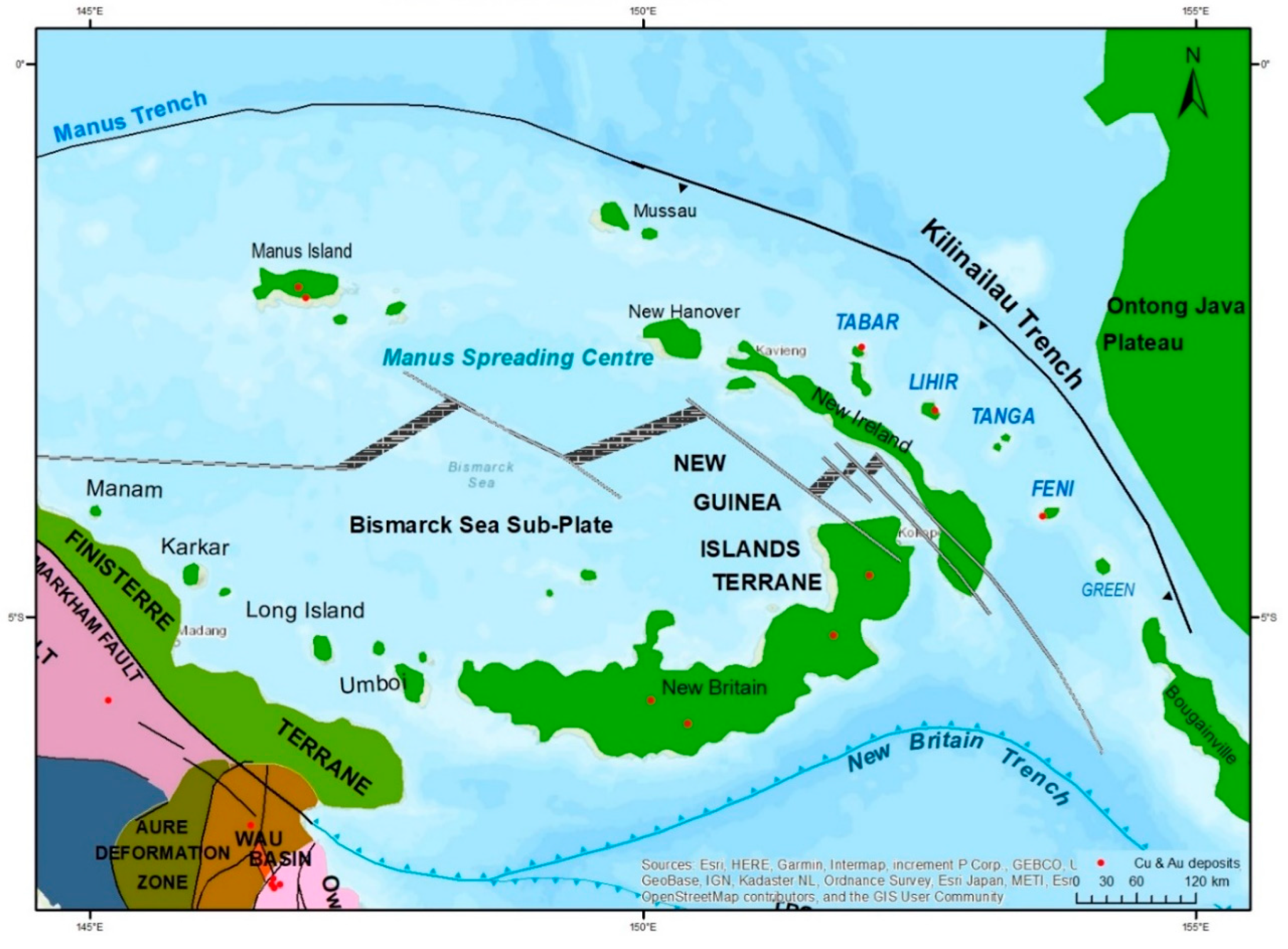
Figure 3.
Geology & sample location map of Feni Island Group. Geology modified after Wallace et al (1983) [2] Samples collected for further analysis shown in red.
Figure 3.
Geology & sample location map of Feni Island Group. Geology modified after Wallace et al (1983) [2] Samples collected for further analysis shown in red.

Figure 4.
SRTM Digital Elevation Model (DEM) of Feni Islands.

Figure 5.
Geology map of Ambitle. Red circles represent samples collected for this study.
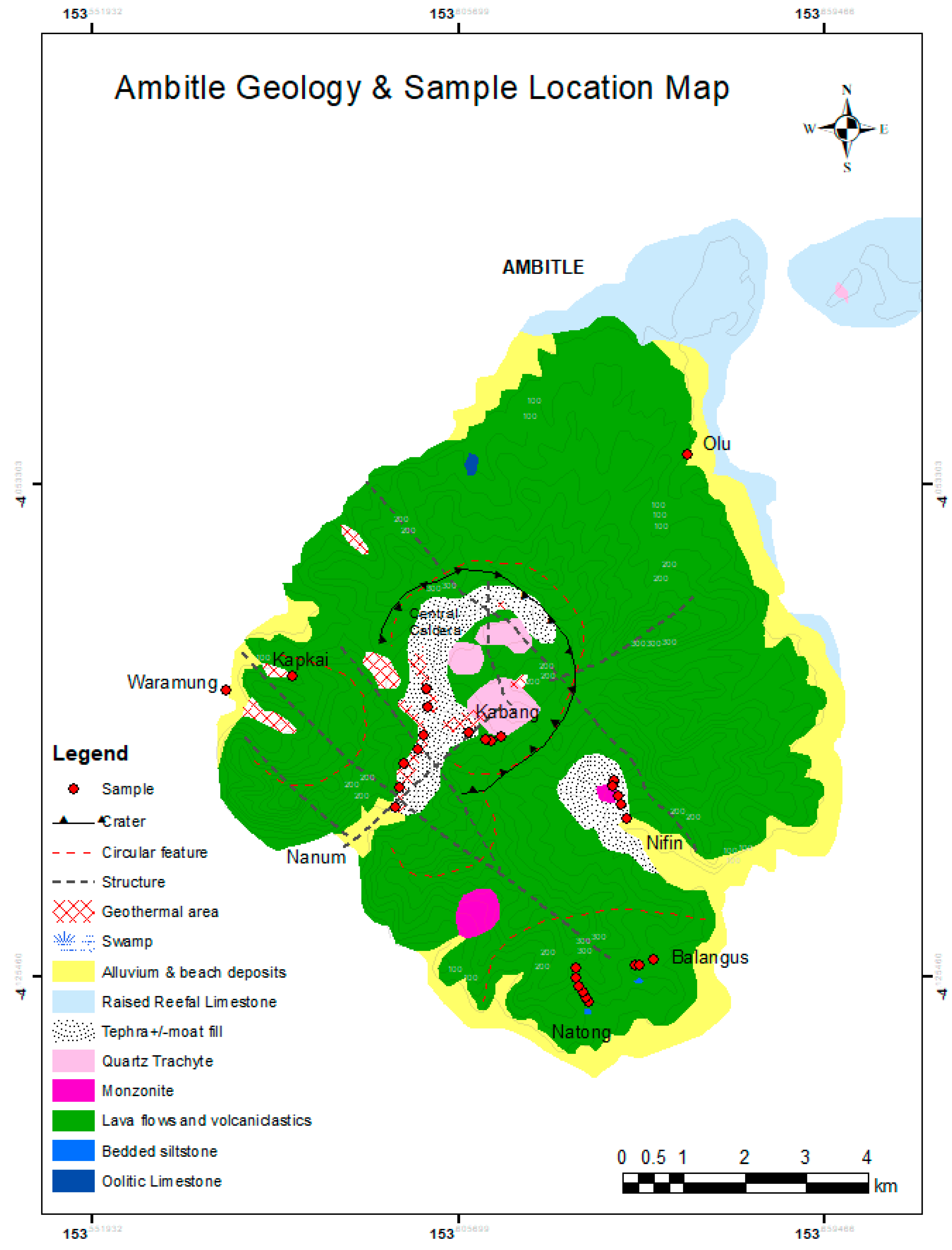
Figure 6.
Field images of Ambitle Island deposits and geomorphology. (A) Volcanogenic oxidized siltstone at Niffin (B) Pyroclastic deposit at Niffin River. Weathered mafic matrix-supported pyroclastic lapilli-block tuff deposit unconformably overlying horizontal ash-clay bed (base surge) and quartz-pumice-rich felsic igimbritic layer. (C) Eastern side of Ambitle characterized by steep volcanic domes. Image taken from eastern point of Babase Island. (D) Vesicular feldspar-pyroxene phyric basaltic float containing a mafic or basaltic xenolith.
Figure 6.
Field images of Ambitle Island deposits and geomorphology. (A) Volcanogenic oxidized siltstone at Niffin (B) Pyroclastic deposit at Niffin River. Weathered mafic matrix-supported pyroclastic lapilli-block tuff deposit unconformably overlying horizontal ash-clay bed (base surge) and quartz-pumice-rich felsic igimbritic layer. (C) Eastern side of Ambitle characterized by steep volcanic domes. Image taken from eastern point of Babase Island. (D) Vesicular feldspar-pyroxene phyric basaltic float containing a mafic or basaltic xenolith.
Disclaimer/Publisher’s Note: The statements, opinions and data contained in all publications are solely those of the individual author(s) and contributor(s) and not of MDPI and/or the editor(s). MDPI and/or the editor(s) disclaim responsibility for any injury to people or property resulting from any ideas, methods, instructions or products referred to in the content. |
© 2023 by the authors. Licensee MDPI, Basel, Switzerland. This article is an open access article distributed under the terms and conditions of the Creative Commons Attribution (CC BY) license (http://creativecommons.org/licenses/by/4.0/).
Copyright: This open access article is published under a Creative Commons CC BY 4.0 license, which permit the free download, distribution, and reuse, provided that the author and preprint are cited in any reuse.


