

Submitted:
07 June 2023
Posted:
07 June 2023
You are already at the latest version
Abstract
Most natural language processing (NLP) tasks suffer performance degradation when encountering long complex sentences, such as semantic parsing, syntactic parsing, machine translation, and text summarization. Previous works address the issue with an intuition of decomposing complex sentences and linking simple ones, such as RST-style discourse parsing, split-and-rephrase (SPRP), text simplification (TS), simple-sentence-decomposition (SSD), etc. However, these works are not applicable for semantic parsing like abstract meaning representation (AMR) parsing and semantic dependency parsing due to misalignments to semantic relations and unavailabilities to preserve original semantics. Following the same intuition and avoiding deficiencies of previous works, we propose a novel framework, hierarchical clause annotation (HCA), based on the linguistic research of clause hierarchy. With the HCA framework, we annotate a large HCA corpus to explore the potentialities of integrating HCA structural features into semantic parsing with complex sentences. Moreover, we decompose HCA into two subtasks, i.e., clause segmentation and clause parsing, and provide neural baseline models for more silver annotations.
Keywords:
Clause Hierarchy
; Hierarchical Clause Annotation
; Complex sentences
; Semantic Parsing
; Syntactic Parsing
; RST corpus
1. Introduction
Most natural language processing (NLP) tasks suffer performance degradation when encountering long complex sentences, such as abstract meaning representation (AMR) parsing [1], semantic dependency parsing [2], constituency parsing [3], semantic role labeling [4], machine translation [5], and text summarization [6]. An intuition to address this issue is first to decompose complex sentences and then re-link simple ones, which shares similar ideas with tasks like RST-style discourse parsing (hereafter RST parsing) [7], split-and-rephrase (SPRP) [8], text simplification (TS) [9], simple-sentence-decomposition (SSD1) [10], etc.
However, previous works with such intuitions to process complex sentences are not practical for semantic parsing tasks, such as AMR [11] and semantic dependency parsing [12]. RST parsing, aiming to extract the rhetorical relations among elementary discourse units (EDUs) [13] at a document level, is still an open problem, where the state-of-the-art model only achieves 55.4 and 80.4 Parseval-Full scores for multi- and intra-sentential parsing. Besides, the blurry definitions of EDUs and the misalignments between rhetorical relations and semantic relations make RST parsing unsuitable for semantic parsing. The SPRP task keeps a big splitting granularity, where outputs may still be complex sentences. The TS and SSD tasks, which decompose complex sentences into simple ones, can not preserve the original semantics for rephrasing for simpler syntax (TS) or dropping discourse connectives (SSD).
In this paper, we propose a novel task, hierarchical clause annotation (HCA), based on the linguistic research of clause hierarchy [14], where clauses are fundamental text units centering on a verb phrase, and sentences with multiple clauses form a complex hierarchy. Our HCA is a more lightweight task at the sentence level, has explicit definitions of clauses and appropriate mappings between inter-clause and semantic relations (vs. RST parsing), and aims to annotate complex sentences into a clause hierarchy (vs. SPRP) without changing or dropping any semantics (vs. TS and SSD).
To show the potentialities of HCA to facilitate semantic parsing with complex sentences, we demonstrate the HCA tree, AMR graph, and semantic dependency graph (SDG) of a complex sentence from the AMR 2.0 dataset2 in Figure 1:
The above sentence is segmented into five clauses , where
- and are coordinate and contrastive,
- and are conditional adverbial and relative clauses of , respectively,
- is a resultative adverbial clause of .
In the HCA tree, the coordinate relation and clauses are nodes, and subordinate relations are directed edges. As demonstrated in Figure 1, the HCA tree shares the same hierarchy with two semantic parsing representations, indicating the possibility of incorporating HCA’s structural information into semantic parsing with complex sentences.
Our main contributions are as follows:
- We propose a novel framework, hierarchical clause annotation (HCA), to segment complex sentences into clauses and capture their interrelations based on the linguistic research of clause hierarchy, aiming to provide clause-level structural features to facilitate semantic parsing tasks.
- We elaborate on our experience developing a large HCA corpus – including determining an annotation framework, creating a silver-to-gold manual annotation tool, and ensuring annotating quality. The resulting HCA corpus contains English sentences from AMR 2.0, each including at least two clauses.
- We decompose HCA into two subtasks, i.e., clause segmentation and parsing, and adapt discourse segmentation and parsing models for the HCA subtasks. Experimental results show that the adapted models achieve satisfactory performances in providing reliable silver HCA data.
2. Related Work
2.1. RST Parsing
In a document, the clauses, sentences, and paragraphs are logically connected together to form a coherent discourse. Rhetorical Structure Theory (RST) [13] provides a general way to describe the relations among parts in a text and postulates a hierarchical discourse structure called discourse tree (DT). The leaves of a DT can be a clause or a phrase without strict definitions, known as elementary discourse units (EDUs). Adjacent EDUs and higher-order spans are non-overlapping and connected hierarchically through coherence relations. Thus, coherence in discourse can be analyzed in terms of how a nucleus interacts with its surrounding satellites to communicate the relationships between main ideas and related ideas.
The RST parsing task generally requires breaking the text into EDUs (i.e., the discourse segmentation task) and linking the EDUs into a DT (i.e., the discourse parsing task). For discourse segmentation, Gessler et al. [15] proposed a Transformer-based neural classifier that enhances contextualized word embeddings with hand-crafted features and achieved the current state-of-the-art performance in DISRPT 2021 Shared Task on Discourse Unit Segmentation3. For discourse parsing, Kobayashi et al. [16] explored a strong baseline by integrating previous simple parsing strategies, top-down and bottom-up, with various transformer-based pretrained language models (PLMs).
Table 1 demonstrates the comparison between our HCA and RST parsing with exemplified sentences from RST Discourse Tagging Reference Manual4. Although both tasks aim to extract a tree structure from input texts, their definitions of elementary units and target interrelations vary, leading to the following differences.
- The elementary units of HCA are clauses, while that of RST parsing are EDUs, including clauses and phrases. The blurry definitions of an EDU may cause obstacles in RST parsing. For example, phrases“as a result of margin calls” in (1) and “Despite some their considerable incomes and assets” in (2) are segmented as EDUs but not clauses due to the absence of a verb. Moreover, although the clause “that they have made it” functions as a predicative of the verb “feel”, it can not be annotated as an EDU.
- The rhetorical relations in RST parsing characterize the coherence among EDUs, and some can not map to semantic relations. For example, the semantic relation between “feel” and “that they have made it” in (2) is not captured in RST parsing.
In summary, the blurry definitions of EDUs and the misalignments between rhetorical and semantic relations make RST parsing unsuitable for semantic parsing compared with our HCA.
2.2. Other Similar Tasks
Some similar tasks share the idea of decomposing complex sentences into simpler parts without capturing their interrelations.
2.2.1. Clause Identification
The CoNLL-2001 shared task, clause identification, [17] proposes a dataset with the gold standard clause provided by the Penn Treebank II [18], where clause-level tags (i.e., S, SBAR, SBARQ, INV, and SQ) indicate target clauses and clausal conjunctions. The clauses identified in the shared task comprise tensed clauses, non-tensed verb phrases, coordinators, and subordinators.
2.2.2. Split-and-Rephrase
The split-and-rephrase (SPRP) task [8] aims to split a complex input sentence into shorter sentences while preserving meaning. In that task, the emphasis is on sentence splitting and rephrasing. There is no deletion and no lexical or phrasal simplification, but the systems must learn to split complex sentences into shorter ones and to make the syntactic transformations required by the split(e.g., turn a relative clause into a main clause).
2.2.3. Text Simplification
The text simplification (TS) task [19] is the process of reducing the linguistic complexity of a text to improve its understandability and readability while maintaining its original information content and meaning. Typically, it rephrases complex sentences with simpler vocabulary and syntax and ignores trivial clauses from the source.
2.2.4. Simple-Sentence-Decomposition
The simple-sentence-decomposition (SSD) task [10] converts complex sentences into a covering set of simple sentences derived from the tensed clauses in the source sentence, where shared nouns or pronouns are copied, and discourse connectives (e.g., and, but, although, etc) are dropped.
2.2.5. Summary
- For clause identification, coordinator “but” and subordinators “If”, “which”, and “that” are segmented out. Besides, non-tensed verb phrases that function as a subject, object, or postmodifier are also target clauses in the task. These cases are out of the definition of annotated clauses in our HCA framework, as redundant hierarchies occur in capturing inter-clause relations.
- For split-and-rephrase, the granularity of decomposing is larger than clauses due to the consideration of preserving the original meaning of the input sentence. The output (1) and (3) are still complex sentences with two clauses. Additionally, the output (2) is segmented from the relative clause that modifies the “anxious” in the matrix clause, leading to a syntax transformation.
- For text simplification, dropping the subordinator “If” and the coordinator “but” leads to the uncertainties of discourse relations between output sentences. Moreover, as replacements for simpler syntax in (3) and (4) bring misalignments between substitute and substituted tokens, text simplification is unsuitable to serve as a preprocess for semantic dependency parsing, which is a token-level task.
- For simple-sentence-decomposition, it also drops clausal connectives like text simplification, leading to the uncertainties of some discourse relations captured by semantic parsing.
2.3. Clause Hierarchy
Clause Hierarchy can be described as a cline along which clauses distribute according to their different levels of grammatical integration [14,20,21,22,23,24]. These works propose that clause combinations in many languages can be described as a set of tighter or looser clauses. A tight clause means that a clausal constituent has, in comparison to a loose clause, more dependence on the clause with which it combines, typically a main clause. Table 3 shows three main versions of Clause Hierarchy and ordered linguistic phenomena according to their clause integration tightness degree.
Matthiessen [21] presented a type of clause hierarchy that extends from syntactic clause combination to cohesion and coherence at the discourse and text level. He considers clause combination to range from tight syntactic “embedding” (e.g., infinitival clauses as a complement to a main verb) to the looser relations of “hypotaxis” (e. g. a finite adverbial) to “parataxis” (e.g., coordination).
Hopper and Traugott [22] also offered a model that shares much with Matthiessen’s, where “parataxis” is the syntactic independence of clauses and “hypotaxis” is a more integrated clause that is syntactically dependent within another clause’s predicate. Tighter still is “subordination”, which, like “embedding” in Matthiessen’s type, covers all clauses which function as a constituent essential to grammaticality, e.g., verbal arguments.
Payne’s clause hierarchy [14] extended from “compound verbs” (tightest) through to separate “sentences” (loosest), where clause combination becomes more or less a single verbal element in his type. Different from the above two types, Payne argues that compound verbs (e.g., go get the book), though uncommon in English, are considered the tightest clause combination as they have two verbal elements placed adjacently in a verb phrase, one of which lacks full finiteness.
In summary, the linguistic researches of Clause Hierarchy provide solid theoretical support for our HCA framework.
3. Hierarchical Clause Annotation Framework
To present an framework for annotation the clause hierarchy of complex sentences, we reference and modify Payne’s version [14] of Clause Hierarchy due to his pellucid and comprehensive definitions of clause combination cases. As demonstrated in Figure 2, we do not consider compound verbs as a clause combination, as these cases are uncommon and produce one-verb clauses after annotation.
With the above version of Clause Hierarchy, we synthesize the HCA framework and build a dataset under the guidance of the framework. The annotation work consists of a preprocessing stage with silver annotations transformed from existing schemas (constituent parsing and syntactic dependency parsing) and a manual proofreading phase with gold annotations on an elaborate browser-based annotator.
3.1. Concept
We list major concepts in the HCA framework.
3.1.1. Sentence and Clause
Sentences, typically starting with a capitalized word and ending with a complete stop, are principally units of written grammar and annotation inputs in HCA. A sentence must consist of at least one clause.
Clauses, considered core units of grammar, center around a verb phrase that largely determines what else must or may occur [25]. Clauses can be categorized by the inner verb type:
- Finite: clauses that contain tensed verbs;
- Non-finite : clauses that only contain non-tensed verbs like ing-participles, ed-participles, and to-infinitives.
In the HCA framework, finite clauses should be annotated, while non-finite clauses that are separated by a comma are also segmented out.
3.1.2. Clause Combination
The main ways in which clauses combine to form sentences are by joining clauses of equal syntactic status (coordination) and subordinate relation (subordination).
- (1)
- Coordination and Coordinator
Coordination is an interrelation between clauses that share the same syntactic status and are typically connected by a coordinator such as and, or, but, etc. In addition, coordinators can be correlative structures (e.g., either...or... and not only...but also...) or just substituted by comma punctuation.
- (2)
- Subordination, Subordinator, and Antecedent
Subordination occurs in a subordinate clause and a matrix clause that is superordinate to the subordinate clause. Subordination can be cataloged as follows:
- Nominative: Function as clausal arguments or noun phrases in the matrix clause and can be subdivided into Subjective, Objective, Predicative and Appositive.
- Relative: Define or describe a preceding noun head in the matrix clause.
- Adverbial: Function as a Condition, Concession, Reason, and such for the matrix clause.
Subordinators are the words that introduce a subordinate clause and indicate a semantic relation between the subordinate clause and its matrix clause, including subordinate conjunctions, relative pronouns, and relative adverbs. Simple subordinators contain a single word, e.g., that, wh-words, if, etc., while complex ones consist of more than one word, e.g., as if, so that, even though, etc.
Antecedents are nouns or pronouns modified before relative clauses and nouns explained before appositive clauses.
To better explain these HCA definitions, we demonstrate some example sentences which are segmented into multiple clauses in Table 4.
3.2. HCA Representation
As illustrated in Figure 3, we model the two basic hierarchical schemas with concepts defined in Section 3.1, characterizing inter-clause relations with the same nucleus-satellite pattern in RST. To be specific, coordination is a multinuclear relation that involves two or more clauses (denoted as nucleus node ) dominated by the coordination node , while subordination is a mononuclear relation (denoted as a directed edge ) pointing from the matrix clause (nucleus) to its subordinate clause (satellite).
As a sentence consists of more clauses, its HCA representation can be a tree structure, where each node is a clause or an inter-clause coordination, and each directed edge is an inter-clause subordination. A three-layer HCA tree of a complex sentence involving five clauses and four interrelations is demonstrated in Figure 1a.
3.3. HCA corpus
With the annotation framework discussed above, we aim to build an HCA corpus for further research on the possibilities of applying clausal structure features to semantic parsing tasks. We choose the AMR 2.0 dataset as our corpus base, whose sentences are collected from the DARPA BOLT and DEFT programs, various newswire data, and weblog data.
The annotation work is conducted in two phases. First, two existing syntactic features, i.e., constituent and syntactic dependency parse trees, are employed to produce silver HCA annotations with transformation rules. Second, human annotators with prior English grammar research experience and extensive hands-on annotation training, review and modify silver annotations on a browser-based annotation tool.
3.3.1. Silver Data from Existing Schemas
Previous researchers[26,27,28,29] utilize constituent-based and syntactic dependency parse trees to extract clauses from sentences with some manual rules. Following the experience from these works, we employ Stanza [30] as our constituent parser and syntactic dependency parser to obtain silver HCA data.
- Consituency Parse Tree
The constituency parse tree (CPT) represents the syntactic structure of a sentence using a tree, where the nodes are sub-phrases that belong to a specific category in the grammar, and the edges are unlabeled. The transformation from CPT to the silver HCA data consists of three phases:
- Traverse non-leaf nodes in the CPT and find the clause-type nodes: S, SBAR, SBARQ, INV, and SQ.
- Identify the tokens dominated by a clause-type node as a clause.
- When a clause-type node dominates another one, an inter-clause relation between them is determined without an exact relation type.
As demonstrated in Figure 4, the first two clauses of the sentence exemplified in Section 1 are identified through their constituent parse tree. The SBAR node and its child node S are combined as a single clause, as no VP is dominated by the other child constituent IN of SBAR. Moreover, the S node on the top dominates the SBAR node, indicating subordination between the two clauses in dashed boxes.
- Syntactic Dependency Parse Tree
The syntactic dependency parse tree (SDPT) consists of a set of directed syntactic relations between the words in the sentence whose root is either a non-copular verb or the subject complement of a copular verb. The transformation from SDPT to silver HCA consists of three phases:
- Use a mapping of dependency relations to clause constituents: subjects (S) and the governor, i.e., a non-copular verb(V), via relation nsubj and such; objects (O) and complements (C) in V’s dependants via relations dobj, iobj, xcomp, ccomp, and such; adverbials (A) in V’s dependents via relations advmod, advcl, prep_in, and such.
- When detecting a verb5 in the sentence, a corresponding clause, consisting of the verb and its dependant constituents, can be identified.
-
If a clause governs another clause via a dependency relation, the interrelation between them can be determined by the relation label:
- Coordination: conj:and, conj:or, conj:but
- Subjective: nsubj
- Objective: dobj, iobj
- Predicative: xcomp, ccmop
- Appositive: appos
- Relative: ccomp, acl:relcl, rcmod
- Adverbial: advcl
3.3.2. Gold Data from Manual Annotator
As discussed above, the syntactic structures of CPT and SDPT can be transformed into clauses and inter-clause relations. However, these silver annotations are still unable to fulfill the need to build an HCA corpus for the following reasons:
- Specific inter-clause relations can not be obtained via the two syntactic structures, where CPT can only provide the existence of a relation without a label, and the dependency relations in SDPT have multiple mappings (e.g., ccomp to Predcative or Relative) or no mapping (e.g., advcl to no exact Adverbial subtype like Conditional).
- Pre-set transformation rules identify more clauses out of the HCA definitions. For example, the extracted non-finite clauses (e.g., to-infinitives) embedded in its matrix clause are too short and lead to hierarchical redundancies in the HCA tree.
- The performances of two syntactic parsers degrade when encountering long and complex sentences which are the core concerns of our HCA corpus.
Therefore, we recruit a group of human annotators with prior English grammar research experience to proofread these silver HCA on a browsed-based software ClausAnn created for the annotation work. The Java Web application ClausAnn provides convenient operations and efficient keyboard shortcuts for annotators, and we open source it on our GitHub repository6. A typical annotation trial on ClausAnn consists of the following steps:
- Review annotations from CPT, SDPT, or other annotators by switching the name tags in Figure 6a.
- Choose an existing annotation to proofread or just start from the original sentence.
-
Segment a text span into two by double-clicking the blank space of a split point, and select the relation between them in Figure 6b.
- (a)
- If the two spans are coordinated, select a specific coordination and label coordinators that indicate the interrelation in Figure 6c.
- (b)
- If the two spans are subordinated, designate the superordinate one, select a specific subordination, and label subordinators that indicate the interrelation in Figure 6d.
- Remerge two text spans into one by clicking the two spans successively.
- Repeat step c and d until all text spans are segmented into a set of clauses constructed in a right HCA tree.
3.3.3. Quality Assurance
There are mainly two steps taken jointly to ensure the quality of the final HCA corpus, i.e., multi-round annotation and consistency measurement.
The total annotation work consists of sentences, and three rounds of annotation are arranged by 5%, 5%, and 90% of total sentences and conducted with a progressive and negotiable strategy. Before the first round, every annotator thoroughly understands the HCA framework and uses the tool ClausAnn proficiently after adequate hands-on training. During the first two rounds, the lead annotator, who majors in English grammar, organizes a discussion on complex or abnormal cases with other annotators.
For consistency measurement, we tracked inter-annotator agreement (IAA) after each round of the annotation work. As discussed in Section 2.1, the HCA and RST parsing tasks aim to extract the clause/EDU hierarchy from texts. Thus, the evaluation metrics of discourse segmentation [15] and discours parsing [16] subtasks in RST parsing are adopted as IAA metrics in evaluating the annotation quality of the HCA corpus:
- P/R/ on clauses: precision, recall, and score on the segmented clauses, where a positive match means that both segmented clauses from two annotators have the same start and end boundaries.
- RST-Parseval [31] on interrelations: consisting of Span, Nuclearity, Relation, and Full are used to evaluate unlabeled, nuclearity-, relation-, and fully labeled interrelations respectively between the matched clauses from two annotators.
In the first two rounds of annotation, a total of 10% sentences are double-annotated, and the ratio comes to 16% in the last round, higher than 13.8% in the RST-DT corpus [7]. According to the statistics, the IAA measured by the above two metrics grows as the annotation rounds increase, indicating that the two steps of multi-round annotation and consistency measurement play a significant role in ensuring annotation quality.
As shown in Table 5, the final IAA achieves high consistencies, where
- scores on clauses range from 98.4 to 100,
- RST-Parseval scores on interrelations range from 97.3, 97.0, 93.6, 93.4 to 98.1, 97.8, 94.2, 94.1 in Span, Nuclearity, Relation, and Full, respectively.
Compared with the RST-DT corpus, whose IAA score on EDUs ranges from 95.1 to 100 and IAA scores on rhetorical relations with three metrics, Spans, Nuclearity, Relation, range from 77.8, 69.5, 59.7 to 92.9, 88.2, 79.2, our HCA corpus reaches better consistencies, as the HCA framework has more restrict definitions on the elementary unit (i.e., clauses) and fewer types of the interrelation.
3.3.4. Dataset Detail
The resulting HCA-AMR2.0 dataset is based on AMR 2.0, which contains sentences, and (49.4%) sentences are paired with an HCA tree, while the rest are simple sentences with only one clause. The train, dev, and test set split follows the original split in AMR 2.0. Detailed statistics are listed in Table 6.
4. Model
In this paper, we model hierarchical clause annotation (HCA) as a two-stage task, i.e., clause segmentation and clause parsing, and provide auto-annotation baselines for each subtask. Clause segmentation segments a complex sentence into several clauses, while clause parsing links the clauses with interrelations into a clause tree.
4.1. Clause Segmentation
We encounter clause segmentation task with a sequence tagging model, DiscoDisCo [15] used in the discourse segmentation task: embed the input sentence, encode with a single Bi-LSTM, decode with a linear projection layer, and indicate the first token of each clause in the output tag sequence.
In the embedding layer, we rely on three kinds of word embeddings concatenated together:
- (1)
- Bi-LSTM encoded character embeddings,
- (2)
- static word embeddings from fastText, [32]
- (3)
- and fine-tuning word embeddings from a pretrained language model (PLM).
Additionally, we introduce and embed various grammatical information like lemmas, part-of-speech (POS), and syntactic dependencies generated by Stanza [30]. These tokenwise features embeddings are concatenated with word embeddings, and the word in the input sentence is embedded as
where is concatenated from three kinds of word embeddings and is grammatical features embeddings.
The embedding of the input sentence with n tokens are fed through a BiLSTM network, and the output is then calculated by a linear projection layer to predict the segmentation tag for i-th token:
Given , we get the predicted tag sequence , and optimizing the cross-entropy loss of to train the weights of the PLM, the BiLSTM network and the linear projection layer, where is the gold tag sequence.
4.2. Clause Parsing
Given segmented clauses in the input sentence, we model clause parsing as a discourse parsing task, where clauses are considered as EDUs and linked into a clause tree. Therefore, we employ discourse parsers in [16], which contain a span-based parser with the top-down strategy and a shift-reduce transition parser with the bottom-up strategy for their simple architectures and open codes. Overviews of the parsers are shown in Figure 7 and Figure 7. Note that the two parsing strategies share the same word embedding layer to represent text spans.
4.2.1. Text Span Embedding
In the process of clause parsing, the representation of text spans is needed for either “span-to-clause” splitting in the top-down parsing strategy or “clause-to-span” combining in the bottom-up parsing strategy. Therefore, we transform the input sentence into a subword sequence , and obtain the embedding using a PLM. The embedding for a text span , consisting of the i-th clause to the j-th clause, is obtained by averaging the vector of both edge subwords,
where returns the index of the begin subword in the i-th clause and returns that of the end subword in the j-th clause.
4.2.2. Top-Down Strategy
The top-down parser splits each span into smaller ones recursively until the span becomes a single clause. We introduce biaffine networks [33] for span splitting and a loss penalty.
For each position k in a span consisting of the i-th clause to the j-th clause, a scoring function , is defined as follows:
where , and are weight matrices in the biaffine layer for splitting a text span. Here, and are defined as follows:
Then, the span is split at the end of an inner clause that maximizes Equation 4:
When splitting a span at the end of the -th clause, the score of the nuclearity and relation labels for the two spans is defined as follows:
where , , and are weight matrices in the biaffine layer for predicting an inter-clause relation. Then, the label that maximizes Equation 8 is assigned to the spans:
where denotes three nuclearity labels, , for predicting the nuclearity, and a set of inter-clause relations labels for predicting the exact relation. Note that the parameters in biaffine layers and s for the nuclearity and relation labeling are learned separately.
4.2.3. Bottom-Up Strategy
Formally, in a shift-reduce model with a bottom-up strategy, the parsing state is denoted as a tuple, where S is a stack that stores processed clauses and Q is a queue that contains incoming clauses. Each element in S can be an unreduced clause or a combined composite item . At each step, the parser chooses one of the following actions with an FFN classifier and updates the state :
- : pop the first clause off Q and push it onto S.
- : pop two elements from S and push a new combined composite item that has the popped subtrees as its children onto S as a single composite item.
We employ three FFN classifiers, , , and , where predicts an action, and the rest two decide the nuclearity and the label of an inter-clause relation after a action. Specifically, the output dimension of is 2 ( or ), that of is 3 (, or ), and that of is the number of inter-clause relations defined in the HCA framework. Three classifier outputs are defined as
where function concatenates three state vectors: is the representation of the top clause stored in S, is that in the second clause of S, and is that in the first clause in Q. Weights of the PLM and each are trained by optimizing the cross-entropy loss of , , and .
5. Experiments
In this section, we elaborate on the experimental details of the proposed baseline models for two HCA subtasks, clause segmentation, and clause parsing, on the novel HCA-AMR2.0 corpus.
5.1. Dataset
Except for the HCA-AMR2.0 corpus, we reference three discourse analysis corpora, GUM [34], STAC [35], and RST-DT [7], to further verify the effectiveness of the proposed models and expound the distinctive advantages of HCA-AMR2.0 over these discourse analysis corpora.
- HCA-AMR2.0: The first HCA corpus is annotated on sentences in AMR 2.0 dataset. The source data includes discussion forums collected for the DARPA BOLT AND DEFT programs, transcripts and English translations of Mandarin Chinese broadcast news programming from China Central TV, Wall Street Journal text, translated Xinhua news texts, various newswire data from NIST OpenMT evaluations and weblog data used in the DARPA GALE program.
- GUM: The Georgetown University Multilayer corpus is created as part of the course LING-367 (Computational Corpus Linguistics) at Georgetown University, and its annotation is followed the RST-DT segmentation guidelines for English. The text sources consist of 35 documents of news, interviews, instruction books, and travel guides from WikiNews, WikiHow, and WikiVoyage.
- STAC: The Strategic Conversation dataset is a corpus of strategic chat conversations in 45 games annotated with negotiation-related information, dialogue acts, and discourse structures in Segmented Discourse Representation Theory (SDRT) framework.
- RST-DT: Rhetorical Structure Theory (RST) Discourse Treebank is developed by researchers at the Information Sciences Institute (University of Southern California), the US Department of Defense, and the Linguistic Data Consortium (LDC). It comprises 385 Wall Street Journal articles from the Penn Treebank annotated with discourse structure in the RST framework.
For the clause segmentation subtask, we select all three discourse analysis datasets evaluated on the discourse segmentation task as a comparison, and the data files are all in conll formats. For the clause parsing subtask, we only select the RST-DT dataset evaluated on the discourse parsing task as a comparison, as previous works of discourse parsing experiments on the other two datasets using accuracy as the evaluating metric other than Parseval. The interrelation data files in HCA and RST-DT are preprocessed by Heilman and Sagae’s system [36]. The important dataset statistics related to the experiments are listed in Table 7.
5.2. Experimental Environments
The information on the main hardware and software used in our experimental environments is listed in Table 8.
5.3. Hyper-Parameters
For the hyper-parameters in the models for clause segmentation and clause parsing subtasks, we list their layer, name, and value in Table 9. Note that both models are not trained until reaching the maximum epochs, where the model of clause segmentation is trained in about thirteen epochs for five hours, and the model of clause parsing is finished in about seven epochs for ten hours with the experimental environments introduced in Section 5.2.
5.4. Evaluation Metrics
As described in Section 3.3.3, we introduce two metrics for IAA to evaluate annotation consistencies between two annotators. Thus, we still use P/R/ on clauses for clause segmentation subtask and RST-Parseval on inter-clause relations for clause parsing subtask to evaluate the consistencies between gold and predicted annotations.
5.5. Baseline Models
We aim to utilize models proposed by previous works on discourse segmentation and discourse parsing tasks and experiment with our HCA-AMR2.0 corpus to obtain effective baseline models for the novel clause segmentation and parsing subtasks.
5.6. Experimental Results
The experiments of clause segmentation and parsing subtasks are conducted separately, and experimental results are compared with those of previous works on discourse segmentation and parsing tasks, respectively.
5.6.1. Results of Clause Segmentation
We adapt the discourse parser DisCoDisCo [15] into the clause segmentation task and conduct an ablation study on different features, e.g., lemma, syntactic dependency, part-of-speech, and static word embedding fastText, to explore which contributes more to the performances. The experimental results of the clause segmentation task are reported in Table 10, as well as the performances of previous works on the discourse segmentation task for comparison. From the results, we have the following observations:
- Compared with the 98.4-100 IAA scores on clause segmentation mentioned in Section 3.3.3, the adapted DisCoDisCo model achieves satisfactory performances, i.e., 91.3 scores.
- In the ablation study of different embedded features, the static word embedding fastText, which gains a 4.9 score improvement, contributes the most in all features, although other features also have positive impacts on the performances.
- In the discourse segmentation task, the DisCoDisCo model outperforms the GumDrop model in the GUM and RST-DT datasets. Although GumDrop performs better than DisCoDisCo in the STAC dataset, Its performance sharply declined with 14.7 scores when removing extra gold features. Thus, we choose to apply the DisCoDisCo model to the clause segmentation subtask.
- Experimented with the same model DisCoDisCo, performances on clause segmentation are about 3-5 scores lower than on discourse segmentation, indicating that the performance gaps are attributed to the corpora. From the statistics in Table 6, an average of 3.1 clauses constitute a sentence in HCA-AMR2.0, more than that in GUM (2.3 EDUs), STAC (1.1 EDUs), and RST-DT (2.6 EDUs). Besides, only HCA-AMR2.0 contains a certain number of weblog data, which are less formal in English grammar and may cause more obstacles for the DisCoDisCo model.
5.6.2. Results of Clause Parsing
We employ the bottom-up and top-down discourse parsers in [16] as our clause parsing models and conduct experimental trials of the base version of different pretrained language models (PLMs, i.e., BERT [38], RoBERTa [39], SpanBERT [40], XLNet [41], and DeBERTa [42]) to obtain better performances. Table 11 demonstrates the main results of both bottom-up and top-down models on clause parsing, as well as that on discourse parsing for comparison. From the results, we have the following observations:
- Better performances are obtained in clause parsing than in discourse parsing by either top-down or bottom-up parsers with whatever PLMs.
- The best performances of clause parsing are obtained by the bottom-up parser with the pretrained DeBERTa, where the performance reaches up to 97.0 scores on Parseval-Span and falls to 87.7 scores on Parseval-Full.
- All the best performances in either clause parsing or discourse parsing are obtained by parsers with pretrained XLNet and DeBERTa, indicating that these two PLMs are more suitable for relation classification tasks than other PLMs.
- Experimented with a same model and a same pretrained language model, performances on clause parsing are about 6-9 Parseval-Full scores higher than that on discourse parsing, indicating that the performance gaps are attributed to the differences between corpora. RST-DT contains 18 classes of relations partitioned from 78 types of blurry rhetorical relations, while HCA has 18 types of distinguishable semantic relations, half of which are subdivided from Adverbial.
To obtain a clause parser with better performances, we conduct experimental trials with the large versions of PLMs, and the results are illustrated in Table 12. As can be observed from the results,
- All the parsers with the corresponding large PLMs perform better than that with the base PLMs.
- The bottom-up parser with DeBERTa-large achieves a better performance, with a 0.8 score improvement on Parseval-Full over the parser with DeBERTa-base.
6. Discussion
6.1. Potentialities of HCA
As discussed in Section 1, we demonstrated the same hierarchy of the HCA tree, the AMR graph, and the SDG of a complex sentence, indicating the potentialities of utilizing the structural information of the HCA tree to improve semantic parsing. Thus, we provide two case studies where simple transformation rules derived from the HCA tree can be applied to these two semantic parsing tasks.
6.1.1. Case Study for AMR Parsing
For AMR parsing, we employ the state-of-the-art AMR parser proposed in [1] to predict the AMR graph of the exemplified sentence in Section 1. As shown in Figure 8, two dotted red edges are missed by the parser when compared with the gold AMR, while two solid red edges are mistakenly predicted.
From the HCA tree given in Figure 1a, the clause ”I get very anxious” mapping to the subgraph and the clause ”but often the anxiety is so much” mapping to subgraph are coordinate and contrastive. Therefore, we provide a transformation rule:
- 1.
- Transform the inter-clause relation BUT to an AMR node contrast-01 and two AMR edges directing to the root nodes of and .
Meanwhile, the clause ”that I can not wait that long” mapping to subgraph is a resultative adverbial clause subordinated to the clause ”but often the anxiety is so much” mapping to the subgraph . Note that the verb of the matrix clause is copular “is”, and the subordinate clause modifies the complement “much” in the matrix clause. Therefore, a new transformation rule can be derived:
- 2.
- Transform the inter-clause relation resultative to an AMR node cause-01 and two AMR edges directing to the root node of and the node much in .
With these two transformation rules, we can delete the solid red edges which are mistakenly predicted and add the dotted red edges which are missed.
6.1.2. Case Study for Semantic Dependency Parsing
For semantic dependency parsing, we employ the state-of-the-art AMR parser proposed in [2] to predict the semantic dependency graph (SDG) of the exemplified sentence in Section 1. As shown in Figure 9, three dotted red edges are missed by the parser when compared with the gold SDG.
As dicussed in Section 6.1.1, inter-clause relations among three clauses mapping to subgraph , , and can be derived into the following transformation rules:
- Transform the inter-clause relation BUT to a dependency edge between root nodes (i.e., anxious and much) of and .
- Transform the inter-clause relation resultative to a dependency edge between root nodes (i.e., much and can) of and .
Moreover, the relative subordinate clause “which does sort of go away after 15-30 mins” mapping to subgraph modifies the complement “anxious” in the matrix clause “I get very anxious” mapping to subgraph . Thus, a new transformation rule can be derived:
- 3.
- Transform the inter-clause relation relative to a dependency edge between the root node go and the node anxious) of .
With these three transformation rules, we can add the dotted red edges which are missed by the parser.
To sum up, we provide two case studies demonstrating the potentialities of HCA in semantic parsing, where transformation rules derived from the HCA tree are applied to modify two state-of-the-art parsers of the AMR parsing and semantic dependency parsing tasks.
6.2. Future Work
As demonstrated in the experimental results, we adapt discourse segmenter and discourse parser into our HCA subtasks (i.e., clause segmentation and parsing) and achieve satisfactory performances. However, there is still much room for improvement compared with IAA scores of manual annotation. Therefore, we aim to design better models for the HCA task in further research.
In the case studies, we derive some transformation rules from the HCA tree to modify the AMR graph and the SDG, which is explainable to humans but impractical. For this limitation, we aim to explore better ways of integrating the HCA structure in semantic parsing and more downstream NLP tasks.
7. Conclusions
In this paper, we propose a novel framework, hierarchical clause annotation (HCA), to segment complex sentences into clauses and capture inter-clause relations with strict definitions from linguistic research of clause hierarchy. We aim to explore the potentialities of integrating HCA structural features in semantic parsing with complex sentences, avoiding the deficiencies of previous works such as RST-parsing, SRRP, TS, SSD, etc. Following the HCA framework, we build up a large HCA corpus comprising English sentences from AMR 2.0. The annotation consists of silver data transformed from the constituency and syntactic dependency parse trees, and gold data annotated by experienced human annotators using a newly-created tool, ClausAnn. Moreover, we decompose HCA into two subtasks, i.e., clause segmentation and clause parsing, and provide effective baseline models for both subtasks to generate more HCA data.
Author Contributions
Conceptualization, Y. F. and Z. G.; Methodology, Y. F. and B. L.; Software, Y. F.; Annotation, all authors; Writing—original draft, Y. F..; Writing—review and editing, B. L., Y. S., M. G., C. S., S. C., and Z. G. All authors have read and agreed to the published version of the manuscript.
Funding
This research received no external funding.
Institutional Review Board Statement
Not applicable.
Informed Consent Statement
Not applicable.
Data Availability Statement
The datasets used in our experiments are publicly available: Hierarchical Clause Annotation-AMR2.0 (HCA-AMR2.0) at https://github.com/MetroVancloud/HCASeg (accessed on 5 November 2022) and https://github.com/MetroVancloud/HCAParser (accessed on 5 November 2022), Abstract Meaning Representation (AMR) Annotation Release 2.0 (AMR 2.0) at https://catalog.ldc.upenn.edu/LDC2017T10 (accessed on 15 June 2021), RST Discourse Treebank (RST-DT) at https://catalog.ldc.upenn.edu/LDC2002T07 (accessed on 11 October 2022), The Georgetown University Multilayer corpus (GUM) at https://gucorpling.org/gum (accessed on 15 April 2023), Strategic Conversation (STAC) at https://www.irit.fr/STAC/ (accessed on 5 April 2023).
Acknowledgments
Our code extends two GitHub repositories https://github.com/gucorpling/DisCoDisCo (accessed on 1 March 2023) and https://github.com/nttcslab-nlp/RSTParser_EMNLP22 (accessed on 10 March 2023), thanks to them very much.
Conflicts of Interest
The authors declare that they have no known competing financial interests or personal relationships that could have appeared to influence the work reported in this paper
Abbreviations
The following abbreviations are used in this manuscript:
| AMR | Abstract Meaning Representation |
| BiLSTM | Bidirectional Long Short-Term Memory |
| CPT | Constituency Parse Tree |
| FFN | Feed Forward Neural Networks |
| HCA | Hierarchical Clause Annotation |
| IAA | Inter-Annotator Agreement |
| PLM | Pretrained Language Model |
| POS | Part-of-Speech |
| RST | Rhetorical Structure Theory |
| RST-DT | Rhetorical Structure Theory Discourse Treebank |
| SDG | Semantic Dependency Graph |
| SDPT | Syntactic Dependency Parse Tree |
| SPRP | Split-and-Rephrase |
| SSD | Simple Setence Decomposition |
| TS | Text Simplification |
References
- Sataer, Y.; Shi, C.; Gao, M.; Fan, Y.; Li, B.; Gao, Z. Integrating Syntactic and Semantic Knowledge in AMR Parsing with Heterogeneous Graph Attention Network. In Proceedings of the ICASSP 2023 - 2023 IEEE International Conference on Acoustics, Speech and Signal Processing (ICASSP); 2023; pp. 1–5. [Google Scholar] [CrossRef]
- Li, B.; Gao, M.; Fan, Y.; Sataer, Y.; Gao, Z.; Gui, Y. DynGL-SDP: Dynamic Graph Learning for Semantic Dependency Parsing. In Proceedings of the Proceedings of the 29th International Conference on Computational Linguistics; International Committee on Computational Linguistics: Gyeongju, Republic of Korea, 2022; pp. 3994–4004. [Google Scholar]
- Tian, Y.; Song, Y.; Xia, F.; Zhang, T. Improving Constituency Parsing with Span Attention. In Proceedings of the Findings of the Association for Computational Linguistics: EMNLP 2020; Association for Computational Linguistics: Online, 2020; pp. 1691–1703. [Google Scholar] [CrossRef]
- He, L.; Lee, K.; Lewis, M.; Zettlemoyer, L. Deep Semantic Role Labeling: What Works and What’s Next. In Proceedings of the Proceedings of the 55th Annual Meeting of the Association for Computational Linguistics (Volume 1: Long Papers); Association for Computational Linguistics: Vancouver, Canada, 2017; pp. 473–483. [Google Scholar] [CrossRef]
- Tang, G.; Müller, M.; Rios, A.; Sennrich, R. Why Self-Attention? In A Targeted Evaluation of Neural Machine Translation Architectures. In Proceedings of the Proceedings of the 2018 Conference on Empirical Methods in Natural Language Processing; Association for Computational Linguistics: Brussels, Belgium, 2018; pp. 4263–4272. [Google Scholar] [CrossRef]
- Xu, J.; Gan, Z.; Cheng, Y.; Liu, J. Discourse-Aware Neural Extractive Text Summarization. In Proceedings of the Proceedings of the 58th Annual Meeting of the Association for Computational Linguistics; Association for Computational Linguistics: Online, 2020; pp. 5021–5031. [Google Scholar] [CrossRef]
- Carlson, L.; Marcu, D.; Okurovsky, M.E. Building a Discourse-Tagged Corpus in the Framework of Rhetorical Structure Theory. In Proceedings of the Proceedings of the Second SIGdial Workshop on Discourse and Dialogue; 2001. [Google Scholar]
- Narayan, S.; Gardent, C.; Cohen, S.B.; Shimorina, A. Split and Rephrase. In Proceedings of the Proceedings of the 2017 Conference on Empirical Methods in Natural Language Processing; Association for Computational Linguistics: Copenhagen, Denmark, 2017; pp. 606–616. [Google Scholar] [CrossRef]
- Zhang, X.; Lapata, M. Sentence Simplification with Deep Reinforcement Learning. In Proceedings of the Proceedings of the 2017 Conference on Empirical Methods in Natural Language Processing; Association for Computational Linguistics: Copenhagen, Denmark, 2017; pp. 584–594. [Google Scholar] [CrossRef]
- Gao, Y.; Huang, T.H.; Passonneau, R.J. ABCD: A Graph Framework to Convert Complex Sentences to a Covering Set of Simple Sentences. In Proceedings of the Proceedings of the 59th Annual Meeting of the Association for Computational Linguistics and the 11th International Joint Conference on Natural Language Processing (Volume 1: Long Papers); Association for Computational Linguistics: Online, 2021; pp. 3919–3931. [Google Scholar] [CrossRef]
- Banarescu, L.; Bonial, C.; Cai, S.; Georgescu, M.; Griffitt, K.; Hermjakob, U.; Knight, K.; Koehn, P.; Palmer, M.; Schneider, N. Abstract Meaning Representation for Sembanking. In Proceedings of the Proceedings of the 7th Linguistic Annotation Workshop and Interoperability with Discourse; Association for Computational Linguistics: Sofia, Bulgaria, 2013; pp. 178–186. [Google Scholar]
- Oepen, S.; Kuhlmann, M.; Miyao, Y.; Zeman, D.; Cinková, S.; Flickinger, D.; Hajič, J.; Urešová, Z. SemEval 2015 Task 18: Broad-Coverage Semantic Dependency Parsing. In Proceedings of the Proceedings of the 9th International Workshop on Semantic Evaluation (SemEval 2015); Association for Computational Linguistics: Denver, Colorado, 2015; pp. 915–926. [Google Scholar] [CrossRef]
- Mann, W.C.; Thompson, S.A. Rhetorical structure theory: Toward a functional theory of text organization. Text-interdisciplinary Journal for the Study of Discourse 1988, 8, 243–281. [Google Scholar] [CrossRef]
- Payne, T.E. Understanding English Grammar: A Linguistic Introduction; Cambridge University Press, 2010. [CrossRef]
- Gessler, L.; Behzad, S.; Liu, Y.J.; Peng, S.; Zhu, Y.; Zeldes, A. DisCoDisCo at the DISRPT2021 Shared Task: A System for Discourse Segmentation, Classification, and Connective Detection. In Proceedings of the Proceedings of the 2nd Shared Task on Discourse Relation Parsing and Treebanking (DISRPT 2021); Association for Computational Linguistics: Punta Cana, Dominican Republic, 2021; pp. 51–62. [Google Scholar] [CrossRef]
- Kobayashi, N.; Hirao, T.; Kamigaito, H.; Okumura, M.; Nagata, M. A Simple and Strong Baseline for End-to-End Neural RST-style Discourse Parsing. In Proceedings of the Findings of the Association for Computational Linguistics: EMNLP 2022; Association for Computational Linguistics: Abu Dhabi, United Arab Emirates, 2022; pp. 6725–6737. [Google Scholar]
- Tjong Kim Sang, E.F.; Déjean, H. Introduction to the CoNLL-2001 shared task: clause identification. In Proceedings of the Proceedings of the ACL 2001 Workshop on Computational Natural Language Learning (ConLL); 2001. [Google Scholar]
- Marcus, M.P.; Santorini, B.; Marcinkiewicz, M.A. Building a Large Annotated Corpus of English: The Penn Treebank. Computational Linguistics 1993, 19, 313–330. [Google Scholar]
- Al-Thanyyan, S.S.; Azmi, A.M. Automated Text Simplification: A Survey. ACM Comput. Surv. 2021, 54. [Google Scholar] [CrossRef]
- Givón, T. Syntax: An Introduction. Volume I; John Benjamins, 2001.
- Matthiessen, C.M. Combining clauses into clause complexes: A multi-faceted view. In Complex Sentences in Grammar and Discourse; John Benjamins, 2002; pp. 235–319.
- Hopper, Paul J.; Traugott, E.C. Grammaticalization, 2003.
- Aarts, B. Syntactic gradience: The nature of grammatical indeterminacy; Oxford University Press, 2007.
- Givón, T. On Understanding Grammar: Revised edition; John Benjamins, 2018; pp. 1–321.
- Carter, R.; McCarthy, M. Cambridge grammar of English: a comprehensive guide; spoken and written English grammar and usage; Cambridge University Press, 2006.
- Feng, S.; Banerjee, R.; Choi, Y. Characterizing Stylistic Elements in Syntactic Structure. In Proceedings of the Proceedings of the 2012 Joint Conference on Empirical Methods in Natural Language Processing and Computational Natural Language Learning; Association for Computational Linguistics: Jeju Island, Korea, 2012; pp. 1522–1533. [Google Scholar]
- Del Corro, L.; Gemulla, R. Clausie: clause-based open information extraction. In Proceedings of the Proceedings of the 22nd international conference on World Wide Web, 2013, pp.; pp. 355–366.
- Vo, D.T.; Bagheri, E. Self-training on refined clause patterns for relation extraction. Information Processing & Management 2018, 54, 686–706. [Google Scholar] [CrossRef]
- Oberländer, L.A.M.; Klinger, R. Token Sequence Labeling vs. In Clause Classification for English Emotion Stimulus Detection. In Proceedings of the Proceedings of the Ninth Joint Conference on Lexical and Computational Semantics; Association for Computational Linguistics: Barcelona, Spain (Online), 2020; pp. 58–70. [Google Scholar]
- Qi, P.; Zhang, Y.; Zhang, Y.; Bolton, J.; Manning, C.D. Stanza: A Python Natural Language Processing Toolkit for Many Human Languages. In Proceedings of the Proceedings of the 58th Annual Meeting of the Association for Computational Linguistics: System Demonstrations; Association for Computational Linguistics: Online, 2020; pp. 101–108. [Google Scholar] [CrossRef]
- Morey, M.; Muller, P.; Asher, N. How much progress have we made on RST discourse parsing? In A replication study of recent results on the RST-DT. In Proceedings of the Proceedings of the 2017 Conference on Empirical Methods in Natural Language Processing; Association for Computational Linguistics: Copenhagen, Denmark, 2017; pp. 1319–1324. [Google Scholar] [CrossRef]
- Bojanowski, P.; Grave, E.; Joulin, A.; Mikolov, T. Enriching Word Vectors with Subword Information. Transactions of the Association for Computational Linguistics 2017, 5, 135–146. [Google Scholar] [CrossRef]
- Dozat, T.; Manning, C.D. Deep Biaffine Attention for Neural Dependency Parsing. In Proceedings of the International Conference on Learning Representations; 2016; pp. 1–8. [Google Scholar]
- Zeldes, A. The GUM Corpus: Creating Multilayer Resources in the Classroom. Lang. Resour. Eval. 2017, 51, 581–612. [Google Scholar] [CrossRef]
- Asher, N.; Hunter, J.; Morey, M.; Farah, B.; Afantenos, S. Discourse Structure and Dialogue Acts in Multiparty Dialogue: the STAC Corpus. In Proceedings of the Proceedings of the Tenth International Conference on Language Resources and Evaluation (LREC’16); European Language Resources Association (ELRA): Portorož, Slovenia, 2016; pp. 2721–2727. [Google Scholar]
- Heilman, M.; Sagae, K. Fast Rhetorical Structure Theory Discourse Parsing. CoRR, 1505. [Google Scholar]
- Yu, Y.; Zhu, Y.; Liu, Y.; Liu, Y.; Peng, S.; Gong, M.; Zeldes, A. GumDrop at the DISRPT2019 Shared Task: A Model Stacking Approach to Discourse Unit Segmentation and Connective Detection. In Proceedings of the Proceedings of the Workshop on Discourse Relation Parsing and Treebanking 2019; Association for Computational Linguistics: Minneapolis, MN, 2019; pp. 133–143. [Google Scholar] [CrossRef]
- Devlin, J.; Chang, M.W.; Lee, K.; Toutanova, K. BERT: Pre-training of Deep Bidirectional Transformers for Language Understanding. In Proceedings of the Proceedings of the 2019 Conference of the North American Chapter of the Association for Computational Linguistics: Human Language Technologies, Volume 1 (Long and Short Papers); Association for Computational Linguistics: Minneapolis, Minnesota; 2019; pp. 4171–4186. [Google Scholar] [CrossRef]
- Liu, Y.; Ott, M.; Goyal, N.; Du, J.; Joshi, M.; Chen, D.; Levy, O.; Lewis, M.; Zettlemoyer, L.; Stoyanov, V. 2019; arXiv:cs.CL/1907.11692].
- Joshi, M.; Chen, D.; Liu, Y.; Weld, D.S.; Zettlemoyer, L.; Levy, O. SpanBERT: Improving Pre-training by Representing and Predicting Spans. Transactions of the Association for Computational Linguistics 2020, 8, 64–77. [Google Scholar] [CrossRef]
- Yang, Z.; Dai, Z.; Yang, Y.; Carbonell, J.; Salakhutdinov, R.R.; Le, Q.V. XLNet: Generalized Autoregressive Pretraining for Language Understanding. In Proceedings of the Advances in Neural Information Processing Systems. Curran Associates, Inc., Vol. 32. 2019. [Google Scholar]
- He, P.; Liu, X.; Gao, J.; Chen, W. 2021; arXiv:cs.CL/2006.03654].
| 1 | Gao et al. have yet to name their task, and thus we summarize their main idea into simple-sentence-decomposition (SSD) for the convenience of writing. |
| 2 | |
| 3 | |
| 4 | |
| 5 | Note that a copular verb in a clause and other constituents are dependants of the complement. |
| 6 |
Figure 1.
Clauses in (a) correspond to subgraphs in (b) and (c), respectively. Colored directed edges in (a) are inter-clause relations, mapping the same colored AMR nodes and edges in (b) and semantic dependencies in (c). Note that reentrant AMR relations in (b) introduced by the pronoun “I” are omitted to save space, as well as semantic dependencies between orphan tokens and the root token “If” in (c).
Figure 1.
Clauses in (a) correspond to subgraphs in (b) and (c), respectively. Colored directed edges in (a) are inter-clause relations, mapping the same colored AMR nodes and edges in (b) and semantic dependencies in (c). Note that reentrant AMR relations in (b) introduced by the pronoun “I” are omitted to save space, as well as semantic dependencies between orphan tokens and the root token “If” in (c).
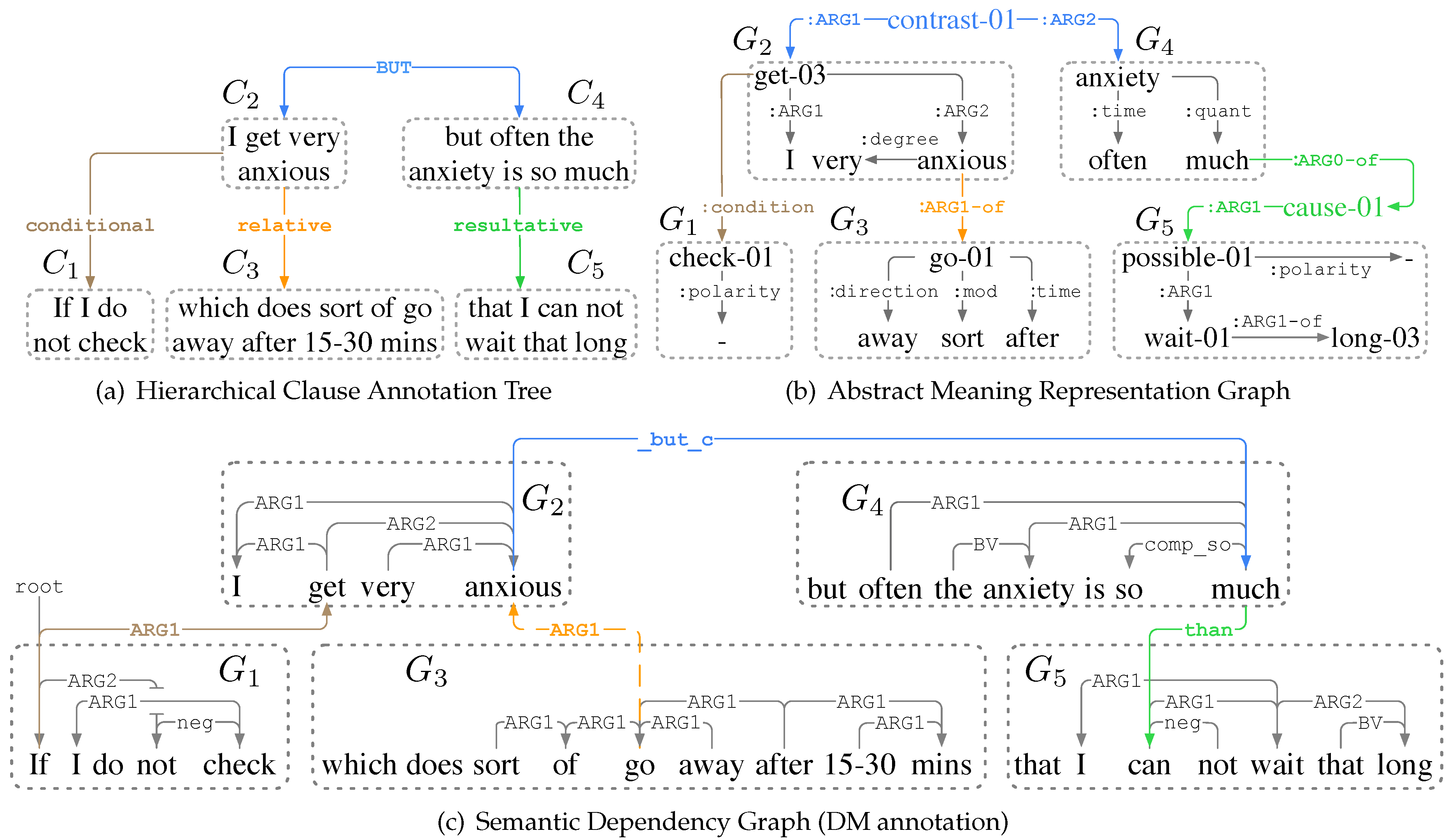
Figure 2.
Modified version of Payne’s Clause Hierarchy.

Figure 3.
Two basic hierarchical schemas in HCA, where node , node , and edge represent a clause, coordination and subordination, respectively.
Figure 3.
Two basic hierarchical schemas in HCA, where node , node , and edge represent a clause, coordination and subordination, respectively.
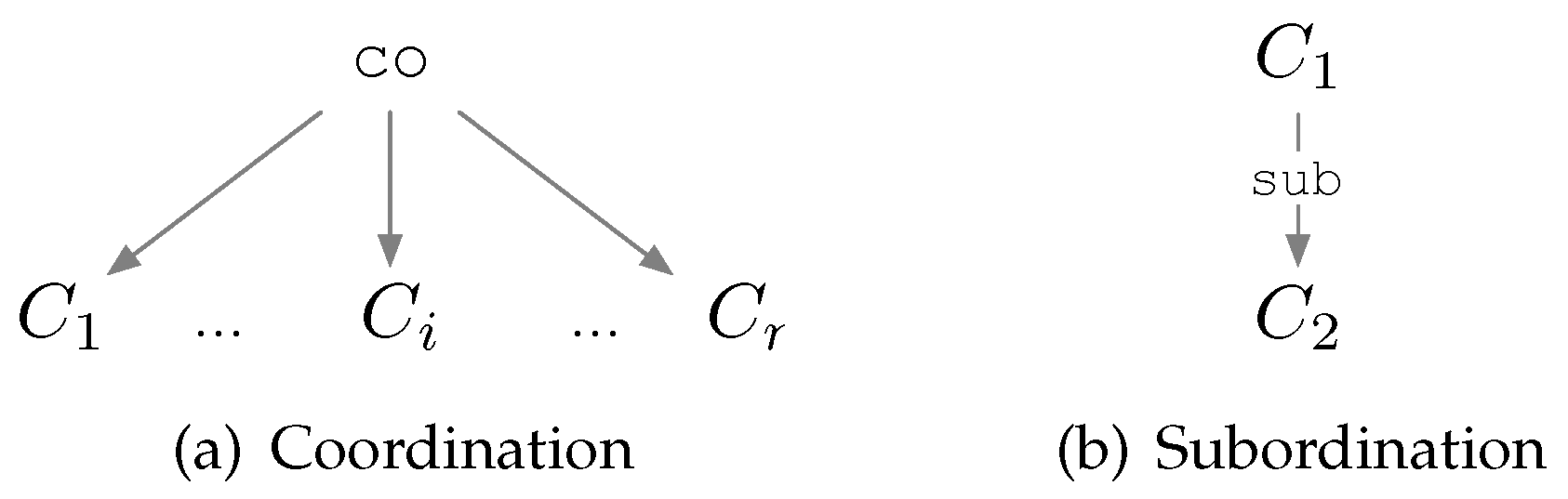
Figure 4.
Extract clauses and inter-clause relations via the constituency parse tree. Two clauses in dashed boxes are identified by underlined clause-type nodes S and its child node SBAR. Note that child constituent nodes of the left VP and the right ADJP are omitted to save space.
Figure 4.
Extract clauses and inter-clause relations via the constituency parse tree. Two clauses in dashed boxes are identified by underlined clause-type nodes S and its child node SBAR. Note that child constituent nodes of the left VP and the right ADJP are omitted to save space.
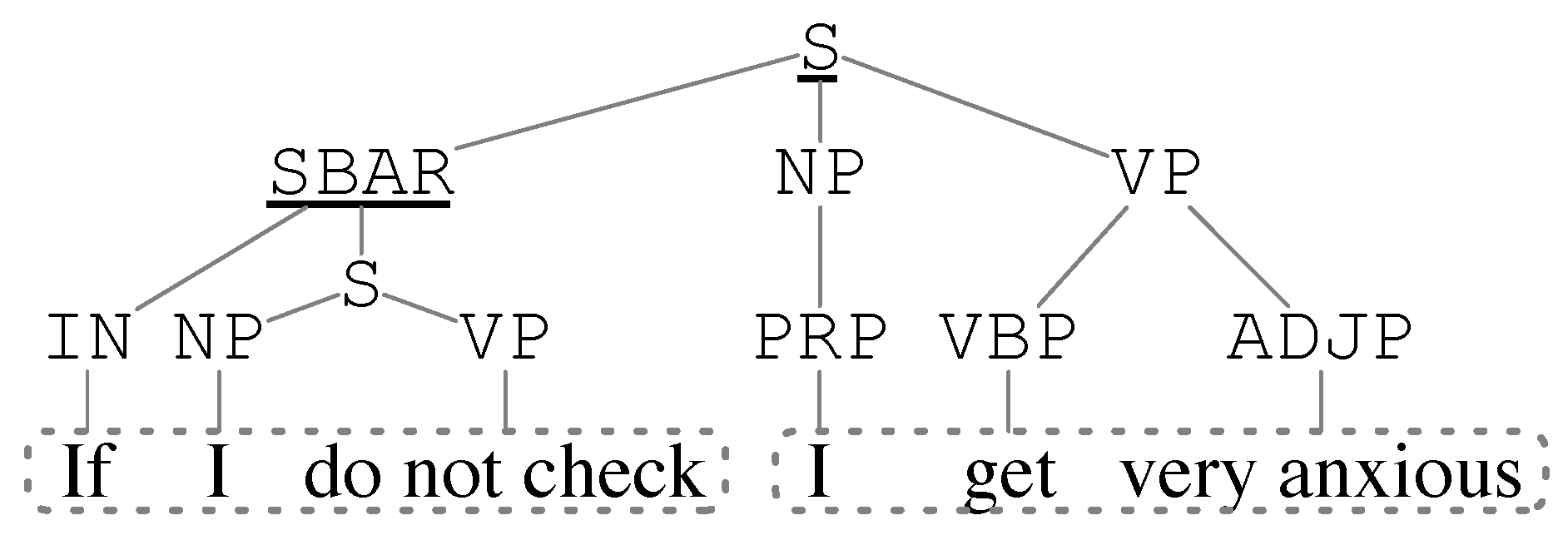
Figure 5.
Extract clauses and inter-clause relations via the syntactic dependency parse tree. Two clauses in dashed boxes are identified by the underlined verb and the governed constituents. The inter-clause relation Adverbial can be determined by the dependency advcl between the two clauses.
Figure 5.
Extract clauses and inter-clause relations via the syntactic dependency parse tree. Two clauses in dashed boxes are identified by the underlined verb and the governed constituents. The inter-clause relation Adverbial can be determined by the dependency advcl between the two clauses.
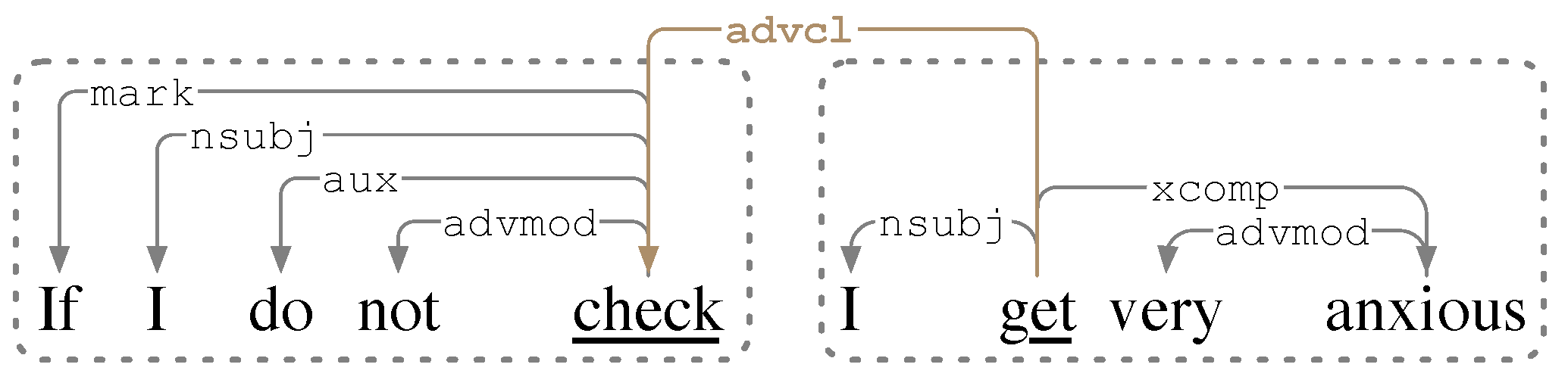
Figure 6.
Operating steps of an annotation trial in the browser-based tool, ClausAnn
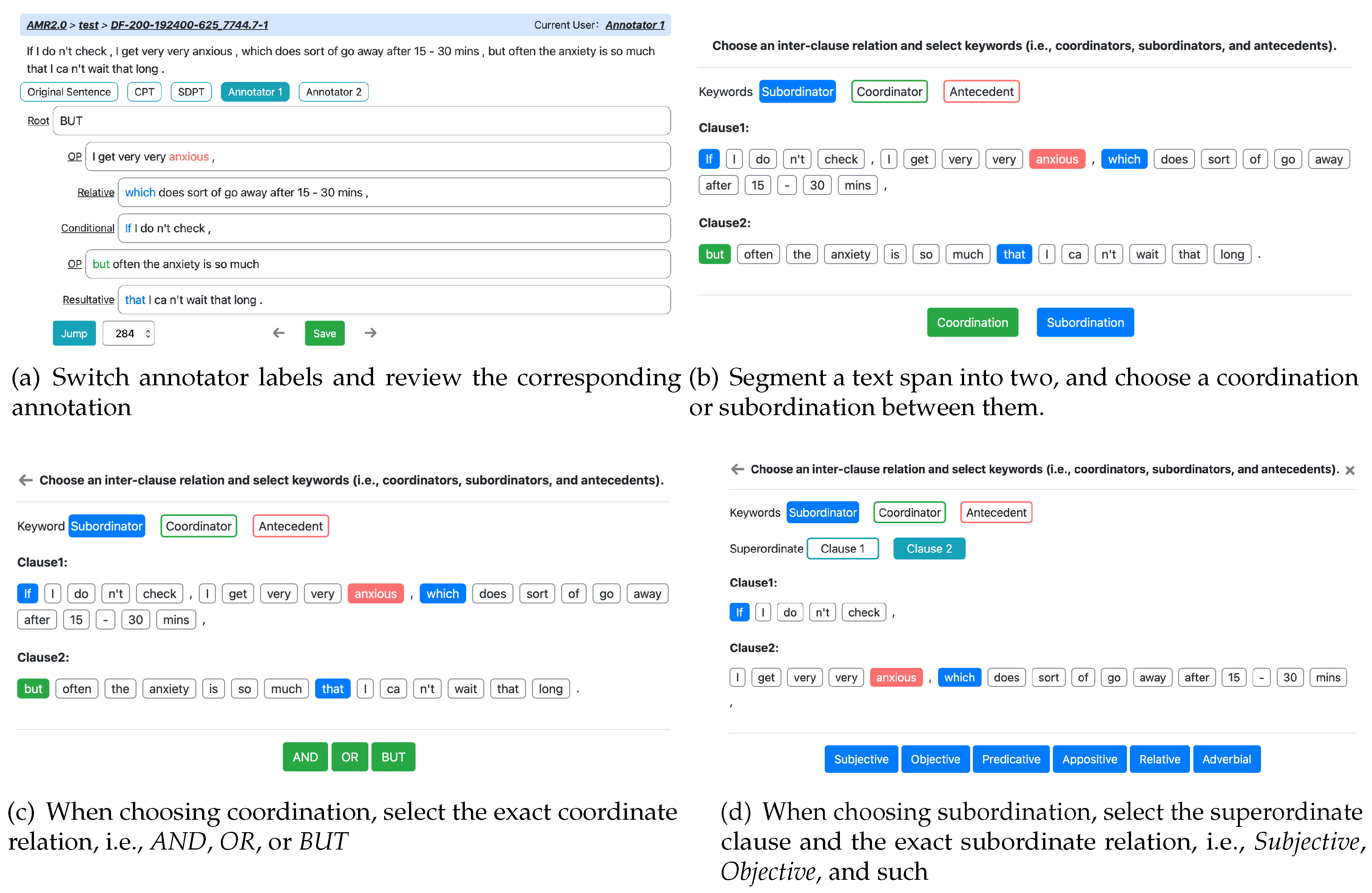
Figure 7.
Bottom-Up Clause Parsing.
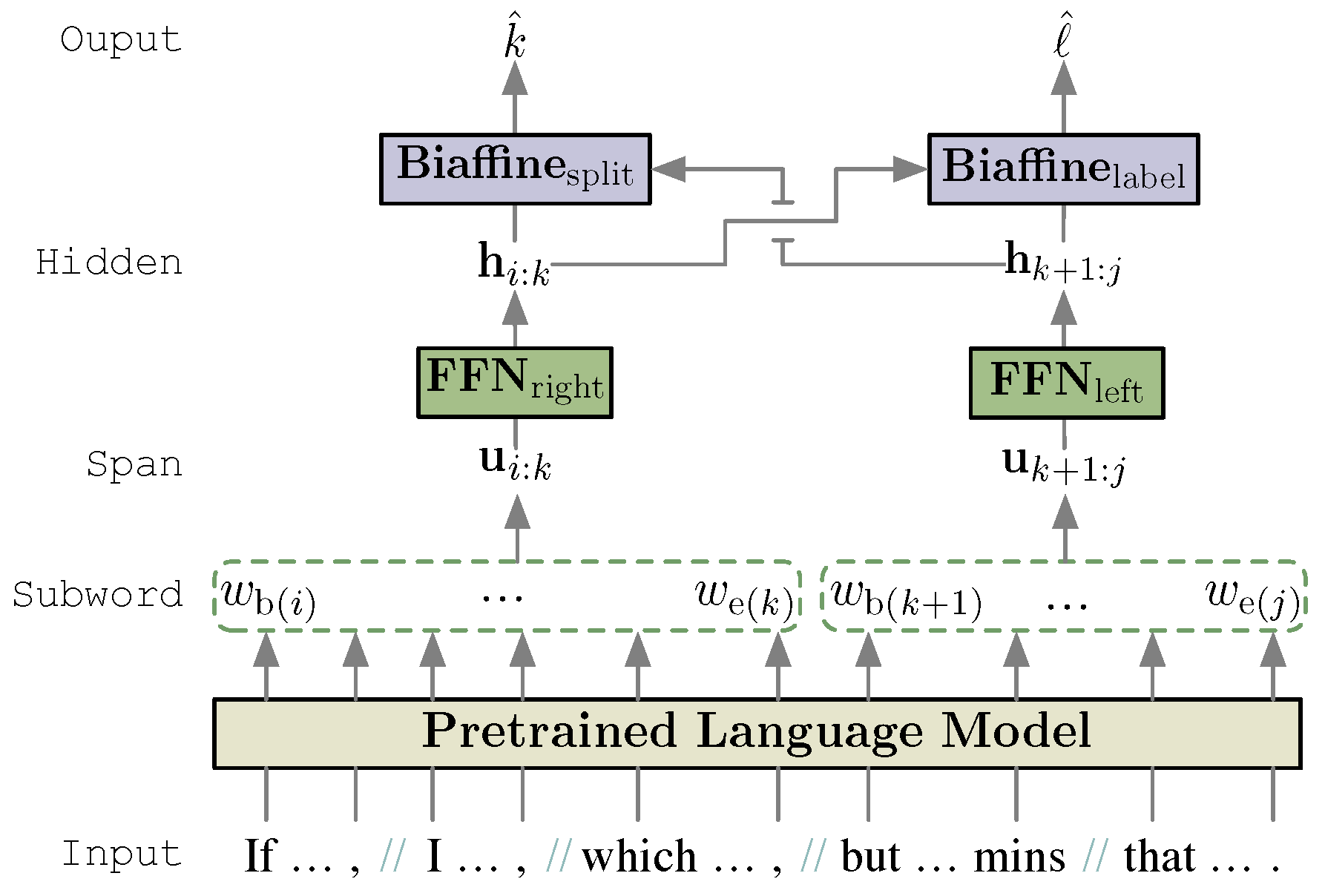
Figure 8.
Abstract Meaning Representation (AMR) Graph predicted by the state-of-the-art AMR parser. Red dotted relation edges, which are missed by the parser, can be recovered by transformation rules derived from the HCA tree. Red solid relation edges, which are mistakenly predicted by the parser, can be deleted by transformation rules derived from the HCA tree.
Figure 8.
Abstract Meaning Representation (AMR) Graph predicted by the state-of-the-art AMR parser. Red dotted relation edges, which are missed by the parser, can be recovered by transformation rules derived from the HCA tree. Red solid relation edges, which are mistakenly predicted by the parser, can be deleted by transformation rules derived from the HCA tree.
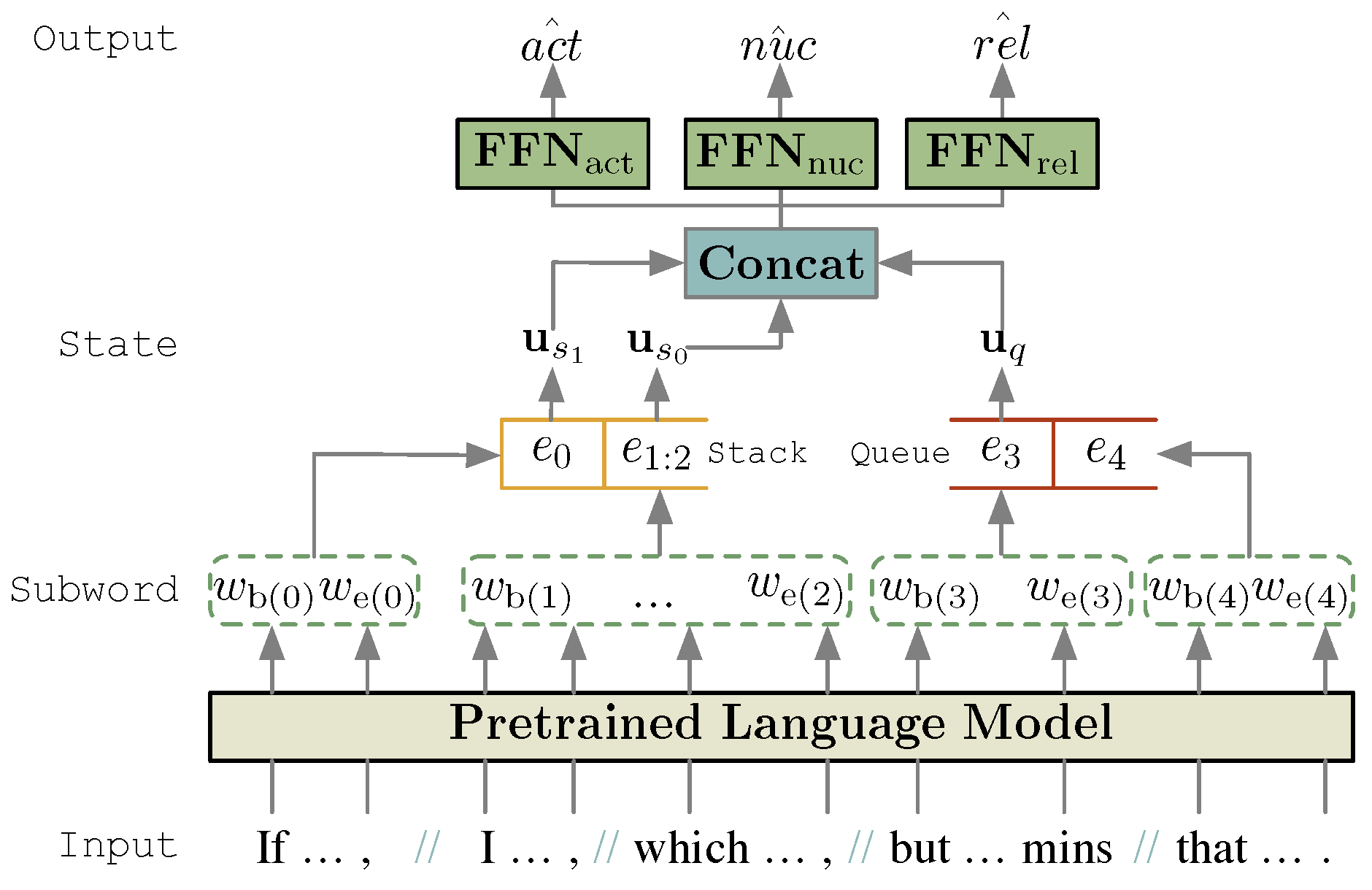
Figure 9.
Semantic dependency graph (SDG) predicted by the state-of-the-art semantic dependency parser, DynGL-SDP. Dotted red dependency edges, which are missed by the parser, can be recovered by transformation rules derived from the HCA tree.
Figure 9.
Semantic dependency graph (SDG) predicted by the state-of-the-art semantic dependency parser, DynGL-SDP. Dotted red dependency edges, which are missed by the parser, can be recovered by transformation rules derived from the HCA tree.

Table 1.
Comparison between our HCA task and the RST parsing task. Two exemplified sentences are from RST Discourse Tagging Reference Manual. Units (i.e., clauses or EDUs) are segmented by square brackets, and index . Relations between units are represented as arrows directed from a matrix clause or a nucleus EDU to a subordinate clause or a satellite EDU with a specific relation.
Table 1.
Comparison between our HCA task and the RST parsing task. Two exemplified sentences are from RST Discourse Tagging Reference Manual. Units (i.e., clauses or EDUs) are segmented by square brackets, and index . Relations between units are represented as arrows directed from a matrix clause or a nucleus EDU to a subordinate clause or a satellite EDU with a specific relation.
| Task | Output Descrpition | Output Example | |
|---|---|---|---|
| Unit | Relation | ||
| Hierarchical Clause Annotation |
Clause trees built up by clauses and inter-clause relations |
(1) [But some big brokerage firms said [they don’t expect major problems as a result of margin calls. |
|
| (2) [Despite their considerable incomes and assets, one-fourth don’t feelthat they have made it. |
|||
| RST Parsing | Discourse trees built up by EDUs and rhetorical relations |
(1) [But some big brokerage firms said [they don’t expect major problems as a result of margin calls. |
|
| (2) [Despite their considerable incomes and assets,one-fourth don’t feel that they have made it. |
|||
Table 2.
Comparison between our HCA task and similar tasks that decompose complex sentences into parts. The input sentence “If I do not check, I get very anxious, which does sort of go away after 15-30 mins, but the anxiety is so much that I can not wait that long.” is selected from the AMR 2.0 dataset and exemplified in Section 1. Underlined words in the Output Example column of each task are modified from the original sentence, while crossed words are deleted from the original sentence.
Table 2.
Comparison between our HCA task and similar tasks that decompose complex sentences into parts. The input sentence “If I do not check, I get very anxious, which does sort of go away after 15-30 mins, but the anxiety is so much that I can not wait that long.” is selected from the AMR 2.0 dataset and exemplified in Section 1. Underlined words in the Output Example column of each task are modified from the original sentence, while crossed words are deleted from the original sentence.
| Task | Output Descrpition | Output Example |
|---|---|---|
| Hierarchical Clause Annotation |
Finite clauses and non-finite clauses seperated by a comma |
(1) If I do not check, (2) I get very anxious, (3) which does sort of go away after 15-30 mins, (4) but often the anxiety is so much (5) that I can not wait that long. |
| Clause Indentification |
Finite clauses, non- tensed verb phrases, coordinators, and subordinators |
(1) If (2) I do not check, (3) I get very anxious, (4) which (5) does sort of go away after 15-30 mins, (6) but (7) often the anxiety is so much (8) that (9) I can not wait that long. |
| Split-and -Rephrase |
Shorter sentences | (1) If I do not check, I get very anxious. (2) The anxieties does sort of go away after 15-30 mins. (3) But often the anxiety is so much that I can not wait that long. |
| Text Simplification |
Sentences with simpler syntax |
(1) If I do not check. (2) I get very anxious (3) The anxiety lasts for 15-30 mins. (3) But I am often too anxious to wait that long. |
| Simple -Sentence -Decomposition |
Simple sentences with only one clause |
(1) If I do not check. (2) I get very anxious, (3) The anxiety does sort of go away after 15-30 mins. (4) But Often the anxiety is so much. (5) that I can not wait that long. |
Table 3.
Three main types of clause hierarchy and the clines of their clause integration tightness degree.
Table 3.
Three main types of clause hierarchy and the clines of their clause integration tightness degree.
| Type | Cline of Clause Integration Tightness Degree |
|---|---|
| Matthiessen [21] | Embedded > Hypotaxis > Parataxis > Cohesive devices > Coherence |
| Hopper& Traugott [22] |
Subordination > Hypotaxis > Parataxis |
| Payne [14] | Compound verb > Clausal argument > Relative > Adverbial > Coordinate > Sentence |
Table 4.
Examples of sentences with different types of inter-clause relations. Clauses are segmented by square brackets and clause marks . The underlined, double-underlined, and wave-underlined words are coordinators, subordinators, and antecedents, respectively.
Table 4.
Examples of sentences with different types of inter-clause relations. Clauses are segmented by square brackets and clause marks . The underlined, double-underlined, and wave-underlined words are coordinators, subordinators, and antecedents, respectively.
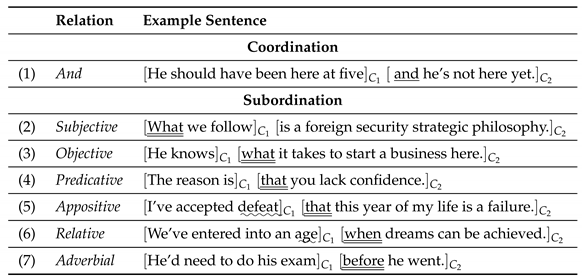 |
Table 5.
Inter-annotation agreement (IAA) of 16% double-annotated sentences in the HCA corpus by ten annotators marked as 1 to 10. Note that bold and underlined figures indict the highest and lowest consistencies in the corresponding metrics, respectively.
Table 5.
Inter-annotation agreement (IAA) of 16% double-annotated sentences in the HCA corpus by ten annotators marked as 1 to 10. Note that bold and underlined figures indict the highest and lowest consistencies in the corresponding metrics, respectively.
| Annotator | Clause | Interrelation | |||||
|---|---|---|---|---|---|---|---|
| P | R | Span | Nuc. | Rel. | Full | ||
| 1, 2 | 99.9 | 99.8 | 99.8 | 97.9 | 97.5 | 94.3 | 94.1 |
| 1, 3 | 100 | 100 | 100 | 98.1 | 97.8 | 94.2 | 94.1 |
| 2, 4 | 99.8 | 99.5 | 99.6 | 97.5 | 97.3 | 93.9 | 93.8 |
| 1, 5 | 99.0 | 98.3 | 98.6 | 98.0 | 97.7 | 94.2 | 94.0 |
| 6, 7 | 99.6 | 99.1 | 99.3 | 97.3 | 97.0 | 93.8 | 93.6 |
| 4, 8 | 99.4 | 99.3 | 99.3 | 97.9 | 93.9 | 93.7 | 93.5 |
| 1, 9 | 99.0 | 98.6 | 98.8 | 97.2 | 97.0 | 93.9 | 93.8 |
| 5, 10 | 98.8 | 98.0 | 98.4 | 97.3 | 97.1 | 93.6 | 93.4 |
Table 6.
Main statistics of the Hierarchical Clause Annotation dataset based on AMR 2.0 (HCA-AMR2.0). * means that some input sequences contain multiple sentences, and the coordination is necessary for these inter-sentence relations in these cases. * indicates that can be divided into nine sub-types like , , and .
Table 6.
Main statistics of the Hierarchical Clause Annotation dataset based on AMR 2.0 (HCA-AMR2.0). * means that some input sequences contain multiple sentences, and the coordination is necessary for these inter-sentence relations in these cases. * indicates that can be divided into nine sub-types like , , and .
| Item | Occurence | Relation | Occurence |
|---|---|---|---|
| # Sentences (S) | MulSnt* | ||
| # S with HCA | And | ||
| # S in Train Set | Or | 974 | |
| # S in Dev Set | 740 | But | |
| # S in Test Set | 751 | Subjective | 992 |
| # Tokens (T) | 521,805 | Objective | |
| # Clauses (C) | 57,330 | ||
| # Avg. T/S | 26.9 | Appositive | 667 |
| # Avg. T/C | 9.1 | Relative | |
| # Avg. C/S | 3.1 | Adverbial★ |
Table 7.
Main statistics of HCA-AMR2.0, GUM, STAC, and RST-DT dataset. Note that Unit in the header represents clause or elementary discourse unit (EDU), Rel. represents inter-clause/EDU relation, #Avg. U/S means the average number of units per sentence, and #Avg. R/U means the average number of inter-clause/EDU relations per unit.
Table 7.
Main statistics of HCA-AMR2.0, GUM, STAC, and RST-DT dataset. Note that Unit in the header represents clause or elementary discourse unit (EDU), Rel. represents inter-clause/EDU relation, #Avg. U/S means the average number of units per sentence, and #Avg. R/U means the average number of inter-clause/EDU relations per unit.
| Dataset | #Unit (U) / #Sentence (S) | #Avg. U/S |
#Rel. | #Rel. Type |
#Avg. Rel./U |
||
|---|---|---|---|---|---|---|---|
| Train | Dev | Test | |||||
| HCA- AMR2.0 |
52,758/17,885 | 2,222/740 | 2,350/751 | 3.1 | 49,160 | 18 | 0.86 |
| GUM | 14,766/6,346 | 2,219/976 | 2,283/999 | 2.3 | - | - | |
| STAC | 9,887/8,754 | 1,154/991 | 1,547/1,342 | 1.1 | - | - | - |
| RST-DT | 17,646/6,671 | 1,797/716 | 2,346/928 | 2.6 | 19,778 | 18 | 0.91 |
Table 8.
Hardware and software used in our experiments.
| Environment | Value |
|---|---|
| Hardware | |
| CPU | Intel i9-10900K @ 3.7 GHz (10-core) |
| GPU | NVIDIA RTX 3090Ti (24G) |
| Memory | 64 GB |
| Software | |
| Python | 3.8.16 |
| Pytorch | 1.12.1 |
| Anaconda | 4.10.1 |
| CUDA | 11.3 |
| IDE | PyCharm 2022.2.3 |
Table 9.
Final hyper-parameters configuration of clause segmentation model.
| Layer | Hyper-Parameter | Value |
|---|---|---|
| Clause Segmentation Model | ||
| Character Embedding (Bi-LSTM) | layer | 1 |
| hidden_size | 64 | |
| dropout | 0.2 | |
| Word Embedding | fastText | 300 |
| Electra | 1024 (large) | |
| Feature Embedding | POS/Lemma/DP | 100 |
| Bi-LSTM | layer | 1 |
| hidden_size | 512 | |
| dropout | 0.1 | |
| Trainer | optimizer | AdamW |
| learning rate | 5e-4, 1e-4 | |
| # epochs | 60 | |
| patience of early stopping | 10 | |
| validation criteria | +span_f1 | |
| Clause Segmentation Model | ||
| Word Embbeding | pretrained language model | 768/1024(base/large) |
| FFN | hidden_size | 512 |
| dropout | 0.2 | |
| Trainer | optimizer | AdamW |
| learning rate | 2e-4, 1e-5 | |
| weight decay | 0.01 | |
| batch size (# spans/actions) | 5 | |
| # epochs | 20 | |
| patience of early stopping | 5 | |
| gradient clipping | 1.0 | |
| validation criteria | RST-Parseval-Full | |
Table 10.
Performaces of the adapted DisCoDisCo model on HCA-AMR2.0 for clause segmentation, and performances of DisCoDisCo and GumDrop on three datasets for the contrastive task, discourse segmentation. Note that * and ∘ indicate gold annotated features from the corresponding dataset and silver features annotated by Stanza, respectively. Bold numbers are the best scores in each dataset. All the experiments on the clause segmentation task are conducted for five runs with different seeds, and the experimental results are averaged.
Table 10.
Performaces of the adapted DisCoDisCo model on HCA-AMR2.0 for clause segmentation, and performances of DisCoDisCo and GumDrop on three datasets for the contrastive task, discourse segmentation. Note that * and ∘ indicate gold annotated features from the corresponding dataset and silver features annotated by Stanza, respectively. Bold numbers are the best scores in each dataset. All the experiments on the clause segmentation task are conducted for five runs with different seeds, and the experimental results are averaged.
| Task | Dataset | Model | P | R | |
|---|---|---|---|---|---|
| Discourse Segmentation |
GUM | GumDrop[37] | 96.5 | 90.8 | 93.5 |
| - all feats. * | 97.7 | 87.4 | 92.3 | ||
| DisCoDisCo[15] | 93.9 | 94.4 | 94.2 | ||
| - all feats. * | 92.7 | 92.6 | 92.6 | ||
| STAC | GumDrop[37] | 95.3 | 95.4 | 95.3 | |
| - all feats.* | 85.0 | 76.7 | 80.6 | ||
| DisCoDisCo[15] | 96.3 | 93.6 | 94.9 | ||
| - all feats. * | 91.8 | 92.1 | 91.9 | ||
| RST-DT | GumDrop[37] | 94.9 | 96.5 | 95.7 | |
| - all feats.* | 96.3 | 94.6 | 95.4 | ||
| DisCoDisCo[15] | 96.4 | 96.9 | 96.6 | ||
| - all feats. * | 96.8 | 95.9 | 96.4 | ||
| Clause Segmentation |
HCA-AMR2.0 | DisCoDisCo | 92.9 | 89.7 | 91.3 |
| - lem. * | 86.8 | 93.9 | 90.2 | ||
| - dp.∘ | 91.0 | 87.7 | 89.3 | ||
| - pos∘ | 91.4 | 87.6 | 89.4 | ||
| - all feats.∘ | 89.2 | 85.4 | 87.2 | ||
| - fastText | 90.5 | 82.7 | 86.4 |
Table 11.
Performances of the top-down and bottom-up parsers with various pretrained language models (PLMs) for clause parsing and discourse parsing tasks, which are evaluated by four RST-Parseval metrics, i.e., Span, Nuclearity (Nuc.), Relation (Rel.), and Full. Standard deviations for three runs are shown in parentheses. Bold numbers are the best scores in each task with each model. Note that we only conduct experiments on HCA-AMR2.0 and RST-DT datasets for clause parsing and discourse parsing, respectively.
Table 11.
Performances of the top-down and bottom-up parsers with various pretrained language models (PLMs) for clause parsing and discourse parsing tasks, which are evaluated by four RST-Parseval metrics, i.e., Span, Nuclearity (Nuc.), Relation (Rel.), and Full. Standard deviations for three runs are shown in parentheses. Bold numbers are the best scores in each task with each model. Note that we only conduct experiments on HCA-AMR2.0 and RST-DT datasets for clause parsing and discourse parsing, respectively.
| Model | PLM | Discourse Parsing | Clause Parsing | ||||||
|---|---|---|---|---|---|---|---|---|---|
| Span | Nuc. | Rel. | Full | Span | Nuc. | Rel. | Full | ||
| Top-Down | BERT | 92.6±0.53 | 85.7±0.41 | 75.4±0.45 | 74.7±0.54 | 96.0±0.20 | 92.1±0.27 | 85.8±0.51 | 85.7±0.47 |
| RoBERTa | 94.1±0.46 | 88.4±0.46 | 79.6±0.17 | 78.7±0.11 | 96.5±0.02 | 93.1±0.09 | 87.1±0.23 | 87.1±0.22 | |
| SpanBERT | 94.1±0.15 | 88.8±0.19 | 79.4±0.49 | 78.5±0.39 | 96.4±0.13 | 92.6±0.12 | 86.1±0.15 | 85.9±0.15 | |
| XLNet | 94.8±0.39 | 89.5±0.39 | 80.5±0.59 | 79.5±0.53 | 96.6±0.07 | 93.5±0.20 | 87.0±0.57 | 86.9±0.56 | |
| DeBERTa | 94.2±0.33 | 89.0±0.16 | 80.1±0.43 | 79.1±0.32 | 96.6±0.02 | 93.3±0.07 | 87.2±0.04 | 87.2±0.10 | |
| Bottom-Up | BERT | 91.9±0.34 | 84.4±0.31 | 74.4±0.37 | 73.8±0.30 | 96.3±0.22 | 92.3±0.36 | 86.1±0.37 | 86.0±0.32 |
| RoBERTa | 94.4±0.12 | 89.0±0.34 | 80.4±0.47 | 79.7±0.51 | 96.4±0.16 | 92.8±0.20 | 86.6±0.56 | 86.6±0.58 | |
| SpanBERT | 93.9±0.24 | 88.2±0.19 | 79.3±0.37 | 78.4±0.29 | 96.5±0.09 | 92.6±0.06 | 86.4±0.20 | 86.2±0.22 | |
| XLNet | 94.7±0.31 | 89.4±0.24 | 81.2±0.27 | 80.4±0.34 | 96.9±0.10 | 93.6±0.09 | 87.4±0.33 | 87.3±0.31 | |
| DeBERTa | 94.6±0.38 | 89.8±0.65 | 81.0±0.64 | 80.2±0.70 | 97.0±0.10 | 94.0±0.17 | 87.8±0.39 | 87.7±0.38 | |
Table 12.
Clause Parsing Results with large versions of pretrained language models (PLMs), XLNet, and DeBERTa (RST-Parseval). † indicates PLMs with a large version. Standard deviations for three runs are shown in parentheses. Bold numbers are the best scores in each model.
Table 12.
Clause Parsing Results with large versions of pretrained language models (PLMs), XLNet, and DeBERTa (RST-Parseval). † indicates PLMs with a large version. Standard deviations for three runs are shown in parentheses. Bold numbers are the best scores in each model.
| Model | PLM | Span | Nuc. | Rel. | Full |
|---|---|---|---|---|---|
| Top-Down | XLNet | 96.6±0.07 | 93.5±0.20 | 87.0±0.57 | 86.9±0.56 |
| XLNet† | 96.7±0.27 | 93.6±0.33 | 87.6±0.36 | 87.6±0.37 | |
| DeBERTa | 96.6±0.02 | 93.3±0.07 | 87.2±0.04 | 87.2±0.10 | |
| DeBERTa† | 97.0±0.14 | 94.0±0.29 | 87.6±0.69 | 87.6±0.61 | |
| Bottom-Up | XLNet | 96.9±0.10 | 93.6±0.09 | 87.4±0.33 | 87.3±0.31 |
| XLNet† | 97.0±0.34 | 93.7±0.46 | 87.6±0.67 | 87.6±0.67 | |
| DeBERTa | 97.0±0.10 | 94.0±0.17 | 87.8±0.39 | 87.7±0.38 | |
| DeBERTa† | 97.4±0.08 | 94.5±0.13 | 88.6±0.27 | 88.5±0.28 |
Disclaimer/Publisher’s Note: The statements, opinions and data contained in all publications are solely those of the individual author(s) and contributor(s) and not of MDPI and/or the editor(s). MDPI and/or the editor(s) disclaim responsibility for any injury to people or property resulting from any ideas, methods, instructions or products referred to in the content. |
© 2023 by the authors. Licensee MDPI, Basel, Switzerland. This article is an open access article distributed under the terms and conditions of the Creative Commons Attribution (CC BY) license (http://creativecommons.org/licenses/by/4.0/).
Copyright: This open access article is published under a Creative Commons CC BY 4.0 license, which permit the free download, distribution, and reuse, provided that the author and preprint are cited in any reuse.


