

Submitted:
06 June 2023
Posted:
06 June 2023
You are already at the latest version
Abstract
Rice farming households having limited capital do various combinations of the capital to get diversified livelihoods in continuing their lives. The purpose of this study was to analyze the effect of the household capital of rice farmers on livelihood diversification in Indramayu District. Survey method with data sources from 214 rice farming households taken by proportional simple random sampling technique. Data analysis used the partial least square method. The results found that the household capital of rice farmers has a positive and significant effect on the livelihood diversification. Government policy recommendations were determined in order of priority are physical capital with the help of agricultural tools and machinery, natural capital by anticipating climate change, financial capital by increasing support for capital sources, social capital by social networks, and human capital by improving farming skills.
Keywords:
livelihood diversification
; entropy index
; capital
; rice farming households
; Partial Least Squares
1. Introduction
Rice farming households play an essential role in contributing to national income. Paddy rice commodities contribute around 60 percent of the payment of 87 percent of the agricultural sector income in Indonesia [1]. However, the fact is that the ownership of rice fields in rice farming households is getting narrower, on average 0.5 hectares are owned by 15.89 million agricultural households [1]. The narrower ownership of paddy fields resulted in a decrease in the area of rice harvest and a reduction in rice production. The magnitude of the decline in rice production by 27.58 percent in the last five years (2015-2019) in Indonesia [2,3]. The decline in rice production has caused low household incomes for rice farmers. The low income has resulted in rice farming households not meeting the necessities of life so the standard of living has not been better.
Indramayu District was selected as our research area because of a rice field center. Agricultural conditions are still subsistence and risk-prone, characterized by drought when the dry season, flooding when the rainy season, and reduced paddy fields due to seawater intrusion [4]. The driving factor for rice farming households to avoid risk by carrying out a livelihood diversification strategy to obtain additional income in Indramayu District. Smallholder farmers are more likely to avoid risk by diversifying livelihoods to minimize variations in income [5]. Livelihood diversification can reduce stress, such as floods, droughts, diseases, and the others [6,7]. The combination of diversified farming and non-farming livelihoods will be better for paddy rice farming households as it provides livelihood security and a standard of the living [5]. Rural households that diversify their livelihoods are those who can build better and less vulnerable household assets when compared to those who do not diversify their livelihoods [8].
Diversification of agricultural livelihoods provides benefits for environmental sustainability. Diversifying agricultural livelihoods by diversifying crops can stabilize the productivity of cropping systems, reduce negative environmental impacts, and reduce biodiversity [9,10]. Diversification of agricultural livelihoods outside of farming (off-farm diversification) provides additional income as farm laborers and entrepreneurs [11]. However, rice farming households that have narrow land and low income cannot grow cash crops that have high selling value, so agricultural diversification can be to has not been successful [12]. In addition, there are several factors inhibiting the diversification of agricultural livelihoods, such as poor market access, market instability, limited government support, high input costs [11]; Limited labor, availability of superior seeds of commercial commodities that not met standards, fertilizer had not been fulfilled [13]; irrigation infrastructure is less supportive, soil quality is not supportive [14,15]. Of course, this is a motivating factor for rice farming households to diversify livelihoods in non-agricultural. Empirical results prove that the integration of non-agricultural livelihoods provides benefits for rural farming households in the food security [16], to increase income, and lower poverty rates [17,18,19]. Agricultural activities, non-agricultural activities, and a combination of agriculture activities and non-agricultural activities have a positive impact on income and welfare [20]. Income in developing countries of 50.0 percent comes from non-agricultural activities, money transfers, and pension payments [21]. In Indonesia, agricultural household income earns 68.91 percent from non-agricultural enterprises [22]. Hence, it is important for rice farmer household, especially those with narrow farming area, to do non-farm diversification as an opportunity of a non-farm job and a way out of poverty.
Livelihood diversification for each rice farming household is different, depends on how households optimize the sources owned with their ability. As the phrase goes [5] that livelihood resources or assets determine people's ability to have livelihood strategies to meet their needs. Resources in the livelihood approach had referred to as capital. There were five types of livelihood capital by households according to [21,23], namely human capital (education, skills, and health), social capital (networks and associations), natural capital (water, land, trees, and others), physical capital (investment in the form of goods), and financial capital (money, savings, access to loans). Findings [24] that the empirical of household capital had a significant effect on people's livelihood strategies in Inner Mongolia, China. Similarly with the findings [8,25] that rural households use their free time to engage in non-agricultural activities in Bangladesh. In addition, it is also evident that higher education, male labor, and infrastructure have a positive and significant effect on the diversification of non-agricultural livelihoods. Meanwhile, the age of the head of household, the farming experience of the head of the family, and the ownership of land have a negative and significant influence on the diversification of non-agricultural livelihoods. It means that young workers have the opportunities to get wage jobs and entrepreneurship in non-agricultural activities.
Opposite [18] finding the age of the head of household has a positive and significant effect on verified livelihoods. It means that the elderly had enough wealth and experience to invest in non-agricultural activities. The value of the level of diversities of livelihoods of each rice farmer household in an area has a relationship with the household capital of rice farmers. The relationship between the value of the level of livelihood diversification (diversity of livelihoods in the household) is negative and not significant with farming area ownership and exploitation [26,27], positive with the mount of household member working [26,27], and is negative and weak land tenure and land concession area [27].
The results of previous research on livelihood diversification had found, but the variables were independent. Household capital was used in determining livelihood diversification. The covariance-based and variance-based Structural Equational Modeling (SEM) was still rare. The analytical method using logit regression models, multinomial logit, and SEM has weaknesses, in which normal distribution and units of measure are the main requirements. Therefore, we promote livelihood diversification by combining the five capitals owned by rice farming households (human capital, social capital, natural capital, physical capital, and financial capital) as material for exogenous variable constructs of rice farmer household capital. This study uses the value of the level of livelihood diversification (entropy index), diversification of agricultural livelihoods, and diversification of non-agricultural livelihoods as materials endogenous variable constructs of livelihood diversification. The analysis tool used is the SmartPLS software program. The reason for using SmartPLS is because this method has several advantages, namely: it does not matter the normal distribution and units of measure (nominal, ordinal data, ratio data), the number of respondents is not much like the method SEM-CB [28,29]. Thus, this research is important to be conducted. The purpose of this study is to analyze the effect of household capital of rice farmers on livelihood diversification in Indramayu District. The empirical results of this study predict that the household capital of rice farmers has a significant effect on livelihood diversification.
This research has based a framework for determining the capital-based livelihood diversification of rice farmer households by compiling an econometric model. First, the capital from rice farmer households construct has been completed (human capital, social capital, physical capital, natural capital, and financial capital based on the perception of rice farmer households). Second, compiling a livelihood diversion construct (the value of the level of livelihood distribution marked by the entropy index, diversification of agricultural livelihoods, and diversification of non-agricultural livelihoods is assessed based on the perception of rice farmer households). Third, connecting the two constructs of household capital of rice farmers and the construct of diversifying livelihoods. Fourth, conduct analysis using the partial method of SmartPLS tools. Then in the next chapter, a discussion and conclusion are carried out.
2. Materials and Methods
2.1. Location and Research Data
Indramayu District had designated as the research location due to consideration, that Indramayu District is the highest rice center in West Java Province, Indonesia. Then, the location of the respondents is determined gradually. First, all sub-districts in Indramayu District had grouped into areas close to markets, cities, tourism, and industries. The reason was that the household was a farmer whose area was close to the industries [30], market or city [31], and tours [32] then the livelihood will vary. Second, one sub-district was selected randomly using an excel program representative of the Eastern, Central, and Western regions. Juntinyuat District (Eastern region), Indramayu District (Central), and Patrol District (Western) were elected. Third, one village was selected randomly using an excel program representing the selected sub-district. Representing were Juntinyuat Village in Juntinyuat District (Eastern region), Teluk Agung Village in Indramayu District (Central), and Patrol Village in Patrol District (Western). The position of the research location can be seen more clearly on the Map of Indramayu District (Figure 1).
Indramayu District had geographically located at 107o52’ – 108o36’ East Longited and 6o15’ – 6o40’ South Latitude. The shape of its topography was plain. The average slope of the soil by 0 – 2 percent caused waterlogging when rainfall was high. The coastline was 147 km. The high air temperature ranged from 22.9oC – 30oC. Its climate conditions have 97 rainy days and rainhall of 1,411 mm.The height from area was 3 meters above sea level. The area of Indramayu District is 2,099.42 Km2. The number of villages is 317, and the number of sub-districts is 31 [2].
2.2. Household Capital of Rice Farmers
Capital is a resource that becomes a household livelihood asset. Household capital to achieve livelihood diversification as a livelihood strategy in this study uses five types of capital [6,33], namely human capital, social capital, natural capital, physical capital, and financial capital.
- Human capital is the resources that the head of the household and its members have outwardly and that are cultivated. The role of human beings is to function the other four household capitals in the household had. The four capitals are natural capital, physical capital, and financial capital. This research uses human capital, namely age, experience, skills.
- Social capital is a resource owned by households. Social capital is a resource owned by the family. Social capital can mobilize human capital to optimize the other three household capital. Other capital is natural capital, physical capital, and financial capital. The social problems used in this study were trust (honest, orderly, and cooperative behavior) and social networks (bonding/homogeneous community with family/friends/neighbors, bridging/heterogeneous, and land tenure institutions).
- Natural capital is a resource available in nature. Natural capital has direct and indirect benefits in nature sustainability. The benefits of natural capital provide nutrient cycling and protection from erosion and storms. This research uses natural capital, namely the availability of water and water sources, land tenure, climate change, environmental services, and biodiversities.
- Physical capital is a resource owned by a household. Physical capital is a means of carrying out livelihood diversification activities. This research uses physical capital, namely: infrastructure and its condition (roads, markets, and others), agricultural tools and machinery, and access to agricultural technology (communication networks).
- Financial capital is a household's financial resources used to diversify livelihoods. This research uses financial capital, namely: sources of income, access to credit, and sources of capital.
A description of variables and measuring indicators to construct the capital of rice farmer households have presented in Table 1.
2.3. Livelihood Diversification
Diversification in livelihood approaches is a phenomenon of strategies for household survival. Livelihood diversification is very significant to strive for because it can improve livelihood security and living standards [33]. There are two kinds of livelihood diversification in rural areas, diversification of agricultural livelihoods and diversification of non-agricultural livelihood. The diversity of each household's livelihood had determined by the values from the diversity index (entropy index). The value of the level of livelihood diversity depends mainly on the members of the working household and the type of livelihood they perform [26,27,35].
2.3.1. Livelihood Diversification Index Analysis
Livelihood Diversification Index analysis was done to determine the degree of livelihood heterogeneity (on-farm, off-farm, and non-farm) done by rice farmer household members. Livelihood diversification index of rice farmer household was determined using entropy index formula [50,51,52]. Entropy index is affected largely by the amount of labor working in a certain livelihood and the amount of household member working in all types of livelihoods. The closer the value of the index entropy is to 1, the more diversified the livelihood of a rice farmer household is. The closer the value is to 0, the more specialized the livelihood of a rice farmer household is. A study related to entropy index in Indonesia had been done by [26,27,35]. Mathematically, entropy index [50] is written as follows:
where:
ρi = I/L
- Ɛ:
- Entropy index, 0 ≤ Ɛ ≤ 1
- ρi:
- the proportion of household members working on the nth type of job to the amount og household members working on all types of livelihood
- I:
- the amount of household member working on the ith type of job
- L:
- the amount of household member working on all types of livelihood
- n:
- the amount of job type done as household livelihood (1, 2, …)
- Entropy index value:
- If the value of Ɛ is 1, the diversification of household members is done to all types of livelihood in a balanced manner.
- If the value of Ɛ is 0, no diversification of household members is done (the livelihood is specialized).
The result of entropy index analysis as rice farmer household livelihood diversification index in Indramayu District is used as the measurement indicator composing endogenous variable construct of Livelihood Diversification (Table 2).
2.3.2. Diversification of Agricultural Livelihood
Diversification of agricultural livelihoods into new livelihood opportunities in rural areas. On-farm diversification in the form of crops diversification as a livelihood strategy to adapt to climate shocks [53]. Various types of plant diversification, namely: multiple cropping, intercropping, relay cropping, sequential planting [54,55]. Moreover, livestock potential had discovered in rice-based household economies. Intensive animal husbandry through diversification of crop-livestock systems provides additional income for farming households in rural areas [56,57,58]. Furthermore, diversification of livelihoods outside farming (off-farm diversification) as wage labor and entrepreneurship (land rent, agricultural machinery rental, and others). Diversifying livelihoods beyond farming brings income and addresses seasonal unemployment [59]. This study uses diversification of agricultural livelihoods to provide additional income through respondents' perceptions of rice farming households. The diversification of agriculture livelihoods as part of the construct of livelihood diversification (Table 2).
2.3.3. Diversification of Non-Agricultural Livelihoods
The Diversification of non-agricultural livelihoods is a new livelihood strategy to build better assets (investment) in rural area [8]. Livelihood diversification had aimed at minimizing household variability, mitigating the impact of losses from climate change, providing employment, and providing additional income [23,60,61] guarantee consumption expenditure [23,39], reducing poverty rates [17]. Some of the types of non-agricultural livelihood integration are tailors, trades, restaurants and food vendors, basket weaving, ceramic pot makers, rope makers, GSM (Global System for Mobile) airtime voucher sales, hairdressers, poultry raising, and the others [46,62,63]. Diversification of non-agricultural livelihoods had used in this study based on respondents' perceptions of rice farming households providing additional income and savings. Diversification of non-agricultural livelihoods as part of endogenous variable constructs of livelihood diversification (Table 2).
2.4. Capital Relationship of Rice Farmer Households and Livelihood Diversification
Livelihood diversification had determined by a combination of the household capital of rice farmers. Based on the results of empirical studies, previous research has three relationships between the household capital of rice farmers and livelihood diversification. The three relationships are the household capital of rice farmers to the value of the level of livelihood diversification, agricultural livelihood diversification, and non-agricultural livelihood diversification.
2.4.1. The relationship of household capital of rice farmers to the diversification of agricultural livelihoods
Household capital has a positive relationship and a significant effect on the diversification of agricultural livelihoods. Human capital beings are like the age of household members [34], skills on the job [35,37], and farming experience [65]. Social capital such as trust (honest, orderly, and cooperative behavior) and networking (bonding/homogeneous community ties with family/friends/neighbors and bridging/heterogeneous community relationships with various communities [33,37], and land tenure institutions [66]. Natural resources such as the availability of water and water sources, land control is getting narrower [35,67]; topographic conditions [15], climate change [34,68], environmental services [21], and biodiversity [21,55]. Physical capital is like the infrastructure of roads, markets, irrigation, communication networks, and internet networks [47], agricultural tools and machinery, and access to agricultural technology [69] Financial capital is like a source of income [18], remittance [68], credit access [11,47,68], and sources of capital [49].
2.4.2. The relationship between household capital of rice farmers to the diversification of non-agricultural livelihoods
Household capital has a positive relationship and a significant effect on the diversification of non-agricultural livelihoods. Human capital is as age [35,70], skills on the job [41], and farming experience negatively affects [25,65]. Social capital [33] is like trust (honest, orderly, and cooperative behavior) and networking (bonding/homogeneous community ties with family/friends/neighbors and heterogeneous bridging/community relationships with various communities [37], and land tenure institutions [66]. Modal nature [33] is such as water availability and water sources, land ownership area [25,40]; climate change [71,72], environmental services, and biodiversity. Physical capital is such as infrastructure and conditions (roads, markets, etc). [37,42], agricultural tools and machinery, and access to agricultural technology (communication networks) [41,43]. Financial capital is such as sources of income [42], livestock [40], remittance [73], credit access [60], and sources of capital [74,75].
2.4.3. The relationship of household capital of rice farmers to the value of the level of livelihood diversification
The combination of household capitals of rice farmers has an impact on the value of the level of diversification livelihood. Human capital, such as the age of the head of the household, has a negative relationship with the entropy index [27]. It means that the elderly experience a decrease in labor productivity, and livelihoods are more towards agriculture. Farming skills have a positive relationship and significant effect on the entropy index [35]. It means that the skills possessed are very diverse on the farm, and they can diversify the farming of various types of crops in their respective fields. In addition, diversification of agricultural livelihoods can be wage labor working outside the farm on land owned by others. Natural capital, such as land tenure, and land tenure are negatively and weakly related [27]. It means that the wider the control and exploitation of land, the more specialized the types of plants cultivated. It is because the input costs of production are high, and labor is much more than in monoculture. This study used the entropy index of respondents of rice farming households. Other paddy farming households follow previous research on the effect of household capital on agricultural and non-agricultural livelihoods (Table 2).
Based on empirical studies, previous research formed a theoretical concept model of diversification of livelihoods of rice farmer households. The conceptual model had formed from the constructed exogenous latent variable constructs of rice farmer household capital and endogenous latent variable constructs of livelihood diversification. The theoretical concept of this model is to answer the hypothesis of research objectives (Figure 2). The provisional estimation is that the capital construct of rice farmer households has a significant influence on the construct of livelihood diversification.
2.5. Sampling Techniques, Number of Samples, and Data Sources
The sampling technique of respondents of rice farmer households by proportional simple random sampling. One Farmer Group Association (Gapoktan) was randomly selected using an excel program from each village represented based on a location determination. Represented Gapoktan were Junti Rahayu Association in Juntinyuat Village (Eastern region), Beberanjaya Association in Indramayu Village (Central), and Setia Karya Association (Western). Then, three farmer groups (Poktan) were randomly selected using an excel program from each Gapoktan. Represented Poktan were Poktan Sejahtera, Srijunti, and Mawar in Gapoktan Junti Rahayu (Eastern region). Jembulu, Kupu Jaya, and Karangasem Poktan in Beberanjaya Association (Central region). Poktan Tani Subur, Luwih Makmur, and Tani Makmur in Gapoktan Setia Karya (Western region). The total population of this study has amount members of nine farmer groups. The sample size of respondents was determined proportionally from each number of farmer group members. The calculation results amounted to 214 sample respondents. The determined sample of the respondents from rice farming households has a minimum paddy field area of 0.5 hectares. Primary data had obtained by survey method using structured questionnaires from rice farmer households. The other data sources had obtained from observations observing respondents and respondents environmental condition.
2.6. Data Model Analysis
Research model data had compiled in the maintainable was evaluated using the SEM-PLS (Structural Equational Modelling-Partial Least Squares) method using SmartPLS software tool version 3.0. Data were evaluated in two stages. The two stages are the evaluation of the measurement model (outer model), and the evaluation of the structural model (inner model) [76].
2.6.1. Partial Least Square
The data analysis method used Structural Equational Modelling-Partial Least Squares (SEM-PLS) SmartPLS program version 3.0. The function of the SEM-PLS program SmartPLS version 3.0 is to test relationships or predictive influences between constructs in high complexity and can develop theories. Advantages of the SEM-PLS method SmartPLS program version 3.0 were independent of the normality of the data measurement scales can use all, the number of samples ranges from 30 to 100 (most the better), the relationship of indicators can use in the form of reflective type and formative type, latent variable scores are explicitly estimated, and optimal implications for prediction accuracy. But there is one weakness, SEM-PLS can only read data in csv (comma delimited) form [76,77].
The stages of analysis using the SmartPLS program version 3.0 were designing structural models (inner models), designing outer models, compiling path diagrams, converting path diagrams into equations, estimating parameters, evaluating models, and testing hypotheses. The formulation of the structural model can be specified [76] as follows:
where () is an endogenous latent variable, along the index range i, (gamma) is the coefficient of the pathway connecting the endogenous latent variable of livelihood diversification () with the latent variability of exogenous household capital of rice farmers (). A parameter is the residual inner variable. The reflective relationship in this study means that indicators are reflections or manifestations of their latent variables. Indicator assumptions Xij and Yij as a linear function of its latent variable. Measurement model equation (outer model) [77] written as follows:
where Xij is a manifest/indicator variable on an exogenous latent variable (ξi), Yij is a manifest/indicator variable on an endogenous latent variable (ƞi), λij is the loading factor coefficient for exogenous and endogenous latent variables, δij is the measurement error on the manifest variable/indicator for exogenous latent variables, and εij is the measurement error on the manifest/indicator variable for endogenous latent variables. Assumptions from measurement models where E(ε) = 0, E( δ) = 0, ε does not correlate with ƞ, ξ, and δ. Similarly, δ does not relate with ƞ, ξ, dan ε.
Xij = λij ξi + δij
Yij = λij ƞi + εij
2.6.2. Evaluation of the Measurement Model (Outer Model)
The evaluation of the indicator measurement model includes three stages [76,77], namely: 1) convergent validity (item reliability, internal consistency or composite reliability, average variance extracted), 2) discriminant validity, and 3) collinearity statistics.
Convergent validity measures the magnitude of the correlation between constructs and latent variables or how much the indicator can explain the dimensions. The greater the convergent validity value, the greater the ability of the indicator to carry out the latent variable. Convergent validity is tested based on three things, namely item reliability (validity of each indicator), composite reliability, and extracted average variance (AVE).
Reliability items were tested based on the value of goods from the standardized loading factor (SLF). The value of the loading factor is the magnitude of the correlation between each measurement item (indicator) and its construct. The value of the loading factor is the magnitude of the correlation between each measurement item (indicator) and its construct. The SLF value of ≥ 0.7 is said to be ideal. Its meaning of indicator is declared valid to measure the construct formed. If the SLF value ≥ 0.5 is declared acceptable. If the SLF value < 0.5 is declared excluded from the model [77] or an SLF value of < 0.4 is otherwise to be issued [78]. The squared value of the loading factor is called commonalities. The value of commonalities indicates the percentage e construct and describes the variance present in the indicator.
Composite reliability had tested to see internal consistency. The construct is measured using the specified indicator. The statistics used to assess composite reliability are Cronbach's alpha and D.G. rho (PCA) [79]. Cronbach's alpha and D.G rho (PCA) limit values of ≥ 7.0 had expressed as having high reliability or reliability as a measuring instrument. The limit value of composite reliability (C.R) ≥ 0.8 is declared very satisfactory [76]. The Composite Reliability (CR) formula is:
where CR is composite reliability, ∑λi is the sum of the loading factors to-i, and is the residual measurement indicator for variable to-i.
Average Variance Extracted (AVE) is the average value of variance described by construct items. AVE standard value of at least 0.5, stated construct has good convergent validity. Good convergent validity means that latent variables can account for on average more than half of the variance of the indicators [78]. The AVE value is obtained from the sum of the squares of the loading factor divided by the error. The formula of Average Variance Extracted (AVE) is:
Discriminant validity checks to ensure that each indicator that makes up the latent variable construct has a higher loading factor than the loading factor of other constructs. The discriminant validity value had stated for each indicator of the contract. The measure of discriminant validity is that the root value of AVE must be higher than the correlation between constructs. The value of AVE must be higher than the square of the correlation between constructs [77].
Inspection of the assumption of collinearity statistics to see whether there are symptoms of multicollinearity. Multicollinearity is a symptom of two or more exogenous constructs having a high relationship (correlation). The high relationship of exogenous constructs causes the model's predictability not to be good. Multicollinearity in SmartPLS is the collinearity statistic, measured by Variance Inflated Factor (VIF). A Variance Inflated Factor standard value of at least 10.0 means had no problem with multicollinearity [79].
2.6.3. Structural Model Evaluation (Inner Model)
Structural model evaluation (inner model) aims to evaluate the relationship between latent variables. The structural model evaluation could evaluate from the path coefficient, R-square, and Goodness of Fit (GoF) Index.
Structural models had evaluated for feasibility by looking at the significance of relationships between constructs. The magnitude of the strength of the relationship between constructs could see in the path coefficient value. The t-test value or critical ratio had obtained from the path coefficient through the bootstrapping process (resampling method). The advantage of the bootstrapping process from the path coefficient could be used for freely distributed data [78]. Research hypothesis on structural models had missed path coefficients. The significance of the research hypothesis could see from the effects between exogenous latent variables and endogenous latent variables marked by H0: γi = 0 (receive H0) or H0: γi ≠ 0 (accept H1).
The coefficient of determination (R-square) or R2 to see the magnitude of the endogenous construct had to described by the exogenous construct. Criteria R-square values range from 0.67 (strong), 0.33 (moderate/moderate), and 0.19 (weak) [77]. The higher the R2 value, the better the prediction model.
The Goodness of Fit (GoF) index is a single measure for validating measurement and structural models. The GoF value had obtained from the root of the average communalities index value multiplied by the average R2 value of the model. The value of commonalities has determined from the square of the loading factor. Communalities are percentage constructs to explain variance in indicators. GoF index formula [78] be:
3. Results
3.1. Evaluation of the Inner Model
Evaluation of measurement models on indicators includes checking individual item reliability, internal consistency or composite reliability, average variance extracted, and discriminant validity.
3.1.1. Reliability Item
Figure 3 shows that all loading factors are above 0.5, so there is no need for allowance (Table A in Appendix A). In addition to show the validity of the items of each indicator, the loading factor also showed the number of contributions of each variable manifest to its variables. The variable capital of rice farmer households had described in 5 dimensions. The five dimensions of variable household capital of rice farmers are human capital, social capital, natural capital, physical capital, and financial capital.
The indicator in human capital dimension that has the highest loading factor is farming skills (X1.3) of 0.717. The social capital dimension that has the highest loading factor on the indicator is social networking (X2.2) of 0.809. The dimension of natural capital that has the highest loading factor on the indicator is climate change (X 3.3) of 0.0876. The indicator with the highest loading factor in the physical capital dimension is the agricultural equipment and machinery (X4.2) of 914. The highest indicator of the loading factor in the financial capital dimension is the source of capital (X5.3) of 0.919. Of the five dimensions, the loading factor of physical capital (X4) of 0.941 and natural capital (X3) of 0.915 has more than a contribution to the household capital of rice farmers. The variable of livelihood diversification in the indicator that is more than the loading factor is the value of the level of livelihood diversification (Y1) of 0.873.
3.1.2. Composite Reliability and Average Variance Extracted (AVE)
All dimensions of both constructs exogenous latent variable of household capital of rice farmers and the endogenous latent variable of livelihood diversification obtained a composite reliability value above 0.7 (Table 3). It means that all factors are good reliability or reliability as a measuring instrument. Similarly, theaverage variance extracted (AVE) is above 0.5 of all dimensions in the exogenous latent variable of household capital of rice farmers and endogenous latent variable of livelihood diversification (Table 3). Both constructs had good convergent validity. The latent variable can explain the average of more than half the variance of its indicators.
3.1.3. Discriminant Validity
The reflective measurement had evaluated through a discriminant validity test based on cross-loading values. Based on Table 4 that the discriminant validity or loading factor for age (X 1.1) is 0.647. The correlation of age indicators (X1.1) is higher on human capital (X1) compared to social capital (X2) with a correlation of 0,191, natural capital (X3) with a correlation of 0,293; Physical capital (X4) with a correlation of 0,275; Financial capital (X5) with a correlation of 0,233; degree of diversification (Y) with a correlation of 0,384. The same can be seen in the correlation of trust indicators (X2.1) Higher on social capital (X2) 0.781 compared to human capital (X1) with a correlation of 0,149; Natural capital (X3) with a correlation of 0,522; Physical capital (X4) with a correlation of 0,576; Financial capital (X5) with a correlation of 0,383; Degree of diversification (Y) with a correlation of 0,315; and so on. All indicators had a higher correlation with their latent variables than compared to other variables. This indicates that the indicator placed on each variable is correct.
3.2. Structural Model Evaluation
3.2.1. Path Coefficient
The t-test had generated from the bootstrapped path coefficient. Uji t to see the significance of the effect of farmer household capital on livelihood diversification in Indramayu District, presented in Figure 4 and Table 5, so there is no need for allowance (Table A in Appendix A).
The results of the t-test analysis in Table 5 show that t-statistics are 12.636 > t-table is 1.96 at a significance level of 5 percent. The p-value is 0.000 < a confidence level of 5 percent (α=0.05). It meant that H0 had rejected and accepted H1. It concluded that there is a significant influence of the household capital of rice farmers on the diversification of livelihoods. A positive path coefficient indicates that the higher the household capital of rice farmers, the higher the livelihood diversification.
3.2.2. R-Square
The R-square value of this research model of 0.441 is moderate, meaning that the research model is good (Table 5). The effect of the household capital of rice farmers on livelihood diversification was 44.1 percent. There is the other factor that influences outside the model by 55.9 percent.
3.2.3. Good of Fit (GoF)
Goodness of Fit (GoF) to validate the model as a whole. The calculation results in Table 6 that the GoF value is the square root of the mean multiplication of R-Square with the mean commonalities value is 0.541 (Table 6). GoF values above 0.33 had categorized as moderate or moderately good GoF. It means that the model has conformed to empirical data.
Note: * (Table B in Appendix A)
After the measurement model and structural model are declared valid, the reliable then equation of the structural model with the magnitude of the R-Square influence of 44.1 percent is as follows:
Y= 0,664X + ζ
This equation had interpreted as livelihood diversification is a life strategy in Indramayu District, which it had influenced by the household capital of rice farmers.
4. Discussion
The result in the analysis of livelihood diversification model of rice farmers in Indramayu District shows that household capitals have positive and significant impact to livelihood diversification. This finding goes along with a finding [80] that all household capitals (human, social, natural, physical, and financial capitals) are positively and significantly impacting living strategies. Another study [5,33] also strengthens that in order to reach livelihood diversification, the ability to combine owned household capitals is essential. The more complete capital components combined, the higher value the capitals would give, hence the higher livelihood diversification.
This discussion focuses more on loading factor result as an indicator of highest contribution in every capital dimension of latent exogenous variable in this study, hence it is statistically recommended to be prioritized. The order of capital dimension with highest contribution on rice farmer household capital as the exogenous latent variable (X) goes as follows: physical capital (X4), natural capital (X3), financial capital (X5), social capital (X2), and human capital (X1). Livelihood diversification index (Y1) is the best indicator of livelihood diversification as endogenous latent variable (Y). Given that, to fix livelihood diversification, livelihood diversification index is prioritized to be improved.
Physical capital dimension value (X4) on household capital of rice farmers (X) can be improved by alternatively prioritizing farming tools and machinery indicator (X4.2) due to its ability to give the highest contribution. The repair of farming tools and machinery as physical capital to increase household capital variable took effect in increasing livelihood diversification variable as well. Rice farmers in Indramayu District only have very simple farming tools and machinery, such as hoe, sickle, chopper, kenca (rice spacing tool), handsprayer, gebotan (simple grain and straw separator), pumping machine, tractor, and grabagan (grain and straw separator machine), to increase their farm production. As stated in prior study by [81], adoption farming machineries are the determinant factor of rice production. Not only that, [82] also stated that machine in mechanizing production may save time, increase production, decrease unemployment, increase income, as well as increase consumption and food safety. The simplicity of owned farming tools resulted in household members of rice farmers, both male and female, utilizing their spare time doing off-farm activities, such as renting farming tools and machinery or freelance farmers, aside from doing on-farm diversification for additional income. As studied by [83], female participation in off-farm activities are more dominant compared to males who tends to participate in on-farm activities, in order to decrease labor scarcity in off-farm activities. Hence, it is crucial to improve and increase farming tools and machinery owning in rice farmer household on rice farmer household capital to reach livelihood diversification for additional income.
Climate change indicator (X3.2) gives highest contribution on natural capital dimension (X3) in increasing rice farmer household capital variable (X). Rice farmer households, in facing the impact of extreme climate, do non-farm part-time jobs around Indramayu District to survive and improve their household welfare. They rely on skills and experiences owned, such as construction, trading, carpenting, etc. This goes along with [84], stating that part-time farmers and poor farm labors tend to be resilient in facing extreme climate change due to their vast source of income, hence being potential to migrate to non-farm jobs. Aside from that, rice farmer households also harvest horticultures with high economical value, such as cauliflower, red onion, chili, watermelon, and melon in Indramayu District. This is supported by [85], that harvesting various horticulture combination may lower the risk in production. Similar with [86], stating that farming diversification in forms of crops and commercial plants may become a safety net on uncertain climate which causes fluctuation in price, etc. Therefore, it is important to improve skills and knowledge of rice farmer households in facing fluctuating climate through farming instructors.
Financial capital dimension (X5) may increase rice farmer household capital variable (X) in Indramayu District by prioritizing the increase in capital source indicator (X5.3). Capital source becomes a crucial factor of financial capital in rice farmer livelihood diversification. Loan, being easy, fast, and according to agreement, is one of the main capital sources. It is being done usually from family, relative, neighbor, friend, wholesaler, loan shark, or farm stall. Other from loan, government’s aid becomes another capital source in forms of natures, such as rice seeds, liquid organic medicines, and fertilizer subsidy. As stated by [11], farm credit or loan positively and significantly impacting farm livelihood diversification towards off-farm activities, such as being farm labor, or entrepreneur by renting farming tools and machineries. Rice farmer households in Indramayu District tend not to take loans from banks due to their believe that banks have complicated terms and conditions, take long time, and have set the payment method one-sided, not according to agreement. Not only that, the interest and liabilities needed are considered rather arduous. This kind of loan is usually done by rice farmer household that are used to diversify their livelihood towards non-farm activities, such as gravestone making, being sellers on the market, selling phone credits, or even having game rentals. According to [37], formal credits positively and significantly affecting non-farm livelihood diversification in rural areas. Hence, it is important for banks to adjust their loan system according to the conditions and ability of rice farmer household in these rural areas, such as adjusting the amount of loan to the real-time cost and input needs or agreeing repayments at the end of each harvest period.
Prioritizing the increase of social networking indicator in social capital (X2) is needed, concerning its highest contribution (X2.2) in increasing rice farmer household capital (X) in Indramayu District which will as well increase the livelihood diversification. This is done by maintaining good relationship with family, neighbor, friend, as well as land tenure agencies. This good relationship is built from acquaintance and trust between individuals and social institution, giving access that may strengthen human capital to reach other capitals to increase overall capital owned by a household. [87] stated that social infrastructures such as trust, joint actions, as well as social networking may strengthen the society as a social capital. As maintained by rice farmer households in Indramayu District, the good relationship opens access to trust, information, as well as capital for livelihood diversification, both farm and non-farm, to reach welfare. Farming land tenure agencies shows trust by giving lease, profit sharing, mortgage, and farming labors as forms of continuity guarantee of on-farm livelihood diversification of rice farmer household. This goes along with [88], finding that social capital, through bonding and bridging, empirically proven to decrease the depth and to get out of poverty.
Donation of human capital dimension (X1), by prioritizing farming skills (X1.3) may increase rice farmer household capital (X) in Indramayu District. Human resource has found as one of the resources that can support agribusiness model [89] . The increase in farming skills of the head of the family may increase the value of their capital and give effect to farming livelihood diversification 2 found that farming skills positively and significantly affecting farming livelihood diversification. Throughout the years, farming skills are inherited to the head of the household, either from parents, friends, instructors, or even self-obtained. The farming skills implemented to diversify farming livelihood includes implementing on-farm crop rotation system (rice-rice-other crops), intercropping on the same land (tomato, red onion, cucumber), as well as integrating rice and cows as crops and cattle. Not only that, off-farm activities using farming tools and machineries are also done by rice farmer in their spare time to diversify their livelihood. By having the skill to operate on the farming tools and machineries, they can be a professional operator which gets high wage. As stated by [90], off-farm operators are very much wanted in America with promising wage. Farming skills done needed to be improved through skills regarding internet, technology, as well as communication. This is meant to broaden their insights regarding a lot of matters, from the quality and price of seeds, fertilizer, and pesticides, cultivation techniques for each type of plant, to target market and its marketing. Hence, it is needed for farming skills to be improved through technical guidance by farming instructors from government programs regarding commercial plant diversification, trainings on the usage of modern farming tools and machinery, as well as the provision of internet facility in rural areas.
The indicator of livelihood diversification index (Y1) is the best to inform on endogenous latent variable of livelihood diversification (Y). Livelihood diversification index is the value of entropy index: the distribution of household member working on various livelihood (on-farm, off-farm, and non-farm). The livelihood diversification index of rice farmer household in Indramayu District is about 1, showing equal distribution of household members working on various livelihood. However, the mean livelihood diversification index is quite low in all household, being about 0.33. The higher livelihood diversification index in a household, the better welfare they have [19]. Therefore, it is essential to increase livelihood diversification index in every rice farmer household to reach welfare. The role of both central and local government is important, by opening new jobs towards non-farm sector or giving technical guidance to households having small businesses until they success at their market.
Hence, matters prioritized in increasing rice farmer household capital as stated above are needed to be concerned by government of Indramayu District in making policies. The support and attention from central and local government would be much needed, especially in local government’s commitment in aiding access to livelihood diversification of rice farmer household in Indramayu District. The implementation priority in this study is to (1) give proper farming tools and machineries according to location as well as technical guidance until success in usage, (2) train household to diversify crops and cattle to anticipate climate change, (3) aid financial capital through government banks by giving easy terms and conditions as well as adjusting loan according to real-time annual production input cost and the size of cultivated land, (4) aid social networking to land tenure agencies by giving access to governmental land as usable land, and (5) improve farming skills holistically by providing technical guidance, such as training in governmental programs, and facilitate internet network.
Nevertheless, this study has several limitations. With rice farmer household capital affecting livelihood diversification by only 44,1%, numerous other factors may also affect the variable in this structural model of study. Farm and supportive institution variable may be added to help and support rice farmer household to increase their owned capital, so a more holistic explanation regarding livelihood diversification may be served in the next structural model of study.
5. Conclusion
Our study shows that rice farmer household capital positively and significantly affect livelihood diversification in Indramayu District. Recommended prioritized indicators from each capital to increase the household capital affect livelihood diversification with amount as shown in order from highest: farming tools and machineries as physical capital, climate change as natural capital, capital source as financial capital, social networking as social capital, and farming skills as human capital. The livelihood diversification index is also prioritized to be improved to increase livelihood diversification rate of the farmer households. It is suggested for future studies related to farm and supportive institution variables to support rice farmer household capital in affecting livelihood diversification, hence a bigger effect in the model.
Author Contributions
Conceptualization, WA; methodology: WA, EW; software: WA; formal analysis: WA; survey: WA; writing – original draft: WA; writing – review & editing: EW, LS, and TIN; All authors have read and approved published manuscript.
Funding
This study is funded by Beasiswa Pendidikan Pascasarjana Dalam Negeri in pursuing doctoral program regarding “Development Model of Continuous Livelihood Diversification in Rice Farmer Household” in Universitas Padjadjaran (Indonesia).
Institutional Review Board Statement
Not applicable (a part of dissertations done in Faculty. of Agriculture of Universitas Padjadjaran).
Informed Consent Statement
Informed consent statement is obtained from all subject involved in the study.
Data Availability Statement
Survey data served in this study is available per author’s request.
Acknowledgments
Authors sincerely thank farmers who spare their time to participate in the survey, as well as group leaders for allocating time to guide us in conducting our survey. Authors would also like to thank The Head of Agricultural Extension Service for giving us the data of farmers group.
Conflicts of Interest
The authors have no conflict of interest to declare.
Appendix A

Table A.
Results of SmartPLS analysis of measurement models and structural models.
| Variable manifest/Indicator | Description | Original Sampel (O) | Standard Deviation (Stdev) | T-Value (O/Stdev) | VIF (outer model) |
|---|---|---|---|---|---|
| Rice Farmers’ Household Capital (X) | |||||
| X1 | Human Capital | 0,633 | 0,050 | 12,758 | - |
| X1.1 | Age of household head | 0,647 | 0,106 | 6,088 | 1.417 |
| X1.2 | Experience of household head | 0,713 | 0,095 | 7,495 | 1.449 |
| X1.3 | Skills of household head | 0,717 | 0,083 | 8,689 | 1.027 |
| X2 | Social Capital | 0,734 | 0,032 | 22,905 | - |
| X2.1 | Trust | 0,781 | 0,034 | 22,827 | 1.075 |
| X2.2 | Social network | 0,809 | 0,033 | 24,887 | 1.075 |
| X3 | Natural Capital | 0,915 | 0,011 | 79,800 | - |
| X3.1 | Water and water sources | 0,629 | 0,043 | 14,612 | 1.355 |
| X3.2 | Land | 0,669 | 0,035 | 19,313 | 1.447 |
| X3.3 | Climate change | 0,876 | 0,019 | 46,024 | 2.431 |
| X3.4 | Environmental services | 0,833 | 0,026 | 32,575 | 2.286 |
| X3.5 | Biodiversity | 0,738 | 0,044 | 16,773 | 1.741 |
| X4 | Physical Capital | 0,941 | 0,007 | 134,942 | - |
| X4.1 | Infrastructure and its conditon | 0,857 | 0,033 | 26,331 | 1.984 |
| X4.2 | Agricultural tools and machines | 0,914 | 0,010 | 94,108 | 2.780 |
| X4.3 | Access to Agricultural technology | 0,879 | 0,017 | 52,164 | 2.208 |
| X5 | Financial Capital | 0,890 | 0,011 | 83,580 | - |
| X5.1 | Sources of income | 0,899 | 0,014 | 66,356 | 2.461 |
| X5.2 | Credit access | 0,831 | 0,025 | 33,660 | 1.841 |
| X5.3 | Sources of capital | 0,919 | 0,010 | 94,440 | 2.658 |
|
Livelihood Diversification (Y) (Original Sampel=0,664; Standard Deviasi=0,053; T-statistik=12,636; R-Square=0,441) | |||||
| Y1 | Assess the degree of diversification of livelihoods | 0,873 | 0,014 | 61,778 | 1.776 |
| Y2 | Diversification of agricultural livelihoods | 0,722 | 0,043 | 16,798 | 1.276 |
| Y3 | Diversification of non-agricultural livelihoods | 0,843 | 0,023 | 37,126 | 1.769 |
Statement (perception): the household capital owned by lowland rice farmers can affect the diversification of livelihoods. Scale 1 to 5, namely: 1=strongly bad, 2=bad, 3=quite good, 4=good, and 5=strongly good. The value of the level of livelihood diversification (entropy index) (Y1), a scale of 1 to 4, namely: 1=does not occur until diversification occurs very low, 2=low diversification, 3=moderate diversification, and 4=high diversification. Statement (perception): how much influence does the lowland rice farmer's household capital have on the diversification of agricultural (Y2) and non-agricultural (Y3) livelihoods carried out? Scale 1 to 5, namely: 1=very low, 2=low, 3=high enough, 4=high, and 5=very high.
Table B.
Average Score of Communality.
| Variabel Manifest | X1 | X2 | X3 | X4 | X5 | Y | Square |
|---|---|---|---|---|---|---|---|
| X1.1 | 0,647 | 0,418609 | |||||
| X1.2 | 0,713 | 0,508369 | |||||
| X1.3 | 0,717 | 0,514089 | |||||
| X2.1 | 0,781 | 0,609961 | |||||
| X2.2 | 0,809 | 0,654481 | |||||
| X3.1 | 0,629 | 0,395641 | |||||
| X3.2 | 0,669 | 0,447561 | |||||
| X3.3 | 0,876 | 0,767376 | |||||
| X3.4 | 0,833 | 0,693889 | |||||
| X3.5 | 0,738 | 0,544644 | |||||
| X4.1 | 0,857 | 0,734449 | |||||
| X4.2 | 0,914 | 0,835396 | |||||
| X4.3 | 0,879 | 0,772641 | |||||
| X5.1 | 0,899 | 0,808201 | |||||
| X5.2 | 0,831 | 0,690561 | |||||
| X5.3 | 0,919 | 0,844561 | |||||
| Y1 | 0,873 | 0,762129 | |||||
| Y2 | 0,722 | 0,521284 | |||||
| Y3 | 0,843 | 0,710649 | |||||
| Jumlah | 12,23449 | ||||||
| Rata-rata Communality Index | 0,643921 | ||||||
References
- Ministry of Agriculture. Rencana Strategis Kementerian Pertanian Tahun 2020-2024. Ministry of Agriculture Republic Indonesia, 2020; 1-176.
- Indonesia Central Bureau of Statistics. Statistical Yearbook of Indonesia 2017; Sub-directorate of Statistical Compilation and Publication; BPS-Statistics Indonesia: Jakarta, Indonesia, 2017; pp. 1–708. ISSN 0126-2912. [Google Scholar]
- Indonesia Centeral Bureau of Statistics. Statistical Yearbook of Indonesia 2020; Sub-directorate of Statistical Compilation and Publication; BPS-Statistics Indonesia: Jakarta, Indonesia, 2020; pp. 1–748. ISSN 0126-2912. [Google Scholar]
- Indramayu Regency Central Bureau of Statistis. Indramayu Regency in Figure 2021. BPS-Statistics of Indramayu Regency: Indramayu, Indonesia, 2021; pp. 1–299, ISBN. 978-623-6697-31-3. I.
- Ellis, F. Rural Livelihood in Developing Countries: Evidence and Policy Implication. Natural Resources perspectives; Administrative Editor: Melanie Woodland; Series Editor: John Farrington; Overseas Development Institute: London, UK, 1999; Number 40, ISSN: 1356-9228.
- Scoones, I. Sustainable Rural Livelihood A Framework for Analysis. IDS Working Paper 72. Dev. 1998, 42, 1–22. [CrossRef]
- Richard, M.O. Provisional Findings on Linking Climate Informatin to Livelihood Strategies through ICTs among Rural Women in Marginaalized Kenya. SSRN Electron J. 2019; pp. 1–7.
- Gebru, G.W.; Ichoku, H.E.; Phil-Eze, P.O. Determinant of livelihood diversification strategies in Eastern Tigray Region of Ethiopia. Agric & Food Secur. 2018, 7, 1–9. [CrossRef]
- Hufnagel, J.; Reckling, M.; Ewert, F. Diverse approaches to crop diversification in agricultural research. A review. Agron Sustain Dev. 2020, 40, 1–7. [Google Scholar] [CrossRef]
- Fanchone, A.; Alexandre, G.; Chia, E.; Diman, J.L.; Ozier-Lafontaine, H.; Angeon, V.A. Typology to understand the diversity of strategies of implementation of agroecological practices in the French West Indies. Eur J Agron. 2020, 117, 126058. [Google Scholar] [CrossRef]
- Akhtar, S.; LI G cheng, Nazir, A.; Razzaq, A.; Ullah, R.; Faisal, M.; Asad, M.; Naseer, U.R.; Raza, M.H. Maize production under risk: The simultaneous adoption of off-farm income diversification and agricultural credit to manager risk. J Integr Agric. 2019, 18, 460–470. [CrossRef]
- Damanhuri; Muspita, M.; Setyohadi, D. Pengembangan Diversifikasi Usahatani sebagai Penguatan Ekonomi di Kabupaten Bojonegoro, Tulungangung, dan Ponorogo. J Cakrawala. 2017, 11, 33–47.
- Hermanto, B.; Wahyuni, S.M. Model Pertanian Berkelanjutan terhadap Peningkatan Kesejahteraan Petani Kubis (Brassica oleraciae) Dataran Tinggi pada Kawasan Agropolitan di Kabupaten Simalungu Provinsi Sumatera Utara. Dalam Pros. Semin Nas Expo II Hasil Penelitian dan Pengabdian Masyarakat, Universitas Muslim Nusantara, Kota Medan, Sumaterea Utara, Indonesia, 2019; pp 893-900.
- Burchfield, E.K. Determinants of crop diversification in rice-dominanted Sri Lankan agricultural systems. J Rural Stud. 2018, 1–10. [Google Scholar] [CrossRef]
- Qiu, L.; Zhu, J.; Pan, Y.; Wu, S.; Dang, Y.; Xu, B.; Yang, H. The positive impacts of landscape fragmentation on the diversification of agricultural production in Zhejiang Province, China. J Clean Prod. 2019, 5, 1–24. [Google Scholar] [CrossRef]
- Rachman, H.P.S.; Purwantini, T.B.; Marisa, Y. Prospek Diversifikasi Usaha Rumah angga dalam Mendukung Ketahanan Pangan dan Penanggulangan Kemiskinan. Forum Peneliti Agro Ekon. 2006, 24, 1–13. [Google Scholar]
- Rahut, D.B.; Monttaleb, K.A.; Ali, A. Rural Livelihood Diversification Strategies and Household Welfare in Bhutan. Eur J dev Res. 2017, 30, 718–748. [Google Scholar] [CrossRef]
- Loison, A.S. Household livelihood diversification and gender: Panel evidence from rural Kenya. J Rural Stud. 2019, 69, 156–172. [Google Scholar] [CrossRef]
- Gebretsadik, Y.H.; Teklemariam, B.T.; Gebru, H.N. Effect of livelihood diversification on rural households’ poverty reduction in Central Zone of Tigray regional state, Ethiopia. Res Sq. 2020, 1–17. [Google Scholar] [CrossRef]
- Abimbola, O.A.; Oluwakemi, A.O. Livelihood diversification and welfare of rural households in Ondo State, Nigeria. J Dev Agric Econ. 2013, 5, 482–489. [Google Scholar] [CrossRef]
- Ellis, F.; Allison, E. Livelihood Diversification and Natural Resource Access. FAO, LSP WP 9, Access to Natural Resources Sub-Programme, Livelihood Diversification and Enterprise Development Sub-Programme; Overseas Development Group, University of Anglia, UK, 2004.
- Simatupang, P.; Rahmat, M.; Maulana, M. Laporan Akhir Kajian Isu-Isu Kebijakan Pembangunan Pertanian Tahun Anggaran 2016. Review dan Perumusan Indikator Kesejahteraan Petani; Pusat Sosial Ekonomi dan Kebijakan Pertanian, Badan Penelitian dan Pengembangan Bogor, Indonesia, 2016.
- Ellis, F.; Freeman, H.A. (eds.). Rural Livelihoods and Poverty Reduction Policies. Routledge Studies in Development Economics, Routledge Taylor & Francis Group, London and New York, 2005; e-book ISBN 0-203-00621-6.
- Ding, W.; Jimoh, S.O.; Hou, Y.; Hou, X.; Zhang, W. Influence of livelihood capitals on livelihood strategies of herdsmen in inner Mongolia, China. Sustain. 2018, 10, 1–17. [Google Scholar] [CrossRef]
- Salam, S.; Bauer, S. Rural non-farm economy and livelihood diversification strategies: evidence from Bangladesh. GeoJournal. 2020, 2. [Google Scholar] [CrossRef]
- Susilowati, S.H.; Supadi, Saleh, C. Diversifikasi Sumber Pendapatan Rumah Tangga di Pedesaan Jawa Barat. J Agro Ekon. 2002, 20, 85–109. [Google Scholar] [CrossRef]
- Nuryanti, S.; Swastika, D.K.S. Peran Kelompok Tani dalam Penerapan Teknologi Pertanian. Forum Penelit. Agroekon. 2016, 29, 115–128. [Google Scholar] [CrossRef]
- Astrachan, C.B.; Patel, V.K.; Wanzenried, G. A comparative study of CB-SEM and PLS-SEM for theory development in family firm research. J Fam Bus Strateg. 2014, 5, 116–128. [Google Scholar] [CrossRef]
- Monecke, A.; Leisch, F. semPLS: Structural Equation Modeling Using Partial Least Squares Armin. J Stat Softw. 2012, 48, 1–32. [Google Scholar] [CrossRef]
- Hariz, A.R.; Purwanto; Suherman. Kajian Pengembangan Kawasan Industri Konvensional Menjadi Eco-Industrial Park. Dalam Prosiding Seminar Nasional Innovation In Environmental Management Diponegoro University and Queensland University, Semarang, Indonesia; 2015, VI-1-VI-6. ISBN 978-602-71228-3-3.
- Canagarajah, S.; Newman, C.; Bhattamishra, R. Non-farm income, gender, and inequality: evidence from rural Ghana and Uganda. Food Policy. 2001, 26, 405–420. [Google Scholar] [CrossRef]
- Sharpley, R.; Vass, A. Tourism, farming and diversification: An attitudinal study. Tour Manag. 2006, 27, 1040–1052. [Google Scholar] [CrossRef]
- Ellis, F. Household strategies and rural livelihood diversification. J Dev Stud. 1998, 35, 1–38. [Google Scholar] [CrossRef]
- Ntwalle, J.A. Determinants of Tanzania Rural Households’ Income Diversification and its Impact on Food security. Master’s thesis, Agricultural Economics and Management - Master's Programme Degree project/SLU, Department of Economics, Swedish University of Agricultural Sciences, Sweden, 2019; pp. 1–34. ISSN 1401-4084.
- Susilowati, S.H. Dinamika Diversifikasi Sumber Pendapatan Rumah Tangga Perdesaan di Berbagai Agroekosistem. J Agro Ekon. 2017, 35, 105–126. [Google Scholar] [CrossRef]
- Khatun, D.; Roy, B.C. Rural Livelihood Diversification in West Bengal: Determinants. Agric Econ Res Rev. 2012, 25, 115–124. [Google Scholar]
- Weldegebriel, Z.B. Non-Farm Diversification in Ethiopia: What Determines Participation and Returns? 2017; pp. 1–65. Available online: https://www.researchgate.net/publication/315715783. (accessed on 25 January 2023).
- Serrat, O. The Sustainable Livelihoods Approach. In Knowledge Solutions, 2017; pp. 22–26. [CrossRef]
- Kassie, G.W.; Kim, S.; Fellizar, F.P. Determinant factors of livelihood diversification: Evidence from Ethiopia. Cogent Soc Sci. 2017, 3, 1–16. [Google Scholar] [CrossRef]
- Demie, A.; Zeray, N. Determinants of Participation and Earnings in the rural non-farm economy in Eastern Ethiopia. African J Rural Dev. 2016, 1, 61–74. [Google Scholar]
- Ponce, C. Revisiting the Determinants of Non-Farm Income in the Peruvian Andes in a Context of Intraseasonal Climate Variability and Spatially Widespread Family Networks, Diana Balcázar Tafur (eds.); GRADE Group for the Analysis of Development; Av. Almirante Grau 915, Barranco, Lima, Peru, 2018; pp. 1–95.
- Davis, J.; Pearce, D. The rural non-farm economy in Central and Eastern Europe. Rural Non-Farm Economy Project, Social Sciences Department Central Avenue, Chatham Maritime, Kent ME4 4TB, United Kingdom, 2000; pp. 1–48.
- Loison, S.A. Rural Livelihood Diversification in Sub-Saharan Africa: A Literature Review. J Dev Stud. 2015, 51, 1125–1138. [Google Scholar] [CrossRef]
- Leng, C.; Ma, W.; Tang, J.; Zhu, Z. ICT adoption and income diversification among rural households in China. Appl Econ. 2020, 1–15. [Google Scholar] [CrossRef]
- Nguyen, T.T.N.; Tran, H.C.; Ho, T.M.H.; Burny, P.; Lebailly, P. Dynamics of farming systems under the context of coastal zone development: The case of xuan thuy national park, Vietnam. Agric. 2019, 9, 1–19. [Google Scholar] [CrossRef]
- Bayu, E.K. Gender and Livelihood Diversification in Rural Ethiopia. Women’s Participation in Non - Farm Activities: The Case of Shebel Berenta Woreda, East Gojjam Zone, Amhara National Regional State, Department of Gender and Development Studies, Faculty of Social Science Post Graduate Program, Bahir Dar University, Ethiopia, 2018; pp. 1–139.
- Rehan, S.F. Diversification in Bangladesh: From on-Farm, Income and Food Consumption Perspectives. Academic Dissertation. Department of Economics and Management, University of Helsinki, Finland, August 20, 2020.
- Reardon, R.F. The impact of learning culture on worker response to new technology. J Work Learn. 2010, 22, 201–211. [Google Scholar] [CrossRef]
- Wulandari, E.; Meuwissen, M.P.M.; Karmana, M.H.; Lansink, A.G.J.M.O. The role of access to finance from different finance providers in production risks of horticulture in Indonesia. PLoS One. 2021, 16, 1–12. [Google Scholar] [CrossRef]
- Jacquemin, A.P.; Berry, C.H. Entropy Measure of Diversification and Corporate Growth. J Ind Econ. 1979, 27, 359–369. [Google Scholar] [CrossRef]
- Gollop, F.M.; Monahan, J.L. A generalized index of diversification: trends in US manufacturing. Rev Econ Stat. 1991, 73, 318–330. [Google Scholar] [CrossRef]
- Thiele, S. , Weiss, C. Consumer demand for food diversity: Evidence for Germany. Food Policy. 2003, 28, 99–115. [Google Scholar] [CrossRef]
- Piedra-Bonilla, E.B.; da Cunha, D.A.; Braga, M.J. Climate variability and crop diversification in Brazil: An ordered probit analysis. J Clean Prod. 2020, 256, 120252. [Google Scholar] [CrossRef]
- Mu’min, A.; Hastuti, K.; Angriani, P. Pengaruh Diversifikasi Pertanian Terhadap Pendapatan Masyarakat di Desa Belawang Kecamatan Belawang Kabupaten Barito Kuala. J Pendidik Geogr. 2014, 1, 8–20. [Google Scholar]
- Rosa-Schleich, J.; Loos, J.; Mußhoff, O.; Tscharntke, T. Ecological-economic trade-offs of Diversified Farming Systems – A review. Ecol Econ. 2019, 160, 251–263. [Google Scholar] [CrossRef]
- Ugwumba, C.O.A.; Okoh, R.N.; Ike, P.C.; Nnabuife, E.L.C.; Orji, E.C. Integrated Farming System and its Effect on Farm Cash Income in Awka South Agricultural Zone of Anambra State, Nigeria. J Agric Environ Sci. 2010, 8, 1–06. [Google Scholar]
- Munandar, M.; Gustiar, F.; Yakup, Y.; Hayati, R.; Munawar, A.I. Crop-Cattle Integrated Farming System: An Alternative of Climatic Change Mitigation. Media Peternak. 2015, 38, 95–103. [Google Scholar] [CrossRef]
- Asante, B.O.; Villano, R.A.; Patrick, I.W.; Battese, G.E. Determinants of farm diversification in integrated crop-livestock farming systems in Ghana. Renew Agric Food Syst. 2018, 33, 131–149. [Google Scholar] [CrossRef]
- Suratiyah, K. Konsep-Konsep Kegiatan Off-Farm. Populasi. 1994, 5, 1–14. [Google Scholar] [CrossRef]
- Barrett, C.B.; Reardon, T.; Webb, P. Nonfarm Income Diversification and Household Livelihood Strategies in Rural Africa: concepts, dynamics, and policy implications. Food Policy. 2001, 26, 315–331. [Google Scholar] [CrossRef]
- Conway, G.R.; Chambers, R. Sustainable rural livelihoods: practical concepts for the 21st century. IDS Discuss Pap 296, 1992; pp. 1–29. Available online: https://www.researchgate.net/publication/248535825%0ASustainable (accessed on 01 January 2023).
- Van den Broeck, G.; Kilic, T. Dynamics of off-farm employment in Sub-Saharan Africa: A gender perspective. World Dev. 2019, 119, 81–99. [Google Scholar] [CrossRef]
- Nneka, O.; Rafiu, Y.O. Managing the Nigerian Rural Environment through Women Empowerment in Non-Farm Activities in Kajuru Local Government Area of Kaduna State. J Mater Sci Res Rev. 2020, 5, 31–41. [Google Scholar]
- Swastika, D.K.; Elizabeth, R.; Hestina, J. Analisis Keberagaman Usaha Rumah Tangga Pertanian di Lahan Marjinal. Agro Ekon. 2016, 14, 1–16. [Google Scholar] [CrossRef]
- Khatun, D.; Roy, B.C. Rural Livelihood Diversification in West Bengal: Determinants and Constraints. Agric Econ Res Rev. 2012, 25, 115–124. [Google Scholar]
- Sitorus, M.T.F.; Soetarto, E.; Lubis, D.P.; Agusta, I.; Pambudy, R. Agribisnis Berbasis Komunitas. Sinergi Modal Ekonomi dan Sosial: Pengalaman ‘Sang Hyang Sri’ Sukamandi, edisi pertama; Penerbit Pustaka Wirausaha Muda, Bogor, Indonesia, 2001; pp. 1–128.
- Kassie, G.W.; Kim, S.; Fellizar, F.P. Determinant factors of livelihood diversification: Evidence from Ethiopia. Cogent Soc Sci. 2017, 3, 1–16. [Google Scholar] [CrossRef]
- Khan, W.; Jamshed, M.; Fatima, S.; Dhamija, A. Determinants of Income Diversification of Farm Households in Uttar Pradesh, India. Forum Soc Econ. 2019, 1–19. [Google Scholar] [CrossRef]
- Paranata, A.; Wahyunadi; Daeng, A. ; Wijimulawiani, B.S. Mengurai Model Kesejahteraan Petani. Jejak. 2012, 5, 90–102. [Google Scholar]
- Agyeman, B.A.S.; Asuming-Brempong, S.; Onumah, E.E. Determinants of income diversification of farm households in the Western Region of Ghana. Q J Int Agric. 2014, 53, 55–72. [Google Scholar]
- Weldegebriel, Z.B.; Prowse, M. Climate-Change Adaptation in Ethiopia: To What Extent Does Social Protection Influence Livelihood Diversification? Dev Policy Rev. 2013, 31, 035–056. [Google Scholar] [CrossRef]
- Weldegebriel, Z.B.; Prowse, M. Climate variability and livelihood diversification in northern Ethiopia: a case study of Lasta and Beyeda districts. The Geographical Journal. 2016, 183, 84–96. [Google Scholar] [CrossRef]
- Nguyen, D.L.; Grote, U.; Nguyen, T.T. Migration, crop production and non-farm labor diversification in rural Vietnam. Econ Anal Policy. 2019, 63, 175–187. [Google Scholar] [CrossRef]
- Githaiga, P.N. Revenue diversification and financial sustainability of microfinance institutions. Asian J Account Res. 2022, 7, 31–43. [Google Scholar] [CrossRef]
- Sharma, G.P.; Pandit, R.; White, B.; Polyakov, M. The income diversification strategies of smallholders in the hills of Nepal. Dev Policy Rev. 2020, 38, 804–825. [Google Scholar] [CrossRef]
- Haryono, S. Metode SEM Untuk Penelitian Manajemen Dengan AMOS-LISREL-PLS. Cetakan pertama, Badan Penerbit PT. Intermedia Personalia Utama: Bekasi, Jawa Barat, Indonesia, 201; pp. 1–461.
- Chin, W.W. The partial least squares approach to structural equation modelling. In Modern Methods for Business Resesarch, Marcoulides, G.A. (ed.). Lawrence Erlbaum Associates, Publisher, Mahwah, New Jersey, London, 1998; pp. 295–336.
- Wold, S.; Eriksson, L.; Kettaneh, N. PLS in Data Mining Anda Data Integration. In Handbook of Partial Least Squares Concept, Methods, and Applications. Vinzi VE, Chin WW, Henseler, J., Wang, H., (eds.). Springer Heidelberg Dordrecht, London, New York, 2010; pp. 327–357.
- Hult, G.T.M.; Sarstedt, M.; Ringle, C.M. A Primer on Partial Least Squares Structural Equation Modeling (PLS-SEM), SAGE Publiher, 2022; pp. 1–39.
- Illu, A.R.; Muhaimin, A.W.; Setiawan, B. The Effect of Livelihood Assets on Living Strategies: An Empirical Study of Farmer Household Characteristics. Int J Business, Technol Organ Behav. 2021, 1, 241–252. [Google Scholar] [CrossRef]
- Sushma KN, Thilagavathi M, Parimalarangan S, Vasanthi, R. Adoption Pattern of Mechanization of Paddy Farms in West Godavari District of Andhra Pradesh, India. Asian J Agric Extension, Econ Sociol. 2022, 40, 653–658. [Google Scholar] [CrossRef]
- Vortia, P.; Nasrin, M.; Bipasha, S.K.; Islam, M.M. Extent of farm mechanization and technical efficiency of rice production in some selected areas of Bangladesh. GeoJournal. 2019. [CrossRef]
- McCarthy, N., Sun, Y. Participation by Men and Women in Off-Farm Activities: An Empirical Analysis in Rural Northern Ghana. Paper 00852, Environment and Production Technology Division, International Food Policy Research Institute, 2009; pp. 1–26.
- Lopez-Ridaura, S.; Frelat, R.; van Wijk, M.T.; Valbuena, D.; Krupnik, T.J.; Jat, M.L. Climate smart agriculture, farm household typologies and food security: An ex-ante assessment from Eastern India. Agric Syst. 2018, 59, 57–68. [Google Scholar] [CrossRef]
- Paut, R.; Sabatier, R.; Tchamitchian, M. Reducing risk through crop diversification: An application of portfolio theory to diversified horticultural systems. Agric Syst. 2019, 168, 123–130. [Google Scholar] [CrossRef]
- van Zonneveld, M.; Turmel, M.S.; Hellin, J. Decision-Making to Diversify Farm Systems for Climate Change Adaptation. Front Sustain Food Syst. 2020, 4, 1–20. [Google Scholar] [CrossRef]
- Yuliastuti, N.; Sukmawati, A.M.; Purwoningsih, P. Utilization of Social Facilities to Reinforce Social Interaction in Formal Housing. Int J Archit Res ArchNet-IJAR. 2018, 2, 134–151. [Google Scholar] [CrossRef]
- Yamin, S.; Dartanto, T. Pengentasan Orang Miskin di Indonesia: Peran Modal Sosial yang Terlupakan. J Ekon dan Pembang Indones. 2016, 17, 88–102 https://doiorg/1021002/jepiv17i1656. [Google Scholar] [CrossRef]
- Djuwendah, E.; Priyatna, T.; Kusno, K.; Deliana, Y.; Wulandari, E. Building agribusiness model of LEISA to achieve sustainable agriculture in Surian Subdistrict of Sumedang Regency West Java Indonesia. IOP Conf Ser Earth Environ Sci. 2018, 142, 1–8. [Google Scholar] [CrossRef]
- Huffman, W.E.; El-Osta, H. Off-Farm Work Participation, Off-Farm Labor Supply and On-Farm Labor Demand of U.S. Farm Operators, Economic Staff Paper Series 276, IOWA State University, 1997; pp. 1–35.
Figure 1.
Map of Indramayu District Administration Area.
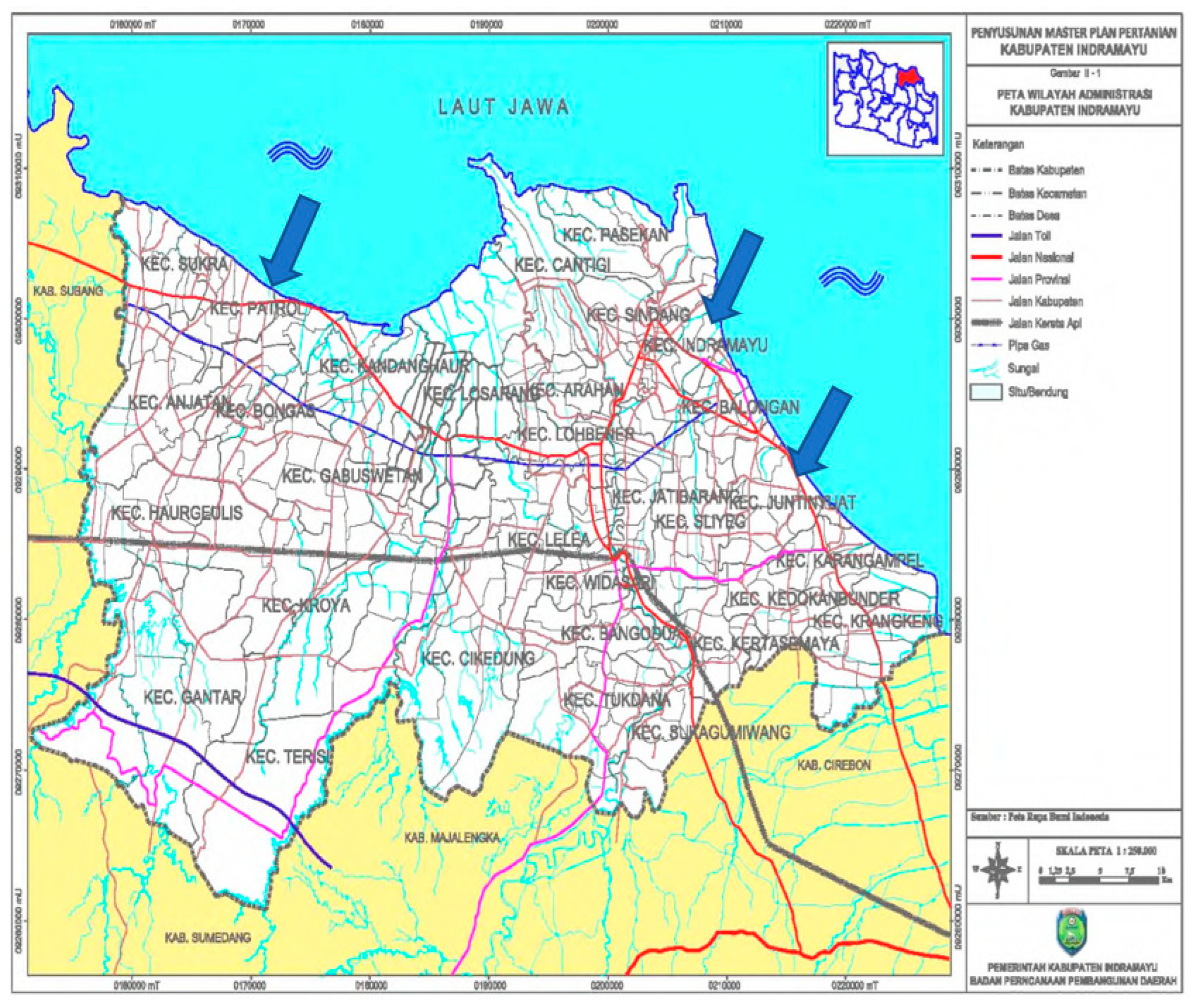
Figure 2.
Conceptual Model of Household Livelihood Diversification.
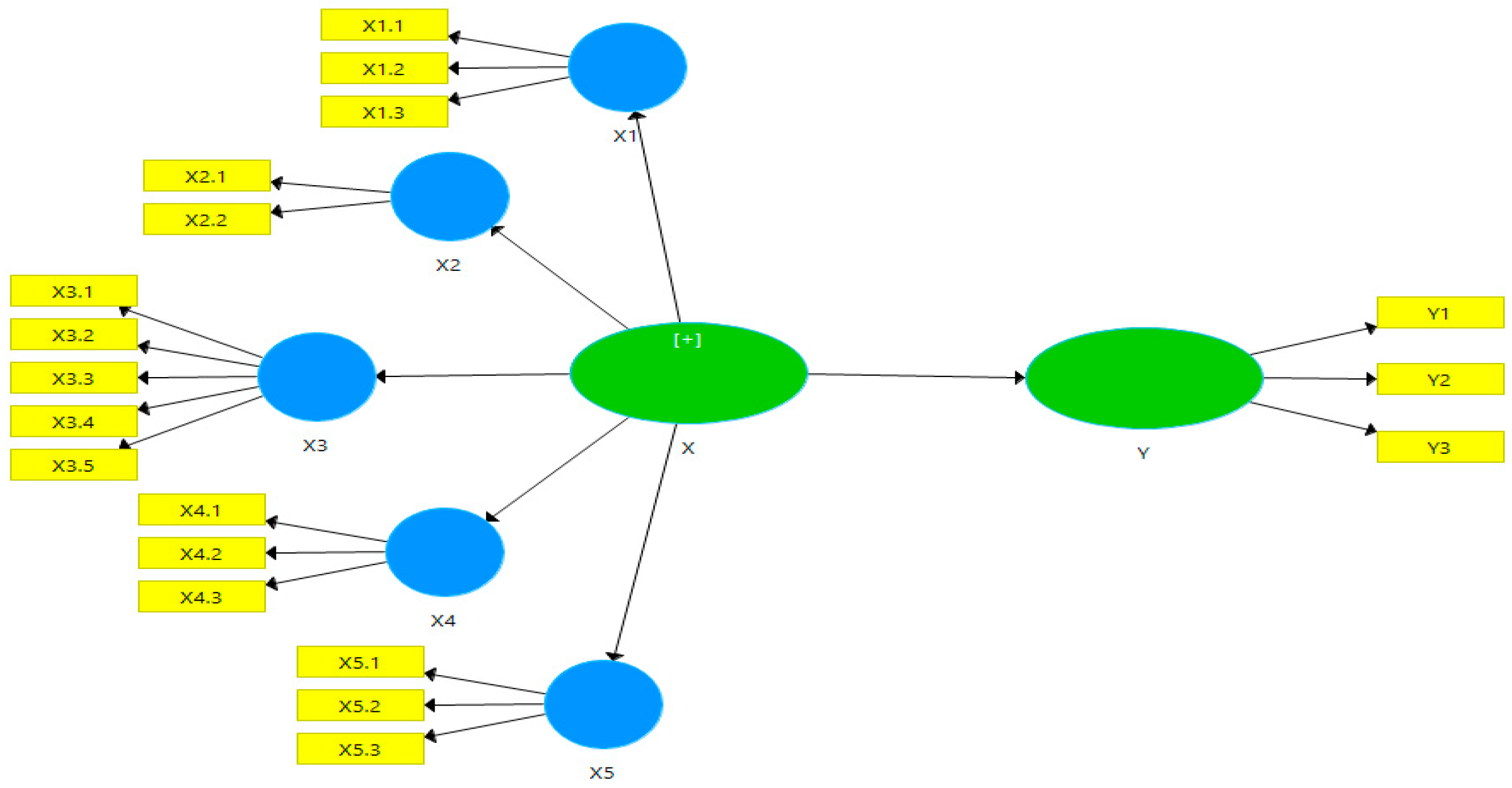
Figure 3.
Standardized Loading Factor Inner and Outer Model.
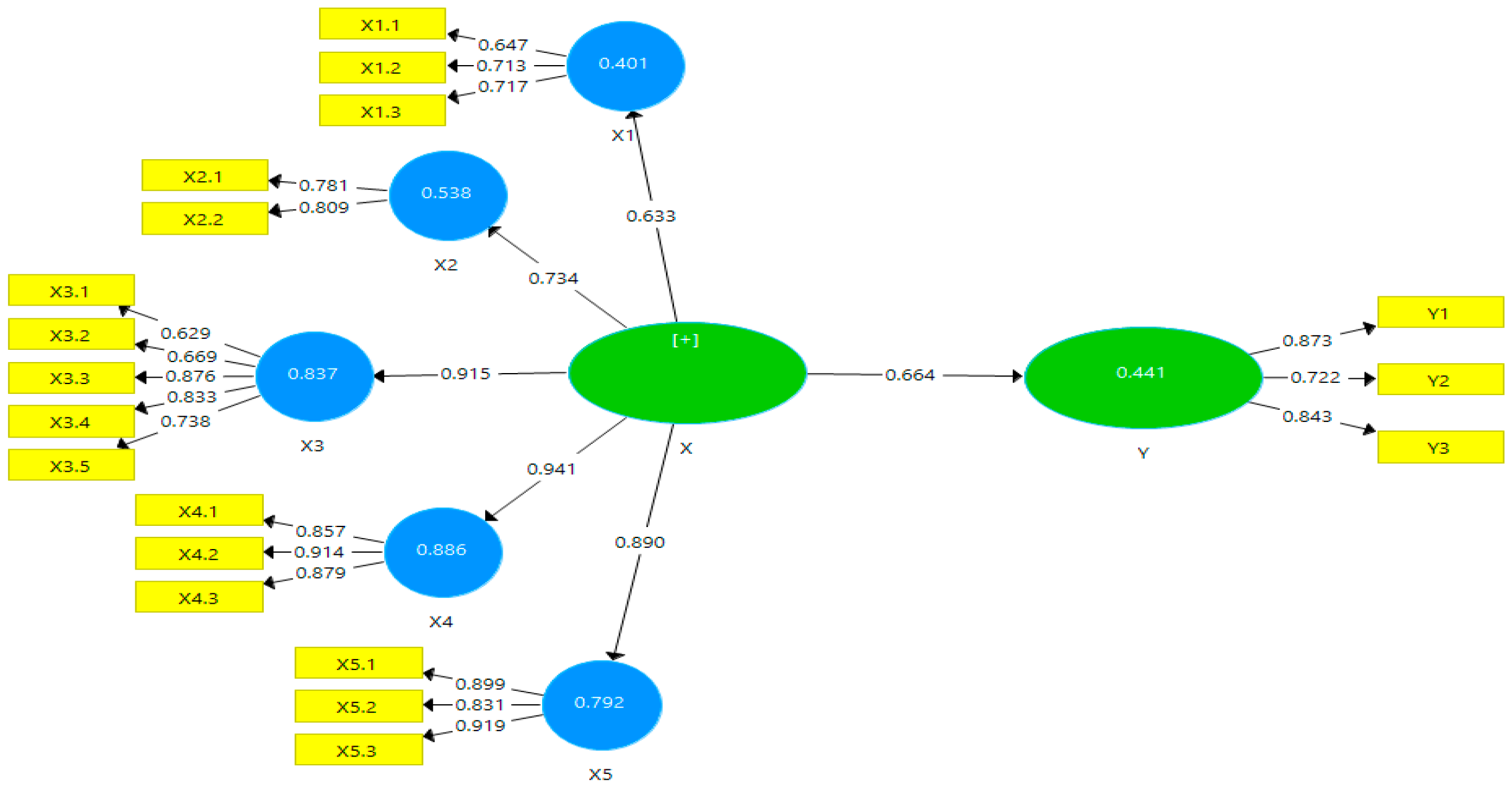
Figure 4.
T-Value Inner and Outer Model.
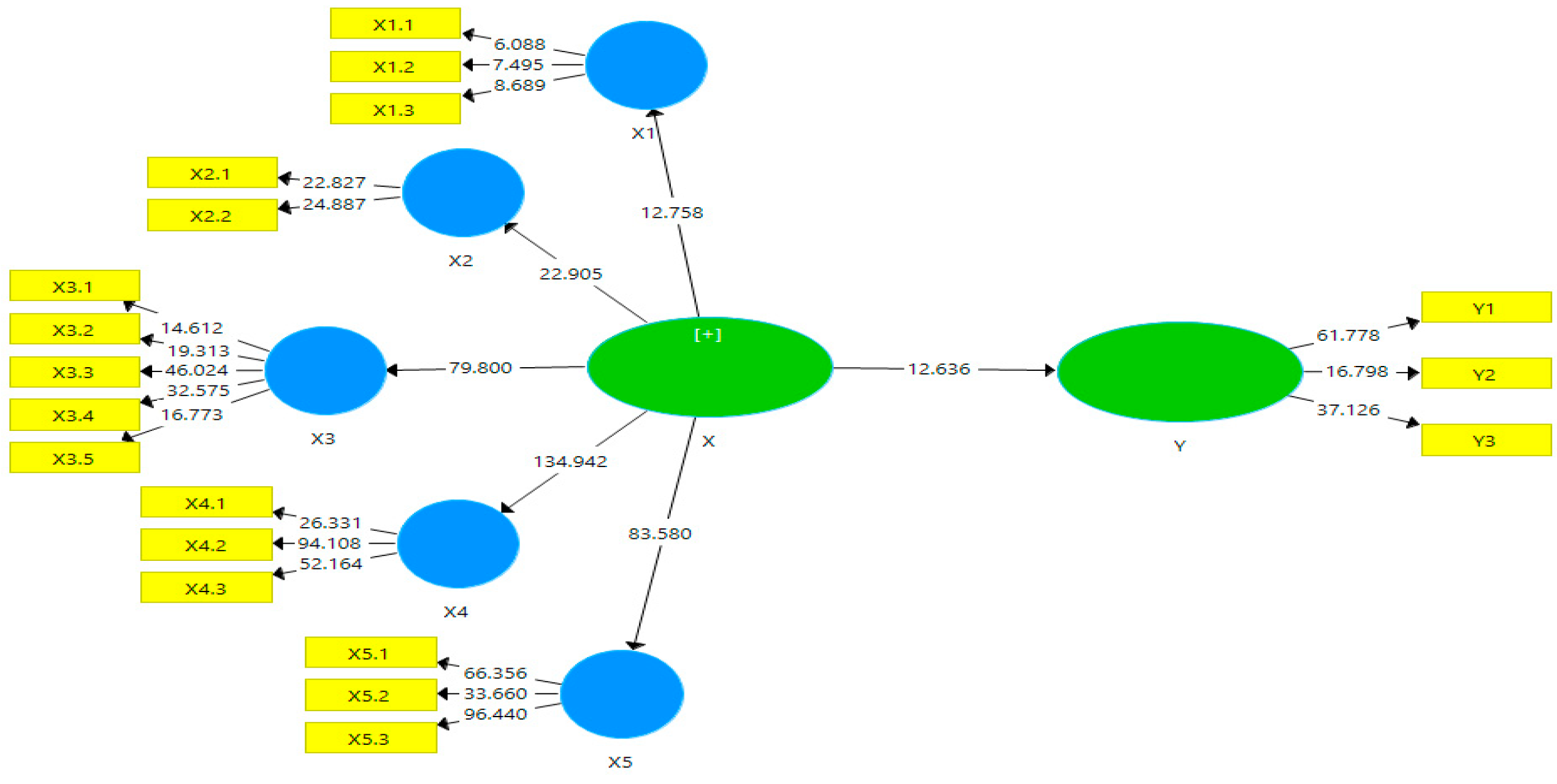
Table 1.
Description of Household Capital Measurement Indicators of Rice Farmers.
| Manifest Variables | Indicators | Definition | Parameters | Scale Unit | X and Y Relationship Hypothesis | Analysis Tools | Reference |
|---|---|---|---|---|---|---|---|
| Exogenous Latent Variables of Household Capital of Rice Farmers (X) | |||||||
| Human Capital (X1) | Age (X1.1) | Duration of life of the head of the household | Year | Ratio | +-/Sig. | (Binary logistic models; Multiple linear model-index entropy) | [34,35] |
| Farming experience (X1.2) | The length of time the head of the household has been in farming | Year | Ratio | +/Sig. | (Multiple Regression-Index Simpthon) | [36] | |
| Farming skills (X1.3) | Types of skills mastered due to the training followed | Likert scale | Ordinal | +/Sig. | (Tobit Models and Double-hurdle Models) | [37] | |
| Social Capital (X2) | Belief (X2.1.) | The level of honesty, order, and cooperation in groups | Likert scale | Ordinal | - | - | [33,38] |
| Social networks (X2.2) | Relationships between relatives and friends (bonding capital), social organizations (bridging capital), land tenure institutions | Likert scale | Ordinal | - | - | - | |
| Natural Capital (X3) | Availability of air and water source (X3.1) | The existence of a water source so that irrigation water for plants is always available every growing season | Likert scale | Ordinal | - | - | [21] |
| Soil (X.3.2) | Narrower paddy field land tenure and land topography | Likert scale | Ordinal | +/Sig. | (Logit model; multinomial logit; Spearman's correlation analysis) | [15.39,40] | |
| Climate change (X3.3) | Climate change conditions (temperature, rainy days, rainfall, solar intensity) affect crop production in the field | Likert scale | Ordinal | +/Sig. | (Binaary logistics) | [34,41] | |
| Environmental services (X3.4) | Environmental services are obtained from natural beauty, agricultural agrotourism. | Likert scale | Ordinal | - | - | [21] | |
| Biodiversity (X3.5) | Various living things that remain preserved in rice fields, such as: ground snakes, eels, microorganisms. | Likert scale | Ordinal | - | - | [21] | |
| Physical Capital (X4) | Infrastructure and its condition (X4.1) | Good physical condition on farm roads, irrigation networks, agricultural markets, internet networks. | Likert scale | Ordinal | +/Sig | (Multiniminal logit; rivew literature) | [40,41,42,43] |
| Agricultural tools and machinery (X4.2) | Agricultural equipment owned and its conditions for farming | Likert scale | Ordinal | - | - | - | |
| Access to agricultural technology (X4.3) | Skills in using agricultural tools and machinery, post-harvest technology and its processing, communication tools and the internet | Likert scale | Ordinal | +/Sig. | Treatment effects (TE) model |
[43,44] | |
| Financial Capital (X5) | Sources of income (X5.1) | Various sources of income come from on-farm (crops and livestock), off-farm (labor wages, rent of tools, machinery, and land), and non-farm (labor wages, pension funds, stalls, delivery) | Likert scale | Ordinal | +/Siq. | (Multinominal logit; econometrics; regression model) | [18,40,42,43] |
| Ease of credit access (X5.2) | There is easy access to credit, such as: ownership of land certificates, status of arable land tenure, family relationships, friends, and participation in groups/institutions | Likert scale | Ordinal | +/Sig. | (Mixed method;exploratory factor analysis; bivariate and multinomial probit) | [11,46,47,48] | |
| Sources of capital (X5.3) | Working capital obtained from various sources, such as: own capital, family loans / abouta / friend, government assistance, banks, middlemen/entrepreneurs, agricultural kiosks. | Likert scale | Ordinal | - | (censored regression model) | [49] | |
Table 2.
Description of Livelihood Diversification Measurement Indicators.
| Endogenous latent variables | Manifest variables (Indicators) | Definition | Parameters | Scale Unit | X and Y Relationship Hypothesis | Analysis Tools | Reference |
|---|---|---|---|---|---|---|---|
| Livelihood Diversification (Y) | Value of Diversification Level (Y1) | The level of diversity of livelihoods based on the number of working household members and the number of types of work | Entropy Index | Ratio | +/Sig | (Multinominal logit; correlation coefficient; multiple linear models) | [26,35,64] |
| Diversification of Agricultural Livelihoods (Y2) | The diversity of agricultural livelihoods provides additional income | Likert scale | Ordinal | - | - | - | |
| Diversification of Non-Agricultural Livelihoods (Y3) | The diversity of non-agricultural livelihoods provides additional income and savings | Likert scale | Ordinal | - | - | - |
Table 3.
Composite Reliability and AVE Results.
| Code | Dimensions/Variables | AVE | Composite Reliability |
|---|---|---|---|
| X1 | Human capital | 0.560 | 0.734 |
| X2 | Social Capital | 0.632 | 0.774 |
| X3 | Natural Capital | 0.570 | 0.867 |
| X4 | Physical Capital | 0.781 | 0.915 |
| X5 | Financial Capital | 0.781 | 0.914 |
| Y | Livelihood Diversification | 0.664 | 0.855 |
Table 4.
Discriminant Validity Results.
| Code | X1 | X2 | X3 | X4 | X5 | Y |
|---|---|---|---|---|---|---|
| X1.1 | 0.647 | 0.191 | 0.293 | 0.275 | 0.233 | 0.384 |
| X1.2 | 0.713 | 0.181 | 0.214 | 0.272 | 0.277 | 0.444 |
| X1.3 | 0.717 | 0.341 | 0.441 | 0.499 | 0.471 | 0.408 |
| X2.1 | 0.149 | 0.781 | 0.522 | 0.576 | 0.383 | 0.315 |
| X2.2 | 0.425 | 0.809 | 0.389 | 0.494 | 0.596 | 0.541 |
| X3.1 | 0.246 | 0.378 | 0.629 | 0.510 | 0.463 | 0.324 |
| X3.2 | 0.353 | 0.320 | 0.669 | 0.536 | 0.567 | 0.456 |
| X3.3 | 0.435 | 0.548 | 0.876 | 0.726 | 0.665 | 0.442 |
| X3.4 | 0.393 | 0.449 | 0.833 | 0.655 | 0.579 | 0.384 |
| X3.5 | 0.376 | 0.430 | 0.738 | 0.743 | 0.462 | 0.282 |
| X4.1 | 0.469 | 0.668 | 0.699 | 0.857 | 0.659 | 0.558 |
| X4.2 | 0.513 | 0.585 | 0.726 | 0.914 | 0.649 | 0.543 |
| X4.3 | 0.443 | 0.530 | 0.817 | 0.879 | 0.741 | 0.485 |
| X5.1 | 0.397 | 0.497 | 0.722 | 0.688 | 0.899 | 0.511 |
| X5.2 | 0.394 | 0.566 | 0.457 | 0.550 | 0.831 | 0.548 |
| X5.3 | 0.534 | 0.585 | 0.723 | 0.789 | 0.919 | 0.623 |
| Y1 | 0.527 | 0.504 | 0.477 | 0.572 | 0.582 | 0.873 |
| Y2 | 0.462 | 0.376 | 0.333 | 0.434 | 0.455 | 0.722 |
| Y3 | 0.451 | 0.436 | 0.398 | 0.440 | 0.506 | 0.843 |
Table 5.
Results of Path Coefficient of Direct Influence.
| Original Sample (O) | Standard Error (STERR) | T-Statistics (|O/STERR) |
P-Value | R-Square | |
|---|---|---|---|---|---|
| X → Y | 0.664 | 0.053 | 12.636 | 0.000 | 0.441 |
Table 6.
GoF Results.
| R Square | The Value of Communality | |
|---|---|---|
| Y | 0.441 | 0.644* |
| GoF | 0.541 | |
Note: * (Table B in Appendix A)
Disclaimer/Publisher’s Note: The statements, opinions and data contained in all publications are solely those of the individual author(s) and contributor(s) and not of MDPI and/or the editor(s). MDPI and/or the editor(s) disclaim responsibility for any injury to people or property resulting from any ideas, methods, instructions or products referred to in the content. |
© 2023 by the authors. Licensee MDPI, Basel, Switzerland. This article is an open access article distributed under the terms and conditions of the Creative Commons Attribution (CC BY) license (http://creativecommons.org/licenses/by/4.0/).
Copyright: This open access article is published under a Creative Commons CC BY 4.0 license, which permit the free download, distribution, and reuse, provided that the author and preprint are cited in any reuse.


