

Submitted:
02 June 2023
Posted:
02 June 2023
You are already at the latest version
Abstract
Various therapeutic approaches have been developed for neglect. Many studies have demonstrated the effect of Digital therapeutics(DTx) on neglect. By contrast, only a few studies have reported on the effects of DTx on egocentric and allocentric neglect. In this article, seven studies on DTx of egocentric and allocentric neglect were reviewed. DTx, which was employed in these studies, could be classified as follows: 1) software adaptation in traditional treatment, 2) VR game using the head-mount display as treatment, and 3) development of new digital program like ReMoVES. In addition, more studies and effective results were reported on egocentric neglect than allocentric neglect. In future studies, each effect on egocentric and allocentric neglect should be identified in detail through the appropriate use of differential evaluation and long-term application of independent digital therapeutics.
Keywords:
Egocentric neglect
; Allocentric neglect
; Digital therapeutics
; Apple cancellation test
; Broken hearts test
1. Introduction
Neglect is a clinical feature observed in cases of brain injury, particularly those affecting the right hemisphere, where individuals find it difficult to recognize the contralesional side of space [1,2]. According to previous studies, patients with neglect tend to experience poorer rehabilitation outcomes [3], longer hospital stays [4], and a lower likelihood of being discharged to their homes [5], compared to patients without neglect. Consequently, neglect has been identified as a significant predictor of decreased levels of functional independence [6], increased utilization of healthcare resources [7], and heightened burden on the patient's family [8]. These findings highlight the detrimental effects of neglect on various aspects of patient outcomes.
Neglect has been classified into various subtypes according to the classification criteria because of its heterogeneous characteristics [9,10]. For example, neglect is classified as sensory, motor, and representational (imaginal) neglect. In addition, in terms of the range of space, neglect is classified as personal neglect, peri-personal neglect, and extra-personal neglect. In terms of the frame of reference, neglect is categorized as egocentric neglect and allocentric neglect (Table 1) [9,10].
The frame of reference is defined as an aspect in which the brain accepts information and identifies the up–down, left–right, front–back directions, and the relative scale of each axis by specifying the central location [11]. The brain receives information differently depending on whether the central criterion is a viewer or an object. Therefore, the symptoms of neglect are also very different [12]. Egocentric neglect is characterized by responses missing on the contralateral side with respect to the viewer. By contrast, allocentric neglect is characterized by responses missing on the contralateral side with respect to the object [13]. Because of these different characteristics of the two types, allocentric neglect could have a negative impact on participation in activities of daily living rather than egocentric neglect [14]. A differential diagnosis between allocentric neglect and egocentric neglect became possible with the development of evaluation tools, such as the apple cancellation test and the broken hearts test [15,16]. In general, these evaluations are performed in such a way that the number of correct (target of complete shape) and incorrect (one of the left and right in targets is incomplete) answers is counted after the patient marks the target of a complete shape [15,16]. Egocentric neglect is determined by the asymmetry score (commission error) between the correct answers on the right and the left based on the center of the evaluation paper. On the other hand, allocentric neglect is discriminated by the asymmetry score (omission error) between the incorrect answer on the right and the wrong answer on the left based on the target in all incorrect answers [15,16]. In the apple cancellation test and the broken hearts test, the criteria to diagnose egocentric (cut-off ≥3) and allocentric neglect (cut-off ≥2) are the same [15,16]. Egocentric and allocentric neglect, which have been reported relatively recently, have been mentioned by many scholars as the need for differential diagnosis and the need for intervention according to the type [17].
As described above, various therapeutic approaches have been developed for egocentric and allocentric neglect because neglect is closely related to functional outcomes. These include visual scanning training, eye-patching, caloric vestibular stimulation, visuomotor imagery, mirror therapy, transcutaneous electrical nerve stimulation (TENS), optokinetic stimulation, constraint-induced movement therapy, prism adaptation, transcranial direct current stimulation (tDCS) activity of daily living (ADL) training, repetitive transcranial magnetic stimulation (rTMS), and digital therapeutics [18,19,20]. A previous study reported that the existing therapeutic modalities were ineffective in treating allocentric neglect [21]. Therefore, some therapeutic approaches for allocentric neglect have been attempted: repetitive transcranial magnetic stimulation (rTMS) [22], visual cueing using immersive virtual- reality [23], training using a computer during transcranial direct current stimulation (tDCS) [24].
Digital therapeutics (DTx) is a newly emerging concept of therapeutic approach in the healthcare system [25]. It is a subdivision of digital health, which is defined as a healthcare system driven using any form of digital technology [26]. The components of digital therapeutics include smartphones, personal digital assistants, virtual reality (VR), and tablet computers that converge with software algorithms [19]. DTx can help reduce healthcare costs [27] and improve availability for patients [28]. In addition, DTx can combine treatment and prevention simultaneously because this approach can provide 24-hour monitoring that was previously impossible [29]. As a result, many DTx has been introduced into the neuro-rehabilitation field, and the clinical effects have been demonstrated [20]. Many studies have demonstrated the effect of DTx on neglect [10,18,19,20]. In addition, many reports have been published on the therapeutic potential of neglect using VR, HMD, etc [30,31]. However, most studies only conducted studies on the effect of intervention without discriminating the type of neglect. By contrast, there are only a few studies on DTX after the differential diagnosis essential for a selective approach according to the type of neglect [23,24,30,33,36]. This review examined DTx for egocentric and allocentric neglect in patients with brain injury. Therefore, in this review, a differential diagnosis between egocentric and allocentric neglect was conducted, and studies that investigated the effects of DTx according to the type of neglect were involved.
This paper reviews DTx studies on the frame of reference in neglect (egocentric neglect and allocentric neglect) related to brain injuries. Relevant studies from 1980 to 2023 were identified by accessing the following electronic databases: Web of Science, PubMed, and Google Scholar. The following keywords were used to search the databases: neglect, apple test, heart test, egocentric neglect, allocentric neglect, digital therapeutics, and brain injury. This review was limited to studies of human subjects with neglect. The relevant studies were selected based on the flow diagram shown in Figure 1. Overall, seven studies were selected and reviewed (Table 2).
2. Studies of Digital Therapeutics(DTx) for Egocentric and Allocentric Neglect
Turgut et al. [30] examined the effects of digital therapy (eye-tracking training based on a computer program) in 32 stroke patients with neglect. They classified the patients into two groups (experimental group, 16 patients, and control group, 16 subjects). The control group performed only basic rehabilitation training, and the experimental group performed rehabilitation training and eye tracking (digital therapeutics, DX) simultaneously. Eye tracking training consisted of two programs: 1) when a blue square on the computer screen moved in the neglect direction, and 2) when the square changed to red, training to press switch was conducted (20 minutes/1 session, total of eight sessions for two weeks). The differential evaluation of egocentric and allocentric neglect was performed using the apple cancellation test. This eye-tracking task was conducted simultaneously while providing transcranial direct current stimulation (tDCS, 1.5 and 2.0 mA) on the right posterior parietal lobe (P4). The assessments were conducted as two pre (T1, T2)/two post (T3,T4) comparisons, and there were no significant changes in the apple cancellation test and the three horizontal line bisection test in both groups at T1 and T2. However, the neuropsychological test (body orientation) and clock drawing test conducted at the last assessment of the experimental group (T4, 6 days after the end of training) showed effective significant changes in both egocentric and allocentric neglect [30]. This study had some limitations. The study was not designed to observe the long-term effects and only the effect of DTx because digital therapy was applied with tDCS. In addition, there were two pre-assessments before training for both groups, but there was no statistical analysis, and both groups performed separate rehabilitation during the intervention period.
Hagiwara et al. [23] reported the effects of the training to provide visual cues using virtual reality (VR) for treating allocentric neglect in four stroke patients. The visual cues were provided using a head-mount display (HMD) type VR, Oculus Rift (Oculus VR., Inc.). The training consisted of a four-digit reading task followed by four actions: 1) display the clue stimulation, 2) blackout the surrounding environment, 3) move the clue stimulation, and 4) remove the blackout. Through this action, the patient’s attention was guided to the neglected side, and a four-digit number was then read again. This training was repeated 10 times. The evaluation was performed using the apple cancellation test and line bisection with 3 horizontal lines, and was performed twice before and after intervention. The patients showed decreased errors in the apple cancellation and line bisection tests after training compared to those before training [23]. On the other hand, this study was conducted only once. Therefore, the author demonstrated only the immediate effects of the treatment. Thus, the long-term effects of the treatment were not reported. The small number of subjects was another limitation. Furthermore, even though we used the apple cancellation test, which can be used for differential diagnosis, we can't understand about egocentric neglect by analyzing only the results for commission.
Huygelier et al. [33] investigated the effect of therapy using a VR game in stroke patients with neglect. They classified the subjects into two groups (experimental group, seven stroke patients with neglect; control group 15 normal subjects). Both groups underwent training by VR using an Oculus Rift head-mounted display (HMD) VR device (Oculus VR., Inc.). The VR training included a variety of contents for treating neglect, including stimulating and providing cues on the neglected side. Six sessions were performed (45 min/ 1 session/day) during seven days. The assessments were the heart cancellation test in psychometric properties of the Dutch Oxford Cognitive Screen (OCS-NL) and the letter cancellation test and figure copy task in behavioral inattention test (BIT) were administered before and after intervention. The authors reported that presenting various stimuli and cues in the neglected area using VR was effective in accurate target cognition for egocentric neglect patients [33]. On the other hand, their study was limited by the short period (seven days) and the use of distinguishable evaluation tools (to determine if neglect is present). In addition, although this study used the heart cancellation test of OCS-NL, which can distinguish between the types of neglect, we could only indirectly check the effect on egocentric neglect by counting only omission (the number of commissions was used to determine allocentric neglect).
In 2020, Trombini et al. [34] reported the effects of computer-assisted cognitive training (CCT) using the Remote Monitoring Validation Engineering System (ReMoVES: University of Genova) (ReMoVES, Touch screen method) for the treatment of neglect in two patients (patient A; posterior cortical atrophy, patient B; right cerebral hemorrhage). Training using ReMoVES and tDCS (1.5 mA) on the right posterior parietal lobe (P4) was provided simultaneously. For CCT training, both patients were trained using the computerized Albert test and apple cancellation test in ReMoVES (20 minutes/session, five times/week for two weeks). The assessment used the computerized Albert test and the apple-cancellation test used for training, with the addition of a line bisection test (paper and pencil method). In patient A, only significant improvement in egocentric neglect was confirmed using the Albert test, whereas, in patient B, significant improvement in both egocentric and allocentric neglect was confirmed using the line bisection test, Albert test and apple cancellation test [34]. There was no significant difference in the drawing test in both subjects. On the other hand, the authors did not exclude the learning effect by conducting training using evaluation tools(computerized apple cancellation test & Albert test).And, a separate analysis of the effect of CCT by combining tDCS during a short training period cannot be performed. In addition, there was no control group and long-term effect data. Finally, the tool used in the evaluation, the line bisection test, is not described in detail, making it difficult to identify the exact tool.
Schenke et al. [35] reported the effects of digital therapeutics (auditory cue and eye tracking training based on a computer program) in stroke patients with egocentric neglect. This study consisted of study 1 and study 2. In study 1, they classified the patients with neglect into two groups (experimental group, 11 patients; control group, 14 patients). The experimental group underwent an auditory cue with basic rehabilitation. In terms of the control group, they underwent basic rehabilitation only. In this study, training was carried out to detect the movement of sound from the right to left headphones while wearing headphones (30 min/ session, five times/week during three weeks). In study 2, another eight patients with neglect (one group) were subjected to computer-based training (digital therapeutics), which provided an auditory cue and eye tracking training simultaneously to the patients. In this study, the patients were required to press a button in the following situations: 1) when the target moved from right to left on the computer screen, and 2) when they heard the word “here” from the headphones (30 min/session, five times/week for three weeks). In Study 1, the line bisection test (3 lines) was administered (twice) before and (twice) after training, and the apple cancellation test was administered (twice) before and (once) after training. In Study 2, the visual scanning test was administered twice before and after training. After three weeks of treatment, two studies reported that the severity of egocentric neglect decreased in the line bisection, the apple cancellation test, and the visual scanning test. In addition, in study 2, they confirmed that digital therapeutics enabled the simultaneous provision of auditory cues and eye tracking training, and convenient treatment was possible [35]. On the other hand, they did not report the long-term effects of this DTx and control group in study 2. In addition, there was no mention of allocentric neglect despite the use of the discriminative apple cancellation test.
In 2021, Vestito et al. [24]. examined the effects of computer-assisted cognitive training (CCT) for egocentric neglect in one patient with posterior cortical atrophy. For four weeks of training, only CCT was conducted for the first two weeks (T 1) using the Remote Monitoring Validation Engineering System (ReMoVES: University of Genova). In this study, three of the most appropriate games for the treatment of neglect in ReMoVES, including ShelfCans, OwlNest, and ChinaLanterns, which did not provide detailed information on the games, were applied (20 minutes/session, five times/week, for two weeks). During the next two weeks(T 2), CCT and tDCS (P4, 1.5 mA on the right posterior parietal lobe (P4) were provided simultaneously (20 minutes/session, five times/week, for two weeks). The evaluations were carried out using the Albert’s test, line bisection test (22 lines), and apple cancellation tests installed in ReMoVES were used. Three tests were performed: one before training (T0, once), and one each at the end of T1 and T2 training. We only report significant results for all tests performed after T2. Therefore, they reported that the simultaneous application of both modalities (CCT and tDCS) was more effective than only CCT [24]. This study used the apple cancellation test for a differential diagnosis. On the other hand, there was no direct reference of the changes in egocentric and allocentric neglect. Another limitation of this study was that the improvements of the egocentric neglect could be identified indirectly by the difference of omission on the apple cancellation test.
Turgut et al. [36] compared the effect of two DTx in sixty patients with neglect. In study 1, 30 stroke patients (right hemisphere injury) were divided into an experimental group (20 patients with neglect) and a control group (10 patients without neglect). In study 2, another 30 stroke patients (right hemisphere injury) were divided into an experimental group (17 patients with neglect) and a control group (13 patients without neglect). In both studies, computerized “three blocks of Posner’s covert shift of attention task (Posner task)” was used for DTx. The Posner task was proceeded by pressing a square on the 24inch monitor where the stimulus picture was presented between the two blank squares on the monitor. The cue induces a rapid response by predicting where the stimulus picture would appear. The task was performed in two sessions consisting of three blocks of 100 trials each and two days between the sessions. The reaction time for a stimulus was measured. In study 1, endogenous cueing (centrally presented arrows as cues) was provided. In study 2, exogenous cueing (peripherally presented crosses were used as cues.) was provided and compared. In both studies, the reaction time was measured twice with an interval of three days. The tools used for evaluation are the apple cancellation test and the line bisection test. They reported that the reaction time and omissions decreased in endogenous cueing rather than exogenous cueing. Therefore, endogenous cueing was more effective for the egocentric neglect [36]. The study had a short study period of 4 days to explore the feasibility of training with the Posner task. This suggests that a longer-term training study is needed. On the other hand, this study presented the average of unilateral neglect type between groups using the apple cancellation test, but the results only compare the omission error and response time to identify egocentric neglect. Therefore, their study was limited by the lack of a detailed comparison of the rehabilitation effects according to the neglect types. Finally, there is no detailed description of the evaluation tool used for line bisection, so it is difficult to understand the exact tool.
3. Discussion
Identification of neglect types and separate interventions are very important. In addition, treatment with DTx will be of interest to future societies. This study conducted a review of 7 studies on DTx for egocentric and allocentric neglect.
DTx, which was employed in these studies, could be classified as follows: 1) software adaptation in traditional treatment [30,35,36], 2) VR game using the head-mount display as treatment [23,33], 3) development of new digital program like ReMoVES [24,34] and 4) simultaneous stimulation of tDCS during DTx [24,30,34]. And, the tDCS used was 1.5 mA (1.5 to 2.0 mA only for reference No. 29), all the anode were located at P4 (posterior parietal lobe) of the injured hemisphere, and DTx was performed simultaneously for 20 minutes. The most common training duration for DTx was 20-30 minutes per session, 4-5 times per week, for 2-3 weeks [24,30,34,36]. Next, there was one study that trained for 45 minutes per session, six times per week, for one week [33], and other studies conducted a before-and-after comparison study with one training session [23,36]. This suggests that long-term studies using DTx and follow-up tests are needed to determine whether the effects are sustained. In addition, although it is good to utilize existing training, it is believed that research is needed to incorporate new equipment.
When looking at the effectiveness of DTx, four studies showed effectiveness on egocentric neglect [24,33,35,36], two studies showed effectiveness on both egocentric and allocentric neglect [30,34], and only one study showed effectiveness on allocentric neglect [23]. On the other hand, when it comes to assessment tools for differential diagnosis of neglect and comparison of effects, the apple cancellation test, a subtest of the Birmingham Cognitive Screen(BCoS), was most commonly used [23,24,30,35,36], and the heart cancellation test, a subtest of the "psychometric properties of the Dutch Oxford Cognitive Screen(OCS-NL)," was used in one study [33]. On the other hand, some studies have used the apple cancellation test in a computerized manner rather than the traditional paper-and-pencil method [24,34]. However, despite being a differential diagnostic assessment, two studies reported effects on egocentric and allocentric neglect [30,34], while the others could only identify improvements in egocentric neglect (producing only omissions) [24,33,35,36] or improvements in allocentric neglect (producing only commissions) [23]. As such, research on allocentric neglect is still lacking, and even though assessment tools with differential diagnosis were used, the fact that changes in egocentric neglect were identified by analyzing limited data is something that future studies should improve. It also shows that there is an urgent need to develop new intervention methods to improve allocentric neglect.
The next most commonly used assessment tool is line bisection test. Most of the studies used a three-line (horizontal) assessment, which is a subtest of the behavioral inattention test (BIT) [23,30,36], with only one study using a 22-line assessment [24], and the other study was unclear due to lack of details [34]. Albert's test was used in two studies [24,34], and the letter cancellation test and figure copy, which are subtests of the BIT, were used in one study [33]. Finally, the clock drawing test was used in one study. Most of the tests were used to examine changes in egocentric neglect, and the clock drawing test was the only test used to examine changes in allocentric neglect besides the apple cancellation test [30]. This suggests that there is a need to develop more diverse assessment tools for allocentric neglect as well as differentiating between the two types.
Nevertheless, there were some limitations in these studies. First, none of the studies provided the long-term effects of DTx [23,30,34,35,36]. Second, despite using an evaluation tool, such as the apple cancellation test that can distinguish between the egocentric and allocentric neglects, it was used only for the presence or absence of neglect [24,33]. Third, some of the studies applied DTx with tDCS [24,30,34]. As a result, these studies could not demonstrate the pure effects of DTx. Fourth, the majority of the above studies did not demonstrate an effect on allocentric neglect Nevertheless, it is important to note that these are studies that can be used for egocentric and allocentric neglect using DTx, which will be prominent in the future society. In addition, we believe that this review will serve as a basis for new DTx studies.
4. Conclusions
In this study, seven studies on digital therapeutics(DTx) of neglect (egocentric and allocentric) were reviewed. Therefore, in future studies, each effect on egocentric and allocentric neglect should be identified in detail through the appropriate use of differential evaluation and long-term application of independent digital therapeutics. Overall, more diverse studies on allocentric neglect will be needed.
Author Contributions
Conceptualization, W-H.J.; Writing, W-H.J.; investigation, W-H.J.; review and editing, S-M.S. All authors have read and agreed to the published version of the manuscript.
Funding
Not Applicable.
Institutional Review Board Statement
The study was conducted according to the guidelines of the Declaration of Helsinki and approved by the Kangwon National University Institutional Review Board (KWNUIRB-2021-06-002-001).
Informed Consent Statement
Not Applicable.
Data Availability Statement
The data used for the study are private but can be made available upon reasonable request.
Acknowledgments
This work was supported by the Semyung University Research Grant of 2020.
Cavedoni, S., Cipresso, P., Mancuso, V. Bruni, F., Pedroli, E. Virtual reality for the assessment and rehabilitation of neglect: where are we now? A 6-year review update. Virtual Reality. 2022, 26, 1663–1704. [PMID: 35669614 DOI: 10.1007/s10055-022-00648-0]
Kaiser, A.P., Villadsen, K.W., Samani, A., Knoche, H,, Evald, L. Virtual Reality and Eye-Tracking Assessment, and Treatment of Unilateral Spatial Neglect: Systematic Review and Future Prospects. Front Psychol. 2022, 22; 13: 787382. [PMID: 35391965 DOI: 10.3389/fpsyg.2022.787382]
References
- Heilman, K.M.; Valenstein, E. Mechanisms Underlying Hemispatial Neglect. Ann Neurol. 1979, 5, 166–170. [Google Scholar] [CrossRef] [PubMed]
- Vallar, G.; Perani, D. The Anatomy of Unilateral Neglect After Right-hemisphere Stroke Lesions: A Clinical/CT-scan Correlation Study in Man. Neuropsychologia. 1986, 24, 609–622. [Google Scholar] [CrossRef] [PubMed]
- Chen, P.; Chen, C. C.; Hreha, K.; Goedert, K.M.; Barrett, A.M. Kessler Foundation Neglect Assessment Process Uniquely Measures Spatial Neglect During Activities of Daily Living. Arch Phys Med Rehabil. 2015, 96, 869–876. [Google Scholar] [CrossRef] [PubMed]
- Katz, N.; Hartman-Maeir, A.; Ring, H.; Soroker, N. Functional Disability and Rehabilitation Outcome in Right Hemisphere Damaged Patients With and Without Unilateral Spatial Neglect. Arch Phys Med Rehabil. 1999, 80, 379–384. [Google Scholar] [CrossRef]
- Paolucci, S.; Antonucci, G.; Grasso, M.G.; Pizzamiglio, L. The Role of Unilateral Spatial Neglect in Rehabilitation of Right Brain-Damaged Ischemic Stroke Patients: A Matched Comparison. Arch Phys Med Rehabil. 2001, 82, 743–749. [Google Scholar] [CrossRef] [PubMed]
- Jehkonen, M.; Laihosalo, M.; Kettunen, J.E. Impact of Neglect on Functional Outcome after Stroke: A Review of Methodological Issues and Recent Research Findings. Restor Neurol Neurosci. 2006, 24, 209–215. [Google Scholar] [PubMed]
- Rundek, T.; Mast, H.; Hartmann, A.; Boden-Albala, L.; Lennihan, L.; Lin, I.F.; Pail, M.C.; Sacco, R.L. Predictors of Resource Use after Acute Hospitalization: The Northern Manhattan Stroke Study. Neurology. 2000, 55, 1180–1187. [Google Scholar] [CrossRef]
- Chen, P.; Fyffe, D.C.; Hreha, K. Informal Caregivers' Burden and Stress in Caring for Stroke Survivors with Spatial Neglect: An Exploratory Mixed-method Sstudy. Top Stroke Rehabil. 2017, 24, 24–33. [Google Scholar] [CrossRef]
- Upshaw, J.N.; Leitner, D.W.; Rutherford, B.J.; Miller, H.D.; Libben, M.R. Allocentric versus Egocentric Neglect in Stroke Patients: A Pilot Study Investigating the Assessment of Neglect Subtypes and Their Impacts on Functional Outcome Using Eye Tracking. J Int Neuropsychol Soc. 2019, 25, 479–489. [Google Scholar] [CrossRef]
- Zebhauser, P.T.; Vernet, M.; Unterburger, E.; Brem, A.K. Visuospatial Neglect - A Theory-informed Overview of Current and Emerging Strategies and A Systematic Review on The Therapeutic Use of Non-Invasive Brain Stimulation. Neuropsychol Rev. 2019, 29, 397–420. [Google Scholar] [CrossRef]
- Mozer, M.C. Frames of Reference in Unilateral Neglect and Visual Perception: A Computational Perspective. Psychol Rev. 2002, 109, 156–185. [Google Scholar] [CrossRef] [PubMed]
- Behrmann, M.; Plaut, D.C. The Interaction of Spatial Reference Frames and Hierarchical Object Representations: Evidence from Figure Copying in Hemispatial Neglect. Cogn Affect Behav Neurosci. 2001, 1, 307–329. [Google Scholar] [CrossRef] [PubMed]
- Gainotti, G.; Ciaraffa, F. Is 'Object-Centred Neglect' A Homogeneous Entity? Brain Cogn. 2013, 81, 18–23. [Google Scholar] [CrossRef] [PubMed]
- Chen, P.; Hreha, K.; Kong, Y.; Barrett, A.M. Impact of Spatial Neglect on Stroke Rehabilitation: Evidence from The Setting of An Inpatient Rehabilitation Facility. Arch Phys Med Rehabil. 2015, 96, 1458–1466. [Google Scholar] [CrossRef] [PubMed]
- Bickerton, W.L.; Samson, D.; Williamson, J.; Humphreys, G.W. Separating Forms of Neglect Uusing the Apples Test: Validation and Functional Prediction in Chronic and Acute Stroke. Neuropsychology. 2011, 25, 567–580. [Google Scholar] [CrossRef]
- Demeyere, N.; Riddoch, M.J.; Slavkova, E.D.; Bickerton, W.L.; Humphreys, G.W. The Oxford Cognitive Screen (OCS): Validation of A Stroke-specific Short Cognitive Screening Tool. Psychol Assess. 2015, 27, 883–894. [Google Scholar] [CrossRef] [PubMed]
- Turgut, N. , Möller, L., Dengler, K., Steinberg, K., Sprenger, A., Eling, P.,... & Hildebrandt, H. (2018). Adaptive cueing treatment of neglect in stroke patients leads to improvements in activities of daily living: a randomized controlled, crossover trial. Neurorehabilitation and neural repair, 32(11), 988-998.
- Evald, L.; Wilms, I.L.; Nordfang, M. Treatment of Spatial Neglect in Clinical Practice: A Nationwide Survey. Acta Neurol Scand. 2020, 141, 81–89. [Google Scholar] [CrossRef]
- Gammeri, R.; Iacono, C.; Ricci, R.; Salatino, A. Unilateral Spatial Neglect after Stroke: Current Insights. Neuropsychiatr Dis Treat. 2020, 16, 131–152. [Google Scholar] [CrossRef]
- Choi, M.J.; Kim, H.; Nah, H.W.; Kang, D.W. Digital Therapeutics: Emerging New Therapy for Neurologic Deficits after Stroke. J Stroke. 2019, 21, 242–258. [Google Scholar] [CrossRef]
- Gossmann, A.; Kastrup, A.; Kerkhoff, G.; Lopez-Herrero, C.; Hildebrandt, H. Prism Adaptation Improves Ego-centered but Not Allocentric Neglect in Early Rehabilitation Patients. Neurorehabil Neural Repair. 2013, 27, 534–541. [Google Scholar] [CrossRef] [PubMed]
- Kim, Y.K.; Jung, J.H.; Shin, S.H. A Comparison of The Eeffects of Repetitive Transcranial Magnetic Stimulation (rTMS) by Number of Stimulation Sessions on Hemispatial Neglect in Chronic Stroke Patients. Exp Brain Res. 2015, 233, 283–289. [Google Scholar] [CrossRef]
- Hagiwara, A.; Yasuda, K.; Saich, K.; Muroi, D.; Kawaguchi, S.; Ohira, M.; Matsuda, T.; Lwata, H. Development of A Visual Cueing System Using Immersive Virtual Reality for Object-centered Neglect in Stroke Patients. 2018 IEEE International Conference on Systems, Man, and Cybernetics (SMC). 2018, 1022-1025.
- Vestito, L.; Trombini, M.; Mori, L.; Dellepiane, S.; Trompetto, C.; Morando, M.; Bandini, F. Improved Visuospatial Neglect after tDCS and Computer-assisted Cognitive Training in Posterior Cortical Atrophy: A Single-case Study. Neurocase. 2021, 27, 57–63. [Google Scholar] [CrossRef] [PubMed]
- Topol, E. Digital Medicine: Empowering both Patients and Clinicians. Lancet. 2016, 388, 740–741. [Google Scholar] [CrossRef]
- Fairburn, C.G.; Patel, V. The Impact of Digital Technology on Psychological Treatments and Their Dissemination. Behav Res Ther. 2017, 88, 19–25. [Google Scholar] [CrossRef]
- Sverdlov, O.; Van Dam, J.; Hannesdottir, K.; Thornton-Wells, T. Digital Therapeutics: An Integral Component of Digital Innovation in Drug Development. Clin Pharmacol Ther. 2018, 104, 72–80. [Google Scholar] [CrossRef] [PubMed]
- Kumar, R.B.; Goren, N.D.; Stark, D.E.; Wall, D.P.; Longhurst, C.A. Automated Integration of Continuous Glucose Monitor Data in The Electronic Health Record Using Consumer Technology. J Am Med Inform Assoc. 2016, 23, 532–537. [Google Scholar] [CrossRef]
- Khirasaria, R.; Singh, V.; Batta, A. Exploring Digital Therapeutics: The Next Paradigm of Modern Health-Care Industry. Perspect Clin Res. 2020, 11, 54–58. [Google Scholar] [CrossRef]
- Cavedoni, S. , Cipresso, P. , Mancuso, V. Bruni, F., Pedroli, E. Virtual reality for the assessment and rehabilitation of neglect: where are we now? A 6-year review update. Virtual Reality. 2022, 26, 1663–1704. [Google Scholar] [CrossRef] [PubMed]
- Kaiser, A.P. , Villadsen, K.W., Samani, A., Knoche, H,, Evald, L. Virtual Reality and Eye-Tracking Assessment, and Treatment of Unilateral Spatial Neglect: Systematic Review and Future Prospects. Front Psychol. 2022, 22; 13: 787382. [CrossRef]
- Turgut, N.; Miranda, M.; Kastrup, A.; Eling, P.; Hildebrandt, H. tDCS Combined with Optokinetic Drift Reduces Egocentric Neglect in Severely Impaired Post-acute Patients. Neuropsychol Rehabil. 2018, 28, 515–526. [Google Scholar] [CrossRef]
- Huygelier, H.; Schraepen, B.; Lafosse, C.; Vaes, N.; Schillebeeckx, F.; Michiels, K. An Immersive Virtual Reality Game to Train Spatial Attention Orientation after Stroke: A Feasibility Study. Appl Neuropsychol Adult. 2020, 29, 915–935. [Google Scholar] [CrossRef]
- Trombini, M.; Vestito, L.; Morando, M.; Mori, L.; Trompetto, C.; Bandini, F.; Dellepiane, S. Unilateral Spatial Neglect Rehabilitation Supported by A Digital Solution: Two Case-studies. Annu Int Conf IEEE Eng Med Biol Soc. 2020, 3670–3675. [Google Scholar] [CrossRef]
- Schenke, N.; Franke, R.; Puschmann, S.; Turgut, N.; Kastrup, A.; Thiel, C.M.; Hildebrandt, H. Can Auditory Cues Improve Visuo-spatial Neglect? Results of Two Pilot Studies. Neuropsychol Rehabil. 2021, 31, 710–730. [Google Scholar] [CrossRef] [PubMed]
- Turgut, N.; Jansen, A.L.; Nielsen, J.; Heber, I.; Eling, P.; Hildebrandt, H. Repeated Application of The Covert Shift of Attention Task Improves Endogenous but Not Exogenous Attention in Patients with Unilateral Visuospatial Inattention. Brain Cogn. 2021, 151, 105732. [Google Scholar] [CrossRef] [PubMed]
Figure 1.
Flow diagram for the selection of studies for review.
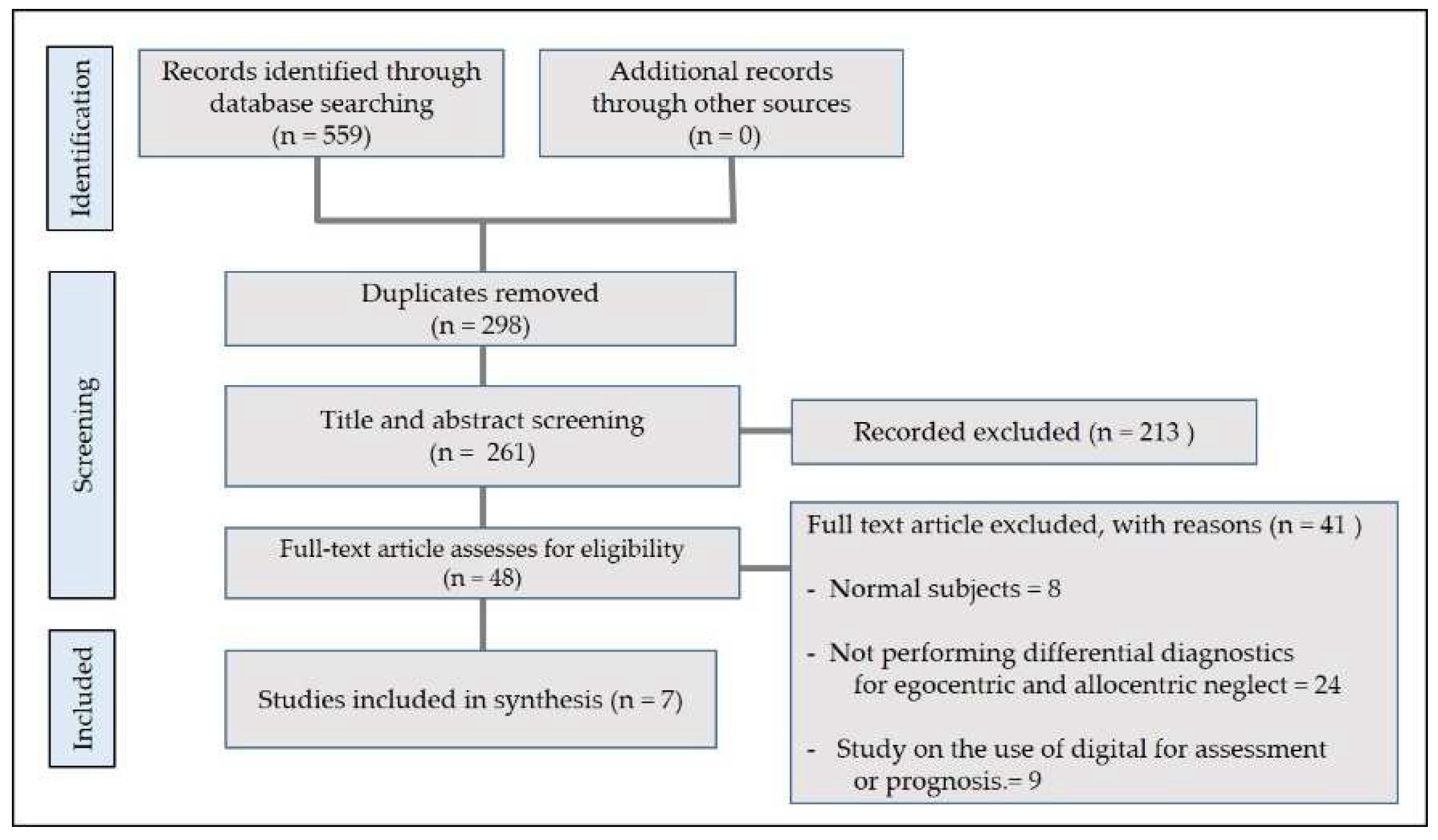

Table 1.
Subtype of neglect.
| Criteria | Aspect of neglect | Range of space | Frame of reference |
|---|---|---|---|
| Subtype | Sensory neglect | Personal neglect | Egocentric neglect |
| Motor neglect | Peri-personal neglect | Allocentric neglect | |
| Representational neglect | Extra-personal neglect |
Table 2.
Digital Therapeutics for egocentric and allocentric neglect.
| Study | Sample size(n) | Type of brain injury | Study description | Frequency of intervention | Follow- up | Outcome measurefor effect | Results |
| Turgut et al. (2016) [30] |
IC:16, CG:16 | cerebrovascular disease | Both groups received standard treatment IC: tDCS+ eye trackingtask (DTx) |
20min/session (during tDCS) |
8sessions during 2wks | LBT, CDT, ACT, FIM. |
IC group improved than CG in both egocentric and allocentric neglect |
| Hagiwara et al. (2018) [23] |
IG: 4, CG: None | Stroke | IG: Visual cue using Oculus Rift (DTx) CG: N/A |
clinical trial in 1 session |
None | ACT, LBT. |
VR intervention has immediate improvement in allocentric neglect |
| Huygelier et al. (2020) [33] |
IG:7, CG: 15 | IG: Stroke CG: Normal subject |
Both groups received the same VR gaming tasks using Oculus Rift (DTx) | 45min/session, |
6sessions during 7day |
OCS-NL. BIT |
The feasibility of evaluation and therapy for egocentric neglect was confirmed |
| Trombini et al. (2020) [34] |
2 Single- cases | Patient 1 : PCA Patient 2 : Right cerebral hemorrhage |
A-tDCS + ReMoVES (DTx) | 20min/session, 5 days/wk (during tDCS) |
2wks | Albert’s test, ACT, in ReMoVES LBT. |
Patient 1 Improvement of egocentric neglect was confirmed using the Albert’s test score only Patient 2 Improvement of both types of neglect (egocentric and allocentric) was confirmed the ACT as well as Albert’s test and LBT |
| Schenke et al. (2021) [35] |
Study 1 : IG:11, CG:14 Study 2 : IG:18, CG:0 |
Stroke |
Study 1 Both groups received standard treatment, IC: auditory cue Study 2 IG: computer-based training (= auditory cues + eye tracking) (DTx) |
study 1, 2 30min/session, 5session/wk |
Study 1, 2 3wks |
Study 1 :LBT, ACT. Study 2: visual scanning test. |
Study 1, 2 IC group improved only in egocentric neglect |
| Vestito et al. (2021) [24] |
1 Single-case | PCA | A-tDCS & A-tDCS + ReMoVES (DTx) |
A-tDCS only 20min/session, 5 days/wk A-tDCS + ReMoVES 20min/session, 5 days/wk (during tDCS) |
2wks 2wks |
Albert’s test, LBT, ACT, in ReMoVES. |
Mixed training(A-tDCS + ReMoVES) was effective for egocentric neglect |
| Turgut et al. (2021) [36] |
Study 1 : IG: 20, CG: 10 Study 2 : IG: 17, CG: 13 |
Stroke IG: with neglect CG: without neglect |
All groups received Posner Task (DTx) Study 1: Endogenous cues Study 2: Exogenous cues |
Study 1,2 2 sessions |
Study 1,2 two days between sessions |
Study 1, 2: ACT. |
Endogenous visuospatial tasks improve only in egocentric neglect |
* Note. IC; intervention group, CG; control group, tDCS; transcranial direct current stimulation, DTx; digital therapeutics, LBT; Line bisection, CDT; clock drawing test, ACT; apple cancellation test, FIM; functional independent measure, BIT; behavioral inattention test, VR; virtual reality, OCS-NL; the Dutch Oxford Cognitive Screen, ADL; Activities of Daily Living, LBT; Line Bisection Test, SSQ; Simulator Sickness Questionnaire, PCA; Posterior cortical atrophy, A-tDCS; anodal transcranial direct current stimulation, ReMoVES; the Remote Monitoring Validation Engineering System.
Disclaimer/Publisher’s Note: The statements, opinions and data contained in all publications are solely those of the individual author(s) and contributor(s) and not of MDPI and/or the editor(s). MDPI and/or the editor(s) disclaim responsibility for any injury to people or property resulting from any ideas, methods, instructions or products referred to in the content. |
© 2023 by the authors. Licensee MDPI, Basel, Switzerland. This article is an open access article distributed under the terms and conditions of the Creative Commons Attribution (CC BY) license (http://creativecommons.org/licenses/by/4.0/).
Copyright: This open access article is published under a Creative Commons CC BY 4.0 license, which permit the free download, distribution, and reuse, provided that the author and preprint are cited in any reuse.


