

Submitted:
27 May 2023
Posted:
30 May 2023
You are already at the latest version
Abstract
Social networking opened up new avenues for learning and knowledge sharing. Due to its document exchange, virtual communication, and knowledge production capabilities, social media is a helpful tool for learning and teaching. The research embraces multiple goals. First, this study examines Bangladeshi university students' social value, communication and collaboration, trust, and perceived benefits of knowledge sharing through social media in academic advancement. The second goal is to examine how families and technology support mediates those aspects of social media knowledge sharing with student academic development. We used Technology Acceptance Model and Social Exchange Theory as examples of how social media sharing of knowledge impacts academic progress in Bangladeshi university students through family and technological support. PLS-SEM was used using survey data from 737 Bangladeshi students to test the model. Social value, communication and collaboration, trust, and perceived benefits of sharing knowledge through social media significantly enhance Bangladeshi students' academic growth. In the case of mediation, family and technological support mediates the relationship between communication and collaboration, trust, perceived benefits and academic development. However, there is no mediation with the social value of knowledge sharing in social media with student’s academic development. The article concludes with implications, limitations, and future research.
Keywords:
Knowledge sharing
; Social media
; Academic development
; University students
; Bangladesh
1. Introduction
The increasing global focus on advanced social media (SM) tools results from their widespread use and positive impact on society. The rapid evolution of this media form has transformed how people share knowledge, interact, and collaborate, particularly in work-related discussions [1]. Social media platforms encompass various online communities for word-of-mouth communication, such as social networking sites (SNS) like Myspace and Facebook, microblogs like personal blogs or Twitter, photo- or video-sharing services like Flickr or YouTube, and collaborative websites like Wikipedia [2]. These platforms have become well-established venues for building knowledge-sharing networks, connecting people with similar interests and facilitating the exchange of ideas [3].
In academic institutions, there is a growing demand for high-quality materials and expertise, making knowledge sharing a challenging task [4]. In addition, the advancement of telecommunications, the Internet, and the World Wide Web has expanded the opportunities for online applications. The rise of social networking sites (SNS) has mainly driven the development of web applications in the past decade. Platforms like Myspace, Facebook, LinkedIn, Twitter, Flickr, Instagram, and WhatsApp have enabled individuals to share their expertise and experiences, create profiles, interact, and collaborate [5]. According to the Global Digital Report 2019, 3.484 billion people use social media, with an annual growth rate of 9%.
To meet the expectations of faculty members, academic institutions need to align their human resource practices, policies, and processes with a focus on integrating knowledge sharing into the organizational culture and removing barriers to its implementation [6]. For example, research conducted by Patel et al. (2013) [7] demonstrated the support provided by intelligent communities and social networking sites (SNS) to teachers and students. Their findings showed that out of 226 participants, 163 used social networking for educational purposes. Additionally, recent studies have explored how social networking sites assist students and professionals [8].
This study investigates how family and technology contribute to students’ learning through social media. It examines the societal value of information sharing, communication and teamwork, confidence, and perceived benefits of social media. The dependent variable in this study is student academic development, while the mediation variable is the support provided by family and technology. The extent to which students’ propensity to share knowledge affects their academic growth can be moderated by family and technological assistance. For instance, parents can support students’ use of social media for educational purposes by encouraging and facilitating its use [9]. In addition, technological assistance can provide students with access to digital tools and resources that support learning and information-sharing activities [10]. This research sheds light on the potential advantages and challenges of utilizing social media for educational purposes by investigating the relationship between students’ knowledge-sharing behaviour, academic development, and the mediating effects of family and technological support in Bangladeshi students. Bangladesh is a growing nation with a population of 168.22 million, where the education sector, notably higher education, plays a crucial role in improving the standard of living and economic well-being. The government has implemented various measures to strengthen the higher education system, including a 20-year strategy plan and the establishment of public universities across the country. Currently, there are 50 public universities in Bangladesh, catering to approximately 0.3 million students. The country also has private universities, contributing to the growth of educational institutions. The SMART Bangladesh Vision 2041 aims to create a technologically advanced and inclusive society, focusing on digital solutions and bridging the digital divide. Initiatives like the Leveraging ICT for Growth, Employment, and Governance (LICT) project further support the country’s IT skills development.
2. Literature Review
Knowledge refers to acquiring and utilizing information, accompanied by the ability [11,12]. It can be categorized in several ways, including personal, shared and public, hard and soft, practical and theoretical, forefront and backdrop, and internal and external [13]. However, the primary division lies in explicit knowledge (EK) and tacit knowledge (TK) [14]. TK represents a direct experience that cannot be easily documented in artefacts, constituting around 80% of total knowledge, while EK makes up the remaining 20% [15]. On the other hand, EK can be conveyed through formal and systemic language, codified using various data forms, and recorded in detailed documents. It is factual, logical, and represented in words, numbers, or formulas, allowing for processing and dissemination through technology [16,17,18,19].
Knowledge sharing encompasses various definitions provided by scholars. Some studies consider knowledge sharing, knowledge flows, and knowledge transfer interchangeable concepts. For instance, Alavi and Leidner (2001) [11] define knowledge sharing as disseminating knowledge within an organization. Park and Im (2003) [20] describe it as the transfer of knowledge from one person to another within an organization. Knowledge sharing is an intentional act that makes experience reusable for others [21]. Through sharing, individuals can exchange implicit or explicit knowledge, creating new knowledge [22].
As defined by Ishaya and Azamabel (2021) [23], social media refers to collaborative digital-mediated tools that facilitate the sharing, communication, and exchange of ideas, information, and various forms of expression through virtual networks. In the twenty-first century, social media has become an integral part of human existence, with its usage widespread across the globe. In 2020, approximately 3.06 billion individuals from diverse backgrounds actively engaged with at least one social media platform in their daily lives, and this number is projected to reach 4.4 billion by 2025. Popular platforms include WeChat, Facebook, Twitter, Weibo, WhatsApp, and Instagram. Furthermore, the uploading of study-related materials by students on social media platforms is recognized as a reliable source of information that holds significance for various communities, such as students, consumers, and workers [24,25,26].
Academic performance refers to how students approach their studies and handle assigned tasks. It is commonly evaluated through cumulative GPA, which reflects class and subject achievements [27,28]. Assessing academic performance can involve measuring the Cumulative Grade Point Average (CGPA) based on previous examinations [29] and considering research papers as indicators of academic achievement. Additionally, creating new knowledge and effective presentations within the classroom and among peers can contribute to academic soundness. In educational settings, various active and collaborative learning strategies are employed to maximize classroom time and help students apply what they have learned. Online environments may utilize weekly assignments and discussion posts to engage students outside the classroom and reinforce practical application. While technology and social media enable information creation and sharing, the support of educators is still necessary in certain situations. Therefore, it is beneficial to integrate technology with traditional teaching methods, leveraging the vast potential of technology alongside the skills of instructors to provide a comprehensive and exceptional learning experience for students at all educational levels, including both public and private universities [28].
3. Theoretical Frameworks
The conceptual relationships proposed in this study are grounded in well-established theories, which form the basis for these relationships. In addition, extensive research has put forth various hypotheses exploring the link between knowledge sharing and students’ academic achievement. This conceptual study considers the theories of the Technology Acceptance Model (TAM) and Social Exchange Theory (SET), which support the conceptual framework.
3.1. Technology Acceptance Model
Fred Davis, a professor at the MIT Sloan School of Management, proposed the "Technology Acceptance Model" (TAM) in 1985 to examine users’ adoption of computer technology [30]. According to Davis, system utilization can be predicted based on the user’s stimulus, which is influenced by external factors and the system’s capabilities and structure [31]. The TAM was derived from the theory of reasoned action (TRA), a well-known social psychology theory that explains individual actions by considering underlying motivations [32]. Davis (1989) [30] adapted TRA by deconstructing the attitude construct into two key concepts: perceived usefulness (PU) and perceived ease of use (PEU), which determine the acceptance and usage behaviour of new technology. The concept of perceived effectiveness reflects an individual’s belief that using a particular technology will enhance their work performance, while perceived simplicity of use refers to the ease with which an individual expects to use the technology. In addition to these variables, some studies have identified external factors like perceived satisfaction, which is consistently associated with the core constructs of TAM and positively influences the intention to use technology [33,34]. Over time, the TAM has emerged as a prominent model for explaining and predicting technology usage [30].
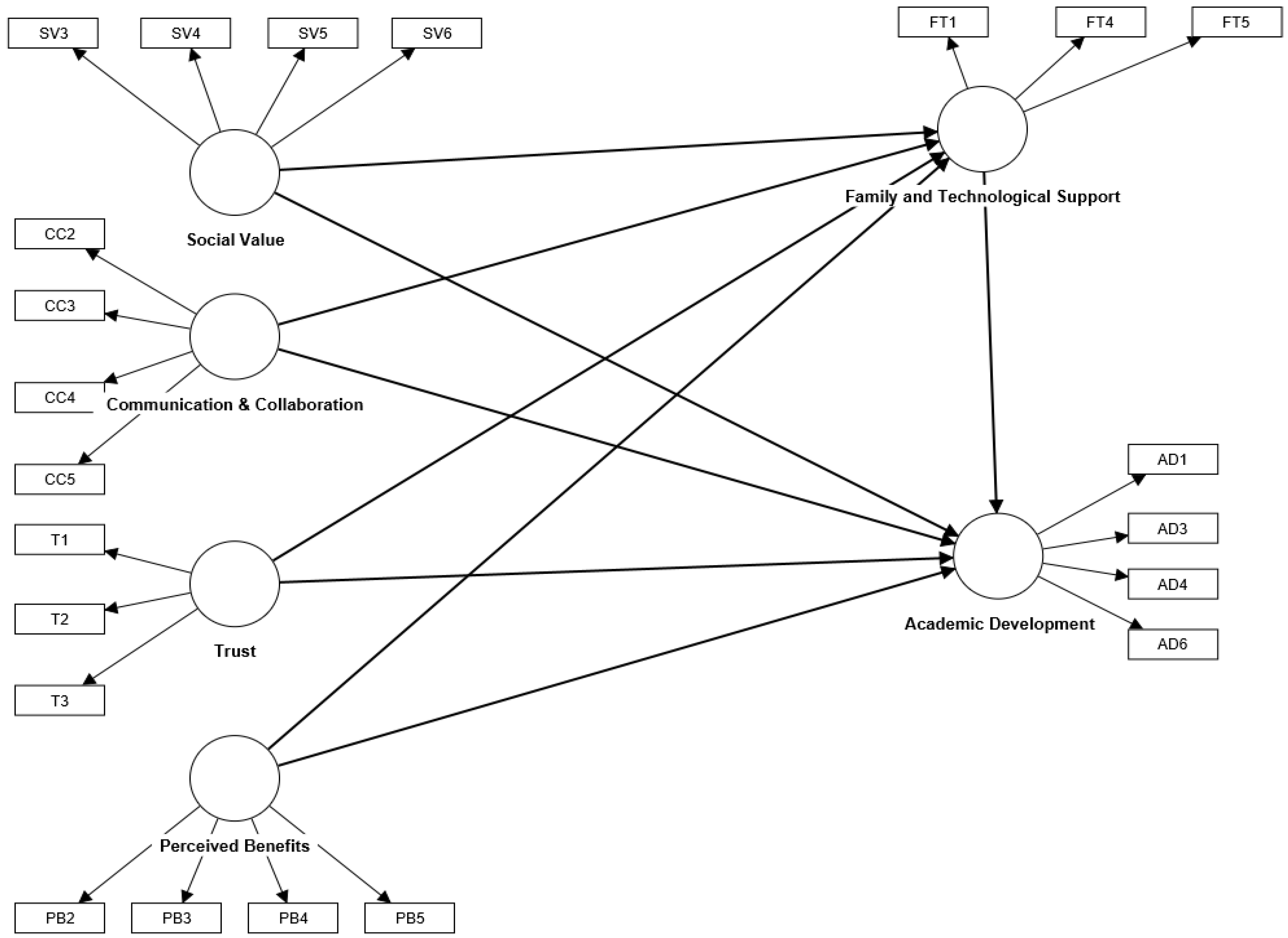
Based on the TAM theory, the independent variables influencing students’ adoption of social media for educational purposes are social value, communication and collaboration, trust, and perceived benefits of knowledge sharing. Social value represents the extent to which individuals perceive using social media for educational purposes as valuable for their academic development. Communication and collaboration reflect individuals’ beliefs about the ability of social media to facilitate academic communication and collaboration with peers. Trust pertains to individuals’ confidence in the reliability and security of using social media for educational activities. Finally, perceived benefits of knowledge sharing in social media encompass individuals’ perceptions of the advantages gained through sharing knowledge in this context.
According to Gao and Bai (2014) [35], peer, family, and media social influence (SI) have a significant impact on individuals’ inclination to adopt specific technologies. SI refers to the extent to which individuals believe that significant others endorse using a new system. Rahman et al. (2018) [36] and Venkatesh et al. (2003) [37] support the notion of SI as a crucial factor in technology adoption. Schmidthuber et al. (2020) [38] found a positive relationship between societal impact and customers’ intention to use mobile payments. However, in this study, family and technological support are considered influences from the family that encourage greater utilization of social media for knowledge sharing and subsequent academic development. Family and technological issues can mediate the relationship between perceived ease of use and students’ academic development. Students with access to reliable technology and internet connections are more likely to share knowledge on social media platforms. Support from the family, such as parental monitoring and financial assistance for social media use, can also positively influence students’ adoption of social media for educational purposes. These factors facilitate the ease of using social media and contribute to students’ academic development.
According to this theoretical framework, the combined influence of social value, communication and collaboration, trust, and perceived benefits will impact students’ academic development. These independent variables play a significant role in shaping the learner’s growth. Furthermore, the relationship between these variables and academic development is mediated by the support provided by family and technology. The assistance from family and technological resources acts as intermediaries, facilitating the impact of the independent variables on students’ academic progress.
3.2. Social Exchange Theory
The social exchange theory, initially developed in the 1950s to analyze human behaviour and resource trading, originated in that decade [39]. This theoretical framework, as proposed by Blau, provides insights into understanding knowledge-sharing behaviour in the context of using social media for academic development. According to Cropanzano and Mitchell (2005) [40], the social exchange theory suggests that social behaviour is the outcome of an exchange process between two parties, with each party aiming to maximize their rewards while minimizing costs.
In the context of students’ academic development, the social exchange theory posits that their engagement in knowledge-sharing behaviours through social media is influenced by their perception of receiving benefits such as improved academic performance or enhanced knowledge and the perceived low costs of sharing. According to the theory, students are more inclined to share knowledge when they believe it will result in benefits like academic improvement and increased knowledge. Moreover, the social exchange theory proposes that the presence of family and technological support can act as mediators in the relationship between knowledge-sharing behaviour and academic development. This is due to the facilitation of communication and collaboration enabled by family and technological support.
The support received from families can significantly impact students’ inclination to share their acquired knowledge. Family support may manifest through encouragement, providing access to resources, and creating an environment conducive to learning and collaboration. Furthermore, technological support is crucial in facilitating knowledge sharing by granting students access to reliable Internet, computers, and relevant software. This type of support eases sharing of knowledge and reduces associated costs.
According to this research, knowledge sharing is conceptualized as a form of social exchange that is influenced by an individual’s social value orientation. In this social exchange, sharing information incurs costs for the knowledge owner while providing benefits to the recipient, which subsequently influences the willingness to share information. The study also suggests that social value orientation plays a role in shaping knowledge sharing behavior, as it reflects an individual’s beliefs or attitudes towards the outcomes of sharing. The concepts of social value, trust, perceived benefits, collaboration, family, and technological issues align with the findings of Cyr and Choo (2010) [41], Assegaff and Dahlan (2011) [42], and Al-Rahimi et al. (2013) [43].
3.3. Communication and Collaboration and Students’ Academic Performance
According to Analoui et al. (2014) [44], knowledge holds significant value for every organization. When individuals share newly gained information with others in an organization, it is referred to as a knowledge-sharing activity [45]. Communication involves human contact through oral communication and body language, and social networking in the workplace plays a crucial role in enhancing communication and promoting information transfer [46].
Collaboration and communication are vital for the success of organizations, educational institutions, and individuals in academic and research settings [6,47,48,49]. Through effective collaboration and communication, knowledge can be shared among students. In the context of the 21st century, collaborative learning, contact with others, and displayed learning are essential aspects [50,51]. Al-rahmi et al. (2015) [52] emphasize that collaborative learning through social media channels such as Facebook, email, and Twitter facilitates learning and information sharing among students, instructors, and trainers in real-life scenarios and experiences. Social media platforms positively impact collaborative learning, including contact with colleagues, supervisor interaction, participation, perceived ease of use, and perceived usefulness.
Social media resources enable individuals to engage in social activities, build intimate relationships with friends, and navigate a new social world [53,54]. Within an academic environment, these social technologies are used to connect and collaborate with faculty and students [55]. Increased communication facilitated by social media can help students improve their overall performance, engage in classroom discussions, and integrate with peers [56]. Social media platforms serve as dynamic tools to foster the development of learning environments by encouraging collaboration and communication among students, thereby enhancing their learning behaviour and performance. Based on the above discussions, the study hypothesizes as follows:
H1:
A significant positive relationship exists between communication and collaboration in knowledge sharing through social media and students’ academic development.
3.4. Perceived Benefit of Knowledge Sharing in Social Media and Academic Development
In light of the benefits and individual outcomes associated with knowledge exchange, promoting knowledge sharing via social media networks becomes essential within organizations [57]. The expectations of perceived rewards, such as respect, recognition, moral responsibility, and pleasure, are crucial in influencing individuals’ participation in social phenomena [12,39]. Moreover, personal and societal values also impact individuals’ willingness to continuously share their expertise [58], as these values guide the flow of information within an organization. Participants’ perceptions of the advantages of knowledge sharing significantly influence their willingness to share information [41].
Previous studies, such as Constant et al. (1996) [59], have shown that participants in extra-organizational electronic networks often perceive themselves as part of a larger group than they are. Based on these, this research proposes the following hypothesis:
H4:
There is a significant positive relationship between the perceived benefits of knowledge sharing in social media and academic development.
3.5. Social Value of Knowledge Sharing in Social Media and Academic Development
The role of social values in service quality and knowledge dissemination has been highlighted by Rogers (1962) [60] and Robertson (1967) [61] in their research on opinion leadership and diffusion of technologies [62]. Interpersonal contact and knowledge dissemination have a significant impact on social values. With social media’s prevalence, interpersonal communication and knowledge exchange have become highly feasible [63,64].
José-Cabezudo & Camarero-Izquierdo (2012) [65] found that the strength of a social connection tie, whether weak or strong, plays a crucial role in the relationship between knowledge sharing and its antecedents in social media. Employees use social media to build relationships and interact [66]. Successful information sharing among coworkers requires effective communication and relationship building [67]. Social media platforms simultaneously promote social and academic relationship building, ultimately impacting academic performance in the educational setting. These platforms allow researchers to share stories, collaborate on projects, and stay updated on recent research developments, fostering new partnerships and collaborations. Social value is predicted to influence students’ knowledge-sharing behaviours [68].
Fiske’s Relational Model Theory (RMT) concept (1992) [69] suggests that humans are inherently social beings, a belief supported by research [70]. RMT helps understand interpersonal relationships’ dynamics and how they influence individual behaviour. According to RMT, individuals tend to engage in cooperative behaviour, experience the joy of helping others, and derive a sense of fulfilment when they have strong relationships. These factors contribute to their willingness to take positive actions. Based on these insights, this study hypothesizes the following:
H6:
There is a significant positive relationship between students’ social value of knowledge sharing in social media and their academic development.
3.6. Trust of Knowledge Sharing in Social Media and Academic Development
Trust, as defined by Gambetta (2000) [71] and Riegelsberger et al. (2003) [72], is the act of being open to individuals based on a good recognition of the consequences of their behaviour. When individuals trust each other, they are more likely to take risks, knowing that the other party will not harm them. Dyer and Singh (1998) [73] found that trust is a cost-effective method for enhancing organizational knowledge exchange. Trust facilitates information sharing among members of an organization and promotes cooperation [74]. Trust plays a central role in every organizational interaction [75], and several studies [76,77] have demonstrated the influence of trust on knowledge sharing.
The consensus among scholars is that trust is a psychological state characterized by a willingness to be vulnerable based on positive expectations about another person’s intentions or behaviour [78]. Trust is a powerful and cost-effective motivator for individuals to share their unique expertise. It establishes and maintains trade relationships that facilitate sharing of high-quality information [79], ultimately leading to effective knowledge sharing. When individuals trust each other, they are less concerned about negative consequences and more willing to share their expertise [80]. Based on these observations, this study hypothesizes the following:
H8:
A positive relationship exists between trust in knowledge sharing on social media and academic development.
3.7. Academic Development
Academic performance may be assessed using academic and non-academic criteria, such as extracurricular activities. Higher education aims to increase students’ academic performance, general education knowledge, and talents such as critical thinking, moral growth, community social skills, and psychological maturity. Academic performance refers to how students approach their studies and how they cope with or complete the tasks assigned by their teacher. Academic success is commonly assessed by cumulative GPA, linked to class and subject area accomplishment, according to Junco (2015) [27]. Thus, academic performance can be measured by one Cumulative Grade Point Average (CGPA) [29] in the previous examinations. In addition, several research papers can be one of the indicators to represent academic performance. New knowledge creation and good presentation within the classroom and fellows can also be considered academic soundness. At the school, various active and collaborative learning tactics may be used to optimize the limited classroom time and help students comprehend how to apply what they’ve learned.
Sharabati (2018) [81] looks at the factors that influence knowledge sharing on an online social network (particularly Facebook) and how it affects students’ academic achievement in the classroom. The survey included 60 undergraduate students from Palestine Technical University enrolled in accounting basics programs. The structural equation model was used to determine what variables would encourage these students to share their expertise on Facebook for educational reasons. The findings suggest that altruism and knowledge self-efficacy motivate students to share their information on Facebook, but trust and reputation do not. Furthermore, the findings of this research show that knowledge sharing via social media significantly influences students’ academic achievement. Because the elements influencing students’ knowledge sharing varies across persons and circumstances, future studies might look into gender, age, education level, and topic disparities in social network involvement.
3.8. Family and Technological Support (FT) as the Mediating Role
Technology facilitates knowledge sharing through various channels and means in the digital era. Two critical technological considerations are the availability of IT infrastructure and the utilization of social media platforms [82]. On the other hand, insufficient technological infrastructure and information systems pose significant risks to internal knowledge sharing within organizations [83].
There is a digital divide between individuals in developed countries with advanced access to information and communication technology (ICT) and those in developing countries with limited or no access to such technologies [84]. This divide is observed between countries and within countries where disparities in access and usage of ICT exist across regions [85]. Efforts to bridge this digital divide have been proposed and implemented [86]. However, in the case of Bangladesh, the country needs to catch up in bridging the digital divide compared to other underdeveloped nations due to a lack of concerted efforts. A proper institutional and legal framework and relevant laws or acts have helped progress in this area. The Bangladesh Telecom Regulatory Commission (BTRC) holds jurisdiction over managing and controlling the country’s telecom industry, which is crucial for ICT deployment but faces conflicting powers and authority. Although Bangladesh is progressing in various ICT aspects, it is at a different pace than developed countries. Ensuring accessibility to ICT for people at all levels is essential for its effective development. Bangladesh has been increasing its workforce in the ICT sector through educational institutions and training programs. However, it is essential to ensure the quality of these programs and adapt them as needed. Expansion of ICT services should not be limited to major cities and districts but should reach all levels, including the grassroots. The establishment of digital exchanges and the extension of transmission linkages at the Upazilla level, along with the development of optical fibre cable infrastructure, are steps taken to provide nationwide ICT services. Bangladesh has also established undersea cable connections to the global information superhighway, but proper planning and utilization of these connections are necessary to maximize their benefits. Content creation, application development, and business opportunities must be explored to leverage the available bandwidth fully.
Parenting styles have been found to influence the academic success of teenagers, regardless of their educational level. Parents play a significant role in shaping their teenagers’ social and educational lives and can contribute to their success in school and life [87]. Family intervention can be a crucial factor in creating a supportive educational development environment, including using social media for knowledge sharing. Furthermore, research has highlighted how technology can facilitate the exchange of existing information. Information technology is considered a critical enabler of knowledge management, particularly in the context of developing a knowledge-based economy. Information and communication technologies (ICTs) are essential for the efficient accumulation, compilation, storage, and dissemination of data, reducing the cost of sharing codified knowledge compared to implicit knowledge [87]. Based on these considerations, the study hypothesized the following relationships:
H3:
The mediating role of family and technology support exists in the relationship between knowledge sharing on social media and academic development.
H2:
The mediating role of family and technology support exists in the relationship between communication and collaboration in knowledge sharing on social media and students’ academic development.
H5:
The mediating role of family and technology support exists in the relationship between the perceived benefits of knowledge sharing on social media and academic development.
H7:
The mediating role of family and technology support exists in the relationship between trust in knowledge sharing on social media and academic development.
H9:
The mediating role of family and technology support exists in the relationship between the social value of knowledge sharing on social media and academic development
This research proposes the following model based on the above discussion.
Figure 1.
Theoretical Framework of Knowledge Sharing in Social Media and Academic Development.
4. Methods
When designing a research study, several factors need to be considered, including the purpose of the study, the type of study, the unit of analysis, the time horizon, the level of researcher control and manipulation, the data collection process, measurement of variables, and data analysis [88].
There are currently 50 public and 108 private universities in Bangladesh, with a total student enrollment of 1,233,529 at the bachelor’s, master’s, and diploma levels [89]. This research study focuses specifically on students from public universities in Bangladesh. Public universities in Bangladesh operate independently and are categorized into agricultural universities, engineering universities, general universities, medical universities, science and technology universities, and specialized institutions [90].
This study aims to examine the knowledge-sharing practices and academic progress of university students on social media. Data for this study was collected through a survey questionnaire, utilizing both online and offline modes of data collection. Due to the COVID-19 situation, the survey was primarily conducted online using Google Forms. The survey was made available online between January 2022 and August 2022.
The questionnaire consisted of two sections. The first section gathered basic personal information from the respondents, including gender, age, place of residence, and the last Cumulative Grade Point Average (CGPA) obtained. The second section of the survey focused on respondents’ perspectives on knowledge sharing on social media and its impact on their academic performance. All survey items were adapted from previously validated measures and were scored on a five-point Likert scale, ranging from one (strongly disagree) to five (strongly agree).
In summary, this research study employed a questionnaire with two parts: collecting personal information such as age, sex, education level, place of residence, and earned CGPA and the second part gathering responses regarding knowledge sharing on social media and academic performance.
The questionnaire was distributed to 600 students across various educational institutions in Bangladesh using Facebook messaging. In addition, the researcher visited classrooms at Rajshahi University and sent the questionnaire via Messenger to the class groups, requesting them to complete the Google Form. Students were also asked to share the questionnaire with their acquaintances at other universities in Bangladesh. As a result, 437 responses were obtained, with 300 of them considered valid. Therefore, a total of 737 responses were collected for analysis.
Among the participants, 63% identified as male, while 37% identified as female. Most of the respondents (88%) were 18-25 years old, indicating a predominance of young adults. In terms of academic level, the study revealed that 50% of the students were at the undergraduate level, 45% were at the Masters level, 3% were at the MPhil level, and 2% were at the PhD level. This distribution suggests a higher representation of students at the undergraduate and Master’s levels.
The study also provided insights into the students’ social media usage patterns. Most (80%) reported spending 2-4 hours daily on social media. Among the specific platforms, Facebook was the most popular, used by 93% of the students. YouTube was also widely used, with 70% of the students using it. Additionally, 50% of the students used WhatsApp, while 20% used Google Scholar and 10% used ResearchGate, among other platforms.
Regarding the research methodology, the current study aligns with the positivist paradigm, which emphasizes the development of solid theoretical frameworks that are rigorously tested. Structural Equation Modeling (SEM), a sophisticated statistical approach combining Confirmatory Factor Analysis (CFA) with a structural model, was employed for data analysis. SEM allows for examining interrelationships among variables based on a priori theoretical assumptions and is particularly useful for hypothesis testing and inferential data analysis. It enables the modelling of interactions between multiple predictor and criterion variables and employs CFA to evaluate the fit of the hypothesized model to the actual data [91]. In addition, SEM is commonly used to assess causal correlations between variables, employing a linear equation system to evaluate the hypothesized model.
5. Results
This section examines the suitability of the data for the measurement models by assessing the fit of the structural and causal models based on established measurement models. The analysis involves path analysis and the evaluation of Confirmatory Factor Analysis (CFA) and Structural Equation Modeling (SEM). In addition, reliability analysis, validity convergence, and data discrimination are conducted to determine whether the models are appropriate for further examination.
5.1. Level of response rate
While there are no universally established criteria for determining a high response rate, an 80% or higher response rate is generally considered outstanding. In addition, high response rates are desirable as they contribute to the validity, reliability, and generalizability of the study findings, particularly in survey and observational studies [92].
To increase response rates, it is recommended to use validated survey tools whenever possible and involves professionals in survey research to ensure the development of rigorous procedures. Using established survey instruments helps maintain accuracy and reliability while developing new measurement instruments requires precision and sensitivity to avoid ambiguity and potential bias in the results [93].
In the current research study, 900 questionnaires were distributed, and 737 (82%) accurately completed questionnaires were returned to the researchers. Therefore, with an overall response rate of 82%, the study’s response rate is considered acceptable and provides a solid basis for analysis and interpretation. The response rate of 82% for the current research is therefore considered acceptable.
5.2. Variables and Items Used in the Study

Table 1.
Variables and Items Used in the Study.
| Variables and Items | |
| Social Value (SV) | |
| At work, I use social media to form new friendships. | Zhao et al. (2018) [94]; Pihlström and Brush (2008) [95]; Yen (2011) [96]; Sheth et al. (1991) [62]; Ali-Hassan et al. (2015) [97]; Rasheed et al. (2020) [98] |
| I use social media to meet people I would not have met at work otherwise. | |
| I use social media to meet new people with similar interests. | |
| I use social media to keep in touch with coworkers and maintain close social relationships. | |
| I use social media to find colleagues who match my interests. | |
| I use social media to enhance my daily social life. | |
| Communication and collaboration (CC) | |
| I am comfortable interacting with students, colleagues, and others. | Mahdiuon et al. (2019) [99]; Sharma et al (2016) [100]; Zaffar & Ghazawneh, (2012) [101]; Letierce et al., (2010) May [49]; Ghazali et al., (2016) [68]; |
| The use of social media improves classmate communication. | |
| Social media helps me build networks with my students and facilitates cooperation. | |
| I will continue efficient contact with my social media connections, resulting in excellent knowledge exchange and worldwide collaboration. | |
| I may obtain access to new ideas and solutions by communicating with more inventive and open-minded individuals across the globe through social media. | |
| Perceived Benefits (PB) | |
| Knowledge sharing through social media can achieve mutual benefits in the community. | Moghavvemi et al. (2017) [102]; Akosile and Olatokun (2020) [82]; Wasko and Faraj (2005) [103] |
| Knowledge sharing through social media is a way to increase my reputation in my community. | |
| Knowledge sharing through social media is a way to enhance my way of feelings to feel good. | |
| Because I am aware that other students will assist me, it is only fitting that I assist other students. | |
| I am confident that someone would assist me in a similar scenario. | |
| The fascinating content on social media may inspire me to share what I know there. | |
| Trust (T) | |
| Most of my students, coworkers, and acquaintances are trustworthy enough to trust me with my expertise. | Akosile & Olatokun (2020) [82]; Zhao et al. (2018) [94]; Nahapiet & Ghoshal (1998) [74]; Lee et al. (2014) [21]; Sharabati (2018) [81] |
| My classmates/colleagues/friends and I have a lot of self-assurance regarding social media. | |
| I am confident that my students, coworkers, and acquaintances will not take undue advantage of my expertise for personal benefit. | |
| I’ve never been harmed by sharing my knowledge with teachers, coworkers, or friends. | |
| Academic Development (AD) | |
| I suggest innovative approaches to investigate topics. | Rasheed et al. (2020) [98]; Zhang & Bartol (2010) [104]; Meng et al. (2017) [105]; Tierney et al. (1999) [106]; Sharabati (2018) [81]; Van Den Hooff & De Ridder (2003) [22]; Naeem (2019) [107]. |
| I will learn new things as a result of my study and research. | |
| To assist me in developing my work, I will generate new ideas and knowledge. | |
| My capacity to make discoveries and information in my area of research and study has increased due to sharing knowledge on social media. | |
| I can identify the difference between old and new information in the wisdom yard. | |
| My CGPA is precisely what I was hoping for. | |
| Family and technology availability and use (FT) | Authors development |
| My living place permits me to use technology to share knowledge | |
| Parents’ job is essential in availing technology to access and use to share knowledge. | |
| I have technological support. | |
| I can use technology well to share knowledge. | |
| Internet bandwidth helps me to perform well in using and accessing the Internet to share knowledge. |
6. Findings
6.1. Descriptive Statistics of Constructs
If a data array exhibits significant skewness or kurtosis, it is essential to demonstrate clearly that the data is regular using a histogram or numerical measures. A surface outlier is identified if the residual value exceeds -3.3 or +3.3. Skewness, or rather the lack of symmetry, is a measure of asymmetries. A distribution or data set is symmetric when it appears the same on the left and right sides of the middle. According to the normal distribution, kurtosis may be used to determine whether the findings are light-tailed or heavy-tailed. Positive numbers for the skewness indicate data that is skewed right, whereas negative values suggest data that is slanted left. Skewed left refers to the length of the left tail concerning the right tail. Like skewed left, skewed right indicates that the right tail is longer than the left one. The multimodality of the data may impact the skewness sign. The second definition also states that positive kurtosis denotes a "heavy-tailed" distribution while negative kurtosis denotes a "light-tailed" distribution. Data are not average if there is significant skewness and kurtosis. In other words, data sets with a high kurtosis look to contain many outliers or heavy tails. Data sets with low kurtosis are typically thin or emphasized. A uniform distribution would be the most severe scenario [108,109]. The mean and standard deviation of the analysis are shown in Table 2. Every item was calculated on a Likert scale of 5 points. All variables were above 3.2 on average. The 5-scale results indicate that most study constructs have a mean of more than 3.
Table 3 presents the results of reliability analysis using Cronbach’s alpha and composite reliability, which assess the internal consistency of the observed items. The values in PLS-SEM are arranged based on the individual reliability level of each indicator [110]. Cronbach’s alpha and composite reliability range from 0 to 1, with higher values indicating higher reliability. In exploratory research, reliability levels between 0.60 and 0.70 are considered acceptable, while more advanced stages require values greater than 0.70 [111]. However, values exceeding 0.90 are not preferred, and values of 0.95 or above are considered poor [112].
Table 2.
Treatment of Outliers
| Items | Mean | Minimum Rating | Maximum Rating | Standard deviation | Excess kurtosis | Skewness | Number of observations used |
|---|---|---|---|---|---|---|---|
| AD1 | 3.792 | 1.000 | 5.000 | 0.831 | 1.381 | -0.958 | 737.000 |
| AD3 | 3.643 | 1.000 | 5.000 | 0.862 | 0.507 | -0.684 | 737.000 |
| AD4 | 3.633 | 1.000 | 5.000 | 0.843 | 0.447 | -0.606 | 737.000 |
| AD6 | 3.748 | 1.000 | 5.000 | 0.765 | 1.174 | -0.741 | 737.000 |
| CC2 | 4.037 | 1.000 | 5.000 | 0.767 | 2.145 | -1.020 | 737.000 |
| CC3 | 3.882 | 1.000 | 5.000 | 0.910 | 1.621 | -1.116 | 737.000 |
| CC4 | 3.822 | 1.000 | 5.000 | 0.803 | 0.846 | -0.706 | 737.000 |
| CC5 | 3.768 | 1.000 | 5.000 | 0.828 | 0.870 | -0.752 | 737.000 |
| FT1 | 3.787 | 1.000 | 5.000 | 0.831 | 1.584 | -1.017 | 737.000 |
| FT4 | 3.791 | 1.000 | 5.000 | 0.830 | 1.471 | -0.920 | 737.000 |
| FT5 | 3.790 | 1.000 | 5.000 | 0.932 | 0.956 | -0.974 | 737.000 |
| PB2 | 3.834 | 1.000 | 5.000 | 0.974 | 1.194 | -1.118 | 737.000 |
| PB3 | 3.933 | 1.000 | 5.000 | 0.733 | 0.701 | -0.476 | 737.000 |
| PB4 | 3.646 | 1.000 | 5.000 | 0.872 | 0.846 | -0.859 | 737.000 |
| PB5 | 3.536 | 1.000 | 5.000 | 0.982 | 0.184 | -0.746 | 737.000 |
| SV3 | 3.497 | 1.000 | 5.000 | 1.030 | -0.278 | -0.591 | 737.000 |
| SV4 | 3.588 | 1.000 | 5.000 | 1.073 | -0.141 | -0.680 | 737.000 |
| SV5 | 3.533 | 1.000 | 6.000 | 1.014 | -0.087 | -0.641 | 737.000 |
| SV6 | 3.408 | 1.000 | 5.000 | 1.060 | -0.370 | -0.543 | 737.000 |
| T1 | 3.630 | 1.000 | 5.000 | 0.856 | 0.370 | -0.631 | 737.000 |
| T2 | 3.588 | 1.000 | 5.000 | 0.837 | 0.618 | -0.662 | 737.000 |
| T3 | 3.446 | 1.000 | 5.000 | 0.856 | -0.169 | -0.306 | 737.000 |
Table 3.
Results of the Measurement Model
| Constructs | Items | Factor Loading |
Cronbach’s Alpha |
Composite reliability | Average Variance Extracted (AVE) |
|---|---|---|---|---|---|
| Academic Development | AD1 | 0.719 | 0.684 | 0.808 | 0.517 |
| AD2 | DISCUT | ||||
| AD3 | 0.768 | ||||
| AD4 | 0.557 | ||||
| AD5 | 0.807 | ||||
| Communication and Collaboration | CC1 | DISCUT | 0.762 | 0.850 | 0.587 |
| CC2 | 0.734 | ||||
| CC3 | 0.768 | ||||
| CC4 | 0.850 | ||||
| CC5 | 0.704 | ||||
| Family and Technological Issues | FT1 | 0.654 | 0.783 | 0.853 | 0.537 |
| FT2 | 0.767 | ||||
| FT3 | 0.782 | ||||
| FT4 | 0.709 | ||||
| FT5 | 0.745 | ||||
| Perceived Benefits | PB1 | DISCUT | 0.697 | 0.814 | 0.529 |
| PB2 | DISCUT | ||||
| PB3 | 0.528 | ||||
| PB4 | 0.734 | ||||
| PB5 | 0.809 | ||||
| PB6 | 0.804 | ||||
| Social Value | SV1 | DISCUT | 0.719 | 0.839 | 0.634 |
| SV2 | DISCUT | ||||
| SV3 | 0.794 | ||||
| SV4 | 0.825 | ||||
| SV5 | 0.769 | ||||
| SV6 | DISCUT | ||||
| Trust | T1 | 0.806 | 0.652 | 0.810 | 0.588 |
| T2 | 0.807 | ||||
| T3 | 0.681 | ||||
| T4 | DISCUT | ||||
| T5 | DISCUT |
To assess the convergent validity of reflective variables, Average Variance Extracted (AVE) is used [113]. AVE measures the variation a construct explains compared to measurement error. It is a measure of convergent validity, indicating the degree of agreement between different indicators of the same construct. Convergent validity is evaluated using item factor loadings, composite reliability, and AVE. AVE and composite reliability range from 0 to 1, with higher values indicating better reliability. Convergent validity is confirmed when AVE is equal to or greater than 0.5. AVE represents the extent to which a latent concept explains the variation in its indicators, also known as commonality [111]. The construct’s component outer loadings must all be more than the recommended amount of 0.708% [114]. If the Average Variance Extracted (AVE) is greater significant than 0.5 and the Composite Reliability (CR) is greater than 0.7, items with outer loadings between 0.40 and 0.70 can be retained [115]. The outer (factor) loadings, Composite Reliability (CR), and Average Variance Extracted (AVE) scores all matched the predetermined standards, as shown in Table 3. Figure 2 displays the SmartPLS output of the measurement model.
Figure 2.
Measurement Model Assessment

6.2. Discriminant Validity Assessment Based on Heterotrait Monotrait Ratio (HTMT)
Table 4.
Discriminant Validity (Heterotrait-Monotrait Ratio (HTMT)
| Variables | AD | CC | FT | PB | SV | T |
| Academic Development | ||||||
| Communication & Collaboration | 0.800 | |||||
| Family and Technological Support | 0.834 | 0.610 | ||||
| Perceived Benefits | 0.667 | 0.630 | 0.751 | |||
| Social Value | 0.586 | 0.659 | 0.317 | 0.430 | ||
| Trust | 0.754 | 0.622 | 0.590 | 0.484 | 0.433 |
6.3. Discriminant Validity Assessment Based on Fornell-Larcker Criterion
In recent years, the Heterotrait-Monotrait Ratio of the Correlations (HTMT) approach has been introduced as a method to evaluate discriminant validity [116]. The HTMT ratio is calculated as the average of the heterotrait-hetero method correlations divided by the average of the monotrait-hetero method correlations. It provides a quantitative measure of the extent to which constructs differ from each other compared to their internal consistency. The HTMT (Table 4) approach offers a more rigorous assessment of discriminant validity by considering both the strength of relationships between constructs and the level of reliability within constructs [116]. Any study using latent variables must evaluate the discriminant validity to avoid multicollinearity problems. The most popular technique for this is the Fornell and Larcker criteria (Table 5), a new criterion for evaluating the discriminant validity, as Henseler proposed in 2015. This study’s findings support the discriminant validity results reported in Table 4 and Table 5.
Table 5.
Fornell-Larcker Criterion
| AD | CC | FT | PB | SV | T | |
| Academic Development | 0.718 | |||||
| Communication & Collaboration | 0.568 | 0.738 | ||||
| Family and Technological Support | 0.553 | 0.412 | 0.748 | |||
| Perceived Benefits | 0.473 | 0.463 | 0.509 | 0.731 | ||
| Social Value | 0.404 | 0.469 | 0.233 | 0.325 | 0.692 | |
| Trust | 0.509 | 0.439 | 0.376 | 0.349 | 0.283 | 0.764 |
6.4. Structural Model
The coefficient of determination, commonly referred to as R squared, ranges from 0 to 1, with 1 indicating perfect predictive accuracy. The interpretation of R-squared values can vary across different disciplines, and there are no universally applicable guidelines for determining the level of predictive acceptance. However, Henseler et al. (2009) [117] proposed a rule of thumb stating that R-squared values of 0.75, 0.50, and 0.25 are considered substantial, moderate, and weak, respectively. Therefore, it is recommended that Q2 (Table 7) be greater than 0 [118,119].
Based on the findings presented in Table 7, the result indicates a moderate predictive accuracy of the mediating variables within the model and a medium accuracy of the dependent variable, academic development. The model accounted for 51% of the variance in student academic development, while family and technological support explained 32%.
Table 6.
Path Coefficient of Model Hypothesis Test
| Hypothesis | β value | Sample mean (M) | Standard deviation (STDEV) | T statistics (|O/STDEV|) | P values | Results | |
|---|---|---|---|---|---|---|---|
| H1 | CC -> AD | 0.250 | 0.249 | 0.042 | 5.918 | 0.000 | Supported |
| H2 | CC -> FT | 0.169 | 0.168 | 0.048 | 3.551 | 0.000 | Supported |
| H3 | FT -> AD | 0.290 | 0.291 | 0.046 | 6.354 | 0.000 | Supported |
| H4 | PB -> AD | 0.091 | 0.092 | 0.039 | 2.330 | 0.020 | Supported |
| H5 | PB -> FT | 0.375 | 0.374 | 0.042 | 8.819 | 0.000 | Supported |
| H6 | SV -> AD | 0.126 | 0.127 | 0.031 | 4.026 | 0.000 | Supported |
| H7 | SV -> FT | -0.018 | -0.014 | 0.038 | 0.462 | 0.644 | Rejected |
| H8 | T-> AD | 0.223 | 0.222 | 0.034 | 6.475 | 0.000 | Supported |
| H9 | T-> FT | 0.176 | 0.177 | 0.039 | 4.470 | 0.000 | Supported |
Note: p <0.05 (based on a One-tailed test with 5000 bootstrapping)
Table 7.
Q and R square
| Variables | Q² predict | R2 |
| Academic Development | 0.440 | .510 |
| Family and Technological Support | 0.310 | .322 |
6.5. f-square
The impact sizes of the links between the constructs should be considered to examine the practical applicability of substantial effects. Independent of sample size, the effect size is a way to quantify the size of an effect. The f2 values between 0.020 and 0.150, 0.150 and 0.350, or more than or equal to 0.350, respectively, indicate a weak, medium, or high impact size [120]. Effect size values of less than 0.02 indicate that there is no effect. Table 8 shows the f-square of this study.
Table 8.
f Square
| Variables | AD | CC | FT | PB | SV | T |
| Academic Development | ||||||
| Communication & Collaboration | 0.076 | 0.026 | ||||
| Family and Technological Support | 0.116 | |||||
| Perceived Benefits | 0.011 | 0.155 | ||||
| Social Value | 0.025 | 0.000 | ||||
| Trust | 0.076 | 0.035 |
The path coefficients in the regression analysis and the standardized coefficients in the PLS-SEM were found to be comparable [116]. The significance of the hypotheses was assessed using the β values and tested using the T-statistics. The significance of the hypothesis was assessed using the bootstrapping method. A bootstrapping approach was used to assess the significance of the path coefficient and T-statistics values using 5000 subsamples without significant changes. Table 6 presentation of this investigation [91]. This study employed a bootstrapping method with 5000 subsamples to evaluate the significance of the path coefficients and T-statistics values [91].
The findings in Table 6 and Figure 2 and Figure 3 confirmed the significant and positive influence of knowledge sharing in social media for communication and collaboration on students’ academic development (β = 0.250, T = 5.918, p < 0.000), providing robust support for H1. Additionally, the direct influence of communication and collaboration on family and technological support was also found to be positive and significant (β = 0.169, T = 3.551, p < 0.000), supporting H2. Family and technological support’s vivacious and significant effect on students’ academic development was also established (β = 0.290, T = 6.354, p < 0.000), confirming H3.
Figure 3.
Smartpls Output of the Structural Model Assessment
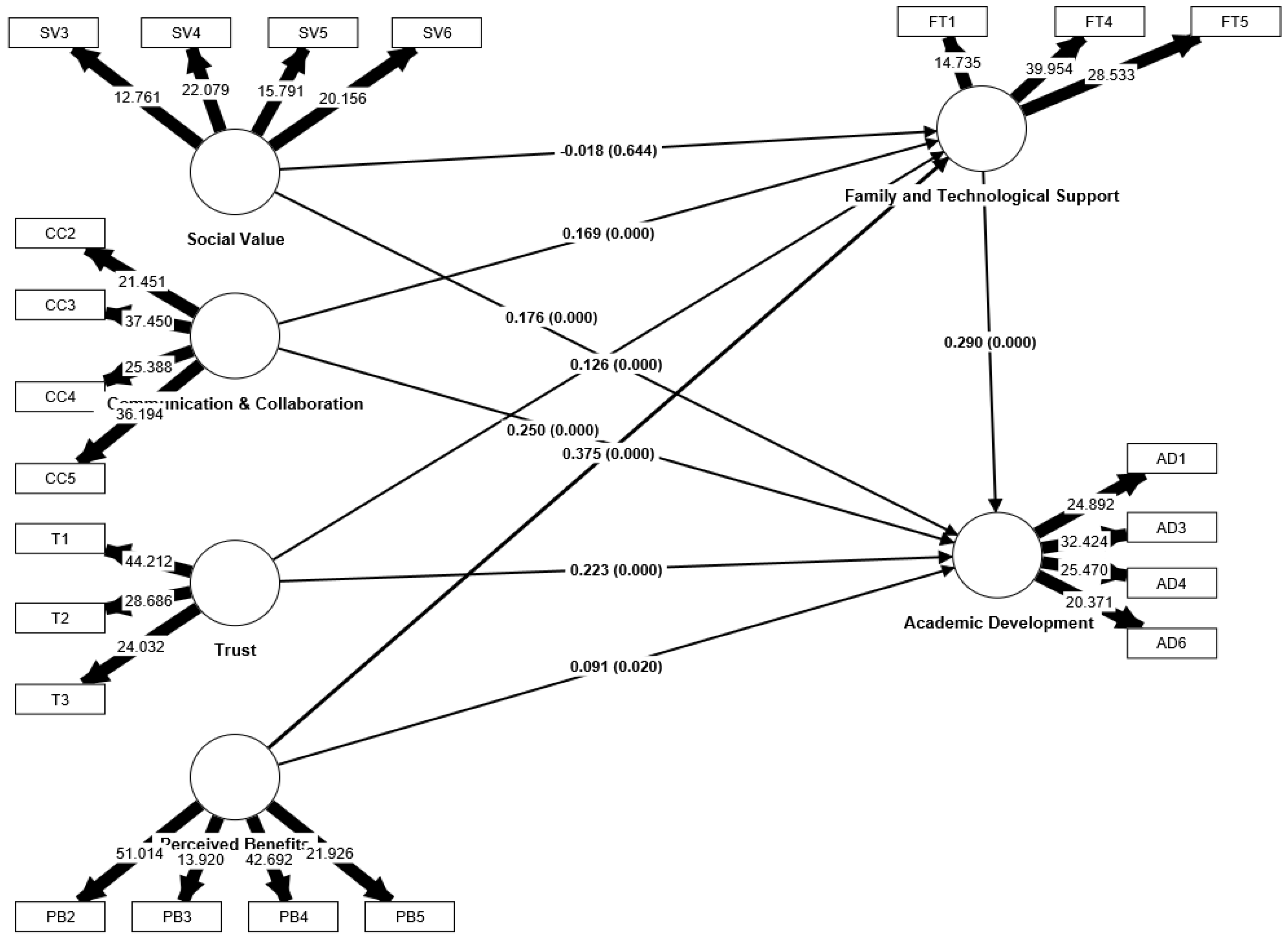
The relationship between perceived benefits and academic development was found to be significant (β = 0.091, T = 2.330, p < 0.020), providing support for H4. Furthermore, the mediating role of family and technological support in the relationship between perceived benefits and academic development was strongly supported (β = 0.375, T = 8.819, p < 0.000), confirming H5.
The positive relationship between the social value of knowledge sharing in social media and students’ academic development was also confirmed (β = 0.126, T = 4.026, p < 0.000), supporting H6. However, family and technological support did not mediate the relationship between the social value of knowledge sharing and academic development; as a result was negative and insignificant (β = -0.018, T = 0.462, p = 0.644), leading to the rejection of H7.
The influence of trust on knowledge sharing through social media and students’ academic development was found to be significant (β = 0.233, T = 6.475, p < 0.000), supporting H8. Additionally, family and technological support were found to mediate the relationship between trust and academic development, with a significant positive effect (β = 0.176, T = 4.470, p < 0.000), confirming H9. The greater the beta coefficient (β), the stronger the effect of an exogenous latent construct on the endogenous latent construct [121].
Table 6 and Figure 2 and Figure 3 presented the path coefficients in the model. The construction-related factor exhibited the highest path coefficient of β = 0.375, indicating its strong impact on family and technological issues and academic development. On the other hand, the external-related factor had a negative effect on academic development with a path coefficient of β = -0.018. The graphical representation in Figure 2 and Figure 3 illustrates all the path coefficients in the model.
Table 3 presents the correlation coefficients between the latent endogenous and exogenous variables, revealing significant associations between them. Through a comprehensive analysis of the measurement and structural models, the validity of both theories was established. Eight out of nine hypotheses were found to be statistically significant and accepted. These findings provide a comprehensive and accurate understanding of the factors influencing knowledge sharing on social media and its impact on the academic development of Bangladeshi students.
7. Conclusion and Discussion
In conclusion, university students in developing countries such as Bangladesh can tremendously benefit from sharing knowledge through social media for academic development, provided that they consider the needs of their families and the limitations of available technology. Students, regardless of where they are physically located, can share and obtain information more efficiently, thanks to the convenience and accessibility offered by social media platforms. However, in some regions of the country, access to the Internet is restricted, and there is a need for more technological infrastructure, both of which can impede the efficiency of the information exchange through social media. In addition, the support of one’s family can also play an essential part in encouraging and facilitating knowledge exchange among university students, specifically for those students who might need access to essential technological resources. Therefore, attempts to encourage knowledge exchange through social media in Bangladesh should concentrate on enhancing technological infrastructure and increasing internet availability, specifically in remote regions of the country. In addition, educational initiatives should be carried out to encourage the support of university students’ families in their efforts to share their knowledge. By addressing these problems, Bangladesh will be able to enhance the academic development of university students and contribute to creating a more knowledgeable and competent population.
This study aims to discover whether or not there is a connection between students’ use of social media platforms to share their knowledge and the student’s overall academic growth. The roles of students’ families and the availability and usage of technology were maintained as mediating factors throughout the study. A total of 737 university students participated in the survey and filled out either the online questionnaire or the offline form.
This research contributes to an overall conceptual understanding of the structural relations of social media knowledge sharing and student academic development. This research predicted that knowledge sharing in social media for communication and collaboration significantly and positively influences the student’s academic development. When observing, the direct and positive influence of communication and collaboration in social media for academic development are significantly related to family and technological support. The findings from the study endorsed that the communication and collaboration factors have a positive relationship, and there is a mediation of family and technological support between them. This finding is supported by Mahdiuon et al. (2020) [122]. The influence of family and technological support factors on a student’s academic development was positive and significant and was hugely supported. Thus, family and technological support play a significant role in a student’s academic performance at the university level. The effect of perceived benefits related items and academic development of the students in Bangladesh was significant and is found supported in the research Moghavvemi et al. (2017) [123]. In addition, family and technological support mediated the relationship between perceived benefits of knowledge sharing in social media and academic development was the top most positive and significantly supported in this study. The study by Park & Weng (2020) [124] worked at how country-level economic status and characteristics connected to information and communications technology (ICT) affect student academic attainment. According to the findings, (a) student’s interest in ICT, perceived ICT competence, and autonomy had positive effects on academic performance; (b) GDP per capita had significant interaction effects on the relationship between ICT-related factors (ICT use for studying at school, for entertainment, and perceived ICT autonomy), and (c) a higher level of student’s perceived ICT autonomy led to better learning outcomes in countries with less GDP.
When observing the direct and positive influence of the social value of knowledge sharing in social media and student’s academic development, the findings endorsed that the social value of knowledge sharing in social media-related factors has a positive relationship with student’s academic development and is supported by Ali-Hassan et al. (2015) [97]. However, the family and technological support did not mediate the relationship between the social value of sharing knowledge through social media and students’ academic development. The findings provided empirical support on the influence of trust on sharing knowledge through social media and students’ academic development significantly supported and accepted, and that is also suggested in the study of Ridings et al. (2002) [125]. This study expanded on Jarvenpaa et al. (1998) [126] use of the same trust scales in a virtual team context to apply trust to virtual settings. The team members’ application had them separated by time and space, and they did not know each other or have any other relationships. Family and technological support mediated the relationship between the trust of knowledge sharing in social media and academic development. It showed that it had a more excellent value of variance and a high effect on affecting the quality of family and technological issues and academic development. Following the completion of the study, the PLS-SEM test was applied to determine whether or not the mediation effect was statistically significant. According to the findings, there is evidence to imply that there was mediation.
Theories such as the Technology Acceptance Model (TAM) and the social exchange theory have been employed in social media to implement knowledge sharing the most frequently in the past [127,128,129]. This indicates that professionals and researchers have attempted to investigate how sharing information through social media applications might affect users’ intents and actions when using social media.
This study offers a valuable summary, making it possible for academics and practitioners to grasp and acquire an overview of the present research and the position of social media in studies on knowledge sharing. The use of social media for knowledge sharing is still a relatively new area of research from the perspective of Bangladesh; hence, the findings of this study can act as a reference for other researchers working in this area. Furthermore, when they are looking to explore the usage of social media in knowledge sharing, it might assist them in finding relevant subjects for their research. Overall, this study adds to the understanding of the connection between social media knowledge sharing and educational development and emphasizes the critical roles that family support and technology infrastructure play. By taking care of these issues, Bangladesh can maximize the potential of social media for academic growth and help its university students progress towards being aware and capable adults.
The current study has several limitations that should be considered in future research. Firstly, the data was collected from a representative sample of students from public institutions in Bangladesh, so caution should be exercised when generalizing the findings to all higher education institutions in the country. Future studies could benefit from including students from diverse public and private universities. Additionally, the data was only collected from students, and it would be valuable to gather data from a larger sample of educators to validate the research methodology and explore their perspectives on using social media for academic advancement. Finally, most of the data was collected through a Google form questionnaire, which may introduce response biases and inaccuracies. Therefore, the study has the following specific limitations:
- Sampling bias: The focus on students from Bangladeshi public universities may introduce selection bias, limiting the generalizability of the results to the entire student population in Bangladesh.
- Self-reported information: The reliance on self-reported data may be subject to social desirability bias, where participants provide answers they believe are socially acceptable, potentially affecting the accuracy of the data. Memory bias may also impact the accuracy of participants’ recollections of specific details.
- Limited scope: The study focused primarily on family and technical factors mediating knowledge sharing on social media for academic growth, overlooking other potential influences such as societal norms, individual characteristics, and university policies.
- Cross-sectional design: Using a cross-sectional design prevents establishing causation between knowledge sharing, family/technical factors, and academic growth. Longitudinal research would provide a better understanding of these relationships over time.
- Generalizability: The findings may not be generalizable to other countries or regions and may only be applicable within the specific context of Bangladesh.
Despite these limitations, the study offers valuable insights into the variables influencing knowledge sharing on social media for academic growth in Bangladesh. Future research should address these limitations to enhance our understanding of this topic further.
Author Contributions
The concepts of this research, empirical analysis, and writing were added to by MAH and XJZ. AS and IH helped with the data analysis. MMI scanned the work. ZR assisted in gathering the data. Finally, the conclusions and review of the literature were aided by both authors (M.N.H. and AEAA).
Funding
No funding has been provided for this study.
Data Availability Statement
The authors will share the unfiltered raw data that underlies the results of this paper in case of requirement.
Ethics Statement
Written informed consent was obtained from each participant before they began the study.
References
- Filo, K.; Lock, D.; Karg, A. Sport and Social Media Research: A Review. Sport Manag. Rev. 2015, 18 (2), 166–181. DOI: 10.1016/j.smr.2014.11.001. [CrossRef]
- Yan, Z.; Wang, T.; Chen, Y.; Zhang, H. Knowledge Sharing in Online Health Communities: A Social Exchange Theory Perspective. Inf. Manag. 2016, 53 (5), 643–653. DOI: 10.1016/j.im.2016.02.001. [CrossRef]
- Bilgihan, A.; Barreda, A.; Okumus, F.; Nusair, K. Consumer Perception of Knowledge-Sharing in Travel-Related Online Social Networks. Tourism Manag. 2016, 52, 287–296. DOI: 10.1016/j.tourman.2015.07.002. [CrossRef]
- Ramayah, T.; Yeap, J. A. L.; Ignatius, J. Assessing Knowledge Sharing Among Academics: A Validation of the Knowledge Sharing Behavior Scale (KSBS). Eval. Rev. 2014, 38 (2), 160–187. DOI: 10.1177/0193841X14539685. [CrossRef]
- Boyd, D.; Ellison, N. B. Social Network Sites: Definition, History, and Scholarship. J. Comput. Mediated Commun. 2007, 13 (1), 210–230. DOI: 10.1111/j.1083-6101.2007.00393.x. [CrossRef]
- Sita Nirmala Kumaraswamy, K. S. N.; Chitale, C. M. Collaborative Knowledge Sharing Strategy to Enhance Organizational Learning. J. Manag. Dev. 2012, 31 (3), 308–322. DOI: 10.1108/02621711211208934. [CrossRef]
- Patel, A. S.; Darji, H.; Mujapara, J. A. A Survey on Role of Intelligent Community and Social Networking to Enhance Learning Process of Students and Professionals. Int. J. Comput. Appl. 2013, 69 (4).
- Redmond, F.; Lillis, D. Social Networking Sites: Evaluating and Investigating Their Use in Academic Research. In ICERI2010. Proceedings 2010, (5837–5845). IATED.
- Kirschner, P. A.; Karpinski, A. C. Facebook® and Academic Performance. Comput. Hum. Behav. 2010, 26 (6), 1237–1245. DOI: 10.1016/j.chb.2010.03.024. [CrossRef]
- Krasnova, H.; Wenninger, H.; Widjaja, T.; Buxmann, P. Envy on Facebook: A Hidden Threat to Users’ Life Satisfaction? Wirtschaftsinf. Proc. 2013, 2013, 92.
- Alavi, M.; Leidner, D. E. Review: Knowledge Management and Knowledge Management Systems: Conceptual Foundations and Research Issues. M.I.S. Q. 2001, 25 (1), 107–136. DOI: 10.2307/3250961. [CrossRef]
- McLure Wasko, M. M.; Faraj, S. ‘It is what one does’: Why People Participate and Help Others in Electronic Communities of Practice. J. Strateg. Inf. Syst. 2000, 9 (2–3), 155–173. DOI: 10.1016/S0963-8687(00)00045-7. [CrossRef]
- Pathirage, C. P.; Amaratunga, D.; Haigh, R. The Role of Tacit Knowledge in the Construction Industry: Towards a Definition, 2008.
- Nonaka, I.; Takeuchi, H. The Knowledge-Creating Company: How Japanese Companies Create the Dynamics of Innovation. Long Range Plann. 1996, 29 (4), 592. DOI: 10.1016/0024-6301(96)81509-3. [CrossRef]
- Mohajan, H. K. Sharing of Tacit Knowledge in Organizations: A Review. Am. J. Comput. Sci. Eng. 2016, 3 (2), 6–19.
- Crowley, B. Tacit Knowledge and Quality Assurance: Bridging the Theory-Practice Divide. Knowl. Manag. Inf. Prof. 2000, 205–220.
- Nonaka, I.; Konno, N.; Toyama, R. Emergence of “Ba”. Knowl. Emergence Soc. Tech. Evol. Dimen. Knowl. Creation 2001, 1, 13–29.
- Magnier-Watanabe, R.; Benton, C.; Senoo, D. A Study of Knowledge Management Enablers Across Countries. Knowl. Manag. Res. Pract. 2011, 9 (1), 17–28. DOI: 10.1057/kmrp.2011.1. [CrossRef]
- Ekore, J. O. Impact of Key Organizational Factors on Knowledge Transfer Success in Multinational Enterprises. Manag. J. Contemp. Manag. Issues 2014, 19 (2), 3–18. https://hrcak.srce.hr/file/196719.
- Park, H. S.; Im, B. C. A Study on the Knowledge Sharing Behavior of Local Public Servants in Korea 2003. Internet http://www.kapa21.or.kr/down.
- Lee, C. K.; Al-Hawamdeh, S. Factors Impacting Knowledge Sharing. J. Info. Know. Mgmt. 2002, 01 (1), 49–56. DOI: 10.1142/S0219649202000169. [CrossRef]
- Van den Hooff, B.; Elving, W.; Meeuwsen, J. M.; Dumoulin, C. Knowledge Sharing in Knowledge Communities. In Communities and Technologies; Springer, 2003, pp 119–141.
- Ishaya, B.; Azamabel, N. Behavioural Impact of Social Media Platforms Among Youths in Yola Metropolis. U. Int. J. Res. Technol. 2021, 2 (3), 32–36.
- Statista. Number of Social Network Users Worldwide from 2017 to 2025. https://www.statista.com/markets/424/topic/540/social-media-user-generated-content/#overview (accessed January 16 2022), 2022.
- Pekkala, K.; van Zoonen, W. Work-Related Social Media Use: The Mediating Role of Social Media Communication Self-Efficacy. Eur. Manag. J. 2022, 40 (1), 67–76. DOI: 10.1016/j.emj.2021.03.004. [CrossRef]
- Avcı, K.; Çelikden, S. G.; Eren, S.; Aydenizöz, D. Assessment of Medical Students’ Attitudes on Social Media Use in Medicine: A Cross-Sectional Study. BMC Med. Educ. 2015, 15 (1), 18. DOI: 10.1186/s12909-015-0300-y. [CrossRef]
- Junco, R. Student Class Standing, Facebook Use, and Academic Performance. J. Appl. Dev. Psychol. 2015, 36, 18–29. DOI: 10.1016/j.appdev.2014.11.001. [CrossRef]
- Hamid, N. A. A. Usage of Social Media Tools in Teaching and Learning and Its Influence on Students Engagement, Knowledge Sharing and Academic Performance. Res. Manag. Technol. Bus. 2020, 1 (1), 278–295.
- Aslam, M. M. H.; Shahzad, K.; Syed, A. R.; Ramesh, A. Social Capital and Knowledge Sharing as Determinants of Academic Performance. J. Behav. Appl. Manag. 2013, 15 (1), 25–41. DOI: 10.21818/001c.17935. [CrossRef]
- Davis, F. D. Perceived Usefulness, Perceived Ease of Use, and User Acceptance of Information Technology. M.I.S. Q. 1989, 13 (3), 319–340. DOI: 10.2307/249008. [CrossRef]
- Chuttur, M. Y. Overview of the Technology Acceptance Model: Origins, Developments, and Future Directions. Working Papers on Information Systems. http://sprouts.aisnet.org/9-37; Vol. 9 (37), 2009.
- Fishbein, M.; Ajzen, I. Belief, Attitude, Intention, and Behavior: An Introduction to Theory and Research; Addison-Wesley, 1975.
- Bruner, G. C.; Kumar, A. Explaining Consumer Acceptance of Handheld Internet Devices. J. Bus. Res. 2005, 58 (5), 553–558. DOI: 10.1016/j.jbusres.2003.08.002. [CrossRef]
- Cheney, T. An Acceptance Model for Useful and Fun Information Systems. Hum. Technol. 2006, 2 (2), 225–235. DOI: 10.17011/ht/urn.2006520. [CrossRef]
- Gao, L.; Bai, X. A Unified Perspective on the Factors Influencing Consumer Acceptance of Internet of Things Technology. Asia Pac. J. Mark. Logist. 2014, 26 (2), 211–231. DOI: 10.1108/APJML-06-2013-0061. [CrossRef]
- Rahman, M. S.; Mannan, M.; Hossain, M. A.; Zaman, M. H.; Hassan, H. Tacit Knowledge-Sharing Behavior Among the Academic Staff: Trust, Self-Efficacy, Motivation and Big Five Personality Traits Embedded Model. Int. J. Educ. Manag. 2018, 32 (5), 761–782. DOI: 10.1108/IJEM-08-2017-0193. [CrossRef]
- Venkatesh, V.; Morris, G.; Davis, B. User Acceptance Information Technology: Toward a Unified View. M.I.S. Q. 2003, 27 (3), 425–478. DOI: 10.2307/30036540. [CrossRef]
- Schmidthuber, L.; Maresch, D.; Ginner, M. Disruptive Technologies and Abundance in the Service Sector - Toward a Refined Technology Acceptance Model. Technol. Forecasting Soc. Change 2020, 155, 119328. DOI: 10.1016/j.techfore.2018.06.017. [CrossRef]
- Blau, P. M. Exchange and Power in Social Life; Wiley, 1964.
- Cropanzano, R.; Mitchell, M. S. Social Exchange Theory: An Interdisciplinary Review. J. Manag. 2005, 31 (6), 874–900. DOI: 10.1177/0149206305279602. [CrossRef]
- Cyr, S.; Wei Choo, C. W. The Individual and Social Dynamics of Knowledge Sharing: An Exploratory Study. J. Doc. 2010, 66 (6), 824–846. DOI: 10.1108/00220411011087832. [CrossRef]
- Assegaff, S.; Hussin, A. R. C.; Dahlan, H. M. Perceived Benefit of Knowledge Sharing: Adapting TAM Model. In International Conference on Research and Innovation in Information Systems; Vol. 2011; IEEE Publications, 2011, November, pp 1–6. DOI: 10.1109/ICRIIS.2011.6125744. [CrossRef]
- Al-Rahimi, W. M.; Othman, M. S.; Musa, M. A. Using TAM Model to Measure the Use of Social Media for Collaborative Learning. Int. J. Eng. Trends Technol. (IJETT) 2013, 5 (2), 90–95.
- Analoui, B. D.; Sambrook, S.; Doloriert, C. H. Engaging Students in Group Work to Maximise Tacit Knowledge Sharing and Use. Int. J. Manag. Educ. 2014, 12 (1), 35–43. DOI: 10.1016/j.ijme.2013.08.002. [CrossRef]
- Ryu, S.; Ho, S. H.; Han, I. Knowledge Sharing Behavior of Physicians in Hospitals. Expert Syst. Appl. 2003, 25 (1), 113–122. DOI: 10.1016/S0957-4174(03)00011-3. [CrossRef]
- Smith, A. D.; Rupp, W. T. Communication and Loyalty Among Knowledge Workers: A Resource of the Firm Theory View. J. Knowl. Manag. 2002, 6 (3), 250–261. DOI: 10.1108/13673270210434359. [CrossRef]
- Avital, M.; Bjork, B. C.; Boland, R. J.; Crowston, K.; Lyytinen, K. J.; Majchrzak, A. ICIS 2008 Panel Report: Open Access Publishing to Nurture the Sprouts of Knowledge and the Future of Information Systems Research. SSRN Journal 2014. DOI: 10.2139/ssrn.2536508. [CrossRef]
- Bonetta, L. Scientists Enter the Blogosphere. Cell 2007, 129 (3), 443–445. DOI: 10.1016/j.cell.2007.04.032. [CrossRef]
- Letierce, J.; Passant, A.; Breslin, J.; Decker, S.. Using Twitter during an Academic Conference: The #iswc2009 Use-Case. In. ICWSM 2010, May, 4 (1), 279–282. DOI: 10.1609/icwsm.v4i1.14072. [CrossRef]
- Dabbagh, N.; Reo, R. Tracing the Roots and Learning Affordances of Social Software. In Web 2.0-based e-learning: Applying social informatics for tertiary teaching. Back to the Future; IGI Global, 2011, pp 1–20. DOI: 10.4018/978-1-60566-294-7.ch001. [CrossRef]
- Al-Rahmi, W.; Othman, M. The Impact of Social Media Use on Academic Performance Among University Students: A Pilot Study. J. Inf. Syst. Res. Innov. 2013, 4 (12), 1–10.
- Al-Rahmi, W.; Othman, M.; Yusuf, L. Effect of engagement and collaborative learning on satisfaction through the use of social media on Malaysian higher education. Research Journal of Applied Sciences, Engineering and Technology. 2015, 9 (12), 1132-1142.
- Dholakia, U. M.; Bagozzi, R. P.; Pearo, L. K. A Social Influence Model of Consumer Participation in Network- and Small-Group-Based Virtual Communities. Int. J. Res. Mark. 2004, 21 (3), 241–263. DOI: 10.1016/j.ijresmar.2003.12.004. [CrossRef]
- Zhou, T.; Li, H.; Liu, Y. The Effect of Flow Experience on Mobile SNS Users’ Loyalty. Ind. Manag. Data Syst. 2010, 110 (6), 930–946. DOI: 10.1108/02635571011055126. [CrossRef]
- Mazer, J. P.; Murphy, R. E.; Simonds, C. J. I’ll See You on “Facebook”: The Effects of Computer-Mediated Teacher Self-Disclosure on Student Motivation, Affective Learning, and Classroom Climate. Commun. Educ. 2007, 56 (1), 1–17. DOI: 10.1080/03634520601009710. [CrossRef]
- Ross, C.; Orr, E. S.; Sisic, M.; Arseneault, J. M.; Simmering, M. G.; Orr, R. R. Personality and Motivations Associated with Facebook Use. Comput. Hum. Behav. 2009, 25 (2), 578–586. DOI: 10.1016/j.chb.2008.12.024. [CrossRef]
- Paroutis, S.; Al Saleh, A. Determinants of Knowledge Sharing Using Web 2.0 Technologies. J. Knowl. Manag. 2009, 13 (4), 52–63. DOI: 10.1108/13673270910971824. [CrossRef]
- Oliveira, D. C.; Furtado, E.; Mendes, M. S. Do Users Express Values During Use of Social Systems? A Classification of Their Postings in Personal, Social and Technical Values. In Social Computing and Social Media. Proceedings of the 8: 8th International Conference, SCSM 2016, Held as Part of HCI International; Toronto, July 17–22, 2016; Springer International Publishing, 2016, pp 130–140. DOI: 10.1007/978-3-319-39910-2_13. [CrossRef]
- Constant, D.; Sproull, L.; Kiesler, S. The Kindness of Strangers: The Usefulness of Electronic Weak Ties for Technical Advice. Organ. Sci. 1996, 7 (2), 119–135. DOI: 10.1287/orsc.7.2.119. [CrossRef]
- Rogers, E. M. Diffusion of Innovations; Free Press, 1962.
- Robertson, T. S. The Process of Innovation and the Diffusion of Innovation. J. Mark. 1967, 31 (1), 14–19. DOI: 10.1177/002224296703100104. [CrossRef]
- Sheth, J. N.; Newman, B. I.; Gross, B. L. Why We Buy What We Buy: A Theory of Consumption Values. J. Bus. Res. 1991, 22 (2), 159–170. DOI: 10.1016/0148-2963(91)90050-8. [CrossRef]
- Rainier, R.; Rawski, G.; Yang, J.; Johnson, B. Technology Acceptance Model (TAM) and Social Media Usage: An Empirical Study on Facebook. J. Enterpr. Inf. Manag. 2014, 27 (1), 6–30. DOI: 10.1108/JEIM-04-2012-0011. [CrossRef]
- Ruleman, A. B. Social Media at the University: A Demographic Comparison. New Libr. World 2012, 113 (7/8), 316–332. DOI: 10.1108/03074801211244940. [CrossRef]
- José-Cabezudo, R. S.; Camarero-Izquierdo, C. Determinants of Opening-Forwarding E-Mail Messages. J. Advertising 2012, 41 (2), 97–112. DOI: 10.2753/JOA0091-3367410207. [CrossRef]
- Bruque, S.; Moyano, J.; Eisenberg, J. Individual Adaptation to IT-Induced Change: The Role of Social Networks. J. Manag. Inf. Syst. 2008, 25 (3), 177–206. DOI: 10.2753/MIS0742-1222250305. [CrossRef]
- Gold, A. H.; Malhotra, A.; Segars, A. H. Knowledge Management: An Organizational Capabilities Perspective. J. Manag. Inf. Syst. 2001, 18 (1), 185–214. DOI: 10.1080/07421222.2001.11045669. [CrossRef]
- Ghazali, S.; Sulaiman, N. I. S.; Zabidi, N. Z.; Omar, M. F.; Alias, R. A. The Impact of Knowledge Sharing Through Social Media Among Academia. In AIP Conf. Proc. (Vol. 1782, No. 1, p. 030003); AIP Publishing LLC 2016, October. DOI: 10.1063/1.4966060. [CrossRef]
- Fiske, A. P. The four elementary forms of sociality: Framework for a unified theory of social relations. Psychological Review. 1992, 99, 689–723.
- Boer, N.-I.; van Baalen, P. J.; Kumar, K. An Activity Theory Approach for Studying the Situatedness of Knowledge Sharing. In Proceedings of the 35th Annual Hawaii International Conference on System Sciences; IEEE Publications, 2002, January, pp 1483–1492. DOI: 10.1109/HICSS.2002.994017. [CrossRef]
- Gambetta, D. Can We Trust. Trust Mak. Breaking Coop. Relat. 2000, 13, 213–237.
- Riegelsberger, J.; Sasse, M. A.; McCarthy, J. D. The Researcher’s Dilemma: Evaluating Trust in Computer-Mediated Communication. Int. J. Hum. Comput. Stud. 2003, 58 (6), 759–781. DOI: 10.1016/S1071-5819(03)00042-9. [CrossRef]
- Dyer, J. H.; Singh, H. The Relational View: Cooperative Strategy and Sources of Interorganizational Competitive Advantage. Acad. Manag. Rev. 1998, 23 (4), 660–679. DOI: 10.5465/amr.1998.1255632. [CrossRef]
- Nahapiet, J.; Ghoshal, S. Social Capital, Intellectual Capital, and the Organizational Advantage. Acad. Manag. Rev. 1998, 23 (2), 242–266. DOI: 10.5465/amr.1998.533225. [CrossRef]
- Fox, A. Beyond Contract: Work, Power and Trust Relations; Faber & Faber, 1974.
- Alam, S. S.; Abdullah, Z.; Ishak, N. A.; Zain, Z. M. Assessing Knowledge Sharing Behaviour Among Employees in SMEs: An Empirical Study. Int. Bus. Res. 2009, 2 (2), 115–122. DOI: 10.5539/ibr.v2n2p115. [CrossRef]
- Bousari, R. G.; Hassanzadeh, M. Factors That Affect Scientists’ Behavior to Share Scientific Knowledge. COLLNET J. Scientometr. Inf. Manag. 2012, 6 (2), 215–227. DOI: 10.1080/09737766.2012.10700935. [CrossRef]
- Abdullah, N. L.; Hamzah, N.; Arshad, R.; Isa, R. M.; Ghani, R. A. Psychological Contract and Knowledge Sharing Among Academicians: Mediating Role of Relational Social Capital. Int. Bus. Res. 2011, 4 (4), 231. DOI: 10.5539/ibr.v4n4p231. [CrossRef]
- Liang, T. P.; Liu, C. C.; Wu, C. H. Can Social Exchange Theory Explain Individual Knowledge-Sharing Behavior? A Meta-analysis. International Conference on Information Systems Proceedings, ICIS 2008, 2008.
- Lin, H. F. Effects of Extrinsic and Intrinsic Motivation on Employee Knowledge Sharing Intentions. J. Inf. Sci. 2007, 33 (2), 135–149. DOI: 10.1177/0165551506068174. [CrossRef]
- Sharabati, M. M. N. The Impact of Knowledge Sharing Through Facebook on Students’ Academic Performance in Palestine. The Int. J. Bus. Inf. 2018, 13 (2), 155–190. DOI: 10.6702/ijbi.201806_13(2).0002. [CrossRef]
- Akosile, A.; Olatokun, W. Factors Influencing Knowledge Sharing Among Academics in Bowen University, Nigeria. J. Librarianship Inf. Sci. 2020, 52 (2), 410–427. DOI: 10.1177/0961000618820926. [CrossRef]
- Top, S. Assessing the Knowledge Sharing in Terms of Risk Level In-House Service Sector Assisted with Logistic Regression Model. Procedia Soc. Behav. Sci. 2012, 58, 802–811. DOI: 10.1016/j.sbspro.2012.09.1058. [CrossRef]
- Giri, J. Digital Divide. Paper presented at ICT and Development for Computer Association of Nepal IT Conference, Kathmandu, January 26–27, 2002.
- Legard, D. Use of IT to Cut Global Poverty, UN report. http://www.interconnection.org/resources/itpoverty.htm (accessed March 8 2022), 2001.
- Islam, A.; Tsuji, K. Bridging Digital Divide in Bangladesh: Study on Community Information Centers. Electron. Libr. 2011, 29 (4), 506–522. DOI: 10.1108/02640471111156768. [CrossRef]
- Masud, H.; Ahmad, M. S.; Jan, F. A.; Jamil, A. Relationship Between Parenting Styles and Academic Performance of Adolescents: The Mediating Role of Self-Efficacy. Asia Pacific Educ. Rev. 2016, 17 (1), 121–131. DOI: 10.1007/s12564-015-9413-6. [CrossRef]
- Sekaran, U.; Bougie, R. Research Methods for Business: A Skill Building Approach; John Wiley & Sons, 2016.
- BER, Bangladesh Economic Review. https://mof.portal.gov.bd/sites/default/files/files/; Ministry of Finance, 2022.
- UGC. Public Universities in Bangladesh; University Grant Commission (UGC), 2012.
- Chin, W. W. The Partial Least Squares Approach to Structural Equation Modeling. Mod. Methods Bus. Res. 1998, 295 (2), 295–336.
- Booker, Q. S.; Austin, J. D.; Balasubramanian, B. A. Survey Strategies to Increase Participant Response Rates in Primary Care Research Studies. Fam. Pract. 2021, 38 (5), 699–702. DOI: 10.1093/fampra/cmab070. [CrossRef]
- Galliher, J. M.; Bonham, A. J.; Dickinson, L. M.; Staton, E. W.; Pace, W. D. Representativeness of PBRN Physician Practice Patterns and Related Beliefs: The Case of the AAFP National Research Network. Ann. Fam. Med. 2009, 7 (6), 547–554. DOI: 10.1370/afm.1015. [CrossRef]
- Zhao, J.; Zhu, C.; Peng, Z.; Xu, X.; Liu, Y. User Willingness Toward Knowledge Sharing in Social Networks. Sustainability 2018, 10 (12), 4680. DOI: 10.3390/su10124680. [CrossRef]
- Pihlström, M.; Brush, G. J. Comparing the Perceived Value of Information and Entertainment Mobile Services. Psychol. Mark. 2008, 25 (8), 732–755. DOI: 10.1002/mar.20236. [CrossRef]
- Yen, Y. S. The Impact of Perceived Value on Continued Usage Intention in Social Networking Sites, 2011.
- Ali-Hassan, H.; Nevo, D.; Wade, M. Linking Dimensions of Social Media Use to Job Performance: The Role of Social Capital. J. Strateg. Inf. Syst. 2015, 24 (2), 65–89. DOI: 10.1016/j.jsis.2015.03.001. [CrossRef]
- Rasheed, M. I.; Malik, M. J.; Pitafi, A. H.; Iqbal, J.; Anser, M. K.; Abbas, M. Usage of Social Media, Student Engagement, and Creativity: The Role of Knowledge Sharing Behavior and Cyberbullying. Comput. Educ. 2020, 159, 104002. DOI: 10.1016/j.compedu.2020.104002. [CrossRef]
- Mahdiuon, R.; Salimi, G.; Raeisy, L. Effect of Social Media on Academic Engagement and Performance: Perspective of Graduate Students. Educ. Inf. Technol. 2019, 1–20. DOI: 10.1007/s10639-019-10032-2. [CrossRef]
- Sharma, S. K.; Joshi, A.; Sharma, H. A Multi-analytical Approach to Predict the Facebook Usage in Higher Education. Comput. Hum. Behav. 2016, 55, 340–353. DOI: 10.1016/j.chb.2015.09.020. [CrossRef]
- Zaffar, F. O.; Ghazawneh, A. Knowledge Sharing and Collaboration Through Social Media-the Case of IBM. MCIS (Short Pap.) 2012, 28.
- Moghavvemi, S.; Sharabati, M.; Paramanathan, T.; Rahin, N. M. The Impact of Perceived Enjoyment, Perceived Reciprocal Benefits and Knowledge Power on Students’ Knowledge Sharing Through Facebook. Int. J. Manag. Educ. 2017, 15 (1), 1–12. DOI: 10.1016/j.ijme.2016.11.002. [CrossRef]
- Wasko, M.; Faraj, S. Why should I share? Examining social capital and knowledge contribution in electronic networks of practice. MIS quarterly. 2005, 35-57.
- Zhang, X.; Bartol, K. M. Linking Empowering Leadership and Employee Creativity: The Influence of Psychological Empowerment, Intrinsic Motivation, and Creative Process Engagement. Acad. Manag. J. 2010, 53 (1), 107–128. DOI: 10.5465/amj.2010.48037118. [CrossRef]
- Meng, Y.; Tan, J.; Li, J. Abusive Supervision by Academic Supervisors and Postgraduate Research Students’ Creativity: The Mediating Role of Leader–Member Exchange and Intrinsic Motivation. Int. J. Leadersh. Educ. 2017, 20 (5), 605–617. DOI: 10.1080/13603124.2017.1304576. [CrossRef]
- Tierney, P.; Farmer, S. M.; Graen, G. B. An Examination of Leadership and Employee Creativity: The Relevance of Traits and Relationships. Pers. Psychol. 1999, 52 (3), 591–620. DOI: 10.1111/j.1744-6570.1999.tb00173.x. [CrossRef]
- Naeem, M. Uncovering the Role of Social Media and Cross-Platform Applications as Tools for Knowledge Sharing. VINE J. Inf. Knowl. Manag. Syst. 2019, 49 (3), 257–276. DOI: 10.1108/VJIKMS-01-2019-0001. [CrossRef]
- Tabachnick, B. G.; Fidell, L. S.; Ullman, J. B. Using Multivariate Statistics; Vol. 6; Pearson, 2013.
- Brown, S. Measures of Shape: Skewness and Kurtosis, 2011.
- Ab Hamid, M. R.; Sami, W.; Sidek, M. M. Discriminant Validity Assessment: Use of Fornell & Larcker Criterion Versus HTMT Criterion. In J. Phys. Conf. S. (Vol. 890, No. 1, p. 012163); IOP Publishing 2017, September, 890. DOI: 10.1088/1742-6596/890/1/012163. [CrossRef]
- Hair Jr., J. F.; Hult, G. T. M.; Ringle, C. M.; Sarstedt, M. A Primer on Partial Least Squares Structural Equation Modeling (PLS-SEM); Sage Publications, 2021.
- Nunnally, J. C.; Bernstein, I. H. Psychological Theory; McGraw-Hill, 1994. Nyer, P. U. A Study of the Relationships Between Cognitive Appraisals and Consumption Emotions. Journal of the Academy of Marketing Science 1997, 25 (4), 296–304. DOI: 10.1177/0092070397254002. [CrossRef]
- Al-Azawei, A. Predicting the Adoption of Social Media: An Integrated Model and Empirical Study on Facebook Usage. Interdiscip. J. Inf. Knowl. Manag. 2018, 13, 233–258. DOI: 10.28945/4106. [CrossRef]
- Hair, J. F.; Hult, G. T. M.; Ringle, C. M.; Sarstedt, M. A primer on partial least squares structural equation modelling (PLS-SEM) (2nd ed.). Thousand Oaks, CA: Sage. 2017.
- Ramayah, T. J. F. H.; Cheah, J.; Chuah, F.; Ting, H.; Memon, M. A. Partial least squares structural equation modelling (PLS-SEM) using smartPLS 3.0. An updated guide and practical guide to statistical analysis. 2018.
- Henseler, J.; Ringle, C. M.; Sarstedt, M. A New Criterion for Assessing Discriminant Validity in Variance-Based Structural Equation Modeling. J. Acad. Mark. Sci. 2015, 43 (1), 115–135. DOI: 10.1007/s11747-014-0403-8. [CrossRef]
- Henseler, J.; Ringle, C. M.; Sinkovics, R. R. The Use of Partial Least Squares Path Modeling in International Marketing. In New Challenges to International Marketing; Emerald Group Publishing Limited. 2009, 277–319. DOI: 10.1108/S1474-7979(2009)0000020014. [CrossRef]
- Stone, M. Cross-Validatory Choice and Assessment of Statistical Predictions. J. R. Stat. Soc. B (Methodol.) 1974, 36 (2), 111–133. DOI: 10.1111/j.2517-6161.1974.tb00994.x. [CrossRef]
- Geisser, S. The Predictive Sample Reuse Method with Applications. J. Am. Stat. Assoc. 1975, 70 (350), 320–328. DOI: 10.1080/01621459.1975.10479865. [CrossRef]
- Yahaya, M. L.; Murtala, Z. A.; Onukwube, H. N. Partial Least Squares (PLS-SEM): A Note for Beginners. Int. J. Environ. Stud. Saf. Res. 2019, 4 (4), 1–30.
- Hussain, S.; Fangwei, Z.; Siddiqi, A. F.; Ali, Z.; Shabbir, M. S. Structural Equation Model for Evaluating Factors Affecting Quality of Social Infrastructure Projects. Sustainability 2018, 10 (5), 1415. DOI: 10.3390/su10051415. [CrossRef]
- Mahdiuon, R.; Salimi, G.; Raeisy, L. Effect of Social Media on Academic Engagement and Performance: Perspective of Graduate Students. Educ. Inf. Technol. 2020, 25 (4), 2427–2446. DOI: 10.1007/s10639-019-10032-2. [CrossRef]
- Moghavvemi, S.; Sharabati, M.; Klobas, J. E.; Sulaiman, A. Effect of Trust and Perceived Reciprocal Benefit on Students’ Knowledge Sharing via Facebook and Academic Performance. Electron. J. Knowl. Manag. 2018, 16 (1), 23–35.
- Park, S.; Weng, W. The Relationship Between ICT-Related Factors and Student Academic Achievement and the Moderating Effect of Country Economic Index Across 39 Countries. Educ. Technol. Soc. 2020, 23 (3), 1–15.
- Ridings, C. M.; Gefen, D.; Arinze, B. Some Antecedents and Effects of Trust in Virtual Communities. J. Strateg. Inf. Syst. 2002, 11 (3–4), 271–295. DOI: 10.1016/S0963-8687(02)00021-5. [CrossRef]
- Jarvenpaa, S. L.; Knoll, K.; Leidner, D. E. Is Anybody Out There? Antecedents of Trust in Global Virtual Teams. J. Manag. Inf. Syst. 1998, 14 (4), 29–64. DOI: 10.1080/07421222.1998.11518185. [CrossRef]
- Salloum, S. A.; Al-Emran, M.; Habes, M.; Alghizzawi, M.; Ghani, M. A.; Shaalan, K. Understanding the Impact of Social Media Practices on E-learning Systems Acceptance. In Proceedings of the International Conference on Advanced Intelligent Systems and Informatics 2019; Springer International Publishing, 2020, pp 360–369. DOI: 10.1007/978-3-030-31129-2_33. [CrossRef]
- Ahmed, Y. A.; Ahmad, M. N.; Ahmad, N.; Zakaria, N. H. Social Media for Knowledge-Sharing: A Systematic Literature Review. Telemat. Inform. 2019, 37, 72–112. DOI: 10.1016/j.tele.2018.01.015. [CrossRef]
- Baima, G.; Santoro, G.; Pellicelli, A. C.; Mitręga, M. Testing the Antecedents of Customer Knowledge Sharing on Social Media: A Quantitative Analysis on Italian Consumers. Int. Mark. Rev. 2022, 39 (3), 682–705. DOI: 10.1108/IMR-03-2021-0122. [CrossRef]
Disclaimer/Publisher’s Note: The statements, opinions and data contained in all publications are solely those of the individual author(s) and contributor(s) and not of MDPI and/or the editor(s). MDPI and/or the editor(s) disclaim responsibility for any injury to people or property resulting from any ideas, methods, instructions or products referred to in the content. |
© 2023 by the authors. Licensee MDPI, Basel, Switzerland. This article is an open access article distributed under the terms and conditions of the Creative Commons Attribution (CC BY) license (http://creativecommons.org/licenses/by/4.0/).
Copyright: This open access article is published under a Creative Commons CC BY 4.0 license, which permit the free download, distribution, and reuse, provided that the author and preprint are cited in any reuse.