

Submitted:
23 May 2023
Posted:
23 May 2023
You are already at the latest version
Abstract
The deployment of Artificial Intelligence (AI) systems in decentralized environments is on the rise, yet representation of shared conceptualization in such scenarios remains a challenging issue. The absence of a shared understanding can lead to suboptimal performance of AI systems and hinders the ability to comprehend the knowledge and beliefs of agents in the domain. This paper proposes a formal model for modeling conceptualization in AI systems that integrates ontology, epistemology, and epistemic logic. The model aims to address the gap in representing shared conceptualization in decentralized environments and enhance the performance of AI systems operating in such environments. The proposed model is a hybrid structure that blends extensional and intensional structures and leverages logic-based languages for modeling purposes. A case study in the healthcare sector is presented to illustrate the application of the proposed model. The study contributes to the existing literature by providing a formal model for representing shared conceptualization in decentralized environments, which can be utilized to optimize the performance of AI systems in these environments.
Keywords:
Artificial intelligence (AI)
; Knowledge representation
; Ontology
; Epistemology
; Conceptualization
; Modal logic
1. Introduction
The field of AI systems has experienced a significant increase in the use of decentralized environments, where multiple agents and systems operate independently while needing to share knowledge and information [Allen and West, 2018]. Representing shared conceptualization in such environments, however, is a challenging task, as it demands a balance between the flexibility of decentralized environments and the stability of closed environments [Adhnouss et al., 2022]. A key challenge in AI is representing knowledge and beliefs in a decentralized context [Lapso and Peterson, 2022]. Decentralized environments, including autonomous and multi-agent systems, necessitate a shared understanding of the environment and its entities, which is referred to as shared conceptualization.
Previous studies have suggested various conceptualization models, such as extensional and intensional models [Ali and McIsaac, 2020]. These models, however, have limitations when applied to decentralized environments. To address these limitations and improve AI system performance in decentralized settings, we propose a formal model for representing shared conceptualization that combines elements from ontology, epistemology, and epistemic logic.
Epistemology, particularly in the context of computer science and AI systems, is closely related to intensional representation. It involves the formal specification of shared conceptualization without necessarily making the specification explicit [Floridi, 2008]. In essence, epistemology concentrates on the meanings of terms and expressions, capturing the diverse perspectives and interpretations of different agents.
Our proposed model integrates epistemology, ontology (which is more extensional), and modal logic to tackle the challenges of representing shared conceptualization in decentralized environments. This approach combines the strengths of both extensional and intensional representations to offer a more comprehensive and adaptable framework for representing knowledge and beliefs in AI systems operating in decentralized contexts.
A key aspect of our proposed model is the incorporation of possible worlds, which enables a more comprehensive representation of diverse perspectives and beliefs in decentralized environments. This overcomes the limitations of existing models based on extensional representations. Possible worlds, rooted in modal logic, facilitate modeling alternative states of affairs and provide a formal structure for reasoning about knowledge, beliefs, and uncertainties [Kripke, 1980]. In this context, each AI or information system can be considered a possible world, representing its unique perspective and understanding of the environment.
Incorporating possible worlds into our hybrid model aims to address the limitations of existing extension-based models and enhance the representation of shared conceptualization in decentralized environments. This approach enables AI systems to better understand and reason about the diverse perspectives and beliefs of agents and entities within these environments, ultimately resulting in improved performance and more effective collaboration.
The proposed model builds upon the work of [Adhnouss et al., 2022], who proposed a hybrid model for representing shared conceptualization in dynamic closed environments. The model consists of three levels: the domain level, the possible worlds level, and the extension level. The domain level defines the entities and concepts in the universe of discourse, the possible worlds level defines the possible states of affairs, and the extension level defines the relations between entities in different possible worlds.
By employing this model, we aim to enhance AI systems' performance in decentralized environments by ensuring that the knowledge and information shared among agents and systems remain consistent and accurate. The proposed model can also be utilized to formally specify and represent shared conceptualization, which may be beneficial in developing and maintaining AI systems in decentralized environments.
1.2. Research Question and Key Contributions of the Paper
In this paper, we address the research question: How can we formally model shared conceptualization in a decentralized environment to improve the performance of AI systems? We propose a hybrid model for formal modeling of conceptualization in AI systems and evaluate its effectiveness in a healthcare sector scenario.
The key contributions of this paper include:
- Defining and explaining the central concepts related to the research question, including ontology, epistemology, and epistemic logic in a decentralized environment.
- Analyzing gaps in the existing literature concerning shared conceptualization representation in a decentralized setting.
- Introducing a novel formal model for conceptualization in decentralized AI systems that integrates ontology, epistemology, and epistemic logic.
- Demonstrating the potential of the proposed model to improve AI system performance in a decentralized context using a healthcare sector scenario.
- Emphasizing the importance of understanding the philosophical foundations of science and AI for appropriate and meaningful interpretation of research outcomes in interdisciplinary research.
1.4. Research Methodology
Our research methodology comprises a combination of literature review, model development, and a scenario that illustrates how our hybrid model can be used in the context of decentralized AI systems. The literature review involves identifying key concepts, theories, and studies related to the research question, analyzing gaps in existing literature, and discussing previous studies and models relevant to the topic. This review establishes the theoretical foundation for our hybrid approach integrating epistemology, ontology, and epistemic logic.
The model development phase encompasses the creation of a formal framework for representing and reasoning about shared conceptualization in decentralized AI systems. This process involves defining the intensional and extensional components of the conceptualization structure and incorporating epistemic logic to capture knowledge and belief relationships between agents.
The exploratory scenario phase aims to demonstrate the practical application and effectiveness of the proposed model. By applying the model to a real-world scenario in the healthcare sector, we can evaluate its potential to improve AI system performance in a decentralized context and gain insights into its broader applicability. This phase also helps identify any limitations or areas for improvement in the model, which can inform future research and development efforts.
2. Theoretical Foundations and Approaches
2.1. Related Work
The study of ontology, epistemology, and epistemic logic plays a crucial role in this research, as it helps to understand the nature of knowledge and how it can be acquired, represented, and shared [Guizzardi and Halpin, 2008; Guarino et al., 2009; Themistocleous and Irani, 2001] .
The literature on ontology in AI systems is extensive and encompasses a diverse array of topics. The term "ontology" is borrowed from philosophical ontology, which is concerned with the study of being and the nature of existence in the world that humans can acquire knowledge about. It assists researchers in understanding the certainty they can have regarding the nature and existence of the objects they investigate and the 'truth claims' they can make about reality [Guarino, 1998].
In the context of AI and computer science, ontology has been adapted and reinterpreted, distinguishing it from its philosophical roots. Gruber characterizes ontology in this context as “an explicit specification of a conceptualization” [Gruber, 1995]. Here, "conceptualization" is defined as “the objects, concepts, and other entities that are assumed to exist in some area of interest and the relationships that hold among them” [Genesereth and Nilsson, 2012]. Consequently, ontology does not seek to objectively capture the entirety of reality but focuses on specific aspects. Ontology corresponds to a representation in a particular language, with its meaning made as explicit as possible within the ontology itself.
Gruber also presents an alternative view of conceptualization as "a simplified, abstract view of the world for some purpose that we wish to represent" [Gruber, 1995]. This interpretation highlights the intensional structure of conceptualization. Other definitions propose that ontology is associated with a formal specification of shared conceptualizations agreed upon by a community of individuals or artificial agents [Borst, 1999]. This formal representation facilitates interoperability between software systems.
Studer provides a hybrid definition, describing ontology as "a formal, explicit specification of a shared conceptualization" [Studer et al., 1998]. Guarino refines Gruber's definition, distinguishing between ontology and conceptualization by defining ontology as “a logical theory accounting for the intended meaning of a conceptualization” [Guarino et al., 2009]. Guarino critiques Gruber's definition, stating that the term "conceptualization" in this context pertains to ordinary mathematical relations or extensional relationships within the domain. Guarino argues that these relations mirror specific states of affairs, such as a particular arrangement of blocks on a table in the blocks world scenario [Guarino et al., 2009]
Epistemology, the study of knowledge, is concerned with the validity, scope and methods of acquiring knowledge, such as what constitutes a knowledge claim; how knowledge can be acquired or produced; and how the extent of its transferability can be assessed. Epistemology is important because it influences how researchers frame their research in their attempts to discover knowledge [Tsoukas, , 2004].
There are several different types of epistemologies, each with their own unique perspective on how knowledge is acquired and how it should be used. Objectivist epistemology assumes that reality exists outside, or independently, of the individual mind. Objectivist research is useful in providing reliability (consistency of results obtained) and external validity (applicability of the results to other contexts) [Tsoukas, 2004].
Constructionist epistemology, on the other hand, rejects the idea that objective ‘truth’ exists and is waiting to be discovered. Instead, it argues that ‘truth’ or meaning arises from our engagement with the realities in our world [Gergen, 1999]. In other words, a ‘real world’ does not preexist independently of human activity or symbolic language. Constructionist epistemology is particularly relevant in the field of AI, as it highlights the importance of understanding the role of human cognition and interpretation in the creation of knowledge [Floridi, 2010].
Constructionist epistemology emphasizes the importance of context and the role of human interpretation in shaping knowledge. In AI systems, this perspective can inform the design of systems that can adapt to different contexts and thereby understand the nuances of human communication. For example, a constructionist approach to natural language processing would focus on understanding the ways in which language is used in different contexts and how it is shaped by cultural and social factors [Floridi, 2010] .
Subjectivist epistemology, on the other hand, relates to the idea that reality can be expressed in a range of symbols and language systems, and is stretched and shaped to fit the purposes of individuals. This perspective emphasizes the role of the individual in shaping their own understanding of reality [Floridi, 2010]. In AI systems, subjectivist epistemology can inform the design of systems that are able to adapt to the unique needs and perspectives of individual users.
Different types of epistemologies can have a significant influence on the design and development of AI systems. Realist epistemology emphasizes the importance of objective truth and the ability to understand the world independently of human experience. Constructionist epistemology highlights the importance of context and human interpretation in shaping knowledge, while subjectivist epistemology emphasizes the role of the individual in shaping their own understanding of reality [Guba & Lincoln, 2005; Haraway, 1988]. Understanding the different types of epistemologies and their implications for AI systems can help to inform the design and development of more effective and efficient AI systems.
Brachman distinguishes between the epistemological and conceptual levels in knowledge representation. He posits that knowledge representation should focus on epistemological links instead of conceptual links, emphasizing the minimal formal structure of a concept required to ensure formal inferences about the relationship (subsumption) between one concept and another [Brachman and Schmolze, 1989]. This approach relates to the intensional level of representation, which occurs after the conceptualization phase and concerns the formal structure of concepts and their relationships.
Brachman proposes a classification of knowledge representation formalisms, which includes the logical and epistemological levels. The logical level deals with representing concepts and relationships in a domain using predicates and logical operators. It emphasizes the logical form of statements and the rules for deducing new statements from existing ones. Logical languages, based on formal logic such as predicate calculus, provide precise semantics for representing concepts and relationships. However, the predicates used in logical languages can have multiple interpretations, leading to ontological neutrality. This means that the real-world meaning of the predicates is arbitrary, making it challenging to construct meaningful and consistent ontologies. The logical level offers a foundation for knowledge representation with its precise semantics and logical form, but it should be used with caution when building ontologies.
Epistemic logic is a branch of logic that deals with knowledge and belief. It is used to formally specify and represent shared conceptualization in AI systems. This is particularly important in decentralized environments, where the sharing of knowledge is crucial for the effective functioning of the system [Burrieza and Yuste-Ginel, 2020; Bealer, 1979].
Previous studies and models related to the topic of providing shared conceptualization structures for various settings include the work of [Gruber, 1995; Guarino et al., 2009; Ali and McIsaac, 2020; Adhnouss et al., 2022]. For closed systems, [Gruber, 1995] proposed an extensional structure, while [Guarino, 1998; Ali and McIsaac, 2020] proposed an intensional structure. A hybrid model has been proposed by [Adhnouss et al., 2022] that combines elements of extensional and intensional structures, and which is particularly suitable for decentralized environments.
In summary, previous studies and models, such as those proposed by the work cited above, have significantly contributed to understanding ontology in AI systems. However, a gap in the literature remains concerning the representation of shared conceptualization in decentralized environments, specifically regarding the integration of ontology and epistemology. Brachman acknowledges this gap and emphasizes the importance of addressing it in the development of AI systems [Brachman and Schmolze, 1989]. This study aims to fill this gap.
2.2. Types of Environments
In the literature [Adhnouss et al., 2022; El-Asfour et al., 2022; Majkic and Prasad, 2018; Xue et al., 2012], environments are categorized based on the level of agreement and coordination among observers, leading to the identification of three main categories:
- Closed environments are characterized by strong agreement and coordination among observers. In these environments, observations are consistent with a shared understanding of the environment, enabling effective collaboration among participating entities. Closed environments are typically found in controlled settings, such as laboratory experiments and controlled studies, where variables are limited, and conditions can be easily manipulated.
- Decentralized environments, on the other hand, are prevalent in autonomous and multi-agent systems where there is a lack of consensus and coordination among observers. While observers in decentralized environments may be autonomous and independent, they generally share a common understanding of the observed domain. In healthcare, for example, different healthcare providers may have different views on a patient's condition, but they generally share a common understanding of medical terminology and best practices. Decentralized environments require the development of methods and models that enable efficient communication and collaboration of agents in the face of inconsistent information.
- Open environments represent complex and dynamic situations, such as natural disasters and intricate social systems, characterized by significant diversity and uncertainty among observers. In these environments, observers may have different or even conflicting concepts about the observed domain. For example, if the same individual is observed by different domains, such as agriculture, healthcare, and law, each domain may have a unique perspective on the individual, with different goals, values, and methods of evaluation. These environments are both decentralized and open, and they pose significant challenges due to conflicting or inconsistent observations, necessitating a shared understanding or shared conceptualization of the environment and its entities.
2.3. Conceptualization
Conceptualization is a crucial aspect in the field of artificial intelligence (AI), as it provides an abstract representation of an observed domain, allowing computers to comprehend and reason about the world in a manner akin to human cognition [Guarino, 1998; Gruber, 1995]. Conceptualization can be categorized into two primary types: extensional and intensional [Adhnouss et al., 2022; Ali and McIsaac, 2020; Guarino et al., 2009].
Extensional conceptualization involves constructing an abstract representation of the observed domain by pinpointing key concepts and relationships and organizing them meaningfully and usefully. This process entails recognizing the internal structure of the domain, and the resulting representation is assessed based on its truth value, aiming to accurately reflect the observed domain in line with reality. Extensional conceptualization is crucial for knowledge representation and reasoning systems, enabling computers to understand and reason about the world consistent with objective, verifiable facts.
Conversely, intensional conceptualization focuses on creating an abstract representation of the observed domain by taking into account multiple viewpoints or perspectives. This approach may include subjectivity and interpretation, as it involves generating a representation that embodies the observer's subjective experiences and beliefs. The resulting representation might not accurately capture the full spectrum of factors and relationships within the observed domain and could be comparable to a false belief if not grounded in objective, verifiable facts. Intensional conceptualization is an essential component of AI systems, as it enables computers to understand and reason about the world, considering various perspectives and accommodating subjectivity and interpretation.
A significant advantage of employing conceptualization in AI systems, compared to alternative methods of knowledge representation, lies in its potential to provide a more accurate and comprehensive depiction of domain-specific knowledge. Identifying and defining entities, relationships, and concepts within a domain enables AI systems to more accurately represent the knowledge present in that domain. Moreover, determining the possible states of affairs and their interrelations allows AI systems to more accurately represent the various ways knowledge can be organized and understood [Ali, 2020].
2.4. Limitations of Ontology-Based Representation in Decentralized Environments
In decentralized environments, ontology-based representation faces two main challenges: interpretation and reasoning.
- Interpretation: Achieving a common understanding of concepts and relationships is crucial but difficult in decentralized environments due to the varying interpretations of concepts and relationships among different observer domains. While ontology offers an extensional representation by focusing on the extension of concepts and their relationships, the diverse interpretations necessitate an intensional representation that emphasizes the concepts themselves and the meanings attributed to them by different observer domains [Xue et al., 2012]. Consequently, ontology-based representation methods, which rely on a shared understanding and a common ontology, are limited in these contexts.
To address the interpretation challenge, it is essential to explore alternative semantic approaches capable of overcoming the limitations of ontology-based representation methods [Majkic, 2006]. Such semantic approaches should establish a structured framework to comprehend the diverse perspectives and interpretations of different observer domains while also accommodating varying ontological views and beliefs present in these environments.
- 2.
- Reasoning: Decentralized environments introduce unique challenges regarding the representation and reasoning of complex and heterogeneous knowledge [Ntankouo Njila et al., 2021]. Although ontology-based representation can categorize information, it is limited by the constraints of classical logics such as first-order logic and description logic. These logics are ill-suited to represent and reason about multiple perspectives on a subject, and their incapacity to express modality and possibility hinders the representation and reasoning of relationships between various perspectives.
To address the reasoning challenge, a more expressive logical framework is needed to represent and reason about the relationships between various perspectives in decentralized environments. This will involve supplementing ontology with methods that account for differing interpretations and perspectives of observer domains, as well as exploring new logical frameworks capable of handling modality and possibility.
In summary, the limitations of ontology-based representation in decentralized environments stem from challenges in both interpretation and reasoning. Addressing these challenges requires the development of alternative semantic approaches and more expressive logical frameworks to better represent and reason about the diverse perspectives and interpretations found in decentralized environments.
2.5. Representing Conceptualization Structure: Challenges and Limitations of Classic Logics
First-order logic (FOL) and description logic (DL) are popular representation languages in the field of artificial intelligence and knowledge representation. However, they have limitations in representing the complex and multifaceted nature of the conceptualization structure in a decentralized environment.
Consider a patient journey in the healthcare domain. The same patient may be seen by multiple healthcare professionals, each with their own perspectives on the patient's medical history, treatment plan, and prognosis. FOL and DL would struggle to represent and reason about these different perspectives in a formal and rigorous way. In decentralized environments, these perspectives can be viewed as distinct possible worlds, where a possible world is a complete, self-consistent description of a specific scenario or state of affairs. Each possible world represents a unique understanding of the domain held by different actors, such as individuals, organizations, or AI systems. Modal logic, particularly epistemic logic, provides a natural framework for representing and reasoning about these possible worlds, as it can express relationships between them and handle the uncertainty and variability inherent in decentralized environments.
In FOL, we would need to represent each perspective or viewpoint as a separate formula and use the rules of FOL to reason about the relationships between these formulas. For example, we might represent the perspective or viewpoint of the pharmacist using the following FOL formula:
∀x(Patient(x) ∧ TakesMedicationA(x) ∧ HasAllergies(x))
This formula expresses the fact that all patients must take medication A and have allergies. However, this formula does not capture the fact that the perspective or viewpoint of the pharmacist is distinct from the perspective of the doctor or physiotherapist, and it does not allow us to reason about the relationships between these different perspectives in a formal and rigorous way.
In DL, we would need to represent each perspective as a separate concept or class, which would not capture the fact that these perspectives are related to the same subject. For example, we might represent the perspective of the pharmacist using the following DL axioms:
Patient and TakesMedicationA subclassOf PharmacistPatient
Patient and HasAllergies subclassOf PharmacistPatient
This representation expresses the fact that the class of patients who take medication A and the class of patients who have allergies are both subclasses of the class of patients seen by the pharmacist. However, this representation does not capture the fact that the same patient may be seen by multiple healthcare professionals with different perspectives, and it does not allow us to reason about the relationships between these different perspectives in a formal and rigorous way.
Therefore, while FOL and DL are suitable for representing certain types of information and relationships, they are limited in their ability to represent the complex and multi-faceted nature of the conceptualization structure in a decentralized environment. A more suitable representation language will be needed to fully capture the possible worlds and the relationships between them.
The conceptualization structure for the decentralized environment requires a representation that captures the intensional properties and relations of entities across different possible worlds. However, DL and FOL, as well as frame-based representation systems, are limited in their ability to handle intensional properties and relations due to their extensional nature. They are based on symbols and axioms that define the relationships between entities in a single, actual world, and do not provide a way to reason about different possible states or worlds in which entities can exist. As a result, they cannot be used to fully represent the complex and dynamic nature of the decentralized environment and its underlying ontology.
When observing decentralized environments, it is clear that individual perspectives and information systems or ontologies are represented independently. These individual perspectives have two key aspects when it comes to the representation of conceptualization:
- The individual interpretation of the conceptualization
- The intensional representation required to handle the diversity of these interpretations.
The importance of accurately capturing the diverse perspectives of individuals in a decentralized environment requires a precise representation language. The explicit specification of the representation language must align with each individual's extensional interpretation, ensuring that their unique perspectives are accurately represented. However, the diversity of individual interpretations can pose a challenge in creating a coherent representation. To address this, a layer of specification that adheres to epistemic views is necessary. This layer provides a means to abstract the individual interpretations into a common intensional representation, thereby preserving the diversity of perspectives in a consistent manner.
Gottlob Frege, a seminal philosopher of language, has greatly influenced our understanding of the distinction between the extensional and intensional aspects of language [Frege, 1952]. He argued that expressions can have both an extension and an intension, where the extension refers to the object an expression refers to, and the intension refers to the way it refers to the object. In the following section, we will delve into Frege's arguments on this topic and explore the significance of considering both extensions and intensions in representation languages.
2.6. The Importance of Understanding Extensions and Intensions in Representation
The distinction between extensions and intensions is a traditional linguistic concept related to expressions and their semantics. An expression can possess both an extension and an intension. For instance, consider the example provided by Frege: the expressions "morning star" and "evening star" both refer to the same entity, planet Venus, hence they share the same extension. However, each expression carries a different meaning or perspective; “evening star" refers to the first star to appear in the evening and "morning star" refers to the last luminous body to disappear in the morning. Hence, these expressions have distinct intensions.
The distinction between extensions and intensions, as introduced by Frege, has had a significant impact on contemporary discussions in logic and the philosophy of language, as well as influencing fields such as artificial intelligence and computer science. Frege's insights have helped to clarify the differences between the reference of an expression and the way in which it refers to the object, leading to new avenues of research in semantics and providing a framework for understanding how expressions with the same referent can convey different meanings or perspectives.
There are certain classes of statements that fail extensionality, meaning that two expressions can refer to the same object but convey different meanings [Fox and Lappin, 2008]. One such class is identity statements, as illustrated by Frege's Puzzle. The statement "evening star is evening star" doesn't add any new information, whereas the statement "evening star is morning star" has more cognitive significance as it tells us that the two senses refer to the same object.
Another class of statements that fail extensionality is substitutivity in referentially opaque contexts. In these contexts, the reference of an expression is not determined by its normal denotation, but rather by its sense. For example, the statement "John believes that the 'evening star' is beautiful" does not imply that "John believes that the 'morning star' is beautiful," even though they refer to the same object. This is due to the referential opacity in constructs such as quotations, indirect speech, and propositional attitudes (beliefs, knowledge, etc.). The replacement of an expression with another that refers to the same object often results in a change in meaning. For instance, "Lex Luthor discovered that Clark Kent was Superman"; using Clark Kent to replace Superman in "Lex Luthor discovered that Clark Kent was Clark Kent", produces a change in the meaning of the sentence, although the two expressions have the same referent.
In AI and computer science, the view that the extension pertains to the reference of an expression, while the intension refers to its meaning, has been influential, despite alternative perspectives such as Fodor's. This process can be divided into extensional and intensional representation of conceptualization, with extensional representation conceptualization striving for greater accuracy, and intensional representation conceptualization allowing for subjectivity and interpretation. This perspective has had a significant impact on the development of computational models.
2.7. Ontology and Epistemology in Conceptualization: A Modal Logic Approach
The integration of ontology and epistemology in knowledge representation is a vital aspect of creating resilient, adaptive, and context-aware AI systems. We embrace Brachman's concept, which involves the integration of ontology and epistemology in knowledge representation, an essential aspect of developing robust, adaptive, and context-sensitive AI systems. This approach provides a unique contribution to the understanding and representation of knowledge.
Ontology focuses on depicting concepts and relationships in a specific domain using predicates and logical operators. Despite its clear semantics and logical structure, ontology is neutral in terms of real-world meaning, which can lead to challenges when creating meaningful and consistent ontologies.
Incorporating an epistemological level between ontology and conceptual levels is essential, as demonstrated in the literature. This level offers a structured and meaningful knowledge representation, considering the truth and necessity of propositions, and providing a framework for reasoning about belief and truth in various contexts.
Consider the statement "All apples are red." At the ontology level, this statement consists of predicates, "apple" and "red," connected by the logical operator "are." The statement's truth is assessed based on the truth of the predicates and the operator connecting them. In this scenario, the statement is deemed true if all entities in the domain considered apples also possess the property of being red.
However, at the epistemological level, this statement might not be regarded as true or necessary. For instance, not all apples are inherently red since various apple varieties come in different colors. In this situation, the statement would be viewed as false or uncertain. The epistemological level offers a more refined perspective on knowledge, considering not only the statement's logical form but also the context and domain knowledge affecting its truth.
Another example is the statement "Snow is white." At the logical level, this statement consists of predicates "snow" and "white" connected by the operator "is." The statement's truth would be assessed based on the truth of the predicates and the operator connecting them. At the epistemological level, this statement is considered true or necessary in many domains, as snow is typically white. However, there might be situations or domains where the statement is not necessarily true, such as in areas where snow is contaminated and appears black or gray. The epistemological level considers the context and domain knowledge that influence the statement's truth, offering a more accurate understanding of what is necessary and true.
Both examples demonstrate the differences between ontology and epistemological levels in knowledge representation. The first example underscores the limitations of the logical level in capturing real-world complexities, while the second example highlights the importance of context and domain knowledge at the epistemological level.
In this paper, we examine the integration of ontology and epistemology using a modal logic approach, connecting the extensional level of modal logic to ontology and the intensional level to epistemology. This linkage allows for a more comprehensive understanding of shared conceptualization in multi-agent systems.
The intensional level of representation, linked to epistemology, defines general concepts and their relationships, offering a framework for understanding and representing abstract knowledge. The extensional level, associated with ontology, instantiates these concepts and relationships based on specific instances or examples in the real world, facilitating a concrete representation of knowledge.
By accommodating multiple extensional levels, the knowledge representation system incorporates various perspectives and beliefs, enabling more effective communication, collaboration, and reasoning among agents in a multi-agent system. In this context, epistemology in artificial intelligence is redefined as the systematic examination of the intrinsic nature, structural foundations, and justificatory principles related to knowledge representation and reasoning processes within intelligent systems.
2.8. Modal Logic for Representing and Reasoning in Decentralized Environments
Modal logic is a powerful and versatile formalism employed in various fields such as philosophy, computer science, and linguistics. It has been used to reason about necessity, possibility, knowledge, belief, and temporal relations, among other things. Typically, modal logic extends classical propositional or predicate logic with modal operators that express notions of necessity and possibility, enabling more expressive representations of statements and accounting for different modalities.
In our research, we adapt modal logic to represent and reason about different perspectives in decentralized environments. Although modal logic has been applied in a range of contexts, including some similar to ours, we believe our approach offers valuable benefits that merit further exploration. By using modal logic, we can explicitly model individual agents' or observers' beliefs and knowledge within the system, effectively capturing their diverse perspectives more effectively than classical logic alone. This approach facilitates the representation of shared conceptualization in decentralized environments, where agents may have conflicting or incompatible views on relationships between entities.
Given the definitions provided by [Studer et al,1998; Guarino et al. 2009] the term "formal" in the context of ontology and shared conceptualization refers to a logical, structured, and explicit representation of a shared understanding of concepts and their relationships. In this sense, a formal model should be grounded in a well-defined logical framework, providing a clear and unambiguous specification of the concepts, their properties, and the relationships between them.
In the proposed model, the "formal" aspect is achieved through the utilization of modal logic as a structured and logically rigorous formalism for representing and reasoning about abstract concepts, their properties, and the relationships between them. By building on the expressiveness of modal logic and its ability to capture the intensional and extensional aspects of meaning, the model aims to provide a formal, explicit specification of the shared understanding among agents in a decentralized environment.
Modal logic features two levels of semantics: the extensional level and the intensional level. These levels help differentiate aspects of meaning in each statement or expression.
- Extensional level (ontology): At the extensional level, the focus is on the relationships between specific objects, instances, or entities in the world. It deals with actual instances or examples of concepts and their relationships, aligning with ontology. By representing actual relationships among objects, the extensional level allows for more precise and accurate models of entities and their interactions in each domain.
- Intensional level (epistemology): At the intensional level, the focus is on abstract concepts, their properties, and the inherent relationships between them. This level deals with the general aspects of meaning, corresponding to epistemology. By capturing the essence of a concept or relationship, the intensional level provides a structured and meaningful representation of knowledge suitable for the development of ontologies and other knowledge representation systems.
By utilizing both levels, the proposed model effectively represents shared conceptualization in decentralized environments, accommodating diverse perspectives and beliefs while enabling more effective communication, collaboration, and reasoning among agents in a multi-agent system.
3. Formal Modeling of Conceptualization in Decentralized Environments
3.1. Formal Modelling
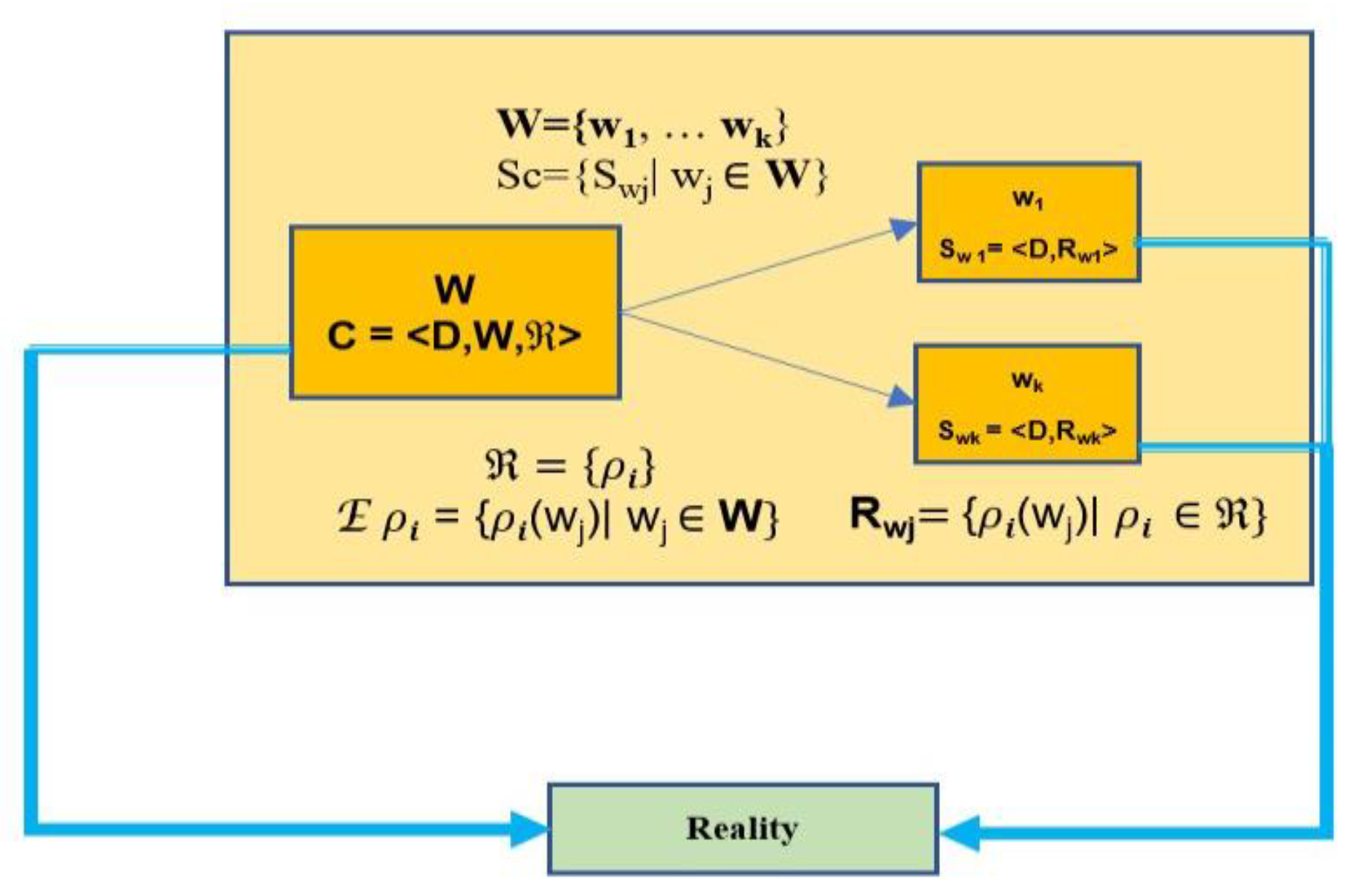
In the proposed model, the conceptualization is represented by two levels of structures. On the higher level is the intensional structure C =< D,W, ℜ >, which contains all possible worlds. The lower level can be viewed as a function from possible worlds into extensional structure sets such as:
Sw1 = < D,Rw1 >,..., Swk = < D,Rwk >.
Figure 1.
The conceptualization structure and its two levels.
Therefore, we formally define the structure as follows:
- ρn ∶W→ 2Dn where ρn is intensional relations are defined on a domain space < D,W > where D is a domain and W is a set of maximal extensional structures of such a domain.
- For a generic extensional relation ρ, Eρ ={ ρ(w) ∣ w ∈ W} will contain the admittable extensions of ρ.
- A conceptualization for D can be now defined as triple C =< D, W, ℜ >, where ℜ is a set of extensional structures on the domain space < D,W >.
-
SwC=<D,RwC> is the intended extensional structure of w according to C.
- –
- RwC= {ρ(w)∣ρ∈ R} is the set of extensions (relative to w) of the elements of R.
- –
- SC is the set {SwC∣w ∈ W} of all the intended world structures of C.
- C=<D,R>=SwC is the structure of the universe, in the extensional form. This is a direct model for the structure of extensional conceptualization.
3.1. Epistemology: A Proposed Formulation
In order to comply with the conceptualization, we present a formal treatment of epistemology and ontology in terms of two distinct semantic levels, namely, intensional (Θ) and extensional (Φ). Generally, intensional semantics are broader than extensional semantics. Hence, if one knows the intensional of an expression, one can determine its extension with respect to a particular world [Napoli et al., 2017].
Since the notion of a model is an extensional account of meaning [Guarino et al., 2009], a conceptualization that is intentionally specified would necessitate an ontological commitment to specify the intensional meaning of the vocabulary and to constrain its models.
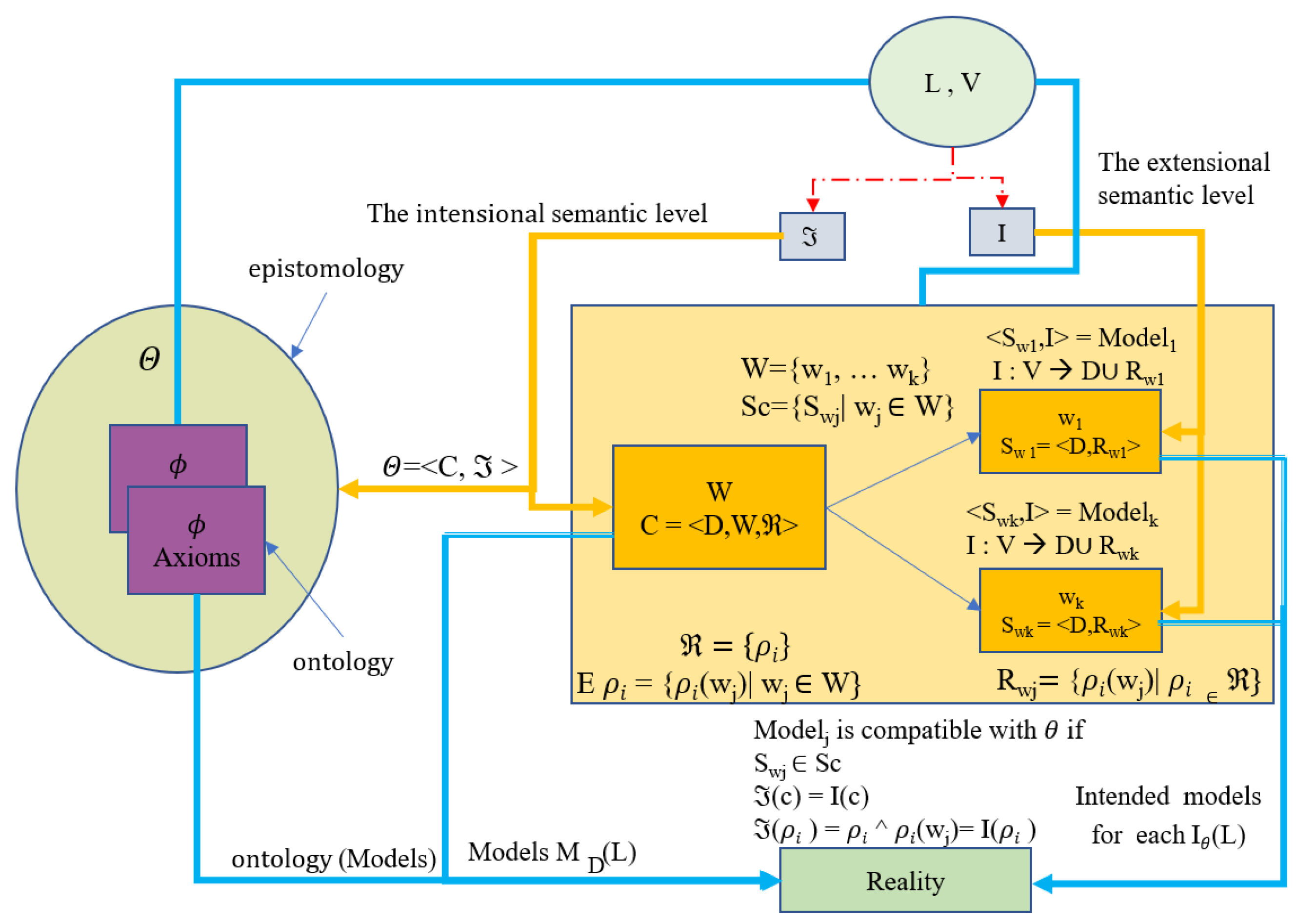
In this context, if we consider an intensional structure < D, W, ℜ >with an intensional language L, an intensional interpretation and vocabulary V , we can define the intensional semantic level of epistemology, which corresponds to ontological commitment in [Guarino et al., 2009], as:
Θ =< C, ℑ >
where:
- C is a conceptualization.
- ℑ is an intensional interpretation function assigning elements of D to constant symbols of V, and elements of ℜ to predicate symbols of V.
ℑ ∶ V → D ∪ ℜ
In order to restrict the intensional semantic level Θ, utilized by I, of the intentional logical language L to be used in a manner intended for a specific domain rather than randomly, an extensional interpretation I accompanied by a set of axioms is required.
3.2. Ontology: A Proposed Formulation
Now, given the intensional semantic level Θ and an extensional interpretation I, an intended extension (a model) M =< Sw,I > of L , is compatible with Θ if:
- SwC ∈ SC;.
- ∀c ∈ V ∶ I(c) = ℑ (c).
- ∃w ∈ W ∀p ∈ V ∶ ℑ (p) = ρ ∧ ρ(w) = I(p).
Therefore, for a language L and conceptualization C, the set of all extensions (models) of L that are compatible with Θ represents the set of intended extensions IΘ(L) of L according to Θ.
The extensional semantic level Φ of Θ can then be expressed as a specification of C formulated by a language L, an extensional interpretation I and a set of axioms that it and approximate the intensional interpretation to the intended extensions (models) IΘ(L).
As a result, we can say:
- Θ commits to C if it has been designed with the purpose of characterizing C , and it approximates the reality D through its extensions.
- A language L commits to Θ if it commits to conceptualization C such that Φ agrees with C.
- L commits to Φ for a given Θ such that the IΘ(L) is captured in the models for Φ.
Figure 2 below illustrates how the intensional semantic level is derived from an intensional interpretation, and the extensional semantic level from an extensional interpretation to form an ontological view.
3.2. Modal Logic Examples in the Healthcare Sector
In the healthcare sector, let’s consider a conceptualization C, where the universe of discourse D is defined as the set of all possible entities in the domain, including patients, physicians, nurses, and medical facilities. The set W represents the possible worlds in the conceptualization, representing different states of affairs in the healthcare sector. The set R represents the conceptual relations that hold within each possible world, including relations such as Patient1 (representing the set of patients), Physician1 (representing the set of physicians), Nurse1 (representing the set of nurses), and Facility1 (representing the set of medical facilities).
We can define a function ρn ∶ W→ 2Dn that maps each possible world w in W to a set of extensional structures ρ(w) representing the entities and relationships that hold within that world. Formally, ∀w ∈ W, we have:
- Patient1(w) ⊆D represents the set of patients in world w.
- Physician1(w) ⊆D represents the set of physicians in world w.
- Nurse1(w) ⊆D represents the set of nurses in world w.
- Facility1(w) ⊆D represents the set of medical facilities in world w.
- Diagnosis2(w) ⊆D × D represents the set of diagnoses made by physicians in world w.
- Assist2(w) ⊆D × D represents the set of assistance provided by nurses in world w.
Example 1:
Representing Relations between Patients, Physicians, and Nurses
In the Healthcare Sector In the healthcare sector, let’s consider two possible worlds, w1 and w2. In world w1, there is a patient p1 who is diagnosed with a disease d1 by physician ph1. Nurse n1 provides assistance to p1. The relations in this world can be represented using the function ρ as follows:
- Patient1(w1) = {p1}
- Physician1(w1) = {ph1}
- Nurse1(w1) = {n1}
- Diagnosis2(w1) = {(p1,d1)}
- Assist2(w1) = {(p1,n1)}
In world w2, there is a different patient p2 who is diagnosed with a different disease d2 by physician ph2. Nurse n2 provides assistance to p2. The relations in this world can be represented using the function ρ as follows:
- Patient1(w2) = p2
- Physician1(w2) = ph2
- Nurse1(w2) = n2
- Diagnosis2(w2) = (p2,d2)
- Assist2(w2) = (p2,n2)
This example illustrates how the proposed hybrid model for formal modeling of conceptualization in AI systems can be applied to represent the relations between patients, physicians, and nurses in the healthcare sector. By using the intensional structure ρ and the set of admittable extensions Eρ, we can represent the different possible states of affairs in the healthcare sector, including the different patients, physicians, nurses, and diseases that exist in each possible world, as well as the relationships between these entities.
Furthermore, by using modal logic, we can reason about the different beliefs and how they relate to each other in a more precise and formal manner than what is possible with traditional first-order logic (FOL) or description logic (DL). One of the limitations of FOL is that it lacks built-in mechanisms for representing modal notions such as necessity and possibility, which can be essential when reasoning about beliefs and perspectives. While it is possible to encode these notions in FOL using complex workarounds, this can lead to cumbersome and less intuitive representations. As for DL, it is typically focused on representing taxonomies and relationships between concepts, but it also lacks native support for modalities, which can hinder the representation of shared perspectives in a nuanced and flexible way. In contrast, modal logic provides a more natural and expressive formalism for representing and reasoning about perspectives, thanks to its built-in modal operators and richer semantics.
Example 2:
Representing and Reasoning about Different Perspectives in the Healthcare Sector
Now, let’s consider an agent, who is a nurse, who believes that patient p1 is diagnosed with disease d1 and is being assisted by nurse n1. We can represent this belief using the epistemic modal operator K and the accessibility relation R as follows:
Kp1(w1) ∧ Kd1(w1) ∧ Kn1(w1) ∧ R(w1,w2)
This means that the agent knows that patient p1 is diagnosed with disease d1 and is being assisted by nurse n1 in world w1, and also the agent believes that this is possible in world w2 as well.
Alternatively, let’s consider another agent, who is a physician, who believes that patient p2 is diagnosed with disease d2 and is being assisted by nurse n2. We can represent this belief using the epistemic modal operator K and the accessibility relation R as follows:
Kp2(w2)∧Kd2(w2)∧Kn2(w2)∧R(w2,w1)
This means that the agent knows that patient p2 is diagnosed with disease d2 and is being assisted by nurse n2 in world w2, and also the agent believes that this is possible in world w1 as well.
The use of the epistemic modal operator K and the accessibility relation R allows us to reason about these different beliefs and how they relate to each other in a more precise and formal manner than what is possible with FOL. Additionally, by utilizing the intensional structure ρ, we are able to represent and reason about different perspectives in the healthcare sector in a more comprehensive and accurate way. This, in turn, can help improve the performance of AI systems in a decentralized environment.
3.3. Applying the Hybrid Model to a Multi-Specialist Healthcare Scenario
In complex and dynamic domains such as healthcare, effective decision making often requires the integration of multiple perspectives and expertise. A hybrid approach combining epistemology, ontology, and epistemic logic provides a powerful and flexible framework to represent and reason about these diverse perspectives in a structured manner. This paper explores the application of this hybrid approach to modeling and analyzes the shared conceptualization among various medical professionals involved in the treatment of a patient with diabetes. Specifically, we focus on how the primary care physician, endocrinologist, and nephrologist can collaborate and make informed decisions based on their respective areas of expertise. By employing a conceptualization structure that incorporates intensional and extensional components, we demonstrate how the hybrid approach can be used to capture the different possible world structures representing the perspectives and knowledge of the medical professionals involved. This approach enables a more comprehensive understanding of the patient’s condition and facilitates better coordination and decision-making among the medical team. In the revised scenario, we will consider each specialist’s perspective as a separate possible world, reflecting their unique viewpoint and understanding of the diabetes treatment domain. For simplicity, let’s assume that there are two specialists: an endocrinologist (s1) and a nephrologist (s2).
First, we define the conceptualization C = ⟨D, W, ℜ ⟩ for the diabetes treatment scenario:
D: patient, primaryCarePhysician, endocrinologist, nephrologist, treatmentPlan, insulinType, dosage
W:
- w1 (endocrinologist’s perspective)
- w2 (nephrologist’s perspective)
ℜ:
- Patient(x)
- PrimaryCarePhysician(x)
- Endocrinologist(x)
- Nephrologist(x)
- TreatmentPlan(x)
- InsulinType(x)
- Dosage(x)
- HasDiabetes(x)
- ResponsibleFor(x,y)
- ProvidesInput(x,y,z)
- TreatmentPlanFor(x,y)
- TreatmentPlanIncludes(x,y,z)
Next, we define the intensional interpretation function I and vocabulary V :
- V : p,d,e,n,t,i,dos
- ℑ: V → D ∪ ℜ
- ℑ (p) = patient
- ℑ (d) = primaryCarePhysician ℑ (e) = endocrinologist ℑ (n) = nephrologist
- ℑ (t) = treatmentPlan
- ℑ (i) = insulinType
- ℑ (dos) = dosage
Now, let’s define the intensional semantic level (epistemology) Θ = ⟨C, ℑ ⟩.
For each possible world w ∈ W, we can define the intended extensional structure Sw,C as the set of extensional structures that hold within that world according to the conceptualization C.
Sw,C for w1 (the endocrinologist’s perspective):
- Sw,Cw =⟨D,Rw,Cw1⟩
- Sw,C for w2 (the nephrologist’s perspective):
- Sw,Cw =⟨D,Rw,Cw2⟩
Rw,Cw1 and Rw,Cw2 represent the sets of extensions (relative to w1 and w2, respectively) of the elements of R. These sets of extensions will differ based on the perspectives of the two specialists, capturing their unique viewpoints and understanding of the domain.
By considering the different perspectives of the two specialists as separate possible worlds, we can better represent their individual contributions and knowledge in the context of the diabetes treatment domain. This approach can facilitate more effective communication and decision-making among the medical team, ultimately leading to improved patient outcomes.
Let’s define the intended extensional structures SwCw1 and SwCw2 for Φ1 (endocrinologist’s perspective) and Φ2 (nephrologist’s perspective), respectively, along with their sets of extensions RwCw1 and RwCw2:
- SwCw1 = ⟨D,RwCw1⟩ (the intended extensional structure for w1, the endocrinologist’s perspective)
- SwCw2 = ⟨D,RwCw2⟩ (the intended extensional structure for w2, the nephrologist’s perspective)
For w1 (endocrinologist’s perspective on the ontological view2), we can define the set of extensions RwCw1 as follows:
- Patient(p)
- PrimaryCarePhysician(d)
- Endocrinologist(e)
- TreatmentPlan(t)
- InsulinType(t,i)
- Dosage(t,dos)
- HasDiabetes(p)
- ResponsibleFor(d,p)
- ProvidesInput(e,d,t)
- TreatmentPlanFor(t,p)
- TreatmentPlanIncludes(t,i,dos)
For w2 (nephrologist’s perspective), we can define the set of extensions RwCw2 as follows:
- Patient(p)
- PrimaryCarePhysician(d)
- Nephrologist(n)
- TreatmentPlan(t)
- InsulinType(t,i)
- Dosage(t,dos)
- HasDiabetes(p)
- ResponsibleFor(d,p)
- ProvidesInput(n,d,t)
- TreatmentPlanFor(t,p)
- TreatmentPlanIncludes(t,i,dos)
In these sets of extensions, RwCw1 and RwCw2, we capture the different perspectives of the two specialists, the endocrinologist (e) and nephrologist (n). The main difference between RwCw1 and RwCw2 is the type of specialist providing input to the primary care physician (d) regarding the treatment plan (t) for the patient (p).
In RwCw1, the endocrinologist (e) provides input, while in RwCw2, the nephrologist (n) provides input. These unique perspectives and inputs will contribute to the medical team’s overall understanding of the patient’s condition and inform their decision-making process for the treatment plan.
In order to apply modal logic to the scenario and identify the accessibility relation between the two possible worlds (w1 and w2), we can represent the treatment plan for a patient with diabetes by defining a set of modal operators and axioms. Let’s consider the following modal operators:
Ke: Represents the knowledge of the endocrinologist (in w1)
Kn: Represents the knowledge of the nephrologist (in w2)
R: Represents the accessibility relation between w1 and w2
Now, let’s formally represent the scenario using these modal operators and the previously defined extensional structures RwCw1 and RwCw2:
For w1 (endocrinologist’s perspective), we have:
- Ke,Patient(p)
- Ke,PrimaryCarePhysician(d)
- Ke,Endocrinologist(e)
- Ke,TreatmentPlan(t)
- Ke,InsulinType(t,i)
- Ke,Dosage(t,dos)
- Ke,HasDiabetes(p)
- Ke,ResponsibleFor(d,p)
- Ke,ProvidesInput(e,d,t)
- Ke,TreatmentPlanFor(t,p)
- Ke,TreatmentPlanIncludes(t,i,dos)
For w2 (nephrologist’s perspective), we have:
- Kn,Patient(p)
- Kn,PrimaryCarePhysician(d)
- Kn,Nephrologist(n)
- Kn,TreatmentPlan(t)
- Kn,InsulinType(t,i)
- Kn,Dosage(t,dos)
- Kn,HasDiabetes(p)
- Kn,ResponsibleFor(d,p)
- Kn,ProvidesInput(n,d,t)
- Kn,TreatmentPlanFor(t,p)
- Kn,TreatmentPlanIncludes(t,i,dos)
Now, let’s define the accessibility relation R between the two possible worlds:
R(w1,w2): This relation signifies that the information in w1 (endocrinologist’s perspective) is accessible from w2 (nephrologist’s perspective), and vice versa.
R(w2,w1): This relation signifies that the information in w2 (nephrologist’s perspective) is accessible from w1 (endocrinologist’s perspective).
By defining the accessibility relation R between w1 and w2, we allow the sharing of knowledge between the two specialists’ perspectives. This, in turn, helps the medical team to collaborate and make informed decisions about the patient’s treatment plan. By combining the knowledge from both perspectives, the primary care physician can consider the input from both specialists and adjust the treatment plan accordingly.
In this context, the accessibility relation R allows us to reason about the combined knowledge of the endocrinologist and the nephrologist. Using modal logic, we can define some additional axioms to describe the relationship between their knowledge:
To represent the axioms using modal logic, we can use the following notation:
KeProvidesInput(e,d,t) → KnProvidesInput(e,d,t)
KnProvidesInput(n,d,t) → KeProvidesInput(n,d,t)
KeTreatmentPlanIncludes(t,i,dos)∧ KnTreatmentPlanIncludes(t,i,dos)
→ KdTreatmentPlanIncludes(t,i,dos)
In this notation, Ke and Kn represent the knowledge of the endocrinologist and nephrologist, respectively.
These axioms use the modal operators defined earlier to represent the relationship between the knowledge of the endocrinologist and the nephrologist. The first two axioms state that if one specialist provides input for the treatment plan, the other specialist is aware of this. The third axiom states that if both specialists agree on the insulin type and dosage for the treatment plan, the primary care physician will include it in the final plan. With these axioms, the medical team can analyze the shared knowledge between the endocrinologist and nephrologist perspectives and make more informed decisions about the patient’s treatment plan. This approach ensures that the different perspectives and expertise of the specialists are taken into account, leading to a better overall understanding of the patient’s needs and a more effective treatment plan.
3.3. Summary of Hybrid Model for Formal Modeling of Conceptualization in AI Systems
In summary, the proposed hybrid model for formal modeling of conceptualization in AI systems integrates the principles and approaches from ontology and epistemology to create a comprehensive and robust representation framework that accommodates both intensions and extensions. By incorporating both ontological and epistemological perspectives, the model is able to provide a more comprehensive and precise representation of knowledge and beliefs within a given domain. The use of modal logic, specifically the epistemic modal operator K and the accessibility relation R, allows for reasoning about the different perspectives and beliefs within the system, providing a more robust and accurate representation of knowledge showing the potential of the model to be applied to any domain where there are different perspectives and beliefs that need to be represented and reasoned about.
4. Implications, Limitations, and Future Research
4.1. Implications for Future Research and Practice
The conclusions drawn from our literature review and the proposed hybrid model for formal modeling of conceptualization in AI systems have several implications for future research and practice in the field of AI systems, particularly in domains requiring the representation and reasoning of various perspectives and beliefs. This promising approach for representing knowledge and reasoning aims to address the limitations of existing models. Key implications include:
- Improved AI system performance: By providing a consistent and accurate representation of knowledge, beliefs, and relationships within a domain, the proposed model may contribute to enhanced decision-making and problem-solving capabilities in AI systems.
- Interdisciplinary collaboration: The integration of ontology, epistemology, and modal logic in the proposed model highlights the importance of interdisciplinary collaboration in addressing complex problems in AI systems. This approach can inspire future research to draw upon diverse fields to create innovative solutions.
- Scalability: The proposed model's flexibility and adaptability can support the growth and expansion of AI systems in various domains, allowing for seamless integration of new entities and relationships.
- Standardization: The formal modeling approach can contribute to the development of standard protocols and guidelines for representing knowledge and beliefs in AI systems, facilitating interoperability and compatibility among diverse systems.
4.2. Limitations
Despite the potential benefits of the proposed hybrid model, there are some limitations that should be considered:
- Complexity: The integration of ontology, epistemology, and modal logic in the proposed model may increase its complexity, which could present challenges in implementation and maintenance.
- Applicability: Although the patient treatment journey scenario demonstrated the effectiveness of the proposed model, its applicability to other sectors and use cases remains to be further explored.
- Evolution of knowledge: The proposed model may not fully account for the dynamic nature of knowledge and its continuous evolution in various domains, potentially requiring periodic updates to maintain accuracy and relevance.
4.3. Future Research Directions
To address these limitations and further refine the proposed hybrid model, future research could explore the following areas:
- Development of tools and frameworks: To facilitate the implementation and maintenance of the proposed model, future research could focus on developing tools, frameworks, and techniques that streamline the process. For example, in the healthcare domain using a graph database like Neo4j, researchers could define axioms in modal logic, design a graph schema capturing modal logic relationships, assign properties to nodes and relationships, import healthcare data adhering to the schema, and query the graph using Cypher to analyze the healthcare domain while incorporating modal logic. By developing tools, frameworks, and techniques that support these steps, future research can streamline the implementation and maintenance of the proposed model, making it more accessible and practical across various domains.
- Evaluation in diverse contexts: Additional case studies in various sectors and use cases could be conducted to assess the generalizability and robustness of the proposed model across different contexts.
- Adaptive modeling: Incorporating mechanisms for handling the dynamic nature of knowledge and its evolution in various domains could enhance the proposed model's effectiveness and applicability.
- Integration with other AI techniques: Exploring the synergies between the proposed model and other AI techniques, such as machine learning and natural language processing, could provide additional insights and further improve the representation and reasoning capabilities in AI systems.
The proposed hybrid model can be employed in semantic integration, a process of combining and reconciling information from different sources to create a unified and coherent understanding. The model's combination of ontology, epistemology, and modal logic enables it to effectively represent and reason about the knowledge, beliefs, and relationships within various domains. This makes it particularly well-suited for addressing the challenges posed by semantic integration.
When applied to semantic integration, the proposed model offers several advantages:
- Enhanced understanding: By representing the underlying structure and meaning of information from diverse sources, the model can facilitate a more comprehensive understanding of the data, leading to better decision-making and problem-solving.
- Conflict resolution: The model's ability to represent and reason about different perspectives and beliefs can help identify and resolve inconsistencies or contradictions that may arise during the integration process.
- Improved interoperability: By providing a standardized and formal approach to representing knowledge and beliefs, the model can enhance the compatibility and interoperability of information from different systems, facilitating seamless integration.
5. Conclusions
In conclusion, the proposed hybrid model for the formal modeling of conceptualization in AI systems represents a groundbreaking advancement, offering a robust and versatile tool for representing and reasoning about diverse perspectives and beliefs in decentralized environments. By skillfully integrating the strengths of ontology, epistemology, and modal logic, our model delivers a more precise and formal representation of entities, relationships, and states of affairs across various domains, such as healthcare. The incorporation of modal logic, along with the epistemic modal operator K and the accessibility relation R, paves the way for more accurate and formal reasoning about diverse beliefs and their relationships, setting it apart from traditional FOL approaches.
The model's effectiveness has been convincingly demonstrated through a concrete example and scenario in the healthcare sector, showcasing its immense potential to revolutionize AI system performance in decentralized environments. The example provided serves as a testament to the model's potential applicability, which extends far beyond healthcare to encompass a wide range of domains and industries.
In our rapidly evolving and interconnected world, the ability to reason about different perspectives and beliefs is of paramount importance. The proposed model rises to this challenge, offering a powerful and innovative tool for researchers and practitioners in the AI field. As AI advancements continue to redefine the boundaries of what is possible, this model is poised to play a pivotal role in realizing these possibilities. We firmly believe the proposed model will leave an indelible mark on the AI field, and we eagerly anticipate its continued development, refinement, and application.
References
- [Adhnouss et al., 2022] Fateh Mohamed Ali Adhnouss, Husam M. Ali El-Asfour, Kenneth A McIsaac, El-Feghia, Aburukba, and Wahaishi. Ontological view-driven intensional semantic integration for information systems in a decentralized environment. In Proceedings of the 14th International Joint Conference on Knowledge Discovery, Knowledge Engineering and Knowledge Management, IC3K 2022, Volume 2: KEOD, pages 109–116, 2022.
- [Ali and McIsaac, 2020] Islam Ali and Kenneth A McIsaac. Intensional model for data integration system in open environment. In Knowledge Engineering and Ontology Development Conference: KEOD, pages 189–196, 2020.
- [Allen and West, 2018] JR Allen and DM West. How artificial intelligence is transforming the world, 2018.
- [Bealer, 1979] George Bealer. Theories of properties, relations, and propositions. The Journal of Philosophy, 76(11):634–648, 1979.
- [Borst, 1999] Willem Nico Borst. Construction of engineering ontologies for knowledge sharing and reuse,1999.
- [Brachman and Schmolze, 1989] Ronald J Brachman and James G Schmolze. An overview of the kl-one knowledge representation system. Readings in artificial intelligence and databases, pages 207–230, 1989.
- [Burrieza and Yuste-Ginel, 2020] Alfredo Burrieza and Antonio Yuste-Ginel. Basic beliefs and argument-based beliefs in awareness epistemic logic with structured arguments. In Computational Models of Argument, pages 123– 134. IOS Press, 2020.
- [El-Asfour et al., 2022] Husam M. Ali El-Asfour, Fateh Mohamed Ali Adhnouss, Kenneth A McIsaac, and Wahaishi. The nature of intelligence and its forms: An ontologicalmodeling approach. Waset. Org, 16:40–47, 2022.
- [Floridi, 2008] Luciano Floridi. The Blackwell guide to the philosophy of computing and information. John Wiley & Sons, 2008.
- [Floridi, 2010] Luciano Floridi. Information: A very short introduction. OUP Oxford, 2010.
- [Fox and Lappin, 2008] Chris Fox and Shalom Lappin. Foundations of intensional semantics. John Wiley & Sons,2008.
- [Frege, 1952] Gottlob Frege. Translations from the philosophical writings of gottlob frege. edited by peter geach and max black. 1952.
- [Gergen, 1999] Kenneth J Gergen. Agency: Social construction and relational action. Theory & Psychology, 9(1):113–115, 1999.
- [Genesereth and Nilsson, 2012] Michael R Genesereth and Nils J Nilsson. Logical foundations of artificial intelligence. Morgan Kaufmann, 2012.
- [Gruber, 1995] Thomas R Gruber. Toward principles for the design of ontologies used for knowledge sharing? International journal of human-computer studies, 43(5-6):907– 928, 1995.
- [Guarino et al., 2009] Nicola Guarino, Daniel Oberle, and Steffen Staab. What is an ontology? In Steffen Staab and Rudi Studer, editors, Handbook on ontologies, pages 1–17. Springer, 2009.
- [Guarino, 1998] Nicola Guarino. Formal ontology in information systems: Proceedings of the first international conference (FOIS’98), June 6-8, Trento, Italy, volume 46. IOS press, 1998. 6.
- [Guba and Lincoln, 2005] Egon G Guba and Yvonna S Lincoln. Paradigmatic controversies, contradictions, and emerging confluences. 2005.
- [Guizzardi and Halpin, 2008] Giancarlo Guizzardi and Terry Halpin. Ontological foundations for conceptual modelling. Applied Ontology, 3(1-2):1–12, 2008.
- [Haraway, 1988] Donna Haraway. Situated knowledges: The science question in feminism and the privilege of partial perspective. Feminist studies, 14(3):575–599, 1988.
- [Keet, 2018] Maria Keet. An introduction to ontology engineering, volume 1. Maria Keet Cape Town, South Africa, 2018.
- [Khurana et al., 2022] Diksha Khurana, Aditya Koli, Kiran Khatter, and Sukhdev Singh. Natural language processing: State of the art, current trends and challenges. Multimedia tools and applications, pages 1–32, 2022.
- [Kripke, 1980] Saul A. Kripke. Naming and Necessity. Harvard University Press, Cambridge, MA, 1980.
- [Lapso and Peterson, 2022] Joshua Lapso and Gilbert Peterson. Factored beliefs for machine agents in decentralized partially observable markov decision processes. In The International FLAIRS Conference Proceedings, volume 35, 2022.
- [Majkic and Prasad, 2018´ ] Zoran Majkic and Bhanu Prasad.´ Intensional fol for reasoning about probabilities and probabilistic logic programming. International Journal of Intelligent Information and Database Systems, 11(1):79–96, 2018.
- [Majkic, 2006] Zoran Majkic. Intensional semantics for p2p data integration. Lecture notes in computer science,4090:47, 2006.
- [Napoli et al., 2017] Donna Jo Napoli, Rachel Sutton Spence, and Ronice Muller de Quadros. Influence of pred-¨ icate sense on word order in sign languages: Intensional and extensional verbs. Language, 93(3):641–670, 2017.
- [Ntankouo Njila et al., 2021] Roger Cesari ́e Ntankouo Njila, Mir Abolfazl Mostafavi, and Jean Brodeur. A decentralized semantic reasoning approach for the detection and representation of continuous spatial dynamic phenomena in wireless sensor networks. ISPRS International Journal of Geo-Information, 10(3):182, 2021.
- [Studer et al., 1998] Rudi Studer, V Richard Benjamins, and Dieter Fensel. Knowledge engineering: principles and.
- methods. Data & knowledge engineering, 25(1-2):161–197, 1998.
- [Themistocleous and Irani, 2001] Marinos Themistocleous and Zahir Irani. Benchmarking the benefits and barriers of application integration. Benchmarking: An International Journal, 2001.
- [Tsoukas, 2004] Haridimos Tsoukas. Complex knowledge: Studies in organizational epistemology. OUP Oxford, 2004.
- [Wang et al., 2009] Ying Daisy Wang, Hamada Ghenniwa, and Weiming Shen. Ontological view based semantic transformation for distributed systems. In 2009 IEEE International Conference on Systems, Man and Cybernetics, pages 4007–4012. IEEE, 2009.
- [Xue et al., 2012] Yunjiao Xue, Hamada H Ghenniwa, and Weiming Shen. Frame-based ontological view for semantic integration. Journal of Network and Computer Applications, 35(1):121–131, 2012.
Figure 2.
The relationships between the epistemology with intensional semantic level and ontology with the extensional semantic level.
Figure 2.
The relationships between the epistemology with intensional semantic level and ontology with the extensional semantic level.
Disclaimer/Publisher’s Note: The statements, opinions and data contained in all publications are solely those of the individual author(s) and contributor(s) and not of MDPI and/or the editor(s). MDPI and/or the editor(s) disclaim responsibility for any injury to people or property resulting from any ideas, methods, instructions or products referred to in the content. |
© 2023 by the authors. Licensee MDPI, Basel, Switzerland. This article is an open access article distributed under the terms and conditions of the Creative Commons Attribution (CC BY) license (http://creativecommons.org/licenses/by/4.0/).
Copyright: This open access article is published under a Creative Commons CC BY 4.0 license, which permit the free download, distribution, and reuse, provided that the author and preprint are cited in any reuse.


