

Submitted:
22 May 2023
Posted:
23 May 2023
You are already at the latest version
Abstract
Background: Caregivers of asthmatic children have poor knowledge of proper asthma man-agement practices in Nigeria. The objective of this study was to examine the knowledge, attitudes, and practice behaviors of caregivers in the management of asthma in children under age 5 in Oyo State, Nigeria, using the Health Belief Model. Methods: While a mixed method was used in the original research, this brief describes the quantitative method used in this study to evaluate caregiver’s asthma management practices A 55-item questionnaire investigating childhood asthma knowledge, attitude, and practice was administered during child welfare clinic visits to 118 caregivers. To gain insights into caregivers’ beliefs about asthma management practice behavior, focus group discussions were conducted among two groups of 10 caregivers. Data were analyzed using the IBM SPSS Version 25.0. Statistical significance was set at p < 0.05 and 95% CI. Result: More than 70% of caregivers knew that asthma is associated with airway inflammation and about 90% knew that Flu infections triggered asthma attacks in their children. Overall, 70% of caregivers from the focus group discussions found preventive measures including avoidance of common triggers like dust and smoke, wearing warm clothes in cold weather, environmental sanitation, regular visits to the clinic, and medication adherence helpful. Similarly, caregivers reported the use of quick-to-relieve OTC drugs rather than seeking medical attention. Caregivers with higher income (OR = 3.0; 95% CI = 1.558-5.778; P = 0.001) were 3.0 times more likely to practice proper asthma behavior than those with a lesser income. Conclusion: Despite having moderate knowledge of asthma, caregivers of asthmatic children had wrong perceptions and inadequate knowledge about preventive and treatment options. An optimal public health approach is needed to identify and target underserved communities that suffer poorer asthma outcomes and improve caregivers’ knowledge and skills in asthma management practices. The need to pay more attention to the proper management of childhood asthma among caregivers in underserved populations cannot be overemphasized.
Keywords:
asthma management behavior
; pediatric asthma
; childhood asthma management
; caregivers
; wheezing
; asthma triggers
; inhaler
; rural communities
; and Nigeria
1. Introduction
Asthma is a significant global health problem; and a leading cause of respiratory disorder among children around the world.1 In Nigeria, the prevalence of asthma remains unknown with certainty as there is insufficient literature on the burden of asthma.2 Nevertheless, there is little data to estimate the prevalence burden of asthma in Nigeria; with a prevalence ranging from 5.1% to 14.3%. in children and 7% -18% in the general population in adults between the ages of 15-35 years.3,4
Childhood asthma not only affects the children but also their caregivers because children depend on them for care. Caregivers experience the challenges of pre-identification and management of early asthma symptoms and potential triggers of asthma exacerbation; knowing how and when to practice appropriate asthma preventive measures and seek emergency care and being able to differentiate asthma symptoms from other health conditions.5 Reports in the literature indicate that caregivers residing in rural communities are confronted with the profound hardship of poverty and are unable to afford quality asthma care for their children.6,7 Several factors contribute to the poor management of childhood asthma in rural Nigeria. Some of these factors are related to poor standards and access to quality primary care such as the lack of proper health infrastructures, and a shortage of rural health workforce6,7 Similarly, low educational attainment, poor economic background, cultural and religious beliefs, attitudes toward chronic illnesses, and psychological stressors have also been shown to affect asthma management practice behaviors of caregivers.8 However, the extent to which some or a combination of these factors impact childhood asthma management practices has not been investigated. In developing countries like Nigeria, there is a paucity of reports on childhood asthma management practices by caregivers in resource-poor communities. To address these gaps in knowledge, this study was conducted to assess the knowledge, attitude, and practice among caregivers of children with asthma and identify the factors associated with their knowledge and beliefs of asthma management practices.
2. Materials and Methods
Study design and sample population
Although this study employed an explanatory sequential mixed method design and a multistage sampling technique, the focus of this paper is the quantitative methodology used in this research. The study was conducted in ten healthcare facilities within three Local Government Areas in Oyo State within the Ibadan Metropolitan area. Participants were selected using a multistage sampling of caregivers of children with wheezing or asthma episodes in the last 12 months from May to July 2020. The sampling process for this study included three stages. (i.e., two-stage random sampling of health facilities and convenience sampling of research subjects). A clustered sampling was used in the first stage of the sampling for the selection of Local Government Areas (LGAs). Followed by a simple random sample of clusters (LGAs) which yielded 3 LGAs from the eleven LGAs in the Ibadan Metropolitan area. Of the 109 health facilities within the three LGAs, 9 primary healthcare facilities and one state hospital were selected at random. Within the ten health facilities, participants were selected based on availability (convenience sampling). Recruitment of participants was conducted on the child welfare clinic days at the health facilities. Caregivers of children with wheezing or asthma episodes in the last 12 months were also identified from the weekly patient registration log and invited by the medical staff to participate in this study.
Study Procedure
At the start of the interview, the interviewer screened for suitability and enrolled those who met the eligibility criteria. Face-to-face interviews were carried out with 118 caregivers from May to July 2020. Enrolled participants gave both written and verbal consent, respectively.
The questionnaire: A research team member administered a 55-item questionnaire (Appendix 1). The knowledge domain was adapted from the 17-item Asthma Knowledge questionnaire (AKQ). AKQ is a disease-specific questionnaire developed and validated by Martínez and Sossa,9 with questions on knowledge about symptoms, triggers, and interventions. The attitude and practice domain were adapted from the Child Asthma Risk Assessment Tool (CARAT)10, a 57-item questionnaire developed by the National Cooperative Inner-City Asthma Study to determine the impact of primary care, clinic-based interventions on symptoms days (http://Carat.asthmarisk.org/). The modified version of this instrument has been used in another study to evaluate the baseline asthma knowledge, attitude, and practice of primary caregivers of asthmatic children.8 The combined instrument (i.e., AKQ and CARAT) was reviewed in the Jiann-Ping Hsu College of Public Health for face and content validity.
Measures related to the questionnaire: the questionnaire included the following measures to which the responses were recorded as a binary response (Yes/No) or as a 5-point Likert-scale response ‘strongly disagree (SD=5)’, ‘disagree (D=4)’, ‘neither agree, nor disagree (N=3)’, ‘agree’ (A=2), and ‘strongly agree (SA=1)’, respectively. This implies that the correct response was either ‘strongly agree’ or “strongly disagree” and ultimately dependent on the correct response for each specific research question. The survey instrument for this study was divided into six sections:
Demographic characteristics include the child’s sex, age, and parental SES (i.e., education and income levels) (Questions 1-5).
Background of the study population and health characteristics including family history, access to healthcare, and its utilization (Questions 6-17).
Perceived susceptibility and severity of asthma through research questions on asthma-related knowledge and understanding of risk factors. This has been subcategorized into three parts (Section 3a: Myths and Beliefs regarding asthma (Question 18-24), Section 3b: Level of knowledge about the disease (Question 25-30); Section 3c: Knowledge about associated aspects of asthma (Question 34-41).
Environmental exposures (Questions 34-41).
Perceived barriers to and benefits of practicing proper asthma management behaviors, including those regarding 48 costs, time, and access to health care facilities. (The research questions about the practice of caregivers in managing asthma in their children are from Questions 42-52).
The psychosocial and emotional burden of asthma on the child and the caregiver (Question 53-55).
Asthma Knowledge Score was estimated as follows:
The first category was Myths and beliefs regarding asthma” (Q18-24) which contains 7 questions and each question with a score of 1–5. The possible total score of 35 was subcategorized as follows: poor (score 7–14), moderate (score 15–21), and good (score 22–35).
The second category was “level of knowledge about the disease” (Q25-30) which contained six questions and each question with a score of 1–5. The possible total score of 30 was subcategorized as follows: poor (score 6–12), moderate (score 13–18), and good (score 19–30).
The third category was “knowledge about associated aspects of asthma” (Q31-33) which contained three questions and each question with a score of 1–5. The possible total score of 15 was subcategorized as follows: poor (score 3–6), moderate (score 6–9), and good (score 10–15). Missing answers to the asthma knowledge questionnaire were scored as ‘0’.
The total sum of all three categories was calculated to be 80 with higher scores indicating greater knowledge of asthma, and this total was subcategorized into three levels: poor (score 20–40), moderate (score 41–60), and good knowledge (score 61–80). In other words, those respondents who obtained an asthma knowledge score above 61 were considered as high-level knowledge, while the scores between 41 and 60 were considered medium-level knowledge. A score below 40 was considered low-level knowledge. The other segments contained closed-ended questions about the practice of caregivers in managing asthma in their children, environmental exposures, and the psychosocial and emotional burden of asthma on the child and the caregiver. The questionnaire was translated into the local language (i.e., Yoruba) and reviewed by a local research expert. A pilot study was conducted among 10 caregivers of children with asthma to ensure that the language and content were appropriate, and to ensure overall clarity and suitability of the instrument.
Data analysis
Data was entered in Statistical Package for Social Science (SPSS) software version 25.0. Descriptive results were compiled by computing frequencies for categorical variables. The continuous variables were summarized using means and SDs for normally distributed variables. Regression analyses were performed to test if there are significant associated factors affecting outcomes. The Chi-square test was used to test for categorical variables association. Statistical significance was claimed at p≤0.05 and we also provide 95% CI.
3. Results
One hundred and seventy-eight caregivers completed the interviewer-administered questionnaire, with a response rate of 98.9%. Table 1 summarizes the demographic and background characteristics of the study participants for both caregivers and their children. Of the 178 caregivers of children with asthma, 156 (87.6%) were mothers, 11 (6.2%) were fathers, and 10 (5.6%) were grandparents with the rest being guardians and relatives. The mean age of the children of the caregivers was 3.0 (±1.01) years, ranging from 1 to 5 years; 51.7% of them were male, and 48.7% were female. Most of the respondents (58.3%) had low levels of education (i.e., no education, attended primary and/or secondary school), whereas 34.8% (n=62) respondents attended college but did not receive a degree and 6.7 percent of the respondents said they had completed a college degree. The participants received most of the information about asthma from primary care doctors/nurses, relatives/friends, and the Internet (68%, 12.4%, and 2.8%, respectively).
Table 2 shows the Chi-square analysis result, which indicates that educational status in caregivers of children with asthma had no association with asthma control. However, there is an association between the income of caregivers and asthma control. The greater proportion of the caregivers of children with poorly controlled asthma had low education and a monthly income of less than $208 (78.1%). Income and asthma control are not independent of each other and there is a statistically significant relationship between these variables.
Table 3 and Table 4a present the analysis of the caregiver’s responses to the asthma knowledge questions. The total calculation (n) and analysis for section (See Table 3) and bivariate analysis (See Table 4a) were done for 178 participants, and this was the exact number of responses from this study. The mean score for the first category for the asthma knowledge questions (myths and beliefs regarding asthma) was 22.81 (±3.62) out of 35. Most of the respondents (66.9%) had good knowledge scoring, 31.5% had sufficient knowledge scoring, and only 1.7% had poor knowledge in this category.
The mean score for the second category (general knowledge about asthma) was 24.84 (± 3.56) out of 30. Most of the respondents (99.9%) had a high level of knowledge scoring with no poor knowledge in this category.
The mean score for the third category (knowledge about associated aspects of asthma) was 11.83 (±1.90) out of 15. Most of the respondents (94.4%) had good knowledge, 4.5% had sufficient knowledge and 1.1% had poor knowledge in this category. The mean value for the total knowledge score was 59.48 (±4.78) out of 80. Overall, more than half of the respondents (58.4%) had moderate knowledge and 41.6% had sufficient knowledge of asthma, misperceptions, and associated aspects of asthma.
| Table 4a. Score of Asthma Knowledge. |
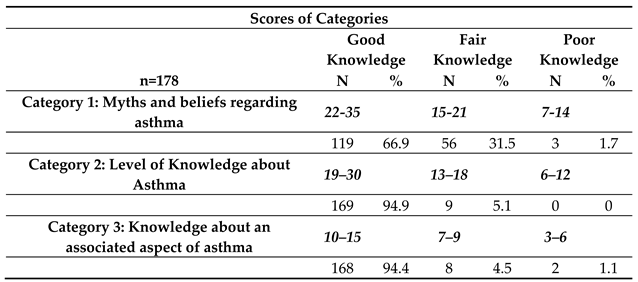 |
Table 4b summarizes the risk perception level of caregivers toward asthma in their children. Majority of the respondents 78.7% (140) had a moderate perceived susceptibility scoring between 3-5 (X̄= 3.66, SD = 1.191). Most of the respondents believed their children were susceptible to risk and severity of asthma based on their family history (40.4%), exposure to indoor pollutants and allergens linked to asthma such as type of cooking fuel (98.9%), mold/mildew (32%), pets (27%) and other environmental factors.
| Table 4b. Summary Score of Perceived Susceptibility level of the respondents. |
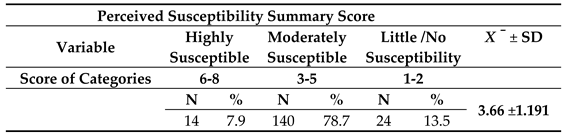 |
Table 5a summarizes the relationships between the Asthma perception level and knowledge of asthma triggers of the participants. A statistically significant association was found between the level of perceived susceptibility of an attack and asthma triggers variable (allergens (χ2=0.0259) and generated smoke only (χ2=0.0352). No statistically significant association was found between the caregiver’s perception level and other asthma triggers (URI, weather, and exercise variables).
| Table 5a. Association between Asthma perception level and knowledge of asthma triggers. |
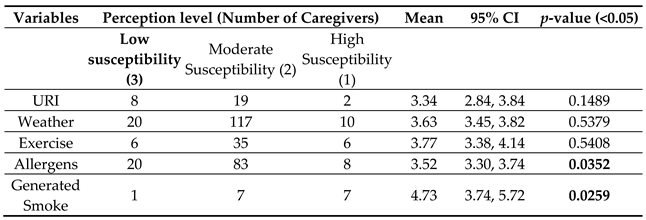 |
Table 5b shows the independent predictors of allergens-specific exposure. Majority of the caregivers believe that their child’s asthma is triggered by exposure to dust (OR = 0.324; 95% CI = 10.131-0.803; p = 0.015) and cleaning supplies (OR = 0.244; 95% CI = 0.88-0.677; p = 0.007), as these predictors were statistically significant.
| Table 5b. Estimated prevalence and odds ratio for independent predictors of allergens-specific exposure. |
 |
Table 6a summarizes the relationships between the caregiver’s pre-identification of early childhood asthma symptoms (dry cough at night and wheezing) and clinic visits. Caregivers with knowledge of wheezing (yes” category) were less likely to take their child to the clinic for asthma symptoms, a statistically significant result (p=.001); but more likely to visit the clinic for asthma symptoms (p=.000).
| Table 6a. Poisson regression analysis of early symptoms of asthma (dry cough at night and wheezing) and clinic visits, associated with the Caregiver’s pre-identification of early childhood asthma symptoms and frequency of asthma attacks. |
 |
Table 6b summarizes the relationships between the caregiver’s pre-identification of early childhood asthma symptoms (dry cough at night and wheezing) and hospital admissions. Asthma-related hospitalization in children within the last 12 months was significantly associated with the caregiver’s knowledge about childhood asthma symptoms e.g., dry cough (p=.020).
| Table 6b. Poisson regression analysis of early symptoms of asthma (dry cough at night and wheezing) and hospital admissions, associated with the Caregiver’s pre-identification of early childhood asthma symptoms and frequency of asthma attacks. |
 |
Table 6c summarizes the relationships between the caregiver’s pre-identification of early childhood asthma symptoms (dry cough at night and wheezing) and administering asthma medication. Caregivers with knowledge of wheezing are more likely to administer medicine for quick relief of asthma symptoms, a statistically significant result, p=.0005; but those with the knowledge of dry cough were less likely to administer medicine for quick relief of asthma symptoms, a statistically significant result, p=.003. Interestingly, the odds for knowledge of wheezing were twice that of dry cough 1.313 (1.313, 1.086) and were statistically significant.
| Table 6c. Poisson regression analysis of early symptoms of asthma (dry cough at night and wheezing) and administering asthma medication, associated with Caregiver’s pre-identification of early childhood asthma symptoms and severity of asthma attacks. |
 |
Tables 7a and b present the tabulation of asthma knowledge, education, and income level of participants and their practice in managing their child’s asthma. No significant correlation was found between asthma management practices and asthma knowledge of caregivers, χ2 (1) = 0.026, p=0.872). Those participants 46 (64.8%) with educational attainment of secondary school and below, engaged in poor asthma management practices compared to those with some college and college graduates 25 (35.2%), the difference was not significant. caregivers with income above N75, 000]. Caregivers with an income of N75, 000 ($208) and more were 3.0 times more likely to practice proper asthma behavior than those with a lesser income.
| Table 7a. Association between Asthma knowledge level and management practice scores of respondents. |
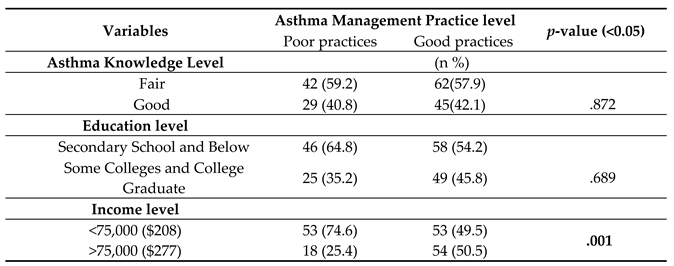 |
| Table 7b. Results of binary logistic regression analysis for odds of practicing asthma management behavior against the predictor variable (Income). |
 |
4. Discussion
The purpose of this study was to explore the level of knowledge, attitude, and practice behaviors of caregivers (i.e., parents and guardians) in the management of childhood asthma in Oyo State, Nigeria.
Most participants in the current study were mothers [n =156 (87.6%)]. This is expected since asthma is more prevalent in young children of young mothers. This study has presented data on the level of knowledge of caregivers about childhood asthma management practices in Oyo state, Nigeria highlighting the individual, behavioral, psychosocial, and environmental risk factors associated with asthma management practices. Mothers are expected to be more prevalent concerning asthma management since they are the primary caregivers of children below the age of 5 years old and mostly attend the child welfare clinic in rural Nigeria. Another local study found mothers to be the main caregivers attending the clinic with their children.5
Most of the children were boys aged ≥5 years. This finding is similar to that of a local study that found most children with asthma (60.9%) to be male within the preschool (2-5 years) and school-age (6-12 years).2 Further, the study found that the ages of asthmatic children ranged from 2 to 11 years with a mean age of 6.4 years.2 The prevalence of caregiver-reported asthma (98.3% ) in our study is comparable to that reported from other parts of Africa like Tanzania, Asia (Saudi Arabia, Pakistan, and China), and tropical countries.11,12,13,14
Study participants were interviewed during their visit to the child welfare clinic at the PHCs and pediatric department of the State Hospital where patients with unstable, difficult-to-control/severe asthma are being received; therefore, participants' level of knowledge and practice may vary for several reasons. Parents whose child has difficulty or hard-to-control asthma will more likely visit the PHCs and State hospitals, visit the doctors/nurses often, and as a result be more knowledgeable about asthma. Another reason may be that the state clinic has specialized pediatric doctors that provide specialized care and education to patients each time they visit the hospital. However, in this analysis, study participants were not subcategorized according to the healthcare settings, and hence, the caregiver’s level of knowledge and practice is not determined by the level of care received (whether caregivers attended the CWC at the PHC/ State hospital or not).
One potential factor that may explain the utilization of PHCs and the pediatric department of the State hospital may be the caregiver’s perception of disease severity and control. Besides, it is important to take into consideration the fact that the assessment of childhood asthma severity is based mainly on personal caregiver’s reports and not necessarily a medically diagnosed report. Asthma severity levels in children may be affected by caregivers’ poor perception of asthma symptoms in their children and difficulties in caregivers’ recognition of signs and symptoms of the disease in their children. While the caregiver’s perception of the disease has been linked to poor asthma management, in this study, there were other factors such as the degree of a child’s exposure to pollutants and level of asthma severity that contributed to the caregiver’s asthma care-seeking behavior and treatment for their children.
Family history of asthma was obtained, and the findings differ from prior studies that reported positive asthma history among most of their respondents.2, 11 Most of the respondents [n=106 (59.6%)] in this study reported no family history of asthma, and 72 respondents (40.4%) reported a history of asthma in the parents or close relatives. It is, however, low compared to the history of asthma 56 (52.8%) among children that attended the pediatric chest clinic of the Wesley Guild Hospital (WGH), Ilesha, Nigeria reported by Kuti et al., 2017. This finding correlates with the study on parents and guardians of children with asthma that attended the general pediatric and pediatric pulmonology outpatient clinics at King Abdullah Specialist Children’s Hospital, King Abdulaziz Medical City for National Guard, Riyadh, Saudi Arabia (during the period from August 2016 to March 2017).11 The relatively low response of family history reported in this study may be because family history is often overlooked as an important risk factor and caregivers may not consider family history as an indicator of risk for childhood asthma due to poor knowledge, myths, misconception, or cultural factors.
Further, since the source of asthma information is known to have an impact on knowledge and asthma management practices, it may be worthwhile to discuss caregivers’ sources of health information. The Internet is a growing source of health information in developing countries such as Nigeria, but in this study, 68% of participants reported primary care providers such as doctors and community health nurses as their source of information about asthma. Considering the poor standard of asthma care and the lack of asthma educators in many health facilities in Nigeria, the role of the radio, TV, and Internet as alternative sources of asthma education need to be enhanced. Professional and certified health education communication channels on asthma guidelines-based care and asthma self-management education need to be available for patients and their families.
Most of the participants in this study had a moderate knowledge score in the total knowledge and all knowledge subcategories (myths and beliefs, general knowledge, and knowledge of associated aspects) using the validated AKQ. A local study investigating a similar topic reported that the level of knowledge about childhood asthma was significantly poor among caregivers (38.5%) in the pediatric chest clinic of the Wesley Guild Hospital (WGH), Ilesha, Nigeria using a different AKQ with a mean knowledge score of 11.2 (SD =3.7) which ranged from1 to 18.5 The difference in their finding and this study may be related to the lower educational qualifications of caregivers in Ilesha (a smaller city) compared to Ibadan (a metropolitan city).
In the current study, participants were most knowledgeable about asthma pathophysiology (such as the role of airway inflammation), triggers of asthma exacerbation in their children, and questions related to diagnosis and treatment. The findings agree with the reports from Rastogi et al., 2013 and AlOtaibi, & AlAteeq, 2018. These studies found better knowledge among caregivers in questions related to symptoms of asthma, asthma triggers in their children, diagnosis and treatment, pathogenesis, and nature of the disease. The findings of this study agree with Rastogi et al., 2013 who found that caregivers had better knowledge of asthma triggers and were aware of the importance of using controller medications. The result of the current study also showed that caregivers were knowledgeable about the associated aspects of asthma, with 94.9% having a moderate level of knowledge. However, a severe deficit of knowledge was observed particularly in questions related to the myths and beliefs about asthma; where 31.5% of participants had fair knowledge and 1.7% had poor knowledge. In this subcategory of knowledge (myths and beliefs regarding asthma), caregivers were presented with statements such as “asthma is a curse from the gods,” “childhood asthma can be cured by homemade or herbal remedies,” and “pray before going to the clinic when your child has an asthma attack.” Caregivers’ misconceptions about asthma medication are reflected in their actual practice in managing asthma in their children, as almost half of the respondents in this study reported providing alternative therapy for asthma such as massage, homemade, and herbal remedies. Such therapies were more widely used by caregivers whose knowledge score was relatively low. This is consistent with the findings from international studies.2,15,17.
One potential factor that may explain the caregivers’ perceived susceptibility to risk and severity of asthma may be the underlying knowledge of asthma triggers. Factors associated with the asthma perception level among caregivers were family history of asthma; indoor environmental allergens e.g., house dust, cooking fuel, pets, mold, and other environmental pollutants such as tobacco smoke. Exposure to allergens may likely have contributed to asthma severity as reported by caregivers of children with asthma. The outcome of this study showed that caregiver’s knowledge of allergens and generated smoke was significantly associated with perceived susceptibility to an asthma attack, which was similarly reported by Rastogi et al.,2013, who found that knowledge of perceived triggers (e.g., infection, type of food consumed, and exercise) influenced caregiver’s perception of an asthma attack. Given the level of awareness about common triggers of asthma exacerbation, caregivers’ perception of risk can be low in terms of the frequency of symptoms and decreased risk of severe asthma attacks. Avoidance of exposure to dust and cleaning supplies in children with asthma will go a long way in ensuring good asthma control and ultimately improve their quality of life.
The current study showed that the severity of asthma was also associated with caregivers’ knowledge of early asthma symptoms. caregivers with knowledge of early asthma symptoms (i.e., recurrent wheezing and dry cough at night) reported high usage of quick-relief medicine for their children during asthma exacerbations. Similarly, the frequency of asthma attacks was found to be significantly related to the pre-identification of wheezing and dry cough at night as early symptoms of childhood asthma. In this study, caregivers with knowledge of early wheezing episodes (especially during or after exercise) were less likely to visit the clinic but more likely to visit the clinic with recurring dry cough episodes. The results suggest that caregivers would prefer to use cough medicines purchased from the patent and proprietary medicine vendors (PPMVs) in their community or use home remedies to help relieve cough symptoms in their children. These findings were similar to those reported by Rastogi et al. (2013) and Soo & Tan (2014). Despite the relatively good knowledge of asthma in this study, caregivers did not visit the primary health care center for asthma exacerbations like wheezing but went to emergency visits for night-dry cough, which led to hospital admissions. This also implies that caregivers are unable to translate their knowledge and awareness into action in situations of asthma exacerbations. Poor knowledge of early asthma symptoms may be associated with either frequent hospital admission or low clinic visits (i.e., frequency of healthcare-seeking behavior).
Socio-demographic class is an important predictor of asthma control in this study, which has also been reported in other studies.2,13,16 In these studies, the authors found that caregivers’ low income and unemployment status were significant predictors of poor asthma control in Pakistan, Nigeria, and the USA. In this current study, the result showed that the level of asthma control was not significantly related to caregivers' education, though more proportions of caregivers with children having well-controlled asthma had at least a secondary level education of education. This observation may be related to the fact that highly educated caregivers may have inadequate knowledge, incorrect caregiver-reported diagnosis, and wrong perception of asthma management practices.2 On the other hand, income level was significantly associated with asthma control in this study. Caregivers in the low-income category are at risk of the financial burden that makes them unable to afford the cost of proper asthma care for their children; hence, predisposes them to poor management of childhood asthma. This also implies that if asthma treatment services are easily accessible and affordable to all socio-economic classes in the community, asthma exacerbations will reduce leading to better asthma practices and improved quality of life for both the caregivers and their children.
In summary, our result suggests that caregivers of asthmatic children have moderate knowledge of the common asthma symptoms and aggravating factors but poor knowledge regarding fundamental asthma treatment and management. The challenge for future health promotion and public health lies in the careful identification of caregivers’ experiences, their needs in managing the care of their asthmatic child, and factors that facilitate or hinder the performance of appropriate asthma management practice behaviors. This study revealed that caregivers, particularly parents, play an important role in shaping healthcare behavior in their children. For better asthma management and control, an optimal public health approach is needed to identify and target underserved communities that suffer poorer asthma outcomes and improve caregivers’ knowledge and skills in asthma management practices. To holistically improve child asthma care and outcomes, asthma education campaigns, including community-targeted initiatives to engage caregivers, healthcare professionals, and the community at large are recommended. This study, however, contributes new findings to the existing literature done locally about childhood asthma management practices in Nigeria; and how social and environmental factors influence proper asthma management practice behaviors of caregivers.
Regarding the limitations of this work, this study was carried out in primary health care centers and state pediatric outpatient clinics with the selection of participants through a convenience sampling method. Although data saturation was achieved in the analysis, there is a possibility that other important aspects of the caregiver’s experience of asthma management were not captured. In addition, we used an interviewer-administered questionnaire in this research, interviewer bias recall bias cannot be excluded. Information on the frequency and severity of asthma symptoms reported by caregivers may not be accurate. Study participants may erroneously provide inaccurate or false reports depending on their ability to recall past asthma episodes, hence a recall bias. Despite these limitations, this study has contributed to the inadequate data on childhood asthma and factors associated with proper asthma management in a developing country. This study has also revealed insights into the level of knowledge, attitude, and practice behaviors of caregivers in the management of asthma in their children in developing countries like Nigeria, and examined factors associated with the barriers and benefits of proper asthma management practices.
5. Conclusions
In conclusion, this study shows the caregiver’s perception and understanding of asthma; as well as the benefits and barriers of successful asthma management practices (i.e., the decision of asthma care and adherence to appropriate asthma preventive and management measures). Understanding caregivers’ experiences of childhood asthma management play a pivotal role in the effort to achieve a sustainable approach to improving care for children with asthma. Given the limited healthcare resources in rural Nigeria, innovative use of multimedia platforms and help from other allied health professionals such as community health extension workers (CHEWS) and patent medicine vendors (PMVs) should be considered for the delivery of asthma education.
Author Contributions
Conceptualization, O.A., and A.A.; methodology, O.A., J.Y., and A.A.; software, O.A., and J.Y.; validation, O.A., J.Y., and A.A.; formal analysis, O.A., and J.Y.; investigation, O.A., and A.A.; resources, O.A.; data curation, O.A., and J.Y.; writing—original draft preparation, O.A., A.A., J.Y., J.C., and G.S writing—review and editing, O.A., A.A., J.C., and G.S.; visualization, O.A., and A.A.; supervision, A.A.; project administration, A.A., J.Y., J.C., and G.S.; funding acquisition. All authors have read and agreed to the published version of the manuscript.
Funding
This research received no external funding.
Institutional Review Board Statement
The study was approved by the Institutional Review Board of Georgia Southern University (protocol code: GSU-IRB# H19323, and date of approval: 4/12/2019) and the Research Ethics review committee of the Oyo state ministry of Health respectively.
Informed Consent Statement
Informed consent was obtained from all subjects involved in the study.
Data Availability Statement
Data is unavailable due to privacy.
Acknowledgments
We wish to acknowledge the Oyo State Ministry of Health who gave their unreserved support in ensuring that the study was conducted successfully. We are particularly grateful to the primary health care and state hospital staff for their participation and coordination of participants for this study.
Conflicts of Interest
The authors declare no conflict of interest.
References
- Asher, I.; Pearce, N. Global burden of asthma among children. The international journal of tuberculosis and lung disease 2014, 18, 1269–1278. [Google Scholar] [CrossRef] [PubMed]
- Kuti, B.P.; Omole, K.O. Epidemiology, triggers, and severity of childhood asthma in Ilesha, Nigeria: Implications for management and control. Nigerian Medical Journal: Journal of the Nigeria Medical Association 2017, 58, 13.
- Adeloye, D.; Chan, K.Y.; Rudan, I.; Campbell, H. An estimate of asthma prevalence in Africa: a systematic analysis. Croatian Medical Journal 2013, 54, 519–531. [Google Scholar] [CrossRef] [PubMed]
- Masoli, M.; Fabian, D.; Holt, S.; Beasley, R. Global Initiative for Asthma (GINA) Program. The global burden of asthma: executive summary of the GINA Dissemination Committee report. Allergy.
- Kuti, B.P.; Omole, K.O. Factors associated with caregivers' knowledge about childhood asthma in Ilesha, Nigeria. Annals of Nigerian Medicine 2016, 10, 30. [Google Scholar] [CrossRef]
- Bellin, M.H.; Land, C.; Newsome, A.; Kub, J.; Mudd, S.S.; Bollinger, M.E.; Butz, A.M. Caregiver perception of asthma management of children in the context of poverty. Journal of Asthma 2017, 54, 162–172. [Google Scholar] [CrossRef] [PubMed]
- Desalu, O.O.; Onyedum, C.C.; Iseh, K.R.; Salawu, F.K.; Salami, A.K. Asthma in Nigeria: Are the facilities and resources available to support internationally endorsed standards of care? Health Policy 2011, 99, 250–254. [Google Scholar] [CrossRef] [PubMed]
- Rastogi, D.; Madhok, N.; Kipperman, S. Caregiver asthma knowledge, aptitude, and practice in high healthcare utilizing children: effect of an educational intervention. Pediatric Allergy, Immunology, and Pulmonology.
- Martínez, C.R.; Sossa, M.P. Validation of an asthma knowledge questionnaire for use with parents or guardians of children with asthma. Archivos de Bronconeumología, 2005; 41. [Google Scholar]
- National Cooperative Inner-City Asthma Study. Child Asthma Risk Assessment Tool© (CARAT). Agency for Healthcare Research and Quality Rockville, MD. Available online: https://innovations.ahrq.gov/qualitytools/child-asthma-risk-assessment-tool-carat (accessed on 1 January 2019).
- AlOtaibi, E.; AlAteeq, M. Knowledge and practice of parents and guardians about childhood asthma at King Abdulaziz Medical City for National Guard, Riyadh, Saudi Arabia. Risk Management and Healthcare Policy 2018, 11, 67. [Google Scholar] [CrossRef] [PubMed]
- Simba, J.; Marete, I.; Waihenya, R.; Kombe, Y.; Mwangi, A.; Mburugu, P.; Ogaro, F. Knowledge and perceptions of childhood asthma among caretakers of children with asthma at a National Referral Hospital in Western Kenya: a descriptive study. African health sciences 2018, 18, 965–971. [Google Scholar] [CrossRef] [PubMed]
- Awan, A.S. , & Munir, S.S. Asthmatic Children. The Professional Medical Journal 2015, 22, 130–136. [Google Scholar]
- Zhao, J.; Shen, K.; Xiang, L.; Zhang, G.; Xie, M.; Bai, J.; Chen, Q. The knowledge, attitudes, and practices of parents of children with asthma in 29 cities of China: a multicenter study. BMC Pediatrics 2013, 13, 20. [Google Scholar] [CrossRef] [PubMed]
- Soo, W.F.; Tan, N.C. The influence of caregivers' knowledge and understanding of asthma etiology on domiciliary management of children with asthma. Singapore medical journal 2014, 55, 132–136. [Google Scholar] [CrossRef] [PubMed]
- Bloomberg, G.R.; Banister, C.; Sterkel, R.; Epstein, J.; Bruns, J.; Swerczek, L.; Garbutt, J.M. Socioeconomic, family, and pediatric practice factors that affect the level of asthma control. Pediatrics 2009, 123, 829–835. [Google Scholar] [CrossRef] [PubMed]
- Ho, J.; Bender, B.G.; Gavin, L.A.; O'Connor, S.L.; Wamboldt, M.Z.; Wamboldt, F.S. Relations among asthma knowledge, treatment adherence, and outcome. Journal of Allergy and Clinical Immunology 2003, 111, 498–502. [Google Scholar] [CrossRef] [PubMed]

Table 1.
Demographics and Background Characteristics of the Participants.
| Demographic Data (n=178) | N | % |
|---|---|---|
| Education Level of Caregivers | ||
| No Education | 6 | 3.4 |
| Primary School | 23 | 12.9 |
| Secondary School | 75 | 42.1 |
| College | 62 | 34.8 |
| College Graduates | 12 | 6.7 |
| Relationship to Child | ||
| Mother | 156 | 87.6 |
| Father | 11 | 6.2 |
| Grandparents | 10 | 5.6 |
| Other Relatives or Guardians | 1 | 0.6 |
| Family Income (Monthly) | ||
| 0-75,000 | 106 | 59.6 |
| >75,00 – 100,000 | 72 | 40.4 |
| >100,000 | 0 | 0 |
| Gender of Child | ||
| Male | 92 | 51.7 |
| Female | 86 | 48.3 |
| Sources of Information about Asthma | ||
| N (n=178) | % | |
| Primary Care Provider (i.e Doctor, Nurse) | 121 | 68 |
| Internet/Social Media | 5 | 2.8 |
| Relatives/Friends | 22 | 12.4 |
| Other Sources (Radio/TV) | 30 | 16.9 |
Table 2.
Descriptive Statistics Based on Asthma Control.
| Poorly controlled | Well-controlled | |||||
|---|---|---|---|---|---|---|
| Variable | N | % | N | % | X2 | P |
| Education | 0.329 | >0.05 | ||||
| Secondary School and Below | 19 | 59.4 | 85 | 58.2 | ||
| Some College and College Graduate | 13 | 40.6 | 61 | 41.8 | ||
| Income | 0.018 | <0.05 | ||||
| <75,000($208) | 25 | 78.1 | 81 | 55.5 | ||
| >75,000 ($277) | 7 | 21.9 | 65 | 44.5 | ||
Table 3.
Asthma Knowledge Questions.
| Strongly agree | Agree | Neither agree/nor Disagree | Disagree | Strongly disagree | |
|---|---|---|---|---|---|
| N (%) | N (%) | N (%) | N (%) | N (%) | |
| Section 3a: Myths and beliefs regarding asthma. | |||||
| Asthma is a curse from the gods. | 90 (50.6) | 48 (27.0) | 34 (19.1) | 4 (2.2) | 2 (1.1) |
| Childhood Asthma can be cured by traditional herbs/ homemade or herbal remedies. | 20 (11.2) | 24 (13.5) | 60 (33.7) | 58 (32.6) | 16 (9.0) |
| Your child may outgrow asthma. | 6 (3.4) | 16 (9.0) | 25 (14.0) | 89 (50.0) | 42 (23.6) |
| Inhaler use can lead to dependence or addiction. | 4 (2.2) | 33 (18.5) | 44 (24.7) | 67 (37.6) | 30 (16.9) |
| After a child’s asthma attack, once the coughing is over, the use of an inhaler or medications should be stopped? | 12 (6.7) | 27 (15.2) | 21 (11.8) | 89 (50.0) | 29 (16.3) |
| It is not good for children to use an inhaler for too long. | 4 (2.2) | 22 (12.4) | 50 (28.1) | 63 (35.4) | 39 (21.9) |
| When a child has an asthma attack, it is best to pray before going to the emergency room/clinic especially when symptoms are mild. | 19 (10.7) | 26 (14.6) | 30 (16.9) | 63 (35.4) | 40 (22.5) |
| Section 3b: Level of Knowledge about Asthma | |||||
| The main cause of asthma is airway inflammation. | 3 (1.7) | 3 (1.7) | 29 (16.3) | 65 (36.5) | 78 (43.8) |
| Asthma attacks can be prevented if medications are taken even when there are no symptoms between attacks. | 4 (2.2) | 11 (6.2) | 18 (10.1) | 77 (43.3) | 68 (38.2) |
| Flu (common cold & cough) infections are the main causes or triggers of asthma attacks. | 5 (2.8) | 8 (4.5) | 17 (9.6) | 59 (33.1) | 89 (50.0) |
| If an asthmatic child gets the flu, you should apply the inhaler even if there is no coughing or wheezing | 5 (2.8) | 20 (11.2) | 31 (17.4) | 61 (34.3) | 61 (34.3) |
| Asthmatic children might have attacks that are severe enough to require hospitalization in an intensive care unit or they might even die from an attack. | 1 (0.6) | 2 (1.1) | 5 (2.8) | 45 (25.3) | 125 (70.2) |
| Some medications for asthma do not work unless they are administered every day. | 4 (2.2) | 14 (7.9) | 47 (26.6) | 55 (30.9) | 58 (32.6) |
| Section 3c: Knowledge about an associated aspect of asthma | |||||
| Children who have asthma should not participate in sports that make them run too much. | 3 (1.7) | 5 (2.8) | 11 (6.2) | 61 (34.3) | 98 (55.1) |
| It is best not to smoke or let anyone else smoke near a child who has asthma. | 1 (0.6) | 2 (1.1) | 1 (0.6) | 40 (22.5) | 134 (75.3) |
| If the parents/guardians of a child with asthma smoke outside the house, it won’t affect the child. | 48 (27.0) | 47 (26.4) | 19 (10.7) | 31 (17.4) | 33 (18.5) |
Disclaimer/Publisher’s Note: The statements, opinions and data contained in all publications are solely those of the individual author(s) and contributor(s) and not of MDPI and/or the editor(s). MDPI and/or the editor(s) disclaim responsibility for any injury to people or property resulting from any ideas, methods, instructions or products referred to in the content. |
© 2023 by the authors. Licensee MDPI, Basel, Switzerland. This article is an open access article distributed under the terms and conditions of the Creative Commons Attribution (CC BY) license (http://creativecommons.org/licenses/by/4.0/).
Copyright: This open access article is published under a Creative Commons CC BY 4.0 license, which permit the free download, distribution, and reuse, provided that the author and preprint are cited in any reuse.


