

Submitted:
22 May 2023
Posted:
23 May 2023
You are already at the latest version
Abstract
Energy efficiency is, in principle, a simple idea: an output of human value, for example, vehicle-km traveled, divided by the needed input energy. Efficiency improvements are regarded by many as an important means of mitigating not only climate change, but also other environmental problems. Accordingly, many countries have efficiency ratings for appliances and efficiency standards for road vehicles. Despite the vast number of articles published on energy efficiency, few question whether it is a useful or accurate measure in its present form. This review addresses this lack, by a critical review of the literature, not only in energy efficiency, but in other areas of research, such as ‘energy services’, that can help broaden the scope of this idea, both geographically and conceptually. These shortcomings are illustrated in case studies of road passenger transport and buildings. The main findings are that energy efficiency inevitably has an ethical dimension, that feedbacks are more widespread than generally considered, and that conventional efficiency measures omit important energy input items, particularly those concerned with mining of the materials needed for renewable energy plants. Finally, the key results of this review are summarized, and its limitations are discussed, as is the future research needed to overcome these shortcomings.
Keywords:
buildings energy efficiency
; climate change
; energy efficiency
; feedback effects
; passive solar energy
; renewable energy
; transport energy efficiency
; urban heat island
1. Introduction
Humans have always used energy. Initially, like all other heterotrophs, it was for food. Fire was discovered and utilized by humans hundreds of millennia ago, and much later, renewable energy sources such as wind and water power were employed. Fossil fuels were even used in small amounts many centuries ago, with peat being the most important [1]. The concept of energy efficiency and its measurement, however, had to wait until scientific progress in understanding the equivalence of heat and energy, and accurate means of measuring the calorific value of the various fuels.
Energy efficiency is today widely regarded as an important means of cutting energy use and, consequently, carbon emissions. Most countries have implemented at least some policies intended to improve energy efficiency, such as efficiency standards for private vehicles, or energy ratings for domestic appliances. Both the latest report of the Intergovernmental Panel on Climate Change (IPCC) [2] and the International Energy Agency (IEA) [3] regard energy efficiency as an important means of reducing GHGs and energy use. The European Union has made ‘energy efficiency first’ the guiding principle for energy policy in achieving the energy transition needed [4].
As a simple illustration of how energy efficiency is presently assessed, consider a coal-fired power station. The simplest efficiency measure is the annual output electricity in gigawatt-hr (GWh = 109 Wh) divided by the thermal content of the annual input of coal (in gigajoule (GJ = 109J) into the generating plant. By converting GWH into GJ, percentage efficiency of the plant can be calculated, perhaps 45%. But this is far from the full story; two important considerations are, first, the embodied energy consisting of that needed to mine the coal, process it, and transport it to the power plant boilers, and second, the need to deal with combustion air emissions. Important emissions are various oxides of sulfur and nitrogen, and particulate emissions, all of which can adversely impact the health of humans. In most modern coal plants, scrubbers are installed to remove oxides of sulfur, and particulate traps to remove particles. NOX emissions are being addressed, but remain a serious health issue, with 97% of the urban population in the European Union (EU) still exposed to levels exceeding World Health Organization (WHO) guidelines [5]. Estimated global deaths from the transport sector were estimated at 385,000 in 2015 [6]. The important point here is that human welfare—and thus values—are brought into efficiency calculations. Accounting for both coal production and pollution control will lower the calculated efficiency, but not significantly.
Once welfare/ethical considerations are introduced, the logical next step is address to the greenhouse gas (GHG) emissions from power stations. Several articles have recently discussed the dire predicament facing humanity if climate change (CC) is not urgently dealt with (e.g., [7,8,9,10,11,12,13]). Raymond et al. [14] have shown that in some parts of the world, the wet-bulb temperature can on occasion already exceed the limits of human heat tolerance. Together, these articles and others show that even the survival of humans, or at least human civilization as we presently knot it, is at stake. GHGs can thus be regarded as a second level pollutant.
For a comprehensive picture of the power plant efficiency, then, the energy costs of removing GHG emissions, mainly carbon dioxide (CO2), must be included. Various approaches have been proposed for CO2 removal, including carbon dioxide removal (CDR), both mechanical and biological. CO2 can be removed directly by carbon capture and storage (CCS), which involves using amines to capture the CO2 emitted, compressing it, then burying it deep underground [15]. Direct air capture (DAC) involves capturing CO2 from the ambient air. Since its atmospheric concentration is only 0.04%, much more energy is needed for capture than is the case for direct capture at power plants. Nevertheless, ambient air CO2 concentrations are still far higher than concentrations of particulates, SOx and NOx in the plant exhaust gases. They are also far higher than dealing with the air pollutants discussed, with their much lower concentrations in the plant exhaust gases.
Other possibilities include bioenergy with carbon capture and storage (BECCS), reforestation and enhanced mineral weathering. Biological carbon capture in plants and soils are already practiced to some extent, and are regarded as cheaper than mechanical approaches, but there are doubts both about their potential, and the possibility that they could reduce albedo in some regions [16]. One proposal, solar geoengineering (SG), would do away with the need for completely eliminating GHG emissions, and proponents claim, would have costs far lower than CCS or even biological sequestration, but for several reasons is not likely to be deployed on the scale needed [17].
As the Chatterjee and Huang [18] and Realmonte et al. [19] have demonstrated, there is deep uncertainty in the energy and monetary costs of DAC, as it has not been tried at scale. And as Lane et al. [15], have stressed, the potential for underground burial, needed for CCS, BECCS and DAC, is also unclear, mainly because the rate at which it can be safely sequestered is most uncertain. Such uncertainty means that the energy costs for full carbon mitigation are also uncertain, and hence, so is the real value of energy efficiency of a coal power station.
As will be shown, among the vast and growing research literature on energy efficiency, there are only a handful which attempt to examine the difficulties surrounding attempts to develop more relevant measures in a world facing increased environmental damage from energy use. This paper aims to fill that gap.
The argument in the rest of this review proceeds as follows. Section 2 surveys the present energy efficiency literature, noting the paucity of articles critically examining this concept, and gives an outline of the approach used. Section 3 discusses the topic in broad terms, concentrating on the need to broaden its boundaries, both geographically and conceptually. The next two sections introduce two case studies to illustrate what rethinking the concept could mean, Section 4 examining cities and buildings, including domestic residences, and Section 5 its application to road passenger transport, especially by private vehicle. Finally, Section 6 recapitulates the argument, discusses the limitations of the paper, and also gives directions for further research on the topic.
2. Method for selection of papers to review
The literature on energy efficiency is very large and growing. Putting the term ‘energy efficiency’ into the Scopus database revealed a total of over 261 thousand papers with that term in the title, abstract or keywords, with nearly 24 thousand in 2022 alone. Although isolated papers stretch back a century, research interest in the appears to have accelerated after the oil crises of the 1970s. Adding the term AND ‘critique’ to energy efficiency returned a mere 72 papers, or under 0.03%. Inspection of all these papers showed that nearly all were irrelevant to the rethinking the topic needs. When the term ‘barriers’ was substituted for ‘critique’, over 4900 articles were returned, but again, nearly all were concerned with overcoming the perceived barriers, not in looking deeper into what energy efficiency means. The research by UK social scientist Elizabeth Shove deserves special mention as one of the few researchers delving deeper into the concept [20,21].
Because of this dearth of critical articles, it was necessary to review papers on topics with some connection to that under investigation in order to gain further insight. The various topics which were accordingly examined included the following:
- Energy services: It is now a commonplace that people do not consume energy for its own sake, but because of the energy services it can provide [22].
- Energy feedback effects: In the form of energy rebound, this is a recognized feedback [23], but it needs to be expanded in scope. The energy rebound concept recognizes that improving energy efficiency can lead, not only to increased use of the higher-efficiency device such as a car, or alternatively, increased energy use in other sectors because of the money saved. Steren et al. [24] found that in Israel, the rebound effect of improved car efficiency increased over time, eventually resulting in no fuel savings because of increased driving. But feedbacks can also occur outside the nation state or region (such as the European Union) implementing efficiency improvements, as will be discussed in the following section.
- Joint production of goods: In discussing the costs and energy inputs to bioethanol production, for example, it is acknowledged that cattle feed is produced as well as ethanol, and that energy inputs should be partitioned between the two outputs, thus raising the efficiency of ethanol production [25].
- Cost benefit analysis (CBA): CBA is useful analogy because it attempts to look at all the (monetary) costs and benefits of a given project, such as a new airport.
- Pollution and its control: As discussed above, air pollution was the first environmental harm recognized as resulting from energy production and use. Pollution control introduces ethical notions into energy efficiency.
- Earth System Science (ESS): This review adopts an Earth System Science (ESS) approach, which in the context of this paper has two important aspects. First, the impact of one energy-using device can affect the energy use of other devices sharing the same building or road. Second, all feedback effects must be considered.
- Energy return on investment (EROI). EROI is a vital approach for assessing the energy inputs into energy systems, and its application will usually lead to lower values for energy efficiency.
Energy-related statistics were mainly taken from the global energy statistics published annually BP [28] and the IEA [29]. Historical energy use relied on United Nations [30], and Junker and Liousse [31]. Gross Domestic Product (GDP) data was taken from the World Bank database [32]. For the latest on CC science and mitigation, the most recent IPCC reports were used [2,33].
3. Energy efficiency: General considerations
Energy efficiency can be broadly defined as the input energy needed to produce an output of human interest, i.e., fulfillment of a task, which could be as varied as vehicular passenger-km (p-k), or the production of a tonne of wheat at the farm gate. However, for efficiency to have meaning, careful consideration must not only be given to the definition of the task being fulfilled, but also to the point in the energy supply chain at which the energy is measured.
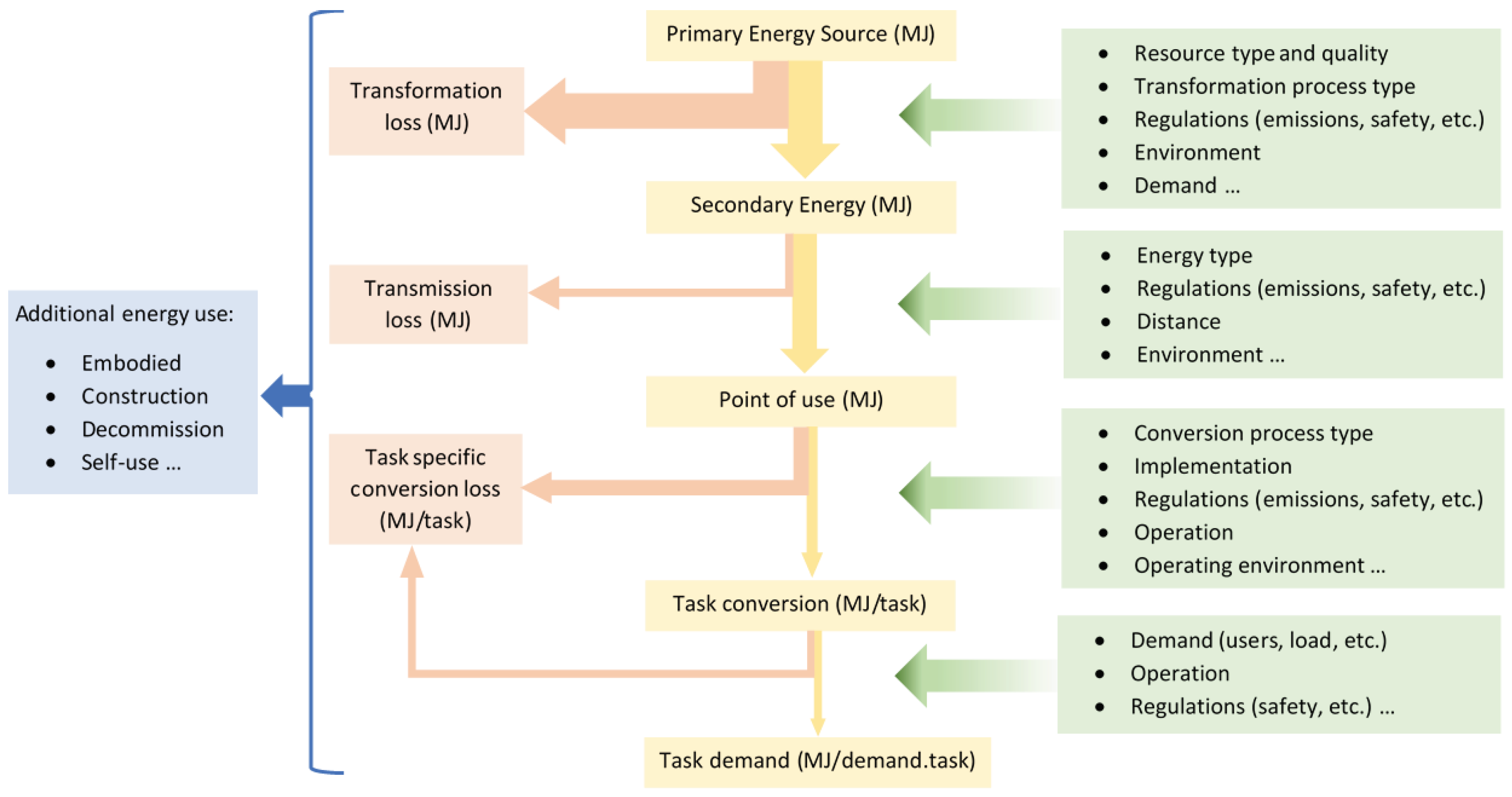
Figure 1 shows a representative energy supply chain in which primary energy (fossil fuels, nuclear energy, or renewables such as wind and solar) is transferred to the point at which a task is undertaken. System losses occur at each step in the transformation process. Losses depend on factors including: resource type and quality; transformation technology, limited by theoretical and engineering considerations; operational constraints and demand; regulation of emissions, safety and so on; and the operating environment, e.g., weather. Although indicative, the total losses can be significant. Laitner [34] has reported that in the early 2010s, the US overall was only 14% energy efficient, so that 86% of energy used is wasted, suggesting huge scope for efficiency gains.
A number of energy researchers regard energy efficient improvements as having the potential to produce large reductions in both energy use and CC mitigation [34,35,36]. Consider the case of electricity generation from RE sources, which because of their lower GHG emissions will need to dominate energy supply. For these, location largely determines resource quality (energy return relative to installed capacity), and in the case of solar is modulated by weather. The efficiency of the transformation of the primary energy source to secondary energy is technology dependent. For solar PV, for example, cell and transformer efficiency are among the critical determinants, and much focus has been put into improving these.
However, RE power systems in general use greater quantities of material per gigawatt (GW) of power generated [37], than FF power plants. This is especially the case for the comparatively rare materials needed for PV cells and wind turbine generators [38]. Given the low capacity factors for wind and PV systems, their materials use per gigawatt-hr (GWh) will be even higher. A recent IEA report [39] looked at global demand for various materials if the world is to have zero carbon emissions by 2050. It found that demand for certain key materials—including ‘lithium, copper, cobalt, nickel and the rare earth elements’—would need to rise six-fold. Moreau et al. [40] reached similar conclusions, but also found that ‘that scarcity relates sometimes more to techno economic supply than to raw material availability.’
Many of these minerals are presently mined in low-or even middle-income countries in tropical Africa or elsewhere, where environmental legislation and enforcement are often poor. The result is that mine wastes are at best put in tailings dams—which are often poorly-constructed and fail—or, even worse, are not contained at all. As Ali [41] reminds us, ‘There’s no free lunch in clean energy’. All energy sources, including RE, have environmental side effects.
Ensuring RE generation is not lost to curtailment will require large scale use of energy storage systems such as batteries, which, like the power plant, must be manufactured and maintained. Transmission losses to deliver the energy to the point of use depend on such things as distance, voltage, and conductor material used. Due to their size and resource quality, solar PV power plants are often located far from load centers, and are in many cases distant from the existing electricity grid.
The complexity inherent in the energy supply chain has led to the use of different definitions of efficiency. In the case of vehicles for example, efficiency can be reported as ‘tank (or battery) to wheels’ (MJ/km) or ‘well to wheels’ (MJ/km) which takes the measurement boundary to the primary energy source. Further inclusions may account for energy (and emissions) embodied in the supply chain giving rise to a ‘full life cycle’ efficiency. If travel is the task to be fulfilled, differences in the way efficiency is measured enable comparisons between fuels, technology, and travel modes. While transport has been used here as an illustration, similar comments can be made regarding use of energy to produce any output of human interest.
Importantly, the efficiency of an energy-intensive device, such as a vehicle or air conditioner, cannot be properly considered in isolation. This isolation may ignore the effect of the presence of similar devices—congested roads are known to lower the efficiency of all road vehicles, although to some extent, drivers can themselves have some over control vehicle efficiency by ‘eco driving’ [42]. On the other hand, if fully automated vehicles (AVs) were to travel on freeways as a platoon, air resistance would be lower on the following vehicles, just as it is with wagons on a railway freight train. The complexities of efficiency measurement for internal combustion engine vehicle (ICEVs) as compared with EVs are discussed in detail in Section 4.
Similarly, it can be argued that putative gains from national energy efficiency improvements for private road vehicles and large household appliances needs to be considered in a global context. The need arises for two reasons, illustrated here by private vehicle ownership. The first arises from the huge disparity in vehicle ownership (considering only vehicles with four wheels or more) between various countries, from over 1000 vehicles per 1000 population (that is, over one per person) in some countries to under 10 in several low-income countries, mainly in tropical Africa [43]. The second is the signal that the emphasis on energy efficiency—and recently on EVs as a means of raising efficiency and cutting carbon emissions—sends to present and aspiring car owners in all countries. This message is that technical fixes like energy efficiency or EVs can solve all our environmental challenges [44]; there is no need to consider alternatives such as giving non-private road travel priority, or emphasizing access over vehicular mobility.
Yet another way in which system boundaries for energy efficiency must be widened is the existence of other global challenges apart from potential fossil fuel depletion and global CC. The initial list by Steffen and colleagues [45] included nine global limits; the crossing of even one of these would have serious consequences for Earth’s environment. Both Bradshaw et al. [7], and Dirzo et al. [8] have stressed the dangers facing global biodiversity. Dryden and Duncan [46] and Georgian et al. [47] have discussed those facing oceans, including acidification and steady loss of ocean phytomass. Heinze et al. [48] have warned that the oceans are at risk of crossing several ocean tipping points, including ‘warming, ocean acidification, and deoxygenation’. Gross [49] has discussed the growing problem resulting from widespread plastic pollution.
Just as a number of studies now look at the energy costs of avoiding FF carbon emissions, similar assessments could be done on the costs of avoiding these other global environmental challenges. Moving away from FFs can ameliorate some of these problems, but it also has the potential to make them worse (see, e.g., [50,51]). Sonter et al. [50] entitled their article: ‘Renewable energy production will exacerbate mining threats to biodiversity’.
4. Energy efficiency: Cities and their buildings
The energy efficiency of entire economies can be readily assessed by its inverse, energy intensity, which measures GDP output per unit of energy, for various economic sectors or for regions at various scales—at the city, country or even world level. Given that national energy statistics are readily available for each year [28,29], and national GDP data from the World Bank [32], national intensities can be compared, and also the variation in any one country over time. For the world overall, World Bank data indicate that energy intensity has fallen over time, indicating improved efficiency. Many high-income countries, especially in Europe, have lower energy intensities than the world average. However, this can be misleading as these countries are often net importers of energy-intensive goods, which lowers their recorded intensity. As already discussed, a global approach is needed for accurate comparisons.
For the rest of this review, interest will focus on two specific sectors, rather than the overall economy. The energy efficiency of cities and their buildings (as well as energy-consuming devices within buildings), which account for nearly 40% of global energy use [52] and road passenger transport, will be considered in turn. All transport accounted for nearly 26% of global final energy demand, and road transport was 77% of this value [53]. Importantly, domestic energy use and private transport energy are the only two energy uses directly under control of households.
Cities overall can partly make their own climate, as evidenced by the Urban Heat Island (UHI) effect, which can cause cities to be several °C warmer than the surrounding countryside [54]. UHI has several causes, but an important one is the heat release from all the city’s energy consuming devices, from power plants to computer laptops. The UHI thus exerts an influence on the cooling needed in buildings in the warmer months, and the heating needs in the colder ones. In warmer climates, it may make sense to counter the UHI effect—and higher summer temperatures in general—by applying a reflective surface to the roofs of buildings [55], in order to increase the overall urban albedo, i.e., the fraction of insolation which is reflected directly back into space. The downside is that winter heating needs may increase, so the overall energy efficiency of roof coatings is location dependent.
An alternative approach to countering UHI is to at least partly reverse another important UHI cause: the loss of evapotranspiration cooling resulting from paved surfaces and buildings replacing vegetated surfaces. More urban parks, even ‘urban forests’ have accordingly been promoted to improve thermal comfort [56]. However, urban parks have another benefit: the increase the wellbeing of those with ready access to them [57,58]. In summary, urban parks, produce joint outputs, one readily quantifiable (the temperature decrease in an urban park relative to the surrounding area), and one difficult to quantify benefit, an improvement in wellbeing. How to partition any input energy costs (e.g., for watering and maintenance) is thus very complex.
Another example of joint outputs is provided by combined heat and power (CHP) or cogeneration projects, mostly located in China in Europe. Globally, in 2116, about 16% of electricity came from CHP plants, which also provided 11 EJ of heat [59]. Such systems were also common in the early days of electricity, but with the rise of very large generating units, often located near coal mines, they fell from favor. Emphasis shifted to maximizing the electricity output for a given fuel input, with combined cycle gas turbine plants reaching efficiencies of more than 60%. CHP plants are smaller, and situated in residential areas. Some are powered by municipal waste [60], which can produce an additional benefit as well as heat and power: they can reduce CH4 emissions from municipal landfills.
Calculating the energy efficiency of a given device such as an electric light or a refrigerator by conventional means may be misleading, as they are invariably used in the same building with a host of other energy-consuming appliances, such as office or home computers, refrigerators and freezers, and air conditioners. In cold weather, the heat released from all this equipment helps to heat the building. Conversely, in warm weather, they add to the cooling load, unless ways are found to exhaust the heat generated from energy-intensive appliances like washing machines and refrigerators to outside the building in warm weather.
Apartment blocks offer a further illustration of the complexities of energy efficiency measurement in buildings [61]. Apartments kept at lower temperatures during cold months will receive a heat flow from adjacent apartments kept at a higher temperature. The lower-temperature occupants have higher thermal comfort because of an energy subsidy from other apartments.
Further, as Elizabeth Shove [20] has pointed out, defining energy efficiency in terms of energy use per volume (as with freezers) can work in favor of purchasing larger units. The same applies to buildings—larger buildings are perceived as more energy efficient. For dwellings, a more useful index would be energy use per person, but such a concept would be difficult to apply to public buildings, with their varying occupancy rates.
5. Energy efficiency: Road passenger transport as a case study
Efficiency of ICEVs is usually measured by km per liter of fuel (or, in the US, miles per gallon). This value is based on the refined fuel and as noted above is often termed ‘tank-to-wheels’ efficiency. A more comprehensive (and relevant) measure is ‘well-to-wheels’ efficiency, which is based on primary energy. This approach enables comparison with vehicles using other fuels, such as electric propulsion for both public and private transport. Merely comparing tank-to-wheels efficiency of EVs and ICEVs would be misleading, since the higher efficiency of EVs on this measure is offset by the much lower primary to secondary energy conversion efficiency for electricity compared with oil refining.
Importantly, propulsion efficiency for all vehicle types has shown steady improvement. For the US, the fuel efficiency of both cars and light trucks more than doubled from 1970 to 2019 [62]. Nevertheless, there are doubts as to whether further gains in the ‘well-to-tank’ efficiency component can continue. Court and Fizaine [63] have shown how the energy return on investment (EROI) for fossil fuels (FFs) in recent decades has declined over time. This decline will continue as reserves of economically recoverable petroleum are exhausted; further attempts of oil-importing nations to develop national lower EROI fields because of energy security concerns will also lower well-to-tank efficiency. So far, the CO2 emissions from petroleum fuels—and bioliquids appear to be no better [64]—have been largely ignored in efficiency calculations. For well-to-wheels efficiency, CO2 emissions can be included by calculating the energy needed to avoid these emissions, for example by direct air capture followed by CO2 burial deep underground.
For electricity production, efficiency calculations are even more complicated, depending on the energy mix. For fossil fuel power stations, incorporating the energy needed to account for CO2 emissions is the same as above. For RE electricity, calculations are more complex, mainly because of the energy costs of the materials needed for wind and PV electricity. These two primary electricity sources are not only presently the fastest-growing electricity sources, but the International Energy Agency (IEA) [53] also forecast that these sources will supply most electricity in the coming decades. As for CO2 emissions from fossil fuels, there are notional energy costs for safe disposal of mining wastes, and remediation of the areas mined.
An important problem with energy efficiency as usually measured is that the system boundaries are drawn too narrowly. A good illustration would be the efficiency comparison between electric vehicles (EVs) and internal combustion engine vehicles (ICEVs). For use in EVs, efficient conversion of the electricity into vehicle motion depends on the vehicle powertrain and batteries, vehicle design (e.g., shape and mass), and operation (e.g., driving pattern, air conditioner use, etc.). The lower mass specific energy storage of batteries relative to liquid fuels means that EVs are generally heavier than the equivalent ICEVs. Furthermore, all too often, only propulsion efficiency is considered. However, in colder climates, cabin heating is often needed for occupant comfort. The inefficiency of ICEV engines means that engine waste heat is available, but for EVs, additional heating will be needed, perhaps from onboard propane burners [65,66]. The vehicle engine actually produces joint products in the form of two energy services: vehicle propulsion and occupant thermal comfort.
Driving patterns (i.e., behavior, urban or freeway driving) can reduce or increase efficiency. Congestion reduces efficiency particularly for ICEVs, whereas for EVs regenerative braking can recover some losses. Vehicle design and use are heavily regulated. Increasing safety requirements in response to human welfare concerns increases vehicle complexity (leading to increased embodied energy and emissions), although technological development has led to efficiency gains through, for example, use of light-weight materials and enhanced power train efficiency, and for EVs, increased battery energy density. Although emissions from use of EVs powered by RE use are almost entirely limited to particulate emissions from tire wear and brake pads, regulations (i.e., standards or guidelines) exist in various forms at national and international levels to manage some, but not all, pollutants emitted during their manufacture. An important source of EV pollution is safe disposal of used batteries [67,68]. As noted in the power station example discussed in Section 1, should removal of pollutants require energy, this must be accounted for in system energy flows [27].
The demand for the task can impact efficiency; increasing vehicle occupancy improves the task specific efficiency if measured in units of energy per unit passenger kilometer (MJ/p-k), while also increasing vehicle mass-based losses (e.g., rolling resistance). Buses may have higher task specific efficiency than passenger vehicles, but only once a critical occupancy level has been reached.
The efficiency of non-motorized transport—walking and cycling—is also a complex matter. These modes are far more energy efficient than motorized modes on a secondary energy basis for the fuels used (food vs petrol or diesel for vehicles). Many countries, however, including some outside the OECD, are suffering from both an obesity crisis and a lack of exercise [69,70]. Given this, it is clear that the energy cost of non-motorized travel for such people (including most residents in the high-income countries) is irrelevant: the more energy we use the better, to burn up food calories. Similar ideas apply to ICEV cabin heating; since the energy is freely available, energy efficiency is not an issue, as it would be for EVs used in cold climates.
6. Discussion and conclusions
The discussion in this paper has shown that measuring energy efficiency is not a simple matter, and is subject to deep uncertainty, for several reasons. Although energy efficiency is simply defined as useful output divided by energy input, both the numerator and the denominator of this equation may be subject to large uncertainties. It is argued in this paper that both are conceived too narrowly. Figure 1 shows all the factors which must be considered. The output too often focuses on a single device, such as a refrigerator. Nevertheless, simple efficiency measures, such as passenger-km/MJ or vehicle-km/MJ for vehicles have their uses, for instance as a means of comparing the efficiency of different car models. However, their limitations as policy instruments to reduce energy use or carbon emissions in the world overall, or even in just one country, need to be recognized.
Energy inputs often do not fully consider the total energy input costs, especially those incurred overseas. This lack leads to an over-estimation of the real energy efficiency. It follows that policies based on this misleading information may increase energy use rather than decrease it—or worsen pollution if remedial energy costs are ignored—at least from a global context. Certainly, the steady rise in both global primary energy and resulting CO2 emissions over the past three decades [28], despite steady improvement in efficiencies at the appliance level, seems to bear this out. As Stoddard et al. [71] have pointed out, we are yet to bend the ‘global emissions curve’ for tackling CC.
The limitations of this paper also indicate the directions future research needs to take. The key limitation is the absence of numerical data incorporating the new ideas, for instance in transport, in contrast to the plentiful –if incomplete—data on appliance or vehicle efficiency. Much more work is also needed on the materials for RE power generation, including the quantities needed for an entirely carbon-free energy system, whether materials availability is likely to be a future problem for PV and wind turbine manufacture, and, particularly, means of assessing the energy needed for full environmental restoration of affected areas because of the pollution ensuing from mining these materials.
Author Contributions
Conceptualization, PM and DH; methodology, PM and DH; investigation, PM; data curation, DH.; writing—original draft preparation, PM.; writing—review and editing, DH; visualization, DH; project administration, PM. Both authors have read and agreed to the published version of the manuscript.
Funding
This research received no external funding.
Institutional Review Board Statement
Not applicable.
Informed Consent Statement
Not applicable.
Conflicts of Interest
The authors declare no conflict of interest.
Nomenclature
- AVs automated vehicles
- BECCS bioenergy with carbon capture and storage
- BTS Bureau of Transportation Statistics
- CBA cost benefit analysis
- CC climate change
- CCS carbon capture and storage
- CDR carbon dioxide removal
- CH4 methane
- CHP combined heat and power
- CO2 carbon dioxide
- CO2-eq carbon dioxide equivalent
- DAC direct air capture
- EIA Energy Information Administration
- EJ exajoule (1018 joule)
- EROI energy return on investment
- ESS Earth System Science
- EU European Union
- EV electric vehicle
- FF fossil fuels
- GDP Gross Domestic Product
- GHG greenhouse gas
- GJ gigajoule (109 joule)
- Gt gigatonne = 109 tonne
- GW gigawatt (109 watt)
- GWh gigawatt-hr (109 watt-hr)
- ICEV internal combustion engine vehicle
- ICT Information and communication technology
- IEA International Energy Agency
- IPCC Intergovernmental Panel on Climate Change
- LCA Life cycle analysis
- MJ megajoule (106 joule)
- Mt megatonne (106 tonne)
- OECD Organization for Economic Cooperation and Development
- OPEC Organization of the Petroleum Exporting Countries
- ppm parts per million (atmospheric)
- p-k passenger-km
- PPP purchase parity pricing
- PV photovoltaic
- RE renewable energy
- SG solar geoengineering
- t CO2/cap tonnes CO2 per capita
- TWh terawatt-hour (1012 watt-hr)
- UHI Urban Heat Island
- USD US dollars
References
- Wikipedia. Fossil Fuels. 2023. https://en.wikipedia. 14 April.
- Intergovernmental Panel on Climate Change (IPCC). Climate Change 2022: Mitigation of Climate Change. 2022. Available online: https://www.ipcc.ch/report/ar6/wg3/ (accessed on 24 April 2023).
- International Energy Agency (IEA). World Energy Outlook 2022; IEA/OECD: Paris, France, 2022. [Google Scholar]
- Trotta, G. Assessing Energy Efficiency Improvements, Energy Dependence, and CO2 Emissions in the European Union Using a Decomposition Method. Energy Efficiency 2019, 12, 1873–1890. [Google Scholar] [CrossRef]
- Mulholland, E.; Miller, J.; Bernard, Y.; Lee, K.; Rodríguez, F. The Role of NOx Emission Reductions in Euro 7/VII Vehicle Emission Standards to Reduce Adverse Health Impacts in the EU27 through 2050. Transp. Eng. 2022, 9, 100133. [Google Scholar] [CrossRef]
- 6. Anenberg,S.C.; Miller, J.; Henze, D.K.; Minjares, R.; Achakulwisut, P. The Global Burden of Transportation Tailpipe Emissions on Air Pollution-Related Mortality in 2010 and 2015. Environ. Res. Lett. 1088.
- Bradshaw, C.J.A.; Ehrlich, P.R.; Beattie, A.; Ceballos, G.; Crist, E.; Diamond, J.; Dirzo, R.; Ehrlich, A.H.; Harte, J.; Harte, M.E.; et al. Underestimating the Challenges of Avoiding a Ghastly Future. Front. Conserv. Sci. 2021, 1, 615419. [Google Scholar] [CrossRef]
- Dirzo, R.; Ceballos, G.; Ehrlich, P.R. Circling the Drain: The Extinction Crisis and the Future of Humanity. Phil. Trans. R. Soc. B 2022, 377, 20210378. [Google Scholar] [CrossRef] [PubMed]
- Kemp, L.; Xu, C.; Depledge, J.; et al. Climate Endgame: Exploring Catastrophic Climate Change Scenarios. Proc. Natl. Acad. Sci. USA 2022, 119(34), e2108146119. [Google Scholar] [CrossRef] [PubMed]
- Ripple, W.J.; Wolf, C.; Newsome, T.M.; Gregg, J.W.; Lenton, T.M.; Palomo, I.; Eikelboom, J.A.J.; Law, B.E.; Huq, S.; Duffy, P.B.; et al. World Scientists’ Warning of a Climate Emergency. Biosci. 2021, 71, 894–898. [Google Scholar] [CrossRef]
- Rising, J.; Tedesco, M.; Piontek, F.; Stainforth, D.A. The Missing Risks of Climate Change. Nature 2022, 610, 643–651. [Google Scholar] [CrossRef]
- Naeem, S.; Lu, Y.; Jackson, J. Curtailing the Collapse of the Living World. Sci. Adv. 2022, 8, eadf9317. [Google Scholar] [CrossRef]
- Steel, D.; DesRoches, C.T.; Mintz-Woo, K. Climate Change and the Threat to Civilization. Proc. Natl. Acad. Sci. USA 2022, 119, e2210525119. [Google Scholar] [CrossRef]
- Raymond, C.; Matthews, T.; Horton, R.M. The Emergence of Heat and Humidity Too Severe for Human Tolerance. Sci. Adv. 2020, 6, eaaw1838. [Google Scholar] [CrossRef]
- Lane, J.; Greig, C.; Garnett, A. Uncertain Storage Prospects Create a Conundrum for Carbon Capture and Storage Ambitions. Nature Clim. Change 2021, 11, 925–936. [Google Scholar] [CrossRef]
- Moriarty, P.; Honnery, D. Feasibility of a 100% Global Renewable Energy System. Energies 2020, 13, 5543. [Google Scholar] [CrossRef]
- Moriarty, P.; Honnery, D. Renewable Energy and Energy Reductions or Solar Geoengineering for Climate Change Mitigation? Energies 2022, 15, 7315. [Google Scholar] [CrossRef]
- Chatterjee, S.; Huang, K.-W. Unrealistic Energy and Materials Requirement for Direct Air Capture in Deep Mitigation Pathways. Nature Comm. 2020 11, 3287. [CrossRef]
- Realmonte, G.; Drouet, L.; Gambhir, A.; Glynn, J.; Hawkes, A.; Köberle, A.C.; Tavoni, M. An Inter-Model Assessment of the Role of Direct Air Capture in Deep Mitigation Pathways. Nature Comm. 2019. [CrossRef] [PubMed]
- Shove, E. What is Wrong with Energy Efficiency? Bldg Res. & Info. [CrossRef]
- Shove, E.; Walker, G. What is Energy For? Social Practice and Energy Demand. Theory, Culture & Soc.
- Fell, M.J. Energy Services: A Conceptual Review. Energy Res. & Soc. Sci. [CrossRef]
- Vivanco, D.J.; Freire-González, J.; Galvin, R.; Santarius, T.; Walnum, H.-J.; Makov, T.; Sala, S. Rebound Effect and Sustainability Science. J. Ind. Ecol. 2022, 26, 1543–1563. [Google Scholar] [CrossRef]
- Steren, A.; Rubin, O.D.; Rosenzweig, S. Energy-efficiency Policies Targeting Consumers May Not Save Energy in the Long Run: A Rebound Effect that Cannot be Ignored. Energy Res. & Soc. Sci. 0260. [Google Scholar] [CrossRef]
- Gnansounou, E. Coproducts Performances in Biorefineries: Development of Claiming-based Allocation Models for Environmental Policy. Bioresour. Technol. 2018, 254, 31–39. [Google Scholar] [CrossRef]
- Hall, C.A.S. Will EROI be the Primary Determinant of our Economic Future? The view of the natural scientist versus the economist. Joule 2017, 1, 635–638. [Google Scholar] [CrossRef]
- Daaboul, J.; Moriarty, P.; Palmer, G. , Honnery, D. Making Energy Green—A Method for Quantifying the Ecosystem Maintenance Energy and the Green Energy Return on Energy Invested. J. Cleaner Prod. 1310. [Google Scholar] [CrossRef]
- BP. BP Statistical Review of World Energy 2022; BP: London, UK, 2022; Available online: https://www.bp.com/content/dam/bp/business-sites/en/global/corporate/pdfs/energy-economics/statistical-review/bp-stats-review-2022-full-report.pdf (accessed on 15 April 2023).
- 29. International Energy Agency (IEA). Key World Energy Statistics 2021, 2021.
- 30. United Nations (UN). World Energy Supplies in Selected Years 1929-1950, 1952.
- Junker, C.; Liousse, C. A Global Emission Inventory of Carbonaceous Aerosol from Historic Records of Fossil Fuel and Biofuel Consumption for the Period 1860–1997. Atmos. Chem. Phys. 1195. [Google Scholar]
- 32. World Bank. GDP, PPP (Constant 2017 International $), /: https, 20 March 2023.
- 33. Intergovernmental Panel on Climate Change (IPCC). Synthesis Report of the IPCC Sixth Assessment Report (AR6): Summary for Policymakers, 21 March 2023.
- Laitner, J.A. An Overview of the Energy Efficiency Potential. Environ. Innov. & Soc. Transitions 2013, 9, 38–42. [Google Scholar] [CrossRef]
- Lovins, A.B. How Big is the Energy Efficiency Resource? Environ. Res. Lett. 2018, 13, 090401. DOI 10.1088/1748–9326/aad965. [Google Scholar] [CrossRef]
- Thema, J. , Suerkemper, F.; Couder, J.; Mzavanadze, N.; Chatterjee, S.; Teubler, J.; Thomas, S.; Ürge-Vorsatz, D.; Hansen, M.B.; Stefan Bouzarovski, S.; et al. The Multiple Benefits of the 2030 EU Energy Efficiency Potential. Energies, 2798. [Google Scholar] [CrossRef]
- Mills, M.P. Mines, Minerals, and Green Energy: A Reality Check. Manhattan Institute Report, 20. http://www.goinggreencanada.ca/green_energy_reality_check.pdf. 20 July.
- Lawton, G. Net Zero’s Dirty Secret. New Sci. 2021, 252(3360), 38–43. [Google Scholar] [CrossRef]
- 39. International Energy Agency (IEA). The Role of Critical Minerals in Clean Energy Transitions, /: at: https.
- Moreau, V.; Dos Reis, P.C.; Vuille, F. Enough Metals? Resource constraints to supply a Fully Renewable Energy System. Resources 2019, 8(1), 29. [Google Scholar] [CrossRef]
- Ali, S.H. There’s No Free Lunch in Clean Energy. Nature 2023, 615, 563. [Google Scholar] [CrossRef] [PubMed]
- Moriarty, P.; Honnery, D. Energy Efficiency: Lessons from Transport. Energy Pol. 2012, 46, 1–3. [Google Scholar] [CrossRef]
- Wikipedia. List of Countries by Vehicles per Capita. 2023. Available online: https://en.wikipedia.org/wiki/List_of_countries_by_vehicles_per_capita. (accessed on 18 April 2023).
- Gunderson, R.; Stuart, D.; Petersen, B. The Fossil Fuel Industry’s Framing of Carbon Capture and Storage: Faith in Innovation, Value Instrumentalization, and Status Quo Maintenance. J. Cleaner Prod. 2020, 252, 119767. [Google Scholar] [CrossRef]
- Steffen, W.; Richardson, K.; Rockström, J.; Cornell, S.E.; Fetzer, I.; Bennett, E.M.; Biggs, R.; Carpenter, S.R.; de Vries, W.; de Wit, C.A.; et al. Planetary Boundaries: Guiding Human Development on a Changing Planet. Science 2015, 347, 1259855. [Google Scholar] [CrossRef] [PubMed]
- Dryden, H.; Duncan, D. Climate Disruption Caused by a Decline in Marine Biodiversity and Pollution. IJECC, 2: 3414-3436. IJECC.92086. ISSN, 3414. [Google Scholar]
- Georgian, S.; Hameed, S.; Morgan, L.; Amon, D.J.; Sumaila, U.R.; Johns, D.; Ripple, W.J. Scientists’ Warning of an Imperiled Ocean. Biol. Conserv. 2022, 272, 109595. [Google Scholar] [CrossRef]
- Heinze, C.; Blenckner, T.; Martins, H.; Rusiecka, D.; Döscher, R.; Gehlen, M.; Gruber, N.; Holland, E.; Hov, Ø.; Joos, F.; et al. (2021) The Quiet Crossing of Ocean Tipping Points. PNAS 2021, 118, e2008478118. [Google Scholar] [CrossRef]
- Gross, M. Pollution Passes Boundaries. Current Biol. 2022, 32, R141–R157. [Google Scholar] [CrossRef]
- Sonter, L.J.; Dade, M.C.; Watson, J.E.M.; Valenta, R.K. Renewable Energy Production Will Exacerbate Mining Threats to Biodiversity. Nat. Commun. 2020, 11, 4174. [Google Scholar] [CrossRef]
- Brodie, J.F.; Watson, J.E.M. Human Responses to Climate Change Will Likely Determine the Fate of Biodiversity. Proc. Natl. Acad. Sci. USA 2023, 120(8), e2205512120. [Google Scholar] [CrossRef]
- Vérez, D.; Borri, E.; Cabeza, L.F. Trends in Research on Energy Efficiency in Appliances and Correlations with Energy Policies. Energies 2022, 15, 3047. [Google Scholar] [CrossRef]
- Intergovernmental Panel on Climate Change (IPCC). Climate Change 2022: Mitigation of Climate Change. 2022. Available online: https://www.ipcc.ch/report/ar6/wg3/ (accessed on 18 May 2023).
- Kim, S.W.; Brown, R.D. Urban Heat Island (UHI) Intensity and Magnitude estimations: A Systematic Literature Review. Sci. Total Environ. 2021, 779, 146389. [Google Scholar] [CrossRef]
- Elnabawi, M.H.; Alhumaidi, A.; Osman, B.; Alshehhi, R. Cool Roofs in Hot Climates: A Conceptual Review of Modelling Methods and Limitations. Buildings 2022, 12, 1968. [Google Scholar] [CrossRef]
- Aram, F.; Solgi, E.; Higueras García, E.; Mosavi, A.; Várkonyi-Kóczy, A.R. The Cooling Effect of Large-Scale Urban Parks on Surrounding Area Thermal Comfort. Energies 2019, 12, 3904. [Google Scholar] [CrossRef]
- Ayala-Azcárraga, C.; Diaz, D.; Zambrano, L. Characteristics of Urban Parks and Their Relation to User Well-Being. Landscape & Urban Plan. [CrossRef]
- Small, G; Jimenez, I.; Salzl, M.; Paliza Shrestha, P. Urban Heat Island Mitigation Due to Enhanced Evapotranspiration in an Urban Garden in Saint Paul, Minnesota, USA. ISSN 1743-3541 (on-line) WIT Trans. Ecol. & Environ. 2020, 243. , 243. [CrossRef]
- Jin, T. The effectiveness of Combined Heat and Power (CHP) Plant for Carbon Mitigation: Evidence from 47 Countries Using CHP Plants. Sustain. Energy Technol. Assess. 2022, 50, 101809. [Google Scholar] [CrossRef]
- Seruga, P.; Krzywonos, M.; den Boer, E.; Nied ’zwiecki, Ł.; Urbanowska, A.; Pawlak-Kruczek, H. Anaerobic Digestion as a Component of Circular Bioeconomy—Case Study Approach. Energies 2023, 16, 140. [Google Scholar] [CrossRef]
- Shesho, I.K.; Tashevski, D.J.; Filkoski, R.V. Heat transfer between heated, partially heated and nonheated residential units in buildings. IOP Conf. Series: Earth and Environ. Sci. 0120. [Google Scholar] [CrossRef]
- Davis, S.C.; Boundy, R.G. Transportation Energy Data Book, Edition 40. ORNL/TM-2022/2376. https://tedb.ornl.gov/wp-content/uploads/2022/03/TEDB_Ed_40.
- Court, V.; Fizaine, F. Long-term Estimates of the Energy-Return-On-Investment (EROI) of Coal, Oil, and Gas Global Productions. Ecol. Econ. 2017, 138, 145–159. [Google Scholar] [CrossRef]
- Lark, T.J.; Hendricks, N.P.; Smith, A.; Gibbs, H.K. Environmental Outcomes of the US Renewable Fuel Standard. Proc. Natl. Acad. Sci. USA 2022, 119, e2101084119. [Google Scholar] [CrossRef]
- Liu, K.; Wang. ;, Yamamoto, T.; Morikawa, T. Exploring the Interactive Effects of Ambient Temperature and Vehicle Auxiliary Loads on Electric Vehicle Energy Consumption. Appl. Energy 2018, 227, 324–331. [Google Scholar] [CrossRef]
- Moriarty, P. Electric Vehicles Can Have Only a Minor Role in Reducing Transport’s Energy and Environmental Challenges. AIMS Energy 2022, 10(1), 131–148. [Google Scholar] [CrossRef]
- Morse, I. A Dead Battery Dilemma. Science 2021, 2021 372, 780–783. [Google Scholar] [CrossRef]
- Skeete. J.-P.; Wells, P.; Dong, X.; Heidrich, O.; Harper, G. (2020) Beyond the EVent Horizon: Battery Waste, Recycling, and Sustainability in the United Kingdom Electric Vehicle Transition. Energy Res. Soc. Sci. 2020, 69, 101581. [Google Scholar] [CrossRef]
- Couglan, A. The workout pill: Why exercise is the best medicine. New Sci. /: Aug., https, 2152. [Google Scholar]
- Pontzer, H. Step on it. New Sci. 2019, 15 June, 35–37. [Google Scholar] [CrossRef]
- Stoddard, I.; Anderson, K.; Capstick, S.; Carton, W.; Depledge, J.; Facer, K.; Gough, C.; Hache, F.; Hoolohan, C.; Hultman, M.; et al. Three decades of climate mitigation: Why Haven’t We Bent the Global Emissions Curve? Annu. Rev. Environ. Resour. /: 653–89. https, 1146. [Google Scholar]
Figure 1.
A generalized energy supply chain showing transformation of primary energy into the energy needed to fulfill a task as measured by demand. Losses shown on the left, supply chain controlling factors shown on the right. Arrows are indicative of energy flows. Additional factors for full life-cycle analysis shown on far left.
Figure 1.
A generalized energy supply chain showing transformation of primary energy into the energy needed to fulfill a task as measured by demand. Losses shown on the left, supply chain controlling factors shown on the right. Arrows are indicative of energy flows. Additional factors for full life-cycle analysis shown on far left.
Disclaimer/Publisher’s Note: The statements, opinions and data contained in all publications are solely those of the individual author(s) and contributor(s) and not of MDPI and/or the editor(s). MDPI and/or the editor(s) disclaim responsibility for any injury to people or property resulting from any ideas, methods, instructions or products referred to in the content. |
© 2024 by the authors. Licensee MDPI, Basel, Switzerland. This article is an open access article distributed under the terms and conditions of the Creative Commons Attribution (CC BY) license (https://creativecommons.org/licenses/by/4.0/).
Copyright: This open access article is published under a Creative Commons CC BY 4.0 license, which permit the free download, distribution, and reuse, provided that the author and preprint are cited in any reuse.


