

Submitted:
18 May 2023
Posted:
19 May 2023
Read the latest preprint version here
Abstract
In addition to the subject-matter theoretical knowledge acquired during undergraduate and especially postgraduate studies future young scientists must also acquire the accompanying academic skills. This skillset will enable them to plan and conduct research in accordance with the scientific method, but also to present the results of that research in suitable forms. No result and no new knowledge derived from research is valuable in itself, as long as it is not presented to the scientific community and society as a whole. This dissemination is most often done through the peer-reviewed publishing in scientific journals. Hence acquiring the skill of writing scientific publications must be an integral part of education, eg. part of the acquired academic skills. However, currently that is not the case in all scientific environments and a significant number of (young) scientists and researchers do not possess all the necessary knowledge and skills to write academic articles, especially when it comes to the standard form and technical preparations. This skill-gap often results in a significant number of submitted papers to be rejected or sent back for resubmission even before they reach the Editor's desk. In an effort to provide an academic-writing-skill resource for young academics in the field, this article, points out the general principles of a well-written and prepared paper, indicates the most common errors and omissions, and suggests ways to prevent them. In addition, the article is considering the current state of academic skills in, primarily, less developed scientific environments. and the causes of such a state.
Keywords:
Academic skills
; postgraduate education
; publish or perish
; 12 golden rules
; IUPAC recommendations and nomenclature
Introduction
The number of scientific journals and thus the number of published papers has increased enormously in recent years. According to PublishingState.com1 more than 30,000 journals were published in 2021, and the number continues to increase by about 5 -7 % per year. In 2021 SCIMAGOJR recognized 27,399 journals, while their number in 1999 was 16,978.2 They published 4,941,761 papers in 2021, while in 1996, just 1,153,167 papers were published.3 The number of submitted papers is probably several times higher than that. The reasons for this expansion lie in several prevalent changes, the largest of which is the technological development in the recent years. The number of researchers, and therefore research, increased greatly due to the increased availability of information and literature, but also to new methods, new instruments, and analysis techniques.4 This technological progress has made it possible for scientific research, from the most basic and simple to the complex, long-lasting and demanding kind, to become available to many more researchers. Therefore, bearing in mind that the results and new knowledge obtained through research are non-traceable until they are made publicly available, the number of scientific papers to be published has increased tremendously.
Publish or perish – a push for speed before quality
Digital publishing, electronic communication between authors and journals and other innovations with digital platforms made the submission process easier, faster and more accessible from even the most remote locations.5 Parallelly, publishing papers and doing so frequently is a powerful and not rarely the only academic weapon to gain and maintain a position in the scientific world. With this combination of the advantages of digital technologies and increased pressured to publish, it becomes clearer what is the cause of this expansion in the number of published scientific results.6 A larger number of published research papers means that the scientist and his institution are successful, worthy of funding for their research and that they deserve full attention from the academic community.7 The number of publications is often the most important measure of success and competence. Increasingly, it is also the basic criterion when selecting candidates for employment, promotion or obtaining a leadership role, for example.8 Scientists who publish less often and dedicate themselves to other academic activities (teaching, applied research, etc.) may therefore be handicapped in relation to the competition, either when applying for grants for their research, or for positions in the educational system.9 Thus, the phrase Publish or perish, uttered by Coolidge back in 1932, became a harsh truth.10
And what has the expansion in the publication of scientific papers brought us? One thing is certain – many new technologies, new products, new materials, and new drugs are largely the result of that expansion. We have found or are well on our way to finding the technological sides of the solutions to many of today's challenges, such as energy, global warming, environmental protection, communicable diseases etc.11 We have made communication easier and more efficient, we have achieved new efficient ways of trading and much more.
However, this expansion has another side. As result of the Publish or perish challenge, authors under pressure to publish as much as possible may end up neglecting the quality of their research or may not have the time to present their research in a quality way.12,13 Besides a number of issues with poorly communicated or poorly conducted research, a common side-effect is to overwhelm the publishers with poorly written, poorly technically prepared, and not infrequently papers with almost inconsiderable results and conclusions. Sometimes, even papers that contain significant and valuable knowledge are published, simply because they are either not well written or not prepared in accordance with the standards and/or Instructions for Authors of the journals to which they are submitting papers. Such papers often end up in the wastebasket even before they reach the Editor, or are desktop rejected because the Editors do not even want to consider such articles. At best, they will be published in journals of low influence, bad reputation and visibility, and sometimes even in predatory ones.
What is the current state?
As an illustration of the current state of challenges with article volumes arriving to editors, we take the data on the number of papers submitted and taken into consideration in the Journal of the Serbian Chemical Society (JSCS) from 2011 to 2022. Namely, in that period 16,185 manuscripts were submitted to the journal), and only 2785 of them (or 17.21 %) were accepted for consideration, and 1505 (9.30 %) were published. The number of submitted articles here includes those which were repeated submissions of the same manuscript several times. The authors were informed that their article is not prepared in accordance with the Instructions for Authors, or did not meet the minimum requirements, primarily in technical preparation.
A more detailed analysis of data for a period of a little longer than a year (March 2015 to July 2016) on submitted papers in the same journal showed that there is a "significant difference between local (in this case—Serbian) and external submissions".14 Figure 1 shows the distribution of papers submitted, received in the procedure and published in the indicated period, according to the countries of origin of the authors for correspondence, i.e. of the paper submitter.
All the above data show that the number of "articles that were published in the journal is only the tip of the huge iceberg of all submitted manuscripts."14 Likewise, the data clearly show that the journal submissions are constantly filled with manuscripts that are not prepared according to the Instructions for Authors and/or do not contain all the required information. This also means that the technical editors have to spend a lot of time in checking such manuscripts, and in communication with the authors point out the omissions that need to be corrected. Moreover, it is sometimes necessary to perform this procedure several times for the same manuscript, because many authors resubmit the text without making the necessary corrections.14
As the author of this article himself has been a part of the JSCS Editorial team for years, and had insight into each of the 16,185 manuscripts submitted in the previous 12 years, taking into account the data presented14, he believes that it can be assumed that a large number of authors either does not read the Instructions for Authors before starting to prepare the manuscript, or ignores its requirements.
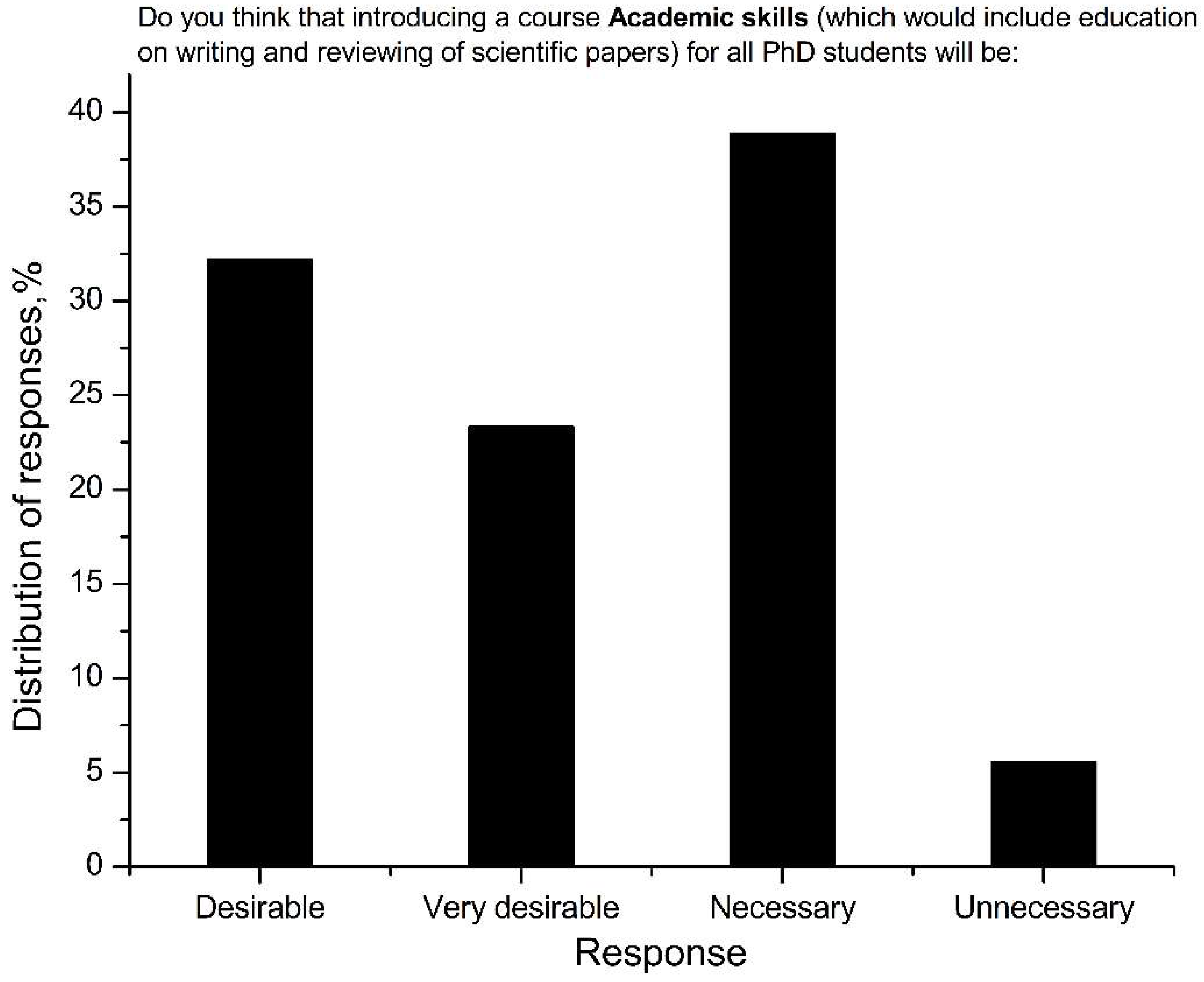
Why is it so? There are probably many reasons, but it has been shown, for example, that young researchers and authors from Serbia15 feel a lack of education in acquiring academic skills, among which is the presentation of scientific results, including writing a scientific paper. After the seminar on peer review16 which can be seen as putting scientific writing skills to use on someone else’s work the participants were asked to fill out a survey, in which one of the questions was whether a course on writing and peer review of scientific papers should be introduced in doctoral studies. The vast majority of those who filled out the questionnaire, 94 % of them, stated that it was desirable, of which almost 40 % said it was necessary, Figure 2.15
By reviewing the curricula of master's and doctoral studies at faculties covering the field of chemistry and similar sciences at universities in Serbia, it was established that there are often no courses on acquiring academic skills. When such courses exist, too little space is devoted to writing scientific papers, with contents of a general nature without acquiring useful knowledge. Based on the results of the JSCS case study,14 it can be concluded that such courses in "external" countries (in the case of this study these were primarily India, Iran, Pakistan, China, Turkey...) are rare and of lower quality. Based on decades in the Editorial Boards of several international journals and primarily out of personal experience but without quantifable data the author draws a negative correlation between the number of papers rejected or returned for corrections and resubmission for technical reasons and the level of academic skills acquired through undergraduate and postgraduate education. In other words, in places where emphasis is put on well-presented research and carefully curated manuscripts submitted to scientific journals are rarely rejected/returned due to technical reasons. The number of such manuscripts increases the authors come from education programmes which do not prioritize these ‘soft academic skills’ such as writing, peer-reviewing, and scientific communication. Of course, this claim is not based on exact data, but primarily based on the personal experience of the author of the article.
On the other hand, although there are many publications, papers, books, guides and even video tutorials on how to write and publish a scientific paper, ie. present scientific results (only a few are listed here),17–27 they modestly refer to the technical preparation of the manuscript, which, as concluded here, is a fairly common reason for the manuscript not even being considered for publication.
In any case, it can be stated that the number of submissions that are returned or rejected for technical reasons is too large. Hence, it is necessary to show the authors that the preparation and form of the manuscript are as important as its content. Editorial offices do not want to waste time and resources, neither theirs nor those of reviewers who need to evaluate such works. How to do this?
How to improve the present state
As is previously alluded, academic skill education is the supposed best way to inform and train the authors. The necessity of such education in some academic communities is clearly established,15 and it certainly exists in environments where that segment of education is neglected or does not exist at all.
The "obligation" of senior researchers to pass on their experiences and knowledge to their young collaborators should not be neglected either. Young researchers should have the help of their mentors and supervisors while writing their first paper. They must be guided on the standards and principles of good paper writing practice and on the importance of clear presentation of results, including making illustrations and creating tables. On the other hand, there must be no hesitation in asking older colleagues for help or suggestions whenever younger ones encounter doubts or unknowns.
In an effort to contribute to the dissemination of good writing practice, the rest of this article gives some of the general principles that should be followed when writing a scientific paper including a dozen examples on how they are often neglected. The examples are limited to the fields of chemistry and related fields, but those principles are generally valid for all fields of science, with the specificities that these sciences have.
12. golden rules of a well-written paper
Firstly, as the sub-heading notes, this section focuses on rules of a well-written paper, not a good paper. In order for a scientific paper to be said to be good we would have to evaluate the scientific content and conclusions, their scope, relevance and scientific methods. Still, a good publication also requires good writing to be able to communicate its findings. The following "12 golden rules" contain what should be kept in mind before and while writing a scientific publication.
Read the Instructions for Authors carefully and in detail
Each publisher and/or journal has its own standards for the final appearance of the publication. In order to apply these standards, Instructions for authors are created, which contain detailed requirements that authors must adhere to when writing manuscripts. Those instructions are sometimes very extensive and detailed from the author's point of view, but the authors are expected to comply with them. The detailedness of the Instructions is most often the result of explicitly pointing out some of the general "rules" of writing a paper to the authors and these make up the rest of these 12 golden rules.
The title and keywords must be composed wisely
The title of the publication should describe the content of the research that will be presented as succinctly as possible. Terms such as investigation, analysis, presentation or similar, are often redundant. Titles which are too bored or too long, in which the reader has to work hard to discern what the content of the article is, have less chance of being read. On the other hand, it is often recommended that the title contains exact names, for example the material that is the subject of the research, geographical names, or the location to which the research refers, etc.
Keywords and words from the title are, as a rule, the most important and sometimes the only terms on the basis of which databases (such as SCOPUS or Web of Science) are searched, so repeating terms from the title as keywords does not help and should be avoided.
An abstract is a publication in itself
The abstract is what the reader will read first, and based on what is written in it, decide whether to read the complete work as well. That is why it must not be too extensive, and it must clearly show what, why and how something was researched and what knowledge the research brought. Together with the Conclusion it must give a complete overview of the research. That is why it must not contain details about procedures, experiments, used methods or techniques, etc. The abstract is often most useful of there is one line on the general background and one line on the exact research question of the paper at the beginning. The rest can be a combination of summarizing findings and conclusions while emphasizing the most impactful ones.
The Introduction explains the motives and objectives of the research
Based on the presentation of current knowledge, through an adequate review of the literature, the introduction should clearly show the reasons and aims of the research presented in the paper. The literature review must not be too extensive, but also not incomplete from the point of view of the research objective. Usually up to 20 literature citations are sufficient, which will clearly show the previous knowledge, including several review papers in which this knowledge is systematically presented. The goal of the research defined here in the Conclusion should be explicitly commented on: whether it was achieved, what new findings were obtained, whether and to what extent they are in line with the previous ones. As a general guideline, it is useful to refer to the Creating A Research Space (CARS) model on writing introductions.28,29 The model underlines this balance between presenting the current state in the field and building a space for your research question within it.
Experiments performed should be described so they are reproducible
Experiments, measurements, and analysis must be described in the Experimental part of the paper in such a way that anyone should be able to reproduce the results. The procedure, materials and equipment used must be described in detail. Experimental protocols should be listed chronologically, leaving no room for confusion when repeating them. This section of the paper should not contain any experimental data. If the protocols are well-established, it is acceptable to cite previous publications which describe them in detail.
Do not clutter the paper with unnecessary results
Almost every research produces a large number of results, but there is no need to present them all in the paper. Authors often clutter their manuscripts with lots of tables and figures, long descriptions, or unnecessary data. It should be limited only to those results that will directly support the discussion and conclusions, without repeating similar ones or presenting irrelevant or less important ones unless they directly confirm reliability of the findings. For example, there is no need to show all the spectra recorded during the research, or to list the details of the spectral data, but only representative and key ones. If, however, it is deemed important (especially for readers engaged in close research), such data should be presented in the Additional Material or deposited in some repository, and the paper should only refer to them.
Tables, figures and equations must be clear without reading the text of the manuscript
When looking at a table or figure, reading the figure legend and the accompanying footnote (if any), their content must be completely clear and understandable, without reading the text. For example, the comparisons shown, and the abbreviations used should be stated clearly. Of course, how the presented data were obtained, how it is interpreted and what conclusions the data led to, should be commented in the manuscript.
Besides these general rules, there are a few more technical ones. One, there is no need to show the data presented in the table again in the figure, and vice versa. Two, the range of the axes on the diagrams must not be greater than the range of the plotted data, data values should not be written on the figure, they can be read from the axes. Three, the resolution of the illustrations, the chosen font, and its size, as well as the thickness of the lines on them, must be such that what is shown can be clearly seen and read.
Finally, sll tables, illustrations and equations should be numbered, according to the order of appearance in the text, and they should be referred in the text by calling their number, without using designators such as above, below, next, following, etc.
Values of physical quantities should be stated clearly, along with units
In the text, on pictures and tables, numerical values of physical quantities must always be listed with the name of the quantity (or the appropriate symbol) and the unit in which they are expressed. When naming quantities and/or using their symbols, IUPAC recommendations and nomenclature30,31 should be followed, and SI units32,33 should be used (except when this is not possible for justified reasons). In general, the designation of physical quantities (symbols) must be in italic, whereas the units and indexes (except for indexes having the meaning of physical quantities) are in upright letters. In graphs and tables, a slash should be used to separate the designation of a physical quantity from the unit, for example: p / kPa, T0 / K, t / h, ln (j / mA cm-2). If the full name of a physical quantity is unavoidable, it should be given in upright letters and separated from the unit by a comma, for example: Pressure, kPa; Temperature, K; Current density, mA cm-2.
The results and discussion should be concise and easy to read
Whether they are presented in separate chapters in the paper, or together, the presentation of the results and their discussion should not recount the data already presented in the tables and illustrations. Through short and clear paragraphs, no longer than 5-6 sentences, the conclusions to which the results have led, which new findings have been obtained, and how they relate to current knowledge and literature data should be highlighted. The reader should not be overwhelmed with unnecessary details, long comments, and information without essential importance to understand the interpretation of the obtained data. For each presented data that leads to a unique conclusion, their logical connection, cause-and-effect relationship, or mutual dependence should be explained.
Any retrieved Information must be cited
Every literary data, including those obtained in personal communication, must be listed in the references. On the other hand, the list of references must not contain any citation that is not referred to in the manuscript. If sentences or parts of the text are taken in their entirety, they must be placed in quotation marks, along with references to the source. For tables or illustrations taken from the literature, it must be checked whether they are protected by copyright, and if they are, permission to use them must be sought.
When creating a list of references, it is mandatory to follow the format required by the journal to which the manuscript is submitted.
The point is in the Conclusions
As already mentioned, the Abstract and Conclusions must make it completely clear to the reader what the article contains. This should be considered when compiling the content of the Conclusions. There is no need to summarize what has been said in the rest of the paper. The conclusion should briefly re-state the main objective of the project and give clear answers to the questions indicated in the Introduction; why and how the research was conducted and what new knowledge resulted from the research. After reading the paper, the reader must not ask the question: Okay, so what? Therefore, the findings must be related back to the larger context of the research and the field.
Speculations and conjectures are inadmissible, assumptions must be clearly supported by facts, and claims must be based only on presented results.
The Acknowledgement must not be forgotten
Although this does not affect whether the article is well written or whether its content is of high quality, it is necessary to acknowledge all those who contributed to the research being carried out and the paper being written. These are primarily funds, organizations and/or institutions that financed the research, but also colleagues or collaborators, apart from co-authors, who helped with advice, discussions, or consultations, perhaps provided some instruments, or even made some measurements during the research.
In addition, at the end of the manuscript, it is desirable to attach statements on conflict of interest, informed consent and on human and animal ethical treatment, if applicable.
Examples of bad practice
Based on the long-term experience of the author of the article, several specific examples of bad practice and the most common mistakes made by authors during manuscript preparation are listed in the Supplementary material.
Conclusion
The current state of scientific publication is witnessing a rise in the quantity of submitted articles for review which can overwhelm the editorial process. Based on a few exact data, it can be concluded that there is a need for systematic education of young researchers and scientists in acquiring academic skills (primarily during postgraduate studies), with special attention to writing and reviewing scientific publications. A higher level of academic skills enables clear communication of the scientific findings and increase chances of publication which is the most valued out of research in the current evaluations systems in many institutions. In an effort to contribute to a higher level of general knowledge on the principles of academic writing, the second part of the article shows the basic principles that should be followed for a scientific paper to be well written, along with several examples of the most common mistakes and ways to overcome them.
References
- How Many Academic Journals are There in the World?, https://publishingstate.com/how-many-academic-journals-are-there-in-the-world/2021/ (accessed: October 31, 2022).
- SJR : Scientific Journal Rankings, https://www.scimagojr.com/journalrank.php (accessed: October 31, 2022).
- SJR - International Science Ranking, https://www.scimagojr.com/countryrank.php (accessed: October 31, 2022).
- Reducing the time from basic research to innovation in the chemical sciences, A Workshop Report to the Chemical Sciences Roundtable, The National Academies Press, Washington DC, USA, 2003. [CrossRef]
- L. Brown, R. Griffiths, M. Rascoff, K. Guthrie, J. Electron. Publ. 10 (2007). [CrossRef]
- M. Nentwich, Poiesis und Prax. 3 (2005) 181-198. [CrossRef]
- M. Kozlov, Nature 613 (2023) 225. [CrossRef]
- C. D. Kelly, M. D. Jennions, Trends Ecol. Evol. 21 (2006) 167-170. [CrossRef]
- M. R. Shen, E. Tzioumis, E. Andersen, K. Wouk, R. McCall, W. Li, S. Girdler, E. Malloy, Acad. Med. 97 (2022) 444-458. [CrossRef]
- H. J. Coolidge, Archibald Cary Coolidge, life and letters, Houghton Mifflin Company, Boston, USA, 1932 (http://catalog.hathitrust.org/api/volumes/oclc/2530584.html).
- J. H. Grossman, P. P. Reid, R. P. Morgan, J. Technol. Transf. 26 (2001) 143–152. [CrossRef]
- H. Aguinis, C. Cummings, R. S. Ramani, T. G. Cummings, Acad. Manag. Perspect. 34 (2020) 135–154. [CrossRef]
- P. Rzymski, M. Nowicki, G. E. Mullin, A. Abraham, E. Rodríguez-Román, M. B. Petzold, A. Bendau, K. K. Sahu, A. Ather, A. F. Naviaux, P. Janne, M. Gourdin, J. R. Delanghe, H. D. Ochs, J. E. Talmadge, M. Garg, M. R. Hamblin, & N. Rezaei, Int. Immunopharmacol. 86 (2020) 106711. [CrossRef]
- M. J. Mrowinski, A. Fronczak, P. Fronczak, O. Nedic, A. Dekanski, Scientometrics 125 (2020) 115-133. [CrossRef]
- Drvenica, A. Dekanski, N. Buđevac, I. Umeljić, O. Nedić, Hem. Ind. 73 (2019) 275-279. [CrossRef]
- Održan seminar o recenziranju u Narodnoj biblioteci – CPN, https://www.cpn.edu.rs/odrzan-seminar-o-recenziranju-u-narodnoj-biblioteka/?script=lat (accessed: January 17, 2023) In Serbian.
- How to Write a Research Paper: A Step-By-Step Guide, Grammarly Blog, https://www.grammarly.com/blog/how-to-write-a-research-paper/?gclid=CjwKCAiAzp6eBhByEiwA_gGq5N-uF3vL5wEqTKopDXLpK3_0t6Xvonj2U9MnfTfsz8THZdVWCdnP_hoCgxEQAvD_BwE&gclsrc=aw.ds (accessed: January 22, 2023).
- J. H. Shubrook, J. Kase, M. Norris, Int. J. Sports Phys. Ther. 7 (2012) 512. [CrossRef]
- How to write a scientific paper - YouTube, https://www.youtube.com/watch?v=Vky9PDKx5KU&ab_channel=GlobalHealthwithGregMartin (accessed: January 18, 2023).
- Z. Popović, Kako napisati i objaviti naučno delo, Akademska misao i Institut za fiziku Beogradskog univerziteta, Beograd, 2014.
- Dekanski, J. Serbian Chem. Soc. 79 (2014) 1561–1570. [CrossRef]
- F. Ecarnot, M. F. Seronde, R. Chopard, F. Schiele, N. Meneveau, Eur. Geriatr. Med. 6 (2015) 573-579. [CrossRef]
- S. M. Richardson, F. Bella, V. Mougel, J. V. Milić, J. Mater. Chem. A 9 (2021) 18674-18680. [CrossRef]
- F. A. Maiorana, H. F. Mayer, Eur. J. Plast. Surg. 41 (2018) 489-494. [CrossRef]
- P. Kukołowicz, Polish J. Med. Phys. Eng. 23 (2017) 1-2. [CrossRef]
- J. Faber, Dental Press J. Orthod. 22 (2017) 113–117. [CrossRef]
- How To Write A Chemistry Research Paper? All Details, https://www.rasayanika.com/2021/05/06/how-to-write-a-chemistry-research-paper-all-details/ (accessed: January 18, 2023).
- S. Abdullah, EFL J. 1 (2016) 1-16. [CrossRef]
- J. Swales, “Create a Research Space” (CARS) Model of Research Introductions. in Writing about writing : a college reader, E. Wardle, D. P. Downs, Eds., Bedford/St. Martin’s, Boston, USA, 2014, pp. 12-15 (https://vdoc.pub/documents/writing-about-writing-a-college-reader-1mb5686j3i9o).
- IUPAC Recommendations Archives - International Union of Pure and Applied Chemistry, https://iupac.org/tag/iupac-recommendations/ (accessed: February 14, 2023).
- D. Mc Naught, A. Wilkinson, Iupac (2012) 1670. [CrossRef]
- SI Brochure - BIPM, https://www.bipm.org/en/publications/si-brochure (accessed: February 18, 2023).
- Essentials of the SI: Base & derived units, https://physics.nist.gov/cuu/Units/units.html (accessed: February 22, 2023).
Figure 1.
Distribution of country of origin for: (a) all corresponding authors of submitted papers (users), (b) all submitted manuscripts, (c) All manuscripts accepted for consideration (subject to peer review) and d) published manuscripts.14 Permissions under Attribution 4.0 International (CC BY 4.0).
Figure 1.
Distribution of country of origin for: (a) all corresponding authors of submitted papers (users), (b) all submitted manuscripts, (c) All manuscripts accepted for consideration (subject to peer review) and d) published manuscripts.14 Permissions under Attribution 4.0 International (CC BY 4.0).
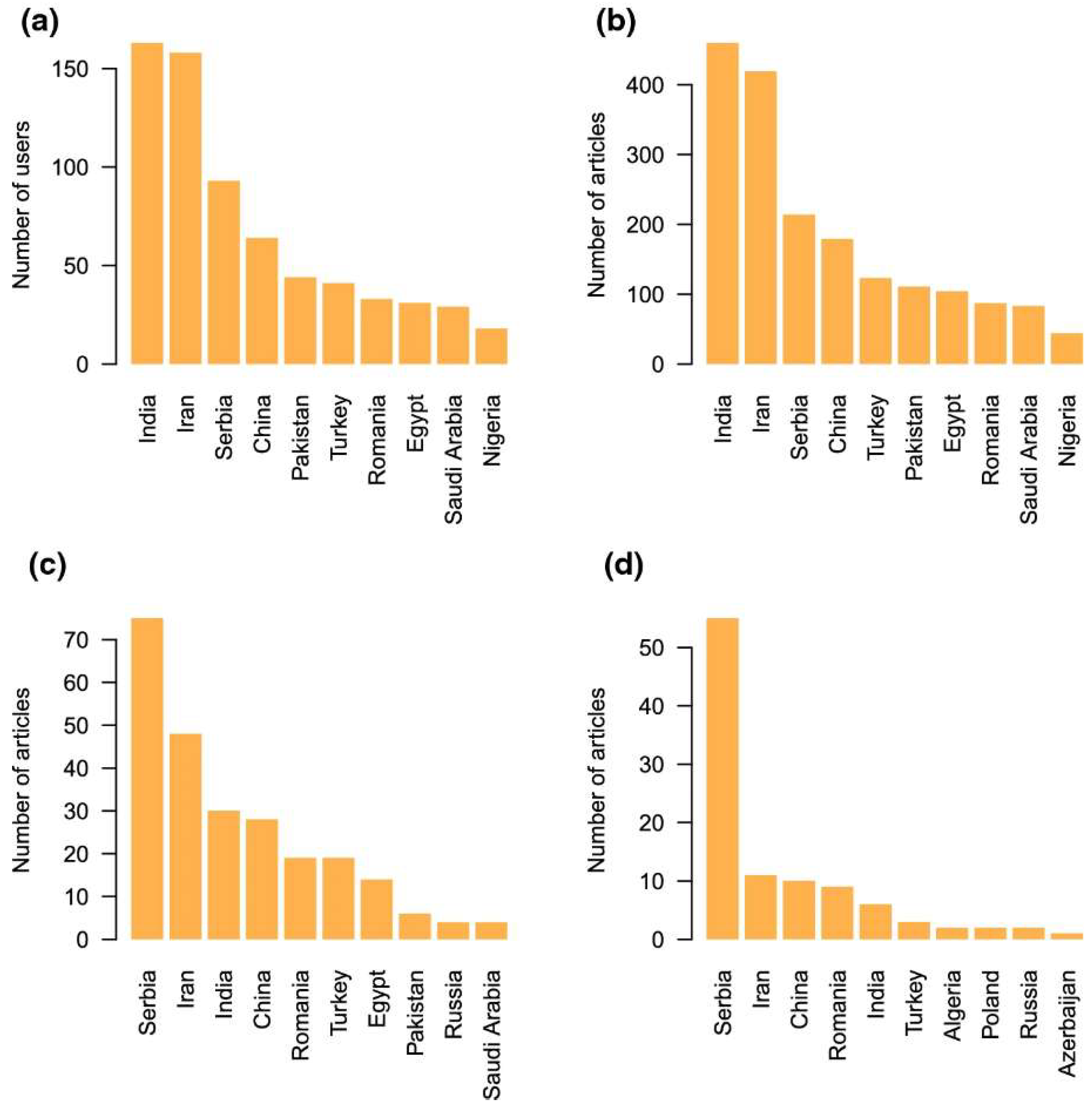
Figure 2.
The peer review seminar’s participants opinion on the introduction of a course on writing and reviewing scientific papers in doctoral studies.15,16 Permissions under Attribution 4.0 International (CC BY 4.0).
Figure 2.
The peer review seminar’s participants opinion on the introduction of a course on writing and reviewing scientific papers in doctoral studies.15,16 Permissions under Attribution 4.0 International (CC BY 4.0).
Disclaimer/Publisher’s Note: The statements, opinions and data contained in all publications are solely those of the individual author(s) and contributor(s) and not of MDPI and/or the editor(s). MDPI and/or the editor(s) disclaim responsibility for any injury to people or property resulting from any ideas, methods, instructions or products referred to in the content. |
© 2023 by the authors. Licensee MDPI, Basel, Switzerland. This article is an open access article distributed under the terms and conditions of the Creative Commons Attribution (CC BY) license (http://creativecommons.org/licenses/by/4.0/).
Copyright: This open access article is published under a Creative Commons CC BY 4.0 license, which permit the free download, distribution, and reuse, provided that the author and preprint are cited in any reuse.