

Submitted:
12 May 2023
Posted:
12 May 2023
You are already at the latest version
Abstract
The aim of this study was to analyze glucosinolates (GSLs) in germplasms that are currently conserved at the RDA-Genebank. The analysis focused on the glucosinolate diversity among the analyzed germplasms, with the goal of identifying those that would be most useful for future breeding efforts to produce nutritionally rich Choy sum plants..Twenty-three accessions of Choy sum which possessed ample background passport information were selected. By analyzing the glucosinolate content for 17 different glucosinolates, we observed aliphatic GSLs to be the most common. We identified one accession, IT228140 to synthesize high quantities of glucobrassi-canapin and progoitrin which have been reported to contain several therapeutic applications. Overall, this study highlights the importance of conserving and analyzing plant genetic re-sources, such as those held in national genebanks, for the purpose of developing new varieties of crops that are both nutritious and beneficial for human health. The identification of excellent germplasms for breeding material and the confirmation of the anticancer effects of glucosin-olates are significant contributions to the field of agricultural research and have the potential to positively impact public health.
Keywords:
glucosinolate
; germplasm
; breeding
; anticancer
; genebank
; diversity
1. Introduction
Choy sum (Brassica rapa subsp chinensis var parachinensis) is a leafy plant and is one of the representative horticultural crops widely consumed in Asian countries including Malaysia, Cambodia and China [1]. The leaves of the plant are used as food and plant grows swiftly to a height of 20 to 30 cm, within a month which makes it favorable to harvest the edible leaves for cooking [2]. Choy sum is one of the representative brassica crops widely used across the Southeast Asian countries in their cuisine [3]. The flowers and peduncles are also consumed along with young leaves, and Choy sum has been reported to be highly nutritious and contains 12 times more vitamin A, 2 times more vitamin C, 5 times more iron, and 1.5 times more calcium than Chinese cabbage (Brassica rapa subsp pekinensis) [4,5,6,7].
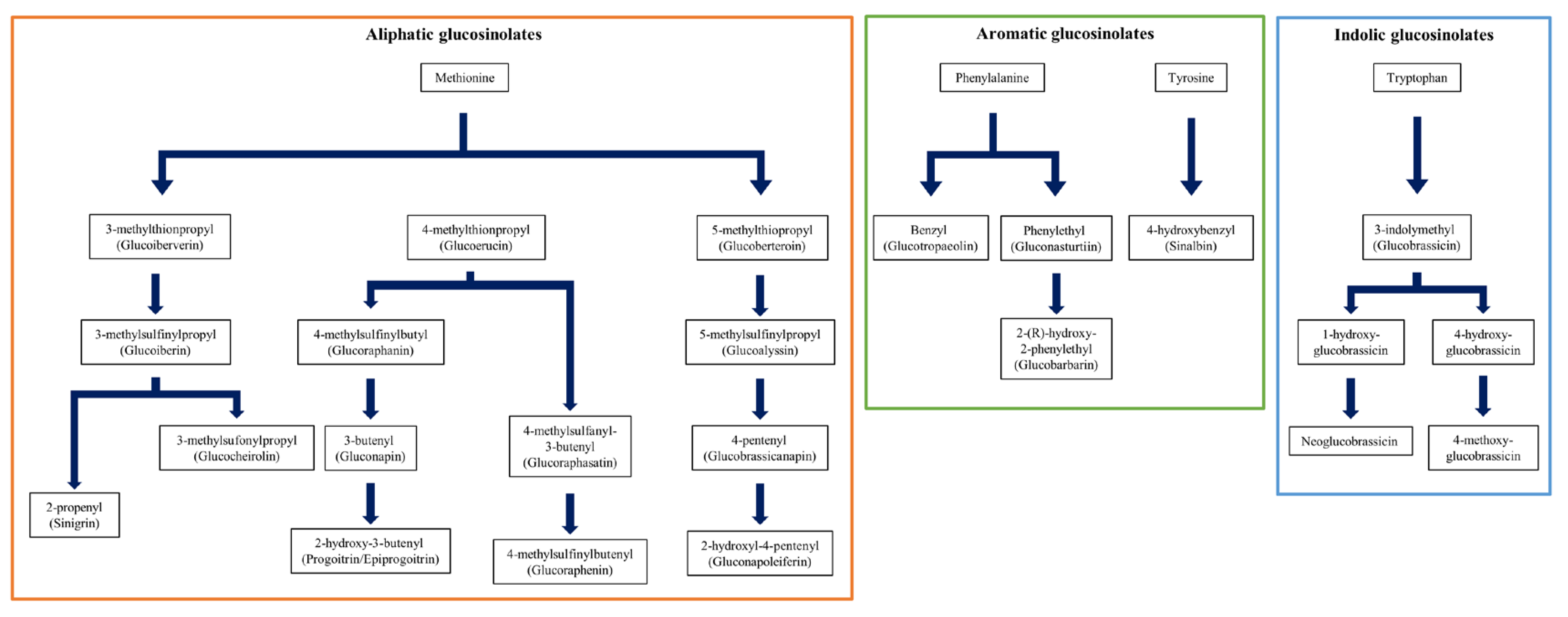
In general, Crucifers (Brassica genus) are not rich in vitamins, but are also major sources of minerals and dietary fiber. human body [4]. In addition to the above mentioned benefits, plants from the family Cruciferae also synthesize glucosinolates which are anionic, hydrophilic secondary metabolites [8]. These Glucosinolates (GSLs) are synthesized by plants from the brassica genus (Brassicaceae) plants [9] contain sulfur as well as nitrogen and based on their residue (R) side chain, divided into three categories: aliphatic, aromatic and indolic GSL, and each biosynthetic pathway starts with amino acid (AA) including methionine (met), phenylalanine (phe) and tryptophan (trp) as precursors [10]. After that, it goes through N-hydroxy-AA, aldoxime, and thiohydroximic acid to become desulfo GSL, and GSLs are finally synthesized through a series of processes [11]. Glucosinolates are widely identified in chinese cabbage (Brassica rapa subsp penkinensis), cabbage (Brassica oleracea) and broccoli (Brassica oleracea subsp italic) etc, and are representative secondary metabolites of plants that play a role in protecting plants from attacks by viruses or pests [12,13,14,15]. In terms of their value to humans, glucosinolates are a potential compounds that have been well-established for their anti-cancer as well as antioxidant functions [16,17]. In Choy sum, seedlings and microgreens have been reported to contain minerals, carotenoids, vitamins and glucosinolates [4]. Screening of germplasms for their nutrient contents can provide potential candidates for breeding of highly nutritional crop varieties. In the present study we studied Choy sum germplasm available at the National Agrobiodiversity Center (RDA-Genebank) of the Rural Development Administration, Jeonju, South Korea for their glucosinoate content.
2. Materials and Methods
2.1. GSLs Standards Used in This Experiment
All the reagents employed for both extraction and analysis in this study were analytical-grade products obtained from Sigma-Aldrich (St. Louis, MO, US) and Thermo Fisher Scientific Korea (Seoul, Korea). Among the seventeen GSL standards, six GSLs including Progoitrin (PRO), Epiprogoitrin (EPI), Glucobrassicanapin (GBN), Glucoiberin (GIB), Glucoraphenin (GRE) and Sinalbin (SNB) were purchased from Phytolab (Martin Baue, KG, Germany) and the remaining eleven GSL were purchased from phytoplan (Neuenheimer, Heidelberg, Germany). All standards had a purity of ≥98%.
2.2. Choy Sum Genetic Materials and Cultivation Condition
Among the total ninety-one of Choy sum (Brassica rapa subsp chinensis var parachinensis) germplasms conserved at the National Agrobiodiversity Center (RDA-Genebank) Republic of Korea, germplasms with no passport information on origin or statues (landrace and cultivar etc) were excluded and twenty-three germplasms were selected as materials for our experiments [18]. The selected genetic materials in order of the number of accessions, originated from Malaysia (5), Thailand (5), Taiwan (4), Vietnam (2), China (2), Mauritius (2), India (1), Laos (1) and Bangladesh (1). With regards to their biological status, they were segregated as landraces (17) and cultivars (6). Since Choy sum is an outcrossing crop, we confirmed the phenotype of the selected accessions in the field for three consecutive years from 2019 to 2021 (during the month of September), and to maintain purity of the germplasms, we continuously removed individual plants which did not stick to the phenotype.

Table 1.
Classification of origin and status of germplasms used in this experiment.
| Malaysia | Thailand | Taiwan | Vietnam | China | Mauritius | India | Laos | Bangladesh | Total | |
|---|---|---|---|---|---|---|---|---|---|---|
| Cultivar | 2 | 1 | 1 | 1 | 1 | 6 | ||||
| Landrace | 3 | 4 | 3 | 2 | 1 | 1 | 1 | 1 | 1 | 17 |
| Total | 5 | 5 | 4 | 2 | 2 | 2 | 1 | 1 | 1 | 23 |
2.3. Sample Preparation: Pretreatment and Extraction
Leaves were harvested randomly from each plants in accession. The harvested leaves were collected in poly vinyl bags and briefly stored at a temperature of -80 °C. Next, the leaves were lyophilized using an LP500 vacuum freeze-drier from Ilshinbiobase Co. in Dongducheon, Korea, for 2 days (48 h), and then ground into a fine powder. The harvested leaves were then moved back to -80 °C until profiling. The extraction of GSLs from the harvested leaves were performed using the method established earlier by Kim et al. in 2023. Specifically, 0.1 g of harvested leaves was mixed with 5 mL of 80% methanol and held at 25 °C for 30 minutes. Then, it was shaken continuously at 120 rpm for 30 minutes at 25 °C followed by centrifugation of the mixture at 14,000 rpm for 10 minutes at 4 °C, and the supernatants were transferred to clean vials for further analysis [19].
2.4. Identification and Quantification of GSLs Using UPLC-MS/MS
The Acquity Ultra Performance Liquid Chromatography, manufactured by Waters (Milford, CT, USA) coupled to the Xevo™ TQ-S system developed by MS Technologies (UK), was employed for the analysis of GSLs in accordance with the method described by Kim et al. (2023). In this experiment, a 5 µL sample was analysed using an Acquity Ultra Performance Liquid Chromatography BEH C18 (1.7 µm, 2.1 × 100 mm) column (Waters Corp., UK). For elution, 0.1% trifluoroacetic acid in water was used as eluent A and the elutent B mobile phase was 0.1% trifluoroacetic acid in methanol at a flow rate of 0.5 mL/min and 35 °C. The conditions for elution were set at 100% of A from 0.0 to 1.0 min, 100% of A from 1.0 to 7.0 min, 100 to 80% of A from 7.0 to 10 min, 80 to 0% of A from 10 to 11 min, 0 to 100% of A from 11 to 15 min, and 100% of A thereafter. Negative ion electrospray ionization and multiple reaction monitoring modes were used for detection of the GSLs. The MS/MS parameters were set using capillary and cone voltages of 3 kV and 54 V, respectively, for ionization. The identification of detected GSLs was carried out by comparing their retention times and MS and MS/MS fragmentation spectra with those of commercially procured standards. Validation of the method's precision and accuracy was performed by measuring linear, intraday, and intraday precision. To prepare the standards, 10 mg of individual GSLs in methanol were dissolved to obtain stock solutions (1 mg mL−1). Calibration curves were plotted using the corresponding standards to calculate GSL concentrations. The results were expressed as µmol GSLs kg−1 sample dry weight (DW). The limit of detection (LOD) and limit of quantification (LOQ) values were taken as three and ten times respectively, the standard error of the intercept of the regression equation of the linear calibration curve divided by the slope. Fresh batches of test solutions were always prepared before sample analysis.
Table 2.
UPLC spectroscopy information on seventeen glucosinolates studied in this experiment.
| Name | Abbreviation | Class | RT (min) | MRM Transition |
CID (ev) | Dwell Time (sec) | Calibration Curve Parameters |
|---|---|---|---|---|---|---|---|
| Progoitrin | PRO | Aliphatic | 5.94 | 387.77 >194.85 | 25 | 0.029 | Y = 8.2526X + 28.1501(r2= 0.961) |
| Sinigrin | SIN | Aliphatic | 6.56 | 357.75 >161.84 | 25 | 0.029 | Y = 12.7878X -11.1181 (r2= 0.999) |
| Gluconapin | GNA | Aliphatic | 7.78 | 371.74 >258.74 | 25 | 0.029 | Y = 8.36216X +29.5397(r2= 0.994) |
| Glucoiberin | GIB | Aliphatic | 7.98 | 421.62 >357.73 | 25 | 0.029 | Y = 33.6632X +446.334(r2= 0.997) |
| Epiprogoitrin | EPI | Aliphatic | 8.06 | 387.7 > 258.74 | 25 | 0.029 | Y = 7.4939X -6.76519(r2= 0.999) |
| Glucocheirolin | GCR | Aliphatic | 8.38 | 437.71 >258.74 | 25 | 0.029 | Y =20.7762X +39.3608(r2= 0.986) |
| Glucoraphanin | GRA | Aliphatic | 8.39 | 435.59 >177.78 | 25 | 0.029 | Y = 25.0808X +60.584(r2= 0.983) |
| Glucoraphenin | GRE | Aliphatic | 8.53 | 433.66 >258.81 | 25 | 0.029 | Y = 15.2565X +3.62242(r2= 0.988) |
| Glucobrassicanapin | GBN | Aliphatic | 8.60 | 385.71 >258.87 | 25 | 0.029 | Y = 7.2514X +47.2841(r2= 0.992) |
| Glucobarbarin | GBB | Aromatic | 8.64 | 437.71 >274.75 | 25 | 0.029 | Y = 9.29915X -0.454779(r2= 0.999) |
| Glucoerucin | GER | Aliphatic | 8.73 | 419.69 >258.74 | 25 | 0.029 | Y = 6.77393X +73.6679(r2= 0.984) |
| Glucotropaeolin | GTL | Aromatic | 8.88 | 407.72 >258.87 | 25 | 0.029 | Y = 18.2122X -3.93949(r2= 0.999) |
| Sinalbin | SNB | Aromatic | 9.10 | 423.62 >258.74 | 25 | 0.029 | Y = 49.7228X -33.0636(r2= 0.999) |
| Glucoberteroin | GBE | Aliphatic | 9.18 | 433.72 >275.06 | 25 | 0.029 | Y = 6.09397X +63.1212(r2= 0.997) |
| Glucobrassicin | GBC | Indolyl | 9.31 | 446.69 >204.94 | 25 | 0.029 | Y = 6.39827X +2.6232(r2= 0.997) |
| Gluconasturtiin | GNS | Aromatic | 9.34 | 421.69 >274.87 | 25 | 0.029 | Y = 4.36109X –90.233(r2= 0.961) |
| Glucoraphasatin | GRH | Aromatic | 9.62 | 417.63 >258.81 | 25 | 0.029 | Y = 15.5149X -5.95281(r2= 0.997) |
2.5. Statistical Analysis
The Bartlett sphericity test confirmed the individual GSLs to be independent of the others [20]. In addition, the results of our experiment with the Kaiser–Meyer–Olkin (KMO) test confirmed the rationality of the data structure [19]. In this study, diversity was analyzed using 17 GSL profile values of 23 accessions of choy sum (Brassica rapa subsp chinensis var parachinensis) according to the method of Kim et al [21,22].
3. Results
3.1. Quantification of GSLs and Selection of Candidate Germplasm for Breeding Materials
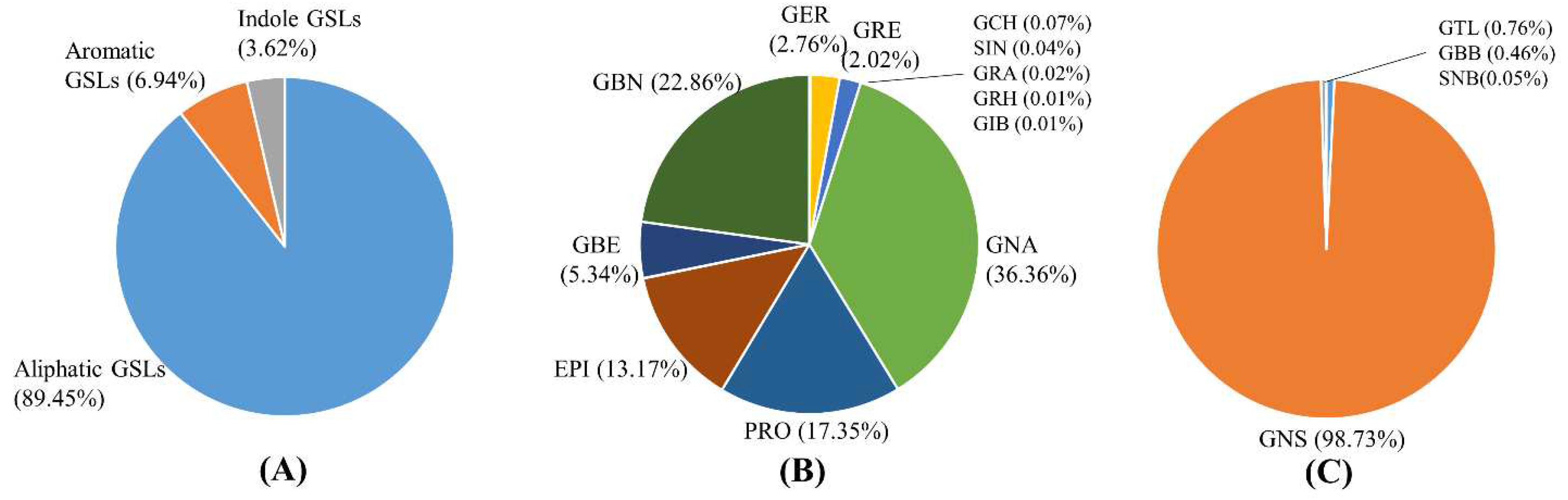
In this study, seventeen glucosinolates of choy sum (Brassica rapa subsp chinensis var parachinensis) held at the RDA-Genebank were profiled using UPLC-MS/MS (Table 1). Overall, aliphatic GSLs were found to be high in choy sum leaves and ranged from 8,243.00 to 18,110.85 µmol·kg−1 DW (means 8,243.54 µmol·kg−1 DW), taking up a vast majority (89.45%) of the total GSLs. Aliphatic GSLs were also predominantly found in our previous studies on Chinese cabbage (Brassica rapa subsp parachinensis) [19]. Among the aliphatic GSLs, Gluconapin content ranged from 117.38 to 13,111.41 µmol·kg−1 DW, and the average was 2997.62 µmol·kg−1 DW, with total aliphatic GSLs contributing to the largest class of detected GSLs from choy sum at 36.36%. Next, glucobrassicanapin content ranged from 148.87 to 6830.64 µmol·kg−1 DW, with an average of 1884.15 µmol·kg−1 DW. Detected quantities of Progoitrin and epiprogoitrin ranged from 120.20 to 3,172.65 µmol·kg−1 DW and 75.56 to 2,728.20 µmol·kg−1 DW, respectively. Additionally, Glucoberteoin indicated an average of 440.22 µmol·kg−1 DW, but some individual samples showed more than 3,000 µmol·kg−1 DW in the results. The aromatic GSLs were detected at a range of 84.98 to 2,389.73 µmol·kg−1 DW, accounting for 6.94% of the total GSLs. In particular, Gluconasturtiin ranged from 74.28 to 2,379.24 µmol·kg−1 DW, with an average of 651.28 µmol·kg−1 DW, accounting for the majority of the aromatic GSL. Finally, glucobrassicin, an indolic GSL was detected at an average of 333.30 µmol·kg−1 DW, accounting for 3.62% of the total GSLs (Figure 1).
Our results aimed to provide breeders a selection of potential candidate genetic resource for use in breeding programs to produce nutritionally enhanced natural foods. The germplasm with the highest total glucosinolate content (20,023.79 µmol·kg−1 DW) was found to be IT228140, which was introduced in 2003 to the RDA-Genebank from Myanmar Cultivar, which is being conserved at the World Vegetable Center (AVRDC). In this particular germplasm, glucobrassicanapin (GBN) was at 6,830.64 µmol·kg−1 DW, which was significantly higher than the average of 1884.15 µmol·kg−1 DW in this experiment. GBN's hydrolysis product is 4-pentenyl isothiocyanate, which has been reported to increase antibacterial activity against Aeromonas hydrophila, a gram negative pathogenic bacteria [23]. It has also been found to decrease the release of leukotriene B4 (LTB4) and release of leukotriene B4 (LTB4) from RBL in rat [24]. In addition, the progoitrin (PRO) content of IT228140 was also high at 3109.34 µmol·kg−1 DW. The hydrolysis product of PRO is nitrile crambene (1-cyano-2-hydroxy-3-butene), which has been reported to be up to 1000 times more effective in arresting cell cycle of hepatic cancer cell line[25]. However, PRO is directly related to the bitter taste in broccoli. So, crucifers containing PRO more than 3,000 µmol·kg−1 DW are known avoided by even animals due to their strong bitter taste, which limits their breeding potential [26].
Table 3.
Profile of individual glucosinolates in 60 kimchi cabbage germplasm samples (μmol∙kg−1 DW).
Table 3.
Profile of individual glucosinolates in 60 kimchi cabbage germplasm samples (μmol∙kg−1 DW).
| Variable | Range | Mean | Std. deviation | |
| Aliphatic GSLs | Glucoiberin | 0~1.48 | 0.39 | 0.46 |
| Sinigrin | 0.16~17.69 | 3.69 | 4.21 | |
| Glucocheirolin | 0.08~19.91 | 5.48 | 6.07 | |
| Glucoerucin | 0.64~1,983.01 | 227.83 | 562.36 | |
| Glucoraphanin | 2.29~569.16 | 166.77 | 179.00 | |
| Gluconapin | 117.38~13,111.41 | 2,997.62 | 3,406.77 | |
| Progoitrin | 120.20~3,172.65 | 1,430.06 | 899.82 | |
| Epiprogoitrin | 72.56~2,728.20 | 1,085.29 | 711.35 | |
| Glucoraphasatin | 0.03~9.89 | 0.70 | 2.02 | |
| Glucoraphenin | 0.11~9.18 | 1.35 | 2.10 | |
| Glucoberteroin | 6.02~3,491.34 | 440.22 | 899.73 | |
| Glucobrassicanapin | 148.87~6,830.64 | 1,884.15 | 1,457.35 | |
| Total aliphatic | 8,243~18,110.85 | 8,243.54 | 4,557.95 | |
| Aromatic GSLs | Glucotropaeolin | 1.83~9.58 | 4.87 | 2.08 |
| Gluconasturtiin | 74.28~2,379.24 | 631.28 | 575.41 | |
| Glucobarbarin | 0.97~8.04 | 2.94 | 1.71 | |
| Sinalbin | 0.04~2.96 | 0.34 | 0.69 | |
| Total aromatic | 84.98~2,389.73 | 639.42 | 576.14 | |
| Indolic GSLs | Glucobrassicin | 85.15~908.09 | 333.30 | 203.01 |
| Total GSLs | 9,216~20,023.79 | 9,216.26 | 4,905.73 | |
Figure 1.
Proportion of the analyzed profiles in total glucosinolates (A) Three major pathways (B) Twelve aliphatic GSLs (C) four aromatic GSLs in twenty-three choy sum germplasms. * Progoitrin (PRO), Sinigrin (SIN), Gluconapin (GNA), Glucoiberin (GIB), Epiprogoitrin (EPI), Glucocheirolin (CGR), Glucoraphanin (GRA), Glucoraphenin (GRE), Glucobrassicanapin (GBN), Glucobarbarin (GBB), Glucoerucin (GER), Glucotropaeolin (GTL), Sinalbin (SNB), Glucoberteroin (GBE), Glucobrassicin (GBC), Gluconasturtiin (GNS) and Glucoraphasatin (GRH).
Figure 1.
Proportion of the analyzed profiles in total glucosinolates (A) Three major pathways (B) Twelve aliphatic GSLs (C) four aromatic GSLs in twenty-three choy sum germplasms. * Progoitrin (PRO), Sinigrin (SIN), Gluconapin (GNA), Glucoiberin (GIB), Epiprogoitrin (EPI), Glucocheirolin (CGR), Glucoraphanin (GRA), Glucoraphenin (GRE), Glucobrassicanapin (GBN), Glucobarbarin (GBB), Glucoerucin (GER), Glucotropaeolin (GTL), Sinalbin (SNB), Glucoberteroin (GBE), Glucobrassicin (GBC), Gluconasturtiin (GNS) and Glucoraphasatin (GRH).
3.2. Correlation Analysis
Pearson correlation is a widely used method to determine the relationship between two variables. It is a numerical summary of the strength and direction of the linear relationship between two variables, based on whether the relationship between the two variables is linear or non-linear. To investigate the relationship between individual glucosinolates in this experiment, we conducted a Pearson correlation analysis. Our results showed a highly positive correlation between gluconapin, a major GSL in Chinese cabbage (Brassica rapa spp), and sinigrin, a major GSL in leaf mustard (Brassica juncea) (r = 0.939, p < 0.001). We also found sequential correlations between gluconapin, glucoiberin, and glucocheirolin (r = 0.636, r = 0.589, r = 0.579, p < 0.001, respectively). However, we could not observe any significant relationship between the remaining individual GSLs, including glucobrassicanapin, which is another major GSL in Chinese cabbage. In addition, we found that glucobrassicanapin (GBN), a known major GSL in cabbage, had significant correlations with progoitrin (PRO) and epiprogoitrin (EPI) (r = 0.473, r = 0.409, p < 0.001). Furthermore, we confirmed significant correlations between progoitrin (PRO) and epiprogoitrin (EPI) with glucobrassicanapin (GBN), a major glucosinolate in cabbage (r = 0.473, r = 0.409, p < 0.001). Notably, PRO and EPI are stereoisomers of each other and are both metabolite products of GNA (r = 0.973, p < 0.001). The aliphatic biosynthesis pathway, which is one of the three biosynthetic pathways of GSLs, produces three different compounds, namely glucoiberin (GIB), glucoerucin (GER), and glucoberteroin (GBE), from methionine depending on the position of the methyl group. From this pathway, we observed a strong positive correlation between glucobeteroin and glucoraphenin, which are known to be metabolite products of Glucoerucin (GER) along with GER itself (r = 0.985, r = 0.939, p < 0.001). Further, we observed a high correlation between sinabin, which is synthesized from tyrosine in the aromatic GSL biosynthetic pathway, and glucobarbarin, which is synthesized from phenylalanine (r = 0.893, r = 0.761, p < 0.001). Additionally, a correlation was also found between GER and glucobrassicin which are both synthesized in the Indole GSL biosynthetic pathway (r = 0.462, p < 0.001).
Figure 2.
Pearson’s correlation analysis between individual glucosinolate compounds. * Progoitrin (PRO), Sinigrin (SIN), Gluconapin (GNA), Glucoiberin (GIB), Epiprogoitrin (EPI), Glucocheirolin (CGR), Glucoraphanin (GRA), Glucoraphenin (GRE), Glucobrassicanapin (GBN), Glucobarbarin (GBB), Glucoerucin (GER), Glucotropaeolin (GTL), Sinalbin (SNB), Glucoberteroin (GBE), Glucobrassicin (GBC), Gluconasturtiin (GNS) and Glucoraphasatin (GRH).
Figure 2.
Pearson’s correlation analysis between individual glucosinolate compounds. * Progoitrin (PRO), Sinigrin (SIN), Gluconapin (GNA), Glucoiberin (GIB), Epiprogoitrin (EPI), Glucocheirolin (CGR), Glucoraphanin (GRA), Glucoraphenin (GRE), Glucobrassicanapin (GBN), Glucobarbarin (GBB), Glucoerucin (GER), Glucotropaeolin (GTL), Sinalbin (SNB), Glucoberteroin (GBE), Glucobrassicin (GBC), Gluconasturtiin (GNS) and Glucoraphasatin (GRH).
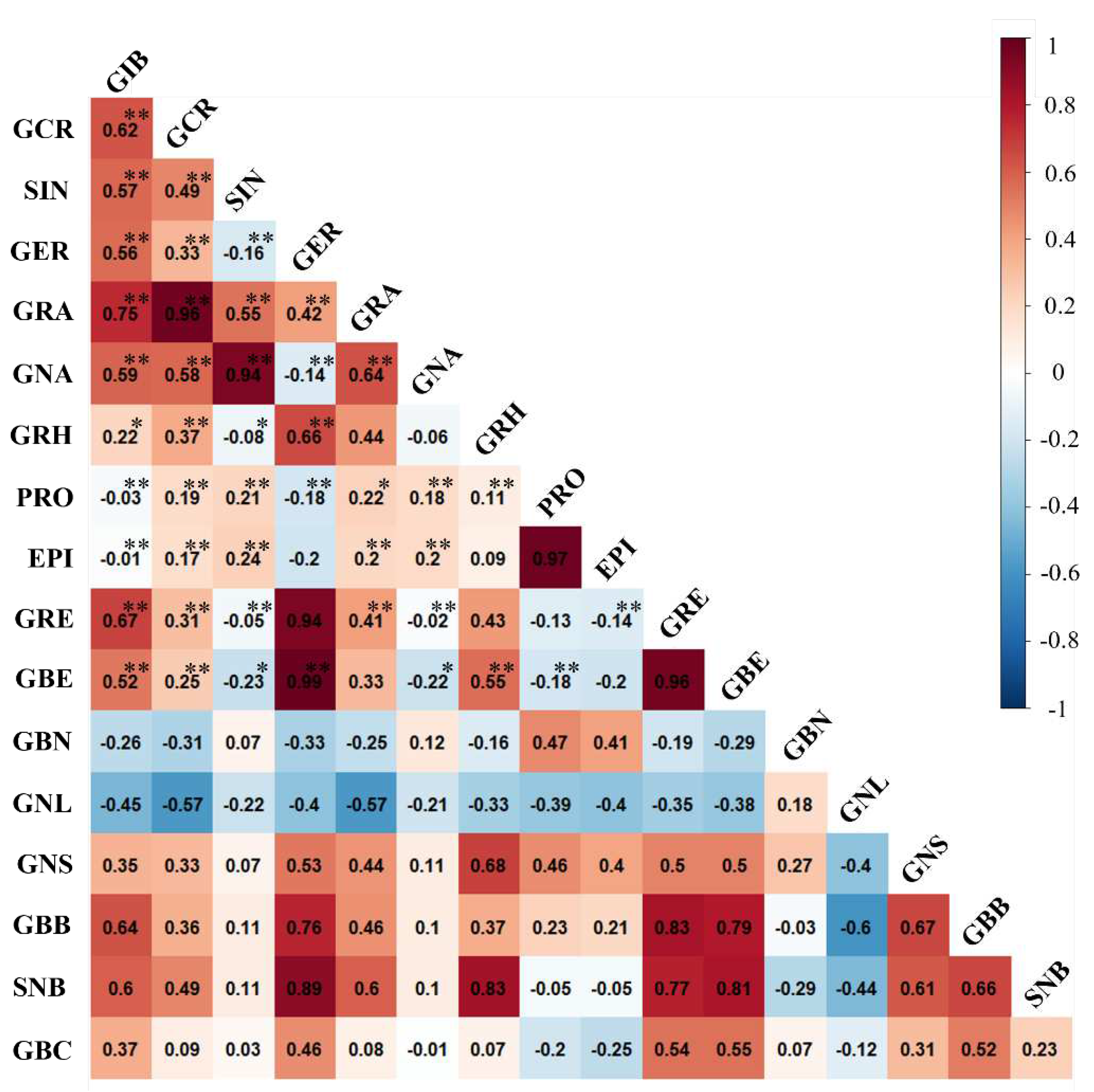
Figure 3.
Three major biosynthesis pathways of glucosinolate in Brassicaceae. Flow charts explain the three pathways of synthesis: amino acid chain elongation, formation of the glycon moiety, and side chain modification.
Figure 3.
Three major biosynthesis pathways of glucosinolate in Brassicaceae. Flow charts explain the three pathways of synthesis: amino acid chain elongation, formation of the glycon moiety, and side chain modification.
3.3. Diversity Analysis and Clustering
After conducting both the KMO test coefficient for sample adequacy and Bartlett’s test of sphericity, we found that the sample structure met the necessary requirements with values greater than 0.6. To analyze the data and determine the most relevant components with the largest variance, we utilized Principal Component Analysis (PCA), a widely used and popular clustering method. We first reduced the data dimensions to four principal components (PCs) using eigenvectors with values greater than or equal to 1. PC1 explained 41.28% of the total variance with eigenvector of 2.65, PC2, PC3, and PC4 explained 21.06%, 14.11%, and 8.62% of the total variance, respectively. PC1 showed positive correlations with SNB (0.34), GER (0.33), GRE (0.32), and GBB (0.32), and a negative correlation with GNL (-0.24). PC2 showed strong positive correlations in the order of GNA (0.40), SIN (0.39), PRO (0.37), and EPI (0.37). PC3 was correlated with PRO and EPI, and PC4 showed correlations with GBC (0.55) and GRH (-0.38). We finally selected two PCs (PC1 and PC2) as the principal components for the PCA, as PC2 and PC3 can also explain the two variable of PRO and EPI equally well.
Through PCA using PC1 and PC2, we explain 64.68% of the total variance (Figure 3(A)). Clearly, the aliphatic GSLs had the greatest influence on total GSL content, especially with gluconapin, progoitrin, and epiprogoitrin. In contrast, germplasms with low total GSL were significantly influenced by presence of glucotropaeolin an aromatic GSL. The scatter plot of the germplasms indicated the possibility of the germplasms segregating into two clusters. To validate the accuracy of the two clusters identified by PCA, we employed K-means clustering, to identify the optimal clusters. The optimal clustering was determined to be 3, and the results were visualized using a clustering dendrogram (Figure 3(B)). We employed Orthogonal Partial Least Squares Discriminant Analysis (OPLS-DA) to investigate the distribution reflecting the three clusters, and identified the major variables that contributed to cluster differentiation using Variable Importance in Projection (VIP) values (Figure 3(C)). Germplasms with high levels of glucoerucin, glucoraphenin, glucobeteroin, glucobarbarin, and sinalbin were included in group 1 (yellow dots). We also identified a new group 2 (blue squares) which showed a trend towards high total GSL, along with high levels of gluconapin, glucoraphanin, glucoerucin, and sinigrin. The individual GSLs that contributed to the three clusters were largely influenced by VIP values, with glucoerucin, glucoberteroin, and sinalbin being the most influential, while glucobrassicanapin and glucotropaeolin were the least influential GSLs (Figure 3(D)).
3.4. Nutritional Value of Glucosinolates
Glucosinolates (GSLs) are plant secondary metabolites that, when acted upon by the enzyme myrosinase in the plant, produce isothiocyanates which possess various physiological activities in both animals and humans. In particular, it is widely known that GSLs induce the activity of phase 2 detoxification enzymes, which include glutathione-S-transferase, quinone reductase, and glucuronyl transferase, and exhibit various anti-carcinogenic functions. The breakdown product of gluconapin, 1-cyano-3,4-epithiobutane, is known to prevent postprandial hypertriglyceridemia and reduce plasma triglyceride gain [27]. Moreover, it has also been reported to increase the expression of NAD(P)H quinone oxidoreductase 1 (NQO1), glutathione S-transferase A3, and the glutamate-cysteine ligase subunit (CETP) in Hep G2 cells, indicating its potential to induce diverse anti-carcinogenic effects [28]. Nitrile kramben, a degradation product of progoitrin, has been reported to increase the activity of quinone reductase in mouse Hepa 1c1c7 cells and mouse H4IIEC3 cells, as well as in human Hep Gsub2;/M phase, resulting in cell cycle arrest [25]. Other studies have shown therapeutic activities of GSL such as protection against acute pancreatitis by inducing pancreatic acinar cell apoptosis in Swiss mice by activation of anti-inflammatory and mitochondrial pathways [25,29]. Moreover, 4-Pentenyl isothiocyanate (4-PeITC), a degradation product of glucobrassicanapin, has been confirmed to have notable antibacterial activity against Aeromonas hydrophila (gram negative bacteria), and suppress release of leukotriene B4 (LTB4) from RBL-2H3 (basophil leukemia cells) [23,24]. Indole-3-carbinol (I3C), a degradation product of glucobrassicin, inhibited glucocorticoid-induced osteoblast apoptosis by preventing the reactive oxygen species-mediated Nrf2 cycle in cells [30]. It is well known that sulforaphane, a breakdown product of glucoraphanin in broccoli, has the potential to inhibit the development of prostate and lung cancer [31]. As a result, broccoli cultivars with high sulforaphane content have been selectively bred and commercialized. Glucobrassicin, which is hydrolyzed by myrosinase, produces not only sulforaphane but also indole-3-carbinol, which is known to suppress breast and ovarian cancer in humans [32]. Additionally, 2-phenylethyl isothiocyanate, a breakdown product of gluconasturtiin, is known to reduce cancer incidence by inhibiting the activity of phase 1 enzymes and promoting the induction of phase 2 enzymes [33] . Indole-3-carbinol is a derived product of glucobrassicin and sulphoraphane and remains to be the most potent anticancer compounds found in the GSLs in cruciferous vegetables [34]. Moreover, Glucoiberin, progoitrin, and gluconasturtiin hydrolysis products have also been widely reported as inhibiting agents that protect human and animal cells against several carcinogens [35]. Overall, GSLs are of potential interest for human health due to their nutritional and therapeutic effects.
Figure 4.
Diversity analysis among germplasms using individual GSL profile. (A) Principal Component Analysis, (B) Cluster dendrogram (C) Orthogonal Partial Least Squares Discriminant Analysis (D) Variable Importance in Projection value.
Figure 4.
Diversity analysis among germplasms using individual GSL profile. (A) Principal Component Analysis, (B) Cluster dendrogram (C) Orthogonal Partial Least Squares Discriminant Analysis (D) Variable Importance in Projection value.
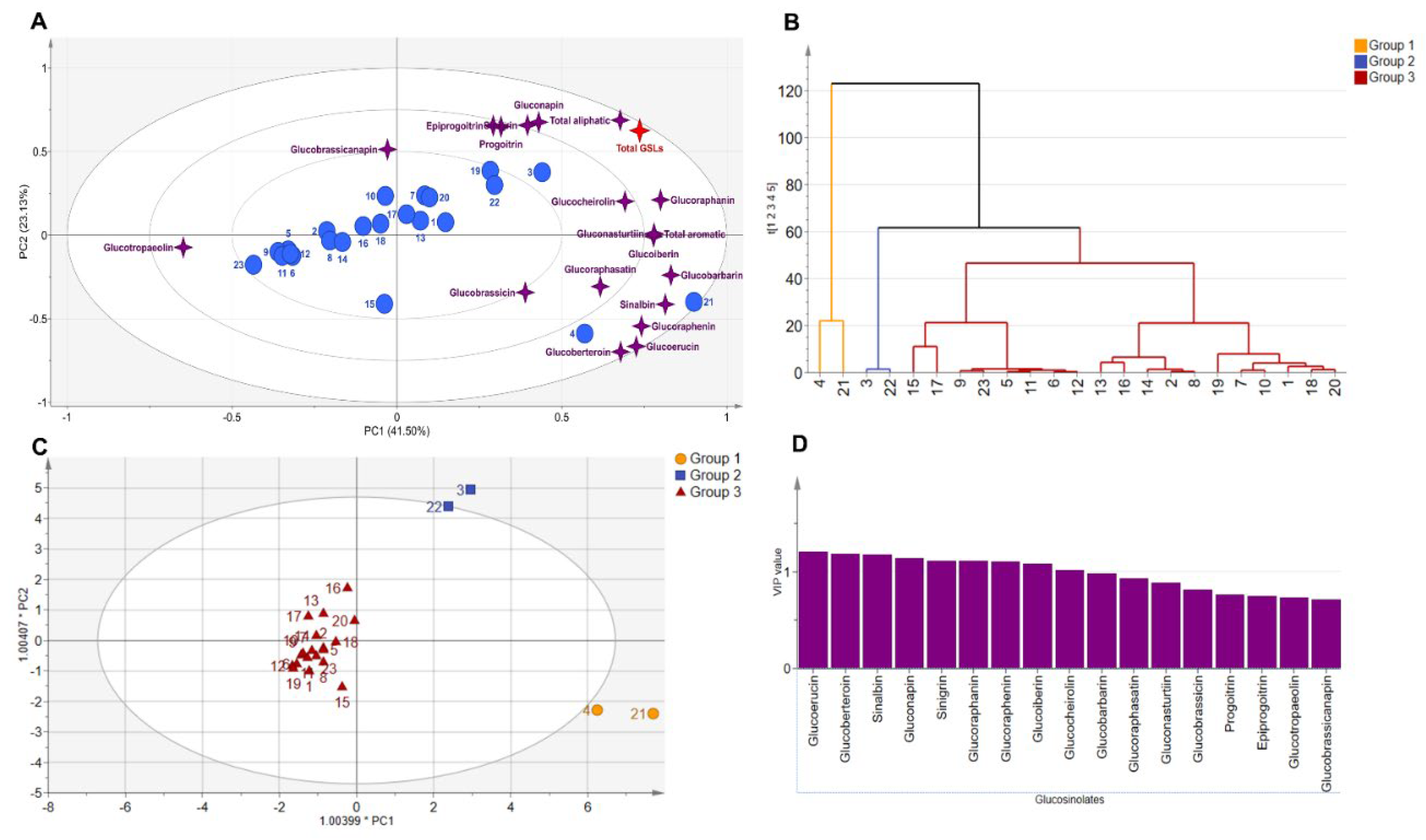
Table 4.
Functions of major glucosinolates and hydrolysis products analyzed in this experiment.
| Chemical Compounds | Class | Hydrolysis Products | Functions |
| Gluconapin | Aliphatic | 1-cyano-3,4-etithiobutane |
In Mice ∙ Prevent postprandial hypertriglyceridemia and decrease plasma triglyceride gain [27] In Human ∙ Increase NAD(P)H quinone oxidoreductase 1 (NQO1), glutathione S -transferase A3 and the glutamate–cysteine ligase subunit; (CETP) in Hep G2 Cell [36] |
| Glucobrassicanapin | Aliphatic | 4-pentenyl isothiocyanate |
In Gram negative bacteria ∙ Increase antibacterial activity against Aeromonas hydrophila [23] In rat [24] ∙ Decreas release of leukotriene B4 (LTB4) and release of leukotriene B4 (LTB4) from RBL- |
| Progoitrin | Aliphatic | Nitrile Crambene (1-cyano-2-hydroxy-3-butene) |
IN human Hep Gsub2 cell; mouse Hepa 1c1c7 cells and mouse H4IIEC3 cells [25] ∙ Increase the activity of quinone reductase resulting in cell cycle arrest In Swiss mice In Swiss mice protect against acute pancreatitis by inducing pancreatic acinar cell apoptosis by activating anti-inflammatory and mitochondrial pathways [25,29] ∙ Decerase acute pancreatitis and activate anti-inflammatory pathway [25] ∙ Activate mitochondrial pathways [29] |
| Gluconasturtiin | Aromatic | 2-phenylethyl isothiocyante | The anticancer activity of phenylethyl isothiocyanate, a hydrolyzed product obtained from gluconasturtiin, is excellent as it induces cyto-protective genes mediated by Nrf2 and AhR transcription factors, represses NF-κB, and inhibits both cytochrome P450 and histone deacetylase [37] |
| Glucobrassicin | Indolic | Indole-3-carbinol |
In human ∙ Inhibit breast and ovarian cancer [38] ∙ Inhibit apoptosis of osteoporosis and ROS-mediated Nrf2 pathway [30] In rat ∙ Decrease portal hypertension, the severity of mesenteric angiogenesis, and portosystemic collaterals in cirrhosis [39] In mice ∙ Decrease Citrobacter rodentium growth causing acute intestinal inflammation and increase T cell activity [40] |
5. Conclusions
The study provides valuable information on the types and levels of GSLs produced by different germplasm of Choy sum. The data available through this research would be of potential interest for breeders to select candidate germplasm for that exhibit desired desirable quantities of GSLs.
From the results, we identified one accession IT228140 to be rich in GBN and PRO which have been extensively reported to contain antimicrobial, antitumor and other therapeutic properties. Other germplasms also exhibited high amounts of GSLs and can be employed for breeding of superior varieties of Choy sum with high GSL content.
However, breeders should also consider the trade-off between glucosinolate content and palatability when selecting germplasm for breeding programs. The results of this study can help breeders to select suitable germplasm with desirable glucosinolate content and taste for developing new cultivars with enhanced nutritional and health benefits.
Funding
This research was carried out with the support of the “Research Program for Agricultural Science & Technology Development (Project NO. PJ01425501)”, National Institute of Agricultural Sciences, Rural Development Administration, Republic of Korea.
Data Availability Statement
Not applicable.
Conflicts of Interest
All authors have no conflict of interest to declare.
References
- Foo, J.T.S. A Guide to Common Vegetables; Singapore Science Centre: 1996.
- Edward, E. Modelling the Growth of Choy Sum (Brassica Chinensis Var. Parachinensis), at Different Nitrogen Fertilizer Rates. 2008.
- Huang, J.J.; D’Souza, C.; Tan, M.Q.; Zhou, W. Light intensity plays contrasting roles in regulating metabolite compositions in choy sum (Brassica rapa var. parachinensis). Journal of Agricultural and Food Chemistry 2021, 69, 5318-5331.
- Zou, L.; Tan, W.K.; Du, Y.; Lee, H.W.; Liang, X.; Lei, J.; Striegel, L.; Weber, N.; Rychlik, M.; Ong, C.N. Nutritional metabolites in Brassica rapa subsp. chinensis var. parachinensis (choy sum) at three different growth stages: Microgreen, seedling and adult plant. Food Chemistry 2021, 357, 129535. [CrossRef]
- Wang, D.; Shi, Q.; Wang, X.; Wei, M.; Hu, J.; Liu, J.; Yang, F. Influence of cow manure vermicompost on the growth, metabolite contents, and antioxidant activities of Chinese cabbage (Brassica campestris ssp. chinensis). Biology and fertility of soils 2010, 46, 689-696. [CrossRef]
- Domínguez-Perles*, R.; Mena*, P.; Garcia-Viguera, C.; Moreno, D. Brassica foods as a dietary source of vitamin C: A review. Critical reviews in food science and nutrition 2014, 54, 1076-1091.
- Wang, W.; Wang, J.; Wei, Q.; Li, B.; Zhong, X.; Hu, T.; Hu, H.; Bao, C. Transcriptome-wide identification and characterization of circular RNAs in leaves of Chinese cabbage (Brassica rapa L. ssp. pekinensis) in response to calcium deficiency-induced tip-burn. Scientific reports 2019, 9, 1-9. [CrossRef]
- Wu, X.; Zhou, Q.-h.; Xu, K. Are isothiocyanates potential anti-cancer drugs? Acta Pharmacologica Sinica 2009, 30, 501-512.
- Liu, Z.; Wang, H.; Xie, J.; Lv, J.; Zhang, G.; Hu, L.; Luo, S.; Li, L.; Yu, J. The roles of cruciferae glucosinolates in disease and pest resistance. Plants 2021, 10, 1097. [CrossRef]
- Wittstock, U.; Halkier, B.A. Glucosinolate research in the Arabidopsis era. Trends in plant science 2002, 7, 263-270. [CrossRef]
- Halkier, B.A.; Du, L. The biosynthesis of glucosinolates. Trends in plant science 1997, 2, 425-431. [CrossRef]
- Bouranis, J.A.; Beaver, L.M.; Choi, J.; Wong, C.P.; Jiang, D.; Sharpton, T.J.; Stevens, J.F.; Ho, E. Composition of the gut microbiome influences production of sulforaphane-nitrile and iberin-nitrile from glucosinolates in broccoli sprouts. Nutrients 2021, 13, 3013. [CrossRef]
- Park, S.; Son, H.-K.; Chang, H.-C.; Lee, J.-J. Effects of cabbage-apple juice fermented by Lactobacillus plantarum EM on lipid profile improvement and obesity amelioration in rats. Nutrients 2020, 12, 1135. [CrossRef]
- Mandrich, L.; Caputo, E. Brassicaceae-derived anticancer agents: Towards a green approach to beat cancer. Nutrients 2020, 12, 868. [CrossRef]
- Takasugi, M.; Katsui, N.; Shirata, A. Isolation of three novel sulphur-containing phytoalexins from the chinese cabbage Brassica campestris L. ssp. pekinensis (cruciferae). Journal of the Chemical Society, Chemical Communications 1986, 1077-1078. [CrossRef]
- Le, T.N.; Chiu, C.-H.; Hsieh, P.-C. Bioactive compounds and bioactivities of Brassica oleracea L. var. italica sprouts and microgreens: An updated overview from a nutraceutical perspective. Plants 2020, 9, 946.
- Lim, W.F.; Mohamad Yusof, M.I.; Teh, L.K.; Salleh, M.Z. Significant decreased expressions of CaN, VEGF, SLC39A6 and SFRP1 in MDA-MB-231 xenograft breast tumor mice treated with Moringa oleifera leaves and seed residue (MOLSr) extracts. Nutrients 2020, 12, 2993.
- RDA-Genebank. RDA-Genebank passport data (http://genebank.rda.go.kr/). Available online: (accessed on Mar 23).
- Kim, S.-H.; Lee, G.-A.; Subramanian, P.; Hahn, B.-S. Quantification and Diversity Analyses of Major Glucosinolates in Conserved Chinese Cabbage (Brassica rapa L. ssp. pekinensis) Germplasms. Foods 2023, 12, 1243.
- Tobias, S.; Carlson, J.E. Brief report: Bartlett's test of sphericity and chance findings in factor analysis. Multivariate behavioral research 1969, 4, 375-377.
- Kim, S.-H.; Subramanian, P.; Hahn, B.-S.; Ha, B.-K. High-Throughput Phenotypic Characterization and Diversity Analysis of Soybean Roots (Glycine max L.). Plants 2022, 11, 2017. [CrossRef]
- Kim, S.-H.; Jo, J.W.; Wang, X.; Shin, M.-J.; Hur, O.S.; Ha, B.-K.; Hahn, B.-S. Diversity characterization of soybean germplasm seeds using image analysis. Agronomy 2022, 12, 1004. [CrossRef]
- Jang, M.; Hong, E.; Kim, G.H. Evaluation of antibacterial activity of 3-butenyl, 4-pentenyl, 2-phenylethyl, and benzyl isothiocyanate in Brassica vegetables. Journal of food science 2010, 75, M412-M416.
- Yamada-Kato, T.; Nagai, M.; Ohnishi, M.; Yoshida, K. Inhibitory effects of wasabi isothiocyanates on chemical mediator release in RBL-2H3 rat basophilic leukemia cells. Journal of nutritional science and vitaminology 2012, 58, 303-307. [CrossRef]
- Keck, A.-S.; Staack, R.; Jeffery, E.H. The cruciferous nitrile crambene has bioactivity similar to sulforaphane when administered to Fischer 344 rats but is far less potent in cell culture. Nutrition and cancer 2002, 42, 233-240. [CrossRef]
- Wang, J.; Gu, H.; Yu, H.; Zhao, Z.; Sheng, X.; Zhang, X. Genotypic variation of glucosinolates in broccoli (Brassica oleracea var. italica) florets from China. Food chemistry 2012, 133, 735-741. [CrossRef]
- Washida, K.; Miyata, M.; Koyama, T.; Yazawa, K.; Nomoto, K. Suppressive effect of Yamato-mana (Brassica rapa L. Oleifera Group) constituent 3-butenyl glucosinolate (gluconapin) on postprandial hypertriglyceridemia in mice. Bioscience, biotechnology, and biochemistry 2010, 74, 1286-1289. [CrossRef]
- Liu, M.; Hansen, P.E.; Wang, G.; Qiu, L.; Dong, J.; Yin, H.; Qian, Z.; Yang, M.; Miao, J. Pharmacological profile of xanthohumol, a prenylated flavonoid from hops (Humulus lupulus). Molecules 2015, 20, 754-779.
- Cao, Y.; Adhikari, S.; Clément, M.V.; Wallig, M.; Bhatia, M. Induction of apoptosis by crambene protects mice against acute pancreatitis via anti-inflammatory pathways. The American journal of pathology 2007, 170, 1521-1534. [CrossRef]
- Lin, H.; Gao, X.; Chen, G.; Sun, J.; Chu, J.; Jing, K.; Li, P.; Zeng, R.; Wei, B. Indole-3-carbinol as inhibitors of glucocorticoid-induced apoptosis in osteoblastic cells through blocking ROS-mediated Nrf2 pathway. Biochemical and biophysical research communications 2015, 460, 422-427. [CrossRef]
- Traka, M.H.; Melchini, A.; Coode-Bate, J.; Al Kadhi, O.; Saha, S.; Defernez, M.; Troncoso-Rey, P.; Kibblewhite, H.; O'Neill, C.M.; Bernuzzi, F. Transcriptional changes in prostate of men on active surveillance after a 12-mo glucoraphanin-rich broccoli intervention—results from the Effect of Sulforaphane on prostate CAncer PrEvention (ESCAPE) randomized controlled trial. The American journal of clinical nutrition 2019, 109, 1133-1144. [CrossRef]
- Jeffery, E.H.; Araya, M. Physiological effects of broccoli consumption. Phytochemistry Reviews 2009, 8, 283-298. [CrossRef]
- Zasada, I.; Ferris, H. Sensitivity of Meloidogyne javanica and Tylenchulus semipenetrans to isothiocyanates in laboratory assays. Phytopathology 2003, 93, 747-750. [CrossRef]
- Zhang, Y.; Talalay, P. Anticarcinogenic activities of organic isothiocyanates: chemistry and mechanisms. Cancer research 1994, 54, 1976s-1981s.
- Staack, R.; Kingston, S.; Wallig, M.; Jeffery, E. A comparison of the individual and collective effects of four glucosinolate breakdown products from brussels sprouts on induction of detoxification enzymes. Toxicology and applied pharmacology 1998, 149, 17-23. [CrossRef]
- Kelleher, M.O.; McMahon, M.; Eggleston, I.M.; Dixon, M.J.; Taguchi, K.; Yamamoto, M.; Hayes, J.D. 1-Cyano-2, 3-epithiopropane is a novel plant-derived chemopreventive agent which induces cytoprotective genes that afford resistance against the genotoxic α, β-unsaturated aldehyde acrolein. Carcinogenesis 2009, 30, 1754-1762.
- Hayes, J.D.; Kelleher, M.O.; Eggleston, I.M. The cancer chemopreventive actions of phytochemicals derived from glucosinolates. European journal of nutrition 2008, 47, 73-88. [CrossRef]
- Stoewsand, G. Bioactive organosulfur phytochemicals in Brassica oleracea vegetables—a review. Food and chemical toxicology 1995, 33, 537-543. [CrossRef]
- Chang, T.; Ho, H.-L.; Hsu, S.-J.; Chang, C.-C.; Tsai, M.-H.; Huo, T.-I.; Huang, H.-C.; Lee, F.-Y.; Hou, M.-C.; Lee, S.-D. Glucobrassicin metabolites ameliorate the development of portal hypertension and cirrhosis in bile duct-ligated rats. International Journal of Molecular Sciences 2019, 20, 4161. [CrossRef]
- Wu, Y.; He, Q.; Yu, L.; Pham, Q.; Cheung, L.; Kim, Y.S.; Wang, T.T.; Smith, A.D. Indole-3-carbinol inhibits Citrobacter rodentium infection through multiple pathways including reduction of bacterial adhesion and enhancement of cytotoxic T cell activity. Nutrients 2020, 12, 917. [CrossRef]
Disclaimer/Publisher’s Note: The statements, opinions and data contained in all publications are solely those of the individual author(s) and contributor(s) and not of MDPI and/or the editor(s). MDPI and/or the editor(s) disclaim responsibility for any injury to people or property resulting from any ideas, methods, instructions or products referred to in the content. |
© 2023 by the authors. Licensee MDPI, Basel, Switzerland. This article is an open access article distributed under the terms and conditions of the Creative Commons Attribution (CC BY) license (http://creativecommons.org/licenses/by/4.0/).
Copyright: This open access article is published under a Creative Commons CC BY 4.0 license, which permit the free download, distribution, and reuse, provided that the author and preprint are cited in any reuse.