

Submitted:
07 June 2023
Posted:
09 June 2023
You are already at the latest version
Abstract
The aim of this study is to analyse tourism promotion of eight provinces of Andalusia from 2010 to 2022, and to examine the ways that tourism promotion campaigns influence and stimulate the improving of tourism supply and demand at Andalusian provinces. The methodology used in this study collected data from Andalusian public organizations (secondary data), and information related to this topic from researchers and organizations (primary data) for the purpose of this research project. This research provides a new contribution to tourism industry and promotion strategies context. Findings of the current study prove that DMOs of Andalusian provinces increased the tourism promotion budgets and campaigns to revitalize the tourism demand and supply due to the pandemic crisis and Russia’s invasion of Ukraine. Indeed, results of this research suggest that Andalusia’s tourism promotion budgets and campaigns have helped to improve the number of passenger arrivals, number of tourists, hotel occupancy rate, overnight stays at hotels by international and Spanish, and total overnight stay indicators in the period analysed, especially in the years 2021 and 2022. The contribution of this study has a great relevance to tourist destinations, DMOs, hotels, airports, and stakeholders where application of tourism promotion budgets, joint promotion campaigns, and new tourism products and services should be implemented to improve the tourism supply and demand, guarantee the regional and local economy and well-being of population.
Keywords:
Tourism promotion budget
; Andalusia location
; hotels
; aiports
; tourists
; passenger arrivals
; overnight stays
1. Introduction
Tourism is one of the key sectors of the Andalusian economy, representing 13% of regional GDP and 14% of employment. Marketing strategies and promotion and communication campaigns developed by Destination Marketing Organizations (DMOs) are required marketing tools to promote the tourism products and services of Andalusia territory and its eight provinces (Almería, Cádiz, Córdoba, Granada, Huelva, Jaén, Málaga, and Seville). Sun and beach, cultural, and urban tourism coexist in harmony in these eight provinces. To ensure effective management of tourism promotion, local and regional governments need tools like Key Performance Indicators (KPIs) that can measure digital and traditional marketing, and promotion activities’ impacts on tourism development of each one of the eight tourist destinations and their airports. Andalusia is one of the seventeen autonomous communities of Spain, and its location in the south of Spain and excellent climate is one the primary reasons why tourists like to visit this tourist destination, in fact, Andalusia fulfils all strategies and business requirements to operate by the major hotel chains such as Meliá, Marriott, Iberostar, RIU, amongst many others [1]. From 2018 to 2021, Spain has been the second most visited country in the world, the first was France [2].
In tourism and aviation industries the new technologies, database, and digital communication tools are being used on the production inputs and outputs of commercial activities and decision-making processes. In this context, DMO managers need to create organizational structures that exploit the available data and produce, manage, and integrate information more effectively, and stimulate local economies [3,4,5], due to the sudden unprecedented fall in demand triggered by the COVID-19 pandemic, air transport and tourism sectors will require marketing and financial stimulus to support recovery [6,7]. In 2020, the pandemic crisis completely paralyzed the tourist activity in Andalusia, according to the National Statistics Institute (INE), Andalusia received 2,7 million international tourists, and 16 million overnight stays in 2020, approximately one-quarter of pre-COVID-19 levels [8,9]. Indeed, new variants of the coronavirus, Brexit, and the conflict between Ukraine and Russia have once again set off alarm bells, as international tourism is the basis of Andalusia’s tourist destination [10,11].
The cornerstone of tourism promotion at Andalusian tourist destinations lies in the territory (location), marketing management (understood as DMO), airports (accessibility), hotels (accommodation), and tourist attractions (entertainment). The extent to which these factors can effectively relate to one another and combine their products and services as a seamlessly integrated whole will determine the national and international success of the destination’s promotion. Tourism demand is affected by travel costs, and the accessibility to a destination [12]. The air accessibility boosts tourism flows in a destination by reducing monetary, time-related costs, and a competitive advantage against its main competitors [13,14]. In fact, 58% of international tourists reached their destinations around the world by airlines [15], in the case of Spain, this percentage increase to 75% through airports [16].
Tourism promotion must be an efficient management of a destination’s resources and strategic plans by DMOs, to adapt the tourism supply to market trends and will empower tourists to visit such destination. Thus, it is necessary to harmonize all promotional efforts to specific market clusters [6] because the source place’s demand and purchasing power provides a tourist destinations’ market positioning and marketing decisions [17]. Tourism promotion efforts are usually undertaken by the central or local government through budgetary allocations [18,19,20], due to a mutual benefit for both destination marketers and companies in associating product and service brands with destination promotions [21].
From a business point of view, tourism promotion has hitherto received inadequate attention in tourism and air transport literature, due to a lack of interoperability in the promotion and communication campaigns and joint marketing strategies. There are limited studies in the context of tourism promotion, hotels, and airports relationship, which analyses the impact of tourism promotion budgets for improving the tourism industry of the city, as well as promotion campaigns to attract tourists and passengers at cities and airports. Uner et al. [22] note that the impact of promotion campaigns through digital channels on tourists’ attitudes to determine the selection of a destination, the link between promotional activities and the destination’s brand image has become increasingly important due to the relevance to attract specific tourists’ segments, especially in pandemic crisis where marketing communication and promotion campaigns have helped to revitalize tourism demand at tourist destinations and hotels [23].
DMO’s promotion campaigns and marketing plans are designed to provide positive messages about the destination’s tourist offer and stimulate tourism demand in the countries where promotion campaigns are commercialised [24,25]. Several studies have made efforts to examine the impact of tourism promotion campaigns to improve the tourism demand and supply at tourist destinations [16,25,26,27]. However, only a few have made efforts to integrate air transport impacts into tourism promotion campaigns at tourist destinations [28,29].
These are the main gaps that this study aims to fill. This research addresses these knowledge gaps by providing discussions and justifications on how DMOs, hotels, and airports should fortify their interaction and cooperation to develop joint marketing strategies to stimulate tourist and passenger’s demand. For this reason, the main objective of this study is to analyse tourism promotion of eight provinces of Andalusia from 2010 to 2022, and to examine the ways that tourism promotion campaigns influence and stimulate the improving of tourism demand and supply at Andalusian provinces. Furthermore, this study proposes four research questions to tackle the main gaps related to this topic and which were mentioned previously.
- RQ1
- : What are the benefits obtained from Andalusia’s tourism promotion budgets?
- RQ1
- RQ2: Can the Andalusia’s tourism promotion help to enhance tourism supply and demand?
- RQ1
- RQ3: What are the shortages of the tourism promotion in the eight provinces of Andalusia?
- RQ1
- RQ4: Can Andalusia’s tourism promotion campaigns be improved by DMOs?
Main reasons for selecting this study were:
- The need to study tourism promotion in tourism and aviation industries jointly.
- The lack of studies that covered this topic in tourism literature.
- The pandemic crisis and Russia’s invasion of Ukraine have led to an increase in tourism promotion by DMOs and tour operators to restart tourism and aviation sectors.
- The attention to digital channels and their effective role in tourism promotion.
- Shed light on the tourism cities of Andalusia.
2. Literature Review
2.1. Tourism Promotion a Marketing Tool to Increase the Number of Tourists and Passengers at Andalusian Provinces and Airports
The role of digital channels in tourism marketing and promotion activities has changed the business paradigm in this consolidated digital era, where products and services are now made, advertised, and sold all over the world. Thanks to smartphones and apps, travellers can move about an airport and city more efficiently since they are able to access in real-time information on flights, invoicing, public transport, tourist attractions, hotels, and better options for finding stores, services, and food within an airport’s terminal and the city [30]. The promotion of tourism industry has always been based on the idea that a region or city could grow economically and providing jobs and business opportunities for its citizens if tourists spend time and money [31]. Most countries that have experienced a higher growth in demand, connectivity, and competition have employed strategies to promote the overall attractiveness of their destinations [32]. Promotion in tourism helps to draw the attention of the potential tourists, modify the behaviour of the existing buyers, and influence them to visit a destination [33].
Market segmentation is a strategic tool with the purpose of grouping international tourists in distinct groups, improving destination attributes, and developing effective marketing planning at the policy level [34,35]. Aiming to attract tourists, the tourism industry promotes and emphasizes the tourist offer in the main tourism markets [36]. For example, the Japanese government implemented the “Go To Travel” promotion campaign to reactive domestic tourism in 2020, due to the dramatic plunge of domestic tourism as a result of COVID-19 pandemic [37]. Travelers were given 50% of their travel expenditures, including transportation fees and hotel charges. The number of campaign applicants grew about 15 million people in a month [37]. Promotion and marketing tools play a vital role in informing the potential consumers of the destination’s tourism supply on attracting and convincing them for the inclination towards destination products and services [38]. In the last years, Andalusia’s DMO is focused on the promotion of the Andalusian gastronomic heritage to encourage national and international tourists to visit Andalusian tourist destinations, as well as reduce the seasonality of sun and beach tourism on the Andalusian coastline [39].
From an aviation point of view, Emirates airline promotion activities have a significant and positive impact on Dubai’s branding image [40]. There is already synergy between the promotional and branding efforts of the airlines and the destination, but unified efforts may generate greater results. Interoperability between DMOs and destination managers are advised to develop a co-branding strategy that is more comprehensive and benefits both airlines and destination. Nevertheless, DMO attempts to market and manage the destination as a holistic entity, generally providing tourism-related information and access to services such as online reservations [41], with the aim of creating a city appeal that is aspiring to all stakeholders’ tourists, businesses, airports, hotels, and citizens [42]. DMOs attract tourists by displaying the amalgamation of services provided by private players and government organizations [43]. Although, tourist destinations lost their control over the content in the public domain regarding the price and quality of its services or products in the last years [44].
3.1. Supply Indicators
Tourism supply indicators can help to design and improve the effectiveness of tourism promotion campaigns in target markets. This would enable DMOs to direct their promotional efforts toward inducing a more favourable campaigns based on differing segment’s responses. Tourism promotion campaigns help to reduce the seasonality of tourist destinations. Zafar [45] indicates that tourists hold multidimensional images of destinations, and that different tourist segments will act differently because they have different images of the same destination.
In order to achieve the research objective, the tourism promotion budgets of eight provinces of Andalusia (Almería, Cádiz, Córdoba, Granada, Huelva, Jaén, Málaga, and Seville) were identified to ensure effective management of tourism promotion. For instance, tourism promotion through digital channels (e.g., websites and apps) reinforce the destination image [46]. Tourism management organizations, hotel establishments, and other tourism and destination businesses should coordinate their promotion and marketing initiatives [6,21,28,45,47,48,49]. The growing demand of tourists is related to tourism destination promotional activities [50]. Customizing destination promotional mix to fit global touristic standards ensures efficient destination positioning but requires a high monetary investment [51]. Tourism promotion organizations do a good job of publicizing regional activities via traditional and digital means as a marketing tool, especially toward young and well-educated target markets [52].
Hotel supply is measured in terms of room stock, and its demand can be measured in a variety of ways, including occupancy percentage, room rates, room nights sold, and sales revenue [53]. This research uses two indicators of hotel accommodation. The first indicator is the number of hotels, and the second indicator is the number of beds in hotels [26,53,54,55,56]. This data was provided by the Instituto de Estadística y Cartografía de Andalucía known as IECA [57], which have made it possible to classify the types of accommodation and tourist’s motivation in Andalusia. The purpose of including these two indicators in the study was to evaluate the hotel offer at Andalusian destination because the hotel industry has a great significance in the tourist’s average daily spending. Indeed, hotels represent 58.4% by type of accommodation in Andalusia from 2010 to 2021 (see Panel A in Figure 1), and the overwhelming majority of tourists (85.5%) travel to Andalusia for holidays and leisure motivations (see Panel B in Figure 1), all this data was collected from IECA [57]. Tourist’s motivation and behaviour are major factors for competent authorities to define forms of communication with clients or for business support [58]. The economic impacts of international tourist spending are focused on the hotel industry, restaurants, retail businesses, and private and public transport [59].
3.2. Demand Indicators
Improved international air connectivity can help to attract more visitors. Air transport connectivity has a great influence on tourist flows due to its speed, safety, service quality, and reliability [60]. Passenger arrivals data can lead to more precise estimates, and these data are essential to analyse the evolution of tourist arrivals in the time series [61], passenger arrivals as an indicator is widely used in tourism and aviation studies [6,10,28,60,62,63,64,65,66,67]. International tourist arrivals are the key indicator of tourism demand and the most popular proxy for tourism demand in the tourism literature. Tourist arrivals is an indicator which helps to identify direct and indirect differences in quality or quantity of the tourism demand within a defined period of time at destinations, hotels, tourist attractions, amongst many others [54,68,69,70,71,72,73]. Most DMOs pursue strategies to stimulate tourist arrivals even further [74].
Tourism demand for a particular destination is the quantity of tourism goods and services that consumers are willing to purchase during a specified period under a given set of conditions [75]. Tourist arrivals in a destination is the traditional and most widely used measure of tourism demand. Another two popular measures are tourist expenditure [76,77], and the number of nights stayed [78,79,80]. These three variables reflect the overall magnitude of tourism demand from different perspectives, and their analysis may contribute to marketing recommendations for DMOs and managerial decisions in tourism operators. In addition, tourism promotion activities through digital channels help to reduce the seasonality of demand and increasing and diversifying the tourist offer in the low season [6,81,82]. The treatment of seasonality at marketing strategies by DMOs is a key factor to design promotion campaigns through digital channels and increase the number of tourists in the low season. The tourist destination of Andalusia is characterised by its high seasonality from April to October, and the low season is located between November and March [83,84,85]. For instance, in 2018, Andalusia’s DMO launched an advertising campaign named ‘Tasty Andalucía’, which was aimed at international tourists who visited the region to promote its products and services throughout the year to stimulate tourism demand, and to reduce the seasonal nature.
The data on occupancy rate of Andalusia hotels was collected from IECA organizations, which contains annual and monthly aggregate occupancy rates of hotel classes from 1 January to 31 December 2022. Of particular interest to the hotel industry is assessing the impact of accommodation supply on key hotel performance indicators [26,69,86,87,88,89,90]. Supply and demand imbalances in hotel markets cause short-term growth or declines in rate and are inefficiently self-correcting over the long term [90]. The hotel occupancy rate is also one of the important considerations for us to measure the impact of tourism promotion at hotels. In June 2020, the Spanish government proposed a series of actions to boost tourism sector in this territory with 4 billion euros, one of these actions was to intensify efforts on marketing and promotional campaigns worldwide to attract domestic and international tourists and recover hotel activity during the pandemic crisis [91,92].
Average stay of tourist is a highly considered variable in tourism studies because it is a key element in the decision-making process of a tourist [56,93,94], and DMOs’ promotion campaigns must be adjusted to the tourist’s decisions with regard to the time they spent at a destination. The length of stay is an important issue for the management of tourism travels, since longer lengths of stay result in higher hotel occupancy rate and hotel earnings [56,95]. Length of stay is a key indicator in the measurement of international tourism, determining the total number of guest nights spent by a given number of visitors in a destination. This affects spending, service offers, as well as the character and availability of activities [96,97]. Tourists’ length of stay is one of the most important tourism demand variables, and this is the amount of time that the tourist spends at a given destination [97]. DMOs should be interested in increasing length-of-stay for interrelated reasons of transport infrastructure capacity needs, and the distribution of tourist flows [73,74,97].
Overnight stay at hotel is another Key Perform Indicator (KPI) or metric that measure the performance of a particular area of hotel operations or the overnight stays as a whole. This ensures clear visibility on the functionality and sustainability of hotels and a destination within the hospitality landscape [26,54,78,93,95,98]. DMOs should invest more in preserving, enhancing, and promoting both tangible and intangible cultural heritage for attracting tourism flows and ensuring longer stay [99].
Tourist spending is a necessary component of economic impact analysis because this indicator is used as a tool for marketing and policy decisions [100]. Average daily spending by tourist has been thoroughly examined and debated in tourism literature by researchers and scholars [74,97,98,101,102]. This research considers that the tourist expenditure as a key variable in the economic analysis of the costs and profits associated with the tourism industry. It argues that the study of this variable should take into account the increasing complexity of tourism demand and supply [103]. Jurdana and Frleta [101] confirm that family income, type of accommodation, past behaviour, and length of stay significantly influence daily expenditure. Tourists are net consumers of economic resources within the destinations visited [104].
DMOs and tour operators should monitor and analyse the tourist’s average daily expenditure in their decisions-making processes to maximise the economic benefits of tourism spending [105]. In this same line, Kalantari et al. [106] revealed that tourists who use OTAs, tour operators, social media, and digital newspapers prior to visit tend to spend more during their stay. Consequently, most tourists use internet to seek information about their next vacation and destinations. Today, most tourism promotion campaigns developed by DMOs, and tour operators are through digital channels. For this reason, this study included the tourist’s average daily expenditure as an indicator because authors previously mentioned correlate the tourism promotion with the tourist’s daily expenditure in the selected destination. The tourist expenditure is essential to formulate and gauge the impact of promotional activities at a destination [107].
3. Methodology
This research has been conducted in the region of Andalusia, southern Spain. Andalusia is a consolidated tourist destination, and this is grouped into 8 provinces: Almería, Cádiz, Córdoba, Granada, Huelva, Jaén, Málaga, and Seville. Seville is the capital city of Andalusia. Andalusia’s coastline has a length of 1101 km. The coasts that form the Andalusian coastline are the Costa de Almería, the Costa Tropical of Granada, the Costa del Sol of Málaga, and Costa de la Luz of Huelva (see Figure 2). Its three most important tourist attractions are sun and beach activities, gastronomy, and an excellent climate which is both sunny and refreshingly cool, and a minimum of 300 sunny days a year [83,84,85,108,109]. Andalusia’s coastline has 263 beaches [110] localised in Almería, Granada, Málaga, Cádiz and Huelva. Most hotels are localised in these five provinces thanks to international and domestic tourist demand. The coast is the most important focus of tourism in Andalusia and the most traditional areas remain the western Costa del Sol, west Almería, and bay of Cádiz [108].
Moreover, this study uses quantitative method to measure supply variables like tourism promotion budgets, number of hotels, and estimated number of hotel beds. Moreover, the seven indicators of demand analysed (airport’s passenger arrivals, number of tourists, hotel occupancy rate, average stay of tourist, overnight stays at hotel by international and Spanish international tourists, and average daily spending by tourist) are shown in Figure 3 to better understanding of ten variables examined. All these indicators implemented in this research have allowed to answer the four research questions and the main goal of this study. From 2010 to 2022 was the period analysed in this study because the global economy began to recover in 2010 from financial crisis of 2008. Furthermore, this research tries to compare data from 2019 to 2020 with the aim of measuring the impact of promotion campaigns before and after the COVID-19 pandemic. Following the rigorous process of variables over the period considered, the four indicators: number of hotels, number of hotel beds, average stay of tourists, and tourist’s average daily spending at Andalusian provinces are shown in Appendix A at the end of the paper.
To collect data, tourism and aviation scientists make use of number of different data collection strategies. In this section, we show supply and demand data according to IECA, INE, and AENA organizations (secondary data). To count the number of passenger arrivals at Andalusian airport, data was collected from Aeropuertos Españoles y Navegación Aérea commonly known as AENA [111]. Moreover, tourism promotion budgets data was taken directly from Junta de Andalucía [112,113], and Hosteltur [114]. The rest of indicators like the number of hotels, and beds, number of tourists, hotel occupancy rate, average stay of tourist, and overnight stays at hotel by international and national tourists were collected from IECA [57,115,116] and INE [8,9,117,118]. In addition, this research provides updated data from 2022, which has helped to contextualize and measure the pandemic effects and compare this with those for earlier years.
Furthermore, this study collected information related to this topic from researchers and organizations (Primary data) for the purpose of this research project. For example, public and private organizations, and expert authors in this topic have helped to select and collect specific indicators to improve the methodology of this research, and to draw the appropriate conclusions [19,49,51,113,114,119,120,121]. Primary data improve researchers’ understanding on the indicators and methods selected [122]. Primary and secondary data are significant inputs into appraisal and market analysis. Both forms of data enter the analysis that underpins our study [123,124]. In the following subsections, we present ten tourism indicators examined from the viewpoint of supply and demand side. Many DMOs are leveraging the influence of famous actors and actresses, musicians, chefs, athletes, and influencers for attracting demographic segments to their destinations through social media and tourism promotion campaigns [125,126], and influencers marketing in the travel and tourism domain is used by international hotel firms to increase the hotel occupancy rate [127].
The main advantage of combining primary and secondary data used as a methodology for our analysis and indicators selected in this study lies in the staging of different variables and sectors, and what role these indicators play in shaping patterns of communication and tourism promotion campaigns developed by DMOs and private companies to revitalize Andalusia’s tourism demand and supply in difficult times. On the contrary, the different indicators identified from different sectors of demand and supply like hotels, airports, public organizations, or Spanish and international tourism flows make us see the difficulty in addressing the impact of tourism promotion at Andalusian eight provinces and its real impact in ROI terms.
4. Analysis and Results of Research
4.1. Present and Future of the Eight Provinces of Andalusia in Tourism Industry
It is important to understand the different characteristics of eight provinces of Andalusia to analyse their tourism promotion budgets and results to establish appropriate planning, management, and design of joint marketing strategies in the future. Different marketing strategies should be developed to attract tourists with different characteristics [128], a collaborative approach to attraction planning could be beneficial to all types of cultural attractions and capitalize on their spending patterns in the Andalusia region [129]. For instance, Huelva, Cádiz, Málaga, Granada, and Almería are tourist destinations focused primarily on sun and beach and gastronomy activities because of their excellent beaches and location, but Málaga perfectly combines sun and beach and urban tourism as an added tourist attraction thanks to its more than 20 museums, Málaga cathedral, Malaga’s Roman theatre, the Alcazaba fortress, amongst many others.
Most international tourists have a huge misconception of Andalusia and its eight provinces, they think that these cities only offer sun and beach tourism, but they are totally wrong, possibly because of DMO’s of Andalusia have not been well promoted the most varied tourism offer in the last years. Andalusia’s destination does not mean only the beach, its wealth comes from different tourist activities that allow tourists to enjoy the environmental diversity of the region. Andalusia and its eight provinces are a multi-space that brings together all the classifications of tourist activities because each province has its own peculiarities.
Notwithstanding, Seville, Córdoba, and Jaén are tourist destinations focused on monumental, cultural, and urban tourism, and cynegetic and rural tourism in the case of Jaén province. These three cities have not beaches. We must stress the importance of Granada city as part of monumental and cultural, thanks to the Alhambra of Granada monument, and its historical context in the history of Spain. The diversification of products and services is a deseasonalisation tool, but also a strategy recommended for tourist destinations, particularly in cultural tourism [83,84]. The elements that tourists value most in connection with the image of Andalusia are the destinations that specialize in products of rural, nature, and culture tourism [130]. The following shows the analysis and results from each Andalusian province in alphabetical order.
Figure 4 displays the seven indicators of Almería tourist destination, being the tourism promotion budget (€) the most important variable in this study, this is shown in the black solid line, and the remaining six constructs are shown in percentage year-on-years, due to the tourism promotion budget is assigned each year by local governments, and so we can analyse together the evolution of tourism promotion and rest of variables for each year.
- Tourism promotion budget (€).
- Number of passenger arrivals at Andalusia’s airports.
- Number of tourist (national and international).
- Hotel occupancy rate.
- Overnight stays at hotels by Spanish tourists.
- Overnight stays at hotels by international tourists.
- Total overnight stays at hotels (national and international).
Almería: In the last thirteen years the number of hotels decreased by –6.7%, and the number of hotel beds increased by 30% due to the construction of new 10 hotels along the coast of Almeria in recent years. This moderate drop in the number of hotels is a consequence of the pandemic crisis during 2020 and 2021, and this period of uncertainly paralyzed the growth of tourism and aviation activities in all terms. This problem is a constant in Andalusia and its eight provinces between 2020 and 2022, for this reason, sometimes we compare all data in both years 2021 and 2022, in comparison with 2019 in this study, due to the pandemic crisis has stopped the positive evolution of tourism industry at Andalusia and around the world in 2020. Furthermore, the average stay of tourist fell by –8.8% during the period analysed. Conversely, the average daily spending by tourist increased by 26.5% in this period, a tourism supply based on the quality rather than quantity of number of tourists can improve the tourist’s expenditure at destination. The main economic activities in the city of Almería are horticulture and tourism industries, Almería is known as ‘The orchard of Europe’.
Almería’s tourism promotion budgets positively increased the quality and quantity promotion campaigns through digital channels, especially between 2020 and 2022 the budget of tourism promotion was duplicated to reverse the situation of the pandemic and recover tourist flow and trade in Almería city. The increase of the budget in these three years helped to stimulate the tourism demand, and this was very beneficial to get the tourism industry back on its feet in 2022. This same year, the hotel occupancy rate (14%), overnight stays (51%), and stay-night by international and national tourists by 157% and 49%, these four indicators were benefited by the remarkable increase in the number of passenger arrivals by 121% (700 thousand passengers) at Almería’s airport (see Figure 4), but this figure is still very far from 1 million passengers in 2019. The International Almería Antonio de Torres airport, IATA [131] code is (LEI) is a secondary and strategy airport that provide air accessibility and connectivity in the eastern zone of Andalusia.
Since the beginning of the pandemic and declared by World Health Organization (WHO) in March 2020, its impact and effects on tourism and aviation industries have been bewildering and dramatic in all terms, particularly in eight destinations of Andalusia which is highly dependent on tourism industry. In order to restore the tourism and aviation industries in these eight cities, in 2021 Andalusia’s DMO promoted its eight provinces in eight European countries (Portugal, Ireland, UK, the Netherlands, Sweden, Germany, Italy, and France), through digital channels (social media, YouTube, TV, amongst many others), food demonstrations, shopping malls, sporting events, World Travel Market, ITB Berlin, amongst many others. These eight source markets represent close to 40% of total stays in Andalusian hotel establishments and around 70% of overnight stays made exclusively by international travellers [112].
A promotion campaign named ‘Andalucía wants you back’, helped to encourage the potential tourist to return to Andalusia once the mobility restrictions were overcome (see Figure 5). This marketing strategy and many others through traditional and digital channels empowered the brand image of eight provinces of Andalusia worldwide and helped to recover the tourism industry in these eight cities in 2021 (see Figure 6). For instance, in 2022 the Andalusian destination received 30 million tourists a 55.3% more than last year, that is, 10,5 million tourists more than in the year 2021. However, although the 30 million tourists are a good number, this figure is fewer than 32 million tourists that received the Andalusian destination in 2019. It is clear from findings that the pandemic had a significant impact on the aviation and hospitality industry and altered and has disrupted tourism demand forces in Andalusian tourist destinations [132,133].
Cádiz: Cádiz is a coastal town in Andalusia, and the last thirteen years tourism has grown because of the beaches, historical and artistic heritage sightseeing, carnivals, and year-round cruise ship tourism [134]. The number of hotels increased by 3.8% from 2010 to 2019. However, as mentioned above, the effects of the pandemic crisis provoked the closing of numerous hotels throughout Andalusia. Nevertheless, in 2022 the number of hotels decreased by –3% and the number of hotel beds was by –1% in comparison with 2010, this data shows the recovery of tourism industry in Almería destination. Indeed, the average stay of tourist fell by –10.4% in 2022 if we compare with 2010. Although, the average daily spending by tourist has not stopped growing in Cádiz, Almería, Córdoba, Granada, Huelva, and Málaga until 2022. the rest of provinces such as Jaén, and Seville saw reduced the average daily spending by tourist over the period considered. In the case of the province of Cádiz, the average daily spending by tourist reached its peak at 84,5 euros during the period covered by this study.
Regarding the tourism promotion budgets, these have fluctuated over the last thirteen years, and the year 2020 became the year with the largest economical budget (6 million euros) in tourism promotion (see Figure 7), with the aim of recovering the tourism flow lost by the pandemic crisis and passenger arrivals fall by –80.7% in 2020, and –61% in 2021 in comparison with 2019 in the airport of Jerez (IATA: XRY), that is, 1,6 million passengers in two years, too much lost tourists for Cádiz economy that depends mainly on tourism sector. Surprisingly, in 2022 the hotel occupancy rate increased by 14%, number of tourists (17%), overnight stays (42%), stay-night by international and national tourists by 127% and 46% respectively, and passenger arrivals by 108% (900 thousand passengers), but a –18% passengers in comparison 2019. These results reveal a positive tourism and air transport trend since 2020 in the province of Cádiz. Overall, tourism promotion budgets and campaigns have helped to revitalize tourism demand and supply between 2021 and 2022 in the city of Cádiz, this data must be analysed within a national and international context of pandemic crisis, war, and an economic uncertainty, all of them have directly affected the tourism and air transport industries.
Promotion tourism campaigns through digital channels as a channel of marketing have opened a new direct distribution form between tourism suppliers and final consumers, where intermediaries are not needed, and it is favouring an increased concentration in the tourist sector [135]. We must remember the high correlation between passenger arrivals at airports and tourists, given that 75 percent of tourist arrivals to Spain are through airports. This is why the tourism promotion strategy is so important to promote marketing campaigns in the specific target markets, to stimulate tourism demand, and trying to reach a maximum of flow tourist that ensures the sustainability of the tourism industry at destinations. In 2020, all indicators experienced negatives rates due to the pandemic crisis, but these indicators considerably improved thanks to tourism promotion campaigns and the gradual lifting of restrictions on COVID-19’s measures of security and hygiene.
Cádiz is highly dependent on sun and beach tourism by national and international tourists, and they essentially interested in coastal tourism. In 2014, this province recorded 2,092,818 stay-night visitors, two thirds being national and one third international visitors [136], but in 2020 and the stay-night by international tourists was the most affected variable (–82.1%) by the pandemic crisis, as we can see in Figure 7. From a management and strategic point of view, the pandemic has been a disruptive and positive point to revaluate and improve the operability of hotels by managers. Hotel operators need to implement new commercial strategies to tackle the new challenges facing the hospitality industry. For example, Tan [137] suggests that the implementation of communication strategies to enhance consumers’ environmental knowledge is important for the growth and success of green hotels. An efficient communication campaign is important when companies want to attract new customers and maintain the existing ones [138].
Córdoba: This province is a city with an enormous heritage of culture and monuments, and its main tourist attractive is the Great Mosque of Córdoba and the Palace of the Caliphs Medina Al-Zahara, these have been the cover of many promotion campaigns worldwide, and the Córdoba’s official website of tourism. The number of hotels decreased by –0.6%, and the number of hotel beds increased by 10.3% in the period analysed. In 2020, the overnight stays at hotels by international tourists fell three times more than the Spanish’s overnight stays at hotels in Córdoba (see Figure 8), this city is focused on cultural and gastronomic tourism. From 2018 to 2022, the tourism promotion budgets were an average of 1,1 million euros, and these served to give an effective response to the pandemic crisis. The background of continuing economic uncertainty which resulted from COVID-19 pandemic in 2020 provoked that Andalusia and its eight provinces increase their economic budgets in tourism promotion to stimulate the demand, boots and position the brand image of Córdoba around the world.
An added problem for this city is that the Córdoba airport (IATA: ODB) is not being exploited as a tourist airport by AENA Group. Spanish airports are managed by a central authority named AENA, a government-owned company. The Córdoba airport is focused on passenger charter flights, military flights, agricultural treatment companies, aerial photographs, and other aerial work [63]. The variable of passenger arrivals through Córdoba airport has fluctuated greatly in the last 13 years. There was no response by airport operator and Córdoba’s DMO to improve the number of passenger arrivals at airport, or even the opening of new routes and new frequencies, generating an increase in the net volume of passengers. Most international tourists visiting this city coming from Málaga and Seville airports. Obviously, the Córdoba airport should be better managed by AENA operator and promoted by Córdoba’s DMO as an accessible secondary airport to visit the city of Córdoba. The quality of management by airport and tourism operators affects the efficiency and effectiveness in the utilization of scarce resources.
The Córdoba’s tourism industry was severely damaged in 2020, especially in the number tourists which decreased by –67%, and, therefore, decrease the overnight stays by –67% with previous year, the overnight stay at hotels by Spanish tourists a –59%, the overnight stay at hotels by international tourists a –80%, and the hotel occupancy rate was by –42.4%. The data for 2020 revealed extremely difficult production and marketing conditions in tourism industry globally, requiring supplementary aid by national and regional governments to stimulate tourism and aviation demand through tourism promotion budgets in economic and advertising terms. Nonetheless, in 2021 and 2022 results display that all indicators examined grew exponentially, except for the number of passenger arrivals by –62% due to the management of this airport in non-commercial activities. Córdoba’s tourism promotion budgets and campaigns have steadily grown, increasing from 32% in 2017 to 61% in 2022 compared to the year 2017. For instance, in 2022 the hotel occupancy rate increased by 37.5%, and overnight stays at hotels by international and Spanish tourists a 140% and a 32% more than in the previous year. Results show the pick-up of tourism activity in the city of Córdoba, and a new record in the average daily spending by tourist, reaching a total of 72,6 euros in 2022.
Granada: This city is very attractive in cultural and sun and beach activities for national and international tourists. This combines cultural tourism with its monumental Alhambra building, it is a beautiful complex of buildings and gardens, and its beaches localized in the Costa Tropical. All this, together with a gastronomy made with the typical food of the zone. Indeed, the main aim of Granada’s DMO is to make the province’s attractions known worldwide so that the number of visitors in cultural, and sun and beach tourism activities through international tourist fairs, international tourist conferences, promotional campaigns through digital channels in Spain, European countries, amongst many other activities [139]. Andalusian cities use their historical heritage to lure tourism and thus boost their economies such as Granada, Córdoba, or Seville have made a big effort to embellish themselves and attract an increasing number of tourists [140].
The tourism promotion budgets of Granada have remained around 2,5 million euros every year, except 2010 with 3,4 million euros, this year the arrival of passengers decreased by –17.6% with previous year, but the rest of variables increased the rate of growth. There is a positive evolution of the occupancy hotel rate from 2010 to 2019, but this indicator decreased by –41.3% in 2020 in comparison with 2019. In addition, in 2021 all indicators showed a positive development in 2021, although these positive data did not reach the levels of 2019. Granada’s DMO must promote its tourism products and services through digital channels like social media and international digital newspapers such as The Guardian, New York Times, Le Monde, Frankfurter Allgemeine Zeitung, De Volkskrant, La Republica, Verdens Gang, amongst many others. Many studies mention the significant impact of the information published on social media on consumer preferences, since social media data can be used to analyse the image of a tourist destination and management tourism products and services in the city of Granada [141].
Furthermore, the number of hotels has been significantly reduced by –11.5% in the last thirteen years, and the average stay of tourist was also reduced by –18.9. Nevertheless, the number of beds increased by 21.6%, and the average daily spending a 1.4% within the set period (see Figure 9). This data is quite worrying and for now, this generates far more doubts than certainties in the future of the Granada’s tourism industry. DMO and stakeholders should ask themselves why this happening, are we serving the needs of tourists? Are we using the proper promotion channels? Are we offering tourist packages according to our market segments?; Are we planning the opening of new air routes to increase the number of tourists?, or Why are tourists spending less money in our destination?
A stark imbalance in the variable of Granada-Jaén airport’s passenger arrivals is shown in Figure 9, the Federico García Lorca Granada-Jaén airport (IATA: GRX), it is a secondary airport and is localized in the city of Granada. This airport is focused on commercial flights and air cargo, although its offer of commercial flights is quite limited. Like the city of Córdoba, most international tourists visiting this city coming from Málaga and Seville destinations. This airport is strategically shared between the city of Granada and Jaén to make more accessible these two provinces, but unfortunately this strategic airport is not achieving the results hoped by airport operator and these two cities. Results show that the number of passenger arrivals at Granada-Jaén airport grew by 81 per cent, the number of tourists by 13 per cent, hotel occupancy rate by 13 per cent, overnight stays by 74 per cent, and stay-night by international and national tourists by 144 per cent and 35 per cent respectively in 2022. These data confirm the restoration of the tourism and air transport sectors in the province of Granada and supported by an increase of 20 per cent to the 2022 tourism promotion budget.
Huelva: It is a coastal city, and a very popular holiday resort for British people and European tourists. This is localised in Western Andalusia, exactly in the Costa de la Luz area. The tourism sector is the most important activity for the province of Huelva, and it requires the assistance of highly qualified workers in hotels and restaurants, which are taught at universities of Andalusia [142]. With the regard to the number of hotels decreased by -6.9% over the last thirteen years, a -9.2% the number of hotel beds, and the average stay of tourists has fluctuated in negative terms, especially in 2022 with 6,3 days of average stay by tourist. In the period of pandemic, 60% of national tourists were from Andalusia, encouraged by initiatives such as the tourist voucher. A tourism voucher for residents in Andalusia, and they benefited from a two-night discount in an Andalusian accommodation with the ‘Andalucía Segura’ label [143]. This is one reasons why the hotel occupancy rate does not have suffered severely the impact of the pandemic in 2020 and 2021. Aguado-Correa et al. [144] revealed that the revitalization of the hotel business will go together with the adoption of strategies that instil confidence in potential customers through promotional campaigns, the official websites of the hotel establishments. and posted on their Facebook and Twitter platforms. In 2000 mass tourism stimulated the development of hotels in Huelva, and Andalusia and Huelva’s DMOs developed marketing and branding activities through tourism promotion that helped to grow tourism industry in this territory [145].
The tourism promotion budgets of the province of Huelva have constantly remained in the period analysed, except in 2020 with 4,4 million euros to combat the pandemic crisis, and the drop in the national and international tourist arrivals. The city of Huelva does not have its own airport like the rest of provinces, most international tourist arrivals came from Portugal, Francia, Germany, United Kingdom, Denmark, and the Netherlands [116], and the nearest airports to Huelva’s city are the Faro International airport (IATA: FAO) in Portugal, Seville, Jerez, and Málaga airports in Andalusia. During the pandemic crisis, the overnight stay at hotels by international tourists fell by –87.2%, but in 2021 and 2022 this was the largest growth in percentage terms 133% and 177% respectively in comparison with the other variables (see Figure 10), but this exponential growth did not help to improve the tourist’s average daily spending, in fact, this was reduced by –3.1% in comparison with 2021.
This tourist destination manages very well the national and international tourism flows. For example, in 2020 the national tourism was the main visitor in Huelva, and the overnight stay at hotels by Spanish tourists declined by –53.6%, this was less affected than the overnight stay at hotels by international tourists with a –87.2%. Nevertheless, in 2022 was all the opposite as we mentioned previously, most indicators examined in this province had a remarkable growth, for example, the number of tourists increased by 1,2 million tourists, the overnight stay at hotels by international and national tourists grew by 735 and 840 thousand overnights. In 2020, DMO’s Huelva increased the tourism promotion budget by 163% to recovery tourism demand, and its result was satisfactory in all terms in the years 2021 and 2022. Huelva’s promotion campaigns are focused on the climate benefits, gastronomy, sun and beach activities, and the National Park of Doñana to attract international and national tourists [146].
Jaén: Much of the global olive oil production comes from the rural areas of Jaén in northern Andalusia. Jaén is the Andalusian province that attracts the lowest number of tourists [57], it is quite difficult to consider the tourism industry as a viable alternative for Jaén’s local economic development. Its main economic activity is the production of olive oil, and recently this city is focusing on oleo-tourism managed by local actors which are offering new opportunities in the tourism industry of this territory [147,148], combined with the cynegetic tourism, a sustainable and well-planned tourism activity by DMO of Jaén for more than 30 years. Rural areas and towns in Jaén such as Sierra Cazorla, Sierra de Segura, La Loma, Ubeda, Baeza, and Andújar provide a full and diverse experience based on local resources and heritage. The tourism promotion budgets have been considerably constrained in the period analysed, and tourism promotion campaigns through digital channels were very limited, and this affected the positioning of the brand image of Jaén and the tourist destination.
During the period established of this study, the number of hotels decreased by –12.2%, most of them are rural hotels, and the number of hotel beds a –9.4%. In addition, the average stay of tourists was reduced by –29.8% (from 3,7 days to 2,6 days) in the last thirteen years, and the average daily spending by tourist fell by –7.6%. In 2020, the province of Jaén was the most resilient by pandemic crisis in the hotel occupancy rate (–31.4%) because most hotels are focused on rural hotels and their main clients are Spanish tourists. Foreign tourism fell by –51.2% in 2020, and this dragged the overnight stay at hotels by international tourists by –76.2% [149]. This data is extremely important for evaluations and future tourism planning by Jaén’s DMO, airport operators, and the rest of tourism stakeholders at all levels.
Like in Granada, this data is quite worrying for Jaén’s DMO, airport operator, and stakeholders. As we mentioned previously, the Federico García Lorca Granada-Jaén airport (IATA: GRX), this a secondary airport and this is localized in the city of Granada, but this airport is shared by both cities. They should ask themselves why this happening with tourism and aviation sectors, and how they can improve and stimulate tourism demand in their territories. For example, they must design joint national and international promotion campaigns with Andalucian and Spanish governments (turismoandaluz.com and spain.info) through digital channels to stage the new products and services in oleo-tourism activity. Olive groves, mills, and shops are updating their facilities to provide tours, tastings, and education about olive oil, where visitors can taste, learn, and experience olive oil culture in action.
In 2020, the passenger arrivals fall by –68.8%, and tourists –55.2% at airport and the city, and this situation destabilized the fragile tourism industry of Jaén, and hence reduced the overnight stay at hotels by international tourists by –76.2%, as it is shown in Figure 11. Ignoring the effects of COVID-19, in 2022 all data seem slipped back into business as usual, particularly the increase of number of tourists by 3.2% (985 thousand tourists), the overnight stay at hotels by Spanish tourists by 18.7%, the overnight stay at hotels by international tourists with a 123%, and overnight stays a 41.1%. This positive trend indicates that recovery of the tourism industry was taking place, but these figures are still very far from data in 2019. These results suggest that DMOs’ tourism promotion budgets should be increased to revitalise tourism demand and supply and reorient tourism promotion to its target audience, to encourage tourists to stay longer in the city of Jaén and spend more money. In this same line, Pulido-Fernández et al. [150] claim that Huelva’s DMO need to develop marketing strategies and tourism promotion campaigns of tourist products focused on each type of tourist, especially through advertising, OTAs, and social media.
Málaga: Since the 1970s, this province is the Mecca of tourism in Andalusia and possibly in Spain. The municipalities of Torremolinos and Marbella are the greatest landmarks, these two destinations are the most visited by national and international tourists in Andalusia region. One of the most important key factors of Málaga as an international tourist destination has been the Málaga Costa del Sol airport (IATA: AGP), the accessibility and connectivity worldwide that this airport provides to the city triggered the planning and organization of tourism development in this city. ‘The new terminal building and the new runway of Málaga airport attracted additional international tourists, especially those flying with low-cost carriers’ [151]. Nowadays, this airport has become a multifunctional airport, and claim of establishment of large national and international companies such as Google, Amazon, Oracle, Vodafone, Virus Total, Deloitte, DHL, amongst many others [62,152]. Local government is focused on technology and logistical sectors, to reduce the high dependency in tourism industry, and the seasonality of this sector that do so much damage to the population in low season.
For instance, in 2020 the Málaga Costa del Sol airport (IATA code is AGP) in Andalusia saw just 5,2 million passengers pass through its terminal, a drop of −74% year-on-year [62,63,111]. Consequently, in 2020 this drastic fall in passenger arrivals at Málaga airport impacted on hotel occupancy rate by –46.7% of Málaga city in comparison with 2019. In addition, this same year the city of Málaga dramatically received only 3,5 million tourists, a drop of −67% in comparison with the previous year, that is, in one single year more than 14 million passengers and tourists stopped coming to the city of Málaga according to Institute of Statistics and Cartography of Andalusia [67,111,115,116], and a −51% in 2021 compared to the data for 2019 (27 million passengers and tourists did not stay in hotels and they did not visit the city of Málaga). These results are very detrimental to the Málaga economy since it is highly dependent on the tourism sector.
The city of Málaga has the greatest number of hotels, and number of hotel beds in Andalusia, and its extensive tourist, cultural, leisure, and adventure offer make it very attractive to visit by tourists. In 2020, the number of hotels decreased by –40% and number of beds a –45.2% by the effects of pandemic crisis, data never seen historically. As we mentioned previously, the consequences of pandemic crisis provoked the sale of a large number of hotels in Andalusia, especially in Málaga where most hotels are concentrated. Sánchez and Cañas [153] reported that more than 80% of hotels on the Málaga beachfront in 2020 closed.
Surprisingly, this same year the average stay of tourists increased to 10,4 days in comparison with 2019 (9,2 days), possibly this data was measured on hotels opened, and the closed hotels were not counted. Nevertheless, the closure and sell of hotels in this destination reduced the average stays of tourists to 8,3 days in 2021, but the number of hotels increased by 22% and number of beds a 27% in comparison with 2019. Furthermore, between 2020 and 2021 the number of tourists fell considerably –65.7% and –48% if we compare with 2019, that is, 12 million tourists did not visit the city of Málaga, too much lost tourists for Málaga economy that depends mainly on the tourism industry. This is the main reason why the local government and Málaga’s DMOs is diversifying the production structures in this territory. Regarding to the average daily spending of tourist has continued to grow in the last thirteen years. In 2010 the average expenditure per tourist and per day was of 47,4 euros, in 2022 this increased by 71,3 euros.
Figure 12 displays the hotel occupancy rate has fluctuated until the period 2019 with 1.6%, in 2020 and 2021 respectively decreased –46.7% and –24.5% in comparison with 2019 by the impact of the pandemic. The rest of variables examined had a positive direction in 2021, especially the overnight stay at hotels by Spanish tourists by 109%, the overnight stay at hotels by international tourists with a 90.6%, and overnight stays a 99.6% with previous years. Overall, 2022 was better than 2021 in absolute terms, the number of passengers increased by 9,6 million, the number of tourists grew by 3 million, the overnight stay at hotels by international and Spanish tourists 8 million overnights and 500 thousand overnights, and overnight stays 20 million. These figures were benefited by tourism promotion campaigns developed by DMO’s Málaga in 2021, where DMO launched a tourist campaign titled ‘Málaga, where better?’ in the Netherlands, Germany, and the United Kingdom, activating a strategic action in these key markets, designed to promote Málaga city as a safe tourist destination, and kickstart once again the tourist activity of the German, British and Nordic markets, these three important market segments dropped drastically during the pandemic.
This marketing campaign provoked that the number of passenger arrivals at Málaga airport experienced a notable growth in the years 2021 (72%), and 2022 (108%) in comparison with 2021, although in 2020 this was practically inactive due to the COVID-19 pandemic (see Figure 12). However, data from 2021 and 2022 by number of passenger arrivals did not reach the figures for 2019. Transportation infrastructure connects regions and promotes regional economic development. Airports influence total arrivals at touristic accommodations, including guests from domestic and abroad [154,155]. The recovery of the tourism and aviation industries in the province of Málaga has required a great effort by Málaga’s DMO, the Junta de Andalucía, AENA operator, and stakeholders. Mass tourism has helped to recover Andalusian tourist destinations in the period of the pandemic crisis. Nevertheless, under the need to make the tourist destinations sustainable in the future, DMOs created tourism campaigns to transform the tourist product making that marketing strategies have been more efficient [11].
In the last three years, the tourism promotion budgets have had an exponential growth to stimulate tourism demand and position the Málaga’s destination worldwide at national and international tourist fairs, international tourist conferences, promotional campaigns through digital channels in Spain, UK, Denmark, Germany, Italy, Portugal, USA, China, and Japan countries, amongst many other activities. Barke and Newton [156] found that promoting sustainable tourism in an urban context like Málaga city improve the quality of tourism supply and demand. One of the advantages of the province of Málaga is the diversity of places it has.
For instance, a benchmark of tourism promotion campaign worldwide, and one of Andalusia’s top attractions is ‘El Caminito del Rey’ in the city of Málaga. This is a nature and adventure activity and a narrow hiking path known for its nearly two miles stretch of man-made boardwalks and glass footbridges that hug the sides of sheer cliffs and hang over river gorges (see Figure 13). In 2015, this tourist attraction was opened to the public, but before the opening ceremony, Andalusia and Málaga’s DMO designed several promotion campaigns through digital channels like social media, digital newspapers around the world, Online Travel Agency websites, target markets’ tourism official websites, World Travel Market, ITB Berlin, amongst many others. Since then, if the tourist wants to visit ‘El Caminito del Rey’ attraction, he/she needs to book early since the number of entries is limited, and the demand of tourists to visit this adventure activity is very high.
Seville: Tourism represents about 11 % of the GDP in the economy of Seville. The tourism industry in the province of Seville constitutes one of the fundamental pillars of the economic, social, and cultural progress activities. Seville’s importance lies not only in its plentiful monumental and artistic heritage, but also in the rest of the characteristics of the city that come together to form the tourist product like accommodations, museums, tourist attractions, infrastructures, shops, catering, and recreational areas [158]. As stated by Moragas [159] ‘selling the past in its different forms is one of the principal claims of tourist marketing’. The city of Seville has been able to adapt to the needs of the 21st century by diversifying its tourist offering as consumer interests evolve, including business, gastronomic, shopping, river, golf, and idiomatic tourism activities.
One of its main assets is the Seville airport (IATA: SVQ) also known as San Pablo airport, an aerodrome with an open business model, to combine passengers, air cargo and above all it offers aeronautical companies and airlines logistical support. It has diversified its airport business model excellently and this is now achieving good results [67]. The evolution of passenger arrivals in this airport has had its ups and downs (see Figure 14), AENA operator and Seville’s DMO did not reach a passenger arrival flows that help to project better the tourism industry in this territory in efficiency and sustainable terms. For instance, in 2018 joint marketing strategies between Seville airport and DMO reached an extraordinary achievement, this airport had the largest growth in number of passengers by 24.9% across Europe, within the framework of airports between 5 and 10 million passengers [160].
Nevertheless, after 2019 the number of passenger arrivals dropped once again. Although, in 2021 and 2022 the number of passenger arrivals grew by 48.7% and 97%. Consequently, the evolution of the number of tourists substantially improved by 66.6% (1 million tourists) and 207.6% (3 million tourists) in comparison with 2020. Indeed, the number of passenger arrivals at Seville airport increased by 2.9% compared to the year 2019. Moreover, results show the positive progression of all indicators in the Figure 14, particularly especially the overnight stay at hotels by international tourists with a 170%, overnight stays a 92.1%, and the hotel occupancy rate with a 48% in comparison with 2021. In addition, the number hotels increased by 15.5% and number of beds by 22.5% in the period analysed. Although, the tourist’s average daily spending decreased by –4.5% in the last thirteen years.
Results display the reduction of Seville’s tourism promotion budgets from 2010 to 2019, but like the rest of the Andalusian provinces, in 2020 Seville’s DMO had to increase the tourism promotion budget by 38.4% (4,4 million euros) to recover the tourism demand and supply, and results have been quite favourable for 2021 and 2022. Findings show that most Andalusian provinces increased the tourism promotion budgets in 2020, and these obtained very satisfactory results in all indicators examined. It is important to note that the results of tourism promotional campaigns by DMOs do not have immediate impact on countries where these marketing campaigns were promoted. Results of promotion campaigns are analysed and measured the year after in economic, tourism, and passenger terms to measure the return on investment (ROI). The tourism promotion campaigns help add value to the characteristics in the products and services that provide companies, or even the city’s tourism supply. For instance, flamenco tourism is a high value subsegment in which the value per tourist is around one third above the average figure, and this type of tourism is strategically used by DMO of Seville to increase the number of tourist arrivals, and project the brand image of Seville internationally [161].
In the same line, when tourist destinations face economic, pandemic, and war crisis, these increase the promotion budgets to stimulate tourism demand, as we can see previously. In 2021 and 2022, all variables had an exponential growth in the province of Seville. All these reflect the central role tourism plays in Seville’s economy and its over dependence on this industry [162]. In this study, we noted the complexity of the problem of pandemic crisis, Brexit, and Russia’s invasion of Ukraine in the main emitters of tourists, people have not yet recovered full confidence to be able to travel freely again. It is precisely, for this reason that tourism promotion campaigns can help reduce people’s fears and uncertainly to travel to other countries. As stated by Avraham [163] during the COVID-19 pandemic much effort was invested in generating positive coverage in TV, digital newspapers, social media, running campaigns, analysing target audiences, promote tourist destination’s appealing messages to revitalize tourism demand and supply.
According to findings presented, tourism promotion budgets and campaigns contribute to revitalize the tourism demand and supply due to the COVID-19 pandemic. For instance, in 2020 the provinces of Almería, Cádiz, Córdoba, Huelva, Málaga, and Seville increased their tourism promotion budgets and campaigns to recover tourism demand and supply, and passenger flows at Andalusian provinces. As the results show, passenger arrivals, number of tourists, hotel occupancy rate, overnight stays at hotels by international and Spanish, and total overnight stay indicators analysed increased in the years 2021 and 2022. Therefore, these six indicators increased in terms of percentages in comparison with 2020, and according to data showed in this study. Figure 15 illustrates the six indicators benefited by Andalusia’s tourism promotion budgets and campaigns. These findings are in line with studies carried out by Figueiredo et al. [36], Tilson [164], Narváez and Zambrana [165], Olszewski-Strzyżowski [166], and Toubes et al. [167] in which they state that tourism promotion campaigns contribute to improve and revitalize tourism demand and supply.
5. Conclusions
The main objective of this study was to analyse tourism promotion of eight provinces of Andalusia from 2010 to 2022, and to examine the ways that tourism promotion campaigns influence and stimulate the improving of tourism demand and supply at Andalusian provinces. Findings suggest that Andalusia’s tourism promotion budgets and campaigns have helped to improve the number of passenger arrivals, number of tourists, hotel occupancy rate, overnight stays at hotels by international and Spanish, and total overnight stay indicators in the period analysed, especially in the years 2021 and 2022.
Our study’s first question (RQ1) was to examine the benefits obtained from Andalusia’s tourism promotion budgets. This study shows how tourism promotion budgets by Andalusia and its eight provinces have served to stimulate tourism demand and in 2021 and 2022, and after that COVID-19 restrictions finalized, and RQ1 question is answered. Marketing strategies through tourism promotion campaigns empowered the brand image of Andalusia worldwide and helped to recover the tourism industry in this territory. DMOs, hotel managers and airport operators must be aware that when the world economy and tourism industry is doing well, they can design and developed new marketing strategies and promotion campaigns to stimulated tourism demand and supply, or even create new products and services aligned with a sustainability concept and strategy according to the destination’s marketing plan.
Additionally, this research tackles how Andalusia’s tourism promotion can help to enhance tourism supply and demand in the second question (RQ2). Most provinces of Andalusia, the increase of the budgets and promotion campaigns in last thirteen years have helped to stimulate the tourism demand, particularly these were very beneficial to get the tourism industry back on its feet in the years 2021 and 2022. Tourism promotion campaigns through digital channels, international tourist fairs, international tourist conferences, amongst many other activities improve the quality of tourism demand at eight Andalusian provinces. Although in the case of province of Almería, Cádiz, Córdoba, Granada, Huelva, and Jaén marketing strategies and tourism promotion activities enhanced the increase of the number of hotels in comparison with 2020, but these figures did not reach the number of hotels opened in 2019. We must be aware that to reach the pre-COVID-19 levels is long and complicated, due to the sudden unprecedented fall in demand triggered by the pandemic crisis and Russia’s invasion of Ukraine context.
Furthermore, the province of Granada did not also obtain the expected results in terms of passenger and tourist arrivals in 2020 and 2021 by tourism promotion campaigns, this situation could be possibly resolved if AENA operator and Granada and Jaén DMOs establish coordinated marketing strategies to increase the number of passenger arrivals at the Federico García Lorca Granada-Jaén airport. For example, the possibility of opening new air routes with low-cost carriers in Germany, Denmark, Norway, Sweden, Italy or even Japan and China, tourist from these countries value the Mediterranean gastronomy and cultural and monumental tourism. We cannot forget the high correlation between passenger arrivals at airports and tourists, given that 75 percent of tourist arrivals to Spain are through airports. Furthermore, the city of Granada cannot focus only on cultural and sun and beach tourism, DMO of Granada and stakeholders need to diversify tourism offer and development of the new tourism products and services.
Our research’s third question (QR3) was to explore the shortages of the tourism promotion in the eight provinces of Andalusia. We observed in this study that there is a lack of interoperability among them to unite efforts and resources which is impeding good performance of tourism promotion campaigns in national and international terms (alone and together). For example, when a province is advertising a joint promotion campaign under the umbrella brand of Andalusia, this should put in value the accessibility and connectivity of the destination and its main tourist attractions. Nevertheless, if DMO of the province decides to do a tourism promotion campaign alone at international countries would be advisable focus the efforts in mature and emerging markets and with more potential growth. Evidently, these market segments must be properly aligned with the tourist supply of the province. The quality of tourism supply is based on improving the existing tourism offer and development of the new products to stimulate tourism demand. Marketing strategies and promotion campaigns focused on new tourist products and services should improve the tourist’s average daily expenditure, as is presently the case of Almería, Cádiz, Córdoba, Granada, and Málaga provinces.
Last, this study reveals that Andalusia’s tourism promotion campaigns may be improved by DMOs (RQ4), if airport and hotel operators, OTAs, and stakeholders in the sphere of Andalusia’s tourism provide support in economic and commercial strategies terms to satisfy the tourism industry’s need and stage the quality of tourism supply of the eight Andalusian provinces. DMOs face new challenges associated with ensuring there is consistency between the knowledge about the tourism product on offer through digital channels, and how this digital tool is used in marketing and branding activities. The success of tourism promotion campaigns by Andalusia and its eight provinces relies on how DMOs stage products and services’ characteristics and their tourist attractions of each of them, and these are influenced by a broad range of external factors like market share, revenue, costs, digital channels, information, communication content, etc. Andalusia is a multi-space that brings together all the classifications of tourist activities because each province has its own peculiarities as we can saw previously.
For this reason, DMOs and stakeholders need to design different marketing strategies with different characteristics to stimulate tourism demand. The new challenges that Andalusia and its eight provinces require differentiated responses and tourism promotion budgets. In this context, each province will establish its own individual marketing plan, and each of them will develop joint promotion campaigns under the umbrella brand of Andalusia with the aim of internationalizing their products and services, attract more tourists, position their brand image and target more effectively through digital channels and other marketing strategies. Indeed, digital marketing is a broad umbrella that includes sales and communication, presentation and interaction, strategic analysis, and measurement instruments which boots the tourism industry at tourist destinations [167]. Findings of the current study prove that DMOs of Andalusian provinces increased the tourism promotion budgets and campaigns to revitalize the tourism demand and supply due to the pandemic crisis and Russia’s invasion of Ukraine. There is an urgent need for recovery of tourism and aviation industries, and tourism flows at tourist destinations, but this requires time, money, and marketing strategies. The importance of government and tourism stakeholder interventions, stimulus packages, and tourism promotion campaigns in helping the tourism industry are integral part to recovery strategies to tackle the COVID-19 crisis and Russia-Ukraine war [168,169].
5.1. Theoretical and Practical Implications
Initially, the analysis of results provides theoretical implications in the literature review. This study revealed that the tourism promotion of destination can enhance one region’s visibility or profile worldwide and bring foreign exchange and economic growth to the regional and local economy. Smeral [19] indicates that tourism promotion derives its positive impact from the stimulating effects of tourism marketing. Indeed, most countries promote tourism through marketing campaigns and strategies to attract international tourism which has a positive effect on long run economic growth of the city [170,171,172,173]. The destination’s promotion has a dynamic role in different provinces or cities, hospitality, airports or even in the number of tourists arrivals, but this research shows how tourism products and services are interrelated and are complementary. As stated by Magalhães et al. [174] this means that an action on one of the stakeholders can have an impact on one or more of the others involved, and this impact could be positive or negative. Findings contribute to the growing literature on crisis management and resilience at tourist destinations and how tourism promotion budgets and campaigns should improve the tourism demand and supply.
Moreover, this study also has some practical implications, which could be implemented by academicians and tourism and aviation’s practitioners. The present study has a great relevance to tourist destinations, DMOs, hotels, airports, and stakeholders where application of tourism promotion budgets, joint promotion campaigns, and new tourism products and services should be implemented to improve the tourism supply and demand, guarantee the regional and local economy and well-being of population. Indeed, use of digital channels to promote the city’s tourist attractions by DMOs is consolidating access to potential tourists, so they will have a better understanding the national, regional, or tourist destination through DMOs’ official websites, app, social media, digital newspaper, YouTube, amongst many others. For example, Arora and Lata [175] indicate that tourists’ information usefulness through YouTube channel for destination visit intentions help to make a better decision to visit a destination by potential tourists. Findings of this research suggest that DMOs and stakeholders need to develop marketing strategies focused on domestic tourism. For example, DMOs should implement policies that promote domestic tourism, in which residents receive tourism vouchers for a holiday in their territory [168]. Andalusian provinces like Jaén, Granada, Huelva, Almería, and Cádiz would benefit from these new policies in tourist arrivals, overnight stay, and tourist’s average daily expenditure.
5.2. Limitations and Future Research
One of the major limitations of this study has been the lack of collaboration by Andalusia and its eight provinces with this research project. Local governments are reluctant to provide information and data related to tourism promotion campaigns and their respective economic budgets. Furthermore, DMOs do not show the economy impact of tourism promotion campaigns at cities and airports in their official websites, this information would be very important to design future marketing campaigns, and future studies in this area of knowledge. For example, future research could measure the efficiency of tourism promotion budgets and campaigns by countries, market segments, digital channels, the hotel occupancy rate, number of passenger arrivals, and average daily spending by tourist. Or even to analyse the characteristics of products and services of tourism promotion campaigns and results through digitals channels with the aim of designing customised and specific tourist packages.
Author Contributions
Conceptualization, L.F.-B..; methodology, L.F.-B.; validation, L.F.-B.; formal analysis, L.F.-B.; investigation, L.F.-B.; resources, L.F.-B.; data curation, L.F.-B.; writing—original draft preparation, L.F.-B.; writing—review and editing, L.F.-B.; visualization, L.F.-B.; supervision, L.F.-B.; project administration, L.F.-B.; funding acquisition, L.F.-B. The author has read and agreed to the published version of the manuscript.
Funding
This research received no external funding.
Institutional Review Board Statement
Not applicable.
Informed Consent Statement
Not applicable.
Acknowledgments
The author would like to thank anonymous reviewers and editor for providing valuable suggestions and comments.
Conflicts of Interest
The author declares no conflict of interest.
Appendix A

Table A1.
Descriptive indicators of the eight provinces of Andalusia (2010-2022).
| Year | Number of hotels in Almería | Estimated number of hotel beds | Average stay of tourists (Days) | Average daily spending by tourist (€) |
|---|---|---|---|---|
| 2010 | 192 | 29,989 | 8 | 52,8 |
| 2011 | 180 | 29,290 | 8,3 | 46,4 |
| 2012 | 177 | 28,023 | 9,6 | 44,2 |
| 2013 | 172 | 28,311 | 9,2 | 48,2 |
| 2014 | 186 | 28,498 | 8,8 | 52,4 |
| 2015 | 193 | 28,816 | 7,1 | 52,6 |
| 2016 | 195 | 29,665 | 7 | 56,6 |
| 2017 | 206 | 29,465 | 7,7 | 60,3 |
| 2018 | 204 | 29,973 | 7,7 | 61,5 |
| 2019 | 195 | 29,753 | 7,9 | 63,1 |
| 2020 | 137 | 15,976 | 7,6 | 60 |
| 2021 | 138 | 18,924 | 7,5 | 64,5 |
| 2022 | 179 | 38,916 | 7,3 | 66,8 |
| Number of hotels in Cádiz | Estimated number of hotel beds | Average stay of tourists (Days) | Average daily spending by tourist (€) | |
| 2010 | 421 | 39,261 | 7,7 | 69.8 |
| 2011 | 416 | 39,518 | 7,6 | 68,4 |
| 2012 | 416 | 38,322 | 8 | 66 |
| 2013 | 401 | 39,238 | 9,1 | 65,7 |
| 2014 | 388 | 37,639 | 8,6 | 66,5 |
| 2015 | 397 | 36,832 | 8,4 | 67,2 |
| 2016 | 406 | 37,603 | 6,9 | 70 |
| 2017 | 414 | 37,941 | 6,7 | 69,6 |
| 2018 | 429 | 39,193 | 6,4 | 71 |
| 2019 | 437 | 39,892 | 6,3 | 77,2 |
| 2020 | 316 | 25,156 | 7,7 | 72 |
| 2021 | 351 | 30,156 | 7,1 | 78,2 |
| 2022 | 408 | 38,916 | 6,9 | 84,5 |
| Number of hotels in Córdoba | Estimated number of hotel beds | Average stay of tourists (Days) | Average daily spending by tourist (€) | |
| 2010 | 184 | 9,915 | 3,2 | 64,7 |
| 2011 | 196 | 10,615 | 3,7 | 56,3 |
| 2012 | 197 | 11,034 | 3,8 | 52,5 |
| 2013 | 195 | 10,768 | 3,9 | 54,9 |
| 2014 | 192 | 10,812 | 3,9 | 57,6 |
| 2015 | 188 | 10,886 | 3,9 | 56 |
| 2016 | 196 | 11,048 | 3,7 | 59 |
| 2017 | 203 | 11,224 | 3,5 | 62,2 |
| 2018 | 198 | 11,045 | 3,3 | 63,9 |
| 2019 | 203 | 11,314 | 3,2 | 64,7 |
| 2020 | 139 | 7,192 | 3,1 | 65,2 |
| 2021 | 148 | 8,784 | 3 | 66,2 |
| 2022 | 183 | 10,936 | 3,2 | 72,6 |
| Number of hotels in Granada | Estimated number of hotel beds | Average stay of tourists (Days) | Average daily spending by tourist (€) | |
| 2010 | 408 | 29,013 | 5,3 | 72,4 |
| 2011 | 427 | 29,892 | 5,9 | 69,4 |
| 2012 | 407 | 29,168 | 5,5 | 63,7 |
| 2013 | 400 | 29,600 | 5 | 63,4 |
| 2014 | 417 | 30,677 | 5,1 | 62,1 |
| 2015 | 422 | 31,150 | 5,3 | 63,6 |
| 2016 | 418 | 31,227 | 5,4 | 65,7 |
| 2017 | 401 | 30,580 | 5,3 | 66,2 |
| 2018 | 413 | 31,878 | 5,1 | 70,4 |
| 2019 | 398 | 31,976 | 5,1 | 69,3 |
| 2020 | 235 | 18,567 | 5,3 | 63,9 |
| 2021 | 278 | 21,678 | 4,8 | 67,3 |
| 2022 | 361 | 29,478 | 4,3 | 73,4 |
| Number of hotels in Huelva | Estimated number of hotel beds | Average stay of tourists (Days) | Average daily spending by tourist (€) | |
| 2010 | 146 | 20,197 | 7,3 | 47,2 |
| 2011 | 150 | 21,298 | 8,1 | 46,9 |
| 2012 | 146 | 21,075 | 8,3 | 50,3 |
| 2013 | 143 | 20,899 | 7,9 | 54,7 |
| 2014 | 140 | 20,661 | 7 | 55 |
| 2015 | 140 | 19,427 | 7,5 | 51,8 |
| 2016 | 143 | 21,155 | 7,2 | 54,5 |
| 2017 | 148 | 21,484 | 7,9 | 58,2 |
| 2018 | 131 | 20,827 | 8,1 | 58,6 |
| 2019 | 133 | 20,575 | 7,9 | 56,1 |
| 2020 | 94 | 11,035 | 8,9 | 52,4 |
| 2021 | 110 | 12,693 | 7,5 | 58,7 |
| 2022 | 136 | 18,341 | 6,3 | 56,9 |
| Number of hotels in Jaén | Estimated number of hotel beds | Average stay of tourists (Days) | Average daily spending by tourist (€) | |
| 2010 | 183 | 8,842 | 3,7 | 85,2 |
| 2011 | 182 | 9,037 | 3,8 | 92,7 |
| 2012 | 183 | 9,046 | 2,7 | 98,5 |
| 2013 | 185 | 8,787 | 2,4 | 93,9 |
| 2014 | 177 | 8,560 | 2,4 | 96,8 |
| 2015 | 186 | 8,626 | 3 | 87,6 |
| 2016 | 178 | 8,440 | 2,7 | 92,1 |
| 2017 | 175 | 8,489 | 2,9 | 82,3 |
| 2018 | 175 | 8,453 | 2,6 | 85,2 |
| 2019 | 164 | 8,143 | 2,5 | 79,4 |
| 2020 | 117 | 5,922 | 2,5 | 73,3 |
| 2021 | 142 | 7,039 | 2,7 | 74,5 |
| 2022 | 161 | 8,015 | 2,6 | 78.7 |
| Number of hotels in Málaga | Estimated number of hotel beds | Average stay of tourists (Days) | Average daily spending by tourist (€) | |
| 2010 | 532 | 80,345 | 11,9 | 47,4 |
| 2011 | 536 | 79,478 | 11,4 | 51,5 |
| 2012 | 560 | 78,748 | 12 | 53,5 |
| 2013 | 546 | 79,737 | 10,7 | 55,9 |
| 2014 | 571 | 81,610 | 9,4 | 55,7 |
| 2015 | 561 | 81,550 | 9,7 | 55 |
| 2016 | 569 | 83,446 | 10 | 58 |
| 2017 | 555 | 83,344 | 9,3 | 61,9 |
| 2018 | 546 | 84,974 | 9,4 | 61,4 |
| 2019 | 548 | 85,967 | 9,2 | 63,3 |
| 2020 | 329 | 47,139 | 10,4 | 56,5 |
| 2021 | 401 | 59,870 | 8,3 | 65,4 |
| 2022 | 548 | 84,299 | 7,2 | 71,3 |
| Number of hotels in Seville | Estimated number of hotel beds | Average stay of tourists (Days) | Average daily spending by tourist (€) | |
| 2010 | 316 | 26,150 | 3,4 | 76 |
| 2011 | 317 | 26,256 | 3,3 | 73 |
| 2012 | 335 | 26,908 | 3,6 | 73,9 |
| 2013 | 336 | 27,091 | 3,5 | 74 |
| 2014 | 339 | 27,445 | 3,4 | 78,8 |
| 2015 | 350 | 28,597 | 3,5 | 82,7 |
| 2016 | 372 | 29,705 | 3,3 | 81,8 |
| 2017 | 366 | 29,805 | 3,4 | 78,9 |
| 2018 | 367 | 30,594 | 3,4 | 76 |
| 2019 | 385 | 31,646 | 3,3 | 73 |
| 2020 | 215 | 18,888 | 3,1 | 70,1 |
| 2021 | 250 | 23,494 | 3,8 | 72,5 |
| 2022 | 365 | 32,045 | 3,5 | 72,6 |
References
- Sánchez-Ollero, J.L.; García-Pozo, A.; Marchante-Lara, M. (2011). The environment and competitive strategies in hotels in Andalusia. Env. Eng. Manag. J. 2011, 10, 1835–1843. [Google Scholar] [CrossRef]
- UNWTO. World Tourism Barometer. 2022, Available online:. Available online: https://www.e-unwto.org/doi/epdf/10.18111/wtobarometereng.2022.20.1.4 (accessed on 23 November 2022).
- Moniche, A.; Gallego, I. Benefits of policy actor embeddedness for sustainable tourism indicators’ design: the case of Andalusia. J. Sus. Tour ahead- ahead-of-print. 2022. [Google Scholar] [CrossRef]
- Parrilla-González, J.A. Does the Tourism Development of a Destination Determine Its Socioeconomic Development? An Analysis through Structural Equation Modeling in Medium-Sized Cities of Andalusia, Spain. Land. 2021, 10, 378. [Google Scholar] [CrossRef]
- Tejada, P.; Romero, I.; Moreno, P. Measuring Tourism Sustainability: The Case of Andalusia. In: Ferrante, M., Fritz, O., Öner, Ö. (eds) Regional Science Perspectives on Tourism and Hospitality. Advances in Spatial Science. Springer, Cham. 2021. [Google Scholar] [CrossRef]
- Florido-Benítez, L. The impact of tourism promotion in tourist destinations: A bibliometric study. Inter. J.Tour. Ci. 2022, 8, 844–882. [Google Scholar] [CrossRef]
- UNWTO. Supporting jobs and economies through travel & tourism. Call for action to mitigate the socio-economic impact of COVID-19 and accelerate recovery. United Nations. 2020. Available online: https://webunwto.s3.eu-west-1.amazonaws.com/s3fs-public/2020-04/COVID19_Recommendations_English_1.pdf (accessed on 1 September 2022).
- INE. Press Release. 2020. Available online: https://www.ine.es/en/daco/daco42/frontur/frontur1219_en.pdf (accessed on 1 June 2022).
- INE. Press Release. 2022. Available online: https://www.ine.es/en/daco/daco42/egatur/egatur0722_en.pdf (accessed on 9 October 2022).
- Florido-Benítez, L. COVID-19 and BREXIT crisis: British Isles must not kill the goose that lays the golden egg of tourism. Gran Tour. 2022, 6, 61–100. [Google Scholar]
- Cruz-Ruiz, E.; Ruiz-Romero, E. , Caballero-Galeote L. Recovery Measures for the Tourism Industry in Andalusia: Residents as Tourist Consumers. Economies. 2022, 10, 133. [Google Scholar] [CrossRef]
- Koo, T.; Papatheodorou, A. Spatial evolution of airports: A new geographical economics perspective. The Eco. Air. Ope. Ad. Air. Eco. 2017, 6, 235–259. [Google Scholar] [CrossRef]
- Papatheodorou, A. A review of research into air transport and tourism: Launching the Annals of Tourism Research Curated Collection on Air Transport and Tourism. A. Tour. Res. 2021, 87, 103151. [Google Scholar] [CrossRef]
- Vergori, A.S.; Arima, S. Low-cost carriers and tourism in the Italian regions: A segmented regression model. A. Tour. Res. 2022, 97, 103474. [Google Scholar] [CrossRef]
- IATA. Global Outlook for Air Transport. Times of Turbulence. 2022. Available online: https://www.iata.org/en/iata-repository/publications/economic-reports/airline-industry-economic-performance---june-2022---report/ (accessed on 23 July 2022).
- Florido-Benítez, L.; del Alcázar, B. Airports as ambassadors of the marketing strategies of Spanish tourist destination. Gran Tour, 2020, 21, 47–78. [Google Scholar]
- Chen, Y.; Li, Y.; Gu, X.; Chen, N.; Yuan, Q.; Yan, M. Evaluation of Tourism Development Potential on Provinces along the Belt and Road in China: Generation of a Comprehensive Index System. Land. 2021, 10, 905. [Google Scholar] [CrossRef]
- Seetanah, B.; Sannassee, R.V. Marketing Promotion Financing and Tourism Development: The Case of Mauritius. J. Hos. Mark. Manag. 2015, 24, 202–215. [Google Scholar] [CrossRef]
- Smeral, E. Aspects to justify public tourism promotion: An economic perspective. Tour. Rev. 2006, 61, 6–14. [Google Scholar] [CrossRef]
- Dwyer, L.; Forsyth, P. The case for tourism promotion: An economic analysis. The Tour. Rev. 1992, 47, 16–26. [Google Scholar] [CrossRef]
- Wang, S.; Japutra, A.; Molinillo, S. Branded premiums in tourism destination promotion. Tour. Rev. 2021, 76, 1001–1012. [Google Scholar] [CrossRef]
- Uner, M.M.; Karatepe, O.M.; Cavusgil, S.T.; Kucukergin, K.G. Does a highly standardized international advertising campaign contribute to the enhancement of destination image? Evidence from Turkey. J. Hos. Tour. In. Ahead-of-print. 2022. [Google Scholar] [CrossRef]
- Šerić, M.; Vernuccio, M. Challenges in Marketing Communications during the COVID-19 Pandemic: Insights from Tourism and Hospitality Managers. Tour. Inter. Inter. J. 2022, 70, 694–706. [Google Scholar] [CrossRef]
- Rather, R.A. Customer experience and engagement in tourism destinations: The experiential marketing perspective. J. Tra. Tour. Mar. 2020, 37, 15–32. [Google Scholar] [CrossRef]
- Aktan. M.; Zaman, U.; Farías, P.; Raza, S.H.; Ogadimma EC. Real Bounce Forward: Experimental Evidence on Destination Crisis Marketing, Destination Trust, e-WOM and Global Expat’s Willingness to Travel during and after COVID-19. Sustainability. 2022, 14, 1111. [Google Scholar] [CrossRef]
- De Jorge, J.; Suárez, C. Productivity, efficiency and its determinant factors in hotels. The Ser. In. J. 2014, 34, 354–372. [Google Scholar] [CrossRef]
- Feng, W.; Liu, Y.; Li, D. Emotional or rational? The congruence effect of message appeals and country stereotype on tourists’ international travel intentions. An. Tour. Re. 2022, 95, 103423. [Google Scholar] [CrossRef]
- Florido-Benítez, L. The location of airport an added value to improve the number of visitors at US museums. Ca. Stu. Trans. Po. 2023, 11, 100961. [Google Scholar] [CrossRef]
- Seetanah, B.; Sannassee, R.V.; Teeroovengadum, V.; Nunkoo, R. Air access liberalization, marketing promotion and tourism development. Inter. J. Tour. Res. 2019, 21, 76–86. [Google Scholar] [CrossRef]
- Florido-Benítez, L. International mobile marketing: a satisfactory concept for companies and users in times of pandemic. Ben. Inter. J. 2021, 29, 1826–1856. [Google Scholar] [CrossRef]
- Vogel, H.L. Amusement/Theme Parks and Resorts. In: Travel Industry Economics, Springer, Cham, 2021. [CrossRef]
- Warnock-Smith, D.; Christidis, P. European Union-Latin America/Caribbean air transport connectivity and competitiveness in different air policy contexts. J. Trans. Geo. 2021, 92, 102994. [Google Scholar] [CrossRef]
- AALEP. Tourism promotion in the EU and destination image. 2016. Available online: http://www.aalep.eu/tourism-promotion-eu-and-destination-image (accessed on 12 August 2022).
- Nusair, K.; Alazri, H.; Alfarhan, U.F.; Al-Muharrami, S. Toward an understanding of segmentation strategies in international tourism marketing: the moderating effects of advertising media types and nationality. Re. Inter. Bu. Stra. 2022, 32, 346–367. [Google Scholar] [CrossRef]
- Xia, J.C.; Evans, F.H.; Spilsbury, K.; Ciesielski, V.; Arrowsmith, C.; Wright, G. Market segments based on the dominant movement patterns of tourists. Tour. Manag. 2010, 31, 464–469. [Google Scholar] [CrossRef]
- Figueiredo, E.; Pinto, C.; da Silva, D.S.; Capela, C. ’No country for old people’. Representations of the rural in the Portuguese tourism promotional campaigns. Ager: Revista de estudios sobre despoblación y desarrollo rural. J. Dep. Ru. Dev. Stu. 2014, 17, 35–64. [Google Scholar]
- Tamura, M.; Suzuki, S.; Yamaguchi, Y. Effects of tourism promotion on COVID-19 spread: The case of the “Go To Travel” campaign in Japan. J. Trans. He. 2022, 26, 101407. [Google Scholar] [CrossRef]
- Pallathadka, L.K.; Pallathadka, H.; Singh, S.K. A Quantitative Investigation on the Role of Promotions and Marketing in Promoting Tourism in India. Inte. J. Res. Arts Hu. 2022, 2, 144–150. [Google Scholar] [CrossRef]
- Dancausa Millán, M. G.; Millán Vázquez de la Torre, M. G.; Hernández Rojas, R. Analysis of the demand for gastronomic tourism in Andalusia (Spain). PloS one. 2021, 16, e0246377. [Google Scholar] [CrossRef]
- Al Saed, B. , Upadhya, A.; Saleh, M.H. Role of airline promotion activities in destination branding: Case of Dubai vis-à-vis Emirates Airline. Euro. Res. Manag. Bu. Eco. 2020, 26, 121–126. [Google Scholar] [CrossRef]
- Ghanem, M.; Elshaer, I.; Saad, S. Tourism public-private partnership (PPP) projects: an exploratory-sequential approach. Tour. Rev. 2021, 77, 427–450. [Google Scholar] [CrossRef]
- Paskaleva-Shapira, K.A. New Paradigms in City Tourism Management: Redefining Destination Promotion. J. Tra. Re. 2007, 46, 108–114. [Google Scholar] [CrossRef]
- Kumar, P. , Mishra, J.M.; Rao, Y.V. Analysing tourism destination promotion through Facebook by Destination Marketing Organizations of India. Cu. Iss.Tour. 2022, 25, 1416–1431. [Google Scholar] [CrossRef]
- Gebreel, S.S.O.; Shuayb, A. Contribution of Social Media Platforms in Tourism Promotion. Sino. J. 2022, 1, 189–198. [Google Scholar] [CrossRef]
- Zafar, U.A. The Need for the Identification of the Constituents of a Destination’s Tourist Image: A Promotion Segmentation Perspective. J. Pro. Ser. Mark. 1996, 14, 37–60. [Google Scholar] [CrossRef]
- Kozak, M.; Bigné, E.; Andreu, L. Web-based national tourism promotion in the Mediterranean area. Tour. Rev. 2005, 60, 6–11. [Google Scholar] [CrossRef]
- Toubes, D.R.; Vila, N.A.; Fraiz, B.J.A. Changes in Consumption Patterns and Tourist Promotion after the COVID-19 Pandemic. J. Theo. App. Ele. Co. Res. 2021, 16, 1332–1352. [Google Scholar] [CrossRef]
- Félix,A. ; Reinoso, N.G.; Vera, R. Participatory diagnosis of the tourism sector in managing the crisis caused by the pandemic (COVID-19). Re. Inter. Am. Tur. Ta. 2020, 16, 66–78. [Google Scholar] [CrossRef]
- Govers, R.; Go, F.M.; Kumar, K. Promoting tourism destination image. J. Tra. Res. 2007, 46, 15–23. [Google Scholar] [CrossRef]
- Chang, H.H.; Chiang, C.C. Is virtual reality technology an effective tool for tourism destination marketing? A flow perspective. J. Hos. Tour. Tec. 2022, 13, 427–440. [Google Scholar] [CrossRef]
- Šerić, N.; Marušić, F. Tourism promotion of destination for Swedish emissive market. Ad. Eco. Bus. 2019, 7, 1–8. [Google Scholar] [CrossRef]
- Dudensing, R.M.; Hughes, D.W.; Shields, M. Perceptions of tourism promotion and business challenges: A survey-based comparison of tourism businesses and promotion organizations. Tour. Manag. 2011, 32, 1453–1462. [Google Scholar] [CrossRef]
- Phillips, P.A. Trouble in the UK hotel sector? Inter. J. Con. Hos. Manag. 1997, 9, 149–154. [Google Scholar] [CrossRef]
- Perić, B.K.; Smiljanić, A.R.; Kežić, I. Role of tourism and hotel accommodation in house prices. A. Tour. Res. Em. In. 2022, 3, 100036. [Google Scholar] [CrossRef]
- Herrmann, R.; Herrmann, O. Hotel roomrates under the influence of a large event: The Oktoberfest in Munich 2012. Inter. J. Hos. Manag. 2014, 39, 21–28. [Google Scholar] [CrossRef]
- Peypoch, N. , Randriamboarison, R.; Rsoamananjara, F.; Solnaandrasana, B. The length of stay of tourists in Madagascar. Tour. Manag. 2012, 33, 1230–1235. [Google Scholar] [CrossRef]
- IECA. Statistical Yearbook of Andalusia. 2021. Available online: https://www.juntadeandalucia.es/institutodeestadisticaycartografia/badea/informe/anual?CodOper=b3_6&idNode=6100 (accessed on 7 October 2022).
- Šimková, E.; Holzner, J. Motivation of tourism participants. Pro. So. Be. Sci. 2014, 158, 660–664. [Google Scholar] [CrossRef]
- Phucharoen, C.; Sangkaew, N. Does firm efficiency matter in the hospitality industry? An empirical examination of foreign demand for accommodation and hotel efficiency in Thailand. J. Tour. Ana. Re. Aná. Tur. 2020, 27, 62–80. [Google Scholar] [CrossRef]
- Yang, Y.; Xue, L.; Jones, T.E. Tourism-enhancing effect of world heritage sites: panacea or placebo? A meta-analysis. A. Tour. Res. 2019, 75, 29–51. [Google Scholar] [CrossRef]
- Bartolomé, A.; McAleer, M.; Ramos, V.; Rey-Maquieira, J. Modelling Air Passenger Arrivals in the Balearic and Canary Islands, Spain. Tour. Eco. 2009, 15, 481–500. [Google Scholar] [CrossRef]
- Florido-Benítez, L. How Málaga’s airport contributes to promotes the establishment of companies in its hinterland and improves the local economy. Inter. J. Tour. Ci. 2021, 8, 393–411. [Google Scholar] [CrossRef]
- Florido-Benítez, L. The effects of COVID-19 on Andalusian tourism and aviation sector. Tour. Re. 2021, 76, 829–857. [Google Scholar] [CrossRef]
- Medeiros, M.C.; McAleer, M.; Slottje, D.; Ramos, V.; Rey-Maquieira, J. An alternative approach to estimating demand: neural network regression with conditional volatility for high frequency air passenger arrivals. J. Eco. 2008, 147, 372–383. [Google Scholar] [CrossRef]
- Postorino, M.N.; Mantecchini, L.; Malandri, C.; Paganelli, F. Airport Passenger Arrival Process: Estimation of Earliness Arrival Functions. Trans. Res. Pro. 2019, 37, 338–345. [Google Scholar] [CrossRef]
- Doganis, R. Flying off course. Airline Economics and Marketing, Routledge, UK. 2019.
- Florido-Benítez, L. The Safety-Hygiene Air Corridor between UK and Spain will coexist with COVID-19. Logistics. 2022, 6, 1–22. [Google Scholar] [CrossRef]
- Eric, T.N.; Semeyutin, A.; Hubbard, N. Effects of enhanced air connectivity on the Kenyan tourism industry and their likely welfare implications. Tour. Manag. 2020, 78, 104033. [Google Scholar] [CrossRef]
- Papastathopoulos, A.; Koritos, C.; Mertzanis, C. Effects of faith-based attributes on hotel prices: the case of halal services. Inter. J. Con. Hos. Manag. 2021, 33, 2839–2861. [Google Scholar] [CrossRef]
- Kester, J. International tourism trends in EU-28 member states: Current situation and forecasts for 2020-2025-2030 Report for the European Commission, Directorate-General for Enterprise and Industry, prepared by the World Tourism Organization (UNWTO). 2016. Available online: https://ec.europa.eu/growth/content/international-tourism-trends-eu-28-member-states-current-situation-and-forecast-2020-2025-0_en (accessed on 13 September 2022).
- Yang, Y.; Li, D.; Li, X.R. Public transport connectivity and intercity tourist flows. J. Tra. Res. 2019, 58, 25–41. [Google Scholar] [CrossRef]
- Bader, E.E. Sustainable hotel business practices. J. Re. Le. Pro. 2005, 5, 70–77. [Google Scholar] [CrossRef]
- Shoval, N.; Raveh, A. Categorization of tourist attractions and the modeling of tourist cities: based on the co-plot method of multivariate analysis. Tour. Manag. 2004, 25, 741–750. [Google Scholar] [CrossRef]
- Oklevik, O.; Gössling, S.; Hall, C.M.; Jacobsen, J.K.S. , Grøtte, I.P.; McCabe, S. Overtourism, optimisation, and destination performance indicators: a case study of activities in Fjord Norway. J. Sus. Tour. 2019, 27, 1804–1824. [Google Scholar] [CrossRef]
- Song, H.; Witt, S.F. Tourism Demand Modelling and Forecasting: Modern Econometric Approaches; Pergamon, Oxford, 2000. [Google Scholar]
- Cortés-Jiménez, I.; Blake, A. Tourism demand modeling by propose of visit and nationality. J. Tra. Res. 2011, 50, 408–416. [Google Scholar] [CrossRef]
- Smeral, E. Impacts of the world recession and economic crisis on tourism: forecasts and potential risks. J. Tra. Res. 2010, 49, 31–38. [Google Scholar] [CrossRef]
- Wu, D.C.; Song, H.; Shen, S. New developments in tourism and hotel demand modeling and forecasting. Inter. J. Con. Hos. Manag. 2017, 29, 507–529. [Google Scholar] [CrossRef]
- Athanasopoulos, G.; Hyndman, R.J. Modelling and forecasting Australian domestic tourism. Tour. Manag. 2008, 29, 19–31. [Google Scholar] [CrossRef]
- Baggio, R.; Sainaghi, R. Mapping time series into networks as a tool to assess the complex dynamics of tourism systems. Tour. Manag. 2016, 54, 23–33. [Google Scholar] [CrossRef]
- Labanauskaitė, D.; Fioreb, M.; Stašysa, R. Use of E-marketing tools as communication management in the tourism industry. Tour. Manag.Pers. 2020, 34, 100652. [Google Scholar] [CrossRef]
- Flores-Ruiz, D. , Elizondo-Salto, A.; Barroso-González, MdlO. Using social media in Tourist Sentiment Analysis: A Case Study of Andalusia during the Covid-19 Pandemic. Sustainability. 2021, 13, 3836. [Google Scholar] [CrossRef]
- Cisneros-Martínez, J.D.; Fernández-Morales, A. Cultural tourism as tourist segment for reducing seasonality in a coastal area: the case study of Andalusia. Cu. Iss.Tour. 2015, 18, 765–784. [Google Scholar] [CrossRef]
- Benítez-Aurioles, B. Seasonality in the peer-to-peer market for tourist accommodation: the case of Majorca. J. Hos.Tour. Ins. 2022, 5, 331–349. [Google Scholar] [CrossRef]
- Benítez-Aurioles, B. How the peer-to-peer market for tourist accommodation has responded to COVID-19. Inter. J. Tour. Ci. 2022, 8, 379–392. [Google Scholar] [CrossRef]
- Yang, Y.; García, M.N.; Viglia, G. , Nicolau, J.L. Competitors or Complements: A Meta-analysis of the Effect of Airbnb on Hotel Performance. J. Tra. Res. 2022, 61, 1508–1527. [Google Scholar] [CrossRef]
- Liu, P.; Wu, L.; Li, X. What can hotels learn from the last recovery? Examining hotel occupancy rate and the guest experience. Inter. J. Hos. Manag. 2022, 103, 103200. [Google Scholar] [CrossRef]
- Wu, E.H.C.; Hu, J.; Chen, R. Monitoring and forecasting COVID-19 impacts on hotel occupancy rates with daily visitor arrivals and search queries. Cu. Iss. Tour. 2022, 25, 490–507. [Google Scholar] [CrossRef]
- Qiu, R.T.R.; Liu, A.; Stienmetz, J.L.; Yu, Y. Timing matters: crisis severity and occupancy rate forecasts in social unrest periods. Inter. J. Con. Hos. Manag. 2021, 33, 2044–2064. [Google Scholar] [CrossRef]
- Denton, G. and Sandstrom, J. (2021), “The influence of occupancy changes on hotel market equilibrium”, Cornell Hospitality Quarterly, Vol. 62 No. 4, pp. 426-437. [CrossRef]
- La Moncloa. Government of Spain strengthens tourism with a Strategic Plan worth 4.26 billion euros. 2020. Available online: https://www.lamoncloa.gob.es/lang/en/presidente/news/Paginas/2020/20200618tourism-plan.aspx (accessed on 23 April 2023).
- Gera, R.; Kumar, A. Impact of COVID-19 on Tourism Destination Resilience and Recovery: A Review of Future Research Directions. In: Dube, K., Nhamo, G., Swart, M. (eds) COVID-19, Tourist Destinations and Prospects for Recovery. Springer, Cham. 2023. [CrossRef]
- Nyns, S.; Schmitz, S. Using mobile data to evaluate unobserved tourist overnight stays. Tour. Manag. 2022, 89, 104453. [Google Scholar] [CrossRef]
- Prayag, G.; Ozanne, L. A systematic review of peer-to-peer (P2P) accommodation sharing research from 2010 to 2016: Progress and prospects from the multi-level perspective. J. Hos. Mar. Manag. 2018, 27, 649–678. [Google Scholar] [CrossRef]
- Thrane, C. Analyzing Tourists’ Length of Stay at Destinations with Survival Models: A Constructive Critique Based on a Case Study. Tour. Manag, 2012, 33, 126–132. [Google Scholar] [CrossRef]
- Gössling,, S. , Scott, D.; Hall, C.M. Global trends in length of stay: implications for destination management and climate change. J. Sus. Tour. 2018, 26, 2087–2101. [Google Scholar] [CrossRef]
- Santos, G.E. D O., Ramos, V.; Rey-Maquieira, J. Length of stay at multiple destinations of tourism trips in Brazil. J. Tra. Res. 2015, 54, 788–800. [Google Scholar] [CrossRef]
- Nickerson, N.P.; Jorgenson, J.; Boley, B. Are sustainable tourists a higher spending market? Tour. Manag., 2016, 54, 170–177. [Google Scholar] [CrossRef]
- Atsız, O.; Leoni, V. ; Akova, Determinants of tourists’ length of stay in cultural destination: one-night vs longer stays. J. Hos. Tour. In. 2022, 5, 62–78. [Google Scholar] [CrossRef]
- Wilton, J.J.; Nickerson, N.P. Collecting and Using Visitor Spending Data. J. Tra. Res. 2006, 45, 17–25. [Google Scholar] [CrossRef]
- Jurdana, D.S.; Frleta, D.S. Satisfaction as a determinant of tourist expenditure. Cu. Iss. Tour. 2017, 20, 691–704. [Google Scholar] [CrossRef]
- Thrane, C.; Farstad, E. Tourists’ length of stay: the case of international summer visitors to Norway. Tour. Eco. 2012, 18, 1069–1082. [Google Scholar] [CrossRef]
- Perez, E.A.; Juaneda, S.C. Tourist expenditure for mass tourism markets. A. Tour. Res. 2000, 27, 624–637. [Google Scholar] [CrossRef]
- Leiper, N. The framework of tourism: Towards a definition of tourism, tourist, and the tourist industry. A. Tour. Res. 1979, 6, 390–407. [Google Scholar] [CrossRef]
- Alam, R.; Nayak, D. Microeconomic determinants of domestic tourism expenditure in India. International J.Tour. Po. 2023, 13, 91–116. [Google Scholar] [CrossRef]
- Kalantari, H.D.; Jopp, R.; Gholipour, H.F.; Lim, W.M.; Lim, A.L.; Wee, L.L.M. Information source and tourist expenditure: evidence from Sarawak, Malaysia. Cu. Iss.Tour. 2022, 3, 1–35. [Google Scholar] [CrossRef]
- Abbruzzo, A.; Brida, J.G.; Scuderi, R. Determinants of individual tourist expenditure as a network: Empirical findings from Uruguay. Tour. Manag. 2014, 43, 36–45. [Google Scholar] [CrossRef]
- Sarrión-Gavilán, M.D.; Benítez-Márquez, M.D.; Mora-Rangel, E.O. Spatial distribution of tourism supply in Andalusia. Tour. Manag. Pers. 2015, 15, 29–45. [Google Scholar] [CrossRef]
- de la Torre, M.G.; Sánchez-Ollero, J.L.; Millán, M.G. Ham Tourism in Andalusia: An Untapped Opportunity in the Rural Environment. Foods. 2022, 11, 2277. [Google Scholar] [CrossRef]
- Junta de Andalucía. Todas las playas andaluzas, aptas para el baño. 2018. Available online: https://www.juntadeandalucia.es/presidencia/portavoz/salud/133964/ConsejeriaSalud/playas/aguasdebano/calidad/Andalucia (accessed on 1 February 2023).
- AENA. Air traffic statistics 2023. 2023. Available online: https://www.aena.es/es/estadisticas/informes-anuales.html (accessed on 13 December 2022).
- Junta de Andalucía. Andalusia will tour eight European cities in a direct-to-consumer promotion to recover international tourism. 2021. Available online: https://www.turismoandaluz.com/noticias/andalucia-recorrera-ocho-ciudades-europeas-en-una-promocion-directa-al-consumidor-para (accessed on 6 January 2023).
- Junta de Andalucía. Presupuesto de la Comunidad Autónoma de Andalucía. 2023. Available online: https://www.juntadeandalucia.es/organismos/transparencia/informacion-economica-presupuestaria/visor-presupuestos.html (accessed on 5 January 2023).
- Hosteltur. La Junta de Andalucía destina un presupuesto de 83 M € a Turismo. 2019. Available online: https://www.hosteltur.com/129287_la-junta-de-andalucia-destina-un-presupuesto-de-83-m-a-turismo.html (accessed on 1 January 2023).
- IECA. Statistical Yearbook of Andalusia. 2023. Available online: https://www.juntadeandalucia.es/institutodeestadisticaycartografia/badea/informe/anual?CodOper=b3_6&idNode=6100 (accessed on 22 April 2023).
- IECA. Tourism demand. 2021. Available online: https://www.juntadeandalucia.es/institutodeestadisticaycartografia/badea/informe/anual?CodOper=b3_6&idNode=6100 (accessed on 22 April 2023).
- INE. Press Release. 2022. Available online: https://www.ine.es/en/daco/daco42/frontur/frontur1219_en.pdf (accessed on 2 February 2023).
- INE. Press Release. 2022. Available online: https://www.ine.es/en/daco/daco42/egatur/egatur0722_en.pdf (accessed on 7 February 2023).
- Rita, P.; Moutinho, L. Allocating a Promotion Budget. Inter. J.Co. Hos. Manag. 1992, 4, 3–8. [Google Scholar] [CrossRef]
- Dore, L.; Crouch, G.I. Promoting destinations: An exploratory study of publicity programmes used by national tourism organizations. J. Va. Mar. 1992, 9, 137–151. [Google Scholar] [CrossRef]
- ITB Berlin. Andalusia enjoyed strong growth in tourist arrivals in Q1. 2022. Available online: https://news.itb.com/topics/news/andalusia-growth62022/ (accessed on 6 February 2023).
- Lu, S.; Cheng, G.; Li, T.; Xue, L.; Liu, X.; Huang, J.; Liu, G. Quantifying supply chain food loss in China with primary data: A large-scale, field-survey based analysis for staple food, vegetables, and fruits. Res., Con. Re. 2022, 177, 106006. [Google Scholar] [CrossRef]
- Rabianski J., S. Primary and secondary data: Concepts, concerns, errors, and issues. The Appra. J. 2003, 71, 43–55. [Google Scholar]
- Antonio, N.; de Almeida, A.; Nunes, L. Big Data in Hotel Revenue Management: Exploring Cancellation Drivers to Gain Insights Into Booking Cancellation Behavior. Cor. Hos. Qua. 2019, 60, 298–319. [Google Scholar] [CrossRef]
- Femenia-Serra, F.; Gretzel, U. Influencer marketing for tourism destinations: Lessons from a mature destination. In Information and Communication Technologies in Tourism 2020: Proceedings of the International Conference in Surrey, United Kingdom, January 08–10.; 2020; pp. 65–78. [Google Scholar] [CrossRef]
- Ingrassia, M.; Bellia, C.; Giurdanella, C.; Columba, P.; Chironi, S. Digital influencers, food and tourism—A new model of open innovation for businesses in the Ho. Re. Ca. sector. J. In. Tec. Mar. Co. 2022, 8, 50. [Google Scholar]
- Gretzel, U. (2018) Influencer marketing in travel and tourism. In: Sigala M, Gretzel U (eds) Advances in social media for travel, tourism, and hospitality: new perspectives, practice and cases. Routledge, New York, 147–156.
- Hughes, H.; Allen, D. Cultural tourism in Central and Eastern Europe: The views of ‘induced image formation agents. Tour. Manag. 2017, 26, 173–183. [Google Scholar] [CrossRef]
- Molinillo, S.; Japutra, A. Factors influencing domestic tourist attendance at cultural attractions in Andalusia, Spain. J. Des. Mark. Manag. 2017, 6, 456–464. [Google Scholar] [CrossRef]
- Andrades-Caldito, L.; Sánchez-Rivero, M. ,Pulido-Fernández, J.I. Differentiating Competitiveness through Tourism Image Assessment: An Application to Andalusia (Spain). J. Tra. Res. 2013, 52, 68–81. [Google Scholar] [CrossRef]
- IATA. Airports codes. 2023. Available online: https://www.iata.org/en/youandiata/airports/ (accessed on 23 April 2023).
- Dube, K. COVID-19 vaccine-induced recovery and the implications of vaccine apartheid on the global tourism industry. Phy. Che. Ear. 2022, 126, 103140. [Google Scholar] [CrossRef] [PubMed]
- Gao, Y. Benchmarking the recovery of air travel demands for US airports during the COVID-19 Pandemic. Trans. Res. Inter. Per, 2022, 13, 100570. [Google Scholar] [CrossRef]
- Alves, B.; Rigall-I-Torrent, R.; Ballester, R.; Benavente, J.; Ferreira, O. Coastal erosion perception and willingness to pay for beach management (Cádiz, Spain). J. Co. Con. 2015, 19, 269–280. [Google Scholar] [CrossRef]
- Guzmán, J.; Moreno, P.; Tejada, P. The tourism SMEs in the global value chains: the case of Andalusia. Ser. Bu. 2008, 2, 187–202. [Google Scholar] [CrossRef]
- Williams, AT. , Randerson, P.; Di Giacomo, C.; Anfuso, G.; Macias, A.: Perales, J.A. Distribution of beach litter along the coastline of Cádiz, Spain. Ma. Po. Bu. 2016, 107, 77–87. [Google Scholar] [CrossRef] [PubMed]
- Tan, L.L. Understanding consumers’ preferences for green hotels – the roles of perceived green benefits and environmental knowledge. J. Hos. Tour. In. ahead-of-print. 2022. [Google Scholar] [CrossRef]
- Šerić, M.; Mikulić, J. Building brand equity through communication consistency in luxury hotels: an impact-asymmetry analysis. J. Hos. Tour. In. 2020, 3, 451–468. [Google Scholar] [CrossRef]
- Granada. Provincial Tourism Board of Granada. 2022. Available online: https://www.turgranada.es/en/provincial-tourism-board-granada/ (accessed on 29 October 2022).
- González, R.; Medina, J. Cultural tourism, and urban management in northwestern Spain: the pilgrimage to Santiago de Compostela. Tour. Geo. 2003, 5, 446–460. [Google Scholar] [CrossRef]
- Viñán-Ludeña, M.S.; de Campos, L.M. Analysing tourist data on Twitter: a case study in the province of Granada at Spain. J. Hos. Tour. In. 2022, 5, 435–464. [Google Scholar] [CrossRef]
- Infante-Moro, A.; Infante-Moro, J.C.; Gallardo-Pérez, J.; Martínez-López, F.J.; García-Ordaz, M. Training needs in digital skills in the tourism sector of Huelva”, 2021 XI International Conference on Virtual Campus. 2021, 1–5. [CrossRef]
- NECSTouR. Balance of the tourism season in 2021 in Andalusia. 2021. Available online: https://necstour.eu/good-practices/balance-tourism-season-2021-andalusia (accessed on 23 April 2023).
- Aguado-Correa, F.; Rabadán-Martín, I.; Padilla-Garrido, N. COVID-19 and the accommodation sector: first measures, and online communications strategies. A multiple case study in a Spanish province. Inv. Tur. 2022, 24, 172–197. [Google Scholar] [CrossRef]
- Vargas Sanchez, A.; Dredge, D. Huelva, the Light: Enlightening the process of branding and place identity development, In Dredge, D. & Jenkins, J. (eds.) Stories of Practice: Tourism Planning and Policy, Ashgate, 2021.
- Figueroa, C.M.C. La competitividad del destino a través de la lente de la promoción: Huelva la Luz y Huelva más allá. In II Congreso Internacional Ciudades Creativas: actas. Icono 14 Asociación Científica, 2011, 1648–1659.
- Tregua, M. , D’Auria, A.; Marano-Marcolini, C. Oleotourism: Local Actors for Local Tourism Development. Sustainability. 2018, 10, 1492. [Google Scholar] [CrossRef]
- Marano-Marcolini, C.; D’Auria, A.; Tregua, M. Oleotourism Development in Jaén, Spain. Camilleri, M.A. (Ed.) The Branding of Tourist Destinations: Theoretical and Empirical Insights, Emerald Publishing Limited, Bingley, 2018, 147–168.
- CES. Annual report of socioeconomic of the province of Jaén. 2020. Available online: https://www.dipujaen.es/export/sites/default/galerias/galeriaDescargas/diputacion/dipujaen/CES/otras-imagenes/Resu_Memoria_2020_completa_final.pdf (accessed on 21 February 2023).
- Pulido-Fernández, J.I.; Casado-Montilla, J.; Carrillo-Hidalgo., I.; Durán-Román, J.L. Does type of accommodation influence tourist behavior? Hotel accommodation vs. rural accommodation. Anatolia 2023, 34, 1–20. [Google Scholar] [CrossRef]
- Eugenio-Martin, J.L. Estimating the Tourism Demand Impact of Public Infrastructure Investment: The Case of Málaga Airport Expansion. Tour. Eco. 2016, 22, 254–268. [Google Scholar] [CrossRef]
- Florido-Benítez, L. Málaga Costa del Sol airport and its new conceptualization of hinterland. Tour. Cri. 2021, 2, 195–221. [Google Scholar] [CrossRef]
- Sánchez, N.; Cañas, J.A. Waiting for tourists in southern Spain’s ghost coast. 2020. Available online: https://english.elpais.com/economy_and_business/2020-09-24/waiting-for-tourists-in-southern-spains-ghost-coast.html (accessed on 1 April 2023).
- Doerr, L.; Dorn, F.; Gaebler, S.; Potrafke, N. How new airport infrastructure promotes tourism: evidence from a synthetic control approach in German regions. Re. Stu. 2020, 54, 1402–1412. [Google Scholar] [CrossRef]
- Halpern, N.; Graham, A. Airport Marketing, Routledge, New York. 2013.
- Barke, M.; Newton, M. Promoting sustainable tourism in an urban context: Recent developments in Málaga city, Andalusia. J. Sus. Tour. 1995, 3, 115–134. [Google Scholar] [CrossRef]
- Andalucía.org. Offers and Experiences – Excursión Caminito del Rey desde Málaga.2022. Available online: https://www.andalucia.org/en/deals-excursion-caminito-del-rey-desde-malaga (accessed on 7 April 2023).
- Pisonero, R.D. Actuation and Promotion Mechanisms of Urban Tourism: The Case of Seville (Spain). Turizam. 2011, 15, 26–39. [Google Scholar] [CrossRef]
- Moragas, R. Patrimonio, Turismo y Ciudad. Bo.Ins. An. Pa. 2004, 9, 16–21. [Google Scholar] [CrossRef]
- Florido-Benítez, L. Seville Airport: A Success of good relationship management and Interoperability in the improvement of air connectivity. Re. Tur. Es. Prá. 2020, 5, 1–30. [Google Scholar]
- Thimm, T. The Flamenco Factor in Destination Marketing: Interdependencies of Creative Industries and Tourism —the Case of Seville. J.Tra. Tour.Mar. 2014, 31, 576–588. [Google Scholar] [CrossRef]
- Stylidis, D.; Quintero, A.M.D. Understanding the Effect of Place Image and Knowledge of Tourism on Residents’ Attitudes Towards Tourism and Their Word-of-Mouth Intentions: Evidence from Seville, Spain. Tour. Pla. De. 2022, 5, 433–450. [Google Scholar] [CrossRef]
- Avraham, E. From 9/11 through Katrina to Covid-19: crisis recovery campaigns for American destinations. Cu. Iss. Tour. 2021, 24, 2875–2889. [Google Scholar] [CrossRef]
- Tilson, J.; KHS; APR. Fellow PRSA (2005) Religious-Spiritual Tourism and Promotional Campaigning: A Church-State Partnership for St. James and Spain. J. Hos. Le. Mar. 2005, 12, 9–40. [Google Scholar] [CrossRef]
- Narváez, I.C.; Zambrana, J.M.V. How to translate culture-specific items: a case study of tourist promotion campaign by Turespaña. J. Spe. Tra. 2014, 21, 71–112. [Google Scholar]
- Olszewski-Strzyżowski, D.J. Promotional Activities of Selected National Tourism Organizations (NTOs) in the Light of Sustainable Tourism (Including Sustainable Transport). Sustainability. 2022, 14, 2561. [Google Scholar] [CrossRef]
- Toubes, D.R.; Vila, N.A.; Fraiz, B.J.A. Changes in Consumption Patterns and Tourist Promotion after the COVID-19 Pandemic. J. The.App. Ele. Co. Re. 2021, 16, 1332–1352. [Google Scholar] [CrossRef]
- Kuščer, K.; Eichelberger, S.; Peters, M. Tourism organizations’ responses to the COVID-19 pandemic: an investigation of the lockdown period. Cu. Iss. To. 2022, 25, 247–260. [Google Scholar] [CrossRef]
- Jones, P. A review of the UK’s tourism recovery plans post COVID-19. Athe. J. Tour. 2022, 9, 9–18. [Google Scholar] [CrossRef]
- Morrison, A.; Coca-Stefaniak, J.A. (2021), “Sustainable tourism in urban destinations”, Inter. J. Tour. Ci. 2021, 7, 881–886. [Google Scholar] [CrossRef]
- Shi, H. The efficiency of government promotion of inbound tourism: The case of Australia. Eco. Mo. 2012, 29, 2711–2718. [Google Scholar] [CrossRef]
- Katircioglu, S.T. International tourism, higher education and economic growth: the case of North Cyprus. The Wo. Eco. 2010, 33, 1955–1972. [Google Scholar] [CrossRef]
- Cardenete, M.A.; Delgado, M.-C.; Villegas, P. Impact assessment of Covid-19 on the tourism sector in Andalusia: an economic approach. Cu. Iss.Tour. 2022, 25, 2029–2035. [Google Scholar] [CrossRef]
- Magalhães, M.J. , de Magalhães, S. T.; Rodrigues, C.; Marques, S. Acceptance criteria in a promotional tourism demarketing plan. Pro, Com, Sci, 2017, 121, 934–939. [Google Scholar] [CrossRef]
- Arora, N.; Lata, S. YouTube channels influence on destination visit intentions: An empirical analysis on the base of information adoption model. J. In. Bu. Res. 2020, 12, 23–42. [Google Scholar] [CrossRef]
Figure 1.
Types of accommodation and tourist’s motivation in Andalusia. Source. Own elaboration from IECA [57].
Figure 1.
Types of accommodation and tourist’s motivation in Andalusia. Source. Own elaboration from IECA [57].
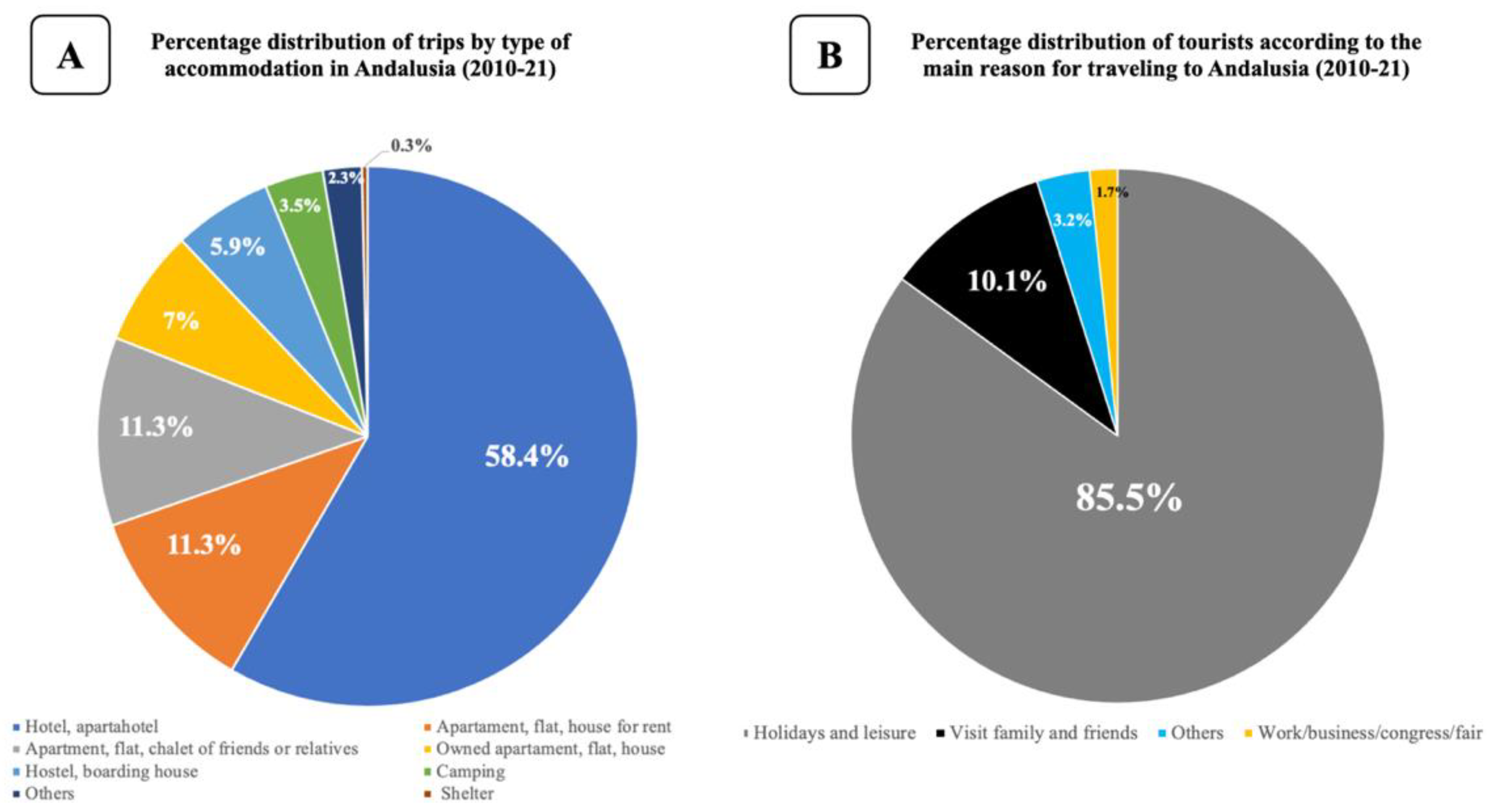
Figure 2.
Location of the research (Andalusian eight provinces). Source. Own elaboration.
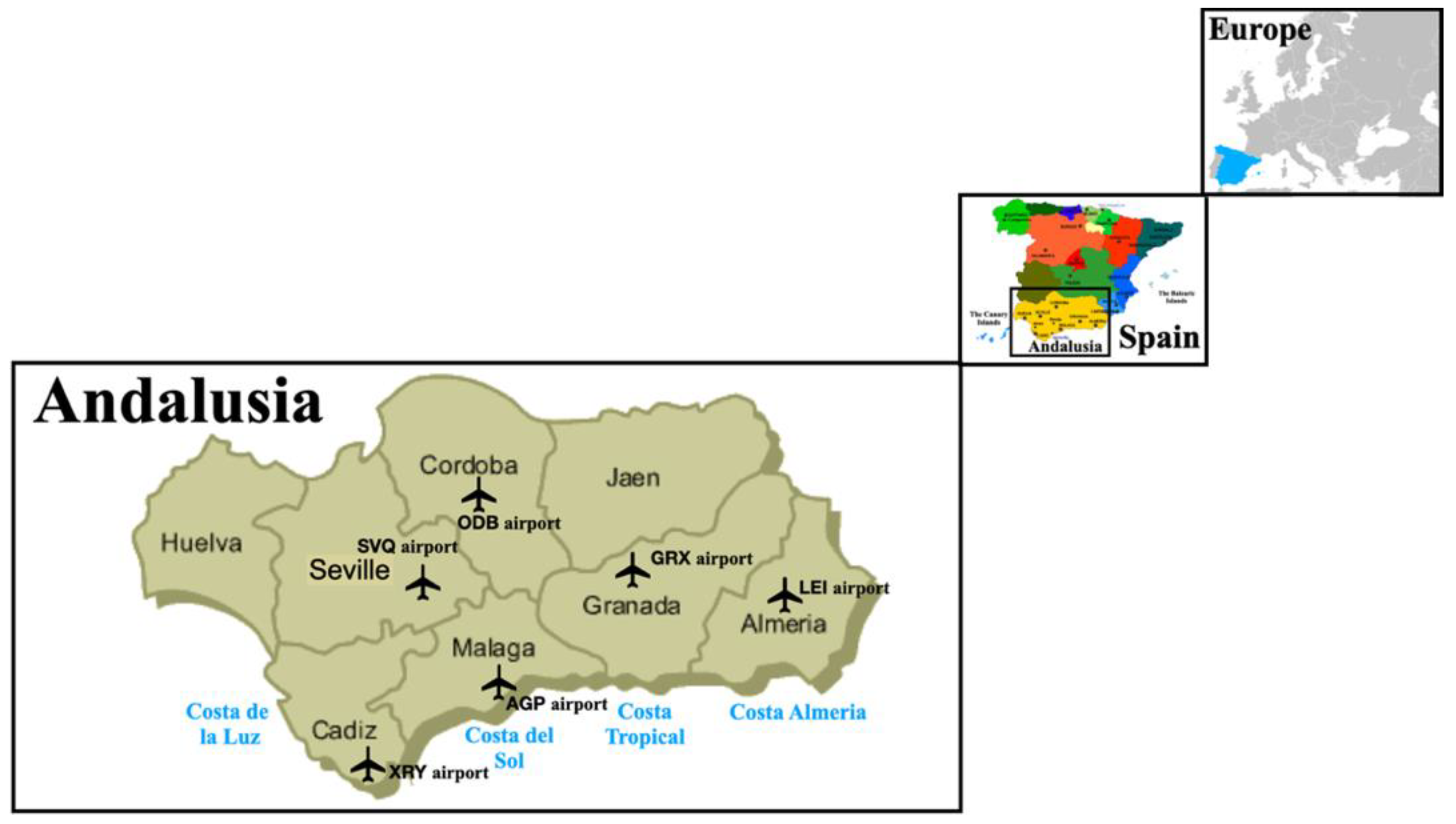
Figure 3.
Supply and demand indicators (2010-2022). Source. Own elaboration from IECA [57,115,116], INE [8,9,117,118], and AENA [111].
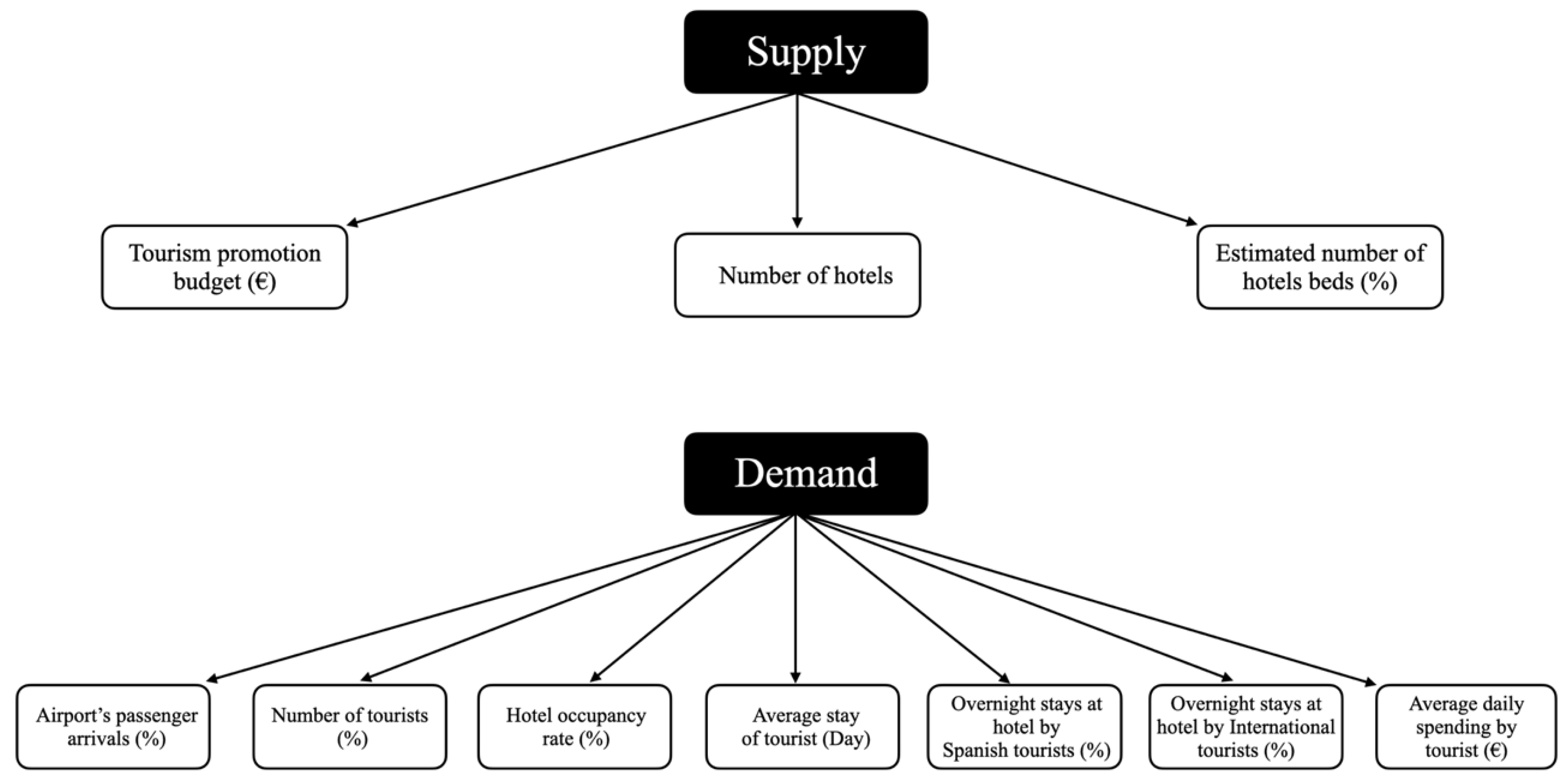
Figure 4.
Descriptive statistics of Almería province (2010-2022). Source. Own elaboration from IECA [57,115,116], INE [8,9,117,118], and AENA [111]. Note. 2022 provisional data.
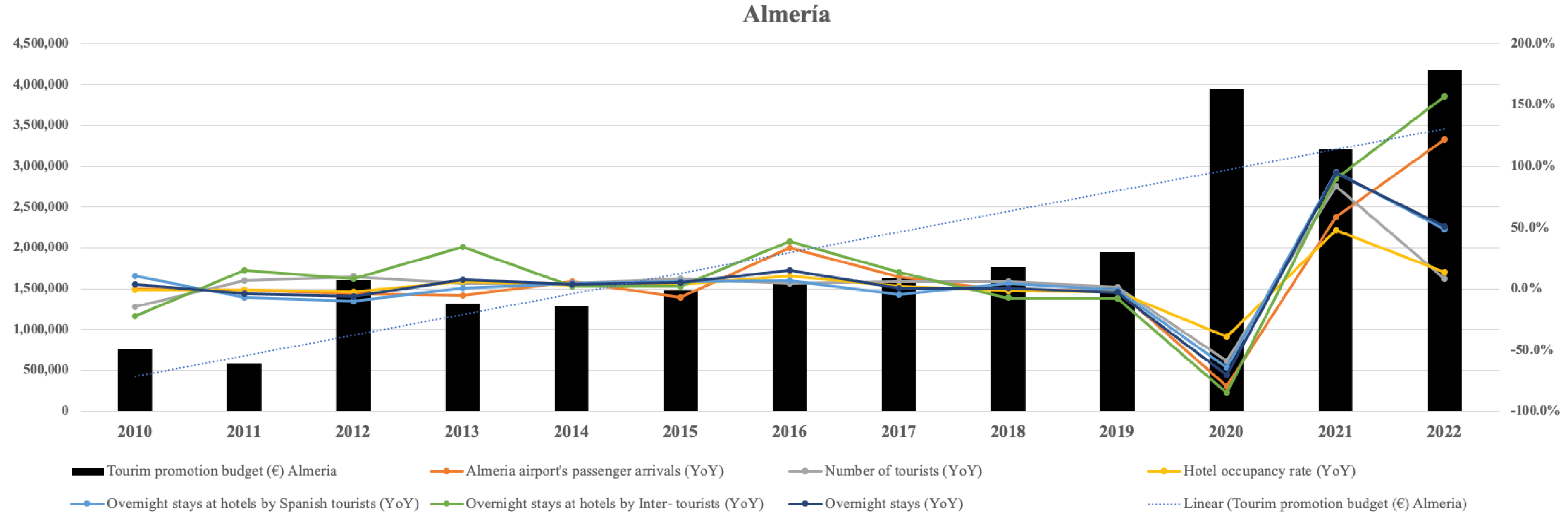
Figure 5.
Tourism promotion campaign in Europe in 2021 ‘Andalucía wants you back’. Source. Junta de Andalucía [112].
Figure 5.
Tourism promotion campaign in Europe in 2021 ‘Andalucía wants you back’. Source. Junta de Andalucía [112].
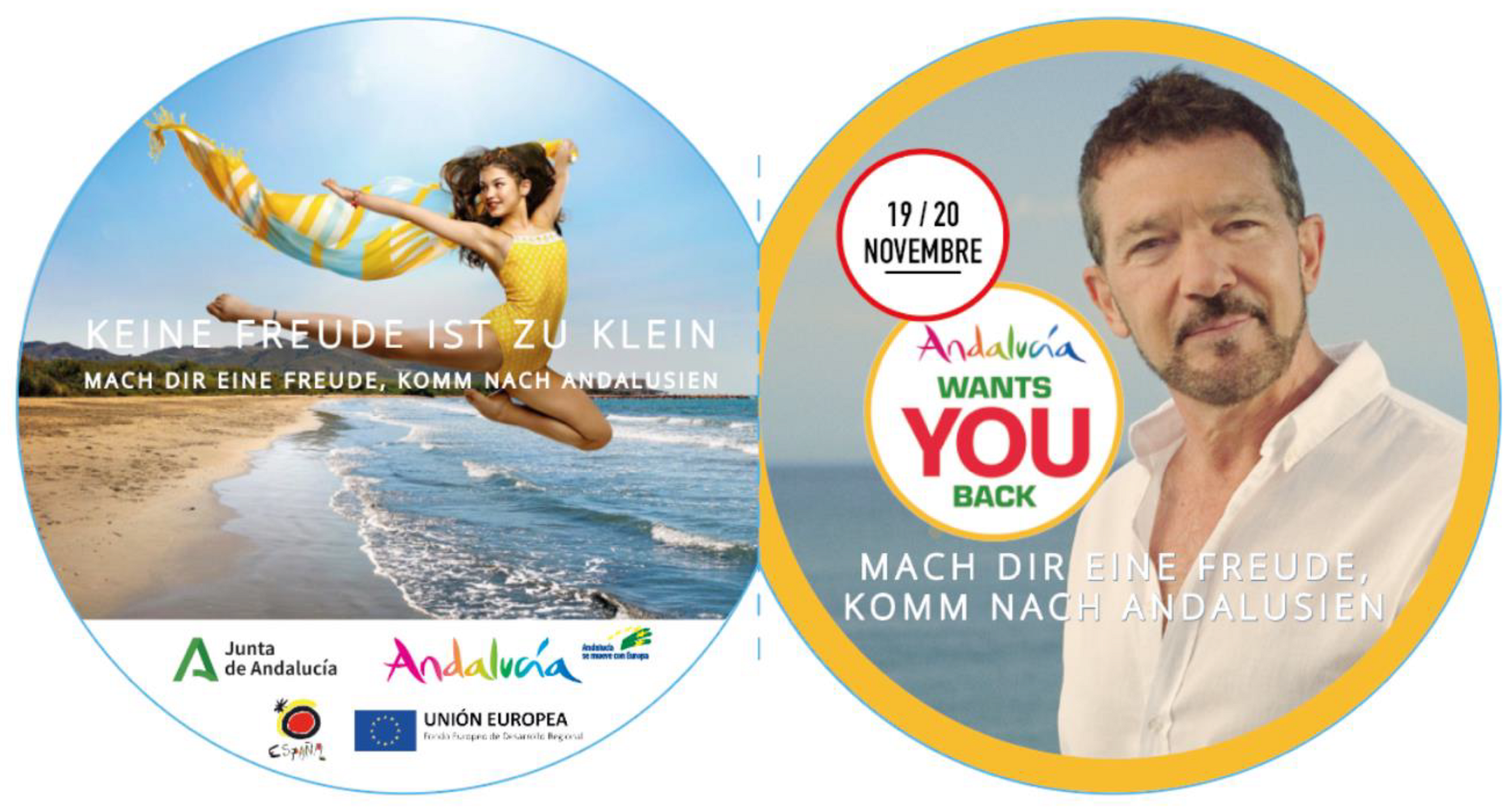
Figure 6.
Tourism promotion campaign of eight provinces of Andalusia in 2021. Source. Junta de Andalucía [112].
Figure 6.
Tourism promotion campaign of eight provinces of Andalusia in 2021. Source. Junta de Andalucía [112].
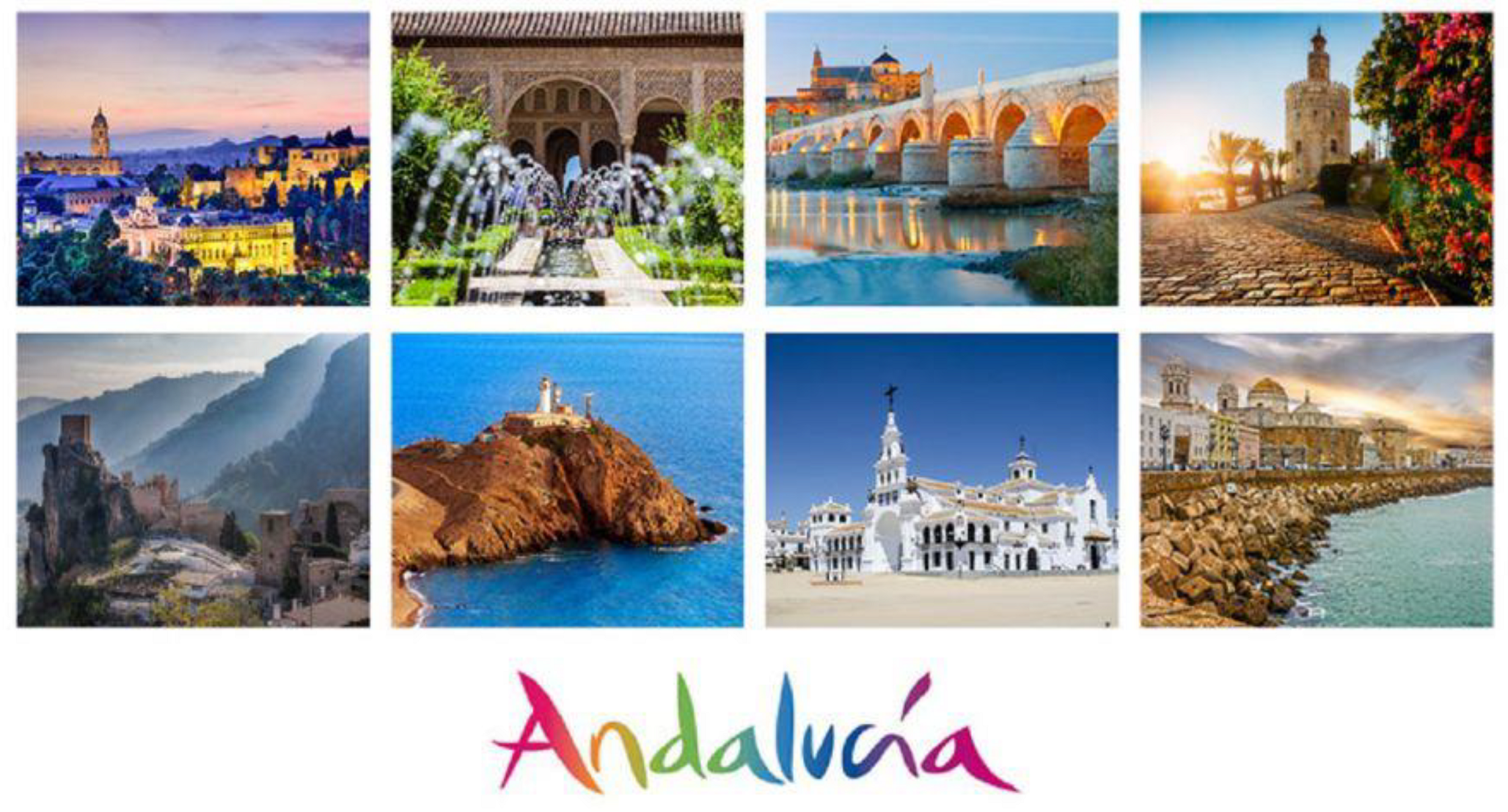
Figure 7.
Descriptive statistics of Cádiz province (2010-2022). Source. Own elaboration from IECA [57,115,116], INE [8,9,117,118], and AENA [111]. Note. 2022 provisional data.
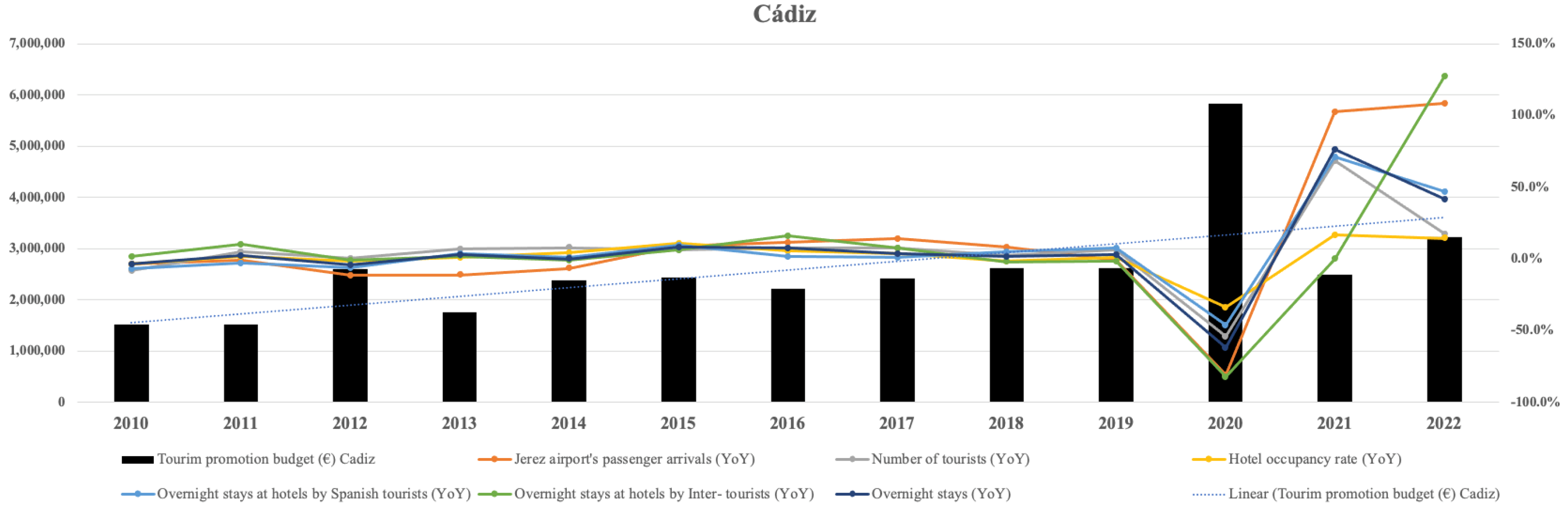
Figure 8.
Descriptive statistics of Córdoba province (2010-2022). Source. Own elaboration from IECA [57,115,116], INE [8,9,117,118], and AENA [111]. Note. 2022 provisional data.
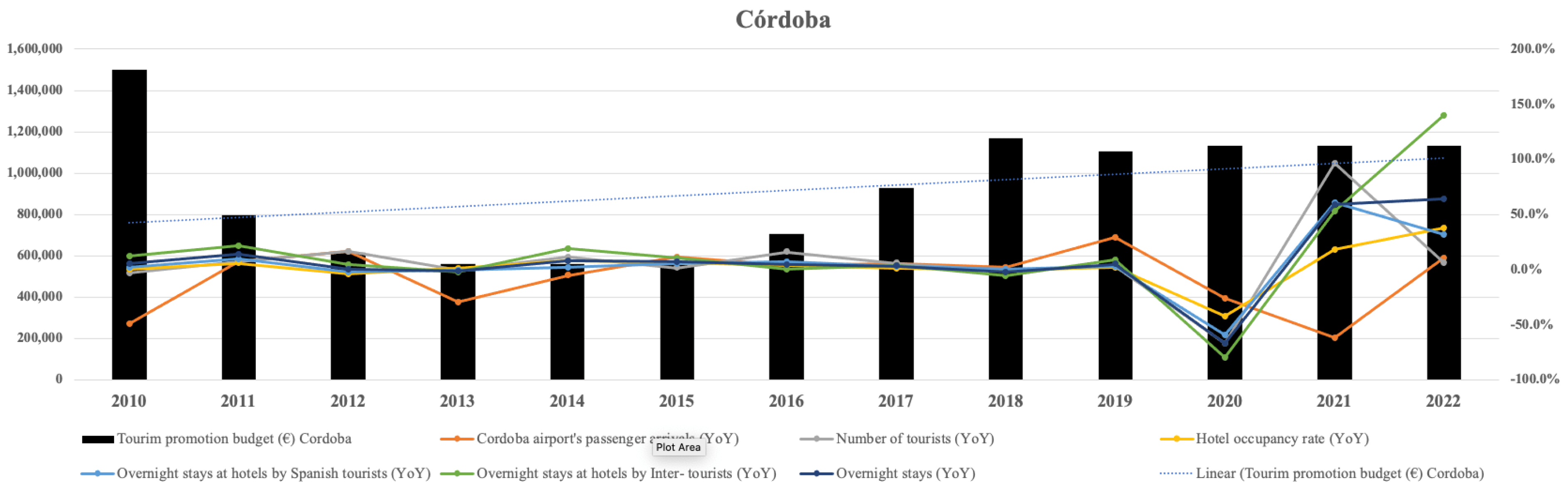
Figure 9.
Descriptive statistics of Granada province (2010-2022). Source. Own elaboration from IECA [57,115,116], INE [8,9,117,118], and AENA [111]. Note. 2022 provisional data.
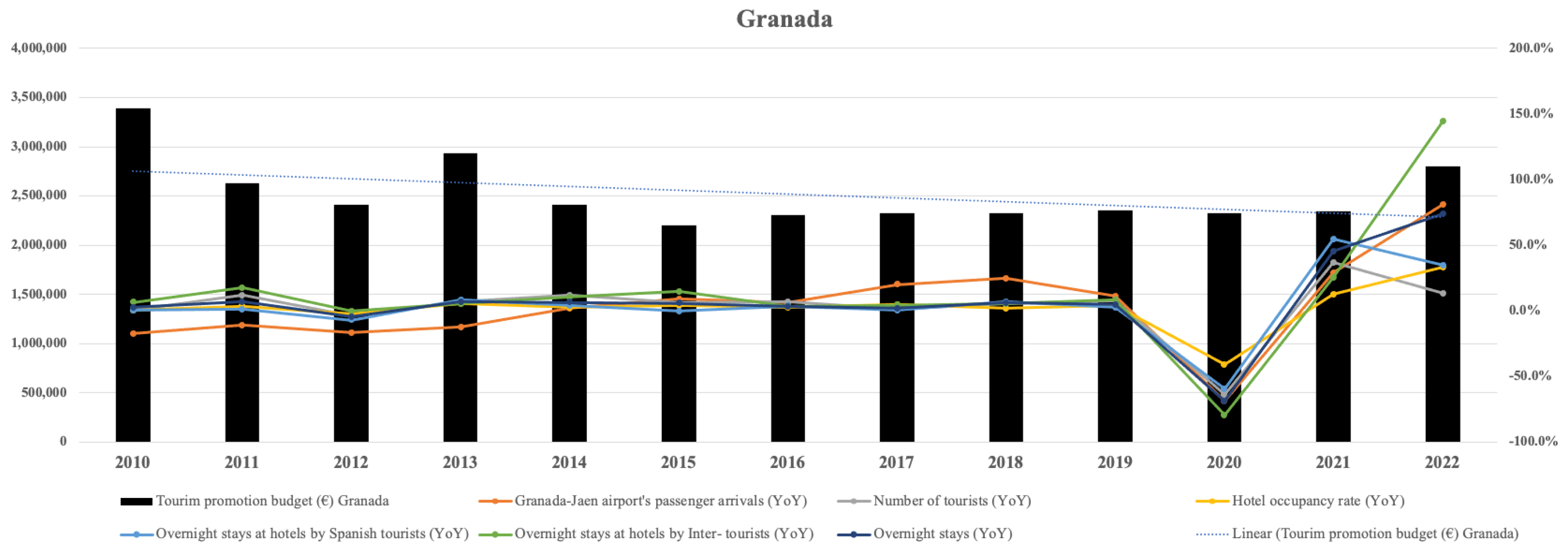
Figure 10.
Descriptive statistics of Huelva province (2010-2022). Source. Own elaboration from IECA [57,115,116], INE [8,9,117,118], and AENA [111]. Note. 2022 Provisional data.
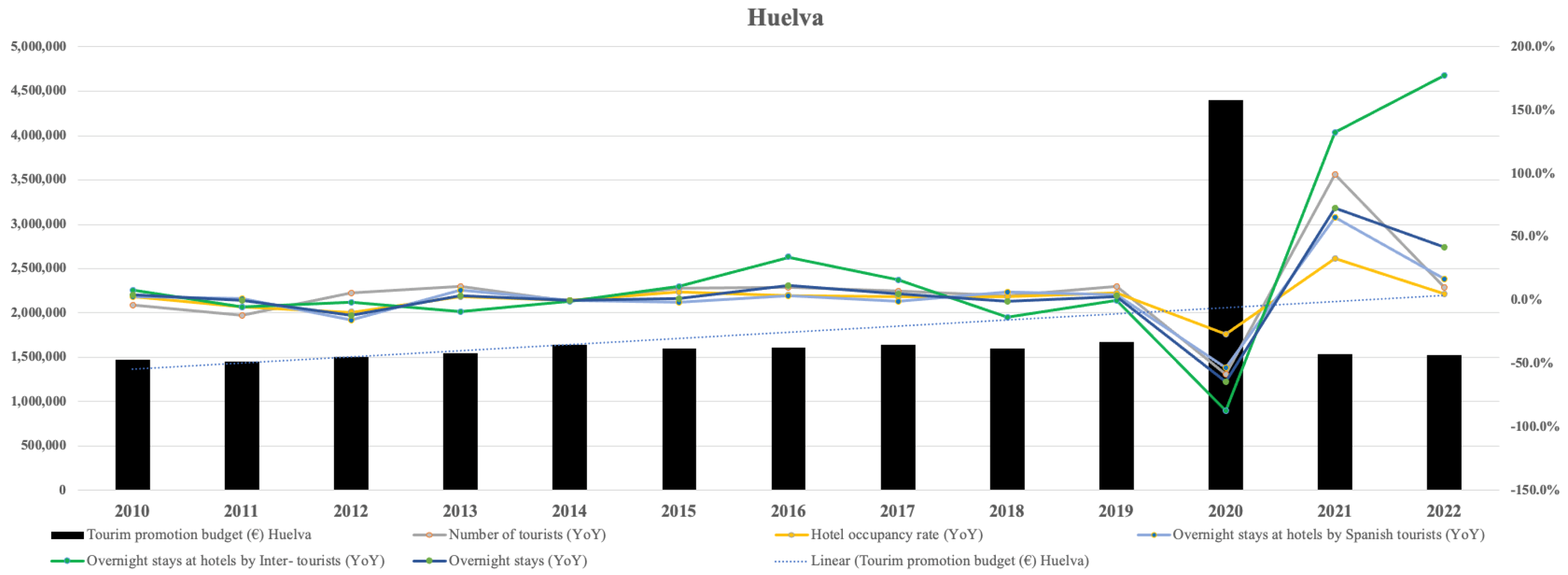
Figure 11.
Descriptive statistics of Jaén province (2010-2022). Source. Own elaboration from IECA [57,115,116], INE [8,9,117,118], and AENA [111]. Note. 2022 provisional data.
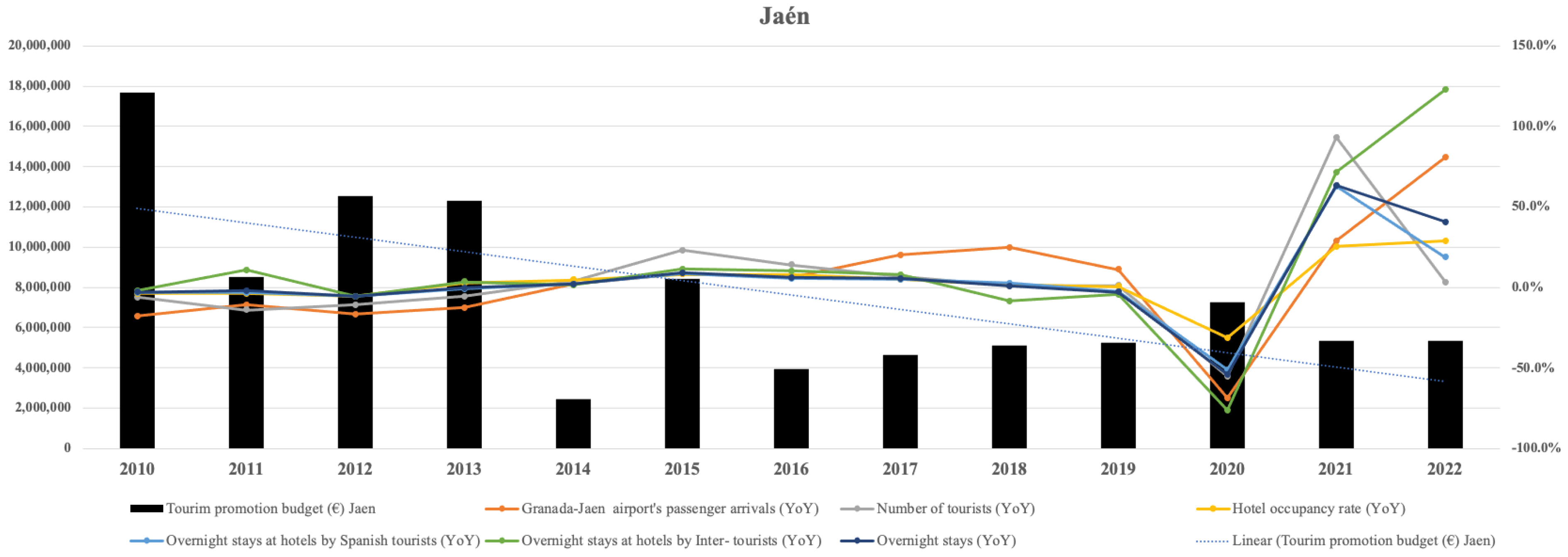
Figure 12.
Descriptive statistics of Málaga province (2010-2022). Source. Own elaboration from IECA [57,115,116], INE [8,9,117,118], and AENA [111]. Note. 2022 provisional data.
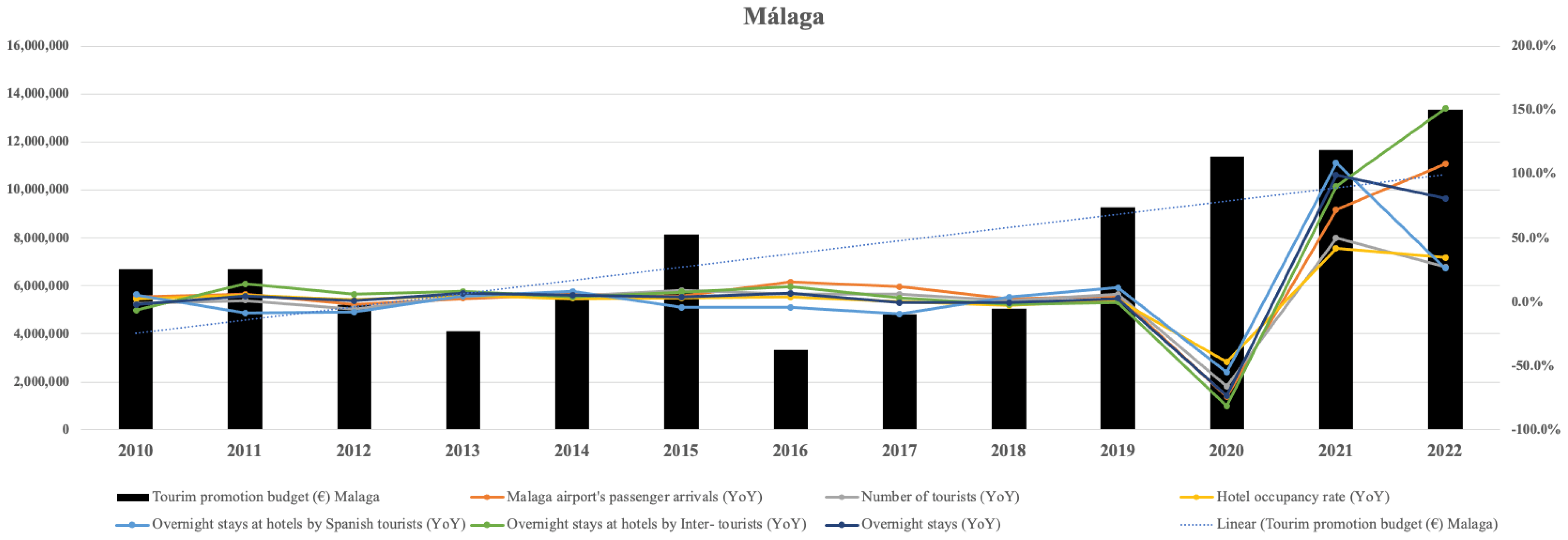
Figure 13.
Tourism promotion of ‘Caminito del Rey’ through Andalusia’s DMO official website. Source. Andalucía.org [157].
Figure 13.
Tourism promotion of ‘Caminito del Rey’ through Andalusia’s DMO official website. Source. Andalucía.org [157].
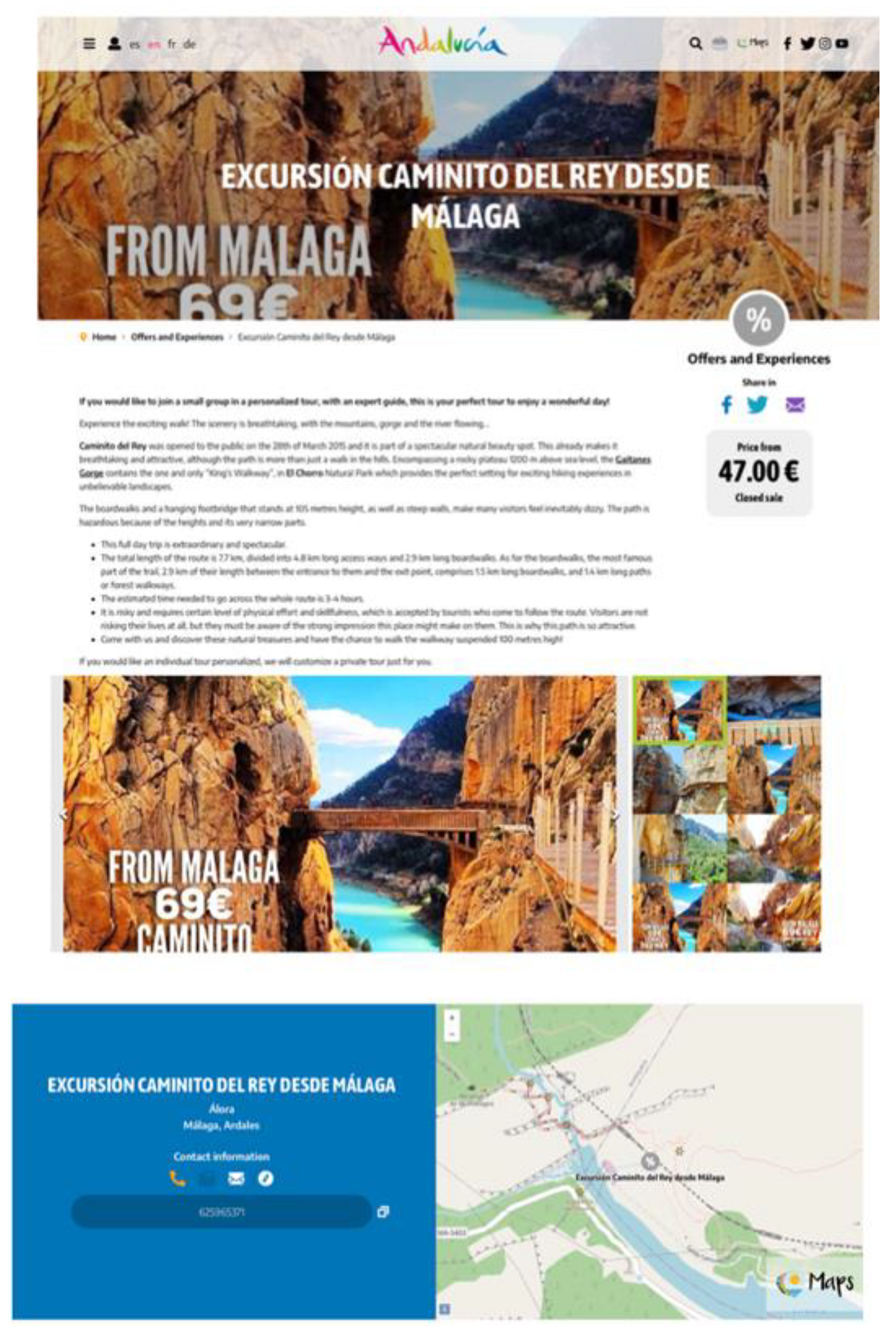
Figure 14.
Descriptive statistics of Seville province (2010-2022). Source. Own elaboration from IECA [57,115,116], INE [8,9,117,118], and AENA [111]. Note. 2022 provisional data.
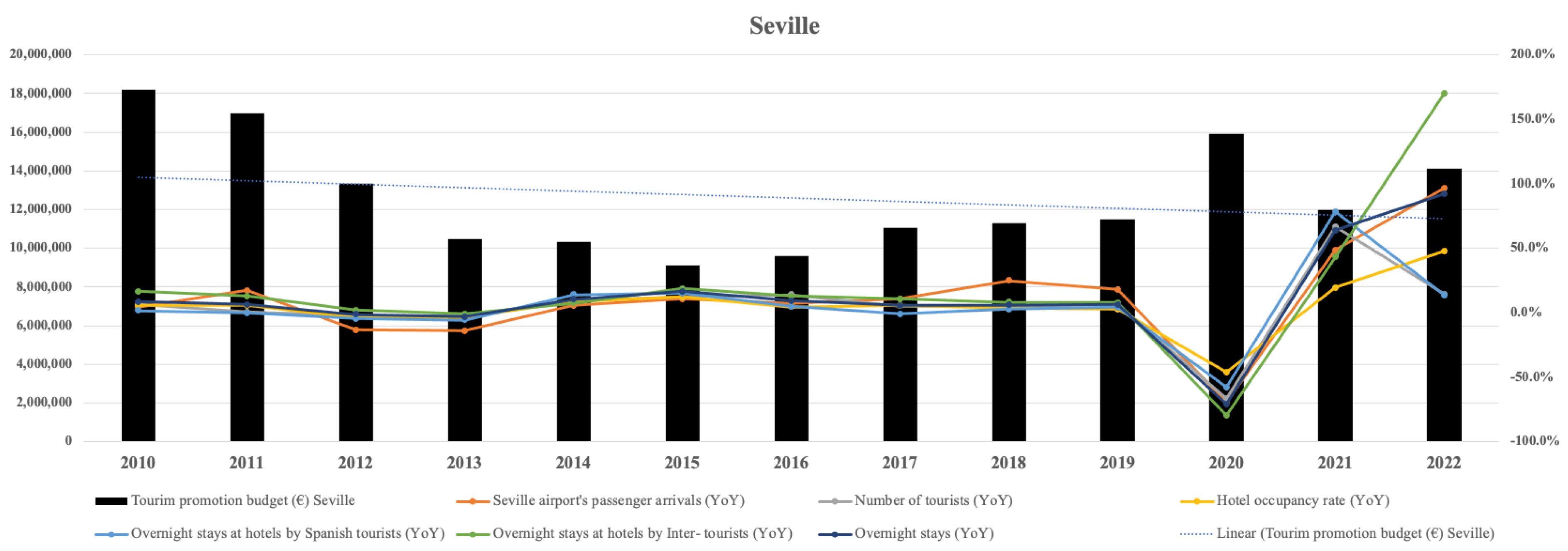
Figure 15.
Indicators favoured by tourism promotion budgets and campaigns at Andalusian provinces. Source. Own elaboration.
Figure 15.
Indicators favoured by tourism promotion budgets and campaigns at Andalusian provinces. Source. Own elaboration.
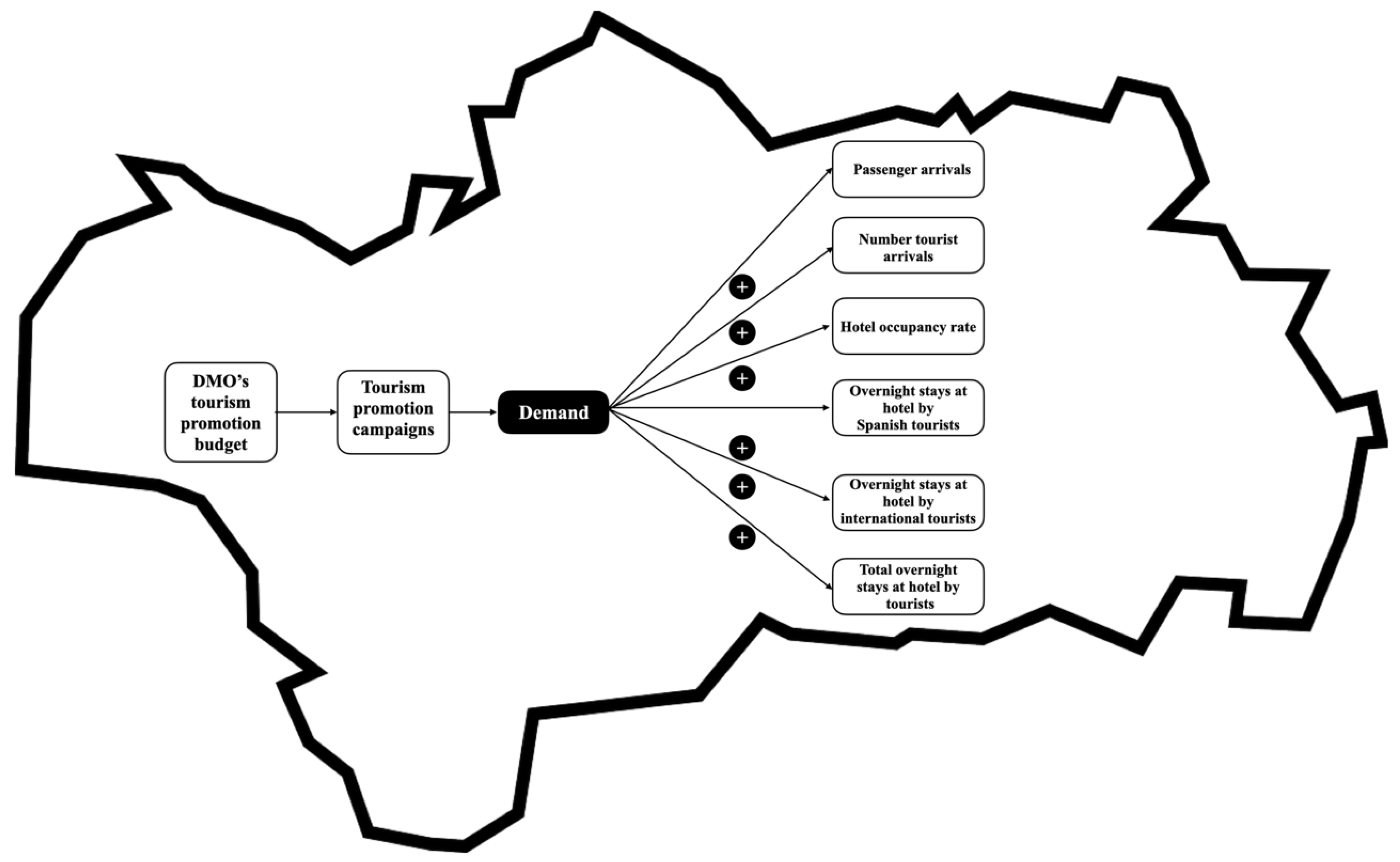
Disclaimer/Publisher’s Note: The statements, opinions and data contained in all publications are solely those of the individual author(s) and contributor(s) and not of MDPI and/or the editor(s). MDPI and/or the editor(s) disclaim responsibility for any injury to people or property resulting from any ideas, methods, instructions or products referred to in the content. |
© 2024 by the author. Licensee MDPI, Basel, Switzerland. This article is an open access article distributed under the terms and conditions of the Creative Commons Attribution (CC BY) license (https://creativecommons.org/licenses/by/4.0/).
Copyright: This open access article is published under a Creative Commons CC BY 4.0 license, which permit the free download, distribution, and reuse, provided that the author and preprint are cited in any reuse.


