
Submitted:
28 April 2023
Posted:
29 April 2023
You are already at the latest version
Abstract
Analysing and understanding donor behaviour in Non-profit Organisations (NPOs) is challenging due to the lack of human and technical resources. Machine learning (ML) techniques can analyse and understand donor behaviour at a certain level; however, it remains to be seen how to build and design an Artificial Intelligence enabled Decision Support System (AI-enabled DSS) to analyse donor behaviour. Thus, this paper proposes an AI-enabled DSS conceptual design to analyse donor behaviour in NPOs. A conceptual design is created following a Design Science Research approach to evaluate an AI-enabled DSS's initial DPs and features to analyse donor behaviour in NPOs. The evaluation process of the conceptual design applied formative assessment through conducting interviews with stakeholders from NPOs. The interviews were conducted using the Appreciative Inquiry framework to facilitate the process of interviews. The results of analysis based on the interviews provide insightful information not only about the proposed conceptual design for an AI-enabled DSS, but also about what is required to analyse donor behaviour NPOs using DSS. Evaluating the conceptual design results recommend efficiency, effectiveness, flexibility, and useability in the requirements of the AI-enabled DSS. This research contributes to the design knowledge base of AI-enabled DSS for analysing donor behaviour in NPOs. Future research will combine theoretical components to introduce a practical AI-enabled DSS for analysing donor behaviour in NPOs. This research is limited to such analysis on donors who donate money or volunteer time for NPOs.
Keywords:
decision support systems
; design science research
; donor behaviour
; non-profit organisations
; data analysis
; artificial intelligence
; machine learning
1. Introduction
NPOs, not-for-profit organisations, vary from organisation to organisation, and are private, independent, and self-governing that sets their policies and objectives [1]. These organisations include museums, educational institutions, research facilities, human services, medical facilities, human rights groups, religious institutions, and foundations. The objectives of NPOs include personal actions in addition to the principles and motives that inspire individuals to be involved in charitable giving, philanthropy, volunteering, and other activities that advance society, the environment, and cultural heritage [1]. The funding sources in NPOs vary; nearly 50% of income is self-generated in Australia, 33.5% is the government's contribution, and only 9.5% represents gifts, giving, and public donations [2]. NPOs can significantly impact society by enlisting volunteers and donors to offer their time and money, as well as by developing dependable relationships with clients. However, many NPOs experience financial difficulties due to decreased investment returns, constrained corporate budgets, and a decline in income from charitable trusts and foundations, significant contributors, and community contributions [3]. At the same time, employees at NPOs spend more time maintaining relationships with partners and donors to deal with uncertainty [3]. Moreover, NPOs spend more time on marketing to raise donors' awareness of any difficulties or challenges [3]. Donors support the goals of NPOs by giving money, gifts, volunteering time and previous experiences. Private donations are significant in funding NPOs in the USA, which annually contribute to more than 10% of the Gross Domestic Product [4]. Dietz and Keller [5] reported that individuals donate to NPOs because of their deep passion or beliefs of NPOs’ needs, attracting around $260 billion in 2014 in the USA. The factors impacting peoples' intentions toward donating include income, educational level, and previous giving history [4]. Today's NPOs focus on gaining donations by knowing donor behaviour which requires them to interact with their donors [6] authentically. One of the essential behaviours of donors is to return or intend to donate for a second time. Only 19% of donors donate for the second time, which is a major concern for NPOs [6]. However, Sargeant and Jay [7] mentioned that appropriate mapping with donors to corresponding charities and improving communications with them is critical for NPOs.
According to a study conducted by Dietz and Keller [5], donors are divided into three categories: Giving (money, donation of goods and services, purchases made, and so forth); Doing (volunteering, attending events, serving in a leadership role, and so on); and Communicating (Spreading the word, advocating, following on social media, and staying informed are all examples of communication). It is found that donors who donated money and time live in well-established familiar settings (they are older, married, and have children) and have solid financial backgrounds (higher incomes, receiving gifts, and inheriting) [8]. Moreover, communication is an interaction in two ways (between donors, volunteers and NPOs) [5]. Therefore, to narrow this study's scope, we classified donors (who give money) and volunteers (who do activities) under donor behaviour to build a predictive and descriptive analysis that helps NPOs in making better decisions.
The many factors influencing donor behaviour requires understanding donors [9]. Such understanding and analysis of donor behaviour can assist NPOs in increasing marketing and fundraising efficiency [10]. Donor behaviour include donor intentions to donate either time or money, donor frequency (returning), donor engagement, donor communications, and volunteering engagement [5,8]. This donor behaviour can be understood better by the NPOs using technologies, data science and ML [11]. ML techniques provide better understanding of donors for the NPOs, which can improve the chances of increasing interactions with and financial support from them [12].
Analysing donor behaviour would enhance decision-making potentially providing high value to NPOs. Given this context, it is critical to understand the fundamentals of donors [9]. NPOs can increase their current financial support and interact with outgoing donors for potential opportunities for repeat donation activities by analysing their behaviours using ML techniques [12]. However, NPOs face significant challenges, such as a lack of technical skills [13] and financial resources [14] for applying data analytics. Most importantly, managers can use data to gain useful insights into the organsation's strengths and weaknesses, allowing them to make informed decisions [15]. Creating a DSS for managing NPO activities is essential [16]. The DSS system aids in the resolution of organisational problems in order to reduce uncertainty and improve decision-making [17]. Nevertheless, the literature shows that no attempts have been made to designing an AI-enabled DSS for analysing donor behaviour. It is believed that designing a DSS based on ML techniques is complex and requires self-learning and user interactions [18].
Given our focus on donors giving and doing, this research aims to create a conceptual design of artefact (AI-enabled DSS) to analyse donor behaviours in NPOs. By extending the research process framework [19], the conceptual design provides general answers to meet all user and consumer needs [20]. Consequently, the conceptual design was evaluated and modified based on experts’ interviews. The evaluation results recommend that the AI-enabled DSS to analyse donor behaviour should be usable for NPOs’ decision-making. This research will further develop a design theory for an artefact (the AI-enabled DSS) that will use ML techniques to analyse donor behaviour. This artefact is intended to assist NPOs’ managers in making better decisions on future marketing, fundraising, and other NPOs’ missions. The design theory will explain the artefact’s functions, attributes, and features [21]. The design theory also provides how the AI-enabled DSS is designed and constructed for future implications.
This paper is organised as follows: section 2, which contains a theoretical background of DSSs, donor behaviour, and reviewing the literature on DSS in NPOs. Following that is section 3 which covers an introduction to the design science approach, the research process model, the demonstration of the conceptual design, the evaluation of the conceptual design, and the data analysis. Section 4 presents the evaluation results of the conceptual design and the next steps and expected results in section 5, followed by the research limitations in section 6.
2. Theoretical Background
2.1. Decision Support Systems
Over the last few decades, many researchers are interested in various domains of DSS such as information systems (IS), mathematics, and economics [17]. The key component of IS research that evolved in improving and managing the decision-making process is decision support [22]. DSS is not focused on integrating all existing options but rather on selecting the best one based on priorities and objectives [17]. In the context of DSS architecture, one essential component is the database, which is responsible for the modification and processing of the data [17]. After the data has been entered into a DSS, the system's components can be configured such that they process the data, present solutions that will help in problem-solving, and ultimately produce a decision design that will manage the issue [17]. Another component of the DSS is the model management system, which performs useful simulations through various analytical techniques to provide complex advanced or useful information. These useful insights of analytics are presented on a user interface, a third component of the DSS [23]. However, DSS has evolved from traditional to intelligence-based systems with AI, ML, cloud computing, and networking as the primary drivers [17]. These technologies become necessary to ensure long-term viability, high productivity, and benefits [17]. Knowledge-driven, document-driven, data-driven, and communication-driven DSS are all part of the AI DSS [24]. Therefore, the AI-enabled DSS has a strong function in adjusting and handling intelligent models in the form of knowledge and presenting them simply on interfaces [17]. The AI-enabled DSS employs AI approaches to assist decision-making, making it "intelligent" [25]. Any DSS based on ML is referred to as intelligent or AI-enabled DSS [26].
2.2. Donor Behaviour
Attitudes, norms, perceived behavioural control, subjective norms, prior actions, and morals are some elements that influence donor willingness to provide money or volunteer time [9]. Some influential determinants on donor behaviour towards contributing [4], included donor education level, gender, age, population, household income, and ethnicity. ML models (Support Vector Regression, Multiple Linear Regression, Artificial Neural Networks) were created using these criteria to accurately predict future philanthropic giving from donors [4]. The findings suggest that educational level, population, and prior donation quantity are all important independent variables. Similarly, Shehu, et al. [8] created a multinomial logistic model to see if multi-donation people differ from single donors or non-donors. Shehu, et al. [8] applied a variety of predictors to create useful insights into donor behaviour, including geographic, health-related, psychographic, and sociodemographic characteristics. The findings provide helpful information about NPOs’ donor engagement and retentions to donate, as well as donor-recognized profile factors. However, none of the studies mentioned above [4,8,9] attempted to create an AI-enabled DSS for analysing donor behaviour in NPOs. As a result, NPOs are lacking an AI-enabled DSS for analysing donor behaviour for better decisions making.
2.3. DSS in NPOs
NPOs need effectiveness in managing decisions [21]. Decision-making is supported by data growth, which provides more opportunities to handle data [27]. Most data from NPOs is unstructured and difficult to decipher hidden information and establish connections [28]. NPOs face significant hurdles in using data analysis, such as a lack of technical skills [13] and financial resources [14]. As a result, if the data is not well-collected and arranged, some NPOs may not be able to draw inferences and insights from it [29]. Managers can use data to get valuable insights into the organisation's strengths and weaknesses, allowing them to make well-informed decisions [15]. An effective DSS is an interactive software-based tool that helps decision-makers gather key information from various raw data, documents, personal experiences, and business models to identify problems, find solutions, and make decisions.
Most importantly, creating a DSS for controlling the activities of NPOs is critical [16]. There are attempts to predict donor behaviour using ML techniques [4,30]. However, we found a lack of descriptive and predictive analytics literature to understand and predict donor behaviour towards helping, donating, and giving to the NPOs, especially in the context of donating money and volunteering time. A DSS was developed by Barzanti, et al. [31] to rank donors using a fuzzy method to predict the targeted campaign. Although this study is useful for our problem initiation, it lacks in developing guidelines for designing a DSS. The above studies [4,30,31] focus on domain-specific explanations that show the capabilities of some ML techniques to analyse donor behaviour.
Despite the importance of adopting DSS in NPOs, there is a need to develop an AI-enabled DSS for analysing donor behaviour. There is a gap in experimental or theoretical studies on creating an AI-enabled DSS in NPOs to analyse donor behaviour. Designing an AI-enabled DSS is difficult as it requires features like autonomy, self-learning, and user involvement [18,32]. These features set the AI-enabled DSS apart from typical DSSs as the former needs enhancements in relevance and quality [26]. This paper addresses the challenges and research gaps by building a conceptual AI-enabled DSS design based on driven information from theoretical sources, then evaluating it relaying on interviewing stakeholders in NPOs and experts from the field. Further, the evaluation results are to capture the required design knowledge of deploying an artefact to analyse donor behaviour based on this design. Most importantly, Design Science Research (DSR) can help NPOs overcome the challenges of designing DSS as it involves guidelines to facilitate the design process. [26]. Furthermore, according to Arnott and Pervan [26], researchers are looking for help with planning and implementing their DSR projects.
3. Research Methodolgy
Design Science is the process of designing artefacts and scientific investigations in order to answer a specific problem [33]. Design science develops and assesses IT artefacts that are meant to address specific organisational issues [34]. Constructs made out of software, hardware, systems, or models are called artefacts [34]. The artefact must be innovative, productive, or valuable in resolving a previously unsolved or known issue [34]. The artefact might range from simple instantiations to greater efforts in the context of final design theories in the context of implemented software or algorithms [34].
3.1. Research Process Model
The process of creating the artefact should involve a search process for a solution to a specified problem, drawing on existing theories and body of knowledge Peffers, et al. [35]. Meanwhile, study’s findings must be effectively communicated to the appropriate audience [34]. The DSR represents an incremental and iterative process [34]. Also, the iterative cycles imply constant reflection and abstraction [36], which are necessary foundations for developing a design theory and artefact. Design theory describes how an artefact should be constructed in order to achieve the desired initiatives and results [36]. Thus, the DSR process presented by [35] suited our research aims. The research process model developed by [35] provides a useful synthesised general model that builds on other approaches [37].
Figure 1.
AI-enabled Process Model adopted.
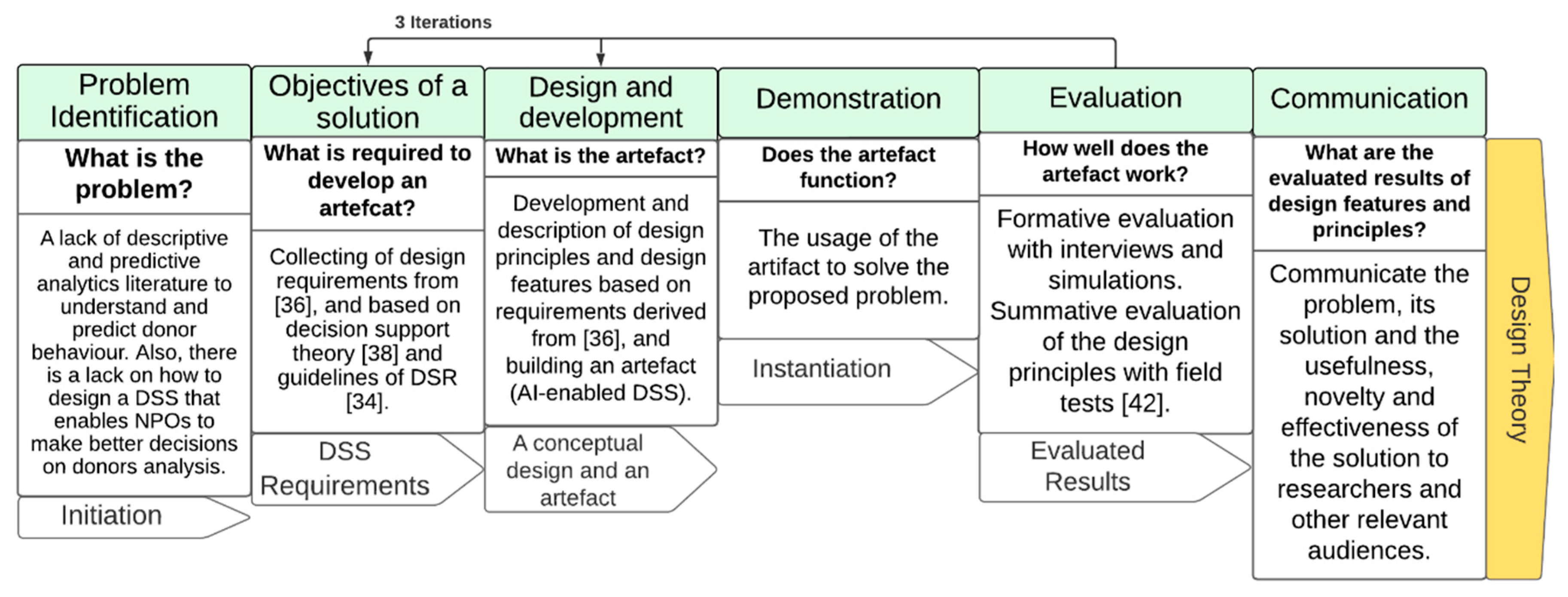
Furthermore, we find this process model to be consistent with our research aims, which contains: (1) identifying the problem, (2) define objectives of a solution, (3) design and development, (4) demonstration, (5) evaluation; and (6) communication. Considering the process model of Peffers, et al. [35], our research process model (1) identified the problem through analysing the literature to (2) found and formed the objectives of a solution, (3) developed a conceptual design, (4) builds an artefact as an instantiation of the problem in a further study, (5) evaluates the design of the artefact conceptually and practically, and (6) communicate the problem, the solution and usefulness of the solution to researchers and other audience. Moreover, three iterations are conducted to ensure a variety of evaluation methods, and for more validity of the artefact's design.
3.1.1. Phase 1: Problem Identification
This phase identifies a research problem and the importance of solving the proposed problem. While such instantiations demonstrated ML capabilities in different instances and studies [4,30,31] reported in the literature, there is a lack of prescriptive design knowledge to guide researchers and practitioners in systematically implementing them for DSS in NPOs for analysing donor behaviour. To expand the awareness of the research problem beyond the literature, two informal interviews were conducted with two experts from NPOs during this phase. During interviews, we asked the experts (1) to describe the process of donor behaviour analysis, (2) state the challenges they face in designing such a DSS that helps in describing and predicting donor behaviour, and (3) explicate the potential of creating a design theory that guides the process of designing AI-enabled DSS, or any other suggestions. Table 1 summarises these interviews stating the process of analysing donor behaviour, the challenges faced by some of NPOs, and suggestions for creating an artefact that analyses donor behaviour.
All valuable insights were noted from the interviews. For example, experts mentioned that descriptive and predictive analytics assist NPOs in making better decisions to increase efficiency and performance and understanding the influential factors on donations in NPOs. Furthermore, these analytics can be generated and visualised through a DSS. At this stage, the interviews helped identify the problem and increase awareness of creating a design theory of an artefact to analyse donor behaviour.
3.1.2. Phase 2: Objectives of a Solution
In this phase, the objectives and the requirements of the intended artefact are elicited to determine the main functionalities of the AI-enabled DSS. The initial requirements for creating an artefact are defined based on meta requirements of Meth, et al. [36] and on the decision theory by Silver [38]. Also, the guidelines are followed of developing an artefact by Hevner, et al. [34]. The guidelines are intended to help researchers, reviewers, authors, and readers understand what is required for effectual research [34].
A design scientist must understand the artefact's objectives . The objectives of the artefact can be defined through design requirements. Table 2 introduces the initial design requirements derived from Meth, et al. [36]. Existing research in decision support theory typically describes two primary goals of decision-makers: ensuring maximum decision quality and reducing effort [21,36]. However, a DSS may offer the user only limited selections of strategies [38], which requires designers of a DSS to ensure minimising the restrictions [39]. The degree to which the DSS pre-selects decision techniques and, as a result, only provides decision makers with a limited variety of strategies - which may not include their preferred ones - is known as system restrictiveness [39]. Ultimately, the most crucial characteristics of any DSS are the perceived advice quality, perceived cognitive effort, and perceived restrictiveness [36]. Therefore, the three design requirements from Meth, et al. [36] borrowed, offered a basement of our conceptual design and provided potentials for constructing our conceptual design of AI-enabled DSS for analysing donor behaviour. Table 2 presents the design requirements browed from Meth, et al. [36] with an explanation for each DR, and a justification.
3.1.3. Phase 3: Design and Development
This phase creates definitions of design principles (DPs) and design Features (DFs) which interpret the design requirements in the previous phase. es can be a statement that tells what the artefact should do [18]. DFs are unique artefact capabilities to fulfil design principles [36]. DPs are statements that help develop an artefact that meets the design requirements [36]. DPs are essential design theory elements because they contain important design knowledge [40]. Because one aim is to build an artefact (AI-enabled DSS for analysing donor behaviour), the DPs should be stated as “the should do., or the system should fulfil… ” [40]. Table 3 presents six DPs together with their explanation.
DFs are specific capabilities that map or address the DPs and design requirements [36]. DFs are specific artefact functionalities required to meet DPs [36]. The DFs are introduced in the last phase of conceptual design and are created to interpret the DPs (Table 4).
After defining the design requirements, principles and features, a conceptual design is presented in phase 4, which is the demonstration. After demonstrating a conceptual design and evaluating it, an artefact of AI-enabled DSS will be built, and evaluated to ensure the validity of design requirements, principles and features.
3.1.4. Phase 4: Demonstration
The demonstration phase is to present an instantiation of the AI-enabled DSS. The aim of demonstration stage is to that the usage of the artefact can solve the problem. In this research context, the demonstration stage is divided into two steps: a conceptual design of the AI-enabled DSS and an artefact (AI-enabled DSS) for analysing donor behaviour. Noticeably, in this paper, our aim of the demonstration is to present a conceptual design of the AI- enabled DSS to ensure the validity of design requirements, DPs and DFs can solve the research problem. Therefore, the first part of the evaluation phase (iteration one) is conducted, which is to apply such a required change to the conceptual design.
From the previous stage (Design and Development), we combined design requirements (the requirements of the AI-enabled DSS), that link to the DPs (our objectives), and the DFs which interpret our execution of the design requirements and DPs. A preliminary conceptual design is developed and evaluated with NPOs’ stakeholders. The evaluation phase includes interviews with experts from NPOs to provide valuable feedback on the conceptual design. Before iteration one, we met with experts to demonstrate this preliminary conceptual design and explained how the components emerged. Figure 2 shows three main components of the conceptual design which are three design requirements, six DPs, and four DFs.
3.1.5. Phase 5: Evaluation
In this phase, the framework of evaluation introduced by Venable, et al. [42] is used, which has two types of evaluations, formative and summative. The assessment is meant for evaluating the AI-enabled DSS and the design theory with relevant design requirements, DPs, and DFs. Formative evaluations are utilised to generate experimentally verified interpretations that serve as the foundation for effective action in enhancing the traits or performance of the evaluand [42]. Summative evaluation provides a foundation to produce common meanings of the evaluation in a different context. The evaluation phase will run three iterations; after each iteration, some changes will be applied to the design and development of the AI-enabled DSS.
Most importantly, because the demonstration is only to present the conceptual design (not instantiated/functional) so far, a cycle goes back to phases 2 (Objectives of a solution) then phase 3 (Design and Development), for ensuring that evaluation results of iteration one have been addressed. Further, an artefact (AI-enabled DSS) will be built based on the evaluation results from iteration one. After that, Iteration two will occur to ensure the functionality of the artefact, followed by iteration three to collect expert’s feedback on the effectiveness, the efficiency, control, and the success of the AI-enabled DSS1.
Iteration one aims to evaluate the initial design requirements, DPs and DFs. Iteration one resulted after design requirements, DPs, and DFs being evaluated (formative assessment) to ensure their relevance to our research aims and objectives. For iteration one evaluation, semi-structured interviews were conducted with NPOs decision-makers, data scientists, volunteers, systems designers and analysists, experts in NPOs, and managers of NPOs. Interviews, one of the qualitative research methods, are frequently concerned with obtaining a thorough grasp of a situation or determining the specific phenomenon [43]. During interviews, those experts are involved in evaluating our conceptual design. This iteration results lead to applying any changes or suggestions on design requirements, DPs and DFs.
3.2. Data Collection and Interview Analysis for Iteration One Evaluation
Iteration one of the evaluation phase was conducted using semi-structured interviews with a total of 16 interviewees from NPOs. In the concept of qualitative research methods, the sample number of interviews varies depending on the number of questions and the research objectives. In qualitative research methods, the sample size is frequently less than in quantitative research methods [44], because qualitative research methods are frequently concerned with gaining a thorough grasp of a phenomenon or determining the meaning [43]. Therefore, 16 interviewees2 were invited to participate in the interviews, considering the variety of their experience, their deep understanding of the research problem, and their availabilities of conducting the interviews within a certain period of the study.
Each interviewee was invited via email with a consent form and a brief introduction about the research problem and proposed solution. Each interviewee signed a consent form and gave an agreement for the recording which was used to analyse the interviews. After meeting with each interviewee in a certain time, the conceptual design is introduced briefly during the interviews using a short presentation. The presentation duration was for 10 minutes, which included a brief introduction about the research problem, the research aims, the conceptual design, the expected output of the research, and an explanation of the interview process. This is followed by introducing 11 questions (shown in Appendix A) distributed in five phases of Appreciative Inquiry Theory [45]. Appreciative Inquiry is a method of focusing on what is excellent in a company in order to improve it and build a better future [45]. A consideration of the Appreciative Inquiry in designing the questions would provide the best guidance in obtaining the best answers from the stakeholders. Also, the questions were designed to make it easier for the participants to understand the questions and provide sufficiently detailed answers.
Following the flow of the Appreciative Inquiry which contains five phases, experts were asked several questions relative to each phase. The five phases are:
- Participants: the questions are to ask about experts’ experience working in NPOs.
- Discovery: the questions are to ask experts about their experience working on DSS, ML, and data analytics, either in NPOs or in profitable organisations.
- Dream: the questions are to collect the experts’ feedback on the conceptual design of AI-enabled DSS for analysing donor behaviour.
- Design: the questions are to ask experts about any additional design requirements, DPs and DFs that can be added to the conceptual design.
- Destiny: the questions are to measure experts’ expectations of the AI-enabled DSS for analysing donor behaviour in NPOs.
Furthermore, all the records of the interviews were saved on the University of Technology Sydney OneDrive of the research investigator. Each interview was for less than an hour, including an introduction about our research framework, explanation of the conceptual design, and the questions. Therefore, subsection 3.1.7 and section 4 present a comprehensive analysis and the results of the interviews. Qualitative data analysis strategies vary widely, depending on the purpose of each collected qualitative data [46]. However, in this study, two strategies of qualitative data analysis, which are: to code and to categorise, are applied for the interview analysis. For some uses, coding entails giving a datum a symbolic meaning. Coding is a process of understanding the meanings of various data sections. On the other hand, categorising in qualitative data analysis is to group similar or comparable codes for further analysis. In this paper, four categories are provided to report the analysis results.
Interestingly, the four categories have various codes, which are explained accordingly. Thus, some codes from different categories are linked to providing such insightful information. To help the categories and the coding process, we use MaxQDA software that specializes in analysing qualitative data. The four categories of all answers to the interviews are as follows:
- Working experience:
This category summarises interviewees’ answers during the phases: participants and discovery of Appreciative Inquiry Theory. Table 5 shows the code of working experience of participants in the interviews. Experts were interviewed who have experience in data science, software engineering, systems design and analysis, social science, management, and volunteering experience as consultants. The variety of experience provided richness in the answers and the evaluation. Also, conducting interviews aim to make categories of answers from different experts. These categories led to discovering hidden patterns among all the interviewees [43].
During the first part of our interviews, the experts were asked simple questions about their working experience. We found that most experts have some experience working or volunteering in NPOs (different types of NPOs such as charities, religious centres, and youth centres). Following that, two software engineering experts, who had short experience volunteering in NPOs, provided relative answers during the interviews. Three NPOs’ managers and one CEO of different NPOs also answered our questions, but they comprehensively explained the challenges of analysing donor behaviour in NPOs. Interestingly, one researcher in NPOs studies who support our claims that DSS are critical for NPOs to target more donors. He stated that NPOs require a clear vision of the donor behaviour of donations over a long time. The variety of involving experts in our interviews helped us raise awareness of the problem, understand some of the decision-making requirements of NPOs, and draw a path of opinions that assist us in designing the AI-enabled DSS in NPOs. These codes are integrated with the following categories to provide such meaningful analysis of the interviews.
Category’s construction attempts to group things that appear to be similar that appear to be appropriate [46]. Categorization is an act of interpretation, which may help in interpreting other categories and their codes. Thus, category of working experience help knowing different answers of different experts,
with their variety of experience. Relevant and various experience may include knowledge and skills in the evaluation which lead to affective evaluation. Therefore, the codes of work experience are linked to the following categories and codes for obtaining the maximum benefits of the evaluation, drawing useful conclusions of the interview analysis.
- 2.
- Evaluation of the conceptual design:
This category is to collect the relevant answers of participants’ evaluation of the conceptual design. This category summarises interviewees’ answers during the dream of Appreciative Inquiry Theory phase. After asking experts about their additional design requirements, DPs, and DFs, they were asked about their opinions on mapping design requirements, DPs, DFs (the conceptual design). Then, we analysed each answer to assign it to a certain code to form the evaluation category. The evaluation category eventually has five codes of answers reported by experts generally evaluating our conceptual design. Table 6 shows the association between codes of work experience and codes of evaluation of the conceptual design. The evaluation codes combined all experts’ answers who share the same opinions that generally evaluate our conceptual design. A variety of experts in NPOs claim that the conceptual design is great, abstractive, and systematic design which indicates a precise links between all the main components of design requirements, DPs, and DFs. Interestingly, one data scientist and an NPO manager agreed that the mapping of the three components of the conceptual design is good, but they would consider adding “adaptive systems” and “security”. The evaluation of the conceptual design reassured us that the mapping of design requirements, DPs, and DFs is good design. Still, certain additional requirements (followed in category 3) should be considered when building the AI-enabled DSS.
- 3.
- Additional design requirements, DPs and DFs:
This category is to combine the similarity of additional design requirements, DPs, and DFs by participants in the interviews. This category summarises the answers of interviewees during the phase of design of Appreciative Inquiry Theory. For example, three NPOs managers required the “useability”, indicating that usability is a key requirement for those lacking technical skills. Similarly, “very friendly system” is required by one experienced volunteer with NPOs. Noticeably, the “Quality of data” is also required in addition to other requirements because they are believed to be essential requirements for data scientists. It is stated that any data analysis should be based on accurate and high-quality data [47]. Wang and Strong [48] grouped more than 100 quality data elements into four groups: relevance, accuracy, accessibility, and representation. However, quality of data is considered when building the AI-enabled DSS in a further study. The consideration of data quality will be through checking these four categories of data quality during the step of data preparation, which is prior to applying such data analysis using ML techniques. There are unique additional requirements requested by some experts such as “Increasing efficiency” and “Adaptive system”. Increasing efficiency of decision-making is typical of our DR 2. However, “Adaptive system” is an interesting requirement for interactive systems [49]. When all of the necessary input characteristics are unknown or there are some slow variations in the input data, an adaptive system is typically used [50]. “Adaptive systems” requirement is out of our scope and research objective for this study and the further studies of building an AI-enabled DSS for analysing donor behaviour in NPOs. In addition, a social expert in social science mentioned that more NPOs would benefit substantially when have a flexible system to install, edit contents of the AI-enabled DSS. This unique requirement is also considered when building the analytical models (Iteration two) and in (Iteration three) of the AI-enabled DSS design science framework. Interestingly, DPs are derived from the design requirements.
Therefore, we asked the interviewees to add DPs according to the additional design requirements. For example, experts who asked for “Usability” as an additional DR, stated that “the AI-enabled DSS should be easy to use to describe and predict donor behaviour”. Another social expert in NPOs, claimed that a possible DP could be “the enabled DSS should be flexible to install and access by NPOs’ stakeholders”. This is to ensure that the “flexibility” of the additional DR can be achieved and save time and effort for NPOs’ by decision-makers.
Consequently, experts who asked for additional design requirements, are asked about any additional DFs. Coincidentally, experts who added “usability” as additional design requirements, asked for “Tooltips”, in addition “easy to navigate” and “choice of colours” as other DFs. Table 7 represents the category the additional design requirements, DPs, and DFs, linked with the category of work experience.
- 4.
- Expectations of the AI-enabled DSS:
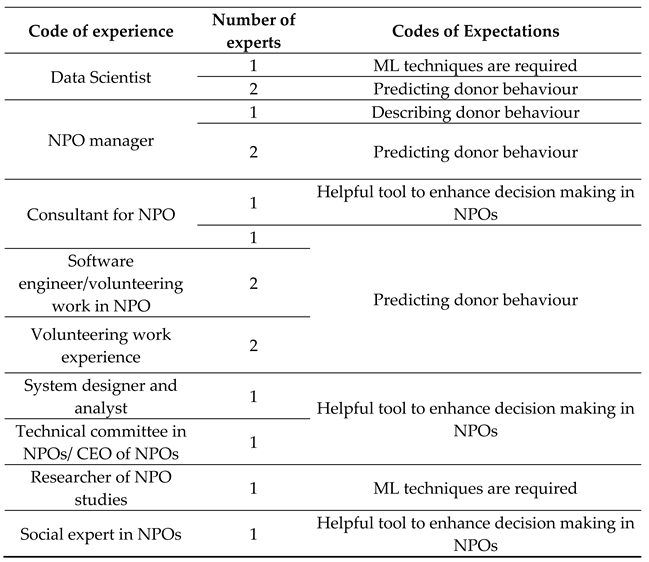
This category is to collect the relevant answers of participants’ expectations about our AI-enabled DSS for analysing donor behaviour in NPOs, and group them similarly. This category summarises interviewees' answers during the destiny of Appreciative Inquiry Theory phase. Before concluding each interview, we asked the experts about what they expect from the AI-enabled DSS for analysing donor behaviour. One question was asked for all interviewees, which is: “What results/analysis do you expect when implementing the AI-enabled DSS to analyse donor behaviours?”. Further, all answers were analysed and assigned it under a code. As a result, four codes of expectations were obtained of the AI-enabled DSS. Table 8 shows the association between work experience category and experts’ expectations of AI-enabled DSS for analysing donor behaviour of AI-enabled DSS for analysing donor behaviour in NPOs. The work experience category codes combined all interviewees with the same role.
Most participants expected that our artefact expects to predict and describe donor behaviour, representing our main research objectives. Other experts expected that the AI-enabled DSS would be a helpful solution to enhance decision-making in NPOs based on their understanding the conceptual three components (design requirements, DPs, and DFs). Essentially, one data scientist and a researcher in social studies in NPOs, expected that the ML techniques are required to achieve the objectives of AI-enabled DSS for analysing donor behaviour. The association of evaluation codes and work experience assist in providing useful feedback, with users’ different experience. For example, when different experts agreed on one code of evaluation, it indicates the importance of considering that code when applying such changes in the following iterations.
The results of the interviews led to discuss about applying the required changes of the conceptual design. The required changes (explained in section 4) offered the authors different perspectives of the experts during the evaluation of the conceptual design of AI-enabled DSS for analysing donor behaviour. Moreover, the results confirm that the mapping of design requirements, DPs, and DFs is well-presented, which reflects the achievement of the research aims ultimately.
4. Research Results
The results of the interviews analysis provided insightful information about our conceptual design and what is required to analyse donor behaviour in NPOs using the AI-enabled DSS. The results are considered as iteration one which is to ensure the relevance of the DPs and DFs to our research aims. A key insight from iteration one is that a traditional DSS does not meet NPOs’ decision-makers requirement because they lack in efficiency and performance. However, DR1 supports the claim that a DSS should be designed to be effective and efficient. Thus, it is stated that decision-makers need to spend less time during the process of making decisions [36], which supports our DR2. Most importantly, the interviews showed that decision-makers desire to obtain control and monitor the analysis while using the system. Therefore, “DR3 is an important requirement for any software designer” as stated by a software engineering expert in the interviews.
Iteration one evaluation led to learning about the problem (analysing donor behaviour), the solution (designing the AI-enabled DSS), and adding an essential DR to the conceptual design, which is missed during the initial conceptual design stage. This experiment reflected on how the different stakeholders, with rich experience of working and volunteering in NPOs, involved in the evaluation led to different insights (from literature and interviews with two experts). After finalising the analysis of the results, the team of this research looked at the results; considering the variety of experts interviewed and resources cited from the literature, the decision to modify the initial conceptual design is made necessarily.
Most importantly, a minor change of the conceptual design is required based on the interviews analysis. Looking at the additional design requirements, we found that usability is an additional requirement because the main target of the AI-enabled DSS is to help the main end users from NPOs make better decisions on donors. Although the interviewees have a variety of experiences, terms and considerations of usability are mostly repeated in the interviews. We added usability as a fourth main requirement in the design requirements in the conceptual design (See Figure 3). Usability is the second level of user experience, according to the Nielsen Norman Group [51], a leader in the user experience. Once it is shown that the product can solve users' concerns, its usability is considered. The usability of a design is determined by how well its features suit users' demands and surroundings [51]. Furthermore, some key elements of usability should be applied when considering the “usability” during the design and development phase. Usability should include the following elements [51]:
- Effectiveness: it assists users in correctly performing actions.
- Efficiency: users may do jobs quickly by following the simplest approach.
- User engagement: Users find it enjoyable to use and relevant to the industry/topic.
- Error Tolerance: it covers a wide variety of user operations and only displays an error when something is truly wrong.
- Ease of Learning: new users will have no trouble achieving their objectives and will have even more success on subsequent visits.
Usability is an important element of the design process of any system to ensure that the users of that system do not desert the system [51]. Usability is found to have a strong effect on the outcomes of any DSS [52]. A well-designed DSS is an interactive software-based system that assists decision makers in compiling relevant information from various raw data, documents, personal knowledge, and business models to identify and solve problems and make decisions [52].
Considering the additional DPs, DP7 was added, which states the DSS should be usable and easy to use by NPOs stakeholders. Generally, most of the experts who required “usability” to be an additional DR, claimed that the AI-enabled DSS should be usable to predict and describe donor behaviour in NPOs. Thus, this additional DP would reflect on the additional DR, and lead us to considerably add a corresponding DF that interprets how the DP7 will be achieved.
The DF5 of usability is to add a tooltip feature on the contents of the AI-enabled DSS. For instance, a system designer and analyst stated, “when I move the cruiser on a graph, I would like to know what numbers are, find useful information and act like as I do not know about data analysis. Tooltips can provide these type of advice”. Tooltips are information that appears when a user presses a button [53]. Tooltips help the user effectively use the system, which, therefore, decreases the usage of commands of help [54]. Therefore, it is concluded that the tooltip feature would achieve the DP7 reflected on DR4. Essentially, other DFs reported by other experts during the interviews such as “choice of color” and “easy to navigate,” will be considered as fundamentals of designing the AI-enabled DSS for analysing donor behaviour.
The other elements of usability, such as quality of information, easy navigation, error tolerant, effective, and efficient performance will be considered when building the interfaces of AI-enabled DSS in a further study. In order to increase the validity of the experiment, there will be other evaluations of the conceptual design throughout the planned study. Our planned study will continue from this study and develop the artefact (the AI-enabled DSS), evaluate the analysis, and also evaluate the design requirements, DPs, and DFs practically with NPOs stakeholders. The aim of the planned study is to measure the AI-enabled DSS's conceptual design practically.
5. Next Steps and Expected Research Outcomes
5.1. Iteration Two
There is a public dataset related to donors which have some features of donors such as age, state, gender, previous history of donations and amount of donations. This dataset was used in The Fourth International Conference on Knowledge Discovery and Data Mining KDD-98 [55]. The dataset was gathered by a non-profit organisation that offers activities and services to veterans in the United States who have suffered spinal cord injuries or diseases. This NPO raises funds through direct mailing campaigns [55]. The available dataset includes a record for each donor who received the 1997 mailing but did not make a donation in the previous 12 months. It is stated for each amount donated by each donor [55]. This iteration has an outcome of building predictive analysis of donors and volunteers in NPOs using various data analysis and ML techniques, which will be validated to ensure the accuracy of analysis performance.
5.2. Iteration Three
The type of evaluation (summative evaluation) aims to ensure the success of applying and mapping the design requirements, DPs, and DFs. Summative evaluation is a process of gathering, combining, and interpreting data to decide on an artefact or a product [56]. We will develop a functional front-end, back-end, and web-based DSS using Shiny library in R and involve it in platform of AI and ML, which can analyse, deploy models, and visualise the analysis through a dashboard. Shiny R is one of the most effective and interactive tools that help data scientists to build a web-based application [57]. One potential of AI and ML platforms is Dataiku, a unique central solution for designing, implementing and managing such AI-enabled DSS [58]. Dataiku is featured in offering a dashboard that is easy for a user to create visualisations and interactive analyses [59]. Another feature of Dataiku is the availability for no cost for the community, and academics. All these features yield us to consider it for building the AI-enabled DSS for analysing donor behaviour. After that, NPOs decision-makers, data scientists, and managers will test the designed AI-enabled DSS to analyse donor behaviour. Their feedback will then be analysed and apply the required changes. Finally, the AI-enabled DSS will meet all the design requirements, DPs, and DFs to analyse donor behaviour. The output of this iteration is to finalize the design theory by combining evaluation results and results of the developed AI-enabled decision support system.
5.3. Design Theory of AI-enabled DSS
One main component of DSR process model developed by Peffers, et al. [35] is the design theory which is a perspective of statements on how to design such a solution to achieve certain goals for solving a known problem [60]. The design theory is a representation of knowledge contribution from DSR [60]. The design theory will follow the profile of the design theory adapted from Gregor and Jones [40]. In our research context, the design theory is initially formed profile of designing AI-enabled DSS for analysing donor behaviour in NPOs.
6. Limitations
The findings presented in this study, like all research, have limitations. First, we focused on conceptualising the design of the AI-enabled DSS that deals with analysing donor behaviour in NPOs. Meanwhile, we believe that our design requirements apply to other AI-enabled DSS outside donor behaviour analysis. However, our DPs and DFs may follow the global design knowledge for every other AI-enabled DSS. We recommend that future studies investigate design concepts and characteristics in various situations and compare and contrast them.
Second, we took design knowledge in the form of design requirements, DPs, and DFs, as Meth et al. [32] did. We recognise that defining design requirements, DPs, and DFs is an initiation of designing an AI-enabled DSS in NPOs. Future research could expand on these findings and explore more into DSS implementation principles. Third, we concentrated on building a conceptual design than an AI-enabled DSS implementation. As a result, future research might investigate how designs of different AI-enabled DSS may impact the organisational performance of decision-making in NPOs.
7. Conclusions
Data analytics may transform the nature of many NPOs if appropriate analytical models, frameworks, and empirical studies are developed to support the sector. One major gap is the lack of literature on designing an intelligent DSS to analyse donors’ intentions towards donating and volunteering. NPOs generally lack the technical, financial, and human resources to build a supportive decision support system for the analysis of donor behaviours. Donor behaviour varies due to various causes such as income, level of education, gender, and previous history. Knowing and understanding these behaviours and the influential factors of donations and volunteering matter for NPOs. Thus, this paper aims to provide a conceptual design of AI-enabled DSS for analysing donor behaviour in NPOs. Then, we evaluated this conceptual design to investigate the mapping between design requirements, DPs and DFs, and their relevancy through interviews with experts in NPOs who provided such insightful information. The interviews were conducted applying Appreciative Inquiry, which facilitates the process and extracts useful answers. By analysing the interview data, we found that usability is an essential requirement as an essential requirement of the conceptual design.
The lessons learned from this study added insights to be considered in further studies, insisting on the capabilities of ML and DSS that could reduce effort on decision-making, save time, and enhance the relationships of donors and volunteers in NPOs. Our main contribution in this study is to derive a conceptual design of a DSS for analysing donor behaviour, which is intended to support the knowledge base of designing an artefact for analysing donor behaviour. Then, in a further study, the aim is to (1) develop an artefact (AI-enabled DSS) based on the conceptual design and (3) evaluate whether this artefact supports the AI-enabled decision support system for analysing donor behaviour or not. Our future work intends to demonstrate that AI-enabled DSS based on the DSR can be used and adopted among the global NPOs.
Author Contributions
For research articles with several authors, a short paragraph specifying their individual contributions must be provided. The following statements should be used “Conceptualization, I.A. and M.P; methodology, T.A.; software, I.A., F.K, B.U. and S.T.; validation, I.A. and M.P; resources, R.A.; data curation, M.S.; writing—original draft preparation, I.A.; writing—review and editing, R.A and B.U.; visualization, I.A.; supervision, M.P.; project administration. All authors have read and agreed to the published version of the manuscript.”
Funding
I.A. is sponsored from Kingdom of Saudi Arabia, Umm Al-Qura University through a Postgraduate Student Scholarship.
Institutional Review Board Statement
“Not applicable”
Informed Consent Statement
“Informed consent was obtained from all subjects involved in the study.”
Data Availability Statement
Not Applicable.
Acknowledgments
Not Applicable.
Conflicts of Interest
“The authors declare no conflict of interest.”
Appendix A. A list of questions in the interviews for iteration 1
| Stage | Script/ Questions |
| Introduction (2 minute) |
|
| Participation (5 minutes) |
|
| Discovery (5 minutes) |
|
| Dream (3 minutes) |
|
| design (3 minutes) |
|
| Destiny (3 minutes) |
|
| Conclusion | Thank you for your collaboration and participation in this interview. I hope we can speak to you in the future for our second interview of the evaluation. |
| 1 | Iterations two and three are explained as in detail in section 5 of this paper. |
| 2 | Details about the participants’ roles experience and presented in subsection 3.1.7 |
References
- Anheier, H.K. Nonprofit organizations theory, management, policy; Routledge Taylor & Francis Group: 2005; p. 450.
- Productivity Commission. Contribution of the not for profit sector; Australia, Canberra, 2010; pp. 1–23.
- Centre for Corporate Public Affairs. Impact of the economic downturn on notfor-profit organisation management; 2009; pp. 1–52.
- Farrokhvar, L.; Ansari, A.; Kamali, B. Predictive models for charitable giving using machine learning techniques. PLoS ONE 2018, 13, 1–14. [Google Scholar] [CrossRef] [PubMed]
- Dietz, R.; Keller, B. A Deep Dive into Donor Behaviors and Attitudes; Abila: 2016; p. 22.
- Te, N. Study Helps You Better Understand Donor Behaviors. 2019.
- Sargeant, A.; Jay, E. Fundraising management: Analysis, planning and practice, Third ed.; Routledge Taylor & Francis Group London and New York, 2014; p. 438.
- Shehu, E.; Langmaack, A.C.; Felchle, E.; Clement, M. Profiling donors of blood, money, and time: A simultaneous comparison of the German population. Nonprofit Manage. Leadersh. 2015, 25, 269–295. [Google Scholar] [CrossRef]
- Li, C.; Wu, Y. Understanding Voluntary Intentions within the Theories of Self-Determination and Planned Behavior. Journal of Nonprofit & Public Sector Marketing 2019, 31, 378–389. [Google Scholar] [CrossRef]
- Weinger, A. The Importance of Donor Data and How to Use It Effectively. Philanthropy News Digest 2019, 2022. [Google Scholar]
- Dag, A.; Oztekin, A.; Yucel, A.; Bulur, S.; Megahed, F.M. Predicting heart transplantation outcomes through data analytics. Decis Support Syst 2017, 94, 42–52. [Google Scholar] [CrossRef]
- Dunford, L. To Give or Not to Give: Using an Extended Theory of Planned Behavior to Predict Charitable Giving Intent to International Aid Charities; University of Minnesota: 2016; pp. 1–79.
- Hou, Y.; Wang, D. Hacking with NPOs: Collaborative analytics and broker roles in civic data hackathons. Proc. ACM Hum. Comput. Interact. 2017, 1, 1–16. [Google Scholar] [CrossRef]
- Hackler, D.; Saxton, G. The strategic use of information technology by nonprofit organizations: Increasing capacity and untapped potential. Public Adm. Rev. 2007, 67, 474–487. [Google Scholar] [CrossRef]
- LeRoux, K.; Wright, N.S. Does Performance Measurement Improve Strategic Decision Making? Findings From a National Survey of Nonprofit Social Service Agencies. Nonprofit Volunt. Sect. Q. 2010, 39, 571–587. [Google Scholar] [CrossRef]
- Barzanti, L.; Giove, S.; Pezzi, A. A decision support system for non profit organizations. In Lecture Notes in Computer Science (including subseries Lecture Notes in Artificial Intelligence and Lecture Notes in Bioinformatics); Springer Verlag: 2017; Volume 10147 LNAI, pp. 270–280.
- Zeebaree, M.; Aqel, M. A Comparison Study between Intelligent Decision Support Systems and Decision Support Systems. The ISC Int'l Journal of Information Security 2019, 11, 187–194. [Google Scholar]
- Rhyn, M.; Blohm, I. A Machine Learning Approach for Classifying Textual Data in Crowdsourcing. In Proceedings of the 13th International Conference on Wirtschaftsinformatik (WI), St. Gallen, Switzerland; 2017; pp. 1–15. [Google Scholar]
- Alsolbi, I.; Agarwal, R.; Narayan, B.; Bharathy, G.; Samarawickrama, M.; Tafavogh, S.; Prasad, M. Analyzing Donors Behaviors in Nonprofit Organizations: A Design Science Research Framework. In Proceedings of the Proceedings of 3rd International Conference on Machine Intelligence and Signal Processing NIT Arunachal Pradesh, India, 23-25 September 2021. [Google Scholar]
- Horváth, I. Conceptual design: inside and outside. In Proceedings of the Proceedings of the 2nd International Seminar and Workshop on Engineering Design in Integrated Product; 2000; pp. 63–72. [Google Scholar]
- Walls, J.G.; Widmeyer, G.R.; El Sawy, O.A. Building an information system design theory for vigilant EIS. Information systems research 1992, 3, 36–59. [Google Scholar] [CrossRef]
- Arnott, D.; Pervan, G. A critical analysis of decision support systems research revisited: The rise of design science. Journal of Information Technology 2014, 29, 269–293. [Google Scholar] [CrossRef]
- Bourouis, A.; Feham, M.; Hossain, M.A.; Zhang, L. An intelligent mobile based decision support system for retinal disease diagnosis. Decis Support Syst 2014, 59, 341–350. [Google Scholar] [CrossRef]
- Power, D. Decision Support Systems: A Historical Overview. In Handbook on Decision Support Systems 1 Basic Themes; Springer 2008; pp. 121–140.
- Burstein, F.; Holsapple, C.W. Handbook on Decision Support Systems 1: Basic Themes; Springer-Verlag London Ltd.: Berlin Germany, 2008. [Google Scholar]
- Arnott, D.; Pervan, G. Design Science in Decision Support Systems Research: An Assessment using the Hevner, March, Park, and Ram Guidelines. Journal of the Association of Information Systems 2012, 13, 923–949. [Google Scholar] [CrossRef]
- Fredriksson, C. Big data creating new knowledge as support in decision-making: practical examples of big data use and consequences of using big data as decision support. J. Decis. Syst. 2018, 27, 1–18. [Google Scholar] [CrossRef]
- Bopp, C.; Harmon, C.; Voida, A. Disempowered by data: Nonprofits, social enterprises, and the consequences of data-driven work. In Proceedings of the ACM SIGCHI Conference on Human Factors in Computing Systems, Denver, USA; 2017; pp. 3608–3619. [Google Scholar]
- Maxwell, N.L.; Rotz, D.; Garcia, C. Data and decision making: same organization, different perceptions; different organizations, different perceptions. Am. J. Eval. 2016, 37, 463–485. [Google Scholar] [CrossRef]
- Korolov, R.; Peabody, J.; Lavoie, A.; Das, S.; Magdon-Ismail, M.; Wallace, W. Predicting charitable donations using social media. Soc. Netw. Analysis Min. 2016, 6. [Google Scholar] [CrossRef]
- Barzanti, L.; Giove, S.; Pezzi, A. A. A Decision Support System for Non Profit Organizations. In Fuzzy Logic and Soft Computing Applications; Lecture Notes in Computer Science; Springer International Publishing: Cham, 2017; pp. 270–280. [Google Scholar]
- Rhyn, M.; Leicht, N.; Blohm, I.; Leimeister, J.M. Opening the Black Box: How to Design Intelligent Decision Support Systems for Crowdsourcing. In Proceedings of the 15th International Conference on Wirtschaftsinformatik, Potsdam, Germany; 2020; pp. 1–15. [Google Scholar]
- Johannesson, P.; Perjons, E. An Introduction to Design Science; 2014; pp. 1–197.
- Hevner, R.A.; March, S.; Park, J.; Ram, S. Design Science in Information Systems Research. Management Information Systems Quarterly 2004, 28, 75–105. [Google Scholar] [CrossRef]
- Peffers, K.; Tuunanen, T.; Rothenberger, M.; Chatterjee, S. A design science research methodology for information systems research. Journal of Management Information Systems 2007, 24, 45–77. [Google Scholar] [CrossRef]
- Meth, H.; Mueller, B.; Maedche, A. Designing a requirement mining system. Journal of the Association for Information Systems 2015, 16, 799–837. [Google Scholar] [CrossRef]
- Gregor, S.; Hevner, A. Positioning and Presenting Design Science Research for Maximum Impact. MIS Quarterly 2013, 37, 337–356. [Google Scholar] [CrossRef]
- Silver, M.S. Decisional Guidance for Computer-Based Decision Support. MIS Quarterly 1991, 15, 105–122. [Google Scholar] [CrossRef]
- Silver, M.S. User perceptions of DSS restrictiveness: An experiment. In Proceedings of the Proceedings of the Twenty-First Annual Hawaii International Conference on System Sciences.; 1988; pp. 116–124. [Google Scholar]
- Gregor, S.; Jones, D. The anatomy of a design theory. Journal of the Association for Information Systems 2007, 8, 312–335. [Google Scholar] [CrossRef]
- Đurić, G.; Mitrović, Č.; Vorotović, G.; Blagojevic, I.; Vasić, M. Developing self-modifying code model. Istrazivanja i projektovanja za privredu 2016, 14, 239–247. [Google Scholar] [CrossRef]
- Venable, J.; Pries-Heje, J.; Baskerville, R. FEDS: a framework for evaluation in design science research. European journal of information systems 2016, 25, 77–89. [Google Scholar] [CrossRef]
- Dworkin, S.L. Sample Size Policy for Qualitative Studies Using In-Depth Interviews. Archives of Sexual Behavior 2012, 41, 1319–1320. [Google Scholar] [CrossRef] [PubMed]
- Weston, C.; Gandell, T.; Beauchamp, J.; McAlpine, L.; Wiseman, C.; Beauchamp, C. Analyzing Interview Data: The Development and Evolution of a Coding System. Qualitative Sociology 2001, 24, 381–400. [Google Scholar] [CrossRef]
- Börjesson, A.; Holmberg, L.; HolmstrГöm, H.; Nilsson, A. Use of Appreciative Inquiry in Successful Process Improvement. In Proceedings of the Organizational Dynamics of Technology-Based Innovation: Diversifying the Research Agenda, Boston, MA, 2007; 2007//; pp. 181–196. [Google Scholar]
- Saldaña, J. Coding and analysis strategies. The Oxford handbook of qualitative research 2014, 581–605. [Google Scholar]
- Li, C.; Yangyong, Z. The Challenges of Data Quality and Data Quality Assessment in the Big Data Era. Data Science Journal 2015, 2. [Google Scholar] [CrossRef]
- Wang, R.Y.; Strong, D.M. Beyond Accuracy: What Data Quality Means to Data Consumers. Journal of Management Information Systems 1996, 12, 5–33. [Google Scholar] [CrossRef]
- Weibelzahl, S.; Paramythis, A.; Masthoff, J. Evaluation of Adaptive Systems. In Proceedings of the Proceedings of the 28th ACM Conference on User Modeling, Adaptation and Personalization, Genoa, Italy, 2020; pp. 394–395.
- Narendra, K.S. Chapter Two - Hierarchical Adaptive Control of Rapidly Time-Varying Systems Using Multiple Models. In Control of Complex Systems, Vamvoudakis, K.G., Jagannathan, S., Eds.; Butterworth-Heinemann: 2016; pp. 33–66.
- Nielsen, J. Usability 101: Introduction to Usability. Available online: www.nngroup.com/articles/usability-101-introduction-to-usability/ (accessed on 23/02/2022).
- Mt, A. The Effect of Usability and Information Quality on Decision Support Information System (DSS). Arts and Social Sciences Journal 2017, 8. [Google Scholar] [CrossRef]
- Isaksen, H.; Iversen, M.; KaasbГёll, J.; Kanjo, C. Design of Tooltips for Data Fields. In Proceedings of the Design, User Experience, Cham, 2017, and Usability: Understanding Users and Contexts; pp. 63–78.
- Christie, D.M.; Wayne, D.D.; Joseph, E.U. A methodology for the objective evaluation of the user/system interfaces of the MADAM system using software engineering principles In Proceedings of the Proceedings of the 18th annual Southeast regional conference, Tallahassee, Florida, 1980; pp. 103–109. [Google Scholar]
- Parsa, I. KDD Cup 1998 Data. In Proceedings of the he Second International Knowledge Discovery and Data Mining Tools Competition, New York; 19898. [Google Scholar]
- Dick, W. Dick, W. Summative evaluation. Instructional design: Principles and applications 1977, 337-348.
- Malasi, A. All you need to know to build your first Shiny app. Available online: https://towardsdatascience.com/all-you-need-to-know-to-build-your-first-shiny-app-653603fd80d9 (accessed on 8 April 2021).
- Dataiku.com. The Dataiku Story. Available online: www.dataiku.com/stories/the-dataiku-story/ (accessed on 8 April 2021).
- Uskov, V.L.; Bakken, J.P.; Putta, P.; Krishnakumar, D.; Ganapathi, K.S. Smart education: predictive analytics of student academic performance using machine learning models in Weka and Dataiku systems. In Smart Education and e-Learning 2021; Springer: 2021; pp. 3–17.
- Vaishnavi, V.; Kuechler, B.; Petter, S. Design Science Research in Information Systems. 2019, 1-62.
Figure 2.
The preliminary conceptual design of AI-enabled DSS for analysing donor behaviour in NPOs.
Figure 2.
The preliminary conceptual design of AI-enabled DSS for analysing donor behaviour in NPOs.
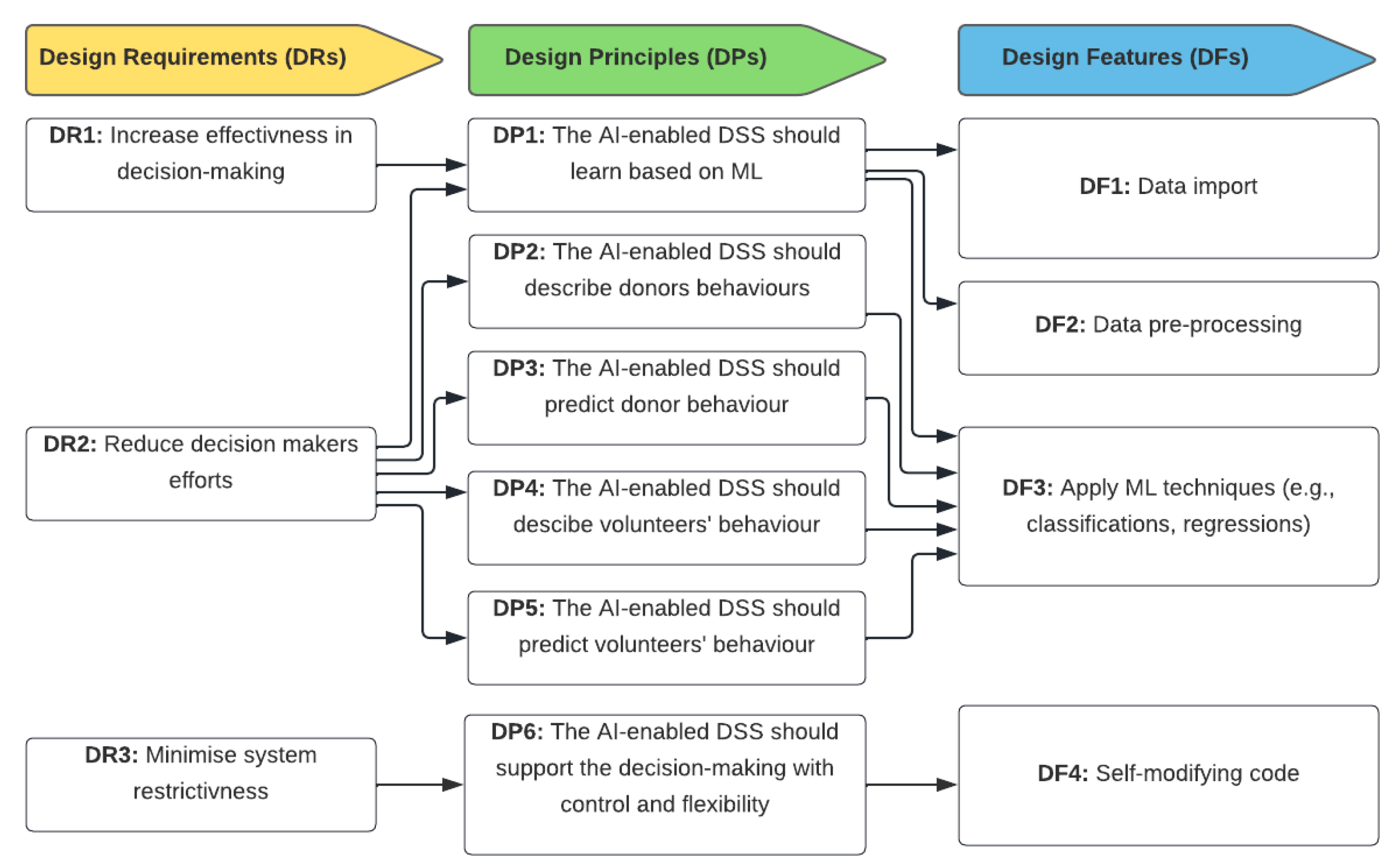
Figure 3.
The updated conceptual design of the AI-enabled DSS for analysing donor behaviour in NPOs.
Figure 3.
The updated conceptual design of the AI-enabled DSS for analysing donor behaviour in NPOs.
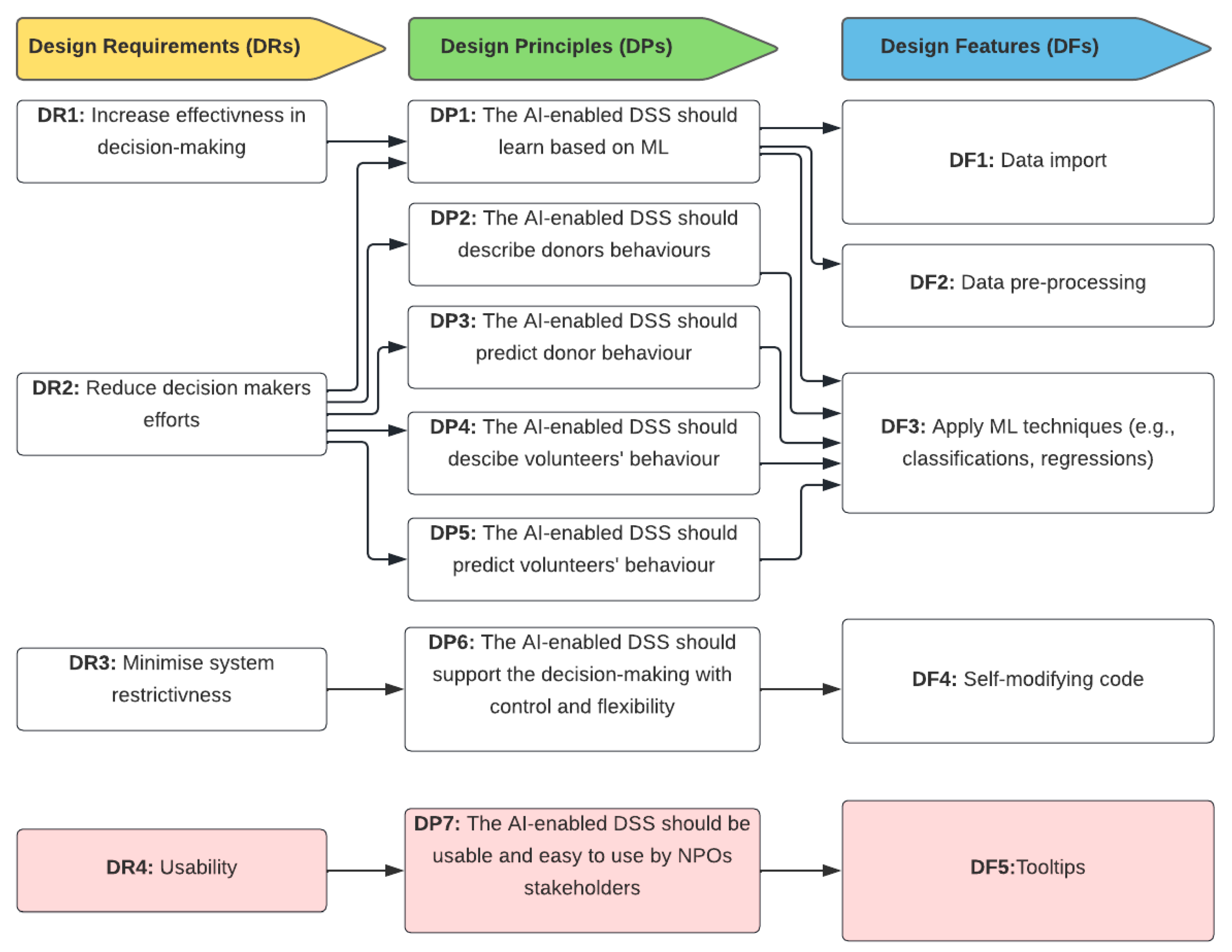

Table 1.
Summary of informal interviews with NPO’s experts.
| Expert category | Process of analysing donor behaviour | Major challenges | Suggestions |
| Data scientist in a NPO (5 years) | Occasionally analysing data of donor to create such analysis temporarily. No usage of DSS for analysing donor behaviour. | No collection of data of donor regularly. Different needs of creating such analysis, depending on NPOs’ needs. | Building a DSS that analyse donor behaviour using ML techniques. Also, creating a design theory would increase the awareness of scholars to consider such analytics solutions. |
| Manager of NPO (8 years) | Normally using Excel sheets for creating tables and graphs about donors | Lack of human and technical resources. Low budget to afford such effective solutions. Spending long times to make a decision. |
Using an efficient system helps understand donors more comprehensively through such analysis. |
| Consultant of NPOs | Using Google analysis for analysing data of donor to help in making-decision. | Lack of human and technical resources. Lack of knowledge on designing a DSS for analysing donor behaviour. |
Relying on ML capabilities to benefit more in creating visualistions that lead to understanding donors and volunteers and enhance decision-making. |
Table 2.
Design Requirements (based on Meth, et al. [36]).
Table 2.
Design Requirements (based on Meth, et al. [36]).
| Design Requirements | Explanations | Justification | |
|---|---|---|---|
| Increase the decision quality by providing high quality advice. | Providing advice with quality. The process of analysing donor behaviour should be supported by the system that improves the quality of decisions. | Decision makers have various objectives when making a decision [40]. Thus, they aim to achieve the maximum of good advice [40]. The AI-enabled DSS should provide high quality of decision to help NPOs make better decisions about donors and volunteers. | |
| Reduce decision maker’s effort. | The system should prepare the decision and offer it for the decision-maker with the relevant information. For example, the system should provide information (through visualisations) about donors. This type of information can decrease the cognitive effort needed for NPOs decision-makers. | Decision makers strive to make the minimum efforts when making decisions [36]. When the DSS provides high quality advice, the effort of decision makers will be reduced [40]. | |
| Minimise system restrictiveness. | The system should offer several pre-selects decision strategies and offer decision makers more flexibility to choose appropriate analytics. | The AI-enabled DSS should provide control and to not restrict users [40]. For example, users of DSS in NPOs require to choose the type of the analytics (predictive or descriptive). |
Table 3.
Initial DPs of AI-enabled DSS to analyse donor behaviour in NPOs.
| Design principles | Explanation |
| DP1: The AI-enabled DSS should learn based on ML | The AI-enabled DSS should be designed as an adaptive system [38]. The AI-enabled DSS should have predefined models to train the datasets. Therefore, ML techniques can learn based on the generated data of donors entered by decision-makers in NPOs (who use the AI-enabled DSS) to create effective descriptive and predictive models. |
| DP2: The AI-enabled DSS should describe donor behaviour. | Describing donor behaviour using ML is a key element of the AI-enabled DSS. NPOs may benefit from the interpreted results by the DSS to explain certain factors and information about donors such as the most gender donating, etc. Most importantly, ML techniques can describe the relative information about donors and visualise it properly. |
| DP3: The AI-enabled DSS should predict donor behaviour. | The AI-enabled of DSS should be able to predict donor behaviour using ML algorithms. Different types of predictive models can generate useful insights for NPOs decision-makers and support decision-making about donors. For example, the AI-enabled DSS should create a model to predict which age of previous donors may donate more in the future. |
| DP4: The AI-enabled DSS should describe volunteers’ behaviour. | Describing volunteers’ behaviour using ML is a key element of the AI-enabled DSS. NPOs need to rely on interpreted results by the DSS to explain certain factors and information about donors. For example, the AI-enabled DSS should create a model to predict who is likely to volunteer in the future. |
| DP5: The AI-enabled DSS should predict volunteers’ behaviour. | The AI-enabled DSS should be able to predict volunteers’ behaviour using ML algorithms. Different types of predictive models can generate useful insights for NPOs decision-makers and support decision-making about volunteers. Thus, ML techniques can describe the relative information about volunteers and visualise it properly. |
| DP6: The AI-enabled DSS should support the decision making with control and flexibility. | The AI-enabled DSS should maintain the control level by allowing decision makers in NPOs (who use this system) to choose the type of predictive or descriptive analysis. Another example is allowing the NPOs decision makers to print a report or start a new analysis. |
Table 4.
Initial DFs of AI-enabled DSS to analyse donor behaviour in NPOs.
| Design Features | Explanation |
| DF1: Data import | The AI-enabled DSS should allow data import of donors. A guideline should be introduced to NPOs on preparing the data and making the attributes aligned with the back-end code of the system. This feature will allow the user of the AI-enabled DSS to import the data from a spreadsheet containing specified features. Importing the data will be an easy step and automatically loaded via the interface of the AI-enabled DSS. The sources of the data may vary; however, there will be insurance when building the AI-enabled DSS that a guideline about the data, its format, and how it is imported is provided. |
| DF2: Data pre-processing | This feature is to pre-process the data to ensure the adequacy of attributes. Meth, et al. [36] described pre-processing features as important. The pre-processing feature uses data preprocessing techniques such as cleaning the data and formatting the dates. |
| DF3: Applying ML techniques (e.g., classifications, regressions, etc.) |
The AI-enabled DSS should analyse the imported data using MLs techniques. ML techniques provide the means to structure the data, organise patterns and extract useful hidden information. For example, a classification technique can be chosen to classify donors based on their donations (high or low) and provide recommendations (high potential to donate in the future) or low (unlikely to donate again). |
| DF4: Self-Modifying code | Software systems that have the capacity to independently change in a certain way are referred to as having self-modifying code, programs, or software [41]. The AI-enabled DSS should provide control for the users to maintain the workflow of making decision [32]. For example, enabling the user to choose the type of analysis from a list menu or removing unnecessary tooltip. |
Table 5.
Category of working experience.
| Working experience code | Number of Experts | Number of experts on DSS | Length of experience (years) | Number of Experts of donor behaviour | Experience length (years) |
| NPO manager | 4 | 1 | 4 | 1 | 10 |
| Data Scientist | 3 | 2 | 6 and 15 | 1 | 8 |
| Consultant for NPO | 2 | 0 | 0 | 2 | 4 and 8 |
| Software engineer | 2 | 1 | 7 | 1 | 2 |
| Volunteering work experience | 2 | 1 | 12 | 0 | 0 |
| Researcher of NPO studies | 1 | 0 | 0 | 1 | 13 |
| Social expert in NPOs | 1 | 0 | 0 | 1 | 5 |
| System designer and analyst | 1 | 1 | 18 | 1 | 13 |
| Total of experts | 16 | 6 | - | 8 | - |
Table 6.
Category of evaluation of the conceptual design.
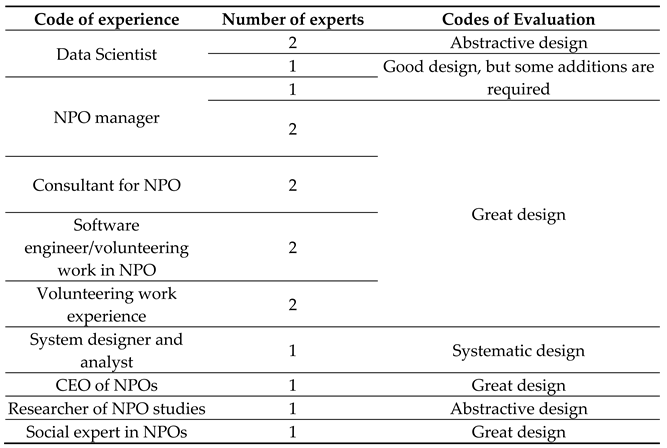 |
Table 7.
Category of the additional design requirements, DPs, and DFs.
| Code of experience | Number of experts | Additional DR | Additional design requirements | Additional DPs | Additional DFs |
|---|---|---|---|---|---|
| Data Scientist | 3 | Quality of data | - | - | - |
| Increasing efficiency | |||||
| NPO manager | 3 | Adaptive system | |||
| Quality of data | |||||
| Usability | DSS should be usable to use to describe or predict donor behaviour | Tooltips | |||
| Choice of colours | |||||
| Consultant for NPO | 2 | Quality of data | - | - | |
| Security | Performance | ||||
| Software engineer/volunteering work in NPO | 2 | Usability | - | Easy to navigate | |
| Adaptive systems | - | ||||
| Volunteering work experience | 2 | - | DSS should be usable to use to describe or predict donor behaviour | Tooltips | |
| System designer and analyst | 1 | ||||
| Technical committee in NPOs/ CEO of NPOs | 1 | ||||
| Researcher of NPO studies | 1 | Tooltips | |||
| Social expert in NPOs | 1 | Flexibility to use |
Table 8.
Category of evaluation of the conceptual design.
 |
Disclaimer/Publisher’s Note: The statements, opinions and data contained in all publications are solely those of the individual author(s) and contributor(s) and not of MDPI and/or the editor(s). MDPI and/or the editor(s) disclaim responsibility for any injury to people or property resulting from any ideas, methods, instructions or products referred to in the content. |
© 2023 by the authors. Licensee MDPI, Basel, Switzerland. This article is an open access article distributed under the terms and conditions of the Creative Commons Attribution (CC BY) license (http://creativecommons.org/licenses/by/4.0/).
Copyright: This open access article is published under a Creative Commons CC BY 4.0 license, which permit the free download, distribution, and reuse, provided that the author and preprint are cited in any reuse.


