

Submitted:
20 June 2025
Posted:
23 June 2025
You are already at the latest version
Abstract
In this paper, we consider the concept of global digital citizenship, particularly as it could apply to museums and cultural heritage sectors. In this perspective survey study, we explore current examples of how museums can adjust to the tenets of global digital citizenship that are necessary to navigate and participate in increasingly interconnected digital worlds and to collectively address global challenges. The paper provides a qualitative survey and discussion covering issues concerning open foundations, knowledge co-creation, digital equity and inclusion, and participatory innovation. In conclusion, there are untapped opportunities for museums (e.g., audience participation and digital tools, especially with recent developments in Artificial Intelligence), but also constraints that must be considered (e.g., lack of funding or digital inequality, not to mention ethical issues in the use of AI).
Keywords:
cultural heritage
; digital citizenship
; digital culture
; digital inclusiveness
; digital literacy
; digital museums
; emerging technologies
; global citizenship
; participatory design
1. Introduction
Our expanding interconnected digital world has the potential for equitable and free information access, to enable new pathways for knowledge sharing and production, and to connect with people, places, and cultures. Critical capacities required to fulfil this potential, however, rely on competencies and mindful approaches of what can be termed “digital citizenship” [1,2].
“Digital citizenship” and related terms, such as “digital citizen” [2,3,4], have only come into use in recent years. “Digital citizenship” is broadly defined to be the ability of participating in society online [5], such as engaging with other users and also with digital content in a critical and ethical way, as well as navigating the online environment safely and responsibly, while having an awareness of one’s own rights and those of others [6].
Concepts of digital citizenship have been around since the 1990s, although these have been applied initially to only a small proportion of the population. This coincides early in the development of the Internet. for instance, as email and spam increased, the concept of “netiquette” appeared in the public consciousness (see [7], pp.191–193), closely associated with digital literacy skills.
Digital Literacy
Digital literacy is a major cornerstone of digital citizenship. Paul Gilster first popularized the term digital literacy in his book of the same name, published in 1997. He conceived of digital literacy as, simply, “literacy for a digital age” [8] at a time when the World Wide Web was developing [9]. Following Gilster’s coining of the phrase, there have been several updated definitions in line with the shifting advancements of a digital society, but a common understanding is that digital literacy is clearly evolving into the “capability to use digital technology and knowing when and how to use it.” [10].
Digital literacy involves the appropriate use of digital communication, digital identities, digital rights, digital tools, and considerations of digital safety and security. Digitally literate citizens are better able to participate on the Internet within online communities, seeking and sharing information, self-publishing, and related activities through collective and individual efforts [1,11]. A critical aspect of such digital citizenship practice is the continuous development of norms of responsible and empowered technology use. These norms are encapsulated by Mark Ribble in nine elements [10,12], namely: “Digital Access”, “Digital Commerce”, “Digital Communication and Collaboration”, “Digital Etiquette”, “Digital Fluency”, “Digital Health and Welfare”, “Digital Law”, “Digital Rights and Responsibility”, and “Digital Security and Privacy” [12].
The issues concerning digital literacy have been especially studied relating to education [13,14] and information literacy, but critically also in the context of social inclusion, the digital divide, responsible action [15]. Being a digital citizen further encompasses different digital information literacy skills compared with more traditional media [16] and developing these skills is a lifelong [17] process, particularly as digital technology evolves so rapidly. The initiative The European Year of Digital Citizenship Education 2025 (https://europeanyear2025.coe.int) reinforces the mandate to ensure that citizens of all ages in European countries have the necessary skills to thrive in a digitally connected society, fostering a sense of shared responsibility, democratic participation, and human rights online. Indeed, the digital transformation of society has affected people’s lives in new ways and have concurrently also brought immense changes to the museum sector as embodied in the rise of digital culture.
Digital Culture
The rise of digital culture as part of this transformation is shaping how we use technology to interact in everyday life, at work, and in society. For example, museum professionals themselves need appropriate digital culture and skills to operate within their organizations. Museums and digitization efforts have been facilitating the preservation, dissemination, and production of cultural and educational resources, such as documentation, 3D digitization, digital data processing and storage, and digital reproduction of objects [18]. ‘One by One’ is a UK-wide research project that aimed to aid the country’s museums “better define, improve, measure and embed the digital skills and literacy of their staff and volunteers” [19]. Specifically, Phase Two of the One by One project found, concerning digital literacies and skills, that museums should be [19]:
- “Person-centered, led by individuals’ needs rather than technologies or other external drivers;
- Purposeful and values-led, clearly related to organizational missions; and
- Nuanced and contextualized – helping people understand and relate skills to their own practice and setting.” [19]
This expertise is critical in navigating the intricate online environment; however, more than ever they need to be complemented by the socially responsible attitudes in our interactions with global digital communities and to participate in activities that contribute to tackling global challenges [20].
Being able to facilitate interconnections between people, cultures and communities is an essential capacity worldwide [21]. UNESCO defines this as a new pathway for education, namely “global citizenship” referring to “an education that aims to empower learners of all ages to assume active roles, both locally and globally, in building more peaceful, tolerant, inclusive and secure societies” and entails three functions: cognitive, socio-emotional, and behavioral [22].
Global Digital Citizen
Watanabe-Crockett describes a global digital citizen as being “a responsible, ethical citizen, leveraging technology to foster community on a global scale” [23]. This involves participating in and contributing to the blended physical and digital worlds, and how we can grow citizens in this new reality. According to Watanabe-Crockett, global digital citizenship embodies five tenets: “personal responsibility”, “global citizenship”, “digital citizenship”, “altruistic service”, and “environmental stewardship” [23].
Such tenets of global digital citizenship are gaining traction in the cultural sector in the last couple of years and can manifest themselves in a variety of contexts supported through digital transformation, for example, citizen activism [24], “citizen science” [1,25,26], climate action [27], as well as “the balance of digitality and reality” which citizens within a society driven by technology need to increasingly handle.
However, these tenets, taken together and applied to museums and cultural heritage organizations, are not yet well described, and not least the emerging trends shaping the notion of both global digital citizenship and digital culture require further consideration. This perspective survey paper aims to focus on the possibilities and practices available to museums and cultural heritage organizations to better support and engage their audiences across thematic tenets of global digital citizenship.
A Perspectives Approach
This qualitative research adopts a perspectives survey approach [28] in exploring the intersectional landscape of global digital citizenship and museums and cultural heritage organizations. A primary focus concerns situating the study using a thematic framing based on key defining elements of digital citizenship [2,3,12] and global digital citizenship [22,23] to understand the possibilities of advancing new insights and research.
A clustering of thematic socio-technical elements was drawn from the definitional tenets of global digital citizenship and core capabilities of digital citizenship. These elements were used to collate examples of historical research, current practice, and emerging trends, broadly defined as follows: open foundations connecting local to global communities, knowledge co-creation and global awareness, equitable and amplified participation in museums and digital cultural heritage, leveraging digital innovation, via the lens of global digital citizenship. Integral to the methodological approach, the authors were informed by digital culture research [29]. This was intended to highlight evidence and examples (both historical and recent) with relevance to intersectionality and practice as key to the exploration [15,30].
The authors have differing backgrounds from the museum world and computer science. We have used this breadth of expertise to survey the literature, both through online searches and using existing knowledge and experience, to provide a wide-ranging perspective survey of the issues. The themes were selected and structured using this knowledge. This overview is intended to be of benefit to both academics and practitioners in the field.
2. Open Foundations
Open foundations supporting global digital citizenship were altruistically led by Tim Berners-Lee [9], including the establishment of the Virtual Library with his colleague Arthur Secret during the early 1990s. The Virtual Library was intended to aid the navigation of the web before the establishment of search engines. This included early information about online museum resources, including hyperlinks, in the Virtual Library museums pages (VLmp) [31], an early international collaborative volunteer effort [32]. Such public collaboration is also possible within individual museums concerning their collections [33].
The online encyclopedia Wikipedia (https://www.wikipedia.org) is another notable example of philanthropy of a global digital citizen, Jimmy Wales [34], formerly a financial trader. Wikipedia is now an authoritative place for global digital citizens to create and edit information about museums online [35], replacing earlier directories like VLmp and the Virtual Library, as a global-scale, multi-language, and distributed collaboration. In its expanding role, Wikipedia has become integral to the fabric of a wider knowledge commons, that is, a shared intellectual resource that anyone in the world who has access to the Internet can reference without having to pay or be affiliated with an academic institution [36]. Even though Wikipedia is blocked in some countries, it is possible for citizens to collaborate internationally to add information for those countries [37]. In tandem, the Creative Commons (CC) global network (https://network.creativecommons.org) is an international non-profit organization actively seeking to shape policies and norms in support of a thriving commons of shared knowledge, culture, and open sharing through open licensing and attribution [38] suggests that digital cultural heritage can be understood as a “commons”, since the digitisation of cultural collections, for instance, has mostly been publicly funded and made available as open access.
Closely tied to these developments is the open access movement evolving with open source software developments of the 1990s to the present day, now having a profound impact on how we can create opportunities for participation, and create new tools and knowledge [39,40,41]. This first wave of museums with online resources in the 1990s, such as the Science Museum in London [32], was associated with emerging web technology developments, open access and open source, using information systems and databases, and hyperlinked content. This has similarities to more recent exploitation by museums of artificial intelligence (AI) and machine learning [42]. An important book of the period, The Wired Museum [43], predicted how technology could allow museums to accomplish interactive audience engagement with their content. It also indicated possible concerns that are still relevant now, such as quality control issues and content overload.
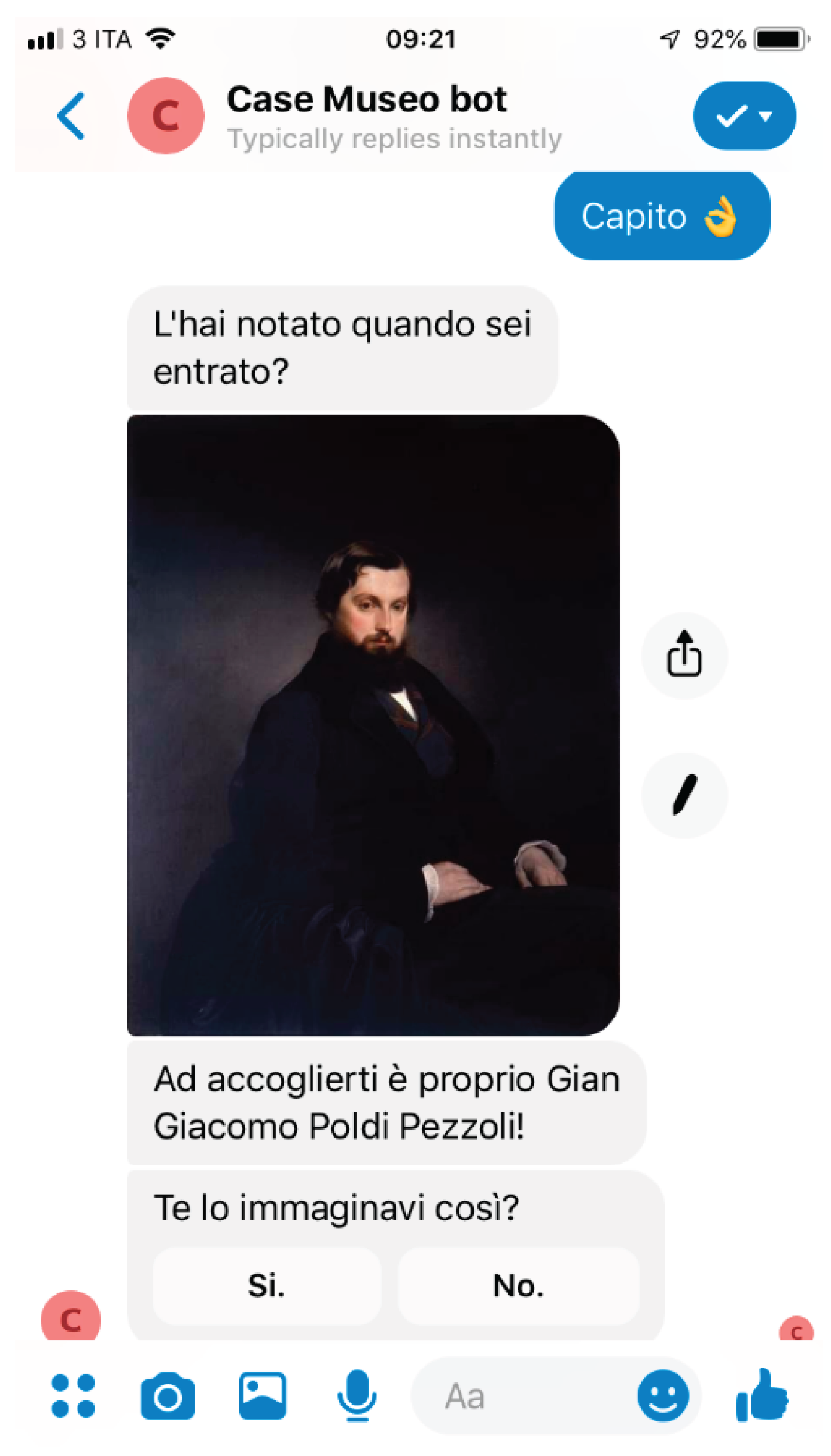
Crucially, digital literacy underpins the skills that support establishing online communities, developing and navigating community platforms and their resources [5] advocate integrating digital literacy and digital citizenship education into formal curricula to equip youth, as well as communities and the public, with the necessary skills and attitudes for responsible online participation. The Community Virtual Library represents a proactive community example that established a Digital Citizenship Museum [44] with the expressed mission to ensure citizens are digitally literate through education, raising global awareness, and building a community around the challenges and solutions of digital literacy (see Figure 1).
Good global digital citizenship is comprised of virtual communities [45] which can enable people with different skillsets to come together with a common goal, often on a volunteer basis. A common purpose is a central starting point, and this is supported in the Community of Practice (CoP) social science framework [46,47], which is useful in modeling how communities in a specific area can be established, develop, and eventually transmogrify depending on their success. The rise of social media has more recently accelerated the establishment of CoP communities rallying around digital activism, for example, by helping to facilitate grassroots and non-hierarchical initiatives using open foundations, which have been shaping museum practice over recent decades [48].
OpenGlam (https://openglam.org) is a key example of an open foundation supporting the ideas and principles of the open movement that are relevant to the practices and mission of the GLAM sector (Galleries, Libraries, Archives, and Museums). OpenGlam, established in 2010 and supported by Creative Commons, provides open access to digital heritage and cultural collections, resources, and tools. Informing the OpenGlam project is the Europeana platform (https://www.europeana.eu), launched in 2008, providing digital access to millions of cultural heritage items from several thousand institutions across Europe. At the core of the platform are open standards and a data model enabling open access, tools, and services. Like Europeana, the Smithsonian Open Access portal [49] is an example of a pan-organizational initiative that provides an authoritative and publicly accessible resource of more than 4.9 million 2D and 3D digital items from the Smithsonian collections across the Smithsonian’s 21 museums, nine research centers, libraries, archives, and its national zoo. An open expertise-based initiative, GLAM-E Lab (https://www.glamelab.org) is a joint initiative between the University of Exeter (UK) and the New York University School of Law (US), providing legal counsel and support in building open access capacity to smaller and less well-resourced UK and US cultural institutions.
4. Knowledge Co-Creation
The rise of global digital citizenship has timely significance for museums and their position as participatory knowledge organizations [38]. Despite differences in capability, museums and cultural organizations share expertise in facilitating participation at various audience levels. The Participatory Museum [50] provides approaches designed for helping museums to become more willing to consider participation, involving input from users, the collaborative design programs and exhibitions, and innovative projects, in addition to making platforms available for users to create their distinct meanings [51].
In the context of a social museum, Visser identifies new models for digital socialization involving the museum and its public [52], with approaches to learning aimed at broadening digital citizen engagement. Leading cultural organizations, such as the American Alliance of Museums and the UK Museums Association, engage in high-profile advocacy and campaign programs, encompassing larger social issues impacting digital citizenry across racism, homelessness, and migration, among other challenges:
“Museums help us negotiate the complex world around us; they are safe and trusted spaces for exploring challenging and difficult ideas” ([53], p. 4).
This repositioning of museums in embracing new types of participation increases the opportunities for their communities to share, be challenged, and evolve with them. In tandem with grass-roots media, open data, and ubiquitous technologies, citizen-led participation has also signaled a noteworthy change in the way that information is collected, disseminated, and shared by digital citizens. To understand digital human cultures among the plethora of digital information and platforms, for example, there is a growing spotlight on “thick data”; that is, the human insights missing from big data [54]. This data is implicit, often invisible, and gathered through human observations and narratives. Museums and cultural organizations are well-positioned to lead in expressing digital culture through data, digital innovation, and participation [50,55,56].
However, critically, there must also be investment in the digital transformation of museums. This is a particular challenge in the Global South, where infrastructure funding, technical and human resources are constrained in creating and accessing digital content unless part of a dedicated government directive, as in the example of the Vietnamese government’s strategy for digitizing culture, heritage, and museums [57].
Museums and cultural organizations have, in the last decade or more, invited audiences to help annotate digital collections and contribute to collections knowledge through citizen science – an approach by which public volunteers and researchers can collaborate in scientific studies [1,60]. Connecting a distributed set of people using digital platforms and data tools is typically undertaken using crowdsourcing, which can enable citizen science digitally [26,109]. Several platforms have been made available in the last two decades that support citizen science projects online, such as the Zooniverse [58]. Museums and cultural heritage organizations have launched projects on Zooniverse, such as the Courtauld Institute’s World Architecture Unlocked project, which invited citizen scientists to subject tag a million architectural photographs from around the world held in their Conway Library collection [59]. Crowdsourced heritage and citizen science approaches have flourished in these environments for several decades in varying forms [1,11,60,61], and can encompass smaller crowdsourced collaborations within a given geography, such as community cataloguing of a national archive collection in Bogota, Colombia [62].
Another notable example of digital citizen crowdsourcing supporting social activation and knowledge co-creation is in the preservation of lost cultural heritage [63]. The Rekrei platform (https://rekrei.org) hosts a crowdsourced project in which global digital citizens submit photographs of monuments, museums, and artefacts which have become damaged by natural disasters (as the earthquakes in Nepal) or human intervention (monument destruction in Mosul) to help to preserve a global, shared, human heritage. The project uses photogrammetric techniques to create 3D representations that viewers anywhere with Internet access can explore online or in VR. See Figure 2.
Digital technology in this way is helping to contribute to a rise in more open, participatory, and alternative forms of democracy [15]. An OECD white paper [64] reported that digital transformation has opened new online spaces connecting civic spaces at a global level, which are increasingly supporting the mobilisation of social movements both online and offline, and creating more dynamic and inclusive civic spaces. Civic platforms of digital tools can support public online consultations or improve and simplify the way citizens experience government services online, such as vTaiwan (https://info.vtaiwan.tw) – a public online-offline consultation process platform in Taiwan, and Decide Madrid (https://decide.madrid.es) – the city of Madrid’s public engagement platform [65].
Citizen journalism can be seen as part of this participatory evolution and as a digital form of activism of news gathering and reporting by the public external to traditional structures. Through citizen journalism, the global digital citizen can also gain an empowered position during an event, media, or history [66]. The Autry Museum of the American West, based in Los Angeles, California, created the Autry Citizen Journalism Project zine to enable this empowerment by recognizing the role of citizen journalism in local community storytelling and issue resolution [67]. Digital citizenship can involve campaigning for those who are experts in the use of social media. One example involves Bletchley Park, formerly the center for World War II codebreaking operations by Alan Turing et al. [68], and now a heritage site and museum. Social media, especially Twitter, was used to help raise awareness of the site and the difficulties in fundraising [69,70].
Museums have provided forums for expressing social justice concerns [71]. Market research suggests that there are elevated trust perceptions by the public in museums and cultural organizations [72,73]. One study shows that the rate at which museums and exhibit-based cultural organizations are seen as credible sources of information increased by 9.5% as of the end of 2022, when compared to before the COVID-19 pandemic [73]. Social media has provided new routes for amplifying the trust perceptions of museums via social movements in which global digital citizens are participating and leading [71]. Movements such as Black Lives Matter [74] and #FridaysforFuture of the youth climate movement [75] are examples of public movements of protest and activism reaching global audiences and cultural organizations through social media platforms. Conversely, some have had controversial effects, resulting in divisions of public opinion and support [48]. The #MeToo movement has similarly affected museums [76], requiring awareness of political and social sensitivity to avoid controversy. There are related efforts in the cultural and government sectors to combat misinformed 'facts' [77] and stories through exhibitions and policy-facing strategies [78], such as museums and climate justice programs [27,79].
The first museum in the USA dedicated to climate change [80,81] was established in 2015, the Climate Museum in New York (https://climatemuseum.org), followed in the same year by the Climate Museum UK (https://climatemuseumuk.org), which works across distributed teams, collections, and sites through community activations and events. The Museums of Climate Change Network (https://mccnetwork.org) was established to connect museums from most continents around the world with a shared mission and resources. With global convergences, such as youth climate change activism amplifying the global scale of the threat of climate change, there is a greater need for digital inclusion in the cultural sector and acknowledgement of the different generations coming together to tackle these global challenges [75].
Knowledge co-creation has taken on various digital guises as the examples above illustrate, so that museums are evolving into hybrid spaces, where audiences are challenging or contributing to what they see; with some aspects of exhibitions now co-created and co-produced by the public [82,83]. Such a shift aligns with some perceptions that museums should move from being information providers to enablers, making tools available for visitors, not only to explore their ideas and make their own conclusions but to be an intermediary of information and knowledge provision for a variety of users, facilitating the membership and trusted participation of individuals within society [50,55,84,85].
5. Digital Inclusiveness
Crucially, global digital citizenship encourages what has been called by others “social inclusion” [87]. A key challenge in participatory practice in museums is the audiences who participate; these may be a similar demographic or even less diverse than those who visit [88]. Social movements can be gauges of audience concern and activism, representing diverse social justice forms of participation [74,75,76]. Evaluation and other measures also need to be considered to understand the reach of museums and in engaging a wider range of digital citizens, including culturally and age-diverse audiences [6].
Janes [89] argues in The Mindful Museum that the convergence of international concerns. Issues ranging from the erosion of cultural diversity to climate change have created a breakpoint moment for museums to go beyond current museum business models based on ancillary education, consumption, and entertainment. In 2021, Steven Hadley explored the practice of audience development and its relationship to cultural policy, noting that it is a misunderstood area in arts management, in which he concludes that “the policy of the democratisation of culture, and the practice of audience development, appear to have failed” [90].
A potential approach is that museums consider enhancing greater organizational awareness of societal issues and who participates. This entails, perhaps, a rethinking of how to achieve ‘empowering’ participation, and how the distribution of power is situated in socially interactive museums [91]. The changing digital landscape for creative and cultural expressions is proliferating new opportunities for empowering the production and sharing of content by museum communities [41,92]. At the same time, however, it is arguably widening the gap of cultural and creative participation along the same lines as the digital divide. This is due to issues such as a lack of access to digital platforms, a lack of online neutrality, and inequalities of discoverability, e.g., in terms of how content from various places is made visible across digital platforms [93].
The COVID-19 pandemic has particularly highlighted a digital divide and the important need for digital inclusiveness in the cultural sector. According to UNESCO, institutions that had ‘invested heavily’ in digital activities before the pandemic, providing a critical resource to those who could access these [94,95]. However, cultural sector experiences of digital exclusion can remain divided by the greater capacity of national and state-funded institutions to deliver digital activities than smaller public, university, or artist-run institutions, for instance [96].
Within the United Kingdom, studies also point to a widening gap in educational attainment, which may have a growing impact on both online and in-person participation. The English national survey, Taking Part [97], replaced more recently by the Participation Survey [98], shows that the gap in museum attendance between upper and lower socioeconomic groups remained unchanged between 2005 and 2010, at around 24%, and then began to increase to 31%. Despite a widespread narrative of progress in museum inclusion, more recent publications on audience development question this. For example, Birgit Mandel [99] argues that “traditional concepts of audience development do not lead to sustainable changes in the social structure of the audience. More substantial institutional changes are necessary, supported by new cultural policies.”
While some museum-related publications mention that the main predictor of museum visiting is not income, race, or class, but level of educational attainment, museums have no great understanding of why this is so and typically have no theories or strategies to help with how it could be addressed. The level of educational attainment has become very significant in political divergence. As noted in [100], “British politics since the 2016 Brexit referendum has been characterised by the emergence of a new divide, between graduates and school leavers. Education now has a stronger relationship with vote choice than any other demographic or economic variables other than age.” The failure of museums to reduce the attendance gap with in-person visits, and in particular to attract more people with few or no educational qualifications, means that they are not in a good position to tackle digital exclusion and division propagated online by different forces through social media, increasingly driven using AI. Participatory practices are a partial answer, but, as noted in [90,99], they are not sufficient on their own.
For millions of citizens globally, especially in low- and middle-income countries, access to culture through digital capabilities remains out of reach. According to The OECD (Organisation for Economic Co-operation and Development), almost half of the world’s population does not have Internet access, and there is a persistent gender gap in terms of access to digital technology, with 327 million fewer women compared to men having access to the mobile Internet [101]. The prospect of a wider public participating as global digital citizens can also amplify the challenges of digital access and the issues of equitable distribution of technology and resources. The OECD has further highlighted the importance of information technology for the continued functioning of societies [102]. It has also strongly emphasized the alarming digital inequalities between countries and within them.
A particular disproportion concerns Indigenous communities [103]. Digital equity is recognized as integral to the tenets of global digital citizenship. The First Nations Technology Council in Canada defines digital equity in this context as “a state in which every Indigenous person, community, and Nation is fully equipped to access and effectively use technology to contribute, thrive, and succeed in today’s digital society while preserving self-determination” [104]. In Australia, the Commonwealth Government has published a First Nations Digital Inclusion Roadmap 2026 and beyond in efforts to move closer towards closing the digital divide experienced by First Nations Australians, and supporting First Nations digital empowerment across modes of digital inclusion such as: “access”, “affordability”, and “digital ability” [105].
Dirksen highlights that global “citizenship in a digital context, like all forms of citizenship, is only as strong as the rights, protections, and agency contained within it that are accessible to all its people” [106]. This encompasses advancing the decolonization of digital spaces that will need a reflective and substantial shift in how efforts to decolonize and democratize digital spaces are approached [106,107]. Collective action through various forms of crowdsourcing projects, for instance, may influence driving efforts to increase digital data justice, characterized by efforts to identify and enact ethical pathways to social justice in an intensely “datafied” society [108,109].
6. Amplifying Global Digital Citizenship through Participatory Innovation
Coming full circle to Watanabe-Crockett’s definition of a global digital citizen [23], there is an opportunity to consider the dynamics of participatory innovation, especially in the leveraging of evolving digital technologies in the fostering of communities in museums and cultural heritage sectors. Nina Simon’s Participatory Museum [64] provides foundational approaches to how museums can involve users to innovate projects and programs, e.g., through co-design and providing platforms for users to construct their specific meanings [91]. The notion of open innovation has a related focus around organizational engagement with a range of stakeholders and their perspectives to develop improved products or services [110]. An innovation model specific to museums was put forward by Haitham Eid [111], largely based on three interconnected concepts of open innovation, social enterprise, and social innovation. Museum innovation has long been associated with emerging technologies and adopting new approaches to forms of social innovation, moving towards museum institutions that are more participatory, relevant, and impactful [112,113].
The tenets of global digital citizenship, such as digital literacy, also align with the ability of global digital citizens to engage in innovation, e.g., navigating and using various emerging technologies like artificial intelligence (AI) and machine learning, and to comprehend their social implications [114]. Audiences have benefited from museums trialing natural language processing and AI-based demonstrators for over a decade, for example, exploring the use of chatbots and recommender systems related to deepening interaction with cultural collections [42,115] (see Figure 3). For instance, OpenAI’s ChatGPT [116], a generative AI chatbot using machine learning, was released in late 2022, and interacts with users via text prompts, responding to prompts drawing on Internet data, which includes museum data generated by museum professionals, researchers, and members of the public [115]. At the time of ChatGPT 4’s subsequent release in March 2023, Microsoft launched its AI-enabled Bing chat on mobile, Google launched Bard (later Gemini from February 2024 with sound and image search capabilities), and Anthropic launched a ChatGPT alternative called Claude. The Museums + AI Network (https://themuseumsai.network) and the Network of European Museum Organisations (NEMO, https://www.ne-mo.org) are both active in monitoring this area of development [42].
The implications for both museums and their communities in this space are yet to be understood. Museums have variously shifted between the hype and the reflexive questioning of the impact of AI on creative work [117], e.g., the Serpentine Gallery (London) exhibition The Call (2024-25) [118], which explicitly used AI models to generate choral music with public contributions to the core audio datasets. In another example, curators at the Nasher Museum of Art (Duke University, Durham, North Carolina, USA) piloted the use of ChatGPT to curate an exhibition utilizing works of art from the Museum’s digitized collections and documented the results, including hallucinations (‘nonsensical’ information), generated by the chatbot [119]. On the side of museum practice, AI4LAM [120] is an example of an international, participatory community focused on advancing the use of AI in, for, and by libraries, archives, and museums (LAM), and providing public and open resources, such as an AI registry.
Another concurrent innovation, the “metaverse” [121], supports cultivating cultural communities with shared experience in a network-based immersive virtual world involving Extended Reality (XR), e.g., Virtual Reality (VR) and Augmented Reality (AR) [122], and developing Internet technologies. It has been predicted that 700 million people will have a presence in the metaverse by 2030 [123]. Metaverse worlds are already being adopted by First Nations. These incorporate First Nations' narratives, particularly kinship, for welcoming and supporting traditionally underrepresented Indigenous groups in society and the metaverse [124]. One example is the work of Indigenous artist and performer, Lawrence Paul Yuxweluptun, and Paisley Smith, a filmmaker and VR director, both of whom hail from the unceded territories of the Cowichan/Syilx First Nations in British Columbia, Canada. Together, they created Unceded Territories, a provocative immersive and VR experience engaging online viewers within an interactive landscape that grapples with interconnected issues of climate change, colonialism, and indigenous civil rights [125]. A similar scale and sense of urgency relate to community actions around the physical Earth, namely the tackling of climate change as a critical global challenge. Museums and cultural organizations are recognizing that they have a critical role in influencing and supporting the response of society to the crisis [94] and are leveraging digital innovation to engage in public debate and activism [126].
As digital innovation continues to evolve and transform society, as well as the museum sector, ethical considerations [115] must be at the forefront of their construction and participation. The Museums + AI network published a practitioner’s toolkit that allows museums to critically reflect on the capabilities and ethics of using AI within their collections [127,128]. Individual museum organizations, such as the Smithsonian Institution, have established an AI values framework specific to their communities [129].
Among the challenges of generative AI models, like ChatGPT [130] and text-to-image applications like DALL-E [115] also concern the ownership of the generated outputs, mostly built on source content or data scraped or extracted from the Internet, public repositories, and social media. This has raised copyright issues and the obstacles in determining ownership of art and code generated by AI models, which are increasingly becoming easier to access, build, and use, such as the AI assistant app, DeepSeek [131]. Source data generated by global digital citizens needs participatory data stewardship mechanisms [132]. Without a deep understanding of the cultures and dynamics at play in this landscape, there are potential social risks and harms [133] of embedded bias, misinformation, privacy breach, and malicious use, among others, if not bolstered by ethical practices and responsible global citizenry [134]. Indeed, in addressing the evolving societal challenges of AI, including its governance in the global community, there are risk implications for the diminishment of digital citizenship itself [135]. Digital citizenship has a role in upholding principles, ensuring the fulfillment of human rights, and promoting more robust digital citizenship practices [136]. A human rights perspective is exemplified by the UNESCO Recommendation on the Ethics of Artificial Intelligence [137], which raises critical questions about the impact of rapidly advancing AI technologies on global digital citizens and societies.
The use of participatory innovation approaches with emerging technology platforms, such as AI and the metaverse, to enable more inclusive, responsible, and trustworthy environments for global digital citizens remains limited in its realization thus far, and within the scope of the present study. As in the examples provided, global digital citizenship also tends to extend beyond the individual and can be identifiable as a community and multi-stakeholder process, e.g., to achieve participatory policy or the aims of open data initiatives [138]. Notwithstanding, museums and cultural organizations are at a particularly significant juncture to re-imagine themselves innovatively and responsibly to address these disparities as potential stewards of the past and future, in which global digital citizens should equally be in partnership to help fill those gaps [27,56].
7. Conclusion
In the intersectional landscape of global digital citizenship, there are opportunities available to museums and cultural heritage organizations to better support and engage increasingly globally aware audiences. In a time of rapid digital transformation of museums and cultural heritage organizations, more inclusive participatory practices in knowledge sharing and co-creation are evidenced as possibilities both in situ and in distributed contexts. There are also concurrent developments (e.g., in AI) shifting practices towards more responsive modes of activation in line with the rise of open access and global awareness connecting organizations, communities, and individuals through digital media. Emerging technologies underpin certain opportunities, bringing together museums and cultural organizations with global digital citizens engaging in innovative scenarios with digital culture, collections, community, and global narratives.
Reflecting on socio-technical considerations, however, there are inevitable constraints in the extent of digital transformation possible for museums and cultural institutions where digital infrastructure may be under-resourced or where lower levels of digital literacy or digital divides exist among populations and geographies. Not least, there are ethical considerations of how global digital citizens engage in a digital society where advancing technologies can amplify not only participatory opportunities but disparities and potential social risks and harms.
Museums and cultural institutions have a conceivable role in stewarding the tenets of global digital citizenship to enable a new means of inclusive, trustworthy, and responsible participation in an interconnected world. Ideally, this might also entail richer opportunities for global digital citizenry to flourish.
Author Contributions
Conceptualization, A.B. and J.B.; methodology, A.B.; formal analysis, A.B. and J.B.; investigation, A.B.; resources, writing—original draft preparation, A.B. and J.B.; writing—review and editing, J.B. and A.B.; project administration, J.B.; funding acquisition, A.B. and J.B. Both authors have read and agreed to the published version of the manuscript.
Funding
Jonathan Bowen is funded by the UK Universities Superannuation Scheme (USS).
Acknowledgements
Jonathan Bowen received support and additional funding from Museophile Limited. Papers in the EVA London conference on Electronic Visualisation and the Arts have been helpful in producing this paper. Thank you to Giuliano Gaia for Figure 3. Finally, thank you to the reviewers for their help in improving this paper, both in terms of the structure and additional references.
Conflicts of Interest
The authors declare no conflict of interest. The funders had no role in the design of the study; in the collection, analyses, or interpretation of data; in the writing of the manuscript, or in the decision to publish the results.
References
- Borda, A.; Bowen, J. P. Turing’s Sunflowers: Public research and the role of museums. In Proceedings of the EVA London 2020: Electronic Visualisation and the Arts. London, UK, 16–20 November 2020; Weinel, J., Bowen, J. P., Diprose, G., Lambert, N., Eds.; BCS: Swindon, UK, 2020; Electronic Workshops in Computing. ScienceOpen. pp. 32–39. [CrossRef]
- Digital Citizen Initiative. UNESCO. Available online: https://en.unesco.org/creativity/policy-monitoring-platform/digital-citizen-initiative (accessed on 10 April 2023).
- Hamayel, H. J.; Hawamdeh, M. M. Methods Used in Digital Citizenship: A Systematic Literature Review. Journal of Digital Educational Technology. 2022, 2(3), ep2207. [Google Scholar] [CrossRef]
- Digital citizen. Wikipedia. Available online: https://en.wikipedia.org/wiki/Digital_citizen (accessed on 28 December 2024).
- Mossberger, K.; Tolbert, C. J.; McNeal, R. S. Digital Citizenship: The Internet, Society, and Participation; The MIT Press, 2007. [CrossRef]
- Jones, L. M.; Mitchell, K. J. Defining and measuring youth digital citizenship. New Media & Society 2016, 18(9), 1817–1839. [Google Scholar] [CrossRef]
- Negroponte, N. Being Digital; Hodder & Stoughton, 1995.
- Gilster, P. Digital Literacy; John Wiley: New York, 1997. [Google Scholar]
- Berners-Lee, T. Weaving the Web; Orion Business Books, 1999.
- Ribble, M.; Bailey, G. Digital Citizenship in Schools; ISTE: Washington, DC, 2007. [Google Scholar]
- Borda, A.; Bowen, J. The Rise of Digital Citizenship and the Participatory Museum. In Proceedings of EVA London 2021: Electronic Visualisation and the Arts, London, UK, 5–9 July 2021; Weinel, J., Bowen, J. P., Borda, A., Diprose, G., Eds.; BCS: Swindon, UK, 2022; Electronic Workshops in Computing. ScienceOpen. pp. 20–27. [CrossRef]
- Ribble, M. Digital Citizenship: Using technology appropriately, 2017. Available online: https://www.digitalcitizenship.net (accessed on 11 April 2023).
- Ribble, M. Digital Citizenship in Schools: Nine Elements All Students Should Know, 3rd edition; International Society for Technology in Education, 2017.
- Rogers-Whitehead, C. Digital Citizenship in Schools: Teaching Strategies and Practice from the Field. Rowman & Littlefield Publishers, 2019.
- Choi, M.; Cristol, D. Digital citizenship with intersectionality lens: Towards participatory democracy driven digital citizenship education. Theory Into Practice 2021, 60(4), 361–370. [Google Scholar] [CrossRef]
- Simsek, E.; Simsek, A. New Literacies for Digital Citizenship. Contemporary Educational Technology. 2013, 4(2), 126–137. [Google Scholar] [CrossRef] [PubMed]
- Kurbanoğlu, S.; Špiranec, S.; Grassian, E.; Mizrachi, D.; Catts, R., Eds. Information Literacy: Lifelong Learning and Digital Citizenship in the 21st Century. Communications in Computer and Information Science, volume 492. Springer, 2014. [CrossRef]
- Milic, N. Digitalising the Museum. In Handbook of Research on Museum Management in the Digital Era; Bifulco, F., Tregua, M., Eds.; Hershey, PA, Information Science Reference, 2022. pp. 138–154.
- Malde, S.; Kennedy, A.; Parry, R. Understanding the digital skills & literacies of UK museum people: Phase Two Report. University of Leicester, UK, 2019. [CrossRef]
- Gilbertson, M.; Craft, M.; Potter, T. Planetary grand challenges: a call for interdisciplinary partnerships. Interdisciplinary Journal of Partnership Studies 2019, 6(1), 1–17. [Google Scholar] [CrossRef]
- Engel, L. C.; Yemini, M. Internationalization in public education, equity and hope for future citizenship. In Humanist futures: Perspectives from UNESCO Chairs and UNITWIN Networks on the futures of education; Paris, UNESCO, 2020.
- Global citizenship education: Topics and learning objectives. UNESCO, 2015. Available online: https://unesdoc.unesco.org/ark:/48223/pf0000233240 (accessed on 10 April 2023).
- Watanabe-Crockett, L. What is a Global Digital Citizen and Why Does the World Need Them? Medium, 12 January 2017. Available online: https://medium.com/future-focused-learning/what-is-a-global-digital-citizen-and-why-does-the-world-need-them-8b94ace7803 (accessed on 10 April 2023).
- Allan, S.; Thorsen, E., Eds. Citizen Journalism: Global Perspectives. Peter Lang Publishing, 2009.
- Irwin, A. Citizen Science: A study of people, expertise and sustainable development. London, Routledge, 1995.
- Hecker, S.; Haklay, M.; Bowser, A.; Makuch, Z.; Vogel, J.; Bonn, A., Eds. Citizen Science: Innovation in Open Science, Society and Policy. London, UCL Press, 2018.
- Harrison, R.; Sterling, C. Reimagining Museums for Climate Action. London, Museums for Climate Action, 2021. Available online: https://www.museumsforclimateaction.org/mobilise/book (accessed on 28 December 2024).
- Neuman, W. L. Social Research Methods Qualitative and Quantitative Approach, 8th edition. Pearson, 2021.
- Neilson, T.; Levenberg, L.; Rheams, D. Introduction: Research Methods for the Digital Humanities. In Research Methods for the Digital Humanities; Levenberg, L., Neilson, T.; Rheams, D., Eds.; Cham, Palgrave Macmillan, 2018. [CrossRef]
- Sonkoly, G.; Vahtikari, T. Innovation in Cultural Heritage: For an Integrated European research policy. Working Paper. European Commission, Publications Office, Luxembourg, 2018. Available online: https://op.europa.eu/en/publication-detail/-/publication/1dd62bd1-2216-11e8-ac73-01aa75ed71a1/language-en (accessed on 28 December 2024).
- Virtual Library museums pages. Wikipedia. Available online: https://en.wikipedia.org/wiki/Virtual_Library_museums_pages (accessed on 28 December 2024).
- Gaia, G.; Boiano, S.; Bowen, J. P.; Borda, A. Museum websites of the first wave: The rise of the virtual museum. In Proceedings of the EVA London 2020: Electronic Visualisation and the Arts. London, UK, 16–20 November 2020; Weinel, J., Bowen, J. P., Diprose, G., Lambert, N., Eds.; BCS: Swindon, UK, 2020; Electronic Workshops in Computing. ScienceOpen. pp. 24–31. [CrossRef]
- Liu, A. H.-Y.; Bowen, J. P. Creating online collaborative environments for museums: A case study of a museum wiki. International Journal of Web Based Communities 2011, 7(4), 407–428. [Google Scholar] [CrossRef]
- Reagle, J.; Koerner, J., Eds. Wikipedia @ 20. The MIT Press, 2020.
- Bowen, J. P.; Angus, J. Museums and Wikipedia. In MW2006: Museums and the Web; Albuquerque, Archives & Museum Informatics, 2006. Available online: https://www.archimuse.com/mw2006/papers/bowen/bowen.html (accessed on 28 December 2024).
- LaPorte, S.; Ayers, P. Common Interests: Libraries, the Knowledge Commons, and Public Policy. I/S: A Journal of Law and Policy for the Information Society 2016, 13(1), 295–316. Available online: https://kb.osu.edu/server/api/core/bitstreams/67b4f68d-b945-56b3-92fd-9eb821672f19/content (accessed on 18 April 2025).
- Bowen, J. P.; Fan, H. The Chengdu Biennale and Wikipedia Art Information. In Proceedings of EVA London 2022: Electronic Visualisation and the Arts, London, UK, 4–8 July 2022; Bowen, J. P., Weinel, J., Borda, A., Diprose, G., Eds.; BCS: Swindon, UK, 2022; Electronic Workshops in Computing. ScienceOpen. pp. 111–118. [CrossRef]
- Lehmann, J. Digital Commons as a Model for Digital Sovereignty: The Case of Cultural Heritage. In Proceedings of the Weizenbaum Conference 2022: Practicing Sovereignty, Interventions for Open Digital Futures; Herlo, B., Irrgang, D., Eds.; 2023. Weizenbaum Institute. pp. 162–170. [CrossRef]
- Dorman, D. Open Source Software and the Intellectual Commons. American Libraries 2002, 33(11), 51–54, December. Available online: http://www.jstor.org/stable/25648551 (accessed on 25 April 2023).
- Powell, A. Democratizing production through open source knowledge: from open software to open hardware. Media, Culture & Society 2012, 34(6), 691–708. [Google Scholar] [CrossRef]
- Pollock, R.; Walsh, J. Open Knowledge: Promises and Challenges. In The Digital Public Domain: Foundations for an Open Culture, 1st edition; de Rosnay, M. D., De Martin, J. C., Eds.; Volume 2, pp. 125–132. Open Book Publishers, 2012. Available online: http://www.jstor.org/stable/j.ctt5vjsx3.13 (accessed on 28 December 2024).
- Gaia, G.; Boiano, S.; Borda, A. Engaging Museum Visitors with AI: The Case of Chatbots. In Museums and Digital Culture: New Perspectives and Research; Giannini, T., Bowen, J. P. Eds.; chapter 15, pp. 301–329; Cham, Springer, Series on Cultural Computing, 2019. [CrossRef]
- Jones-Garmil, K. Ed. The Wired Museum: Emerging Technology and Changing Paradigms. American Association of Museums, 1997.
- Digital Citizenship Museum. Community Virtual Library. Available online: https://communityvirtuallibrary.org/digital-citizenship-museum (accessed on 28 December 2024).
- Beler, A.; Borda, A.; Bowen, J. P.; Filippini-Fantoni, S. The building of online communities: An approach for learning organizations, with a particular focus on the museum sector. In EVA 2004 London Conference Proceedings, University College London, UK; Hemsley, J., Cappellini, V., Stanke, G., Eds.; pp. 2.1–2.15, 2004. Available online: https://arxiv.org/abs/cs/0409055 (accessed on 28 December 2024).
- Wenger, E. Communities of Practice: Learning, Meaning, and Identity. Cambridge University Press, 1998.
- Wenger, E.; McDermott, R. A.; Snyder, W. Cultivating Communities of Practice: A Guide to Managing Knowledge. Harvard Business School Press, 2002.
- Schellenbacher, J. Museums, activism and social media (or, how Twitter challenges and changes museum practice). In Museum Activism, Janes, R. R., Sandell, R., Eds. Routledge, 2019. [CrossRef]
- Smithsonian Open Access. Smithsonian Institution, Washington, D.C., USA. Available online: https://www.si.edu/openaccess (accessed on 10 April 2023).
- Simon, N. The Participatory Museum, 2010. Available online: http://www.participatorymuseum.org (accessed on 10 April 2023).
- Mutibwa, D. H.; Hess, A.; Jackson, T. Strokes of serendipity: Community co-curation and engagement with digital heritage. Convergence 2020, 26(1), 157–177. [Google Scholar] [CrossRef]
- Visser, J. From Social Media to the Social Museum. Nordic Center of Heritage Learning. The Nordic Centre of Heritage Learning and Creativity, Östersund, Sweden, 2013. Available online: http://nckultur.org/wp-content/uploads/2013/06/From_Social_Media_to_a_Social_Museum_Jasper_Visser.pdf (accessed on 5 January 2025).
- Museums Taskforce Report and Recommendations. Museums Association, London, UK, 2018. Available online: https://ma-production.ams3.digitaloceanspaces.com/app/uploads/2020/08/17073208/Museums-Taskforce-Report-and-Recommendations.pdf (accessed on 28 December 2024).
- Mortati, M.; Magistretti, S.; Cautela, C.; Dell’Era, C. Data in design: How big data and thick data inform design thinking projects. Technovation 2023, 122, 102688. [Google Scholar] [CrossRef]
- Kelly, L. Museums as Sources of Information and Learning. Open Museum Journal 2006, 8. Australian Museum. Available online: https://publications.australian.museum/museums-as-sources-of-information-and-learning/ (accessed on 5 January 2025).
- McKenzie, B. The Possible Museum: Anticipating Future Scenarios. In Addressing the Challenges in Communicating Climate Change Across Various Audiences; Leal Filho, W., Lackner, B., McGhie, H., Eds.; pp 443–456. Springer, Cham, Climate Change Management, 2019. [CrossRef]
- Duester, E. Digital Museums in the Global South: A Framework for Sustainable and Culturally Appropriate Digital Transformation. Routledge, 2025.
- Zooniverse. People-Powered Research, Zooniverse. Available online: http://www.zooniverse.org (accessed on 18 April 2025).
- Zooniverse. World Architecture Unlocked, Zooniverse. Available online: https://www.zooniverse.org/projects/courtaulddigital/world-architecture-unlocked (accessed on 18 April 2025).
- Hedges, M.; Dunn, S. Academic Crowdsourcing in the Humanities: Crowds, communities, and co-production. Cambridge, MA, Elsevier Science, 2017.
- Ridge, M., Ed. Crowdsourcing our Cultural Heritage. London, Ashgate, 2024.
- Afanador-Llach, M. J.; Lombana-Bermudez, A. Developing New Literacy Skills and Digital Scholarship Infrastructures in the Global South: A Case Study. In Global Debates in the Digital Humanities, Ricaurte, P.; Chaudhuri, S.; Fiormonte, D., Eds., chapter 17, pp. 225–238. Minneapolis, University of Minnesota Press, 2022. Available online: https://muse.jhu.edu/book/100081 (accessed on 18 April 2025).
- Constantinidis, D. Crowdsourcing Culture: Challenges to Change. In Cultural Heritage in a Changing World, Borowiecki, K., Forbes, N., Fresa, A., Eds., chapter 13, pp. 215–234. Cham, Springer, 2016. [CrossRef]
- OECD. Digital Transformation and the Futures of Civic Space to 2030, OECD Development Policy Paper 29. Organisation for Economic Co-operation and Development, 10 June 2020. Available online: https://www.oecd.org/en/publications/digital-transformation-and-the-futures-of-civic-space-to-2030_79b34d37-en.html (accessed on 18 April 2025).
- Tseng, Y.-S. Rethinking gamified democracy as frictional: a comparative examination of the Decide Madrid and vTaiwan platforms. Social & Cultural Geography, 2022; 1–18. [Google Scholar] [CrossRef]
- Dangerfield, M. B. Power to the People: The rise and rise of Citizen Journalism. Tate, UK, 2015. Available online: https://www.tate.org.uk/art/art-terms/p/photojournalism/power-people (accessed on 5 January 2025).
- Citizen Journalism: Sign of the Times. The Autry Museum, Los Angeles, USA, 2018. Available online: https://theautry.org/citizen-journalism (accessed on 10 April 2023).
- Hodges, A. Alan Turing: The Enigma. New York, Simon and Schuster, 1983.
- Black, S.; Bowen, J. P.; Griffin, K. Can Twitter Save Bletchley Park? In MW 2010: Museums and the Web Conference, Denver, Colorado, USA; Archives & Museum Informatics, 2010. Available online: https://www.museumsandtheweb.com/biblio/can_twitter_save_bletchley_park.html (accessed on 5 January 2025).
- Black, S.; Colgan, S. Saving Bletchley Park. London, Unbound, 2015.
- Carter, J. Museums and justice. Museum Management and Curatorship 2019, 34(6), 541–543. [Google Scholar] [CrossRef]
- Dilenschneider, C. People Trust Museums More Than Newspapers. ColleenDilenschneider, 26 April 2017. Available online: https://www.colleendilen.com/2017/04/26/people-trust-museums-more-than-newspapers-here-is-why-that-matters-right-now-data/ (accessed on 5 January 2025).
- Dilenschneider, C. More People Trust Museums Now Than Before the Pandemic (DATA). ColleenDilenschneider, 1 March 2023. Available online: https://www.colleendilen.com/2023/03/01/more-people-trust-museums-now-than-before-the-pandemic-data/ (accessed on 5 January 2025).
- Mundt, M.; Ross, K.; Burnett, C. M. (2018). Scaling Social Movements Through Social Media: The Case of Black Lives Matter. Social Media + Society 2018, 4(4). [Google Scholar] [CrossRef]
- Lozano-Díaz, A.; Fernández-Prados, J. S. Young digital citizenship in #FridaysForFuture. Review of Education, Pedagogy, and Cultural Studies 2022, 44(5), 447–468. [Google Scholar] [CrossRef]
- Giannini, T. Contested Space: Activism and Protest. In Museums and Digital Culture: New Perspectives and Research; Giannini, T., Bowen, J. P. Eds.; chapter 5, pp. 91–111; Cham, Springer, Series on Cultural Computing, 2019. [CrossRef]
- #DayOfFacts – Museums and cultural/scientific institutions reminding the public that facts matter. DayOfFacts, WordPress, 17 February 2017. Available online: https://dayoffacts.wordpress.com (accessed on 5 January 2025).
- Miller, P. A new mission for museums: Report calls for institutions to help battle ‘fake news’. The Herald, 5 March 2018. Available online: https://www.heraldscotland.com/news/16064183.new-mission-museums-report-calls-institutions-help-battle-fake-news/ (accessed on 5 January 2025).
- Johnson, H. Adorno and climate science denial: Lies that sound like truth. Philosophy & Social Criticism 2020, 47(7). [Google Scholar] [CrossRef]
- Cameron, F. R.; Neilson, B., Eds. Climate Change and Museum Futures. London, Routledge, 2015.
- Adorno, F. Stronger Than the Storm: Museums in the Age of Climate Change. Western Museums Association (WMA), USA. Available online: https://westmuse.org/articles/stronger-storm-museums-age-climate-change (accessed on 5 January 2025).
- Barnes, P.; McPherson, G. Co-Creating, Co-producing and Connecting: Museum Practice Today. Curator: The Museum Journal 2019, 62(2), 257–267. [Google Scholar] [CrossRef]
- Kershaw, A.; Bridson, K.; Parris, M. A. The muse with a wandering eye: the influence of public value on coproduction in museums. International Journal of Cultural Policy 2018, 26(3), 344–364. [Google Scholar] [CrossRef]
- Kelly, L. Engaging Museum Visitors in Difficult Topics Through Socio-cultural Learning and Narrative. In Hot Topics, Public Culture, Museums; Cameron, F., Kelly, L., Eds.; pp. 194–210. Cambridge Scholars Publishing, 2010. http://www.c-s-p.org/flyers/Hot-Topics--Public-Culture--Museums1-4438-1974-3.htm (accessed on 10 April 2023).
- Kelly, L. The Connected Museum in the World of Social Media. In Museum Communication and Social Media: The connected museum; Drotner, K., Schroder, K., Eds.; pp. 54–71. London, Routledge, 2013.
- Beazley, I.; Bowen, J. P.; Liu, A. H.-Y.; McDaid, S. Dulwich OnView: An art museum-based virtual community generated by the local community. In Proceedings of the EVA London 2010: Electronic Visualisation and the Arts. London, UK, 5–7 July 2010; Seal, A., Bowen, J. P., Ng, K., Eds.; BCS: Swindon, UK, 2010; Electronic Workshops in Computing. ScienceOpen. pp. 79–86. [CrossRef]
- Warschauer, M. Technology and Social Inclusion: Rethinking the Digital Divide. Cambridge, MA, The MIT Press, 2004. [CrossRef]
- Bonacchi, C.; Bevan, A.; Keinan-Schoonbaert, A.; Pett, D.; Wexler, J. Participation in heritage crowdsourcing. Museum Management and Curatorship 2019, 34(2), 166–182. [Google Scholar] [CrossRef]
- Janes, R. R. The Mindful Museum. Curator: The Museum Journal 2010, 53(3), 325–338. [Google Scholar] [CrossRef]
- Hadley, S. Audience Development and Cultural Policy, p. 234. London, Palgrave Macmillan, 2021.
- Black, G. Meeting the audience challenge in the ‘Age of Participation’. Museum Management and Curatorship 2018, 33(4), 302–319. [Google Scholar] [CrossRef]
- Filip, F. G.; Ciurea, C.; Dragomirescu, H.; Ivan, I. Cultural heritage and modern information and communication technologies. Technological and Economic Development of Economy 2015, 21(3), 441–459. [Google Scholar] [CrossRef]
- Kahne, J.; Hodgin, E.; Eidman-Aadahl, E. (2016). Redesigning civic education for the digital age: Participatory politics and the pursuit of democratic engagement. Theory & Research in Social Education 2016, 44(1), 1–35. [Google Scholar] [CrossRef]
- Disinfodemic: Deciphering COVID-19 disinformation. UNESCO, 2020. Available online: https://unesdoc.unesco.org/ark:/48223/pf0000374416 (accessed on 5 January 2025).
- UNESCO Report: Museums around the world in the face of COVID-19. UNESCO, 2020. Available online: https://unesdoc.unesco.org/ark:/48223/pf0000373530 (accessed on 5 January 2025).
- Holcombe-James, I. COVID-19, digital inclusion, and the Australian cultural sector: A research snapshot. Digital Ethnography Research Centre, RMIT University, Melbourne, Australia, 2021. [CrossRef]
- Reynolds, A. aking Part focus on: Diversity Trends, 2005/06 to 2015/16. Department for Culture, Media & Sport, UK Government, 26 April 2017. Available online: https://assets.publishing.service.gov.uk/media/5a82301ee5274a2e8ab57f50/Diversity_focus_report.pdf (accessed on 20 June 2025).
- UK Government. Guidance: Participation Survey. Department for Culture, Media and Sport & Department for Digital, Culture, Media & Sport, UK Government, 26 August 2021. (Last updated 29 February 2024.). Available online: https://www.gov.uk/guidance/participation-survey (accessed on 20 June 2025).
- Mandel, B. R. Can Audience Development Promote Social Diversity in German Public Art Institutions? The Journal of Arts Management, Law, and Society 2019, 49(2), 121–135. [Google Scholar] [CrossRef]
- Ford, R.; Bunting, H.; Scott, R.; Sobolewska, M. Degrees of Separation: The education divide in British politics. The Social Mart Foundation (SMF), United Kingdom, November 2023. Available online: https://www.smf.co.uk/wp-content/uploads/2023/11/Degrees-of-separation-November-2023.pdf (accessed on 20 June 2025).
- OECD. Bridging the Digital Gender Divide: Include, Upskill, Innovate. Organisation for Economic Co-operation and Development, 2018. Available online: https://eulacfoundation.org/system/files/digital_library/2023-07/bridging-the-digital-gender-divide.pdf (accessed on 21 April 2025).
- Bridging digital divides in G20 countries. G20 Infrastructure Working Group, Organisation for Economic Co-operation and Development, 20 December 2021. [CrossRef]
- Campbell-Meier, J.; Sylvester, A.; Goulding, A. Indigenous Digital Inclusion: Interconnections and Comparisons. In ALISE 2020 Proceedings. The Association for Library and Information Science Education (ALISE), pp. 301–316, October 2020. Available online: https://www.ideals.illinois.edu/items/116456 (accessed on 21 April 2025).
- First Nations Technology Council Co-Creating Strategy to Achieve Digital Equity for Indigenous Peoples. First Nations Technology Council, Canada, 3 November 2021. Available online: https://www.technologycouncil.ca/news/first-nations-technology-council-co-creating-strategy-to-achieve-digital-equity-for-indigenous-peoples/ (accessed on 21 April 2025).
- First Nations Digital Inclusion Advisory Group. First Nations Digital Inclusion Roadmap: 2026 and beyond. Commonwealth of Australia, December 2024. Available online: https://www.digitalinclusion.gov.au/sites/default/files/documents/first-nations-digital-inclusion-roadmap-2026-and-beyond.pdf (accessed on 27 December 2024).
- Dirksen, A. Decolonizing Digital Spaces. In Citizenship in a Connected Canada: A Research and Policy Agenda; Dubois, E.; Martin-Bariteau, F., Eds.; Ottawa, ON, University of Ottawa Press, 2020. Available online: https://ssrn.com/abstract=3620493 (accessed on 10 April 2023).
- Shoenberger, E. What does it mean to decolonize a museum? Museum Next, 23 February 2022. Available online: https://www.museumnext.com/article/what-does-it-mean-to-decolonize-a-museum/ (accessed on 27 December 2024).
- Cooper, C. B.; Rasmussen, L. M.; Jones, E. D. Data Ethics in the Participatory Sciences Toolkit. Citizen Science Association, 2022. Available online: https://www.citizenscience.org/data-ethics (accessed on 20 April 2025).
- Hintz, A.; Dencik, L.; Wahl-Jorgensen, K. Digital Citizenship in a Datafied Society. Polity, 2018.
- Chesbrough, H. Open Innovation: The New Imperative for Creating and Profiting from Technology. Harvard Business Review Press, 2003.
- Eid, H. Museum Innovation and Social Entrepreneurship: A New Model for a Challenging Era. Routledge, 2019.
- Povroznik, N. (2024). Museums’ digital identity: Key components. Internet Histories 2024, 8(1–2), 153–168. [Google Scholar] [CrossRef]
- Boiano, S.; Borda, A.; Gaia, G. Participatory Innovation and Prototyping in the Cultural Sector: A case study. In Proceedings of EVA London 2019: Electronic Visualisation and the Arts, London, UK, 8–12 July 2019; Weinel, J., Bowen, J. P., Diprose, G., Lambert, N., Eds.; BCS: Swindon, UK, 2019; Electronic Workshops in Computing. ScienceOpen. pp. 18–26. [CrossRef]
- Ceccaroni, L., et al. Advancing the productivity of science with citizen science and artificial intelligence. In Artificial Intelligence in Science: Challenges, Opportunities and the Future of Research. OECD Publishing, Paris, 26 June 2023. [CrossRef]
- Boiano, S.; Borda, A.; Gaia, G.; Di Fraia, G. Ethical AI and Museums: Challenges and new directions. In Proceedings of EVA London 2024: Electronic Visualisation and the Arts, London, UK, 8–12 July 2024; Bowen, J. P., Weinel, J., Borda, A., Diprose, G., Eds.; BCS: Swindon, UK, 2024; Electronic Workshops in Computing. ScienceOpen. pp. 18–25. [CrossRef]
- Merritt, E. Chatting About Museums with ChatGPT. American Alliance of Museums, 25 January 2023. Available online: https://www.aam-us.org/2023/01/25/chatting-about-museums-with-chatgpt/ (accessed on 27 December 2024).
- Droitcour, B. The Year in Review: Museums Are Leaving AI Hype Behind. Frieze, 10 December 2024. Available online: https://www.frieze.com/article/year-review-ai-art-2024 (accessed on 21 April 2025).
- Holly Herndon & Mat Dryhurst: The Call. Serpentine Gallery, 2024. Available online: https://www.serpentinegalleries.org/whats-on/holly-herndon-mat-dryhurst-the-call/ (accessed on 21 April 2025).
- Richardson, J. (2024) Can ChatGPT replace a curator. MuseumNext, 11 September 2024. Available online: https://www.museumnext.com/article/when-algorithms-curate-art-the-nasher-museums-ai-experiment/ (accessed on 21 April 2025).
- AI4LAM: Artificial Intelligence for Libraries, Archives & Museums. Available online: https://sites.google.com/view/ai4lam (accessed on 21 April 2025).
- Charr, M. Museums in the Metaverse: Exploring the Future of Cultural Experiences. MuseumNext, 25 June 2024. Available online: https://www.museumnext.com/article/museums-in-the-metaverse-exploring-the-future-of-cultural-experiences/ (accessed on 21 April 2025).
- Bowen, J. P. The Metaverse and Expo 2020: VR. AR, MR, and XR. In The Arts and Computational Culture: Real and Virtual Worlds; Giannini, T., Bowen, J. P., Eds.; Springer Series on Cultural Computing, 2024. Chapter 12, pp. 299–317. [CrossRef]
- Armstrong, M. This chart shows how big the metaverse market could become. World Economic Forum, 7 February 2023. Available online: https://www.weforum.org/agenda/2023/02/chart-metaverse-market-growth-digital-economy (accessed on 12 April 2023).
- Barba, B.; Mat, V. L.-A.; Gomez, A.; Pirovich, J. Discussion Paper: First Nations' Culture in the Metaverse. SSRN, Elsevier, 18 April 2022. [CrossRef]
- Smith, P.; Yuxweluptun, L. P. Unceded Territories. Paisley Smith. Available online: https://www.paisleysmith.com/unceded-territories-vr (accessed on 21 April 2025).
- Borda, A. Bearing Witness: A commentary on climate action and immersive climate change exhibitions. In Proceedings of EVA London 2023: Electronic Visualisation and the Arts, London, UK, 10–14 July 2023; Bowen, J. P., Weinel, J., Diprose, G., Eds.; BCS: Swindon, UK, 2023; Electronic Workshops in Computing. ScienceOpen. pp. 15–22. [CrossRef]
- Murphy, O.; Villaespesa, E. AI: A Museum Planning Toolkit. Goldsmiths, University of London, January 2020. Available online: https://research.gold.ac.uk/id/eprint/28201/ (accessed on 21 April 2025).
- Goodyear, M. P. Who Is Responsible for AI Copyright Infringement? Issues in Science and Technology 2024, 41(1), 31–33. [Google Scholar] [CrossRef]
- Dikow, R. B.; DiPietro, C.; Trizna, M. G.; et al. Developing responsible AI practices at the Smithsonian Institution. Research Ideas and Outcomes 2023, 9, e113334. [Google Scholar] [CrossRef]
- Lucchi, N. ChatGPT: A Case Study on Copyright Challenges for Generative AI Systems. European Journal of Risk Regulation 2023, 1–23. [Google Scholar] [CrossRef]
- DeepSeek-AI. DeepSeek-R1: Incentivizing Reasoning Capability in LLMs via Reinforcement Learning. arXiv:2501.12948v1 [cs.CL], 22 January 2025. Available online: https://arxiv.org/pdf/2501.12948 (accessed on 21 April 2025).
- Nuffield Foundation. Participatory data stewardship: A framework for involving people in the use of data. Ada Lovelace Institute, 7 September 2021. Available online: https://www.adalovelaceinstitute.org/report/participatory-data-stewardship/ (accessed on 21 April 2025).
- Domínguez Hernández, A.; Krishna, S.; Perini, A. M.; et al. Mapping the individual, social and biospheric impacts of Foundation Models. In FAccT’24: Proceedings of the 2024 ACM Conference on Fairness, Accountability, and Transparency, pp. 776–796. ACM, June 2024. [CrossRef]
- Benjamins, R.; Rubio Viñuela, Y.; Alonso, C. Social and ethical challenges of the metaverse. AI Ethics 2023, 3, 689–697. [Google Scholar] [CrossRef]
- Ceccarini, L. The Digital Citizen(ship): Politics and Democracy in the Networked Society. ElgarOnline, 2021. [CrossRef]
- Santana, L. E.; Trauthig, I.; Woolley, S. We Can Harness Digital Citizenship to Confront AI Risks. Centre for International Governance Innovation (CIGI), 26 September 2024. Available online: https://www.cigionline.org/articles/we-can-harness-digital-citizenship-to-confront-ai-risks/ (accessed on 21 April 2025).
- UNESCO Recommendation on the Ethics of Artificial Intelligence. Office of the High Commissioner for Human Rights (OHCHR), United Nations, 23 November 2021. Available online: https://www.ohchr.org/sites/default/files/2022-03/UNESCO.pdf (accessed on 12 April 2023).
- Godinho, M. A.; Borda, A.; Kostkova, P.; et al. Knowledge co-creation in participatory policy and practice: Building community through data-driven direct democracy. Big Data & Society 2021, 1–6. [Google Scholar] [CrossRef]
Figure 1.
Community Virtual Library Digital Citizenship Museum, CC License, 2018, https://communityvirtuallibrary.org/digital-citizenship-museum/.
Figure 1.
Community Virtual Library Digital Citizenship Museum, CC License, 2018, https://communityvirtuallibrary.org/digital-citizenship-museum/.
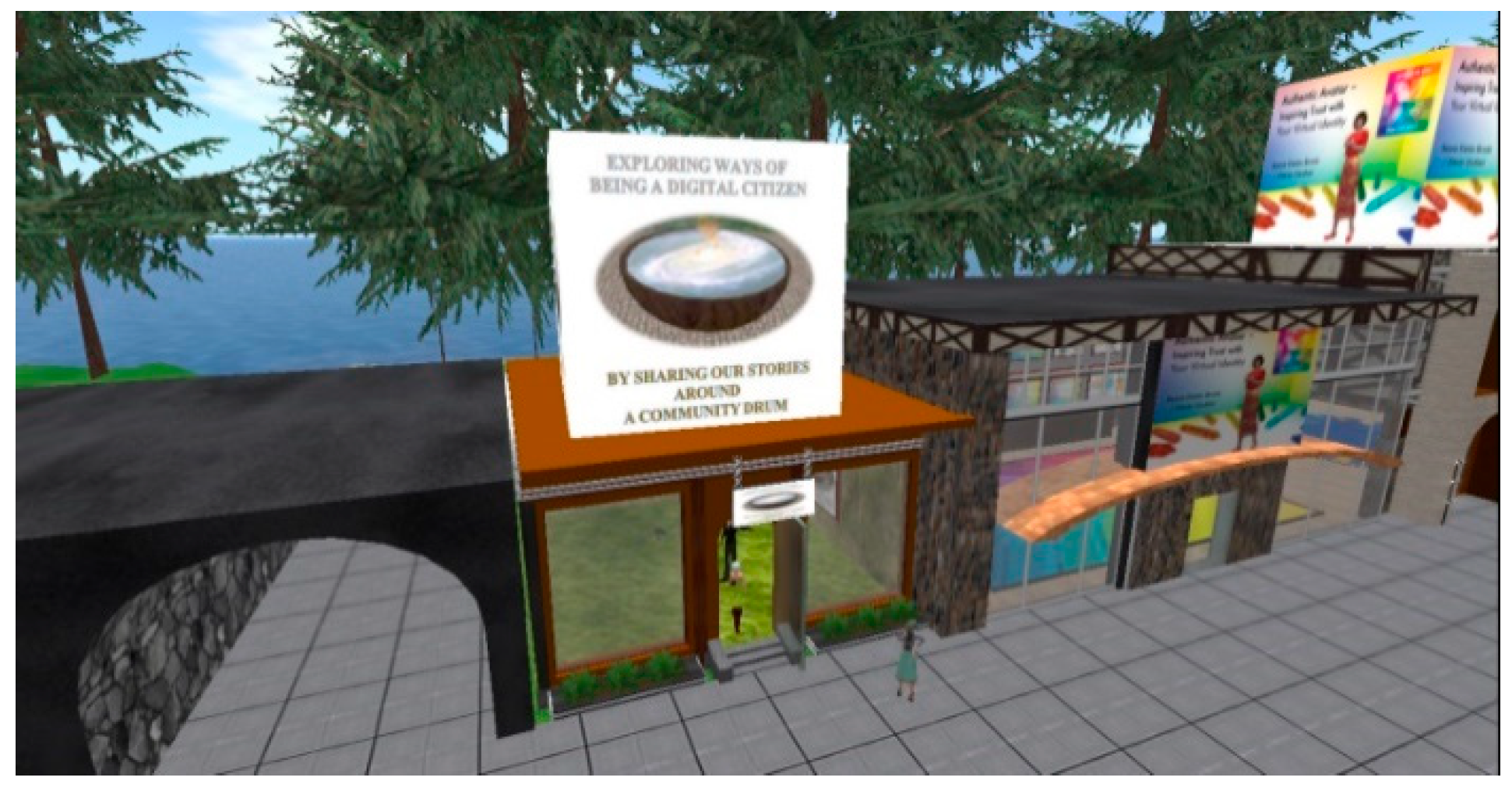
Figure 2.
Partial reconstruction of a lion statue from the Mosul Cultural Museum. See: https://rekrei.org. License: CC Attribution-NonCommercial.
Figure 2.
Partial reconstruction of a lion statue from the Mosul Cultural Museum. See: https://rekrei.org. License: CC Attribution-NonCommercial.
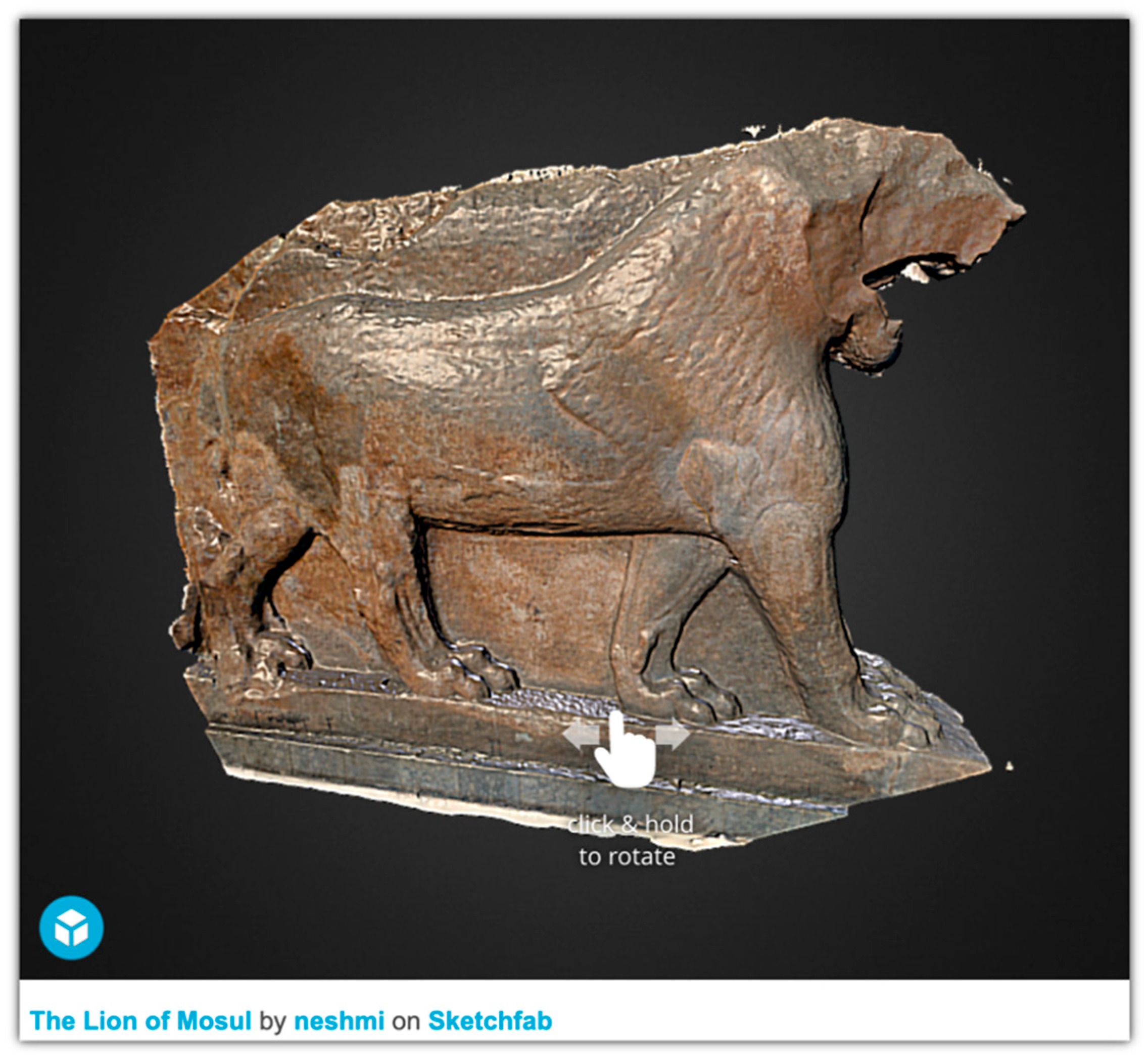
Figure 3.
Screenshot from the House Museum (Case Museo) chatbot game [42].
Figure 3.
Screenshot from the House Museum (Case Museo) chatbot game [42].
Disclaimer/Publisher’s Note: The statements, opinions and data contained in all publications are solely those of the individual author(s) and contributor(s) and not of MDPI and/or the editor(s). MDPI and/or the editor(s) disclaim responsibility for any injury to people or property resulting from any ideas, methods, instructions or products referred to in the content. |
© 2025 by the authors. Licensee MDPI, Basel, Switzerland. This article is an open access article distributed under the terms and conditions of the Creative Commons Attribution (CC BY) license (http://creativecommons.org/licenses/by/4.0/).
Copyright: This open access article is published under a Creative Commons CC BY 4.0 license, which permit the free download, distribution, and reuse, provided that the author and preprint are cited in any reuse.