

Submitted:
22 April 2023
Posted:
23 April 2023
You are already at the latest version
Abstract
(1) Background: the use of force by Public and Private Security Forces is currently an issue of great relevance because of the potential injuries that any excessive use of force by either the active or passive subjects or a deficit in the real mastery of the appropriate Physical Intervention Techniques (PIT) may cause. For this reason, certain traditionally used Physical Intervention Techniques have been questioned by scientific research studies and punished by justice. On the other hand, certain media have dealt with this matter in a biased and unfair manner by broadcasting videos where the use of force by police officer is displayed out of context. As a consequence, this problem has been brought under the spotlight, causing general uneasiness of the communities and rapidly spreading over social networks while favoring all sorts of parallel judgments. (2) Research method: A suit equipped with 19 Inertial Measurement Units (IMU) and a Biomechanics of Bodies software application for the Marras’ analysis of the data collected on trajectory, trunk twisting velocity, its sagittal angle, load, nature and severity of the injuries associated to the different intervention techniques that have been examined. (3) Results: according to the data registered, the implementation of Operational Tactical Procedures (OTP) reduces the probability of injuries and leads to a more satisfactory outcome. (4) Conclusions: the implementation of Operational Tactical Procedures, to-gether with the awareness on the risks associated to the excessive use of force by Public and Private Security Forces and Bodies, could reduce the risk of injuries suffered by both officers and citizens.
Keywords:
Use of force
; IMUS
; body injuries
; forensic medicine
; police arrest techniques
; criminology
; Op-erational Tactical Procedures
1. Introduction
The use of force by public and private law enforcement professionals is defined as the use of coercive physical measures by public security bodies according to the competencies granted by the State Members (European Regulation on the Use of Force [1]).
Media has echoed this problem and foster public scrutiny and criticism of police practices (Delgado, 2011) [2]. Since the murder of George Floyd (McLean, 2022) [3] in May 2020, public concern on the use of force by police officers has substantially increased after promises of change by politicians followed by unsubstantiated police training programs that have led to no satisfactory solution.
If we turn to legislation, nothing has been established with regard to how interventions should be performed, but it sets out certain limits with respect to human rights, dignity, exceptionality, proportionality, prohibition of torture and degrading treatment (Code of Conduct for Law Enforcement Officials 4/169 of 17 December 1979 [4], European Code of Police Ethics [5], Law 2/86 on Security Forces and Corps [6], Organic Law 4/2015 on the protection of citizen security [7], Criminal Procedure Law [8] and the Criminal Code [9].), without discrimination or abuse of power (Code of Ethics of the National Police Force).
The doctrine of the Supreme Court (Conde-Pumpido, 2016) [10], on the other hand, determines certain cases where the use of force is justified, weighing the goods and interests in conflict and concluding that they must be governed by the principles of congruence, opportunity and proportionality, in addition to starting from the manifest limit of not carrying out torture or inhuman or degrading treatment.
For all the above said, the potential harm that may be caused by certain interventions of the Security Forces and Bodies is a matter of great relevance, since they constitute formal actions that have the capability of depriving citizens, even if unintentionally, from numerous rights, including the right to life (Lawson, 2019) [11]. This is either because appropriate training is not being provided or scarce time is not properly used or, at least, not in the most effective manner, which results in poor safety standards both for the active and the passive subject.
Regular training usually consists in a number of reactive actions based on martial arts and combat sports (Vera-Jiménez, 2022) [12], where attacks are targeted to specific vital organs (Vera-Jiménez, 2020) [13] and the preventive actions require the use of tools on specific vulnerable body parts (arms and legs) to inflict moderate and controlled pain for a less harmful outcome. Naturally, any direct action on the extremities may be closely associated to either bone fractures and dislocations or contusions of the soft tissues or neurovascular structures. On the other hand, any action directed to the head is highly likely to cause brain injuries or skull fractures (Adedipe, 2013) [14].
The increasing trend to militarize [11] security forces by fostering the recruitment of people with military backgrounds for law enforcement bodies is often positively and erroneously associated to the use of lethal force against civilians under arrest. The problem is that people who have been trained on military modus operandi may tend to make a disproportionate use of force.
The Rokoko Smartsuit Pro (a suit with sensors to capture movement and other variables) is fundamental for the purpose of this study. This equipment provides a set of data suitable for their analysis by Biomechanics of Bodies software applications (Shippen, 2016) [15], such as the Marras’ risk assessment method, or also REBA and NIOSH that were used previously (Vera-Jiménez, 2022) [16]. Marras’ analysis allows to identify and discriminate, for instance, between high and low risk of work-related lumbar spine disorders based on a multiple logistic regression model that comprises a combination of five workplace movements and other factors (Marras, 1993) [17].
The same procedures can be applied to the analysis and assessment of the injury risks associated to OTP and compare these against those associated to traditional physical intervention techniques [12].
In this sense, the inadequacy of the original design seems to come from the linear structure that has traditionally been applied, both at a macro level (general aspects of training) and at a micro level (isolated techniques and tactics). In fact, more training time is allocated to the training on firearms and combat than to the acquisition of the knowledge and skills that the officers need to effectively implement specific non-violent methods for the resolution of conflicts. For example, in 2013, 95% of police academies provided an average of just 12 hour training (Garrett, 2017) [18].
Participants in different research studies on search and police practices, stated that they did not trust the tools and knowledge they had been provided with, since they lacked a great deal of practice and a standardized evaluation of their performance. (Rajakaruna, 2016) [19].
Based on the results reported by Koerner, Swen, 2021 on the implementation of non-linear pedagogy [20], those in charge of providing the training should be prepared to incorporate to their training sessions, a new self-defense method that should help law enforcement officers to prevent future harm.
When providing training at a micro level, i.e. isolated techniques and tactics, instructors should take into consideration the decision-making capacity of the students in real situations to overcome their own limitations and gain experience. Furthermore, emotions such as stress, fear or anger should also be taken into account for a more effective intervention (Miller, 2017) [21].
Vera-Jiménez, evaluated in his thesis the intervention techniques used by the Police Forces from Cadiz city in order to determine the possibilities of limiting the risk of injuries suffered by their officers during physical interventions through the implementation of operational tactical procedures in case of demanding arrests (Vera-Jiménez, 2020) [22] are reflex-based defense mechanisms. Through the internalization of a series of body movements known as specific tactical responses, the officers should be able to reduce a subject showing a strong resistance to the arrest while avoiding the risk of serious injuries. To this end, officers basically learn to press, manipulate or hit specific non-vital areas of the body. A reduction in casualties has been observed from 2007 until 2013 as a result of this new method of training while neither crime rate, nor the number of physical interventions has declined.
It should not be forgotten that over the last few years new tools or technologies have been incorporated to police intervention equipment (conducted energy devices -DEC- or pepper sprays). Although their use has caused a great deal of public outrage and widespread media coverage, it has been overlooked that the problems arising from their use were often attributable to specific circumstances such as positional asphyxia, pre-existing diseases or substance abuse (MacDonald, 2009) [23].
Regarding expandable batons, the training protocols identify the primary target areas (large muscles or muscle masses), since a blow onto a vulnerable area could lead to serious body injuries or even lethal ones [2]. Similarly, different types of police batons that would allow to reduce the risk of injuries have been tested (Vera-Jiménez, 2020) [24].
As an addition to the previous background, we must point out that the judgments SPSC 540/2022 [25], SPSC 959/2021 [26], SPSC 576/2018 [27], SPSC 403/2014 [28], SPSC 671/2010 [29], SPSC 752/2009 [30] sentenced police officers for the use of force in a non-proportionate manner that resulted in serious injuries, which entails the non-application of exonerating circumstance according to Article 20.7 of the Criminal Code.
2. Materials and Methods
This research has consisted on the analysis of different scientific publications on the use of force by law enforcement personnel. In addition, the need to incorporate new techniques, both with or without the use of specific equipment, to minimize the risk of injury has been analyzed. Likewise, current legislation has been examined (Code of Conduct for Law Enforcement Officers, European Code of Police Ethics, Law 2/86 on Security Forces and Corps, Organic Law 4/2015, of March 30, on the Protection of Citizen Security, Code of Ethics of the National Police Corps, Law 5/2014 on Private Security, Criminal Procedure Act and Criminal Code) with regard to the principles governing the use of force by the Security Forces and Corps. A number of sentences passed by the Supreme Court on this matter (SPSC 540/2022, SPSC 959/2021, SPSC 576/2018, SPSC 403/2014, SPSC 671/2010, SPSC 752/2009), pointing out in each case the injuries, consequences, procedures and the arguments of the judges have also been examined. For this purpose, different databases have been used, such as, the Judicial Documentation Center, Digital Law, Iberley among others.
In addition to the above, a Rokoko Smartsuit Pro suit has been employed. This suit is equipped with a set of 19 wireless triaxial accelerometric or Inertial Measurement Units (IMU), gyroscopic and geomagnetic sensors that allow to determine the position, velocity, acceleration and magnetic fields of a human body. The collected data are displayed on a screen by means of an avatar that shows the different positions of the body (Figure 1).
This suit allowed the measurement of a series of biomechanical parameters while two police officers collaborating in this research performed each of the physical intervention techniques while wearing the sensor-fitted suit. The data collected were then processed using the Biomechanics of Bodies (BoB) analysis software, which allowed the risks involved in traditional techniques to be compared against the new tactical operational procedures. The BoB software includes several software plug-ins for biomechanical modeling to manage the data on position, velocity, acceleration (linear and angular extensions or muscle rotations), muscle tension or compression force and energy or power. It is also fitted with three-dimensional graph generation features and several data display modes (Figure 2).
The ergonomics system known as "Occupational Biomechanics" by Marras [17] is based on a multiple logistic regression model, which uses a combination of five factors corresponding to five trunk movements features. The factors are 1) Lift rate, 2) Average twisting velocity, 3) Maximum moment, 4) Maximum sagittal flexion, and 5) Maximum lateral velocity. The values corresponding to these factors are determined by means of the BoB software application.
In the paper by Marras [17], even though causality is not demonstrated, an association between biomechanical factors and the risk of low back disorders is indicated. This model is appropriate to be used for quantitative and objective measures in ergonomic studies that intend to minimize the risk of work-related lumbar disorders. The analysis yields the results in the form of "Probability of high risk".
The subjects who performed the relevant tests were a 1.83 m high and 98 kg weight male as the police officer performing the arrest, and a 1.73 m high and 68 kg weight male as the opponent. Both of them practice martial arts and combat sports at a high level. After warming-up, the techniques were performed in specifically adequate sport facilities.
3. Results and discussion
The above mentioned sentences, are analyzed below:
SPSC 540/2022 16th February, 2022
A local police officer is condemned for causing injuries (art. 147.2 of the Penal Code) after attacking several people, causing one of them a contusion on the left knee with ecchymosis of 12 x 4 cm, and another an open injury and fracture of the cartilage shell of the right auricle, which impeded both of them from exercising their occupations. As established by Article 22.7 of the Penal Code, wrong use of his public agent status was considered as an aggravating factor.
SPSC 959/2021 of December 10th 2021
The sentenced officers were found guilty of causing injuries to an individual (article 147.1 of the Penal Code) consisting in a jaw double fracture that required the use of osteosynthesis material and left the victim suffering from chronic pain.
SPSC 576/2018 of November 21st 2018
An officer struck a woman using his regular baton on the left thigh, right thigh and right hand. The woman suffered a non-displaced diaphyseal fracture of the 2nd metacarpal finger of her right hand, a contusion wound of 0.5 centimeters at the fracture site, on the dorsum of her right hand, with edema and surrounding hematoma; linear abrasion, with hematoma of approximately 20 centimeters on the side of her left thigh and linear abrasion with hematoma of approximately 15 on the back of her right thigh. Therefore, the officer was condemned for causing injuries (147.2 of the Penal Code) and for serious negligence. In this case, articles 147.1 and 148.2 of the Penal Code were applied.
SPSC 403/2014 of May 13th, 2014
Several local police officers used their batons to hit a person in the eye and also causing damages to one of his knees and shoulders. They were sentences for negligence according to 621.1 in relation to section 147.2 of the Criminal Code.
SPSC 671/2010 of 2nd July 2010
The police officers caused a fracture in three fragments of the lower third of the left humerus in addition to radial paralysis, requiring orthopedic and rehabilitative medical treatment and the following side effects: osteosynthesis material in the left shoulder, paralysis of the radial nerve in the left upper extremity at the radius, causing a partial and permanent disability for the development of normal activities and, in addition to this, a moderate aesthetic defect as a result of the surgical scar. The police officers were sanctioned on the basis of article 147.1 of the Penal Code.
SPSC 752/2009 of July 3rd 2009
In the same line, several municipal police officers were found guilty of a crime of injuries under the Article 147 of the Penal Code for assaulting a person and causing him cranioencephalic trauma with collapse-fracture, adding a right temporoparietal epidural hematoma and mass effect on the right ventricular system, contusions on the right hemisphere and a probable fracture of the medial orbital wall, as well as hematoma on the right periorbital area, contusions on the thoracic wall and erosions on the left forearm.
It is important to point out that all these sentences have a common element which is that the convicted officers used the traditional techniques of physical intervention for which they had received training. They did not take into account that police officers can be convicted of a crime of injury as described in Article 147, without the exemption provided for in Article 20.7 of the Penal Code, which would apply in cases of legitimate and proportionate use of force in the performance of a duty and which would entail the application of penalties ranging from 6 months to 3 years and 6 months imprisonment.
As can be seen, the consequences of a bad intervention, training and the subsequent inappropriate use of force were highly harmful, often involving cranioencephalic trauma, cervical contusions and hematomas, most of which were disabling. The same can be said about the use of expandable batons, which resulted in condemning the police officers for its use after qualifying it as a "dangerous instrument".
We must point out that the injuries that result as a consequence of the deficient training of police officers and the policies by which the different Agencies are governed, are highly questionable aspects due to two main reasons:
- The utmost importance of the proper training of officers on the implementation of police intervention techniques that result in the least possible injuries or no injuries at all, and
- The limited number of existing studies on criminological and medico-legal data.
However, we would like to add that the use of intelligent suits (IMUS) has allowed the collection of data related to the energy and force applied over the different postures involved in the interventions, whether traditional ones of the new OTPs. Furthermore, thanks to the "Body Biomechanics" software application, the numerous data corresponding to the postures, speeds and accelerations involved, have been registered by the sensors in the suit and fed into the software application for its subsequent analysis following the Marras method (Figure 3).
In Figure 3, 4 avatars representing each of the techniques (basic OTP techniques 4, basic OTP techniques 1, trad. throw techniques and trad. choking techniques) are shown on the left. A graph where the data corresponding to the different levels of injury risk is displayed on the right hand side. It can be seen that, on the one hand, traditional physical intervention techniques presented 70-80% risk of injury, while it was confirmed, on the other hand, that the OTPs registered lower risk levels (between 54 and 63%), with a lower risk of injury for the officers themselves.
| Marras | |||||
| Classification of techniques by injury risk levels | |||||
| Biomechanical data | |||||
| Parameter | units | BASIC OTP 4. BoB | BASIC OTP 1 . BoB | TRAD. THROW TECH. BoB | TRAD. CHOKING TECH. BoB |
| Lift rate | [Lifts/hour] | 0.00 | 0.00 | 0.00 | 0.00 |
| Average twisting velocity | [Degree/s] | 8.54 | 8.83 | 12.41 | 22.19 |
| Maximum momentum | [Nm] | 355.02 | 1222.01 | 1614.74 | 2019.01 |
| Maximum sagittal flexion | [Degree] | 15.78 | 19.49 | 46.76 | 44.82 |
| Maximum lateral velocity | [Degree/s] | 43.65 | 52.28 | 73.28 | 98.37 |
| Probability of injuries | % | 54.20 | 62.49 | 77.07 | 80.20 |
| Marras normalized data | |||||
| Parameter | units | BASIC OTP 4. BoB | BASIC OTP 1 .BoB | TRAD. THROW TECH. BOB | TRAD. CHOKING TECH. . BoB |
| Lift rate | % | 1.00 | 1.00 | 1.00 | 1.00 |
| Average twisting velocity | % | 55.54 | 59.19 | 87.72 | 100.00 |
| Maximum momentum | % | 100.00 | 100.00 | 100.00 | 100.00 |
| Maximum sagittal flexion | % | 59.90 | 79.94 | 100.00 | 100.00 |
| Maximum lateral velocity | % | 54.55 | 72.35 | 96.65 | 100.00 |
| Risk of serious injuries | % | 54.20 | 62.49 | 77.07 | 80.20 |
4. Conclusions
Based on the analysis that has been carried out, it could be concluded that OTPs are less harmful and, therefore, more suitable for the training of the members of the Security Forces and Corps. Their implementation allows to speed up police interventions by reducing body movements as well as providing the possibility to clearly differentiate the levels of force to be employed in each situation. All of this, from the perspective of occupational risks and specifically in the police field, represents a considerable improvement of the safety during police arrests, with a significant reduction in the risk of injuries suffered by both the police officers themselves and the citizens.
Author Contributions
Conceptualization, J.C.V.-J., J.A.Á. and J.A.; acquisition financing, J.C.V.-J., J.A.Á. and J.A.; research, J.C.V.-J., D.V.C. and J.A.; validation, J.C.V.-J., D.V.C., L.G.H., J.A.Á. and J.A.; screen, J.C.V.-J.; methodology, J.C.V.-J., D.V.C., J.A.Á., and J.A.; redaction—preparation of the original draft, J.C.V.-J. and J.A.; Writing—Correction and edition, J.C.V.-J. and J.A.; supervision, J.C.V.-J., D.V.C., L.G.H.., J.A.Á., and J.A. All authors have read and accepted the published version of the manuscript.
Institutional Review Board Statement
The study was conducted in accordance with the Declaration of Helsinki, and approved by CADIZ RESEARCH ETHICS COMMITTEE (Internal Code: 1912-N-19, 01/10/2019)
Informed Consent Statement
Not applicable.
Data Availability Statement
Not applicable.
Conflicts of Interest
Not applicable.
Abbreviations
| BoB | Biomechanics of Bodies |
| CED | Conducted-energy Devices |
| IMU | Inertial Measurement Units |
| OTP | Operational Tactical Procedures |
| PIT | Physical Intervention Techniques |
| SPSC | Spanish Supreme Court |
| Tech. | Techniques |
| Trad. | Traditional |
References
- European Regulation on the Use of Force.
- Delgado, R.A. (2011). An ideal use of force model for law enforcement: An assessment of the Austin Police Department. Masters of Public Administration, Texas State University, San Marcos, Texas. https://digital.library.txstate.edu/handle/10877/3472. 1087. [Google Scholar]
- McLean, K., Stoughton, S.W. & Alpert, G.P. Police Uses of Force in the USA: a Wealth of Theories and a Lack of Evidence. Camb J Evid Based Polic 6, 87–108 (2022). [CrossRef]
- Code of Conduct for Law Enforcement Officials 4/169 of 17 December 1979.
- European Code of Police Ethics.
- Law 2/86 on Public Security Forces.
- Organic Law 4/2015 on the protection of citizen security. 2015.
- Criminal Procedure Law.
- Criminal Code.
- Conde-Pumpido, C. en Estudio Multidisciplinar de la Operativa y del uso de la Fuerza Policial. (2016). Tirant lo Blanch. https://biblioteca-tirant-com.bibezproxy.uca.es/cloudLibrary/ebook/info/9788491193777. pp. 37-42.
- Lawson, E. (2019). TRENDS: Police Militarization and the Use of Lethal Force. Political Research Quarterly, 72(1), 177–189. [CrossRef]
- Vera-Jiménez JC, Meléndez-Sánchez FL, Álvarez JA, Ayuso J. An Analysis of Biomechanical Parameters in OTP Police Physical Intervention Techniques for Occupational Risk Prevention. Int J Environ Res Public Health. 2022, 19, 6615. [CrossRef]
- Vera-Jiménez JC, Lorente JA, González-Herrera L, Álvarez JA, Ferreiro-González M, Ayuso J. A Legal and Forensic Medicine Approach to Police Physical Intervention Techniques in High-Risk Situations. International Journal of Environmental Research and Public Health. 2020; 17(8):2809. [CrossRef]
- Adedipe A, Maher PJ, Strote J.Injuries associated with law enforcement use of force. Trauma. 2013;15(2):99-106. [CrossRef]
- Shippen, J., & May, B. (2016). BoB – Biomechanics in MATLAB. In Proceedings of 11th International Conference BIOMDLORE 2016 (pp. 11-13). Vilnius Gediminas Technical University. [CrossRef]
- Vera-Jiménez, J. C., Meléndez-Sánchez, F. L., Álvarez, J. A., & Ayuso, J. (2022). An Analysis of Biomechanical Parameters in OTP Police Physical Intervention Techniques for Occupational Risk Prevention. International Journal of Environmental Research and Public Health 2022, 19, 6615. [CrossRef]
- Marras WS, Lavender SA, Leurgans SE, Rajulu SL, Allread WG, Fathallah FA, Ferguson SA. The role of dynamic three-dimensional trunk motion in occupationally-related low back disorders. The effects of workplace factors, trunk position, and trunk motion characteristics on risk of injury. Spine (Phila Pa 1976). 1993, 18, 617–628. [CrossRef]
- Garrett, Brandon L. and Stoughton, Seth W., A Tactical Fourth Amendment (25 March, 2016). Virginia Law Review, Vol. 103, 211, 2017, Virginia Public Law and Legal Theory Research Paper No. 29, Available at SSRN:https://ssrn.com/abstract=2754759 Accessed on 2023.
- Rajakaruna, N., Pamela J., H., Cutler, A., &Fairman, G. (2016, Diciembre 22). https://emj.bmj.com/content/26/1/20.full. Police Practice and Research, 18(5), 507-521. [CrossRef]
- Koerner, Swen. (2021). Nonlinear Pedagogy in Police Self-Defence Training: Concept and Application. [CrossRef]
- Vera-Jiménez, J.C., Ferreiro-González, M., Barbero, G.F. et al. OTP-PRL: an app for occupational risk prevention in policing activities. BMC Public Health 19, 1549 (2019). [CrossRef]
- Miller, T.R., Lawrence BA, Carlson NN, Hendrie D, Randall S, Rockett IR, Spicer RS. Perils of police action: a cautionary tale from US data sets. Inj Prev. 2017 Feb;23(1):27-32. [CrossRef]
- Vera Jiménez, Jose Carlos, et al. “Evaluation of the police operational tactical procedures for reducing officer injuries resulting from physical interventions in problematic arrests. The case of the Municipal Police of Cádiz (Spain).” International Journal of Occupational Medicine and Environmental Health, vol. 33, no. 1, 2020, pp. 35-43. [CrossRef]
- MacDonald JM, Kaminski RJ, Smith MR. The effect of less-lethal weapons on injuries in police use-of-force events. Am J Public Health. 2009 Dec;99(12):2268-74. [CrossRef]
- Vera Jiménez, J.C. (2020, octubre 26). El uso del bastón policial extensible. Sus ventajas y limitaciones. h50 Digital Policial.
- SPSC 540/2022 of February 16th 2022 (ECLI:ES:TS:2022:540). 16 February.
- SPSC 959/2021 of Decembert 10th 2021 (ECLI:ES:TS:2021:959).
- SPSC 576/2018 of November 21st 2018 (ECLI:ES:TS:2018:4036).
- SPSC 403/2014 of May 13th 2014 (ECLI:ES:TS:2014:2223).
- SPSC 671/2010 of July 2nd 2010 (ECLI:ES:TS:2010:671).
- SPSC 752/2009 of July 3rd 2009 (ECLI:ES:TS:2009:4619).
Figure 1.
Avatar that illustrates the posture of a human body while performing an intervention technique.
Figure 1.
Avatar that illustrates the posture of a human body while performing an intervention technique.
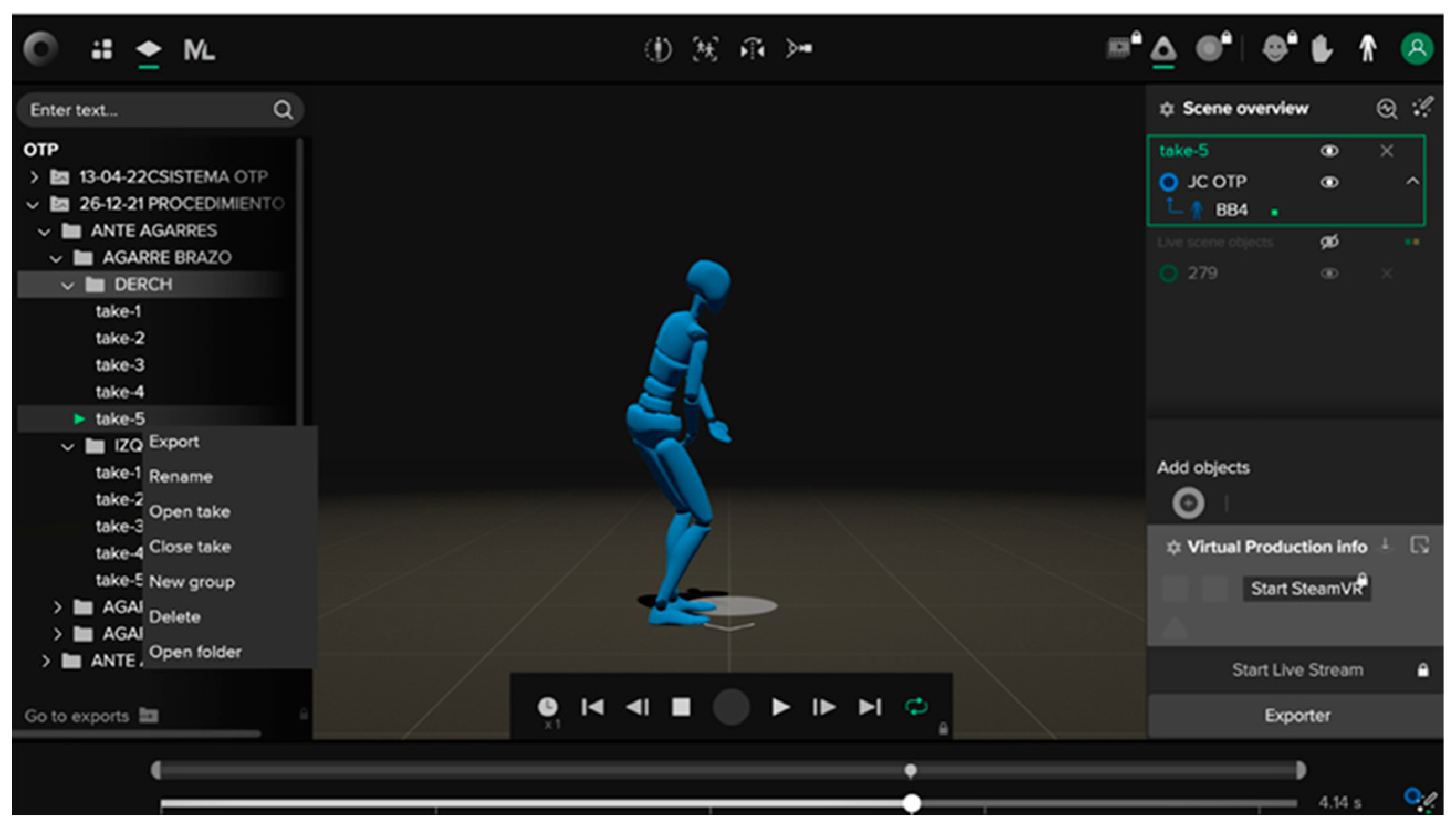
Figure 2.
Graph generated by the BoB software application.
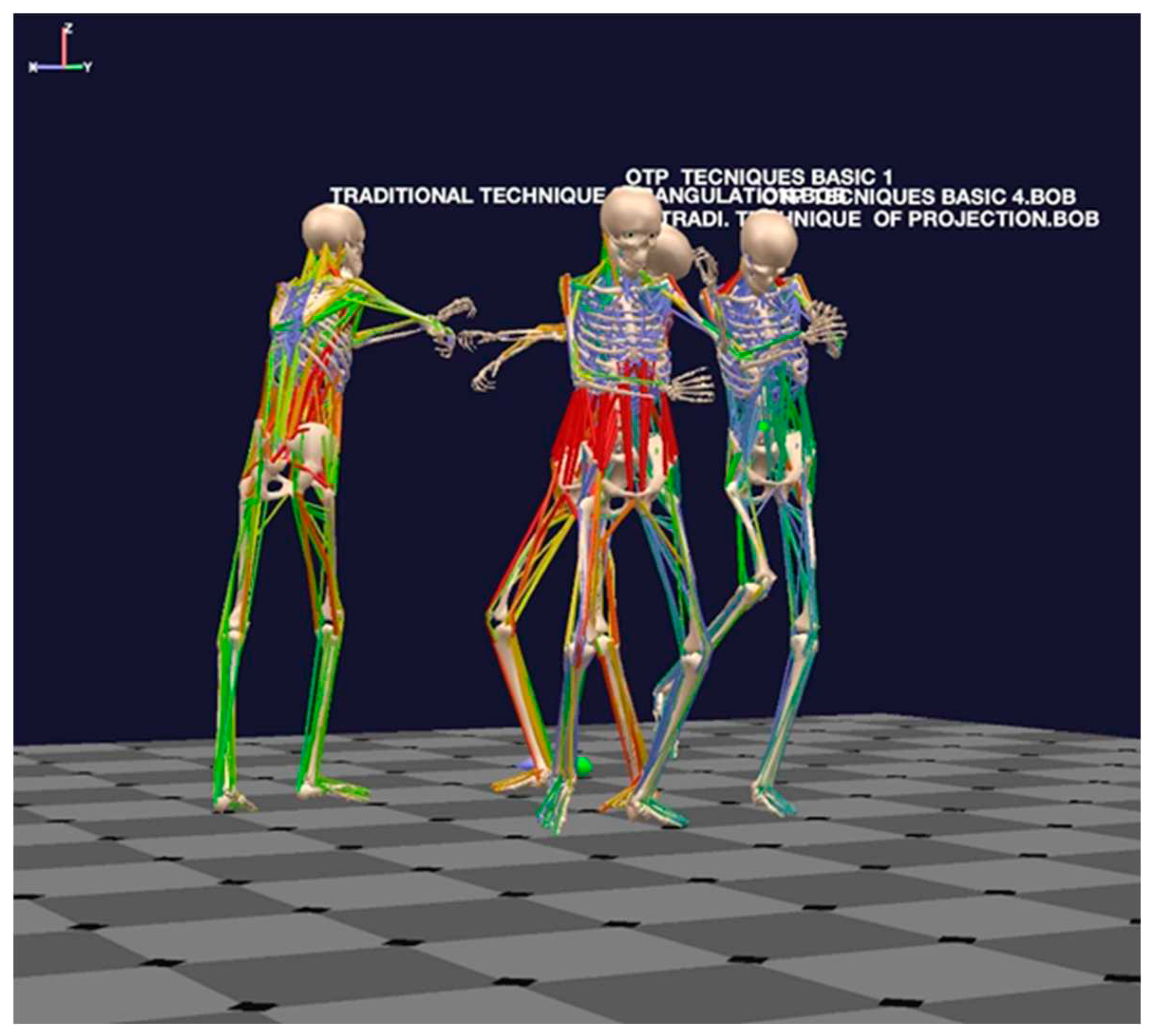
Figure 3.
Graph generated from the Marras analysis.
Disclaimer/Publisher’s Note: The statements, opinions and data contained in all publications are solely those of the individual author(s) and contributor(s) and not of MDPI and/or the editor(s). MDPI and/or the editor(s) disclaim responsibility for any injury to people or property resulting from any ideas, methods, instructions or products referred to in the content. |
© 2023 by the authors. Licensee MDPI, Basel, Switzerland. This article is an open access article distributed under the terms and conditions of the Creative Commons Attribution (CC BY) license (https://creativecommons.org/licenses/by/4.0/).
Copyright: This open access article is published under a Creative Commons CC BY 4.0 license, which permit the free download, distribution, and reuse, provided that the author and preprint are cited in any reuse.


