

Submitted:
13 April 2023
Posted:
19 April 2023
You are already at the latest version
Abstract
Artificial intelligence (AI) applications in different fields are developing rapidly, among which AI painting technology, as an emerging technology, has received wide attention from users for its creativity and efficiency. This study aimed to investigate the factors that influence user acceptance of the use of AIBPS by proposing an extended model that combines the Extended Technology Acceptance Model (ETAM) with the AI-based Painting System (AIBPS).A questionnaire was administered to 528 Chinese participants, using validated factor analysis data and Structural Equation Modeling (SEM) was used to test the hypotheses. The findings showed that hedonic motivation (HM) and perceived trust (PE) had a positive effect (+) on users' perceived usefulness (PU) and perceived ease of use (PEOU), while previous experience (PE) and technical features (TF) had no effect (-) on users' perceived usefulness (PU). This study provides an important contribution to the literature on AIBPS and the evaluation of systems of the same type, which helps to promote the sustainable development of AI in different domains and provides a possible space for further extension of TAM, thus helping to improve the user experience of AIBPS. The results of the study provide insights for system developers and enterprises to better motivate users to use AIBPS.
Keywords:
AI-based painting systems(AIBPS)
; Technology Acceptance Model (TAM)
; Behavioral intentions
; User experience
; Structural Equation Modelling (SEM
1. Introduction
Artificial intelligence (AI) is rapidly developing and widely used as computer technology and algorithms continue to advance. IDC (International Data Corporation) reports that global spending on AI will more than double between 2023 and 2026, with spending exceeding $300 billion [1]. Since the end of the 20th century, applied research of AI has been widely used in various fields as an interdisciplinary approach, subtly transforming industries such as automotive, finance, healthcare, retail, journalism, media, education, gaming, online assistants, payments, art and smart homes [2,3], and previous scholars have related AI art through literature and case studies [4,5]. Examples include the AI video content generation system Runway, AI image processing system Toolkit, AI automatic social media posting system Repurpose IO, AI music system Amper Music, and AI art image system Dall-E2.
AI art is widely used in the field of AIGC [6], and various related systems have been developed to facilitate and enhance the capabilities of users [7]. The product Chat GPT chatbot based on AI generative content (AIGC), has surpassed 100 million active users in only two months of its launch, making it the fastest growing application in history [8]. Scholars have prospectively discussed the potential of AI art technology applications [9,10,11]. Deng explores the application of AI in art design [12]; Liu analyzes the relationship between the integration of traditional and AI painting [13]; Köbis and Mossink experimentally assess whether users distinguish AI-generated poetry [14]; De Mantaras, RL, and Arcos, J.L on the relationship between AI and music [15]; Jeon on film creation through an AI-generated system that generates stories, narratives, images, and sounds in films using AI [16]. Therefore, the application of AI in the field of art is promising, and more AI will be applied to art creation in the future.
Driven by AI art, the application of AI in the field of painting continues to mature and develop [13]. AIBPS can generate paintings by learning and simulating the process of human painting [5], and can also generate a large number of images and works in a short time [17]. Therefore, more and more artists and designers are applying it to practical creations. In 2022, the first prize winner of the Colorado State Fair Art Competition, "Théâtre D'opéra Spatial", made headlines with a painting by designer Jason M. Allen using AIBPS-Midjourney [18]. However, according to the interview, he generated more than 800 times through the AI system and repeatedly tested to obtain satisfactory work, which does not directly generate the expected satisfactory work. Academics also continue to discuss user acceptance regarding AI-generated paintings, such as whether AI-generated paintings are art [19,20], whether users accurately recognize AI-generated paintings [21], whether AI is imaginative [5], whether AI can create artistic paintings autonomously [22], whether AI-generated art can be considered as human-created works like "Art", and whether users accept AI-generated paintings. Therefore, user acceptance and behavioral intentions towards AIBPS may be a real issue, as it can directly affect user engagement and sustained usage. If users do not accept and use AIBPS, this may lead to lower user retention, user activity, and reduced revenue for AIBPS [23]. Thus, AI is widely used in fields such as art creation and design, and research is needed to optimize user acceptance and behavioral intentions to improve effectiveness.
TAM is the most prevalent theory to evaluate user acceptance of new AI technologies [24] and was first proposed by Davis [25]. TAM is now widely used in different aspects of new technologies and confirmed that perceived usefulness (PU) and perceived ease of use (PEOU) have a significant impact on user acceptance. Researchers have continuously upgraded and extended TAM based on TAM, such as TAM2, TAM3, UTAUT, UTAUT 2, etc [26,27,28,29,30,31,32]. Although RATAM, a new high-tech acceptance theory model for AI robot architecture design contexts, provides new insights into the future development of AI in architectural design [33].To our knowledge. There has been no such empirical research applying the extended TAM to AIBPS, and no research has been conducted to investigate the factors that influence user adoption of AIBPS. Therefore, this study aims to explore the factors that influence users' acceptance and behavioral intentions toward AIBPS using an extended TAM framework and extends previous discussions on AIBPS to help evaluate and improve the experience and effectiveness of using the technology in practical applications. In general, this study aims to solve the following questions: (1) What are the factors that influence users' acceptance and use of AIBPS? (2)What are the relationships among the influencing factors? (3)How can the development and improvement of AIBPS features used by users be facilitated in response to these factors?
The research framework of this paper is as follows: Section 2, reviews about AIBPS and technology acceptance models, presents the research model and hypotheses of this paper and explores the determinants that influence the acceptance and use of AIBPS. Section 3, we collect user data through questionnaire surveys and analyze them. Section 4, evaluates the measurement model and structural equation model. Section 5, we have a discussion and revelation. In Section 6, the conclusions of this paper are summarized. Section 7, discusses the limitations of the study and future directions. It is hoped that these findings will help system developers better understand users' preferences and acceptance of AIBPS, facilitate the development of new features, and thus guide users to accept and use AIBPS more rationally, and consequently promote the sustainable development of artistic creativity.
2. Theoretical Background and Hypothesis Development
2.1. Overview of Artificial Intelligence in Painting
In recent years, AI techniques have gained popularity in the field of painting art, and the current mainstream AIBPS is based on semantic analysis [34]. This technique uses a huge database of text and images to train a machine-learning model that generates images by learning based on the textual input given by the user [35]. AIBPS uses deep learning algorithms to analyze and learn existing images, enabling the creation of new images. For example, Edmond de Belamy, a generative adversarial network portrait painting produced by the Parisian art collective Obvious in 2018, sold for $432,500 at Christie's New York in October 2019 [36]. Existing generative class of neural networks include Generative Adversarial Networks (GAN), Convolutional Neural Networks (CNN), creative adversarial networks (AICAN), and Contrastive language-image pre-training models (CLIP). The early AIBPS include DeepDream, Prisma, and Dall-E, and the current AIBPS include Disco Diffusion, Dall-E2, Imagen, Midjourney, and Stable Diffusion. Currently, there are two types of generative models of AIBPS in the market, one is diffusion-based and the other is sequence-to-sequence [37]. Therefore, generating high-quality, realistic images that accurately match the text descriptions is still a challenging task for AI systems.
Previous scholars have explored the relationship between AI and painting, such as creativity in AI painting [38], reflections on AI painting techniques [13], attitudes of art and non-art majors towards AI painting [17], comparing human and AI painting [39], and applying AI painting techniques to cultural and creative products [40]. The Art of AI Painting incorporates a wide range of techniques and styles, using machine learning to improve the user's painting ability. Whether or not they have or specialize in painting skills, with the help of AIBPS, art majors and non-art majors users can easily be able to create impressive works [17]. The intervention of AI in the creation of painting art not only brings more possibilities, but also overturns the paradigm of art creation and changes the way we think about viewing and evaluating artworks [39]. Thus humans and AI can form a good partnership when making art, thus allowing for maximum creativity [38]. Since AI-generated paintings are based on technology, while human-generated paintings are based on emotions, fundamental differences remain in some aspects [41]. More and more users are now interested in the AIBPS creation method, however, whether users are willing to accept this art creation method, and what factors contribute to user acceptance, and whether frequent use of AI painting systems will lead to homogenization of creation, these are the contents of this paper's research.
2.2. Technology Acceptance Model (TAM)
The Technology Acceptance Model (TAM) is used to explain and predict the adoption of computer technology. Davis argued that for a new technology to be accepted, it is crucial that it be used and easily identified [25]. His research developed and validated new scales for two specific variables, perceived usefulness (PU) and perceived ease of use (PEOU) [42]. TAM is also one of the most commonly used models to understand the level of user adoption of emerging and communication technologies [43]. A meta-analysis conducted by some scholars proved that TAM is a valid and robust model and has been widely used [44]. In addition, PU and ATT directly affect behavioral intention(BI), whereas PEOU affects BI by PU directly or indirectly [45]. In the context of this study, users' ATT and BI were higher if they perceived that using AIBPS in their painting creation process was beneficial.
TAM is an important theoretical basis for studying users' acceptance of new technologies. In this model, PU and PEOU are two important influencing factors and they are both influenced by external variables, and many scholars have proposed new models by combining these variables. These models provide system developers with a better way to control user BI [46]. For example, the Technology Acceptance Model for the Elderly (STAM) explores the acceptance of new technologies among older Hong Kong Chinese [47]; the Technology-Organization-Environment (TOE) framework combined with TAM examines the factors influencing end-user ATT and BI of AI-based technologies in construction companies [28]; the Learning Behavior Acceptance Model (T-LBAM) explores students' participation in gamified online courses intrinsic influences on willingness [26]. It is important to notice that there are many influencing factors in TAM, and these factors vary significantly across different research areas. Therefore, we need to fully consider the impact of various external variables on user perceptions in order to better understand the acceptance of new technologies by users [27]. In addition, TAM has been used by many scholars as a theoretical basis for research describing users' ATT and BI of new systems or technologies for AI, and the model has been validated in areas such as mobile payments [49], healthcare [50], service delivery [51], learning platforms [52], architecture companies [28], and digital library [46].
Although many scholars have applied TAM to the AI field, no scholars have yet combined TAM with the AI art field in an empirical study. The process by which various TAM factors in the AI field influence the acceptance of AIBPS is not clear. Therefore, this study aims to propose an extended technology acceptance model (ETAM) and combine it with AIBPS to investigate the factors that influence users' acceptance and use of AIBPS. Through this study, we can provide new ideas for applying the ETAM model in the AI field and also help to promote the development of the AI art field.
2.3. Research Hypotheses
2.3.1. Previous experience(PE)
Previous experience refers to the fact that experienced users will find this new technology more useful, easier to use, and more likely to use it more often [53]. Although TAM has been shown to be applicable to experienced users, previous experience is still one of the main predictors of users' behavioral intentions [54,55]. In a meta-analysis of 107 papers, scholars identified 152 external variables that influence perceived usefulness and ease of use, of which they identified previous experience as particularly important [56]. The experienced users are more receptive to new technologies, thus previous experience is an important factor influencing users' adoption of new technologies [57]. Studies have shown that experience is one of the most adequate moderating variables in TAM [44]. Therefore, we propose the following hypothesis:
Hypothesis 1 (H1a).
The user's previous experience of AIBPS will positively influence their perceived usefulness of AIBPS.
Hypothesis 1 (H1b).
The user's previous experience of AIBPS will positively influence their perceived ease of use of AIBPS.
2.3.2. Technical features (TF)
Technical features need to be applicable and easy to use, and compatible with prior art to reflect the advantages of functionality [28] Some scholars have argued that AI device-specific technology preferences play an important role in user acceptance of new technologies [58]. Thus, in some cases, users' ATT and BI may vary depending on the technical features of the system and the differences between users [59]. According to previous studies, the technical features of a new technology or device can directly affect the user's PEOU and PU of the system [46,60,61]. Thus, the inclusion of technical features as external variables in TAM can help to better understand user acceptance and adoption of AI painting technology. Consequently, we offer the following hypothesis:
Hypothesis 2(H2a).
The technical features of AIBPS will positively influence users' perceived usefulness of AIBPS.
Hypothesis 2(H2b).
The technical features of AIBPS will positively influence users' perceived ease of use of AIBPS.
2.3.3. Hedonic motivation (HM)
Hedonic motivation refers to the pleasure or expectation of pleasure that an individual obtains through the use of AI devices [51]. Furthermore, previous studies have used hedonicism as a major predictor of user behavior on technological systems [62]. With the continuous development of AI technologies, hedonic motivation has been widely used in terms of users' acceptance of AI [63,64], involving applications such as smart banking [48] and smart voice assistants [65], and some scholars have shown that hedonic motivation also significantly influences the social presence of AI chat systems and thus the intentions to use AI chat services [66]. For users, when using AI devices for hedonic motives, these devices can provide benefits by satisfying personal interests and entertainment needs [67], in other words, hedonic motives are the pleasure or joy derived from using the technology or system and are important determinants of users' acceptance and continued use of the technology [68]. In addition, several related studies have extended the TAM model to include hedonic motivation factors and proposed the Hedonic Motivation System Adoption Model (HMSAM) [69]. Accordingly, the following hypothesis is proposed:
Hypothesis 3(H3a).
The user's hedonic motivation for AIBPS will positively influence their perceived usefulness of AIBPS.
Hypothesis 3(H3b).
The user's hedonic motivation for AIBPS will positively influence their perceived ease of use of AIBPS.
2.3.4. Perceived trust (PT)
Perceived trust refers to the user's recognition of the reliability and trustworthiness of a system [70]. As people become increasingly dependent on new technologies, trust in new technologies has become increasingly important [71,72]. Perceived trust, as a predictor of technology acceptance [73,74], is central to explaining the relationship between users' beliefs about new technologies and acceptance behavior [73]. Studies have shown that users' PU and PEOU for new technologies have an influential role in their trust [53]. At the same time, users' trust and reliance on AI decision aids may be fragile [75]. Schnall et al. investigated the relationship between perceived trust and intention to use, as well as between PU and PEOU [76]. As AI technologies become common in various domains, trust has a significant impact on the intention to use AI and plays an important role in the acceptance of AI technologies [77]. For example, perceived trust influences the BI of intelligent healthcare services [78]. Solberg et al. proposed a conceptual model of perceived risk and dependence for AI decision making that helps researchers to study trust and dependence on AI decision aids [79]. Thus, we propose the following hypothesis:
Hypothesis 4(H4a).
The user's perceived trustof AIBPS will positively influence their perceived usefulness of AIBPS.
Hypothesis 4(H4b).
The user's perceived trust of AIBPS will positively influence their perceived ease of use of AIBPS.
2.3.5. Perceived Usefulness (PU) and Perceived Ease of Use (PEOU)
Perceived usefulness (PU) refers to the extent to which individuals believe that a new technology can improve their efficiency [80] and has also been interpreted as the subjective likelihood of potential users [30]. Perceived ease of use (PEOU) refers to the extent to which individuals accept that a new technology can be easily adopted without requiring significant time to learn [39]. PEOU not only affects users' PU, but also affects their ATT of accepting new AI technologies [46]. As the main determinants of users' use and acceptance of new technologies [25], PU and PEOU equally have a positive impact on the ATT aspect of chat AI robots [82]. The development of new systems that are easy to use will become increasingly common in the future, and adherence to or deviation from commonly understood standards of ease of use may have a significant impact on the acceptance of the system [87]. By providing an intuitive user interface, easy to understand steps, and a quick feedback mechanism, users can quickly master the use of AIBPS, making it easier for non-professional users to create paintings, while also helping professional users to provide inspiration and improving the efficiency and quality of their creations. Therefore, we offer the following hypothesis:
Hypothesis 5.
The user's perceived usefulness of AIBPS will positively influence their attitudes towards AIBPS.
Hypothesis 6.
The user's perceived usefulness of AIBPS will positively influence their behavioral intention towards AIBPS.
Hypothesis 7.
The user's perceived ease of use of AIBPS will positively influence their perceived usefulness of AIBPS.
Hypothesis 8.
The user's perceived ease of use of AIBPS will positively influence their attitudes towards AIBPS.
2.3.6. Attitude toward Using (ATT)
The use of new technologies has been shown to depend on users' attitudes (ATT) and their influence on decision-making [73], and users' ATT is also a determinant of the use of new technologies [51,84,85,86].BI depends on a person's ATT towards the behavior in question. Attitudes and emotions towards the use of AI devices will determine their attitudes towards the use of AI devices in the service delivery process and their willingness to use them in service delivery [51]. In a study by Sánchez-Prieto et al. student users' ATT of an AI learning program was a factor in determining whether they actively used the program or not [88]. Therefore, users’ decision to use AIBPS may depend on the user's ATT. As such, we propose the following hypothesis:
Hypothesis 9.
The user's attitudes toward AIBPS will positively influence their behavioral intention towards AIBPS.
2.4. Research Model
This study analyzes the factors that influence users' willingness and acceptance of using AI painting systems. Expanding on Davis' Technology Acceptance Model (TAM), external variables were derived from the literature survey and prior research analysis. Table 1 is our hypothesis.
Based on the above hypotheses, this study proposes a research model for the acceptance behavior of AIBPS. Perceived usefulness (PU), perceived ease of use (PEOU), attitude to use (ATT), and behavioral intention (BI) were taken as basic variables. Four external variables were deduced through a literature survey and previous research analysis: previous experience (PE), technical features (TF), hedonic motivation (HM), and perceived trust (PT). According to the characteristics of AIBPS, a research model of AI painting service acceptance is proposed. Figure 1 illustrates the proposed research model [30].
3. Methods
3.1. Questionnaire design
The study's questionnaire was divided into three parts: Section 1 provided a brief description and introduction to AI painting, as well as relevant images; the second section asked respondents about their gender, age, educational background, frequency of use, and experience level. Section 2 aims to explore users' willingness to utilize AIBPS, and it contains 8 variables with 4-5 options to measure each, making a total of 34 items. The details and references of the variable item questionnaire (see Table 2). To ensure that the questionnaire was accurately represented in terms of clerical wording, substance, and ambiguity, we first sent it to five expert university professors with an average of eight years of experience teaching AI and art for checking. All data submitted by participants will be kept confidential and used for academic purposes only, will not be shared with third parties, and no one's identifying information will be made public. Each user who completed the questionnaire received a WeChat bonus of 5 RMB as a reward to express our appreciation for their time and truthful answers to each question. As the large scale performed better than the small scale in terms of reliability and validity in the empirical study [89]. Therefore, all items in Section 3 were measured on a 7-point Likert scale (1 "strongly disapprove", 2 "disapprove", 3 "somewhat disapprove", 4 "fair", 5 "somewhat approve", 6 "approve", 7 "strongly approve").
3.2. Participants and data collection
From September to December 2022, a total of 568 questionnaires were collected through the online questionnaire platform (Questionnaire Star, a Chinese platform specialized in providing online questionnaire services). The questionnaire was also considered invalid. As the study was conducted among users who had accessed or used AIBPS, the second part of the demographic was closed with a skip option, i.e. "You have not accessed or used AIBPS", and in these cases, the questionnaires were considered invalid. According to the questionnaire system, only 6 of the respondents in this study had not been exposed to or used AIBPS, accounting for 0.01% of the total, and a total of 40 invalid questionnaires were removed. In order to reduce the influence of typical technique bias, the questionnaire was set up in such a way that, firstly, it took no less than 120 seconds to complete and any questionnaire that took less than 120 seconds to complete was considered irresponsible; secondly, invalid questionnaires such as those with obvious contradictions and those with the same number of consecutive choices were excluded. Finally, the Harman single factor test [103] was used to test for typical technique bias, and a reshuffled principal component factor analysis was performed on each variable. As shown in Table 3, the first factor unrotated explained 28.927% of the total variance, which is well below the critical threshold of 40%, indicating that the data contained no common method bias(see Table 3).
The sample size of this study is an important factor for SEM analysis, and too small a sample size may affect the model fit. Therefore, after rigorous screening, 528 valid questionnaires were used in this study for research and analysis, with a valid return rate of 93%. It is worth mentioning that this sample size meets the requirement of the required sample size for SEM analysis, which is greater than 200 [104]. Also, the content of this study was approved by the Academic Ethics Committee of University X in May 2022.
3.3. Demographic information
In this study, the data of 528 valid samples were analyzed demographically (Table 4) and then processed using SPSS software. In terms of gender, there were 274 males (51.89 %) and 254 females (48.11 %). In terms of age, 134 respondents (25.38%) were aged 18-25, 122 respondents (23.11%) were aged 26-30, and 93 respondents (17.61%) were aged 31-40, with these three age groups dominating the sample. In terms of educational background, 214 respondents (40.53%) were undergraduate, and 251 (47.53%) were undergraduates. In terms of frequency of use, 153 (28.97%) used AIBPS once a day, 267 (50.57%) once a week, 23 (4.36%) once a month, and 85 (16.1%) others. The percentage of users with previous painting experience is 90.72%. The demographic profile of respondents reported in this study is similar to the demographic profile reported in previous technology acceptance studies and therefore warrants further statistical analysis.
The results of the study of the AI paintings systems encountered are listed in Table 5, with Dall-E2 having the highest degree of familiarity at 80.68%, followed by Midjourney at 72.16%, Disco Diffusion at 59.28%, Stable Diffusion at 52.27%, WOMBO at 50.57%, NovelAI at 33.14%. It is worth noting that DALL-E1 has been released in 2021 and has been known and used by a wide range of users early on, so more users will start using DALL-E2 when it is released, which is one of the reasons for its high percentage of familiarity. Midjourney can be used on the communication software Discord to easily talk to others and get paintings, while Disco Diffusion can be run directly in Google Drive and generates paintings with the highest accuracy, making it one of the AIBPS often used by professional users.
4. Results
Based on the theory of previous studies, it is suggested that the analysis be conducted in two parts [105]. The first one assesses the measurement model and the second assesses the structural equation model.
4.1. Measurement model assessment
To ensure the quality of the data analysis, we performed Confirmatory Factor Analysis (CFA) on the data. The valid sample size for the analysis of this test data was 528, which exceeded the number of analyzed items by 10 fold, and the sample size was moderate.
4.1.1. Results of the Reliability and Validity Test
First, we performed a reliability analysis and calculated Cronbach's alpha (CA) and composite reliability (CR). Since the reliability should be greater than at least 0.8 [105], The final values obtained by the test are both greater than 0.8. Therefore, it can be proved that the findings of the variables are reasonable, the items are retained, and the model is reliable. The Convergence Validity was then tested, and the study showed that the average variance (AVE) extracted was to be greater than 0.5 [106,107]. Factor loading analysis measures the correlation between individual variables and factors, which are usually substantial and significant for all items and need to be greater than 0.7 [108]. The significance levels of the current items were all below 0.05, the average variance (AVE) extractions of the variables were greater than 0.5, and the standardized factor loading coefficients were all above 0.7. Therefore the validation factors for the variables were measured at good levels, indicating convergent validity and meeting the requirements for further model analysis. See Table 7.
Secondly, the KMO and Bartlett's test were conducted to analyze the overall questionnaire for validity. The results are shown in Table 8. The KMO value for this part of the questionnaire was 0.914 and Bartlett's spherical test chi-square value was 12816.192, with a degree of freedom of 561 and a significance of 0.000<0.05, which indicates that the data passed the validity test and is suitable for subsequent factor analysis.
4.1.2. Discriminant Validity
In this study, two methods were used to evaluate discriminant validity. First, the method of assessing the square root of AVE was conducted to demonstrate that the factors have discriminant validity based on previous research [109], and the square root of AVE for each factor must be greater than the correlation coefficient for each pair of variables [110]. The values of the square root of the AVE for the discriminant validity of this measurement were all higher than the correlation coefficients under the items, indicating that the measurement questions had good discriminant validity. See Table 9.
Secondly, this study used the heterotrait-monotrait ratio of validity method, which assesses the correlation between different factors and the consistency within the same factor with HTMT values that should be less than 0.85 [111]. By measurement, all HTMT values in this study were less than 0.85, indicating that each variable had good discriminant validity. The discriminant validity of the variables is reasonably demonstrated in Table 10.
4.2. Structural equation assessment
4.2.1. Model fit index
As demonstrated in Table 11, the CMIN/DF value for the model analyzed in this study was 1.843 and the value for the remaining fit indicators NFI is 0.928, IFI is 0.966, TLI is 0.962, CFI is 0.965, GFI is 0.901, and RMSEA is 0.040. All of the fit indicators reached higher than the minimum values recommended by previous studies [112], indicating that the model scales match well. This indicates a good model fit [113], and therefore the model test results can be analyzed.
4.2.2. Model path analysis
The evaluation was conducted using the SEM model, and path analysis was performed using IBM AMOS 25. The results are presented in Table 12 and Figure 2. Eleven out of 13 hypotheses were confirmed, indicating a positive influence. Among the four external variables, PE, TF, HM, and PT, the study found that PE and TF ultimately had a negative influence on users' PU (-), so hypotheses H1a (PE→PU, β=0.026, t=0.616, p>0.05) and H2a (TF→PU, β=0.060,t=1.419, p>0.05) were not confirmed. However, PE and TF eventually positively influence users' PEOU (+), thus H1b (PE→PEOU, β=0.107, t=2.475, p<0.05) and H2b (TF→PEOU, β=0.102, t=2.339, p<0.05) were verified, which is consistent with the results of previous studies.
HM and PT eventually had a positively influence on both PU and PEOU of users (+). Thus hypotheses H3a (HM→PU, β = 0.254, t = 5.054, p < 0.05), H3b (HM→PEOU, β = 0.377, t = 7.594, p < 0.05), H4a (PT→PU, β = 0.149, t = 3.206, p < 0.05) and H4b (PT→PEOU, β = 0.229, t = 4.875, p < 0.05) were verified.
In this study, it was assumed that H5 (PU→ATT, β=0.206, t=3.964, p<0.05), H6 (PU→BI, β=0.351, t=7.989, p<0.05), H7 (PEOU→PU, β=0.276, t=5.177, p<0.05), H8 (PEOU→ATT, β=0.347, t=6.320, p<0.05) and H9 (ATT→BI, β=0.539, t=10.877, p<0.05) which are also consistent with the results of previous studies. The hypotheses were valid and all were verified.
5. Discussion
5.1. Discussion
This study aims to investigate the determinants that influence users' acceptance and behavioral intention toward AIBPS. First, the findings indicate that the external variable PE has a positively influence on users' PEOU, which is consistent with previous research by scholars studying new AI technologies and systems [54,55,57], and that PE, as a variable that can influence users' attitudes and adoption of technology, is more likely to be accepted by experienced users [114]. However, PE has a negative influence on users' PU. One possible reason is that AIBPS has a simple and easy-to-use user interface and interaction design, and users may be more concerned with the artistic effects generated by the system itself, so PE is not necessary for users. To improve the AIBPS user experience, AIBPS developers can continuously optimize AIBPS by collecting user feedback and requirements and providing tutorials to help users understand AIBPS. In summary, if users have previous experience with AIBPS, they are more likely to be satisfied with other AIBPS and willing to use them repeatedly. In addition, developers can customize their AIBPS according to the needs and expectations of their target users.
Second, TF has a positively influence on users' PEOU, according to previous studies confirming that TF of a new technology or device directly affects users' perceptions of PU and PEOU of that system [46,60,61], thus confirming that TF has a positively influence on ATT and BI of a new technology [58]. However, TF has a negative influence on users' PU, which indicates that AIBPS, which generates paintings by simply typing text in a dialog box, has no learning cost for even inexperienced users who have never been exposed to AI painting. However, users cannot be satisfied by the TF of AIBPS and cannot achieve their expected goals. Therefore, developers can improve the TF of AIBPS by developing new features, which in turn improve the quality of painting generation, user interface, and ease of use of the service. In addition, developers can combine advanced algorithms, machine learning, and natural language processing techniques to enhance the capabilities of AIBPS. For the development of AIBPS, it can include the adjustment function of painting parameters, editing and processing function, voice recognition function and virtual reality function. The editing and processing function allows the user to resize and add filters to the generated paintings, thus enhancing the user's sense of operation and control; the voice recognition function allows the user to control the painting process through voice commands, further improving the interaction and user experience between the user and AI; The virtual reality function allows users to feel the charm of creating artworks in an immersive way.
Then, HM has a positively influence on both PU and PEOU of users, a finding that is also consistent with previous findings when studying new AI technologies [48,65,96,115,116]. Specifically, users are hedonically motivated to create art using AIBPS, and AIBPS provides a platform to create paintings without the need for manual painting skills, which further facilitates users' use of the system. Therefore, developers can increase users' enjoyment motivation and subsequently improve their usage of BI in the AIBPS system by providing diverse functionalities and a good user experience. In addition, to enhance users' Hedonic Motivation (HM), system developers can provide a series of painting styles and themes that cater to users' emotional and aesthetic preferences. Meanwhile, in line with the development trend of the Metaverse, developers can create virtual communities or galleries to enable users to share their paintings created through AIBPS with others, and add functions to receive feedback and support within the virtual community.
Moreover, PT has a positively influence on both PU and PEOU of users, a result that confirms previous scholars [77,117] that trust is particularly important when users try to use AI technologies [118]. The user's consideration of trust is crucial in the use of AI systems. The higher the trust level, the more it helps to promote user acceptance of the AI system's services [50], while PT also predicts PU [77]. McKnight argues that to build initial trust, perceptions of risk must be overcome, which in turn increases the willingness to use these new technologies [119]. Therefore, developers can enhance users' PT by protecting the security and privacy of user data, maintaining sufficient transparency, providing a good user feedback mechanism, and offering clear and concise terms of service and privacy policies to ensure that AIBPS timely fixes and addresses issues and vulnerabilities that arise during the creation process. To let users know how AIBPS uses their data and also to ensure that paintings on AIBPS do not infringe on the intellectual property rights of others, and to protect the independent copyright of paintings created by users.
Users' PU and PEOU have a positively influence on ATT and BI. Numerous scholars have previously confirmed this result [25,46,82,87]. Previous research was applying TAM to new technologies and systems when these factors have a positive impact on users' ATT and BI. However, the previous study did not apply TAM to AIBPS. Therefore, this study builds on the previous research and finds that these factors are also applicable to AIBPS and that developers need to focus on the factors (PE, TF, HM, and PT) that affect users' PU and PEOU as summarized in this study in order to better improve users' ATT and BI. the simple interface of AIBPS allows users to understand its functionality intuitively. As a result, users choose to use AIBPS much more efficiently, which leads to a more positive ATT for AIBPS. Studies have shown that the development of new technologies and systems that are easy to use can increase user acceptance, and this trend will become more common in the future [83]. Thus, to increase user satisfaction with AIBPS, it is recommended that similar products offer higher quality input images, more diverse shortcut keys, and more advanced features such as generating a combination of multiple artworks for generation, clearer presentation of descriptive vocabulary, and faster modification modes. In addition, to enhance the user's knowledge, developers can make the algorithm process visualized in more detail, including various parameter changes, so that users can understand how the program works. In summary, it is recommended that developers continue to enhance the PU and PEOU of AIBPS by providing better features and user experience, thus promoting the development of ATT and BI.
5.2. Implications
The results of this study have important implications, reviewing the application of TAM theory to AIBPS and exploring the applicability of the theory in studying user acceptance of AI technology. The research results show that both users' PU and PEOU of AIBPS have a positive impact on their ATT and BI, which makes an important theoretical contribution to the existing literature on AIBPS and TAM. As the research on AI applications in fields such as art creation and design is enhanced, factors related to user needs and behavioral habits can be explored to improve the adaptability and practicality of AI in these fields [19,20], reduce user resistance, increase their acceptance and use intentions, and thus better meet user needs and promote the development of AI technologies in fields such as art creation and design. As a premise for system design and enhancement, the research findings can assist system designers in comprehending users' acceptance of AIBPS and their behavioral intentions.
In terms of relevant policies, attention should be paid to the impact of AIBPS on the arts, culture, and other fields, and relevant policy norms should be introduced to promote its sustainable development. To this end, policymakers can adopt a series of policy measures, such as protecting intellectual property rights, encouraging innovative design, and regulating data use. Enterprises and organizations should strengthen the management and application of AIBPS to ensure that it is legal, standardized, reliable, and secure. In addition, they should pay attention to the users' feedback and evaluation, continuously improve the system performance, enhance user experience and satisfaction, and promote the market competitiveness and share of AIBPS, so as to gain more users and profits. Therefore, when developing AIBPS, researchers can refer to TAM and use it to evaluate the user acceptance of AIBPS, so as to improve the efficiency of system design and development, continuously optimize the system's functionality and ease of use, and increase user acceptance and satisfaction with the system.
6. Conclusions
The aim of this study is to investigate the factors that influence user acceptance and usage of AIBPS. By extending the external variables and incorporating AIBPS as a new technology into the Technology Acceptance Model (TAM), we used Structural Equation Modeling (SEM) to verify the effects of these factors on users' attitude (ATT) and behavioral intention (BI). AIBPS plays a vital role in improving the quality and creative efficiency of users' paintings, reducing unnecessary human and material costs and enabling sustainable AI development. It was found that hedonic motivation (HM) and perceived trust (PE) had a positively influence on users' perceived usefulness (PU) and perceived ease of use (PEOU). Among them, hedonic motivation (HM) has the most significant effect on perceived usefulness (PEOU) and perceived ease of use (PU), indicating that users enjoy interacting with AIBPS, find the process of AI painting generation interesting, and enjoy the process of creating artworks. Therefore, the facilitators presented in this study should be considered when developing new features. However, the effects of previous experience (PE) and technical features (TF) on perceived usefulness (PU) were not significant, and despite the ease of operation and user comprehension of AIBPS, users were not satisfied with the artwork generated by AI painting and failed to achieve the desired goal. This suggests that system developers should focus on improving user satisfaction in generating paintings. This study highlights the strengths of TAM theory and provides new empirical research on user acceptance and use of AIBPS, as well as important implications for the design and development of new features for the same type of AIBPS. In summary, although the development of AIBPS is still in its early stages, the research findings indicate that it has demonstrated practical value and will play an increasingly important role in the future of art creation and design. At the same time, these studies have raised some issues related to technology acceptance and user experience of AIBPS, which need to be further explored and addressed in future research.
7. Research Limitations and Future Research
There are several limitations of this study. First, although a large number of respondents participated in this study, the data were only from the Chinese region and did not cover a global scope. Therefore, future studies could consider collecting and comparing data from different countries to expand the impact of the study. Second, this study used an online questionnaire, which makes it difficult to understand users' attitudes comprehensively. Therefore, future studies can use user interviews or discussion groups to understand user needs in-depth. In future research, the model can be used to cross-validate and generalize other factors to delve deeper into the AI field, study the pain points of AIBPS users, analyze the applicability of different models, and summarize the differences between the AIBPS creation process and the human painting process. This will contribute to the development of new features for similar AIBPS, improve user experience and satisfaction, and have important theoretical and practical implications.
Author Contributions
Conceptualization, J.X. and H.L.; methodology, J.X.; software, J.X.; validation, J.X., and C.Y.; formal analysis, J.X.; investigation, J.X. and X.Z.; resources, J.X.; data curation, J.X. and X.Z.; writing—original draft preparation, J.X.; writing—review and editing, J.X. and H.L.; visualization, J.X.; supervision, Y.P.; All authors have read and agreed to the published version of the manuscript.
Funding
This research was funded by the Chinese Ministry of Education Collaborative Education Project between Universities and Firms, grant number 220605242172594 and the Guangdong University of Technology Online Course Construction Project, grant number 211210102.
Informed Consent Statement
This study was approved by the ethics committee of Kookmin University (protocol code: KMU-202205-HRBR-005-02).
Data Availability Statement
Not applicable.
Acknowledgments
The authors would like to thank all those who supported us in this work. Thanks to the reviewers for their comments and efforts to help improve the paper.
Conflicts of Interest
The authors declare no conflict of interest.
References
- IDC Market Glance: Conversational Artificial Intelligence Tools and Technologies, 1Q23. Available online: https://www.idc.com/getdoc.jsp?containerId=US50013123 (accessed on 31 March 2023).
- Zhang, C.; Lu, Y. Study on Artificial Intelligence: The State of the Art and Future Prospects. Journal of Industrial Information Integration 2021, 23, 100224. [Google Scholar] [CrossRef]
- Russell, S. , and Norvig, P. 1995. “A Modern Approach,.
- Oke, S.A. A Literature Review on Artificial Intelligence. International journal of information and management sciences 2008, 19, pp–535. [Google Scholar]
- Boden, M.A. Creativity and Artificial Intelligence. Artificial Intelligence 1998, 103, 347–356. [Google Scholar] [CrossRef]
- Han, Z. Combined Development of Artificial Intelligence and Art Design. In Proceedings of the 2021 6th International Conference on Intelligent Computing and Signal Processing (ICSP); IEEE: Xi’an, China, April 9, 2021; pp. 1023–1026. [Google Scholar]
- Li, L. The Impact of Artificial Intelligence Painting on Contemporary Art From Disco Diffusion’s Painting Creation Experiment. In Proceedings of the 2022 International Conference on Frontiers of Artificial Intelligence and Machine Learning (FAIML); IEEE: Hangzhou, China, June, 2022; pp. 52–56. [Google Scholar]
- Thorp, H.H. ChatGPT Is Fun, but Not an Author. Science 2023, 379, 313–313. [Google Scholar] [CrossRef]
- Chamberlain, R.; Mullin, C.; Scheerlinck, B.; Wagemans, J. Putting the Art in Artificial: Aesthetic Responses to Computer-Generated Art. Psychology of Aesthetics, Creativity, and the Arts 2018, 12, 177–192. [Google Scholar] [CrossRef]
- Cetinic, E.; She, J. Understanding and Creating Art with AI: Review and Outlook. ACM Trans. Multimedia Comput. Commun. Appl. 2022, 18, 1–22. [Google Scholar] [CrossRef]
- Hong, J.-W.; Curran, N.M. Artificial Intelligence, Artists, and Art: Attitudes Toward Artwork Produced by Humans vs. Artificial Intelligence. ACM Trans. Multimedia Comput. Commun. Appl. 2019, 15, 1–16. [Google Scholar] [CrossRef]
- Deng, Y. Application of Artificial Intelligence in Art Design. In Proceedings of the 2021 International Conference on Computer Technology and Media Convergence Design (CTMCD); IEEE: Sanya, China, April, 2021; pp. 200–203. [Google Scholar]
- Liu, X. Artistic Reflection on Artificial Intelligence Digital Painting. J. Phys.: Conf. Ser. 2020, 1648, 032125. [Google Scholar] [CrossRef]
- Köbis, N.; Mossink, L.D. Artificial Intelligence versus Maya Angelou: Experimental Evidence That People Cannot Differentiate AI-Generated from Human-Written Poetry. Computers in Human Behavior 2021, 114, 106553. [Google Scholar] [CrossRef]
- De Mantaras, R. L.; Arcos, J. L. AI and Music: From Composition to Expressive Performance. AI Magazine 2002, 23(3), 43. [Google Scholar] [CrossRef]
- Jeon, B. AI Art Creation Case Study for AI Film & Video Content. The journal of the convergence on culture technology 2021, 7, 85–95. [Google Scholar] [CrossRef]
- Lyu, Y.; Wang, X.; Lin, R.; Wu, J. Communication in Human–AI Co-Creation: Perceptual Analysis of Paintings Generated by Text-to-Image System. Applied Sciences 2022, 12, 11312. [Google Scholar] [CrossRef]
- Dans, E. It’s AI: but is it art? Enrique Dans 2022.
- Audry, S.; Ippolito, J. Can Artificial Intelligence Make Art without Artists? Ask the Viewer. Arts 2019, 8, 35. [Google Scholar] [CrossRef]
- Little-Tetteh K; Shchyhelska H Artificial Intelligence Painting: Is It Art, Really? In Proceedings of the Збірник тез Ⅱ Міжнарoднoї наукoвoї кoнференції мoлoдих учених та студентів „Філoсoфські виміри техніки “; 2019; pp. 73–75.
- Gangadharbatla, H. The Role of AI Attribution Knowledge in the Evaluation of Artwork. Empirical Studies of the Arts 2022, 40, 125–142. [Google Scholar] [CrossRef]
- Hertzmann, A. Can Computers Create Art? Arts 2018, 7, 18. [Google Scholar] [CrossRef]
- Zhang, S.; Pan, Y. Mind over Matter: Examining the Role of Cognitive Dissonance and Self-Efficacy in Discontinuous Usage Intentions on Pan-Entertainment Mobile Live Broadcast Platforms. Behavioral Sciences 2023, 13, 254. [Google Scholar] [CrossRef]
- Kelly, S.; Kaye, S.-A.; Oviedo-Trespalacios, O. What Factors Contribute to the Acceptance of Artificial Intelligence? A Systematic Review. Telematics and Informatics 2023, 77, 101925. [Google Scholar] [CrossRef]
- Davis, F.D. Perceived Usefulness, Perceived Ease of Use, and User Acceptance of Information Technology. MIS Quarterly 1989, 13, 319. [Google Scholar] [CrossRef]
- Yan, H.; Zhang, H.; Su, S.; Lam, J.F.I.; Wei, X. Exploring the Online Gamified Learning Intentions of College Students: A Technology-Learning Behavior Acceptance Model. Applied Sciences 2022, 12, 12966. [Google Scholar] [CrossRef]
- Feng, G.C.; Su, X.; Lin, Z.; He, Y.; Luo, N.; Zhang, Y. Determinants of Technology Acceptance: Two Model-Based Meta-Analytic Reviews. Journalism & Mass Communication Quarterly 2021, 98, 83–104. [Google Scholar] [CrossRef]
- Na, S.; Heo, S.; Han, S.; Shin, Y.; Roh, Y. Acceptance Model of Artificial Intelligence (AI)-Based Technologies in Construction Firms: Applying the Technology Acceptance Model (TAM) in Combination with the Technology–Organisation–Environment (TOE) Framework. Buildings 2022, 12, 90. [Google Scholar] [CrossRef]
- Castiblanco Jimenez, I.A.; Cepeda García, L.C.; Marcolin, F.; Violante, M.G.; Vezzetti, E. Validation of a TAM Extension in Agriculture: Exploring the Determinants of Acceptance of an e-Learning Platform. Applied Sciences 2021, 11, 4672. [Google Scholar] [CrossRef]
- Chatterjee, S.; Rana, N.P.; Dwivedi, Y.K.; Baabdullah, A.M. Understanding AI Adoption in Manufacturing and Production Firms Using an Integrated TAM-TOE Model. Technological Forecasting and Social Change 2021, 170, 120880. [Google Scholar] [CrossRef]
- Wang, J.; Zhao, S.; Zhang, W.; Evans, R. Why People Adopt Smart Transportation Services: An Integrated Model of TAM, Trust and Perceived Risk. Transportation Planning and Technology 2021, 44, 629–646. [Google Scholar] [CrossRef]
- Wang, G.; Shin, C. Influencing Factors of Usage Intention of Metaverse Education Application Platform: Empirical Evidence Based on PPM and TAM Models. Sustainability 2022, 14, 17037. [Google Scholar] [CrossRef]
- Lin, C.-Y.; Xu, N. Extended TAM Model to Explore the Factors That Affect Intention to Use AI Robotic Architects for Architectural Design. Technology Analysis & Strategic Management 2022, 34, 349–362. [Google Scholar] [CrossRef]
- Zhang, C.; Lei, K.; Jia, J.; Ma, Y.; Hu, Z. AI Painting: An Aesthetic Painting Generation System. In Proceedings of the Proceedings of the 26th ACM international conference on Multimedia; ACM: Seoul Republic of Korea, October 15, 2018; pp. 1231–1233. [Google Scholar]
- Wu, Y.; Yu, N.; Li, Z.; Backes, M.; Zhang, Y. arXiv:2210.00968 2022.
- Christie’s Sells AI-Created Artwork Painted by an Algorithm for $432,000 Available online:. Available online: https://www.dezeen.com/2018/10/29/christies-ai-artwork-obvious-portrait-edmond-de-belamy-design/ (accessed on 12 February 2023).
- Wu, Y.; Yu, N.; Li, Z.; Backes, M.; Zhang, Y. Membership Inference Attacks Against Text-to-Image Generation Models 2022.
- Mazzone, M.; Elgammal, A. Art, Creativity, and the Potential of Artificial Intelligence. Arts 2019, 8, 26. [Google Scholar] [CrossRef]
- Sun, Y.; Lyu, Y.; Lin, P.-H.; Lin, R. Comparison of Cognitive Differences of Artworks between Artist and Artistic Style Transfer. Applied Sciences 2022, 12, 5525. [Google Scholar] [CrossRef]
- Zhang, B.; Romainoor, N.H. Research on Artificial Intelligence in New Year Prints: The Application of the Generated Pop Art Style Images on Cultural and Creative Products. Applied Sciences 2023, 13, 1082. [Google Scholar] [CrossRef]
- Sun, Y.; Yang, C.-H.; Lyu, Y.; Lin, R. From Pigments to Pixels: A Comparison of Human and AI Painting. Applied Sciences 2022, 12, 3724. [Google Scholar] [CrossRef]
- Davis, F.D.; Bagozzi, R.P.; Warshaw, P.R. User Acceptance of Computer Technology: A Comparison of Two Theoretical Models. Management Science 1989, 35, 982–1003. [Google Scholar] [CrossRef]
- Kim, K.J.; Shin, D.-H. An Acceptance Model for Smart Watches: Implications for the Adoption of Future Wearable Technology. Internet Research 2015, 25, 527–541. [Google Scholar] [CrossRef]
- King, W.R.; He, J. A Meta-Analysis of the Technology Acceptance Model. Information & Management 2006, 43, 740–755. [Google Scholar] [CrossRef]
- Unal, E.; Uzun, A.M. Understanding University Students’ Behavioral Intention to Use Edmodo through the Lens of an Extended Technology Acceptance Model. Br. J. Educ. Technol. 2021, 52, 619–637. [Google Scholar] [CrossRef]
- Hong, W.; Thong, J.Y.L.; Wong, W.-M.; Tam, K.-Y. Determinants of User Acceptance of Digital Libraries: An Empirical Examination of Individual Differences and System Characteristics. Journal of Management Information Systems 2002, 18, 97–124. [Google Scholar] [CrossRef]
- Chen, K.; Chan, A.H.S. Gerontechnology Acceptance by Elderly Hong Kong Chinese: A Senior Technology Acceptance Model (STAM). Ergonomics 2014, 57, 635–652. [Google Scholar] [CrossRef]
- Alalwan, A.A.; Dwivedi, Y.K.; Rana, N.P. Factors Influencing Adoption of Mobile Banking by Jordanian Bank Customers: Extending UTAUT2 with Trus. International Journal of Information Management 2017, 37, 99–110. [Google Scholar] [CrossRef]
- Almajali, D.; Al-Okaily, M.; Al-Daoud, K.; Weshah, S.; Shaikh, A. Go Cashless! Mobile Payment Apps Acceptance in Developing Countries: The Jordanian Context Perspective. Sustainability 2022, 14, 13524. [Google Scholar] [CrossRef]
- Ye, T.; Xue, J.; He, M.; Gu, J.; Lin, H.; Xu, B.; Cheng, Y. Psychosocial Factors Affecting Artificial Intelligence Adoption in Health Care in China: Cross-Sectional Study. Journal of Medical Internet Research 2019, 21, e14316. [Google Scholar] [CrossRef]
- Gursoy, D.; Chi, O.H.; Lu, L.; Nunkoo, R. Consumers Acceptance of Artificially Intelligent (AI) Device Use in Service Delivery. International Journal of Information Management 2019, 49, 157–169. [Google Scholar] [CrossRef]
- Li, K. Determinants of College Students’ Actual Use of AI-Based Systems: An Extension of the Technology Acceptance Model. Sustainability 2023, 15, 5221. [Google Scholar] [CrossRef]
- Gefen, D.; Karahanna, E.; Straub, D.W. Inexperience and Experience with Online Stores: The Importance of Tam and Trust. IEEE Trans. Eng. Manage. 2003, 50, 307–321. [Google Scholar] [CrossRef]
- Gefen, D. TAM or Just Plain Habit: A Look at Experienced Online Shoppers. Journal of Organizational and End User Computing 2003, 15, 1–13. [Google Scholar] [CrossRef]
- Karahanna, E.; Straub, D.W. The Psychological Origins of Perceived Usefulness and Ease-of-Use. Information & Management 1999, 35, 237–250. [Google Scholar] [CrossRef]
- Trafimow, D. Habit as Both a Direct Cause of Intention to Use a Condom and as a Moderator of the Attitude-Intention and Subjective Norm-Intention Relations. Psychology & Health 2000, 15, 383–393. [Google Scholar] [CrossRef]
- Mailizar, M.; Almanthari, A.; Maulina, S. Examining Teachers’ Behavioral Intention to Use E-Learning in Teaching of Mathematics: An Extended TAM Model. CONT ED TECHNOLOGY 2021, 13, ep298. [Google Scholar] [CrossRef]
- Bouwman, H.; van de Wijngaert, L. Coppers Context, and Conjoints: A Reassessment of Tam. Journal of Information Technology 2009, 24, 186–201. [Google Scholar] [CrossRef]
- Ismatullaev, U.V.U.; Kim, S.-H. Review of the Factors Affecting Acceptance of AI-Infused Systems. Hum Factors 2022, 00187208211064707. [Google Scholar] [CrossRef]
- Wang, Y.; Dong, C.; Zhang, X. Improving MOOC Learning Performance in China: An Analysis of Factors from the TAM and TPB. Comput Appl Eng Educ 2020, 28, 1421–1433. [Google Scholar] [CrossRef]
- Chang, H.S.; Lee, S.C.; Ji, Y.G. Wearable Device Adoption Model with TAM and TTF. IJMC 2016, 14, 518. [Google Scholar] [CrossRef]
- Allam, H.; Bliemel, M.; Spiteri, L.; Blustein, J.; Ali-Hassan, H. Applying a Multi-Dimensional Hedonic Concept of Intrinsic Motivation on Social Tagging Tools: A Theoretical Model and Empirical Validation. International Journal of Information Management 2019, 45, 211–222. [Google Scholar] [CrossRef]
- Upadhyay, N.; Upadhyay, S.; Dwivedi, Y.K. Theorizing Artificial Intelligence Acceptance and Digital Entrepreneurship Model. International Journal of Entrepreneurial Behavior & Research 2021, 28, 1138–1166. [Google Scholar] [CrossRef]
- Lee, K.Y.; Sheehan, L.; Lee, K.; Chang, Y. The Continuation and Recommendation Intention of Artificial Intelligence-Based Voice Assistant Systems (AIVAS): The Influence of Personal Traits. Internet Research 2021, 31, 1899–1939. [Google Scholar] [CrossRef]
- Mishra, A.; Shukla, A.; Sharma, S.K. Psychological Determinants of Users’ Adoption and Word-of-Mouth Recommendations of Smart Voice Assistants. International Journal of Information Management 2022, 67, 102413. [Google Scholar] [CrossRef]
- Dinh, C.-M.; Park, S. (Steven) How to Increase Consumer Intention to Use Chatbots? An Empirical Analysis of Hedonic and Utilitarian Motivations on Social Presence and the Moderating Effects of Fear across Generations. Electron Commer Res 2023. [Google Scholar] [CrossRef]
- Fryer, L.K.; Ainley, M.; Thompson, A.; Gibson, A.; Sherlock, Z. Stimulating and Sustaining Interest in a Language Course: An Experimental Comparison of Chatbot and Human Task Partners. Computers in Human Behavior 2017, 75, 461–468. [Google Scholar] [CrossRef]
- Cabrera-Sánchez, J.-P.; Villarejo-Ramos, Á.F.; Liébana-Cabanillas, F.; Shaikh, A.A. Identifying Relevant Segments of AI Applications Adopters – Expanding the UTAUT2’s Variables. Telematics and Informatics 2021, 58, 101529. [Google Scholar] [CrossRef]
- City University of Hong Kong; Lowry, P. ; Gaskin, J.; Brigham Young University; Twyman, N.; University of Arizona; Hammer, B.; Oklahoma State University; Roberts, T.; Louisiana Technical University Taking “Fun and Games” Seriously: Proposing the Hedonic-Motivation System Adoption Model (HMSAM). JAIS 2013, 14, 617–671. [Google Scholar] [CrossRef]
- Mohd Nizam, D.N.; Law, E.L.-C. Derivation of Young Children’s Interaction Strategies with Digital Educational Games from Gaze Sequences Analysis. International Journal of Human-Computer Studies 2021, 146, 102558. [Google Scholar] [CrossRef]
- Nasirian, F.; Ahmadian, M. AI-Based Voice Assistant Systems: Evaluating from the Interaction and Trust Perspectives.
- Ejdys, J. Building Technology Trust in ICT Application at a University. IJOEM 2018, 13, 980–997. [Google Scholar] [CrossRef]
- Lee, J.D.; See, K.A. Trust in Automation: Designing for Appropriate Reliance. Human Factors 2004. [Google Scholar] [CrossRef] [PubMed]
- Ghazizadeh, M.; Lee, J.D.; Boyle, L.N. Extending the Technology Acceptance Model to Assess Automation. Cogn Tech Work 2012, 14, 39–49. [Google Scholar] [CrossRef]
- Glikson, E.; Woolley, A.W. Human Trust in Artificial Intelligence: Review of Empirical Research. ANNALS 2020, 14, 627–660. [Google Scholar] [CrossRef]
- Schnall, R.; Higgins, T.; Brown, W.; Carballo-Dieguez, A.; Bakken, S. Trust, Perceived Risk, Perceived Ease of Use and Perceived Usefulness as Factors Related to MHealth Technology Use. 2017.
- Choung, H.; David, P.; Ross, A. Trust in AI and Its Role in the Acceptance of AI Technologies. International Journal of Human–Computer Interaction 2022, 0, 1–13. [Google Scholar] [CrossRef]
- Liu, K.; Tao, D. The Roles of Trust, Personalization, Loss of Privacy, and Anthropomorphism in Public Acceptance of Smart Healthcare Services. Computers in Human Behavior 2022, 127, 107026. [Google Scholar] [CrossRef]
- Solberg, E.; Kaarstad, M.; Eitrheim, M.H.R.; Bisio, R.; Reegård, K.; Bloch, M. A Conceptual Model of Trust, Perceived Risk, and Reliance on AI Decision Aids. Group & Organization Management 2022, 47, 187–222. [Google Scholar] [CrossRef]
- Lee, Y.; Kozar, K.A.; Larsen, K.R.T. The Technology Acceptance Model: Past, Present, and Future. CAIS 2003, 12. [Google Scholar] [CrossRef]
- Venkatesh, V.; Davis, F.D. A Theoretical Extension of the Technology Acceptance Model: Four Longitudinal Field Studies. Management Science 2000, 46, 186–204. [Google Scholar] [CrossRef]
- Belda-Medina, J.; Calvo-Ferrer, J.R. Using Chatbots as AI Conversational Partners in Language Learning. Applied Sciences 2022, 12, 8427. [Google Scholar] [CrossRef]
- Venkatesh, V. A Model of the Antecedents of Perceived Ease of Use: Development and Test.
- Liang, Y.; Lee, S.-H.; Workman, J.E. Implementation of Artificial Intelligence in Fashion: Are Consumers Ready? Clothing and Textiles Research Journal 2020, 38, 3–18. [Google Scholar] [CrossRef]
- Chi, O.H.; Gursoy, D.; Chi, C.G. Tourists’ Attitudes toward the Use of Artificially Intelligent (AI) Devices in Tourism Service Delivery: Moderating Role of Service Value Seeking. Journal of Travel Research 2022, 61, 170–185. [Google Scholar] [CrossRef]
- Khor, K.S.; Hazen, B.T. Remanufactured Products Purchase Intentions and Behaviour: Evidence from Malaysia. International Journal of Production Research 2017, 55, 2149–2162. [Google Scholar] [CrossRef]
- Yuanquan, L.; Jiayin, Q.; Huaying, S. Review of Relationships Among Variables in TAM. Tsinghua Science and Technology 2008. [Google Scholar]
- Sánchez-Prieto, J.C.; Cruz-Benito, J.; Therón Sánchez, R.; García-Peñalvo, F.J. Assessed by Machines: Development of a TAM-Based Tool to Measure AI-Based Assessment Acceptance Among Students. International Journal of Interactive Multimedia and Artificial Intelligence 2020, 6, 80. [Google Scholar] [CrossRef]
- Dawes, J. Five Point vs. Eleven Point Scales: Does It Make A Difference To Data Characteristics ?
- Venkatesh; Morris; Davis; Davis User Acceptance of Information Technology: Toward a Unified View. MIS Quarterly 2003, 27, 425. [CrossRef]
- Yousafzai, S.Y.; Foxall, G.R.; Pallister, J.G. Technology Acceptance: A Meta-analysis of the TAM: Part 1. Journal of Modelling in Management 2007, 2, 251–280. [Google Scholar] [CrossRef]
- Taylor, S.; Todd, P.A. Understanding Information Technology Usage: A Test of Competing Models. Information Systems Research 1995, 6, 144–176. [Google Scholar] [CrossRef]
- Liu, I.-F.; Chen, M.C.; Sun, Y.S.; Wible, D.; Kuo, C.-H. 🟢Extending the TAM Model to Explore the Factors That Affect Intention to Use an Online Learning Community. Computers & Education 2010, 54, 600–610. [Google Scholar] [CrossRef]
- Abdullah, F.; Ward, R. Developing a General Extended Technology Acceptance Model for E-Learning (GETAMEL) by Analysing Commonly Used External Factors. Computers in Human Behavior 2016, 56, 238–256. [Google Scholar] [CrossRef]
- Castiblanco Jimenez, I.A.; Cepeda García, L.C.; Violante, M.G.; Marcolin, F.; Vezzetti, E. Commonly Used External TAM Variables in E-Learning, Agriculture and Virtual Reality Applications. Future Internet 2020, 13, 7. [Google Scholar] [CrossRef]
- Alenezi, A.R.; Karim, A.M.A.; Veloo, A. An Empirical Investigation Into The Role Of Enjoyment, Computer Anxiety, Computer Self-Efficacy And In-Ternet Experience In Influencing The Students’ Intention To Use E-Learning: A Case Study From Saudi Arabian Governmental Universities. The Turkish Online Journal of Educational Technology 2010, 9. [Google Scholar]
- Venkatesh; Thong; Xu Consumer Acceptance and Use of Information Technology: Extending the Unified Theory of Acceptance and Use of Technology. MIS Quarterly 2012, 36, 157. [CrossRef]
- Lu, L.; Cai, R.; Gursoy, D. Developing and Validating a Service Robot Integration Willingness Scale. International Journal of Hospitality Management 2019, 80, 36–51. [Google Scholar] [CrossRef]
- Lee, T. The Impact Of Perceptions Of Interactivity On Customer Trust And Transaction Intentions In Mobile Commerce. Journal of Electronic Commerce Research 2005. [Google Scholar]
- Lean, O.K.; Zailani, S.; Ramayah, T.; Fernando, Y. Factors Influencing Intention to Use E-Government Services among Citizens in Malaysia. International Journal of Information Management 2009, 29, 458–475. [Google Scholar] [CrossRef]
- Liu, Y.; Yang, Y. Empirical Examination of Users’ Adoption of the Sharing Economy in China Using an Expanded Technology Acceptance Model. Sustainability 2018, 10, 1262. [Google Scholar] [CrossRef]
- Vimalkumar, M.; Sharma, S.K.; Singh, J.B.; Dwivedi, Y.K. ‘Okay Google, What about My Privacy?’: User’s Privacy Perceptions and Acceptance of Voice Based Digital Assistants. Computers in Human Behavior 2021, 120, 106763. [Google Scholar] [CrossRef]
- Podsakoff, P.M.; MacKenzie, S.B.; Lee, J.-Y.; Podsakoff, N.P. Common Method Biases in Behavioral Research: A Critical Review of the Literature and Recommended Remedies. Journal of Applied Psychology 2003, 88, 879–903. [Google Scholar] [CrossRef]
- Barrett, P. Structural Equation Modelling: Adjudging Model Fit. Personality and Individual Differences 2007, 42, 815–824. [Google Scholar] [CrossRef]
- Hair, J. Multivariate Data Analysis. Faculty Publications 2009. [Google Scholar]
- Wu, J.-H.; Chen, Y.-C.; Lin, L.-M. Empirical Evaluation of the Revised End User Computing Acceptance Model. Computers in Human Behavior 2007, 23, 162–174. [Google Scholar] [CrossRef]
- Lee, M.H. Jacobi-like Forms, Differential Equations, and Hecke Operators. Complex Variables, Theory and Application: An International Journal 2005, 50, 1095–1104. [Google Scholar] [CrossRef]
- F. Hair Jr, J.; Sarstedt, M.; Hopkins, L.; G. Kuppelwieser, V. Partial Least Squares Structural Equation Modeling (PLS-SEM): An Emerging Tool in Business Research. European Business Review 2014, 26, 106–121. [Google Scholar] [CrossRef]
- Fornell, C.; Larcker, D.F. Evaluating Structural Equation Models with Unobservable Variables and Measurement Error. JOURNAL OF MARKETING RESEARCH 1981. [Google Scholar] [CrossRef]
- Structural Equation Models with Unobservable Variables and Measurement Error: Algebra and Statistics. STRUCTURAL EQUATION MODELS 1981.
- Henseler, J.; Sarstedt, M. Goodness-of-Fit Indices for Partial Least Squares Path Modeling. Comput Stat 2013, 28, 565–580. [Google Scholar] [CrossRef]
- Hu, L.; Bentler, P.M. Cutoff Criteria for Fit Indexes in Covariance Structure Analysis: Conventional Criteria versus New Alternatives. Structural Equation Modeling: A Multidisciplinary Journal 1999, 6, 1–55. [Google Scholar] [CrossRef]
- Kline, R.B. Principles and Practice of Structural Equation Modeling, Fourth Edition; Guilford Publications, 2015; ISBN 978-1-4625-2335-1.
- Bailey, J.E.; Pearson, S.W. Development of a Tool for Measuring and Analyzing Computer User Satisfaction. Management Science 1983, 29, 530–545. [Google Scholar] [CrossRef]
- Oyman, M.; Bal, D.; Ozer, S. Extending the Technology Acceptance Model to Explain How Perceived Augmented Reality Affects Consumers’ Perceptions. Computers in Human Behavior 2022, 128, 107127. [Google Scholar] [CrossRef]
- Al-Ammary, J.H.; Al-Sherooqi, A.K.; Al-Sherooqi, H.K. The Acceptance of Social Networking as a Learning Tools at University of Bahrain. IJIET 2014, 4, 208–214. [Google Scholar] [CrossRef]
- Torrent-Sellens, J.; Jiménez-Zarco, A.I.; Saigí-Rubió, F. Do People Trust in Robot-Assisted Surgery? Evidence from Europe. IJERPH 2021, 18, 12519. [Google Scholar] [CrossRef] [PubMed]
- Gefen, D. Reflections on the Dimensions of Trust and Trustworthiness among Online Consumers. SIGMIS Database 2002, 33, 38–53. [Google Scholar] [CrossRef]
- Harrison McKnight, D.; Choudhury, V.; Kacmar, C. The Impact of Initial Consumer Trust on Intentions to Transact with a Web Site: A Trust Building Model. The Journal of Strategic Information Systems 2002, 11, 297–323. [Google Scholar] [CrossRef]
Figure 1.
Proposed Conceptual Model.
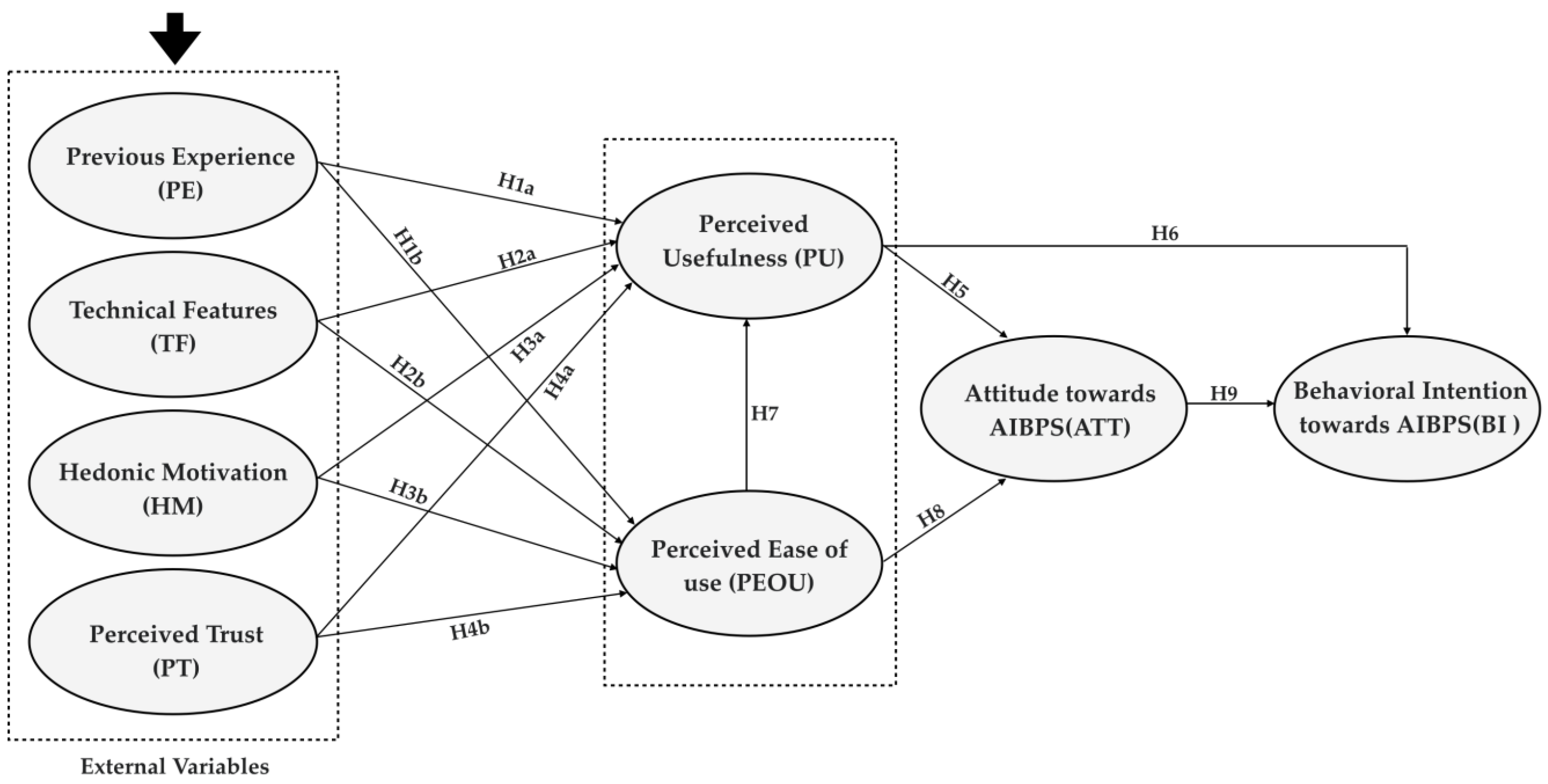
Figure 2.
Results of the structural model test.
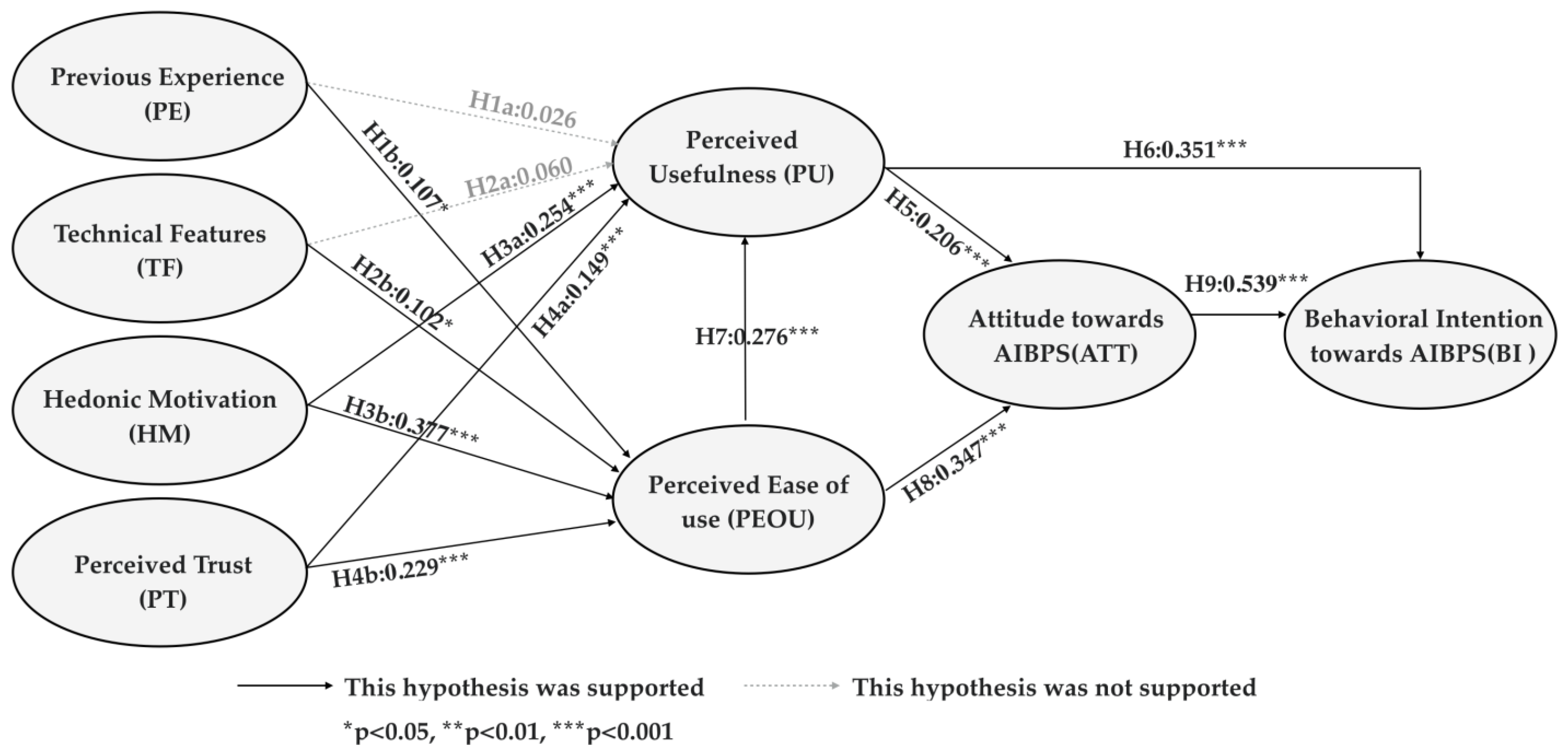

Table 1.
Research hypotheses.
| Variables | Hypotheses | Description |
|---|---|---|
| Previous Experience (PE) |
H1a | The user's previous experience of AIBPS will positively influence their perceived usefulness of AIBPS. |
| H1b | The user's previous experience of AIBPS will positively influence their perceived ease of use of AIBPS. | |
| Technical Features (TF) |
H2a | The technical features of AIBPS will positively influence users' perceived usefulness of AIBPS. |
| H2b | The technical features of AIBPS will positively influence users' perceived ease of use of AIBPS. | |
| Hedonic Motivation (HM) |
H3a | The user's hedonic motivation for AIBPS will positively influence their perceived usefulness of AIBPS. |
| H3b | The user's hedonic motivation for AIBPS will positively influence their perceived ease of use of AIBPS. | |
| Perceived Trust (PT) |
H4a | The user's perceived trust of AIBPS will positively influence their perceived usefulness of AIBPS. |
| H4b | The user's perceived trust of AIBPS will positively influence their perceived ease of use of AIBPS. | |
| Perceived Usefulness (PU) |
H5 | The user's perceived usefulness of AIBPS will positively influence their attitudes towards AIBPS. |
| H6 | The user's perceived usefulness of AIBPS will positively influence their behavioral intention towards AIBPS. | |
| Perceived Ease of Use (PEOU) |
H7 | The user's perceived ease of use of AIBPS will positively influence their perceived usefulness of AIBPS. |
| H8 | The user's perceived ease of use of AIBPS will positively influence their attitudes towards AIBPS. | |
| Attitude towards Using (ATT) |
H9 | The user's attitudes toward AIBPS will positively influence their behavioral intention towards AIBPS. |
Table 2.
Questionnaire for variable items and reference.
| Variables | Items | Issue | Reference |
|---|---|---|---|
| Perceived Usefulness (PU) (five items) |
PU1 | Using AIBPS would enable me to accomplish tasks more quickly. | Davis(1989) [25], Venkatesh and Davis(2000) [81], Lee et al. (2003) [84], Chatterjee et al. (2021) [30] |
| PU2 | Using AIBPS would help me learn a lot more. | ||
| PU3 | Using AIBPS saves time and effort and increases my efficiency. | ||
| PU4 | Using AIBPS would make it easier to do my job. | ||
| PU5 | Using AIBPS would help create new ideas for my work | ||
| Perceived Ease of Use (PEOU) (five items) |
PEOU1 | Learning to operate AIBPS would be easy for me. | Davis(1989) [25], Lee et al. (2003) [80] , Venkatesh et al. (2003)[90], Yousafzai et al. (2007) [91] |
| PEOU2 | I would find it easy to get AIBPS to do what I want them to do. | ||
| PEOU3 | I would find AIBPS easy to use. | ||
| PEOU4 | My interaction with AIBPS would be clear and understandable. | ||
| PEOU5 | It would be easy for me to become skillful at using AIBPS. | Davis(1989) [25], Davis et al. (1989) [42], Na et al.(2022) [28] |
|
| Attitude towards Using (ATT) (four items) |
ATT1 | Using AIBPS is a good idea. | |
| ATT2 | I am positively impressed with the ability of the AIBPS. | ||
| ATT3 | I find AIBPS to be valuable systems for creating works. | ||
| ATT4 | I am very satisfied with the artwork generated by AIBPS. | ||
| Behavioral Intention (BI) (four items) |
BI1 | I find it worthwhile to create with AIBPS. | Davis(1989) [25], Taylor and Todd(1995)[92], Venkatesh et al. (2003)[90], Castiblanco Jimenez et al.(2021)[29] |
| BI2 | I find it beneficial to create with AIBPS. | ||
| BI3 | I intend to use AIBPS to create in the future. | ||
| BI4 | I would recommend AIBPS to others. | ||
| Previous Experience (PE) (four items) |
PE1 | It would have been easier to use if I had previous experience with AIBPS. | Gefen et al.(2003) [53], Liu et al.(2010) [93], Abdullah and Ward(2016) [94] |
| PE2 | If the website had an online guide feature, I would know how to use it better. | ||
| PE3 | By following the step-by-step instructions on the website, it will be easy to operate. | ||
| PE4 | I would have better understood how to use the AIBPS if a friend had first. | ||
| Technical Features (TF) (four items) |
TF1 | AIBPS can output quality work without the need for mastering the basics of painting. | Castiblanco Jimenez(2020) [95], Wang et al.(2020)[60], Na et al.(2022) [28] |
| TF2 | AIBPS can provide me with the content I need whenever I need it. | ||
| TF3 | AIBPS create works quickly and in a very short time. | ||
| TF4 | AIBPS can meet the needs of non-professional people | ||
| Hedonic Motivation (HM) (four items) |
HM1 | I enjoyed interacting with AIBPS. | Alenezi et al. (2010)[96], Venkatesh et al. (2012) [97], Lu et al. (2019) [98] |
| HM2 | Interacting with AIBPS is fun. | ||
| HM3 | Interacting with AIBPS is entertaining. | ||
| HM4 | The actual interaction process with the AIBPS would be pleasant. | ||
| Perceived Trust (PT) (four items) |
PT1 | I trust AIBPS to ensure that I can use them properly. | Lee(2005)[99], Lean et al. (2009) [100], Liu and Yang(2018)[101], Vimalkumar et al.(2021)[102] |
| PT2 | I have more trust in the works created by AIBPS. | ||
| PT3 | I have more trust in the data sources of AIBPS | ||
| PT4 | I have more trust in the privacy protection of AIBPS. |
Table 3.
Common method deviation test (Harman single factor test).
| NO. | Initial Eigenvalues | Extraction Sums of Squared Loadings | Rotating Sum of Squared Loadings | ||||||
| Total | %of Variance | Cumulative% | Total | %of Variance | Cumulative% | Total | %of Variance | Cumulative% | |
| 1 | 9.835 | 28.927 | 28.927 | 9.835 | 28.927 | 28.927 | 3.806 | 11.196 | 11.196 |
Table 4.
Demographic characteristics of the respondents.
| Category | Sub Category | Frequency(n = 528) | Percent % |
|---|---|---|---|
| Gender | Male | 274 | 51.89 |
| Female | 254 | 48.11 | |
| Age (years) | <18 | 59 | 11.17 |
| 18~25 | 134 | 25.38 | |
| 26~30 | 122 | 23.11 | |
| 31~40 | 93 | 17.61 | |
| 41~50 | 53 | 10.04 | |
| 51~60 | 40 | 7.58 | |
| >61 | 27 | 5.11 | |
| Education Level | Less than undergraduate | 214 | 40.53 |
| undergraduate | 251 | 47.54 | |
| Post-Graduate | 50 | 9.47 | |
| Doctor | 13 | 2.46 | |
| Frequency of use AIBPS | At least once a day | 153 | 28.97 |
| At least once a week. | 267 | 50.57 | |
| At least once a month | 23 | 4.36 | |
| Other | 85 | 16.1 | |
| Previous painting experience | YES | 479 | 90.72 |
| NO | 49 | 9.28 | |
| Total of participants | 528 | 100.00 |
Table 5.
Percentage of exposure to and use of AIBPS.
| Items | Percentage (n=528) |
|---|---|
| Disco Diffusion | 59.28% |
| Dall-E2 | 80.68% |
| Midjourney | 72.16% |
| Stable Diffusion | 52.27% |
| WOMBO | 50.57% |
| NovelAI | 33.14% |
Table 7.
Reliability and validity analysis.
| Variables | Items | Standardized Factor Loadings | Cronbach .𝛼 | CR | AVE | |
|---|---|---|---|---|---|---|
| Perceived Usefulness (PU) |
PU1 | 0.804 | 0.903 | 0.903 | 0.651 | |
| PU2 | 0.798 | |||||
| PU3 | 0.816 | |||||
| PU4 | 0.805 | |||||
| PU5 | 0.810 | |||||
| Perceived Ease of Use (PEOU) |
PEOU1 | 0.806 | 0.887 | 0.887 | 0.611 | |
| PEOU2 | 0.806 | |||||
| PEOU3 | 0.762 | |||||
| PEOU4 | 0.728 | |||||
| PEOU5 | 0.803 | |||||
| Attitude towards Using (ATT) |
ATT1 | 0.808 | 0.854 | 0.855 | 0.595 | |
| ATT2 | 0.740 | |||||
| ATT3 | 0.778 | |||||
| ATT4 | 0.759 | |||||
| Behavioral Intention (BI) |
BI1 | 0.821 | 0.858 | 0.859 | 0.603 | |
| BI2 | 0.759 | |||||
| BI3 | 0.758 | |||||
| BI4 | 0.767 | |||||
| Previous Experience (PE) |
PE1 | 0.928 | 0.964 | 0.964 | 0.871 | |
| PE2 | 0.919 | |||||
| PE3 | 0.939 | |||||
| PE4 | 0.947 | |||||
| Technical Features (TF) |
TF1 | 0.929 | 0.952 | 0.954 | 0.837 | |
| TF2 | 0.902 | |||||
| TF3 | 0.915 | |||||
| TF4 | 0.914 | |||||
| Hedonic Motivation (HM) |
HM1 | 0.841 | 0.874 | 0.874 | 0.635 | |
| HM2 | 0.770 | |||||
| HM3 | 0.774 | |||||
| HM4 | 0.801 | |||||
| Perceived Trust (PT) |
PT1 | 0.822 | 0.868 | 0.868 | 0.623 | |
| PT2 | 0.766 | |||||
| PT3 | 0.776 | |||||
| PT4 | 0.791 | |||||
Table 8.
Validity analysis (KMO and Bartlett’s test).
| Kaiser-Meyer-Olkin Measure of Sampling Adequacy. | 0.914 | |
|---|---|---|
| Bartlett’s Test of Sphericity | Approx. Chi-Square | 12816.192 |
| df | 561 | |
| Sig. | 0.000 | |
Table 9.
Discriminant validity(Fornell–Larcker criterion).
| PU | PEOU | ATT | BI | PE | TF | HM | PT | |
|---|---|---|---|---|---|---|---|---|
| PU | 0.807 | |||||||
| PEOU | 0.390 | 0.782 | ||||||
| ATT | 0.317 | 0.356 | 0.772 | |||||
| BI | 0.470 | 0.489 | 0.562 | 0.777 | ||||
| PE | 0.139 | 0.198 | 0.189 | 0.254 | 0.933 | |||
| TF | 0.129 | 0.155 | 0.140 | 0.192 | 0.151 | 0.915 | ||
| HM | 0.365 | 0.402 | 0.370 | 0.567 | 0.206 | 0.103 | 0.797 | |
| PT | 0.278 | 0.311 | 0.321 | 0.438 | 0.110 | 0.096 | 0.323 | 0.789 |
Table 10.
Discriminant validity (HTMT values).
| PU | PEOU | ATT | BI | PE | TF | HM | PT | |
|---|---|---|---|---|---|---|---|---|
| PU | - | |||||||
| PEOU | 0.435 | - | ||||||
| ATT | 0.362 | 0.409 | - | |||||
| BI | 0.533 | 0.561 | 0.655 | - | ||||
| PE | 0.149 | 0.215 | 0.209 | 0.279 | - | |||
| TF | 0.139 | 0.169 | 0.156 | 0.215 | 0.158 | - | ||
| HM | 0.411 | 0.457 | 0.428 | 0.655 | 0.225 | 0.114 | - | |
| PT | 0.315 | 0.355 | 0.373 | 0.508 | 0.121 | 0.108 | 0.371 | - |
Table 11.
Recommended and actual values of fit indices.
| Fit index | CMIN/DF | RFI | NFI | IFI | CFI | PCFI | GFI | AGFI | TLI (NNFI) | RMSEA |
|---|---|---|---|---|---|---|---|---|---|---|
| Recommended value | ≤3.0 | >0.9 | >0.9 | >0.9 | >0.9 | >0.8 | >0.9 | >0.8 | >0.9 | <0.08 |
| Measurement model | 1.843 | 0.921 | 0.928 | 0.966 | 0.965 | 0.885 | 0.901 | 0.886 | 0.962 | 0.040 |
Table 12.
Path Coefficients of the Structural Equation Mode.
| Hypotheses | Relationship | β | Estimate | S.E | C.R./T Value | p -Value | Significant |
|---|---|---|---|---|---|---|---|
| H1a | PE→PU | 0.026 | 0.015 | 0.024 | 0.616 | 0.538 | Not Supported |
| H1b | PE→PEOU | 0.107 | 0.057 | 0.023 | 2.475 | 0.013 | Supported |
| H2a | TF→PU | 0.060 | 0.037 | 0.026 | 1.419 | 0.156 | Not Supported |
| H2b | TF→PEOU | 0.102 | 0.058 | 0.025 | 2.339 | 0.019 | Supported |
| H3a | HM→PU | 0.254 | 0.239 | 0.047 | 5.054 | 0.000 | Supported |
| H3b | HM→PEOU | 0.377 | 0.331 | 0.044 | 7.594 | 0.000 | Supported |
| H4a | PT→PU | 0.149 | 0.159 | 0.050 | 3.206 | 0.001 | Supported |
| H4b | PT→PEOU | 0.229 | 0.228 | 0.047 | 4.875 | 0.000 | Supported |
| H5 | PU→ATT | 0.206 | 0.170 | 0.043 | 3.964 | 0.000 | Supported |
| H6 | PU→BI | 0.351 | 0.343 | 0.043 | 7.989 | 0.000 | Supported |
| H7 | PEOU→PU | 0.276 | 0.296 | 0.057 | 5.177 | 0.000 | Supported |
| H8 | PEOU→ATT | 0.347 | 0.307 | 0.049 | 6.320 | 0.000 | Supported |
| H9 | ATT→BI | 0.539 | 0.638 | 0.059 | 10.877 | 0.000 | Supported |
* β:Standard Bate, S.E: Standard Error, C.R.: Critical Ratio (t-value), p: P Values.
Disclaimer/Publisher’s Note: The statements, opinions and data contained in all publications are solely those of the individual author(s) and contributor(s) and not of MDPI and/or the editor(s). MDPI and/or the editor(s) disclaim responsibility for any injury to people or property resulting from any ideas, methods, instructions or products referred to in the content. |
© 2023 by the authors. Licensee MDPI, Basel, Switzerland. This article is an open access article distributed under the terms and conditions of the Creative Commons Attribution (CC BY) license (http://creativecommons.org/licenses/by/4.0/).
Copyright: This open access article is published under a Creative Commons CC BY 4.0 license, which permit the free download, distribution, and reuse, provided that the author and preprint are cited in any reuse.