
Submitted:
07 March 2023
Posted:
07 March 2023
You are already at the latest version
Abstract
Abstract Natural disasters such as earthquakes have affected urban historical centers severely. Considering the limitations of the existing methods in conservation and preservation of these sensitive areas, and recent advances in technological devices and techniques such as GIS and 3D printers, this article aims to propose a new methodology utilizing available knowledge and resources. The authors of the present research propose an innovative, technological, and highly accurate method to assess the seismic vulnerability of historical contextures rectifying the existing obstacles and limitations. Through this methodology, the level of trial and error is substantially reduced and the output is stronger, more optimized and more conservative as compared with commonly used methods. Using high tech principles and theoretical foundations (i.e. sustainability principles) this method achieves updated analyses, practical plans, and economic optimization.
Keywords:
Conservation
; 3D printing
; Earthquake
; Historical area
; Strengthening
; Consolidation
1. Introduction
Confronting natural disasters and alleviating their detrimental effects are from among the most controversial issues in the realm of environmental studies (DAW & UN/ISDR, 2001). Natural disasters such as earthquakes have affected human residential settlements especially urban environmentsseverely. Due to the concentration and density of human lives and material and intellectual capital, urban environments are prone to disastrous demolitions that can lead to detrimental consequences.
Urban environments are composed of several distinct districts formed on the basis of their physical and functional characteristics. Historical centers in urban areas and historical buildings are endowed with a unique organic context of sociocultural and identity-oriented features. Consequently, these areas should not be compared with other urban areas physically, functionally, economically, and socially. As one of the most vulnerable areas to earthquake, historical cores are in urgent need of attention considering their unique architectural, social, economic, and historical aspects (Carocci, 2001).
Recent earthquakes have necessitated the investigation of vulnerability of the ancient historical contexts residing in the urban cores more than ever. The damage inflicted on the context and buildings located in the urban historical cores due to earthquakes in various cities [Bhuj (India, 2001), Bam (Iran, 2003), Sichuan (China, 2008), L’Aquila (Italy, 2009), Gorkha (Nepal, 2015) and recently Amatrice (Italy, 2016)] all bear witness to this fact (Carocci, 2011).
As more significance is often attached to single historical buildings, the aged organic urban texture intertwined with these single structures is usually ignored (ICOMOS/ISCARSAH Committee, 2005). The authors of the present article believe that strengthening historical monuments in historical cores should be viewed in the context of conservation of their surrounding structures. Otherwise, destruction of the surrounding historical texture under earthquakes or the passage of time would drastically lessen the worth of these monuments.
The methodology proposed in the present research aims to maintain the uniformity and spatial structure of the historical cores in cities. Thus, along with strengthening of these buildings to lessen their seismic vulnerability and facilitation of rescue and relief operations subsequent to the occurrence of earthquakes, the methodology also considers the strengthening of walls and passageways (Salgado-Gálvez et al., 2016; Novelli, D’Ayala, 2015). Various commonly-used novel techniques in design, construction and prefabrication or in situ elements can be employed for strengthening the walls (Jahangiri and Jahangiri,2012). Innovative techniques are recommended for connecting prefab elements or maximal use of optimized highly-effective connections using strands (Jahangiri et al., 2017).
Finally, it should be mentioned that historical conservation and preservation processes such as retrofitting and consolidation turn out to be ineffective unless vulnerability studies are undertaken. In recent years, numerous methods have been employed to assess the seismic vulnerability of urban structures. Nevertheless, urban vulnerability management has been mostly undertaken outside the framework of a uniform and comprehensive planning so urban decision makers are usually incapable of arriving at a deep spatial understanding of the circumstances. Thus, the decisions adopted in this regard (lessening the risks involved in earthquakes and strengthening processes) are predominantly ineffective and insufficient.
Considering the above, attainment of sustainable development and conservation of the historical contexts can preclude the waste of capital and energy dissipation. Hence, a novel organized and uniform approach to protection of historical and cultural areas seems to be in order. This research plans to propose a new methodology that draws upon both vulnerability assessment and vulnerability mitigation.
1.1. Objectives of the Study
The most fundamental principle governing conservation of historical centers is to minimize interventions and to maximize conservation of these historical textures (Lourenço and Roque, 2006). Other subsidiary objectives in proposing the new methodology are:
- Moving toward the achievement of sustainable development in urban environments
- Overcoming the existing limitations and obstacles in conserving historical centers
- Reducing the substantial level of trial and error in existing procedures
- Unifying two separate stages of vulnerability assessment and vulnerability mitigation in one process
- Facilitating rescue and relief operations
- Maintaining the uniformity and spatial structure of urban historical centers by conserving the whole spatial unit and not single monumental buildings alone
- Conservation of historical and architectural values and worth of the context
- Improving environmental and ecological health.
1.2. Limitations of the Study
As the present paper focuses on the urban historical cores, a lump of issues, unknowns, and hindrances may be envisaged in the course of advancement of this research. These limitations include the following:
- Lack of access to data relevant to materials used in the construction of the historical context
- The intertwined organic and complicated morphology and context of the area
- Lack of access to geometric data related to the context and its existing monuments
- The high variety of mechanical features resulting from different skill levels of workforce and the use of natural and local materials
- The problem and high cost associated with the specification of mechanical characteristics of materials used in the context/historical monuments
- Lack of access to data on the internal core of structural elements in historical areas
- Lack of distinction and indifferentiation in the construction sequences
- The high variation in the architectural styles during different historical eras and consequently in the determination of the level of strength of the structure against seismic events
- Lack of knowledge on the present status of damage in the structures
- Paucity or lack of regulations, laws and practical codes
- The high number of elements involved
- The laws and regulations on the conservation and protection of historical areas as world heritage which monitor and restrict detrimental and unjustified interventions, the opportunity for extensive renovation and reconstruction in these areas, and
- Substantial changes in the cores and construction of structural elements accompanied with long construction periods.
2. Methodology
As was mentioned earlier, the authors of this paper aim at presenting an innovative methodology to rectify the defects of previous methods. Meanwhile, there are numerous approaches and categories for seismic assessment mainly based on basic analyses (data, methodology, and results) in each approach (statistically-based, mechanical approaches or based on professional opinion) or as a function of information resources (operational, analytical, theoretical or empirical). From among the most common classifications and categories one can refer to European Partnership which categorizes methods on the basis of details, assessment scale, and use of data into three general levels (Vincente et al., 2014). The first category of approaches employs a large level of qualitative information, i.e. typological data (Gavarini, 2001; Vicente at al., 2011). The second level of approaches is based on mechanical models and high quality information (geometrical and mechanical). The third category incorporates the application of numerical modeling which necessitate accurate and precise structural assessment and monitoring (Vicente, Parodi, Lagomarsino, Varum & Silva, 2011). The most recognized and acceptable classification system, as described by Petrini and Corsanego, is outlined in Table 1.
Despite the fact that none of these categories have been fully developed for estimation of levels of vulnerability in historical contextures, they are extensively employed in the historical cores of cities (D’Ayala and Novelli, 2013). Consequently, a number of dimensions and factors influencing performance of historical buildings in existing approaches and methods are ignored. Also, most of these methods have been developed to assess the seismic vulnerability of single structures and prove to be ineffective in assessment if urban contextures (historical and heritage buildings, old buildings of no historical and cultural value, paths and passages, walls, …). In addition, due to the dependence of some methods on ability, experience and interpretation of the surveyor the reliability of these methods are questionable.
Furthermore a large number of these methods are undertaken independently of the vulnerability of the buildings under study and are based on the basis of observation of the damages sustained subsequent to the occurrence of previous earthquakes. Meanwhile, there is a paucity of observations conducted in the case of low to moderate seismic vulnerability (Vicente et al., 2011). Other disadvantage associated with the existing methods include the effect of expert perspectives and opinions, incompatibility with the new environmental conditions (i.e. being inapplicable to new environmental surroundings), failure to update the information, focusing on single monumental structures and ignoring neighboring passageways and contextures, discounting factors influencing the performance of historical buildings and structures, failure to blend strengthening and renovation stages in analysis and experimentation processes under various scenarios, lack of cost versus benefit analyses, and the incapability to prioritize stages and areas of intervention in the contexture, inter alia.
In proposing a new methodology that is free from the aforementioned shortcomings, the focus is mainly based on the technological advances in the creation of 3D prototypes and the feasibility of seismic experiments and the investigation of strengthening scenarios of these prototypes. In other words, it appears illogical to insist on using traditional and unsatisfactory methods considering the latest developments in 3D printing. Drawing upon the latest technological advances, one can bridge the gap between seismic assessment and evaluation and the initiation of the historical contexture strengthening with reference to the strengthening scenarios in the mechanical and numerical fashion. This is especially the case when one considers the fact that the specific features of historical areas and the incapability of compensating for the damages sustained due to seismic events, justify maximal application of present knowledge, available budget and technologies. Using this approach, various seismic scenarios and urban contexture reactions can be examined to adopt the most optimal strengthening method considering the budget and facilities available.
Due to the idea of using 3D printing techniques in conserving historical city centers, this study focused on how practitioners and professionals viewed this application and methodology making the Delphi Technique a logical choice as it utilizes open-ended questions, makes it possible to interview practitioners, and investigates the likelihood of reaching a consensus (Linstone, 1975). In addition, the Delphi technique allows for the iterative process of refinement and provision of feedback to the participants furnishing the participants with the opportunity to adjust their opinion(s) anonymously (Reynolds et al., 2007). For the objectives contemplated in the present research, a panel consisting of 15 national and international experts from various backgrounds was selected on the basis of their publications, academic positions, and qualifications. A Delphi study consisting of three rounds was adopted to investigate the research proposed methodology thus exploring how professionals view 3D printing applicability in conserving and strengthening historical centers.
In phase 1, the first draft of conserving historical areas by the use of 3D printers was emailed to the panel who were asked to write down their opinion on 3D printing application methodology in urban historical district conservation processes. The first phase resulted in several suggestions and modifications to the process. In phase 2, the second draft was developed on the basis of the analysis of responses to the first draft. In this stage the correspondents were asked to indicate the extent to which they (dis)agreed with the application of 3D printers and the chronology of the process developed for conserving urban historical centers using this technique marking a six-point scale ranging from “strongly agree” and “mostly agree” to “strongly disagree” while justifying their rationale for their vote. Phase 3 involved administration of the second modified version of the methodology (with the use of the information gathered in phase 2) which asked the participants to vote on the applicability of the proposed methodology emerging from the analysis of the second phase. By the use of the Delphi technique, authors of the present paper were able to achieve consensus on the use of 3D printers in conserving historical centers among the experts. In other words, after comparing and justifying the opinions and suggestions of the panel, the efficiency of the methodology was approved. The application of Delphi technique was most effective in omitting parallel procedures such as public reinforcement of walls and historical paths and the use of 3D printers for completion and optimization of the process. The detailed result of this process is presented in the next section.
2.1. Procedure of the New Method
The new methodology will be conducted in three stages (Figure 1): First, using GIS techniques, positioning and geometrical modifications of the selected area are performed (as depicted in Stage A). Secondly, in Stage B, simulation of the selected block/area will be conducted through numerical and experimental analyses. All the procedures related to prototype testing will be performed using 3D printing in appropriate scales and simulation of the materials will be conducted via direct experimentation. The results emanating from stages A and B will be employed as the finalized geometry of the selected block accompanied with the properties of materials in monuments and strong elements. Finally, in Stage C the conditions governing urbanization, architecture, and optimization will be elicited and directly employed. Using 3D modeling, remote sensing, and 3D printing techniques, the enhancement of accuracy of processes is made feasible (Moradi et al., 2015).
For data collection and data base formation and to overcome the limitations arising from lack of access to structural, constructional, and architectural information on the urban historical contexture, aerial photos, remote sensing techniques, and GIS were employed. This technique is also capable of being utilized in areas lacking basic information. In this method, data collection occurs at three areas of architectural typology, defects and structural and nonstructural characteristics of the buildings, and social and demographic features. All the data collected are blended into a data base management system in GIS subsequent to processing so as to manage, compare, and analyze the data being collected. The output of this stage consists of a 3D environment of the case accompanied with information on the materials in mesh fashion and appropriate format, capable of being transferred to other software environments.
At the next stage (i.e. seismic vulnerability evaluation and assessment), both analytical and experimental methods are employed. In the analytical subdivision, numerical methods are employed to estimate seismic vulnerability and, in parallel, direct experimental tests are conducted on the prototype scaled from a simulated historical area using 3D printing and seismic table. During the process, numerical analyses are verified using FEM and experimental records optimizing the process with the least trial and error.
Finally, in the process of vulnerability mitigation, the proposed method is investigated, simulated, and verified with reference to various criteria. Although the recognition of the level of intervention, strengthening techniques, and feasibility of applying strengthening elements all depend on feasibility of the method selected in view of the principles and criteria for intervention in historical contextures.
3. Conclusions
On the whole, it can be asserted that the present paper aims at investigating the seismic vulnerability of historical contexts in urban cores and to estimate the level of vulnerability using an innovative and technological approach to lessen these damages. As the main issue in the economic optimization of historical areas conservation techniques is the lack of modularity and prefabrication of strengthening elements, prefabrication techniques are also utilized to renovate, strengthen, and consolidate these urban contexts. It is strongly hoped that using this method, a compatible approach to sustainable development of historical contexts across the globe will be obtained. It is worth mentioning that the results emanating from the present research may exert a substantial positive effect on the attainment of sustainable development through savings in energy consumption (lessening the casualties and damages inflicted on the structures, substructures, and human resources), and enhancing seismic resistance. The advantages emanating from the present research include, but are not limited to the following:
- Innovation and creativity in vulnerability assessment procedures for context and intervention techniques
- Facilitation of community and private sector participation and preparing the groundwork necessary for collaboration of general and public sectors of the society
- Feasibility studies on the expansion and correspondence of the approach contemplated in the present proposal in countries possessing historical and earthquake-stricken contexts
- Preparing the groundwork necessary for simultaneous occurrence of the three stages of rehabilitation, strengthening, and renovation in the process of intervention and consequently saving on financial, temporal, and workforce-related costs.
- Maintaining the cohesiveness and uniformity of urban historical contexts and precluding the disjuncture in spatial structure of these unique contexts, and
- Facilitating supervision of the quality of design, construction, and implementation of prefabrication parts.
Acknowledgments
The authors would like to express their most sincere gratitude to the experts at Shahr-e-Raz Consulting Engineering Co. and Shiraz Municipality for their support.
References
- Carocci C. F. (2011). “Small centres damaged by 2009 L’Aquila earthquake: on site analyses of historic masonry clusters” Bulletin Earthquake Engineering. [CrossRef]
- Carocci C. F. (2001). “Guidelines for the safety and preservation of historic centres in seismic areas”.
- Historic Constructions, P.B. Lourenço, P. Roca (Eds.), Guimarães, pp. 145-165.
- DAW & UN/ISDR, 2001. Environmental Management and the Mitigation of Natural Disasters: a Gender Perspective (Final Report of the Expert Group Meeting, Ankara, Turkey). United Nations Division for the Advancement of Women (DAW) and Inter-Agency Secretariat of the International Strategy for Disaster Reduction (UN/ISDR), Geneva, Switzerland, 33 pp.
- Gavarini, C. (2001). “Seismic risk in historical centers.” Soil Dynamics and Earthquake Engineering volume 21, pp. 459-466. [CrossRef]
- Hager, I., Golonka, A., & Putanowicz, R. (2016). “3D printing of buildings and building components as the future of sustainable construction.” Procedia Engineering. International Conference on Ecology and new Building materials and products, pp. 292– 299. [CrossRef]
- ICOMOS/ISCARSAH Committee (2005). Recommendations for the analysis, conservation and structural restoration of architectural heritage. See www.icomos.org.
- Jahangiri, A., Behnamfar, F., Jahangiri, M. (2017). “Introducing the Innovative Post-tensioned Connection with the Rigid Steel Node.” KSCE Journal of Civil Engineering, Volume 21, Issue 4, pp. 1247–1255.
- Jahangiri, A. & Jahangiri, M. (2012). “The new post-tensioned and clamped steel solid connector for strengthening of framed structures.” Proceedings of World Academy of Science, Engineering and Technology (WASET), Kualamupur, pp.1437-1443.
- Linstone, H. A., & Turoff, M. (1975). The Delphi method: techniques and applications. MA: Addison- Wesley Publishing Company, Inc.
- Lourenço, P. B., & Roque, J. A. (2006). “Simplified indexes for the seismic vulnerability of ancient masonry buildings.” Construction and Building Materials, Volume 20, Issue 4, pp, 200-208. [CrossRef]
- Moradi, M., Delavar, M. R., & Moshiri, B. (2015). “A GIS-based multi-criteria decision-making approach for seismic vulnerability assessment using quantifierguided OWA operator: a case study of Tehran, Iran.” Annals of GIS, Volume 21, Issue 3, pp. 209-222. [CrossRef]
- Novelli, V.I., D’Ayala, D. (2015). “LOG-IDEAH: LOGic trees for identification of damage due to earthquakes for architectural heritage.” Bulletin of Earthquake Engineering. Volume 13, Issue 1, pp. 153-176. [CrossRef]
- Reynolds, R. A., Woods R. & Baker J. (2007). Handbook of research on electronic surveys and measurement. London, Idea Group Reference.
- Salgado-Gálvez, M. A., Romero, D. Z., Velásquez, C. A., Carreño, M. L., Cardona, O. D., & Barbat, A.
- H. (2016). “Urban seismic risk index for Medellín, Colombia, based on probabilistic loss and casualties estimations.” Natural Hazards, Volume 80, Issue 3, pp. 1995-2021. [CrossRef]
- Vicente, R., Ferreira, T. Maio, R. (2014). “Seismic Risk at the Urban Scale: Assessment, Mapping and Planning.” Procedia Economics and Finance. 4th International Conference on Building Resilience, Building Resilience, Salford Quays, United kingdom, Volume 18, pp. 71 – 80. [CrossRef]
- Vicente, R., Parodi, S., Lagomarsino, S., Varum, H., & Silva, J. A. (2011). “Seismic vulnerability and risk assessment: case study of the historic city centre of Coimbra, Portugal.” Bulletin of Earthquake Engineering, Volume 9, Issue 4, pp. 1067–1096. [CrossRef]
Figure 1.
Stages involved in surveying, scaling, 3D printing, numerical analysis, and experimentation on the selected block prototype.
Figure 1.
Stages involved in surveying, scaling, 3D printing, numerical analysis, and experimentation on the selected block prototype.
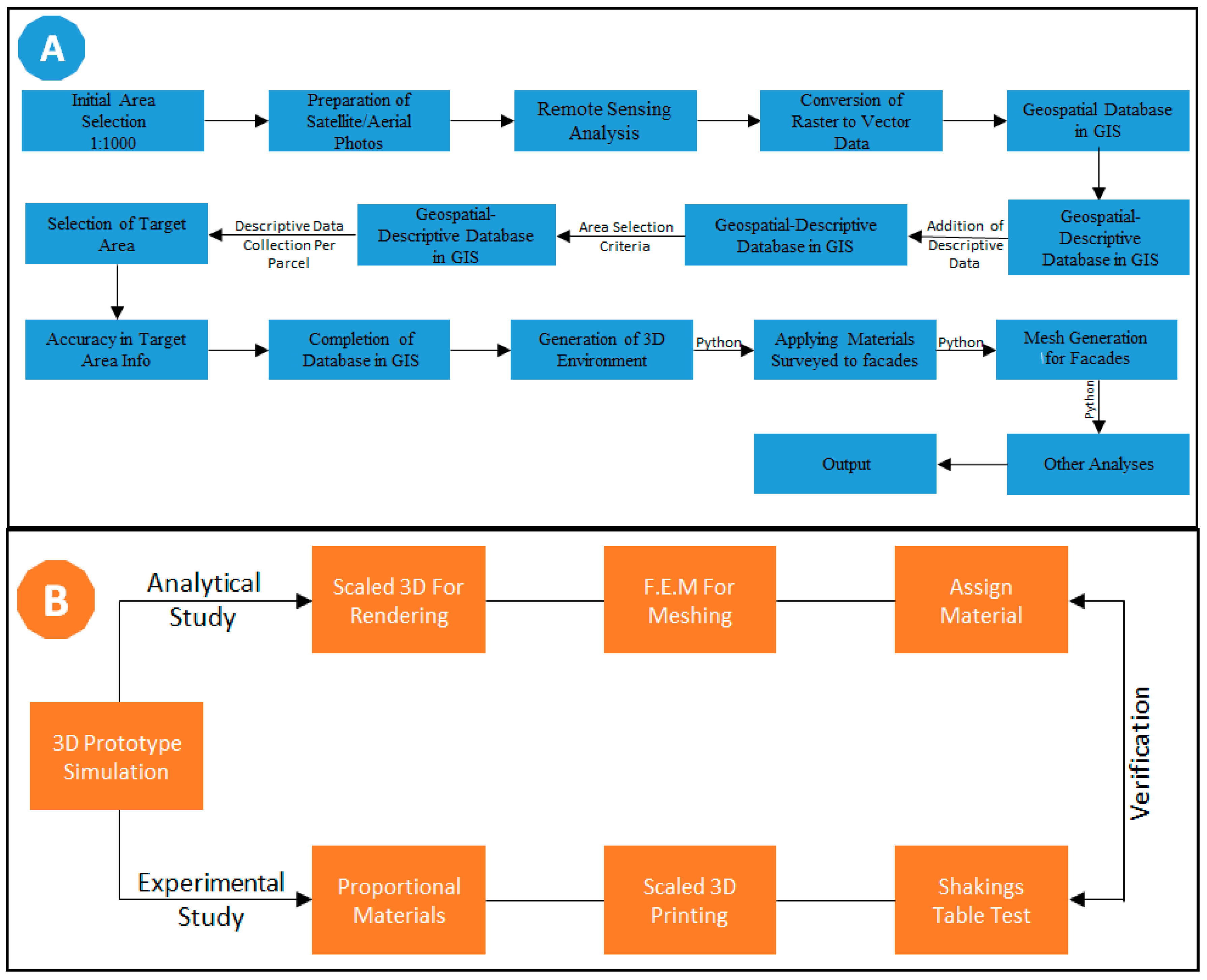

Table 1.
Vulnerability assessment categories developed by Petrini and Corsanego.
| Techniques | Descriptions |
| Direct Techniques | Two major methods are employed: Typological and mechanical. Using a straightforward mechanical model, typological methods classify structures in terms of materials, construction techniques, structural characteristics, and other factors exerting an effect on the seismic response. The possibility of damage is assessed on the basis of observation of the damages sustained subsequent to the occurrence of the earthquake and professional knowledge of the field. Mechanical methods are employed to predict the seismic effect on the structure using a straightforward mechanical model. Depending on the model selected, the method can be further subdivided into several subcategories (i.e. simple and complicated). Methods basedon simple mechanical models are appropriate for large scale analyses (i.e. a large number of buildings) only requiring a limited number of input parameters. |
| Indirect Techniques | Indirect techniques incorporate the specification of a vulnerability index and determination of the relations between damages sustained and the intensity of the earthquake which are supported the statistics of the casualties and damages after the occurrence of the earthquake. This type of assessment has been extensively employed in large scale vulnerability analyses including the determination of the vulnerability index with reference to observations of the characteristics of the shell structure of the building on the basis of simple structural calculations and specification of the factors influencing seismic response. The method requires an extensive database of typological and mechanical characteristics of the structure and relies on damagesobserved subsequent to previous earthquakes to further classify vulnerability. |
| Traditional Techniques | Traditional techniques are necessarily of an innovative nature presenting a vulnerability index independently of the prediction of level of damages sustained. This method is utilized to compare various structures having a single typology in a specific region. In this method, characteristics exerting an effect on seismic resistanceare investigated with the results being calibrated with reference to professional opinions. |
| Hybrid Techniques | Hybrid vulnerability is a combined method for assessment of vulnerability of buildings against seismic events which blends experimental and analytical methods to remedy the deficiencies of these two methods. In the hybrid method, more than one method is utilized to estimate the seismic vulnerability selecting the most optimal method as per the available information whose practice is suitable withheterogeneous data. |
Disclaimer/Publisher’s Note: The statements, opinions and data contained in all publications are solely those of the individual author(s) and contributor(s) and not of MDPI and/or the editor(s). MDPI and/or the editor(s) disclaim responsibility for any injury to people or property resulting from any ideas, methods, instructions or products referred to in the content. |
© 2023 by the authors. Licensee MDPI, Basel, Switzerland. This article is an open access article distributed under the terms and conditions of the Creative Commons Attribution (CC BY) license (http://creativecommons.org/licenses/by/4.0/).
Copyright: This open access article is published under a Creative Commons CC BY 4.0 license, which permit the free download, distribution, and reuse, provided that the author and preprint are cited in any reuse.


