

Submitted:
22 February 2023
Posted:
23 February 2023
You are already at the latest version
Abstract
The first reports of the acute and often fatal illness known as the “English Sweat” are from 1485 and its last known outbreak was in 1551. During this period, the Sweat produced only five epidemic waves. Except for one outbreak which spread to the northern part of the continent of Europe in 1529, the Sweat was confined almost exclusively to England, with only anecdotal reports of isolated infections in other parts of the British Isles. The Sweat was thus only a minor component in the panorama of infectious disease affecting mediaeval and early modern Europe. Nevertheless, it continues to fascinate both medical historians and modern infectious disease biologists – the latter group now often engaged in competing exercises in retrospective diagnosis. This paper seeks to explore the reasons for such enduring interest, using the Early English Books Online (EEBO) text corpus to analyse the various contexts in which the Sweat was discussed up to 1700. EEBO shows that references to the Sweat occur repeatedly in astrological and religious discourses, especially from the mid-17th century onwards. Four salient examples are examined in detail. It is proposed that the cultural memory of the Sweat, in the 150 years following its disappearance, was kept disproportionately alive not so much by accounts of its alarming symptoms but more due to its metaphorical and illustrative utility in non-medical discourse.
Keywords:
sweating sickness
; sudor anglicus
; English Sweat
; Picardy Sweat
; febbre miliare
; Tudor
; England
; EEBO
; Early English Books Online
; CQPWeb
; corpus linguistics
; history of medicine
; history
; early modern
; late mediaeval
Introduction
The standard account of the history of the disease known as the “English Sweat” or sudor anglicus, may be obtained from the Cambridge Historical Dictionary of Disease (Carmichael, 2003). It first appeared in England in 1485 with subsequent outbreaks in 1508, 1517, 1528, and 1551. As its name suggests, it seemed to be confined to England, except for the penultimate outbreak which spread across northern Europe, and its principal symptom was an acute high fever which could result in death within hours. It seemed disproportionately to affect adult males of the more prosperous classes and caused great consternation among the population.
There has been much dispute concerning even this bare framework. It has been pointed out (Creighton, 1891) that there is very little information concerning the first two outbreaks, and that even the dating of the second one is open to doubt. Claims that mortality was higher in richer males, or indeed that it was significantly high in any population group, have been disputed (Dyer, 1997; Webster, 1979). Translation of the medical terminology of the 16th century (e.g. Caius, 1552) into a set of standard modern symptoms began in the early 19th century ("Critical", 1808), and beyond its most fundamental presentation of acute life-threatening fever, the clinical description of the Sweat by subsequent authors has often been variable. These efforts have in turn inspired many attempts at retrospective diagnosis, of which the most recent performs a comparative study of a reconstructed clinical description of the Sweat with the symptoms of known infectious agents of the present day (Heyman et al., 2018). Similarities between the English Sweat of the 15th and 16th centuries, the “Picardy Sweat” of 18th century France and the febbre miliare that was still extant in Italy into the early 20th century, have produced speculation that the causative agent of the Sweat may have endured in a milder form over a wider geographical area (Creighton, 1891; Heyman et al., 2014; Shaw, 1933).
It is also striking that theories of the aetiology of the English Sweat often reflect the pressing clinical concerns of the day. Suggestions have included, for instance, a fungal toxin within bread flour at the time of early 19th century British concerns about imported wheat and famine ("Critical", 1808); typhus (Gerster, 1916), influenza (Roberts, 1965) and arboviruses (Wylie and Collier, 1981) in the 20th century; hantaviruses following the Four Corners outbreak of 1993 (Bridson, 2001); anthrax in the aftermath of the apparent bio-terrorist attacks of 2001 (McSweegan, 2004). At the time of writing, there is still no publication claiming that the Sweat fits the description of an acute coronavirus infection, but it is probably only a matter of time before such a paper appears.
It is not the purpose of the present paper to enter into any of the above controversies. Instead, it considers a very different issue, namely the question of why we still hark back to the English Sweat today. The slightly cynical observation made in the previous paragraph, implying that the Sweat has become a kind of mirror in which we inevitably see our current infectious disease emergencies, cannot be the whole story. It provides no explanation whatsoever for why the disappearance of the Sweat itself, after its last outbreak in 1551, was not also followed by the disappearance of the Sweat from learned or popular discourse, once its last eyewitnesses had died. Early modern England was an environment in which numerous virulent epidemic diseases circulated, including bubonic plague, and there was a high endemic infant mortality from many other infections. Smallpox persisted until well into the 19th century, along with new epidemic threats from typhus, typhoid fever and cholera. Compared to these, the Sweat could easily have come to be dismissed as a poorly characterised triviality, a microbiological equivalent of the phantasmagorical beasts of early modern crypto-zoology.
This paper attempts a preliminary investigation into the question of why this did not happen, by tracing the discourse surrounding the Sweat in Early English Books Online (EEBO; ProQuest, 1998) version 3, accessed using CQPWeb (Hardie, 2012). EEBO consists of 44,422 texts amounting to 1,202,214,511 words, including virtually all books printed in English anywhere in the world, as well as books in other languages printed in the territory of what is now Canada, the USA, the UK and the Republic of Ireland, prior to 1700. Since the first book printed in English was in 1473, EEBO covers the period of the Sweat (1485-1551) and the succeeding century and a half.
It should be pointed out, however, that EEBO is not a suitable resource for primary historical investigation of the Sweat, because many of the most relevant contemporary documents were not printed for sale or general distribution at the time. These include personal letters, diplomatic correspondence, official documents at several levels of government, monastic annals and other manuscript sources. Some of these were eventually printed, but usually not until after 1700 and therefore do not appear in EEBO. Others remain to this day undigitized and only personally accessible within archives. A further category of unincluded works consists of those printed in languages other than English, which principally deal with the wider northern European epidemic of 1529.
The present investigation therefore does not attempt to draw any conclusions from EEBO concerning the facts of the Sweat itself, but rather to study how the Sweat was presented and discussed, in what contexts and with what implications, in the printed English literature prior to 1700. The subject of study is therefore the published learned, polemical, popular and artistic discourse on the Sweat and how it might have been received by the print-reading population. A survey of literacy, defined as an ability to write in an official document, using records left by 6000 individuals sampled within the parish of Norwich from 1580-1700, calculated that 100% of the clergy, 98% of the gentry, 56% of tradesmen, 15% of labourers and 11% of women were functionally literate (Cressy, 1977). However, the reach of printed literature would have been considerably higher than these figures suggest, since even a single literate person within a household would have been able to read to the others and reading aloud in the family or shared public spaces was a common pastime. The potential for stimulation of public discourse via print was therefore large and the limiting factors would principally have been the size of the print run of each document, the relative interest of different sections of the public and their capacity to pay. This study investigates how that section of the population kept the memory of the Sweat alive in the century and a half after its disappearance.
Methods
EEBO was searched using CQPWeb (Hardie, 2012) with the terms “English Sweat”, “sudor anglicus” and “sweating sickness” in a case-insensitive manner. CQPWeb was also used to examine the collocates within EEBO of each of the search terms “sweat”, “sweating” and “sickness”. That collocate search revealed the presence of rare spelling variants “sweting” and “sycknes” which had escaped, on 11 occasions in total, the variant spelling correction function incorporated in EEBO. These were combined with the 401 matches to the first search. All concordance lines were examined by eye and a subjective categorization by topic performed. Other functions, such as tabulation of the distribution of texts by decade of publication, were performed in CQPWeb. EEBO modernises spelling where possible, but no further attempt is made in the quotations used here to correct any remaining irregularities, and each quotation is presented as it is found in EEBO. Any manual deletions are indicated by “…..”. The same applies to the titles and other publication details of the items cited within EEBO.
Results and Discussion
Distribution of references to the Sweat in EEBO
The total number of matches to the search criteria was 412 in 205 distinct texts, equivalent to 0.343 instances per million words in EEBO. The earliest match to the search terms is found in “Fabyan’s Chronicle” (Fabyan, 1533). Robert Fabyan had been dead for at least 20 years by the time of its publication but would have been an eyewitness to the first two outbreaks, although only that of 1485 is mentioned in his chronicle. The final match is another posthumous item, Richard Boulton’s edition of the works of chemist and physicist Robert Boyle (Boyle, 1700). Figure 1 shows the distribution of the 205 publications containing those 412 matches, per decade.
The peak decade is that of the 1650s. The final outbreak of the Sweat was in 1551, and “living memory” must therefore be considered to have been exhausted by the early decades of the 17th century. Nevertheless, interest in the Sweat was maintained as the 17th century progressed. To further study the contexts within which this interest was expressed, all 412 concordance lines were read and the principal topic of the Sweat-related discussion within the publication was classified manually. The partition of the resulting 205 classifications is shown in Figure 2.
In Figure 2, medical references are sub-divided into “Remedy” in which some kind of cure is specified and “Cause” in which the aetiology of the Sweat is considered. The remainder, which mostly consist of accounts of the symptoms and course of the disease, are classified as “Clinical”. The category “Wit” refers to aphorisms, jokes, doggerel and references to the Sweat in more serious poetic works and the dialogue of plays. “List” includes indexes, dictionaries, booksellers’ catalogues and bibliographies, the last of these often produced for sale of a library (e.g. Porter, 1659). It is notable that “Religion” is the second highest category and almost as numerous as “History”. Figure 3 shows the distribution of the occurrence of the categories in Figure 2 over time.
Figure 3 shows that mention of the Sweat in historical accounts (“History”) was fairly constant over the entire period studied. Likewise, descriptions of purported cures (“Remedy”) and references to the Sweat in fictional or entertainment contexts (“Wit”) are also fairly evenly distributed across the total period. By contrast, references in the context of religion and morality (“Religion”) as well as medical texts that do not discuss cures (“Clinical” and “Cause”) tend to be more densely distributed in the 17th century. A burst of religious discourse commences from the late 1630s onwards, declining somewhat in the 1670s, before reigniting in the mid-1680s. References to the Sweat in publications describing methods of divination (“Astrology”) begin in the 1630s and are produced fairly steadily until the mid-1680s. Like “Religion”, “Astrology” suffers a slight decline in the 1670s.
It is tempting to connect the patterns in Figure 3 to the political changes taking place in England over that period. The rise in the political influence of Puritan forms of non-conformist Protestantism in the 1630s may be the driving force in the category of “Religion”. Indeed its most abundant period appears to be the time of the English Civil War of the 1640s and the succeeding interregnum of parliamentary rule and the Protectorate, when Puritanism reached the high-water mark of its power. Likewise the decline in the category of “Religion” in the 1670s may be connected to the increasing suppression of Puritanism after the Restoration of Charles II in 1660. After the deposition of James II in 1688 and the settlement of a more permissive regime under the joint monarchy of William III and Mary II, the category of “Religion” undergoes a resurgence.
Examples of each category of discourse.
Before a more detailed examination of case studies, some salient examples of each category of reference to the Sweat are given, with the exception of the “List” items.
History
“Fabyan’s Chronicle”, published in 1533 but written before 1513, establishes a pattern for historical accounts that continues throughout the remainder of the period .
And upon the xi. day of October next following, then being the sweating sickness of new begun, dyed the said Thomas Hylle then of London mayor. And for him was chosen as mayre sir william Stokker knight & Draper, which dyed also of the said sickness shortly after.
The above passage refers to the first outbreak in 1485, which occurred shortly after the arrival of the invading army of the Earl of Richmond, soon to be Henry VII, in London. Such terse accounts are typical of chronicles of the entire period and there is often textual dependence between them. Even today, as previously mentioned, access to the rather sparse primary sources on the Sweat may be difficult, and almost all the historians working within the period relied on elaboration, or even simple reproduction, of previous secondary sources. Fabyan’s account, however, does have the advantage of being that of an eyewitness, and his position as an official within the Worshipful Company of Drapers during the events of 1485 and later in the government of the City of London, ensured that he would be well informed.
Cause
In 1536, we encounter the first speculation concerning the cause of the Sweat (Morison, 1536). Richard Morison was born around 1513, so would presumably have been too young to have much recollection of the third outbreak of the Sweat in 1517 but he certainly would have been an eyewitness to the fourth and largest outbreak in 1528. He also lived long enough to see the final outbreak in 1551.
Who knows not, that the english sweat, no old sycknes, and twenty other diseases more, come every day of inordinate fedynge?
The imputation that the Sweat was caused by overindulgence matched the general notion that it principally attacked prosperous middle-aged men. As previously mentioned, this has been disputed by subsequent historians, but the moralistic tone of this speculation established a pattern that was later taken up in religious discourses.
Clinical
For a fuller clinical description, we need to wait until 1543, when Richard Grafton gave this account of the first outbreak of 1485 (Hardyng and Grafton, 1543).
In this year a new sickness did reign, and is so sore and painful, as never was suffered before, the which was called the burning sweat. And this was so intolerable, that men could not keep their beds, but as lunatike persons & out of their wits ran about naked, so that none almost escaped ye were infected therewith.
These words were printed in Richard Grafton’s continuation edition of John Hardyng’s chronicle, the original of which ends in the reign of Edward IV before the first outbreak in 1485. They are therefore Grafton’s and not Hardyng’s. Like Morison, Grafton’s life spanned more than one outbreak of the Sweat, so his description would presumably be that of an eyewitness. Curiously, apart from this description of the first outbreak, Grafton makes only passing mention of one other, that of 1528. The symptom of mania that Grafton describes, is rarely mentioned by subsequent authors (an exception is Hayward and Vaughan, 1630).
Remedy
The first proposed remedy for the Sweat in EEBO is found in the work of Andrew Boorde in 1547, although it is clearly intended as a general preservative against plague (“pestilence”) as well as the Sweat (Boorde, 1547).
Chapyter treats of a diet and of an order to be used in the Pestyferous time of the pestilence and sweating sycknes.
Boorde’s medical career lasted from his exit from a monastic order in 1529 to his death in 1549. Therefore, although he would have encountered three of the first four outbreaks of the Sweat as a younger man, it is not clear if he had any direct experience of administering his remedy to a patient with the Sweat, whatever its merits for other diseases. Both Boorde’s “diet” and “order” are complex. The “diet” specifies:
use temporat meats and drynge. and beware of wine, bear, & cider, use to eat stewed or baken wardens if they can be gotten if not eat stewed or baken peers with comfits, use no gross meats, but those the which be light of digestion.
It seems quite unlikely that any patient in the throes of a high fever and the mania described earlier by Grafton, could have had much inclination to eat at all. The “order” consists of half a dozen or so herbal ingredients which are mixed and then either burned as an incense or moulded into an aromatherapy pomander. Remedies offered for the Sweat in the 16th century were frequently of this herbalist nature, but later works show the growing influence of chemistry as Paracelsianism spread from the continent to the British Isles. For instance at the other end of EEBO’s period, in 1694, we find William Salmon’s version of “Bate’s Dispensatory” specifying a remedy containing some ingredients that would have required manufacture in a laboratory rather than purchase in a market (Bate et al., 1694). Andrew Boorde and George Bate may have belonged to competing traditions in early modern medicine, but they have two things in common. The first is that neither could have treated a sweating sickness patient – Boorde because, as previously mentioned, he only practiced medicine in a period between outbreaks and Bate because he was not born until 1608. The second is that both maximise the market for their remedies by claiming that they treat several ailments equally well. As Bate, or possibly his posthumous editor Salmon, claims:
Our Author commends it also against the Palsy, the Leprosy, Worms, whether in old or young, Ruptures the English Sweating-sickness Plague, and all manner of Poison, as a speedy help in time of need.
Wit
The category defined here as “Wit” is varied. No single example may be regarded as typical but one example, John Heywood’s epigram “Of one fearing the sweat”, from 1560, shows how the Sweat was employed as a device in sardonic social commentary (Heywood, 1560).
Sweating sickness so fear thou beyond the mark, That winter or summer thou never sweatst at work.
Beyond the joke, however, the epigram does reinforce that, as others commented, the Sweat was something that many individuals would “fear ….. beyond the mark”. Born in the late 1490s, Heywood would have been another eyewitness to the Sweat and his quip about the fear in at least some of the populace would presumably have been based on direct observation.
Religion
Shortly after Heywood, we find William Bullein starting the long tradition of employing the Sweat for religious purposes (Bullein, 1564).
GOD have mercy of all Christen souls, it was then a merry world, and will never be so good again, until these Gospelling Preachers have a sweating sickness in Smithfield, and their Bible burn.
This passage is part of a didactic dialogue and the opinion expressed is certainly not that of Bullein himself, who was a sympathiser with the “Gospelling Preachers” of what was in the 1560s still an emerging Puritan movement. But these words, put into the mouth of a fictional Catholic sympathiser, again play on public horror of the Sweat. Interestingly, Bullein was a doctor but, even when recommending a remedy for the Sweat, religion was never far from his mind (Bullein, 1595).
…..they be Gods instruments to punish the earth. Example we have of mortal pestilence, horrible fevers, and sweating sickness, and of late, a general fever, that this land is often greatly plaged withal. Sweet air to be made in the time of sickness Then one must make a fire in every chimney within the house, and burn sweet perfumes to purge this foul air.
Bullein’s simple aromatherapeutic preventative is little changed from that of Boorde, mentioned above. Bullein, like Boorde, only took up the practice of medicine after giving up an original vocation as a cleric. Consequently, also like Boorde, his career did not overlap any of the known outbreaks of the Sweat, so it is unlikely if his remedy could have been directly tested either.
Astrology
Moving forward to 1627, we find the first mention of the Sweat in connection to astrology (Hakewill, 1627).
Here with us, we have not heard of late days of any such diseases, as the shaking of the sheets, or the sweating sickness ….. as for the cause thereof ….. let others search it out, for my own part I have observed, that this malady hath run through England thrice in the ages afore-going, & yet I doubt not but long before also it did the lik, although it were not recorded in writing. First in the year of our Lord 1485, in which King Henry the seventh first began his reign, a little after the great Conjunction of the superior Planets in Scorpio. A second time yet more mildly, although the Plague accompanied it in the 33d year after, Anno 1518, upon a great opposition of the same Planets in Scorpio & Taurus, at which time it plagued the Netherlands and high Almany als. Last of all 33 years after that again in the year 1551, when another Conjunction of those Planets in Scorpio took their effects: so that by Gods goodness for the space now of these last seventy three years we have not felt that disease. Twice thirty three years & more, and the same Conjunction and opposition of the Planets have passed over, & yet it hath not touched us.
George Hakewill’s account is interesting not merely as the beginning of the use of the Sweat as a confirmatory device for theories of astrology, but in that we clearly see a selective interpretation of the history of the Sweat to suit the purposes of the author. Hakewill’s horoscope has three conjunctions of the planets in Scorpio, 33 years apart. In order to make this heavenly phenomenon a causative factor for the Sweat, it is necessary to forget the second outbreak and fourth outbreaks. Furthermore, it is necessary to move the date of the third outbreak by one year from 1517 to 1518. Given that many of the chroniclers failed to mention one or more outbreaks, it is possible that some had slipped from general memory by the time Hakewill was writing in the 1620s. Hakewill commits a greater error, however, in moving the northern European outbreak from 1529 back to 1518. Finally, he undermines his own argument by observing that the next years of the conjunction – 1584 and 1617 – were years when “God’s goodness” had finally spared England.
The subsequent use of the Sweat in astrology is the subject of the first of the four case studies.
Case Studies
Use of the Sweat as a confirmatory example in astrological prediction
Following Hakewill’s work, EEBO next contains a reference to the Sweat in an astrological context in the work of John Swan and William Marshall (1635) who blamed the 1528 outbreak and its spread to Europe the following year, on comets. A few years later, Johann Alsted (1643) repeats Hakewill’s claims about the 33 year periodicity of planetary conjuctions, including the reduction of the number of outbreaks to three and the change in the date of the 1517 outbreak to 1518. In 1652 an anti-astrology pamphlet claimed that an eclipse in England in 1645 was followed by an outbreak of sweating sickness – a conjunction that does not impress the anonymous writer (Anon., 1652). This is the only reference in EEBO to the Sweat having appeared outside of its canonical five outbreaks, and surely must be a misattribution of another feverish illness.
Even medical writers were willing to assign an astrological element to the aetiology of the Sweat. Benjamin Welles’ translation of Brice Bauderon’s 1588 “Pharmacopée” (Bauderon, 1657) concedes that “the element of Stars” had a role in the outbreaks of the Sweat. John Gadbury in 1665, writing when bubonic plague was consuming London and searching desperately for an astrological sign that it might abate – in a text hopefully entitled “London’s deliverance predicted” - was willing to consider both comets and planetary conjunctions (Gadbury, 1665).
Anno 1527. That great Plague, called the Sweating Sickness began to rage: a great and terrible Comet, of a bloody colour, appeared but a little before in the Heavens. They then laboured also under the weighty effects of a Conjunction of Saturn, Jupiter, and Mars in Risces, a watery sign, perhaps a main reason why that Pestilence was attended with a Sweat.
Gadbury also has to move an outbreak by one year, this time from 1528 to 1527, to suit his astrological analysis. When a comet appeared in 1681 an anonymous writer harked back to the example given by Gadbury (Anon., 1681).
Four Comets appeared this year, when soon after the Turk besieged Viennal, and became Master of many Cities in Hungary: also the Sweating-sickness odestroy’d many thousands in England.
The comet of 1681 also stimulated Christopher Ness to tell a similar story but he gets the date of the Sweat wrong by an even larger margin (Ness, 1681).
In the year 1522 Another Comet of a Saturnine colour (as before) broke forth, which ushered in a most dreadful Plague, and that Sweating Sickness which was most peculiar to English Bodies, dogging them (as it were) into all Lands.
The tendency to make the dates of the outbreaks fit the astrological theory was continued in the following year by John Holwell who moves the year not back to 1522, but forward to 1530 (Holwell, 1682), to suit the presence of Saturn in the constellation of Aries.
Mr. Cambden observes, that Saturn can not (or seldom doth pass through the Fiery Triplicity, but he doth afflict London with a Plague, or some other Epidemical Disease, of which I will give a few Examples : Anno Domini 1348 Saturn was in Aries, an Universal Plague in London: 1485 Saturn in Sagittarius a Sweating Sickness in London: 1507 Saturn in Leo, another Sweating Sickness in London: 1517 Saturn in Sagittarius, the third Sweating Sickness in London: 1530 Saturn in Aries , the fourth Sweating Sickness in London.
In 1686, John Goad presented an even fuller list of this kind, too lengthy to be reproduced here, but it is notable that he also moved dates around. He seems to have been less cavalier that some of his predecessors, feeling the need to cite ambiguities in the 16th century eyewitness accounts of John Stow, which he probably read in the 1618 edition by Edmund Howes, to justify the dates he required (Goad, 1686; Stow and Howes, 1618).
Use of the Sweat as a metaphor for “soul slumber”
In the 1611 play “No Wit/Help Like a Woman’s”, by Thomas Middleton (1657), we find the lines:
Sleep not on it, this is no slumbering business, It is like the sweating sickness; I must keep Your eyes still wake, y’re gone if once you sleep
This notion derives from John Caius extended description of the Sweat (Caius, 1552), which advanced the theory that a fatal outcome in cases of the Sweat was often indicated by the patient slipping into unconsciousness.
Those who start to faint must be laid on their right side, called by their name and beaten with rosemary branches. A good drink of Guaiacum can be given and the patient must not be allowed to sleep.
Prior to both Middleton and Caius, this had been mentioned by William Roper, but his late 1530 manuscript on Thomas More (see below) was not published until 1626 (Roper, 1626). Such tendency to sleep had to be resisted and vigorous means were to be employed to keep the patient awake. Many patients found this only added to the unpleasantness of the disease, but Caius considered this to be vital and subsequent authors simply repeated this assertion, despite the fact that few, if any, of them could have been eyewitnesses (Cogan, 1636; Godwin, 1628; Godwin and Godwin, 1630; Hayward and Vaughan, 1630; More and More, 1631; Mynsicht and Partridge, 1682; Sennert, 1658; Sennert et al., 1660; Willis and Pordage, 1684; Wirsung and Mosan, 1605).
The first instance of this general belief being taken up as a religious metaphor appears in 1639, when Richard Sibbes, or one of his posthumous editors (Sibbes et al., 1639) stated that:
It is a report, and a true one of the sweating sickness, that they that were kept avvake by those that were with them escaped, but the sickness was deadly if they were suffered to sleep.
Christians, they claimed, likewise could fall asleep in a spiritual sense, but their fellows would rouse them back to a state of grace. George Swinnock later coined the term “soul-lethargy” to describe this state of spiritual laziness (Swinnock, 1665).
In the next decade, the density of religious works taking up the theme of the Sweat increases. John Trapp, in a series of volumes (Trapp, 1646; Trapp, 1649; Trapp, 1657; Trapp, 1660; Trapp and Trapp, 1647a; Trapp and Trapp, 1647b) makes use of the Sweat for several religious points. As well as multiple references to the Sweat and other plagues as a sign of God’s anger, and also repeating Sibbes’ metaphor on sleep, he also claims that the Sweat always induced a great deal of religious fervour in the population, but of a purely self-interested variety, with people forgetting their religion and resuming their more typical lives of sin once the danger had passed.
John Wall (1648) stresses that this spiritual treatment may, like its medical inspiration, occasionally be unwelcome to the “patient”.
Like those in the time of the sweating sickness that were smitten with Rosemary branches to keep them waking, and from sleeping to death; though they cried out at the smart of the blows against those that smote them, O you kill me, you kill me; whereas alas they had been killed with their disease, if they had not been smitten.
William Jenkyn (1654) expresses it more elegantly.
Keep company with waking Christians; such as neither dare sleep in sin themselves, nor suffer any to sleep who are near them. In the sweating sickness (they say) that they who were kept awake by those who were with them, escaped; but their sickness was deadly if they were suffered to sleep. The keeping one another awake is the best fruit of the communion of Saints.
There are many other similar references to the “soul-lethargy” that draw on accounts of the treatment of the Sweat using Caius’ method (Pell, 1659; Spencer, 1658; Stonham, 1676; Symons, 1658; Watson, 1692; Younge, 1641; Younge, 1660). The pulpits of England, especially during the period of Puritan dominance, would therefore have helped to keep the memory of the Sweat alive, regaling the faithful with this metaphor. Another powerful impetus in this direction came from the opposite end of the religious spectrum.
The miraculous cure of Thomas More’s daughter
Thomas More and Thomas Cromwell were, successively, close associates of Henry VIII and men of immense power in England. The former opposed the king’s divorce from Queen Katherine and the establishment of the Church of England under supreme royal authority, consequently suffering execution in 1535. The latter was one of the architects of subsequent religious policy and a key political figure in the early English Reformation. After mismanaging the king’s fourth marriage, he too was executed in 1540. For Catholics, More became venerated as a martyr and eventually a saint, whereas Cromwell was anathema. Their respective encounters with the Sweat provided a potent narrative taken up by Catholics in exile and those practising in secret in England. All three of Cromwell’s children were victims of the Sweat along with his wife, whereas More’s daughter Margaret was saved, as described by her husband William Roper (Roper, 1626).
God showed, as it seemed, a miraculous and manifest token of his love, and favour towards him, at such time, as his daughter Roper lay dangerously sick of the sweating sickness (as many others did that year) and continued in such extremity of that disease, that by no skill of Physic, or other art in such case commonly used, (although she had divers both expert and learned Physicians continually attendant about her) she could be kept from sleeping, so that the Physicians themselves utterly despaired of her recovery, and quite gave her over. Her Father Sir Th, More, as one that m intierely loved and tendered he being in great grief and hea, and seeing all human helps to fale, determined t have recourse to God by prayer for remedy. Whereupon going up after his accustomed manner, into his aforesaid New Building, he there in his Chapel, upon his knees with tears, most devoutly besought Almighty God, that it would please his divine Goodness, unto whom nothing was impossible, if it were his blessed will, to vouchsafe graciously to hear his humble petiti ō. And suddenly it came into his mind, that a Glister might be the only way to help her; of which when he had told the Physicians, they all instantly agreed, that if there were any hope of remedy, that was the most likelist; and marveled much, that themselves had not before remembered the same. Then was it instantly ministered unto her sleeping, & after a while she awakened, and contrary to all their expectations immediately began to recover, & in short time was wholly restored unto her former health. Whom, if it had pleased God to have taken away, at that time, her Father said, that he would never after have meddled with worldly business.
Written not long after his father-in-law’s execution, Roper’s account was published in 1626 by the English College which had been established at Douai in 1568 and served as the headquarters of English Catholicism in exile. This story of divine intervention was repeated throughout religious apologetic literature, whether Catholic (More and More, 1631) or not (Hoddesdon, 1662) over the next century.
The tragic death of the Brandon boys
On 14th July 1551, 15-year-old Henry Brandon and his 13-year-old brother Charles, died of the Sweat within an hour of each other. Being sons of Henry VIII’s brother-in-law and consecutively the 2nd and 3rd Dukes of Suffolk, with Charles’s tenure of less than 60 minutes being until today the shortest length of time any individual has held a title in the English peerage, their high status ensured that this human interest story was much repeated. Anthony à Wood (1692) mentions that their story soon became the subject of elegiac poems by James Calfhill (Querela Oxoniensis academiæ ad Cantabrigam 1552) and John Parkhurst (Ludicra sive Epigrammata Juvenilia 1573). Its first appearance in EEBO is with Francis Godwin’s 1628 chronicle (expanded and republished two years later: Godwin and Godwin, 1630). The story then becomes one of the most ubiquitous elements in discourses on the Sweat over the remainder of the 17th century (Bacon et al., 1676; Baker, 1643; Fullwood and Fuller, 1655; Hayward and Vaughan, 1630; Heylyn, 1661; Howell, 1679; Lloyd, 1670; R. B., 1681; Seller, 1696; Spelman, 1698; Spelman and Spelman, 1646; Stubbe et al., 1670). It was also included in a genealogy of the Brandon family (Dugdale, 1676) and served as a plot element in two historical romances by Jean de Préchac (Préchac, 1678; Préchac, 1686). Soon after Wood recalled the two early elegiac poems, the topic was taken up again in the poetry of Guy Miege (Miege, 1694; Miege, 1697).
The story of the Brandon boys could either be read as a sorrowful ending to promising young aristocratic lives cut tragically short, or as a salutary reminder that there are certain things that no amount of power and wealth can protect against. It also served to confirm the popular notion of the time, still disputed today, that the Sweat had greater mortality within the most elite social groups and particularly among males. However one read it, as a royalist or Puritan, a romantic or a moralist, or with Schadenfreude for the elite, it was too compelling an anecdote to leave out of any account of the period, another factor guaranteeing that the Sweat would continue to be mentioned for 150 years.
The Afterlife of the Sweat
This study has sought to explore ways in which the memory of the English Sweat resonated powerfully for 150 years after its last appearance. Despite being only one relatively minor component of the infectious disease burden that continually challenged late mediaeval and early modern society, it obtained a special place in popular culture through its various other uses - as a confirmatory example in astrology, a metaphor in Puritan theology, a miracle story for Catholics and as a human interest story. EEBO ends as the 18th century begins, so it is not possible to pursue the story beyond that point using the comprehensiveness provided by EEBO. By the early 19th century, a genre of retrospective diagnosis of the Sweat had established itself, which continues to this day. Future work will require to join these two periods together.
One final issue may be remarked upon. The article began with the current consensus that the English Sweat struck in 1485, 1508, 1517, 1528, and 1551. Charles Creighton (1891 footnotes 490 and 503) notes that there is some variation in dating of the middle three outbreaks but attributes this to vagaries of the Julian Calendar with its complication of the start of civil year on 5th April, and human error. The observation made here, that astrologers felt free to assign, or re-assign, the dates of outbreaks to suit their theories, may have been a contributory factor to this confusion.
Acknowledgements
I thank all members of Lancaster University’s corpus linguistics and digital humanities communities for their assistance and encouragement over the years. With particular regard to this work, I must make a special mention of Dr Andrew Hardie, who has patiently fielded all my queries concerning CQPWeb.
References
- "Critical" (1808) The Inquirer, No. XV. What Was the Cause of the Sweating Sickness? Edinb Med Surg J, 4(16), 464-469.
- Alsted, J. H. (1643) Untitled. London: unlisted.
- Anon. (1652) Printed in the year, that many did fear, that Doomes-day it was nigh: but now we do see, what star-gazers be, for they have fore-told a ly. London: unspecified.
- Anon. (1681) The Petitioning-comet, or, A Brief chronology of all the famous comets and their events that have happen’d from the birth of Christ, to this very day : together with a modest enquiry into this present comet. London: Printed by Nat. Thompson.
- Bacon, F., Godwin, F. & Godwin, M. (1676) The history of the reigns of Henry the Seventh, Henry the Eighth, Edward the Sixth, and Queen Mary the first written by the Right Honourable Francis Lord Verulam, Viscount St. Alban ; the other three by the Right Honourable and Right Reverend Father in God, Francis Godwyn, Lord Bishop of Hereford. Alternative Title(s) Historie of the raigne of King Henry the Seventh. London: Printed by W.G. for R. Scot, T. Basset, J. Wright, R. Chiswell, and J. Edwy.
- Baker, R. (1643) A chronicle of the Kings of England, from the time of the Romans goverment unto the raigne of our soveraigne lord, King Charles containing all passages of state or church, with all other observations proper for a chronicle / faithfully collected out of authours ancient and moderne, & digested into a new method ; by Sr. R. Baker, Knight. London: Printed for Daniel Frere.
- Bate, G., Shipton, J. & Salmon, W. (1694) Pharmacopœia Bateana, or, Bate’s dispensatory translated from the second edition of the Latin copy, published by Mr. James Shipton : containing his choice and select recipe’s, their names, compositions, preparations, vertues, uses, and doses, as they are applicable to the whole practice of physick and chyrurgery : the Arcana Goddardiana, and their recipe’s intersperst in their proper places, which are almost all wanting in the Latin copy : compleated with above five hundred chymical processes, and their explications at large, various observations thereon, and a rationale upon each process : to which are added in this English edition, Goddard’s drops, Russel’s pouder [sic], and the Emplastrum febrifugum, those so much fam’d in the world : as also several other preparations from the Collectanea chymica, and other good authors / by William Salmon ... London: Printed for S. Smith and B. Walford.
- Bauderon, B. (1657) The expert phisician learnedly treating of all agues and feavers, whether simple or compound, shewing their different nature, causes, signes, and cure ... / written originally by that famous doctor in phisick, Bricius Bauderon ; and translated into English by B.W., licentiate in physick by the University of Oxford ... London: by R.I. for John Hancock.
- Boorde, A. (1547) A compendyous regyment or a dyetary of healthe made in Mountpyllyer, by Andrewe Boorde of physycke doctour, newly corrected and imprynted with dyuers addycyons dedycated to the armypotent Prynce and valyent Lorde Thomas Duke of Northfolke. London: In Fletestrete at the sygne of the George nexte to saynte Dunstones churche by Wyllyam Powel.
- Boyle, R. (1700) The works of the Honourable Robert Boyle, Esq., epitomiz’d by Richard Boulton ... ; illustrated with copper plates. London: J. Phillips and J. Taylor.
- Bridson, E. (2001) The English ’sweate’ (Sudor Anglicus) and Hantavirus pulmonary syndrome. British Journal of Biomedical Science, 58(1), 1-6.
- Bullein, W. (1564) A dialogue bothe pleasaunte and pietifull wherein is a goodly regimente against the feuer pestilence with a consolacion and comfort against death / newly corrected by Willyam Belleyn, the autour thereof. London: Ihon Kingsto.
- Bullein, W. (1595) The gouernment of health: a treatise written by William Bullein, for the especiall good and healthfull preseruation of mans bodie from all noysome diseases, proceeding by the excesse of euill diet, and other infirmities of nature: full of excellent medicines, and wise counsels, for conseruation of health, in men, women, and children. Both pleasant and profitable to the industrious reader. London: Printed by Valentine Sims dwelling in Adling street, at the signe of the white Swan, neare Bainards caste.
- Caius, J. (1552) A boke, or counseill against the disease commonly called the sweate, or sweatyng sicknesse. Made by Ihon Caius doctour in phisicke. Very necessary for euerye personne, and muche requisite to be had in the handes of al sortes, for their better instruction, preparacion and defence, against the soubdein comyng, and fearful assaultying of the-same disease. London: By Richard Grafton printer to the kynges maiestie.
- Carmichael, A. G. (2003) Sweating Sickness. In: Kiple, K. F. (ed.) The Cambridge Historical Dictionary of Disease. Cambridge, UK ; New York [N.Y.]: Cambridge University Press.
- Cogan, T. (1636) The haven of health. Chiefly gathered for the comfort of students, and consequently of all those that have a care of their health, amplified upon five words of Hippocrates, written Epid. 6. Labour, cibus, potio, somnus, Venus. Hereunto is added a preservation from the pestilence, with a short censure of the late sicknes at Oxford. By Thomas Coghan Master of Arts, and Batcheler of Physicke. London: Printed by Anne Griffin, for Roger Ball, and are to be sold at his, shop without Temple-barre, at the Golden Anchor next the Nags-head Tavern.
- Creighton, C. (1891) A history of epidemics in Britain from A.D. 664 to the extinction of plague. Cambridge: at the Universitry Press.
- Cressy, D. (1977) Levels of Illiteracy in England, 1530–1730. The Historical Journal, 20(1), 1-23. [CrossRef]
- Dugdale, W. (1676) The baronage of England, or, An historical account of the lives and most memorable actions of our English nobility in the Saxons time to the Norman conquest, and from thence, of those who had their rise before the end of King Henry the Third’s reign deduced from publick records, antient historians, and other authorities / by William Dugdale ... London: Printed by Tho. Newcomb, for Abel Roper, John Martin, and Henry Herringman.
- Dyer, A. (1997) The English sweating sickness of 1551: an epidemic anatomized. Med Hist, 41(3), 362-84. [CrossRef]
- Fabyan, R. (1533) Fabyans cronycle newly prynted, wyth the cronycle, actes, and dedes done in the tyme of the reygne of the moste excellent prynce kynge Henry the vii. father vnto our most drad souerayne lord kynge Henry the .viii. To whom be all honour, reuerece, and ioyfull contynaunce of his prosperous reygne, to the pleasure of god and weale of this his realme amen. London: Wyllyam Rastel.
- Fullwood, F. & Fuller, T. (1655) The church-history of Britain from the birth of Jesus Christ until the year M.DC.XLVIII endeavoured by Thomas Fuller. London: Printed for Iohn Williams.
- Gadbury, J. (1665) London’s deliverance predicted in a short discourse shewing the cause of plagues in general, and the probable time (God not contradicting the course of second causes) when the present pest may abate, &c. / by John Gadbury. London: Printed by J.C. for E. Calver.
- Gerster, A. G. (1916) What was the English sweating sickness or sudor anglicus of the fifteenth and sixteenth centuries? Bulletin of the Johns Hopkins Hospital, 27, 332-337.
- Goad, J. (1686) Astro-meteorologica, or, Aphorisms and discourses of the bodies cœlestial, their natures and influences discovered from the variety of the alterations of the air ... and other secrets of nature / collected from the observation at leisure times, of above thirty years, by J. Goad. London: Printed by J. Rawlins for Obadiah Blagrave.
- Godwin, F. (1628) Rerum Anglicarum Henrico VIII¨ Edvvardo VI. et Maria regnantibus, annales. London: Printed by Thomas Harper apud Ioannem Billium, typographum Regiu.
- Godwin, F. & Godwin, M. (1630) Annales of England. Containing the reignes of Henry the Eighth. Edward the Sixt. Queene Mary. Written in Latin by the Right Honorable and Right Reverend Father in God, Francis Lord Bishop of Hereford. Thus Englished, corrected and inlarged with the author’s consent, by Morgan Godwyn. London: Printed by A. Islip, and W. Stansb.
- Hakewill, G. (1627) An apologie of the povver and prouidence of God in the gouernment of the world. Or An examination and censure of the common errour touching natures perpetuall and vniuersall decay diuided into foure bookes: whereof the first treates of this pretended decay in generall, together with some preparatiues thereunto. The second of the pretended decay of the heauens and elements, together with that of the elementary bodies, man only excepted. The third of the pretended decay of mankinde in regard of age and duration, of strength and stature, of arts and wits. The fourth of this pretended decay in matter of manners, together with a large proofe of the future consummation of the world from the testimony of the gentiles, and the vses which we are to draw from the consideration thereof. By G.H. D.D. Oxford: Printed by Iohn Lichfield and William Turner, printers to the famous Vniversit.
- Hardie, A. (2012) CQPweb – combining power, flexibility and usability in a corpus analysis tool. International Journal of Corpus Linguistics, 17(3), 380-409.
- Hardyng, J. & Grafton, R. (1543) The chronicle of Ihon Hardyng in metre, fro[m] the first begynnyng of Engla[n]de, vnto ye reigne of Edwarde ye fourth where he made an end of his chronicle. And from yt time is added with a co[n]tinuacion of the storie in prose to this our tyme, now first emprinted, gathered out of diuerse and sondrie autours of moste certain knowelage [et] substanciall credit, yt either in latin orels in our mother toungue haue writen of ye affaires of Englande. London: In officina Richardi Grafton.
- Hayward, J. & Vaughan, R. (1630) The life, and raigne of King Edward the Sixt. Written by Sr. Iohn Hayward Kt. Dr. of Lawe. London: Printed by Eliot’s Court Press, and J. Lichfield at Oxford, for Iohn Partridge, and are to be sold at the signe of the Sunne in Paules Churchyard.
- Heylyn, P. (1661) Ecclesia restaurata, or, The history of the reformation of the Church of England containing the beginning, progress, and successes of it, the counsels by which it was conducted, the rules of piety and prudence upon which it was founded, the several steps by which it was promoted or retarded in the change of times, from the first preparations to it by King Henry the Eight untill the legal settling and establishment of it under Queen Elizabeth : together with the intermixture of such civil actions and affairs of state, as either were co-incident with it or related to it / by Peter Heylyn. London: Printed for H. Twyford, T. Dring, J. Place, W. Palmer,.
- Heyman, P., Cochez, C. & Hukic, M. (2018) The English Sweating Sickness: Out of Sight, Out of Mind? Acta Med Acad, 47(1), 102-116. 10.5644/ama2006-124.221.
- Heyman, P., Simons, L. & Cochez, C. (2014) Were the English sweating sickness and the Picardy sweat caused by hantaviruses? Viruses, 6(1), 151-71. 10.3390/v6010151.
- Heywood, J. (1560) A fourth hundred of epygrams, newly inuented and made by Iohn Heywood. London: In fleetstrete in the house late Thomas Berthelettes.
- Hoddesdon, J. (1662) The history of the life and death of Sr. Thomas More, Lord High Chancellor of England in King Henry the Eights time collected by J.H., Gent. London: Printed for George Eversden, and Henry Eversden.
- Holwell, J. (1682) Catastrophe mundi, or, Europe’s many mutations until the year 1701 being an astrological treatise of the effects of the triple conjunction of Saturn and Jupiter 1682 and 1683, and of the comets 1680 and 1682, and other configurations concomitant : wherein the fate of Europe for these next 20 years is ... more than probably conjectured ... : also, an ephimeris of all the comets that have appeared from ... 1603 to the year 1682 ... : whereunto is annexed the hieroglyphicks of Nostrodamus ... / by John Holwell. London: Printed for the author and are to be sold by most bookseller.
- Howell, W. (1679) Medulla historiæ Anglicanæ being a comprehensive history of the lives and reigns of the monarchs of England from the time of the invasion thereof by Jvlivs Cæsar to this present year 1679 : with an abstract of the lives of the Roman emperors commanding in Britain, and the habits of the ancient Britains : to which is added a list of the names of the Honourable the House of Commons now sitting, and His Majesties Most Honourable Privy Council, &c. London: Printed for Abel Swalle, and are to be sold by him.
- Jenkyn, W. (1654) Untitled. London: Printed by Tho. Maxey, for Samuel Gellibrand, at the golden Ball in Paul’s Church-yar.
- Lloyd, D. (1670) State-worthies, or, The states-men and favourites of England since the reformation their prudence and policies, successes and miscarriages, advancements and falls, during the reigns of King Henry VIII, King Edward VI, Queen Mary, Queen Elizabeth, King James, King Charles I. London: Printed by Thomas Milbourne for Samuel Speed.
- Mcsweegan, E. (2004) Anthrax and the etiology of the English sweating sickness. Med Hypotheses, 62(1), 155-7. [CrossRef]
- Middleton, T. (1657) No wit, [no] help like a womans a comedy / by Tho. Middleton, Gent. London: Printed for Humphrey Moseley.
- Miege, G. (1694) Miscellanea, or, A choice collection of wise and ingenious sayings, &c of princes, philosophers, statesmen, courtiers, and others out of several antient and modern authors, for the pleasurable entertainment of the nobility and gentry of both sexes / by G.M. London: Printed for William Lindsey.
- Miege, G. (1697) Delight and pastime, or, Pleasant diversion for both sexes consisting of good history and morality, witty jests, smart repartees, and pleasant fancies, free from obscene and prophane expressions, too frequent in other works of this kind, whereby the age is corrupted in a great measure, and youth inflamed to loose and wanton thoughts : this collection may serve to frame their minds to such flashes of wit as may be agreeable to civil and genteel conversation / by G.M. London: Printed for J. Sprint ... and G. Conyers.
- More, C. & More, T. (1631) D.O.M.S. The life and death of Sir Thomas Moore Lord high Chancellour of England. Written by M. T.M. and dedicated to the Queens most gracious Maiestie. Douai: Printed by B. Bellièr.
- Morison, R. (1536) A remedy for sedition vvherin are conteyned many thynges, concernyng the true and loyall obeysance, that comme[n]s owe vnto their prince and soueraygne lorde the Kynge. London: In aedibus Thomae Bertheleti regii impressori.
- Mynsicht, A. V. & Partridge, J. (1682) Thesaurus & armamentarium medico-chymicum, or, A treasury of physick with the most secret way of preparing remedies against all diseases : obtained by labour, confirmed by practice, and published out of good will to mankind : being a work of great use for the publick / written originally in Latine by ... Hadrianus áa Mynsicht ...; and faithfully rendred into English by John Partridge ... London: Printed by J.M. for Awnsham Churchill.
- Ness, C. (1681) A philosophical and divine discourse blazoning upon this blazing star divided into three parts; the I. Treating on the product, form, colour, motion, scituation, and signification of comets. II. Contains the prognosticks of comets in general, and of this in particular; together with a chronology of all the comets for the last 400 years. III. Consists of (1.) the explication of the grand concerns of this comet by astrological precepts and presidents. (2.) The application of its probable prognosticks astrologically and theologically. By Christopher Nesse, minister of the gospel, in London, 1681. London: printed for J. Wilkins, and J. Sampson [and L. Curtiss on Ludgate-hill.
- Pell, D. (1659) Untitled. London: printed for Livewell Chapman, and are to be sold at the Crown in Popes-head Alle.
- Porter, T. (1659) A list of books which "Are to be sold by Robert Walton, at the Globe and Compass, in s. Paul’s Churchyard, on the North-sid". London.
- Préchac, J. D. (1678) The English princess, or, The duchess-queen a relation of English and French adventures : a novel : in two parts. London: Printed for Will. Cademan and Simon Neale.
- Préchac, J. D. (1686) The illustrious lovers, or, Princely adventures in the courts of England and France containing sundry transactions relating to love intrigues, noble enterprises, and gallantry : being an historical account of the famous loves of Mary sometimes Queen of France, daughter to Henry the 7th, and Charles Brandon the renown’d Duke of Suffolk : discovering the glory and grandeur of both nations / written original in French, and now done into English. London: Printed for William Whitwood.
- Proquest (1998) Early English Books Online. In: Company., P. I. a. L. (ed.) 3 ed. Ann Arbor, Mich.
- R. B., P. O. N. C. (1681) The surprizing miracles of nature and art in two parts : containing I. The miracles of nature, or the strange signs and prodigious aspects and appearances in the heavens, the earth, and the waters for many hundred years past ... II. The miracles of art, describing the most magnificent buildings and other curious inventions in all ages ... : beautified with divers sculptures of many curiosities therein / by R.B., author of the Hist. of the wars of England, Remarks of London, Wonderful prodigies, Admirable curiosities in England, and Extraordinary adventures of several famous men. London: Printed for Nath. Crouch.
- Roberts, R. S. (1965) A consideration of the nature of the English sweating sickness. Med Hist, 9(4), 385-9. [CrossRef]
- Roper, W. (1626) The mirrour of vertue in worldly greatnes. Or The life of Syr Thomas More Knight, sometime Lo. Chancellour of England. Paris i.e. Saint-Omer: Printed at the English College Press.
- Seller, J. (1696) The history of England giving a true and impartial account of the most considerable transactions in church and state, in peace and war, during the reigns of all the kings and queens, from the coming of Julius Cæsar into Britain : with an account of all plots, conspiracies, insurrections, and rebellions ... : likewise, a relation of the wonderful prodigies ... to the year 1696 ... : together with a particular description of the rarities in the several counties of England and Wales, with exact maps of each county / by John Seller ... London: Printed by Job and John How, for John Gwillim.
- Sennert, D. (1658) Nine books of physick and chirurgery written by that great and learned physitian, Dr Sennertus. The first five being his Institutions of the whole body of physick: the other four of fevers and agues: with their differences, signs, and cures. London: printed by J.M. for Lodowick Lloyd, at the Castle in Corn-hil.
- Sennert, D., Culpeper, N. & Cole, A. (1660) Two treatises. The first, of the venereal pocks: Wherein is shewed, I. The name and original of this disease. II. Histories thereof. III. The nature thereof. IV. Its causes. V. Its differences. VI. Several sorts of signs thereof. VII. Several waies of the cure thereof. VIII. How to cure such diseases, as are wont to accompany the whores pocks. The second treatise of the gout, 1. Of the nature of the gout. 2. Of the causes thereof. 3. Of the signs thereof. 4. Of the cure thereof. 5. Of the hip gout or sciatica. 6. The way to prevent the gout written in Latin and English. By Daniel Sennert, Doctor of Physick. Nicholas Culpeper, physitian and astrologer. Abdiah Cole, Doctor of Physick, and the liberal arts. London: printed by Peter Cole, printer and book-seller, at the sign of the Printing-press in Cornhil, neer the Royal Exchang.
- Shaw, M. B. (1933) A Short History of the Sweating Sickness. Ann Med Hist, 5(3), 246-274.
- Sibbes, R., Goodwin, T. & Nye, P. (1639) Bovvels opened, or, A discovery of the neere and deere love, union and communion betwixt Christ and the Church, and consequently betwixt Him and every beleeving soule. Delivered in divers sermons on the fourth fifth and sixt chapters of the Canticles. By that reverend and faithfull minister of the Word, Doctor Sibs, late preacher unto the honourable societie of Grayes Inne, and Master of Katharine Hall in Cambridge. Being in part finished by his owne pen in his life time, and the rest of them perused and corrected by those whom he intrusted with the publishing of his works. . London: Printed by GM for George Edwards in the Old Baily in Greene-Arbour at the signe of the Angel.
- Spelman, H. (1698) The history and fate of sacrilege discover’d by examples of scripture, of heathens, and of Christians; from the beginning of the world continually to this day / by Sir Henry Spelman ... London: Printed for John Hartley.
- Spelman, H. & Spelman, C. (1646) Untitled. Oxford: Printed by Henry Hall printer to the Universiti.
- Spencer, J. (1658) Kaina kai palaia Things new and old, or, A store-house of similies, sentences, allegories, apophthegms, adagies, apologues, divine, morall, politicall, &c. : with their severall applications / collected and observed from the writings and sayings of the learned in all ages to this present by John Spencer ... London: Printed by W. Wilson and J. Streater, for John Spencer.
- Stonham, B. (1676) The parable of the ten virgin’s opened, or, Christ’s coming as a bridegroom cleared up and improved from Matthew XXV, ver. 1,2,3 &c. / by Benjamin Stonham. London: No publisher given.
- Stow, J. & Howes, E. (1618) The abridgement of the English Chronicle, first collected by M. Iohn Stow, and after him augmented with very many memorable antiquities, and continued with matters forreine and domesticall, vnto the beginning of the yeare, 1618. by E.H. Gentleman. There is a briefe table at the end of the booke. London: By Edward Allde and Nicholas Okes for the Company of Stationer.
- Stubbe, H., Tartaglia, N., Sardi, P. & Henshaw, T. (1670) Legends no histories, or, A specimen of some animadversions upon The history of the Royal Society wherein, besides the several errors against common literature, sundry mistakes about the making of salt-petre and gun-powder are detected and rectified : whereunto are added two discourses, one of Pietro Sardi and another of Nicolas Tartaglia relating to that subject, translated out of Italian : with a brief account of those passages of the authors life ... : together with the Plus ultra of Mr. Joseph Glanvill reduced to a non-plus, &c. / by Henry Stubbe ... London.
- Swan, J. & Marshall, W. (1635) Speculum mundi¨ Or A glasse representing the face of the world shewing both that it did begin, and must also end: the manner how, and time when, being largely examined. Whereunto is joyned an hexameron, or a serious discourse of the causes, continuance, and qualities of things in nature; occasioned as matter pertinent to the work done in the six dayes of the worlds creation. Cambridge: Printed by Thomas Buck and Roger Daniel, the printers to the Vniversitie of Cambridg.
- Swinnock, G. (1665) The works of George Swinnock, M.A. containing these several treatises ... . London: Printed by J.B. for Tho. Parkhurst.
- Symons, H. (1658) Timåe kai timåoria, A beautifull swan with two black feet, or, Magistrates deity attended with mortality & misery affirmed & confirmed before the learned and religious Judge Hales, at the assize holden at Maidstone, July 7, 1657, for the county of Kent / by Henry Symons ... London: Printed by J. Hayes and are to be sold by H. Crips.
- Trapp, J. (1646) Untitled. London: Printed by G.M. for Iohn Bellamy, and are to be sold at his shop, at the signe of the three Golden-Lyons in Cornehill, near the Royall Exchang.
- Trapp, J. (1649) Untitled. London: Printed for Timothy Garthwait, at the George in Little-Brittai.
- Trapp, J. (1657) A commentary or exposition upon the books of Ezra, Nehemiah, Esther, Job and Psalms wherein the text is explained, some controversies are discussed ... : in all which divers other texts of scripture, which occasionally occurre, are fully opened ... / by John Trapp ... London: Printed by T.R. and E.M. for Thomas Newberry ... and Joseph Barber.
- Trapp, J. (1660) A commentary or exposition upon these following books of holy Scripture Proverbs of Solomon, Ecclesiastes, the Song of Songs, Isaiah, Jeremiah, Lamentations, Ezekiel & Daniel : being a third volume of annotations upon the whole Bible / by John Trapp ... London: Printed by Robert White, for Nevil Simmons.
- Trapp, J. & Trapp, J. (1647a) Brief commentary or exposition upon the Gospel according to St John. London: Printed by A.M. for John Bellamie, at the sign of the three golden-Lions near the Royall-Exchang.
- Trapp, J. & Trapp, J. (1647b) A commentary or exposition upon all the Epistles, and the Revelation of John the Divine wherein the text is explained, some controversies are discussed, divers common-places are handled, and many remarkable matters hinted, that had by former interpreters been pretermitted : besides, divers other texts of Scripture, which occasionally occur, are fully opened, and the whole so intermixed with pertinent histories, as will yeeld both pleasure and profit to the judicious reader : with a decad of common-places upon these ten heads : abstinence, admonition, alms, ambition, angels, anger, apostasie, arrogancie, arts, atheisme / by John Trapp ... London: Printed by A.M. for John Bellamie, at the sign of the three golden-Lions near the Royall-Exchang.
- Wall, J. (1648) Untitled. London: Printed for Ralph Smith, at the signe of the Bible in Cornhill neer the Royall Exchang.
- Watson, T. (1692) A body of practical divinity consisting of above one hundred seventy six sermons on the lesser catechism composed by the reverend assembly of divines at Westminster : with a supplement of some sermons on several texts of Scripture / by Thomas Watson ... London: Printed for Thomas Parkurst.
- Webster, C. (1979) Health, Medicine, and Mortality in the Sixteenth Century. Cambridge [Eng.] ; New York: Cambridge University Press.
- Willis, T. & Pordage, S. (1684) Dr. Willis’s practice of physick being the whole works of that renowned and famous physician wherein most of the diseases belonging to the body of man are treated of, with excellent methods and receipts for the cure of the same : fitted to the meanest capacity by an index for the explaining of all the hard and unusual words and terms of art derived from the Greek, Latine, or other languages for the benefit of the English reader : with forty copper plates. London: Printed for T. Dring, C. Harper, and J. Leig.
- Wirsung, C. & Mosan, J. (1605) The general practise of physicke conteyning all inward and outward parts of the body, with all the accidents and infirmities that are incident vnto them, euen from the crowne of the head to the sole of the foote: also by what meanes (with the help of God) they may be remedied: very meete and profitable, not only for all phisitions, chirurgions, apothecaries, and midwiues, but for all other estates whatsoeuer; the like whereof as yet in english hath not beene published. Compiled and written by the most famous and learned doctour Christopher VVirtzung, in the Germane tongue, and now translated into English, in diuers places corrected, and with many additions illustrated and augmented, by Iacob Mosan Germane, Doctor in the same facultie. London: Printed by Richard Field Impensis Georg. Bisho.
- Wood, A. Á. (1692) Athenæ Oxonienses an exact history of all the writers and bishops who have had their education in the most ancient and famous University of Oxford, from the fifteenth year of King Henry the Seventh, Dom. 1500, to the end of the year 1690 representing the birth, fortune, preferment, and death of all those authors and prelates, the great accidents of their lives, and the fate and character of their writings : to which are added, the Fasti, or, Annals, of the said university, for the same time ... London: Printed for Tho. Bennet.
- Wylie, J. a. H. & Collier, L. H. (1981) The English Sweating Sickness (Sudor-Anglicus) - a Reappraisal. Journal of the History of Medicine and Allied Sciences, 36(4), 425-445.
- Younge, R. (1641) Untitled. London: Printed by J.B. and S.B., and are to be sold by Philip Nevill.
- Younge, R. (1660) A Christian library, or, A pleasant and plentiful paradise of practical divinity in 37 treatises of sundry and select subjects ... / by R. Younge ... London: Printed by M.I. and are to be sold onely by James Crumps.
Figure 1.
Mentions of the English Sweat (and variant terms) by decade in EEBO, quantified as number of works containing at least one match to the search criteria.
Figure 1.
Mentions of the English Sweat (and variant terms) by decade in EEBO, quantified as number of works containing at least one match to the search criteria.
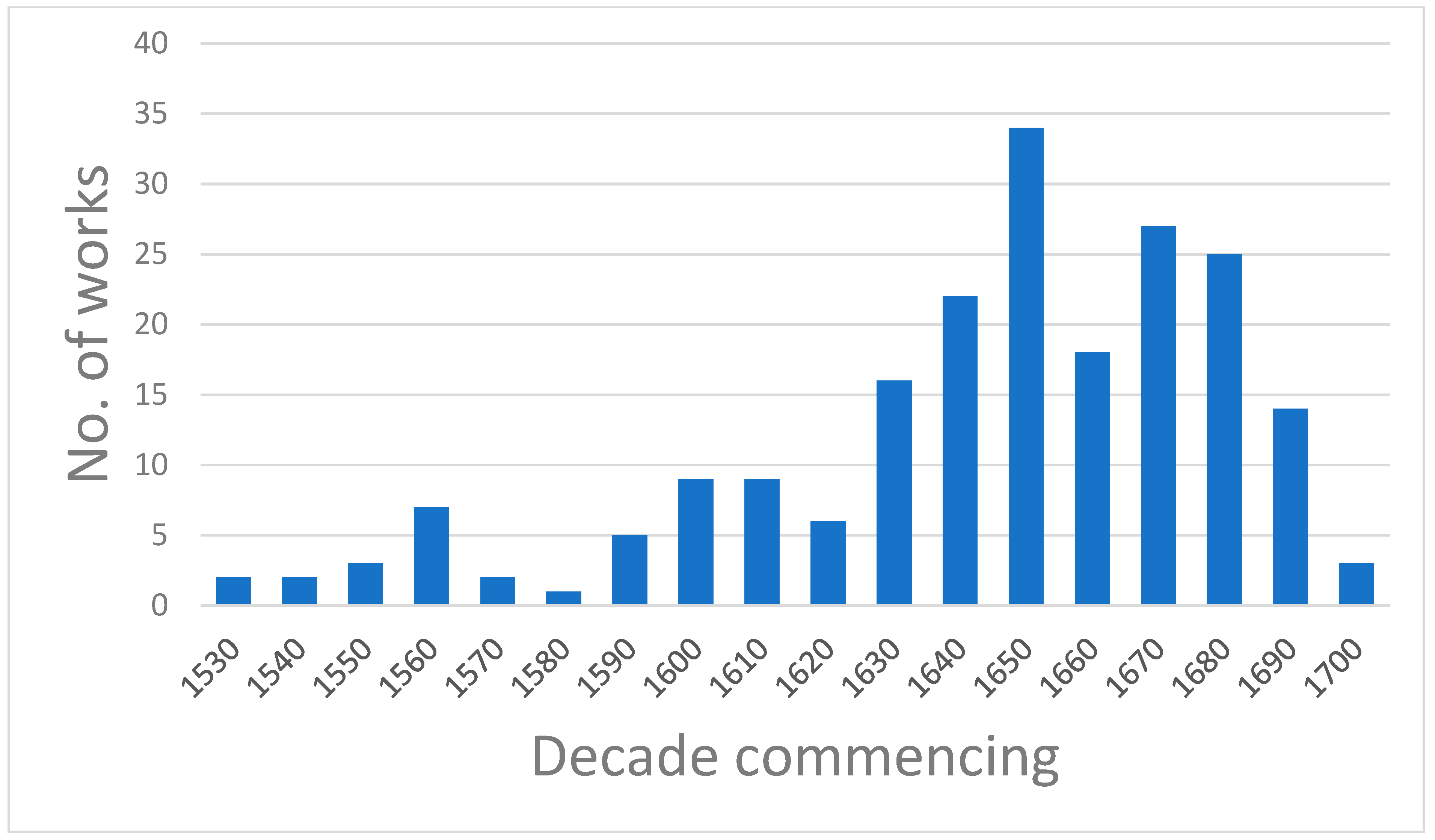
Figure 2.
Distribution by subjective assessment of context from concordance lines, of the 205 publications mentioning the English Sweat (and variant terms) in EEBO.
Figure 2.
Distribution by subjective assessment of context from concordance lines, of the 205 publications mentioning the English Sweat (and variant terms) in EEBO.
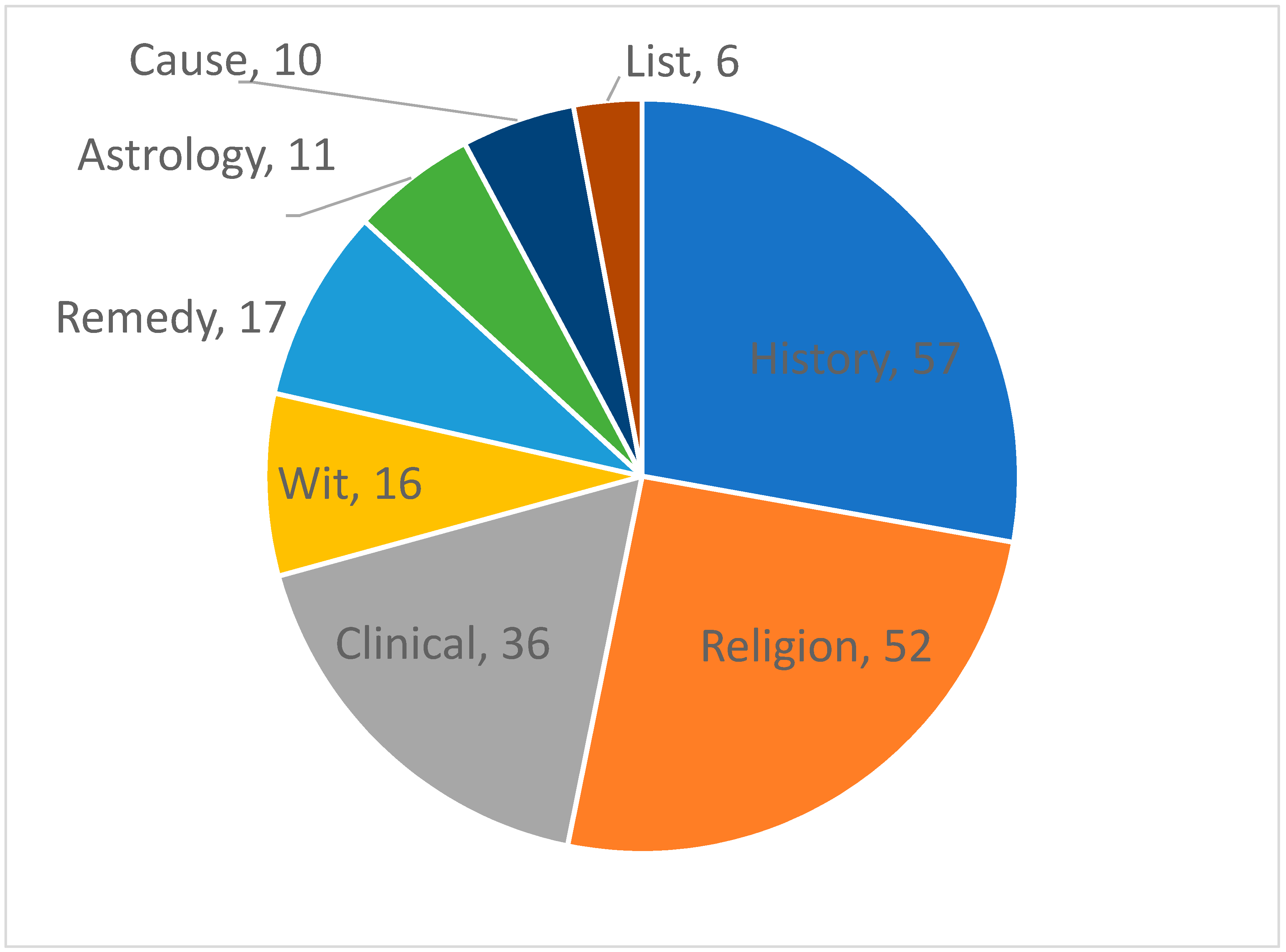
Figure 3.
Distribution of categories in Figure 2 over time. Red vertical line: last appearance of the Sweat in 1551. Blue dotted vertical lines separate the reigns of monarchs. H8: Henry VIII; E6: Edward VI; M1: Mary I; E1: Elizabeth I; J1: James 1; C1: Charles I; I: Interregnum; C2: Charles II; J2: James II; WM2: William & Mary II.
Figure 3.
Distribution of categories in Figure 2 over time. Red vertical line: last appearance of the Sweat in 1551. Blue dotted vertical lines separate the reigns of monarchs. H8: Henry VIII; E6: Edward VI; M1: Mary I; E1: Elizabeth I; J1: James 1; C1: Charles I; I: Interregnum; C2: Charles II; J2: James II; WM2: William & Mary II.

Disclaimer/Publisher’s Note: The statements, opinions and data contained in all publications are solely those of the individual author(s) and contributor(s) and not of MDPI and/or the editor(s). MDPI and/or the editor(s) disclaim responsibility for any injury to people or property resulting from any ideas, methods, instructions or products referred to in the content. |
© 2023 by the authors. Licensee MDPI, Basel, Switzerland. This article is an open access article distributed under the terms and conditions of the Creative Commons Attribution (CC BY) license (http://creativecommons.org/licenses/by/4.0/).
Copyright: This open access article is published under a Creative Commons CC BY 4.0 license, which permit the free download, distribution, and reuse, provided that the author and preprint are cited in any reuse.


