

Submitted:
28 January 2023
Posted:
29 January 2023
You are already at the latest version
Abstract
The improvement of health and social care needs the introduction of shared solution at transnational level. The SI4CARE (Social Innovation for Integrated Health Care) project is a transnational initiative within the Adriatic-Ionian regions aiming to develop strategies to improve the current status of health and social care. The Municipality of Miglierina, a small rural town in Calabria, which is a member the project, is developing a pilot action related to the use of wearable device for monitoring people affected by dementia with the project partner Ra.Gi.. Ra.Gi. is a non-profit organization dedicated to assisting people with dementia in day care centers and so-called dementia-friendly communities. The pilot is based on the use of smart wearable devices to monitor these patients during their daily lifetime. This paper focuses on the design and implementation of the system discussing the proposed application, the strengths and weaknesses. Finally, the possibility of extending the experiment to the other Adriatic-Ionian region is presented.
Keywords:
Wearable Device
; Dementia
1. Introduction
The Adriatic and Ionian (ADRION) region is defined based on the Adriatic and Ionian seas. It currently has more than 70 million people living in cities and rural villages spanning a sizeable geographic scenario, from oceans to internal mountains. The European Union has defined an ad hoc strategy which involves nine countries, four EU Member States (Croatia, Greece, Italy, Slovenia) and five Accession Countries (Albania, Bosnia and Herzegovina, Montenegro, North Macedonia, Serbia) (please visit the at www. Adriatic-Ionian.eu for detailed information).
The analysis of the demography across these regions demonstrates the relevant increase of adults and, more in-depth, the rise in people affected by declining functional capacities, thus needing the help of long-term care services [1]. A particular class of people with functional impairments present neurodegenerative disorders [2,3].
People presenting this problem need long-term care systems and continuous monitoring to avoid injuries during everyday activities. In particular, it has been shown that these people’s families also need help since the whole effort for taking care of dementia-affected people is vast. In the Calabria region, few centres, managed by public or non-profit organizations, offer the possibility of a daily-time stay for people, thus helping both diseased people and their families. More recently, in Italy and Calabria, some non-profit organizations and municipalities are experimenting with the so-called dementia friendly communities, i.e., developing a novel model of communities in which people with dementia may experience an unprecedented lifestyle.
The possibility of giving some freedom to diseased people needs the introduction of smart systems for monitoring the position and vital parameters of the patients.
Achieving these goals requires developing innovative healthcare services based on Information technology-based solutions (ICT), Artificial Intelligence (AI) and social innovations. While ICT and AI are two fundamental pillars for developing efficient solutions, the need for Social Innovation arises from creating social value with practical impacts on society, aggregating needs and interests, increasing civic participation and strengthening social cohesion.
The Miglierina Municipality and the RaGi non-profit organization have designed a prototype of a novel digitally supported social infrastructure which can respond to the needs of people affected by dementia and their families.
The pilot is based on testing the effectiveness of the wearable devices for monitoring the healthcare status of people with dementia within the daily centres, and dementia-friendly communities [4,5,6].
It has been shown that older people often have difficulties due to the absence of public transportation in rural areas, hence telemonitoring systems may help them. In recent works, the effectiveness of telemonitoring some physiological parameters has been demonstrated [4,7,8,9]. The project aims twofold: supporting the families and people with dementia, and showing the efficacy of telemonitoring in a real scenario within the SI4CARE project. The decision support system developed within the project will evaluate the output of the pilot.
1.1. Novelty and Impact of the work.
The key points of this work are the following:
- We implemented a pilot project related to the use of telemedicine in the adriatic ionian region;
- the use of the such project within the care of people with dementia;
- the integration of computational methods and data gathered from wearable devices .
2. The SI4CARE Project
The SI4CARE project aims to develop an ecosystem for the application of Social Innovation in Adriatic Ionian area to innovative healthcare services. Such services will be delivered mainly to older adults, and to people with cognitive disorders.
The project wants to develop a single transnational strategy which is implemented in regional and action plans and pilots. Results and benefits of the action are monitored through a ICT Decision Support System.
The SI4CARE project brings together public and private healthcare providers, users and associations, academia and social entrepreneurs, voluntary associations, NGOs, public administration and public administrations to design shared solutions. Social Innovation should be largely used in the healthcare system in a coordinated way, to offer services and develop new models to better respond to unmet/ poorly met needs of societies, more effectively than the traditional approach, with the beneficiaries/end users as players of their own need-satisfaction since they are triggered and engaged in finding solutions and answers. Stakeholders will get actively involved in a wider, transnational network of actors and experts in social innovation and its application to the healthcare sector. A shared approach that SI4CARE project will create and promote within the healthcare sector will boost national and regional social innovation for the improvement of the healthcare services for the ageing population in the ADRION Regions.
2.1. Pilot Description
2.2. Dementia Friendly Communities
3. Materials and Methods
3.1. Wearable Devices
The selection of wearable device has been performed considering all the wearable device actually in use in Italy and certified by the healtcare system[10,11]. Then from the available ones, the scientific committee of MoM has selected those presenting the possibility to easily export data and presenting as functionalities: the tracking of patients, the monitoring of heartbeat. Finally, the the SiDLY telemedicine wristbands (SiDLYCare PRO) https://www.hospital.sidly.eu/ has been selected [1]. This device might be used in the regions of the other partners, thus making the project repeatable.
The whole system comprises the wristbands, a mobile application and a telecare platform for the management of the wristbands.
SiDLYCare PRO is a wristband which is able to continuously monitor physiological parameters of the patients. The bracelet is also able to connect patients with caregivers or familiars by means of an internal telephonic system connected to mobile phone and data networks. A visible SOS button on the top of the bracelet is deputed to sent a customised alert message through a registered phone call, a text message and via the web management system.
SiDLYCare PRO has the following functions:
- A fall detector able to send a customised alarm;
- A detection for exit of predefined and highly customisable geographical areas;
- Measurement of hearth rate and level of saturation (SpO2);
- A pedomter to measure the activity;
- A barometer to measure environment quality;
- Medicines reminder.
- A SOS button able to establish a two-way voice call and to send alert call with the GPS position to caregivers;
- Battery status warning;
- monitoring of battery and network status.
Figure 1.
SiDLYCare PRO bracelets
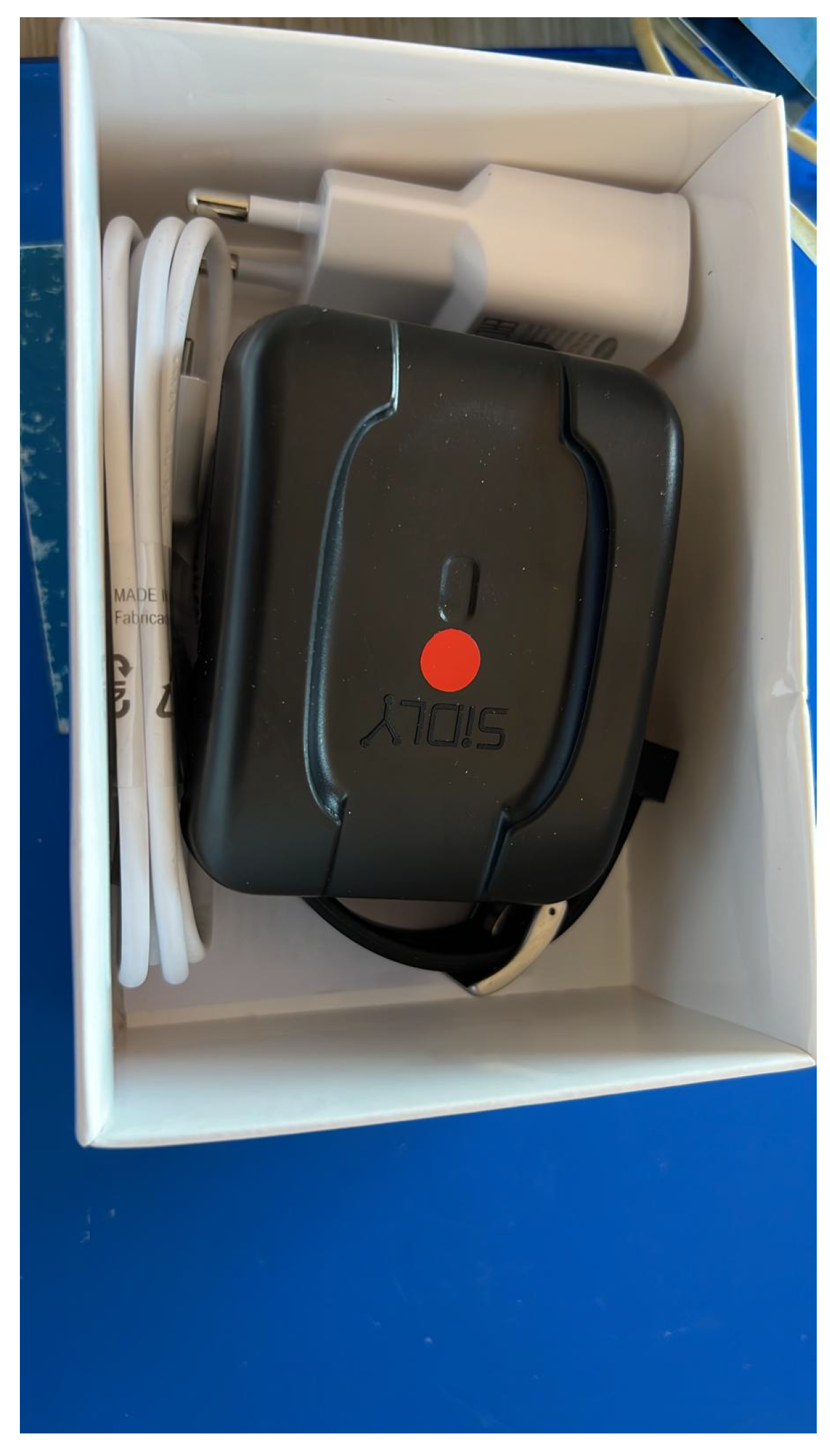

Table 1.
SiDLY Bracelet characteristcs
| Dimensions | 51mm x 33mm x 15mm |
|---|---|
| Weight | 41g |
| Autonomy | 48 H after full charge |
| Charging time | 3 hours |
| Type of charge | Induction |
| Call Protection | Only authorised numbers |
| Waterproof | It can be used in the shower or bath |
User position is monitored by means of an equipped global positioning system (GPS) sensor. It enables the bracelets to detect user position. The manager of the system can define a region on the map, so the system send a position when the user moves away from the defined area. The bracelets is also able to detect falls and it reacts by sending an alarm. Finally, the user may invoke an SOS alarm, and the system also detects the position and sends the coordinates to manager or family/caregivers.
3.2. Parameters
We collect the following parameters through the bracelet:
- Heart Rate and SpO2;
- Activity;
- Environmental parameters measurement (barometer);
- monitoring of falls;
- monitoring of presence within the area.
An ad hoc defined questionnaire is also given to family and caregiver to monitor both the status of patients and the perceived satisfaction by the family.
3.3. Data Managing and Analysis
Data sent by the sensors are stored into the secure cloud provided by the bracelet vendor. An ad hoc defined software module extract anonymised parameters and integrates them with the user questionnaire to perform advanced analysis. After collecting the data into the secure cloud, an ad hoc designed software module extracted the parameters of the patients to enable advanced analysis. Currently, the software module has two main analysis functions:
- Cluster Analysis;
- Classification of patients.
Database of the application is implemented by using My-SQL database. Security of data is guaranteed by data encryption and one-time password protocol.
Data analysis is implemented on top of the Python libraries for data analysis sklearn and PyTorch.
The current plan of the project considers the possibility to predict falls or other events of interest on the basis of the analysis of the time series of vital parameters. We plan to learn a deep neural network based on an recurrent neural network architecture that can predict adverse events, or simply events that should be reported, based on the time series analysis. Finally, the more important aim, considering the project, is to demonstrate the effectiveness of the system in terms of well being of the patients and in the improvement of the healthcare system in term of the monitoring of patients.
4. Results and Discussion
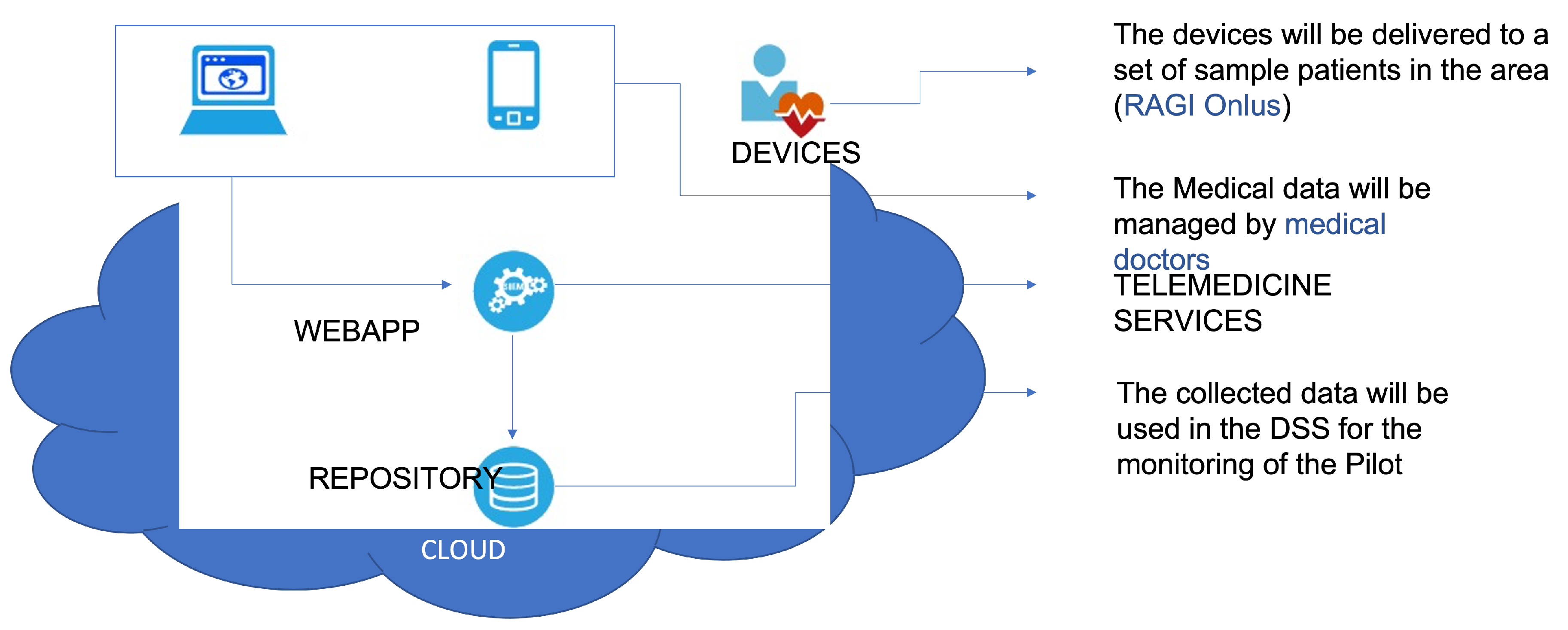
We here discuss the realised architecture depicted in Figure 2. MoM was responsible for designing and implementing the architecture. SiDLY wristbands were delivered to RaGi onlus who is in charge for delivering them to the patients. Patients were monitored durig the stay at the center for the time interval of monitoring. Currently, the system has been fully implemented and tested in the preliminary version. The system has been released to final users which are starting to collect data.
5. Conclusions
The SI4CARE project is a transnational initiative which leads to develop innovative strategies for improving health and social care in the Adriatic-Ionian region. Municipality of Miglierina is a local partner of the project. Together with the stakeholder, MoM designed and developed a pilot project based on the use of wearable devices for monitoring people with dementia. Preliminary results of the project show the strength of such an approach suggesting the possibility to extend the experiment in the other adriatic-ionian regions. There exist two main challenges that should be considered: the need to train healthcare professionals and the requirmentes of economic, financial and organizational resources.
SI-4CARE Members
Sokratis G. Papageorgiou (1st Department of Neurology Aiginition University Hospital Athens), Efthalia Angelopoulou (1st Department of Neurology Aiginition University Hospital Athens), Dimosthenis Pavlou (School of Topography and Geoinformatics University of West Attica), Jovanka Vučetić, Public Health Center Tivat, Montenegro.
Author Contributions
Conceptualization, A.G. S.F. M.M and G.P.; methodology, PHG GP AG and SF.; software, A.G. F.T. and S.F., ; validation, F.E. E.P. and Z.Z.; formal analysis, E.S. A.T .; writing—original draft preparation, P.H.G and A.G; writing—review and editing, P.H.G.; project administration, G.P. and D.S.; All authors have read and agreed to the published version of the manuscript.
Funding
This research was funded by SI4CARE Adrion Project. si4care.adrioninterreg.eu. The Project SI4CARE is co-financed by the ERDF via the Programme Interreg ADRION.
Institutional Review Board Statement
We here report the design of the architecture.
Informed Consent Statement
Informed consent will be obtained from all subjects involved in the study.
Conflicts of Interest
The authors declare no conflict of interest.
Abbreviations
The following abbreviations are used in this manuscript:
| MoM | Municipality of Miglierina |
References
- Gallo, A.; Fregola, S.; Menon, M.; Talarico, F.; Fragkiadaki, S.; Kontaxopolou, D.; Vukojevic, K.; Matijaca, D.; Miljkovic, M.; Kožetinac, S.; et al. Using Smart Devices for Monitoring Elderly Patients in Rural Areas of Calabria after COVID-19 Vaccination: Experiences within the SI4CARE Project. COVID 2023, 3, 124–130. [CrossRef]
- Martin, J.B. Molecular basis of the neurodegenerative disorders. New England Journal of Medicine 1999, 340, 1970–1980. [CrossRef]
- T O’Brien, J.; Thomas, A. Vascular dementia. The Lancet 2015, 386, 1698–1706.
- Gepner, Y.; Mofaz, M.; Oved, S.; Yechezkel, M.; Constantini, K.; Goldstein, N.; Eisenkraft, A.; Shmueli, E.; Yamin, D. Utilizing wearable sensors for continuous and highly-sensitive monitoring of reactions to the BNT162b2 mRNA COVID-19 vaccine. Communications Medicine 2022, 2, 1–8. [CrossRef]
- Mercatelli, D.; Pedace, E.; Veltri, P.; Giorgi, F.M.; Guzzi, P.H. Exploiting the molecular basis of age and gender differences in outcomes of SARS-CoV-2 infections. Computational and Structural Biotechnology Journal 2021, 19, 4092–4100. [CrossRef]
- Cinaglia, P.; Tradigo, G.; Guzzi, P.H.; Veltri, P. Design and implementation of a telecardiology system for mobile devices. Interdisciplinary Sciences: Computational Life Sciences 2015, 7, 266–274. [CrossRef]
- Daskalos, A.C.; Theodoropoulos, P.; Spandonidis, C.; Vordos, N. Wearable Device for Observation of Physical Activity with the Purpose of Patient Monitoring Due to COVID-19. Signals 2022, 3, 11–28. [CrossRef]
- Klingberg, A.; Wallis, L.A.; Hasselberg, M.; Yen, P.Y.; Fritzell, S.C.; et al. Teleconsultation using mobile phones for diagnosis and acute care of burn injuries among emergency physicians: mixed-methods study. JMIR mHealth and uHealth 2018, 6, e11076. [CrossRef]
- Galicia, J.C.; Guzzi, P.H.; Giorgi, F.M.; Khan, A.A. Predicting the response of the dental pulp to sars-cov2 infection: a transcriptome-wide effect cross-analysis. Genes & Immunity 2020, 21, 360–363. [CrossRef]
- Cullen, A.; Mazhar, M.K.A.; Smith, M.D.; Lithander, F.E.; Ó Breasail, M.; Henderson, E.J. Wearable and Portable GPS Solutions for Monitoring Mobility in Dementia: A Systematic Review. Sensors 2022, 22, 3336. [CrossRef]
- Harper, M.; Ghali, F. A Systematic review of wearable devices for tracking physiological indicators of Dementia related difficulties. In Proceedings of the 2020 13th International Conference on Developments in eSystems Engineering (DeSE). IEEE, 2020, pp. 406–411.
Figure 2.
Figure shows the architecture of the realised system. Devices are delivered to a set of patients selected by Ra.Gi.. The monitoring device stores the parameters in a secure cloud compliant with the GDPR regulations. Medical doctors monitor such parameters through the web app provided by the SiDLY system. Finally, anonymised parameters of the patients are collected into a secure repository. Such data are given as input to a a decision support system of the project to monitor the pilot. Finally, data are also analysed by means of data mining and machine learning algorithms.
Figure 2.
Figure shows the architecture of the realised system. Devices are delivered to a set of patients selected by Ra.Gi.. The monitoring device stores the parameters in a secure cloud compliant with the GDPR regulations. Medical doctors monitor such parameters through the web app provided by the SiDLY system. Finally, anonymised parameters of the patients are collected into a secure repository. Such data are given as input to a a decision support system of the project to monitor the pilot. Finally, data are also analysed by means of data mining and machine learning algorithms.
Disclaimer/Publisher’s Note: The statements, opinions and data contained in all publications are solely those of the individual author(s) and contributor(s) and not of MDPI and/or the editor(s). MDPI and/or the editor(s) disclaim responsibility for any injury to people or property resulting from any ideas, methods, instructions or products referred to in the content. |
© 2023 by the authors. Licensee MDPI, Basel, Switzerland. This article is an open access article distributed under the terms and conditions of the Creative Commons Attribution (CC BY) license (http://creativecommons.org/licenses/by/4.0/).
Copyright: This open access article is published under a Creative Commons CC BY 4.0 license, which permit the free download, distribution, and reuse, provided that the author and preprint are cited in any reuse.


