

Submitted:
18 January 2023
Posted:
18 January 2023
You are already at the latest version
Abstract
Digital federated platforms and data cooperatives for secure, trusted and sovereign data exchange will play a central role in the construction industry of the future. With the help of platforms, cooperatives and their novel value creation, the digital transformation and the degree of organization of the construction value chain can be taken to a new level of collaboration. The goal of this research project was to develop an experimental prototype for a federated innovation data platform along with a suitable exemplary use case. The prototype is to serve the construction industry as a demonstrator for further developments and form the basis for an innovation platform. It exemplifies how an overall concept is concretely implemented along one or more use cases that address high-priority industry pain points. This concept will create a blueprint and a framework for further developments, which will then be further established in the market. The research project illuminates the perspective of various governance innovations to increase industry collaboration, productivity and capital project performance and transparency as well as the overall potential of possible platform business models. However, a comprehensive expert survey revealed that there are considerable obstacles to trust-based data exchange between the key stakeholders in the industry value network. The obstacles to cooperation are predominantly not of a technical nature, but of a competitive, predominantly trust-related nature. To overcome these obstacles and create a pre-competitive space of trust, the authors therefore propose the governance structure of a data cooperative model, which is discussed in detail in this paper.
Keywords:
digital platforms
; data sharing and exchange
; digital transformation
; data cooperatives
; in-teroperability
; data sovereignty
; construction industry
; value networks
; productivity
; capital pro-ject performance
1. Introduction
With the help of digital platforms, the degree of organization of value creation systems can be raised to a new level of cooperation between the players in the construction industry [1]. Applied to construction projects, planning and production processes can be much better organized and lead to frictionless, low-waste collaboration. The possibilities of digital platforms go far beyond Building Information Modeling (“BIM”) [2,3,4,5]. Digital platforms can therefore be understood as mobilization platforms [6,7]. They are the digital manifestation of a value network of different stakeholders who want to achieve a common goal [8,9]. In this case, the common goal is to create a sustainable built environment [10]. The platform is therefore not only used to map the project structure, but also to organize the structured exchange of data. According to Hagel [7], digital platforms therefore consist of an ecosystem with governance structures, i.e. regulatory structures, and a set of standards and protocols to digitally organize interaction in a complex multistakeholder environment. Platforms, therefore, do not replace a traditional project structure, but support and enable it. They form a meta-organization for joint and coordinated action toward a higher-level overall goal with maximum impact. Platforms can provide a process-driven platform approach for more efficient processes in planning and implementation, based on more agile and systemic value chains [11].
Thinking one step further, a digital platform can evolve into a trusted learning system (Figure 1) which is supported by artificial intelligence (“AI”) [12]. Of course, under limiting conditions, this is also possible in value networks that organize themselves analogously, i.e., without a digital platform. However, digital platforms can accelerate systemic learning enormously. Innovation can be defined as the acceleration of performance improvement of such platforms [1,13,14].
To enable the exchange and aggregation of data in a project environment, the various stakeholders must be willing to share their data. This is the case when the respective stakeholders see a clear benefit from it and can also decide sovereignly who and in what way their data can be further used. That is, the data provider remains in possession of the data and makes it available to the data consumers, who in turn offer digital services or use the data for processing [15].
One way to realize this is a so-called federated data infrastructure [16]. Here, a federator ensures sovereign data exchange between data providers and consumers. The term "federated" means that balanced and fair regulation ensures that the various stakeholders as a whole benefit from the data exchange [17,18]. The prerequisite for data exchange in a multi-stakeholder environment is therefore not only based on technical implementation, but also on fair and transparent regulation that is implemented in a trustworthy manner via an institution authorized for this purpose, the "federator" [19].
The participation in a so called digital construction-project platform of small and medium-sized enterprises (“SMEs”) is enabled by the federated and big-data-architecture [1] in such a way that this companies are incentivised to take part in the value creation network [20].
For users, a digital platform is made up of various applications [21]. The applications are not developed by the platform operator; instead, development is left to the market to exploit the full innovation potential. The platform creates an appropriate digital organization (design) for this purpose and also regulates the exchange of data. It forms the innovation and development framework for external software developers. The platform thus offers the opportunity to place new applications in a context with new or existing business models [22].
Particularly worth mentioning are business models based on smart services and data apps, use of data for AI services and to improve processes, marketplace for data and services for e.g. standardized construction supervision and quality monitoring, and incentive effects through cooperation for improved processes [23].
It should be emphasized here once again: Transparent data sovereignty is essential for the development of such a digital platform [24]. The regulatory framework of the platform therefore plays a decisive role. It can only be created as a cooperative regulatory framework that takes into account the different interests of the players involved in construction and balances out any conflicts of objectives that arise [25]. The digital transition is also an essential enabler of ecological, circular and low-carbon solutions as well as increased productivity by benefiting and connecting all steps in the building life cycle. However, it should be noted that digitalization is not the goal but one of the means towards a more sustainable and more resilient construction ecosystem [26].
In this paper, we will first discuss the research methodology we used to develop an experimental prototype for a federated innovation data platform. This will be covered in Section 2. Next, in Section 3, we will delve into the current state of digital transformation in the construction industry, including an examination of the trend towards increased market concentration. In Section 4, we will propose a suitable federated reference architecture framework, discuss cooperative governance, and identify and prioritize potential use cases. Finally, in Section 5, we will provide a summary, note any limitations, and suggest future directions for this research.
2. Research Methodology
The research project aimed to develop an experimental prototype for a federated innovation data platform along a suitable exemplary use case. The prototype was to serve as a demonstrator for further developments and develop the basis for a project-based digital innovation platform. It should exemplify how an overall concept is concretely implemented along one or more use cases. This will create a blueprint and a framework for further developments, which will then be further established in the market in a demand-oriented manner. The research project will thereby also illuminate the perspective of different business model innovations as well as the overall potential of possible platform business models.
The innovations of the research and development project consisted of the following work packages (WP, see also Figure 2):
- WP 1 Definition of requirements and alignment of solution approaches (desktop research): A targeted identification was carried out by means of a pre-selection of possible convincing, exemplary and scalable use cases for the federated innovation platform as well as design of a conceptual and structured framework for the innovation platform with regard to its general applicability. The subject and goal of the first work package was a comprehensive inventory of the intended application context and the resulting business, IT, data, and governance-related requirements and framework conditions. The basis for this was a literature research on existing state-of-the-art examples in the area of federated innovation/data platforms and the evaluation of existing industry surveys, i.e. desktop research. Likewise, existing, fundamentally comparable or related approaches and current implementation initiatives, e.g., from the Industry 4.0 context and development projects were evaluated in terms of content and methodology and classified in the state of the art of federated platforms and methods. Against this background and on the basis of the preliminary work of the project participants, a detailed finetuning and further differentiation of the envisaged solution approaches was carried out, also with regard to the mutual fit of the individual approaches for the implementation of the intended overall concept. It is important to note that a secondary research approach has certain limitations. For example, the data used may not be current, or may not be directly related to the specific research question. Additionally, the authors may not have access to all the relevant data and information needed to conduct the research.
- WP2 User requirements, use case and platform model validation (by means of member, expert, user interviews): Validation of the hypotheses as well as the use case pre-selection of the desktop research with the help of member, expert or user interviews. The decision-making basis was provided by telephone interviews and video conferences with selected members of the Bavarian Construction Industry Association (Bayerischer Bauindustrieverband e.V.), which were engaged to iteratively test and deepen existing use case ideas. The object and goal of the second work package was the concrete determination of requirements and potentials as well as the conceptual development of an implementation strategy for the federated innovation platform that can be implemented in software terms with a focus on the user experience. For this purpose, suitable user requirements were developed and critical components as well as user pain points were identified. The results were used to align the structure of the federated platform and the accompanying activities accordingly. The bilateral member survey was also an important element of the work plan, as this is where trust in a future data ecosystem is already established and potential project champions for the implementation phase are identified.
- WP3 Technological Software foundations, structure, functional profile, user roles and interactions (Demonstrator Blueprint): A blueprint of a regulatory concept for the Federated Innovation Platform was developed, which takes into account the different interests of the involved stakeholders regarding their data sovereignty. For this purpose, an exemplary concept was created as a prototype for the selected use case. Based on the framework conditions and technical principles systematically specified in WP1 and WP2, WP3 aimed to develop a scalable software-technical platform system environment and associated central functional mechanisms, as well as to map them in a high-performance, practice-oriented test environment (IT hardware, server landscape, cloud services, etc.). As part of this task and to realistically map the use case, the corresponding interface requirements of the specialist modules and data flows were formalized, specialist components to be integrated were specified and configured according to the state of the art (in-house and third-party services), hardware and cloud services were defined and set up, and software engineering principles for aspects of data management, federated platform functions and user interaction were implemented (Figure 3).
- WP4 IT implementation, data ecosystem, third-party users and innovative services/business models (platform implementation): The design and implementation (i.e., programmatic implementation) of the IT concept for the Federated Data Platform studied in depth in WP3 was prototyped based on the use case identified in WP2. Based on the framework conditions and technical foundations systematically specified in WP1, WP2 and WP3, as well as the demonstrator blueprint, the present work package aimed at implementing the federated platform and the exemplary use case. The concrete coordination of the work package contents WP4 resulted from WP1 to WP3 in coordination with the project sponsor.
3. Digitalization in the Construction Sector
3.1. Data is the New Oil
According to Clive Humby, 2006,"Data is the new oil" [28]. The general public has been made familiar with this quote by the Economist in 2017 [29], which states that data has replaced oil as “the world's most valuable resource”. For all its valid criticisms, Humby's quote is still accurate in many ways (see also [30]):
- a)
- The world’s most valuable resource is no longer oil, but data [9]: However, aggregating data creates value exponentially at zero marginal cost and the digital transformation is more than just about cost efficiency.
- b)
- Data is increasingly valuable as an input to large-scale AI systems and economy-wide processes of technological investment and innovation.
- c)
- A large-scale infrastructure is needed to collect, cleanse, and share data. Infrastructure that must be built, funded, and regulated as part of large-scale projects in both the public and private sectors. Much like Standard Oil had a monopoly on oil refining [31], we have a monopolized and compartmentalized landscape for data refining and transmission. A landscape that is ripe for review, much like Standard Oil was.
- d)
- Disputes over data ownership, use, and sovereignty are increasingly becoming a national and international challenge [32]. They create tensions over technological interdependence and drive state and regional agendas. Access to data is more and more seen as an issue of national security and the national technology agenda, as much as a critical contributor to the domestic new economy [33].
But data as the new oil leaves out important perspectives. It’s being misunderstood in ways that have real implications for how we think about and regulate data [30]:
e) Data encompasses everything from huge data sets that capture the web browsing data of millions of people to hospital patients records that often contain sensitive information. We can’t look at these two data sets in the same way; and we shouldn’t. And we can’t use or protect them in the same way either. So, we can’t just swap one record for another: they're highly context-specific, they’re not interchangeable, they need to be protected and managed as such, and that needs to be done flexibly, with individual and community decision-making.
Right now, the law focuses largely on two kinds of data: (a) personal information, like our social security numbers, and (b) intellectual property, copyrights and patents. However, today’s evidence shows that the new oil age was not triggered by any of the above types of data (a or b). In fact, it’s about a different kind of data, sometimes called (c) data exhaust [34]. The data we generate and that is captured as we move through the world today: Data like where we are, what we buy, who we talk to, what we write, who we swipe right, e.g., according to Tinder’s core mechanics, and even the temperature we set our home to. Such data is no longer just used to sell us advertising. It's also being used to train algorithms that may have decision-making power over us or even try to mimic our intellectual abilities. This kind of data that we are focusing on is subject to network effects that are obviously not present in natural resources like crude oil. In terms of productive use, data is only truly meaningful and valuable in aggregate and its entirety. This creates incentives for the monopolized data collection we observe: e.g., a person’s Facebook data, for example, is worth about seven cents only. The aggregate data of all Facebook users, on the other hand, is worth billions of dollars. As a consequence, Facebook earned about 208 dollars from each North American user annually (as per 2021/2022 data [35]). Typical AI applications rely on access to massive amounts of data. And ideally on good quality data, but the current ecosystem often trades quality for quantity. In addition, most of this data is essentially collective: When a user makes a Facebook post and another user likes that post. Can you then claim that the “like” is independent of the post? When an email is sent and then responded to, who owns what part of that interaction? And who then owns the metadata of the exchange? The types of data produced today are difficult to attribute to individuals. And because of network effects, data is valuable primarily because it can be used to predict the behavior of the people we are connected to. Therefore, this kind of data is highly networked and interdependent, and at this stage highly collective.
It is important to highlight that data is not just a passive and finite resource like oil that can be extracted. [36]. On the contrary, data is limitless and actively created through social interaction. It's a product of collective work–not some millennia old natural process. And this is particularly relevant when we think about the data that trains AI systems. Large scale models like Generative Pre-trained Transformer 3 (“GPT-3”) [37], an autoregressive language prediction model that uses deep learning to produce human-like text, aren't autonomous AI achievements, entirely the opposite [38]: Those projects only work because they're trained on hundreds of billions of words initially written by humans capturing centuries of human history and culture, everything from books to Wikipedia articles [39]. Likewise, referring to “oil” as metaphor for data suggests that data primarily functions as a resource for economic gain at the cost of social cohesion and climate change. By treating data as the new oil, humanity already witnesses the risks and limits of a new dependency. This time, the new dependency is not about fossil fuel-based industrialization and hyper-globalization [40], but of hyper-digitalization. The digital transformation has already led to an uneven global concentration of digital resources and a heightened demand for digital sovereignty [41]. The former has been critically associated with “surveillance capitalism” [42] and “techno-feudalism” [43], which has manifested in the rise of digital monopolies and oligopolies constraining markets and data access, and threatening democratic values and fundamental rights. The latter, digital sovereignty, is the legitimate response towards the former seeking to prevent and mitigate the disruptive impact of hyper-digitalization. The problem is not one of sovereignty or the right to make independent policy and technology choices, but the line separating sovereignty from nationalism and protectionism. Like capitalism, technology lacks the intrinsic value of social and environmental good. Thus, to navigate and manage the digital transformation successfully, new governance models are necessary that serve society, protects privacy, ensures cybersecurity and digital market integrity, and help accelerate the decarbonization of the economy [44].
3.2. Industry-Specific Challenges
Twenty-first century infrastructure and building construction need to respond to changing demographics, becoming climate neutral, resilient, and economically affordable, while remaining a driver for development and shared prosperity [1].
A special characteristic of the construction and real estate industry is its very flexible adaptation to the challenges of the highly competitive market [45,46]. Very flexible, interconnected and open project-based networks of many different, often medium-sized companies along the construction value chain create a very high degree of market agility. Thanks to this extremely powerful structure, the construction and real estate industry is able to implement the most diverse and also technically highly demanding construction projects. This agile and project-based network structure poses a major challenge for digitization. So far, the IT industry has not been able to provide adequate solutions for this, especially when it comes to secure and sovereign data exchange between companies via shared data spaces. Solutions have been developed primarily for sectors in which individual companies assume complete responsibility for a product or service to be marketed, i.e., also fully control the data technology processes.
The network structure in construction initially contradicts central data management, as there is no so-called process owner [47]: Owner, architect, authority, engineering consultants, project controllers, subcontractors and their subcontractors, suppliers, etc. work together in a project, but each stakeholder more or less in its own data environment [48]. Some data can be protected from access by other stakeholders or uninvolved parties through modern IT programs, but this requires considerable administrative effort, which in the practice of a larger construction project is too complex to provide real protection.
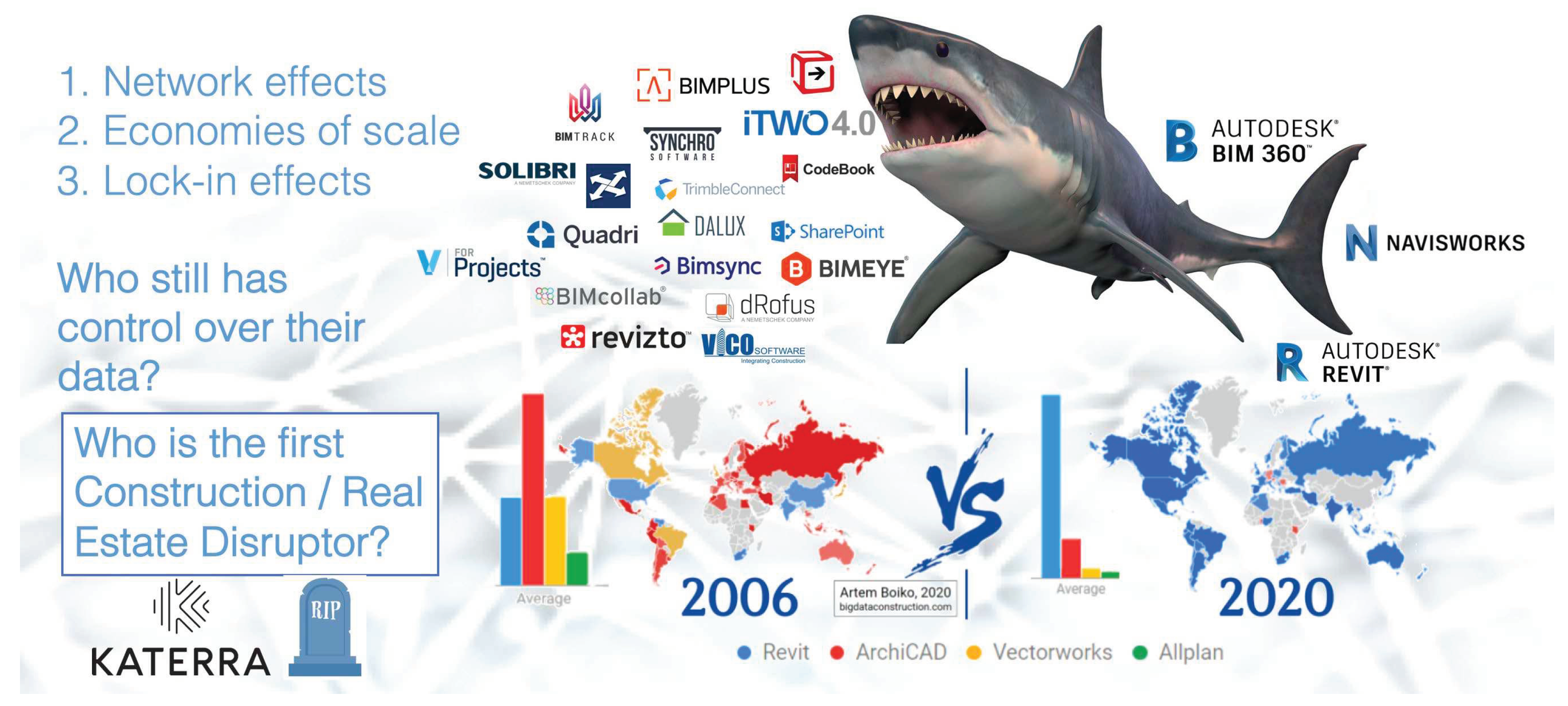
There is no central party that is logical from the organizational structure and manages the IT system with all the data. The various stakeholders involved in construction cannot provide that. Even large construction companies cannot take over platform control because they are only involved at a very late stage in the value chain. By then, the essential planning steps have usually already been completed. Instead, network effects, economies of scale and lock-in-effects currently lead to a “winner-takes-it-all” situation (Figure 4).
3.3. Industry-Specific Challenges: Summary
Commonly identified key challenges for the sector can be summarized as follows [49]:
- a)
- a unique combination of product, process, and team that does not allow for repetition as jobsites change;
- b)
- a collaborative but highly fragmented process with no clear top-down leadership, where a (general) contractor comparable to the global integrator or "brand" in other sectors is too late to be the leader in the data process;
- c)
- non-existent market or technology leadership with simultaneous participation of a large number of small companies;
- d)
- a lot of manual, low-skilled work on the construction site and slow changes in core construction and engineering knowledge, with limited investment in continuous learning;
- e)
- very low profit margins and short timelines that do not allow for large R&D efforts or experimentation with new technologies;
- f)
- most construction processes are not yet accompanied by adequate standardization, which limits corresponding digitization processes; and
- g)
- a national and international standardization framework (DIN, CEN, and ISO) required for digital collaboration is still in its infancy.
However, despite the overall challenges, the importance of the construction sector should not be underestimated: According to [50], the industrial construction ecosystem employs approximately 24.9 million people in the EU and provides a value added of 1,158 billion Euros (9.6% of the EU total), which after retail is the second highest. The aggregate size of the global construction market was valued at more than US$10 trillion in 2022 and is predicted to reach US$15 trillion by 2028 [51,52]. The construction ecosystem is dominated by micro and small enterprises. With a total of 5.3 million firms in the EU, 99.9% companies of the ecosystem are SMEs, which represent 90% of employment and 83% of the total value added. The fragmentation of the ecosystem is accentuated by the fact, that around 90% of the companies are microenterprises, standing for 45% of employment and 32% of the total value added. Therefore, a platform solution must both reflect the dominance of SMEs in the sector and provide an effective means to address the fragmentation of the construction ecosystem [50].
Figure 4.
"The winner takes it all"–Growing market concentration of platforms shown in the field of Building Information Modelling (“BIM”) between 2006 and 2020 (reprinted with permission from [53]).
Figure 4.
"The winner takes it all"–Growing market concentration of platforms shown in the field of Building Information Modelling (“BIM”) between 2006 and 2020 (reprinted with permission from [53]).
A comprehensive survey of the European construction industry [54] regarding the state of the sector’s digital transformation revealed the following findings:
- a)
- The industry is struggling with a limited to average level of digitization. To date, digitization is mainly used for communication and file exchange, but not for (digital) value creation processes.
- b)
- In this context, there are still major differences between subsectors in construction, i.e., high acceptance or maturity among planners versus low acceptance or low digitization maturity among SMEs. Likewise, between company sizes, i.e., limited acceptance of digital tools such as BIM among SMEs while BIM is already seen as a starting point for many digital transformation processes and other technologies among large contractors today;
- c)
- Predominantly, market forces are the main reason for starting or expanding digitization. Digitization drivers are therefore requirements from customers, project partners as well as competition.
- d)
- Although public digital transformation drivers such as government incentives, public funding or public procurement seem to have less influence on digitization decisions, companies rate very positively almost all public or private initiatives that could encourage or support companies in sharing digital information with construction partners; and
- e)
- Companies cite the following principal barriers to successful digital transformation: (1) cost, (2) ICT skills, (3) embedded work culture immediately followed by (4) “lack of knowledge”.
Based on the industry-specific challenges summarized above, appropriate responses must be found. The necessary strategies and recommendations to overcome these challenges can be summarized as follows [49]:
- (1)
- Improved interoperability is an essential, if not the most important, prerequisite for all types of trust-based collaboration among construction stakeholders, which will thereby also greatly enhance innovation, i.e., process improvement and new software development, and the overall supply of construction services, i.e., competition.
- (2)
- Broad support and promotion of the development of standards that will form the basis for the desired optimized interoperability is urgently needed. In addition to the improved (digital) process aspects, an important focus here is on enabling and standardizing data exchange through specifications for information delivery, data dictionaries, file formats, standardization of API interfaces, etc.
- (3)
- Standardization of data exchange should be achieved exclusively through open standards to avoid a lock-in effect with proprietary solutions. This will facilitate the integration of construction data across all construction phases and applications and effectively integrate the technical knowledge of all lead standards organizations and committees. Open standards will also lead to stronger (data) links with the supply chain of manufacturers of construction products and elements.
- (4)
- An important factor in facilitating the collaboration process at the project level is the increased adoption of standards for organizing and digitizing information (e.g., [55]) and translating them locally into protocols and software templates to facilitate or enable the entire ecosystem, especially resource-poor stakeholders (e.g., SMEs), to collaborate under real-world conditions on the jobsite.
- (5)
- Here, platforms can combine certain functionalities, integration of construction know-how, linking with product data from the supply industry, and connectivity, thus breaking down several barriers and silos and becoming a key factor in accelerating digitization in the industry by transforming silos into value networks. Digital platforms could also help with all kinds of compliance issues in the industry, e.g., due to challenges with technical standards, simplify this work for construction companies, and generate immediate efficiency gains, which in turn could create a pull for innovation in digital tools.
- (6)
- SME-centered technologies and SME-centered platforms should facilitate, not hinder, their digital transformation. Specific, visibility measures are needed to make SMEs aware of current (unknown-to-them) solutions and thus promote supply to more than 80% of the market, e.g., through intuitive low-threshold plug-and-play tools specifically customized for construction SMEs.
- (7)
- Digital platform solutions that take into account SMEs' financial, collaborative, and technical capabilities and aspirations by offloading their IT resources while respecting data ownership and data certification, i.e., trusted data, will have a positive long-term impact on SMEs' digital transformation. Platforms could thus provide the basis for better coordination, collaboration and cooperation between SMEs and other key stakeholders on projects.
- (8)
- National, regional and municipal authorities shall promote the digital transformation of the construction industry by, on the one hand, allowing all kinds of digital interactions, such as computer-readable building codes, digital building permits, digital performance checks, etc., and, on the other hand, by stimulating their own developments or prescribing selected digital tools for a range of measures.
- (9)
- Digital skills shall be built at all levels of the construction sector, and digitally skilled personnel shall be trained for the sector by taking lifelong learning and retraining for granted. This includes organizing specific networks, digital literacy levels, support tools and demonstration centers, in addition to raising awareness among all stakeholders.
- (10)
- Support tools and demonstration centers shall be targeted at SMEs. A localized, pragmatic approach is needed to reach all subsectors and build trust. SMEs in particular need simple tools with a strong value proposition, practical on-site training, and continuing education programs based on current best practices. Here, industry clusters in particular could stimulate the digital transformation, solve concrete problems, inform, network and create concrete opportunities for collaboration.
3.4. Responses and Developments of the Industry Sector
For years, the construction industry has been pursuing the goal of data-networked cooperation between all parties involved in a construction project. Better cooperation and data sharing among construction stakeholder would be highly valuable. However, the fragmented value creation network is on the one hand a great strength of the business sector, but on the other hand it is a weakness if a higher level of digitization is to be achieved, at least, that is the case when one tries to transfer the previous digitization concepts to the construction industry.
However, the question arises as to whether the construction industry must adapt to the existing concepts of digitization or whether concepts should not be found that utilize and retain the specific character of the industry as a strength. It is to be considered, that the construction sector adapts highly to the requirements of the market. Construction projects are inherently decentralized, as there is no single coordinating body that centralizes decision-making throughout a building's lifecycle. Instead, multiple independent stakeholders interact in a network with the building over time, from design to operations and maintenance, to demolition and recycling of materials. However, because they are all dealing with the same physical asset, intensive collaboration between these stakeholders is indisputably required.
According to Werbrouck et al. [56], few industries are as fragmented as the construction sector, where countless actors are involved during the lifecycle of a facility, from direct actors such as the architect, the owner, a construction company and a building manager, to indirect data providers such as governments or geo-institutes. This “federated” reality is in contrast to the previous digital concept of a “centralized” cloud server, a “common data environment” (CDE). Therefore, Werbrouck et al. proposes a basic infrastructure for a “federated CDE” that uses domain-independent web specifications for (access-controlled) data federation [56].
The construction industry has been working on a consistent step in this direction for many years with the development of BIM. (Building Information Modeling). The idea behind this is that all parties involved in a construction project handle all necessary processes-from planning to demolition-via a central data system.
Recently, this collaboration has been shifting more and more to specialized cloud-based ecosystems defined in ISO 19650, called Common Data Environments (CDEs). These CDEs are usually provided by major BIM tool vendors (e.g., AutoDesk, Aveva Group, Bentley Systems, Hexagon, Nemetschek, Trimble, etc.) and offer the most seamless integration possible with these often-commercial BIM related tools. But the larger the scope of the project, the greater the likelihood that the stakeholders will not all be using the same ecosystem. After all, they represent different disciplines, so the data models they use are likely not aligned. To overcome these data sharing challenges, the use of Semantic Web technologies for building lifecycle information management (BLC) has become increasingly important in recent years. Project contributions from different stakeholders can be hosted on different servers with this, but remain semantically connected and clearly part of the same overall project [56].
According to Oraskari et al. [57], a Common Data Environment (CDE) is an agreed-upon source of information for construction-related projects to collect, manage, and share data among stakeholders. Oraskari’s [57] approach in the AEC domain is to use building SMART’s BIM Collaboration Format (BCF) as the digital part of the CDEs. He points out that unlike the federated nature of the AEC industry, CDEs are typically organized in a centralized manner. Therefore, a distributed environment for the BCF is proposed as an example for further developments in CDE distribution and CDE-independent data management. Thus, a single source of truth for project data and the benefits of the centralized approach can be realized in a distributed environment with a solid architecture that allows for decentralized authentication and the ability of stakeholders to control their data.
In summary, it can be deduced from the above that a Common Data Environment (CDE) can certainly be established even in a very fragmented environment. However, this naturally requires regulatory agreements to which the market participants, both on the part of the software providers and the users, adhere. The central question here is who will take on this regulation and how it will be enforced in the market. It should be particularly emphasized at this point that the very dynamic changes in the technology of data platforms also require very dynamic and agile regulation. The usual approach of the construction industry in such a fragmented market to create uniform rules for all market participants are in particular standardization procedures. However, this approach is not suitable in this dynamic environment; it is far too slow.
For this reason, it is the extremely fast-developing IT companies in particular that are creating quasi-standards through market monopolization. This is a key reason why even in recent years a few globally active IT companies have become monopolistic market leaders, increasingly moving into the center of industrial value creation and even more increasing their dominance via network, scale and lock-in effects by developing new AI-based business models based on the data they aggregate. The construction and real estate industries are also increasingly affected by these developments.
4. The Search for a Suitable Platform Architecture
For the construction sector, we therefore propose a federated organized data network that promotes the data sovereignty of the construction and real estate industry with concrete measures and guarantees in the long term:
- The technical basis for such a federated CDE, is a digital platform for the construction and real estate industry.
- The regulatory basis is implemented through a data-cooperative of companies involved in the value chain of planning and constructing built environment.
This can be effectively achieved by creating federated digital platforms for construction projects based on use cases, vision, and governance.
4.1. Federated Reference Architecture Frameworks
Digital platforms enable lifecycle participation and good governance guided by a shared vision. The DigiPLACE project [49,58,59], which is funded by the European Commission’s Directorate-General for Communications Networks, Content and Technology (“DG CONNECT”), started with the idea to understand (Figure 5)
- a)
- how digital platforms can be developed in the context of the construction sector,
- b)
- how the construction supply chain can be integrated with such platforms and
- c)
- how the diverse stakeholders base can benefit from it [26]. DigiPLACE's Reference Architecture Framework (“RAF”) brings together the different views of stakeholders and creates a common understanding of the requirements for interoperable platforms.
The RAF is organized into two main blocks: (A) the core policies that enable interoperability and data exchange, and (B) domain-specific policies that leverage interoperability to create benefits and a strong value proposition. The first block covers aspects such as common language and processes, and control over the use of data. In the second block, use cases have been identified in the following four separate areas:
- (1)
- Environmental performance, e.g., BIM-based life cycle analysis (“LCA”);
- (2)
- Large-scale data exchange via business-to-business (“B2B”) or business-to-government (“B2G”) platforms;
- (3)
- Business, market, and collaboration, e.g., BIM-based project collaboration; and
- (4)
- Public services and initiatives, e.g., digital building permits, digital construction diaries.
In [1], the concept of a data platform for the complete value chain in infrastructure development was proposed. The platform is the digital manifestation of a value creation network with a large number of participants. The platform enables the targeted exchange of data between the stakeholders and therefore not only needs to standardize data interfaces, but also needs to design a basic architecture for this purpose. This is necessary so that an organizational structure can be introduced into the network of different applications and so that the platform can be organized. The authors of this article propose a module structure for this purpose, as well as a layer model that is based on the RAMI structure of Industrie 4.0.
It is outlined in [1] that platform creators and key platform participants should take into consideration five dimensions of this iterative process of “systems convergence and platform emergence” to harness the benefits of such transformation process, as illustrated in [1] Figure 6: governance, design, protocols, implementation, and use cases.
We do not wish to go into detail on the technical implementation in this context. However, it should be emphasized here that extensive regulation will be required for technical implementation. In this context, we must therefore also answer the question of who will establish these regulations in the construction and real estate sector. The regulatory framework relates not only to the technical exchange of data, but also to regulations governing the structure in which the various parties involved can interact with each other and ensure their data sovereignty. The following chapter therefore proposes a data cooperative as a solution to this central issue.
4.2. The Data Cooperative Model and Platform Model Validation
As a regulatory institution, the authors of the article propose the establishment of a “data cooperative” in the construction and real estate industry. The cooperative follows a similar basic model as DATEV eG (“eingetragene Genossenschaft”) [60] in the 1960s. It was a catalyst for electronic data processing in financial accounting. The envisioned current cooperative goals reflect the cooperative digital transformation of the tax accountancy industry, which could thus be a blueprint for the construction and real estate industry: “The open DATEV ecosystem (software, cloud services, integrative platforms) forms a media-break-free extension of the process chain that can be mapped end-to-end. In this way, the workflow within companies, but also between companies and DATEV's members, the tax consultancies, is optimized on a broad basis” [60].
Data cooperatives can create an institutionalized governance framework for the participants as well as a trust space for sharing data across corporate boundaries [26]. The basic idea is to establish a cooperative whose purpose is to create a common data space. With a cooperative, a legal form is deliberately chosen whose explicit and legally binding purpose is cooperation for the benefit of the members (GenG §1) [61]. On the one hand, cooperatives have a long tradition, which in Germany goes back to the Cooperative Act of 1867 [62]. In particular, cooperatives are established for the joint procurement of goods (e.g. for farmers or bakers), for joint production and joint distribution (e.g. for vintners and winegrowers or in the timber wholesale trade) or in banking (e.g. the Volks- and Raiffeisenbanken)[63].
The cooperative model is not only proven and popular in the SME environment, it also offers many other advantages as an institutional framework for sharing and refining data across companies: from the creation of a defined and legally secured cooperation structure to the scalability and openness of the membership structure, the establishment of a neutral organization that is responsible for joint data management and utilization, and the claim of cooperation inherent in the cooperative model. Moreover, when it comes to new technologies, such as artificial intelligence (AI) and data analysis, small and medium-sized enterprises (SMEs) in particular often find it increasingly difficult to compete with international corporations. A significant reason for this is that SMEs cannot build up the data assets needed to develop and deploy analytics and AI methods. A data-cooperative model could overcome this problem [64].
One of the main reasons for this is that SMEs' data is limited in scope and richness. Current AI approaches are characterized in particular by the fact that they can include a large number of parameters and perspectives in an analysis and thus enable holistic solutions for a given problem context. A single, specialized SME, on the other hand, can often only provide an excerpt of the required data. In addition, there is the question of the resources to be made available. For example, employing data scientists is difficult to justify economically for many SMEs [65].
The fundamental thing that sets data cooperatives apart is that this is a collective approach to the stewardship of this data. It’s an approach that understands that one, the data we produce by moving through the world is an exhaust, it’s valuable and it’s the product of work. And two most of this data is collective and it's most productive and most accountable when it's treated that way. Data like this cannot be owned but it absolutely must be governed. And the way that data cooperatives do this, is by forming a new technical and institutional layer, that would exist between those that have data and those that use. It is accomplishing all the tasks the industry is lacking right now: mediating data flows, governing data use, reuse, storage, and transfer, preserving privacy, and also building the high-quality data sets, we increasingly need to enable competition and unlock innovation [66].
4.3 Identification and Prioritization of Suitable Use Cases
Recently, the utmost importance of identifying and prioritizing suitable use case has been acknowledged by industry experts [67], who postulate that certain practices will enable construction companies to move beyond isolated pilot projects and unlock the value of digitization across the enterprise: These practices include
- a)
- focusing on fixing pain points rather than installing IT solutions,
- b)
- implementing digital use cases that drive collaboration,
- c)
- retraining and restructuring engineering teams,
- d)
- aligning project baselines to capture value, and
- e)
- linking projects to create impact across the enterprise.
4.4 Governance Structure of the Data Cooperative
To reduce the risks while harnessing the opportunities of the digital transformation, a promising multi-layered governance model has emerged from this study. The study clearly suggests that not technology alone, but governance is a crucial dimension of addressing the sector’s challenges and enabling data sharing. Governance should not be seen as a structure restricting multistakeholder industrial activity, but rather as the possibility of collaboration across organizational boundaries following shared principles. The proposed governance model combines hard principles (laws and regulations) and soft principles (values, standards, and procedures). Thus, governance compliance and conformity should provide the certainty and trust needed for data sharing alongside the sector’s value chain and within a multi-cloud environment. It increases efficiency and provides industrial and digitial governance capacity and capability that is usually lacking with small and medium-sized businesses. The proposed governance model is comprised of four types of governance (Figure 8):
- Organizational governance
- Digital governance
- Industry governance
- Project governance
(1) Organisational governance: The cooperative functions as the legal-organizational foundation of the learning platform. The cooperative is comprised of coop-members representing the infrastructure industry and jointly steering the data cooperative. As the coop-members are also platform participants–i.e., data providers, users, and project collaborators–the underlying organizational governance of the cooperative ensures a high-level of trust. The main decision-making bodies of the cooperative are the general assembly, the advisory and executive boards. Based on an equal voting system where each coop-member has one vote, the members elect the chairperson and members of the executive and advisory boards during the general assembly. The cooperative jointly determines the vision and strategy of the cooperative and platform priorities. In spite of the political nature of a cooperative, different governance mechanisms within the cooperative ensure decision-making agility. The cooperative remains open to new members, that is any new member can join the cooperative but must adhere to its statues. A separate legal entity that belongs to the cooperative could be used for managing the operations of the digital technology platform. The organizational governance complies with the legal requirements of the respective national cooperatives act.
(2) Digital governance: Digital governance is a common framework for accountability, roles, decision-making, and change management with the objective to ensuring trustworthy digital collaboration. Digital governance requires the compliance with cybersecurity, data privacy, data governance regulations and their technological implementation. Conformity is reached through certification and the implementation of digital technology standards. As the landscape of digital regulations, certifications, and technology standards has become very complex, the data cooperative with its digital platform provides governance capability and capacity which is often lacking with small and medium-sized businesses. However, digital governance remains a multistakeholder responsibility given the federated, decentralized, and multicloud environment of the learning platform and existing onsite legacy systems of platform participants. Yet, the data cooperative can determine the required standard and level of digital trustworthiness to which its members and platform participants must comply.
(3) Industry governance: Industry governance systematizes the application interfaces (APIs) that are provided by the platform and the underlying business process of the applications and data spaces. Industry governance interacts with digital governance and the digital platform as it enables the digital integration and thus collaboration between platform participants alongside the infrastructure and data value chains. Industry governance is mainly determined by an existing landscape of infrastructure regulations, standards, and business processes. Its complexity is highlighted by the Reference Architecture Model as depicted in Figure 7. Also here, small and medium-sized businesses strongly benefit from the industry governance provided by the digital technology platform.
(4) Project governance: The project constitutes the center of collaboration between platform participants and prioritizes the digital assets and applications needed for collaboration. During a project, the platform either helps to integrate processes during the planning or delivery phase of an infrastructure project or to reuse and aggerate data for analysis and learning. The former is the area of enterprise resource planning, the latter of data science. In this context, project governance is a management framework for decision-making and incorporates elements of industrial and digital governance as well as the governance framework of project/platform participants.
Overall, the design and implemation of such multi-layered governance model does and should not happen at once in terms of a complex turnkey project. Instead, the governance model manifests subsequently and with agility, that is driven by the use cases (see Figure 7) selected and prioritised by the stakholders and members of the data cooperative.
5. Conclusions
This paper presents and discusses the main results of the design and development of an experimental prototype for a data sharing platform. It has become very clear that governance, rather than technology, plays a central role in addressing the challenges of the infrastructure sector and accelerating its digital transformation. Trust was identified as the most critical dimension for achieving a data sharing platform. A data cooperative as an overarching legal-organizational structure managing a digital platform seems to manifest the required level of trust. This hypothesis was fundamentally confirmed by numerous expert interviews with Chief Executive Officers (“CEOs”) and Chief Technology Officers (“CTOs”) in the Bavarian construction industry, which we will leave anonymous at this point. While a data cooperative in combination with the data sharing platform and a federated digital architecture prevents individual platform participants from dominating software applications and data and monopolizing them in the long term, it enables increased collaboration and innovation on the other hand. It also provides industrial and digital governance and standards that increase the efficiency, technological capabilities, and capacity of its participants and, most importantly, engage, enable, and accelerate the digital transformation of small and medium-sized enterprises in the overall process because it addresses several key challenges that SMEs face in their digital transformation. A data cooperative accelerates SME digital transformation by fostering collaboration and providing a framework for sharing resources, knowledge and navigating industry best practices. The authors therefore expect SMEs in particular to benefit greatly from a collaborative and federated data platform.
The limitations of this concept paper must be explicitly acknowledged. In the present context, the focus of the paper is only on the design and platform architecture development of the presented prototype for a data sharing platform within the construction industry, with a particular emphasis on the governance and trust aspects of the platform. Consequently, the concept does not yet provide concrete information on the actual implementation methodology of the platform, or an assessment of its potential for success, including the incorporation of the roadmap to implement the proposed data cooperative. The presented results are based on expert interviews, which provide valuable insights into the topic and the overall resonance of the industry, especially in this initial phase. However, there is currently a lack of reliable data, such as actual usage data including user experience data during the use of the prototype or evaluations of concrete discussions during the founding phase of the data cooperative and the associated negotiations between the founding members. This is where the success of the proposed concept will first become apparent. Additionally, the study is limited to the specific context of the construction sector, and it would be beneficial to further explore and strategically exploit the potential applicability and generalizability of the results from other industries.
Future directions for this paper include the implementation of a specific use case selected by the constituent members of the data cooperative to test the implementation and capabilities of the data sharing platform, measuring the impact of the platform on small and medium enterprises, and exploring the potential applications of the platform within the Bavarian construction industry. The authors plan to establish a data cooperative and data platform with a federated digital architecture and a robust governance structure, ensuring a high level of trust among all participants. The scalability of the data sharing platform will be evaluated and the security and privacy implications will be explored under real-world conditions.
In addition, the authors plan to investigate the potential of the platform to be applied to other prioritized use cases for the construction industry, and to develop strategic partnerships with key stakeholders in these areas to promote the use and adoption of the data sharing platform.
As part of the G20/T20 Taskforce TF-2: Our Common Digital Future: Affordable, Accessible and Inclusive Digital Public Infrastructure [69], the authors intend to conduct a comprehensive study of the economic and societal impact of the data sharing platform and use this information to inform the development of policies and regulations that support the platform’s continued growth and success. This study will be a key step towards realizing the vision of a fully digitalized and connected construction industry that drives innovation, efficiency and sustainability.
Author Contributions
Conceptualization, M.M.B., KN; methodology, KN; T.J.; software, D.R.; validation, K.N., T.S., M.S. and T.J.; investigation and formal analysis, T.J.; resources, M.M.B.; writing—original draft preparation, M.M.B.; writing—review and editing, T.B., K.N. and T.J.; visualization, M.M.B.; project administration, M.M.B.; funding acquisition, K.N., T.S., M.S. and M.M.B. All authors have read and agreed to the published version of the manuscript.
Funding
(a) This research was funded by the Bavarian Construction Association (Bayerischer Bauindustrieverband). (b) The article processing charges (APC) were fully funded by the Ministry of Science, Research and the Arts Baden-Württemberg (Ministerium für Wissenschaft, Forschung und Kunst Baden-Württemberg). (c) Furthermore, an overall discount of 10% on the APC was granted within the framework of the Open Access Program, in which one of the authors of the TU Munich participates.
Data Availability Statement
Not applicable.
Acknowledgments
In this section you can acknowledge any support given which is not covered by the author contribution or funding sections. This may include administrative and technical support, or donations in kind (e.g., materials used for experiments).
Conflicts of Interest
The authors declare no conflict of interest.
References
- Nübel, K.; Bühler, M.M.; Jelinek, T. Federated Digital Platforms: Value Chain Integration for Sustainable Infrastructure Planning and Delivery. Sustainability 2021, 13, 8996. [Google Scholar] [CrossRef]
- Ding, C.; Kohli, R. Analysis of a building collaborative platform for Industry 4.0 based on Building Information Modelling technology. IET Collab. Intell. Manuf. 2021, 3, 233–242. [Google Scholar] [CrossRef]
- Honcharenko, T.; Kyivska, K.; Serpinska, O.; Savenko, V.; Kysliuk, D.; Orlyk, Y. Digital Transformation of the Construction Design Based on the Building Information Modeling and Internet of Things. Proceedings of ITTAP; pp. 267–279.
- Porwal, A.; Hewage, K.N. Building Information Modeling (BIM) partnering framework for public construction projects. Autom. Constr. 2013, 31, 204–214. [Google Scholar] [CrossRef]
- Abanda, F.H.; Vidalakis, C.; Oti, A.H.; Tah, J.H. A critical analysis of Building Information Modelling systems used in construction projects. Adv. Eng. Softw. 2015, 90, 183–201. [Google Scholar] [CrossRef]
- Hagel, J.; Brown, J.S. From Push To Pull: Emerging Models For Mobilizing Resources. J. Serv. Sci. (JSS) 2008, 1, 93–110. [Google Scholar] [CrossRef]
- Hagel, J. The power of platforms: Part of the Business Trends series. Deloitte University Press 2015, 15, 2015. [Google Scholar]
- Soldatos, J.; Kefalakis, N.; Despotopoulou, A.-M.; Bodin, U.; Musumeci, A.; Scandura, A.; Aliprandi, C.; Arabsolgar, D.; Colledani, M. A digital platform for cross-sector collaborative value networks in the circular economy. Procedia Manuf. 2021, 54, 64–69. [Google Scholar] [CrossRef]
- Das, A.; Dey, S. Global manufacturing value networks: assessing the critical roles of platform ecosystems and Industry 4.0. J. Manuf. Technol. Manag. 2021, 32, 1290–1311. [Google Scholar] [CrossRef]
- Çetin, S.; De Wolf, C.; Bocken, N. Circular digital built environment: An emerging framework. Sustainability 2021, 13, 6348. [Google Scholar] [CrossRef]
- Bühler, M.; Jelinek, T.; Nübel, K.; Anderson, N.; Ballard, G.; Bew, M.; Bowcott, D.; Broek, K.; Buziek, G.; Cane, I.; et al. A new vision for infratech: governance and value network integration through federated data spaces and advanced infrastructure services for a resilient and sustainable future. In Policy brief, 2021; p. 27.
- Sjödin, D.; Parida, V.; Palmié, M.; Wincent, J. How AI capabilities enable business model innovation. J. Bus. Res. 2021. [Google Scholar] [CrossRef]
- Andronie, M.; Lăzăroiu, G.; Iatagan, M.; Uță, C.; Ștefănescu, R.; Cocoșatu, M. Artificial Intelligence-Based Decision-Making Algorithms, Internet of Things Sensing Networks, and Deep Learning-Assisted Smart Process Management in Cyber-Physical Production Systems. Electronics 2021, 10, 2497. [Google Scholar] [CrossRef]
- Li, D.; Han, D.; Weng, T.-H.; Zheng, Z.; Li, H.; Liu, H.; Castiglione, A.; Li, K.-C. Blockchain for federated learning toward secure distributed machine learning systems: a systemic survey. Soft Comput. 2022, 26, 4423–4440. [Google Scholar] [CrossRef]
- Cuno, S.; Bruns, L.; Tcholtchev, N.; Lämmel, P.; Schieferdecker, I. Data governance and sovereignty in urban data spaces based on standardized ICT reference architectures. Data 2019, 4, 16. [Google Scholar] [CrossRef]
- Gaia-X. Gaia-X: A Federated Secure Data Infrastructure. Availabe online: https://www.gaia-x.eu/ (accessed on 29 August).
- Liaqat, M.; Chang, V.; Gani, A.; Ab Hamid, S.H.; Toseef, M.; Shoaib, U.; Ali, R.L. Federated cloud resource management: Review and discussion. J. Netw. Comput. Appl. 2017, 77, 87–105. [Google Scholar] [CrossRef]
- Wu, C.; Wu, F.; Qi, T.; Wang, Y.; Huang, Y.; Xie, X. Game of Privacy: Towards Better Federated Platform Collaboration under Privacy Restriction. arXiv 2022, arXiv:2202.05139. [Google Scholar]
- Curry, E.; Tuikka, T.; Metzger, A.; Zillner, S.; Bertels, N.; Ducuing, C.; Dalle Carbonare, D.; Gusmeroli, S.; Scerri, S.; López de Vallejo, I.; et al. Data Sharing Spaces: The BDVA Perspective. In Designing Data Spaces : The Ecosystem Approach to Competitive Advantage, Otto, B., ten Hompel, M., Wrobel, S., Eds. C: Springer International Publishing, 2022; 365–382. [Google Scholar] [CrossRef]
- Brell-Cokcan, S.; Stumm, S.; Kirner, L.; Lublasser, E. Transparency and Value of Data in Construction. In The Monetization of Technical Data, Springer: 2023; pp. 539–558.
- Hevner, A.; Malgonde, O. Effectual application development on digital platforms. Electron. Mark. 2019, 29, 407–421. [Google Scholar] [CrossRef]
- Gawer, A. Digital platforms and ecosystems: remarks on the dominant organizational forms of the digital age. Innovation 2022, 24, 110–124. [Google Scholar] [CrossRef]
- Winter, J. Smart Data, Smart Products, Smart Services – Innovationen und neue Leistungsversprechen in Industrie, Dienstleistung und Handel. In Smart Services: Band 3: Kundenperspektive – Mitarbeiterperspektive – Rechtsperspektive, Bruhn, M., Hadwich, K., Eds. Springer Fachmedien Wiesbaden: Wiesbaden, 2022; pp. 479-503. [CrossRef]
- European Commission. Shaping Europe’s digital future - The Cybersecurity Strategy. Availabe online: https://digital-strategy.ec.europa.eu/en/policies/cybersecurity-strategy (accessed on 14.10.2022).
- 25. Gaia-X. Gaia-X-Architecture Document - 22.04 Release.
- European Commission (DG-GROW). High Level Construction Forum - Meeting Report, Reporting from the 1st meeting of the Digital Cluster Group; Technical Secretariat of the HLCF, European Commission: Brussels, Belgium, 19.10.2021, 2021. [Google Scholar]
- IDSA. International Data Spaces - The future of the data economy is here. (: Availabe online.
- Humby, C. Data is the new oil. Proc. ANA Sr. Marketer’s Summit. Evanston, IL, USA. 2006. [Google Scholar]
- Parkins, D. Regulating the internet giants: The world’s most valuable resource is no longer oil, but data in The Economist 2017. The Economist Newspaper Limited: London, UK, 6 May 2017. [Google Scholar]
- Miller, K. Radical Proposal: Data Cooperatives Could Give Us More Power Over Our Data. Law, Regulation, and Policy 2022. Availabe online: https://hai.stanford.edu/news/radical-proposal-data-cooperatives-could-give-us-more-power-over-our-data. (accessed on 14 November 2022).
- Lamoreaux, N.R. The problem of bigness: from standard oil to Google. J. Econ. Perspect. 2019, 33, 94–117. [Google Scholar] [CrossRef]
- Floridi, L. The Fight for Digital Sovereignty: What It Is, and Why It Matters, Especially for the EU. Philos. Technol. 2020, 33, 369–378. [Google Scholar] [CrossRef]
- Hummel, P.; Braun, M.; Tretter, M.; Dabrock, P. Data sovereignty: A review. Big Data Soc. 2021, 8, 2053951720982012. [Google Scholar] [CrossRef]
- George, G.; Haas, M.R.; Pentland, A. Big data and management. Academy of Management Briarcliff Manor, NY: 2014; Vol. 57, pp 321-326.
- Statistica. Facebook's average revenue per user as of 3rd quarter 2022, by region (in U.S. dollars). Internet, Social Media User-Generated Content 2022. Availabe online: https://www.statista.com/statistics/251328/facebooks-average-revenue-per-user-by-region/. (accessed on 15 November 2022).
- Hirsch, D.D. The glass house effect: Big Data, the new oil, and the power of analogy. Me. L. Rev. 2013, 66, 373. [Google Scholar]
- Dale, R. GPT-3: What’s it good for? Nat. Lang. Eng. 2021, 27, 113–118. [Google Scholar] [CrossRef]
- Floridi, L.; Chiriatti, M. GPT-3: Its nature, scope, limits, and consequences. Minds Mach. 2020, 30, 681–694. [Google Scholar] [CrossRef]
- Brown, T.; Mann, B.; Ryder, N.; Subbiah, M.; Kaplan, J.D.; Dhariwal, P.; Neelakantan, A.; Shyam, P.; Sastry, G.; Askell, A. Language models are few-shot learners. Adv. Neural Inf. Process. Syst. 2020, 33, 1877–1901. [Google Scholar]
- Gill, S. Critical perspectives on the crisis of global governance: Reimagining the future; Springer: 2015.
- Jelinek, T. The Digital Sovereignty Trap: Avoiding the Return of Silos and a Divided World, 1 ed.; Springer Nature: Singapore, 2023. [Google Scholar]
- Zuboff, S. The age of surveillance capitalism : the fight for the future at the new frontier of power; PublicAffairs: New York, 2019. [Google Scholar]
- Varoufakis, Y. Techno-feudalism is taking over. Availabe online: https://www.project-syndicate.org/commentary/techno-feudalism-replacing-market-capitalism-by-yanis-varoufakis-2021-06 (accessed on 11 March).
- Inderwildi, O. Intelligent Decarbonisation: Can Artificial Intelligence and Cyber-Physical Systems Help Achieve Climate Mitigation Targets?; Springer Nature.
- World Economic Forum (WEF). Shaping the Future of Construction: A Breakthrough in Mindset and Technology; World Economic Forum: Cologny, Switzerland, 2016. [Google Scholar]
- World Economic Forum (WEF). Shaping the Future of Construction – Inspiring Innovators redefine the Industry; http: //www3.weforum.org/docs/WEF_Shaping_the_Future_of_Construction_Inspiring_Innovators_redefine_the_industry_2017.pdf, 2017. [Google Scholar]
- Hendrickson, C.; Hendrickson, C.T.; Au, T. Project management for construction: Fundamental concepts for owners, engineers, architects, and builders; Chris Hendrickson: 1989.
- Shen, W.; Hao, Q.; Mak, H.; Neelamkavil, J.; Xie, H.; Dickinson, J.; Thomas, R.; Pardasani, A.; Xue, H. Systems integration and collaboration in architecture, engineering, construction, and facilities management: A review. Adv. Eng. Inform. 2010, 24, 196–207. [Google Scholar] [CrossRef]
- DigiPLACE. Towards a European Digital Platform for Construction. Availabe online: https://digiplaceproject.eu/. (accessed on 5 November 2022).
- 50. European Commission. Scenarios for a transition pathway for a resilient, greener and more digital construction ecosystem in Commission Staff Working Document, 2021.
- Deloitte. Global Powers of Construction, in Deloitte GPoC 2021; Infrastructure Department, Deloitte Madrid: Madrid, 2021. [Google Scholar]
- Statistica. Size of the global construction market from 2020 to 2021, with forecasts from 2022 to 2030. Availabe online: https://www.statista.com/statistics/1290105/global-construction-market-size-with-forecasts/ (accessed on 2023).
- Boiko, A. Big data and machine learning. Practical step-by-step course for beginners. Availabe online: https://bigdataconstruction.com/. (accessed on 15 November 2022).
- 54. DigiPLACE. DigiPLACE Survey: assessing the digital maturity of construction SMEs and craftsmen, 20 November 2020; 22.
- International Organization for Standardization (ISO). Organization and digitization of information about buildings and civil engineering works, including building information modelling (BIM) — Information management using building information modelling — Part 1: Concepts and principles. In ISO 19650-1:2018, ISO: Vernier, Geneva, Switzerland, 2018.
- Werbrouck, J.; Pauwels, P.; Beetz, J.; Mannens, E. Data patterns for the organisation of federated linked building data. Proceedings of LDAC2021, the 9th Linked Data in Architecture and Construction Workshop; pp. 1–12.
- Oraskari, J.; Schulz, O.; Werbrouck, J.; Beetz, J. Enabling Federated Interoperable Issue Management in a Building and Construction Sector. In Proceedings of Proceedings of the 29th EG-ICE International Workshop on Intelligent Computing in Engineering.
- David, A.; Zarli, A.; Mirarchi, C.; Naville, N.; Perissich, L. DigiPLACE: Towards a reference architecture framework for digital platforms in the EU construction sector. In ECPPM 2021–eWork and eBusiness in Architecture, Engineering and Construction, CRC Press: 2021; pp. 511–518.
- 59. DigiPLACE. D6.2 – Revised set of consolidated scenarios: Reference Architecture Framework (RAF) and a roadmap for a coherent generalisation of Digital Platforms for Construction in Europe, in DigiPLACE - Digital Platform for Construction in Europe, 2021.
- DATEV, eG. DATEV - Zukunft gestalten. Gemeinsam. Availabe online: https://www.datev.de/.
- Bundesministerium der Justiz. Gesetz betreffend die Erwerbs- und Wirtschaftsgenossenschaften (Genossenschaftsgesetz - GenG) § 1 Wesen der Genossenschaft. Availabe online: (accessed on 2023).
- Guinnane, T.W. New Law for New Enterprises: Cooperative Law in Germany, 1867–1889. Jahrb. Für Wirtsch. /Econ. Hist. Yearb. 2020, 61, 377–401. [Google Scholar] [CrossRef]
- Baars, H. Was sind Datengenossenschaften? In www.datengenossenschaft.com, Ferdinand-Steinbeis-Gesellschaft für transferorientierte Forschung gGmbH der Steinbeis-Stiftung (FSG): Stuttgart, Germany, 2020; Vol. 2022.
- Houser, K.; Bagby, J.W. The Data Trust Solution to Data Sharing Problems. Vanderbilt J. Entertain. Technol. Law Forthcom. 2022, 25, 113. [Google Scholar] [CrossRef]
- Willetts, M.; Atkins, A.S.; Stanier, C. Barriers to SMEs adoption of big data analytics for competitive advantage. Proceedings of 2020 Fourth International Conference On Intelligent Computing in Data Sciences (ICDS); pp. 1–8.
- Baars, H.; Tank, A.; Weber, P.; Kemper, H.-G.; Lasi, H.; Pedell, B. Cooperative Approaches to Data Sharing and Analysis for Industrial Internet of Things Ecosystems. Appl. Sci. 2021, 11, 7547. [Google Scholar] [CrossRef]
- McK. Decoding digital transformation in construction, in Capital Projects & Infrastructure Practice, M.J.R. JanKoeleman, David Rockhill, Erik Sjödin, and Gernot Strube, Editor, 2019.
- Zentralverband Elektrotechnik- und Elektronikindustrie e. V (ZVEI). Das Referenzarchitekturmodell Industrie 4.0 (RAMI 4.0) - The Reference Architecture Model Industry 4.0 (RAMI 4.0), 2015.
- Think20 (T20) India. TF-2: Our Common Digital Future: Affordable, Accessible and Inclusive Digital Public Infrastructure. Think20 (T20) India, 2023; Available from https://t20ind.org/taskforce/our-common-digital-future-affordable-accessible-and-inclusive-digital-public-infrastructure/.
Figure 1.
The vision of a data cooperative in construction: From data silo to trusted learning platform. Evolution of platforms; adopted from [7] (reprinted with permission) and based on authors’ own research and depiction.
Figure 1.
The vision of a data cooperative in construction: From data silo to trusted learning platform. Evolution of platforms; adopted from [7] (reprinted with permission) and based on authors’ own research and depiction.
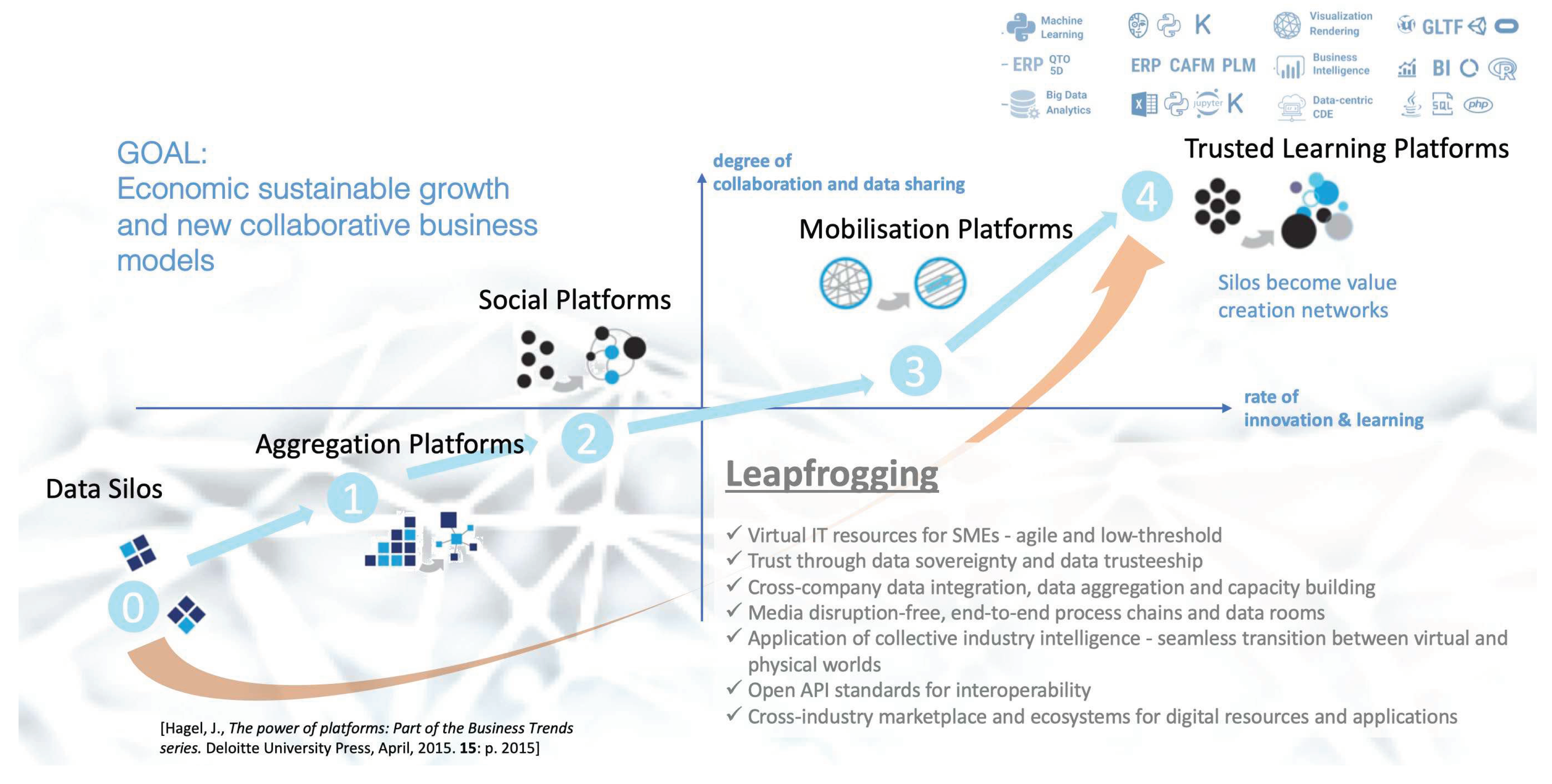
Figure 2.
Research methodology consisting of desktop research (WP1), user interviews (WP2), demonstrator blueprint (WP3) and platform implementation (WP4); based on authors’ own depiction.
Figure 2.
Research methodology consisting of desktop research (WP1), user interviews (WP2), demonstrator blueprint (WP3) and platform implementation (WP4); based on authors’ own depiction.
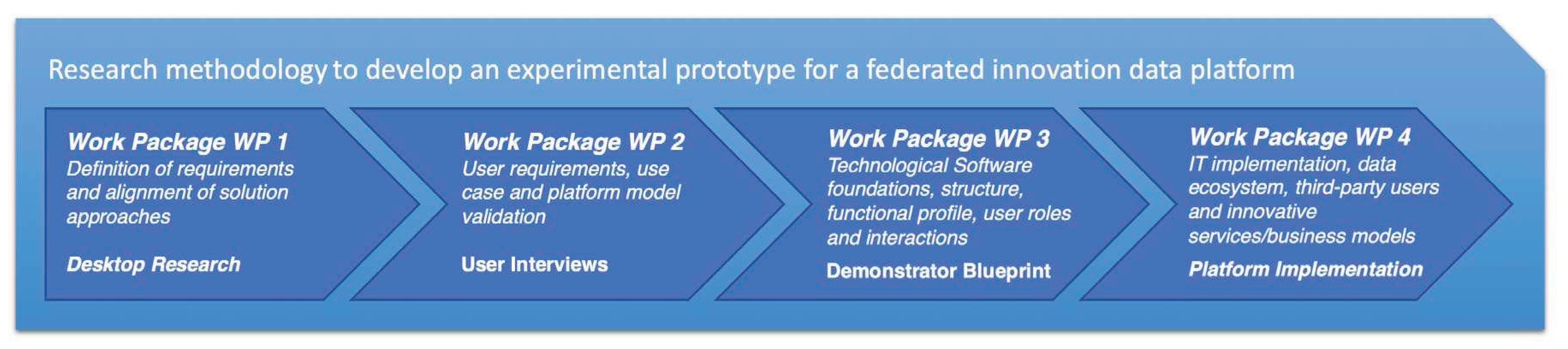
Figure 3.
The Federated Innovation Platform prototype (WP3 and 4): A visual representation of the platform's regulatory concept, user roles and interactions, and integration of in-house and third-party services, showing how data flows and interface requirements are formalized, and how hardware and cloud services are set up and configured according to the state of the art. Depicting also the software engineering principles for data management, federated platform functions and user interaction that are implemented in the platform (from authors’ own research and depiction of federated infrastructure platform concept [1], [11] according to IDSA Reference Architecture model [27]).
Figure 3.
The Federated Innovation Platform prototype (WP3 and 4): A visual representation of the platform's regulatory concept, user roles and interactions, and integration of in-house and third-party services, showing how data flows and interface requirements are formalized, and how hardware and cloud services are set up and configured according to the state of the art. Depicting also the software engineering principles for data management, federated platform functions and user interaction that are implemented in the platform (from authors’ own research and depiction of federated infrastructure platform concept [1], [11] according to IDSA Reference Architecture model [27]).
Figure 5.
Reference Architecture Framework for construction digital platforms (reprinted with permission from [59]).
Figure 5.
Reference Architecture Framework for construction digital platforms (reprinted with permission from [59]).
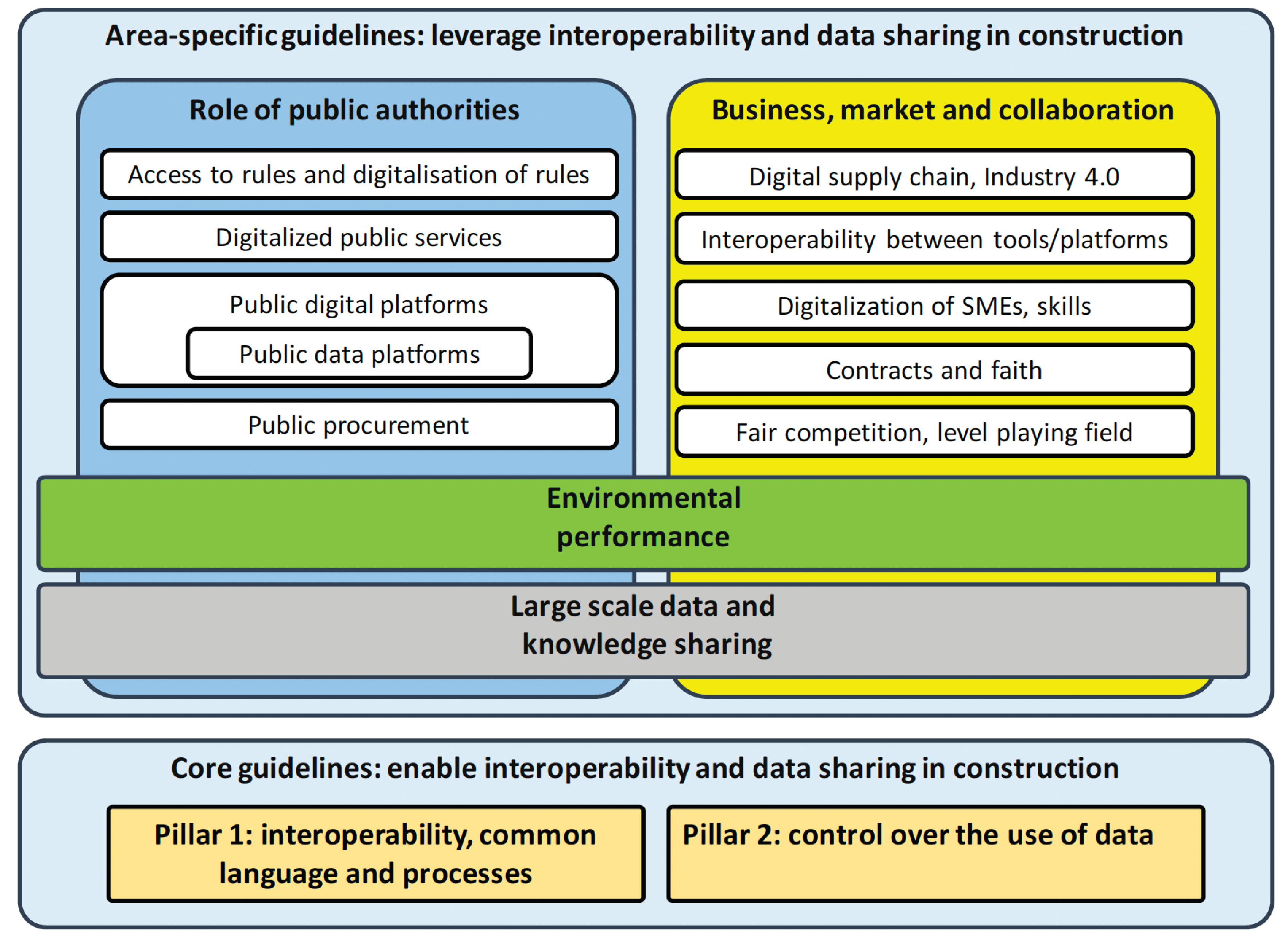
Figure 6.
Five dimensions of implementing a mobilization and learning platform (authors’ own research and depiction [1]).
Figure 6.
Five dimensions of implementing a mobilization and learning platform (authors’ own research and depiction [1]).
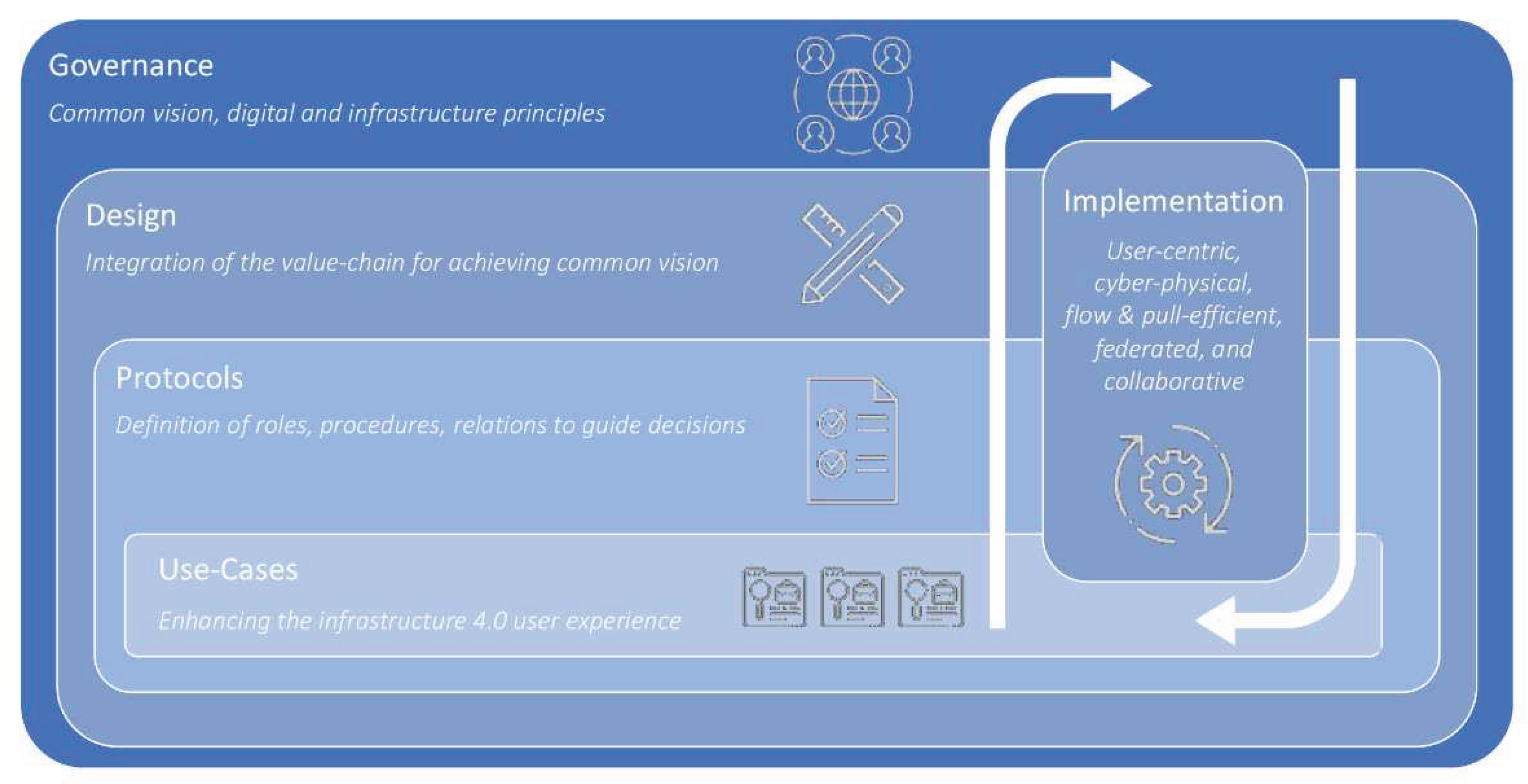
Figure 7.
Exemplary use cases of a data cooperative: Digital interfaces, data exchange formats and structure, adapted from the Reference Architecture Model Industry 4.0 (RAMI 4.0, reprinted with permission of [68]).
Figure 7.
Exemplary use cases of a data cooperative: Digital interfaces, data exchange formats and structure, adapted from the Reference Architecture Model Industry 4.0 (RAMI 4.0, reprinted with permission of [68]).
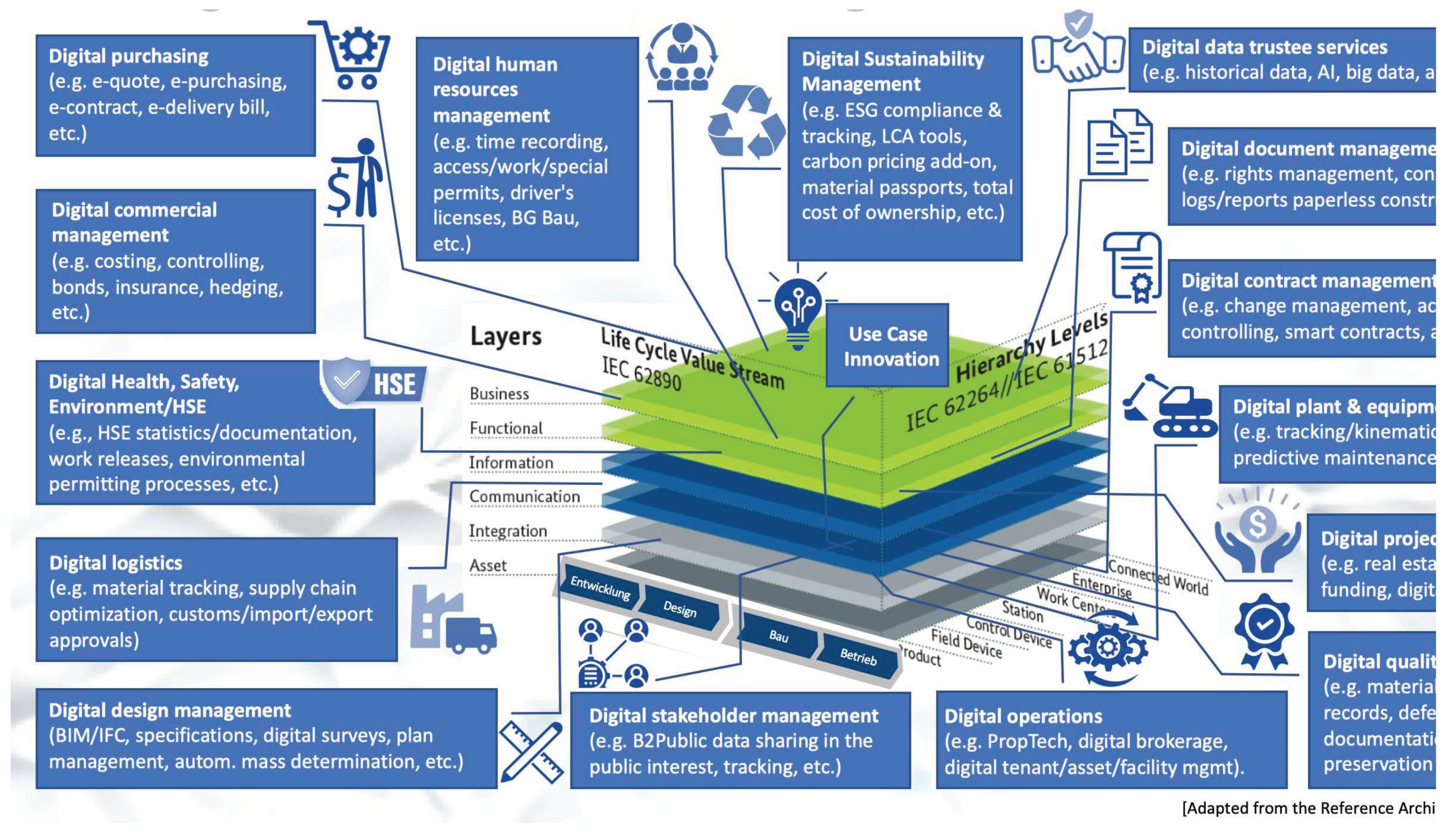
Figure 8.
Types of governance for trustworthhy digital collaboration (authors’ own research and depiction).
Figure 8.
Types of governance for trustworthhy digital collaboration (authors’ own research and depiction).
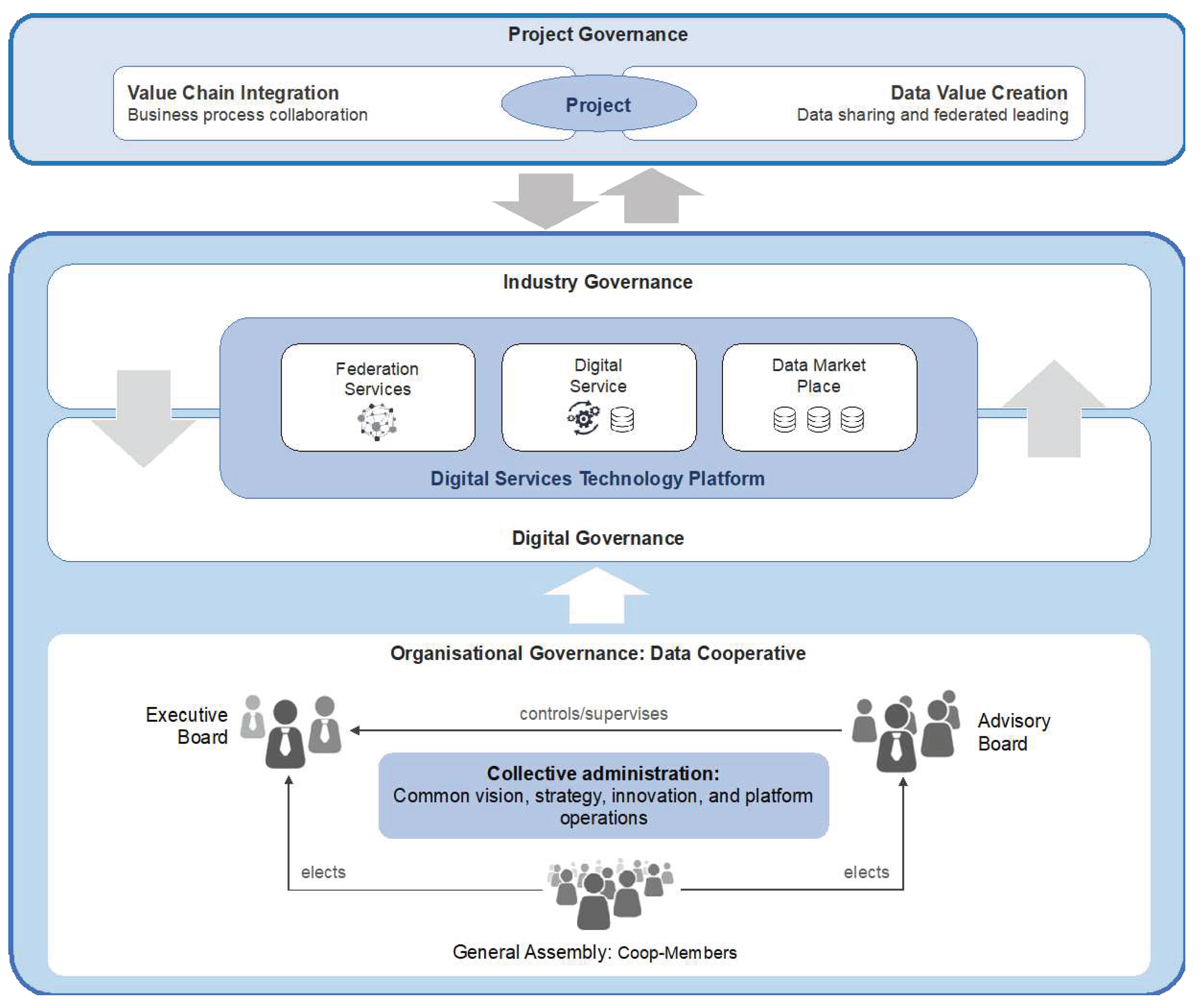

Table 1.
Pre-selected exemplary and scalable use cases for the federated innovation platform. The prioritization is based on a non-representative industry survey, in which we asked the following question: Which of these known use cases should be prioritized for open standardized interfaces (APIs) and collaborative federated data spaces in the context of data cooperatives for the construction and real estate industries? (* survey of 61 experts from construction and 23 experts from real estate industry, highest priority > 10 points, high priority > 7 points, top 3 priorities in bold)
Table 1.
Pre-selected exemplary and scalable use cases for the federated innovation platform. The prioritization is based on a non-representative industry survey, in which we asked the following question: Which of these known use cases should be prioritized for open standardized interfaces (APIs) and collaborative federated data spaces in the context of data cooperatives for the construction and real estate industries? (* survey of 61 experts from construction and 23 experts from real estate industry, highest priority > 10 points, high priority > 7 points, top 3 priorities in bold)
| Use Case Title | Use Case Examples | Category | Priority* |
|---|---|---|---|
| Standardized purchasing platforms |
e.g. e-quote, e-purchasing, e-contract, e-delivery bill, etc. | commercial management |
construction (8.93), real estate (4.61) |
| Smart commercial processes |
e.g., digital invoice verification, costing, controlling, bonds, insurance, hedging, etc. | commercial management |
construction (9.72), real estate (7.78) |
| Easy Health, Safety, Environment (HSE) |
e.g., HSE statistics/documentation, work releases, environmental permitting procedures, etc. | health and safety | construction (6.80), real estate (1.44) |
| Intelligent construction logistics | e.g., synchronization with the production process, material tracking, supply chain optimization, customs/import/export permits, etc. | logistics, supply chain management | construction (12.46), real estate (5.09) |
| Agile design coordination |
e.g., collaborative openBIM, digital surveys, digital design management, digital as-built/mass determination, etc. | asset design | construction (9.66), real estate (5.70) |
| B2Public data sharing in the public interest | e.g., digital stakeholder management, issue/sentiment tracking, etc. | data sharing | construction (6.21), real estate (1.96) |
| Collaborative quality and defect management |
e.g. material testing, manufacturing protocols, digital defect management and documentation, as-built documentation, preservation of evidence, etc. | asset production |
construction (9.54), real estate (7.65) |
| Lean Construction 4.0 | e.g. networking of production data, collaborative kinematics/operating characteristics tracking, cycle planning/control, predictive maintenance, etc. | asset production |
construction (10.41), real estate (5.44) |
| Intelligent contract controlling |
e.g. change management, acceptances, digital contract management, smart contracts, approvals, etc. | commercial management |
construction (9.10), real estate (5.91) |
| Cooperative workflow management |
e.g. document management, rights management, construction diary, protocols/reports paperless construction site, etc. | asset communication |
construction (9.53), real estate (5.17) |
| Data fiduciary services for smart collaboration | e.g., pre-competitive Big Data/KI analysis of historical construction & operational data, etc. | data sharing | construction (7.25), real estate (4.17) |
| Digital sustainability management | e.g. ESG compliance & tracking, LCA tools, carbon pricing, material passports, total cost of ownership, etc. | asset communication |
construction (7.77), real estate (11.35) |
| Digital HR management |
e.g. time recording, access/work/special permits, driver's licenses, BG Bau, etc. | asset production |
construction (8.71), real estate (2.13) |
| Use case innovations | e.g., other case studies that have not yet been or cannot be mentioned here | innovation management |
construction (2.74), real estate (0.87) |
| Intelligent operating concepts | e.g. PropTech, digital tenant/asset/facility mgmt, etc. | asset operations |
construction (7.07), real estate (8.17) |
| Collaborative project development | e.g., digital RE development tools/databases, real estate FinTech, digital crowdfunding, etc. | asset development |
construction (8.48), real estate (3.13) |
| Digital building permits |
e.g., open, standardized interfaces with the public sector for faster and more transparent approval processes | asset development |
construction (9.30), real estate (7.57) |
* based on industry survey.
Disclaimer/Publisher’s Note: The statements, opinions and data contained in all publications are solely those of the individual author(s) and contributor(s) and not of MDPI and/or the editor(s). MDPI and/or the editor(s) disclaim responsibility for any injury to people or property resulting from any ideas, methods, instructions or products referred to in the content. |
© 2023 by the authors. Licensee MDPI, Basel, Switzerland. This article is an open access article distributed under the terms and conditions of the Creative Commons Attribution (CC BY) license (http://creativecommons.org/licenses/by/4.0/).
Copyright: This open access article is published under a Creative Commons CC BY 4.0 license, which permit the free download, distribution, and reuse, provided that the author and preprint are cited in any reuse.


