
Submitted:
14 January 2023
Posted:
17 January 2023
You are already at the latest version
Abstract
Inspired by Dirac's large number hypothesis (LNH), Zeldovich proposed a relation between the cosmological constant (CC), the mass of a proton, the Planck constant and Newton's gravitational constant. Zeldovich's formula suggests that the substance which is responsible for CC may interact with elementary particles. Since Newton's gravitational constant and the Planck constant appear in Zeldovich's formula, these interactions may be related to gravitational phenomena and quantum phenomena. Following this clue, we propose a liquid droplet model of electron. Applying the Laplace's equation, Zeldovich's formula of CC is derived. Weinberg proposes a relation between the mass of a pion, the Planck constant, the Hubble constant, Newton's gravitational constant and the velocity of light in vacuum when discussing cosmological models with a varying constant of gravitation. Weinberg pointed out that this relation may not merely be regarded as a meaningless random combinations of these fundamental constants in physics. The Weinberg's relation is derived based on the critical mass density formula in the Friedmann model of the universe and Zeldovich's formula.
Keywords:
Zeldovich's formula
; Weinberg's relation
; cosmological constant
; dark energy
; droplet
; surface tension
1. Introduction
In 1967, inspired by the remarks of Eddington, Dirac and other authors concerning the curious numerical relations in cosmology, Y. B. Zeldovich proposes the following relation [1,2]
where is CC, G is Newton’s gravitational constant, is the mass of a proton, , h is the Planck constant, is a dimensionless parameter.
In 2008, C. G. Boehmer and T. Harko propose the following formula of CC [3]
where is the mass of an electron, e is the charge of an electron, c is the velocity of light in vacuum.
The Boehmer-Harko formula Eq. (3) can also be written as the same form of Zeldovich’s formula Eq. (1).
In 2009, C. Beck derive the following formula of CC based on four axioms [5]
where is the mass of an electron, is the low-energy limit of the fine structure constant.
The Beck’s formula Eq. (5) can also be written as the same form of Zeldovich’s formula Eq. (1). The predicted cosmological constant according to the Beck’s formula Eq. (5) is about higher than the observed value ([6], p. 138).
The third independent method to construct similar formula of CC is based on the Dirac’s LNH [4]. Eq. (3) and Eq. (5) are used to study some varying cosmological constant models and warm dark matter [4].
Zeldovich’s formula Eq. (1) is a conjecture inspired by Dirac’s LNH [1,2]. Zeldovich’s formula Eq. (1) suggests that the substance responsible for CC may interact with the substances which constitute elementary particles. Since Newton’s gravitational constant G and the Planck constant h appear in Eq. (1), Zeldovich’s formula may be related to gravitational phenomena and quantum phenomena. However, the physical foundations of Zeldovich’s formula Eq. (1) are still unknown. In this manuscript, we propose a theoretical derivation of Zeldovich’s formula Eq. (1) based on the theory of vacuum mechanics (VM) [7].
In 1972, S. Weinberg proposes the following relation when discussing cosmological models with a varying constant of gravitation ([8], p. 619)
where is the mass of a pion, is the Hubble constant, is a dimensionless parameter.
S. Weinberg pointed out that Eq. (6) may not merely be regarded as a meaningless random combinations of ℏ, , G and c ([8], p. 620). He thought that Eq. (6) may be a possible clue, which suggests that Dirac’s large numbers may be determined partly by the influence of the whole universe ([8], p. 619).
In 2008, A. Alfonso-Faus proposed a derivation of Weinberg’s relation Eq. (6) based on Newton’s universal gravitation and momentum conservation laws [9]. He proposed that Zeldovich’s formula Eq. (1) is equivalent to Weinberg’s relation Eq. (6) [10]. Therefore, he thought that the speed of light must be proportional to the Hubble parameter and thus decrease with time [10]. Using Weinberg’s relation Eq. (6), he proposed that the self gravitational potential energy of any fundamental particle is independent of the mass of the particle [11].
According to Hubble’s law, redshift of galaxies proportional to the distance of those galaxies, indicating a recession velocity of those galaxies proportional to the distance ([12], p. 395). In 1990-1999 two groups observed that the expansion of universe is accelerating ([13], p. 112). The concept `dark energy’ is commonly regarded as the origin of the observed accelerated expansion of the universe ([6], p. 490). Since the Hubble constant appears in Weinberg’s relation Eq. (6), it is a natural idea that Eq. (6) may be related to dark energy. Following this clue, in this manuscript we propose a derivation of the Weinberg’s relation Eq. (6).
2. A liquid droplet model of electron
Because P. A. M. Dirac was not satisfied with quantum electrodynamics, he suggested an ether hypothesis ([14], p. 201). P. A. M. Dirac’s ether hypothesis may also be enlightening for the cosmological constant problem (CCP).
In 2022, we propose a mechanical model of vacuum and derive CC [7]. Vacuum is supposed to be filled with two kinds of continuums which may be called the and substrata [7].
On August 17th 2017, the gravitational-wave (GW) event GW170817 and the gamma-ray burst (GRB) event GRB 170817A were observed independently [15]. The observed time delay of between GRB 170817A and GW170817 shows that the difference between the speed of GW and the speed of light is limited between and , where c is the speed of light in vacuum [15].
According to VM [16], GW is the propagations of tensorial potential of gravitational fields in vacuum. The speed c of light in vacuum is the speed of transverse elastic waves in the substratum [17]. The substratum may be regarded as a new version of the the electromagnetic ether in the history [17]. Since the speed of GW coincides with the speed c of transverse elastic wave in the substratum, then the substratum is the medium which propagates the tensorial potential of gravitational fields. Therefore, the hypothetical substratum in Ref. [7] seems to be unnecessary.
The particles that constitute the substratum may be called the particles [7]. The particles are sinks in the substratum [7]. For a macroscopic observer with whose time scale is very large comparing to the Maxwellian relaxation time of the substratum, vacuum behaves like a Newtonian-fluid. Based on some assumptions, we have the following equation of state of vacuum [7]
where is the pressure of vacuum, is the energy density of vacuum.
Liquid drop models have been proposed to describe the the nuclear binding energies since 1935 [18]. Weizsäcker and Bethe’s concept of nuclear drop was used to explain the nuclear fission phenomenon by Meitner, Frisch, Bohr and Wheeler [18]. The behaviors of nuclear matter is similar to incompressible liquids. In N. Bohr’s liquid drop model of complex nuclei, the nucleus is treated as a droplet of continuous medium ([19], p. 91). P. A. M. Dirac suggested a spherical model of electron ([14], p. 203).
In VM [7], the substratum is proposed to act as the concept of dark energy. We introduce the following assumption.
Assumption 1
where is the mass density of vacuum, is the mass densities of the substratum, is the energy densities of the substratum.
Inspired by the concept of nuclear drop in the history [18], we introduce the following assumption.
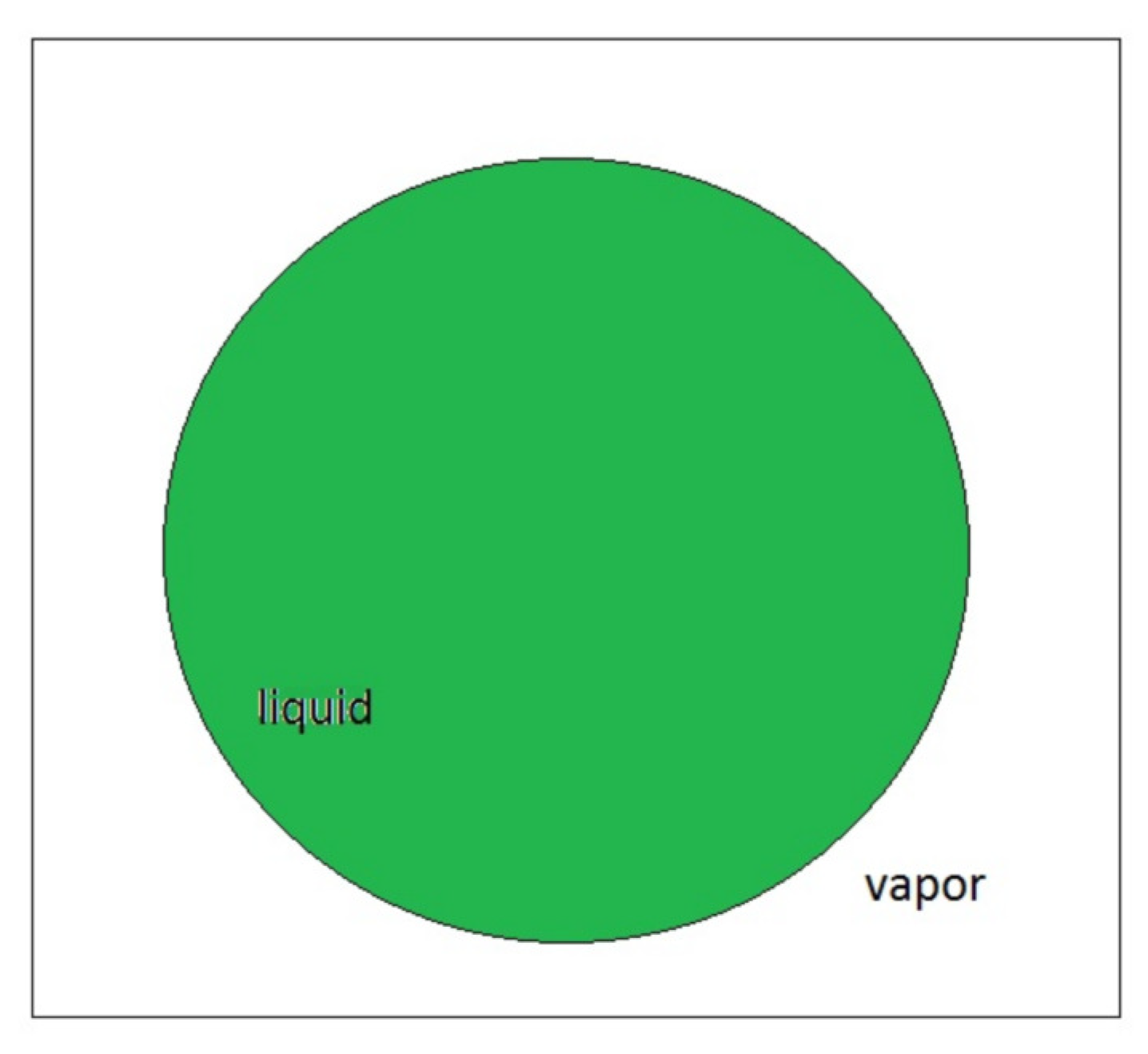
Assumption 2. Vacuum is approximately modelled as a vapor phase, which is composed of the particles. An electron is approximately modelled as a spherical liquid droplet in vacuum, which is also composed of the particles.
Figure 1 is an illustration of the liquid droplet model of an electron.
3. The Laplace equation of an electron based on the theory of capillarity
A relation between the pressures of liquid phase and vapor phase of a liquid droplet was derived from mechanical equilibrium conditions of the liquid-vapor interface in 1805 independently by T. Young [20] and by P. S. Laplace [21]. Lord Kelvin also obtained this equation in 1858-1859 [22,23]. This equation can be written as ([24], p. 7)
where and are the pressures of liquid phase and vapor phase respectively, R is radius of the spherical droplet, is the surface tension of the liquid-vapor interface.
Eq.(10) is called the Laplace’s equation ([24], p. 7). The aforementioned theories are called mechanical theory of capillary phenomena ([24], p. 7).
In order to keep an electron from exploding, P. A. M. Dirac’s model of electron should be supplied with a non-Maxwellian surface force ([14], p. 204). Such a surface force was introduced by Poincare in pre-relativistic electron theories in 1906 ([14], p. 204).
Poincare’s concept of surface force of an electron is inspiring. According to Assumption 2, the pressures of the vapor phase of an electron is the pressure of vacuum. Applying the Laplace’s equation (10) to an electron, we have
where is the pressure of the liquid phase in the spherical electron, is the pressure of vacuum, is the surface tension of the liquid-vapor interface of the spherical electron, is the radius of the spherical electron.
4. Derivation of Zeldovich’s formula of CC
Next, we need to calculate the quantities , and in the Laplace’s equation (11).
Firstly, we calculate the quantity . According to Assumption 2, an electron is composed of the particles. The gravitational constant G is a constant in the general theory of relativity (GR) [8,25,26]. However, in VM [27], the gravitational constant G depends on the density of the substratum. If depend on time and position in space, then G may also depend on time and position. Based on VM [27], there exists the following gravitational interaction between two particles in an electron
where
is the mass of monad at time t, is the strength of a monad, is the mass of a particle at time t, is the density of the substratum in the electron, is the unit vector directed along the line from a particle at to another at , is the force acting on the particle at by another at .
The gravitational potential energy of the particles in an electron is
where
is the mass density of the liquid phase in the electron, r is the distance between the field point and the center of the electron.
The gravitational potential energy density of the particles in an electron is
where is the volume of the electron.
Inspired by Eq. (7), we introduce the following assumption
Assumption 3.
where is a dimensionless parameter.
Secondly, we calculate the quantity . Since the hypothetical substratum in Ref. [7] seems to be unnecessary, we set in Eq. (104) of Ref. [7] and obtain the following relationship
Noticing Eq. (), Eq. (21) can be written as
Thirdly, we calculate the surface tension . The liquid droplet model of electron in Assumption 2 is established by an analogy of the liquid drop model of nuclear in the history. According to the theory of capillary phenomena, surface tension can be regarded as the surface energy per unit area ([24], p. 5). Thus, the surface energy of an electron is
Assumption 4. The surface energy of an electron is proportional to negative value of the gravitational potential energy of the particles in the electron, i.e.,
where is a dimensionless parameter.
We use the following notation
where is a dimensionless parameter.
The electron radius in the international system of units (SI) is ([28], p. 1183)
where
is the fine-structure constant, e is the electron charge, is the permittivity constant of vacuum, , h is Planck’s quantum of action.
We introduce the following notation
where is a dimensionless parameter.
5. Derivation of Weinberg’s relation of CC
We will explore the possibility of a derivation of Weinberg’s relation Eq. (6). According to the Friedmann model () of the universe, the sign of curvature of the spacetime is determined by the mass density of the universe and the Hubble constant ([29], p. 398). Therefore, there exists a critical mass density ([29], p. 398)
where is the critical mass density of the universe.
Thus, the critical energy density of the universe is
where is the critical mass density of the universe.
We introduce the following notation
where is a dimensionless parameter.
Applying Zeldovich’s formula Eq. (34), Eq. (40) can be written as
where is a dimensionless parameter.
We introduce the following notation
where is a dimensionless parameter.
6. Discussion
P. A. M. Dirac’s dimensionless large numbers in the Centimeter-Gram-Second (CGS) system of units can be written as ([30], p21)
where is the age of the universe.
P. A. M. Dirac speculates that these two large numbers Eqs. (44-45) are related to the age of the universe ([31], p74). However, there are no convincing explanations of why these mysterious Dirac’s large umbers Eqs. (44-45) should appear.
7. Conclusion
The observed time delay of between GRB 170817A and GW170817 shows that the speed of GW equals the speed of light in vacuum. Then the substratum, or we call the electromagnetic ether, is the medium which propagates the tensorial potential of gravitational fields. Thus, the hypothetical substratum in a previous model of vacuum seems to be unnecessary. Therefore, vacuum is approximately modelled as a vapor phase, which is composed of the particles. An electron is approximately modelled as a spherical liquid droplet in vacuum. The Zeldovich’s formula of CC is derived by applying the Laplace’s equation. Weinberg’s relation may be a possible clue which suggests that Dirac’s large numbers may be determined partly by the influence of the whole universe. Thus, the Weinberg’s relation is derived based on the critical mass density formula in the Friedmann model of the universe and Zeldovich’s formula.
References
- Y. B. Zeldovich. The cosmological constant and the theory of elementary particles. Soviet Physics Uspekhi, 11:381–393, 1968.
- V. Sahni and A. Krasinski. Republication of: The cosmological constant and the theory of elementary particles (by ya. b. zeldovich). General Relativity and Gravitation, 40:1557–1591, 2008.
- C. G. Boehmer and T. Harko. Found. Phys., 38:216, 2008.
- H. Wei, X.-B. Zou, H.-Y. Li, and D.-Z. Xue. Cosmological constant, fine structure constant and beyond. The European Physical Journal C, 77:14, 2017.
- C. Beck. Axiomatic approach to the cosmological constant. Phys. A, 388:3384–3390, 2009.
- P. A. Zyla and et al. Review of particle physics, particle data group. Prog. Theor. Exp. Phys., 2020:083C01, 2020.
- Xiao-Song Wang. A theoretical calculation of the cosmological constant based on a mechanical model of vacuum, accepted. Reports on Mathematical Physics, 90(1):1–24, 2022.
- S. Weinberg. Gravitation and cosmology: principles and applications of the general theory of relativity. John Wiley & Sons Inc., New York, 1972.
- A. Alfonso-Faus. The speed of light and the hubble parameter: the mass-boom effect. Astrophysics and Space Science, 315:117–123, 2008.
- A. Alfonso-Faus. Zel’dovich λ and weinberg’s relation: an explanation for the cosmological coincidences. Astrophysics and Space Science, 318:25–29, 2008.
- A. Alfonso-Faus. Universality of the self gravitational potential energy of any fundamental particle. Astrophysics and Space Science, 337:363–365, 2012.
- H. C. Ohanian and R. Ruffini. Gravitation and Spacetime, 3rd edition. Cambridge University Press, New York, 2013.
- G. Byrd, A. D. Chernin, P. Teerikorpi, and M. Valtonen. Paths to Dark Energy Theory and Observation. Walter de Gruyter GmbH & Co., Berlin, 2012.
- H. Kragh. Dirac, A Scientific Biography. Cambridge Uaiversity Press, Cambridge, 1990.
- B. P. Abbott and et al. Gravitational waves and gamma-rays from a binary neutron star merger gw170817 and grb 170817a. The Astrophysical Journal Letters, 848:L13, 2017.
- Xiao-Song Wang. Derivation of generalized einstein’s equations of gravitation in some non-inertial reference frames based on the theory of vacuum mechanics. Reports on Mathematical Physics, 87(2):183–207, 2021.
- Xiao-Song Wang. Derivation of maxwell’s equations based on a continuum mechanical model of vacuum and a singularity model of electric charges. Progress in Physics, 2:111–120, 2008.
- K. Pomorski and J. Dudek. Nuclear liquid-drop model and surface-curvature effects. Phys. Rev. C, 67:044316, 2003.
- V. Zelevinsky and A. Volya. Physics of Atomic Nuclei, First Edition. Wiley-VCH Verlag GmbH & Co. KGaA, Weinheim, 2017.
- T. Young. An essay on the cohesion of fluids. Philos. Trans. Roy. Soc. London, 95:65–87, 1805.
- P.-S. Laplace. Traite de mecanique celeste, supplement to Volume 4. Courcier, Paris, 1805.
- W. Thomson. Philos. Trans. Roy. Soc. London, 9:255, 1858.
- W. Thomson. Phil. Mag., 17:61, 1859.
- J. S. Rowlinson and B. Widom. Molecular Theory of Capillarity. Clarendon Press, Oxford, 1982.
- C. Moller. The theory of relativity, second edition. Clarendon Press, Oxford, 1972.
- C. Misner, K. Thorne, and J. Wheeler. Gravitation. Freeman, New York, 1973.
- Xiao-Song Wang. Derivation of the newton’s law of gravitation based on a fluid mechanical singularity model of particles. Progress in Physics, 4:25–30, 2008.
- W. Benenson, J. W. Harris, H. Stocker, and H. Lutz. Handbook of physics. Springer, New York, 2002.
- L. D. Landau and E. M. Lifshitz. The Classical Theory of Fields, 4th revised English edition, translated from the Russian by Morton Hamermesh. Butterworth Heinemann, Amsterdam, 1994.
- H. Kragh. Varying Gravity, Dirac’s Legacy in Cosmology and Geophysics. Springer, Heidelberg, 2016.
- P. Dirac. Directions in Physics. John Wiley & sons, New York, 1978.
Figure 1.
An illustration of the liquid droplet model of an electron.
Disclaimer/Publisher’s Note: The statements, opinions and data contained in all publications are solely those of the individual author(s) and contributor(s) and not of MDPI and/or the editor(s). MDPI and/or the editor(s) disclaim responsibility for any injury to people or property resulting from any ideas, methods, instructions or products referred to in the content. |
© 2023 by the authors. Licensee MDPI, Basel, Switzerland. This article is an open access article distributed under the terms and conditions of the Creative Commons Attribution (CC BY) license (http://creativecommons.org/licenses/by/4.0/).
Copyright: This open access article is published under a Creative Commons CC BY 4.0 license, which permit the free download, distribution, and reuse, provided that the author and preprint are cited in any reuse.