

Submitted:
05 January 2023
Posted:
09 January 2023
You are already at the latest version
Abstract
Nowadays, frameworks and models are critical to enabling organizations to identify their current sustainability integration into business and to follow up on these initiatives over time. In this context, the maturity models offer a structured way of analyzing how a supply chain meets specific sustainability requirements and which areas demand attention to reach maturity levels. This study proposes a five-level maturity model to help supply chains identify their level of engagement with sustainability practices combining three perspectives: intra and inter-organizational sustainability practices, triple-bottom-line approach and critical areas for sustainability. All the steps followed in constructing the maturity model were based on a literature review, and case studies supported its improvement, application, and testing. The proposed model presents many advantages, such as being used as a self-assessment tool, a roadmap for sustainability behaviour improvement, and a benchmarking tool to evaluate and compare standards and best practices among organizations and supply chains.
Keywords:
Maturity Model
; Sustainability assessment
; Supply Chain
; Intra- and inter-organizational perspec-tive
; TBL dimensions
1. Introduction
Companies are rethinking their SC operations, considering their SC environmental and social impacts (Chaabane et al., 2012; Dai et al., 2021). This has given rise to the concept of Sustainable Supply Chain Management (SSCM), which refers to the management of material, information, and capital flow as well as cooperation among companies throughout the supply chain, considering the Triple Bottom Line (TBL) based on customers’ and other stakeholders’ requirements (Seuring & Müller, 2008). Hynds et al. (2014, p. 50) argue that “achieving true sustainability means integrating TBL concerns into all aspects of a business” and Müller & Pfleger (2014, p. 313) defend that “sustainability is not achieved by single actions, but rather is an on-going process”. Hepper et al. (2017) highlight the importance of frameworks and models to enable organizations to identify their current level of sustainability integration into their business, establish more advanced integration levels, and follow up on these initiatives over time. However, it seems that most of the existing frameworks do not account for either environmental and social issues (Schalteger & Burritt, 2014), nor cultural change and the involvement of its internal and external stakeholders (Zhang et al., 2013; Negri et al., 2021). Few tools and frameworks within the company or SC consider the TBL (Correia et al., 2018).
A maturity model (MM) allows describing a current state and “offers a structured way of analyzing how an organization meets certain requirements and which areas demand attention to reach mature levels” (Aguiar & Jugend, 2022, p. 3). Since a MM is a conceptual framework made up of parts that describe the development of a particular area of interest over time (Klimko, 2001) or, as Cuenca et al. (2013) state, a framework that describes a specific system over time, it is a valuable tool for analysis and evaluation when applied to SC sustainability (Correia et al., 2017). To Müller and Pfleger (2014), sustainability MMs are prominent examples of sustainability measurement systems. According to these authors, “the basic idea of [sustainability] maturity models [...] can be used to evaluate a company’s state with regards to sustainability objectively, and thus provides organizations with a sensible tool to manage their sustainability capability” (Müller & Pfleger, 2014, p. 315). Thus, the development of MMs in the scope of SC sustainability is relevant because: it is a descriptive tool for evaluate strengths and weaknesses; it is an instrument to help develop a roadmap for performance improvement; and it is a comparative tool to evaluate processes/organizations and compare them with the standards and best practices of other organizations, allowing them to implement external benchmarking (Klimko, 2001; Röglinger et al., 2012; Moultrie et al., 2016).
The lack of procedures for evaluating and operating MMs may be a barrier that prevents their use as a management and diagnostic tool (Santos-Neto & Costa, 2019). Also, there needs to be more empirical work to confirm the validity and usefulness of sustainability MMs (Correia et al., 2017). Considering these research gaps, the objective of this paper is to propose a MM with a holistic approach to sustainability to assess the level of sustainability at individual company and SC levels by considering three integrative perspectives: (1) Intra- and inter-organizational sustainability practices involving various SC partners, (2) TBL perspective, (i.e., economic, social, and environmental sustainability dimensions), (3) critical areas for sustainability considering the Sustainability governance, Product and process level, Customer and supplier management, and Stakeholder focus.
This paper is organized as follows: first, we report the findings of a literature review on sustainability MMs; then, the research methodology followed in this study is described; after that, the different phases followed for the development of the sustainability MM are described, including its proposal and test; and in the end, some conclusions are drawn.
2. Background
With the growing interest in sustainability issues (Chardine-Baumann & Botta-Genoulaz, 2014), several instruments have emerged, and others have been adapted to assist their integration into companies and SC. The institutionalization of sustainability issues has led to the emergence of standardized management systems (e.g., ISO 14000, SA 8000), guidelines and official recommendations for environmental and social reporting (e.g., GRI guidelines), and tools for measuring corporate sustainability (Life Cycle Assessment, sustainability balanced scorecard) (Hassini et al., 2012; Müller & Pfleger, 2014; Saeed & Kersten, 2020). While some of these instruments are more focused on issues related to one of the dimensions of sustainability, there are internationally recognized frameworks that take a holistic approach by considering the social, environmental, and economic aspects of sustainability (e.g., GRI guidelines) (Saeed & Kersten, 2020). Labuschagne et al. (2005) point out that many sustainability assessment frameworks are inconsistent regarding their purpose (reporting, monitoring, rating, management, or performance assessment), are indicator-based, and, for the most part, their focus is not on the entire organization.
From the analysis of the previous instruments (e.g., standards, tools to assess sustainability in individual companies and SC), there seems to be no instrument that simultaneously does the following: i) presents a comprehensive approach to sustainability that considers the three dimensions of sustainability; ii) contemplates the different management-oriented functional/acting areas and concrete actions (structuring the field of action) to be carried out to improve sustainability; iii) considers not only the practices to be developed internally but also those involving its SC and other stakeholders.
Despite the popularity of the MM concept, as pointed out by Wendler (2012), there is no clear definition of the term “maturity model” (Correia et al., 2017). A MM can be understood as “a conceptual framework made up of parts that describe the development of a particular area of interest over time” (Pigosso et al., 2013). We have adopted this definition, as it assumes a comprehensive viewpoint of MMs and does not limit it to a specific area (e.g., project management or processes). The literature shows that MMs can be oriented toward the integration of sustainability in specific areas such as Design (Pigosso et al., 2013), the company (Amini & Bienstock, 2014), or the SC (Santos et al., 2020). Since sustainability incorporates a temporal dimension as it implies a dynamic process of change over time (Lozano, 2008; Negri et al., 2021), the company will benefit from using tools to track its progress toward sustainability efforts. MMs assume an evolutionary perspective considered by Liebetruth (2017) as a potent and flexible tool not only for SC performance measurement and management but also for integrating all aspects of sustainability.
3. Research methodology
Different approaches to developing a MM are presented (e.g., De Bruin et al., 2005; Mettler, 2009); Becker et al., 2009). De Bruin et al. (2005) propose one of the most recognized methodologies for developing MMs (Figure 1). It consists of six iterative phases whereby the results of a given phase may require that a previous phase be revisited for improvement. This study follows the methodology suggested by De Bruin et al. (2005).
The objective of this study is to propose a MM comprising the following phases: scope definition, design, populate and test. The “deploy” phase was excluded from this study because the deployment should be extended to other companies besides those used in the model’s development. The “maintain” phase is related to the need to ensure its update and to provide the necessary conditions (e.g., resources, software) so that the use of the MM lasts. This part is outside this research scope as it deals with the future use of the model. Figure 2 shows the research design followed herein.
One of the decisions to be made in the development of MMs is the choice of the research methods to be used, which influences the scientific and practical quality of the resulting MM (Mettler, 2009). In this study a combination of theory-driven and practitioner-based approaches was used.
A literature review of existing sustainability MMs and their characteristics provided the background knowledge to develop the MM mainly used for the first three phases of MM development (i.e., Scope, Design and Populate). These stages are described further.
The use of exploratory research methods such as the Delphi technique, nominal group technique, focus groups, and case studies are recommended in the literature in the development of MMs (De Bruin et al., 2005; Lasrado et al., 2015). De Bruin et al. (2005) highlight the importance of these methods, especially for the Populate phase, as the literature review is unlikely to provide sufficient information for MM development at this stage. The case study method was also used to improve and validate the proposed MM.
One of the main criticisms of MM is the lack of validation in selecting the MM dimensions or variables (Lasrado et al., 2015). De Bruin et al. (2005) suggest that MMs should be validated considering the model’s constructs and the model instruments’ performance (i.e., scale and assessments procedure). Pöppelbuß & Röglinger (2011) also suggest analyzing the MM usability. In this study the, improvement and validation process took place in two stages: 1) 1st stage of the validation process – the objective is to obtain contributions for the improvement and clarity of several aspects of the design and populate phases, namely: i) in the validation of the areas, practices, and sub-practices; ii) in the allocation of sub-practices to the evolution levels and maturity levels defined based on the literature review, and iii) in the assessment process for determining the maturity level of the areas and the company; 2) 2nd stage of the validation process – the objective is to test the MM resulting from the previous phases (final MM) and validate it based not only on its content (i.e., areas, practices, and respective sub-practices) but the maturity levels. Also, the MM usability (i.e., understandability, ease of use, and practicality) is analyzed, as suggested by Salah et al. (2014) and Pöppelbuß & Röglinger (2011).
3.1. Case study
The case study methodology can be used to study under-researched phenomena, which requires an in-depth study of a few cases (Yin, 2003), as is our case. The use of multiple case studies seemed appropriate for developing our MM. The cases are used to improve and validate the MM in the populate phase and test the model’s final version. Furthermore, the case study allows the target audience of the MM (organizations) to be involved in its development process. Compared to the single case study, this research strategy is more robust and reliable (Baxter & Jack, 2008). Also, it allows an exhaustive and in-depth analysis of different situations (Yin, 2003), providing richer information for the development of the MM. For the case selection, the Portuguese mould industry was focused since Portugal is one of the world’s leading manufacturers in this industry, supplying large multinationals from different sectors (Correia et al., 2021). Sustainability is considered one of this industry’s main challenges (CEFAMOL, 2022), which makes developing a MM for SC sustainability MM a relevant issue.
To find companies interested in participating in the study, the research team contacted the TOP 100 Portuguese companies in the mouldmaking industry (PBA, 2019). Five companies confirmed their interest. These companies are characterized by: i) being small and medium-sized enterprises (SMEs) (number of employees <250; turnover<50 million euros); ii) using a make-to-order production strategy exporting more than 90% of their production; iii) supplying various industries (their main customers are from the automotive industry). Table 1 presents a brief characterization of the companies participating in this study.
The five companies were informed of the study’s objectives, procedures to be followed, and the type of information sought. The companies indicated the experts to be engaged in the study attending to their skills and functions: Managing partner (Company 2 and Company 4); quality and environmental manager (Company 1); Director of quality and maintenance (Company 3), and quality manager (Company 5). These experts were the contact point between the company and the researcher. If necessary, they could discuss with colleagues from other functional areas to get an appropriate answer.
Multiple data collection instruments were used that are considered valid for case studies (Yin, 2003), such as interviews, document collection and analysis, and questionnaires, which also allow for a greater understanding of the phenomenon to be studied (Schoch, 2016). The interviews were conducted after sending a protocol indicating the aspects to be covered in them, as Voss et al. (2002) suggested.
The interview aimed for the researchers to become familiar with the company’s approach to sustainability, present the MM in development and its main elements, and obtain contributions that would improve the MM. In addition to the interviews, three questionnaires were administered with the following intentions: i) the first questionnaire sought to obtain information on areas, practices, and sub-practices to be considered in the MM and allocation of sub-practices by evolution level; adequacy of the MM as to maturity levels; and adequacy as to discrimination criteria to be considered in the MM; ii) the second questionnaire intended to discover the level of application of sub-practices in the company; ii) the third questionnaire was to understand how the company evaluated the MM in managerial terms.
This process was accompanied by secondary data collection, which allowed for a deeper and better understanding of the aspects under analysis and clarified some doubts.
4. Development of Maturity Model
4.1. Scope
The scope will determine the degree of the model application within its domain (Correia et al., 2017). De Bruin et al. (2005) suggested an extensive literature review to understand domain issues deeply. To define the scope of the MM, we ground our search in Correia et al. (2017) and Santos et al. (2020). Following Correia et al. (2017), two characteristics were defined to analyze the MM scope: i) unit of analysis, which is the SC hierarchic level and can range from the process and company to network level; ii) sustainability focus, which is the sustainability dimensions targeted by the MM. These characteristics are highlighted in Table 2.
Table 2’s analysis suggests the following: i) the MMs’ scope ranges from the process, company, and network level; i) some MMs address the maturity considering only the environmental dimension, which according to Correia et al. (2017), makes it difficult “to identify critical elements that contribute to higher levels of sustainability”; ii) many MMs present a TBL approach (but a more detailed analysis of the MMs identified in Table 2 shows that sustainability is mainly treated as a stand-alone element of the TBL); iii) all the MMs with a network scope follow a TBL approach. However, these MMs have some shortcomings. For example, although several sustainability initiatives that address TBL call for interactions and collaboration between organizations, these elements do not receive sufficient attention in MMs; iv) most of the MMs present several limitations, such as a lack of details on distinct sustainability aspects to measure (e.g., Robinson et al., 2006; Standing & Jackson, 2007; Reefke et al., 2014; Vernier, 2016), poor definition of each stage and not even explaining in depth how a company can reach and surpass the maturity levels (e.g., Golinska & Kubler, 2014; Kurnia et al., 2014, Hynds et al., 2014; Gouvinhas et al., 2016; Verrier et al., 2016; Rudnicka, 2016; Machado et al., 2017; Santos et al., 2020).
According to Seuring and Müller (2008), integrating sustainable operations requires companies to engage in SCM practices. Thus, a MM should consider integrating intra- and inter-organizational sustainability practices (across different areas and organizational levels). Measuring a company’s capacity to apply certain practices fulfils an essential purpose of MMs: diagnosing the company’s current situation.
4.2. Design
In the design stage, it is necessary to respond to why the model needs to be developed, how it will be applied, who needs to be involved, and what can be achieved (De Bruin et al., 2005).
Why the model needs to be developed
A MM can be used for three purposes (De Bruin et al., 2005): i) descriptive tool – assessment of strengths and weaknesses (“as-is” assessments); ii) prescriptive tool – development of a roadmap for improvement (“to-be” maturity); iii) comparative tool – evaluation of the company, compared to standards and best practices.
How it will be applied
Most of the sustainability MMs proposed in the literature need to address the implementation of MM or describe in detail the application considering the resources involved. For example, Paz et al. (2015) and Xavier (2017) argue for using a computer software program to facilitate the application of their model, but they do not provide details about it. Pigosso et al. (2013) state that their MM is applied with documents, interviews, questionnaires, and computer resources to collect information about companies’ processes, to understand how it is organized, structured, and documented, and to evaluate which eco-design management practices the company applies. According to Xavier (2017) and Xavier et al. (2020), interviews are the preferred method. Based on the literature review, in this study, we apply and test the MM using interviews, document collection and analysis, and questionnaires as data collection instruments. We suggest the application of structured questionnaires in the future using a computer software program and cloud computing to collect data from respondents regarding intra- and inter-organization sustainability practices.
Who needs to be involved
A MM could be deployed by self-assessment or external auditor (De Bruin et al. 2005). Fraser et al. (2002) emphasize that self-assessments are more beneficial if approached as a team exercise because the team’s involvement contributes to eliminating single-respondent bias and providing an opportunity for consensus and team building. In this work, a self-assessment option of Pigosso et al. (2013) and Xavier (2017) is followed since the suggested MM intends to describe different sustainability dimensions and involves intra- and inter-organization processes to gather different perspectives.
What can be achieved
At this stage, it is essential to specify the number of maturity levels of the model and their definitions. To this end, it is first necessary to clarify what maturity represents. The concept of maturity is usually associated with terms such as competency, capability, or even level of sophistication (De Bruin et al., 2005). Correia et al. (2017) argue that there needs to be a more common understanding of the maturity concept and a guideline for gaining maturity within the SC sustainability domain.
Yimam (2011) argues that two alternatives can contribute to achieving the development of a company’s maturity: i) developing the capacity to employ more advanced and effective practices, techniques, methods and tools; and ii) systematizing and refining the processes/practices that are explicitly defining and documenting, managing, standardizing, measuring, controlling, and continuously improving the organization’s processes/practices. Thus, maturity can be understood as an organization’s ability to use more advanced and effective practices, tools, methods, techniques, and procedures, thereby improving the possibility of achieving process or knowledge goals.
Maturity is a concept that indicates evolution and development. Moving from an initial to a more mature state means that the organization has greater sophistication, capability, or availability of certain specific characteristics (Mettler et al., 2009). In terms of sustainability, Göcer et al. (2018, p. 8) consider that maturity “refers to the level [at which] an organization can scan, seize, comprehend, disseminate, and control sustainability-related issues within itself, across the supply chain and even in the broad organizational environment”. Rudnicka (2016, p. 205) state that “the maturity can be defended as a level of engagement of the whole network and quality of management of the sustainable development in SC”. In this study, maturity can be understood as the level of the organization’s ability to know how to plan, implement and control different types of sustainability issues/practices in its internal operations and in its SC to improve its sustainability performance. The maturity levels highlight predictable patterns about the present and future changes of the object under study (i.e., organization, individual, SC).
In this study, to construct the MM, the maturity levels is considered as a combination of the evolution levels of sustainability practices and their implementation level (IL). We cross some of the previous criteria (i.e., complexity, TBL approach, involvement, proactivity) to differentiate the levels of evolution.
Defining the number of maturity levels is another fundamental element of a MM. There is not a consensus or rule of thumb in the literature about the optimal number of maturity levels. The number ranges from three to six, with five being the number of maturity levels most common (e.g., Pigosso et al., 2013; Golinska &Kubler, 2014; Machado et al., 2017). We also propose a model with five levels. According to Srai et al. (2013, p. 17), this number allows “a sufficient level of granularity to permit differentiation between hierarchies of network maturity whilst still being accessible to the practitioner in terms of making informed choices during applied assessment phases of the work”.
Some MM (e.g., Srai et al., 2013) present no descriptors for the maturity levels. Others do, but the descriptors are different for each MM. Regarding this issue, the proposal of Edgeman and Eskildsen (2014) was followed. Thus, the following more generic descriptors are used: Very low maturity, Low maturity, Moderate maturity, High maturity, and Very high maturity. The definition of each maturity level and individual descriptor result from the comparative analysis of the existing MM, and are presented in more straightforward and specific Appendices A and B. These levels represent the evolution of sustainability MM for SC. The low maturity levels represent less complex sustainability practices’ non-application or incomplete application. The higher levels of maturity represent the application of more complex practices and imply a more substantial involvement of the SC partners and other stakeholders, addressing the three TBL dimensions.
4.3. Populate
In this phase, it is necessary to identify what needs to be measured in the maturity assessment and how it can be measured (De Bruin et al., 2015).
What needs to be measured
De Bruin et al. (2005) suggest that an extensive literature review can be used to identify domain components and subcomponents (what needs to be measured). The MMs are available in the literature addressing sustainability in a vast number and diversity of elements (Correia et al., 2017). To identify areas that are mutually exclusive and collectively exhaustive (De Bruin et al., 2005), the three levels of analysis proposed by Mani et al. (2015) were considered: i) the firm’s operations; ii) the inter-organizational level where strong economic ties are found, involving suppliers, customers, and consumers; iii) the external level, which involves other external stakeholders such as community, NGOs, regulators.
Sustainability practices can be grouped into critical areas considering similarities in features/characteristics. Correia et al. (2018) consider these essential components to assess the evolution of sustainability, addressing an intra-company perspective and the SC perspective. In our study, we consider four main areas that coincide with several critical success factors for implementing a sustainable SC identified in supply chain MMs with sustainability concerns (Correia et al., 2017) (Figure 3). Each area is broken down into a set of sub-areas (i.e., practices), which in turn are broken down into sub-practices that enable their operationalization. Each area of the proposed MM is briefly described as follows: 1) Sustainability governance: focuses on the institutions, structures, and mechanisms that guide, regulate, and control the activities of stakeholders in the SC (Li et al., 2014); ii) Product and process level: Organizations can adopt various practices related to products and processes to improve sustainability. Baumgartner (2013) highlights that implementing corporate sustainability in a balanced fashion requires its introduction at all business levels and in all business processes. Karaosman et al. (2016) point out that a company’s commitment and engagement with sustainability implies integrating social aspects at the product and process level; iii) Customer and supplier management: Supplier management comprises efforts with suppliers in planning and executing joint environmental and social solutions; or supporting suppliers to improve their sustainability performance (Sancha et al., 2016). Customer management reflects a company’s focus on working with customers to understand sustainability-related problems and monitoring activities better to ensure that products are safe for the customer and to identify emerging issues that need to be addressed (Klassen & Vereecke, 2012); iv) Stakeholder focus (not considering customers and suppliers), which includes business initiatives that are not directly related to the company’s SC operations and that may involve regulatory stakeholders and community stakeholders (Okongwu et al., 2013).
How can it be measured
The next step in MM development is to clarify how each area can be measured. The strategies followed by companies to integrate sustainability into their intra- and the inter-organizational process should be carefully and reasonably broken down into several practices to aid its comprehension (Hallstedt et al., 2010). Identifying and systematizing the practices for each area is essential to constructing a MM (Xavier, 2017; Xavier et al., 2020). To describe the practices’ evolution process, either in the company or in its SC, sub-practices need to be identified by levels of evolution (Pigosso et al., 2013; Xavier, 2017).
Based on the literature review on sustainability MMs (e.g., Reefke et al., 2013; Paz et al., 2015; Rudnicka, 2016; Vernier et al., 2016; Subramania et al., 2017; Hynds et al., 2014; Kurnia et al., 2014; Srai et al., 2013; Gouvinhas et al., 2016, Machado et al., 2017), it was first suggested to distribute the sub-practices and their allocation by evolution levels. Table 3 presents examples of sub-practices for each area and their allocation to evolution levels after validation.
It is also necessary to develop evaluation scales that allow for assessing maturity. Various types of scales may be used: 1) binary nominal scales - for ‘yes or no’ decisions and responses and to facilitate the quantitative evaluation process (grades 0 or 1) (Hynds et al., 2014); 2) continuous scales, quantitative (e.g., increasing range 0-5) or qualitative, (e.g., low, medium, high) (Looy et., 2014). Similar to other authors (e.g., Pigosso et al., 2013; Xavier et al., 2020), in this study, it is suggested to measure each sub-practice implementation level using a scale from 1 to 5, whereone1 means “Not implemented or not fully implemented” and 5 means “The sub-practice is fully implemented and embedded in the company processes and continuously improved”. Figure 4 presents the evaluation scale used in this study.
The discrimination criterion establishes the minimum number of practices for each maturity level and how to move from one maturity level to another. The literature presents different suggestions regarding this criterion (e.g., Hynds et al., 2014; Pigosso et al., 2013; Xavier et al., 2020). For example, Pigosso et al. (2013) consider that 100% of practices at an evolution level must have an implementation level greater than or equal to 3 to move from one maturity level to another. An MM with a vast scope and presenting several areas of analysis and with a high number of practices may have a more flexible criterion (Xavier, 2017). For our MM, which fits this type, we adapted the proposal of Xavier et al. (2020), who suggest a percentage of 90%. Figure 5 presents the matrix with the discrimination criteria for each maturity level. An area (e.g., Sustainability Governance) has maturity level 1 if fewer than 90% of its sub-practices associated with evolution level 1 present an implementation level below 3. For an area to have a maturity level of 5, at least 90% of the sub-practices at evolution levels from 1 to 5, must have an implementation level greater than or equal to 3.
4.4. The rationale for improving the Maturity Model
In the 1st stage of the validation process, face-to-face interviews with the experts were conducted. After the presentation and explanation of an initial version of the MM under development, the experts were invited to answer a set of questions, give comments, and propose changes to improve the MM. The following aspects were discussed: i) adequacy of the areas, practices and sub-practices of the MM; ii) allocation of sub-practices by levels of evolution; iii) a number of maturity levels and description of the levels; and iv) discrimination criteria to determine the maturity level.
Experts generally expressed a favorable position concerning the relevance of the areas and practices, the suggested discrimination criteria, and the number of maturity levels. There was no need to make changes to these MM elements.
However, concerning the sub-practices and based on the experts’ comments and suggestions, of the 218 initial sub-practices, 83 were excluded to minimize overlapping concepts and ambiguities. Some sub-practices (20) were modified by changing the sentences or including examples to make them more straightforward and avoid difficulties in their interpretation.
This process resulted in a total of 135 sub-practices that comprise the final version of the MM distributed by the five levels of evolution. In the literature, other MMs present equally high numbers of practices (e.g., Xavier, 2017). According to the experts’ suggestions, some practices were changed from one level of evolution to another. Of the 135 validated practices, the evolution levels of 14 were modified.
Regarding the maturity levels, the experts mentioned the need for greater clarity concerning some descriptions (change of expressions/words used) and the need to make the maturity levels more distinctive. Thus, some changes were introduced in the description of maturity levels to make them more straightforward and specific. Appendix A describes the maturity levels for each MM area following the improvements. Appendix B represents the maturity level of the whole organization and its SC (considering all areas) after implementing the interviewees’ suggestions.
4.5. Maturity Model Proposal
Using the results of the literature review and case studies contributions, the Sustainability MM proposed is illustrated in Figure 6.
4.6. Test of the proposed maturity model
The proposed MM was improved using the five case studies in the test phase. After the application of the MM, the companies were asked to evaluate the MM as a whole. The results of the application and evaluation of the MM are described next.
To test the operationalization of the MM, a questionnaire was designed and used in each case company to indicate the level of implementation for each of the 135 sub-practices that comprise the MM. Based on this data set, each company’s maturity levels were calculated.
4.6.1. Application of the Maturity Model: discussion of results
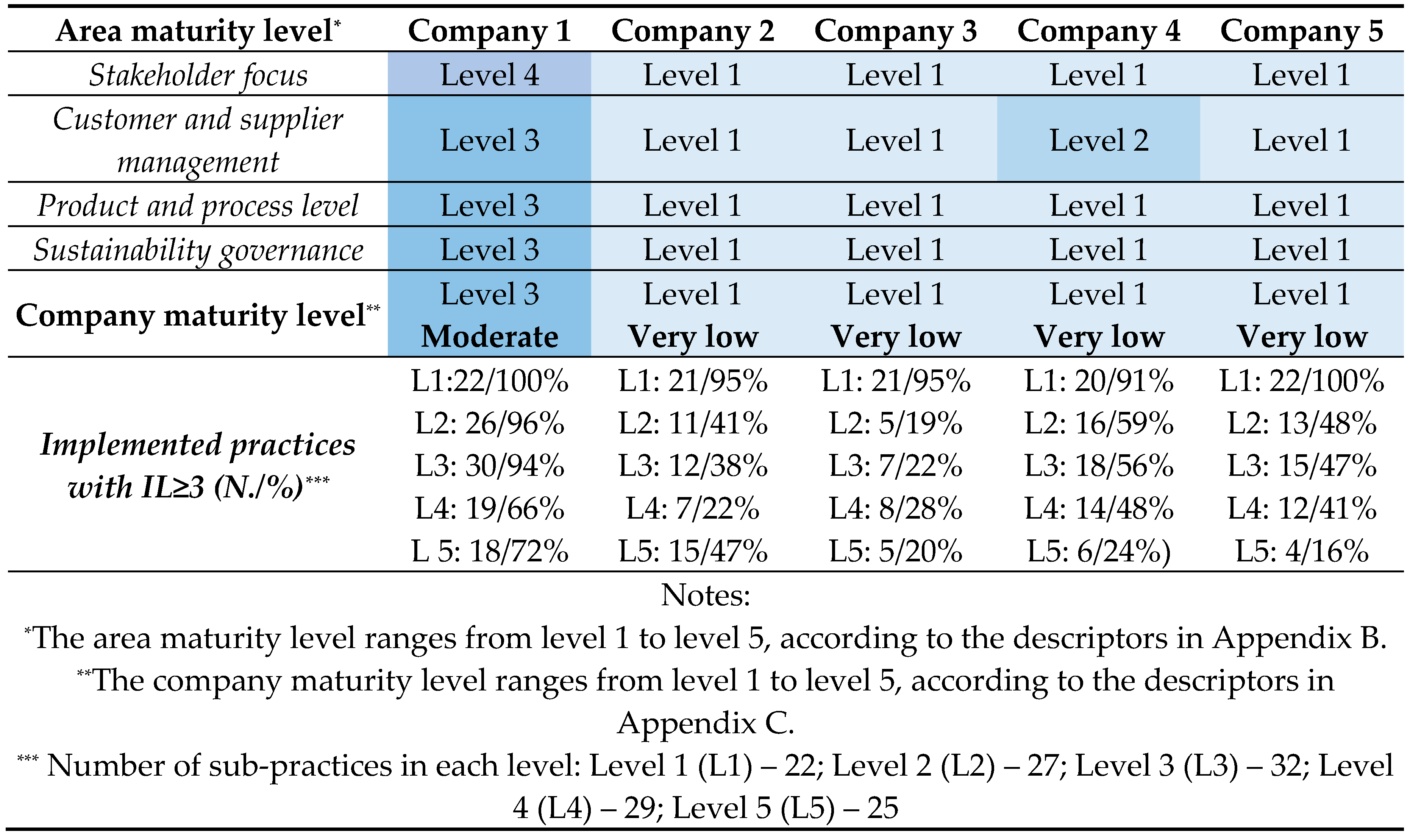
None of the companies under study presents a maturity level of 5, neither in any critical area nor overall. Company 1 is the one that presents higher maturity levels for each of the areas and overall. The overall maturity level is Moderate (Level 3), indicating that more than 90% of the sub-practices in evolution level 3 and above have an implementation level of 3 or more. The company also has already implemented (with IL≥3) other practices associated with the evolution levels 4 and 5 (66% and 72%, respectively), as can be seen in the last row of the Table 4. The remaining companies present very low maturity (Level 1) overall and for almost all areas (except company 4 for the customer and supplier management area, which presents Level 2).
These outcomes result from the sustainability practices implemented by each company. Next, a brief overview of each company’s perspective is provided:
- Company 1 – Moderate maturity level. This company has formal structures with responsibilities in sustainability management and clear guidelines and principles established in both the environmental and social areas, not only internally but also directed toward managing its partners in the SC and other stakeholders. Implementing an environmental management system almost two decades ago has made it possible to raise awareness, and it is an essential element in the company’s environmental management. Social data are collected to define objectives/indicators and evaluate performance but are mainly internal data. Most practices related to the Product and process level are implemented. The company has focused, above all on the integration and consolidation of green production and quality management, as well as the social practices related to its workers (such as Employee development, training, education, Employee health and safety, and labor practices). Since its production is primarily intended for the automotive industry, Company 1 has sought to respond to the demands of its customers. It has focused on implementing practices/sub-practices aimed at improving quality and other parameters associated with the economic dimension. It has also focused on environmental and social practices/sub-practices that involve communicating and regularly interacting with its customers. Environmental and social practices involving customers have started to be adopted by only some customers but have progressively extended to others; this requires using more resources (time, skills, investments, structures). Those practices that require working with its suppliers are relatively recent but increasingly important. The company shows great concern and attention regarding sustainability with other stakeholders, such as its local community.
- Company 2 – Very low maturity level. The company focuses on economic issues, with its main concern regarding environmental and social aspects being to comply with legislation/compliance. This is reflected in the absence of dedicated sustainability structures. For example, when it is necessary to respond to some request/requirement from its stakeholders (e.g., customers, suppliers, official bodies) or solve some problem related to the environmental or social area, the management seeks to solve these issues without any structured approach. There are no defined policies regarding sustainability. The company ensures that environmental and social legislation is complied with in production, design, purchasing, distribution, and logistics, as well as in Employee health and safety, employee development and training, and other working practices. It is worth noting that there is an effort to implement certain sub-practices, particularly in quality management, Green production, Employee health and safety, and Labor practices, in a systematic and controled way. The company values the relationship with its customers and has close contacts to maintain customer satisfaction with an essentially economic focus. The focus is on maintaining relationships that allow the company to achieve the best operational and economic performance. The company is very focused on its internal operations and makes little effort to make a beneficial contribution to society.
- Company 3 – Very low maturity level. The company has recently focused on increasing capacity and technological innovation. A single person is responsible for quality management, legal compliance with environmental issues, and workers’ health and safety. This is considered a barrier to implementing other practices, such as collecting and processing environmental and social data, which does not occur systematically in the company. It is a family-owned company, and the most recent and succeeding generations in management have shown greater interest in these issues, but this has not yet been reflected in a formal structure or control. The company has a reactive behavior in almost all practices related to Ecodesign, Green Production, Distribution and logistics, Green and Social Purchasing, Employee health and safety, Employee development and training, and Labor practices. However, there is a more significant evolution in implementing Quality management and Lean management practices. Concerning the environmental dimension, the company seeks to comply with legal obligations. The company pays attention to its stakeholders’ demands and expectations regarding sustainability. However, its involvement with other entities such as customers, suppliers, and the community in sustainability practices is practically non-existent; moreover, the resources allocated to their implementation are also insufficient.
- Company 4 – Very low maturity level. This company presents a very low maturity level (Level 1) for the MM areas: Stakeholder focus, Product and process level, and Sustainability governance. The customer and supplier management area is more advanced in terms of maturity. There are no specific structures to deal with sustainability (from an integrated perspective). Environmental or social issues are the responsibility of several people in different areas (e.g., production, quality, and administration departments). These people are in charge of collecting environmental and social data, which is done for controlling the various measures implemented and reporting to official/governmental entities. The existing performance evaluation systems do not yet integrate these environmental or social aspects. However, the company recognizes that implementing this sub-practice is advantageous and necessary in the future. The company’s attention is turned toward its technological capacity and increased flexibility. However, the company is proactive in terms of Environmental Production, Distribution and Logistics, Employee health and safety, Employee development and training, working practices, and Quality management. For example, in green production, proactivity is explained because of the need to meet its customers’ demands. The focus on customers also stands out in the management of its SC. The company is attentive to the demands and expectations of its stakeholders and provides regular support to some stakeholders in various initiatives (e.g., offering sponsorships to sports clubs). However, these sub-practices do not require significant resources or joint working between them and the company.
- Company 5 – Very low maturity level. There is no holistic approach to sustainability, and the economic dimension takes precedence over the remaining dimensions. In this company, environmental issues are the responsibility of the quality manager, and the human resources department manages social issues. Environmental issues are already included in the company’s performance assessment tools and considered in the reporting to top management. It should also be noted that the company implemented some practices at the Product and process level that are more demanding in terms of resources and more complex – for example, green production. The focus on supplier management is also fundamentally economic. In supplier management, the company implements some sub-practices from time to time in the environmental and social scope. However, it has already implemented some, which implies greater communication and involvement with its suppliers (associated with levels of evolution higher than level 1).
4.6.2. Presentation of the results from the validation of the Maturity Model
The assessment of the MM was performed by several criteria (i.e., the relevance of components, comprehensiveness of components, mutual exclusion of components, the sufficiency of maturity levels, the accuracy of maturity levels, ease of understanding, and level of usefulness and practicality). This assessment was based on a short questionnaire adapted from Asah-Kissiedu et al. (2021). A five-point Likert scale using the levels (5) Strongly agree, (4) Agree, (3) Neither agree nor disagree, (2) Disagree, (1) Strongly disagree) (Appendix C).
All experts considered that the MM is comprehensive and suitable for assessing the maturity of SC. Regarding relevance and comprehensiveness, all the experts (three in level 5 and two in level 4 on the Likert scale) confirm that the areas, practices, and sub-practices are relevant and cover all aspects of the MM domain. The same results are obtained concerning the maturity levels. The experts agree with maturity levels’ “Sufficiency” and “Accuracy”. As for “Ease of understanding” and “Usefulness and practicality”, the results are also satisfactory (two experts in level 5, two in level 4, and one in level 3 of the Likert scale). Some concern was registered about the criterion “Ease of use”, with one expert disagreeing that this criterion is checked. The experts consider that the comprehensiveness of the model makes it more difficult to obtain information since it is dispersed over various areas of activity. The remaining experts agree with the “Ease of use” (1 expert in level 5 and the remaining three at level 4 on the Likert scale concerning this criterion).
5. Conclusion
The interest in using MMs to help integrate sustainability in organizations and their SC has been growing, however, the literature on sustainability MM still needs to be explored, with more empirically validated models for practice and considering a holistic approach in terms of sustainability (i.e., environmental, social, and economic dimensions). Moreover, the previous sustainability MMs considering the SC level present several limitations (e.g., lack of information on how to reach and pass the maturity levels), making it difficult to understand how they work and their operationalisation (Correia et al., 2017; Meza-Ruiz et al., 2017; Santos et al., 2020).
This study proposes a sustainability MM for SC with the main objective of mitigating the limitations identified in sustainability MMs proposed in the literature. Thus, it contributes to going deeply into theory regarding the sustainability MM research area, an emerging area that needs to be developed (Correia et al., 2017).
The previous sustainability MMs were reviewed to identify research gaps and approaches used in developing the model and help define the scope of the MM to be proposed. An extensive literature review on corporate sustainability and SSCM was also performed to identify, among other aspects, the levels of MM to define the components (areas) and subcomponents (practices) of the MM. The model was improved with the collaboration of five companies from the Portuguese mouldmaking industry and applied to them to test its validity and reliability and if it is user-friendly.
The model suggested is based on the TBL approach, contributing, however to the sustainability MM literature with a more comprehensive method at the level of the elements (areas/practices) that comprise the model. This research systematizes intra- and inter-organizational sustainability practices through a MM to guide the integration and evolution of sustainability maturity in SC. These sustainability practices are associated with various critical areas for sustainability and its different dimensions. Many of these practices considered in the proposed MM require the involvement and collaboration of the organization with its SC partners and other stakeholders. Despite being of great importance for the sustainability of SC (Seuring & Müller, 2008; Liu et al., 2012; Tachizawa et al., 2014; Sancha et al., 2016), this dimension seems to be little explored in sustainability MMs considering the SC level proposed in the literature, and in that sense, this model contributes to filling this gap by strengthening this aspect.
Also, the proposed MM provides a guide for practitioners who want to use MMs to assess the level of maturity of their organization and corresponding SC regarding sustainability. Since the maturity levels are associated with the implementation of sustainability practices, the self-evaluation through the model and identification of improvement actions is a task that may be performed with the collaboration of the managers and those responsible for the various performance/functional areas (e.g., purchasing, production, logistics, etc.). It may contribute to their greater involvement and motivation in the assessment and improvement actions.
Nevertheless, the model presents some limitations. The high number of practices to be evaluated is a positive aspect because it illustrates the comprehensiveness of the model and its detail. However, it may represent a difficulty in assessing the maturity levels’ implementation and determination. Future work could analyze the possibility of developing software systems that support the MM application method and facilitate its use, for example, a computer application for information gathering and treatment or using the internet. Also, the improvement and application of MMs were carried out in SMEs belonging to a sector very dependent on the automotive industry and with a specific production strategy (a make-to-order production strategy). As a result of applying MM to the several companies studied, it was found that many of them presented a very similar profile in terms of maturity, either about the MM areas or in general terms. To increase the external validity of the model, multiple studies must be carried out in organizations with other characteristics (for example, size, position in the SC, etc.) and belonging to different activity sectors.
Analyzing the barriers and facilitators to implementing this model may be an interesting research topic for future work. Another is to focus on monitoring the implementation of this type of model, adopting a longitudinal analysis.
Author Contributions
Elisabete Correia was responsible for developing the approach decided by the research team and collecting data from the case studies; Susana Garrido contributed to the rationale of the proposed model, Helena Carvalho, with the methodology. All the authors contributed to the writing of the document.
Funding
This work was funded by national funds through FCT – Fundação para a Ciência e a Tecnologia.
Acknowledgments
This work was funded by national funds through FCT – Fundação para a Ciência e a Tecnologia, I.P., Project UIDB/05037/2020
Conflicts of Interest
none
Appendices
Appendix A (doi. 10.6084/m9.figshare.21758459) - this Appendix can be found online at https://figshare.com/s/420629308e666c40ed31;
Appendix B (doi. 10.6084/m9.figshare.21758504) - this Appendix can be found online at https://figshare.com/s/c54807f0f3f835200c73;
Appendix C (doi.10.6084/m9.figshare.21758528)- this Appendix can be found online at https://figshare.com/s/2487ba06e26d99f8f316
References
- Aguiar, M. F. & Jugend, D. (2022). Circular product design maturity matrix: A guideline to evaluate new product development in light of the circular economy transition. Journal of Cleaner Production, 365, 132732. [CrossRef]
- Amini, M. & Bienstock, C. C. (2014). Corporate sustainability: an integrative definition and framework to evaluate corporate practice and guide academic research. Journal of Cleaner Production, 76, 12-19. [CrossRef]
- Asah-Kissiedu, M., Manu, P., Booth, C.A., Mahamadu, A.-M., & Agyekum, K. (2021). An Integrated Safety, Health and Environmental Management Capability Maturity Model for Construction Organisations: A Case Study in Ghana, Buildings, 11, 645. [CrossRef]
- Babin, R. & Nicholson, B. (2011). How green is my outsourcer? Measuring sustainability in global IT outsourcing. Strategic Outsourcing: An International Journal, 4, 47–66. [CrossRef]
- Baumgartner, R.J. (2013). Managing corporate sustainability and CSR: A conceptual framework combining values, strategies and instruments contributing to sustainable development. Corporate Social Responsibility and Environmental Management, 21, 258–271. [CrossRef]
- Baxter, P. & Jack, S. (2008). Qualitative Case Study Methodology: Study Design and Implementation for Novice Researchers. The Qualitative Report, 13(4), 544–556. [CrossRef]
- Becker, J., Knackstedt, R., & Pöppelbuß., J. (2009). Developing Maturity Models for IT Management – A Procedure Model and its Application. Business & Information Systems Engineering, 1(3), 212-222. [CrossRef]
- CEFAMOL (2022). Molde, 123, January 2022. Available at: https://www.cefamol.pt/index.php?id=85&idn=510 (accessed 05 May 2022).
- Chaabane, A., Ramudhin, A., & Paquet, M. (2012). Design of sustainable supply chains under the emission trading scheme. International journal of production economics, 135(1), 37-49. [CrossRef]
- Chardine-Baumann, E. & Botta-Genoulaz, V. (2014). A framework for sustainable performance assessment of supply chain management practices. Computers & Industrial Engineering, 76, 138–147. [CrossRef]
- Correia, E, Azevedo, S.G., & Carvalho, H. (2018). Proposal of a framework to construct a supply chain sustainability maturity model. 5th Euroma 4-6 Kassel (2018), Germany.
- Correia, E., Carvalho, H., Azevedo, S.G., & Govindan, K. (2017). Maturity Models in Supply Chain Sustainability: A Systematic Literature Review. Sustainability, 9 (1) (64). [CrossRef]
- Correia, E., Garrido, S., & Carvalho, H. (2021). Online sustainability information disclosure of mould companies, Corporate Communications: An International Journal, 26(3), 557-588. [CrossRef]
- Cuenca, L., Boza, A., Alemany, M.M.E., & Trienekens, J.J.M. (2013). Structural elements of coordination mechanisms in collaborative planning processes and their assessment through maturity models: Application to a ceramic tile company. Computers in Industry, 66(8), 898–911. [CrossRef]
- Dai, J., Xie, L., & Chu, Z. (2021). Developing sustainable supply chain management: The interplay of institutional pressures and sustainability capabilities. Sustainable Production and Consumption, 28, 254-268. [CrossRef]
- De Bruin, T., Freeze, R., Kaulkarni, U., & Rosemann, M. (2005).Understanding the Main Phases of Developing a Maturity Assessment Model. In Campbell, B, Underwood, J, & Bunker, D (Eds.) Australasian Conference on Information Systems (ACIS), November 30 – December 2, 2005, Australia, New South Wales, Sydney.
- Ebrahimi, F., Saen, R. F., & Karimi, B. (2021). Assessing the sustainability of supply chains by dynamic network data envelopment analysis: a SCOR-based framework. Environmental Science and Pollution Research, 28(45), 64039-64067.
- Edgeman, R. & Eskildsen, J. (2014). Modeling and assessing sustainable enterprise excellence. Business Strategy and the Environment, 23(3), 173-187. [CrossRef]
- Estampe, D., Lamouri, S., Paris, J., & Brahim-Djelloul, S. (2013). A framework for analyzing supply chain performance evaluation models. International Journal of Production Economics, 142, 247–258. [CrossRef]
- Fraser, P., Moultrie, & Gregory, M. (2002). The use of maturity models/grids as a tool in assessing product development capability. In Proceedings of the Engineering Management Conference, 244- 249. [CrossRef]
- Gilley, K., Worrell, D., & El-Jelly, A.. (2000). Corporate Environmental Initiatives and Anticipated Firm Performance: The Differential Effects of Process-driven versus Product-driven Greening Initiatives. Journal of Management, 26 (6), 1199–1216. [CrossRef]
- Göçer, A., Vural, C. A., Halldorsson, A., & Fawcett, S.E. (2018). Sustainability Myopia: How A Lack of Visibility Stunts Sustainability Maturity. 5th International EurOMA Sustainable Operations And Supply Chains Forum.
- Golinska, P. & Kuebler, F. (2014). The method for assessment of the sustainability maturity in remanufacturing companies. Procedia Cirp, 15, 201-206. [CrossRef]
- Gouvinhas, R. P., Reyes, T., Naveiro, R., M., Perry, N., & Filho, E. R., (2016). A proposed framework of sustainable self-evaluation maturity within companies: an exploratory study. International Journal on Interactive Design and Manufacturing, 10(3), 319-327. [CrossRef]
- Hallstedt, S., Ny, H., Robert, K.H., & Broman, G., (2010). An approach to assessing sustainability integration in strategic decision systems for product development. Journal of Cleaner Production, 18, 703-712. [CrossRef]
- Hassini, E., Surti, C., & Searcy, A. (2012). Literature review and a case study of sustainable supply chains with a focus on metrics. International Journal of Production Economics, 140, 69-82. [CrossRef]
- Hepper, E. L, Souza, O. T., Petrini, M. C., & Silva; C. E. L. (2017). Proposição de um modelo de maturidade para sustentabilidade corporativa. Acta Scientiarum. Human and Social Sciences, 9(1), 43-53. [CrossRef]
- Hervani, A. A., Helms, M. M., & Sarkis, J. (2005). Performance measurement for green supply chain management. Benchmarking: An International Journal, 12(4), 330–353. [CrossRef]
- Hynds, E. J., Brandt, V., Burek, S., Jager, W., Knox, P., Parker, J. P.,... & Zietlow, M. (2014). A maturity model for sustainability in new product development. Research-Technology Management, 57(1), 50-57. [CrossRef]
- Karaosman, H., Morales-Alonso, G., & Brun, A. (2016). From a systematic literature review to a classification framework: Sustainability integration in fashion operations. Sustainability, 9(1), 30. [CrossRef]
- Klassen, R. D. & Vereecke, A. (2012). Social Issues in Supply Chains: Capabilities Link Responsibility, Risk (Opportunity), and Performance. International Journal of Production Economics, 140(1), 103-115. [CrossRef]
- Klimko, G. (2001, November). Knowledge management and maturity models: Building common understanding. In Proceedings of the 2nd European conference on knowledge management (Vol. 2, pp. 269-278). Bled, Slovenia.
- Kurnia, S., Rahim, M. M., Samson, D., & Singh, P. (2014). Sustainable supply chain management capability maturity: Framework development and initial evaluation. In Proceedings of the 22nd European Conference on Information Systems in Tel Aviv, ECIS 2014, pp. 1-10.
- Labuschagne, C., Brent, A., & van Erck, R. (2005). Assessing the Sustainability Performances of Industries. Journal of Cleaner Production 13(4), 373–385. [CrossRef]
- Lasrado, L. A., Vatrapu, R., & Andersen, K. N. (2015, August). Maturity models development in IS research: a literature review. In IRIS Selected Papers of the Information Systems Research Seminar in Scandinavia (Vol. 6, No. 6). New York: IRIS.
- Liebetruth, T. (2017). Sustainability in performance measurement and management systems for supply chains. Procedia engineering, 192, 539-544. [CrossRef]
- Looy, A. V., Backer, M. D., & Poels, G. (2014). A conceptual framework and classification of capability areas for business process maturity. Enterprise Information Systems, 8(2), 188-224. [CrossRef]
- Lozano, R. (2008). Envisioning sustainability three-dimensionally. Journal of Cleaner Production, 16(17), 1838-1846. [CrossRef]
- Machado, C. G., Lima, E. P., Costa, S. E. G., Angelis, J., J., & Mattioda, R. A. (2017). Framing maturity based on sustainable operations management principles. International Journal of Production Economics, 190, 3-21. [CrossRef]
- Mani.V, Agrawal, R., & Sharma, V. (2015). Social sustainability practices in the supply chain of Indian manufacturing industries. International Journal of Automation and Logistics, 1(3), 211-233. [CrossRef]
- Mettler, T. (2009). A Design Science Research Perspective on Maturity Models in Information Systems. https://www.alexandria.unisg.ch/publications/214531.
- Meza-Ruiz, I. D., Rocha-Lona, L., del Rocío Soto-Flores, M., Garza-Reyes, J. A., Kumar, V., & Lopez-Torres, G. C. (2017). Measuring business sustainability maturity-levels and best practices. Procedia Manufacturing, 11, 751-759. [CrossRef]
- Moultrie, J., Sutcliffe, L., & Maier, A. (2016). A maturity grid assessment tool for environmentally conscious design in the medical device industry. Journal of Cleaner Production, 122, 252-265. [CrossRef]
- Müller, A. & Pfleger, R. (2014). Business transformation towards sustainability. Business Research, 7, 313-350. [CrossRef]
- Negri, M., Cagno, E., Colicchia, C., & Sarkis, J. (2021). Integrating sustainability and resilience in the supply chain: A systematic literature review and a research agenda. Business Strategy and the environment, 30(7), 2858-2886. [CrossRef]
- Nouri, F. A., Nikabadi, M. S., & Olfat, L. (2018). Developing the framework of sustainable service supply chain balanced scorecard (SSSC BSC). International Journal of Productivity and Performance Management.
- Okongwu, U., Morimoto, R., & Lauras, M. (2013). The maturity of supply chain sustainability disclosure from a continuous improvement perspective. International Journal of Productivity & Performance Management, 62(8), 827-855. [CrossRef]
- Paz, F. J., Kipper, L. M., & Frozza, R. (2015). Desenvolvimento de uma ferramenta para avaliação da maturidade para a sustentabilidade organizacional: uma proposição teórico-metodológica. Tecno-lógica, 19(1), 36-42. [CrossRef]
- PBA (2019). Portuguese business association, available at: http://www.aeportugal.pt/Aplicacoes/SectoresEmpresariais/Top100.asp?IDSector518.
- Pigosso, D.C. A., Rozenfeld, H., & McAloone, T. C. (2013). Eco-design maturity model: a management framework to support ecodesign implementation into manufacturing companies. Journal of Cleaner Production, 59, 160-173. [CrossRef]
- Pöppelbuß,J. & Röglinger, M. (2011). What makes a useful maturity model? A framework of general design principles for maturity and its demonstration in business process management. In Proceedings of the European Conference on Information Systems (ECIS) Proceedings, Helsinki, Finland, 9-11 June 2011.
- Reefke, H., Ahmed, M. D., & Sundaram, D. (2014). Sustainable supply chain management—Decision making and support: The SSCM maturity model and system. Global Business Review, 15(4_suppl), 1S-12S. [CrossRef]
- Robinson, H. S., Anumba, C. J., Carrillo, P. M., & Al-Ghassani, A. M. (2006). STEPS: a knowledge management maturity roadmap for corporate sustainability. Business Process Management Journal, 12(6), 793-808. [CrossRef]
- Röglinger, M., Pöppelbuß, J., & Becker, J. (2012). Maturity models in business process management. Business Process Management Journal, 18(2), 328-346. [CrossRef]
- Rudnicka, A. (2016). How to manage sustainable supply chain? The issue of maturity. LogForum, 12(4), 203-211. [CrossRef]
- Saeed, M. A. & Kersten, W. (2020). Sustainability performance assessment framework: a cross-industry multiple case study. International Journal of Sustainable Development & World Ecology, 27(6), 496-514. [CrossRef]
- Salah, D., Paige, R., & Cairns, P. (2014, December). An evaluation template for expert review of maturity models. In International Conference on Product-Focused Software Process Improvement (pp. 318-321). Springer, Cham.
- Sancha, C., Gimenez, C., & Sierra, V. (2016). Achieving a socially responsible supply chain through assessment and collaboration. Journal of Cleaner Production, 112, 1934-1947. [CrossRef]
- Santos, D. A., Quelhas, O. L. G., Gomes, C., F.S., Zotes, L. P., França, S. L. B., Souza, G. V. P. S, & Santos, S. S.C. (2020). Proposal for a maturity model in sustainability in the supply chain. Sustainability, 12(22), 9655. [CrossRef]
- Santos-Neto, J.B.S & Costa, A.P.C.S. (2019). Enterprise maturity models: a systematic literature review. Enterprise Information Systems. 13(5), 719-769.
- Sari, Y., Hidayatno, A., Suzianti, A., Hartono, M., & Susanto, H. (2020). A corporate sustainability maturity model for readiness assessment: a three-step development strategy. International Journal of Productivity and Performance Management, 70(5), 1162-1186. [CrossRef]
- Schaltegger, S. & Burritt, R. (2014). Measuring and managing sustainability performance of supply chains: Review and sustainability supply chain management framework. Supply Chain Management: An International Journal, 19(3), 232-241. [CrossRef]
- Schoch, K. W. (2016). Case study research. In Burkholder, Gary J., Cox, K. A., Crawford, L. M. (Eds.), The Scholar-Practitioner's Guide to Research Design, 1st Edition (pp. 227 – 241), Sage publications.
- Seuring, S. & Müller, M. (2008). From a literature review to a conceptual framework for sustainable supply chain management. Journal of Cleaner Production, 16, 1699-1710. [CrossRef]
- Silvius, G. & Schipper, R. (2015). Developing a maturity model for assessing sustainable project management. The Journal of Modern Project Management, 3(1), 112-112.
- Srai, J. S., Alinaghian, L. S., & Kirkwood, D. A. (2013). Understanding sustainable supply network capabilities of multinationals: A capability maturity model approach. Proceedings of the Institution of Mechanical Engineers, Part B: Journal of Engineering Manufacture, 227(4), 595-615.
- Standing, C. & Jackson, P. (2007). An approach to sustainability for information systems. Journal of systems and Information Technology. 9, 167-176. [CrossRef]
- Subramanian, J. A., Campos, J. K., & Wateau, E. (2017), “A maturity model for sustainable supply chain practices in the consumer goods industry”, 4th International EurOMA Sustainable Operations and Supply Chains Forum (SOSCF), February 27-28, Milan, Italy.
- Verrier,B., Rose, B., & Caillaud, E. (2016). Lean and Green strategy: the Lean and Green House and maturity deployment model. Journal of Cleaner Production, 116, 150-156. [CrossRef]
- Voss, C., Tsikriktsis, N., & Frohlich, M., (2002). Case research in operations management. International Journal of Operational Production Management, 22(2), 195-219. [CrossRef]
- Wendler, R. (2012). The maturity of maturity model research: A systematic mapping study. Information and software technology, 54(12), 1317-1339. [CrossRef]
- Xavier, A. F. (2017). Proposta de um modelo de maturidade para avaliação das práticas de eco-inovação nas organizações: ECO-MI, (Doctoral Dissertation), Universidade Federal do Rio de Janeiro, Rio de Janeiro.
- Xavier, A., Reyes, T., Aoussat, A., Luiz, L., & Souza, L. (2020). Eco-innovation maturity model: A framework to support the evolution of eco-innovation integration in companies. Sustainability, 12(9), 3773. [CrossRef]
- Yimam, A. H. (2011). Project management maturity in the construction industry of developing countries (the case of Ethiopian contractors), (Master’s Thesis), University of Maryland, Maryland.
- Yin, R. K. (2003). Case Study Research: Design and Methods, Sage, London.
- Zhang, F., Rio, M., Allais, R., Zwolinski, P., Carrillo, T. R., Roucoules, L.,... & Buclet, N. (2013). Toward a systemic navigation framework to integrate sustainable development into the company. Journal of cleaner production, 54, 199-214. [CrossRef] [PubMed]
Figure 1.
Model Development Phases. Source: De Bruin et al. (2005).
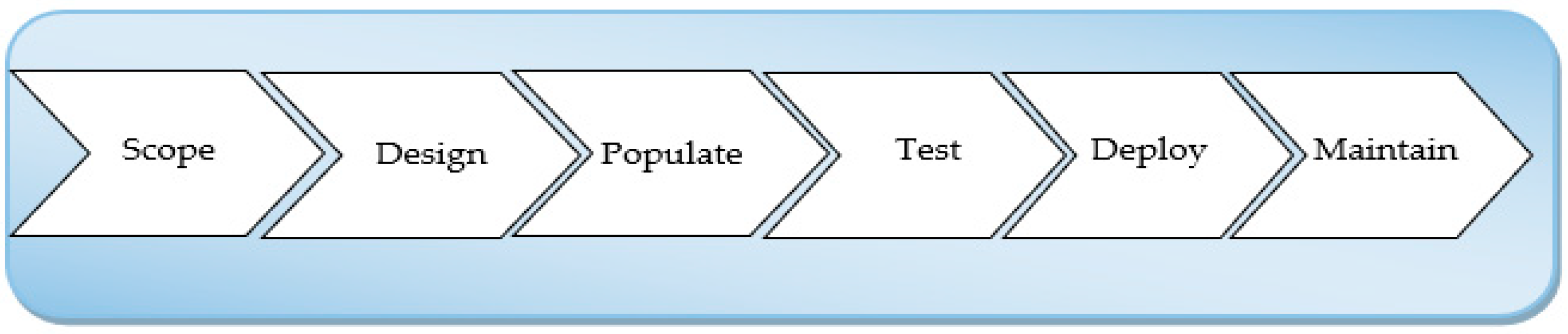
Figure 2.
Research design.
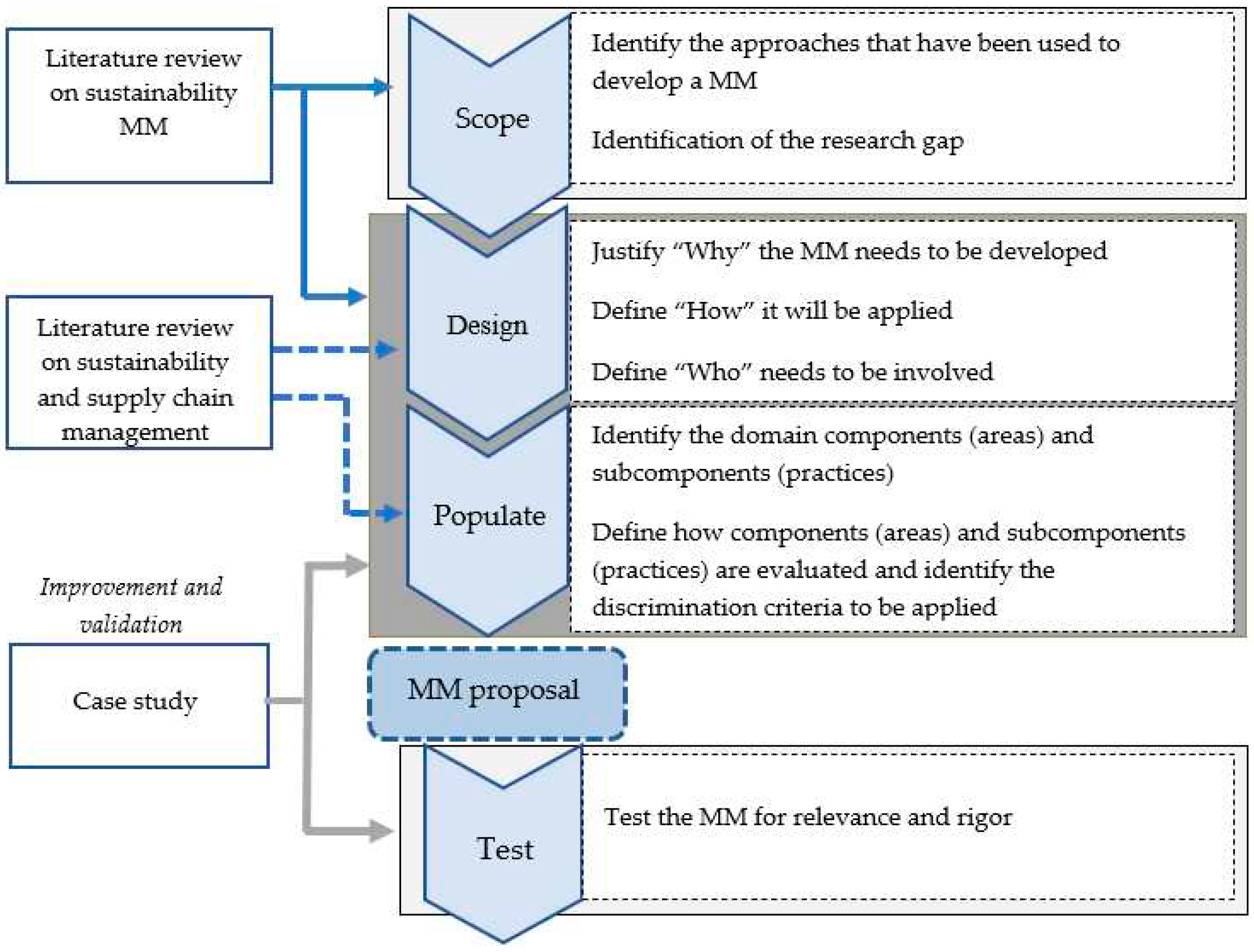
Figure 3.
Maturity Model domain, areas, and practices.
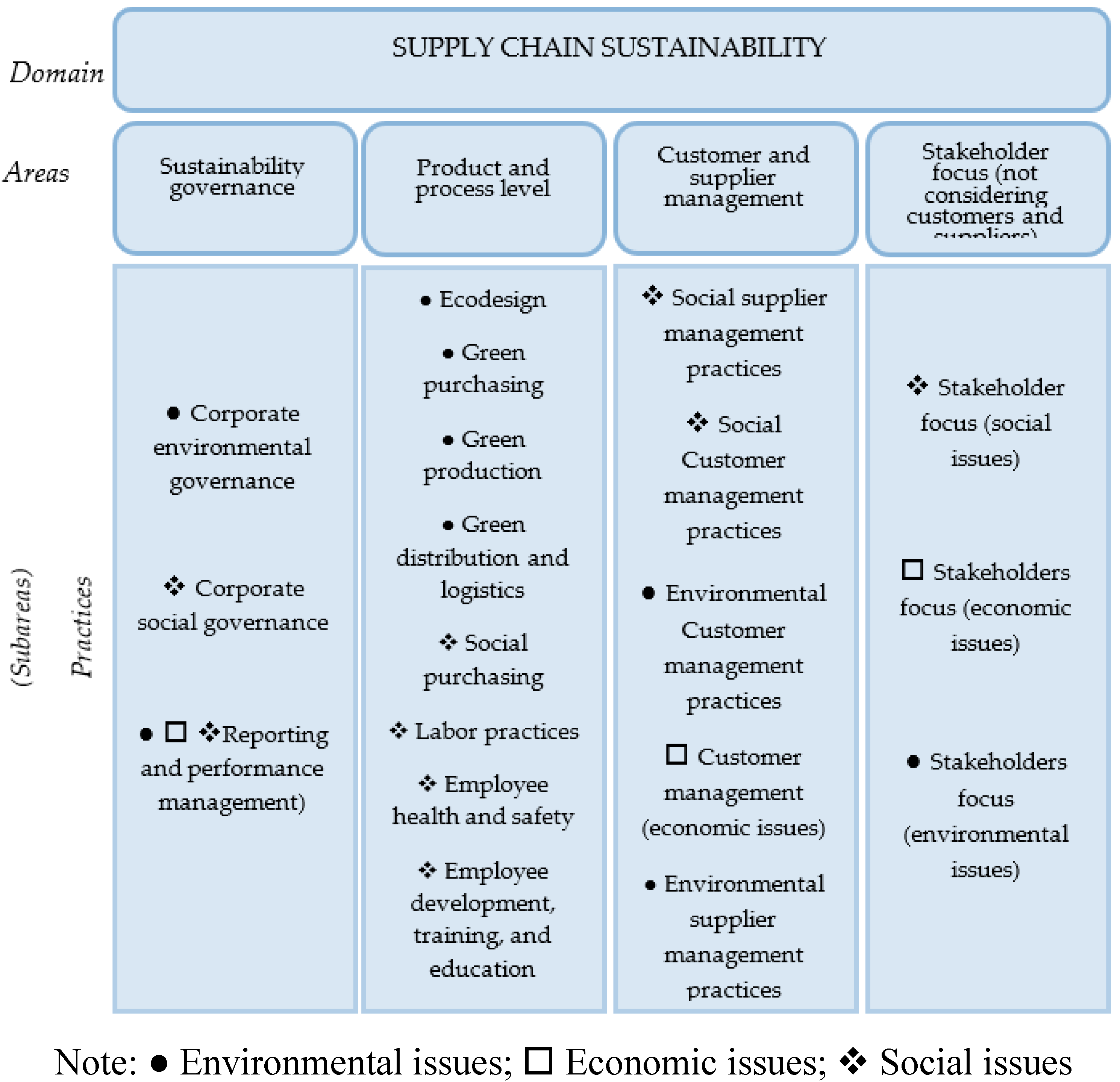
Figure 4.
Implementation level of the Sustainability sub-practices in the Maturity Model.
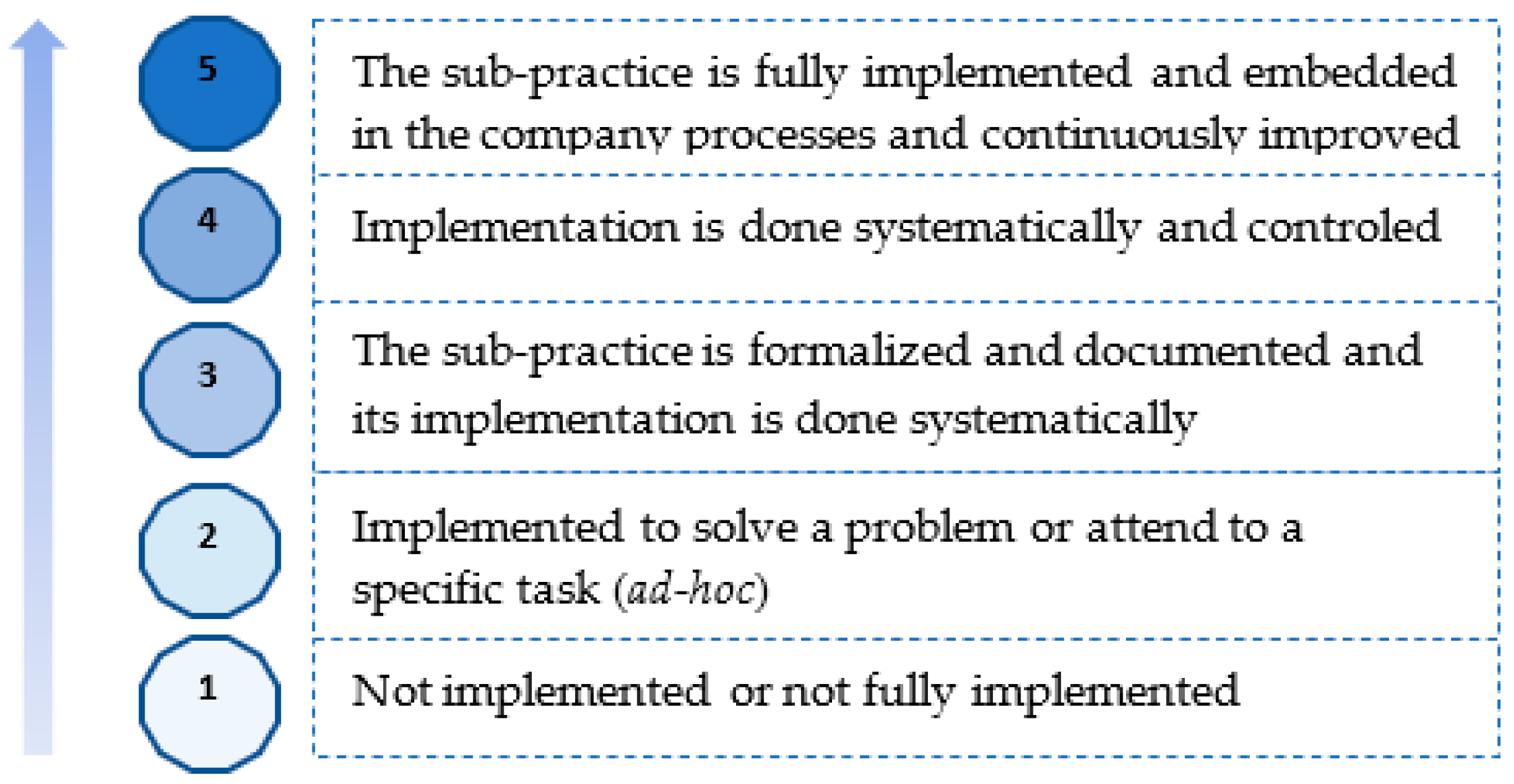
Figure 5.
Matrix of maturity levels and discrimination criteria.
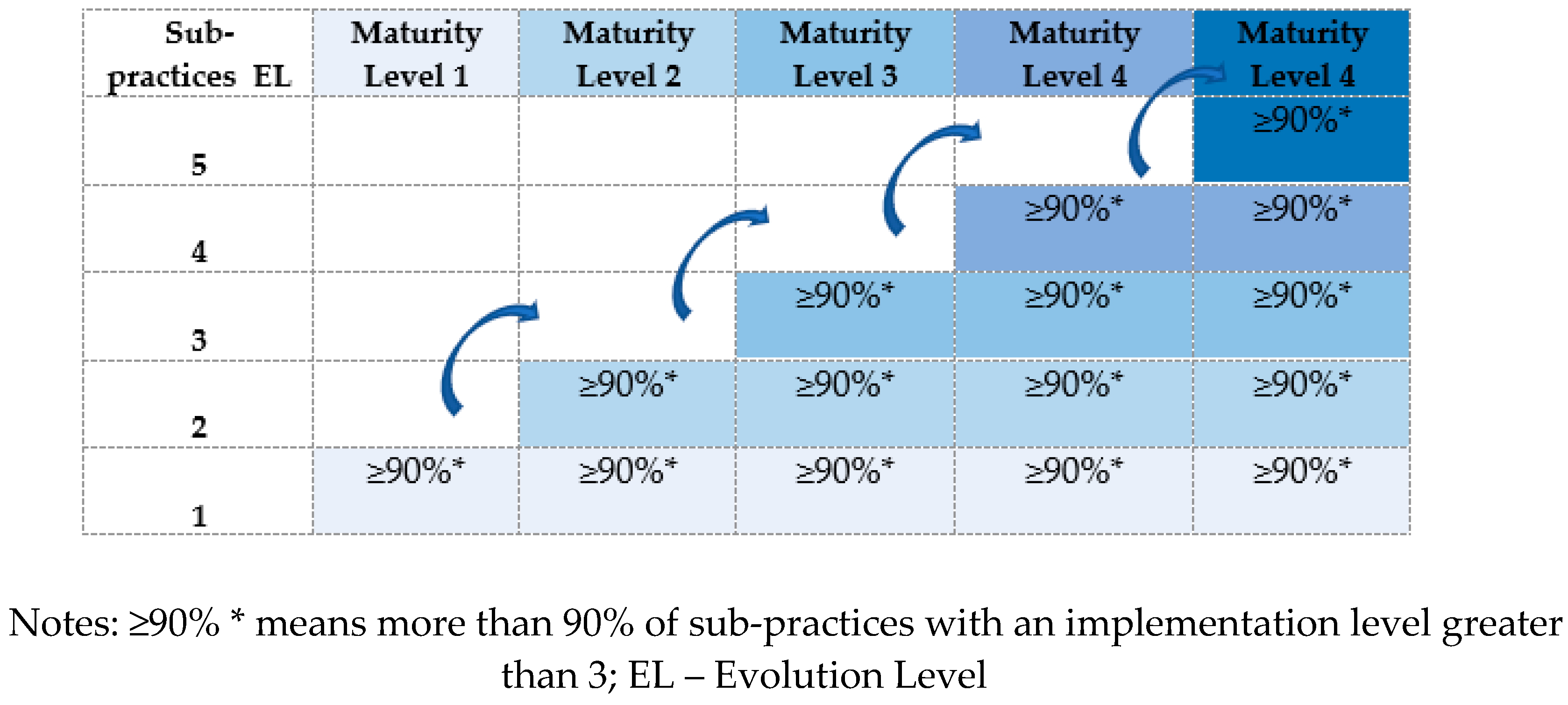
Figure 6.
Sustainability Supply Chain Maturity Model (SSCMM) Proposal.
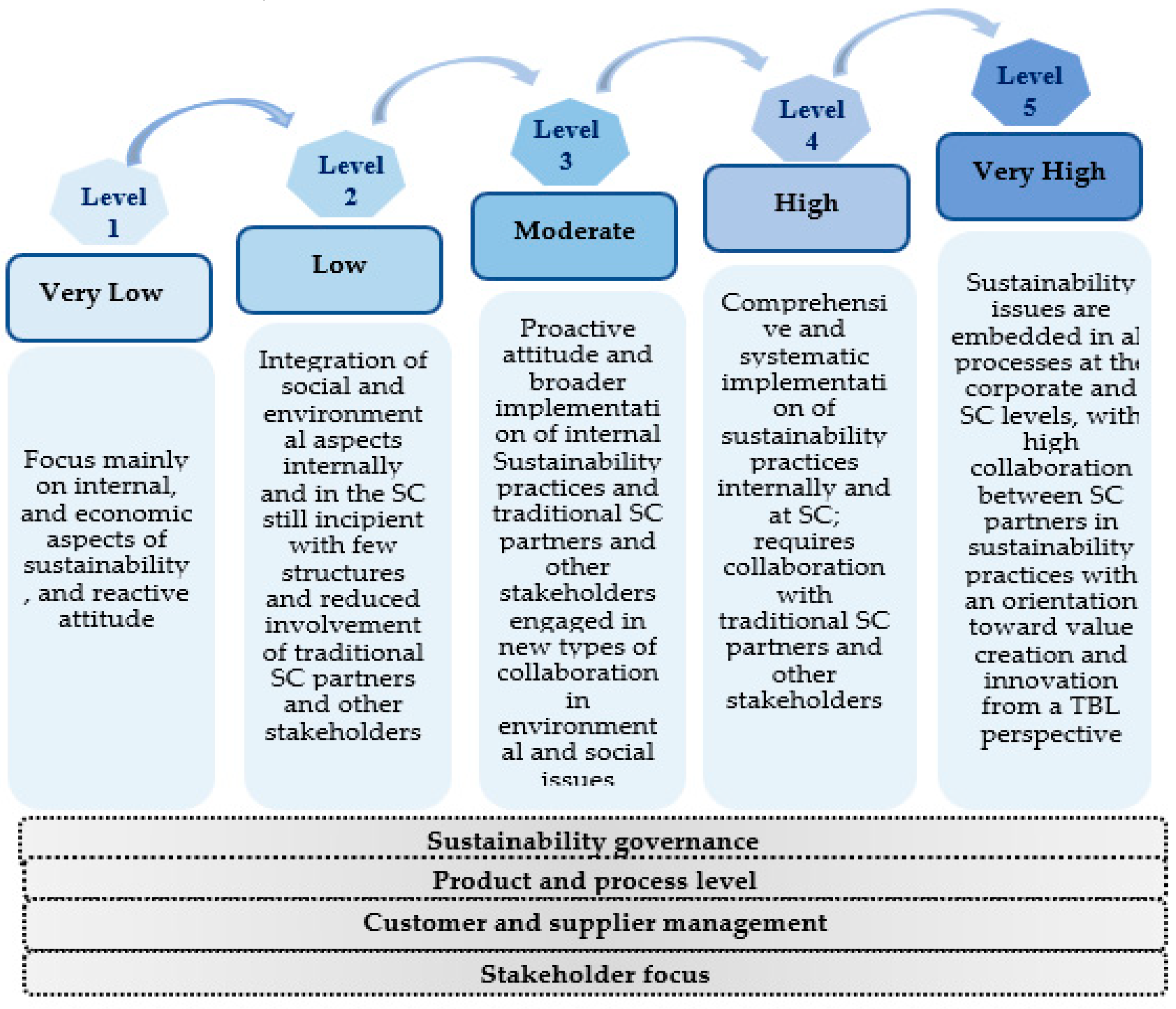

Table 1.
General characterization of the case-study companies.
| Companies | General Characterization | |
|---|---|---|
| Company 1 | It manufactures compression and plastic injection moulds, with a capacity of up to 120 tons, for the automotive industry. Still, it tries to preserve the markets of other sectors, namely Electronics/Telecommunications and Housewares. It employs 248 workers and has a turnover of 29.8 million euros. | |
| Company 2 | It makes plastic injection moulds for the automotive sectors; appliances, and housewares, exporting almost all its production. Its focus is moulds of medium and large dimensions (up to 60 Tons). It employs 126 workers and has a turnover of 8.5 million euros. | |
| Company 3 | It makes moulds with a capacity of up to 20 tons, producing Die Casting Moulds for the automotive, appliances and packaging sectors. This company employs 69 workers and has a turnover of 7.7 million euros. | |
| Company 4 | It makes high-precision moulds for parts of various industries such as automotive, aeronautics, medical/pharmaceutical, electrical and electronics. The company has moulds of multiple types: thermoplastic injection, die casting, rotary injection, two-component injection, compression, and transfer sandwich. The company also injects plastic parts. It employs 73 workers and has a turnover of 4.3 million euros. | |
| Company 5 | It manufactures compression and plastic injection moulds for the automotive, appliance, and packaging industries. It employs 68 workers and has a turnover of 5.6 million euros. | |
Table 2.
Unit of Analysis and Focus of Sustainability Maturity Models.
| Authors, Year | Unit of Analysis | Sustainability Focus | |||
|---|---|---|---|---|---|
| Process | Company | Network | TBL approach |
Env. Sustain. | |
| Robinson et al., 2006; Standing & Jackson, 2007; Machado et al., 2017; Subramanian et al., 2017 | ✓ | ✓ | |||
| Babin & Nicholson, 2011 | ✓ | ✓ | |||
| Pigosso et al., 2013; Hynds et al., 2014; Verrier et al., 2016; Xavier et al., 2020 | ✓ | ✓ | |||
| Okongwu et al., 2013; Srai et al., 2013; Kurnia et al., 2014; Rudnicka, 2016; Reefke et al., 2014; Santos et al., 2020 | ✓ | ✓ | |||
| Edgeman & Eskildsen, 2014; Golinska & Kuebler, 2014; Gouvinhas et al., 2016; Sari et al., 2020 | ✓ | ✓ | |||
Table 3.
Example of Areas and Sub-areas of the proposed Maturity Model by Evolution Level.
| AREA: SUSTAINABILITY GOVERNANCE | Evol.Level |
|---|---|
| Practice: Corporate environmental governance | |
| Sub-practices: | |
| Consideration of environmental issues in some functional areas | 1 |
| Data collection on environmental aspects | 2 |
| Environmental compliance and auditing programs in all departments | 3 |
| Commitment to GSCM from senior and middle-level managers | 3 |
| Obtaining ISO 14001 certification | 4 |
| (…) | |
| AREA: PRODUCT AND PROCESS LEVEL | |
| Practice: Green purchasing | |
| Sub-practices: | |
| Materials that should not be used in products and should not be used in purchases are identified | 1 |
| Compliance with environmental legislation, such as external purchasing directives | 1 |
| Suppliers are selected using environmental criteria | 2 |
| Providing design specifications to suppliers that include environmental requirements for purchased items | 3 |
| Purchase of efficient materials/products in terms of energy/water consumption and non-polluting, toxic, or dangerous | 3 |
| (…) | |
| AREA: CUSTOMER AND SUPPLIER MANAGEMENT | |
| Practice: Social supplier management practices | |
| Sub-practices: | |
| Ensuring that suppliers obtain OHSAS 18001 certification or other health and safety management system certification such as SA 8000 | 3 |
| Perform audit procedures for suppliers’ internal management system related to social issues (e.g., related to health and safety, appropriate labor working conditions) | 3 |
| Guidance and support to suppliers helping them to improve their social performance | 4 |
| Develop new product/process with suppliers that reduce health risks for consumers | 5 |
| (…) | |
| AREA: STAKEHOLDER FOCUS (NOT CONSIDERING CUSTOMERS AND SUPPLIERS) | |
| Practice: Stakeholder focus (environmental issues) | |
| Sub-practices: | |
| (…) | |
| Development of its initiative of programs for society related to environmental protection | 3 |
| Collaboration with universities and research institutions in the development of new environmental technologies or more environmentally friendly products | 4 |
| Innovative partnerships (e.g., NGOs and community groups) related to projects focused on environmental protection) | 5 |
Table 4.
Maturity levels for each company by area.
 |
Disclaimer/Publisher’s Note: The statements, opinions and data contained in all publications are solely those of the individual author(s) and contributor(s) and not of MDPI and/or the editor(s). MDPI and/or the editor(s) disclaim responsibility for any injury to people or property resulting from any ideas, methods, instructions or products referred to in the content. |
© 2023 by the authors. Licensee MDPI, Basel, Switzerland. This article is an open access article distributed under the terms and conditions of the Creative Commons Attribution (CC BY) license (http://creativecommons.org/licenses/by/4.0/).
Copyright: This open access article is published under a Creative Commons CC BY 4.0 license, which permit the free download, distribution, and reuse, provided that the author and preprint are cited in any reuse.


