

Submitted:
30 December 2022
Posted:
04 January 2023
You are already at the latest version
Abstract
Self-conscious emotions, such as shame and guilt, play a fundamental role in regulating moral behavior and in promoting the welfare of the society. Despite their relevance, the neural bases of these emotions are uncertain. In the present meta-analysis, we performed a systematic literature review in order to single out functional neuroimaging studies on healthy individuals specifically investigating the neural substrates of shame, embarrassment and guilt. Seventeen studies investigating the neural correlates of shame/embarrassment, and seventeen studies investigating guilt brain representation met our inclusion criteria. The analyses revealed that both guilt and shame/embarrassment were associated with the activation of the left anterior insula, involved in emotional awareness processing, and arousal. Guilt specific areas were located within the left temporo-parietal junction, which is thought to be involved in social cognitive processes. Moreover, specific activations for shame/embarrassment involved areas related to social pain (dorsal anterior cingulate, insula, thalamus), behavioral inhibition (premotor cortex) networks. This pattern of results might reflect distinct action tendencies associated with the two emotions.
Keywords:
self-conscious emotions
; shame
; embarrassment
; guilt
; moral emotions
; anterior insula
1. Introduction
Moral emotions are crucial in regulating social interactions, as they promote the welfare of the society or of other people (Haidt et al. 2003). Indeed, they provide the emotional drive to properly behave in social interactions (Kroll and Egan 2004; Piretti et al. 2020; Grecucci et al. 2021), forcing individuals to implement strategies that are optimal over a long period, even though they do not appear functional in the short period (Ridley 1996; Sober and Wilson 1998).
It has been proposed that moral cognition depends on prefrontal, temporal and the limbic circuits, associated with the integration of context- independent and -dependent information with the associated emotional reactions (event-feature-emotion complexes model, EFEC) (Moll et al. 2005; 2008). Specifically, the prefrontal cortex seems to be responsible for representing context-dependent knowledge of event sequences (Grafman 1995; Wood and Grafman 2003), the temporal lobes for perceiving social cues and for representing context-independent social semantic knowledge (Lambon Ralph et al. 2017; Olson et al. 2013; Haxby et al. 2000), and the limbic system for the generation of emotional and motivational states (Saper et al. 2000). Hence, according to the EFEC model, the generation of moral emotions, including self-conscious emotions, relies on integrity of a network including prefrontal, temporal and limbic areas (Moll et al. 2005; 2008).
Several studies investigating the neural substrates of moral cognition (Eres et al. 2017; Bzdok et al. 2012), confirmed the anatomical predictions of this model and better defined the topography of the brain areas associated with moral processing. Indeed, they showed that ventromedial and dorsomedial prefrontal cortices (vmPFC and dmPFC), temporo-parietal junction (TPJ), precuneus, posterior cingulate cortex, left amygdala, anterior temporal lobes (ATL) and lateral orbitofrontal cortex were consistently found activated in neuroimaging studies investigating moral processing (Bzdok et al. 2012; Eres et al. 2017; Grecucci et al. 2021; Piretti et al. 2020).
Among moral emotions, a sub-group of emotions (e.g., shame, embarrassment, guilt and pride), defined as self-conscious emotions, helps individuals to navigate in the complexities of fitting into groups (Haidt 2003), satisfying the human need of belonging to social groups (Baumeister and Leary 1995). Self-conscious emotions are evoked by self-reflection and self-evaluation (Tangney et al. 2007) and occur when social norms, or agreed-upon social rules, are violated (Bastin et al. 2016). The provide an immediate feedback that promote inhibition or reinforcement of behaviour based on their positive or valence (Tangney et al. 2007; Grecucci et al. 2021; Piretti et al. 2020). One case in point, is shame that has been proposed as an algorithm the brain uses to inhibit socially and morally unwanted behaviors (Piretti et al. 2020; Grecucci et al. 2021).
While the EFEC model might explain the cognitive processes underlying all self-conscious emotions, which are all induced by moral and social norm violation (Bastin et al. 2016), it does not make any prediction about the different processes that might occur in different types of emotions such as the negative self-conscious emotions.. Indeed, even though shame, embarrassment and guilt are often (but culpably) used interchangeably, they appear to be substantially different (Gibson 2015). Shame is typically elicited by the belief that the individual’s violation of standards of morality, aesthetics or competence, defines who the individual is (Wong and Tsai 2007). Hence, it involves the way the individuals perceives themselves and how they believe other people see them and their inadequacy to fulfil social standards (Tangney et al. 1992). The distinction between shame and embarrassment is still a matter of debate (for review see Crozier 2014). If on the one hand, embarrassment might be considered as a dimension of shame (Probyn 2005), on the other, it might represent a distinct emotional entity (Keltner and Buswell 1997; Tangney et al. 1996). Embarrassment seems related to trivial social transgressions, occurring suddenly and in public contexts, especially in presence of individuals with equal or higher hierarchical social status. (Keltner and Buswell 1996; Tangney et al. 1996; Buss 2001; Haidt 2003; Tangney 2003). Conversely, shame emerges when one perceives personally the serious violation of a moral norm, that might be also experienced in private situations (Tangney et al. 1996; Tangney 2003). Furthermore, shame and embarrassment are also distinct in the intensity (i.e., shame is more intense than embarrassment) (Rochat 2009), in the duration (i.e., shame is more persistent than embarrassment) (Scheff 1994) and in the focus of attention (i.e., shame affects the self, embarrassment affects the persona, the apparent self). However, these two emotions have also some features in common. They are associated with the same specific physiological reactions (e.g., blushing) (Sabini and Silver 2005) and the same action tendency, leading people to hide and reduce their social presence and making movement and speech more difficult and less likely (Asendorpf 1990, Keltner and Buswell 1997, Lewis 1993; Miller 1996). However, it has also been reported that, differently from shame, embarrassment leads to reparative behaviours to re-gain social approval (Feinberg et al. 2011; Keltner and Buswell 1997; Leary et al. 1996). At the neural level, shame was selectively associated with with dlPFC, posterior cingulate cortex and sensory-motor cortex, whereas embarrassment with vlPFC, amygdala and occipital areas, and both emotions with hippocampus and midbrain (Bastin et al. 2014). However, it must be acknowledged that, since the distinction between shame and embarrassment is not sharp, being classified according to the private-public, moral-conventional or low-high intensity dimensions, it is not easy to establish which brain areas are involved in processing these emotions, and which areas might selectively process one of the two emotions.
If the difference between shame and embarrassment is not as clear-cut, the distinction between guilt and the other two emotions is more evident. Guilt occurs when the violation of social norms induces harm or suffering to other individuals (Hoffman 1982; Grecucci et al. 2021; Piretti et al. 2020), typically in a relationship or among members of the same group (Fiske 1991). Differently from shame and embarrassment in which, respectively, the self and the persona are perceived as defective, in guilt a specific action is typically perceived as wrong (Hoffman 1982; Lewis 1971; Lewis et al. 1993). The occurrence of guilt induces remorse and behavioural responses that aim to repair the wrong action (Tangney et al. 2007). This difference in the focus, self-oriented and other-oriented, for shame and guilt respectively, has important consequences on empathy for other people: while guilt tends to increase the empathic concern towards other people, empathic responses seem to be disrupted by self-oriented distress associated with shame (Tangney et al. 2007).

Table 1.
Differences between shame and guilt.
| SHAME | GUILT | |
|---|---|---|
| Target | What we are: related to the entire self. ”I’m bad” |
What we do: related to specific behaviours “What I did has been bad” |
| Level | Interpersonal – it occurs only with others | Intrapsychic – it occurs alone |
| Emotional activation | Painful | Less painful |
| Emotional perception | Difficult to recognize | Easy to recognize |
| Action tendency | Motivates hiding and inhibition | Motivates reparation to the situation |
| Relation with aggression, hostility, violence, externalization | Increased for shame-proneness individuals | Decreased for guilt- proneness individuals |
| Scapegoat | Blame mainly others | Blame myself |
| Responsibility | Deflected outward | Accepted |
In a review, Bastin and collaborators (2014) suggested that guilt processing was selectively associated with ventral ACC, precuneus, premotor and posterior temporal areas. In addition, both guilt and shame processing were associated with anterior insula and dACC, and that both guilt and embarrassment processing with dorsomedial prefrontal cortex (dmPFC), vlPFC and anterior temporal lobe (ATL) (Bastin et al. 2014). In addition, a recent meta-analysis (Gifuni et al. 2017) partially confirmed the guilt neural substrates proposed by Bastin and collaborators (2014), reporting the activation of precuneus, dorsal ACC, dmPFC, and posterior temporal areas, in association with guilt processing (Gifuni et al. 2017).
However, it is worth noting that studies investigating self-conscious emotions used heterogeneous methods that prevent any firm conclusions from being drawn. For this reason, we run a meta-analysis study including neuroimaging research on the neural substrates of negative self-conscious emotions, i.e., to pinpoint brain areas consistently associated with shame, embarrassment and guilt processing. We predicted that shame, embarrassment and guilt may show different brain activations mirroring behavioural differences related to the emotions, together with some shared activations in light of their moral-self-conscious nature.
2. Materials and Methods
In order to find studies investigating the neural underpinnings of shame, embarrassment and guilt we conducted a research on PubMed (https://www.ncbi.nlm.nih.gov/pubmed/) using the terms ((“fMRI” OR “functional magnetic resonance imaging” OR “PET”) AND (“shame” OR “embarrassment” OR “guilt” OR “moral emotions” OR “self-conscious emotions” OR “moral violations” OR “social standard violation”)), and setting a range of dates between January 1st 1995 and December 14th 2018. This research identified 123 studies.
Subsequently, we refined our research by applying the following criteria:
- 1)
- paper originally published in English;
- 2)
- fMRI or PET studies including task-related whole brain analyses. Studies reporting region of interest (ROI analyses, resting-state fMRI analyses, diffusion tensor imaging (DTI) or voxel-based morphometry (VBM) were excluded;
- 3)
- participants were healthy adults: In case of studies involving neurological or psychiatric patients, children or adolescents, we considered only contrasts involving healthy controls, if reported;
- 4)
- Studies investigating the neural underpinnings of shame and guilt were included into two different sets, for two distinct meta-analyses. Specifically, we included studies contrasting shame/embarrassment vs. neutral or other emotional conditions and guilt vs. neutral or other emotional conditions. Studies failing to distinguish embarrassment/shame and guilt were excluded.
Since the difference between shame and embarrassment is not clear-cut, as they can be classified according to different criteria, and since the same physiological reactions and the same action tendencies, and their distinction is still a matter of debate, we decided to include in the same set both shame and embarrassment.
This method allowed us to identify 15 studies for the shame/embarrassment set (168 foci, 373 total subjects) and 17 studies for the guilt set (123 foci, 367 total subjects) (see Table 3). The most used paradigm in the studies analysed was emotion induction through verbal scripts (shame/embarrassment = 5; guilt = 7), pictures (shame/embarrassment = 5), both scripts and pictures (guilt = 3), vignettes (shame/embarrassment = 3) or movies (guilt = 1), while a few studies used the recollection of autobiographical memories through verbal scripts (shame/embarrassment = 1; guilt = 3), interpersonal games (shame/embarrassment = 1, guilt = 3), or implicit association task (guilt = 1).
Table 2.
Studies investigating shame/embarrassment and guilt brain processing.
| Subset | Authors | Paradigm | Stimulus type | Contrasts | Foci | Subjects (Females) |
|---|---|---|---|---|---|---|
| Shame/ | Bas-Hoogendam et al. 2017 | Induction | Verbal scripts | Unintentional violations > neutral | 5 | 21(15) |
| embarrassment | Berthoz et al. 2002 | Induction | Verbal scripts | Unintentional violations > normal | 15 | 12(0) |
| Finger et al. 2006 | Induction | Verbal scripts | Moral and social with audience > social and neutral without audience | 2 | 16(-) | |
| Krach et al. 2011 | Induction | Vignettes | Vicarious embarrassment > neutral | 9 | 32(17) | |
| Krach et al. 2015 | Induction | Vignettes | Social pain > social neutral | 17 | 16(0) | |
| Laneri et al. 2017 | Induction | Vignettes | Empathic embarrassment > neutral | 14 | 51(21) | |
| Melchers et al. 2015 | Induction | Pictures | Vicarious embarrassment > neutral | 6 | 60(39) | |
| Michl et al. 2012 | Induction | Verbal scripts | Shame > neutral | 10 | 14(7) | |
| Morita et al. 2008 | Induction | self- and other-faces | Self-face > other-face | 9 | 19(10) | |
| Morita et al. 2012 | Induction | self- and other-faces | Self-face > other-face | 29 | 15(2) | |
| Morita et al. 2014 | Induction | self- and other-faces | Self-face > other-face | 17 | 32(16) | |
| Morita et al. 2016 | Induction | self- and other-faces | Self-face > other-face | 13 | 18(0) | |
| Paulus et al. 2015 | Induction | Vignettes | Positive correlation of vicarious embarrassment | 11 | 32(17) | |
| Paulus et al. 2018 | Induction | Vignettes | Fremdscham > neutral | 15 | 34(0) | |
| Takahashi et al. 2004 | Induction | Verbal scripts | Embarrassment > neutral | 10 | 19(9) | |
| Wagner et al. 2011 | Recollection | Verbal scripts | Shame > neutral | 10 | 15(15) | |
| Zhu et al. 2018 | Interpersonal game | Pictorial stimuli (dots) | Shame > happiness | 2 | 30(17) | |
| Guilt | Basile B et al. 2011 | Induction | Verbal and facial stimuli | Guilt > anger and sadness | 3 | 22(13) |
| Finger et al. 2006 | Induction | Verbal scripts | Moral > social and neutral | 5 | 16(-) | |
| Fourie et al. 2014 | implicit association task | verbal and facial stimuli | Prejudice feedback > neutral feedback | 5 | 22(22) | |
| Gilead et al. 2016 | Induction | Verbal scripts | Guilt > anger, joy, pride | 10 | 19(14) | |
| Gradin et al. 2016 | Interpersonal game | Verbal | Defection > cooperation | 6 | 25(17) | |
| Green et al. 2012 | Induction | Verbal scripts | Guilt > indignation (Within HC) | 7 | 22(18) | |
| Kédia et al. 2008 | Induction | Verbal scripts | Guilt > self-anger | 4 | 29(14) | |
| Michl et al. 2012 | Induction | Verbal scripts | Guilt > neutral | 19 | 14(7) | |
| Molenberghs et al. 2015 | Induction | Video | Civilians > Soldiers | 3 | 48(24) | |
| Morey et al. 2012 | Induction | Verbal scripts | Positive correlation of guilt | 6 | 16(0) | |
| Peth et al. 2015 | Recollection | Verbal | Guilty action > neutral | 10 | 20(6) | |
| Shin et al. 2000 | Recollection | Verbal scripts | Guilt > neutral | 8 | 8(0) | |
| Takahashi et al. 2004 | Induction | Verbal scripts | Guilt > neutral | 5 | 19(9) | |
| Ty et al. 2017 | Induction | Verbal and pictorial stimuli | Restitution > harm | 1 | 18(9) | |
| Wagner et al. 2011 | Recollection | Verbal scripts | Guilt > neutral | 24 | 15(15) | |
| Yu et al. 2014 | Interpersonal game | Pictorial stimuli (dots) | Self-incorrect > both incorrect | 1 | 24(11) | |
| Zhu et al. 2018 | Interpersonal game | Pictorial stimuli (dots) | Guilt > happiness | 5 | 30(17) |
2.1. Statistical Analysis
Analyses were conducted using the software GingerALE v3.0.2 (http://brainmap.org/). The activation likelihood estimation method, implemented in the software (Eickhoff et al. 2009; 2012; Turkeltaub et al. 2012), uses probability theory to define the spatial convergence of foci reported in the selected studies. Specifically, a Gaussian blur with an empirically-derived full-width half maximum (dependent on the number of participants included in the study) is applied to each focus from a single study. Then, all the foci from a single study are represented in a modelled activation map and voxel-wise ALE scores are computed combining all the individual maps. To distinguish between true convergence of foci from random noise a permutation test is applied. We adopted the method described by Turkeltaub et al. (2012) that minimizes within-study effects, preventing the summation of foci of the same experiment that are placed close to each other. For studies reporting between-subjects contrasts, we used the number of participants included in the smallest group as the total number of study participants.
The analyses were performed on studies’ coordinate in Talaraich space. So, in case coordinate were reported in MNI space we converted them to Talaraich space, using the coordinate converter of the GingerALE software, while we kept the same coordinates in studies reporting results in Talaraich space. For each set of studies, we performed the meta-analysis applying a cluster-level family-wise error correction using an uncorrected p-value < .001 for individual voxels, 1000 permutations and a cluster-level threshold of p < .05, as suggested by Eickhoff and collaborators (2016).
Finally, we performed further analyses. We run 1) a conjunction analysis aiming to elucidate common neural activations of shame/embarrassment and guilt; 2) a subtraction analysis in order to highlight specific neural activations of either shame/embarrassment or guilt.
Subtraction analyses were performed subtracting one of the outputs of the previous analyses (ALE images) to the other (i.e., Shame/Embarrassment vs. Guilt, Guilt vs. Shame/Embarrassment). Since the two sets of studies differ in the sample size, GingerALE software computes a simulation of data randomly pooling the original data and then creating two new sets of the same size of the original datasets. For each new dataset, an ALE image is created and then subtracted to the other. These simulated images are compared with the real observed data. After 104 permutations, a voxelwise P-value image reveals for each voxel, where the real data is located in the distribution of all the possible values (for that specific voxel). Values are converted into z-scores. Subtraction analyses results are presented with a threshold of p < .05 uncorrected and a cluster size > 200 mm3, since input data for these contast analyses were already corrected for multiple comparisons, as in previous studies (Eickoff et al. 2012, Laird et al. 2005; Zmigrod et al. 2016). Results are visualized using MricoGL (https://www.mccauslandcenter.sc.edu/mricrogl).
3. Results
3.1. Shame/Embarrassment
The meta-analysis on shame/embarrassment revealed 6 significant clusters (see Figure 1 and Table 3). One cluster included the left anterior insula and the pars orbitalis of the left inferior frontal gyrus (cluster 1), while 3 clusters were located within the frontal lobes and included left medial prefrontal cortex (cluster 2), right dorsolateral prefrontal cortex (dlPFC) (cluster 3), and right precentral gyrus (cluster 4). The other clusters were located within the medial portion of the left thalamus (cluster 5) and the right fusiform gyrus (cluster 6)
The same analysis on studies contrasting shame/embarrassment with a neutral baseline revealed only a cluster located on bilateral lingual gyri, corresponding to cluster 4 in the previous analysis.
3.2. Guilt
The meta-analysis on guilt revealed four significant clusters (See Figure 1 and Table 4). Two clusters were located at the level of insula, with a bigger cluster on the left hemisphere (cluster 1), and a smaller one on the right hemisphere (cluster 3). Another cluster was located on the posterior part of the left superior and middle temporal gyri, at the border with the parietal lobe (cluster 2). The other cluster was located within the occipital lobes, on the midline, at the level of lingual gyri (cluster 4).
3.3. Conjunction and subtraction analyses
Conjunction analyses (see Figure 2 and Table 5) showed that both shame/embarrassment and guilt shared the activation of one cluster located within left dorsal anterior insula and the pars orbitalis of the left inferior frontal gyrus. Subtraction analyses revealed one significant cluster for the subtraction ‘guilt vs. shame/embarrassment’, which was located on the right anterior insula, and eight clusters for the contrast ‘shame/embarrassment vs. guilt’. While 6 of these clusters corresponded to clusters from 2 to 4 of the shame/embarrassment meta-analysis, the other clusters included only the dorsal portion of the left anterior insula, being located superiorly to the one emerging from conjunction analysis.
4. Discussion
In the current meta-analysis we analyzed the functional neuroimaging literature on shame/embarrassment and guilt with the aim to identify the brain areas consistently associated with the processing either emotions. The results show that either emotions to be associated with left anterior insula, but they also show specific sets of areas involved in the processing of shame/embarrassment and guilt.
4.1. Common areas
The anterior insula was found in association of a wide variety of tasks (see Craig 2009). Among the cognitive functions associated with anterior insula that include also interoception, pain perception and body awareness, it is worth mentioning its role in emotional awareness (Craig 2009), arousal and self-reflection (e.g., Johnson et al. 2005; Modinos et al. 2009). In addition, the lesion of this area is associated with pain asymbolia (Berthier et al. 1988), a condition in which patients are still able to localize a painful stimulation and to identify it as pain but they lose all the unpleasant aspects (e.g., bodily, emotional and behavioral signs) of pain (Aydede 2005, chapter I section 4.2). The same type of patients showed reduced arousal ratings, and attenuated valence rating to emotional stimuli than both pathological and healthy controls (Berntson et al. 2011). The interpretation of these findings is not univocal. If on the one hand, they might reflect the impairment in arousal processing, on the other they might be caused also by a deficit in emotional awareness. In addition, functional neuroimaging studies on healthy individuals investigating self-referential processing found anterior insula activation (e.g., Johnson et al. 2005; Modinos et al. 2009). Hence, the association between negative self-conscious emotion processing and the activation of left anterior insula in functional neuroimaging studies might reflect the awareness of the subjective experience of shame/embarrassment and guilt, its intensity, or self-directed evaluation processes that are necessary in order to generate both guilt and shame experiences.
Our conjunction analysis did not show the involvement of mPFC in representing both shame and guilt, contrary to our predictions. Although our meta-analysis on shame/embarrassment revealed the activation of left mPFC (cluster 2), the same analysis on guilt did not show this cluster of activation. However, the activation of the very same area in association with guilt processing was evident using a more liberal threshold (p < .001 uncorrected, minimum cluster size = 250), possibly reflecting the heterogeneity of the paradigm and stimuli included in the guilt dataset. It is worth noting that these clusters of activations overlap with the results of a previous meta-analysis on guilt processing (Gifuni et al. 2017). The mPFC represents a high-level integration area and is thought to support different aspects of social and affective processing (Amodio and Frith 2006; Roy et al. 2012), ranging from self-reflection (van der Meer et al. 2010), person perception (Mitchell et al. 2002), affective appraisal (Scherer 2001; Grecucci et al. 2017), theory of mind (Frith and Frith 2006), learning and predicting actions outcome (Alexander and Brown 2011). Moreover, the same area was found to be active in functional neuroimaging studies investigating moral judgment, when moral evaluations were contrasted with non-moral or neutral baselines (Garrigan et al. 2016). If on the one hand, it has been proposed that mPFC associate external stimuli (e.g., context–based information) with their socio-emotional value, through a connection with anterior temporal lobes (Moll et al. 2008), on the other it might be involved in self-referential processing (e.g., representation of traits, abilities, attitudes and behaviours regarding the self), which is necessary in order to generate self-conscious emotions. This latter hypothesis seems to be confirmed by neuropsychological studies showing that patients with damage at mPFC were impaired in self-referential memory (Philippi et al. 2011), self-evaluation (Schmitz et al. 2006) and self-referential verbal production (Kurczek et al. 2015).
4.2. The Shame network
The occurrence of self-emotional distress in association with shame/embarrassment (Tangney et al. 2007; Grecucci et al. 2021; Piretti et al. 2020) might explain the association of the processing of these emotions with dorsal ACC (cluster 4 and 5), left anterior insula (cluster 1) and the medial nuclei of the thalami (cluster 3). Neuropsychological studies highlighted that patients with dorsal ACC lesions, typically made in order to treat drug-resistant pain (Yen et al. 2005), are still able to perceive and correctly localize painful sensations, but such sensations are not distressing anymore (Foltz and White 1962). Moreover, it is worth noting that the surgical lesion of the dorsal ACC also leads to a reduced concern about the opinions or the social judgment of other people (Tow and Whitty 1953), and can be used in the treatment of drug-resistant obsessive-compulsive disorder, a psychiatric syndrome which is often associated with extremely intense shame experiences (Weingarden et al. 2015). Medial thalamic nuclei are thought to be involved in affective aspects of physical pain perception and attachment-related processes (Price 2000). This set of areas is highly overlapping with those involved in the processing of both physical and social pain (Eisenberger 2012). Social pain is the unpleasant experience associated with damage to social bonds or to social values (e.g., rejection, negative social evaluations, bereavement), and is thought to be processed by part of the neural circuit involved in processing physical pain (MacDonald and Leary 2005). Shame and embarrassment are thought to be important aspects of social pain, since they might signal that the social standards of others are not met (MacDonald and Leary 2005).
The meta-analysis on shame/embarrassment also revealed a right premotor area (cluster 8) and the left pre-SMA (cluster 4), that have been associated with motor and speech inhibition (Simmonds et al. 2008; Xue et al. 2008), but also with emotional processing (Piretti et al. 2021). Differently from guilt, which is often associated with pro-social behaviour aiming to repair the transgression that has occurred (Tangney et al. 2007), shame and embarrassment lead to a reduction of social presence, speech and movements (Asendorpf 1990, Keltner and Buswell 1997), which could explain the activation of areas involved in motor and speech inhibition in shame/embarrassment processing. Hence, the presentation of shameful or embarrassing stimuli might automatically activate behavioral motor scripts aiming to reduce social presence.
The involvement of the bilateral dlPFC (cluster 7) might represent top-down regulatory processes that prevent exaggerated shameful responses. Indeed, it has been proposed that, besides its role in cognitive control (MacDonald et al. 2000), dlPFC might be also involved in regulating emotions (Etkin et al. 2015). Different psychopathological conditions characterised by exaggerated shameful experiences, including obsessive-compulsive disorder (Rotge et al. 2010), borderline personality (De Panfilis et al. 2019; Dadomo et al. 2022; Grecucci et al. 2022), depression (Grieve et al. 2013), schizophrenia (Glahn et al. 2008), bulimia nervosa (Schäfer et al. 2010) and PTSD (Li et al. 2014), showed reduced dlPFC volume with respect to healthy controls. These findings might suggest that dlPFC has a role in regulating shame, inhibiting the occurrence of exaggerated shameful experiences.
4.3. The Guilt network
Differently from shame/embarrassment, guilt is thought to be associated with social abilities, as empathy and theory of mind, might be specifically related to guilt generation (Bastin et al. 2016). Indeed, guilt and theory of mind abilities were found to be correlated (Leith and Baumeister 1998). In our meta-analysis we found the association between guilt processing and TPJ, which was reliably found as a crucial area for distinguishing self- and other-actions and representing other individuals’ mental and affective states (See Decety and Lamm 2007 for a meta-analysis). Although the association between guilt and TPJ did not reach significance level in the contrast analyses (i.e., guilt vs. shame/embarrassment), considering the convergence with a previous meta-analisis on guilt processing (Gifuni et al. 2017) and the associations between guilt processing and theory of mind, and theory of mind and TPJ, we believe that TPJ should be taken in consideration as a crucial area in the processing of guilt. However, the association between guilt and empathy and theory of mind is not univocal. On the one hand guilt is thought to increase the understanding of others’ affective and mental states (Tangney et al. 2007), on the other, taking others’ perspective and empathising with others seem to be crucial in order to experience guilt (Giammarco et al. 2015). Hence, our results might refer to functions that are cause or consequence of the emotional experience.
Further analyses obtained excluding autobiographical memory recall paradigms from the dataset confirmed the association between guilt processing and left anterior insula and TPJ. However, this analysis showed also that the cluster located over the right insular cortex did not reach the significance level, suggesting that guilt induction tend to activate less consistently right than left insula.
5. Conclusions
Our meta-analysis revealed common and distinct neural substrates for the processing of shame/embarrassment and guilt. While the activation of left anterior insula was associated with both shame/embarrassment and guilt processing, the pain network, including medial thalami, dorsal ACC and inferior anterior insula, and premotor areas were specifically associated with shame/embarrassment processing and left TPJ and right anterior insula were associated with specific guilt processing.
6. Limitations
The main limitation of our study is the small amount of studies investigating shame, embarrassment and guilt, and the relative small number of participants included in most of the studies. The wide variety of paradigm investigating self-conscious emotions, including reading scripts, viewing vignettes and recalling autobiographical memories, might affect the reliability of the results. Further studies investigating self-conscious emotions are necessary to better characterize common and specific brain networks involved in their processing.
Supplementary Materials
No supplementary materials provided.
Author Contributions
Conceptualization, L.P., E.P., A.G.; methodology, L.P., A.G.; software, L.P., E.P.; validation, all the authors; formal analysis, L.P., E.P., C.G., A.G.; investigation, L.P., E.P., A.G.; resources, L.P., A.G.; data curation, L.P., E.P., A.G.; writing—original draft preparation, L.P., E.P., A.G.; writing—review and editing, C.G., R.I.R., R.J.; visualization, L.P., E.P.; supervision, A.G.; project administration, A.G.; funding acquisition, L.P. All authors have read and agreed to the published version of the manuscript.”
Funding
This research was funded by CARITRO Foundation.
Institutional Review Board Statement
Not applicable
Informed Consent Statement
Not applicable.
Data Availability Statement
Data are available upon request to the corresponding author.
Acknowledgments
/
Conflicts of Interest
The authors declare no conflict of interest.
References
- Alexander, W. H., & Brown, J. W. (2011). Medial prefrontal cortex as an action-outcome predictor. Nature neuroscience, 14(10), 1338. [CrossRef] [PubMed]
- American Psychiatric Association. (2013). Diagnostic and statistical manual of mental disorders (DSM-5®). American Psychiatric Pub.
- Amodio, D. M., & Frith, C. D. (2006). Meeting of minds: the medial frontal cortex and social cognition. Nature Reviews Neuroscience, 7(4), 268. [CrossRef] [PubMed]
- Anderson, S. W., Bechara, A., Damasio, H., Tranel, D., & Damasio, A. R. (1999). Impairment of social and moral behavior related to early damage in human prefrontal cortex. Nature neuroscience, 2(11), 1032. [CrossRef] [PubMed]
- Asendorpf, J. B. Evidence for situational specificity and a two-factor model. (1990). Development of inhibition during childhood.
- Aydede, M. (Ed.). (2005). Pain: new essays on its nature and the methodology of its study. MIT Press.
- Bas-Hoogendam, J. M., van Steenbergen, H., Kreuk, T., van der Wee, N. J., & Westenberg, P. M. (2017). How embarrassing! The behavioral and neural correlates of processing social norm violations. PloS one, 12(4), e0176326. [CrossRef] [PubMed]
- Basile, B. Mancini, F., Macaluso, E., Caltagirone, C., Frackowiak, R. S., & Bozzali, M. (2011). Deontological and altruistic guilt: evidence for distinct neurobiological substrates. Human Brain Mapping, 32(2), 229-239. [CrossRef] [PubMed]
- Bastin, C., Harrison, B. J., Davey, C. G., Moll, J., & Whittle, S. (2016). Feelings of shame, embarrassment and guilt and their neural correlates: A systematic review. Neuroscience & Biobehavioral Reviews, 71, 455-471. [CrossRef] [PubMed]
- Baumeister, R. F., & Leary, M. R. (1995). The need to belong: desire for interpersonal attachments as a fundamental human motivation. Psychological bulletin, 117(3), 497.
- Berntson, G. G., Norman, G. J., Bechara, A., Bruss, J., Tranel, D., & Cacioppo, J. T. (2011). The insula and evaluative processes. Psychological science, 22(1), 80-86. [CrossRef]
- Berthier, M., Starkstein, S., & Leiguarda, R. (1988). Asymbolia for pain: A sensory-limbic disconnection syndrome. Annals of neurology, 24(1), 41-49. [CrossRef] [PubMed]
- Berthoz, S., Armony, J. L., Blair, R. J. R., & Dolan, R. J. (2002). An fMRI study of intentional and unintentional (embarrassing) violations of social norms. Brain, 125(8), 1696-1708. [CrossRef] [PubMed]
- Blair, R. J. R. (1995). A cognitive developmental approach to morality: Investigating the psychopath. Cognition, 57(1), 1-29. [CrossRef]
- Buss, A. (2001). Psychological dimensions of the self. Thousand Oaks, CA, US: Sage Publications, Inc.
- Carretié, L., Albert, J., López-Martín, S., & Tapia, M. (2009). Negative brain: an integrative review on the neural processes activated by unpleasant stimuli. International Journal of Psychophysiology, 71(1), 57-63. [CrossRef] [PubMed]
- Craig, A. D., & Craig, A. D. (2009). How do you feel--now? The anterior insula and human awareness. Nature reviews neuroscience, 10(1). [CrossRef] [PubMed]
- Crozier, W. R. (2014). Differentiating shame from embarrassment. Emotion Review, 6(3), 269-276. [CrossRef] [PubMed]
- Dadomo, H., Salvato, G., Lapomarda, G., Ciftci, Z., Messina, I., Grecucci, A. (2022). Structural features predict sexual trauma and interpersonal problems in Borderline personality disorder but not in controls: a Multi-voxel pattern analysis. Frontiers in Human Neuroscience, 23.
- Decety, J., & Lamm, C. (2007). The role of the right temporoparietal junction in social interaction: how low-level computational processes contribute to meta-cognition. The Neuroscientist, 13(6), 580-593. [CrossRef] [PubMed]
- De Panfilis, C., Schito, G., Generali, I., Gozzi, L., Ossola, P., Marchesi, C., Grecucci, A. (2019). Emotions at the border: Increased punishment behavior during fair interpersonal exchanges in Borderline Personality Disorder. Journal of Abnormal Psychology, 128(2), 162-172.
- Eickhoff, S. B., Bzdok, D., Laird, A. R., Kurth, F., & Fox, P. T. (2012). Activation likelihood estimation meta-analysis revisited. Neuroimage, 59(3), 2349-2361. [CrossRef] [PubMed]
- Eickhoff, S. B., Laird, A. R., Grefkes, C., Wang, L. E., Zilles, K., & Fox, P. T. (2009). Coordinate-based activation likelihood estimation meta-analysis of neuroimaging data: A random-effects approach based on empirical estimates of spatial uncertainty. Human brain mapping, 30(9), 2907-2926.
- Eickhoff, S. B., Nichols, T. E., Laird, A. R., Hoffstaedter, F., Amunts, K., Fox, P. T.,... & Eickhoff, C. R. (2016). Behavior, sensitivity, and power of activation likelihood estimation characterized by massive empirical simulation. Neuroimage, 137, 70-85. [CrossRef] [PubMed]
- Eisenberger, N. I. (2012). The pain of social disconnection: examining the shared neural underpinnings of physical and social pain. Nature Reviews Neuroscience, 13(6), 421. [CrossRef] [PubMed]
- Ekman, P. (1992). An argument for basic emotions. Cognition & emotion, 6(3-4), 169-200. [CrossRef]
- Etkin, A., Büchel, C., & Gross, J. J. (2015). The neural bases of emotion regulation. Nature reviews neuroscience, 16(11), 693. [CrossRef] [PubMed]
- Finger, E. C., Marsh, A. A., Kamel, N., Mitchell, D. G., & Blair, J. R. (2006). Caught in the act: The impact of audience on the neural response to morally and socially inappropriate behavior. NeuroImage, 33(1), 414-421. [CrossRef] [PubMed]
- Fiske, A. P. (1991). Structures of social life: The four elementary forms of human relations: Communal sharing, authority ranking, equality matching, market pricing. New York, NY, US: Free Press.
- Foltz, E. L., & White Jr, L. E. (1962). Pain “relief” by frontal cingulumotomy. Journal of neurosurgery, 19(2), 89-100. [CrossRef] [PubMed]
- Fourie, M. M., Thomas, K. G., Amodio, D. M., Warton, C. M., & Meintjes, E. M. (2014). Neural correlates of experienced moral emotion: an fMRI investigation of emotion in response to prejudice feedback. Social neuroscience, 9(2), 203-218. [CrossRef] [PubMed]
- Frith, C. D., & Frith, U. (2006). The neural basis of mentalizing. Neuron, 50(4), 531-534.
- Garrigan, B., Adlam, A. L., & Langdon, P. E. (2016). The neural correlates of moral decision-making: A systematic review and meta-analysis of moral evaluations and response decision judgements. Brain and cognition, 108, 88-97. [CrossRef] [PubMed]
- Giammarco, E. A., & Vernon, P. A. (2015). Interpersonal guilt and the dark triad. Personality and Individual Differences, 81, 96-101. [CrossRef]
- Gibson, M. (2015). Shame and guilt in child protection social work: new interpretations and opportunities for practice. Child & Family Social Work, 20(3), 333-343. [CrossRef]
- Gifuni, A. J., Kendal, A., & Jollant, F. (2017). Neural mapping of guilt: a quantitative meta-analysis of functional imaging studies. Brain imaging and behavior, 11(4), 1164-1178. [CrossRef] [PubMed]
- Gilead, M., Katzir, M., Eyal, T., & Liberman, N. (2016). Neural correlates of processing “self-conscious” vs.“basic” emotions. Neuropsychologia, 81, 207-218. [CrossRef] [PubMed]
- Glahn, D. C., Laird, A. R., Ellison-Wright, I., Thelen, S. M., Robinson, J. L., Lancaster, J. L.,... & Fox, P. T. (2008). Meta-analysis of gray matter anomalies in schizophrenia: application of anatomic likelihood estimation and network analysis. Biological psychiatry, 64(9), 774-781. [CrossRef] [PubMed]
- Goss, K., & Allan, S. (2009). Shame, pride and eating disorders. Clinical psychology & psychotherapy, 16(4), 303-316. [CrossRef] [PubMed]
- Gradin, V. B., Pérez, A., Macfarlane, J. A., Cavin, I., Waiter, G., Tone, E. B.,... & Steele, J. D. (2016). Neural correlates of social exchanges during the Prisoner’s Dilemma game in depression. Psychological medicine, 46(6), 1289-1300. [CrossRef] [PubMed]
- Grecucci, A., Frederickson, J., Job, R. (2017). Editorial: Advances in Emotion Regulation: from neuroscience to psychotherapy. Frontiers in Psychology, Special issue.
- Grecucci, A., Giorgetta, C., Van’t Wout, M., Bonini, N., & Sanfey, A. G. (2013). Reappraising the ultimatum: an fMRI study of emotion regulation and decision making. Cerebral Cortex, 23(2), 399-410. [CrossRef] [PubMed]
- Grecucci, A., Lapomarda, G., Messina I., Monachesi, B., Sorella, S., Siugzdaite, R (2022). Structural features related to affective instability correctly classify the diagnosis of Borderline Personality Disorder. A Supervised Machine Learning approach. Frontiers in Psychiatry, 2022.
- Grecucci, A., Neresini, A., Job, R. (2021). The moral algorithm. Toward a neuropsychological model of shame. In Giacomoni, P., Valentini, N., Dellantonio, S. Eds. The Dark Side: Philosophical Reflections on the “Negative Emotions”.
- Green, S., Ralph, M. A. L., Moll, J., Deakin, J. F., & Zahn, R. (2012). Guilt-selective functional disconnection of anterior temporal and subgenual cortices in major depressive disorder. Archives of General Psychiatry, 69(10), 1014-1021. [CrossRef] [PubMed]
- Gregory, S., Simmons, A., Kumari, V., Howard, M., Hodgins, S., & Blackwood, N. (2012). The antisocial brain: psychopathy matters: a structural MRI investigation of antisocial male violent offenders. Archives of general psychiatry, 69(9), 962-972. [CrossRef]
- Grieve, S. M., Korgaonkar, M. S., Koslow, S. H., Gordon, E., & Williams, L. M. (2013). Widespread reductions in gray matter volume in depression. NeuroImage: Clinical, 3, 332-339. [CrossRef] [PubMed]
- Haidt, J. (2003). The moral emotions. Handbook of affective sciences, 11(2003), 852-870.
- Harman, R., & Lee, D. (2010). The role of shame and self-critical thinking in the development and maintenance of current threat in post-traumatic stress disorder. Clinical psychology & psychotherapy, 17(1), 13-24. [CrossRef] [PubMed]
- Hedman, E., Ström, P., Stünkel, A., & Mörtberg, E. (2013). Shame and guilt in social anxiety disorder: effects of cognitive behavior therapy and association with social anxiety and depressive symptoms. PloS One, 8(4), e61713. [CrossRef] [PubMed]
- Hodgins, S., De Brito, S. A., Chhabra, P., & Côté, G. (2010). Anxiety disorders among offenders with antisocial personality disorders: a distinct subtype?. The Canadian Journal of Psychiatry, 55(12), 784-791. [CrossRef] [PubMed]
- Hoffman, M. L. (1982). Development of prosocial motivation: Empathy and guilt. In The development of prosocial behavior (pp. 281-313).
- Johnson, S. C., Schmitz, T. W., Kawahara-Baccus, T. N., Rowley, H. A., Alexander, A. L., Lee, J., & Davidson, R. J. (2005). The cerebral response during subjective choice with and without self-reference. Journal of cognitive neuroscience, 17(12), 1897-1906. [CrossRef] [PubMed]
- Kaufman, G. (1989). The psychology of shame: Theory and treatment of shame-based syndromes. New York, NY, US: Springer Publishing Co.
- Kédia, G., Berthoz, S., Wessa, M., Hilton, D., & Martinot, J. L. (2008). An agent harms a victim: a functional magnetic resonance imaging study on specific moral emotions. Journal of cognitive neuroscience, 20(10), 1788-1798. [CrossRef]
- Keltner, D., & Buswell, B. N. (1996). Evidence for the distinctness of embarrassment, shame, and guilt: A study of recalled antecedents and facial expressions of emotion. Cognition and Emotion, 10, 155-171. [CrossRef]
- Keltner, D., & Buswell, B. N. (1997). Embarrassment: its distinct form and appeasement functions. Psychological bulletin, 122(3), 250.
- Krach, S., Cohrs, J. C., de Echeverría Loebell, N. C., Kircher, T., Sommer, J., Jansen, A., & Paulus, F. M. (2011). Your flaws are my pain: Linking empathy to vicarious embarrassment. PLoS One, 6(4), e18675. [CrossRef]
- Krach, S., Kamp-Becker, I., Einhäuser, W., Sommer, J., Frässle, S., Jansen, A.,... & Paulus, F. M. (2015). Evidence from pupillometry and fMRI indicates reduced neural response during vicarious social pain but not physical pain in autism. Human Brain Mapping, 36(11), 4730-4744. [CrossRef] [PubMed]
- Kroll, J., & Egan, E. (2004). Psychiatry, moral worry, and the moral emotions. Journal of Psychiatric Practice®, 10(6), 352-360.
- Kurczek, J., Wechsler, E., Ahuja, S., Jensen, U., Cohen, N. J., Tranel, D., & Duff, M. (2015). Differential contributions of hippocampus and medial prefrontal cortex to self-projection and self-referential processing. Neuropsychologia, 73, 116-126. [CrossRef] [PubMed]
- Laird, A. R., Fox, P. M., Price, C. J., Glahn, D. C., Uecker, A. M., Lancaster, J. L.,... & Fox, P. T. (2005). ALE meta-analysis: Controlling the false discovery rate and performing statistical contrasts. Human brain mapping, 25(1), 155-164. [CrossRef] [PubMed]
- Laneri, D., Krach, S., Paulus, F. M., Kanske, P., Schuster, V., Sommer, J., & Müller-Pinzler, L. (2017). Mindfulness meditation regulates anterior insula activity during empathy for social pain. Human brain mapping, 38(8), 4034-4046. [CrossRef] [PubMed]
- Leith, K. P., & Baumeister, R. F. (1998). Empathy, shame, guilt, and narratives of interpersonal conflicts: Guilt-prone people are better at perspective taking. Journal of personality, 66(1), 1-37. [CrossRef]
- Lewis, H. B. (1971). Shame and guilt in neurosis. Psychoanalytic review, 58(3), 419.
- Lewis, M., Haviland-Jones, J. M., & Feldman Barrett, L. (1993). Handbook of Emotions. New York.
- Lewis, P. A., Critchley, H. D., Rotshtein, P., & Dolan, R. J. (2006). Neural correlates of processing valence and arousal in affective words. Cerebral cortex, 17(3), 742-748. [CrossRef] [PubMed]
- Li, L., Wu, M., Liao, Y., Ouyang, L., Du, M., Lei, D.,... & Gong, Q. (2014). Grey matter reduction associated with posttraumatic stress disorder and traumatic stress. Neuroscience & Biobehavioral Reviews, 43, 163-172. [CrossRef]
- MacDonald, A. W., Cohen, J. D., Stenger, V. A., & Carter, C. S. (2000). Dissociating the role of the dorsolateral prefrontal and anterior cingulate cortex in cognitive control. Science, 288(5472), 1835-1838. [CrossRef] [PubMed]
- MacDonald, G., & Leary, M. R. (2005). Why does social exclusion hurt? The relationship between social and physical pain. Psychological bulletin, 131(2), 202. [CrossRef] [PubMed]
- Melchers, M., Markett, S., Montag, C., Trautner, P., Weber, B., Lachmann, B.,... & Reuter, M. (2015). Reality TV and vicarious embarrassment: An fMRI study. NeuroImage, 109, 109-117. [CrossRef] [PubMed]
- Michl, P., Meindl, T., Meister, F., Born, C., Engel, R. R., Reiser, M., & Hennig-Fast, K. (2012). Neurobiological underpinnings of shame and guilt: a pilot fMRI study. Social cognitive and affective neuroscience, 9(2), 150-157. [CrossRef] [PubMed]
- Miller, R., & Mason, S. E. (2005). Shame and guilt in first-episode schizophrenia and schizoaffective disorders. Journal of Contemporary Psychotherapy, 35(2), 211-221.
- Mitchell, J. P., Heatherton, T. F., & Macrae, C. N. (2002). Distinct neural systems subserve person and object knowledge. Proceedings of the National Academy of Sciences, 99(23), 15238-15243. [CrossRef] [PubMed]
- Modinos, G., Ormel, J., & Aleman, A. (2009). Activation of anterior insula during self-reflection. PloS one, 4(2), e4618. [CrossRef] [PubMed]
- Molenberghs, P., Ogilvie, C., Louis, W. R., Decety, J., Bagnall, J., & Bain, P. G. (2015). The neural correlates of justified and unjustified killing: an fMRI study. Social cognitive and affective neuroscience, 10(10), 1397-1404. [CrossRef] [PubMed]
- Moll, J., De Oliveira-Souza, R., & Zahn, R. (2008). The neural basis of moral cognition. Annals of the New York Academy of Sciences, 1124(1), 161-180. [CrossRef]
- Morey, R. A., McCarthy, G., Selgrade, E. S., Seth, S., Nasser, J. D., & LaBar, K. S. (2012). Neural systems for guilt from actions affecting self versus others. Neuroimage, 60(1), 683-692. [CrossRef]
- Morita, T., Itakura, S., Saito, D. N., Nakashita, S., Harada, T., Kochiyama, T., & Sadato, N. (2008). The role of the right prefrontal cortex in self-evaluation of the face: a functional magnetic resonance imaging study. Journal of Cognitive Neuroscience, 20(2), 342-355. [CrossRef] [PubMed]
- Morita, T., Kosaka, H., Saito, D. N., Fujii, T., Ishitobi, M., Munesue, T.,... & Sadato, N. (2016). Neural correlates of emotion processing during observed self-face recognition in individuals with autism spectrum disorders. Research in Autism Spectrum Disorders, 26, 16-32. [CrossRef]
- Morita, T., Kosaka, H., Saito, D. N., Ishitobi, M., Munesue, T., Itakura, S.,... & Sadato, N. (2012). Emotional responses associated with self-face processing in individuals with autism spectrum disorders: An fMRI study. Social Neuroscience, 7(3), 223-239. [CrossRef]
- Morita, T., Tanabe, H. C., Sasaki, A. T., Shimada, K., Kakigi, R., & Sadato, N. (2013). The anterior insular and anterior cingulate cortices in emotional processing for self-face recognition. Social cognitive and affective neuroscience, 9(5), 570-579. [CrossRef] [PubMed]
- Orth, U., Berking, M., & Burkhardt, S. (2006). Self-conscious emotions and depression: Rumination explains why shame but not guilt is maladaptive. Personality and social psychology bulletin, 32(12), 1608-1619. [CrossRef] [PubMed]
- Paulus, F. M., Müller-Pinzler, L., Jansen, A., Gazzola, V., & Krach, S. (2014). Mentalizing and the role of the posterior superior temporal sulcus in sharing others’ embarrassment. Cerebral cortex, 25(8), 2065-2075. [CrossRef] [PubMed]
- Paulus, F. M., Müller-Pinzler, L., Stolz, D. S., Mayer, A. V., Rademacher, L., & Krach, S. (2018). Laugh or cringe? Common and distinct processes of reward-based schadenfreude and empathy-based fremdscham. Neuropsychologia, 116, 52-60. [CrossRef] [PubMed]
- Peth, J., Sommer, T., Hebart, M. N., Vossel, G., Büchel, C., & Gamer, M. (2015). Memory detection using fMRI—Does the encoding context matter?. NeuroImage, 113, 164-174. [CrossRef] [PubMed]
- Philippi, C. L., Duff, M. C., Denburg, N. L., Tranel, D., & Rudrauf, D. (2012). Medial PFC damage abolishes the self-reference effect. Journal of Cognitive Neuroscience, 24(2), 475-481. [CrossRef] [PubMed]
- Piretti, L., Pappaianni, E., Lunardelli, A., Zorzenon, I., Ukmar, M., Pesavento, V., Rumiati, R.I., Job, R., Grecucci, A. (2020). The role of amygdala in self-conscious emotions in a patient with acquired bilateral damage. Frontiers in Neuroscience, 14, 677.
- Piretti, L., Pappaianni, E., Rumiati, R., Job, R., Grecucci, A. (2021). Dissociating the role of dlPFC and dACC/dmPFC in emotional processing using tDCS. Cognitive, Affective Behavioral Neuroscience.
- Price, D. D. (2000). Psychological and neural mechanisms of the affective dimension of pain. Science, 288(5472), 1769-1772. [CrossRef] [PubMed]
- Probyn, E. (2005). Blush: Faces of shame. U of Minnesota Press.
- Ridley, M., & Waal, F. B. D. (1996). The origins of virtue. Nature, 383(6603), 785-785.
- Ritter, K., Vater, A., Rüsch, N., Schröder-Abé, M., Schütz, A., Fydrich, T.,... & Roepke, S. (2014). Shame in patients with narcissistic personality disorder. Psychiatry research, 215(2), 429-437. [CrossRef] [PubMed]
- Rochat, P. (2009). Others in mind: Social origins of self-consciousness. Cambridge University Press.
- Rotge, J. Y., Langbour, N., Guehl, D., Bioulac, B., Jaafari, N., Allard, M.,... & Burbaud, P. (2010). Gray matter alterations in obsessive–compulsive disorder: an anatomic likelihood estimation meta-analysis. Neuropsychopharmacology, 35(3), 686. [CrossRef] [PubMed]
- Roy, M., Shohamy, D., & Wager, T. D. (2012). Ventromedial prefrontal-subcortical systems and the generation of affective meaning. Trends in cognitive sciences, 16(3), 147-156. [CrossRef] [PubMed]
- Sabini, J., & Silver, M. (2005). Why emotion names and experiences don’t neatly pair. Psychological inquiry, 16(1), 1-10. [CrossRef]
- Schäfer, A., Vaitl, D., & Schienle, A. (2010). Regional grey matter volume abnormalities in bulimia nervosa and binge-eating disorder. Neuroimage, 50(2), 639-643. [CrossRef] [PubMed]
- Scheff, T. J. (1994). Microsociology: Discourse, emotion, and social structure. University of Chicago Press.
- Scherer, K. R., Schorr, A., & Johnstone, T. (Eds.). (2001). Appraisal processes in emotion: Theory, methods, research. Oxford University Press.
- Schmitz, T. W., Rowley, H. A., Kawahara, T. N., & Johnson, S. C. (2006). Neural correlates of self-evaluative accuracy after traumatic brain injury. Neuropsychologia, 44(5), 762-773. [CrossRef] [PubMed]
- Shin, L. M., Dougherty, D. D., Orr, S. P., Pitman, R. K., Lasko, M., Macklin, M. L.,... & Rauch, S. L. (2000). Activation of anterior paralimbic structures during guilt-related script-driven imagery. Biological psychiatry, 48(1), 43-50. [CrossRef]
- Simmonds, D. J., Pekar, J. J., & Mostofsky, S. H. (2008). Meta-analysis of Go/No-go tasks demonstrating that fMRI activation associated with response inhibition is task-dependent. Neuropsychologia, 46(1), 224-232. [CrossRef]
- Sober, E., & Wilson, D. S. (1998). Unto others: The evolution and psychology of unselfish behavior. Cambridge/Mass.
- Street, A. E., & Arias, I. (2001). Psychological abuse and posttraumatic stress disorder in battered women: Examining the roles of shame and guilt. Violence and victims, 16(1), 65. [CrossRef]
- Sznycer, D. (2018). Forms and Functions of the Self-Conscious Emotions. Trends in cognitive sciences, 23(2), 143-157. [CrossRef] [PubMed]
- Takahashi, H., Yahata, N., Koeda, M., Matsuda, T., Asai, K., & Okubo, Y. (2004). Brain activation associated with evaluative processes of guilt and embarrassment: an fMRI study. Neuroimage, 23(3), 967-974. [CrossRef] [PubMed]
- Tangney, J. P. (2003). Self-relevant emotions. In M. R. Leary & J. P. Tangney (Eds.), Handbook of self and identity (pp. 384-400). New York, NY, US: Guilford Press.
- Tangney, J. P., Miller, R. S., Flicker, L., & Barlow, D. H. (1996). Are shame, guilt and embarrassment distinct emotions? Journal of Personality and Social Psychology, 70, 1256-1267. [CrossRef] [PubMed]
- Tangney, J. P., Stuewig, J., & Martinez, A. G. (2014). Two faces of shame: the roles of shame and guilt in predicting recidivism. Psych. Sci. 2014 Mar;25(3):799-805. [CrossRef] [PubMed]
- Tangney, J. P., Stuewig, J., & Mashek, D. J. (2007). Moral emotions and moral behavior. Annu. Rev. Psychol., 58, 345-372. [CrossRef] [PubMed]
- Tangney, J. P., Wagner, P., & Gramzow, R. (1992). Proneness to shame, proneness to guilt, and psychopathology. Journal of abnormal psychology, 101(3), 469. [CrossRef]
- Tow, P. M., & Whitty, C. W. M. (1953). Personality changes after operations on the cingulate gyrus in man. Journal of neurology, neurosurgery, and psychiatry, 16(3), 186.
- Troop, N. A., Allan, S., Serpell, L., & Treasure, J. L. (2008). Shame in women with a history of eating disorders. European Eating Disorders Review, 16(6), 480-488. [CrossRef] [PubMed]
- Turkeltaub, P. E., Eickhoff, S. B., Laird, A. R., Fox, M., Wiener, M., & Fox, P. (2012). Minimizing within-experiment and within-group effects in activation likelihood estimation meta-analyses. Human brain mapping, 33(1), 1-13. [CrossRef] [PubMed]
- Ty, A., Mitchell, D. G., & Finger, E. (2017). Making amends: Neural systems supporting donation decisions prompting guilt and restitution. Personality and Individual Differences, 107, 28-36. [CrossRef]
- van der Meer, L., Costafreda, S., Aleman, A., & David, A. S. (2010). Self-reflection and the brain: a theoretical review and meta-analysis of neuroimaging studies with implications for schizophrenia. Neuroscience & Biobehavioral Reviews, 34(6), 935-946. [CrossRef] [PubMed]
- Vytal, K., & Hamann, S. (2010). Neuroimaging support for discrete neural correlates of basic emotions: a voxel-based meta-analysis. Journal of cognitive neuroscience, 22(12), 2864-2885. [CrossRef] [PubMed]
- Wagner, U., N’diaye, K., Ethofer, T., & Vuilleumier, P. (2011). Guilt-specific processing in the prefrontal cortex. Cerebral cortex, 21(11), 2461-2470. [CrossRef]
- Weingarden, H., & Renshaw, K. D. (2015). Shame in the obsessive compulsive related disorders: a conceptual review. Journal of affective disorders, 171, 74-84. [CrossRef] [PubMed]
- Wong, Y., & Tsai, J. (2007). Cultural models of shame and guilt. The self-conscious emotions: Theory and research, 209-223.
- Xue, G., Aron, A. R., & Poldrack, R. A. (2008). Common neural substrates for inhibition of spoken and manual responses. Cerebral Cortex, 18(8), 1923-1932. [CrossRef] [PubMed]
- Yen, C. P., Kung, S. S., Su, Y. F., Lin, W. C., Howng, S. L., & Kwan, A. L. (2005). Stereotactic bilateral anterior cingulotomy for intractable pain. Journal of clinical neuroscience, 12(8), 886-890. [CrossRef] [PubMed]
- Yu, H., Hu, J., Hu, L., & Zhou, X. (2013). The voice of conscience: neural bases of interpersonal guilt and compensation. Social cognitive and affective neuroscience, 9(8), 1150-1158. [CrossRef] [PubMed]
- Zhu, R., Feng, C., Zhang, S., Mai, X., & Liu, C. (2019). Differentiating guilt and shame in an interpersonal context with univariate activation and multivariate pattern analyses. NeuroImage, 186, 476-486. [CrossRef] [PubMed]
- Zmigrod, L., Garrison, J. R., Carr, J., & Simons, J. S. (2016). The neural mechanisms of hallucinations: a quantitative meta-analysis of neuroimaging studies. Neuroscience & Biobehavioral Reviews, 69, 113-123. [CrossRef]
Figure 1.
Results on the meta-analysis on shame/embarrassment (in red) and guilt (in green) neural correlates.
Figure 1.
Results on the meta-analysis on shame/embarrassment (in red) and guilt (in green) neural correlates.
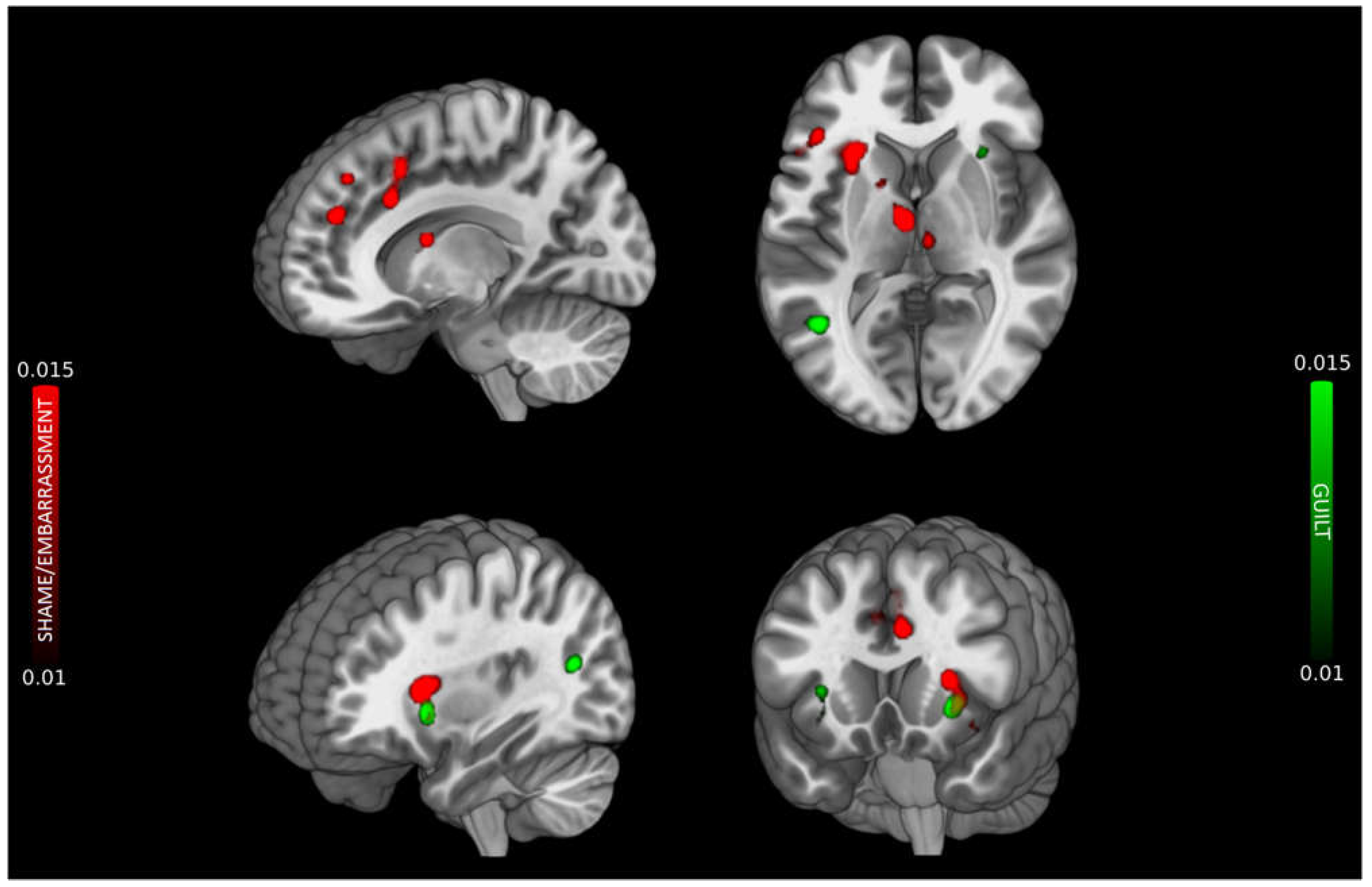
Figure 2.
Contrast analysis results. In red, specific activations of shame/embarrassment vs guilt; in purple, conjunction analysis (Shame/embarrassment & guilt).
Figure 2.
Contrast analysis results. In red, specific activations of shame/embarrassment vs guilt; in purple, conjunction analysis (Shame/embarrassment & guilt).

Table 3.
Results of the meta-analysis on shame/embarrassment processing.
| Cluster # | Volume (mm^3) | Extrema Value | Coordinate | Side | Anatomical Label | BA | ||
|---|---|---|---|---|---|---|---|---|
| x | y | z | ||||||
| 1 | 3896 | 27.37 | -28 | 22 | 8 | Left | Anterior Insula | |
| 17.81 | -36 | 20 | -8 | IFGorb | 47 | |||
| 2 | 2064 | 21.19 | -10 | 44 | 26 | Left | Medial frontal gyrus | 9 |
| 19.53 | -20 | 36 | 36 | Superior frontal gyrus | 9 | |||
| 17.05 | -6 | 38 | 42 | Medial frontal gyrus | 8 | |||
| 3 | 1976 | 29.51 | -6 | -10 | 10 | Left | Thalamus | |
| 18.24 | -14 | 4 | 14 | Left | Caudate | |||
| 15.41 | 6 | -20 | 6 | Right | Thalamus | |||
| 4 | 1688 | 22.70 | -6 | 14 | 44 | Left | Pre-SMA | 6 |
| 22.57 | -6 | 14 | 48 | Pre-SMA | 8 | |||
| 20.21 | -8 | 18 | 32 | dACC | 32 | |||
| 5† | 1016 | 16.64 | 4 | -2 | 34 | Right | dACC | 24 |
| 16.45 | 4 | 16 | 36 | dACC | 32 | |||
| 6† | 976 | 17.42 | -42 | 28 | 16 | Left | Middle frontal gyrus | 46 |
| 13.98 | -52 | 20 | 12 | IFGtri | 45 | |||
| 7† | 960 | 25.41 | 42 | 30 | 14 | Right | Middle frontal gyrus | 46 |
| 8† | 832 | 21.25 | 44 | 2 | 30 | Right | Precentral gyrus/IFGop | 9 |
Note. The table shows results on the meta-analysis on shame/embarrassment neural correlates. BA = Brodmann’s area, IFGorb = Inferior frontal gyrus pars orbitalis, IFGtri = Inferior Frontal gyrus pars triangularis, IFGop = Inferior frontal gyrus pars opercularis, † = not reach the significance level when studies using facial stimuli are excluded from the analysis. Results are corrected with cluster-wise correction, using p < .001 at the voxel level and p < .05 at the cluster level. Coordinates are in Talaraich space.
Table 4.
Results of the meta-analysis on guilt processing.
| Cluster # | Volume (mm3) |
ALE value (*103) |
Coordinates | Side | Anatomical label | BA | ||
|---|---|---|---|---|---|---|---|---|
| x | y | z | ||||||
| 1 | 1528 | 23.42 | -32 | 18 | -2 | Left | Anterior insula/IFGorb | 47 |
| 2 | 1080 | 20.34 | -44 | -58 | 16 | Left | Superior temporal gyrus | 22 |
| 3† | 848 | 14.65 | 30 | 20 | 4 | Right | Anterior insula | |
| 11.04 | 32 | 16 | -10 | |||||
| 10.81 | 28 | 16 | -6 | |||||
Note. The table shows results on the meta-analysis on guilt neural correlates. BA = Brodmann’s area, IFGorb = Inferior frontal Gyrus pars orbitalis, † = not reach the significance level when studies using autobiographical memory recall tasks are excluded from the analysis. Results are corrected with cluster-wise correction, using p < .001 at the voxel level and p < .05 at the cluster level. Coordinates are in Talaraich space.
Table 5.
Contrast analyses results.
| Shame/embarrassment and Guilt | ||||||||
|---|---|---|---|---|---|---|---|---|
| Cluster # | Volume (mm3) | ALE value (*103) | Coordinates | Side | Anatomical label | BA | ||
| x | y | z | ||||||
| 1 | 1160 | 18.76 | -34 | 18 | 0 | Left | Anterior insula/IFGorb | 47 |
| Shame/embarrassment vs. Guilt | ||||||||
| Cluster # | Volume (mm3) | Z-scores | Coordinates | Side | Anatomical label | BA | ||
| x | y | z | ||||||
| 1 | 1280 | 2.56 | 0 | -10 | 12 | Left | Thalamus | |
| 2.14 | -10 | 2 | 14 | Caudate | ||||
| 2 | 1280 | 3.06 | -30 | 20 | 14 | Left | Anterior insula | |
| 3 | 1200 | 2.56 | -8 | 17 | 43 | Left | dACC | 32 |
| 1.98 | -10 | 14 | 48 | Pre-SMA | 6 | |||
| 4 | 1000 | 3.06 | 0 | 4 | 36 | Right | dACC | 24 |
| 5 | 960 | 2.36 | 40 | 28 | 18 | Right | Middle frontal gyrus | 46 |
| 2.07 | 44 | 32 | 8 | IFGorb | 46 | |||
| 6 | 688 | 3.24 | -39 | 28 | 17 | Left | Middle frontal gyrus | 46 |
| 7 | 672 | 2.44 | -18 | 32 | 36 | Left | Middle frontal gyrus | 8 |
| 2.18 | -14 | 38 | 34 | Superior frontal gyrus | 9 | |||
| 2.13 | -20 | 40 | 36 | Superior frontal gyrus | 9 | |||
| 8 | 536 | 2.12 | 48 | 1 | 29 | Right | Precentral gyrus | 6 |
| 1.89 | 46 | 3 | 36 | Precentral gyrus | 6 | |||
Note. The table shows results on the meta-analysis on guilt neural correlates. BA = Brodmann’s area, dACC = dorsal anterior cingulate cortex, pre-SMA = pre-supplementary motor area, IFGorb = Inferior frontal gyrus pars orbitalis. Results are uncorrected with p < .05. Coordinates are in Talaraich space.
Disclaimer/Publisher’s Note: The statements, opinions and data contained in all publications are solely those of the individual author(s) and contributor(s) and not of MDPI and/or the editor(s). MDPI and/or the editor(s) disclaim responsibility for any injury to people or property resulting from any ideas, methods, instructions or products referred to in the content. |
© 2023 by the authors. Licensee MDPI, Basel, Switzerland. This article is an open access article distributed under the terms and conditions of the Creative Commons Attribution (CC BY) license (http://creativecommons.org/licenses/by/4.0/).
Copyright: This open access article is published under a Creative Commons CC BY 4.0 license, which permit the free download, distribution, and reuse, provided that the author and preprint are cited in any reuse.


