

Submitted:
20 January 2023
Posted:
23 January 2023
Read the latest preprint version here
Abstract
The reflectance \(R\) of monolayer graphene for the normal incidence of electromagnetic radiation is known to be remarkably defined only by \(\pi\) and the fine-structure constant \(\alpha\). It is shown in this paper that the reflectance (or the sum of transmittance and absorptance) of monolayer graphene, expressed as a quadratic equation with respect to the fine-structure constant \(\alpha\) must unsurprisingly introduce the 2$^\text{nd}$ fine-structure constant \(\alpha_2\), as the 2$^\text{nd}$ root of this equation, as well as two \(\pi\)-like constants for a convex and a saddle surface. It turns out that this 2$^\text{nd}$ fine-structure constant is negative, and the sum of its reciprocal with the reciprocal of the fine-structure constant \(\alpha\) is independent of the reflectance value \(R\) and remarkably equals $-\pi$. Particular algebraic definition of the fine-structure constant \(\alpha^{-1} = 4\pi^3 + \pi^2 + \pi \approx 137.036\), containing the free \(\pi\) term and agreeing with the physical definition of this dimensionless constant to the 5$^\text{th}$ significant digit, when introduced to this sum, yields \(\alpha_2^{-1} = -4\pi^3 - \pi^2 - 2\pi \approx -140.178\). Assuming universal validity of the physical definition of \(\alpha\), \(\alpha_2\) defines the negative speed of light in vacuum \(c_n\). The average of this speed \(c_n\) and the speed of light in vacuum \(c\) is in the range of the Fermi velocity (\(10^6\) m/s). Furthermore, the 2$^\text{nd}$ negative fine-structure constant \(\alpha_2\) alone introduces the imaginary set of base Planck units.
Keywords:
Planck units
; the fine-structure constant
; speed of light in vacuum
; emergent dimensionality
I. Introduction
Numerous publications provide Fresnel coefficients for the normal incidence of electromagnetic radiation (EMR) on monolayer graphene (MLG), which are remarkably defined only by and the fine-structure constant having the reciprocal
where e is the elementary charge, is the Planck charge, is vacuum permittivity, ℏ is the reduced Planck constant, and c is the speed of light in vacuum.
Transmittance (T) of MLG
for normal EMR incidence was derived from the Fresnel equation in the thin-film limit [1] (Equation 3), whereas spectrally flat absorptance (A) was reported [2,3] for photon energies between about 0.5 and 2.5 eV. T was related to reflectance (R) [4] (Equation 53) as , i.e,
The above formulas for T and R, as well as the formula for the absorptance
were also derived [5] (Eqs. 29-31) based on the thin film model (setting for substrate).
The sum of transmittance (2) and the reflectance (3) at normal EMR incidence on MLG was also derived [6] (Equation 4a) as
where
is the impedance of vacuum, is the MLG conductivity [7], and is the electric susceptibility of vacuum.
These coefficients are thus well-established theoretically and experimentally confirmed [1,2,3,6,8,9].
As a consequence of the conservation of energy
In other words, the transmittance in the Fresnel equation describing the reflection and transmission of EMR at normal incidence on a boundary between different optical media is, in the case of the 2-dimensional (boundary) of MLG, modified to include its absorption.
The paper is structured as follows. Section II shows that Fresnel coefficients for the normal incidence of EMR on MLG introduce the second, negative fine-structure constant . Section III shows that this second fine-structure constant introduces the negative speed of light in vacuum , which in turn introduces the imaginary set of base Planck units. Section IV shows that the negativity of the alone is sufficient to introduce the -set of Planck units. Section V presents Fresnel coefficients for the normal incidence of EMR on MLG expressed just by . Section VI shows that Fresnel coefficients for the normal incidence of EMR on MLG introduce two -like constants for a convex and a saddle surface having respectively positive and negative Gaussian curvatures. Section VII outlines certain prospects of further research, whereas Section VIII concludes the findings of this study.
II. The second Fine-Structure Constant
The reflectance (3) of MLG can be expressed as a quadratic equation with respect to
having two roots with reciprocals
Therefore, the quadratic equation (8) introduces the second, negative fine-structure constant .
The sum of the reciprocals of these fine-structure constants (9) and (10)
is remarkably independent of the reflectance R. The same result can be obtained for the sum of T and A, as shown in Appendix A.
Furthermore, this result is intriguing in the context of a peculiar algebraic definition of the fine-structure constant [10]
that contains a free term and agrees with the physical definition (1) of to the 5th significant digit. Therefore, using Equations (11) and (12), we can express the negative reciprocal of the 2nd fine-structure constant that emerged in the quadratic equation (8) also as a function of only
This result supports the validity of the algebraic definition (12).
But how can this negative value be interpreted physically?
III. Negative Speed of Light and the -set of Planck Units based on it
Almost all physical constants of in the physical definition of the fine-structure constant (1) are positive1, whereas the charge e is squared. Only the velocity can be negative, as it is a directional quantity. Therefore, if
then
where is the negative speed of light in vacuum that, using Equations (11) with (1) and (15), amounts
which is greater that the speed of light in vacuum c in modulus, whereas their average
is in the range of the Fermi velocity.
Furthermore, we can express the term in (16) using the impedance of vacuum (6) as which, using the algebraic definitions of (12) and (13), yields the following relation between the speed of light in vacuum c, negative speed of light , the fine-structure constant and the negative fine-structure constant
where is the electron’s velocity at the first circular orbit in the Bohr model of the atom.
The concept of the negative speed of light in vacuum might seem to be a nonsence or unsettling for the reader. If this is the case, the reader is advised to skip to the subsequent Section 1.
The negative speed of light in vacuum (16) introduces the imaginary set of base Planck units {, , , , } that redefined by square roots containing raised to an odd (1, 3, 5) power become imaginary and bivalued2:
and can be expressed3, using (18), in terms of base Planck units , , , and .
We note in passing, that imaginary and negative physical quantities are the subject of research. In particular, thermodynamics in the complex plane is the subject of research. In particular, Lee–Yang zeros have been experimentally observed [11,12].
Both charge (19) and mass Planck units (21) are related with base Planck units in the same way. It is not surprising: both Coulomb’s law and Newton’s law of gravity are inverse-square laws. We also note that the relations between time (22) and temperature Planck units (23) are inverted: , whereas . Furthermore, eliminating and from (19)-(23) yields the following relations
and
independent of the velocity of light.
The first relation (24) is interesting. A complex energy formula
where represents the real energy, M is the mass of a particle, represents the imaginary energy, and
is the imaginary-real energy ratio4, where Q is the charge5 of the particle, was proposed in [13] (Eqs. (1), (3), and (4)). Squared imaginary-real energy ratio (28) can be expressed as
which certainly supports the complex energy formula (27). We see that for , (24). In such a case, the complex energy (27) is real-to-imaginary balanced, i.e., Such a balanced situation is also specific to black holes, the horizons of which comprise a balanced number of Planck areas with binary potentials equal to and zero [14]. Furthermore, the complex energy (27) of an antiparticle is defined as a conjugate of the complex energy of its associated particle. The complex energy (27) also unifies Coulomb’s law and Newton’s law of gravity (cf. [13] Eqs. (7), (8)) between two particles with masses , , charges , , a distance of R apart, in a complex force formula
We note that the imaginary term vanishes if and (particle vs. antiparticle). Also, the quantum of the imaginary energy (corresponding to the elementary charge e) ([13] Equation (10)) can be expressed, using the impedance of vacuum (6), in terms of the fine-structure constant as
The Planck volume
the Planck momentum
the Planck energy
and the Planck acceleration
are imaginary and bivalued.
However, the Planck force
and the Planck density
are real and bivalued.
On the other hand, the Planck area
is strictly negative. According to the holographic principle, each bit of information is physically represented on the holographic boundary by the Planck area [15,16,17] (having a positive value), whereas these areas are triangular [14]6. Notably, out of all four omnidimensional (i.e., present in all complex dimensions n) convex n-polytopes and n-balls, only n-simplices (i.e., triangles for ) are bivalued, admitting both positive and negative volumes and surfaces [18].
IV. Alternative Derivation of the -set of Planck Units without the Negative Speed of Light
The -set of Planck units, discussed in the preceding section, can also be derived without the negative speed of light (16).
Using the definition of the fine-structure constant (1) for the negative (10) or (13), we see that it requires an introduction of some imaginary Planck charge , so that its square would yield a negative
Thus, using the value of the elementary charge e in (39) and the value of the (10) or (13), the imaginary Planck charge (39) can be derived without the negative speed of light as
Furthermore, the concept of the negative speed of light is not required to derive the imaginary Planck mass, which, using (40), (24) and the values of the Planck mass and charge is
In the derivation of (41), we have used the relation (24) that was derived on the basis of the negative speed of light, but this relation, as such, is independent of any particular value of the speed of light, be it positive or negative.
Knowing that the Planck charge is we can solve it for the speed of light to find and introduce it to the Planck force making it is independent on the speed of light.
V. Algebraic Fresnel coefficients for the normal incidence of EMR on MLG
With algebraic definitions of (12) and (13) transmittance T (2), reflectance R (3) and absorptance A (4) of MLG for normal EMR incidence can be expressed just by .
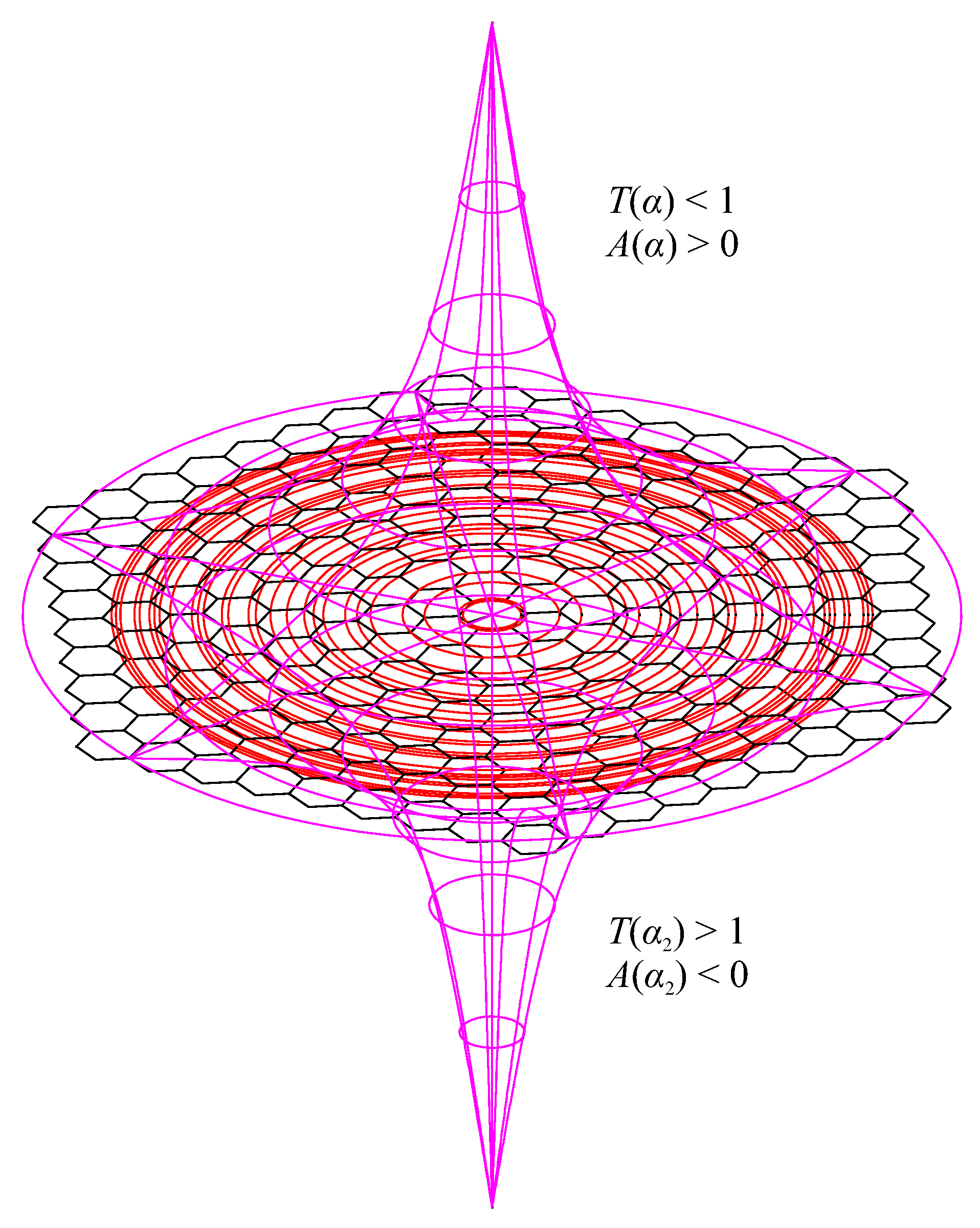
Obviously ( as required by the law of conservation of energy (7), whereas each conservation law is associated with a certain symmetry, as asserted by Noether’s theorem. Nonetheless, physical interpretation of and invites further research. implies a sink, whereas implies a source, whereas the opposite holds true for the transmittance T, as illustrated schematically in Figure 1. Perhaps, the negative absorptance and transmittance exceeding 100% for (10) or (13) could be explained in terms of graphene spontaneous emission.
VI. FRESNEL COEFFICIENTS FOR THE NORMAL INCIDENCE OF EMR ON MLG introduce two -like constants for two surfaces with positive and negative Gaussian curvatures
The quadratic equation (8) describing the reflectance R of MLG under normal incidence of EMR (or alternatively (A1)) can also be solved for yielding two roots
dependent on R and , where indicates or . This can be further evaluated, using the algebraic definition of R (48) (which is the same for both and ), yielding four, yet only three distinct, possibilities
The absolute value of (51) corresponds to a convex surface having a positive Gaussian curvature, whereas the absolute value of (53) - to a negative Gaussian curvature. Their product is independent of , and their quotient is independent of . It remains to be found, whether each of them describes the ratio of circumference of a circle drawn on the respective surface to its diameter () or the ratio of the area of this circle to the square of its radius (). These definitions produce different results on curved surfaces, whereas on convex surfaces, while on saddle surfaces [19].
VII. Discussion
A general relation describing the information capacity (i.e., the number of the triangular Planck areas at the black hole horizon, corresponding to bits of information and the fractional part triangle to small to carry a bit) of a Schwarzschild black hole (BH) having the diameter D multiplier after absorption () or emission () of a particle having the wavelength multiplier has been disclosed in [14] (Equation (18)) as
This general geometric relation, originally derived only for particles having the Compton wavelength equal to the BH radius [20] (p. 153), is remarkably similar to the algebraic definitions of the inverses of (12) and (13) also containing , , and terms. This raises the question of whether the inverses of the fine-structure constants themselves correspond to the number of bits. Remarkably, the floor function of the inverse of the fine-structure constant represents the threshold on the atomic number (137) of a hypothetical element feynmanium that, in the Bohr model of the atom, still allows the 1s orbital electrons to travel slower than the speed of light. On the other hand, the negative introduces the negative BH information capacity, which - taking into account the negative, triangular Planck area (38) - could be in the form
or
To examine the conditions under which the BH information capacity would equal (12) and (13) after absorption or emission we compare (54) with (12), which yields
whereas comparing (54) with (13) yields
in both cases with for absorption and for emission. The emission first term in (57) and (58) corresponds to the BH Compton diameter multiplier [14] (Equation (9)). This issue certainly requires further research. We note in passing that the fine-structure constant has recently been reported as the quantum of rotation [21].
VIII. CONCLUSIONS
We have shown that the reflectance of graphene under the normal incidence of electromagnetic radiation (EMR), expressed as the quadratic equation with respect to the fine-structure constant must introduce the 2nd negative fine-structure constant .
The sum of the reciprocal of this 2nd fine-structure constant with the reciprocal of the fine-structure constant (1) is independent of the reflectance value R and remarkably equals simply .
Particular algebraic definition of the fine-structure constant (12), containing the free term, when introduced to this sum, yields .
Assuming universal validity of the physical definition of the fine-structure constant (1), the 2nd fine-structure constant (13) defines the negative speed of light (16), the average of which and the speed of light in vacuum is in the range of the Fermi velocity ( m/s).
Furthermore, the negative fine-structure constant alone introduces the imaginary set of five base Planck units (19)-(23), whereas mass and charge units (24), as well as temperature and time units (25) are directly related to base Planck units.
The Planck volume (32), momentum (33), energy (34), and acceleration (35) derived from imaginary base units (20)-(23) are imaginary and bivalued, whereas the Planck force (36) and density (37) are real and bivalued.
The square of the imaginary Planck length (20) introduces the negative Planck area (38). If Planck areas correspond to bits of information [15,16,17] and if they are triangular [14], then the fact that among four basic geometrical structures present in all complex dimensions: n-balls, n-cubes, n-orthoplices, and n-simplices only the latter have bivalued (positive and negative) volumes and surfaces equal to the modulus [18] for any real dimension n, suggests a physical interpretation for this negative Planck area (38).
The findings of this study, in particular, the meaning of the relation (25) (which clearly hints at Heisenberg’s uncertainty principle) and the negative ratios (51) and (53), inquire further research in the context of information-theoretic approach [22,23,24] and emergent dimensionality [14,18,25,26].
In the context of the results of this study, monolayer graphene, a truly 2-dimensional material with no thickness7, is a keyhole to other, unperceivable [14], dimensionalities. Graphene history is also instructive. Discovered in 1947 [28], graphene was long considered academic material until it was eventually pulled from graphite in 2004 [29] by means of ordinary Scotch tape8. These fifty-seven years, along with twenty-nine years (1935-1964) between the condemnation of quantum theory as incomplete [30] and Bell’s mathematical theorem [31] asserting that it is not true, and the fifty-eight years (1964-2022) between the formulation of this theorem and 2022 Nobel prize in physics for its experimental loophole-free confirmation, should remind us that Max Planck, the genius who discovered Planck units, has also discovered Planck’s principle.
Appendix A. Other Quadratic Equations
The quadratic equation for the sum of transmittance (2) and absorptance (4), putting , is
and has two roots with reciprocals
and
whereas their sum is also independent of T and A.
Other quadratic equations do not feature this property. For example, the sum of (5) expressed as the quadratic equation and putting , is
and has two roots with reciprocals
and
whereas their sum
is dependent on T and R.
References
- Kuzmenko, A.B.; van Heumen, E.; Carbone, F.; van der Marel, D. Universal dynamical conductance in graphite. Physical Review Letters 2008, 100, 117401, arXiv:0712.0835 [cond-mat]. [Google Scholar] [CrossRef] [PubMed]
- Mak, K.F.; Sfeir, M.Y.; Wu, Y.; Lui, C.H.; Misewich, J.A.; Heinz, T.F. Measurement of the Optical Conductivity of Graphene. Physical Review Letters 2008, 101, 196405. [Google Scholar] [CrossRef] [PubMed]
- Nair, R.R.; Blake, P.; Grigorenko, A.N.; Novoselov, K.S.; Booth, T.J.; Stauber, T.; Peres, N.M.R.; Geim, A.K. Universal Dynamic Conductivity and Quantized Visible Opacity of Suspended Graphene. Science 2008, 320, 1308–1308, arXiv:0803.3718 [cond-mat]. [Google Scholar] [CrossRef] [PubMed]
- Stauber, T.; Peres, N.M.R.; Geim, A.K. Optical conductivity of graphene in the visible region of the spectrum. Physical Review B 2008, 78, 085432. [Google Scholar] [CrossRef]
- Wang, X.; Chen, B. Origin of Fresnel problem of two dimensional materials. Scientific Reports 2019, 9, 17825. [Google Scholar] [CrossRef] [PubMed]
- Merano, M. Fresnel coefficients of a two-dimensional atomic crystal. Physical Review A 2016, 93, 013832. [Google Scholar] [CrossRef]
- Ando, T.; Zheng, Y.; Suzuura, H. Dynamical Conductivity and Zero-Mode Anomaly in Honeycomb Lattices. Journal of the Physical Society of Japan 2002, 71, 1318–1324. [Google Scholar] [CrossRef]
- Zhu, S.E.; Yuan, S.; Janssen, G.C.A.M. Optical transmittance of multilayer graphene. EPL (Europhysics Letters) 2014, 108, 17007. [Google Scholar] [CrossRef]
- Ivanov, I.G.; Hassan, J.U.; Iakimov, T.; Zakharov, A.A.; Yakimova, R.; Janzén, E. Layer-number determination in graphene on SiC by reflectance mapping. Carbon 2014, 77, 492–500. [Google Scholar] [CrossRef]
- Varlaki, P.; Nadai, L.; Bokor, J. Number Archetypes in System Realization Theory Concerning the Fine Structure Constant. 2008 International Conference on Intelligent Engineering Systems; IEEE: Miami, FL, 2008; pp. 83–92. [Google Scholar] [CrossRef]
- Peng, X.; Zhou, H.; Wei, B.B.; Cui, J.; Du, J.; Liu, R.B. Experimental Observation of Lee-Yang Zeros. Physical Review Letters 2015, 114, 010601. [Google Scholar] [CrossRef] [PubMed]
- Gnatenko, K.; Kargol, A.; Tkachuk, V. Lee–Yang zeros and two-time spin correlation function. Physica A: Statistical Mechanics and its Applications 2018, 509, 1095–1101. [Google Scholar] [CrossRef]
- Zhang, T. Electric Charge as a Form of Imaginary Energy, 2008.
- Łukaszyk, S., Black Hole Horizons as Patternless Binary Messages and Markers of Dimensionality. In Future Relativity, Gravitation, Cosmology; Dvoeglazov, V.V.; Caldera Cabral, M.d.G.; Cázares Montes, J.A.; Quintanar González, J.L., Eds.; Nova Science Publishers, 2023. [CrossRef]
- Bekenstein, J.D. Black Holes and Entropy. Phys. Rev. D 1973, 7, 2333–2346. [Google Scholar] [CrossRef]
- Hooft, G.t. Dimensional Reduction in Quantum Gravity, 1993. [CrossRef]
- Verlinde, E. On the origin of gravity and the laws of Newton. Journal of High Energy Physics 2011, 2011, 29. [Google Scholar] [CrossRef]
- Łukaszyk, S. On the Omnidimensional Convex Polytopes and n-Balls in Negative, Fractional and Complex Dimensions. preprint, MATHEMATICS & COMPUTER SCIENCE, 2022. [CrossRef]
- Mahajan, S. Calculation of the pi-like circular constants in curved geometry. ResearchGate, 2013.
- Susskind, L. Black Hole War: My Battle with Stephen Hawking to Make the World Safe for Quantum Mechanics, 2008.
- Shuvaev, A.; Pan, L.; Tai, L.; Zhang, P.; Wang, K.L.; Pimenov, A. Universal rotation gauge via quantum anomalous Hall effect. Applied Physics Letters 2022, 121, 193101. [Google Scholar] [CrossRef]
- de Chardin, P.T. The Phenomenon of Man, Harper: New York, 1959.
- Prigogine, I.; Stengers, I. Order out of Chaos: Man’s New Dialogue with Nature, 1984.
- Vedral, V. Decoding Reality: The Universe as Quantum Information, Oxford University Press, 2010. [CrossRef]
- Łukaszyk, S. Four Cubes, 2021. arXiv:2007.03782 [math].
- Łukaszyk, S. Novel Recurrence Relations for Volumes and Surfaces of n-Balls, Regular n-Simplices, and n-Orthoplices in Real Dimensions. Mathematics 2022, 10, 2212. [Google Scholar] [CrossRef]
- Jussila, H.; Yang, H.; Granqvist, N.; Sun, Z. Surface plasmon resonance for characterization of large-area atomic-layer graphene film. Optica 2016, 3, 151. [Google Scholar] [CrossRef]
- Wallace, P.R. Erratum: The Band Theory of Graphite [Phys. Rev. 71, 622 (1947)]. Physical Review 1947, 72, 258–258. [Google Scholar] [CrossRef]
- Novoselov, K.S.; Geim, A.K.; Morozov, S.V.; Jiang, D.; Zhang, Y.; Dubonos, S.V.; Grigorieva, I.V.; Firsov, A.A. Electric Field Effect in Atomically Thin Carbon Films. Science 2004, 306, 666–669. [Google Scholar] [CrossRef] [PubMed]
- Einstein, A.; Podolsky, B.; Rosen, N. Can Quantum-Mechanical Description of Physical Reality Be Considered Complete? Physical Review 1935, 47, 777–780. [Google Scholar] [CrossRef]
- Bell, J.S. On the Einstein Podolsky Rosen paradox. Physics Physique Fizika 1964, 1, 195–200. [Google Scholar] [CrossRef]
- Łukaszyk, S. A short note about graphene and the fine structure constant 2020. [CrossRef]
- Łukaszyk, S. A short note about the geometry of graphene 2020. [CrossRef]
- C. J. Shearer, A. D. Slattery, A. J. Stapleton, J. G. Shapter, and C. T. Gibson, “Accurate thickness measurement of graphene,” Nanotechnology, vol. 27, p. 125704, Mar. 2016.
| 1 | Vacuum permittivity is the value of the absolute dielectric permittivity of classical vacuum. Thus, cannot be negative. The Planck constant h is the uncertainty principle parameter. Thus, it cannot be negative; negative probabilities do not seem to withstand Occam’s razor. |
| 2 | Base Planck units themselves admit negative values as negative square roots. |
| 3 | The notation , for example, means that the absolute value of the imaginary Planck length (20) is lower than the absolute value of the Planck length . |
| 4 | In the cited study it is called , so we shall call it to avoid confusion with the fine-structure constant . |
| 5 | Charges in the cited study are defined in CGS units; here we adopt SI. |
| 6 | This is also compatible with the Causal Dynamical Triangulation (CDT) approach, which does not assume a pre-existence of a dimensional space, but focuses on the evolution of the spacetime as such. |
| 7 | Thickness of MLG is reported [27] as 0.37 nm with other reported values up to 1.7 nm. However, taking into account that 0.335 nm is the established inter-layer distance, and thus the thickness of bilayer graphene, these results do not seem credible. |
| 8 | Introduced into the market in 1932. |
Figure 1.
Illustration of the concepts of negative absorptance and excessive transmittance of EMR under normal incidence on MLG.
Figure 1.
Illustration of the concepts of negative absorptance and excessive transmittance of EMR under normal incidence on MLG.
Disclaimer/Publisher’s Note: The statements, opinions and data contained in all publications are solely those of the individual author(s) and contributor(s) and not of MDPI and/or the editor(s). MDPI and/or the editor(s) disclaim responsibility for any injury to people or property resulting from any ideas, methods, instructions or products referred to in the content. |
© 2023 by the authors. Licensee MDPI, Basel, Switzerland. This article is an open access article distributed under the terms and conditions of the Creative Commons Attribution (CC BY) license (http://creativecommons.org/licenses/by/4.0/).
Copyright: This open access article is published under a Creative Commons CC BY 4.0 license, which permit the free download, distribution, and reuse, provided that the author and preprint are cited in any reuse.