

Submitted:
18 October 2022
Posted:
21 October 2022
You are already at the latest version
Abstract
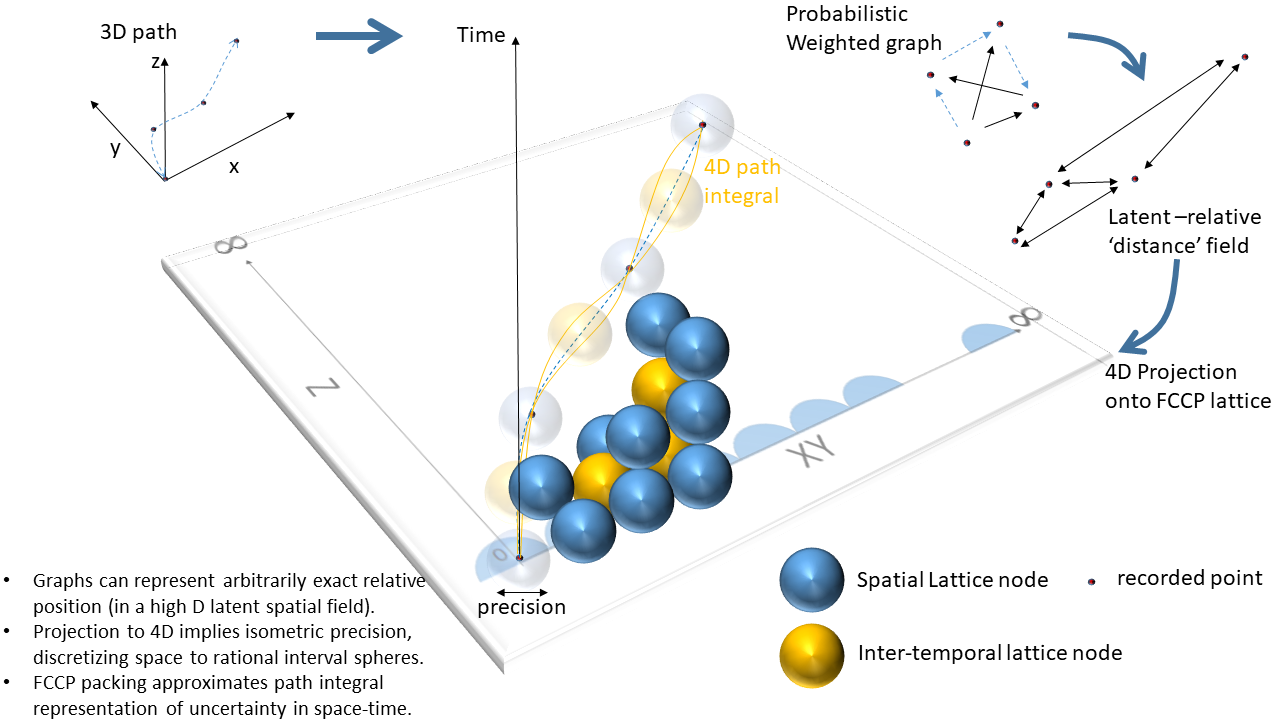
The continuous nature of space and time is a fundamental tenet of many scientific endeavours. That digital representation imposes granularity is well recognized but whether it is possible to address space completely remains unanswered. Part 1 argues that Hales’ proof of Keppler’s conjecture on the packing of hard spheres suggests the answer to be ‘no’, providing examples of why this matters in GIS generally and spatio-temporal GIS in particular. Part 2 seeks to resolve the dichotomy between continuous and granular space, showing how a continuous space may be emergent over a random graph. However, its projection into 3D/4D imposes granularity. Perhaps surprisingly, representing space and time as locally conjugate may be key to addressing a ‘smooth’ spatial continuum. This insight leads to the suggestion of Face Centered Cubic Packing as a space-time topology but also raises further questions for spatio-temporal representation.
Keywords:
Discreteness
; Topology
; Space-Time Representation
; Epistemology
; Face Centered Cubic Packing
Copyright: This open access article is published under a Creative Commons CC BY 4.0 license, which permit the free download, distribution, and reuse, provided that the author and preprint are cited in any reuse.