

Submitted:
02 July 2023
Posted:
03 July 2023
Read the latest preprint version here
Abstract
To date, no scientific study has found evidence of an afterlife, and the mechanism of consciousness is two of the most challenging questions. Here, I show a hypothesis for consciousness and the probability of an afterlife through three simple thought experiments and theoretical evidence. More studies are needed to understand the mechanism precisely. I found that consciousness can be discussed based on a new theory. Here, I hypothesize that when a person or animal dies, the selection of a new nervous system's characteristic of a new life might depend on the characteristics of the final evolved yet unknown particle. Here, I suggest that the positive or adverse evolution of the said particle depends on the natural evolution of the materialistic brain's cognition, including intelligence. The fittest intellectuals, those who have a higher potential scan mind virus, may survive happier and help more for others to improve psychological well-being. Here, I suggest that when a brain dies, the two microparticles might emit at infinite speed from the dead brain and simultaneously bond with a naturally select suitable zygote or early nervous system somewhere in the universe/s, forming a new life with the impact of new nurture.
Keywords:
Cognitive psychology
; determinism
; materialism
; new physics
; theoretical hypothesis
; thought ex-periment
; ultraquantum particles
Consciousness and Life after Death in the Evolution of Intelligence
Consciousness implies awareness: subjective, phenomenal experience of internal and external worlds. Consciousness also implies a sense of self, feelings, choice, control of voluntary behavior, memory, thought, language, and (e.g., when we close our eyes or meditate) internally generated images and geometric patterns; however, what consciousness actually remains unknown and plays an intrinsic role in the universe (Hameroff & Penrose 2014). Philosophers have used the term 'consciousness' for four main topics: knowledge in general, intentionality, introspection (and the knowledge it generates), and phenomenal experience. Penrose–Hameroff summarized consciousness; science/materialism with consciousness has no distinctive role (Chalmers, 2012; Dennett, 1991; Dennett, 1995; Dennett & Kinsbourne, 1991; Wegner, 2002), for example, dualism/spirituality, with consciousness outside of science (Berkeley, 1975; Chopra, 2001; Kant, 1998). Science with consciousness as an essential ingredient of physical law still needs to be fully understood. (Hameroff, 1998; Hameroff, 2007; Hameroff & Penrose, 1996; Hameroff & Penrose, 1996; Penrose & Hameroff, 1995; Penrose & Hameroff, 2011; Whitehead, 1929; Whitehead, 1933). How can we define consciousness, intelligence, and their relationship? How might individual intelligence evolution happen? Is there a probability of an afterlife? How might individual intelligence evolve if the afterlife occurs? How does individual intelligence impact global intelligence evolution? Does a new physics theory link the hypothesis and mechanism of the brain matter to consciousness? These are out of essential and unresolved big questions related to the life of the conscious. Some say that consciousness is not a scientific term and lacks a technical definition, and we are learning to make sense of ourselves without invoking supernatural power (Zeman, 2008). Most scientists put aside the afterlife question, considering it a just religious and metaphysical belief. Moreover, near-death experience represents a biological paradox that challenges our understanding of the brain and has been advocated as evidence for life after death and the noncorporeal basis of human consciousness. (Alexander, 2012; Chopra, 2006; Long & Perry, 2010; Thonnard, et al., 2013; van Lommel, 2010) It is based on an unsupported belief that the brain cannot be the source of highly vivid and lucid conscious experiences during clinical death. (Facco and Agrillo, 2012; Thonnard, et al. 2013; Mobbs & Watt, 2011; van Lommel, 2011)
Nevertheless, the evidence thus far suggests that in the first few minutes after death, consciousness is not annihilated (Reardon, 2019). While many such studies' approaches are on near-death experiences, my methodology differs from those studies and has a new theoretical approach too. This study on the theme was encouraged by researchers who revived disembodied pig brains and challenged definitions of life and death (Vrselja et al., 2019). To philosophers, introspection and phenomenality seem independent or dissociable, although this is controversial. (Sutherland, 1989).
On the other hand, some biophysicists handle the issue of consciousness in a multidisciplinary way. However, when a scientific inquiry into the brain and consciousness occurs, considerable knowledge of physical theories of the matters in the universe and its psychology is unavoidable. Moreover, considering the knowledge of the brain and physical functions, free will is an illusion that shares common cognitive elements with paranormal beliefs. (Mogi, 2014). Nevertheless, neither general relativity nor quantum mechanics help answer these significant problems. When questioning whether there is a unified theory for everything, Hawking found three possibilities: (a) there is a completely unified theory, (b) there is no such ultimate theory or just infinite sequence, and (c) no theory of universe and event cannot be predicted beyond a certain extent (Hawking, 2006). In other words, we cannot conclude universal theory precisely yet.
Hawking told the Guardian, "There is no heaven or afterlife for broken down computers; that is a fairy story for people afraid of the dark." He believed the brain is like a computer that will shut off and regards the brain as a computer that will stop working when its components fail. (Hawking, 2011). Moreover, the biological computer brain naturally selects and programs might make the stream of conscious thoughts. I suggest there are three leading mind software which critical to cognitive functions, and I call those mind virus vs. healthy mind virus (MV vs. HMV) and neutral mind viruses (Dayathilake, 2017; Dayathilake, 2017; Dayathilake, 2017: Dayathilake, 2018). However, the question is whether merely the matter of brain nature and nurture makes consciousness or not. I propose that consciousness may result from multiple factors. Consciousness may arise and vanish in a complex natural neuronal reflex network with a combination of the brain's nature, nurture, X-ultraquantum unique particle of consciousness (X-UQUPC) particle, and X-ultraquantum genomic particle of consciousness (X-UQGPC) (in other words, in the fields of ‘new’ ultraquantum-‘molecular’ biophysics and genetics (a ‘genome’ of the ‘genetic’ information of a conscious mind); however, it does not consist of nucleotide sequences of DNA but the ultraquantum ‘genes’ and may be a changing heritable characteristic of the conscious mind with time; therefore, there is no free will. (Dayathilake, 2017; Dayathilake, 2017; Dayathilake, 2017: Dayathilake, 2018). According to Theravada, Abhidharma outlines twenty-four kinds of conditional relation relations (Karunadasa, 2010) in the processes subject to relation (Gombrich, 2009) and no self that no unchanging, permanent self or essence can be found in any phenomenon (Machin, 2013). Buddhist texts portray consciousness as “momentary collections of mental phenomena” and as “distinct, unconnected and impermanent moments that perish as soon as they arise” (Hameroff & Penrose 2014). Buddhist teachings mention that consciousness is a “momentary collection of mental phenomena” and is “distinct unconnected and impermanence that perish as soon as arise.” Buddhist writings even quantify the frequency of conscious moments. For example, Sarvaastivaadins (Rospatt, 1995) described 6,480,000 “moments” in 24 hours (an average of one “moment” per 13.3 ms, 75 Hz), and some Chinese Buddhists described one “thought” per 20 ms (50 Hz). The best measurable correlate of consciousness through modern science is gamma synchrony electroencephalography (EEG), 30 to 90 Hz coherent neuronal membrane activities occurring across various synchronized brain regions (Hameroff & Penrose, 2014). Slower periods, e.g., 4 to 7 Hz, that a frequency with nested gamma waves could correspond to saccades and visual gestalts (Woolf & Hemeroff,2001; VanRullen & Koch, 2003)
Therefore, we still do not have a fundamental theory to explain the objectives of the article thus far, and I assume that an interdisciplinary study with a theoretical model may be helpful to initially find possible evidence of the issues of consciousness and the afterlife.
Method
The three theoretical experiments assumed that all participants had healthy brains and minds in similar environments. I assumed that the first and third experiments were valid if cell death attenuated and preserved anatomical and neural cell integrity (Vrselja, Z. et al. 2019). From T1 to T2, six brains were dead; therefore, there was no consciousness.
The human participants in all three experiments were categorized into three groups, who lived in the lab time before T1.
- I.
- The identical triplet participants include I-myself-me as 'a'; my sublimes are ‘b’ and ‘c.’ In other words, any article reader may assume that you as ‘a’ and your identical siblings are ‘b’ and ‘c’ of identical triplets.
- I.
- II. The second identical (triplet) participants were labeled ‘d', 'e,' and 'f,'
- I.
- III. The nonidentical triplet is labeled 'g,' 'h,' and 'i.'
All matters and functions from atoms, molecules, and neurons to the whole brain were identical in each triplet of I and II. Nutrients were given a similar quantity and quality, so their physiological, psychological, and physical processes could be identical and simultaneous; in other words, groups I, II, and III were nurtured similarly. I assumed that all similar subatomic particles, atoms of elements, in all brains were qualitatively and quantitatively identical and similarly functional according to quantum theory; similar chemical compounds in the brain behave similarly to theories in chemistry. In other words, all subatomic particles, atoms of elements, and chemicals in those brains are not universally unique but qualitatively (physically and chemically) and quantitively (e.g., physically and chemically). physical mass, sizes, etc.) common. Moreover, I assume all the participants are identical and nonidentical; no one experiences their consciousness is unique, overlaps, coincides, or feels each other's pains and happiness. In other words, even identical persons in similar environmental conditions simultaneously in two or many locations (in the lab or another place on Earth (if) or on another planet/s at any given moment), their feelings-consciousness are individual but not shared.
- Experiment 1
(I assumed) At age 18, at T1, healthy persons of a, b, d, e, g, and h were simultaneously (if) killed without harming their brains. Postmortem samples of disembodied brains were kept in the laboratory until T2 using preservation technology (Vrselja, Z. et al. 2019). Over time, T2 simultaneously gives life to all dead brains.
Results
Soon after T1, the brains of a, b, d, e, g, and h are dead, and those six brains get a life again at T2. However, c, f, and i continue their lives in the lab from birth to beyond time T2. Here, all nine participants' brains grew independently. However, the brain sizes of c, f, and i are more extensive than those of a, b, d, e, g, and h.
Discussion
What happens to the consciousness of a, b, d, e, g, and h after T1? For example, do their similar consciousness streams live in the lab or outside the laboratory, as 'a' (T1 to Tx)(green color square in Figure 1) and 'b' T1 to Ty, who was before T1 as a result of the afterlife? If more simplify the question ‘you- the reader – a’ now live in the lab after T2 or someone else mind- consciousness in the brain ‘a’. Therefore, scientists are probably in trouble confirming whether similar consciousness of a and b (and d, e, g, and h) (whose brains lived until T1 before they were frozen in the lab) now live after T2 (see Venn diagram one) in the lab or someone else consciousness in those six brains. I assumed their cognitive evolution (or regression) might be similar, as shown in the second Venn diagram. (Here, I demonstrate that a, b, and c are just three examples of nine live brains for your easy reference.)
As I showed in Venn diagram one, cognitive functions (except consciousness) of a, b, c, d, e, f, g, h, and i might be;
a∩ b ∩c = X1 or a, b and c have similar cognition (however, three different person consciousness) from T0 and T1
d ∩ e ∩ f = X2 or in other words, d, e, and f have similar cognition (however, three different persons’ consciousness) from T0 and T1
Cognitions, including consciousness of g, h, and i, are different. Even if they are similarly nurturing, their nature is different.
g ∩ h ∩ i = Ø
- Experiment 2
Suppose the whole-brain matter of a, b, d, e, g, and h were instantly separated to the atomic level at T1; moreover, the six brains were simultaneously reconstructed at T2. Furthermore, at T2, these brains looked ‘physically’ similar to those until T1 and were similarly nurtured. The second experiment was designed to avoid two errors (1). if the six brains in experiment one were not dead but had little consciousness, in other words, if they were in a nearly dead stage (yet not dead brains), and (2). to minimize the error of (if) quantum entanglement intervened between the six individual brains when the brains regained (in experiment one) six different consciousness-persons at T2. Furthermore, those six brains are similarly nurtured.
Result
Suppose this experiment is theoretically acceptable; simultaneously, reconstructed brains of a, b, d, e, g, and h will function from T2 and beyond as in experiment one. Furthermore, all brain volumes, anatomy, and physiological activities are similar in the laboratory (as with those six brains until T1) as in experiment one.
Discussion
A similar discussion may apply here, as in experiment two. (See Venn diagrams one and two)
- Experiment 3
I suppose two identical (a,b,c, and d,e, f) and the nonidentical triplicate (g, h, i)are nurtured similarly to experiment one until T1. The dead brains of a, b, d, e, g, and h were frozen from T1 to T2 using preservation technology (Vrselja, Z. et al. 2019). I assumed constructing the newest brains of all nine in a similar methodology as in experiment two. Therefore, I assume I can create twenty-seven new brains from elements in the lab. These twenty-seven new brains constructed materialistically similar triplicates of a, b, c, d, e, f, g, h, and i. Therefore, twenty-seven new participant brains at T2 were a1, a2, a3, b1, b2, b3, c1, c2, c3, d1, d2, d3, e1, e2, e3, f1, f2, f3, g1, g2, g3, h1, h2, h3, i1, i2, and i3. In addition to regaining the life of six frozen brains of a, b, d, e, g, and. Moreover, the brains of c, f, and i continue their lives until T0. Therefore, thirty-six brains (participants) were included in the third experiment. Including c, f, and i, whose brains were in the lab from T2 onward. Hence, the living brains at time T2 are ‘a' to c3(a, a1, a2, a3,b, b1, b2, b3,c, c1, c2, and c3), 'd' to f3(d, d1, d2, d3,e, e1, e2, e3,f, f1, f2, and f3), 'g' to g3(g, g1, g2, and g3), h to h3, (h, h1, h2, and h3), and i to i3 (i, i1, i2, and i3). Therefore, brains within 'a' to c3; 'd' to f3; 'g' to g3, 'h' to h3, and 'i' to i3 were physically and chemically identical. Human cloning is the closest empirical approach to these thought experiments, although they are not ethical and not perfectly applicable due to the lack of present science and biotechnology.
Results
If the third thought experiment was theoretically acceptable, I proposed that all twenty-seven artificially built brains, the six frozen brains, and c, f, and i might live. Therefore, all thirty-three brain functions will simultaneously start at T2 and beyond, along with already continuously functioning three live brains of c, f, and i in the lab.
Discussion
However, no researcher would externally observe whose consciousness is in the lab except c, f, and i. For example, if the reader of my research assumes that he was labeled as ‘a’ util T1, scientists are in great trouble identifying the brain that your consciousness- was in ‘a’ now in which identical brain at T2; out of eleven identical brains of a, a1, a2, a3,b, b1, b2, b3,c1, c2, and c3 which are in the lab or outside the lab. Assume the original participant ‘ a’(‘you’)(before T1) consciousness are now in all eleven identical brains of 'a', a1, a2, a3, b, b1, b2, b3, c1, c2, and c3, it not logical. What happened to ‘a’ (your) conscious mind before T1? (See Venn diagrams one and two). Do ‘a’ (your) consciousness destroy forever, in one out of eleven or another brain out of the lab? How can one say that ‘a’ (your) conscious mind is destroyed without an afterlife? Alternatively, great questions remain if ‘a’ (your) mind selects one of eleven identical brains. In other words, how and why does ‘a’ (your) mind arise (if) in one specific brain out of eleven identical brains?
General Discussion
How did brains gain 'new' consciousness at T2? Whose consciousness identities are now of new thirty-three brains? For example, how do the similar eleven brains, identical to the brain 'a', start new consciousness simultaneously at T2, as I discussed in the third experiment? It might be more convenient to understand the argument if any scientist or reader of this article could imagine ‘you’ and ‘your’ identical two siblings of the triplets and other participants in this research to analyze the results of the experiments. The third experiment is crucial to answering one of the research objectives. Some can argue that the similar conscious minds originally in a, b, d, e, g, and h are not among the thirty-three brains after T2 in the lab. For example, did the similar consciousness of 'a' (you and your siblings ‘b’) exist among similar a, a1, a2, a3, b, b1, b2, b3, c1, c1, and c3 brains in the lab or out of the lab in an unknown place? (I labeled those two brains ‘a?’ and ‘b?’). If not, what happened to the 'a' and b consciousness in the lab before T1?
If the original person 'a' existed brain in the lab while all eleven brains were identical, how and why did the original 'a' select a particular brain out of eleven identical-similar brains? These are crucial and big questions that need to be solved here. Otherwise, 'a'(you) should feel aware that 'a' simultaneously live within two or more identical brains in the lab after T2.
Suppose Orch Or or any other theory of materialism might suggest that the original 'a' might also be among those brains after T2. However, 'a' has no life between T1 and T2. In addition, no stream of series of the afterlife might be their conclusion. However, they might not be smart enough to answer how or why 'a' (and your siblings 'b’) is or is not among such perfectly identical eleven brains simultaneously made at T2. Because the new life of twenty-seven and six brains (frozen) gains life at T2, it appears similar to emerge as in pig brains (Vrselja, Z. et al. 2019). Moreover, their current opinions of the afterlife make it challenging to identify who lives in each conscious brain. This article’s argument might convince us that the new life in pigs’ brains was probably not similar to “pigs’ consciousness before specific brains death.
There are probably two, three, or more or an infinite number of brains physically identical to any given brain simultaneously in the universe/s. Our introspections indicate that a person's consciousness has a unique continuum throughout life and does not coincidently overlap with any other life’s conscious mind out of ‘a’ (your) or mine, or someone else brain. Furthermore, we are generalizing our experience, and scientific findings, personal experience, and feelings suggest that the identity of (your) consciousness would not exchange or move to identical brain/s elsewhere simultaneously. In other words, there is no overlap or coincidence of similar feelings within two or more similar brains, which might create confusion in the mind and feel simultaneously (you) being in two or many environments.
One may propose that everyone has a universal, unique consciousness, a continuous stream of distinct consciousness, and no series of afterlife continuums. However, such a proposal would create contradictions once again.
If cognitive function applies to a Venn diagram one for experiment three, their cognition (above T2) will be:
a ∩ b ∩ c∩ a1 ∩ a2 ∩ a3 ∩ b1 ∩b2 ∩b3 ∩ c1 ∩c2 ∩ c3 = X or similar cognitive functions of these eleven brains will be similar from time T2 and beyond in the laboratory, except for similar consciousness.
According to these mathematical expressions, X depicts similarities in every aspect of identical brains' cognitive functions, except their unique-individual consciousness. The consciousness of 'a’ and 'b' (who were until T1) might not be similar persons of 'a?’ and 'b?’ after T2. When there are no other beings except researchers and said brains in the laboratory;
{a? b?} ∩ Lab = Ø
I did not arrange an additional experiment to find more precise facts on (two-in-one) microparticles to discuss the hypothesis in the results of this study. X-UQGPC (Dayathilake, 2017; Dayathilake, 2017; Dayathilake, 2017: Dayathilake, 2018) may carry the finally evolved (ultraquantum) 'key' genome when somebody or/an animal is dead, which may help bond and 'lock' with the neuronal matters of new life. However, X-UQGPC (or X-UQUPC) might not be physically able to test in a laboratory unless the working hypothesis of theoretical and logical arguments is supported by scientific facts. However, thought experiments one, two, and three suggest that there may be naturally created two, three, more, or infinite physically identical brains to any specific in the universe/s and their similar 'keys' of X-UQGPC. Alternatively, if someone gets birth and their consciousness merely results from a coincidence, such coincidence might happen two or more or infinite times in the universe/s, which makes similar consciousness simultaneously. For example, ‘a’ (you) must confuse if ‘a’ (you) exist-live in many lives simultaneously, as I discussed in the third experiment. Therefore, I suggest that to avoid similar multiple identical consciousnesses and universal confusion, X-UQUPC might naturally be created, which is universally unique to any being in the universe/s.
However, merely materialism and present empirical findings do not support such two kinds of particles that emit and move to bond with a suitable zygote/primary nervous system/embryo at infinite velocity. Previously, physics discussed hypothetical particles tachyon (Feinberg, 1967) that possibly move faster than light. Furthermore, the quantum entanglement speed is 10,000 times the light speed (Juan, Y. et al. 2013), which encourages my hypothesis on the infinite speed of two-particle movement. However, if such a mechanism does not exist, it will again contradict itself because there may be two, many, or an infinite number of identical consciousnesses. Materialists might find it difficult to explain the results of the third experiment without the speculation of X-UQUPC and X-UQGP. In other words, a (you) and b (your sibling) might be a continuum out of the lab after T1.
Both (X-UQGPC + X- UQUPC) particles may be bonded exceptionally and cannot break when justifying the hypothesis. However, I cannot precisely answer how those particles originate in the universe/s and why. Do they never destroy? Buddhist teachings call the state of Nibbana (extinction) “the ultimate and absolute deliverance from future rebirth, old age, diseases, and death from all sufferings and misery” (Nayanatiloka, 1952) and (after) the highest level of intelligence (Dayathilake, K.L.S., 2017) of a being, yet further in-depth studies remain. Moreover, these two particles may not exist without live neurons over time. The combined two particles may not be discussed with either general relativity or quantum theory. Moreover, such particles may be emitted from a dead brain and simultaneously move at infinite speed to bond with another suitable prematurely vacant nervous system.
Furthermore, the observers or researchers in the lab might never find or face a significant challenge in identifying whether the similar stream of consciousness of 'a' (you) and 'b' continues in new brains after T2, out of eleven identical brains. Scientists need to apply the results of three experiments logically. Otherwise, the confusion will continue.
Nevertheless, any person's consciousness continues in the live brain until death; in other words, the living brain is not a zombie like a computer. To Hawking, the live human brain is similar to a zombie (unconscious) computer. He might assume that consciousness has no such unknown (such as X- UQCUP) particle, which quantum theory might not explain. Moreover, it may be a moment-by-moment manifestation of the mind, which is said to happen in every person all the time. (Karunamuni, 2015). Moreover, human consciousness flows like a stream governed by five characteristics (James, 1890).
In other words, materialists may say that participants' lives were a continuum from T0 to T1, which is an empirical-experience fact. Nevertheless, there was no afterlife from T1 to T2, and the similar original consciousness of the six regained similar consciousness and cognitions at T2 in the lab. However, they will be unanswerable to the results of the third experiment; if someone asks them to show the brain of 'a' out of eleven identical brains, they will be in trouble. Furthermore, if they say 'a’ was neither in nor out of the lab, they cannot answer why. Nevertheless, the only option is that 'a' might live from T1, elsewhere outside the lab.
We may assume that the reference to present life uniqueness of self-awareness might be a continuum from childhood (probably from an early embryo) until death. In other words, in the development of a given person's brain in size and its neural organization, new matter (elements, chemicals in different quantities and qualities) replaces inside or outer neurons of the brain (such as new proteins, evolving DNA, neuroplasticity, and neurogenesis) or shrinks in age, when after stroke, or brain damage, etc., an excellent still ‘specific – unique’ stream of consciousness continuum via time. Therefore, our theory might be an alternative to more successfully discussing those big questions with minimal contradictions than existence theories, including materialism.
Therefore, if the six brains did not die but minimized or neutralized (a reference to experiment one) their consciousness at T1, they would continue their unique psychological awareness from T2 and beyond. Nevertheless, if these six participants indeed die, researchers face a significant challenge to find the original consciousness of a, b, d, e, g, or 'h' consequently; however, a problematic issue seems essential to find what might happen to our continuum consciousness after death at T1. If materialism is acceptable, no new physics need or afterlife is involved. However, the issue is why six previous persons were not born at T2 among the thirty-three brains. Suppose one can argue that there is a possibility to be born again among thirty-three while keeping a time interval of T1 to T2. If those six were born again among thirty-three, one could question materialists in which specific brains previous life of six were born and why. Moreover, one can ask materialists who say similar consciousness will arise in a similar brain. If so, how does six specific consciousness (which were before death T1) select six specific-distinct brains among the several identical brains?
If scientists assumed that pig brains (Vrselja et al., 2019) regained similar 'unique' consciousness in (their empirical experiment), similar brains before death after being frozen might be their fault judgment. Analyzing the results of the third study creates contradictions with a particular conclusion. Furthermore, even identical brains are structural, biological, clinical, neurological, cognitive, psychological, and physically similar; however, consciousness is unique in a specific person. Therefore, researchers in the lab or reader face trouble finding answers, such as where ‘a’ (you) indeed live after T2 (death) or whether you live in out of similar eleven brains of a, a1, a2, a3, b, b1, b2,b3, c1, c2, c3, including the defrost dead brain of 'a' and 'b,’ when regaining life after T2'. Furthermore, did 'a's consciousness live elsewhere, out of the lab -on Earth or in the universe/s?
Therefore, materialism, GR, and quantum mechanics do not answer the above issues. Alternatively, in other words, unknown particles (X-UQGPC) may be involved here. Here, I cannot precisely discuss in-depth the X-UQ particles and evidence of present knowledge of biophysics or other physics theories. However, such unidentified matter might closely function with a quantum particle in brain neurons, and the functions might depend on the Orch Or theory.
Quantum mechanics might not adequately discuss such tiny matter in size, mass, speed, velocity, or time. If such particles exist, it is not always necessary for them to behave according to quantum mechanics. From a mathematical aspect, although one is a natural number, it does not present an absolute number (quantitywise). Nevertheless, one may indicate relative measurement (e.g., one light-year, kilo, or nanometer). Regardless, in any natural number, a between zero and 1 (one) has a decimal representation of relative quantities with an infinite decimal.
Moreover, it is unclear whether such absurdly tiny scales have any physical meaning (Roger, 1989). Therefore, asking for the most minor or minuscule mass particle or/and the minor time fracture seems meaningless. However, obtaining all those measurements (quantities) and all qualities might not even be in the future. Here, I argue that if there are countless smaller particles in size and different new physical qualities, they might not behave according to the laws in the present theories of physics. Those might be beyond direct empirical research, such as any elementary – subatomic particles. I use this mathematical application to assume the probability of the existence of particles smaller than empirical elements already found by physicists. Here, I use these mathematical thoughts to suggest the probability of the two in one tiny particle, as I have already mentioned. Otherwise, when it travels through massive bodies such as black holes or colossal stars, it would also be destroyed, deviated, or attached to them by great gravity and heat. (Dayathilake, 2018). Since electromagnetic waves and quantum particles have space-time curvature, such particles cannot pass through these massive bodies in the universe/s and have an absolute (limited) speed of 3x10⁸ ms-1.
Nevertheless, ultraquantum particles (theory) assume that those particles have infinite speed and are massless or nearly ‘zero mass,’ so space-time has no curvature. However, without (firm) evidence, I suggest that those particles simultaneously have a multi(or infinite) dimensional movement within the live brain and, when death occurs, emit and attach in a new ‘nervous system’ at infinite speed, too. Such infinite-speed suggestions minimize contradictions within the significant issues of the argument.
Consequently, the life of the nervous system might be formed by union with two unidentified microparticles and travel in infinite velocity from one dead brain to a new vacant primary nerve system. Data show that subatomic particles break light speed (Eugenie, 2011) and quantum entanglement (Schrodinger, 1935), encouraging my idea of infinite velocity. I call it an unknown-X (X-UQUPC), which would be universally unique to any given person or/and animal. According to this hypothesis, there are no two or more X-UQUPCs in living beings elsewhere in the universe/s; therefore, there are no similar consciousness identities.
Neurobiological changes may impact quantum mechanics and be minimal, inactive, neutral, or less conscious. For example, if there is a lack of oxygen, glucose, and general anesthesia, such fluctuations of consciousness might occur. Here, I explain how consciousness might exist in the brain with the direct results of three experiments. I propose that infinite movement of (X-UQUPC +X-UQGPC) in a specific brain's active areas of a person may result in present-moment awareness of consciousness. The evolution (or regression) of X-UQUPC may depend on the physical brain function of a particular active area(s). X-UQGPC might exist in the whole live brain simultaneously. Therefore, the speed of thoughts might depend on the neuronal network's operating speed. However, X-UQUPC + X-UQGPC may have infinite speed outside (multi or infinite) dimensional (simultaneous) vibration and exist as a 'cloud' in the entire live brain. Therefore, the 'cloud' size may be expanded while developing the brain. Here, I would emphasize that bonded particles do not represent the ‘notion of a spiritual soul’ that has been told particular and ever-suffering or happy birth after death and independent of brain functions, which has no scientific rationale.
The third theoretical experiment attempts to make exact brains develop in completely similar nurtures. (1) a physical foundation of the brain is a scientific fact, (2) we, billions of healthy humans on Earth, an experience that our consciousness continues from past to present, and everyone feels their consciousness of lives is unique and independent to each of their life awareness-consciousness-existence, (3) cloning identical animals or human is a fact-possible in present science and technology (4) already there may be numerous physically identical brains may exist in the universe/s, such as to similar cloning humans and animals. Because astronomers suppose there are nearly 100 to 200 x 10 21 - approximately 200 billion trillion stars- in (our) universe. I suggest that more than one, two, many or infinite numbers of universes might exist in infinite space (Dayathilake, 2017; Dayathilake, 2017; Dayathilake, 2017: Dayathilake, 2018). Scientists claim that billions of stars might already have possible planets where life exists in our universe. (5) Quantum and GR theories do not give a rational answer to materialism. Simultaneously, reductionists did not find unique empirical-physical matter in each brain to justify consciousness.
I analyzed the results in the first table and Venn diagrams one and two for an acceptable answer, especially in the third experiment.
(6) The latest research on consciousness, such as Orch Or theory (Hameroff & Penrose, 2014), or any other, might not be able to challenge the argument here of three experiments.
Because (for example) their hypotheses may not be strong enough to discuss what happened to ‘a’(you) and your siblings' continuum consciousness in the lab. In other words, what happened to three of their consciousness (‘a’), you and your two of ‘a’ and ‘b’ siblings? (because no one existed between T1 and T2). Therefore, who consciouses existed in the lab after T2 (within eleven similar identical brains)? Who were actually in the new eleven identical brains in the lab? According to my suggestion, it might be clear that you (a), your ‘b,’ and ‘c’ siblings might not exist in the brains of those eleven identical brains of a? b? and a1 to c3 simultaneously. Otherwise, (for example), ‘a’(you) and your ‘b’ and ‘c’ two siblings would have been in all (two or many) eleven (similar) brains simultaneously; however, it might not happen, and contradiction. In other words, you and your sibling ‘b’ should feel simultaneously in two or more places (brains). However, as mentioned earlier, no healthy people on Earth have had such experiences. Furthermore, who was in the new eleven brains after T2 in the lab? These questions might not explain other than my points of one to six above. (7) As I previously said, a universally X-UQUPC continuum is a stream from birth to death and the afterlife. Moreover, no healthy person is simultaneously confused with one, two, or more similar lives and multi awareness (multiconsciousness). Therefore, a person's consciousness contradicts unless we do not apply the X-UQUPC of this theory.
(8) Nevertheless, if the consciousness of life emerges just as a rare accident without continuum afterlives and with a purely physical effect, similar accidents might or should also occur (for example) at any time between two or many persons on Earth. Contradictions occur again if similar consciousnesses arise (as I discussed above in point seven). Therefore, it is not logical to accept that the life consciousness of a person (or any being) arises from coincidence. If a similar person's life gains two or more places simultaneously due to (just) coincidence, the materialists' argument fails again with multiple identical consciousnesses. Therefore, you, me, or any other might confuse about multiple existences simultaneously in many places in the universe if life is just a result of a coincidence (9). Therefore, if life is just the result of a coincidence of only known and empirical physical matter, it cannot solve the problem. (10). Nevertheless, point nine will be a contradiction; if such two, more, or infinite similar coincidences might happen simultaneously, similar individuals may be born with identical consciousness (but not unique or independent ); in other words, we should feel that we are concurrently in two or more or infinite places simultaneously. (11) Most importantly, I assume that (when) the origin of mysterious consciousness (naturally )is avoided, such as universal self-confusion. However, the nature of matter might naturally originate carrier particles of individual consciousness (unknown -X unique particle) and continuum stream of consciousness in the afterlife (might be with natural responsibility). However, it is too early to suggest whether this purpose of unique consciousness has any relationship with life in the universe/s. To avoid those contradictions and three experiment results, I suppose there is no time gap to travel to X-two combined microparticles (X-UQGPC and X-UQUPC) between the dead brain and new life in a primary nervous system. Therefore, there might be no issue with distance travel between those two environments of the dead brain to the vacant nerve system. (13) I emphasize that one, two, or more (X-UQGPC) with a similar 'key' may emit at any time. (14) Nevertheless, there may be many more vacant similar nervous systems than the number emitting any X-UQGPC at any given time. In other words, there may be more or infinite vacant and matching nervous systems in the universe/s than any given number of similar 'keys' of X-UQGPC(+X-UQUPC) that might emit at any given time. However, here I should emphasize that if there may be two or more beings having a similar' keys, in different ‘independent’ brains'. However, I may not suggest that there are two or more beings with similar X-UQUPC.
Therefore, the evolution (or regression) of life in the universe/s and consciousness might not be merely a result of known physical matters of the brain and a just outcome of coincidence, as materialism explains. However, it may result from phenomena only discussed with new physics and beyond empirical studies. Otherwise, the principle of individual-unique consciousness of life theory cannot apply. In other words, ‘a’ (you), your sibling’s ‘b,’ and ‘c’ might experience two or more identical brains simultaneously at any given moment (in diverse areas of the universe/s), as I have demonstrated in research observations after T2. As I already emphasized several times in different ways in the paper.
Here, the X-UQGPC might be changed by the brain's quantum particles. Both combined microparticles may not move to any other brain or beyond the specific brain until death. In other words, when a person's brain has a velocity relative to any external matter, the 'cloud' of two ultraquantum particles might move simultaneously with the brain. In other words, when the brain develops to larger or shrinks with age, the two particle sizes may adjust to the live brain area at any given moment. Because the two particles move simultaneously at an infinite velocity in the live regions of an entire brain, X-UGPC may not affect changes that evolve (or progress) in the physical brain. In other words, the evolution (or regression) of X-UQGPC in the brain depends on nature, nurture, biology, biophysics, and related behavior. Therefore, the total evolution (or regression) of these factors may impact the positive or negative effects of X-UQGPC. One may suggest that those particles act as an independent soul.' However, if there is an independent soul, such as a 'constant matter' in identical twins or triplets (nurtured similarly), it should have a variation of I.Q. and behaviors. X-UQUPC might not deviate from X-UQGPC or any person's materialistic brain, which continuously makes its stream of a unique individual consciousness. Therefore, X-UQUPC might never change over time in a particular life and might continue a unique consciousness even after death. However, the evolving or regression X-UQGPC in a specific brain and the characteristic final 'key gene/s' of evolution (or regression) may be crucial to selecting and bonding the next life.
I suggest additional theoretical evidence of a single unique 'cloud of the two microparticles' of any living brain(areas) in humans or animals. For example, billions of neurons in a human brain are not linked as a single network; there are always gaps- space between each other by synapse of every neuron and no unbroken microtubule links (a single network) within the entire brain. Therefore, it is difficult to make a possible argument for a single individual identity in one brain without the theory mentioned here. If we do not consider this hypothesis, one can argue that there might be billions of individuals—independent materialist persons—(therefore billions of separate consciousnesses) in a single brain, and why not so.
I use split-brain research findings to strengthen my idea of the new physics ‘matter’ of two combined microparticle hypotheses. Suppose researchers on split brains suggest multiple modules. In that case, the brain is composed of hundreds of independent centers of thought called "modules" (Blakeslee, 1996), two minds in one person (Schiffer, 2021), leading to the conclusion that simple dual consciousness (i.e., right-brain/left-brain model of the mind) is a gross oversimplification and that the brain is organized into hundreds or perhaps even thousands of modular-processing systems. (Gazzaniga, M., LeDoux, J., 1978; Gazzaniga, M., 1985). However, they are not yet able to make a unified theory to suggest how the material brain is responsible for origin and continuum (at least in the present life span) as a universally unique you (or your siblings) within two, more, or infinite identical brains, if in the universes in diverse nurture, without my theory of two microparticles. They do not yet suggest how individual self-consciousness-awareness-feeling is universally unique with (if) merely brain material function. My thought experiment points out that consciousness is not merely
a function of the material of the brain and cannot merely be explained by relativity theory and the quantum mechanism of brain matter. Furthermore, solve how consciousness might not simply exist in the brain without assuming my view. Second, there are two major apart hemispheres with distinctive functions and billions of apart neurons. However, specific functions unite, and we experience feeling as a single self-person-you or me in a single brain on Earth, might among two or many possible apart identical brains in the universe/s. My alternative principle suggests how two hemispheres and billions of neurons unite for a unique individual-person-self, as already explained. Third, split-brain research convinces us that (if such) microparticles are essential and might be the reason for making a unique (individual) consciousness and feeling as one person. However, combining two microparticles might not impact (in this point, microparticle function neutral impact on brain biology) the physical matter of a brain (just the microparticle communicates in coordination with each other live neurons in the whole brain). The materialistic corpus callosum and the physical matter of the live and presently active part of a brain, along with impacts with microparticles, might make your (for example) different feeling-awareness, perceptions, and memories, likewise. However, I cannot strongly oppose reincarnation research arguments. If reincarnation results are scientific facts, microparticle genomes might deviate and impact the brain, recalling memories in those rare cases.
Accordingly, no alternative theory has yet been seen that may challenge this argument about the afterlife. Therefore, as Hawking has discussed, we cannot compare a significant afterlife question with broken computers because computers do not have life and continuum consciousness but are just materialistic machines. Moreover, reincarnation can save Schrodinger's cat (Merali, 2008), which may strengthen this theory.
The phenomena of X-UQCGP could naturally evolve positively (+) or negatively (-), impacting the nature and nurture of the person's brain (Dayathilake, 2017; Dayathilake, 2017; Dayathilake, 2017: Dayathilake, 2018). Moreover, the notion of a specific and eternal soul independent of brain functions contradicts while observing behaviors and thoughts of persons with Alzheimer's disease, mental disorders, aging (Dayathilake, 2017), and behaviors. If humans have such an independent soul, patients' behaviors or other cognitive functions do not deviate from whatever brain matter makes them vary. In other words, if there is such a permanent and independent soul, neurological or psychiatric patients may not suffer from disorders of their physical brain. Therefore, I suppose there is also no free will (Dayathilake, 2017; Dayathilake, 2017). My definition of human intelligence is the fundamental cognitive ability to solve problems practically with scientific creativity to optimize self and others' PWB (Dayathilake, 2017). MV scanning (meditation) by healthy mind viruses might impact their intelligence evolution. In other words, if a person scans mind viruses successfully, the resultant total level (state) of intelligence moves higher, according to my theoretical 3D graph. Alternatively, in other words, if the evolution of intelligence is more significant than regression, the resultant total state of intelligence might move to a higher level in the graph: In other words, a person’s intelligence level is variable-fluctuating via time. Early Buddhist teachings emphasize five crucial facts – ‘fivefold lawfulness’ important to someone’s nature, nurture, and afterlife quality (and where you will be born). It is quite interesting that according to my studies on Buddhist psychology (Dayathilake, 1991; Dayathilake, 2017), Buddhists teach different categories of ‘laws’ of life (simply other than nature and nurture) as (1). bija niyama-‘ nature’ heritable characteristics transfer from parents -fertile. (2) utu niyama- weather, climate, etc.(3). Kamma niyama- Here, I suppose this might mean heritable characteristics which transfer next life quality and when finding suitable place-nurture which has certain nature of the primary nervous system, one of the main hypotheses, that I mention-suggest this article (as X-UQGPC). (in Buddhist teachings-literature) Buddha has defined that “O Bhikkhus it is volition-decision that I call karma. Having willed, one acts body, speech (in other words, behaviors), and (conscious) mind (Anguttara Nikaya, 1929). I suppose decisions which might be ‘recorded’ in X-UQGPC (4) citta niyama – (because of the law of the stream of consciousness (mind). (e.g., the lawful sequence of the (consciousness) article function. (5) Dhamma niyama- I suppose that (other) nature of a thing(might discuss by materialism (physical, chemical, biological, and other theories might discuss in scientific laws) justice, righteousness (social psychological laws-theories) which impact on brain-mind mechanisms. (Dayathilake, 2017; Dayathilake, 2017; Dayathilake, 2017: Dayathilake, 2018) evolving, along with nature, nurture, and time. Therefore, such MV scanning may impact the natural evolution of X-UQGPC. I found more than 30,300 peer review studies for keyword searches on meditation in PubMed Central on diverse research titles. Moreover, a study found that loving-kindness meditation may help to improve subjective well-being (Chao, 2020), and I found that 1690 research articles discussed loving-kindness meditation in PubMed Central when the my article edit.
When a successful MV scan evolves the intelligence of a given person's intelligent decisions, when scanning, MV might naturally reward psychological well-being. If decisions are harmful (inter- or intrapersonal), such decisions might increase the risk of psychological suffering (Dayathilake, 2018). A study showed that once a nerve becomes electrically active, it can influence the genes, influencing how the nerve develops (Gazzaniga, 1994). Therefore, consciousness and the brain have a close relationship. However, nature and nurture influence the I.Q. of adults (Campbell, 1994). Consequently, I assume that HMV — highly activated persons with relatively few and weaker MV might not decline their intelligence with age. (Dayathilake, 2017; Dayathilake, 2017), and research has indicated that clever brains age more slowly (Rabbitt et al., 2003).
These hypotheses might not ultimately discuss the theories. However, any given person or animal has an individual consciousness, which is a primary principle of the universe and might be a continuum after death. The brain might strongly bond with these two unknown ultraquantum particles, regardless of whether the brain develops in size, damages, splits, shrinks, ages, and their unique consciousness continuum until death. Moreover, those X-two microparticles might not impact psychological qualities in the physical brain. Moreover, other physical-material, neurological, and psychological chemicals, nutrients, anesthetics, drugs, and characteristics of the remaining X-UQCGP might impact the quality and quantity of emotions and conscious awareness.
Nevertheless, this may begin a different methodological approach for consciousness and afterlife studies. If we can find more empirical facts strengthening the theory further, it might help evolve our global unity, peace, health, happiness, and many other facts toward making a better world. These findings may emphasize to humankind how risky the natural continuum live-journey of the universe/s we are in (Dayathilake, 1991) and why we need to learn and practice from real intellectuals the methodology to scan our MV by HMV (Dayathilake, 2017; Dayathilake, 2017). Such intellectuals and scientists may encourage or properly program and evolve people's minds and behaviors (Dayathilake, 2017; Dayathilake, 2017) along with these research findings. Here, I have shown a few inter- and intrapersonal biological networks that impact the evolution (or regression) of intelligence and well-being from individual to global. However, I have attempted carefully to avoid the exaggeration and errors of the conclusions of my best in the big problem of consciousness in this study. If the consciousness continuum after death, the next life’s location-nurture in the universe/s and nature might depend -crucial to give the direction by the total influence of intellectual vs. nonintelligent person(with higher MV) behaviors and your biological and psychological potential to be evolved. In other words, a person/s with higher HMV impacts the direction and evolves the level-state of personal, global, and universal higher goals of psychological well-being in natural survival. Strong determinism (Penrose, 1989) and the afterlife hypothesis also do not seem contradictory. However, it is not easy to precisely find the natural purpose of the unique consciousness continuum in the evolution (or regression) of intelligence via the universe/s. I suggest that the X-UQCGP positive or adverse evolution (or regression) depends on the natural evolution (or regression) of the previous materialistic brain's cognition, including intelligence and nurture. The most intelligent person/s with a higher potential scan their mind virus and may survive happier and help others to evolve psychological well-being and intelligence, minimizing several personal, social, and global issues smoothly. Alternatively, I suppose we might find facts in the future on more robust hypotheses to strengthen my study. In that case, humankind may naturally attempt to find better methods to evolve their X-UQCGP for a happier life on Earth and be born in more comfortable places after their death in the universe/s by positively evolving their intelligence over time.
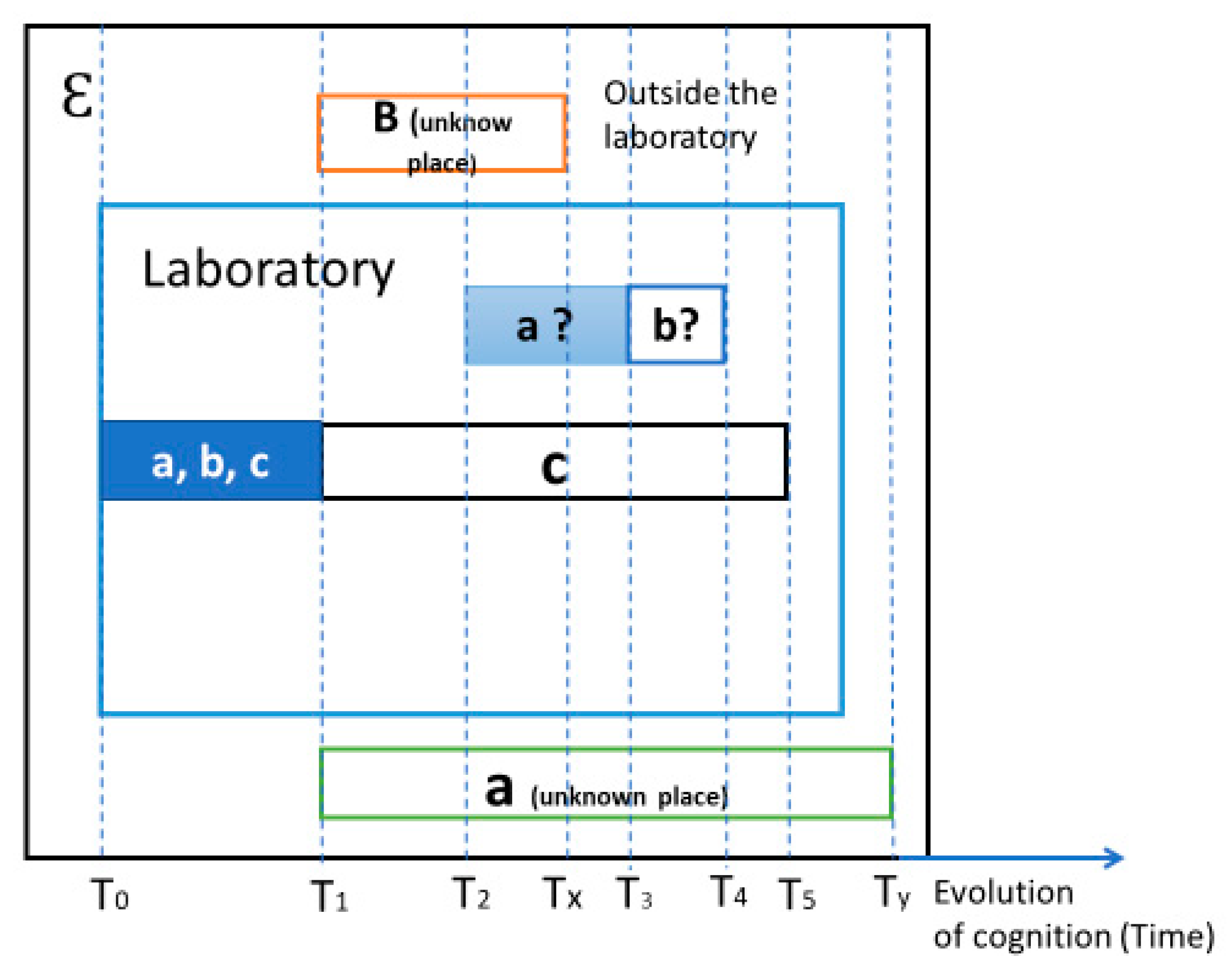
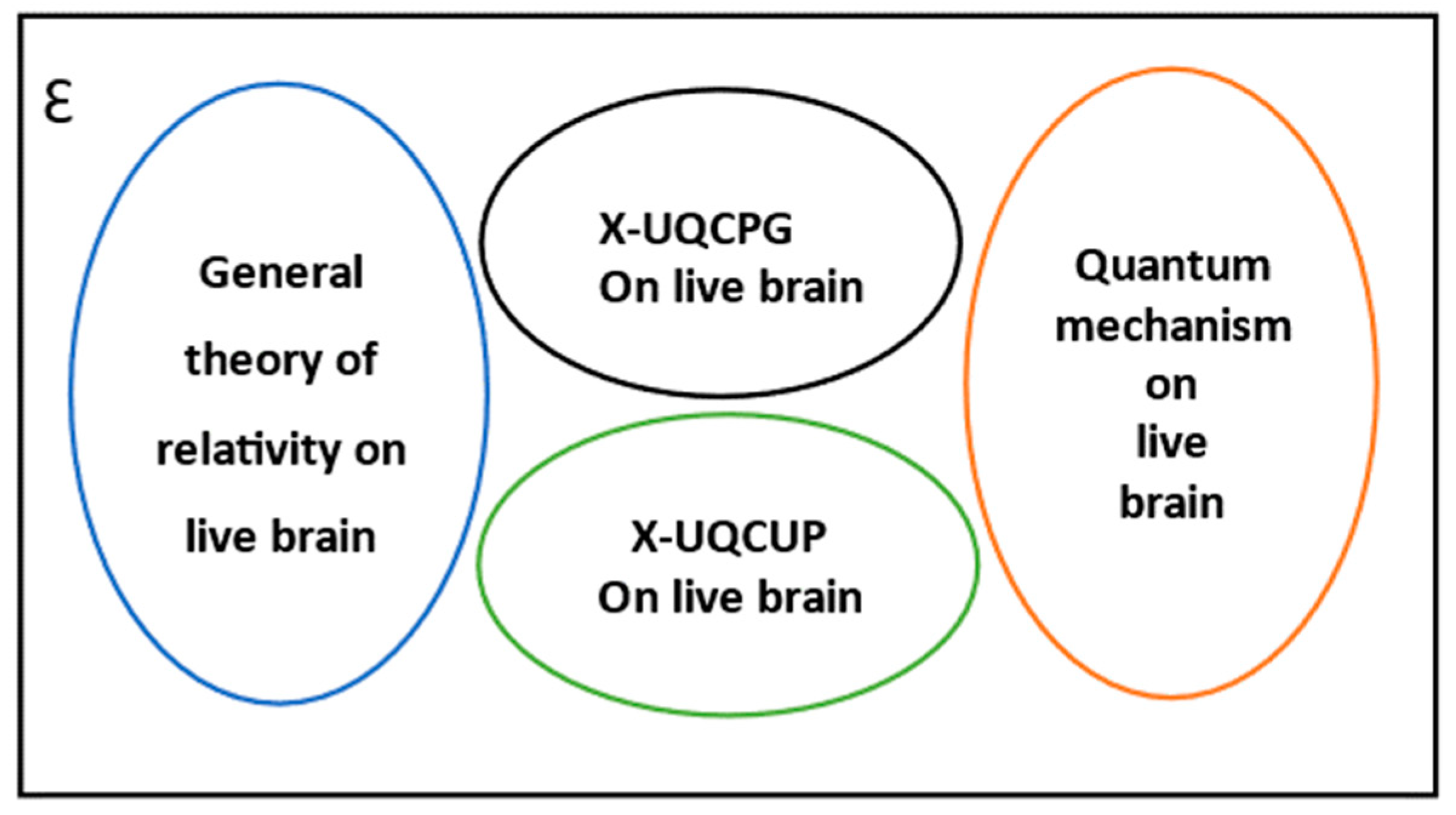

Table 1.
The results Results of experiments 1 to 3: Cognitive function and consciousness of participants.
Table 1.
The results Results of experiments 1 to 3: Cognitive function and consciousness of participants.
| Experiments: | T0 to T1 | T1 to T2 | After T2 |
|---|---|---|---|
| Experiment 1 | |||
| Cognitive functions of a, b, and c | Similar (except consciousness) | Life of c evolving in the lab | a and b have similar cognition; c is older than a and b brains; Therefore, c's cognition is different from a and b |
|
Cognitive functions of d, e, and f |
Similar | Life f evolving in the lab | d and e brains have similar cognition; f is older than d and e; therefore, the cognition of 'f' is different from d and e |
| Cognitive functions of g, h, and i | Different cognitions | Life of i evolving in the lab | g, h, or i have no similar cognition; 'i' is older than the other brains. |
|
The Consciousness Of all nine brains('a' to 'i') |
All the original nine consciousnesses streams were in the lab, unique and independent. | Streams of consciousness of c, f, and 'i' were unique and independent (the big question is what happened to those original consciousness streams of a, b, d, e, g, and h who were until T1) | Unique streams of frozen brains of a, b, d, e, g, and h whose consciousness before T1 might not be in the lab. (What happened to a, b, d, e, g, and h consciousnesses who originally lived until T1?) |
| Experiment 2 | A similar result as in the experiment one | Similar results as in experiment one. c, f, and i brains were still alive. Nevertheless, there were no frozen brains of a, b, d, e, g, and h in the lab. However, there were just atomic elements that 'destroyed' the brains of a, b, d, e, g, and h in the lab until T2. What happened to the consciousness of six of them who were until T1? | Similar results and similar questions remain as in experiment one. |
| Experiment 3 | |||
|
Cognition of: a, a1, a2, a3, b, b1,b2, b3, c, c1, c2, And c3 |
a, b, and c similar cognitions(except consciousnesses) |
c still lives (Then, what happened to the original consciousness of frozen a and b, who were until T1?) |
c is still alive; frozen brains of a? and b? Gain life in the lab. The rest of the newest brains of a1, a2, a3,b1, b2, b3,c1,c2, and c3, and a? and b? have similar cognition. (What happened to the cognition of a and b in the lab before T1?) |
|
Cognitive function of similar brains of d, d1, d2, d3, e, e1, e2, e3 f, f1, f2,and f3 Cognitive function of g, g1, g2, g3,h, h1, h2, h3, i,i1, i2, and i3 |
d, e, and f have similar cognitions(except consciousness) The cognitive functions of g, h, and i were different |
'f' still alive in the lab (What happened to the original consciousness of frozen d and e those who lived until T1?) 'i' still live (what happened to the original consciousness of frozen g and h, those who lived until T1?) |
f still alive in the lab; frozen brains of d? and e? gained life; all nine newest brains of d1, d2, d3,e1, e2, e3,f1,f2, f3 as well as d and e have similar cognition. (what happened to the consciousnesses of d and e, who were originally in the lab before T1?) g to g3 have similar cognition; h to h3 have similar cognition, and i1 to i3 have similar cognition. The brain ‘i’ is older than the other eleven brains and has different cognition. What happened to the original consciousness of g and h? |
| The consciousness of thirty-six brains of a to i3 | The nine original brains in the lab had unique and independent streams of consciousness. | Unique consciousness streams of c, f, and i were still alive in the lab. (However, the crucial and significant issue is what happened to the continuum consciousness stream of a, b, d, e, g, and h, who were in the lab until T1?) | All thirty-six live brains have unique and independent consciousnesses (However, the crucial and significant issue is what happened to the continuum consciousness streams of a, b, d, e, g, and h, who were originally in the lab until T1) |
Figure 2.
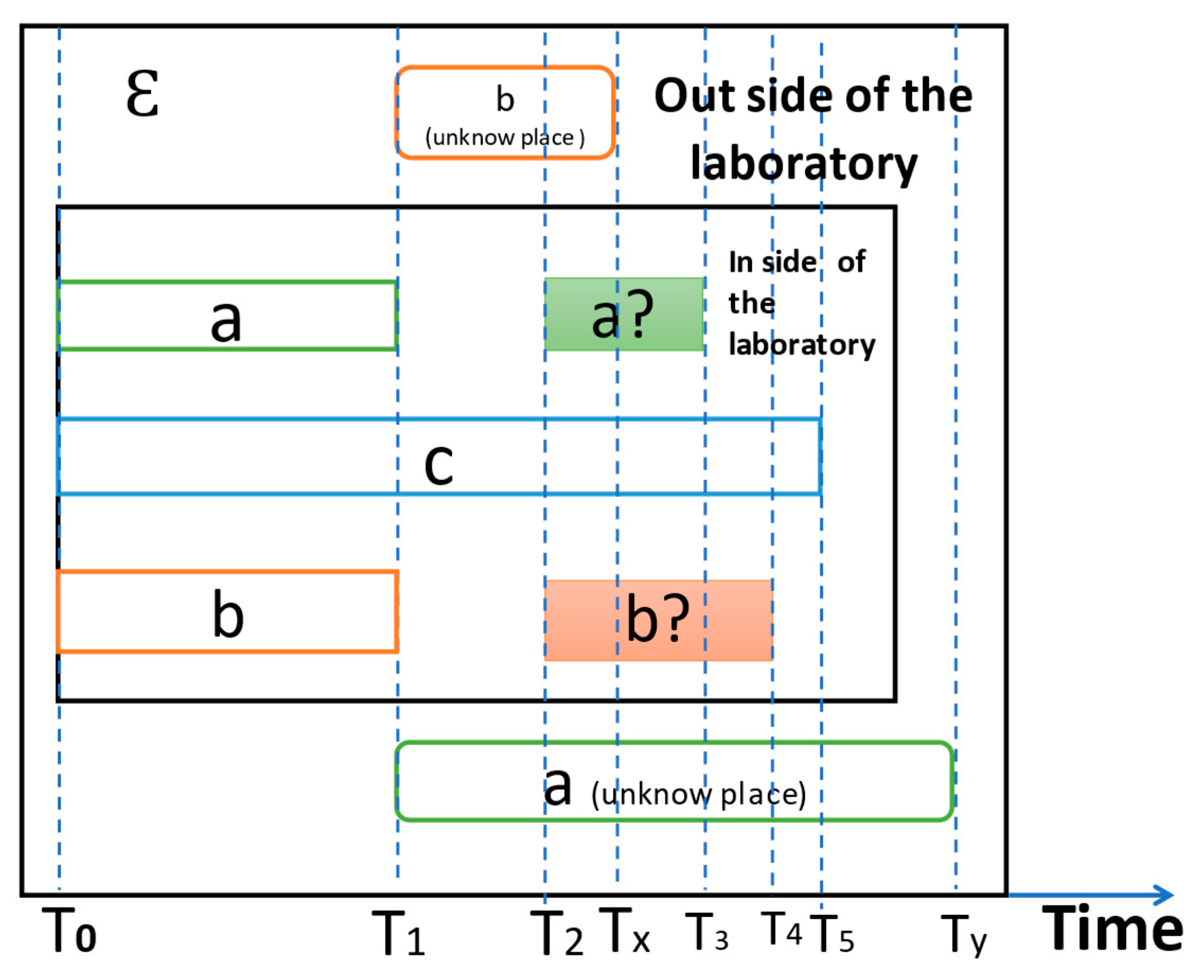
Venn diagram of the cognitive functions of a, b, and c and their life span over time: Note: I demonstrate only one afterlife of a and b (out of nine participants in the three experiments) of their continuum consciousness streams. The laboratory's three streams of individual consciousness of a, b, and c lived between T0 and T1. Three of them had similar cognitive functions until T1. Here, I suggest that after the death of 'a' lived from T1 to Tx and b lived from T1 to Ty, outside (unknown places) of the lab, that might avoid logical contradictions of results. However, c lived from T1 to T5 in the laboratory. The lives of frozen or artificially reconstructed brains of a and b (before labeled as T1) are at T2 of 'a?' lived T1 to T3, and 'b?' (live brain at T2, I label them a? and b? as shown in the figure) lived T1 to T4 in the lab were similarly nurtured.
Figure 2.
Venn diagram of the cognitive functions of a, b, and c and their life span over time: Note: I demonstrate only one afterlife of a and b (out of nine participants in the three experiments) of their continuum consciousness streams. The laboratory's three streams of individual consciousness of a, b, and c lived between T0 and T1. Three of them had similar cognitive functions until T1. Here, I suggest that after the death of 'a' lived from T1 to Tx and b lived from T1 to Ty, outside (unknown places) of the lab, that might avoid logical contradictions of results. However, c lived from T1 to T5 in the laboratory. The lives of frozen or artificially reconstructed brains of a and b (before labeled as T1) are at T2 of 'a?' lived T1 to T3, and 'b?' (live brain at T2, I label them a? and b? as shown in the figure) lived T1 to T4 in the lab were similarly nurtured.
Figure 3.
Venn diagram of the probable relationship between existing theories of brain matter and the new hypothesis of two microparticles. This Venn diagram is a probable relationship between the consciousness of the human brain (or any other living being-life-), the theory of general relativity (GR), quantum mechanics, X-UQCGP, and X-UQCUP. Therefore, the union of four sets in the conscious live brain with Venn diagram symbols is as follows. GR U X-UQCUP U X-UQCGP U Quantum mechanism = union of consciousness of a live brain. All four are disjoint sets: GR ∩ X-UQCUP ∩ X-UQCGP ∩ Quantum mechanism = Ø.
Figure 3.
Venn diagram of the probable relationship between existing theories of brain matter and the new hypothesis of two microparticles. This Venn diagram is a probable relationship between the consciousness of the human brain (or any other living being-life-), the theory of general relativity (GR), quantum mechanics, X-UQCGP, and X-UQCUP. Therefore, the union of four sets in the conscious live brain with Venn diagram symbols is as follows. GR U X-UQCUP U X-UQCGP U Quantum mechanism = union of consciousness of a live brain. All four are disjoint sets: GR ∩ X-UQCUP ∩ X-UQCGP ∩ Quantum mechanism = Ø.
Acknowledgments
My sincere thanks for the tremendous respect for my dearest father, Mr. K.L. Senarath Premathilake (late), and mother, Mrs. K.L. Indra Kurulugama (late), who has given not only nature but also nurture of their best, and my immense gratitude to K.L. Martin (Late grandfather), Mrs. Punchimanike Dalukdeniya (late grandmother), Mr. K.L. Bandula (late grandfather) K.L. Podimanike (late grandmother) nephews- Sanidu Upamal Karunaratne, Nishal Paranagama, Sandaru Shamaindra Senarath, K.L.S. Kawya Kaushalya Kurulugama, and nieces – Ushara Dulakshi Karunaratne, Nishali Paranagama, Mr. and Mrs. Ekanayake and family; option Professor H.M. Petry, committee members, and all the staff, Prof. John Nicholls, Prof. Kenneth Muller, H. E. Mahinda Rajapaksa, H. E. Gotabaya Rajapaksa, Prof. Carlo Fonseka (late), Dr. N Fernando, Sir Arthur C. Clarke (late), Prof. Y. Karunadasa, Mr. H.B. Jayewardene (late), Mr. W. G. Rodrigo (late), Mr. Douglas Perera (late), Dr. Hashitha Mahen Dombagahawatta, Mr. Sanjeewa Wickramanayake, Mrs. Probodhinee Marasingha, and others who encourage and assist.
References
- Alexander, E., (2012). Proof of Heaven. (Simon & Schuster, New York).
- Berkeley, G.,(1975). Philosophical works (Ayers, M., editor).London: Dennett.
- Blakeslee, T., (1996). Beyond the Conscious Mind. Unlocking the Secrets of the Self. pp. 6–7. ISBN 9780306452628.
- Campbell, P., (1994). What if intelligence is inheritable? Nature 371,637. [CrossRef]
- Chalmers, D.J.,(2012). Constructing the world. New York (N.Y.): Oxford University Press.
- Chao Liu, Hao Chen, Chia-Yi Liu, Rung-Tai Lin, & Wen-Ko Chiou (June 2020). The Effect of Loving-Kindness Meditation on Flight Attendants' Spirituality, Mindfulness, and Subjective Well-Being Healthcare (Basel).; 8(2): 174. Published online. 16. [CrossRef]
- Chopra, D., (2001). How to know God: the soul's journey into them the mystery of mysteries. New York: Running Press Book Publishers.
- Chopra D., (2006). Life after Death: The Burden of Proof (Harmony, New York).
- Dayathilake, K.L.S., (2017). Nature of Human Intelligence. Available at SSRN: https://ssrn.com/abstract=3848408 or http://dx.doi.org/10.2139/ssrn.3848408.
- Dayathilake, K.L.S., (June 16, 2017). A Multidisciplinary Hypothesis to Reincarnation: Does It a Universal Survival of the Genomic Particle of the Consciousness When a Brain Death? https://papers.ssrn.com/sol3/papers.cfm?abstract_id=2986253.
- Dayathilake, K.L.S., (July 12, 2018). Life after death in the evolution of intelligence. https://psyarxiv.com/2hkw4/Preprint. [CrossRef]
- Dayathilake, K.L.S., (2017). Nature of human intelligence evolution on psychological well-being. [CrossRef]
- Dayathilake, K.L.S.,(Feb.15, 1991). 'Scientific foundation for optimum happiness of invaluable and extraordinary humanity.’ National Archives collection, Sri Lanka.
- Dennett, D.C.,(1991). Consciousness Explained. Boston (M.A.): Little Brown.
- Dennett, D.C.,(1995). Darwin's dangerous idea: evolution and the meanings of life. New.
- York (N.Y.): Simon and Schuster.
- Dennett, D.C.,& Kinsbourne M., (1991).Time and the observer: the where and when of consciousness. Behave Brain Sci; 15:183–247. [CrossRef]
- Editorial team of Bhikkhus (1929) Anguttara nikaya.page 509. Colombo, Edition of Tripitakaya.
- Eugenie, R. S., (2011). Neutrino-experiment-replicates-faster-than-light-finding-1.9393#auth-1 Nature.452.
- Facco, E. & Agrillo, C., (2012). Near-death experiences between science and prejudice. Front Hum Neurosci. [CrossRef]
- Feinberg, G. (1967). "Possibility of faster-than-light particles." Physical Review. 159 (5): 1089–1105. Bibcode:1967PhRv..159.1089F. [CrossRef]
- Gazzaniga, M.S., (1994). Nature's Mind (Happer Colling Publishers, inc.).
- Gazzaniga, M., LeDoux, J.,(1978). The Integrated Mind. Springer. pp. 132–161. ISBN 9781489922069.
- Gazzaniga, M., (1985). The Social Brain. Discovering the Networks of the Mind. pp. 77–79. ISBN 9780465078509.
- Gombrich, R., (December 31, 2009). What the Buddha thought. Oxford Centre of Buddhist Studies Equinox Publishing Limited.
- Hameroff, S.R. & Penrose, R., (1996). Conscious events as orchestrated space-time selections. J Conscious Stud; 3(1):36–53. [CrossRef]
- Hameroff, S., (1998). Quantum computation in brain microtubules? The Penrose–Hameroff "Orch OR" model of consciousness. Philos Trans R Soc Lond Ser A, Math PhysSci;356:1869–96. [CrossRef]
- Hameroff, S.,(2007). The brain is a neuro-computer. Cogn Sci; 31:1035–45.
- Hameroff, S., & Penrose R., (2014). Consciousness in the universe A review of the 'Orch OR' theory Physics of Life Reviews 11 39–78(2014). [CrossRef]
- Hameroff, S.R. & Penrose, R., (1996). Orchestrated reduction of quantum coherence in brain microtubules: a model for consciousness. In: Hameroff SR, Kaszniak AW, Scott AC, editors. Toward a science of consciousness; the first Tucson on discussions and debates. Cambridge (M.A.): MIT Press;.p.507–40. Additionally, published in Math Computer Simul 1996; 40:453–80. [CrossRef]
- Hameroff, S., (1998). Fundamentality: Is the conscious mind subtly linked to a basic level of the universe? Trends Cogn Sci; 2:119–27. [CrossRef]
- Hameroff, S. & Penrose, R., (2014). "Consciousness in the universe." Physics of Life Reviews. 11 (1): 39–78. Bibcode: 2014Ph L Rv.11...39H. . PMID 24070914. [CrossRef]
- Hawking, S.W.,(2006). The Theory of Everything, Phoenix Books, ISBN 81-7992-591-9.
- Hawking, S.W., (May 15, 2011). The Guardian. 15 May.
- James, W., (1890). The Principles of Psychology, Volume 1. H. Holt. p. 225.
- Juan, Y., Yuan, C., (2013) Bounding of the speed of spooky action at distance.arXiv;1303.0614v1(quant-ph) 4 Mar 2013.
- Kant, I.,(1998). Critique of pure reason (Guyer P, Wood A.W., Trans.) Cambridge University Press.
- Karunadasa, Y., (2010). The Theravada Abhidhamma. Its inquiry into the Nature of Conditioned Reality, p. 262. Centre of Buddhist Studies, The University of Hong Kong. ISBN 978-988-99296-6-4.
- Karunamuni, N.D., (May 2015). "The Five-Aggregate Model of the Mind.” Sage Open. 5 (2): 215824401558386. [CrossRef]
- Long, J., & Perry, P., (2010). Evidence of the Afterlife: The Science of Near-Death Experiences 29 (Harper One, New York).
- Machine, W., (2013). on Anatta, Encyclopedia Britannica.
- Merali, Z., (2008). Reincarnation can save Schrödinger’s cat. Nature 454, 8-9.
- Mobbs, D., & Watt, C., (2011). Nothing paranormal about near-death experiences: How neuroscience can explain seeing bright lights, meeting the dead, or being convinced you are one of them. Trends Cogn Sci 15 (10):447–449. CrossRef PubMed Google Scholar. [CrossRef]
- Nyanatiloka, (1980). Buddhist Dictionary; Manual of Buddhist terms and doctrines. Buddhist Publication Society. Edited by Nyanaponika.(Sri Lanka).
- Parnia, S. et al., (January 16, 2019). AWARE—AWAreness during REsuscitation—A prospective study" Journal of European Resuscitation Council. [CrossRef]
- Penrose, R., (1989). The New Emperor's Mind Oxford University Press. ISBN 0 09 977170 5.
- Penrose, R. & Hameroff, S.R., (1995). What gaps? Reply to Grush and Churchland. J Conscious Stud; 2:98–112.
- Penrose, R. & Hameroff, S.,(2011). Consciousness in the universe: neuroscience, quantum space-time geometry, and Orch OR theory. J Cosmol. 14.http://journalofcosmology.com/Consciousness160.html. 28.
- Rabbitt, P., Chetwynd, A., McInnes, L.D.O., (Feb. 2003). clever brains age more slowly? Further exploration of nun results. Brit. Jour. Psychol. [CrossRef]
- Reardon, S., (2019). Nenad Sestan, brain rebooter; A neuroscientist, revived disembodied pig brains and challenged definitions of life and death. Nature, 568.
- Rospatt, von, A. The Buddhist Doctrine of Momentariness: a survey of the Origins and early phase of this Doctrine up to Vasubandhu. Stuttgart: Franz Steiner Verlag; 1 995.
- Schiffer, F., (2021). Of Two Minds: The Revolutionary Science of Dual-Brain Psychology, 2nd, revised edition: 978-0684854243.
- Schrodinger., E., (2015). Oxford Dictionary of Physics. Seventh edition. 461p.
- Sutherland, S., (1989). "Consciousness." Macmillan Dictionary of Psychology. Macmillan. ISBN 978-0-333-38829-7.
- Thonnard, M., et al. (2013). Characteristics of near-death experience memories compared to real and imagined event memories. PLOS ONE 8(3):e57620. CrossRef PubMed Google Scholar. [CrossRef]
- Van Lommel, P., (2011). Near-death experiences: The experience of the self as real and not an illusion. Ann N Y Acad Sci 1234 (1):19–28. CrossRef PubMed Google Scholar. [CrossRef]
- VanRullen, R.,Koch,C.,(2003). Is perception discrete or continuous? Trends in Cog. Sci.7 (5) 207-13.
- Vrselja, Z.,et al. (2019). Restoration of brain circulation and cellular functions hours postmortem. Nature 568, 336–343.
- Wegner, D.M.,(2002). The illusion of conscious will. Cambridge (M.A. ): MIT Press. [CrossRef]
- Whitehead, A.N., (1929). Process and reality. New York (N.Y. ): MacMillan; p. 27.
- Whitehead, A.N.,(1933). Adventure of ideas. London: MacMillan.
- Woolf,N.J.,hemeroff, S.R., (2001). A quantum approach to visual consciousness. Trends in Cog.Sci. (5); 472-. [CrossRef]
- Zeman, A.,(2008). A Portrait of the Brain, Yale University Press Publication, ISBN 978-0-300-11416-4.
Figure 1.
Venn diagram 1 of the stream of distinctive continuum consciousness of a, b, and c and their life span through time. Note: I demonstrate only one afterlife of a and b (Here, I only consider a, b, and c for easy reference out of nine original participants in the three experiments) of their continuum consciousness streams. All three streams of individual consciousness lived between T0 and T1 in the laboratory. Here, I suggest that after the death of 'a' might be lived (afterlife, from T1 to Tx) and b lived from T1 to Ty, outside (unknown places) of the lab that might be the only option to avoid logical contradictions. However, c might live T1 to T5 in the laboratory. Here, only demonstrated a? and b? (At T2) who independently lived T1 to T3 and T1 to T4 in the lab were similarly nurtured.
Figure 1.
Venn diagram 1 of the stream of distinctive continuum consciousness of a, b, and c and their life span through time. Note: I demonstrate only one afterlife of a and b (Here, I only consider a, b, and c for easy reference out of nine original participants in the three experiments) of their continuum consciousness streams. All three streams of individual consciousness lived between T0 and T1 in the laboratory. Here, I suggest that after the death of 'a' might be lived (afterlife, from T1 to Tx) and b lived from T1 to Ty, outside (unknown places) of the lab that might be the only option to avoid logical contradictions. However, c might live T1 to T5 in the laboratory. Here, only demonstrated a? and b? (At T2) who independently lived T1 to T3 and T1 to T4 in the lab were similarly nurtured.
Disclaimer/Publisher’s Note: The statements, opinions and data contained in all publications are solely those of the individual author(s) and contributor(s) and not of MDPI and/or the editor(s). MDPI and/or the editor(s) disclaim responsibility for any injury to people or property resulting from any ideas, methods, instructions or products referred to in the content. |
© 2023 by the authors. Licensee MDPI, Basel, Switzerland. This article is an open access article distributed under the terms and conditions of the Creative Commons Attribution (CC BY) license (http://creativecommons.org/licenses/by/4.0/).
Copyright: This open access article is published under a Creative Commons CC BY 4.0 license, which permit the free download, distribution, and reuse, provided that the author and preprint are cited in any reuse.


