

Submitted:
31 December 2024
Posted:
31 December 2024
Read the latest preprint version here
Abstract
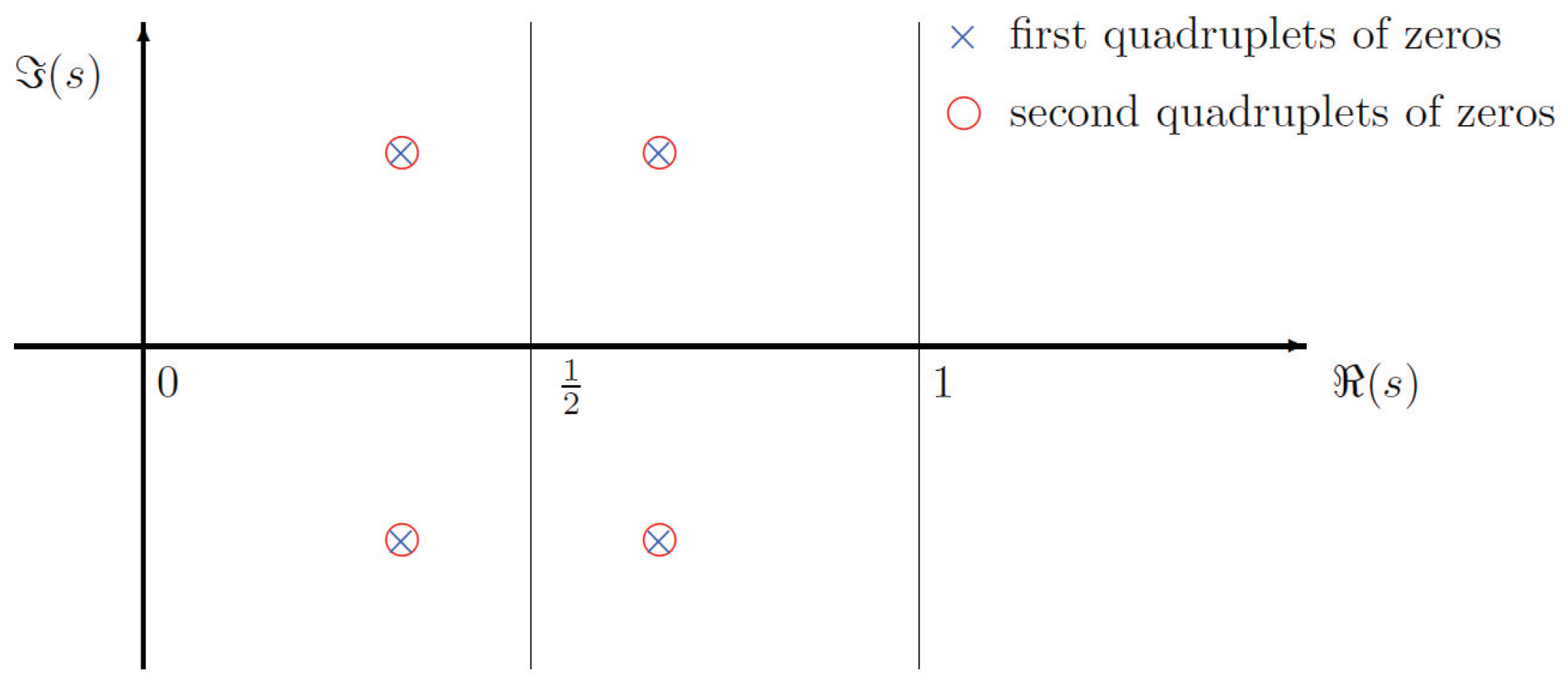
The Riemann Hypothesis (RH) is proved based on a new expression of the completed zeta function ξ(s), which was obtained through paring the conjugate zeros ρi and ρ ¯ i in the Hadamard product, with consideration of the multiplicities of zeros, i.e. ξ ( s ) = ξ ( 0 ) ∏ ρ ( 1 − s ρ ) = ξ ( 0 ) ∏ i = 1 ∞ ( 1 − s ρ i ) ( 1 − s ρ ¯ i ) = ξ ( 0 ) ∏ i = 1 ∞ ( β i 2 α i 2 + β i 2 + ( s − α i ) 2 α i 2 + β i 2 ) m i where ξ ( 0 ) = 1 2 , ρ i = α i + j β i and ρ ¯ i = α i − j β i are the complex conjugate zeros of ξ(s), 0 < αi < 1 and βi ≠ 0 are real numbers, mi ≥ 1 is the multiplicity of ρi, finite and unique (see Lemma 9 and Lemma 10), 0 < |β1 | ≤ |β2| ≤ ⋯. Then, according to the functional equation ξ(s) = ξ(1 − s), we have ∏ i = 1 ∞ ( 1 + ( s − α i ) 2 β i 2 ) m i = ∏ i = 1 ∞ ( 1 + ( 1 − s − α i ) 2 β i 2 ) m i Owing to the divisibility of the infinite product of polynomial factors and the uniqueness of mi , the above equation is equivalent to (see Lemma 3 for details) ( 1 + ( s − α i ) 2 β i 2 ) m i = ( 1 + ( 1 − s − α i ) 2 β i 2 ) m i , i = 1 , 2 , 3 , … , ∞ which is further equivalent to α i = 1 2 , 0 < | β 1 | < | β 2 | < | β 3 | < ⋯ , i = 1 , 2 , 3 , … , ∞ Thus we conclude that the RH is true.
Keywords:
1. Introduction
2. Preliminary Lemmas
3. A Proof of the RH
4. Conclusion
Funding
Data Availability Statement
Acknowledgments
Conflicts of Interest
References
- Riemann, B. (1859), Über die Anzahl der Primzahlen unter einer gegebenen Grösse. Monatsberichte der Deutschen Akademie der Wissenschaften zu Berlin, 2: 671-680.
- Bombieri E. (2000), Problems of the millennium: The Riemann Hypothesis, CLAY.
- Peter Sarnak (2004), Problems of the Millennium: The Riemann Hypothesis, CLAY.
- Hadamard, J. (1896), Sur la distribution des zeros de la fonction ζ(s) et ses conseequences arithmetiques, Bulletin de la Societe Mathematique de France, 14: 199-220, Reprinted in (Borwein et al. 2008). [CrossRef]
- de la Vallee-Poussin Ch. J. (1896), Recherches analytiques sur la theorie des nombers premiers, Ann. Soc. Sci. Bruxelles, 20: 183-256.
- Hardy G., H. (1914), Sur les Zeros de la Fonction ζ(s) de Riemann, C. R. Acad. Sci. Paris, 158: 1012-1014, JFM 45.0716.04 Reprinted in (Borwein et al. 2008).
- Hardy G. H., Littlewood J. E. (1921), The zeros of Riemann’s zeta-function on the critical line, Math. Z., 10 (3-4): 283-317.
- Tom, M. Apostol (1998), Introduction to Analytic Number Theory, New York: Springer.
- Pan C. D., Pan C. B.(2016), Basic Analytic Number Theory (In Chinese), 2nd Edition, Harbin Institute of Technology Press, Harbin, China.
- Reyes E. O. (2004), The Riemann zeta function, Master Thesis of California State University, San Bernardino, Theses Digitization Project. 2648. https://scholarworks.lib.csusb.edu/etd-project/2648.
- A. Selberg (1942), On the zeros of the zeta-function of Riemann, Der Kong. Norske Vidensk. Selsk. Forhand. 15: 59-62; also, Collected Papers, Springer- Verlag, Berlin - Heidelberg - New York 1989, Vol. I, 156-159.
- N. Levinson (1974), More than one-third of the zeros of the Riemann zeta function are on σ=12, Adv. Math. 13: 383-436.
- S. Lou and Q. Yao (1981), A lower bound for zeros of Riemann’s zeta function on the line σ=12, Acta Mathematica Sinica (in chinese), 24: 390-400.
- J. B. Conrey (1989), More than two fifths of the zeros of the Riemann zeta function are on the critical line, J. reine angew. Math. 399: 1-26. [CrossRef]
- H. M. Bui, J. B. H. M. Bui, J. B. Conrey and M. P. Young (2011), More than 41% of the zeros of the zeta function are on the critical line, http://arxiv.org/abs/1002.4127v2.
- Feng, S. (2012), Zeros of the Riemann zeta function on the critical line, Journal of Number Theory, 132(4): 511-542.
- Wu, X. (2019), The twisted mean square and critical zeros of Dirichlet L-functions. Mathematische Zeitschrift, 293: 825-865. [CrossRef]
- Siegel, C. L. (1932), Über Riemanns Nachlaß zur analytischen Zahlentheorie, Quellen Studien zur Geschichte der Math. Astron. Und Phys. Abt. B: Studien 2: 45-80, Reprinted in Gesammelte Abhandlungen, Vol. 1. Berlin: Springer-Verlag, 1966.
- Gram, J. P. (1903), Note sur les zéros de la fonction ζ(s) de Riemann, Acta Mathematica, 27: 289-304.
- Titchmarsh E., C. (1935), The Zeros of the Riemann Zeta-Function, Proceedings of the Royal Society of London. Series A, Mathematical and Physical Sciences, The Royal Society, 151 (873): 234-255.
- Titchmarsh E., C. (1936), The Zeros of the Riemann Zeta-Function, Proceedings of the Royal Society of London. Series A, Mathematical and Physical Sciences, The Royal Society, 157 (891): 261-263. [CrossRef]
- Hadamard, J. (1893), Étude sur les propriétés des fonctions entières et en particulier d’une fonction considérée par Riemann. Journal de mathématiques pures et appliquées, 9: 171-216.
- Karatsuba A. A., Nathanson M. B. (1993), Basic Analytic Number Theory, Springer, Berlin, Heidelberg.
- Kenneth Hoffman, Ray Kunze (1971), Linear Algebra (second edition), Prentice-Hall, Inc., Englewood Cliffs, New Jersey.
- Linda Gilbert, Jimmie Gilbert (2009), Elements of Modern Algebra (seventh edition), Cengage Learning, Belmont, CA.
- Henry, C. Pinkham (2015), Linear Algebra, Springer.
- H. S. Wilf (1994), Generating functionology, Academic Press, New York.
- C. D. Godsil (1993), Algebraic Combinatorics, Chapman and Hall, New York.
Disclaimer/Publisher’s Note: The statements, opinions and data contained in all publications are solely those of the individual author(s) and contributor(s) and not of MDPI and/or the editor(s). MDPI and/or the editor(s) disclaim responsibility for any injury to people or property resulting from any ideas, methods, instructions or products referred to in the content. |
© 2024 by the authors. Licensee MDPI, Basel, Switzerland. This article is an open access article distributed under the terms and conditions of the Creative Commons Attribution (CC BY) license (http://creativecommons.org/licenses/by/4.0/).