

Submitted:
19 December 2020
Posted:
21 December 2020
You are already at the latest version
Abstract
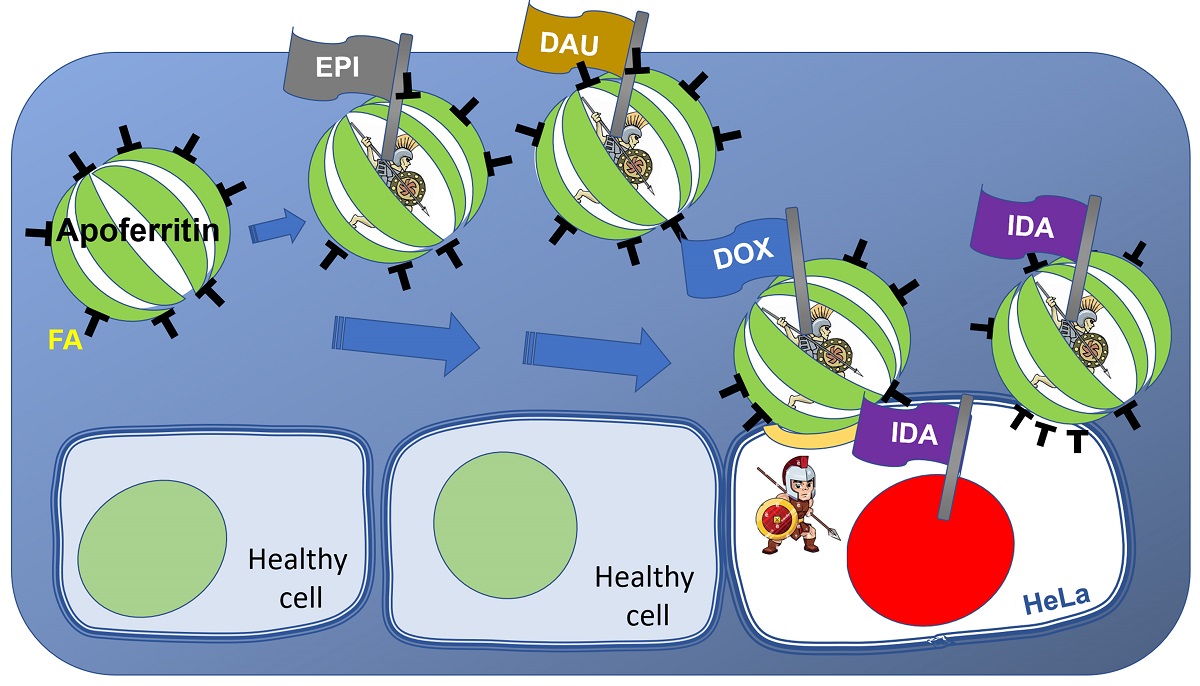
The interactions of chemotherapeutic drugs with nanocage protein apoferritin (APO) are the key features in the effective encapsulation and release of highly toxic drugs in APO-based controlled drug delivery systems. The encapsulation enables mitigating the drugs side effects, collateral damage to healthy cells, and adverse immune reactions. Herein, the interactions of anthracycline drugs with APO were studied to assess the effect of drug lipophilicity on their encapsulation excess n and in vitro activity. Anthracycline drugs, including doxorubicin (DOX), epirubicin (EPI), daunorubicin (DAU), and idarubicin (IDA), with lipophilicity P from 0.8 to 15, were investigated. We have found that in addition to hydrogen-bonded supramolecular ensemble formation with n = 24, there are two other competing contributions that enable increasing n under strong polar interactions (APO(DOX)) or under strong hydrophobic interactions (APO(IDA) of the highest efficacy). The encapsulation/release processes were investigated using UV-Vis, fluorescence, circular dichroism, and FTIR spectroscopies. In vitro cytotoxicity/growth inhibition tests and flow cytometry corroborate high apoptotic activity of APO(drugs) against targeted MDA-MB-231 adenocarcinoma and HeLa cancer cells, and low activity against non-tumorigenic MCF10A cells, demonstrating targeting ability of nanodrugs. A model for molecular interactions between anthracyclines and APO nanocarriers was developed, and the relationships derived compared with experimental results.
Keywords:
apoferritin nanocarriers
; controlled drug delivery
; idarubicin
; ferritin receptor targeting
; folate receptor targeting
Copyright: This open access article is published under a Creative Commons CC BY 4.0 license, which permit the free download, distribution, and reuse, provided that the author and preprint are cited in any reuse.


