

Submitted:
26 November 2020
Posted:
27 November 2020
You are already at the latest version
Abstract
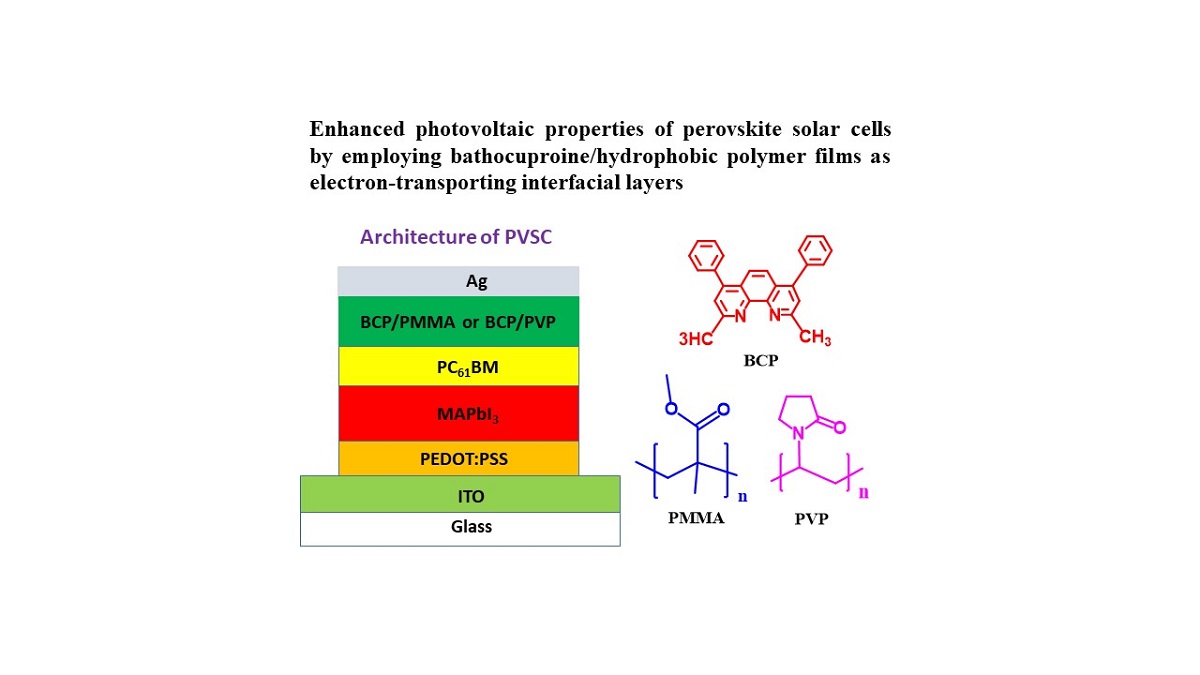
In this study, we improved the photovoltaic (PV) properties and storage stabilities of inverted perovskite solar cells (PVSCs) based on methylammonium lead iodide (MAPbI3) by employing bathocuproine (BCP)/poly(methyl methacrylate) (PMMA) and BCP/polyvinylpyrrolidone (PVP) as hole-blocking and electron-transporting interfacial layers. The architecture of the PVSCs was indium tin oxide/poly(3,4-ethylenedioxythiophene):polystyrenesulfonate/MAPbI3/[6,6]-phenyl-C61-butyric acid methyl ester/BCP:PMMA or BCP:PVP/Ag. The presence of PMMA and PVP affected the morphological stability of the BCP and MAPbI3 layers. The storage-stability of the BCP/PMMA-based PVSCs was enhanced significantly relative to that of the corresponding unmodified BCP-based PVSC. Moreover, the PV performance of the BCP/PVP-based PVSCs was enhanced when compared with that of the unmodified BCP-based PVSC. Thus, incorporating hydrophobic polymers into BCP-based hole-blocking/electron-transporting interfacial layers can improve the PV performance and storage stability of PVSCs.
Keywords:
bathocuproine
; methylammonium lead iodide
; electron-transporting interfacial layer
; perovskite solar cells.
Copyright: This open access article is published under a Creative Commons CC BY 4.0 license, which permit the free download, distribution, and reuse, provided that the author and preprint are cited in any reuse.


