

Submitted:
21 July 2020
Posted:
22 July 2020
You are already at the latest version
Abstract
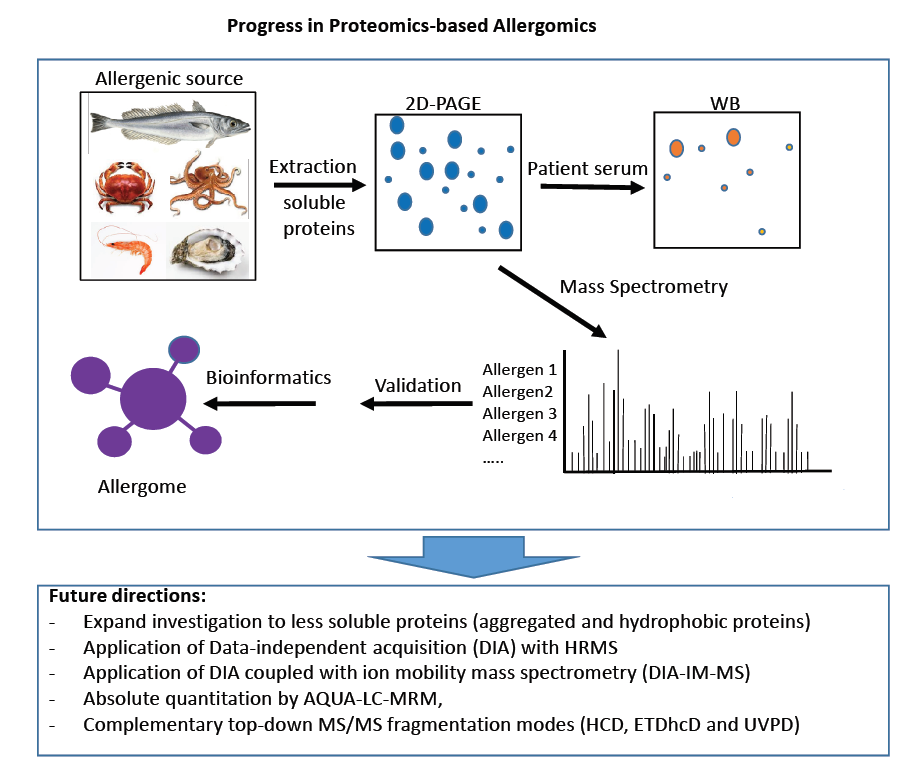
Seafood is considered one of the main food allergen sources by the European Food Safety Authority (EFSA). It comprises several distinct groups of edible aquatic animals including fish and shellfish such as crustacean and mollusks. Recently the EFSA recognized the high risk of food allergy over the world and established the necessity of developing new methodologies for its control. Consequently, accurate, sensitive and fast detection methods for seafood allergy control and detection in food products are highly recommendable. In this work, we present a comprehensive review of the applications of the proteomics methodologies for the detection and quantification of seafood allergens. For that, two consecutive proteomics strategies (Discovery and Targeted Proteomics) applied for the study and control of seafood allergy are reviewed in detail. In addition, future directions and new perspectives were also provided.
Keywords:
discovery proteomics
; targeted proteomics
; mass spectrometry
; fish allergens
; crustacean allergens
; mollusk allergens
Copyright: This open access article is published under a Creative Commons CC BY 4.0 license, which permit the free download, distribution, and reuse, provided that the author and preprint are cited in any reuse.