
Submitted:
13 July 2020
Posted:
14 July 2020
You are already at the latest version
Abstract
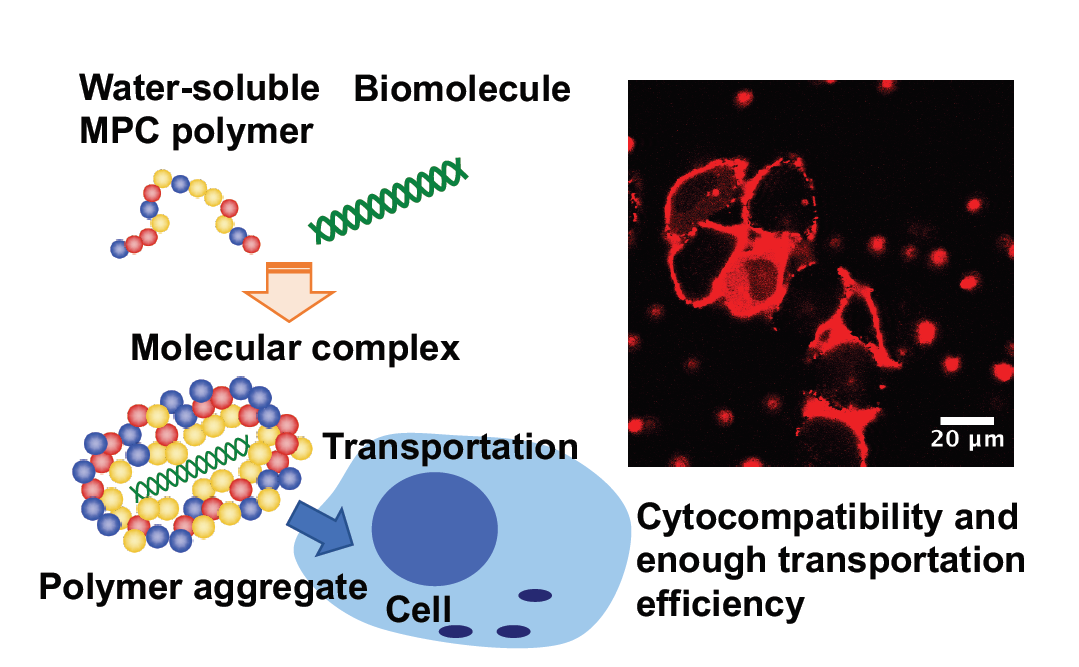
Water-soluble and cytocompatible polymers were investigated to enhance a transporting efficiency of biomolecules into cells in vitro. The polymers composed of 2-methacryloyloxyethyl phosphorylcholine (MPC) unit, a hydrophobic monomer unit, and a cationic monomer unit bearing an amino group were synthesized for complexation with model biomolecules, siRNA. The cationic MPC polymer was shown to interact with both siRNA and the cell membrane and was successively transported siRNA into cells. When introducing 20 − 50 mol% hydrophobic units into the cationic MPC polymer, transport of siRNA into cells. The MPC units (10 − 20 mol%) in the cationic MPC polymer were able to impart cytocompatibility, while maintaining interaction with siRNA and the cell membrane. The level of gene suppression of the siRNA/MPC polymer complex was evaluated in vitro and it was as the same level as that of a conventional siRNA transfection reagent, whereas its cytotoxicity was significantly lower. We concluded that these cytocompatible MPC polymers may be promising complexation reagent for introducing biomolecules into cells, with the potential to contribute to future fields of biotechnology, such as in vitro evaluation of gene functionality, and the production of engineered cells with biological functions.
Keywords:
2-methacryloyloxyethyl phosphorylcholine polymer
; amphiphilic nature
; cationic group
; polymer aggregate
; endocytosis
Copyright: This open access article is published under a Creative Commons CC BY 4.0 license, which permit the free download, distribution, and reuse, provided that the author and preprint are cited in any reuse.


