

Submitted:
08 November 2018
Posted:
09 November 2018
You are already at the latest version
Abstract
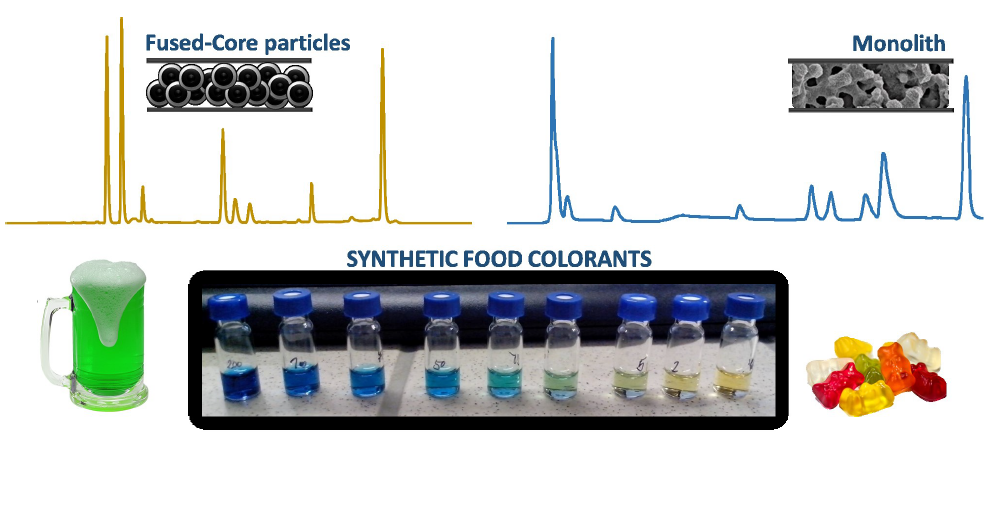
Food analysis demands fast methods for routine control and high throughput of samples. Chromatographic separation enables simultaneous determination of numerous compounds in complex matrices, several approaches increasing separation efficiency and speed of analysis were involved. In this work, modern types of column with monolithic rod or superficially porous particles were employed and compared for determination of eight synthetic food dyes, their chromatographic performance was evaluated. During method optimization, cyano stationary phase Chromolith Performance CN 100 × 4.6 mm and Ascentis Express ES-CN 100 × 4.6 mm, 5 µm were selected for the separation of polar colorants. The separation was performed by gradient elution of acetonitrile/methanol and 2% water solution of ammonium acetate at flow rate 2.0 ml min-1. Mobile phase composition and the gradients were optimized in order to enable efficient separation on both columns. The method using fused-core particle column provided higher separation efficiency, narrow peaks of analytes resulted in increased peak capacity and shortening of analysis time. After the validation, the method was applied for analysis of colored beers, soft drinks and candies.
Keywords:
monolithic column
; porous shell column
; food additive
; dye
; food colorant
; chromatography
; fast chromatography
Copyright: This open access article is published under a Creative Commons CC BY 4.0 license, which permit the free download, distribution, and reuse, provided that the author and preprint are cited in any reuse.