

Submitted:
21 September 2018
Posted:
22 September 2018
You are already at the latest version
Abstract
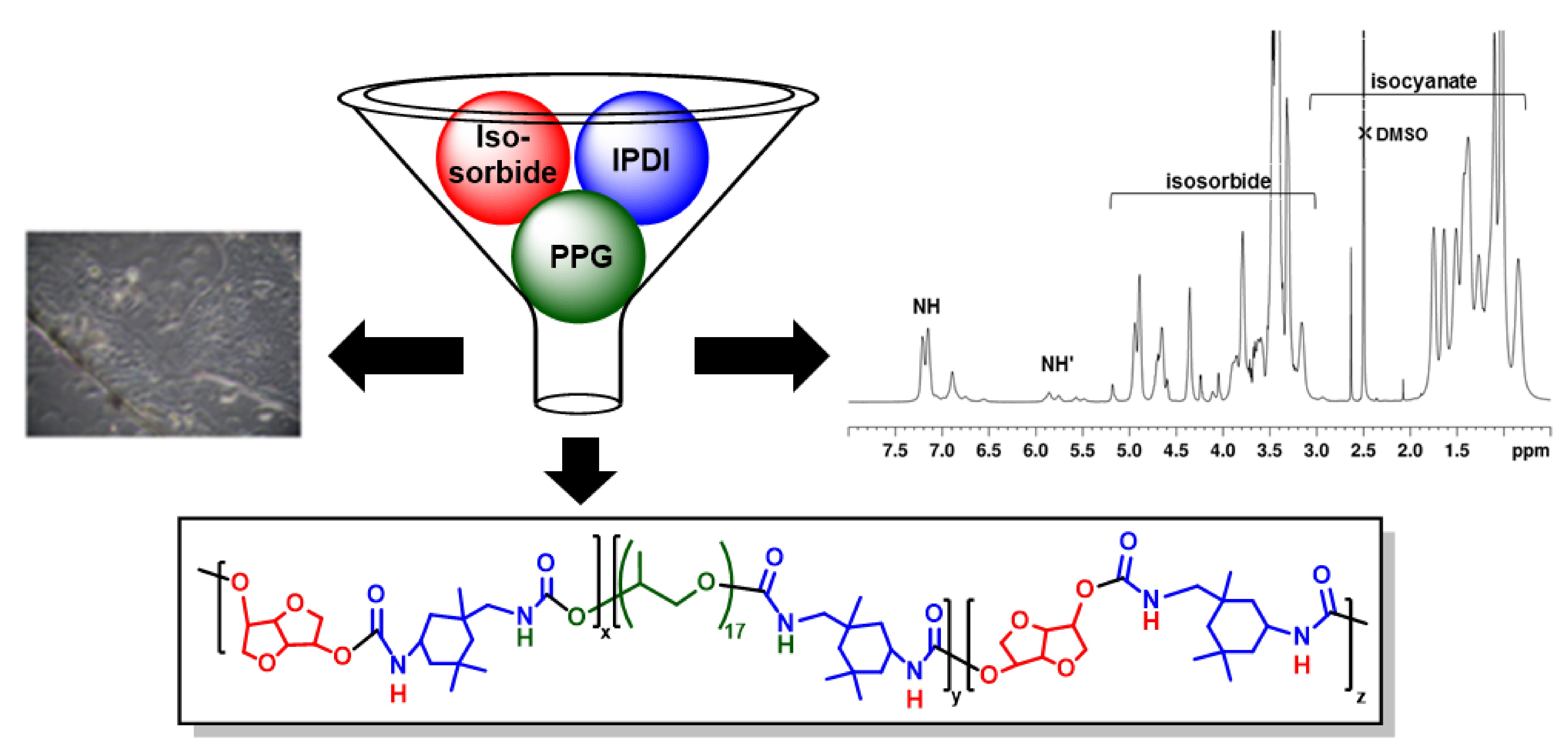
The synthesis of four samples of new polyurethanes was evaluated by changing the ratio of the diol monomers used, poly(propylene glycol) (PPG) and D-isosorbide, in the presence of aliphatic isocyanates such as the isophorone diisocyanate (IPDI) and 4,4′-methylenebis(cyclohexyl isocyanate) (HMDI). The thermal properties of the four polymers obtained were determined by DSC, exhibiting Tg values in the range 55-70 ºC, and their molecular structure characterized by FTIR, 1H and 13C NMR spectroscopies. The diffusion coefficients of these polymers in solution were measured by the Pulse Gradient Spin Echo (PGSE) NMR method, enabling the calculation of the corresponding hydrodynamic radii in diluted solution (1.62–2.65 nm). The molecular weights were determined by GPC/SEC and compared with the values determined by quantitative 13C NMR analysis. Finally, the biocompatibility of the polyurethanes was assessed using the HaCaT keratinocyte cell line by the MTT reduction assay method showing values superior to 70% cell viability.
Keywords:
biocompatibility
; GPC/SEC
; keratinocyte cells
; NMR
; polyurethane
; renewable sources
Copyright: This open access article is published under a Creative Commons CC BY 4.0 license, which permit the free download, distribution, and reuse, provided that the author and preprint are cited in any reuse.


