

Submitted:
14 July 2018
Posted:
14 July 2018
You are already at the latest version
Abstract
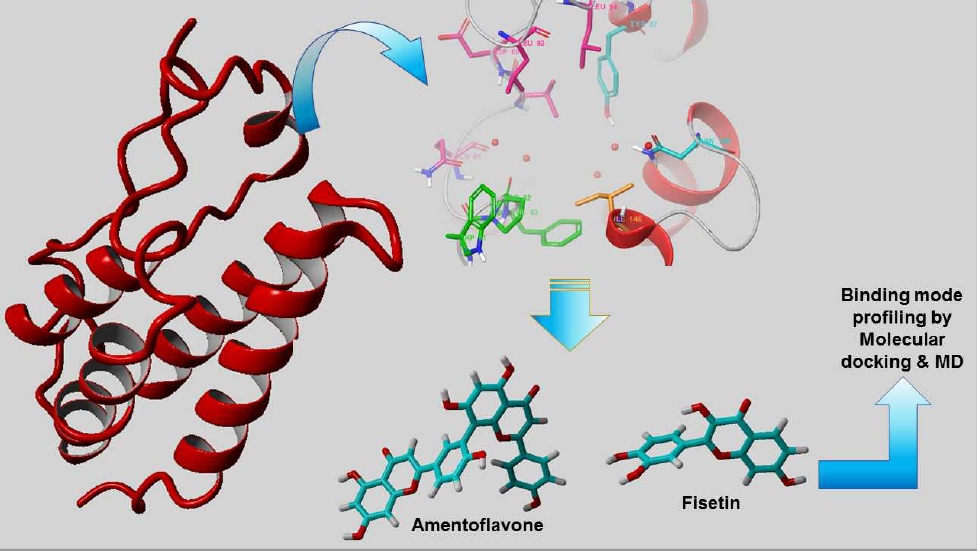
Flavonoids are widely recognized as natural polydrugs, given their anti-inflammatory, antioxidant, sedative and antineoplastic activities. Recently, different studies have shown that flavonoid have the potential to inhibit BET bromodomains. Previous reports suggest that flavonoids are putative inhibitors of the ZA channel due to their orientation and interactions with P86, V87, L92, L94 and N140. Herein, a comprehensive characterization of the binding mode of the biflavonoid amentoflavone and fisetin is discussed. To this end, both compounds were docked with BRD4 using four docking programs. Results were post-processed with protein-ligand interaction fingerprints. To gain further insights into the binding mode of the two natural products, docking results were further analyzed with molecular dynamics. Results showed that amentoflavone makes numerous contacts in the ZA channel, as previously described for flavonoids and kinase inhibitors. It was also found that amentoflavone can potentially make contacts with non-canonical residues for BET inhibition. Most of these contacts were not observed with fisetin. Based on these results, amentoflavone was tested for BRD4 inhibition, showing activity in the micromolar range. This work may serve as basis for scaffold optimization and further characterization of flavonoids as BET inhibitors.
Keywords:
docking
; epigenetics
; epi-informatics
; molecular interactions
; molecular dynamics
; natural products
; flavonoids
Copyright: This open access article is published under a Creative Commons CC BY 4.0 license, which permit the free download, distribution, and reuse, provided that the author and preprint are cited in any reuse.