
Submitted:
23 June 2018
Posted:
25 June 2018
You are already at the latest version
Abstract
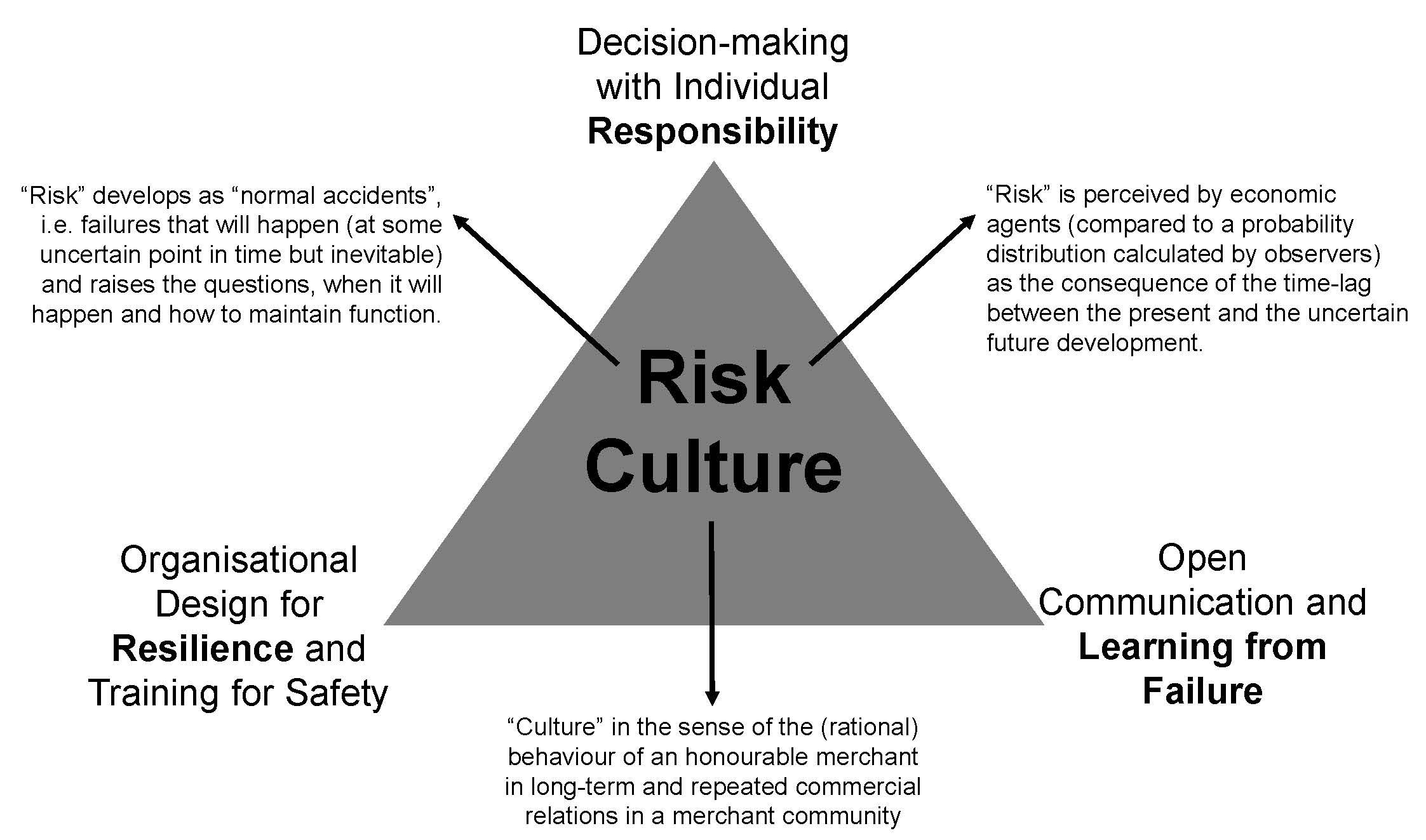
The current discussion about a “risk culture” in financial services was triggered by the recent series of crisis (from the US subprime mortgage crisis to the lock-in trap of central banks in the aftermath of the sovereign debt crisis). The last decade saw a long list of hybris, misconduct and criminal activities by human beings on a single or even a collective basis in banks, in the industry or in the whole economy. As a counter-reaction, financial authorities called for a guidance by a “new” risk culture in financial institutions based on a set of abstract, formal and normative governance processes. In the humanities, culture is a paraphrase for the behaviour in collectives and dynamics of organization found in human societies. Therefore, a “risk culture” should be a link between those normative guidelines and the positive “real-world” decision-making in financial services. This paper will focus on “risk culture” from the perspective of human beings interacting in dynamical and intertemporal commercial relations. In this context, “risk” is perceived by economic agents ex-ante as the consequence of the time-lag between the present and the uncertain future development (compared to a probability distribution calculated by observers ex-post). For all those individual decisions – to be made under uncertainty – future “risk” includes the so-called “normal accidents”, i.e. failures that will happen at some uncertain point in time but inevitable, and it is only the questions, when failure will happen and how to maintain function in the first line of defence. Finally, the sum of all decisions with individual responsibility for things to come is the positive economical context of a “risk culture” in the sense of the (rational) behaviour of an honourable merchant in long-term and repeated commercial relations in a merchant community, as this is a heritage of European business culture.
Keywords:
risk culture
; honourable merchant
; decision-making
; responsibility
Copyright: This open access article is published under a Creative Commons CC BY 4.0 license, which permit the free download, distribution, and reuse, provided that the author and preprint are cited in any reuse.


