

Submitted:
31 October 2017
Posted:
31 October 2017
You are already at the latest version
Abstract
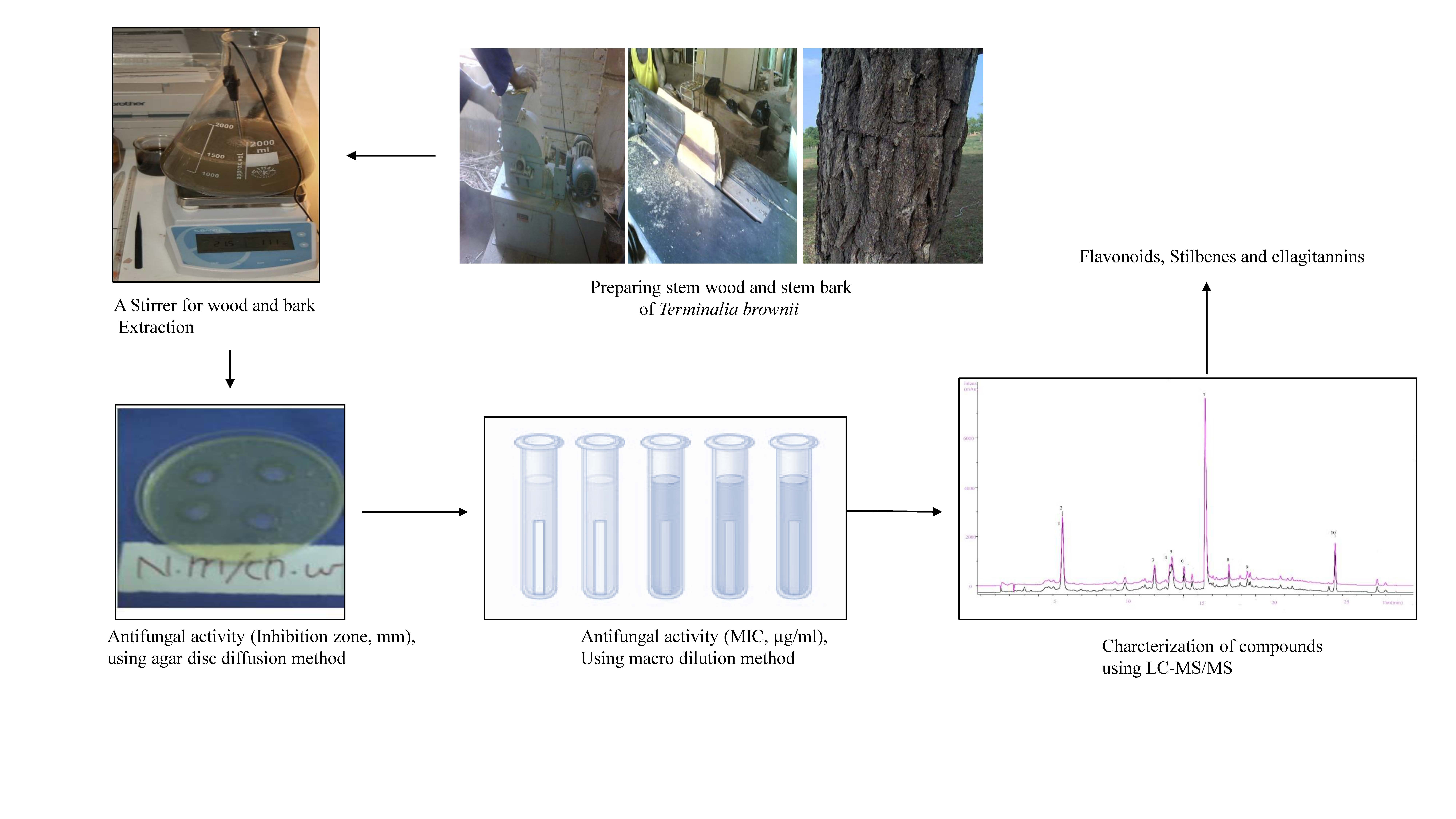
Decoctions, macerations and fumigations of the stem bark and wood of Terminalia brownii Fresen. are used in traditional medicine for fungal infections and as pesticides on field crops and in traditional granaries in Sudan. In addition, T. brownii is commonly used for protecting wooden houses and furniture. Therefore, using agar disc diffusion and macrodilution methods, eight extracts of various polarities from the stem wood and bark were screened for their growth inhibitory effects against filamentous fungi commonly causing fruit, vegetable and grain decay, as well as infections in the immunocompromised host. Ethyl acetate extracts of the stem wood and bark gave the best antifungal activities, with MIC values of 250 µg/ml against Nattrassia mangiferae and Fusarium verticillioides, and 500 µg/ml against Aspergillus niger and Aspergillus flavus. Aqueous extracts gave almost as potent effects as the ethyl acetate extracts against the Aspergillus and Fusarium strains, and were slightly more active than the ethyl acetate extracts against Nattrassia mangiferae. Thin layer chromatography, RP-HPLC-DAD and tandem mass spectrometry (LC-MS/MS), were employed to identify the chemical constituents in the ethyl acetate fractions of the stem bark and wood. The stem bark and wood were found to have a similar qualitative composition of polyphenols and triterpenoids, but differed quantitatively from each other. The stilbene derivatives, cis- (3) and trans- (4) resveratrol-3-O-β-galloylglucoside, were identified for the first time in T. brownii. Moreover, methyl-(S)-flavogallonate (5), quercetin-7-β-O-di-glucoside (8), quercetin-7-O-galloyl-glucoside (10), naringenin-4`-methoxy-7-pyranoside (7), 5,6-dihydroxy-3`,4`,7-tri-methoxy flavone (12), gallagic acid dilactone (terminalin) (6), a corilagin derivative (9) and two oleanane type triterpenoids (1) and (2) were characterized. Our results justify the traditional uses of macerations and decoctions of T. brownii stem wood and bark for crop and wood protection and demonstrate that standardized extracts could have uses for the eco-friendly control of plant pathogenic fungi in African agroforestry systems. Likewise, our results justify the traditional uses of these preparations for the treatment of skin infections caused by filamentous fungi.
Keywords:
Africa
; Terminalia brownii
; antifungal extracts
; Aspergillus
; Nattrassia
; Fusarium
; triterpenoids
; flavonoids
; ellagitannins
; stilbenes
Copyright: This open access article is published under a Creative Commons CC BY 4.0 license, which permit the free download, distribution, and reuse, provided that the author and preprint are cited in any reuse.


